HAL Id: halshs-01735025
https://halshs.archives-ouvertes.fr/halshs-01735025
Preprint submitted on 15 Mar 2018HAL is a multi-disciplinary open access archive for the deposit and dissemination of sci-entific research documents, whether they are pub-lished or not. The documents may come from teaching and research institutions in France or abroad, or from public or private research centers.
L’archive ouverte pluridisciplinaire HAL, est destinée au dépôt et à la diffusion de documents scientifiques de niveau recherche, publiés ou non, émanant des établissements d’enseignement et de recherche français ou étrangers, des laboratoires publics ou privés.
The Speed of Justice
Florence Kondylis, Mattea Stein
To cite this version:
WORKING PAPER N° 2018 – 13
The Speed of Justice
Florence Kondylis
Mattea Stein
JEL Codes: K41, D73, O12
Keywords: Legal procedure, Civil law, Bureaucracy, Economic development,
Firms
P
ARIS-
JOURDANS
CIENCESE
CONOMIQUES48, BD JOURDAN – E.N.S. – 75014 PARIS TÉL. : 33(0) 1 80 52 16 00=
www.pse.ens.fr
CENTRE NATIONAL DE LA RECHERCHE SCIENTIFIQUE – ECOLE DES HAUTES ETUDES EN SCIENCES SOCIALES
ÉCOLE DES PONTS PARISTECH – ECOLE NORMALE SUPÉRIEURE
1
The Speed of Justice
Florence Kondylis and Mattea Stein
March 2018
Abstract
Can changing the rules of the game affect government performance? We study the impact of a simple procedural reform on efficiency and quality of adjudication in Senegal. The reform gave judges the duty and powers to conclude pre-trial proceedings within a four-month deadline. We combine a staggered rollout across the six civil and commercial chambers of the court of Dakar and three years of high-frequency caseload data to construct an event study. We find a reduction in procedural formalism, as the length of the pre-trial stage decreases by 42.9 days (0.29 SD) and the number of case-level pre-trial hearings is reduced, while judges are more likely to impose deadlines. The effect is similar for small and large cases, while fast and slow judges are equally likely to apply the reform. The evidence suggests that these efficiency gains have no adverse impact on quality, while we document positive firm-level effects.
Keywords: Legal procedure, Civil law, Bureaucracy, Economic development, Firms JEL Classification: K41, D73, O12
Florence Kondylis, Development Economics Research Group, World Bank: [email protected]; Mattea Stein, Paris School of Economics and EHESS: [email protected]. We thank Molly Offer-Westort, Violaine Pierre, Pape Lo, Felicité Gomis and Chloe Fernandez for superb management of all court-level data entry and extraction. We are grateful to the Ministry of Justice of Senegal and staff from the Economic Governance Project for their leadership in this work. We are indebted to Presidents Ly Ndiaye and Lamotte of the Court of Dakar and their staff for making all court data available to us, trusting our team throughout the process, and guiding us through the maze of the legal procedure. We benefited from advice from high-level magistrates throughout the process, especially from Mandiogou Ndiaye, Souleymane Teliko, and Klaus Decker. The tax administration data would not be available to us without support from the WWID team at PSE, in particular Bassirou Sarr, and the leadership of Bassirou Niasse at the DGID. We also thank George Akerlof, Kaushik Basu, Denis Cogneau, Jishnu Das, Pascaline Dupas, Fred Finan, Marco Gonzalez-Navarro, Sylvie Lambert, Arianna Legovini, John Loeser, Karen Macours, Marco Manacorda, Thomas Piketty, Caio Piza, Simon Quinn, Anne-Sophie Robilliard, Dan Rogger, Tavneet Suri, Oliver Vanden Eyden, Christopher Woodruff, and Guo Xu, for their insights at various stages of the project, as well as seminar participants at Duke University, the Paris School of Economics, University of Washington, the EU-JRC in Ispra, Paris Nanterre, the World Bank, and numerous conferences. This research benefited from generous funding from the EHESS Paris, KCP, RSB, the Senegal office of the World Bank, and the i2i fund, and would not have been possible without support from DIME. Edina Mwangi, Romaric Sodjahin, and Cyprien Batut provided excellent research assistance. All usual disclaimers apply, particularly that the views expressed in this paper do not engage the views of the World Bank and its members.
2 I. Introduction
Stronger public governance is linked to faster economic development (Pande and Udry, 2005). Yet, the scope for policy changes to affect government efficiency is not clear, as there is limited evidence causally relating public sector reform to civil servants’ performance (Finan, Olken and Pande, 2017).
To the extent that they administer the law, courts are an epicenter of good governance. As their performance affects transaction costs in enforcing contracts and capturing gains from trade, courts play a direct role in strengthening institutions towards economic development (North, 1991). Cross-country evidence shows that legal efficiency, in the form of low
procedural formalism, is a strong correlate of economic development and higher market efficiency (Djankov et al., 2008; Alencar and Ponticelli, 2016). While legal origins account for much of cross-country variations in procedural formalism (La Porta et al., 2008), a
central policy question remains: what is the potential for reforms to improve de facto legal
efficiency?
Even as a literature has flourished that documents the impacts of court backlogs on economic outcomes, the evidence on the impact of legal reforms on improving court
efficiency is scant (Chemin, 2009b). Most legal reforms are rolled out non-randomly across courts, chambers, judges or cases. Coupled with aggregate, annual data, the evidence linking reforms with higher legal efficiency and firm-level investment falls short of
establishing causality (Aboal et al., 2014). Perhaps more problematic, the quality tradeoffs and welfare implications of speeding up adjudication have not, to this day, been empirically investigated.
3
To address these gaps in the literature, we document the causal impact of a legal reform on procedural formalism and quality of legal decisions, and track their impacts on firms involved in the caseload. In 2013, Senegal’s Ministry of Justice introduced a decree aimed to increase the celerity of civil and commercial adjudications. The reform gave first-instance judges the responsibility and administrative powers to meet a procedural deadline during the pre-trial phase, which on average accounted for over two thirds of the total duration of a case. As such, the reform explicitly aimed to curb procedural formalism, which is
characteristic of the civil law system that operates in Senegal (Djankov et al., 2003). The
present study captures the impact of a marginal reduction in de jure procedural formalism
on de facto legal efficiency, building causal evidence on the role of legal reforms in strengthening institutions.
Can changing the rules of the game affect government performance? Are there efficiency-quality tradeoffs? Can we capture their impact on users of public services? We bring four central elements of answer to these questions in the context of the civil and commercial court of Dakar, Senegal. First, we provide causal estimates of the impact of a judicial reform. We combine within-court variations in coverage and high-frequency case data to construct an event study around a change in legal procedure. Our data innovate on the existing literature as court-level studies tend to be circumscribed to richer economies
(Chang and Schoar, 2006) and have limited case-level data.1 We construct a high-frequency
dataset of 5297 civil and commercial cases that entered the Regional First Instance Court of Dakar between 2012 and early 2015. We exploit a staggered administrative rollout across
1 The court data typically used lack details on the procedure beyond duration (Alencar and Ponticelli, 2016;
Chemin, 2009a&b; Coviello et al., 2015; Lichand and Soares, 2014). Chemin (2009a) uses yearly court-level data to identify the impact of a legal reform in Pakistan, exploiting district-level variations in coverage. Alencar and Ponticelli (2016) exploit yearly data on duration of court proceedings (divided by number of judges) to isolate the role of court efficiency on the impacts of a bankruptcy reform in Brazil.
4
six chambers of the court to construct an event study. We use tax administration data to document that effects are not driven by a change in the type of firms involved in court cases.
Second, we bring new evidence on the mechanisms linking individual behavior and efficiency gains in the context of a large public bureaucracy. The granularity of our court data allows us to retrace, for each case, the full legal procedure and construct case-level markers of procedural formalism traditionally used in the literature (duration, number of steps in the procedure at pre-trial and decision stages, number of overturned steps). We additionally collect data on the final judgments and appeals, providing measures of decision quality. Detailed hearing-level data allow us to measure the steps taken by judges to avoid dilatory actions by the parties.
Third, we formally document the impact of deadlines on judges’ behavior. Delays in court may result from strategic behavior on the judges’ part, whereby additional procedural time yields more precise evidence or higher likelihood to extract rents. Alternatively, they may just be a manifestation of irrational procrastination (Akerlof 1991) or collective action problems among judges. The reform we study shares some features of the deadline experiment proposed by Chetty et al. (2014) in which they manipulate the delays under which journal referees are asked to complete their review. An important difference in our set-up is that judges are not explicitly reminded of the deadline at any point—hence, not “nudged” into action close to the deadline. Instead, our results come from the introduction of a default delay within which judges are expected to complete their pre-trial hearings. The need to understand the tradeoffs associated with changes in bureaucrats’ incentives is particularly salient in complex, multi-tasking environments where civil servants have
5
substantial authority and independence (Holmstrom and Milgrom 1983; Finan, Olken and Pande 2017). Judges routinely perform a variety of complex tasks, switching from pre-trial activities (public hearings), to decision-stage activities (review of cases, collegiate meetings, and public hearings), as well as a variety of professional services to the court. While fixing deadline on pre-trial proceedings may increase throughput in this phase of the trial, it may reduce judges’ attention in the deliberations phase. For instance, judges may face
bandwidth problems and exhibit “tunnel vision” (Mullainathan and Shafir 2013). Another concern is that judges may become overzealous in meeting the new deadline, affecting quality of the evidence and, therefore, of the overall procedure. The granularity of our data allows us to test for these effects.
Finally, we bring some evidence on the effect of delays on firm-level outcomes. Akin to the Autor et al. (2015) result that longer administrative processing times reduce future
employment and earnings outcomes of government disability insurance applicants, we hypothesize that firms that have lengthy procedures may face worse outcomes, all else equal, than firms that face shorter legal delays. We survey these firms and collect data on their perceptions of the justice system, and elicit their stated preferences for a faster adjudication.
We find the reform significantly reduced procedural formalism with no adverse effect on the quality of legal decisions. We find a large reduction in the length of the pre-trial stage of 42.9 days (0.29 SD), as judges are 47.4% more likely to apply the four-month deadline (an increase of 23.1 pp. from a baseline of 48.7%). We show that this effect is attributable to an
increase in the decisiveness of each hearing, as the number of desk-rejected and
fast-tracked cases increases (by 16.9 and 9.1 pp., respectively), case-level pre-trial hearings are reduced (0.24 SD), while judges are 48% more likely to issue a strict deadline for an
6
adjournment. We find that smaller and larger litigations are equally affected the reform, while the decree is equally applied by originally faster and slower judges.
These gains in speed do not appear to come at the cost of quality, as captured along four dimensions. First, the quality of the pre-trial itself is not negatively affected, as the completeness of the evidence assembled remains unchanged. Second, we do not find evidence of judges’ effort displacement from decision to pre-trial stage across three measures: decision hearings are scheduled at the same speed, the overall number of decision hearings does not increase, and the quality of the decision does not appear to be affected by the reform. Third, the decree does not affect parties’ intentions to appeal court decisions. Finally, interviewing firms who used the court in our study period suggests positive welfare impacts of the decree, both in a stated preference approach and comparing firms’ perceptions across the decree cutoff.
The remainder of the paper is organized as follows. Section 2 provides some element of background on Senegal’s justice system and the legal civil and commercial procedure. Section 3 places the reform in the context of Senegal’s civil and commercial code of procedure. Section 4 describes the data. Section 5 presents a conceptual framework, and Section 6 the empirical strategy. Section 7 lays out our main empirical results, and Section 8 concludes.
II. Civil and commercial justice in Senegal
As most civil law countries, Senegal’s civil and commercial legal procedure is associated with a high degree of formalism and low legal efficiency (Djankov et al., 2003). Senegal ranked 166 out of 185 economies in the “contract enforcement” category of the 2013 Doing Business Report, suggesting a significant margin of improvement in the speed of
7
commercial dispute resolution (World Bank, 2013).2 The total dispute amount the Regional
First Instance Court of Dakar in Dakar adjudicates yearly is equivalent to 3-6% of
Senegal’s GDP. As this amount of capital is stuck in lengthy litigations, it is easy to infer that the direct economic cost of a slow justice is large (Barro, 1991; Mankiw, Romer, and Weil, 1992). We now detail the architecture of the court and legal procedure that make the context of our study.
In the Regional First Instance Court of Dakar, judges are organized in chambers, consisting
of a president and two additional judges (collegiality3). While the court adjudicates all types
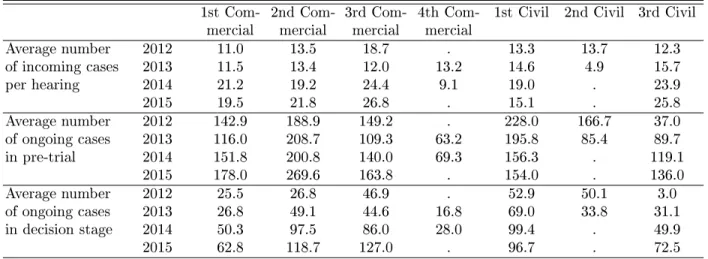
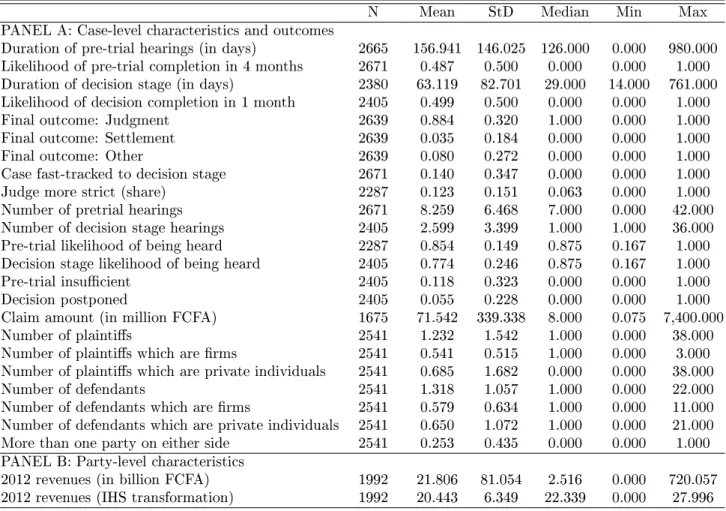
of affairs, we focus on civil and commercial justice. At the time of the reform that is at the center of our study, there were four commercial and two civil chambers in the tribunal of Dakar. Tables 1 and 2 describe the variations in caseload we have access to at the chamber and case levels, respectively.
Commercial and civil trial and judgment in the court consist of the following general steps:
distribution (répartition), pre-trial hearings (mise en état), decision hearings (délibération),
and judgment (jugement). In 2012, 1546 new civil and commercial cases were distributed.
This step consists in the assignment of the new caseload to the chambers by the president of the court; it is notionally based on existing caseload and the specialization of each chamber.
2 The Doing Business Report’s enforcing contracts indicator collects its data through a standardized case study
with a pre-defined claim value and very specific assumptions. Amongst such assumptions is that the case is disputed on the merits and that an expert is appointed. The Doing Business Report’s trial and judgment indicator includes pre-trial and decision proceedings, as well as the time to obtain a written judgment and the period within which any party can appeal the first instance decision. In 2014, the Doing Business Report indicated a 420 day duration for trial and judgement. Upon request from the Ministry of Finance of Senegal, and on the basis of the present analysis of Decree n°2013-1071 combined with its methodology, the Doing Business team adjusted this figure down to 390 days in the 2018 report (and adjusted the duration down retroactively going back to 2015).
3 In French, this is referred to as collégiale, collégialité. For lack of an equivalent legal term in the common law
8
In its assigned chamber, a case first goes through the pre-trial hearings during which the evidence is assembled and the arguments are developed by the parties. These are public hearings chaired by a pre-trial judge in which the parties submit supporting pieces, and may petition the judge to order expert reports. The pre-trial judge’s role is largely administrative. Once the pre-trial is complete, a case moves to the decision stage which consists in collegiate closed-door deliberations; the judgment is announced in a public decision hearing. Should the evidence presented in deliberations be insufficient, the judges can declare it so and send a case back to pre-trial. Alternatively, the decision may be postponed allowing the judges to perform further diligence.
Chambers follow a fixed schedule of hearings. Each chamber disposes of two dates per month on which hearings are scheduled. Each hearing opens with the assignment of the
incoming caseload to pre-trial judges, chaired by the president of the chamber.4 Next, each
pre-trial judge chairs her scheduled pre-trial hearings. For each case heard, the judge can either schedule an additional hearing at the request of one of the parties (adjournment), or close the pre-trial and move the case to the decision stage. If she feels the party asking for the adjournment is producing its evidence too sluggishly, or is otherwise unnecessarily
slowing down the procedure, she can issue a “strict” adjournment (“renvoi ferme” or “renvoi
ultime”). If the judge feels the party is still not doing its due diligence, she can move a case
to decision as is (“en l’état”). Finally, the president of a chamber chairs collegiate decision
hearings. On average, a chamber takes in 16.4 new cases at each hearing (bi-monthly),
ranging from 9.1 to 26.8 across chambers and years (Table 1; Figure 1).5
4 Hence, a case’s first hearing is systematically done collegiately, i.e., chaired by the president in presence of the
two pre-trial judges. Some cases have all their pre-trial hearings done collegiately.
5 At the beginning of the study period, in January 2012, there were 3 commercial and 2 civil chambers. Over the
January 2012 to July 2015 study period, one chamber opened (3rd civil) in 2012, one chamber closed (2nd civil) in
2013, and one chamber opened and closed again (4th commercial) in 2013 and 2014, respectively (Figure 1).
9
Commercial and civil disputes vary widely in their nature and complexity. Commercial cases include mostly payment and other contract disputes, including sale and rent contracts involving a moral person (firm). Similarly, civil cases include contract and payment
disputes between individuals (e.g., landlord and tenant), as well as other civil issues like inheritance disputes. 63% of civil and commercial disputes in our sample include a payment claim. Among these, the average claim amount is of FCFA 71,542,000 (or about USD
135,000), ranging from FCFA 75,000 to FCFA 7,400,000,000 (about USD 160 to USD 13,912,000; Table 2).
III. The 2013 reform of the pre-trial phase
The legal reform at the center of our study explicitly stipulated the goal of speeding up formal dispute resolution to attract investors and private equity funds (Ministère de la Justice, 2013). The decree n°2013-1071 was adopted by ministerial council on July 18, 2013 and published August 6, 2013. It modified the civil procedural code in two main ways: first, it set a four-month limit on the duration of the pre-trial procedure; and second, it assigned new powers to pre-trial judges. Before the application of the decree, only half of all cases completed the pre-trial procedure in four months or less (Table 2).
Second, judges were given more discretionary powers to control the speed of pre-trial phase. Specifically, the reform allowed judges to exert pressures on the parties to avoid dilatory actions, by managing additional expert reports and inquiries, and to desk-reject a case (irrecevabilité) in the very beginning of the pre-trial for blatantly insufficient evidence.6
redistributed across the tribunal by the court president. These changes in portfolio are uneven across chambers, due to a certain degree of specialization of each chamber (Table 1).
6 In the previous version of the code, pre-trial judges could not dismiss a case brought forward without sufficient
supporting evidence. Instead, such cases would undergo the pre-trial procedure for a duration not specified in the code, during which the supporting evidence would either materialize or fail to be assembled, going forward to the deliberations as is. An incomplete case sent to deliberations would either be sent back to pre-trial
10
We exploit two features of the decree application in our empirical analysis. First, the new deadline was not subject to formal sanctions, and judges retained much discretion in its application. This was for both practical and legal reasons. In practice, the court did not possess a case-management system to track adhesion to the decree at the case level. In legal terms, judges benefit from full independence in Senegal, making enforcement of procedural deadlines infeasible. This implies that we can apply a revealed preference framework to analyze variations in application of the decree across judge and case types. A second important feature of the decree was that the new instrument of desk rejection could only be used in the first pre-trial hearing, which implies that it could not be used for ongoing cases. Similarly, judges were not obligated to apply the new deadline to ongoing cases. We use this feature for our identification, as we define cases that enter after the decree as “treated”, while those that entered before serve as our comparison group in an event study setup. It is conceivable that a judge would try to meet the new deadline even for recently started ongoing cases, although without the desk-rejection instrument at hand. Alternatively, it is possible that, a few months down the road, a judge is unable to
distinguish between cases started just before and just after and enforces stricter deadlines for both. This may yield some fuzziness in effective decree application in a small window around the cutoff.
IV. Data
We measure the impact of the reform using two types of data: administrative caseload data, and tax administration and primary survey data on firms.
(declaring the evidence insufficient for a decision to be made collegiately), or the decision would be made on the incomplete evidence.
11 1. Caseload data
We digitize the records of the civil and commercial chambers of the Regional First Instance
Court of Dakar, Senegal, over the period January 2012 to June 2015.7 We record
hearing-level outcomes for each case across both pre-trial and decision phases, and enter
information on the minutes of the judgment. This thorough data capture yields case-level information on the full civil and commercial caseload over the 2012/15 study period. For each case, we record when it entered the court, when and to which chamber it was transferred for the trial procedure (first hearing), which judge presided over its pre-trial, the date and outcome of each pre-trial and decision stage hearing, the date and nature of the final decision, the text of the decision itself (judgment minutes), as well as scant case characteristics (civil or commercial, contested amount, number of parties on each side). Combining case and hearing records yields case-hearing-level data that retraces the whole first instance procedure for all cases entering the court over our study period. These data document which cases were heard in each hearing and the corresponding outcome of the hearing. Hearings are scheduled on a bi-monthly basis, on a chamber-specific schedule that is set every six months by the president of the court; this makes 21 hearings per chamber
per year.8 All judges must hold hearings at the dates set in their chamber’s schedule. Yet,
not all ongoing cases must be heard at every hearing, yielding variations in both length and intensity of the procedure across cases.
From these data, we construct our study sample allowing for all cases to reach adequate
7 Court data were only available in paper form at the onset of the project, as can be seen here and here.
8 A six-week summer break is established at the chamber level over the three-month period August-October, on
a rotating basis across chambers. All judges take leave during the period assigned to their respective chamber, and no hearings can be scheduled.
12
maturity within our data collection timeframe. Namely, we restrict our analysis to cases that entered the court no later than February 2015, thus allowing all cases four months’ time to complete the pre-trial stage. Hearing outcomes and final decisions are recorded until the end of June 2015. This yields an analysis sample of 5297 cases. For specifications where we exclude an adjustment period of three hearings on either side of the cutoff, we maintain an analysis sample of 4795 cases, of which 2671 are baseline cases. Decision stage outcomes only apply to cases that reach this stage, and we allow all cases in our sample one month to complete the decision stage. For this, we restrict the analysis of decision stage outcomes to cases finishing their pre-trial before June 2015. This yields a sample of 4214 cases documenting decision stage outcomes, or 3844 observations for specifications that exclude the adjustment period, of which 2405 are baseline cases.
Table 2 provides baseline summary statistics for the outcomes and characteristics of interest. Before the reform, an average case underwent 8.3 pre-trial hearings over a 156.9 day period. 48.7% of cases completed the pre-trial in four months or less, and 14% had no pre-trial and were fast-tracked to decision phase. Cases had on average 2.6 hearings over the duration of the decision-stage which lasted on average 63 days, while 49.9% of cases completed it in a month or less. While a case was ongoing in the pre-trial phase, there was a high likelihood it would be heard at any given scheduled hearing (85.4%), and judges
issued strict deadlines for only 12.3% of adjournments pre-reform (“judge more strict”). The
likelihood that a case was heard was somewhat lower in the decision phase (77.4%). The pre-trial was declared insufficient for 11.8% of cases and the decision postponed for 5.5% of cases.
Cases have on average 1.23 plaintiffs (of which 0.54 are firms and 0.69 are private
13
0.09 are public institutions). 25% of cases have more than one party involved on one or both sides of the dispute, an indicator of case difficulty. Among cases that include a payment claim, the average claim amount is FCFA 71.5 million, or about USD 135,000, and the median is FCFA 8 million, or about USD 14,500. We use above median claim amount as a second indicator of case difficulty.
2. Firm data
Ultimately, we are interested in documenting the impact of the reform on court users. The cases in our study sample involved a total of 5401 parties that are firms, or a total of 2154 different firms (i.e., 2.5 court appearances on average). First, we retrieve tax administration data on this sample of firms. We obtain a tax identifier for 82% of the parties that are firms, and 66% of distinct firms, which allows us to obtain baseline (2012) revenue data for 70% of the parties that are firms (3785 parties, of which 1991 are baseline), and 46% of distinct firms (993 firms). These are involved in a total of 2910 cases. We mainly use these data to perform robustness checks.
Second, we conduct a survey among firms involved in commercial disputes over our study period. We recover addresses and/or phone numbers in the Dakar region for 1709 out of these 2154 firms, through a combination of court records, name merging with a national registry of firms operating in Senegal which contains contact information fields (Répertoire National des Entreprises et Associations, RNEA), and searches in public address books and a web search engine. Out of the remaining 445 firms, 218 were located outside of the survey area (abroad or in a different region of Senegal) and for 227 no contact information could be
14
obtained. We located 812 of the firms that have some contact information,9 and completed
277 interviews. Conditional on being located, our response rate is 34%. These 277 firms correspond to a total of 925 parties that are firms; they were involved in 884 different cases. The field work took place between August 2016 and February 2017, and we interviewed the CEO, legal counsel or another suitable respondent, by order of preference. We survey a range of perceptions of the justice system, and record stated preferences for faster pre-trial proceedings.
V. Conceptual framework
How did this reform work to reduce pre-trial durations? One explanation is that the effect is
driven by all judges. This presumes that, pre-reform, all judges operate in a low equilibrium with a given accepted level of formalism and a tacit agreement on a reasonable duration. The reform then acts as a shifter, moving all judges to a higher equilibrium by changing their perception of the acceptable level of formalism, with a new (explicit) duration target below the previous (tacit) one. This straight-forward mechanism is what the reform’s initiators had in mind.
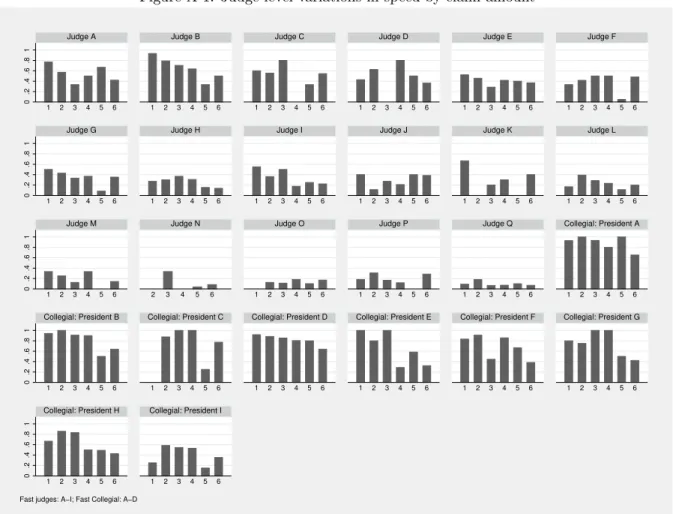
However, as the reform emphasizes one of several tasks a judge performs – presiding over the pre-trial –, and one of several performance measures – the speed of the pre-trial –, we have to consider effects through a changed incentive structure. In fact, before the reform, we observe that judge-level variations in pre-trial durations are not explained by observable case characteristics, as Figure A-1 illustrates. These variations could stem from individual variations in taste for private benefits: some judges, rather than following the tacit rule,
9 Another 133 were found not to exist anymore and the remaining 743 were not found with the available contact
15
may actively delay certain cases to derive a private benefit in the form of career recognition or a private rent (Banerjee et al. 2012). Alternatively, they could stem from individual inefficiencies, such as judges’ propensity to procrastinate or inability to assert authority towards the parties. Hence, if the reform acts on one of these margins, the average effect
may in fact be driven by a specific subset of judges rather than an overall shift for all
judges. To guide our empirical analysis, we now describe judges’ incentives and the pre-reform determinants of pre-trial duration.
1. Judge incentives
We adapt Bandiera et al. (2009) to our context. The judges’ objective function is: Ω𝑖𝑗𝑘 = −𝑑𝑖𝑗𝑘𝑡+ 𝛽𝑖𝑗𝑏𝑖𝑗𝑘
Where 𝑑𝑖𝑗𝑘𝑡 is the pre-trial duration of case 𝑘 handled by judge 𝑖 in chamber 𝑗 at entry time
𝑡. A judge has incentives to keep delays in check, for several reasons: longer pre-trials imply spending more time in pre-trial hearings; a judge may be intrinsically motivated to keep high levels of efficiency; or because large delays hurt her career prospects. The second term
allows for a judge to derive a private benefit, 𝑏𝑖𝑗𝑘, from delaying a case; 𝛽𝑖𝑗 reflects a judge’s
taste for deriving private benefits from delaying cases.
Private benefits may occur in the form of career recognition or rents. In our context, career concerns are particularly salient. Judges are career bureaucrats competing for promotion to
the higher levels of the judicature.10 As such, judges expend effort to convince their peers
10 The path to becoming a judge is competitive. Law students fiercely compete both to enter a training program
to become a judge and to graduate into a judge position. Subsequent promotions lead to sharp increases in their remuneration. In the first-instance court of Dakar, the president of the court rates judges on a scale of 0 to 20 and transmits her evaluation, including written feedback, to the High Judiciary Council, which makes a final
promotion recommendation. All promotions are contingent on seniority.Performance review processes are
16
and superiors of their talent and, possibly, extract other private benefits from their position (Dewatripont et al. 1999a&b).
Why might judges choose longer (rather than shorter) pre-trials out of career concerns? During pre-trial, a judge’s speed (throughput) is the main signal she can send to her management about her performance level. Yet, speed influences the ability of a judge to increase the precision of the evidence: longer pre-trials allow for more detailed evidence to
be assembled.11 During the decision stage, the quality of the judgment justification is the
main signal, and is a function of the precision of the evidence. Therefore, a judge’s optimal choice may be to strategically delay cases, in particular if pre-trial speed carries little or no importance in the performance assessment. This is likely true, as the judge’s role in the pre-trial hearings is purely administrative. Thus, strategic delays may yield higher payoff for larger or more complex cases, as these plausibly carry a stronger quality signal than simpler ones.
Hence, 𝑑𝑖𝑗𝑘𝑡 is a function of the private benefit 𝑏𝑖𝑗𝑘, of a shared bureaucratic inefficiency
parameter 𝜗𝑡, and of an individual bureaucratic inefficiency parameter 𝜇𝑖𝑗:
𝑑𝑖𝑗𝑘𝑡 = 𝑓(𝑏𝑖𝑗𝑘, 𝜗𝑡, 𝜇𝑖𝑗)
With 𝜕𝑓
𝜕𝑏≥ 0 – the larger the private benefit derived from a longer pre-trial for case 𝑘, the
longer the delay (provided 𝛽𝑖𝑗> 0); and
𝜕𝑓 𝜕𝜗𝑡> 0;
𝜕𝑓 𝜕𝜇𝑖𝑗> 0.
Delays that stem from bureaucratic inefficiencies do not benefit the judges; rather, they
11 In addition, incentives for active delays can come from bribe-seeking. However, our data does not allow us to
distinguish these from career concerns, as the implications are similar: a longer pre-trial can increases the probability and size of rent extraction from the parties. Private benefits in the form of bribes may be particularly important for larger, more complex cases.
17
come at a cost, as they multiply the number of hearings and, therefore, the time judges spend on each case. Bureaucratic inefficiencies can occur because of individual-level
inefficiencies (𝜇𝑖𝑗), such as a lower ability or a propensity to procrastinate, or due to shared
rules and norms from which judges either cannot legally deviate, or from which it is not
optimal to deviate individually (𝜗𝑡). These norms include the level of procedural formalism
that is considered acceptable, and the degree of freedom the parties are legally given in shaping the pre-trial. They also include any tacit norms that existed before the reform on
what constitutes a “reasonable” pre-trial duration.12
2. Reform impact
Did the reform mainly operate by lowering shared or individual-level delays? As outlined in the judge’s program, the reform may succeed in reducing pre-trial durations through a reduction in shared or individual inefficiency, or through a change in judges’ propensity to extract private benefits from delays. Since delays increase in all three parameters,
estimating the average effect of the reform will not be enough to separate these channels. Instead, we use detailed case-level data to document case- and judge-level dimensions of heterogeneity, shedding light on the channels through which the reform affects legal efficiency.
First, to determine whether the reform impacts operated through shared vs individual
12 A judge may not, on her own, reduce this cost. This may be because, legally, the parties can use certain
dilatory tactics; for example, before the reform, plaintiffs were legally allowed to bring incomplete cases to court, and judges had no powers to dissuade this behavior. Or it may be because any judge who unilaterally deviates from a tacit rule on pre-trial duration, will see herself assigned a larger number of new cases, nullifying utility gains from speedier pre-trials (the number of ongoing cases is an important factor in determining which judge a new case is assigned to). The idea of a tacit agreement on pre-trial duration from which judges have little incentive to deviate is quite plausible given the collegiate structure of the chambers. As all judges in each chamber participate in deliberations for all cases that enter that chamber, a relatively fast judge may be under pressure to slow down. Indeed, her speed would lead to more cases entering the chamber and would, therefore,
affect all judges’ workload.In this case, shared bureaucratic inefficiencies would stem from a coordination
18
channels, we estimate differential reform effects by judge’s baseline speed (i.e., distance to the enforcement frontier). Judges who are slower than the average at baseline are either
inefficient (i.e., have a higher 𝜇𝑖𝑗), or choose to be slower to derive a private benefit (i.e.,
have a higher 𝛽𝑖𝑗), or both. If the main channel of reform impact was to reduce individual
inefficiencies or change incentives for private benefit extraction, we would see slower judges reacting differently than faster judges.
Second, we investigate differential effects by case size (claim amount). In equilibrium,
judges with different preferences for private gains (𝛽𝑖𝑗) should pick different levels of
private benefit 𝑏𝑖𝑗𝑘 across small or simple cases, and large or complex cases. If the reform
affected delays mostly through judges with a stronger taste for private benefit, we should observe that judges respond by specializing in extracting private benefits from larger or more complex cases. In this case, they would reduce delays but increase the hearing intensity on larger and more complex cases. Commensurately, hearing intensity would remain constant on smaller and simpler cases. If instead the impact of the reform operated mostly through a reduction in shared bureaucratic inefficiencies, we should then observe that judges respond by decreasing the duration of all cases and reducing the number of hearings across all types of cases. Judges would likely have to resort to their new powers to increase the decisiveness of pre-trial hearings and move closer to the enforcement frontier. VI. Empirical strategy
1. Empirical specifications
19
reform on the speed of justice in the Regional First Instance Court of Dakar.13 We exploit
the fact that, while the decree was ratified in July/August 2013 and published in October 2013, it was applied at different times across the 6 civil and commercial chambers of the
regional court, reaching full coverage only in March 2014 (Figure 1).14
We use high-frequency data around these multiple cut-offs and two years of pre-intervention data to identify the causal effect of the reform, net of all other
contemporaneous factors, in a flexible event study framework. If the reform had an impact,
we expect to see a structural change in that outcome at the time of the reform’s application.
For example, we should see a sharp increase in the speed of adjudication for the cases having entered the court right around the application threshold, relative to those that entered earlier. The high-frequency multi-year nature of the court data, together with the staggered introduction of the reform across chambers, allows us to attribute this change to the reform, as we can exclude as causes seasonality or other events, and structural changes external to the court. In fact, for an external event to be responsible for the observed
structural change in the outcome of interest, it would have had to affect each chamber at
the precise time the reform was introduced, which is unlikely.15 We estimate three main
models to measure the impact of the decree on the speed and nature of court procedures.
13 The event study approach is akin to that used by Jensen (2007), Guidolin and La Ferrara (2007), and Atkin et
al. (2018).
14 The 2nd civil chamber closed in early 2013, before the decree is published (see Figure 1). It does not contribute
to the event study design, for two reasons. First, we do not know when the decree would have been introduced in that chamber. Consequently, there is no straightforward way to assign its pre-reform cases an entry period relative to decree application (see event study specification below). Second, we do not know which cases would have been assigned to this chamber, had it not closed. We check that this does not affect our conclusions by verifying the nature of the caseload assigned to this chamber over our study period. One main source of worry
would be that cases in the 2nd civil chamber had a systematically faster pre-trial than in the rest of the court.
Hence, excluding these cases would make the pre-decree artificially slow. A simple means comparison over the
pre-period indicates that this is not the case, as pre-trial for cases in the 2nd chamber lasted on average 163 days
compared to 157 in our study sample.
15 Events and actions internal to the court are a more plausible source of endogeneity, which we will address in
20
The first is our main event-study model. In practice, we estimate a flexible functional form that assigns one treatment effect per case-entry period, as follows:
𝑦𝑖𝑗 = 𝛼 + ∑ 𝛽𝜏
20
𝜏=−38
𝟙(𝑡𝐴𝐸𝑖𝑗== 𝜏) + 𝐷𝑚+ 𝐷𝑗+ 𝜀𝑖𝑗 (1)
𝑦𝑖𝑗 is an outcome of case i, in chamber j; 𝑡𝐴𝐸𝑖𝑗 indicates the number of hearing periods
(half-months) between the period in which case i entered in chamber j and the application of the
decree in that chamber. Hence, 0 is indexed to be the first hearing of application of the
decree in each chamber (regardless of the actual application date): negative values indicate that a case entered before the application of the decree, while 0 and positive values refer to
entry after application. 𝟙(𝑡𝐴𝐸𝑖𝑗 == 𝜏) is an indicator function that takes value one if case i
entered 𝜏 periods away from chamber j’s application of the decree (“t-since-application
dummies”).16 In other words, we include one dummy per period of entry relative to the
decree application in the chamber, thus estimating one treatment effect per case-entry period. If the reform had an effect, we expect to see a significant jump in these dummy
coefficients around 𝜏 = 0. 𝐷𝑚 and 𝐷𝑗 are calendar month and chamber fixed effects.
Standard errors are clustered at the (chamber x period of entry) level.
Case treatment duration, one of our main outcomes of interest, is a censored variable. This is because not all cases were finished at the time of the latest data extraction, and for a given period of entry it is the duration of the longest cases that is missing. While this censoring should only cause a negative trend in our dummy coefficients, and not a jump, we nevertheless estimate a second model that takes duration censoring into account. We estimate a Cox proportional hazard model, combining the event study approach with
16 We construct the same time window around each of the chamber-level decree application dates Thus, our
analysis includes a window of 38 pre-decree application and 21 post-decree application hearing periods (periods 0 to 20 relative to decree application)..
21
survival analysis to estimate the effect of the reform on the outcome case duration,17 as
follows:
ℎ𝑖𝑗(𝑡|𝐷𝑚 , 𝐷𝑗) = ℎ0(𝑡) exp [ ∑ 𝛽𝜏 20
𝜏=−38
𝟙(𝑡𝐴𝐸𝑖𝑗 == 𝜏) + 𝐷𝑚+ 𝐷𝑗] (2)
𝛽̂𝜏 is now interpreted as the impact of entering the court at 𝜏 on the hazard of exiting
pre-trial stage, relative to a reference dummy with a hazard ratio of one. Hence, coefficients below 1 imply a lower probability of exiting, and above 1, a higher probability.
Finally, we compute the average effect of the decree across the cutoff, using one overall treatment dummy and allowing for different slopes. For this, we estimate the following model
𝑦𝑖𝑗 = 𝛼 + 𝛽𝟙(𝑡𝐴𝐸𝑖𝑗 ≥ 0) + 𝜂𝑡𝐴𝐸𝑖𝑗+ 𝛾𝟙(𝑡𝐴𝐸𝑖𝑗 ≥ 0) ∗ 𝑡𝐴𝐸𝑖𝑗+ 𝐷𝑚+ 𝐷𝑗+ 𝜀𝑖𝑗 (3)
where 𝛽𝟙(𝑡𝐴𝐸𝑖𝑗≥ 0) is an indicator function that takes value one if the case entered after
decree application in chamber j, 𝑡𝐴𝐸𝑖𝑗 is a linear trend in entry after application, and 𝐷𝑚
and 𝐷𝑗 are calendar month and chamber fixed effects as before; we cluster our standard
errors at the (chamber x period of entry) level.18 Since these estimates are used to place a
value on the jump associated with our event study, we exclude an adjustment period of three hearings on either side of the cutoff to purge our estimates of short-term
adjustments.19
17 In practice, we estimate the hazard rate ℎ(𝑡), of a case exiting pre-trial at hearing period 𝑡, conditional on the
same covariates as in (1). This approach adds to the simple OLS estimation proposed in (1) in that it corrects for
censoring without being subject to selection bias, conditional on baseline hazard rate ℎ0(𝑡). Here, failure
corresponds to exiting the pre-trial stage.
18 Our setup differs from the basic differences-in-differences model in that we do not observe the same cases
multiple times, but instead observe a different set of cases in each period. Hence, the issue of serial correlation in drawing inference from differences-in-differences estimates raised by Bertrand et al. (2004) is not as salient in our case. However, we follow and adapt Drukker (2003) to test for serial correlation in our main outcomes of interest, and fail to reject the null of no serial correlation. In addition, we follow Cameron and Miller (2015) and implement a 6-point wild cluster bootstrap adapted for small numbers of clusters. While we lose some precision, this adjustment does not qualitatively change our inferences.
19 Including the adjustment period lowers the (absolute) value of our point estimates but does not change our
22 2. Robustness
Our identifying assumption is that the introduction of the decree is the main source of variations in the speed of justice in the two years following the application of reform and that, in the absence of the reform, the speed of justice would have followed a steady trend both within and across chambers. As mentioned above, because of the high-frequency multi-year nature of the data and the staggered reform introduction, our identification is robust to seasonality and events simultaneously affecting the whole court. However, case
assignment to chambers inside the court is non-random and the timing of the introduction
across chambers is likely endogenous to chamber characteristics. This implies that the main threats to our identification are court and chamber-level structural changes that may have occurred around the introduction of the decree.
First, we investigate whether the volume of the incoming caseload at the court level is unaffected by the introduction of the decree. Plaintiffs may have anticipated the enactment of the decree and have fast tracked their cases through court just before the application in any of the chambers or, inversely, may have waited for application of the decree in all chambers to file their cases. We plot the court-wide incoming and ongoing caseload over time (Figure 2). This shows that the number of cases that enter the court over time follows
a smooth trend with seasonal variations.20
Next, we test the hypothesis of a smooth trend in the volume of incoming caseload at the
chamber level.21 To the extent that the court president could have assigned fewer (or,
20Note that a spike in incoming caseload is observed every year after the summer break, which we are
controlling for by including calendar month fixed effects in all specifications.
21 As noted in Section 2, the size of the incoming caseload varies across chambers. This is attributable to a
23
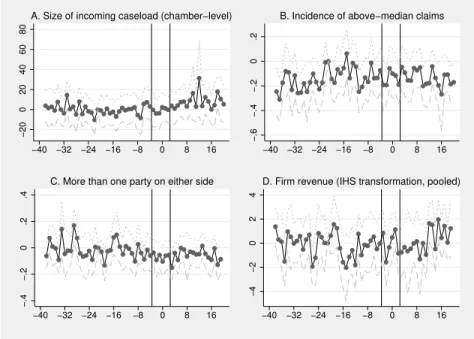
inversely, more) cases to the chambers that were about to apply the decree, chamber-level changes in incoming caseload around the decree introduction cutoff would pose a threat to our identification. Alternatively, the president of the court could have decided on the timing of application of the decree across chambers in reaction to anticipated chamber-specific shocks. We run a structural break diagnostic, akin to our main specifications but at the chamber-hearing level. In the event study specification (akin to (1)), the dummies of interest now indicate how many periods away from the chamber’s application date the hearing is taking place; we thus regress the number of incoming cases on
t-since-application dummies and month and chamber fixed-effects. We similarly adapt equation (3), regressing the number of incoming cases on a post-application dummy (treatment), a linear trend, and their interaction, with month and chamber fixed effects. The coefficients on the treatment variable are insignificant, with or without adjustment period (panel A, Figure 3; col 1, Table A-1). These results lend support to the hypothesis of no significant break in trend for the chamber incoming caseload around these multiple cutoffs.
Second, we verify that there is no change in composition of the caseload. Even though we verify that the court president did not assign fewer cases to the chambers that just started
applying the reform, she could have assigned different ones. For this, we estimate equation
(1) and show that the size of the claims or having more than one party involved on either side of the dispute is not affected by the introduction of the reform (panels B, C, Figure 3; cols 2 and 3, Table A-1). Similarly, we use tax administration data to show that there is no jump in firm size (measured by 2012 revenues) at the cut-off, neither overall, nor for the plaintiff nor for the defendant (panel D, Figure 3; cols 4-6, Table A-1). This indicates that the effect is neither driven by different firms bringing cases to court after the reform, nor by different firms being sued.
24
Finally, we find no record of court-level changes in the structure of the chambers over our
study period, other than the introduction of the decree.22 These checks unanimously
corroborate the validity of our event study design in capturing the causal impact of the reform on the speed of justice.
VII. Results
In this section, we first examine the causal impact of the reform on the length and structure of the pre-trial procedure. We present results on the overall effect on court delays, using rich procedure data to document the channels of impact. We also consider quality vs. efficiency tradeoffs. Second, we gauge the economic impacts of faster adjudication at the firm level.
A. Efficiency of the pre-trial procedure 1. Delays
Did the reform affect the celerity of pre-trial proceedings? We start by estimating our event study specification (1). Panel A, Figure 4 plots the coefficients of the dummies indicating
the number of hearings a case entered relative to the chamber’s decree application date 𝑇𝑗.
The results are striking, revealing a clear drop in pre-trial duration for cases that entered a chamber close to the application of the decree in that chamber. Estimating (3) indicates an average reduction in the pre-trial duration by 42.9 days (p-value<0.01; col 1, Table 3). This is a large effect, on the order of 0.29 of a pre-reform standard deviation.
22 The only change in the court is the closing of two chambers, as mentioned in Section 2. These closures do not
coincide with any of our cutoffs. Since a reduction in the number of chambers implies a cut in the number of judges, these closures should dampen the effect of the decree on the speed of treatment.
25
Next, we reproduce the event study result, accounting for censoring in our pre-trial
duration variable.23 We estimate a Cox proportional hazard model as expressed in (2).
Again, estimating the event study specification exposes a clear jump in the hazard ratio of exiting pre-trial at the decree introduction cutoff (panel B, Figure 4). Estimating the average effect indicates that the introduction of the decree significantly increased the hazard ratio of a case finishing pre-trial by 32% (col 2, Table 3). To further establish robustness, we check that these results qualitatively hold in each individual chamber. We plot the (uncontrolled) average case duration around each individual decree introduction cutoff (Figure A-2), and display the average effect of the decree introduction at the chamber level (panel A, Figure A-3). The results are striking, as raw data from each chamber display jumps at each cutoff, while the average effect within each chamber is within confidence interval of the combined effect.
One of the decree’s innovations was to introduce a four-month delay for the pre-trial
hearings. The finding of a reduction in pre-trial duration is further supported by evidence of a similar jump in the likelihood of completing the pre-trial stage within four months (panel
C, Figure 4), an outcome that is not affected by censoring.24 On average, the likelihood of
meeting this deadline significantly increases by about 23.1 percentage points, a 47.4% increase (p-value<0.01; col 3, Table 3).
To shed light on the nature of the reduction in delays, we compare the distribution of
23 This censoring is documented in Figure 4, which displays a downwards trend in the effect of the entry-period
dummies on pre-trial duration. This is because for any late entry cohort, the longest-lasting cases are still ongoing and, thus, omitted from this sample. While censoring is present, the event study results in Figure 4 indicate that there is a significant break from this pre-trend at the cutoff. Similarly, the average effects show a large and significant treatment effect despite controlling for a linear pre-trend (and allowing this trend to be affected by the reform; Table 5, cols 1 and 2). Hence, we can rule out that censoring explains the observed jump in pre-trial duration.
24 Recall that sample and the window of analysis (up to 21 post-decree application hearings) were chosen such
26
trial durations across the application of the reform. We plot kernel densities of procedural
delays across case cohorts25 and Kaplan-Meier survival estimates pre- and post-reform
(panels D, E, Figure 4). The results are stark: after the decree is applied, the bulk of cases see their pre-trial duration shift to the left. This applies to all ranges of the pre-reform distribution. This hints that judges uniformly apply shorter timelines to all types of cases. 2. Mechanisms
We now use our rich case and hearing-level court data to document the channels through which the decree affected procedural efficiency at pre-trial stage.
First, we measure the extent to which the reform leads cases to elude the pre-trial stage. The reform gives judges the power to desk-reject poorly motivated cases. We find that pre-trial judges made use of this new power, with a clear jump in the likelihood of case
dismissal after the cutoff (panel A, Figure 5). The average effect is large, a 16.9 pp. increase
from a zero baseline (p-value<0.01; col 4, Table 3).26
At the other end of the spectrum of preparedness, cases that enter the court with solid evidence can be brought to deliberations without a pre-trial phase. We document a sharp increase in judges’ propensity to fast-track cases after the introduction (panel B, Figure 5), with an average effect of 9.1 pp. from a 14 percent baseline (p-value<0.05; col 5, Table 3). This may, on the one hand, come from an adjustment in the quality of evidence submitted by the plaintiffs. On the other hand, this may purely come from judges zealously trying to
25 We split the data by cohorts to account for censoring in case duration, which induces a mechanical trend
towards shorter durations. While we do see evidence of the mechanical trend in panel D, Figure 4, a clear jump remains apparent, which is confirmed by the survival rate (panel E, Figure 4).
26 The sharp decline in duration and increase in probability to meet the deadline presented earlier are partly,
but not entirely attributable to desk rejections. Omitting desk rejections from our average effect computations reduces the effect on duration to 24 day (p-value=0.055) and the probability to meet the deadline increases by 17.3 p.p. (p-value=0.000). (Results available upon request.)
27
meet the new deadline.27
The reform led to significant changes in the pre-trial procedure itself. First, we look at the number of pre-trial hearings cases undergo. Again, we present results from the event study design, estimating (1), and report average effects using (3). We observe a significant and sudden decline in the number of pre-trial hearings undergone by cases that entered the chamber close to the application of the decree (panel C, Figure 5). Cases entering a chamber after the decree experienced on average 1.996 fewer pre-trial hearings, equivalent to 0.31 SD (p-value<0.01; col 6, Table 3).
The judges did not increase the intensity of the procedure, as a case’s likelihood to be summoned to hearings was not affected by the decree (panel D, Figure 5; col 7, Table 3). This is perhaps unsurprising given the baseline mean of 88.7%.
Desk-rejecting and fast-tracking cases are not the only margins at which judges adjust their behavior in response to the decree. We use hearing-level outcomes to examine the extent to which judges imposed strict deadlines on parties requesting an adjournment during the pre-trial. Again, we find a sharp break away from the trend at the application of the decree (panel E, Figure 5). This is a large effect, as judges are 5.9 pp. more likely to impose a strict deadline on the parties requesting an adjournment, from a baseline of 12.3% (p-value<0.01; col 8, Table 3). This is all the more striking that these effects are conditional on not being desk-rejected, and hence concern the presumably better prepared share of the caseload.
27 We also verify that the decree did not affect parties’ propensity to settle. At baseline, only 3.5% of cases end in
a settlement (Table 1). We find that the reform did not change that share (results not reported, available upon request).
28
In sum, we find that judges respond to the decree by increasing the decisiveness of the
pre-trial proceedings. Cases are more likely to be desk-rejected or fast-tracked to deliberations. Within the pre-trial procedure, judges schedule fewer hearings with no change in pace, and are more likely to dispense strict adjournments. These results corroborate the notion that the decree led to actual efficiency gains at each step of the pre-trial procedure.
3. Heterogeneity
We now explore dimensions of heterogeneity as motivated by our conceptual framework. We start by allowing for differential reform impacts across small/large or simple/complex cases, using the claim amount to proxy for size and complexity of a case. In practice, we estimate an interacted version of equation (1), allowing for different treatment effects and trends across cases with above- and below-median claim amount (Table 4). We make four central observations.
First, our results confirm the idea that larger claim size is associated with longer procedure delays, on average. Second, we find that the decree equally increased the speed of both small and large-claim cases (col 1, Table 4). In addition, the impact of the decree on the likelihood of completing pre-trial in four months is indistinguishable across types of cases (col 2, Table 4). Third, claim size does not predict the rate at which cases are desk-rejected or fast-tracked, and we fail to detect any differential intensification of the pre-trial
procedure across claim size (cols 3-6, Table 4). Finally, we find that judges are 10.6
percentage points more likely to apply pressure on parties for larger cases after the decree, while the effect on smaller cases is not significant (difference and point estimate significant at the 1% level; col 7, Table 4). These results lend some support to the idea that judges applied the decree equally to all types of cases. To do so, they had to apply relatively more
29
pressure on the parties for large, presumably more complex, cases. Specifically, the absence of intensification of the procedure for large cases goes against the notion that judges
manipulate delays for their private gains.
We find no evidence of differential effects on pre-trial celerity by judge baseline speed28: the
likelihood to finish the pre-trial within 4 months increases significantly both for cases assigned to fast judges and cases assigned to slow judges, and there is no significant difference between these effects (col 2, Table 5). We find a similar pattern for pre-trial duration, as the coefficient on the interaction term is small and insignificant (col 1, Table 5). Fast and slow judges are equally likely to resort to desk rejections and fast-tracking. Interestingly, we observe that the reform differentially affected slow and fast judges’ propensity to reduce procedural formalism at other margins. Fast judges reduce the
number of hearings and are more likely to dispense strict adjournments (cols 5 and 7, Table 5). Strikingly, slow judges fail to significantly reduce the total number of pre-trial hearings. Instead, they increase speed by both intensifying the hearing schedule and increasing the pressure on the parties in the form of strict adjournments (cols 5-7, Table 5).
We conclude that the reform mainly operated as a shifter, moving all case types and judges to a new equilibrium with faster pre-trial proceedings.
B. Decision stage outcomes
Although the reform focused on improving procedural efficiency at pre-trial, it may have
28 Figure A-1 displays the judge-level variations in baseline speed by claim amount category (quintiles, with a
sixth category for cases without a claim amount). This dimension of heterogeneity can be conceived of as a baseline distance to the enforcement frontier. The fast judge indicator takes value 1 when the case is assigned to a judge who treated her baseline cases with above-median speed, where the latter is derived comparing judges’ share of pre-trials completed within four months (within claim amount category and treating separately regular and collegiate pre-trials). The regressions control for amount category and collegiate pre-trial.
30
affected the decision phase both in the form of procedural efficiency and quality of the evidence and deliberations, either through positive externalities or displacement of effort.
We use our rich court data to shed light on these effects.29
1. Duration
We now examine potential changes in judges’ behavior at the decision stage. One possible unintended impact of the reform is that judges’ zeal in pre-trial displaced attention away from their deliberations. This could lead to an increase in both duration and number of decision hearings. We do not estimate a significant jump in the duration of deliberations (panel A, Figure 6; col 1 Table 6), the hazard ratio of completing deliberations (panel B,
Figure 6; col 2, Table 6),30 nor the likelihood of completing this stage within one month
(panel C, Figure 6; col 3, Table 6). Additionally, cases that entered a chamber after the decree did not, on average, experience a different number of decision-stage hearings (panel D, Figure 6; col 4, Table 6). Similarly, we see no jump in the probability of a case being heard at any scheduled hearing over the course of the decision procedure (panel E, Figure 6; col 5, Table 6).
2. Quality
Finally, we examine potential quality-celerity tradeoffs. As discussed above, the pre-trial procedure aims to prepare a case for judgment in the decision phase of the trial. We capture quality of the pre-trial along one dimension – completeness of the evidence brought forward –, and quality of the judgment along two dimensions – judges’ documentation of the
29 As these measures of reform impact are only available for cases that reached deliberations, we cannot rule out
that the introduction of desk rejections could have led to a shift in caseload composition across the decree application cutoff.
30 While computing the hazard ratio at pre-trial stage allowed us to fully account for right-hand censoring of the
duration outcome, this is not true at decision stage. This is because our sample of decision cases is itself
31
decision, and parties’ intention to appeal the decision.
First, we assess completeness of the evidence by looking at the incidence of two decision
hearing outcomes: pre-trial failure (insufficient) and decision postponement. This offers a
plausible measure of pre-trial quality to the extent that the deliberations are done
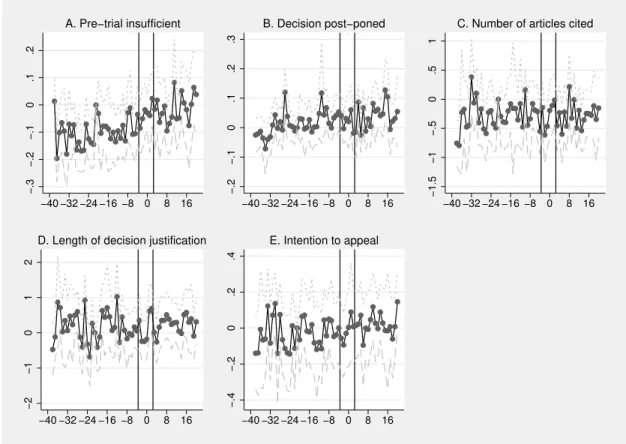
collegiately, whereby each case is reviewed by all judges in the chamber. Panel A, Figure 7 indicates no discernible jump in the probability that a case gets sent back to pre-trial after the introduction of the decree. This is corroborated by a small and insignificant average effect (col 1, Table 7). Similarly, we find no significant change in the likelihood that a decision is postponed (panel B, Figure 7; col 2, Table 7). For both outcomes, there is no change in trend around the introduction of the reform.
Second, we estimate the impact of the reform on the length of judges’ decision justifications and the number of articles cited in them. Again, we fail to detect any impact of the decree on these outcomes both through the event study and average effect estimations (panels C, D, Figure 7; cols 3 and 4, Table 7).
Finally, an important measure of quality of a first-instance judgment is the probability that the decision gets appealed (Coviello et al., 2014). Again, we fail to detect an impact of the reform on parties’ intention to appeal, both in the event study design and on average across the introduction cutoff (panel E, Figure 7; col 5, Table 7).
Taken together, results on decision proceedings and quality of the pre-trial and decisions suggest that accelerating the pace of the pre-trial procedure did not displace judges’
attention away from deliberations, and did not lead to a decline in the quality of either the evidence or the legal justification.
32 C. Judges’ workload
Who bears the cost of the reform? To answer this question at the court level, we document changes in judges’ workload, adapting the event study specification. In practice, we report overall changes in incoming and ongoing caseload around the decree introduction cutoff (Figure 8). While aggregating our data to the judge level weakens the precision of our estimates, we observe that the number of cases heard at each hearing increases in line with the upward trend in judge-level incoming caseload (panels A and C, Figure 8).
Interestingly, judges’ ongoing caseload remains relatively flat (panel B, Figure 8). Although we lack statistical power to precisely measure these effects, the patterns indicate that the reform did not lead to an increased backlog of cases for judges, as there is no discernible change in judge workload over the study period. This suggests that the reform reduced the time each case spends in court without affecting the judges’ overall workload.
D. Valuing a faster justice
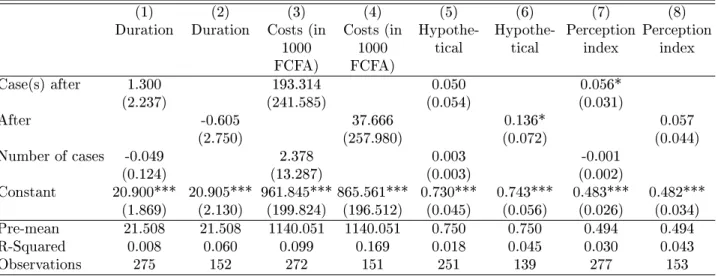
We now document the economic value of the reform among firms involved in the caseload. We start by eliciting stated preferences for shorter delays. We present two scenarios of pre-trial delays, using our empirical estimates of the average reform impact. First, the firm is
told it should hire a lawyer to resolve a dispute of a median amount.31 Two types of lawyers
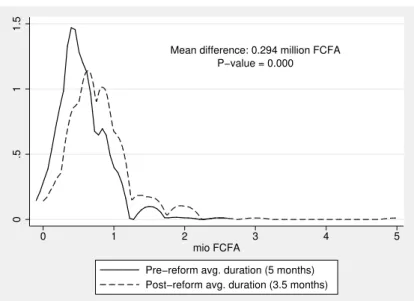
are available: one who can reliably complete pre-trial proceedings at the average pre-reform speed (5 months); and one who can reliably complete pre-trial proceedings at the average post-reform speed (3.5 months). We then asked the firm how much they would be willing to
pay each lawyer, in an open-ended manner.32 The kernel densities corresponding to each
31 We use the median dispute amount in our caseload, FCFA 8,000,000, or about USD 14,500 (Table 2).
32 There are clear limitations to this method (Diamond and Hausman 1994). The idea is to use the answers as
an “opinion poll” to assess if firms see a positive value in shorter disputes, and not to establish the “true value” of the reform (Chetty 2015).