HAL Id: hal-00307590
https://hal.archives-ouvertes.fr/hal-00307590v2
Preprint submitted on 7 Aug 2008
HAL is a multi-disciplinary open access
archive for the deposit and dissemination of
sci-entific research documents, whether they are
pub-lished or not. The documents may come from
teaching and research institutions in France or
abroad, or from public or private research centers.
L’archive ouverte pluridisciplinaire HAL, est
destinée au dépôt et à la diffusion de documents
scientifiques de niveau recherche, publiés ou non,
émanant des établissements d’enseignement et de
recherche français ou étrangers, des laboratoires
publics ou privés.
delta Cen: a new binary Be star detected by
VLTI/AMBER spectro-interferometry
Anthony Meilland, Florentin Millour, Philippe Stee, Alain Spang, R. G.
Petrov, D. Bonneau, Karine Perraut, Fabrizio Massi
To cite this version:
Anthony Meilland, Florentin Millour, Philippe Stee, Alain Spang, R. G. Petrov, et al.. delta Cen: a
new binary Be star detected by VLTI/AMBER spectro-interferometry. 2008. �hal-00307590v2�
Astronomy & Astrophysicsmanuscript no. del˙Cen˙v14.hyper9480 c ESO 2008 August 7, 2008
L E
δ
Cen: a new binary Be star detected by VLTI/AMBER
spectro-interferometry
⋆
A. Meilland
1, F. Millour
1, Ph. Stee
2, A. Spang
2, R. Petrov
2, D. Bonneau
2, K. Perraut
3, and F. Massi
41 Max Planck Intitut fur Radioastronomie, Auf dem Hugel 69, 53121 Bonn, Germany
2 Laboratoire A.H. FIZEAU, UMR 6525, UNS/OCA/CNRS, Campus Valrose, 06108 Nice cedex 2, France
3 Laboratoire dAstrophysique de Grenoble, UMR 5571 Universit´e Joseph Fourier/CNRS, BP 53, 38041 Grenoble Cedex 9, France 4 INAF-Osservatorio Astrofisico di Arcetri, Istituto Nazionale di Astrofisica, Largo E. Fermi 5, 50125 Firenze, Italy
Received; accepted
ABSTRACT
Aims.We study the Be star δ Cen circumstellar disk using long-baseline interferometry which is the only observing technique capable of resolving spatially and spectroscopically objects smaller than 5 mas in the H and K band.
Methods.We used the VLTI/AMBER instrument on January 6, 8, and 9, 2008, in the H and K bands to complete low (35) and medium (1500) spectral resolution observations.
Results.We detected an oscillation in the visibility curve plotted as a function of the spatial frequency which is a clear signature of a companion around δ Cen. Our best-fit soltution infers a binary separation of 68.7 mas, a companion flux contribution in the K band of about 7% of the total flux, a PA of 117.5◦
, and an envelope flux around the Be primary that contributes up to about 50 % of the total flux, in agreement with our Spectral Energy Distribution (SED) fit. The envelope size is estimated to be 1.6 mas in K but no departure from spherical symmetry is detected.
Key words. Techniques: high angular resolution – Techniques: interferometric – Stars: emission-line, Be – Stars: winds, outflows – Stars: individual (δ Cen) – Stars: circumstellar matter Stars: binary
1. Introduction
We have initiated an observational campaign to determine the global parameters of Be stars and the origin of the so-called “Be-phenomenon” using the VLTI interferometer, which combines, for the first time, milli-arcsecond spatial resolution with good spectral resolution of up to 12000 in the near-IR K band. We are therefore able to study the geometry and kinematics within the circumstellar environment. Three Be stars have been observed with the VLTI instruments and the global physical properties of these stars have been found to vary strongly from one star to another.
Achernar was the first Be star observed with the VLTI us-ing the VINCI beam recombiner. These observations exhib-ited a strongly flattened star due to an almost critical rotation (Domiciano de Souza & Kervella 2003) and an extended polar wind that contributed to almost 4% of the total flux in the H band (Kervella & Domiciano de Souza 2007) with no detectable equatorial disk. Nevertheless, its circumstellar environment was known to be highly variable with a quasi-cyclic formation and a dissipation timescale of about 13 years proposed by Vinicius et al (2007). Kanaan et al. (2008) modeled these variations suc-cessfully as a possible outburst of circumstellar matter that has been ejected and was propagating within the stellar environment
with an expansion velocity of 0.2km s−1.
α Arae was the second star observed with the VLTI, using
both MIDI and AMBER instruments, and the observational
re-Send offprint requests to: [email protected]
⋆ Based on observations made with ESO telecopes at La Silla Paranal
Observatory under GTO programme IDs 080.D-0131(A) and 080.C-0099(B)
sults were published by Chesneau et al. (2005) and Meilland et al. (2007a). The data interpretation was completed with the SIMECA code developed by Stee et al. (1994), which is able to simulate the gaseous circumstellar environment of active hot stars. Two distinct regions in the circumstellar environment of
α Arae are clearly present : a thin Keplerian rotating
equato-rial disk and a rapidly expanding enhanced polar wind. As for Achernar, the stellar rotational velocity, which was readily mea-surable due to the flatness of the projected envelope onto the sky plane, was found to be almost critical. By combining MIDI and AMBER data, they found that the disk size did not vary as a function of the observing wavelength, which was a strong indi-cation of possible disk trunindi-cation, as confirmed by more “classi-cal” spectroscopic measurements.
Finally, the third Be star studied using the VLTI instruments, was κ CMa, observed with AMBER in MR mode and presented in Meilland et al. (2007b). For this star, a non-Keplerian rotat-ing disk was detected. The star was found to rotate far below its critical velocity, which appears to indicate that critical rota-tion may not be a requirement of the “Be phenomenon”. Since it has an early spectral type of B2V, the radiation pressure might however be sufficient to initiate a mass loss and possible disk for-mation. This hypothesis agrees with the Cranmer (2005) statis-tical study. Finally, the spectro-differential interferometric mea-surements were able to detect the presence of an inhomogeneity in the circumstellar envelope of this star, which could be inter-preted in terms of the ”one-armed” viscous disk framework of Okazaki( 1997).
To increase the number of Be stars observed by the VLTI and initiale a statistical study of the geometry and kinematics of their surroundings, and study the possible dependence of the “Be
phe-2 A. Meilland et al.: δ Cen: a new binary Be star detected by VLTI/AMBER
nomenon” on the spectral type of the central star, we requested new AMBER observations of 6 close and bright enough Be stars of spectral types ranging from B1 to B8 of which δ Cen was one star.
This letter is organized as follows: in Sect. 2 we briefly intro-duce the Be star δ Cen and its fundamental parameters, in Sect. 3 we present our VLTI/AMBER observations and the data re-duction, and in the last section our results are summarized and conclusions are presented.
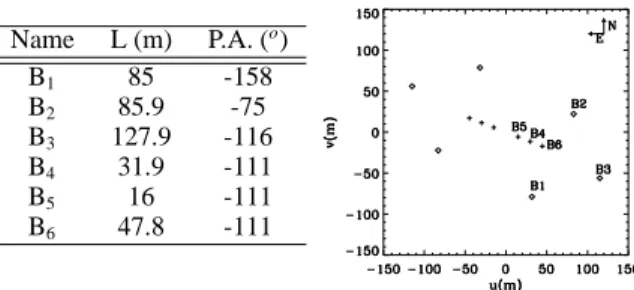
Name L (m) P.A. (o) B1 85 -158 B2 85.9 -75 B3 127.9 -116 B4 31.9 -111 B5 16 -111 B6 47.8 -111
Fig. 1. Left : Names, lengths, and P.A. for each baseline of the
two triplets of observation. Note that the two measurements from
January 8 with A0-K0-G1 are merged into B1, B2, and B3
base-lines, since the projected baseline length and P.A. does not vary
significantly between them. B4, B5, and B6baselines correspond
to the E0-G0-H0 triplets. Right: (u,v) plane coverage obtained during the δ Cen observing run. Fortunately, the largest projected baseline is aligned with the shorter ones.
2.
δ
CenδCen (HR 4621, HD 105435, HIP 59196) is usually classified as
a B2IVne star. Levenhagen & Leister (2006) considered a spec-troscopic analysis that did not take account of the effects of grav-ity darkening and proposed a B2Vne classification. It is a vari-able star with a brightness variation between magnitude 2.65 and 2.51. δ Cen has the same proper motion as the nearby stars HD 105382 (which is also a Be star) and HD 105383 and may there-fore be member of a triple visual star system. A precise radial velocity (RV) measurement campaign of B stars in the Scorpius-Centaurus association conducted by Jilinski et al. (2006)
mea-sured a RV for δ Cen of 3.8± 2.8 km s−1. The RV determined by
various authors from the SIMBAD database also exhibits a large dispersion, which might indicate possible binarity, as we see in the following. On the other side, Mason et al. (1996) and Mason (2008), using U.S. Naval Observatory (USNO) and Center for High Resolution Astronomy (CHARA) speckles cameras did not detect any binarity for this star.
Based on an autocorrelation analysis of Hipparcos photom-etry, Percy et al. (2002) presented a self-correlation diagram with strong minima at 0.55 and 1.1 days, in contrast, Balona (1990) reported a tentative period of 1.923 days, implying that
δ Cen is a short-period variable Be star. Studying line profile
variations in 1999 HEROS spectroscopic data, Rivinius et al. (2003), confirmed both values at 0.532d and 1.139d but with a formally somewhat higher significance of the longer period which was adopted in their paper. They concluded that δ Cen line profile variability was modeled successfully as a non-radial pulsator with l = m = +2, as for the Be star ω CMa, but with a strongly asymmetric power distribution of the line profile vari-ability with a unidentified cause. The star’s distance was esti-mated by Hipparcos to be 121±11pc, and its K and V magnitude to be 2.7 and 2.56, respectively . Lenorzer et al. (2002) identified
δCen as a B star with emission lines observed in the ISO Short
Wavelength Spectrometer Post-Helium program of the Infrared
Obs. time Target Triplet Mode Seeing 06/01/08 08:59 δCen A0-K0-G1 MR 1.02” 06/01/08 09:11 HD109538 A0-K0-G1 MR 1.13” 06/01/08 09:26 δCen A0-K0-G1 MR 1.19” 08/01/08 08:48 HD90798 E0-G0-H0 LR 0.50” 08/01/08 09:11 δCen E0-G0-H0 LR 0.94” 09/01/08 08:07 HD47536 E0-G0-H0 MR 0.68” 09/01/08 08:31 δCen E0-G0-H0 MR 0.74” 09/01/08 08:50 HD109538 E0-G0-H0 MR 0.87” 09/01/08 09:08 δCen E0-G0-H0 MR 1.22” 09/01/08 09:28 HD109538 E0-G0-H0 MR 0.71”
Table 1. Observations log of δ Cen and its calibrators during the
January 2008 Be AMBER GTO run.
Space observatory (ISO). The fundamental parameters deter-mined for rapidly rotating B-type stars by Fr´emat et al. (2005),
taking into account gravitational darkening were Te f f=22384
± 446 K, log g=3.942 ±0.053, and Vsini=263±14 km s−1.
Its linear critical equatorial rotation velocity was Vc=527±29
km s−1 and its inclination angle estimated to be i=41.6±2.3◦.
Levenhagen & Leister (2004) estimate its age to be log Age = 7.20 ±0.15 yr, its luminosity log L/L⊙=3.70 ±0.10, and its mass 8.6 ±0.3 M⊙.
3. Observations and data reduction
δ Cen was observed with AMBER in low and medium
spec-tral resolution modes (specspec-tral resolving powers of R=35 and R=1500, respectively) during the observing runs 080.C-0099 and 080.D-0131, completed in January, 6, 8, and 9, 2008. Five measurments were obtained with the Auxilliary Telescopes (1.8m diameter) on the A0-K0-G1 and E0-G0-H0 baseline triplets. HD 109593 (apparent diameter of 1.638±0.021 mas in the CHARM2 catalog from Richichi et al. 2005), HD 47536 (apparent diameter of 1.69±0.03 mas, also in CHARM2), and
HD 90798 (apparent diameter 1.70±0.51 mas using the getCal1
tool) were also observed to calibrate δ Cen visibilities. The log of these observations are presented Table 1.
The data were reduced using the AMBER data reduction software developped by the JMMC: amdlib, version 2.1. It com-putes a fringe fitting of the AMBER data, after correcting for detector bias and flat-field (Millour et al., 2004 and Tatulli et al., 2007). Following that step, we adopted two different approaches to calibrate the data:
– The “standard” approach, which retains 20% of the total
number of frames according to the fringe SNR. This allows us to limit the fringe smearing effect (also called “jitter” ef-fect) and the coherence length visibility loss due to the at-mospheric OPD (described in Millour et al. 2007). The fol-lowing steps (transfer function estimation, calibration) were completed using a new set of custom-made scripts described
by Millour et al. (20082).
– An approach using bootstrapping, roughly explained in
Tatulli et al., (2007) and described in more detail in Cruzal`ebes et al. (2007). A frame-selection scheme that re-jects frames with a negative flux, a high OPD variation from frame to frame, and a SNR of less than 1, is also applied. The calibration procedure is then completed the same way as for the previous method.
1 available at http://mscweb.ipac.caltech.edu/gcWeb 2 The scripts are available to the community at the following
Fig. 2. δ Cen Spectral Energy Distribution (SED) reconstructed
from various sources in the literature : Morel (1978), 2MASS, IRAS magnitude and flux measurements (diamonds), IUE spec-tra (solid line in the UV), and ISO specspec-tra (solid line in the
IR). The dashed line is a Kurucz model for Te f f = 21000K,
R⋆= 5.9R⊙, log g = 4, and d = 121pc.
The two methods provide the same results within the error bars and we therefore choose to use the calibrated data from the first method later in the paper. Since the aim of the paper is to determine the binary parameters, we exclude the January 9 MR data for which projected baselines are similar to the January 8 LR ones and the data quality is significantly lower. Finally, we merged the two January 5 MR measurements ob-tained with almost the same projected baseline, and determined the wavelength-dependent visibilities for the six baselines pre-sented Fig. 1. The corresponding (u,v) plane coverage of the sci-ence target is also plotted in Fig 1.
4. Results
For a single Be star, assuming that the visibility we measure, V, is only due to the central star and its circumstellar disk we can write:
V = VenvFenv+ V⋆F⋆
Ftot
(1)
where Venvand Fenvare respectively the envelope visibility and
flux in the continuum , V⋆and F⋆ the star visibility and flux in
the continuum and Ftot= Fenv+F⋆. To measure accurately the
ex-tension of a circumstellar envelope from an interferometric
mea-surement, we therefore need to determine both F⋆and Fenvat the
observing wavelength. This can be achieved directly by analyz-ing data acquired by interferometry if, at least, two baselines
resolve the envelope completely but not the star (i.e, Venv=0 and
V⋆∼1). In the case of our δ Cen AMBER data, even the longest
baseline (i.e, B3=127.9m) is too short to fully resolve the
cir-cumstellar envelope.
To determine F⋆ and Fenvin H and K bands to the highest
possible accuracy, we started our modeling by constructing the
δCen Spectal Energy Distribution (SED) using various sources
in the literature (see Fig. 2). A Kurucz model, fitted from UV and visible measurements, for which the circumstellar contribution was negligible, was used to determine the stellar contribution to the flux for wavelengths ranging from UV to Far-IR. The values of the best-fit Kurucz model parameters, which were consistent with those found in the literature and were introduced in Sect. 1, are presented Table 3. This method allows us to characterize precisely the circumstellar IR-excess. Taking into account the uncertainty in the spectral class of δ Cen and its small variability
in the near IR, we obtain Fenv= 0.52±0.06 Ftotin the K band and
0.38±0.08 Ftotin the H band.
K and H band calibrated visibilities obtained with the small
aligned triplet in LR mode (i.e. B4, B5, and B6) are plotted as
a function of the spatial frequency in Fig. 3. These data exhibit
clearly a sinusoidal modulation with a period of T4,5,6=22
cy-cles/arcsec and an amplitude of A4,5,6=0.15±0.02. This
varia-tion cannot be reproduced by a simple star + circumstellar en-velope model regardless of the geometry of this second com-ponent (e.g. uniform or Gaussian disk, or ring), and is usually produced by a companion. The separation between the two
com-ponents in the direction of the projected baselines (i.e., -111o) is
given by S4,5,6=1/T0=44.8±0.5 mas, and its flux by Fc=A4,5,6/2 =
0.075±0.01Ftot. We note that this value may be biased towards a
dimmer flux ratio since the separation is ∼25% of the telescopes PSF (∼ 240mas with the ATs at 2.1µm) and the AMBER instru-ment uses monomode fibers (Tatulli et al. 2004). However, it is beyond the scope of this paper to correct for this effect.
To reproduce the small slope in the visibilty as a function of spatial frequency, we need to introduce a small circumstel-lar envelope (i.e., D=2±0.5mas) around one of the two compo-nents. We note that the data also indicate some small differences in modulation amplitude between the H and K band data. The characterization of these differences, probably due to the varia-tion in the binary flux ratio between these spectral bands, is again beyond the scope of this letter and is not described here.
The B1, B2, and B3 data are also plotted in Fig 3. These
measurements place additional constraints on the binary and the
circumstellar envelope. The B2 and B3 data show a sinusoidal
modulation with periods corresponding to a separation between the binary components in the projected baseline directions of S2=62±5 mas and S3=52±6 mas, respectively. The amplitude of
the modulation is A2=A3=0.15±0.05 which is in agreement with
the measurement for the January 8 LR data (i.e., A0=0.15±0.02).
The separation measured by B3is consistent with that measured
for data acquired with the LR triplet; this is a good indication that our measurements are not biased by some instrumental effects
since B3is almost aligned with the LR triplet (i.e. P.A.=-116ofor
B3, and P.A.=-111ofor B4, B5, and B6). The difference between
the two measurements can be due either to a inaccurate spec-tral calibration of AMBER LR data (up to 0.1µm) or to a small
change in the projected separation due to the 5oof variation in
P.A. between the two data sets. Finally, there is no evidence of a
sinusoidal modulation in the B1data. Since the modulation may
not be detected if its period is at least 3 times the observation range in spatial frequency (i.e., T≥50 cycles/arcsec), the binary
separation along this projected angle, S1, is lower than 20 mas.
The average visibility of each baseline (i.e. V1=0.82, V2=0.86,
and V3=0.81) indicates clearly the presence of an extended
com-ponent, probably a circumstellar envelope with an extension of about 2±0.5mas.
By measuring the projected separation in at least two dif-ferent directions in the sky, we can determine the modulus and the orientation of the binary separation on the sky plane. Our most appropriate binary star + circumstellar envelope model is obtained for a set of values given in Table 2. The modeled visi-bility obtained in K band for each of the six baselines is plotted with the observed measurements in Fig. 3. We note that to ver-ify that the binary signal did not originate in the calibrators we checked that the modulation was evident in the science object raw visibilities and not on the calibrator ones.
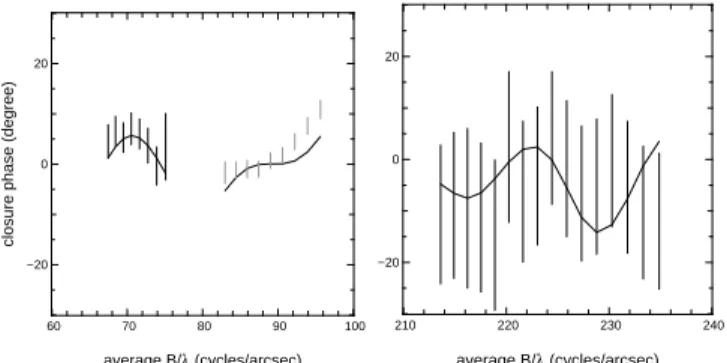
Since AMBER operates simultaneously with three tele-scopes, we are able to measure the closure phase for each triplet.
4 A. Meilland et al.: δ Cen: a new binary Be star detected by VLTI/AMBER 0 50 100 0.4 0.6 0.8 1.0 1.2 Visibility B/λ (cycles/arcsec) Visibility B/λ (cycles/arcsec) 180 185 190 195 200 0.4 0.6 0.8 1.0 1.2 B/λ (cycles/arcsec) 180 190 200 0.4 0.6 0.8 1.0 1.2 B/λ (cycles/arcsec) 280 290 300 0.4 0.6 0.8 1.0 1.2 B/λ(cycles/arcsec)
Fig. 3. Left: LR K (dark) and H (gray) bands visibilities for the January, 8 2008 baselines (B4, B5, and B6) as a function of the spatial
frequency. Second picture from the left to the right: MR visibilities for the January, 5 2008 baselines (B1, B2, and B3) as a function
of the spatial frequency. For all figures, measurements are given by the error bars, whereas the solid line corresponds to our best-fit binary + uniform disk circumstellar envelope modeled using parameters from Table 2.
Such measurements place additional constraints on our models. Figure 4 shows a reasonable agreement between observed and modeled closure phase using parameters from Table 2.
Finally, using R⋆=5.9R⊙ and d=121pc, the 68.7mas
sep-aration between δ Cen and its companion corresponds to
300±50R⋆. Assuming a circular orbit, this provides a lower limit
to the semi-major axis. The companion spectral class can be inferred using both δ Cen spectral class and K band flux ratio determined from the amplitude of the modulation in the inter-ferometric data. The companion spectral class should range
be-tween B4V and A0III, and its mass bebe-tween 4 and 7 M⊙. Using
Kepler’s third law of planetary motion, P = pa3/M
tot, where
P is the period in years, a is the semi-major axis in AU, and
Mtot is the binary system total mass in M⊙, we can determine
a lower limit to its period, i.e. 4.6 years with Mtot=15.2M⊙and
a=250R⋆=6.9AU.
Additional interferometric observations, including long-term monitoring, would be required to determine why these results disagree with those of the speckles observations of Mason (1997, 2008) and to fully determine the projected orbit of the compan-ion of δ Cen. Spectroscopic follow-up should also be completed even though the Doppler shifts due to binarity are difficult to
measure if the star is a rapid rotator (i.e, V sin i= 263km s−1),
and the profiles are affected by non-radial pulsations. The cir-cumstellar environment geometry and kinematics will be stud-ied in a forthcoming paper, which will include all January 2008 VLTI/AMBER medium resolution differential visibilties as well as VLTI/MIDI data.
Distance 121 ± 11 pc
Teff 21000 ± 1000 K Stellar Radius 5.9 ±0.5 R⊙
log g 3.75 ± 0.25 Companion flux (K band) 0.07±0.0.1 Ftot
Separation 68.7±0.5 mas Position Angle (PA) 117.5±0.5◦
Envelope flux (K band) 0.52±0.06 Ftot
Envelope diameter (K band) 1.6±0.4 mas
Table 2. Parameters and results for the binary system + uniform
disk circumstellar envelope obtained for δ Cen. Note that there is
a 180oambiguity in the position angle since the AMBER closure
phase data reduction process is not fully validated.
Acknowledgements. The Programme National de Physique Stellaire (PNPS),
the Institut National en Sciences de l’Univers (INSU) and the Max Planck Institut fur Radioastronomy (MPIfr) are acknowledged for their financial support. The authors would like to thank ESO staff for their help to make the observations a success and more particularly J-B Lebouquin and F. Rantakyro. This research has made use of SIMBAD database, operated at CDS, Strasbourg, France.
60 70 80 90 100
−20 0 20
average B/λ (cycles/arcsec)
closure phase (degree)
210 220 230 240
−20 0 20
average B/λ (cycles/arcsec)
Fig. 4. Observed and modeled closure phase for the B4B5B6
(left) and B1B2B3(right) triplets plotted as a function of the
av-erage spatial frequency. For all figures, the measurements are represented by the error bars whereas the solid line corresponds to our best binary + uniform disk circumstellar envelope mod-eled using parameters from Table 2.
References
Balona, L. A., 1990, MNRAS, 245, 92
Chesneau, O., Meilland, A., Rivinius, T et al. 2005, A&A, 435, 275 Cranmer, Steven R., 2005, ApJ, 634, 585
Cruzal`ebes, P.; Spang, A.; et al., “Calibration of AMBER Visibilities”, in “ESO calibration Workshop 2007”, Springer, in press.
Domiciano de Souza, A., Kervella, P., Jankov, S., et al. 2003, A&A, 407, L47 Frmat, Y., Zorec, J., Hubert, A.-M., & Floquet, M., 2005, A&A, 440, 305 Jilinski, E., Daflon, S., Cunha, K., & de La Reza, R., 2006, A&A, 448, 1001 Kanaan S., Meilland A., Stee Ph., et al. 2008 A&A, 486, 785
Kervella P. & Domiciano de Souza, A. 2007, A&A, 474, L49 Lenorzer, A., Vandenbussche, B. Morris, P. et al. 2002, A&A, 384, 473 Levenhagen, R.S. & Leister, N.V. 2004, AJ, 127, 1176
Levenhagen, R.S. & Leister, N.V. 2006, MNRAS, 371, 252
Mason, B.D., Ten Brummelaar, Th., Gies, D.R., et al., 1997, AJ, 114, 2112 Mason B.D., 2008, Private communication
Meilland, A., Stee, Ph., Vannier, M. et al. 2007a, A&A, 464, 59 Meilland, A., Millour F., Stee, Ph. et al. 2007b, A&A, 464, 73
Millour, F., et al., to be published in SPIE Astronomical Telescopes and Instrumentation, 2008.
Millour, F., et al., in “ESO calibration Workshop 2007”, Springer, in press. Millour, F.; Tatulli, E. et al., SPIE, 2004, 5491, 1222
Morel, M. & Magnenat, P., 1978,A&AS, 34, 477 Okazaki, A., 1997, A&A 318, 548
Percy, J.R., Hosick, J, Kincaide, H. et al. 2002, PASP, 114, 551 Richichi, A.; Percheron, I. & Khristoforova, M.; A&A, 2005, 431, 773 Rivinius, Th., Baade, D., & Stefl, S., 2003, A&A, 411, 229
Stee, Ph., & Ara´ujo, F.X. 1994 , A&A, 292, 221 Tatulli, E., Millour, F. et al. 2007, A&A, 464, 29 Tatulli, E., M`ege, P., & Chelli, 2004, A., A&A, 418, 1179 Vinicius, M. M. F., Zorec, et al. , 2006, A&A, 446, 643