
An expeditious enantioselective synthesis of methyl trans-chrysanthemate
4
0
0
Texte intégral
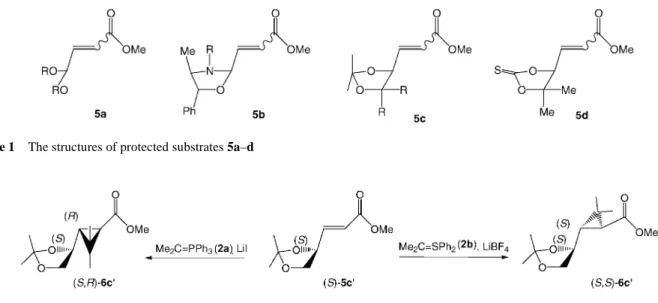
(2) 2020. A. Krief et al.. PAPER. Figure 1. The structures of protected substrates 5a–d. Scheme 3. then 20 °C, 1 h) leads to the racemic methyl epoxychrysanthemate (dl)-6e¢ in good yield (70 %) and reasonably good stereocontrol at the three stereogenic centers (de 80 %) (Scheme 4). The same process can be carried out stepwise providing first methyl (E)-3-(3,3-dimethyloxiran-2-yl)prop-2enoate [(dl)-(E)-5e] by reaction of the first equivalent of ylide 2b with 1 (DME, –78 °C, 2 h, then 20 °C, 1 h, 73% yield) followed by subsequent reaction of a second equivalent of the same ylide (DME, –78 °C, 2 h, then 20 °C, 1 h) with (dl)-5e to give (dl)-6e¢ in 88 % yield (de 94 %, Scheme 5, entry a). The higher relative stereocontrol systematically obtained in the stepwise reaction suggests that the cyclopropanation might take place, at least in part, on the betaine precursor of (dl)-(E)-5e.. Interestingly, a different diastereoisomer (dl)-6e¢¢, resulting from the attack of (dl)-5e from the other face, is obtained in modest yield if the reaction is performed instead with isopropylidenetriphenylphosphorane (2a) (THF, 0 °C, 1 h, then 20 °C, 1 h, 28 % yield; 6e¢¢/6e¢ = 9:91, de 82%, Scheme 5, entry b).4 Therefore (dl)-5e behaves as the other members of the g-alkoxy-a,b-unsaturated esters family 5c,d since all these compounds provide cyclopropyl esters 6 in which the relative stereochemistry is similar within the same family of reagents but different between the two families (2a and 2b, Scheme 3).3–5 We have unambiguously confirmed the trans-relationship of (dl)-6e¢ and (dl)-6e¢¢ by comparing their 1H NMR data to those of 6e obtained as a stereoisomeric mixture (dl)6e¢/(dl)-6e¢¢ = 54:46) by epoxidation of methyl (dl)-transchrysanthemate [(dl)-trans-4] with m-CPBA (1.5 equiv, CH2Cl2, 20 °C, 1 h, 87 % yield).. Scheme 4. Scheme 5 Synthesis 2002, No. 14, 2019–2022. ISSN 0039-7881. © Thieme Stuttgart · New York.
(3) PAPER. Enantioselective Synthesis of Methyl trans-Chrysanthemate. 2021. Scheme 6. Finally, reduction of (dl)-6e to methyl (dl)-trans-chrysanthemate [(dl)-trans-4] has been effectively achieved by reaction with P2I4 (1.2 equiv, CS2, pyridine, reflux, 5 h, 72 %, de ~100 %, Scheme 6).6 It is interesting to note that SmI2, which is usually able to reduce epoxides to olefins,7 does not provide even a trace of the desired product but instead the allyl alcohol 7 resulting from reductive cyclopropane ring opening (Scheme 6).8 Enantioselective Synthesis of Methyl (1R)-trans-Chrysanthemate [(1R)-4*] An enantioselective version of this reaction was achieved from the trans-g,d-epoxy-a,b-unsaturated ester (E)-5e* prepared, using the Sharpless asymmetric epoxidation reaction,9 from 3-methylbut-2-en-1-ol (8) and (l)-diisopropyl tartrate to produce first the required (S)-(3,3dimethyloxiran-2-yl)methanol (9*) (Scheme 7). The most straightforward synthesis of (E)-5e* entails the direct ‘Parikh–von Doering oxidation’10 of the crude mixture obtained from the Sharpless epoxidation reaction (1.2 equiv pyridine×SO3, Et3N, DMSO, 20 °C, 3 h) leading to the crude aldehyde 10* which is in turn subjected, without purification, to the Wittig olefination reaction using amethoxycarbonyltriphenylphosphorane in DMSO (1 equiv, DMSO, 20 °C, 4 h, 59%).4d,11 A single chromatographic purification (silica gel, pentane–Et2O, 80:20 v/v) allows, separation of the small amount (4%) of the Z-stereoisomer (Z)-5e* concomitantly produced. The enantiomeric excess recorded for methyl epoxy-transchrysanthemate [(1R)-trans-6e*] resulting from the reaction of isopropyldiphenylsulfonium tetrafluoroborate was rather moderate (74 %) due to the modest enantiomeric excess with which 9* is obtained (75%).9. Almost complete stereocontrol of methyl (E)-3-[(2R)-3-3dimethyloxiran-2-yl]prop-2-enoate {5e*; ee >98%, [a]D20 –30.64 (c = 1.155, CHCl3)}, methyl epoxychrysanthemate {6e*; ee 98%; [a]D20 +16.02 (c = 0.945, CHCl3)} and methyl trans-chrysanthemate {(1R)-trans-4*; ee 98%; [a]D20 +20.28 (c = 1.140, CHCl3)} was nevertheless achieved by a single crystallization from diethyl ether of the nitrobenzoate of 9e*9b,c from which the enantiopure (S)-(3,3-dimethyloxiran-2-yl)methanol (9e*) was obtained by biphasic ester hydrolysis using a phase transfer catalyst (4.1 equiv of an aq 9.6 N KOH solution, 0.2 equiv benzyltributylammonium chloride, CH2Cl2, 20 °C, 12 h). Spectroscopic data (IR, 1H NMR) of methyl (1R)-transchrysanthemate [(1R)-trans-4*] obtained in this work are identical to those of an authentic sample.4d Work is now in progress to adapt the reported strategy to the synthesis of deltamethrin.. Methyl (E)-3-[(2R)-3,3-dimethyloxiran-2-yl]prop-2-enoate (5e*) Method 1: Crushed, activated 3 Å molecular sieves (1.5 g) were introduced into a flame-dried flask filled with argon. CH2Cl2 (100 mL) was added and the flask was cooled to –20 °C. D-(–)-Diisopropyl tartrate (702 mg, 3.0 mmol), 3-methylbut-2-en-1-ol (8; 4.3 g, 50.0 mmol, stored over molecular sieves), and Ti(i-PrO)4 (710 mg, 2,5 mmol) were added sequentially. The stirring was maintained for 0.5 h at –20 °C, whereupon a 3.7 M solution of tert-butyl hydroperoxide (TBHP) in toluene (27 mL, 100 mmol) was added via a syringe and the stirring was continued for a further 3 h at the same temperature. Careful quenching of the excess TBHP was accomplished by the slow addition of dimethyl sulfide (12.4 g, 200 mmol), taking care that the temperature did not rise above –20 °C. After stirring at –20 °C, for 0.7 h, CH2Cl2 was evaporated under vacuum. Scheme 7 (i) TBHP, Ti(OPr-i)4, (l)-DIPT, CH2Cl2, –20 °C, 3 h, Me2S; (ii) Pyridine×SO3, Et3N, DMSO, 20 °C, 3 h; (iii) Ph3P=CHCO2Me, 20 °C, 4h; (iv) Me2C=SPh2, LiBF4, DME, –78 °C, 2 h then 20 °C, 1 h; (v) P2I4, CS2, pyridine, 5 h, reflux. Synthesis 2002, No. 14, 2019–2022. ISSN 0039-7881. © Thieme Stuttgart · New York.
(4) 2022. PAPER. A. Krief et al.. (15 mbar, under 20 °C). The resulting mixture, still containing some CH2Cl2, was dissolved in DMSO (60 mL) and Et3N (55 mL) and subjected to the ‘Parikh–von Doering oxidation’ reaction using a solution of pyridine×SO3 complex (9.54 g, 60 mmol) in DMSO (70 mL) which was slowly added (3 h) at 20 °C temperature. Olefination reaction of the crude aldehyde was carried out with a-methoxycarbonyltriphenylphosphorane (16.7 g, 50 mmol)11 at r.t. After stirring the resulting mixture for 4 h at r.t., H2O (20 mL) was added and the mixture was extracted twice with Et2O, washed with H2O and dried (Na2SO4). The solvent was removed under reduced pressure and the crude material was purified by column chromatography on silica gel (pentane–Et2O, 80:20 v/v, Rf 0.38) to yield 4.27 g (55%) of (E)-5e*. Method 2: Alternatively oxidation of 8 was performed similarly, but with TBHP in CH2Cl2 (15 mL of a 6.8 M solution, 100 mmol). The reaction mixture was stirred at –20 °C for 2.5 h, then the excess of TBHP was reduced by trimethyl phosphite (19 mL, 75.0 mmol) in 0.75 h taking care that the temperature did not rise above –20 °C. The synthesis of the related nitrobenzoate was achieved by adding Et3N (8.5 mL, 60 mmol) followed by a solution of p-nitrobenzoyl chloride (9.3 g, 50 mmol) in CH2Cl2 (15 ml). This mixture was stirred at 0 °C for 1 h, filtered through a pad of Celite, and the filtrate was washed with 10% aq tartaric acid (2 ´ 15 mL), aq sat. NaHCO3 (3 ´15 mL), and brine (2 ´ 15 mL). The organic phase was dried (Na2SO4), filtered and concentrated. The solid was recrystallized twice from Et2O to give [(2R)-3,3-dimethyloxiran-2-yl] 4-nitrobenzoate, as fine pale yellow needles (3.62 g; 31%; ee >98%; 3.12 g; 26%; ee >90%). An aq solution of NaOH (2.69 g in 5 mL of H2O, 9.6 N, 48 mmol) containing benzyltributylammonium chloride (700 mg, 2.4 mmol) was added dropwise at 20 °C to the [(2R)-3,3-dimethyloxiran-2-yl] 4-nitrobenzoate (2.89 g, ee >98%, 11.5 mmol) dissolved in CH2Cl2 (30 mL). After stirring for 12 h at 20 °C, the mixture was extracted with Et2O and dried (Na2SO4). CH2Cl2 was evaporated at 20 °C under 15 mbar and the resulting mixture was diluted with DMSO (15 mL) containing Et3N (13 mL) and reacted with pyridine×SO3 complex (2.2 g, 13.8 mmol) dissolved in the same solvent (15 mL). The mixture was stirred at r.t. for 2 h and subjected to the olefination reaction using the a-methoxycarbonyltriphenylphosphorane (3.84 g, 11.5 mmol)11 at 20 °C. After stirring at this temperature for 4 h, the mixture was hydrolyzed with H2O (10 mL) and extracted with Et2O, washed with H2O and dried (Na2SO4). The solvents were removed under reduced pressure. The crude material was purified by column chromatography on silica gel (pentane–Et2O, 80:20, Rf 0.38) to yield 0.933 g (52 %) of (E)-5e*. IR (film): 2999, 2958, 2926, 1725, 1658, 1438, 1381, 1320, 1296, 1265, 1194, 1173, 1115, 1042, 981 cm–1. 1. H NMR (400 MHz, CDCl3): d = 1.30 and 1.42 (2 s, 6 H, 2 CH3), 3.34 (dd, J = 6.4, 1.2 Hz, 1 H, Me2COCH), 3.76 (s, 3 H, CO2CH3), 6.12 (dd, J = 15.6, 1.2 Hz, 1 H, CHCO2Me), 6.85 (dd, J = 6.4, 15.6 Hz, HC=CHCO2Me). Methyl trans-3-(3,3-Dimethyloxiran-2-yl)-2,2,dimethylcyclopropane Carboxylate (Methyl trans-Epoxychrysanthemate, 6e*) A solution of LDA (0.58 N, 3.1 mL) was added dropwise, under argon and at –78 °C, to a well stirred solution of isopropyldiphenylsulfonium tetrafluoroborate (569 mg, 1.8 mmol) ) in anhyd DME (10 mL) containing freshly distilled CH2Cl2 (0.12 mL, 1.8 mmol ). The resulting yellow solution was then stirred for an additional 0.3 h at –78 °C. A solution of 5e* (234 mg, 1.5 mmol) in DME (1 mL) was added dropwise to the above mixture. After stirring for 2 h at –78 °C and 1 h at 20 °C, the mixture was hydrolyzed by the addition of aq sat. NH4Cl solution, and extracted with Et2O. The Et2O extract was washed with brine, dried (Na2SO4),and the Et2O was removed under reduced pressure. The crude material was purified by column. Synthesis 2002, No. 14, 2019–2022. ISSN 0039-7881. chromatography on silica gel (pentane–Et2O, 85:15 v/v, Rf 0.49) to yield 266 mg (89 %) of 6e*. IR (film): 2991, 2957, 2931, 1730, 1441, 1403, 1381, 1341, 1287, 1225, 1174, 1118, 1061, 1027, 997 cm–1. 1 H NMR (400 MHz, CDCl3): d = 1.26–1.37 (m, 13 H, 4 CH3, 3 s at 1.37, 1.33 and 1.26 with 3 H each and 1 H, m, CHCHCO2Me), 1.54 (d, J = 5.2 Hz, 1 H, CHCO2Me), 2.51 (d, J = 8.4 Hz, 1 H, Me2COCH), 3.70 (s, 3 H, CO2CH3).. Methyl trans-Chrysanthemate [(1R)-trans-4*] A solution of 6e* (297 mg, 1.5 mmol) and pyridine (1.5 mL) in CS2 (3 mL) was added at 20 °C to a solution of P2I4 (1.026 g, 1.8 mmol) in CS2 (5 mL). The resulting dark brown solution was refluxed for 5 h, hydrolysed with H2O (5 mL) and extracted with Et2O. The organic extracts were washed with aq sat. solution of Na2S2O3 prior to the usual workup. Purification by column chromatography on silica gel (pentane–Et2O, 90:10 v/v, Rf 0.78) afforded the methyl transchrysanthemate [(1R)-trans-4*] in 72 % yield. Its IR and 1HNMR spectrum were identical to those of an authentic sample.4d. References (1) (a) Krief, A.; Bayet, P.; Hevesi, L.; Devos, M.-J. Tetrahedron Lett. 1976, 3911. (b) Krief, A.; Hevesi, L.; Sevrin, M. Tetrahedron Lett. 1976, 3918. (2) (a) Krief, A.; Devos, M.-J. Tetrahedron Lett. 1979, 1511. (b) Krief, A.; Devos, M.-J. Tetrahedron Lett. 1979, 1518. (3) Krief, A.; Lecomte, P.; Demoute, J. P.; Dumont, W. Synthesis 1990, 275. (4) (a) Mulzer, J.; Kappert, M. Angew. Chem., Int. Ed. Engl. 1983, 22, 63. (b) Krief, A.; Dumont, W.; Pasau, P. Tetrahedron Lett. 1988, 29, 1079. (c) Krief, A.; Dumont, W. Tetrahedron Lett. 1988, 29, 1083. (d) Krief, A.; Dumont, W.; Pasau, P.; Lecomte, P. Tetrahedron 1989, 45, 3039. (e) Krief, A.; Surleraux, D.; Dumont, W.; Pasau, P.; Lecomte, P. In Strain and Its Application in Organic Chemistry; de Meijere, A.; Blechert, S., Eds.; Kluwer Academic Publishers: Dordrecht, 1989, 333. (f) Bernardi, A.; Scolastico, C.; Villa, R. Tetrahedron Lett. 1989, 30, 3733. (g) Krief, A.; Surleraux, D.; Dumont, W.; Pasau, P.; Lecomte, P. Pure Appl. Chem. 1990, 62, 1311. (h) Leonard, J. Contemp. Org. Synth. 1994, 1, 387. (i) Leonard, J.; Mohialdin, S.; Reed, D.; Ryan, G.; Swain, P. A. Tetrahedron 1995, 51, 12843. (5) Krief, A.; Provins, L.; Froidbise, A. Tetrahedron Lett. 2002, in press. (6) (a) Krief, A.; Denis, J.-N.; Magnane, R.; van Eenoo, M. Nouv. J. Chim. 1979, 3, 705. (b) Suzuki, H.; Fuchita, T.; Iwasa, A.; Mishina, T. Synthesis 1978, 905. (7) (a) Molander, G. A. Org. React. 1995, 46, 211. (b) Girard, P.; Namy, J. L.; Kagan, H. B. J. Am. Chem. Soc. 1980, 102, 2693. (8) Work is in progress to understand the scope and limitation of this reaction. (9) (a) Gao, Y.; Hanson, R. M.; Klunder, J. M.; Ko, S. Y.; Masamune, H.; Sharpless, K. B. J. Am. Chem. Soc. 1987, 109, 5765. (b) Ko, S. Y.; Masamune, H.; Sharpless, K. B. J. Org. Chem. 1987, 52, 667. (c) Uchiro, H.; Nagasawa, K.; Aiba, Y.; Kotake, T.; Hasegawa, D.; Kobayashi, S. Tetrahedron Lett. 2001, 42, 4531. (10) (a) Parikh, J. R.; von Doering, W. E. J. Am. Chem. Soc. 1967, 89, 5505. (b) Mancuso, A. J.; Swern, D. Synthesis 1981, 165. (11) House, H. O.; Jones, V. K.; Frank, G. A. J. Org. Chem. 1964, 29, 3327.. © Thieme Stuttgart · New York.
(5)
Figure
Documents relatifs