RESEARCH OUTPUTS / RÉSULTATS DE RECHERCHE
Author(s) - Auteur(s) :
Publication date - Date de publication :
Permanent link - Permalien :
Rights / License - Licence de droit d’auteur :
Bibliothèque Universitaire Moretus Plantin
Institutional Repository - Research Portal
Dépôt Institutionnel - Portail de la Recherche
researchportal.unamur.be
University of Namur
Karstifcation in dolomitized Waulsortian mudmounds (Belgium)
Dewaide, Lorraine; Baele, Jean Marc; Collon-Drouaillet, Pauline; Quinif, Yves; Rochez,
Gaëtan; Vandycke, Sara; Hallet, Vincent
Published in:
Geologica Belgica
Publication date:
2014
Link to publication
Citation for pulished version (HARVARD):
Dewaide, L, Baele, JM, Collon-Drouaillet, P, Quinif, Y, Rochez, G, Vandycke, S & Hallet, V 2014, 'Karstifcation
in dolomitized Waulsortian mudmounds (Belgium)', Geologica Belgica, vol. 17, no. 1, pp. 43-51.
General rights
Copyright and moral rights for the publications made accessible in the public portal are retained by the authors and/or other copyright owners and it is a condition of accessing publications that users recognise and abide by the legal requirements associated with these rights. • Users may download and print one copy of any publication from the public portal for the purpose of private study or research. • You may not further distribute the material or use it for any profit-making activity or commercial gain
• You may freely distribute the URL identifying the publication in the public portal ?
Take down policy
If you believe that this document breaches copyright please contact us providing details, and we will remove access to the work immediately and investigate your claim.
GEOLOGICA BELGICA (2014) 17/1: 43-51
Karstification in dolomitized Waulsortian mudmounds (Belgium)
Lorraine DeWaiDe1, Jean-Marc BaeLe2, PauLine coLLon-DrouaiLLeT3, Yves QuiniF2, GaëTan rocHeZ1, sara vanDYcKe4 & vincenT HaLLeT1
1 Université de Namur, Département de Géologie, Faculté des Sciences, 5000 Namur, Belgique.
2 Université de Mons, Géologie Fondamentale et Appliquée, Faculté Polytechnique de Mons, 7000 Mons, Belgique. 3 Université de Lorraine, CNRS, CREGU, Georessources Laboratory, ENSG, 54518 Vandoeuvre-Lès-Nancy Cedex, France. 4 Université de Mons, Génie Minier, Faculté Polytechnique de Mons, 7000 Mons, Belgique.
ABSTRACT. The Waulsortian mudmounds consist of massive limestones that developed from late Tournaisian to early Visean.
Secondary dolomitization has locally affected these mudmounds conducting to the coexistence of dolostone and limestone patches. Numerous karst cavities are preferentially developed in dolomitic intervals and are geometrically related to one or several fracture directions. These cavities, called the “dolostone cavity type” can be partially filled with coarse calcite and are usually bounded to the host dolostone by a calcitic transition zone which has roughly a lenticular shape. Petrographic observations, especially under cathodoluminescence, show the following sequence starting from the micro-cavities/micro-fractures network in the transition zone: 1) calcite cement in cavities, 2) dedolomite fabric, 3) host dolomite. The observed microscopic features, as well as morphological data, lead to the development of a conceptual genetic model of karst formation at macro- and microscale. In this model, first a strong dissolution of the host dolostone occurred from the fracture network thereby creating karst cavities (at macroscale) and important pervasive porosity (at microscale). Dissolution was then followed by dedolomitization in one or two-steps of the already corroded dolospar. Afterwards cementation of the residual porosity and precipitation of coarse calcite in the karst cavities occur. Even if the geological conditions under which these processes took place are not fully unraveled yet, a model that could fit with the data is presented. A discussion about the paleo-environment and paleo-hydrological conditions is settled and we also propose that the development of karst in the dolomitized mudmounds is favored by the coexistence of dolostone and limestone patches given their initial difference in porosity and competence.
KEYWORDS. Waulsort Formation, karstogenesis, dolomite dissolution, calcite replacement, calcite cementation, dedolomite, cavity,
dissolution porosity.
1. Introduction
The Waulsortian mudmounds consist of massive limestone buildups outcropping amongst other Carboniferous carbonates in the Dinant area in Belgium. Their description and the study of their sedimentological setting is mainly the work of Lees who concluded that these limestones correspond to lime mud accumulations from a probable microbial origin (Lees, 1982; Lees and Miller, 1995; Lees, 2006). An important dolomitization affected some parts of these buildups. Even if the Waulsortian rocks are prone to karstification, karstic features were never studied.
The present study started with the simple observation that on a regional scale, the Waulsort Formation is statistically more affected by karstification than the other limestone formations nearby. Consequently the question arised: why those partially dolomitized rocks are more prone to karstification than the limestones nearby? Obviously this question relates to difference in relative solubility of limestone and dolostone as well as the structural and mechanical influences on karst development and the paleo-conditions under which karstification took place.
In this paper field observations and laboratory investigations are summarized and the paper aim to demonstrate that a specific karst development took place in the dolomitized sections of the buildups. Dolostone dissolution, dedolomitization and calcitization are the various processes implied in this particular karst formation which are presented in a karst genetic model.
2. Geological and karstic settings
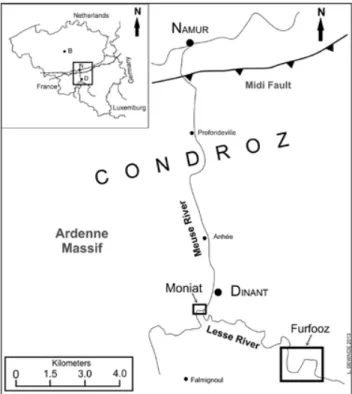
The studied sites are located in Belgium, in the area of Dinant (Fig. 1). Two Waulsortian sites have been studied, especially addressing karst development, namely Furfooz, along the Lesse valley, and Moniat standing in the Meuse valley. The landscape consists of a large undulating plateau area (called “le Condroz”) cut by those two valleys. The maximum altitudes rise around 280 m above sea level and the baseflow level is around 100 m. From a geological point of view, the Dinant area represents the front part of a thrust sheet (the Ardenne allochton) limited to the North by the Midi Fault. The Ardenne allochton has been folded and faulted during the Variscan orogeny (Michot, 1980; Meilliez et al., 1991; Vanbrabant, 2001; Lacquement et al., 2005). In Belgium, karst is developed in various Devonian and Carboniferous limestone
formations of the Ardenne massif (Van den Broeck et al., 1910). These karst networks are related to the rivers cutting within the Ardenne massif during Late Tertiary to Early Quaternary (Ek, 1976; Quinif, 1989).
Waulsortian limestones buildup started during the late Tournaisian and lasted till the Tournaisian-Visean transition. These strata consist of mudstones and wackestones showing a mono-specific fauna indicating marine settings extending from depths of several hundred meters to relatively shallow, photic environment. They represent local, lenticular mud accumulation several kilometers in length and around 300 meters in thickness. Secondary dolomitization at regional scale has notably affected
Figure 1. Localization of the studied area: the Meuse and Lesse valleys in
44 L. DeWaiDe, J.-M. BaeLe, P. coLLon-DrouaiLLeT, Y. QuiniF, G. rocHeZ, s. vanDYcKe & v. HaLLeT
Figure 2. Geological context of
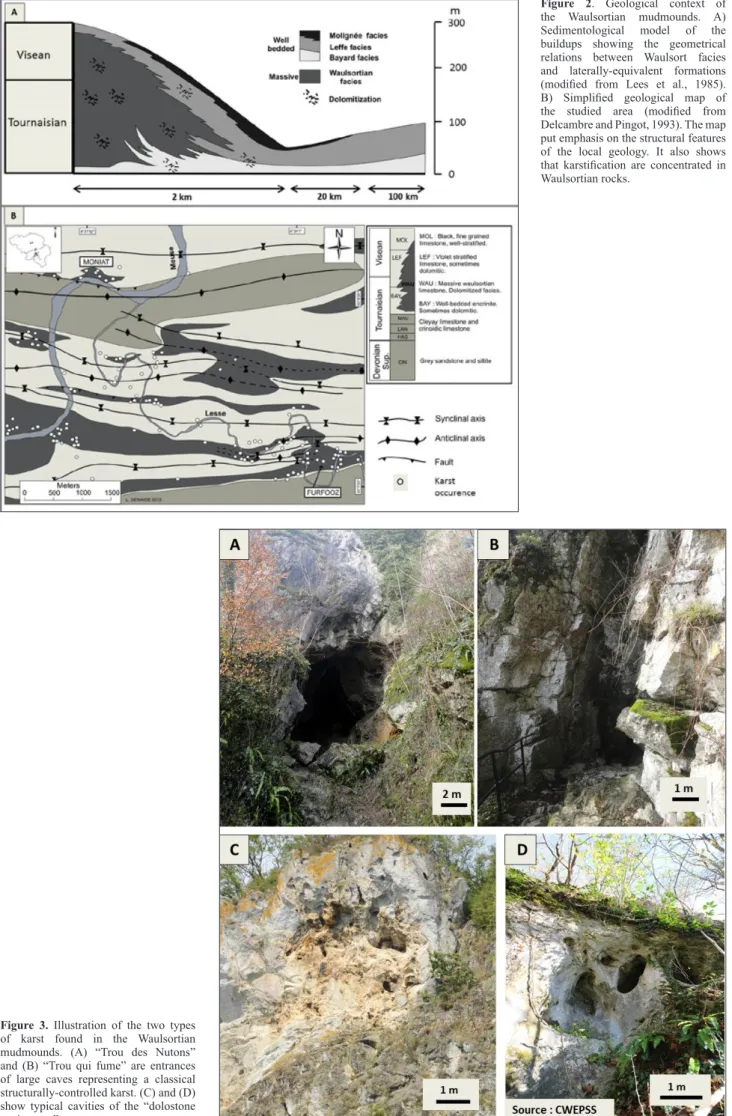
the Waulsortian mudmounds. A) Sedimentological model of the buildups showing the geometrical relations between Waulsort facies and laterally-equivalent formations (modified from Lees et al., 1985). B) Simplified geological map of the studied area (modified from Delcambre and Pingot, 1993). The map put emphasis on the structural features of the local geology. It also shows that karstification are concentrated in Waulsortian rocks.
Figure 3. Illustration of the two types
of karst found in the Waulsortian mudmounds. (A) “Trou des Nutons” and (B) “Trou qui fume” are entrances of large caves representing a classical structurally-controlled karst. (C) and (D) show typical cavities of the “dolostone cavity type”.
the Waulsortian rocks conducting to the coexistence of dolostone and limestone patches. According to Miller (1986), dolomitization of the Waulsortian limestones corresponds to the last diagenetic stage following cementation and occured during deep burial. Buildups pinch out laterally and give way to peri- and post-waulsortian facies called the Bayard, Leffe and Molignée Facies (Fig. 2A) (Lees et al., 1985; Lees, 1997; Poty et al., 2001). These laterally-equivalent facies are well-stratified in contrast to the mudmounds, which mostly show a crude stratification except for some few well-bedded intervals. These dominantly non-stratified units display a peculiar behavior with respect to tectonic deformation. Therefore, despite that the basement in the study area was mainly structured by Variscan tectonics, folding is not really manifested in the mudmounds (Brodkom, 1994). Folds in the Devono-Carboniferous deposits in the region are oriented West-East and are usually slightly overturned towards the North with strongly dipping beds (Fig. 2B).
3. Field observations
The dolomitized Waulsortian limestones and the peri- and post-Waulsortian facies occur adjacent to various regional limestone deposits. Although the Bayard and Leffe Facies are also dolomitized, the Molignée and the early Tournaisian formations (Hastière, Landelies and Maurenne Formations) are pure limestones usually not affected by dolomitization, and they may be argillaceous. Reports on karst occurrence (CWEPSS, 1999) clearly indicate that Waulsortian rocks are more karstified
compared to other adjacent Carboniferous limestones (Fig. 2B). Field observations of the karst development in the Waulsortian buildups allow distinguishing two types of karst features (Fig. 3). First, a subordinate karst occurrences correspond to structurally-controlled, classical caves with large conduits developed along a preferential direction. Secondly, rather small (centimeters to a few meters long) and very frequent cavities are developed preferentially in the dolomitized parts of the mudmounds. This study focuses on this last type of cavities, which is named “the dolostone cavity type”.
The observation of numerous occurrences of “dolostone cavity type” on the field (Fig. 4) allowed unraveling the controlling lithological features associated with these cavities. Two major characteristics were observed. First, karstification is preferentially developed along one or several fractures. Second, although the “dolostone cavity type” is found within dolomitized rocks, a calcitic transition zone outlines almost systematically the boundary of the cavities. This transition zone has an elongated lenticular outer shape with its major axis oriented parallel to the fracture. It consists of coarse crystalline calcite as well as microcrystalline reddish calcite. The coarse crystalline calcite can take the form of large calcite rhombohedra that can reach a decimeter in size and that preferentially line the walls of the cavity and fracture axes. Fig. 5 is a sketch of “the dolostone cavity type” that shows the features associated to its development: fractures geometrically related to the cavities, rhombohedra lining the cavities, calcitic zone surrounding the cavities.
Figure 4. Field occurences of the
“dolostone cavity type” at various scales. (A) Centimetric cavity developed on a microfracture [MF]. Calcite crystals are visible on the walls of the cavity. (B) Metric cavity partially filled with large rhombohedra, the inset on the right shows a zoom on the rhombohedra. (C) Metric cavity related to a fracture [F]. A calcitic transition zone [CTZ] is developed between the cavity and the host dolostone [D]. (D) Moniat site with the inset zooming on the cavities and (E) “Puits des Vaux” in Furfooz are metric to plurimetric cavities showing fracture axis [F] and calcitic transition zone [CTZ].
46 L. DeWaiDe, J.-M. BaeLe, P. coLLon-DrouaiLLeT, Y. QuiniF, G. rocHeZ, s. vanDYcKe & v. HaLLeT
Structural features of the fractures associated with the “dolostone cavity type” are presented in the stereogram in Fig. 6. Two main fracture groups are visible: a first family, represented by strongly dipping planes (60° to 80°) with a roughly E-W strike, is actually parallel to regional stratification. The second family of fractures can be identified as subvertical diaclases their direction varies around N170E which is roughly perpendicular to the stratification. Brodkom (1994) recognized the same fracture groups and added a third one defined also as diaclase planes with a similar direction (N170E) but a weaker dip (10° to 35°). The plots in the center of the stereogram in Fig. 6 could correspond to this third group. According to Brodkom, these groups of fractures are related to the Variscan orogeny.
4. Laboratory investigations
4.1. Material and methods
One well developed occurrence of the “dolostone cavity type” was chosen based on representativeness, exposure and access conditions. The chosen outcrop is similar to the sketch shown in Fig. 5. Samples were collected along various transects with a coring machine (Fig. 7). Sampling density was usually 2 samples per meter along transects, except near the cavity where it was increased to 4 samples/m.
X-ray fluorescence analyses (XRF) were performed at the Central laboratory of Lhoist industry (Lhoist West Europe Division). However, these analyses were realized randomly and only the basic chemical elements were analyzed (Ca, Mg, Fe, Al,
Mn and Si). As the bulk chemical composition of the samples didn’t reveal any useful conclusions within the framework of this paper, the results are not presented here.
Thin sections were made from each drilled core. Prior to sawing, the samples were impregnated in epoxy resin for a few days. After mounting on glass slides, the sections were thinned to 40 µm and left uncovered. The thin sections were first studied with a Leica polarizing microscope. They were then diamond-polished for cathodoluminescence (CL) analysis at the University of Mons, Department of Geology and Applied Geology, using a CITL Mk5 unit operated at 15 kV and 500 µA beam voltage and current, respectively. The distinction between calcite and dolomite under CL, which may be ambiguous based solely on visual appearance of their emission colours, was checked using a CITL COS 8200 optical spectrometer. In our samples, calcite and dolomite were emitting at ca. 600 (yellow) and 645 nm (red), respectively, which is consistent with the published Mn2+-activated CL emission for these carbonate minerals (e.g. Marshall, 1988).
4.2. Petrography
Field observations permitted to discriminate three main rock textures implied in the “dolostone cavity type”. Fig. 8 shows core samples representing these three textures: i) porous, grey dolomite, ii) coarse calcite, which can take the form of cleaved rhombohedra, iii) reddish, microcrystalline calcite. The three macroscopic textures were studied under conventional
Figure 5. Sketch of a “dolostone cavity type”, here hosted in a crudely
subverticaly stratified dolomitic interval of the mudmounds. The development of cavities [C] is related to fracturation. Calcite rhombohedra are mainly concentrated on the walls of the cavities and in open fractures. A lenticular transition zone made of micro- to macro-crystalline calcite exists between the cavities and the host dolostone.
Figure 6. Fracturing land survey results. Measurements were made on
fractures affecting the Waulsortian rocks in the Furfooz site. Π-pole method: Family [1] close to the poles has a strong dip (between 60 and 80 °) and a N80E –N90E strike; family [2] are diaclase planes with a N170E direction and a subvertical dip; family [3], less frequent, is also a diaclase group with a N170E direction but a low dip.
Figure 7. Sampling map of one occurrence of the “dolostone cavity type”.
Sampling line 1 roughly follows the fracture axis while lines 2 and 3 are roughly perpendicular.
Figure 8. Main macroscopic aspect of the samples. (A) Rhombohedra
[R] and coarse crystalline calcite [cc]; (B) reddish, fine crystalline to microcrystalline calcite; (C) grey dolomite, arrows point to porosity.
microscopy and cathodoluminescence. The latter permitted to precise that the reddish microcrystalline calcite is most probably dedolomite.
4.2.1. Microscopic fabric description
a) Dolomite (Fig. 9A)
The porous grey dolostone appears as a massive dolostone showing a dolospar fabric which consists of planar and non-planar dolomite. The non-planar crystals have a subhedral to euhedral morphology and a size between 50 and 250 µm. They commonly possess a more or less cloudy center. Anhedral, non-planar dolomite crystals are somewhat larger (150 to 350 µm) but their boundaries are not well-defined. The texture is thus close to the “planar-s hypidiotopic mosaic” described by Sibley and Gregg (1987). This dolostone relates to a secondary dolomitization of the Waulsortian mudmounds obliterating the original limestone texture. Initial porosity of the dolostone is rather high (visual estimation at ~ 5%).
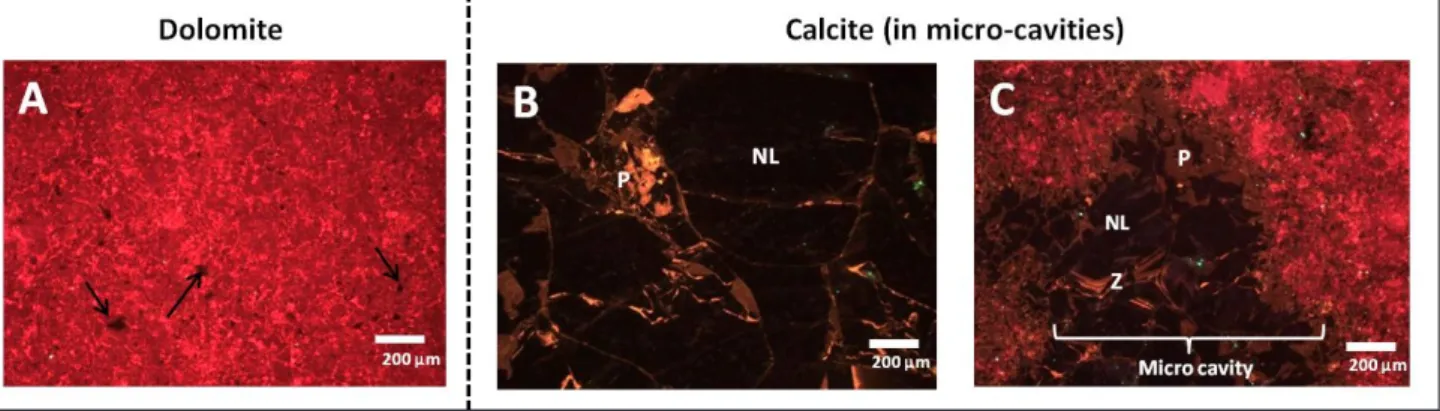
b) Calcite in cavities (Fig. 9B,C)
The calcite mentioned here is the one that fills cavities corresponding to enlarged fractures and not to an inter-granular porosity. The cavities are micrometer to centimeter large at the thin-section scale. Calcite crystals filling them up are subhedral to euhedral and their size is variable but they can reach a few centimeters. Under CL, a succession of three calcite phases can be observed from the wall to the center of the cavities: 1) dull yellow
brown-luminescing calcite with patches of non-luminescing calcite (“patchy” or “P calcite”), 2) non-luminescing (“NL calcite”) and 3) zoned calcite (“Z calcite”), in which luminescing and non-luminescing fringes are alternating. This third phase is not always present in the succession but may dominate in some of the largest cavities.
c) Dedolomite (Fig. 10)
The third texture observed consists of a complex dedolomite fabric. Actually two fabrics can be distinguish. A first dedolomite -DD I- appears, under CL, as a mixture of calcite and corroded dolomite crystals (Fig. 10A). Budaï et al. (1984) stated that petrographic evidences for dedolomitization include: 1) corroded dolomite rhombs edges, 2) partial dolomite rhombs floating in a calcite matrix and 3) calcite patches within the core of dolomite rhombs. The fabric shown in Fig. 10 A and A’ reflects these three features. It can clearly be defined as dedolomite given that dolomite crystals exhibit both peripheral and internal corrosion. The calcite intergrown with corroded dolomite is interpreted as replacement calcite. This replacement calcite is mainly patchy-blotchy “P” calcite under CL (Fig. 10A’). Another dedolomite fabric (DD II) can be differentiated and develop as coarser, euhedral calcite crystals with sharp boundaries and enclosing dolomite inclusions in their centre (Fig. 10B’). In this dedolomite fabric, P calcite can still be present and in this case is intergrown
Figure 9. A) Dolomite fabric and calcite-filled micro-cavities under cathodoluminescence. Dolomite exhibits bright red luminescence. Porosity appears
as dark spots (arrows). B) and C) Calcite filling micro-cavities. The calcite succession (patchy [P], non-luminescing [NL] and zoned [Z]) is well represented in (C) whereas in B the Z phase is not observed.
Figure 10. Dedolomite fabrics
under cathodoluminescence. Dolomite exhibits bright red luminescence, calcite is yellow to brown or non-luminescing. (A) DD I fabric: Relic rhombs are floating in an intergrown patchy calcite matrix. Patchy calcite has partially replaced the corroded rhombs. (A’) Detail of a dedolomite crystal with patchy calcite [P] replacing the corroded dolomite rhomb [DR]. (B) DD II fabric: euhedral dedolomite crystal. (B’) Detail of euhedral dedolomite with sharp crystal boundaries (represented by the dashed line). Dolomite relics [DR] are visible in the center of the crystals.
48 L. DeWaiDe, J.-M. BaeLe, P. coLLon-DrouaiLLeT, Y. QuiniF, G. rocHeZ, s. vanDYcKe & v. HaLLeT
with the dolomite relics in the center of the crystal. However, the major phases in terms of volume are the NL and Z calcite that seem to have overgrown euhedral dedolomite crystals as if they cemented inter- and intra- granular voids.
d) Relationships between the fabrics and interpretation
The distribution of the three fabrics along a sequence 1) dolomite, 2) dedolomite and 3) calcite, reveals the existence of a petrographic gradient developing along the cavities network. The photomicrograph sequence presented in Fig. 11 shows clearly the three fabrics and their organized relationship.
Fig. 12 sketches the various steps leading to the observed fabric distribution. The process presented here is clearly established from a cavity system being developed along a fracture network. The starting point is dissolution acting from permeable pathways (fractures) through the host rock. Dissolution enlarged the existing fractures creating cavities where dolomite dissolution was total and left a porous material made of corroded dolomite in the vicinity of the former fracture. Benefiting of the porosity created by dissolution, fluids flew through the rock operating a replacement of the already corroded dolomite by the patchy calcite (dedolomitization sensu stricto). Finally non-luminescing and zoned calcite cemented voids including intra- and inter granular porosity and larger cavities (cementation). The host dolostone replacement and cementation level follows a gradient which is decreasing as the distance from the cavity increases.
In the literature dedolomitization process is described as a conversion from dolomite to calcite. This conversion is either described as a one-step replacement process, where dissolution of dolomite and calcite replacement occur almost synchronously within a thin, moving reaction front, or as a two-step process where calcite simply cemented the voids created by dissolution (Evamy, 1967, Back et. al., 1983; Budaï et al., 1984, Jones et al., 1989; Ayora et al., 1998). Our observations suggest that both processes have occurred either separately or in combination. Indeed dissolution of dolomite followed by precipitation of calcite in the resulting voids is a two-step process which could correspond to the euhedral dedolomite fabric (DD II) and is consistent with other studies (Jones et al., 1989, James et al., 1993, Qing, 1999, Nader et al., 2003, 2008, Ronchi et al., 2004).
DD II is then the result of cementation in the inter- and intra-granular voids of the corroded dolomite and could therefore be called dedolomite sensu lato. On the other hand, the fine-grained, patchy-luminescing calcite intergrown with dolomite (DD I) is interpreted here as replacive dedolomitization (dedolomitization
s.s.). However, patchy-luminescing calcite is often reported
as a first stage calcite cementation. It is thus possible that this calcite is at least partly void-filling and not strictly replacive.
5. Discussion and perspectives
A preliminary karst genetic model based on morphological, petrographic and geochemical data can be proposed (Fig. 13). This model reflects the processes presented in Fig. 12 but at macroscopic scale. At first, dissolution of the initial dolostone took place along the discontinuities represented by the fracture network. Fluids penetrated the rock causing pervasive dissolution that progressed from the fractures into the rock. A heterogeneous highly porous material was created and open cavities developed locally. This porous material can be compared to the “Ghost Rock” (Quinif, 1999; Quinif, 2010), whose formation is a general process of in situ dissolution of rocks (here dolomite) that can further evolve to more classical forms of karst. Subsequently, dedolomitization occurred by direct replacement of dolomite (dedolomitization s.s.). This replacement step is followed by cementation that came probably much later. On the one hand calcite cementation produced fabric DD II when occuring in the inter- and intra-granular voids of the altered dolomite, and on the other hand cement fluids precipitated coarse calcite in cavities, i.e. rhombohedra in the largest one. One must be aware that cementation is not necessarily linked to the timing of the karstification/dissolution. However as cementation profited of the voids created by dissolution and as the calcite cement is a major petrographic feature of the “dolostone cavity type”, the cementation is presented as a step of the karst genetic model in order to explain what is observed today in the field.
The environmental, dynamic and hydrological conditions in which this model could be contextualized have yet to be investigated. Indeed, it is generally accepted that limestone has a higher dissolution rate than dolostone, i.e. 3 to 60 times
Figure 11. Sequence of catho-
doluminescence photomicro-graphs showing a petrographic gradient from calcite to dolomite. [D] dolomite, [DD] dedolomite, [C] calcite-filled cavity.
Figure 12. Sketch of the
process leading to the observed fabrics and their distribution at thin-section scale. Dissolution occurs from a fracture affecting the initial dolospar. Dissolution creates a cavity [C]by enlargement of the initial fracture and inter- and intra-granular porosity (pointed by arrows) that decreases away from the initial fracture. The corroded dolomite crystals are then entirely or partly dedolomitized through replacement (DD I). The last step consists of calcite cementation (void-filling) in inter- and intra-granular porosity and in the cavity. The petrographic gradient is the end result with [CC] calcite in cavities, [DD] dedolomite texture, [D] dolomite. The replacement step is probably inexistent in DD II (euhedral dedolomite), the latter is then a dedolomite s.l. resulting from two processes not linked in time: first dolomite dissolution, second calcite cementation in the inter- and intra-granular porosity.
higher depending on the conditions (Liu et al., 2005). Dissolution is controlled by physico-chemical factors such as pCO2 and temperature but also by other agents such as the hydrodynamic conditions or the CO2 conversion rate in H+ and HCO3- (Liu and Dreybrodt, 1997; Liu et al., 2005; Pokrovsky et al., 2009). Specific conditions, such as a low Mg/Ca or the presence of dissolved sulphate, must then have prevailed to explain that at some stage dolomite was relatively more soluble than calcite.
Dedolomitization is commonly reported as related to subaerial exposure of dolostone (Swennen et al., 1982; Friedmann, 1994; Cañaveras et al., 1996; Nader et al., 2003). Beside, other studies have suggested that the process also take place in deep environment, i.e. through burial diagenetic process (Land and Prezbindowski, 1981; Budai et al., 1984; Woronick and Land, 1985). As an important driving mechanism of dolomite dissolution, the presence of dissolved sulphate is often invoked: calcium sulfate-rich fluids deriving from the dissolution of evaporites (mainly gypsum) provide calcium and catalyze dedolomitization reactions (Bischoff, 1994; Raines et al., 1997; Arenas et al., 1999). Evaporitic conditions are known in the Visean geological history in Belgium. Evaporite dissolution and subsequent circulation of sulfate enriched solutions have been reported, essentially in the Dinant Sedimentation Area (Boulvain and Pingot, 2012). However evaporite dissolution is not systematically associated with dedolomitization and another source of calcium needs to be found, as pointed out by other studies (Frank, 1981; Theriault and Hutcheon, 1987; Deike, 1990; Khalaf and Abdal, 1993; Ronchi et al., 2004). In the Waulsortian buildups, the origin of calcium ions responsible for dolomite replacement and for calcite cementation could be explained by the heterogeneity of the initial dolomitization and the resulting coexistence of limestone and dolostone. In addition, rocks are dominated by limestones in the study area. Therefore it is likely that fluids flowing through the mudmounds were initially close to equilibrium with limestone, i.e. saturated with respect to calcite and undersaturated with respect to dolomite. These Ca-rich and Mg-depleted fluids were thus potentially reactive against Waulsortian dolostone and this resulted in dolomite dissolution and calcite precipitation. Changes in fluid chemistry and/or in flow regime must however have
existed to explain the prevalence of either dolomite dissolution, dolomite replacement by calcite or calcite cementation.
Finally, the fact that karst occurs preferentially in the dolomitized parts of the mudmounds (see 3.) can be explained by the petrophysical properties of dolostone relative to typical limestones. First, dolostone has in this case higher porosity than limestone. Our petrographic observations have indeed shown that the waulsortian dolostone has a rather high porosity (see 5.2.1). Second, dolostone and limestone have a different response to geomechanical stress. Brodkom (1994) inferred that Waulsortian dolostone bodies acted as massive brittle nuclei during the Variscan orogeny whereas limestone had a more ductile behavior. Dolostone bodies with their higher permeability relative to the surrounding limestone are thus capable of channelizing fluids, which explains their high concentration in alteration and karst features. Likely the connectivity of these bodies at regional scale is an additional important parameter, but the latter remains to be investigated.
Assessing the paleoconditions is a key point in understanding the development of the “dolostone cavity type” karst and it will require the use of advanced techniques, including trace-element and isotope geochemistry, dating and fluid inclusions studies. Future analysis should also include the investigation of other cavities in order to check the consistency of our results at a wider scale and test the genetic model developed so far. Finally, a more detailed structural study has to be carried out in order to link the history of mudmounds fracturing with the development of dedolomitization and karstification processes.
6. Conclusions
Field observations on the locally dolomitized Waulsortian mudmounds lead to the description of specific karst occurrences called “dolostone cavity type”. These karsts are concentrated within dolomitized parts of the mudmounds and exhibit specific features, i.e., the association with one or several fractures and the presence of a calcitic transition zone. The occurence and origin of the “dolostone cavity type” is probably related to the heterogeneous dolomitization of the Waulsortian rocks where
Figure 13. Proposed genetic
model for the development of “dolostone cavity type” karst in Waulsortian mudmounds. (A) Initial dolostone. Here presented with a crude subvertical stratification and a fracture network developed parallel to the stratification. (B) Creation of porosity and cavities [C] by heterogeneous dissolution of the dolostone. Porosity is preferentially developed along fractures. (C) Replacive dedolomitization of the altered dolostone occurs from the porosity development. Creation of the DD I. (D) Final step with cementation fluids precipitating calcite in the residual porosity. Creation of the sensu lato dedolomite and of calcite cement in the cavities. Cement grew as calcite rhombohedra in the largest voids (cavities) but the latter were not completely filled so that residual karstic cavities are observable today. (E) Comparison with field observation (the dedolomite/ calcite zone [DD-C] is outlined).
50 L. DeWaiDe, J.-M. BaeLe, P. coLLon-DrouaiLLeT, Y. QuiniF, G. rocHeZ, s. vanDYcKe & v. HaLLeT
dolostone bodies acted as permeable pathways due to their high porosity and abundant fractures relative to the host limestone.
Field, petrographical and cathodoluminescence analyses reveal that the development of “dolostone cavity type” karsts involves dedolomitization and cementation processes. Fluids first invaded the rock through the fracture network and created a highly porous dolostone material by pervasive dissolution as well as open cavities. Fabric analysis under CL suggests that replacive (“single-step”) dedolomitization has occurred. Furthermore, altered rocks were cemented by calcite precipitation in pores, which can be referred to as a two-step dedolomitization process. Calcite fluids cemented as well the cavities, precipitating large calcite crystals in the cavities. These processes are not necessarily linked in time but they are the different steps leading to the actual occurrences of the “dolostone cavity type” and its major features described on the field. The different processes require a change in fluid chemistry and/or flow regime. These changes could have happened in a large range of environments from burial conditions to subaerial exposure.
7. Acknowledgments
The authors would like to thank the Lhoist Central Laboratory for the X-Ray analyses. We are grateful to “Ardenne et Gaume” for the access to the Furfooz Natural Reserve, and in particular to Ch. Goffin, curator of the park. The authors are also grateful to Prof. F. Boulvain and R. Swennen for their critical reviews. This study is part of the first author Ph.D. thesis at the University of Namur.
8. References
Arenas, C., Alonso Zarza, A.M. and Pardo, G. 1999. Dedolomitization and other early diagenetic processes in Miocene lacustrine deposits, Ebro Basin (Spain). Sedimentary Geology, 125, 23-45.
Ayora, C., Taberner, C., Saaltink, M.W. and Carrera, J., 1998. The genesis of dedolomites : a discussion based on reactive transport modeling. Journal of hydrology, 209, 1-4, 346-365.
Back, W., Hanshaw, B.B., Plummer, L.N., Rahn, P.H., Rightmire, C.T. and Rubin, M., 1983. Process and rate of dedolomitization Mass transfer and 14C dating in a regional carbonate aquifer. Geological Society of America Bulletin, 94, 1415-1429.
Bischoff, J.L., Julia, R., Shanks, W.C. and Rosenbauer, R.J. 1994. Karstification without carbonic acid : bedrock dissolution gypsum-driven dedolomitization. Geology, 22, 995-998.
Boulvain F. and Pingot, J-L., 2012. Genèse du sous-sol de la Wallonie. Académie Royale de Belgique, Mémoire de la Classe des Sciences, 2082, 190 p.
Brodkom, F., 1994. Les rôles et comportements tectoniques de mudmounds waulsortiens au sein de series calcaro-schisteuses dinantiennes lors des déformations varisques. Etude des déformations de lithofaciès structuraux en divers domaines waulsortiens du synclinorium de Dinant, du synclinorium de Laval et du sud de l’Irlande. Thèse de doctorat, Université Catholique de Louvain, Belgique, 282 p. Budai, J.M., Lohmann, K.C. and Owen, R.M., 1984. Burial dedolomite
in the Mississippian Madison Limestone, Wyoming and Utah Thrust Belt. Journal Sedimentary Petrology, 54, 276-288.
Cañaveras, J.C., Sánchez-Moral, S., Calvo, J.P., Hoyos, M. and Ordóñez, S., 1996. Dedolomites associated with karstification. An example of early dedolomitization in lacustrine sequences from the Tertiary Madrid Basin, Central Spain. Carbonates and Evaporites, 11, 1, 85-103.
Commission Wallonne d’Etude et de Protection des Sites Souterrains (CWEPSS), 1999. Atlas du karst wallon : Haute Meuse. Ministère de la Région Wallonne, Direction Générale des Ressources Naturelles et de l’Environnement, 547 p.
Deike, R.D., 1990. Dolomite dissolution rates and possible Holocene dedolomitization of water bearing units in the Edwards aquifer, south-central Texas. Journal of Hydrology, 112, 335-373.
Delcambre, B. and Pingot, J.L., 1993. Carte géologique Hastière-Dinant éditée par le Ministère de la Région Wallonne, Direction Générale des Ressources Naturelles et de l’Environnement.
Ek, C., 1976. Les phénomènes karstiques. In Pissart, A. (éd), Géomorphologie de la Belgique, 138-158.
Evamy, B.D., 1967. Dedolomitization and the development of rhombohedral pores in limestones (Upper Cambrian), Southeast Missouri. Journal of Sedimentary Petrology, 5, 7-17.
Frank, J.R., 1981. Dedolomitization in the the Taum Sauk limestones (Upper Cambrian), Southeast Missouri. Journal of Sedimentary Petrology, 51, 1, 7-18.
Friedman, G.M., 1994. Upper Cambrian-Lower Ordovician (Sauk) platform carbonates of the Northern Appalachian (Gondwana) passive margin. Carbonates and Evaporites, 9, 143-150.
Jones, B., Pleydell, S.M., Ng, K.C. and Longstaffe, F.J., 1989. Formation of poikilotopic calcite-dolomite fabric in the Oligocene-Miocene Bluff Formation of the Ground Cayman British West Indies. Bulletin of Canadian Petroleum Geology, 3, 255-265.
James N.P., Bone Y. and Kyser T.K., 1993. Shallow Burial Dolomitization and Dedolomitization of Mid-Cenozoic, Cool-Water, Calcitic, Deep-Self Limestones, Southern Australia. Journal of Sedimentary Petrology, 63, 3, 528-538.
Khalaf, F.I. and Abdal, M.S., 1993. Dedolomitization of dolocrete deposits in Kuwait, Arabian Gulf Geologische Rundschau, 82, 741-749. Lacquement, F., Averbuch, O., Mansy, J.L., Szaniawskib, R. and
Lewandowski, M., 2005. Transpressional deformations at lateral boundaries of propagating thrust-sheets: the example of the Meuse Valley Recess within the Ardennes Variscan fold-and-thrust belt (N France–S Belgium). Journal of Structural Geology, 27, 1788-1802. Land, L.S. and Prezbindowski, D.R., 1981. The origin and evolution of
saline formation waters, lower Cretaceous carbonates, south-central Texas, U.S.A. Journal of Hydrology, 54, 51-74.
Lees, A., 1982. The paleoenvironmental setting and distribution of the Waulsortian facies of Belgium and southern Britain. In Symposium of the Environmental Setting and Distribution of the Waulsortian Facies (Ed. by Bolton, Lane and Lemone), 1-16, El Paso Geological Society and University of Texas at El Paso.
Lees, A., 1997. Biostratigraphy, sedimentology and palaeobathymetry of Waulsortian buildups and peri-Waulsortian rocks during the Late Tournaisian regression, Dinant area, Belgium. Geological Journal, 32, 1-36.
Lees, A., 2006. Waulsortian. Geologica Belgica, 9, 151-155.
Lees, A and Miller, J., 1995. Waulsortian Banks. In Carbonate Mud-Mounds: Their Origin and Evolution (eds C. L. V. Monty, D. W. J. Bosence, P. H. Bridges and B. R. Pratt), Blackwell Publishing Ltd., Oxford, UK.
Lees, A., Hallet, V. and Hibo, D., 1985. Facies variation in Waulsortian buildups. Part 1. A model from Belgium. Geological Journal, 20, 133-158.
Liu, Z. and Dreybrodt, W., 1997. Dissolution kinetics of calcium carbonate minerals in H2O-CO2 solutions in turbulent flow: the role
of the diffusion boundary layer and the slow reaction H2O+CO2↔H+
+ HCO3- . Geochimica et Cosmochimica Acta, 61, 2879-2889.
Liu, Z., Yuan, D. and Dreybrodt, W., 2005. Comparative study of dissolution rate-determining mechanisms of limestone and dolomite. Environmental Geology, 49, 274-279.
Marshall, D.J., 1988. Cathodoluminescence of Geological Materials. Boston, Unwin Hyman, 146 p.
Meilliez, F., André, L., Blieck, A., Fielitz, W., Goffette, O., Hance, L., Khatir, A., Mansy, J.L., Overlau, P. and Verniers J., 1991. Ardenne-Brabant. Sciences Géologiques Bulletin 44, 3–29.
Michot, P., 1980. Belgique. In Dunod (éd), Géologie des pays européens : France, Belgique, Luxembourg, Paris.
Miller, J., 1986. Facies relationships and diagenesis in Waulsortian mudmounds from the Lower Carboniferous of Ireland and N. England. In: Schroeder, J.H., Purser, B. (Eds.), Reef Diagenesis. Springer-Verlag, 311 – 335.
Nader, F.H., Swennen, R. and Ottenburgs, R., 2003. Karst-meteoric dedolomitization in Jurassic carbonates, Lebanon. Geologica Belgica, 6, 3-23.
Nader, F.H., Swennen R. and Keppens, E., 2008. Calcitization/ dedolomitization of Jurassic dolostones (Lebanon): results from petrographic and sequential geochemical analyses. Sedimentology, 55, 1467–1485.
Pokrovsky, O.S., Golubev, S.V., Schott, J. and Castillo, A., 2009. Calcite, dolomite and magnesite dissolution kinetics in aqueous solutions at acid to circumneutral pH, 25 to 150°C and 1 to 55 atm pCO2: New
constraints on CO2 sequestration in sedimentary basins. Chemical
Geology, 265, 20-32.
Poty, E., Hance, L., Lees, A. and Hennebert, M., 2001. Dinantian lithostratigraphic units (Belgium). Geologica Belgica, 4, 69-94.
Qing, Z., 1999. Carbonate diagenesis and porosity evolution in the Guelph Formation, Southwestern Ontario. PhD thesis, University of Waterloo, Ontario, Canada, 265 p.
Quinif, Y., 1989. Paleokarsts in Belgium. In Elsevier and Academia (ed), Bosak, P., Ford, D.C., Glazek, J., Horacek, I. Paleokarst : A Systematic and Regional Review, Amsterdam and Praha, 35-50. Quinif, Y., 1999. Fantômisation, cryptoaltération et altération sur roche
nue. Le tryptique de la karstification. Actes du Colloque Européen Karst-99, 159-164.
Quinif, Y, 2010. Fantôme de roche et Fantômisation. Essais sur un nouveau paradigme en karstogenèse. Karstologia-Mémoires, 18, 196 p.
Raines, M.A. and Dewers, T.A., 1997. Dedolomitization as a driving mechanism for karst generation in Permian Blaine Formation, Southwestern Oklahoma, USA. Carbonates and Evaporites, 12, 1, 24-31.
Ronchi, P., Jadoul, F. and Savino, R., 2004. Quaternary dedolomitization along fracture systems in a late Triassic dolomitized platform (western southern Alps, Italy). Carbonates and Evaporites, 19, 1, 51-66.
Sibley, D.F. and Gregg, J.M., 1987. Classification of dolomite rock structure. Journal of Sedimentary Research, 57, 6, 967-975. Swennen, R., Boonen, P. and Viaene, W., 1982. Stratigraphy and
lithogeochemistry of the Walhorn section (Lower Visean, Vesder Basin, East Belgium) and its implications. Bulletin de La Société Belge de Géologie, 91, 239-258.
Theriault, F. and Hutcheon, I., 1987. Dolomitization and calcitization of Devonian Grosmont Formation, Northern Alberta. Journal of Sedimentary Petrology, 57, 6, 955-966.
Vanbrabant, Y., 2001. Evolution géodynamique de la partie orientale de l’allochtone de l’Ardenne. Observations structurales et modélisations numériques. Thèse de Doctorat, Université de Liège, 350 p. Van den Broeck, E., Martel, E.A. and Rahir, E., 1910. Les cavernes et
rivières souterraines de la Belgique. Lamertin, Bruxelles.
Woronick, R.E. and Land, L.S., 1985. Late burial diagenesis, Lower Cretaceous Pearsall and Lower Glen Rose formations, South Texas. In Schneidermann N. and Harris P.M. (eds.), Carbonates cements, Special Publication of the Society of Economical Paleontology Mineralogists, Tulsa, 36, 265-275.
Manuscript received 15.01.2013, accepted in revised from 09.08.2013, available online 15.11.2013