HAL Id: tel-02171934
https://tel.archives-ouvertes.fr/tel-02171934
Submitted on 3 Jul 2019HAL is a multi-disciplinary open access archive for the deposit and dissemination of sci-entific research documents, whether they are pub-lished or not. The documents may come from teaching and research institutions in France or abroad, or from public or private research centers.
L’archive ouverte pluridisciplinaire HAL, est destinée au dépôt et à la diffusion de documents scientifiques de niveau recherche, publiés ou non, émanant des établissements d’enseignement et de recherche français ou étrangers, des laboratoires publics ou privés.
Amna Abidi
To cite this version:
Amna Abidi. Imperfect RDF Databases : From Modelling to Querying. Other [cs.OH]. ISAE-ENSMA Ecole Nationale Supérieure de Mécanique et d’Aérotechique - Poitiers; Université de Tunis, 2019. English. �NNT : 2019ESMA0008�. �tel-02171934�
Pour l’obtention du Grade de
DOCTEUR DE L’ECOLE NATIONALE SUPERIEURE DE
MECANIQUE ET D’AEROTECHNIQUE DE POITIERS et DE
L’INSTITUT SUPERIEUR DE GESTION DE TUNIS
(Diplˆome National - Arrété du 25 Mai 2016)Ecole doctorale: Sciences et Ingénierie des Syst`emes, Mathématiques, Informatique
Secteur de recherche: INFORMATIQUE ET APPLICATIONS Présentée par
Amna ABIDI
Imperfect RDF Databases: From Modelling to
Querying
Directeurs de thèse: Allel HADJALI et Boutheina BEN YAGHLANE *********************
Soutenue le 11 Juin 2019 devant la commission d’examen
*********************
JURY
-Rapporteurs:Président de jury Djamal BENSLIMANE Professeur Univ. Lyon 1, France
Hajer BAAZAOUI MC-HDR Univ. de la Manouba, Tunisie
Membres de jury:
Juliette DIBIE BARTHELEMY Professeur AgroParisTech, France Salah BEN ABDALLAH Professeur Univ. de Tunis, Tunisie
Allel HADJALI Professeur ENSMA, France
The ever-increasing interest of RDF (Resource Description Framework) data on the Web has led to several and important research efforts to enrich traditional RDF data formalism for the exploitation and analysis purpose. The work of this thesis is a part of the continuation of those efforts by addressing the issue of RDF data management in presence of imperfection (untruthfulness, uncertainty, etc.). As a first part of our dissertation, we particularly tackled the trusted RDF data model. Hence, we proposed to extend the skyline queries over trust RDF data, which consists in extracting the most interesting trusted resources according to user-defined criteria. To this end, we introduced appropriate semantics of the Trust-skyline, the set of the most interesting resources in a trust RDF dataset. Then, we studied via statistical methods the impact of the trust measure on the Trust-skyline set.
Second, we integrated in the structure of RDF data (i.e., subject-property-object triple) a fourth element expressing a possibility measure to reflect the user opinion about the truth of a statement. To deal with possibility requirements, appropriate framework related to language is introduced, namely Pi-SPARQL, that extends SPARQL to be possibility-aware query language.
Finally, we studied a new skyline operator variant to extract possibilistic RDF resources that are possibly dominated by no other resources in the sense of Pareto optimality. We introduced a dominance relation and a skyline model adapted to the aforementioned kind of data. For experiments, we introduced a new algorithm which outperforms the naive methods. As a first step, it summarizes the region of data explored in earlier iterations. Indeed, new candidate skyline points are compared to this summary rather than the rest of the skyline candidates. In addition, as reducing the number of dominance checks is crucial, another optimization is added by reducing the complexity of the dominance function using the properties of the new variant skyline defined on possibilistic RDF data.
Keywords: Semantic web, Ressource Description Framework, SPARQL, Trust, Uncer-tainty, Possibility theory, Preference queries, Skyline queries, Querying, User-centered system design
L’intérêt sans cesse croissant des données RDF (Resource Description Framework) disponibles sur le Web a conduit à l’émergence de multiple et importants efforts de re-cherche pour enrichir le formalisme traditionnel des données RDF à des fins d’exploitation et d’analyse. Le travail de cette thèse s’inscrit dans la continuation de ces efforts en abor-dant la problématique de la gestion des données RDF en présence d’imperfections (manque de confiance/validité, incertitude, etc.). Dans la première partie de ce mémoire, nous nous sommes intéressés aux données RDF pondérées par un degré de confiance (Trust-RDF). En effet, nous avons proposé d’appliquer l’opérateur skyline sur ces données dans le but d’extraire les ressources les plus confiantes selon des critères définis par l’utilisateur. Pour cela, nous avons introduit une sémantique appropriée du Trust-skyline, l’ensemble des ressources les plus intéressantes extraites d’un ensemble de données RDF pondérées par un degré de confiance. Ensuite, nous avons discuté via des méthodes statistiques l’impact des mesures de confiance sur le Trust-skyline.
Dans une deuxième contribution, nous avons intégré à la structure des données RDF (au niveau du triplet sujet-prédicat-objet) un quatrième élément, exprimant une mesure de possibilité, pour traduire l’expression de la véracité d’une déclaration. Pour gérer cette mesure de possibilité, un cadre langagier appropriée est étudié, à savoir Pi-SPARQL, qui étend le langage SPARQL aux requêtes permettant de traiter des distributions de possi-bilités.
Enfin, nous avons étudié une variante d’opérateur skyline pour extraire les ressources RDF possibilistes qui ne sont éventuellement dominées par aucune autre ressource dans le sens de l’optimalité de Pareto. Nous avons introduit une relation de dominance et un modèle skyline adaptés pour le contexte de données RDF possibilistes. Pour valider notre approche, et à des fins d’expérimentations, nous avons proposé un nouvel algorithme plus performant que la méthode naïve. Comme première étape, il résume les données précé-demment explorées. Ainsi, les nouveaux candidats du skyline ne seront comparés qu’avec ce résumé plutôt qu’avec tout l’ensemble des points. De plus, et comme la réduction du nombre des comparaisons est cruciale, nous avons proposé une autre optimisation en ré-duisant la complexité de la fonction de dominance en utilisant les propriétés de la nouvelle variante du skyline introduite sur des données RDF possibilistes.
Mots-clés: Web sémantique, Ressource Description Framework, SPARQL, Bases de De-gré de confiance, Incertitude, Théorie des possibilités, Requêtes à préférences, Opérateur Skyline, données–Interrogation, Conception centrée sur l’utilisateur
Le Manuscrit est composé de deux parties contenant deux chapitres chacune, les deux premiers chapitres présentent le background nécessaire à la compréhension des contri-butions présentées dans les autres chapitres. Les deux derniers chapitres présentent les contributions de ce travail.
Chapitre 1: RDF Formalism
Ce chapitre rappelle les principaux concepts et formalismes des données RDF (Resource Description Framework) ainsi que les bases du langage de requêtes SPARQL. Il présente ensuite les différents modèles de données RDF incertaines (Trust RDF, Probabilistic RDF, etc).
Chapitre 2: Background on Possibility Theory and Skyline Queries
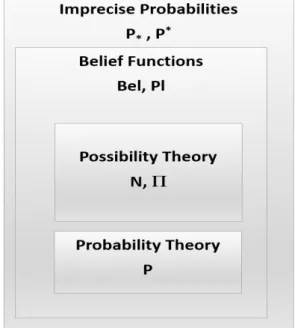
Ce chapitre est aussi lié à la première partie présentant les préliminaires. Il présente les notions de la théorie des possibilités. La théorie des possibilités est comparée aux autres théories d’incertitude: la théorie des probabilités et la théorie de l’évidence.
Il présente ensuite les requêtes de type skyline dans le cas certain ainsi que dans le cas des données incertaines (skyline probabiliste, skyline possibiliste, skyline stochastique, skyline évidentiel). Pour la deuxième partie, nous présentons les contributions de ce travail de thèse.
Chapitre 3: Trust Skyline Model Semantics and Experimentations
Il présente deux principales contributions. La première contribution vise à étendre l’opé-rateur classique de skyline au cas des données RDF pondérées par des degrés de confiance (Trust-Weighted RDF data). Le nouvel opérateur est appelé Trust-skyline et l’extension proposée est principalement basée sur l’adaptation de l’opérateur de dominance de sorte à ce qu’il produise non pas une dominance binaire (1 si domine ou 0 si ne domine pas) mais plutôt une dominance graduelle pondérée (un point X domine un point Y à un certain degré). Pour le calcul du Trust-skyline de nouvelles méthodes sont introduites. Un
algo-l’opérateur Trust-skyline proposé. Les résultats de cet algorithme sont comparés à ceux du Naive T-skyline. La deuxième contribution de ce chapitre consiste à analyser les ré-sultats du Trust-skyline via l’utilisation de méthodes statistiques. L’objectif est d’étudier l’impact de la mesure du seuil de confiance ALPHA (trust measure) sur le résultat du T-skyline. Ainsi, avec une petite valeur d’ALPHA les résultats du T-Skyline sont de petite taille, alors que pour une valeur moyenne ou grande du seuil de confiance, les résultats du T-skyline peuvent être volumineux puisque plusieurs points, ayant un trust inférieur à ALPHA, entrent directement au T-skyline.
Chapitre 4: Possibilistic RDF Data
Ce chapitre fait partie des contributions de cette thèse. Il propose d’abord la modélisa-tion des données RDF incertaines à travers la théorie des possibilités. Ensuite, un langage "Possibility-aware" nommé Pi-SPARQL a été proposé pour supporter les besoins de re-quêtage de données RDF possibilistes.
Enfin une variante d’opérateur skyline est proposée pour extraire les ressources RDF possibilistes qui ne sont éventuellement dominées par aucune autre ressource dans le sens de l’optimalité de Pareto. Une relation de dominance et un modèle skyline adaptés pour le contexte de données RDF possibilistes sont introduits. Pour valider cette approche, et à des fins d’expérimentations un nouvel algorithme plus performant que la méthode naïve a été proposé. Comme première étape, il résume les données précédemment explorées. De plus, et comme la réduction du nombre des comparaisons est cruciale, une autre optimisation liée à la réduction de la complexité de la fonction de dominance est introduite.
A special thank goes to my supervisors Professor Allel HADJALI and Professor Bou-theina BEN YAGHLANE for introducing me to this interesting research domain and for giving me the opportunity to collaborate with other researchers. Thank you for all their advices and guidance during this work.
I would also like to acknowledge with much appreciation my co-supervisor Doctor Mo-hamed Anis BACH TOBJI for his crucial contributions during this work. I would like to express my gratitude to the support, advice and encouragement he gave to me. I have learned much from his guidance and corrections during my researches.
I would like to thank also the rest of my thesis committee: Prof. Djamal BENSLI-MANE, Doctor Hajer BAAZAOUI, Prof. Juliette Débie Barthélemie, and Prof. Salah BEN ABDALLAH, for their insightful comments and encouragement, but also for the useful questions which incented me to widen my research from various perspectives.
I am profoundly grateful to Professor Ladjel BELLATRECHE, leader of Data Engi-neering team, for his encouragement and advises during this project. Furthermore I would also like to acknowledge with much appreciation the crucial role of the members of LIAS and LARODEC laboratories and specially Bénédicte Boinot, Audrey Veron Wiem Hajji, and Isabelle El Khiati whose support and assistance helped me to coordinate this thesis project.
I would have not finished this thesis project without the support of my family espe-cially my parents for their unconditional love. A special thanks goes to my sisters Rawya, Imen Sarah, and my brothers Walid and Bilel for their encouragement and love.
To my friends Fatma, Lahna, Louis, Kods, Warda, Nourhene, Manel and Ravi thank you for being part of my life, thank you for all the precious moments we shared together. Your friendship is a major source of support when things would get a bit discouraging.
love and encouragement, my journey would never be the same without their support! ********************
Nelson Mandela
The process of scientific discovery is, in effect, a continual flight from wonder Albert Einstein
List of figures xix
List of tables xxi
Nomenclature xxiii
Introduction 1
Part I
Preleminaries
7
Chapter 1 RDF Formalism 9
Introduction . . . 10
1.1 Semantic Web vision . . . 10
1.1.1 Introduction to Ontologies . . . 11 1.1.1.1 Definition of ontology . . . 11 1.1.1.2 Example of ontologies . . . 12 1.1.2 Ontology languages . . . 12 1.2 RDF data model . . . 13 1.2.1 RDF triple . . . 13 1.2.2 RDF Graph . . . 14 1.2.3 RDF: XML-based syntax . . . 15 1.2.4 RDF databases . . . 16 1.2.4.1 Non-native RDF Databases . . . 16 1.2.4.2 Triple Table . . . 16
1.2.4.3 Property triple table store . . . 17
1.2.4.4 Horizontal table store . . . 19
1.2.4.5 Native RDF Databases . . . 19
1.3 SPARQL Specifications . . . 20
1.3.1 SPARQL General Form . . . 20
1.3.1.1 Triple pattern . . . 21
1.3.1.2 Graph pattern . . . 21
1.3.2 SELECT query Form. . . 22
1.3.3 Basic Graph Pattern . . . 25
1.3.4 Solution Mapping. . . 25 1.3.5 SPARQL Algebra . . . 26 1.3.5.1 Filter . . . 26 1.3.5.2 Join . . . 27 1.3.5.3 LeftJoin . . . 27 1.3.5.4 Union . . . 27 1.3.5.5 OrderBy . . . 28 1.3.5.6 Project . . . 29 1.4 Extended RDF Formalism . . . 30 1.4.1 Trust RDF data . . . 30 1.4.2 Probabilistic RDF data . . . 32
1.4.3 Other uncertain RDF models . . . 33
Conclusion . . . 35
Chapter 2 Background on Possibility Theory and Skyline Queries 37 Introduction . . . 38
2.1 Possibility theory: An overview . . . 38
2.1.1 Typology of imperfect information . . . 38
2.1.1.1 Imprecision . . . 39
2.1.1.2 Inconsistency . . . 39
2.1.2.1 Probability theory . . . 40
2.1.2.2 Evidence theory . . . 41
2.1.3 Possibility Theory . . . 42
2.1.3.1 Possibility distribution . . . 42
2.1.3.2 Possibility and Necessity measures . . . 43
2.1.4 Possibility theory vs Probability theory and Evidence theory . . 44
2.1.4.1 Possibility theory vs belief function theory . . . 46
2.1.5 Possibilistic Databases . . . 46
2.2 Skyline queries . . . 47
2.2.1 Principle. . . 47
2.2.2 Skyline Computation Algorithms . . . 49
2.2.3 Skyline Queries over Incomplete Data . . . 52
2.2.3.1 Probabilistic Skyline Queries . . . 52
2.2.3.2 Possiblistic Skyline Queries . . . 55
2.2.3.3 Stochastic Skyline Queries . . . 56
2.2.3.4 Evidential Skyline Queries . . . 57
Conclusion . . . 59
Part II
Contributions
61
Chapter 3 Trust Skyline Model: Semantics and Experimentations 63 Introduction . . . 653.1 Trust-Skyline model . . . 66
3.1.1 Trust Dominance . . . 67
3.1.2 Trust-Skyline semantics . . . 71
3.1.3 Trust-Skyline computation . . . 72
3.1.3.1 SQL-like Trust-Skyline queries . . . 73
3.1.3.3 TRDF-Skyline Algorithm . . . 75
3.2 Experimental Evaluation . . . 76
3.2.1 Experimental Setup . . . 77
3.2.2 Impact of the trust measure variation . . . 77
3.2.3 Impact of the size of data set . . . 79
3.2.4 Number of used properties in the skyline query . . . 79
3.3 Statistical methods-driven Analysis . . . 79
3.3.1 Trust-Skyline list Analysis . . . 81
3.3.1.1 T-Skyline points with less trust . . . 82
3.3.1.2 T-Skyline points with more trust . . . 82
3.3.1.3 Behavior of Alpha . . . 82
3.3.2 Alpha v.s. the distribution of Trust values . . . 83
3.3.3 Central Tendency measures . . . 84
3.3.4 Measures of spread: Quartile measure . . . 85
3.3.5 Trust dependence . . . 85
3.4 Analysis Experimental . . . 86
3.4.1 Experimental Setup . . . 86
3.4.2 Impact of trust threshold variation and Central Tendency mea-sures . . . 87
3.4.3 Impact of trust threshold variation and Quartile measures . . . 88
Conclusion . . . 89
Chapter 4 Possibilistic RDF Data 91 Introduction . . . 92
4.1 Possibilistic RDF model . . . 93
4.1.1 Possibilistic RDF databases . . . 93
4.1.2 Possibilistic RDF graph . . . 93
4.2 A SPARQL-like language for possibilistic RDF data . . . 96
4.2.1 Possibility-aware Basic Graph Pattern Matching . . . 97
4.2.2.2 Project(Π) . . . 101
4.2.2.3 Filter operator . . . 101
4.2.3 SPARQL Extension for Possibility distributions Requirements . 102 4.2.3.1 Converting Graph Patterns . . . 102
4.2.3.2 Pi-SPARQL Algebra: Project Possibility Operator . . 103
4.3 Possibilistic Skyline over RDF data . . . 105
4.3.1 Comparison of two possibility distributions. . . 105
4.3.2 Possibilistic dominance on RDF data . . . 107
4.3.3 Possibilistic skyline on RDF data . . . 110
4.4 Possibilistic skyline computation . . . 110
4.4.1 Experimental Evaluation . . . 111
4.4.2 Experimental Setup . . . 113
4.4.3 Size of the Skyline on RDF Data . . . 113
4.4.4 Performance and Scalability . . . 114
Conclusion . . . 117
Conclusion 119 Appendices 123 Appendix . . . 122
1.1 RDF Graph representation. . . 14 1.2 Example of RDF graph model.. . . 17 1.3 Relational Representation of Triple RDF Stores. . . 18 1.4 Relational Representation of Property Tables RDF Stores. . . 18 1.5 Relational representation of Vertical Partitioning Table. . . 19 1.6 SPARQL graph pattern. . . 22 1.7 Trust values’ meaning. . . 31 1.8 Example trust weighted RDF graph. . . 32 1.9 SPARQL query on a probabilistic RDF database. . . 34
2.1 Uncertainty weighted models . . . 40 2.2 Skyline of Hotels . . . 49 2.3 An uncertain objects set. . . 53
3.1 Effect of α on skyline computation . . . 78 3.2 Effect of data size on skyline computation . . . 80 3.3 Effect of criteria number on skyline computation . . . 81 3.4 Trust-Skyline points analysis. . . 83
3.5 Alpha and Central Tendency measures . . . 88 3.6 Alpha and Quartile measure . . . 89
4.1 Graph representation of uncertain RDF data. . . 95 4.2 P i-SPARQL representation of query Q2 . . . 96
4.3 Basic Graph pattern G . . . 97 4.4 Join operator(Θ) . . . 100 4.5 Project possibility operator. . . 104 4.6 Size of the skyline on RDF Data modeled by possibility theory. . . 115 4.7 Elapsed time to compute the skyline on the RDF data modeled by
1.1 SPARQL query result. . . 25
2.1 Possibility measure properties . . . 43 2.2 Possibility and probability values associated with X.. . . 45 2.3 A possibilistic relation pr. . . . 46 2.4 Example of hotels properties. . . 49 2.5 Comparison of skyline computation algorithms . . . 52 2.6 Imperfect skyline models . . . 52 2.7 dominance beliefs . . . 58 2.8 dominance beliefs . . . 58
3.1 Example of trust RDF data . . . 68 3.2 Example of hotels properties. . . 69 3.3 Dominance degree function. . . 70 3.4 Example of hotels candidate list of T-Sky. . . 72 3.5 Used functions Meaning. . . 73 3.6 Parameters under investigation. . . 77 3.7 Trust frequency distribution. . . 85
3.8 Example of trust distribution. . . 86 3.9 Parameters under investigation. . . 87
4.1 Example of possibilistic RDF database . . . 94 4.2 The results of evaluating the BGP G against the query Q2. . . 97 4.3 The results of evaluating the BGP G against the RDF graph . . . 98 4.4 Comparison of two possibility distributions . . . 106 4.5 RDF data modeled by possibility theory. . . 107 4.6 RDF Data: hotel properties . . . 108 4.7 Parameters and Examined Values. . . 113
Acronyms ˜
GP A possibilistic graph
cardD( ˜µp) The cardinality of ˜µp in a multiset D of possibilistic solution mappings
d(Q P ) The trust dominance function between Q and P exp An expression
hi.a+k The maximum value among all properties of a subject hi.ak
hi.a−k The minimum value among all properties of a subject hi.ak
less(, ) A function that returns the least trust degree between two points
lessorequal(, ) A function that returns the least trust degree between two points p-SkyH The possibilistic Skyline operator of a data set H
p − dominance The possibility dominance function
P.t− The minimum trust degree among all properties of a given point
P A The project possibility operator
P rojπ() The Project possibilistic operator
SP OT RDF quadruple < s, p, o, t > T − Skyα The Trust-Skyline operator
T − Sky<α The T-Sky of points having trust degree less than α
T − Sky>α The T-Sky points having trust degree greater than α
X∗ RDF triple < s, p, o >
Latin letters
α A trust measure
λ An arbiterary value
µ A mapping function
π Possibility measure
σ A multiset of solution mappings ˜
Context and Motivaton
The amount of data in the Web is growing more and more; therefore retrieving re-levant and useful information becomes a hard task. Over traditional Web, the pieces of information are expressed in natural language and so understood only by humans. The semantic Web brings structure to the meaningful content of the Web pages, creating an environment where software agents roaming from page to page can readily carry out so-phisticated tasks for users [Berners-Lee et al., 2001,Mark, 2009]. Hence, resources among the Web became marked with labels that describe their various parts; those labels are called the metadata. To achieve semantic Web, the W3C introduced Resource Description Framework (RDF) as a standard for representing metadata.
The large adoption of Semantic Web in research and industry developed the amount of RDF data on the Web, with a huge increase in diversity and size. However, variety of sources affects the reliability of collected data. Given that an RDF triple is a tuple of
< Subject, P redicate, Object > also denoted < s, p, o >. To control information
trust-worthiness, new metrics were introduced in RDF representation to express the intention of information provider about the information veracity issue [Hartig, 2009a,Tomaszuk et al., 2012,Fionda and Greco, 2015]. To manage information in presence of trust, we need then new methods to query RDF data. The last two decades have witnessed a profusion of research effort on supporting complex decision making over uncertain RDF data, such in [Huang and Liu, 2009,Lian and Chen, 2011]. Our ultimate aim in this thesis is to deal with uncertain RDF data in the possibility theory setting [Zadeh, 1978], that represents a non-classical theory of uncertainty. It constitutes an alternative to capture different kinds of imperfection, such as imprecision, total ignorance, and partial ignorance that are not faithfully represented in probability theory [Zimmermann, 1985].
On the other hand, we are interested in preference-based queries in order to extract data according to users’ preference and then to reduce the massive amount of information.
Among all preference models returned to the users, skyline model, defined using Pareto dominance [Börzsönyi et al., 2001a], have been the most extensively studied [Jiang et al., 2012,Zhang et al., 2013,Chomicki et al., 2013] and extended over Graph Data such as in [Zou et al., 2010,Zheng et al., 2014]. The skyline operator aims to make multi-objective decisions over multi-dimensional data when different, and often contradictory criteria are to be taken into account. Given such a multi-criteria preference, the system should be able to identify all potentially interesting data records according to user preferences [Chomicki, 2002,Chomicki, 2011].
Thesis contribution
Our main contributions in this work are:
1. Extending Skyline operator over Trust RDF data: We are interested in querying trust RDF data (T-RDF) [Hartig, 2009a]. We particularly tackle the skyline com-puting problem, which consists in extracting the most interesting trusted resources according to user-defined criteria. To this end, we need to redefine the Pareto domi-nance relationship in the context of trust RDF data. While this operator produces a binary result in case of certain data, in the context of trust RDF data, it produces a weighted set of results (i.e., each result is associated with a degree of dominance) rather than a boolean (true/false) result. In addition, we need to provide a clear semantics for the trust-skyline, i.e., the set of resources that are dominated by no other resource with a degree exceeding a user-defined threshold (denoted α). A great effort for providing efficient methods to compute the trust-skylinehas been made as well.
2. Possibilistic RDF data: We propose to use possibility theory to express uncertainty on RDF data. We introduce a model for representing and managing possibilistic RDF data. Thus, we integrate in the structure of RDF data a possibility measure for each subject-property-object triple to reflect the user opinion about the truth of a statement. The possibility measure can be considered as a way to express a source reliability.
3. Possibility-aware SPARQL query language: We describe a general framework for supporting SPARQL-like queries on possibilistic RDF data, that we denote Pi-SPARQL. To query possibilistic RDF data, our main contributions in this part are:
— Introducing the possibilistic solution mappings for a given RDF query Q. In order to define possibility-aware solution mapping, we need to introduce some terminology related to semantics of SPARQL graph pattern expressions.
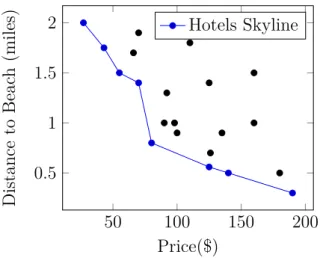
4. Extending the skyline operator over possibilistic RDF data: Firstly, we introduce comparison operators between possibility distributions to allow dominance compu-tations in an RDF data set context. Starting from the work of [Chen et al., 2011], we rethought the dominance operator between two possibilistic RDF objects. In ad-dition, we define the possibilistic skyline, denoted p-SkyH, which retrieves the most interesting subjects over the RDF data set H according to a subset of predicates. The combination aims to filter the massive amount of uncertain resources among the Web according to user preferences.
During the experimental evaluation step, we introduce two algorithms: A naive one and an optimized one to compute the skyline queries over RDF data. The second algorithm allows improving the performance of the naive one by summarizing the region of data explored in earlier iterations.
Manuscript guide
The remainder of this thesis is organized in four chapters as follows:
In Chapter 1, we describe the basic notions related to RDF formalism. First, we introduce the RDF data model, then we present the SPARQL query language developed to query RDF data. Finally, as RDF data is often pervaded with uncertainty (due to the openness of the Web and variety of sources). We, tackled thus the different extended forms of un-certain RDF data.
In Chapter 2 we present the possibility theory, which is a non-Bayesian theory of uncer-tainty. It constitutes the model that we use to model uncertain RDF data. Furthermore, we discuss the preference-based queries, especifically, the skyline preference relations that show encouraging results to personalize and filter the massive amount of information re-siding in today’s databases and Information Systems according to the users’ preferences.
The contribution part starts by Chapter 3 which extend the skyline operator over trust-weighted RDF data (T-RDF). We subdivise this contribution in two main parts. First of all, we define the dominance over Trust-RDF data. Then, we provide a semantics for the trust-skyline, i.e., the set of resources that are dominated by no other resource with a certain degree of trust denoted α. We propose different methods for Trust-skyline com-putation, then describe the experiments that show interesting results as well.
Second, we analyze the results of the Trust-skyline list. To analyze the results we opt for using statistical methods to investigate the trust measures dependence. We check the impact of the trust measure α and the list of the generated trust measures on the resulting trust-Skyline list. The experiments show interesting results.
In Chapter 4, we propose to model uncertain and imprecise RDF data through possibility theory. Indeed, we add a possibility measure to each RDF triple (association between a subject, predicate and object) to model the possibility of such association. We introduce some comparison operators between possibility distributions to allow dominance compu-tations in an RDF data set context. Second, we introduce a possibility-aware SPARQL query language for supporting SPARQL-like queries on possibilistic RDF data. Finally, we extend skyline queries over possibilistic RDF data by revisiting the dominance operator between two possibilistic RDF data.
Reading Guide
We provide a reading guide that summarises the thesis outline by listing the different chapters and their interactions. We illustrate also the prerequisites for the reading of each chapter.
RDF Formalism
Contents
Introduction . . . . 10
1.1 Semantic Web vision . . . . 10
1.1.1 Introduction to Ontologies . . . 11 1.1.2 Ontology languages . . . 12 1.2 RDF data model. . . . 13 1.2.1 RDF triple . . . 13 1.2.2 RDF Graph . . . 14 1.2.3 RDF: XML-based syntax . . . 15 1.2.4 RDF databases. . . 16 1.3 SPARQL Specifications. . . . 20
1.3.1 SPARQL General Form . . . 20
1.3.2 SELECT query Form . . . 22
1.3.3 Basic Graph Pattern . . . 25
1.3.4 Solution Mapping . . . 25
1.3.5 SPARQL Algebra . . . 26
1.4 Extended RDF Formalism . . . . 30
1.4.1 Trust RDF data . . . 30
1.4.2 Probabilistic RDF data . . . 32
1.4.3 Other uncertain RDF models . . . 33
Introduction
The semantic Web is built on World Wide Web Consortium (W3C) standards. It was an enormous undertaking to build the concept of linked data where comes best practice for sharing data. There was a need to establish standards that make possible to change the Web to a semantic Web by allowing users to add descriptive tags or metadata to the Web content.
Therefore, many standards were created such as the Resource Description Framework (RDF) model, the RDF Schema and the Web Ontology Language (OWL) standards for storing vocabularies and ontologies.During this chapter we pinpoint the Semantic Web concepts specially the RDF data.
Note, the large adoption of Semantic Web in research and industry has led to the de-velopment of a large amount of Resource Description Framework (RDF) data on the Web [Berners-Lee et al., 1998a,Mark, 2009,Antoniou and vanHarmelen, 2004a]. However, due to the openness of the web and variety of sources in internet, the reliability of collected data is questioned. To model information trustworthiness, new metrics were introduced in RDF representation to express intention of information provider about information trust [Hartig, 2009a,Tomaszuk et al., 2012,Fionda and Greco, 2015]. Other works are proposed to handle uncertain RDF data, mostly modelled with probability theory such as [Huang and Liu, 2009,Meiser et al., 2011,Lian and Chen, 2011,Meiser et al., 2011]. During this first chapter, we present the basic concepts related to RDF formalism. We start with presenting the semantic Web vision in Section1.1, Section1.2 introduces RDF data model, Section 1.3 presents SPARQL query language and Section 1.4, tackled the different extended forms of uncertain RDF data. Finally, we end with a conclusion.
1.1
Semantic Web vision
The Semantic Web is a set of data that is processable by machine, as defined by Berners-Lee et al. [Börzsönyi et al., 2001a]. Changing the Web from a place where different types of information are merely displayed, to a place for interpretation and exchange of data, where agents (which are not compatible between each other) could exchange data in dif-ferent types. Hence the web changes from a multiple databases and resources to a gigantic database, where resources are linked between each other and those links are understood by computers to provide a more useful and relevant content for users.
As mentioned above, semantic Web aims to structure web resources, hence the produced information becomes not only for human consumption but also for machine "understan-ding" of the data that it is queried. Authors in [Mark, 2009] show that the use of semantic
Web has two motivators; the first is data integration where a specific mapping is made between the data models or schemas of the data sources involved. Hence describing the data sources’ semantics in a machine-interpretable way facilitates the mapping that could be at least semi-automatically. The second motivator, is having a more intelligent support for the internet users. If a computer can process the semantic of information on the web, it can give better results for user queries, by having a better selection, personalization and combination of information from different resources.
The Semantic Web vision is a network of information sources with rich metadata. It provides truly Web-scale integration of many information sources aided by automated algorithms for search and discovery. We could not have a semantic Web without meta-data, but metadata alone will not suffice. The metadata in Web pages will have to be linked to special documents that define metadata terms and the relationships between the terms. These sets of shared concepts and their interconnections are called "ontologies." The authors in [Antoniou and vanHarmelen, 2004a] conclude that, in order to achieve the semantic web there is a need to provide three main goals: The first one is vocabularies for expressing the metadata (Ontologies), the second is syntax for representing metadata (RDF and OWL) and third having metadata for lot of Web pages.
1.1.1
Introduction to Ontologies
Ontology is a term which originates from philosophy; it is used as the name of subfield of philosophy. Recently, this term was hijacked by computer science and it changes to a technical meaning different from the origin. Indeed, ontology was introduced to Artificial Ontelligence (AI) by John McCarthy (about 1980) and then developed in other works. Actually, ontology is used in lot of domains such Samantic Web, Data Mining, natural language processing, etc.
1.1.1.1 Definition of ontology
Ontology is defined by [Gruber, 1993] as an explicit specification of conceptualization. Hence, an ontology consists of a list of terms and relationships between these terms. The terms are denoted by concepts which are classes and objects of the domain. Hence, there is a list of classes and subclasses defined in a hierarchy, a part from the subclass relationship contains the properties, the specification of logical relationships between objects. In gene-ral, ontology provides shared understanding of a specific domain to overcome differences in terminology (more details in [Antoniou and vanHarmelen, 2004a]).
1.1.1.2 Example of ontologies
We illustrate some well-known examples of ontologies in the domain of Semantic Web. For instance, DBpedia [Jens et al., 2015] is generated automatically by extracting data from Wikipedia. Also the ontology Yago [Suchanek et al., 2008], which is created by extracting data from Wikipedia and Wordnet.
For experiments, ontologies are also used to define benchmarks, such the LUBM bench-mark [Guo et al., 2005]. This benchbench-mark define an OWL ontology about the university domain, customizable and repeatable synthetic data, a set of test queries, and several performance metrics.
1.1.2
Ontology languages
As described by [Antoniou and vanHarmelen, 2004a] the most important ontology lan-guages for the web are:
•
XML: Extensible Markup Language (XML), created by the W3C and it is playing an important role in the exchange of a wide variety of data on the Web and elsewhere. Although, it provides a surface syntax for structured documents, but there still no semantic constraints on the meaning of the XML documents•
XML Schema: A language that restricted the structure of XML documents, in more specific way. It provides a means for defining the structure, content and se-mantics of XML documents.•
RDF: A data model for resources or objects and relations and links between them. Otherwise, it provides a semantic for the data model which could be represented in XML syntax (see Section 1.2 for more details).•
RDF Schema: A vocabulary description language for describing properties and classes of RDF resources. It implicates generalization hierarchies of properties and classes of those resources.•
OWL: Web Ontology Language (OWL) is a richer vocabulary description language for describing properties and classes such as relations between classes and richer typing and characteristics of properties.The reason behind creating the semantic Web is to bring structure to the meaningful content of Web pages to facilitate and automate its access. To this end, resources on the Web are marked with labels that describe their structure; these labels are called
meta-data. The aim is to make content not only readable by humans, but also by machines,
W3C community introduced a recommendation for semantic annotations; the Resource Description Framework (RDF). In the coming sections, we will focus our interest on the model used in this thesis project, the RDF one. We are specifically interested in managing uncertain RDF data that are used as an input for our data analysis to come up with new concepts.
1.2
RDF data model
Resource Description Framework (RDF) is a W 3C framework for representing meta-data and describing the semantics of information in a machine-accessible way [W3C, 2004]. An RDF statement is a triple < s, p, o > where s, p, and o stand for subject, predicate and
object respectively.
1.2.1
RDF triple
RDF describes Web resources (subject) related/characterized (via a predicate or a pro-perty) to other resources/literals (object).
Definition 1.1. Assume we have a finite set of RDF URI references (U); a finite set of
Blank nodes (B); and a finite set of RDF Literals (L). A triple < Subject, P redicate, Object > or (s, p, o) ∈ (U ∪ B) × U × (U ∪ B ∪ L) is called an RDF triple.
An RDF triple allows defining statements in form of a triple Subject-Predicate-Object: — A subject is a resource and could be a Uniform Resource Identifier (URI) or a Blank
Node (BN). The resource is a thing, a person, a Web page. The aim from using URI is to provide a universally unique name for a resource or property. Thus, it’s possible to link data from different sources around the world.
We illustrate the example of LUBM ontology, the resource FullProfessor0 has a URI,
http://www.Department0.University0.edu/FullProfessor0. The book of [DuCharme, 2011a] is an excellent bibliographic reference for the whole specifications.
— A Predicate also called property is a relationship between a subject and an ob-ject. It is an RDF URI reference. An example from the LUBM Benchmark, the resource FullProfessor has as property teacherOf which is identified with the URI,
http://www.Department0.University0.edu/Course.
— An Object is the value of a subject property. It is a URI reference, a literal or a blank node. the literals are used to identify values such as strings, numbers and
dates by means of a lexical representation. A literal could be the object of an RDF statement, but not the subject or the predicate. A Blank Node also called BNode is drawn from an infinite set, which is the set of all the RDF URI references and the set of all literals are pairwise disjoint. BNode is a node in an RDF graph representing a resource for which a URI or literal in not given. The resource represented by a blank node is also called an anonymous resource.
1.2.2
RDF Graph
A set of RDF triples is a graph for representing meta-data and describing the semantics of information in a machine-accessible way. Therefore, RDF data can be thought in terms of a decentralized directed labelled graph. The edges’ labels are the "properties", also called "predicates" or "attributes". The RDF data is stored as a set of SubjectNode-PropertyArc-ObjectNode triples often called < s, p, o > triples, and represented graphically as shown in Figure 1.1.
Example 1. We present an example of RDF triple data (written in XML language)
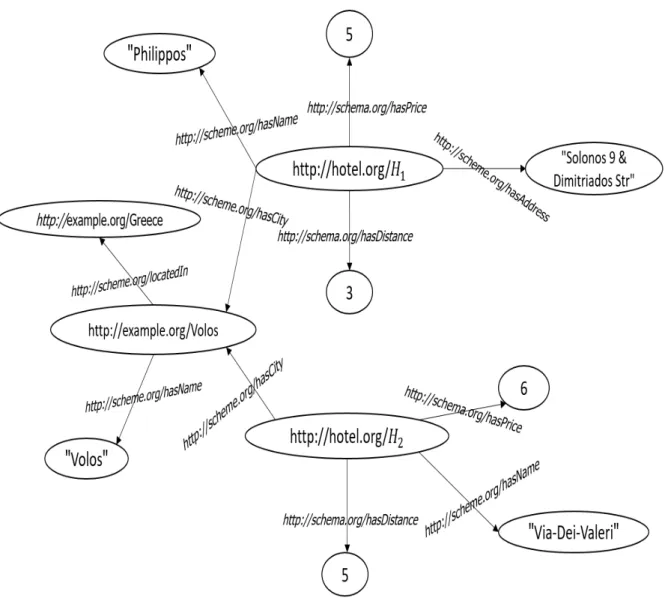
illustrating information about hotel H1 (Extracted from source http://www.hotel.org/H1). The hotel with ID H1 is "Philippos", the street address is "Solonos 9 & Dimitriados Str". The Figure 1.1 is the graph representation of this example: <rdf:RDF
xmlns:rdf="http://www.w3.org/1999/02/22-rdf-syntax-ns#" <rdf:Description rdf:about="http://www.hotel.org/H1"> <hasName> Philippos </hasName>
<hasAdress>Solonos 9 & Dimitriados Str</hasAdress> </rdf:Description>
</rdf:RDF>
1.2.3
RDF: XML-based syntax
RDF is a data model it has several formats i.e several ways to represent data in the form of triples such as:
— Turtle family of RDF languages (N-Triples, Turtle, TriG and N-Quads); — JSON-LD (JSON-based RDF syntax);
— RDFa (for HTML and XML embedding); — RDF/XML (XML syntax for RDF).
In this section, we present XML which is one of the syntax representations of the RDF data model. Meanwhile, in XML, element names are defined by the developer. This often results in a conflict when trying to mix XML documents from different XML applications. XML Namespaces provide a method to avoid element name conflicts. The namespace can be defined by an xmlns attribute in the start tag of an element. The namespace declaration has the following syntax.
xmlns:prefix="Location". Example 2. The location is the DTD or schema
<! Doctype owl [<! ENTITY xsd http://www.w3.org/2001/XMLSchema# >]>. < rdf : RDF
xmlns:rdf="http://www.w3.org/1999/02/22-rdf-syntax-ns#" xmlns:xsd="http://www.w3.org/2001/XMLSchema#" xmlns:uni="http://www.mydomain.org/uni-ns#" > < rdf: Description rdf: about="949318">
<uni : name>Daniel Alberto</uni: name> <uni : title>Professor</uni: title>
</ rdf: Description>
< rdf: Description rdf: about="949333">
<uni: courseName>Data Base</uni: courseName> <uni: isToughtBy> Daniel Alberto </uni: isToughtBy> </ rdf: Description>
</rdf:RDF>
The two elements uni:name and uni:title both define property-value pair for 949333, the content of rdf: Description elements are called property elements. As shown in the last example the two elements courseName and isToughtBy, both of them define the property-value pairs for 949333. The description of a document could be in many categories, it could be clear for human readers, but not for machine. In XML the fact is not formally
cleared anywhere. In, RDF it is possible to add such statement by using the rdf: type element, that could be in our example a course type, we add to the syntax <rdf: type rdf: resource="&uni;course"/> to specify that the resource is a course type not lecturers for example. There exists much more specification about XML syntax that was added to fit with the RDF data, we did not illustrate all of them because it is not the aim of this dissertation.
1.2.4
RDF databases
Within semantic Web applications, storing and querying RDF data is one of the basic tasks. Therefore, many storage approaches have been proposed, some of them are native approaches and others are not. This classification is not the most important criteria for RDF data storage, since some non-native techniques performed well and are the most used ones for storing and querying RDF data.
Example 3. We illustrate an example of RDF graph model about hotel’s properties as
shown in Figure 1.2. The hotel with id H1 has a price value equal to 5 (per night), a distance (from the beach) equal to 3, a name value "Philippos", etc. We use this example to present the different storage approaches of RDF data.
1.2.4.1 Non-native RDF Databases
The non-native approaches are a set of techniques proposed for storing RDF data in RDBMS. Currently, this is widely considered to be the best performing approach for their persistent data store due to the great amount of work achieved on making it efficient, extremely scalable and robust [Sakr and Al-Naymat, 2009].
1.2.4.2 Triple Table
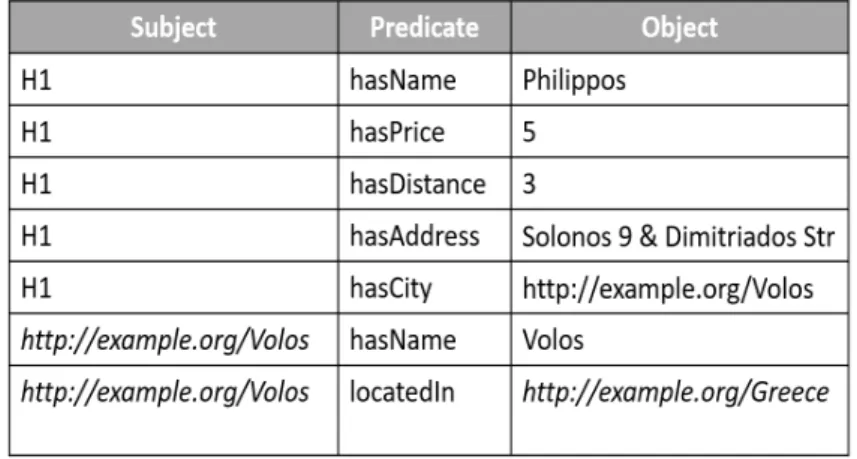
Each RDF statement of the form (Subject, Property, Object) is stored as a triple in one large table with a three-columns schema . The storage system of 3Store is based on a central triple table which holds the hashes for the subject, predicate, object and graph identifier [Sakr and Al-Naymat, 2009] [Harris and Gibbins, 2003a]. Indexes are then added for each of the columns in order to make joins less expensive. However, since the collection of triples is stored in one single RDF table, the queries may be very slow to execute. Indeed, when the number of triples scales, the RDF table may exceed main memory size. Therefore [Neumann and Weikum, 2008] proposed a work over that field,
Figure 1.2 – Example of RDF graph model.
they have presented the RDF-3X (RDF Triple eXpress), an RDF query engine which tries to overcome the criticism that triples stores incurs too many expensive self-joins by creating the exhaustive set of indexes and relying on fast processing of merge joins. The Figure 1.3 shows the triple table store of the RDF graph presented previously in Figure 1.2.
1.2.4.3 Property triple table store
Authors in [McBride, 2002] presented Jena as an open source toolkit for Semantic Web programmers. It implements persistence for RDF graphs using a SQL database through a JDBC connection. The schema of the first version of Jena, Jena1, consisted of a statement
Figure 1.3 – Relational Representation of Triple RDF Stores.
table, a literals table and a resources table. Jena2 uses property table as a general facility for clustering properties that are commonly accessed together. During their work [Sakr and Al-Naymat, 2009] consider that a property table is a separated table that stores the subject value pairs related by a particular property.
The property table technique was proposed to improove RDF data organization by al-lowing multiple triple patterns referencing the same subject to be retrieved without an expensive join.
A variant of the property table, named property-class table, uses the "rdf:type" property of subjects to cluster similar sets of subjects together in the same table. The Figure 1.4 shows the RDF graph model stored over a property table, in which multiple triple patterns refer the same subject.
1.2.4.4 Horizontal table store
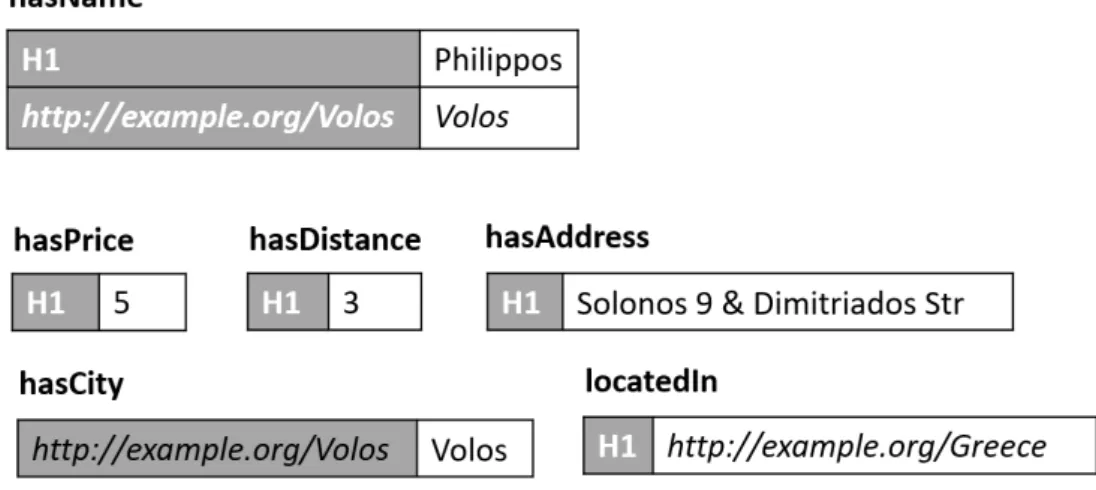
Among the horizontal table store, the RDF triples are modeled as one horizontal table or into a set of vertically partitioned binary tables (one table for each RDF property) [Sakr and Al-Naymat, 2009]. For the vertically partitioned binary table, RDF data are vertically partitioned using a fully decomposed storage model (DSM). Each triple table is divided into n two column tables where n is the number of unique properties in the data as shown in Figure 1.5.
In each of these tables, the first column contains the subject and the second column the object value of that subject. The tables are stored, by using a column-oriented DBMS (DBMS designed especially for the vertically partitioned case, as opposed to a row-oriented DBMS, gaining benefits of compressibility and performance), as collections of columns rather than collections of rows. The goal is to avoid reading entire row into memory from disk, like in row-oriented databases, if only a few attributes are accessed per query.
Figure 1.5 – Relational representation of Vertical Partitioning Table.
1.2.4.5 Native RDF Databases
The native storage solutions store RDF with respect to the data model, avoiding the mapping to a Database Management System (DBMS). Those techniques aim to be closer to the query model of the semantic Web and are based on the characteristic of multiple indexes of the RDF triples. They can be subdivided in two main categories:
1. In memory storage, where the ontology is stored in central memory starting from the launch of the application;
query processing can be performed more efficiently compared to straight-forward approaches like triple tables.
The data representation in native RDF databases differs from one another. In fact, this representation is specific and relative to each native RDF database. Nevertheless, it is possible to characterize them from the data structure. Indeed, we found an RDF database family that uses indexes and tree-structures to model data such RDF-3X [Neumann and Weikum, 2008] , Hexastore [Weiss et al., 2008], or IBM DB2RDF [Bornea et al., 2013]. We could identify another family wich uses graph to model data such the case of gStore [Özsu, 2016].
To query RDF data, several query languages were proposed. Indeed, they differ in many aspects and can be grouped into several families according to data model, expressivity, support for schema information, etc. Mainly there is six families: SPARQL, RQL [ Kar-vounarakis et al., 2002], XPath-, XSLT-, and XQuery-based Languages, Metalog, Reactive Languages, and Deductive Languages [Bailey et al., 2005]. For instance, the SPARQL fa-mily consists of the four query languages SquishQL [Miller et al., 2002], RDQL [Seaborne, 2004], SPARQL, and TriQL. The common property to this family is that they consider RDF as triple data without considering the semantics linked to triples.
In our work we are interested in SPARQL. We present in the coming section, more details about SPARQL.
1.3
SPARQL Specifications
SPARQL query language for RDF (SPARQL) is a SQL-like language for querying RDF data. By 2004, the W3C formed the RDF Data Access Working Group (DAWG) that gathered use cases and requirements to make the first draft of SPARQL Query Language specifications. Before that, a dozen query languages had been developed as commercial, academic, and personal projects. Later, the query language, protocol, and query results XML format became Recommendations/official W3C specifications [DuCharme, 2011a].
1.3.1
SPARQL General Form
SPARQL is similar to SQL. It selects data from an RDF data set by using a SELECT statement to determine which subset of the selected data is returned. Also, SPARQL uses a WHERE clause to define graph patterns to find a match in the data set. Hence, a graph pattern in a "SPARQL WHERE clause" consists of the subject, predicate and objects
triple to find a match in the data. Given that SPARQL is a query language developed primarily to query RDF graphs, the vocabulary for RDF graphs is three disjoint sets: a set of URIs Suri, a set of bnode identifiers Sbnode, and a set of well-formed literals Slit. The union of these sets is called the set of RDF terms. Authors in [Evren and Bijan, 2007] defined an RDF triple as a tuple (s, p, o) ∈ (Suri ∪ Sbnode) × Suri × (Suri ∪ Sbnode ∪ Slit). An RDF graph is a finite set of RDF triples.
SPARQL has four query forms which use the solutions from pattern matching to form result sets or RDF graphs. The query forms are:
— SELECT: Returns all, or a subset of, the variables bound in a query pattern match. — CONSTRUCT: Returns an RDF graph constructed by substituting variables in a
set of triple templates.
— ASK: Returns a Boolean indicating whether a query pattern matches or not. — DESCRIBE: Returns an RDF graph that describes the resources found.
In our thesis project, we are interested in using the SELECT query form. Given that the SELECT query is the most used one to query RDF data [Francois and Stijn, 2011,Saleem et al., 2015].
1.3.1.1 Triple pattern
A triple pattern is the atomic element of a constraint’s description of a SPARQL query. Indeed, SPARQL allows selecting values by letting triple patterns (one or more element of the subject, predicate or object) contain values denoted by ? or $ before a string. The aim from using triple patern is finding the corresponding RDF triples, this process is called matching, it produces a binding of each variable.
Let us illustrate the example of the RDF triple pattern (?hotel, hasName, ?name), the matching of that triple pattern to the RDF graph on Figure 1.2 consists on finding the values of ?hotel having the requested properties ?name and ?price. The variable ?price takes the value 10, hence, the triple pattern becames (H1, Distance, 10) that belongs to the graph in Figure 1.2 indeed, forms a solution. The combination of multiple triple patterns makes a graph pattern.
1.3.1.2 Graph pattern
A graph pattern is a set of triple patterns. Triple patterns are linked to eachother with resources in common (variables, literals, etc.) to form the graph pattern. For a graph pattern, the common variables between two or more triple patterns are called join operator
variables.
Querying an RDF graph using a triple pettern means searching values for each variable of the graph pattern. Indeed, the resulting graph (after replacing the variables with the corresponding values) is considered as sub-graph of the RDF graph.
Authors in [Pérez et al., 2009] defined recursively a SPARQL graph pattern expression as follows.
1. A tuple from (U ∪ B) × U × (U ∪ B ∪ L) is a graph pattern (a triple pattern). 2. If P1 and P2 are graph patterns, then expressions corresponding to conjunction
graph pattern (P1 AND P2), optional graph pattern (P1 OPT P2), and union graph patternv (P1 UNION P2) are graph patterns.
3. If P is a graph pattern and R is a SPARQL built-in condition, then the expression (P FILTER R) is a graph pattern (a filter graph pattern).
Example 4. We illustrate the example of two triple patterns t1 and t2:
?hotel hasName ?name (t1)
?hotel hasPrice ?price (t2)
Figure 1.6 – SPARQL graph pattern.
The Figure 1.6 is a graph pattern representation, that should correspond to a part of the graph (see Figure 1.2) while executing the query. For instance, H1 is a join operator
variable that links both graph patterns t1 and t2.
1.3.2
SELECT query Form
— SELECT: This clause let the users specify the result set, it has generally the form of: SELECT ?Result-Set.
— FROM: Allows users to specify the Data set from which the result set will be selected. It should be written in the form of: From <Location>.
— WHERE: Allows users to pinpoint the Query Triple Pattern. it is generally specified as: WHERE { ?Set-conditions }
SPARQL also uses other operators in the SELECT clause such as FILTER, OPTIONAL, Distinct, LIMIT, ORDER BY and GROUP BY.
— UNION: This operator creates multisets of responses from sets of two or more graph patterns. They either have variables in common or they do not.
— FILTER: SPARQL FILTERs restrict the solutions of a graph pattern match accor-ding to a given expression. Specifically, FILTERs eliminate any solutions that, when substituted into the expression, either result in an effective boolean value of false or produce an error.
— OPTIONAL: Allows information to be added to the solution where the information is available, but do not reject the solution because some part of the query pattern does not match (the optional part does not match). Hence it creates no bindings but does not eliminate the solution.
The sequence modifiers are applied to create sequence (a solution sequence) with specific orders. This sequence is used to generate one of the results of a SPARQL query form, we illustrate below these sequence modifiers:
— ORDER BY: Allows sorting the fetched data in either ascending or descending according to one or more columns.
— Projection modifier: choose certain variables
— Distinct modifier: ensure solutions in the sequence are unique — Reduced modifier: permit elimination of some non-distinct solutions
— Offset modifier: control where the solutions start from in the overall sequence of solutions
— Limit modifier: restrict the number of solutions
The syntax of the SELECT query in SPARQL is as follows [Eric and Andy, 2008]:
hSelectQueryi::= SELECT hDISTINCT|REDUCEDi?hVar+i| ∗ hDatasetClause∗ihWhereClauseihSolutionModifieri
SELECT is the keyworld that identifies the type of the query. The clauses DISTINCT and REDUCE allow modifying the structure of the answer. The symbol Var+ denotes the pro-jection of at least one variable as an answer for the query and ∗ for all the variables. The symbol DatasetClause∗ is used to define the set of queried data.
The symbol WhereClause represents the set of query constraints. Finally, the symbol SolutionModifier denotes a set of modifiers, precisely ORDER BY and /or GROUP BY. Example 5. We illustrate an example of SPARQL query that returns hotels having the
minimum values of the properties price and distance(from the beach):
PREFIX p: <http://www.semanticweb.org/ontology-exp#> SELECT DISTINCT ?name ?distance ?price
WHERE {
?hotel a p:Hotel .
?hotel p:hasName ?name . ?hotel p:hasDistance ?distance . ?hotel p:hasPrice ?price .
OPTIONAL { ?H a p:Hotel .
?H p:hasDistance ?dist . ?H p:hasPrice ?price .
FILTER (( ?dist < ?distance ) && ( ?pri < ?price )) . }
FILTER ( !bound (?H) ). }
We detail the SPARQL query here. Indeed, the first three triples match any hotel for which a place and a distance are known. The pattern inside the OPTIONAL clause also matches a hotel, and gets it’s properties (distance and price). We use the variable name ?Hx for this hotel because of the FILTER clause; we retain only the bindings of ?Hx
that have least values of distance and price than ?Hotel. Despite, what happens if we can’t find anyone with less price and distance? Then all matches to the pattern inside the OPTIONAL braces will be filtered out, and no bindings will remain for ?Hx. Back
outside the OPTIONAL, we filter based on the binding of ?Hx; if ?Hx is not bound, then
The result of this query is shown in Table 1.1 below, where we find hotel H1 associated with its price and distance values. For instance, H1 has less price and distance value than
H2.
Hotel Price Distance
H1 3 5
Table 1.1 – SPARQL query result.
1.3.3
Basic Graph Pattern
The core of each SPARQL query is a Basic Graph Pattern (BGP). A BGP is the elemen-tary graph pattern; it is a set of RDF triple patterns that may contain variables at the subject, predicate, and object position. Indeed, a BGP is a graph structured query that should be matched against the graph database G. Intuitively, a match for a BGP is a mapping from variables in the query to constants (graph database). During evaluation, a solution for a BGP is each solution mapping which, in combination with an RDF instance mapping, maps the BGP to a subgraph of the queried RDF graph.
1.3.4
Solution Mapping
A solution mapping is a mapping from a set of variables to a set of RDF terms. The work of [Eric and Andy, 2008] is an excellent bibliographic reference for the whole specifications. A formal definition is given as follows:
Definition 1.2. A mapping µ from X to Y is a partial function µ : X → Y . The domain
of µ denoted by dom(µ) is the subset of X where µ is defined. Let σ be a multiset of solution mappings, card[σ](µ) = card[σ] is the number of distinct RDF instance mappings, σ, such that P = µ(σ) is a pattern instance mapping and P(BGP) is a subgraph of G.
The solution sequence modifiers defined by W3C in [Eric and Andy, 2008] are: — Order By modifier: The aim from using it is to put the solution in order. — Distinct modifier: It ensures solutions in the sequence are unique.
— Reduced modifier: It permits non-distinct solutions to be eliminated.
— Offset modifier: It controls where the solutions start from in the whole sequence of solutions.
1.3.5
SPARQL Algebra
The outcome of executing a SPARQL is defined by a series of steps as presented in [Eric and Andy, 2008]:
1. Starting from the SPARQL query as a string; 2. Turning that string into an abstract syntax form;
3. Turning the abstract syntax into a SPARQL abstract query comprising operators from the SPARQL algebra;
4. Evaluating this abstract query on an RDF dataset.
Given that a SPARQL abstract query is a tuple (exp, D, Q) where: — exp is a SPARQL algebra expression
— D is an RDF Dataset — Q is a query form
For each symbol in a SPARQL abstract query, an operator for evaluation is defined. Besides BGPs, the SPARQL specification [Eric and Andy, 2008] introduces other graph patterns CGPs (Complex Graph Patterns). CGPs extend BGPs with further traditio-nal relatiotraditio-nal operations (projection, union, difference, optiotraditio-nal (left-outer-join) and fil-ter) [Angles et al., 2017]. During query evaluation, CGPs are represented by algebra operators. Those operators operate on multisets of solution mappings. We present below some operators which we redefined in Section4.2 to consider the possibilistic data model.
1.3.5.1 Filter
The FILTER SPARQL clause restrict the solutions, which correspond to a graph pattern, those who satisfy the specified condition (the filter expression is evaluated to true). Example 6. We illustrate an example of a SPARQL query Qu1: "Give the name of hotels
with price value less than 30"
PREFIX ns: <http://hotel.org/example> SELECT ?name ?price
WHERE {
?x a ns:Hotel .
FILTER (?price < 30) . ?x ns:hasName ?name }
1.3.5.2 Join
The join Θ operator represents a group of graph pattern (minimum two). µ1Θµ2 contains all variable bindings from the two mappings in a new one. Knowing that, the mapping from one operand is combined or merged to every mapping from another if they are compatible. Indeed, µ1Θµ2 is the set of mappings that result from extending mappings in
µ1 with their compatible mappings in µ2.
1.3.5.3 LeftJoin
The LeftJoin performs a join starting with the left side. Indeed, it executes each operand with the graph to query and performs the leftjoin operation by adding every solution from the left, merging compatible solutions from the right that match an optional filter. Example 7. We illustrate an example of LeftJoin query from [Eric and Andy, 2008],
group consisting of a basic graph pattern and two optional graph patterns: { ?s :p1 ?v1 OPTIONAL {?s :p2 ?v2 } OPTIONAL { ?s :p3 ?v3 } } LeftJoin( LeftJoin( BGP(?s :p1 ?v1), BGP(?s :p2 ?v2), true) , BGP(?s :p3 ?v3), true) 1.3.5.4 Union
The Union operator is useful in case of joining the criteria from two separated WHERE statements or to join data using two different predicates and and there is a need to consider
them as the same.
Example 8. We illustrate an example of a Union SPARQL query illustrated from [Eric and Andy, 2008], the queried data model is as follows:
@prefix dc10: <http://purl.org/dc/elements/1.0/> . @prefix dc11: <http://purl.org/dc/elements/1.1/> . _:a dc10:title "SPARQL Query Language Tutorial" . _:a dc10:creator "Alice" .
_:b dc11:title "SPARQL Protocol Tutorial" . _:b dc11:creator "Bob" .
_:c dc10:title "SPARQL" .
_:c dc11:title "SPARQL (updated)" . The SPARQL query is as follows:
PREFIX dc10: <http://purl.org/dc/elements/1.0/> PREFIX dc11: <http://purl.org/dc/elements/1.1/> SELECT ?title
WHERE { { ?book dc10:title ?title } UNION { ?book dc11:title ?title } }
1.3.5.5 OrderBy
The ORDER BY clause establishes the order of a solution sequence. Following the OR-DER BY clause is a sequence of order comparators, composed of an expression and an optional order modifier (either ASC() or DESC()). Each ordering comparator is either ascending (indicated by the ASC() modifier or by no modifier) or descending (indicated by the DESC() modifier).
Example 9. We illustrate an example of a SPARQL query Qu1: "Give the name of hotels
ordered by their price values"
PREFIX ns: <http://hotel.org/example> SELECT ?name
WHERE {
?x a ns:Hotel .
?x ns:hasPrice ?price .
ORDER BY ?name ASC (?price) }
1.3.5.6 Project
The project(π) operator allows for selecting a subset of the output variables of a graph pattern as the new output variables. It allows for stating which variables deemed relevant in the evaluation of Complex Graph Pattern (CGPs).
In the coming section, we present the main extended RDF formalism to manage uncer-tainty in RDF data.
Example 10. We illustrate an example from [Eric and Andy, 2008] that shows a query
to extract the names of people described in an RDF graph using FOAF properties, the queried data model is as follows::
@prefix foaf:<http://xmlns.com/foaf/0.1/> . _:a foaf:name "Alice" .
_:a foaf:mbox <mailto:[email protected]> . _:b foaf:name "Bob" .
_:b foaf:mbox <mailto:[email protected]> . The SPARQL query is as follows:
PREFIX foaf: <http://xmlns.com/foaf/0.1/> SELECT ?name
WHERE
1.4
Extended RDF Formalism
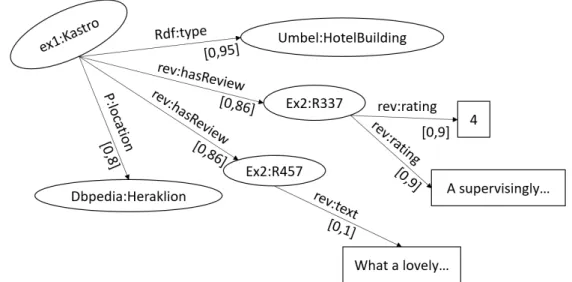
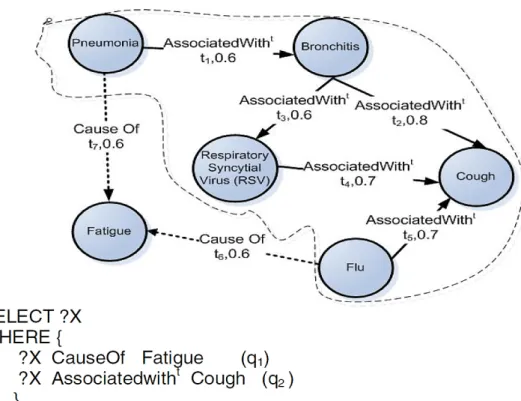
RDF has been used in many real applications. A large amount of RDF data has been pu-blished on the Web; the ease to combine it from different resources creates new challenges linked to efficient query answering and RDF data trustworthiness. Therefore, unreliable data could dominate results of queries, affect knowledge bases, and have negative or mis-leading impact on software agents. In this section, we present the main extended formalism to manage uncertainty residing in RDF data.
1.4.1
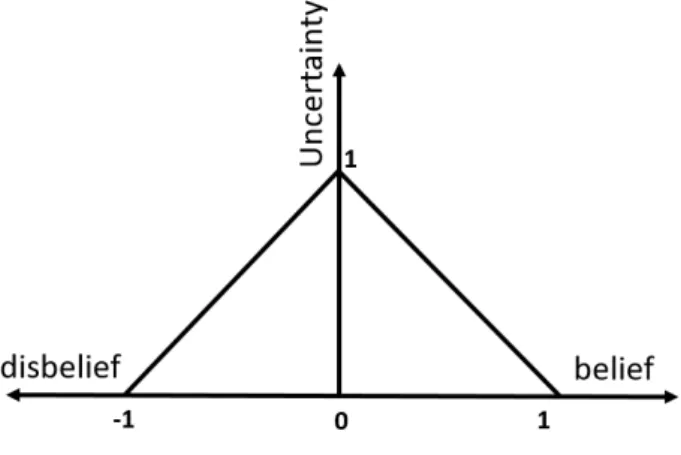
Trust RDF data
Uncertainty can result either from inconsistency between sources or from imprecision/inaccuracy of them. Recently, there is a profusion of research works on this topic. There is an urgent need of standardized mechanisms for data trustwothiness evaluation and a uniform way to manage imperfection of the Web of data [Buche et al., 2005]. Authors in [Richardson et al., 2003,Golbeck, 2006] introduced the Web of trust. For instance, in [Richardson et al., 2003], they estimated user believes in statements supplied by any other user and defined properties for combination functions to merge trusts. The work of [Golbeck, 2006] deals with social networks. Indeed, authors presented an approach to integrate trust, pro-venance and annotations in semantic Web systems. The work of [Golbeck et al., 2003] investigated the applicability of social network analysis to the semantic Web. Authors discussed the multi-dimensional networks evolving from ontological trust specifications. To rate the trustworthiness of RDF Data, Olaf Hartig in [Hartig, 2009a] advocated the need of a uniform way. He introduced a new model that associates RDF statements with trust values (trust model). Trust-RDF or T-RDF model expresses the trustworthiness or the trust degree associated to the RDF triple as a subject of belief and disbelief in the truth of the information represented by this triple. In fact, belief (disbelief) of an RDF triple is expressed as the degree of confidence in the truth (untruth) of the information (see Figure 1.7). Indeed, the trust measure, denoted t, is either a value in the interval [−1, 1] or unknown. In case, t = 1, the user is absolutely sure about the truth of the triple. A positive trust value less than 1 represents belief in the information veracity. Meanwhile, a negative value expresses a disbelief and a value t = −1 expresses a certitude in the information untruth. In the last two decades There is a great research effort to develop the trust RDF model such in [Hartig, 2009a,Hartig, 2009b,Tomaszuk et al., 2012,Ceolin et al., 2014,Olaf, 2014,Fionda and Greco, 2015]. The trustworthiness of RDF triples could be represented by a trust degree which is either a value in the interval [−1, 1] or unknown. For a trust value of 1, the user is absolutely sure about the truth of the corresponding