HAL Id: tel-03199619
https://tel.archives-ouvertes.fr/tel-03199619
Submitted on 15 Apr 2021HAL is a multi-disciplinary open access
archive for the deposit and dissemination of sci-entific research documents, whether they are pub-lished or not. The documents may come from teaching and research institutions in France or abroad, or from public or private research centers.
L’archive ouverte pluridisciplinaire HAL, est destinée au dépôt et à la diffusion de documents scientifiques de niveau recherche, publiés ou non, émanant des établissements d’enseignement et de recherche français ou étrangers, des laboratoires publics ou privés.
Commutation of second-order nonlinear optical
responses of indolino-oxazolidines : from molecules in
solution to functionalized surfaces
Kornelia Pielak
To cite this version:
Kornelia Pielak. Commutation of second-order nonlinear optical responses of indolino-oxazolidines : from molecules in solution to functionalized surfaces. Other. Université de Bordeaux; Université de Namur, 2018. English. �NNT : 2018BORD0096�. �tel-03199619�
THÈSE
présentée pour obtenir le Grade de
DOCTEUR
DE L’UNIVERSITÉ DE BORDEAUX ET DE L’UNIVERSITÉ DE
NAMUR
ÉCOLE DOCTORALE DES SCIENCES CHIMIQUES
SPÉCIALITÉ: CHIMIE PHYSIQUE
par
KORNELIA PIELAK
COMMUTATION DES RÉPONSES OPTIQUES NON
LINÉAIRES DU SECOND ORDRE DES
INDOLINO-OXAZOLIDINES: DES MOLÉCULES EN
SOLUTION AUX SURFACES FONCTIONNALISÉES
Directeur de thèse: Prof. Frédéric CASTET Université de Bordeaux Directeur de thèse: Prof. Benoît CHAMPAGNE Université de Namur
Soutenue le 3 Juillet, 2018
Devant la commission d’examen formée de:
Prof. Vincent RODRIGUEZ Université de Bordeaux Président Prof. Koen CLAYS Katholieke Universiteit Leuven Rapporteur Prof. Eduard MATITO Université du Pays Basque Rapporteur Prof. Elena CARIATI Universitá di Milano Examinateur
THESIS
submitted to the
UNIVERSITY OF BORDEAUX & UNIVERSITY OF NAMUR
DOCTORAL SCHOOL OF CHEMICAL SCIENCES
by
KORNELIA PIELAK
in fulfillment for the Degree of
DOCTOR OF PHILOSOPHY
in CHEMICAL PHYSICS
COMMUTATION OF SECOND-ORDER NONLINEAR
OPTICAL RESPONSES OF INDOLINO-OXAZOLIDINES:
FROM MOLECULES IN SOLUTION TO
FUNCTIONALIZED SURFACES
Thesis Director: Prof. Frédéric CASTET University of Bordeaux
Thesis Director: Prof. Benoît CHAMPAGNE University of Namur
Defense date: 3 July 2018. Review Committee.
Prof. Vincent RODRIGUEZ University of Bordeaux President Prof. Koen CLAYS University of Leuven Reporter Prof. Eduard MATITO University of Basque Country Reporter Prof. Elena CARIATI University of Milan Examiner
Acknowledgements
First and foremost, I would like to express my sincere gratitude to my supervisors Prof. Frédéric Castet and Prof. Benoît Champagne for continuous support during my PhD study, for their patience, motivation, enthusiasm and immense knowledge. Their friendly guidance and expert advices have been invaluable throughout all stages of my work.
Besides my promoters, I would like to warmly thank all the members of my thesis committee: the president Prof. Vincent Rodriquez, the reporters Prof. Koen Clays and Prof. Eduard Matito, and also the examiners Prof. Elena Cariati and Dr. Au-rélie Plaquet, for their insightful comments, interesting questions and discussion.
My sincere thanks also goes to Prof. Lionel Sanguinet for experimental synthe-sizing molecules, which were the matter of my research. Moreover, I would like to thank Dr. Flavie Bondu and Dr. Stefania Righetto for guiding me and a great support during the experimental work.
I would also wish to express my gratitude to Prof. Luca Muccioli and Dr. Claire Tonnelé for their invaluable help during the molecular dynamics simulations and to Jean Deviers for his support in theoretical calculations.
Most importantly, I would like to thank my parents and all my family for their love and help to get through those three years, for understanding and encourage-ment in many moencourage-ments of crisis. For their unwavering belief that I can achieve so much and for giving me strength to reach for the stars and chase my dreams. A very special thanks goes to my supportive fiance Dr. Manoj Gali, without his love, help and positive attitude, I would not have finished this thesis.
In conclusion, I would also like to thank all the members and my friends from the Theoretical Chemistry group at the Institute of Molecular Sciences of the Uni-versity of Bordeaux and the Laboratory of Theoretical Chemistry of the UniUni-versity of Namur, for a support and a great time together.
Contents
1 Introduction 1
1.1 Nonlinear Optical Phenomena . . . 1
1.2 NLO Materials . . . 4
1.3 Nonlinear optical Switches . . . 6
1.3.1 Indolinooxazolidine Derivatives . . . 6
1.4 Switching on Functionalized Surfaces . . . 8
1.5 Potential Applications . . . 9
1.6 Objectives . . . 9
2 Experimental Techniques 17 2.1 UV-vis Spectroscopy . . . 17
2.2 Determination of the First Hyperpolarizability . . . 19
2.2.1 Electric Field-Induced Second Harmonic Generation . . . 19
2.2.2 Hyper-Rayleigh Scattering . . . 24
3 Theoretical Methods 31 3.1 Wavefunction Quantum Mechanics Methods . . . 31
3.1.1 Schrödinger Equation . . . 31
3.1.2 Born-Oppenheimer Approximation . . . 32
3.1.3 Hartree-Fock Theory . . . 33
3.1.4 Møller-Plesset Perturbation Theory . . . 36
3.2 Density Functional Theory . . . 38
3.2.1 Hohenberg-Kohn Theorems . . . 38
3.2.2 Kohn-Sham Theory . . . 39
3.2.3 Exchange-Correlations Functionals . . . 40
3.3 Basis Sets . . . 42
3.4 Absorption Spectra Calculations . . . 43
3.5 Hyperpolarizability Calculations . . . 45
3.5.1 Time-Dependent Hartee-Fock . . . 45
Contents
3.5.3 Finite Field Method . . . 48
3.5.4 Sum-Over-States Method and The Two-State Model . . . 49
3.6 Solvent Effects . . . 50
3.7 Molecular Dynamics Simulations . . . 51
4 Second-Order Nonlinear Optical Properties of Indolino-Oxazolidine Derivatives 61 4.1 Introduction . . . 62
4.2 Experimental and Theoretical Methods . . . 63
4.2.1 Synthesis . . . 63
4.2.2 UV-visible and Hyper-Rayleigh Scattering Measurements . . . 64
4.2.3 Quantum Chemical Calculations . . . 65
4.3 Results and Discussion . . . 66
4.3.1 Structural Properties . . . 66
4.3.2 Linear Optical Properties . . . 68
4.3.3 Nonlinear Optical Properties . . . 72
4.4 Conclusion . . . 75
5 Acido-Triggered Switching of the Second-Order Nonlinear Optical Properties of a Ferrocenyl-Containing Indolino-Oxazolidine Deriva-tive 83 5.1 Introduction . . . 84
5.2 Experimental and Theoretical Methods . . . 85
5.2.1 Synthesis . . . 85
5.2.2 UV-visible and hyper-Rayleigh Scattering Measurements . . . 86
5.2.3 Quantum Chemical Calculations . . . 87
5.3 Results and Discussion . . . 88
5.3.1 Structural Properties . . . 88
5.3.2 Linear Optical Properties . . . 88
5.3.3 Nonlinear Optical Properties . . . 91
5.4 Conclusion . . . 94
6 Dynamical Behavior and Contrasted Second Harmonic Generation Responses in Acido-Triggered Molecular Switches 101 6.1 Introduction . . . 102
6.2 Experimental and Theoretical Methods . . . 104
6.2.1 Nonlinear Optics: General Considerations and Definitions . . . 104
6.2.2 EFISHG Measurements . . . 105
6.2.4 Hyperpolarizability Calculations . . . 108
6.3 Results . . . 109
6.3.1 MD Simulations and ab initio Calculations . . . 109
6.3.2 EFISHG Measurements . . . 114
6.4 Further Discussion and Conclusion . . . 114
7 Nonlinear Optical Responses of Self-Assembled Monolayers Func-tionalized with Indolino-Oxazolidine Photoswitches 121 7.1 Introduction . . . 122
7.2 Theoretical Methodology . . . 123
7.2.1 Molecular Dynamics Simulations . . . 123
7.2.2 Quantum Chemical Calculations . . . 124
7.3 Results and Discussion . . . 125
7.3.1 Morphology of the Self-Assembled Monolayers . . . 125
7.3.2 Commutation of the Nonlinear Optical Responses . . . 127
7.3.3 Relationships Between Geometrical Structures and NLO Responses . . . 130
7.4 Conclusions . . . 131
8 Summary, General Conclusions, and Outlook 137
Appendix A 145
Appendix B 155
Appendix C 165
Chapter
1
Introduction
In this Chapter, the physical and mathematical descriptions of nonlinear opti-cal (NLO) properties of molecules and materials are introduced, focusing on the molecular second-order NLO responses characterized by the first hyperpolarizability, and in particular on the second harmonic generation (SHG) process. Furthermore, various classes of NLO systems are discussed, with special emphasis on indolinoox-azolidines switches, which can commute in solution between two forms displaying very large differences in their SHG responses. We also briefly introduce examples of photoresponsive self-assembled monolayers (SAMs) based on NLO switches, and the potential applications offered by this kind of systems in the field of optical commu-nications, data processing or storage. The global motivation and objectives of this thesis are then presented at the end of the chapter.
1.1
Nonlinear Optical Phenomena
The nonlinear optical (NLO) phenomenon was discovered in 1875, when Kerr observed the change in the refractive index of a material in response to an applied electric field, known as the Kerr effect. [1] However, the dynamic development of NLO experiments started with the invention of the optical ruby laser by Maiman (1960) [2] and just one year later Franken performed the first second harmonic generation (SHG) experiment. [3] From this time, number of nonlinear phenomena have been observed in a large variety materials.
When an electromagnetic wave propagates through a medium, it induces a po-larization as a result of the motion of the electrons and nuclei in response to the external electric field (−→E ). At the macroscopic level, the polarization (−→P ) is defined
as the vector describing the electric dipole moment per unit volume induced by the external electric fields. For small field intensities, such induced polarization is pro-portional to the applied fields. The linear susceptibility (←→χ(1)) is the quantity that
1.1. Nonlinear Optical Phenomena
characterizes the response of the material proportional to the field:
→ P ( → E) = → P0+ ↔ χ(1)·→E (1.1)
However, when the material is a subjected to a very high intensity electric field induced by a laser light, the polarization can be driven beyond the usual linear regime. The nonlinear behavior of the polarization is then described by a power series with respect to the external fields:
→ P ( → E) = → P0+ ↔ χ(1)·E +→ → ↔ χ (2) : → E 2 + ↔ ↔ χ (3) .. . → E 3 + · · · (1.2)
This equation introduces the a second- and a third-order nonlinear optical suscep-tibilities, → ↔ χ (2) and ↔ ↔ χ (3)
, which are third-rank and fourth-rank tensors, respectively. At the molecular scale, the interaction between the applied electric field and the molecules is described by the electric dipole moment (−→µ ). Similarly to the
polarization, the electric dipole moment can be expressed as a power series with respect to the external fields, or using a Taylor series expansion:
→ µ( → E) =→µ0+↔α · → E +1 2 → ↔ β : → E 2 +1 6 ↔ ↔ γ... → E 3 + · · · (1.3)
where↔α is the linear polarizability,
→
↔
β is the first hyperpolarizability (or second-order
polarizability) and
↔
↔
γ is the second hyperpolarizability (or third-order polarizability).
As the microscopic analog of the second-order optical susceptibility, the first hyperpolarizability β is a rank-3 tensor, which contains 27 components usually col-lected within a 9 × 3 matrix:
β =
βxxx βxyy βxzz βxyz βxzy βxzx βxxz βxxy βxyx
βyxx βyyy βyzz βyyz βyzy βyzx βyzx βyxy βyyx
βzxx βzyy βzzz βzyz βzzy βzzx βzxz βzxy βzyx
(1.4)
This large number of tensor elements can be reduced by taking into account the intrinsic permutation symmetry existing in the case of two indiscernible incident photons: βxyz = βxzy. Consequently, the number of independent components in the
can be reduced from 27 to 18, and collected in a 6 × 3 matrix:
β =
βxxx βxyy βxzz βxyz βxzx βxyx
βyxx βyyy βyzz βyyz βyzx βyyx
βzxx βzyy βzzz βzyz βzzx βzyx
(1.5)
Furthermore, if the frequencies (incident and scattered ones) implied in NLO pro-cess are far from any absorption band of the molecule under study, the overall permutation symmetry can be applied on the Cartesian components of the
hyper-1.1. Nonlinear Optical Phenomena
polarizability tensor, without any changes of their values. This property is known the Kleinman’s symmetry rule [4]. With βxyz = βyzx = βzxy = βxzy = βyxz = βzyx),
the β tensor can be curtailed to only 10 components:
β = βxxx βxyy βxzz
βyxx βyyy βyzz
βzxx βzyy βzzz + [βxyz] (1.6)
It is essential to underline that molecules and materials need to be non-centrosymmetric to display order NLO response. If they are centrosymmetric, their second-order NLO responses cancel out, and the lowest second-order nonlinearity is the third second-order. Moreover, the linear and nonlinear optical polarizabilities depend on the fre-quency ω of the applied fields:
→ µ( → E) =→µ0+X ω ↔ α(−ω, ω) · → E ω (e−iωt+ c.c.) + 1 2! X ω1,ω2 → ↔ β (−ωσ; ω1, ω2) : → E ω1→ E ω2 (e−iωσt+ c.c.) + 1 3! X ω1,ω2,ω3 ↔ ↔ γ (−ωσ; ω1, ω2, ω3) : → E ω1→ E ω2→ E ω3 (e−iωσt+ c.c.) + · · · (1.7)
where the ω1, ω2 and ω3 are the frequencies of the applied electric fields, ωσ is the
sum of incident frequencies and c.c. denotes the complex conjugate. Second Harmonic Generation
Second harmonic generation (SHG, also known as ’frequency doubling’) is a non-linear optical process, in which two photons with the same frequency (ω) interact with a medium and generate a new photon at frequency 2ω. This phenomena in pre-sented schematically in Figure 1.1. Two photons of the light field excite the ground state. The first photon creates an excitation from the ground state to an interme-diate state. The intermeinterme-diate state can be a virtual state, which is excited during a short time. The second photon can generate the transition from the intermediate state to the final state, which decays by coherent emission of a photon creating the light field.
D
A
ω
3ω Third Harmonic (THG) 2ω Second Harmonic (SHG) ω T ω Linear Scatteringγ
β
α
Linear and Nonlinear optical properties of a given material under high power fields (E).
I. Introduction
Motivations
D
A
ω
3ω Third Harmonic (THG) 2ω Second Harmonic (SHG) ω T ω Linear Scatteringγ
β
α
Linear and Nonlinear optical properties of a given material under high power fields (E).
Second Harmonic Generation
SHG
= (
2!; !, !)
Nonlinear Optics in Life Diversifying Lasers and Light New Colors Control: Spatial & Frequency Pulsing Materials Interactions Machining Spectroscopy Analysis Tools Information Technology Telecom Sensors Data Storage Signal ProcessingKornelia Pielak – Barcelona (September 5th, 2017) 2
Nonlinear Optics in Life Diversifying Lasers and Light: • New Colors • Control Spatial & Frequency • Pulsing Materials Interaction • Machining • Spectroscopy • Analysis Tools Information Technology • Telecom • Sensors • Data Storage • Signal Processing Virtual state Ground state ! ! 2! D A ω 3ω Third Harmonic (THG) 2ω Second Harmonic (SHG) ω T ω Linear Scattering γ β α Linear and Nonlinear optical properties of a given
material under high power fields (E).
I. Introduction
Motivations
D A ω 3ω Third Harmonic (THG) 2ω Second Harmonic (SHG) ω T ω Linear Scattering γ β α Linear and Nonlinear optical properties of a givenmaterial under high power fields (E).
Second Harmonic Generation
SHG = ( 2!; !, !) Nonlinear Optics in Life Diversifying Lasers and Light New Colors Control: Spatial & Frequency Pulsing Materials Interactions Machining Spectroscopy Analysis Tools Information Technology Telecom Sensors Data Storage Signal Processing
Kornelia Pielak – Barcelona (September 5th, 2017) 2
Nonlinear Optics in Life Diversifying Lasers and Light: • New Colors • Control Spatial & Frequency • Pulsing Materials Interaction • Machining • Spectroscopy • Analysis Tools Information Technology • Telecom • Sensors • Data Storage • Signal Processing Virtual state Ground state ! ! 2!
Figure 1.1: Geometry of second-harmonic generation (left) and energy-level diagram describing second-harmonic generation (right).
1.2. NLO Materials
1.2
NLO Materials
Researches on novel nonlinear optical materials have been a hot topic due to their widespread applications. Generally, NLO materials fall into two classes, either inorganic, which are known to exhibit SHG effect, or organic. Over the last 40 years, the lasers using inorganic matter have been employed as optical devices and consequently inorganic materials have dominated the optical technology. During the 1990’s, organic materials were identified as promising candidates for nonlinear optical applications, because they can exhibit extremely large NLO response. [5–7]
Recent studies particularly focused on the design of π-electron conjugated organic materials [8], which exhibit larger optical nonlinearity, faster optical response, higher bandwidth, lower driving voltage more flexible device design and potentially lower processing cost. [9]
According to Oudar and Chemla [10]), in order to exhibit second-order NLO responses, molecules must possess:
• excited electronic states close in energy to the ground state,
• large oscillator strengths - or transition dipole moments - for electronic tran-sitions from the ground state and excited states,
• large difference between ground state and excited state dipole moments. Those principles are linked via the following equation:
β ∝ | µ 2 ge | ∆µge ∆E2 ge ∝ fge∆µge ∆E3 ge (1.8)
where fge is the oscillator strength, µge and ∆Ege are the transition dipole moment
and energy gap, respectively, between the ground state (g) and the first strongly allowed charge-transfer excited state (e) and ∆µge = µee− µgg.
Many research efforts have been dedicated to the synthesis and design of new materials with efficient nonlinear optical responses, and such requirements (Eq. 1.8) are best met by highly polarizable donor-acceptor chromophores, which are referred to as push-pull systems (Figure 1.2). These organic materials are based on molecular units containing electron donor (D) and electron acceptor (A) groups on opposite sides of a linker containing delocalizable π-electrons. Many efforts have been dedi-cated to find the optimum combination of a bridge, donor and acceptor groups in order to maximize the NLO responses. Commonly, dithiol, dialkylamino or alkoxy units are used as a donor groups, while nitro, cyano or polycyano units are used as acceptor groups. [11–13]
1.2. NLO Materials NO2 NH2 a) NO2 b) Fe NO2 NH2 NO2 O2N H2N NH2 c)
Donor Bridge Acceptor
Figure 1.2: Schematic representation of a model Donor-π-Acceptor system and rep-resentative examples: a) push pull dipolar p-nitroaniline (β = 9.2 × 10⁻³⁰ esu,
measured in acetone [17]), b) push-pull molecule involving an organometallic unit (ferrocene donor, β = 66 × 10−30 esu, Kurtz powder measurements at 1064 nm [18]) and c) octupolar 1,3,5-triamino-2,4,6,-trinitrobenzene molecule (β333 = 27 × 10−30
esu measured in acetone by EFISHG technique [19]) 1 atomic unit = 3.62 × 10−42 m4 V−1 = 8.641 × 10⁻³³ esu. [20]
The nature of the bridge has also been widely studied, paying special attention to a structural parameter having a direct impact on the first hyperpolarizability, namely the bond-length alternation (BLA). [14–16] BLA refers to the average difference in length between single and double bonds along the π-conjugated backbone. A BLA value close to 0 indicates that the system is highly conjugated.
In 1987, M. Green [21] reported the first ferrocene derivatives with excellent NLO response, initiating new molecular design developments using metallocenes as donor moieties. Organometallic units can be characterized by low energy metal to ligand (MLCT) or ligand to metal (LMCT) charge transfer excitations, and can exhibit excited state with very low energy and dipole moments. Moreover metallocenes can be used as donor or acceptor groups, or also as polarisable conjugated bridges. [18, 22, 23] In the recent years, many studies reported NLO properties of metal complexes, very often involving ruthenium [24, 25].
In 1990, J. Zyss and co-workers [26–28] introduced a new kind of systems ex-hibiting high second-order nonlinear optical responses, namely octupolar molecules (Figure 1.2). Octupolar structures are non polar molecules that combine second-order nonlinear optical properties with a strict cancellation of all vector-like observ-ables, including the ground- and excited-state dipole moment. Hence, such systems can not be described by the two-level model because ∆µge = 0 and must be
de-scribed using, at least, a three-level model. Octupolar molecules have the advantage to undergo easier noncentrosymmetric crystallization than dipolar molecules. Fur-thermore, with two or three dimensional charge-transfer transitions, they are able to improve the efficiency-transparency trade-off and stability compared to classical dipolar compounds.
1.3. Nonlinear optical Switches
1.3
Nonlinear optical Switches
In recent years, along with the development of optoelectronic and photonic tech-nologies, molecular NLO switches received extensive attention. Those species are systems that are reversibly switchable between at least two forms that exhibit very different β responses, and which are stable during at least the measurement time for the readout. [29]. The commutation between different forms can be triggered by using various external stimuli such as a variation of pH [30–32], temperature [33], light [34–38] or redox potential [39].
In 1999, J. Coe [40] categorized different types of molecular switches based on the part of the molecule that is altered during the commutation reaction (Figure 1.3). The most common used type of NLO switches involves the alteration of the π conjugation within the bridge linking the donor and acceptor unit. [41] The figure of merit of such switches is the contrast between the ’ON’ state (β 0) and the ’OFF’ state (β ≈ 0). D π A β >> 0 D π D’/A -A π D+/A’ D A β ≈ 0 π →redox/proton transfer of A →redox/proton transfer of D → alternation of π-conjugation in bridge -e-/+H+ +e-/-H+ →alteration of "-conjugated in bridge D π A β >> 0 D π D’/A -A π D+/A’ D A β ≈ 0 π →redox/proton transfer of A →redox/proton transfer of D → alternation of π-conjugation in bridge -e-/+H+ +e-/-H+
+e
-/-H
+-e
-/+H
+ ℎ" D π A β >> 0 D π D’/A -A π D+/A’ D A β ≈ 0 π →redox/proton transfer of A →redox/proton transfer of D → alternation of π-conjugation in bridge -e-/+H+ +e-/-H++e
-/-H
+-e
-/+H
+ ℎ" on D on AFigure 1.3: Schematic representation of a molecular switches.
1.3.1
Indolinooxazolidine Derivatives
Indolinooxazolidine derivatives is the main matter of this thesis. Those com-pounds come from indolinospiropyrans, which were widely used in photochromism. Indolinooxazolidine species have been discovered in the early 1970s, the first in a form of indolenium salts appeared in patents as useful dyeing agents for wood pulp-based paper, wool, natural acetate silk and polyacrylonitrile fibers. [42] The Figure 1.4 presents the indolinooxazolidine and their related structurally sub-families. The first detailed synthesis of the indolinooxazolidine derivatives in its closed form with
π-system was reported later in 1973 by Krongauz. [43]
In the 1990’s, studies of the Indolinooxazolidine derivatives have shown that such systems considered as a core, associated with various styrylic residues might act as multiaddressable switches displaying both photo- and acidochromic properties. Due to their switching ability or mild condensation also in condition without solvent, numerous structural variations of this compound could be developed.
1.3. Nonlinear optical Switches N R1 O R2 Indolinospiropyrans Hirshberg at al. 1952 R1 = alkyl, hydroxyalkyl R2 = NO 2, aryl N R1 O N R2 Indolinospirooxazines Ono at al. 1970 R1 = alkyl, hydroxyalkyl R2 = NO 2, aryl N Indolinooxazolidines Schmitt 1972 R3 = H, Me, CHO, NO 2, halogen Y = C or N R3 O Y Ar Indolinobenzoxazines Shackhus at al. 1987 R4 = H, OMe, NO 2, F, styryl R5 = F R6 = Me, Ph, styryl R4 R5 N O R6 NO2
Figure 1.4: Indolinooxazolidines and their related structurally sub-families (from Ref. [42]).
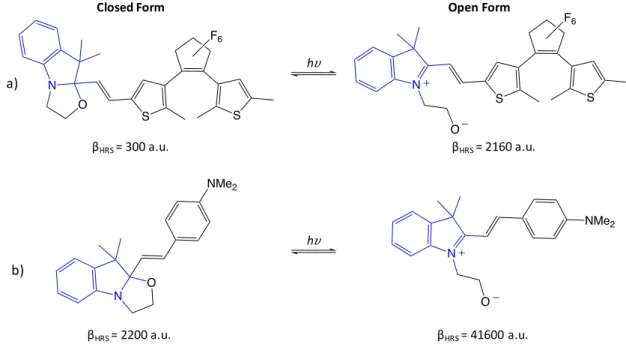
In 2005, Sanguinet at al. [30] reported the synthesis of a new series of multiad-dressable chromophores based on the indolinooxazolidine unit, which were shown to exhibit photo- and acido-tunable NLO properties. Since this time, many systems were derived from indolinooxazolidine family. Recently, it has been demonstrated that the association of an indolinooxazolidine core with a bithiophene moiety act-ing as a redox center leads to a trimodal switch where the interconversion between the colorless closed form and the colored open form can be indifferently triggered by light irradiation, pH variation, or electrical stimulation. Some examples of such compounds with their β response are illustrated on Figure 1.5. Those structures show the huge contrast between the closed and open forms.
N O S S F6 S S F6 N O βHRS = 300 a.u. βHRS = 2160 a.u. Closed Form Open Form h! h! N O NMe2 N O NMe2 βHRS = 2200 a.u. βHRS = 41600 a.u. a) b)
Figure 1.5: Examples of NLO switches based on indolinooxazolidine with their first hyperpolarizability value (from Ref. [44, 45]).
1.4. Switching on Functionalized Surfaces
1.4
Switching on Functionalized Surfaces
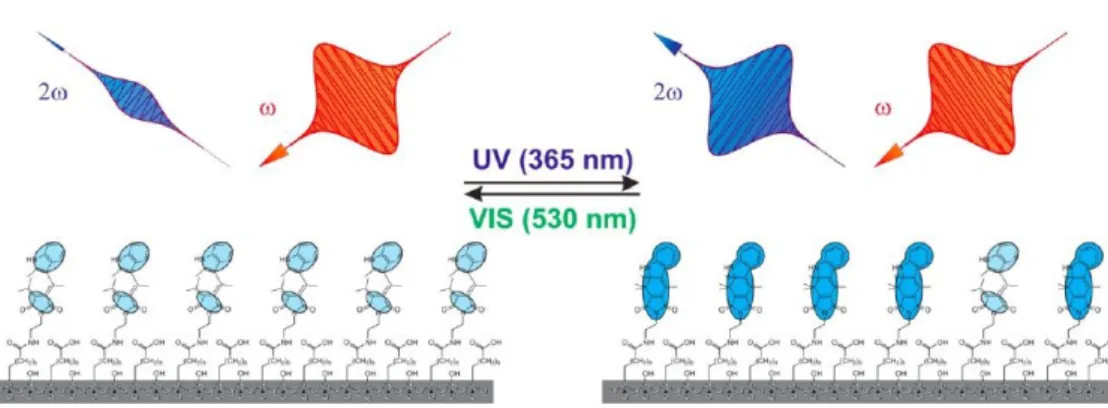
Nowadays, the challenge of designing efficient NLO switches goes beyond the traditional approach of characterizing by experimental and theoretical means -the molecules in solution. It implies considering -the molecules in -the solid state or under the form of functionalized surfaces. Literature describes numerous exam-ples of reversible switching molecules grafted on a planar solid surface [46–48]. The first examples of reversible SHG switching on surfaces were demonstrated by using azobenzene [49] and spiropyran containing polymers [50] and later fulgimide moi-eties [51]. In fact, azobenzene represents the most commonly used and investigated molecular switch for surface functionalization [52–54].
Switching of the second-harmonic generation has been previously demonstrated in poled polymers containing photochromic dyes [50], organic photochromic crys-tals [36], and Langmuir-Blodgett thin films of organometallic complexes [39]. One of the most versatile approaches for surface engineering and interface design is to use self-assembled monolayers (SAM), which generally denotes a monomolecular thick film of organic compounds on flat metal or semiconductor surfaces. SAMs have been considered as ideal platforms to order and align molecules at surfaces. The potential issue of SAM is that the neighboring molecular switches can influence each other by electronic coupling, but this can be treated by taking care of various spacer groups [55].
Figure 1.6: Example of the reversible photoswitching of the NLO response in second harmonic generation (from Ref. [51]).
1.5. Potential Applications
1.5
Potential Applications
Intensive research on the novel nonlinear optical materials can be understood, due to their widespread applications in such branches as optical communications, optical data processing and storage [37], electrooptical devices [56, 57]. Based on the principles of nonlinear optics, nonlinear optical fibers [58] and ultrashort pulsed or power tunable lasers [59] have been constructed. Furthermore, the Q-switching, mode-locking technologies [60] and other lasers (pulse compression, frequency con-version, laser transportation) are based on nonlinear optics phenomena. [61]
Other branches of applications are information technology, which include optical communicating (e.g. semiconductor laser, optical switching, coherent optical com-munication [62]), computing (e.g. optical logic gate) [63] or sensing (e.g. fiber sensor). [64] In particular switches with commutable NLO properties are addressed to store and restore information optically, or to deflect light beams. [65] With the emergence of photonic technologies in areas such as telecommunications where in-formation is coded, transported and routed optically, there is a strong technological demand for high-performance NLO materials. [66, 67]
1.6
Objectives
The main goal of this thesis is the detailed characterization of the second har-monic generation (SHG) responses of indolinooxazolidine derivatives in different environments. These molecular switches are particularly interesting, because they can commute between a colorless closed form and a colored open form, as a result of various external stimuli, such as light irradiation, pH variation, or electrical stimula-tion. The two forms display different NLO responses and a huge contrast of their β values, making these systems interesting for applications in molecular-scale memory devices with multiple storage and nondestructive capacity. In this thesis, we evaluate the first hyperpolarizability of both forms and the corresponding contrast for several indolinooxazolidine derivatives that differ by their donor and acceptor groups. For instance, we study the effect of a -CH3 versus a -NO2 electron-withdrawing group on
the indole moiety, as well as of the effect of using a ferrocene organometallic unit in-stead of a bithiophene donor moiety. Our work adopts a multidisciplinary approach where the NLO properties of the compounds are characterized experimentally and by computational methods, after they have been synthesized by our collaborators.
Experimentally, in order to evaluate the second harmonic generation, we apply the hyper-Rayleigh scattering (HRS) and electric-field induced second harmonic gen-eration (EFISHG) techniques in solution (acetonitrile and chloroform, respectively). The EFISHG method allows the measurements of NLO properties for neutral species only. In such process, NLO switches dissolve in chloroform solution and by the addi-tion of trifluoroacetic acid, the neutral closed form is transformed into a protonated
1.6. Objectives
open form, forming an ion pair with the trifluoroacetate a counterion.
The corresponding theoretical calculations are performed by means of density functional theory (DFT), its time-dependent form (TDDFT), as well as post Hartree-Fock ab initio methods, which take into account the electron correlation effects (by combining the Finite Field method with Møller-Plesset Perturbation theory). The influence of the basis set size, of the exchange-correlation functionals and of the solvation model is also investigated. Moreover, for the full understanding of those compounds, it was also valuable to analyze the linear optical properties, i.e. the UV-vis absorption spectrum.
Regarding the loosely bound ionic pairs, theoretically, the challenge was then to describe their dynamical behavior. To do that we applied a multiscale computa-tional method, which consists first in molecular dynamics simulations with explicit chloroform molecules and then, for a selection of snapshots, in the calculation of the first hyperpolarizability by using quantum chemical methods with implicit solvent model (PCM). This approach turned out to be useful for addressing several issues related to the EFISHG properties, such as the sign of µβ// and the amplitude of the
second hyperpolarizability (γ). This also allowed comparing implicit and explicit solvation models.
Besides molecules in solution, computational investigations tackle the second-order nonlinear optical properties of self-assembled monolayers (SAM) based on indolinooxazolidine derivatives. The morphology of various conformations of the monolayers are characterized by using MD simulations. Then, following the multi-step strategy elaborated for switches in solutions, DFT calculations are performed on snapshots extracted from the MD trajectories, providing a global overview on structural disorder induced by thermal effects and steric interactions, and their im-pact on the SHG responses of both states of the SAM. The sequential MD-QM approach facilitates understanding the relationships between geometrical structures and the NLO properties.
In summary, this PhD addresses the SHG responses and β contrasts of in-dolinooxazolidine derivatives in different environments. Thus, the strategy of this thesis is going beyond the classical framework of describing NLO responses in so-lutions using implicit models and deals with multiscale simulations of soso-lutions, as well as of 2D photoresponsive functionalized surfaces.
Bibliography
[1] J. Kerr. A new relation between electricity and light: Dielectrified media bire-fringent. Philosophical Magazine, 50:337–348, 1875.
[2] T. H. Maiman. Stimulated optical radiation in ruby. Nature, 187:493–494, 1960.
[3] P. A. Franken, A. E. Hill, C. W. Peters, and G. Weinreich. Generation of optical harmonics. Phys. Rev. Lett., 7(4):118–119, 1961.
[4] D. A. Kleinman. Phys. Rev., 126:1977, 1962.
[5] P. N. Prasad and D. J. Williams. Introduction to nonlinear optical effects in
molecules and polymers. Wiley: New York„ 1991.
[6] F. Pan, K. McCallion, and M. Chiappetta. Waveguide fabrication and high-speed in-line intensity modulation in 4-N,N-4-dimethylamino-4-N-methyl-stilbazolium tosylate. Appl. Phys. Lett, 74(4):492–494, 1999.
[7] T. Kaino, B. Cai, and K. Takayama. Fabrication of DAST channel optical waveguides. Adv. Funct. Mater, 12(9):599–603, 2002.
[8] W. Geis, R. Sinta, W. Mowers, S. J. Deneault, M. F. Marchant, K. E. Krohn, S. J. Spector, D. R. Calawa, and T. M. Lyszczarz. Fabrication of crystalline organic waveguides with an exceptionally large electro-optic coefficient. Appl.
Phys. Lett, 84(19):3729–3731, 2004.
[9] L. R. Dalton. Organic electro-optic materials. 76(2003):1421–1433, 2004. [10] J. L. Oudar and D. S. Chemla. Hyperpolarizabilities of the nitroanilines and
their relations to the excited state dipole moment. J. Chem. Phys., 66(6):2664– 2668, 1977.
[11] M. Stahelin, B. Zysset, M. Ahlheim, S. R. Marder, P. V. Bedworth, C. Runser, M. Barzoukas, and A. Fort. Nonlinear optical properties of push-pull polyenes for electro-optics. J. Opt. Soc. Am, 13(11):2401–2407, 1996.
Bibliography
[12] A. E. De A Machado and A. De S. Arnóbio, Gama. Enhanced optical nonlinear-ities in push-pull organic systems with polyenic-mesoionic ring mixed bridges.
J. Braz. Chem. Soc., 19(7):1381–1387, 2008.
[13] N. H. List, R. Zaleśny, N. A. Murugan, J. Kongsted, W. Bartkowiak, and H. Ågren. Relation between nonlinear optical properties of push-pull molecules and metric of charge transfer excitations. J. Chem. Theory
Com-put, 11(9):4182–4188, 2015.
[14] C. B. Gorman and S. R. Marder. An investigation of the interrelationships be-tween linear and nonlinear polarizabilities and bond-length alternation in con-jugated organic molecules. Proc. Natl. Acad. Sci., 90(23):11297–11301, 1993. [15] S. R. Marder, C. B. Gorman, F. Meyers, J. W. Perry, G. Bourhill, J.-L. Brédas,
and B. M. Pierce. A unified description of linear and nonlinear polarization in organic polymethine dyes. Science, 265(5172):632–635, 1994.
[16] F. Meyers, S. R. Marder, B. M. Pierce, and J.-L. Brédas. Electric eield modu-lated nonlinear optical properties of donor-acceptor polyenes: sum-over-states investigation of the relationship between molecular polarizabilities (α,β, and γ.) and bond length alternation. J. Am. Chem. Soc, 116(23):10703–10714, 1994. [17] L. T. Cheng, W. Tam, S. H. Stevenson, G. R. Meredith, G. Rikken, and S. R.
Marder. Experimental investigations of organic molecular nonlinear optical polarizabilities. 1. Methods and results on benzene and stilbene derivatives. J.
Phys. Chem., 95(26):10631–10643, 1991.
[18] N. J. Long. Organometallic compounds for nonlinear optics. Angew. Chem.
Int. Ed, 34:21–38, 1995.
[19] T. Verbiest, C. Samyn, A. Persoons, K. Clays, J. Wolff, and D. Reinhoudt. Investigations of the hyperpolarizability in organic molecules from dipolar to octopolar systems. J. Am. Chem. Soc., 116(20):9320–9323, 1994.
[20] D. P. Shelton and J. E. Rice. Measurements and calculations of the hyper-polarizabilities of atoms and small molecules in the gas phase. Chem. Rev., 94(1):3–29, 1994.
[21] M. L. H. Green, S. R. Marder, M. E. Thompson, J. A. Bandy, D. Bloor, P. V. Kolinsky, and R. J. Jones. Synthesis and structure of (cis)-[1-ferrocenyl-2-(4-nitrophenyl)ethylene], an organotransition metal compound with a large second-order optical nonlinearity. Nature, 330(6146):360–362, 1987.
[22] H. S. Nalwa. Organometallic materials for nonlinear optics. Appl. Organomet.
Bibliography
[23] T. Verbiest, S. Houbrechts, M. Kauranen, and K. Clays. Second-order nonlinear optical materials: recent advances in chromophore design. J. Mater. Chem, 7(11):2175–2189, 1997.
[24] J. B. Coe, A. J. Harris, I. Asselberghs, A. Persoons, C. J. Jeffery, H. L. Rees, T. Gelbrich, and B. M. Hursthouse. Tuning of charge-transfer absorption and molecular quadratic non-linear optical properties in ruthenium(II) ammine complexes. J. Chem. Soc., (20):3617–3625, 1999.
[25] G. Grelaud, M. P. Cifuentes, F. Paul, and M. G. Humphrey. Group 8 metal alkynyl complexes for nonlinear optics. J. Organomet. Chem, 751:181–200, 2014.
[26] I. Ledoux, J. Zyss, J. S. L. Siegel, J. Brienne, and J. Lehn. Second-harmonic generation from non-dipolar non-centrosymmetric aromatic charge-transfer molecules. Chem. Phys. Lett., 172(6):0–4, 1990.
[27] J. Zyss. Octupolar organic systems in quadratic nonlinear optics: molecules
and materials. Nonlinear Optics, 1991.
[28] J. Zyss. Molecular engineering implications of rotational invariance in quadratic nonlinear optics: From dipolar to octupolar molecules and materials. J. Chem.
Phys, 98(9):6583–6599, 1993.
[29] B. L. Feringa and W. R. Browne. Molecular switches. Eds. Wiley-VCH: Wein-heim, 2nd edition, 2011.
[30] L. Sanguinet, J.-L. Pozzo, V. Rodriguez, F. Adamietz, F. Castet, L. Ducasse, and B. Champagne. Acido- and photo-triggered NLO properties enhancement.
J. Phys. Chem. B., 109(22):11139–11150, 2005.
[31] A. Plaquet, B. Champagne, J. Kulhanek, F. Bures, E. Bogdan, F. Castet, L. Ducasse, and V. Rodriguez. Effects of the nature and length of the π-conjugated bridge on the second-order nonlinear optical responses of push-pull molecules including 4,5-dicyanoimidazole and their protonated forms.
ChemPhysChem, 12:3245–3252, 2011.
[32] E. Cariati, C. Dragonetti, E. Lucenti, F. Nisic, S. Righetto, D. Roberto, and E. Tordin. An acido-triggered reversible luminescent and nonlinear optical switch based on a substituted styrylpyridine: EFISH measurements as an un-usual method to reveal a protonation-deprotonation NLO contrast. Chem-Comm, 50(13):1608, 2014.
[33] M. Sliwa, A. Spangenberg, I. Malfant, P. G. Lacroix, R. Métivier, R. B. Pansu, and K. Nakatani. Structural, optical, and theoretical studies of a
ther-Bibliography
mochromic organic crystal with reversibly variable second harmonic generation.
Chem. Mater, 20(12):4062–4068, 2008.
[34] G. Berkovic, V. Krongauz, and V. Weiss. Spiropyrans and spirooxazines for memories and switches. Chem. Rev., 100(5):1741–1754, 2000.
[35] B. L. Feringa, R. A. van Delden, N. Koumura, and Geertsema E. M. Chiroptical molecular switches. Chem. Rev., 100:1789–1816, 2000.
[36] M. Sliwa, S. Létard, I. Malfant, M. Nierlich, P. G. Lacroix, T. Asahi, H. Ma-suhara, P. Yu, and K. Nakatani. Design, synthesis, structural and nonlinear op-tical properties of photochromic crystals: Toward reversible molecular switches.
Chem. Mater, 17(18):4727–4735, 2005.
[37] M. G. Papadopoulos, A. J. Sadlej, and J. Leszczynski. Non-linear optical
proper-ties of matter, from molecules to condensed phases. Springer: The Netherlands,
2006.
[38] V. Aubert, V. Guerchais, E. Ishow, K. Hoang-Thi, I. Ledoux, K. Nakatani, and Le Bozec H. Efficient photoswitching of the nonlinear optical properties of dipolar photochromic zinc(II) complexes. Angew. Chem., Int. Ed., 47:577–580, 2008.
[39] L. Boubekeur-Lecaque, B. J. Coe, K. Clays, S. Foerier, T. Verbiest, and I. As-selberghs. Redox-switching of nonlinear optical behavior in langmuir-blodgett thin films containing a ruthenium(II) ammine complex. J. Am. Chem. Soc, 130(11):3286–3287, 2008.
[40] B. J. Coe. Molecular materials possessing switchable quadratic nonlinear optical properties. Chem. Eur. J, 5(9):2464–2471, 1999.
[41] F. Castet, V. Rodriguez, J.-L. Pozzo, L. Ducasse, A. Plaquet, and B. Cham-pagne. Design and characterization of molecular nonlinear optical switches.
Acc. Chem. Res, 46(11):2656–2665, 2013.
[42] G. Szalóki and L. Sanguinet. Properties and applications of indolinooxazolidines
as photo electro and acidochromic. Springer, 2017.
[43] El. Zaitseva, Al. Prokhoda, Ln. Kurkovskays, Rr. Shifrina, Ns. Kurdish, Da. Drapkina, and Va. Krongauz. Photochromy of organic substances. VI.
Preoa-ration of N-methacryloylhydroxyethyl derivatives of indolent spiropyrans. Khim
Geterotsik, 1973.
[44] J. Quertinmont, B. Champagne, F. Castet, and M. Hidalgo Cardenuto. Explicit versus implicit solvation effects on the first hyperpolarizability of an organic biphotochrome. J. Phys. Chem. A, 119(21):5496–5503, 2015.
Bibliography
[45] F. Mançois, J.-L. Pozzo, J. Pan, F. Adamietz, V. Rodriguez, L. Ducasse, F. Castet, A. Plaquet, and B. Champagne. Two-way molecular switches with large nonlinear optical contrast. Chem. Eur. J, 15(11):2560–2571, 2009. [46] B. C. Bunker, B. I. Kim, J. E. Houston, R. Rosario, A. A. Garcia, M. Hayes,
D. Gust, and S. T. Picraux. Direct observation of photo switching in tethered spiropyrans using the interfacial force microscope. Nano Lett., 3(12):1723–1727, 2003.
[47] Y. Sheng, J. Leszczynski, A. A. Garcia, R. Rosario, D. Gust, and J. Springer. Comprehensive theoretical study of the conversion reactions of spiropyrans: Substituent and solvent effects. J. Phys. Chem. B, 108(41):16233–16243, 2004. [48] R. Rosario, D. Gust, M. Hayes, J. Springer, and A. A. Garcia. Solva-tochromic study of the microenvironment of surface-bound spiropyrans.
Lang-muir, 19(21):8801–8806, 2003.
[49] R. Loucif-Saïbi, K. Nakatani, J. A. Delaire, M. Dumont, and Z. Sekkat. Pho-toisomerization and second harmonic generation in disperse red one-doped and -functionalized poly(methyl methacrylate) films. Chem. Mater, 5(2):229–236, 1993.
[50] Y. Atassi, J. A. Delaire, and K. Nakatani. Coupling between photochromism and second-harmonic generation in spiropyran- and spirooxazine-doped poly-mer films. J. Phys. Chem. A, 99(44):16320–16326, 1995.
[51] M. Schulze, M. Utecht, A. Hebert, K. Rück-Braun, P. Saalfrank, and P. Tegeder. Reversible photoswitching of the interfacial nonlinear optical response. J. Phys.
Chem. Lett, 6(3):505–509, 2015.
[52] C. Gahl, R. Schmidt, D. Brete, E. R. McNellis, W. Freyer, R. Carley, K. Reuter, and M. Weinelt. Structure and excitonic coupling in self-assembled monolayers of azobenzene-functionalized alkanethiols. J. Am. Chem. Soc, 132(6):1831– 1838, 2010.
[53] M. Schulze, M. Utecht, T. Moldt, D. Przyrembel, C. Gahl, M. Weinelt, P. Saalfrank, and P. Tegeder. Nonlinear optical response of photochromic azobenzene-functionalized self-assembled monolayers. Phys. Chem. Chem. Phys., 17(27):18079–18086, 2015.
[54] T. Moldt, D. Brete, D. Przyrembel, S. Das, J. R. Goldman, P. K. Kundu, C. Gahl, R. Klajn, and M. Weinelt. Tailoring the properties of surface-immobilized azobenzenes by monolayer dilution and surface curvature.
Bibliography
[55] N. Katsonis, M. Lubomska, M. M. Pollard, B. L. Feringa, and P. Rudolf. Syn-thetic light-activated molecular switches and motors on surfaces. Progress in
Surface Science, 82(7-8):407–434, 2007.
[56] J. M. Hales, J. Matichak, S. Barlow, S. Ohira, K. Yesudas, J.-L. Brédas, J. W. Perry, and S. R. Marder. Design of polymethine dyes with large third-order optical nonlinearities and loss figures of merit. Science, 327(5972):1485–1488, 2010.
[57] S. Mukhopadhyay, C. Risko, S. R. Marder, and Brédas J.-L. Polymethine dyes for all-optical switching applications: A quantum-chemical characteriza-tion of counter-ion and aggregacharacteriza-tion effects on the third-order nonlinear optical response. Chem. Sci., 4(207890):3906–3911, 2012.
[58] G. Agrawal. Nonlinear fiber optics: its history and recent progress. Josa B, 28(12):0–1, 2011.
[59] A. M. Heidt, J. P. Burger, J.-N. Maran, and N. Traynor. High power and high energy ultrashort pulse generation with a frequency shifted feedback fiber laser.
Opt. Express, 15(24):15892–15897, 2007.
[60] H. Ahmad, M. Dernaika, and S. W. Harun. All-fiber dual wavelength passive Q-switched fiber laser using a dispersion-decreasing taper fiber in a nonlinear loop mirror. Opt. Express, 22(19):22794, 2014.
[61] R. Boyd. Nonlinear Optics. J. Chem. Inf. Model., 53:1689–1699, 2013.
[62] G. Li. Recent advances in coherent optical communication. Adva. Opt. Photo., 1(2):279, 2009.
[63] P. Singh, D. Kr. Tripathi, S. Jaiswal, and H. K. Dixit. All-optical logic gates: Designs, classification, and comparison. Adv. Opt. Tech., 2014, 2014.
[64] Yili Guo. Nonlinear photonics: nonlinearities in optics, optoelectronics, and
fiber communications. Chinese University Press, 2002.
[65] G. Bouwhuis and J. H. Spruit. Optical storage read-out of nonlinear disks.
Appl. Opt, 29(26):3766–3774, 1990.
[66] E. Garmire. Nonlinear optics in daily life. Opt. Express, 21(25):30532, 2013. [67] M. Samoc, N. Gauthier, M. P. Cifuentes, F. Paul, C. Lapinte, and M. G.
Humphrey. Electrochemical switching of the cubic nonlinear optical proper-ties of an aryldiethynyl-linked heterobimetallic complex between three distinct states. Angew. Chem. Int. Ed, 45(44):7376–7379, 2006.
Chapter
2
Experimental Techniques
This chapter describes the principles of the experimental techniques, which were employed to measure the linear and nonlinear optical responses of NLO switches in solution. The experimental determination of the first hyperpolarizability was achieved by means of the Hyper-Rayleigh scattering (HRS) technique, at the ISM of the University of Bordeaux, as well as by the Electric Field-Induced Second Har-monic Generation (EFISHG) technique, available at the ISTM-CNR of the Univer-sity of Milan. The linear optical properties of the NLO switches were described by using the most common method, namely UV-vis absorption spectroscopy and these measurements were performed at both Universities.
2.1
UV-vis Spectroscopy
Molecular spectroscopies study the interactions of electromagnetic waves with matter. Molecules can absorb photons of energy E = hv = hc/λ, where v is the frequency, λ the corresponding wavelength, and the c the speed of light in vacuum. The Ultraviolet-Visible (UV-vis) spectroscopy is a useful technique to characterize the absorption, transmission and reflectivity of a variety of compounds in the 190-780 nm range of the electromagnetic spectrum. [1] UV-vis spectroscopy allows to describe the color of molecules, as well as to unravel the relationships between the color and the structure of compounds. It is routinely used for the quantitative determination of specific chemical species.
Upon irradiation in the UV-vis range the molecule is electronically excited. This process is usually described by the promotion of one electron from an occupied orbital (usually a bonding σ, π or non-bonding n) to an unoccupied one (an anti-bonding π∗ or σ∗ orbital) with higher energy. Typical transitions from the ground state to higher levels are presented in Figure 2.1.
2.1. UV-vis Spectroscopy
Physikalisch-chemisches Praktikum I UV/VIS Spectroscopy – 2017
! !"#$ FWHM Δ! &(!"#$) &(!"#$)/2
Figure 2: Absorption band and full width at half maximum. The orange area is an approximation for the integral over the full spectrum.
! " !∗ "∗ $ bonding non-bonding antibonding
Figure 3: Illustration of di↵erent types of electronic transitions.
1.3.3 Di↵erent types of Electronic Transitions
A rigorous discussion of transition probabilities is beyond the scope of this lab course, but one obvious factor is the overlap of the orbitals involved in the electronic excitation. This is nicely illustrated by the two transitions of an isolated carbonyl group. The n! ⇡⇤
transition is lower in energy ( max⇡ 290 nm) than the ⇡ ! ⇡⇤transition ( max⇡ 180
nm), but the transition probability of the former is a thousand times smaller than that of the latter. The spatial distribution of these orbitals suggests why this is so. As illustrated in Figure3, the n-orbitals do not overlap at all well with the ⇡⇤orbital, so the probability
of this excitation is small. The ⇡! ⇡⇤transition, on the other hand, involves orbitals
that have significant overlap, and the transition probability is very large.
Transitions between electronic states can be divided into the following categories:
1The quantity is called transition dipole moment because of the analogy with a static dipole moment
(see that Experiment): in quantum mechanics, the charge distribution of the electrons in the ground
state is given by ⇢(~r) = e| 0(~r)|2and instead of the classical dipole moment of a charge distribution:
µ =R⇢(~r)~rd~r we write µ = eR 0(~r)~r 0(~r)d~r.
Page 5 of11
Physikalisch-chemisches Praktikum I UV/VIS Spectroscopy – 2017
to another orbital, gaining or losing energy only in amounts exactly corresponding to the di↵erence between two levels: The transition from the ground state (lowest possible
E0 E1 E2 Ground state Excited states ΔE= E1 - E0 Light (ℎ$ = Δ&) ( = )/$
energy) at energy E0 to a higher level at energy Enis possible if the molecule absorbs
electromagnetic radiation of the corresponding wavelength = ch/(En E0), where c
is the speed of light and h is Planck’s constant. Excited states usually exist only for a very short period of time (femtoseconds to microseconds), because the higher energy state is unstable and the extra energy is lost through relaxation processes such as emission of light (see the Experiment Fluorescence Quenching). The typical energy di↵erence between the ground and the first excited levels of many molecules corresponds to electromagnetic waves of the ultra-violet (UV) and visible regions of the electromagnetic spectrum.
1.2 The Electromagnetic Spectrum
The UV-visible range is only a small part of the total electromagnetic spectrum, and is generally defined from wavelengths of 190 nm at the high energy UV end to about 750 nm at the low energy red end of the spectrum. Light in other regions of the spectrum gives rise to di↵erent types of transitions and is the subject of di↵erent types of spectroscopy. For example, IR radiation is usually not energetic enough to cause electronic transitions but can excite vibrations of molecules. The wavelength is the distance between
adja-Figure 1: The electromagnetic spectrum.
Source: http://upload.wikimedia.org/wikipedia/commons/3/30/EM spectrumrevised.png
Page 2 of11
Figure 2.1: Energy changes upon electronic transition from the ground to excited states (left) and different types of electronic transitions (right).
Beer-Lambert Law
One of the most common applications of UV-vis spectroscopy is to monitor the concentration of chromophores by using the Beer-Lambert Law, which describes the
linear relationship between absorbance and concentration of an absorbing species [2].
This rule can be expressed via the equation:
A = logI0
I = ε[c]l (2.1)
where A is the absorbance of the sample, I0 and I are the incident and transmitted
intensities, respectively, l is the path length of the absorbing solution, [c] is the con-centration of the absorbing species and ε is characteristic of each absorbing material, known as the molar absorption coefficient. The ε value varies with the wavelength and depends on the intrinsic property of chemical species i.e. on its chemical com-position. The other useful parameter is the wavelength at which the maximum absorption occurs (λmax), which also depends on the nature of the chromophores.
When ε and λmax are known, the concentration of its solution can be calculated.
The maximum value of the molar absorption coefficient (εmax), at wavelength λmax,
is an indicator of the intensity of the electronic transition, although the absorption band can spread across a range of wavelengths, so that a single wavenumber may not reflect the true intensity of the transition. The integrated absorption coefficient (α) is the integral of the molar absorption coefficient over the entire band, which therefore corresponds to the area under the curve plot of molar absorption coefficient as a function of the wavenumber (˜ν):
α =
Z
band
ε(˜ν)d˜ν (2.2)
The area of the absorption band in solution can be characterized by its width at half maximum (∆˜ν1/2). This is the width at which ε = εmax/2. By assuming a
2.2. Determination of the First Hyperpolarizability symmetrical band, ε is then given by:
Z
band
ε(˜ν)d˜ν ≈ εmax∆˜ν1/2 (2.3)
The experimental intensity of a UV-vis absorption band can be compared with simu-lations using the oscillator strength parameter (f ), which determines the probability of the light absorption through electronic transitions between energy levels:
f = 4mecε0ln10 NAe2
Z
band
ε(˜ν)d˜ν (2.4)
where me is the mass of the electron, c is the speed of the light in vacuum, ε0 is
vacuum permittivity, NA is the Avogadro number and e is the electric charge of the
electron.
2.2
Determination of the First
Hyperpolarizability
2.2.1
Electric Field-Induced Second Harmonic Generation
General Principle
Electric field-induced second harmonic generation (EFISHG) has been first ob-served in solids (1962) [3] and few years later also in gases (1971) [4, 5]. In case of liquids, Levine and Bethea (1975) [6, 7] have performed EFISHG experiments to determine the first hyperpolarizability β of chromophores solutions. For liquids and gases the centrosymmetry is broken by applying a static external electric field
~
E, due to its interaction with the permanent dipole moments ~µ of the molecules,
leading to the following energy contribution (U ):
U = −~µ · ~E = −k~µkk ~Ek cos θ (2.5) where θ is the angle between the dipole moment and the applied electric field. This external electric field necessary to align the molecules, imposes some restrictions on the EFISHG technique:
• a permanent molecular dipole moment is necessary (the first hyperpolarizabil-ity can not be obtained independently from the dipole moment), so that it can not be applied for octupolar molecules, even though their β is non-zero, • EFISHG is not applicable to ionic species,
• compounds of interest are generally polar so they require polar solvents (the most commonly used solvents are dichloromethane and chloroform) [8].
2.2. Determination of the First Hyperpolarizability EFISHG is categorized as a third-order nonlinear optical process and the incident polarization is propagated along the direction of the external static electric field, so that the second harmonic polarization P2ω (at frequency 2ω) reads:
P2ω = ΓE0(Eω)2 (2.6)
where Γ is the macroscopic third-order nonlinearity, E0 is the amplitude of the
static electric field and Eω is the amplitude of the laser field at frequency ω. The
Γ quantity is related to the molecular effective second hyperpolarizability γEF ISHG,
by the equation:
Γ = N f0(fω)2f2ωγEF ISHG (2.7)
N is the number of molecules per unit volume and f0 is known as a Onsager local
field factor (1936) [9], which accounts for the effects of the permanent dipole moment of the surrounding molecules:
f0 =
ε0(n22ω + 2)
n2
2ω+ 2ε0
(2.8)
where ε0 is the static dielectric constant and n2ω is the refractive index at frequency
2ω. fω and f2ω are the Lorentz-Lorenz (1952) [10] local field factors, which account
for the effects of induced dipoles in the medium through electronic polarizations:
fω = n2 ω+ 2 3 and f2ω = n2 2ω+ 2 3 (2.9)
where nω is the refractive index at frequency ω. In Eq. 2.7, γEF ISHG is in fact an
effective second hyperpolarizability, which involves both quadratic (β) and cubic (γ) response contributions:
γEF ISHG = γ +
µβ
5kBT
(2.10)
µ is the molecular dipole moment and β the projection of the vectorial component
of the β tensor on the dipole moment axis. kB is the Boltzmann’s constant, T is the
temperature (K) and γ is the second hyperpolarizability, which is usually neglected in the interpretation of experimental measurements. Thus, the EFISHG technique, often provides the value of the scalar product between ~µ and ~β. On the other hand,
the total SHG responses in EFISHG reads:
γEF ISHG= hγ(−2ω; ω, ω, 0)i = γ//(−2ω, ω, ω, 0) + µβ//(−2ω; ω, ω) 3kBT = [µβ//(−2ω; ω, ω)]ef f 3kBT (2.11)
2.2. Determination of the First Hyperpolarizability of the vector component of the β tensor on the dipole moment axis:
β//(−2ω; ω, ω) = 3 5 X i µiβi µ (2.12)
where µ is the norm of dipole moment and µi its ith Cartesian component. The
µβ///3kBT term is the dipolar orientational second-order contribution to EFISHG
while γ(−2ω; ω, ω, 0) is a third-order term corresponding to the mixing of two optical fields at ω with the dc poling field at ω = 0.
Experimental Setup
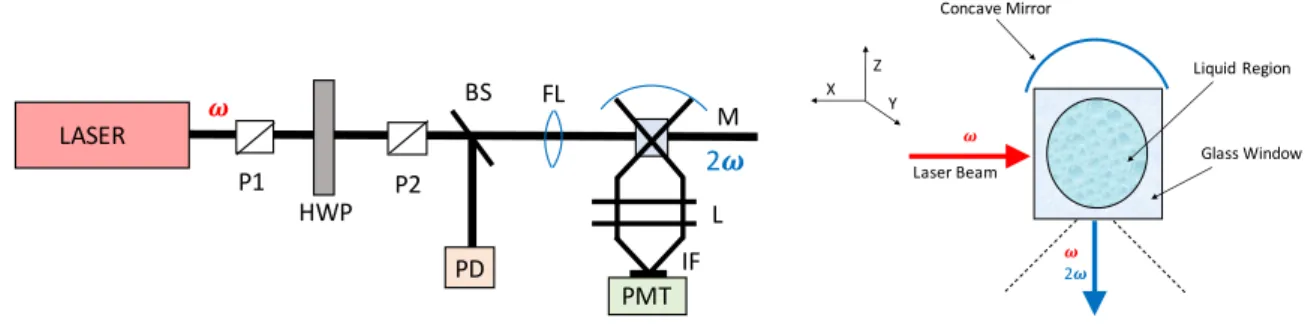
The schematic diagram in Figure 2.2 shows the classical EFISHG setup. The experiments were carried out with an incident wavelength of 1907 nm, obtained by Raman shifting the fundamental 1064 nm wavelength produced by a Q-switched, mode-locked Nd3+:YAG laser. The input polarization is controlled by a half-wave plate (HWP) and a polarizer (P1). Molecules are aligned by a pulsed high voltage synchronized with the laser beam pulse to the wedge-shaped cell. A static electric field is applied to break the statistical centrosymmetry of the solution by dipolar orientation of solvent and chromophore molecules. The cell is translated in the z-direction to vary the path length. The interaction between the laser and the sample generates two output radiations: the transmitted fundamental beam (ω) and its second harmonics (2ω). The fundamental radiation is removed by filters (P2 is a second polarizer and IR is an infra-red blocking filter), so that at the end, only the second harmonic radiation is detected by a photomultiplier tube (PMT). Collected data are then extracted to calculate the ~µ · ~β value of the molecules.
LASER HWP P1 P2 z PMT IR ! ! 2! 2! Laser Beam
Glass Window Liquid Region Metal Electrode
! !
2!
z
ΔL
Figure 2.2: EFISHG setup designed for measuring the hyperpolarizabilities (left) and top view of the wedge cell (right).
Since the wedge-shaped cell is translated perpendicularly to the incident laser beam (along the z-direction) in order to induce a periodic second harmonic genera-tion signal (Maker fringes [11], see Figure 2.3), the width and the periodicity of the fringes are correlated to the macroscopic susceptibility Γ(S) of the solution, which depends on the intensity of the second harmonic light I2ω and on the coherence
2.2. Determination of the First Hyperpolarizability Γ(S) = 1 lc A v u u t I2ω(S) I2ω(0) E0(0) E0(S) + B 10−12 (2.13)
E0 is the amplitude of the dc-electric field. S refers to the chromophores solution
while 0 to the solvent only. A and B are constants depending on the solvent and the cell windows. The microscopic γEF ISHG value is then inferred from the macroscopic
susceptibilities of the solvent Γ(0) and of the solute Γ(S), via the equation:
γEF ISHG =
M ρNAf x
[(1 + x)Γ(S) − Γ(0)] (2.14)
where NA is the Avogadro number, M the molecular weight of the compound, ρ the
density of the solution, x the molar fraction of the compound and f a local field correction factor (f = f0(fω)2f2ω, Eqs. 2.7, 2.8 and 3.3).
TABLE III. Refractive indices, coherence lengths and optical nonlmear- ities of pure 1.4-dioxane and a 1% solution of MNA in 1,Cdioxane. The refractive indices of l,cdioxane and the MNA solution are calculated using the measured coherence lengths.
1,Cdioxane
Wavelength (nm) nN 20 1, (fun) r (lOmzl m2/VZ)
1064 1.413 1.423 26.4*0.5 0.65*0.14 1318 1.412 1.419 48.2AO.9 0.57*0.1 1907 1.409 1.413 112*2 0.62=‘=0.1 1% MNA 1064 1.413 1.424 25.3*0.5 1.75*0.3 1318 I.412 1.419 46.4*0.9 1.3 *to.2 1907 1.409 1.414 103*2 1.32a0.15
ble as compared to the uncertainty arising from the eval- uation of the intensities.
After this calibration of r, ( 1% MNA) with quartz, which was the most critical part of the whole experiment, we always used a 1% solution of MNA as a reference. The relevant parameters for pure 1,4-dioxane and the 1% so- lution of MNA in 1,Cdioxane are listed in Table III.
For the determination of dI’/dw)a the macroscopic coefficients FL were measured for several concentrations (on the same day). Measurements were performed with COANP, DCANP, PNP, and MNA dissolved in 1,4-diox- ane. The concentrations used were: COANP (1, 2, 3, 4, 5, and 10 wt %), DCANP (0.5, 1,2, and 3 wt %), PNP (1, 2.6, and 4.5 wt %), and MNA (1, 2, 3, 4, and 5 wt %>. The maximum concentration of DCANP in 1,4-dioxane was limited to 3% since the solubility is small. This is probably due to the elongated length of the molecule of about 3.65 nm. In order to dissolve 3% of DCANP the solution had to be heated slightly. A 1% solution required about 10 mg substance for our EFISH cell.
The absorption at /z = 1907 nm was only due to 1,4- dioxane. The absorption coefficient was a0 = 2.2 cm - ‘. This leads to a correction factor of 1.57 for 12” (for a cell thickness of 2.06 mm). For the other wavelengths a0 as well as a? for all three wavelengths could be neglected. From the ratio of the measured second-harmonic intensi- ties
12” ( solution)/lti ( 1% MNA),
I’, could be determined for every solution using
(21)
(22)
where da has been taken as 1 (see above); Again all quantities have been described above. Figure 4 shows an example of an EFISH measurement performed with a COANP solution at il = 13 18 nm ( 10 wt %) . The curve has been analyzed using a least-squares fit of the form
3 .e s 9 68 k B s g 4 3 0 0 100 200 300 400 500 600 700 THIcKNESSVARIATIONAL
FIG. 4. Example of an EFISH measurement performed with COANP at A = 1318 nm ( IO-wt % solution). The curve has bean analyzed using a least-squares fit to the theoretical function E!q. (23).
P=a~ sin2[ (7TL/2q) + (q/2)] +a 2, (23)
where the parameters a3 and a4 are the coherence length and the phase offset, respectively, a2 is the fringe minimum,
and al is the fringe amplitude.
Table IV shows the measured coherence lengths and optical nonlinearities FL of 1,4-dioxane and solutions con- taining different concentrations of COANP, DCANP, PNP, and MNA at all wavelengths.
Figure 5 shows an example of the concentration de- pendence of FL for COANP, DCANP, PNP, and MNA at a = 13 18 nm. The values (al?/dw)c were calculated using a linear fit and are listed in Table V.
For the determination of the dielectric constants, the solutions were filled into the space between the two elec- trodes of a suitable capacitor (Fig. 6). Its capacity was measured using an autobalance (Wayne Kerr Autobalance Universal Bridge B642) operating at a frequency of w = lo4 s - ‘. Figure 7 shows the concentration dependence of the dielectric constants of all four substances in 1,4- dioxane. Due to uncertainties in the capacitor dimensions, the errors in the absolute values of the dielectric constants are quite large. The relevant quantities, however, are the slopes (&/dw)a, where the additive errors cancel out. Their uncertainties are therefore much smaller and their reproducibility is very good. The values (&/a~),, given in Table VI, were obtained from a linear fit of the dielectric constants measured for different concentrations. They are used to calculate the permanent dipole moments with the Debye-Guggenheim equation [Eq. (19)]. The necessary parameters for 1,4-dioxane are given in Table I. Table VI lists the permanent dipole moments as determined by this procedure.
The resulting molecular second-order polarizabilities j3, for COANP, DCANP, PNP, and MNA are given in Table V.
Figure 2.3: Example of the Maker fringes measured in an EFISHG experiment (from Ref. [12]).
Conventions and Units in EFISHG
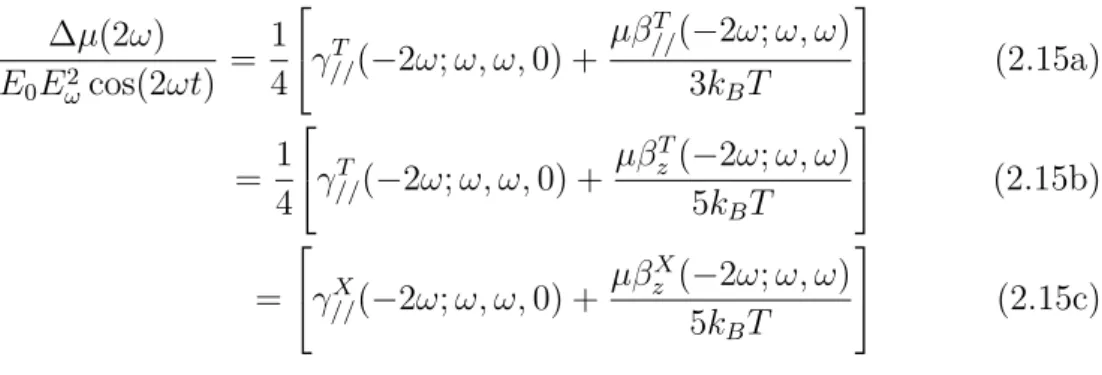
In order to compare the experimental values with the theoretical results, it is necessary to remind the relationships between the T convention (used in the cal-culations) and the phenomenological or X convention (used in the measurements), which were presented by Willetts (1992) [13] by considering the following equations:
∆µ(2ω) E0Eω2cos(2ωt) = 1 4 γ//T(−2ω; ω, ω, 0) + µβ//T(−2ω; ω, ω) 3kBT (2.15a) = 1 4 γ//T (−2ω; ω, ω, 0) + µβzT(−2ω; ω, ω) 5kBT (2.15b) = γ X //(−2ω; ω, ω, 0) + µβX z (−2ω; ω, ω) 5kBT (2.15c) 22
![Figure 1.2: Schematic representation of a model Donor-π-Acceptor system and rep- rep-resentative examples: a) push pull dipolar p-nitroaniline (β = 9.2 × 10 −30 esu, measured in acetone [17]), b) push-pull molecule involving an organometallic unit (ferroce](https://thumb-eu.123doks.com/thumbv2/123doknet/14724537.751815/18.892.200.687.95.310/schematic-representation-acceptor-resentative-examples-nitroaniline-involving-organometallic.webp)
![Figure 3.4: Schematic of Leonard-Jones potential of a single pair of atoms (left) and the periodic boundary conditions in the simulation box (right, inspired from [51]).](https://thumb-eu.123doks.com/thumbv2/123doknet/14724537.751815/67.892.200.702.933.1114/schematic-leonard-potential-periodic-boundary-conditions-simulation-inspired.webp)