Eco-ideation and eco-selection of
R&D projects for complex
systems
François CLUZEL, Bernard YANNOU, Yann LEROY Laboratoire Genie Industriel, CentraleSupélec, Université Paris-SaclayChâtenay-Malabry, France Dominique MILLET Seatech-Supméca, Université de Toulon Toulon, France
1.
I
NTRODUCTIONEco-design becomes more and more recognized and well deployed in competitive mass-consumer goods producers (B-to-C). However the situation is not so advanced in B-to-B industries, in particular for complex industrial systems, characterized by a very long and uncertain life cycle, a high number of subsystems and components or strong interactions with their environment. The technological and regulatory constraints associated with these systems may slow down the ability to innovate, as reliable and long-term proven technologies are often favored. Nevertheless the need for eco-innovation is clearly present, however to eco-innovate on complex industrial systems is a hard task. R&D projects in complex systems industries are often driven by technological and not environmental considerations. These project need to be identified really early in the design process, with few information. On the other hand everybody agrees that environmental-oriented R&D projects are necessary, but the product complexity makes the initiation of an eco-innovation approach tricky, and only few R&D decision-makers are trained in eco-design or eco-innovation. That is why a simple and effective eco-innovation method is necessary, with little necessary preliminary environmental knowledge and stimulating the collaboration. Thus we propose in this paper such an intuitive eco-innovation process. It permits to identify at a strategic level and with limited time and resources eco-innovative R&D projects through a multidisciplinary working group.
Section 2 presents a literature study about eco-innovation on the one hand and R&D projects evaluation and selection for complex industrial systems on the other hand. It permits to introduce the adapted eco-ideation process in section 3. Section 4 deals with the application of this process at Alstom Grid. Finally, some concluding remarks and perspectives are presented in section 5.
2.
H
OW TO ECO-
INNOVATE IN COMPLEX SYSTEMS INDUSTRIES?
2.1 Complex industrial systems in eco-design
This paper focuses on complex industrial and technological systems whose specificities have not really been taken into account in eco-design and eco-innovation. We define a complex industrial system in the sense of eco-design as: a large-scale system in terms of subsystems and components, mass and resource usage; a system whose life cycle is hardly predictable at the design level in the long-term, in particular its lifetime, upgrades, maintenance and end-of-life; a system whose subsystems may have different life cycles and different obsolescence times; a system in close interaction with its environment (super system, geographic site…); and finally system supervised by human decisions and management. Concerning eco-innovation, the main problem of such systems is that the clients’ specifications or the regulations and standards largely limit the ability to radically innovate, as only long-term proven technologies are used. Thus the challenge associated to an eco-innovation approach is whether to identify a set of reliable incremental eco-innovative projects, and/or to be able to make possible radical eco-innovations acceptable to the clients. To deploy an adapted innovation approach, a literature review is first performed on eco-innovation and R&D projects portfolio management.
2.2 Eco-innovation
We consider in this paper the eco-innovation definition proposed in (Carrillo-Hermosilla 2010): an eco-innovation is “an innovation that improves environmental performance, in line with the idea that the reduction in environmental impacts (whether intentional or not) is the main distinguishing feature of eco-innovation”. This includes in particular radical and incremental innovations. Considering the hierarchical nature of complex industrial systems, as well as the fact that radical changes are often hardly acceptable for clients in complex systems industries, we consider that the eco-innovation framework defined by Carrillo-Hermosilla et al. is well adapted to complex industrial systems.
An innovation approach implies two major activities: the identification of eco-innovative ideas (or eco-ideation), and the evaluation and selection of the most promising ideas. Concerning the eco-ideation process in itself, experts groups are largely used through creativity sessions (Bocken 2011). Researches performed in the last decade have identified some best practices to perform an effective creativity session in eco-innovation. Collado-Ruiz and Ostad-Ahmad-Ghorabi advise to diffuse only ‘soft’ environmental information to the group because ‘hard’ environmental information may restrict the creativity (Collado-Ruiz 2010). Pujari shows that the multidisciplinarity in the working group is an eco-innovation success factor (Pujari 2006).
Finally, eco-ideation processes in companies are often performed as classical creativity sessions supported by an eco-innovation tool. Different eco-innovation tools are well known or regularly used in the literature. The eco-design strategy wheel
(also known as the LiDS wheel) (Brezet 1997) is one of them. It is a very simple tool that proposes eco-design guidelines divided in 8 axes on a graphic wheel. 7 axes cover the whole life cycle of the product, whereas the last one aims at identifying new concepts. According to Tyl, its appropriation is really easy. It does not imply specific knowledge and the graphic representation is very clear. It is ideal for a multidisciplinary working group in a company. But as a simple tool, the eco-design strategy wheel may become simplistic, and the pre-defined guidelines hardly allow going further than product-level considerations (Tyl 2011).
However tools like the eco-design strategy wheel do not ensure an effective and multicriteria evaluation and selection step of the most promising ideas. The next section considers general methods in the field of R&D projects portfolio evaluation and selection.
2.3 Evaluation and selection of R&D projects
Once eco-innovation projects have been generated, it is then necessary to identify the best mix of R&D projects to perform. Actually the number of projects selected by a working group may be too high compared to the available resources in the company. This issue deals with the field of R&D projects evaluation and selection and R&D portfolio management. Cooper et al. proposes a classification of the portfolio management techniques (Cooper 1999): financial models, strategic approaches, scoring models and checklists, analytical hierarchy approaches, behavioral approaches and mapping approaches. Cooper et al. shows that a good method should allow to identify the right number of projects, to avoid gridlocks, to highlight high values projects, to ensure a balanced portfolio (for instance long term versus short term), and to be aligned with the company strategy (Cooper 1999). Among all the methods, scoring models and mapping approaches are very popular, mainly because they are easy to use and give good performance results (Cooper 1999):
Scoring models are simple, direct, effective and flexible (Bitman 2008). They show a good ratio between rigor and time spent on the study. Projects are rated and scored according to several qualitative or quantitative indicators. The weighting of the criteria permits to customize the model for special needs (Cooper 1999). One of the main forces of a scoring model is its ability to be easily implemented in companies. Actually, and contrarily to mathematical or financial models, the use of qualitative scales allows a large diffusion of the tools, for example through an Excel sheet or even a paper questionnaire. However, the success of a scoring approach is clearly linked to the selection of sound variables and indicators (Mikkola 2001). References from the existing literature often propose some categories to consider. However environmental aspects are sometimes mentioned, but never analyzed in depth.
Mapping approaches: historically the BCG (Boston Consulting Group) and the McKinsey matrices are the most familiar mapping approaches (Mikkola 2001). Highlighting the particular needs for R&D projects selection,
Mikkola introduces the R&D Project Portfolio Matrix (Mikkola 2001). Two dimensions are considered: competitive advantage and benefits to client. Nevertheless if the two dimensions do not seem adapted to our needs, we notice that this representation type involving two (or more) dimensions may be powerful. But as for scoring models, eco-innovation aspects, or more generally environmental concerns have not really been considered in the past. One single example is proposed by Millet et al. (Millet 2009). Three dimensions are considered: technico-economic feasibility, functional attractiveness (clients’ values), and environmental impacts through an Environmental Improvement Rate (EIR). The latter is represented thanks to bubbles which size is proportional to the EIR value.
2.4 Requirements for an adapted eco-innovation process
Considering the constraints associated to complex industrial systems as well as the previous literature review, an adapted and effective eco-innovation process needs to:
Consider the different system levels, as incremental innovations are easier at a component or subsystem level, and radical innovations easier at a system level;
Be very simple, as multidisciplinary knowledge is mandatory to consider all the aspects of such a large scale system, i.e. the process mainly involves non-environmental experts;
Be performed in a short time and with limited resources, to be easily accepted by the management and the involved experts,
Be very efficient, to reach the best possible ratio between used resources and results;
Build a strong basis for future eco-design works, to maximize the success rate of the identified R&D projects;
Be multicriteria, by considering technical, financial and marketing aspects, to be accepted;
Provide strong proofs in terms of feasibility and interest for the clients, to be successful on the markets.
Considering these requirements, we propose in the next section an adapted eco-innovation process for complex industrial system, based on a multidisciplinary working group, supported by the eco-design strategy wheel and using a hybrid scoring/mapping model for R&D projects evaluation and selection.
3.
P
ROPOSITION OF AN ADAPTED METHODOLOGY3.1 Prerequisites and general approach
The eco-innovation process for complex industrial systems presented is this paper is part of a larger methodology described in (Cluzel 2012). It is built on several hypotheses. First, the approach is deployed in a company providing complex industrial systems (as defined in section 2.1), but with no specific knowledge in
eco-design/eco-innovation. Second, the approach is supported by at least one eco-design expert leading the process, and a first environmental evaluation (Life Cycle Assessment or simplified LCA) of the considered complex technological system has permitted to identify the most impacting elements of the complete system life cycle. Then the main departments of the company need to be represented to ensure a good representativeness of knowledge and skills. Once the working group has been defined, the eco-innovation consists in two main steps: eco-ideation, and eco-innovation R&D projects evaluation and selection, detailed in the next sections.
3.2 Generation of eco-innovative projects
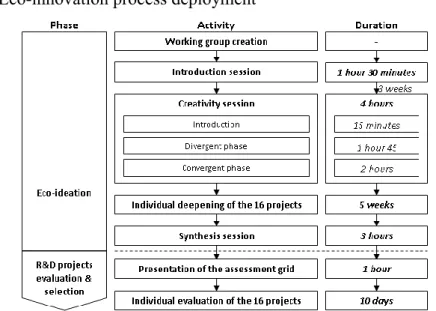
The eco-ideation phase is divided in three sessions, supported by the eco-design strategy wheel:
Introduction session: as the members of the working group are for most of them not familiar with environmental concerns and eco-design principles, it aims at introducing during a short meeting (1 to 2 hours) the main eco-design concepts, the previous environmental assessments as well as the eco-innovation approach. As stated in (Collado-Ruiz 2010), the diffusion of ‘soft’ environmental information is favored.
Creativity session, performed as a half-day meeting. A short introduction is first necessary to remind the objectives and the scope of the study and to put the participants in good creativity conditions. Then a divergent creativity phase is launched. During this phase, only environmental considerations are taken into account (technical, economic or clients’ aspects are voluntary omitted). Each of the 8 axes of the eco-design strategy wheel is separately considered during a short workshop (15 to 30 minutes) in a two-step approach:
o A brainwriting phase, where each participant individually generates a maximal number of ideas in accordance with the considered axis using Post-it® papers,
o Followed by a common brainstorming, where all ideas are read and grouped. The participants are encouraged to orally propose new ideas. All the ideas are stuck on pre-defined supports.
The divergent phase is followed by a convergent phase, where all ideas are discussed and sorted out. Technical, economic or clients’ aspects are now considered. This phase aims at identifying a first set of promising ideas or ideas groups which are from now called eco-innovative projects.
These projects are synthesized in standardized sheets that include a description of the project, its objectives, its potential environmental benefits, and its technical and economic feasibility. Of course this information is not well known at this step, so only qualitative or estimated data are available. The standardized sheets are then deepened during a few weeks by sharing them out between the working group members according to their own competencies.
in order to clarify the different design aspects and to ensure that a common vision emerges.
At that point, a first set of promising projects has been identified. But they are generally too numerous to be all considered as R&D projects. Thus the last step concerns the prioritization of the projects.
3.3 Prioritization of eco-innovative projects
The objective of this step is to evaluate and select a portfolio of eco-innovative R&D projects. We propose in this paragraph an assessment grid based on three dimensions, assimilated to a simple scoring model without any prioritization of the projects:
Potential environmental benefits: the environmental benefits of the project are compared to the environmental performance of the existing solution thanks to the eight axes of eco-design strategy wheel (Brezet 1997) on a six-level qualitative scale (0 to 5, see Table 1). A final score on 20 points is then calculated (average score on the eight axes).
Feasibility explores both the technical and the economic feasibility thanks to 4 indicators resulting from an expert debate at Alstom Grid: ease of implementation (in terms of time and resources), financial return of investment, technical feasibility (in terms of knowledge), and internal level of control (is the company able to internally manage the entire project or not?). Each indicator is assessed thanks to a six-level qualitative scale (0 to 5) that permits to obtain a final feasibility on 20 points (sum of the four scores).
Clients’ value: this dimension assesses the benefits for the clients associated with each project. It uses 4 indicators proposed in (Kondoh 2006): cost reduction, avoidance of risks, improvement of service quality, and improvement of image. As previously each indicator is assessed thanks to a six-level comparative and qualitative scale (0 to 5) that permits to obtain a final clients’ value on 20 points (sum of the four scores).
Moreover for each project we have added an expertise indicator that expresses the self-assessment of a user expertise on each project, with four possible levels (from non-expert to expert). The four first dimensions are formalized in an evaluation sheet, and each member of the working group evaluates each eco-innovative project. By weighting each evaluation with the member’s level of expertise, we give more value to the assessments performed by an expert rather than by a non-expert. Finally an average score is obtained on the five dimensions and for each project.
We then use a mapping model to draw an overview of the performance of the eco-innovative projects, for example a ‘bubble diagram’ involving potential environmental benefits, feasibility and clients’ value. By defining different quadrants inspired by (Mikkola 2001), we give to the decision-makers the ability to identify a powerful and pertinent set of eco-innovative projects according to their available resources.
Table 1. Qualitative scale used to measure potential environmental benefits on each eco-design strategy wheel axis
Score Description
0 The project highly deteriorates the environmental performance of the current solution. 1 The project significantly deteriorates the environmental performance of the current solution. 2 The project does not bring any benefit or damage compared to the current solution. 3 The benefits brought by the considered project are weak.
4 The benefits brought by the considered project are significant. 5 The benefits brought by the considered project are very important.
3.4 Validation criteria
We consider in this paper the four criteria proposed by Shah et al. (Shah 2003) to validate the approach:
Novelty: two questions are added in the assessment grid: 1) Do you think that this project already exist before the eco-innovation approach in the mind of one or several persons in the company, in a subliminal way? 2) Do you think that this project would have emerged, been formalized and seriously considered by the decision-makers without this process?
Variety considers time horizon (balance between short/middle/long term and prospective projects), project perimeter (balance between component/subsystem/system/super system related projects), and the balance of the nature of the projects (technological, organizational or methodological projects).
Quantity is assessed by the total number of ideas generated during the divergent creativity phase and the total number of eco-innovative projects proposed after the convergent phase. The time spent on the different phases of the eco-innovation process is also considered.
Quality is assessed thanks to the three dimensions: potential environmental benefits, feasibility and clients’ value.
These four criteria permit to assess the global performance of the eco-innovation process proposed in this paper. In the next section, we propose a case study performed at Alstom Grid.
4.
C
ASE STUDY:
APPLICATION ATA
LSTOMG
RID4.1 AC/DC conversion substations for the aluminium industry
Alstom Grid PEM (Power Electronics Massy) designs, assembles and sells substations for the electrolysis of aluminium worldwide. These are large electrical stations designed to convert energy from the high voltage network to energy usable for aluminium electrolysis, which is a particularly environmentally impacting and energy-consuming activity. A substation represents thousands of tons of power electronics components and transformers, costing tens of millions of Euros. These substations are complex industrial systems because the number of subsystems and
components is considerable, and the lifetime of a substation is really long, up to 35 or 40 years with high uncertainties. In this context, Alstom Grid PEM wishes to minimize the environmental impacts of its products. A first global Life Cycle Assessment has been performed on an entire substation (Cluzel 2012). This LCA is the basis for the eco-innovation process described in the next parts.
4.2 Eco-innovation process deployment
Figure 2. Time line of the eco-innovation process at Alstom Grid PEM A working group was built with complementary knowledge of a substation, including two persons from the R&D department, one from the Engineering department, one from the Commercial department, two from the R&D department of another Alstom Grid unit providing the transformers, and one academic eco-design expert. The animation was managed by one junior eco-design expert assisted by one eco-design trainee, who were not proposing ideas during the creativity session. So the eco-innovation process involved 9 persons. The whole process lasted about 10 weeks (see Figure 2). After the creativity session, 16 eco-innovative projects were selected and assessed by the working group thanks to the assessment grid presented in section 3.3.
4.3 Results and discussion
4.3.1 Quantity
109 ideas were generated during the creativity sessions. Each axis of the eco-design strategy wheel provided between 10 and 23% of these ideas. Each active member of the working group proposed between 8 and 35 ideas. Relatively to the time spent in the divergent session (1 hour and 45 minutes), it is really satisfactory. After the convergent session, 16 eco-innovative projects were identified.
4.3.2 Variety
the 16 projects is well balanced on the three criteria (time horizon, project perimeter and project nature). All categories are represented.
4.3.3 Novelty
The answers to the questions evoked in section 3.4 clearly show that a lot of eco-innovative ideas may be present in the company employees’ mind but would never emerge without the proposed method. It also shows that new ideas could appear thanks to this method, and that it is a good way to stimulate designer’s creativity.
4.3.4 Quality
The quality of the process is assessed thanks to the designer’s evaluation of the 16 projects according to three criteria (environmental benefits, feasibility, client’s value). The results for the environmental benefits shows that the average score is 10.8 (out of 20), but with a low standard deviation (0.98). It means that the 16 projects propose environmental improvements on some axes of the eco-design strategy wheel, but no generalized environmental improvements. This clearly characterizes incremental eco-innovations. For the feasibility criteria, the average score is 12.2 and the standard deviation is clearly higher (2.70). The projects are well ranged on the scale (from 4.5 to 15.2) showing that the proposed qualitative indicators are sufficient to distinguish the projects. Finally, the results for the client’s value criterion show that the average score reaches 10.9 with a standard deviation at 1.34. As for environmental benefits, it is hard to distinguish the 16 projects. But if we consider that only incremental eco-innovations have been identified, it could be explained by the fact that the projects would only bring little benefits for the client’s value.
5.
C
ONCLUDING REMARKSStarting from the statement that eco-innovation methods are not adapted to complex industrial and technological systems, we have proposed an adapted eco-innovation process. This process includes two main stages: an eco-ideation phase involving a multidisciplinary working group and a creativity session in order to identify powerful eco-innovative projects; and a multicriteria assessment phase performed by the working group, considering environmental, but also technical and economic feasibility, client’s value, project perimeter and time horizon. This process has been applied at Alstom Grid on large electrical substations. The results are very satisfactory as we have shown that this method permits to obtain a high number of ideas with limited time and resources. From these ideas a balanced eco-innovative R&D projects portfolio is identified, mainly composed of ideas that would not have emerged without the method, but also of some new ideas.
R
EFERENCESBitman, W.R., Sharif, N., “A Conceptual Framework for Ranking R&D Projects”, IEEE Transactions on Engineering Management, Vol. 55, No. 2, 2008, pp 267-278. Bocken, N.M.P., Allwood, J.M., Willey, A.R., King, J.M.H., “Development of an eco-ideation
consumer goods”, Journal of Cleaner Production, Vol. 19, No. 12, 2011, pp 1279-1287.
Brezet, H., Van Hemel, C., “Ecodesign: A Promising Approach to Sustainable Production and Consumption”, UNEP, Paris, France, 1997.
Carrillo-Hermosilla, J., del Río, P., Könnölä, T., “Diversity of eco-innovations: Reflections from selected case studies”, Journal of Cleaner Production, Vol. 18, No. 10-11, 2010, pp 1073-1083.
Cluzel, F., Yannou, B., Leroy, Y., Millet, D., “Proposition of an adapted management process to evolve from an unsupervised LCA of complex industrial systems towards an eco-designing organisation”, Concurrent Engineering: Research and Applications, Vol. 20, No. 2, 2012, pp 111-126.
Collado-Ruiz, D., Ostad-Ahmad-Ghorabi, H., “Influence of environmental information on creativity”, Design Studies, Vol. 31, No. 5, 2010, 479-498.
Cooper, R.G., Edgett, S.J., Kleinschmidt, E.J., “New product portfolio management: practices and performance”, Journal of Product Innovation Management, Vol. 16, No. 4, 1999, pp 333-351.
Kondoh, S., Kurakwa, K., Kato, S., Umeda, Y., Takata, S., “Analysis of key success factors for eco-business through case studies in Japan”, Proceedings of the 13th CIRP International Conference on Life Cycle Engineering - LCE2006, Leuven, Belgium, 2006.
Mikkola, J.H., “Portfolio management of R&D projects: implications for innovation management”, Technovation, Vol. 21, No. 7, 2001, pp 423-435.
Millet, D., Tchertchian, N., Brissaud, D., “How to identify the most promising areas of environmental improvement at the early stages of the design process?”, International Journal of Design Engineering, Vol. 2, No. 3, 2009, pp 299 - 319. Pujari, D., “Eco-innovation and new product development: understanding the influences on
market performance”, Technovation, Vol. 26, No. 1, 2006, pp 76-85. Shah, J.J., Smith, S.M., Vargas-Hernandez, N., “Metrics for measuring ideation effectiveness”,
Design Studies, Vol. 24, No. 2, 2003, pp 111-134.
Tyl, B., “L’apport de la créativité dans les processus d’éco-innovation - Proposition de l’outil EcoASIT pour faciliter l’éco-idéation de systèmes durables”, PhD thesis, Université Bordeaux 1, Bordeaux, France, 2011.
A
BOUT THE AUTHOR:
F
RANÇOISC
LUZELEngineer in Mechanics (2008), PhD in Industrial Engineering at Ecole Centrale Paris (2012), François Cluzel is an assistant professor at Laboratoire Genie Industriel (Industrial Engineering Lab) at CentraleSupélec, Université Paris-Saclay. In the Design Engineering Team, his research and teaching projects deal with innovation engineering and design of sustainable systems. He is a member of the Design Society, of the International Society for Industrial Ecology, and of the French network of eco-design researchers EcoSD.