Double Negation in a Negative Concord Language: An Experimental Investigation∗ 1
V. Déprez (U.Rutgers), S. Tubau (UAB), A. Cheylus (CNRS), & M.T.Espinal (UAB)
2
ACCEPTED FOR PUBLICATION IN Lingua.
3 4
Abstract
5
This paper investigates the interpretation and processing of simple transitive Catalan 6
sentences with multiple negative expressions experimentally. Our results provide 7
empirical confirmation that Negative Concord (NC) is the preferred and faster 8
interpretation for negative sentences that either omit or contain the overt negative marker 9
no ‘not’. However, they also reveal that, in contrast to traditional descriptions of Catalan
10
and independently of particular favoring contexts, a non-negligible amount of Double 11
Negation (DN) readings arises, mainly when the negative marker co-occurs with pre-12
verbal Negative Concord Items (NCIs), and when these NCIs have a complex DP 13
structure. Our results further suggest that two populations could be distinguished: one for 14
whom the negative marker is optional and leaves the favored NC reading essentially 15
unaffected, and another where the co-presence of no significantly increases DN readings. 16
We account for these findings within a micro-parametric approach that features 17
ambiguous NCIs (non-negative vs. negative) and a possible ambiguous negative marker 18
no (negative vs. expletive) variably available for Catalan speakers. The nuanced
19
∗This work was presented at the Going Romance 2014: Twenty-Eighth Symposium on Romance Linguistics (Lisbon, 2014), at the Workshop on Negation: Theoretical and Empirical Investigations (Barcelona, 2014), at the 45th Linguistic Symposium on Romance Languages (Campinas, 2015), and at the Laboratoire de
Linguistique Formelle-Paris7 (Paris, 2015). We are grateful to the audiences of these conferences and seminar, and to two anonymous reviewers for all their comments and suggestions on an earlier version of the paper. We acknowledge our gratitude to the students and colleagues at the Universitat Autònoma de Barcelona who participated in the experiments as Catalan subjects. This research has been funded by the following research grant awarded by the Spanish Ministerio de Ciencia e Innovación (FFI2011-23356, FFI2014-52015-P), and by a grant awarded by the Generalitat de Catalunya to the Centre de Linguística Teòrica (2014SGR-1013). The last author also acknowledges an ICREA Acadèmia award.
empirical NC landscape that our experimental work reveals serves to stress the 20
importance of taking DN readings into consideration for a better understanding of the 21
nature of negative constructions in Catalan and cross-linguistically. 22
23
Keywords: Negative Concord, Double Negation, experimental approach,
micro-24
parametric account, ambiguous Negative Concord Items, Catalan 25
26
1. Introduction
27
Within the charted landscape of Negative Concord (NC) languages, Catalan is often cast 28
as a misfit because it presents the peculiarity of optionally allowing the co-presence of a 29
sentential negative marker no ‘not’ with pre-verbal Negative Concord Items (NCIs)1
30
(Fabra 1912, 1918, 1956; Badia i Margarit 1962, 1994; Solà 1973; Quer 1993; Vallduví 31
1994; Espinal 2000a, 2002). The central goal of the present paper is to report the results 32
of an experimental research that sought to test when, and to what extent, native speakers 33
of Catalan prefer to interpret negative sentences of various types with a single negation 34
interpretation as a Negative Concord (NC) reading, and whether, in some circumstances, 35
with specific syntactic combinations of Negative Concord Items (NCIs), with and without 36
a sentential negative marker, a Double Negation (DN) reading could emerge in simple 37
transitive clauses as it has been claimed to emerge in other NC languages like Romanian. 38
We report on two experiments that aimed at investigating the following four 39
questions. First, we tested whether it is correct, as standardly assumed by Catalan 40
1 In this paper we opt to use the descriptive term Negative Concord Item (NCI) (Watanabe 2004) instead of the more frequently used term n-word (Laka 1990) to refer to expressions that can participate in Negative Concord constructions, sharing the semantic property of being licensed both in negative and in non-negative contexts and of appearing sometimes non-negative by themselves. This choice seeks to steer away from the cultural connotations that the term n-word has taken on in the language of North-Americans.
grammarians, that NC is systematically and consistently the default interpretation for 41
sequences of multiple negative terms; second, we asked whether the processing of 42
negative sequences in Catalan could be overall faster, and hence presumably easier to 43
parse, under a NC reading than under a DN one. The latter is commonly assumed to be 44
cross-linguistically marked (Corblin et al. 2006, de Swart 2010, Puskás 2012), but has 45
recently been shown, in equivalent experimental settings, to be sometimes equally fast, 46
and even sometimes faster in distinct languages; third we verified whether the co-47
presence of the sentential negative marker no with pre-verbal NCIs could influence the 48
readings of negative sequences and increase DN readings and fourth, we investigated 49
whether the morpho-syntactic nature of the NCIs involved in a negative sequence could 50
influence the readings preferred by native speakers, increasing or decreasing a putative 51
preference for a NC vs. DN reading. 52
Regarding the first question, we aimed at investigating to what extent the default 53
nature of NC readings in Catalan can be confirmed, and whether Catalan sequences of 54
NCIs in simple transitive clauses are essentially always unambiguous, radically favouring 55
NC readings in neutral discourse and prosodic contexts across native speakers, as 56
expected from the literature.2 57
Regarding the second question, we aimed to experimentally test whether speakers 58
process NC readings more easily and faster than DN readings, and whether the common 59
belief that DN readings have a higher degree of parsing complexity than NC / single 60
negation readings can be correlated with a longer reaction time. 61
Finally, regarding the third and fourth questions, our experiments were designed to 62
explore whether native speakers of Catalan have a preference for NC readings 63
irrespectively of the co-presence or absence of a sentential negation marker with pre-64
verbal NCIs. One of our goals in raising this precise question was to seek to establish an 65
experimental base line for further investigation of the properties of Catalan NC, and in 66
particular of the factors that can bring about the emergence of DN readings, if any. A 67
second goal was to provide an experimental assessment of the strength of NC 68
interpretations in Catalan, for the purpose of cross-linguistic comparison with other 69
Romance languages, such as French, Italian, Portuguese and Spanish. A third goal was to 70
investigate the effects, if any, of the morpho-syntax of DP NCIs on the interpretation of 71
negative sequences. In this respect, we considered simple NCI pronominal forms vs. full 72
DPs (with both partitive and non-partitive forms), and their parallel vs. non-parallel 73
distribution in subject and object position. 74
The paper is organised as follows. Section 2 presents a summary of the relevant 75
background facts about the interpretation of negative sequences in Catalan, centring on 76
the properties of this language as a NC one, and on the contexts where the negative 77
marker no seems to be optional. We then present some theoretical accounts of these 78
known facts from the literature, focusing more specifically on the required ingredients of 79
a micro-parametric approach to Catalan NC. In Section 3, we present our experimental 80
design and methodology. Section 4 details the results of our experiments. Finally, Section 81
5 discusses these results and assesses their consequences within a general theory of NC. 82 83 2. Background 84 2.1. Catalan as an NC language 85
Negative doubling (den Besten 1986), in which multiple occurrences of morphologically
86
negative constituents are interpreted as a single logical negation, is a common synchronic 87
phenomenon in Catalan. Characteristic Catalan examples provided in (1) contain both n-88
words (Laka 1990) (ningú ‘nobody’, res ‘nothing’), here referred to as NCIs (see footnote
89
1) and the negative marker (no ‘not’): 90
(1) Ningú (no) pensa res. 91
nobody not thinks nothing 92
‘Nobody is thinking anything.’ 93
As is well known, no ‘not’ is optional with NCIs in pre-verbal position but must be 94
present with post-verbal ones, as the examples in (2), from Fabra (1956: 83), with an 95
unaccusative predicate and a pre-verbal (2a) and post-verbal subject (2b) illustrate here: 96
(2) a. Cap d’ells (no) ha vingut. 97
none of them not has come 98
‘None of them has come.’ 99
b. *(No) ha vingut cap d’ells. 100
not has come none of them 101
‘None of them has come.’ 102
This well-known asymmetry has long fuelled the on-going debate on the status of 103
Catalan NCIs as negative quantifiers (2a) or as polarity items (2b). In their ability to 104
express a negative meaning alone when occurring in pre-verbal position (2a), or as 105
fragment answers to questions (3), Catalan NCIs show clear similarities with English 106
negative quantifiers. 107
(3) A: On vas? 108
where go.2SG?
109
‘Where do you go?’ 110 B: Enlloc. 111 nowhere 112 ‘Nowhere.’ 113
In post-verbal positions, however, Catalan NCIs have a polar behaviour (Linebarger 114
1987; Progovac 1994; Giannakidou 1998, 2000; Martins 2000), as they are sensitive to 115
the non-veridical (Zwarts 1995) property of a c-commanding licenser or of the contexts in 116
which they felicitously occur. 117
(4) a. No ha comprat cap dels llibres. (negation) 118
not has bought none of.thePL books
119
‘(S)he has not bought any of the books.’ 120
b. Ha comprat cap dels llibres? (question) 121
has bought any of.thePL books
122
‘Has (s)he bought any of the books?’ 123
c. Si ha comprat cap dels llibres, jo ho hauria de saber. (conditional) 124
if has bought any of.thePL books I it should of know
125
‘If (s)he has bought any of the books, I should know it.’ 126
According to traditional descriptive Catalan grammars, the combination of NCIs with 127
other NCIs or minimizers (Vallduví 1994) –otherwise known as negative spread, (with or 128
without no)– always leads to a single negation / NC reading and never to a cancellation of 129
negations into a positive meaning (Horn 1989), in contrast to what is usually found with 130
negative quantifiers for languages such as Standard English. 131
(5) a. Ningú pensa res. (=1b) NC 132
nobody thinks nothing 133
‘Nobody is thinking anything.’ 134
b. Enlloc es veu ni una ànima. NC 135
nowhere CL sees not a soul 136
(6) a. Nobody is thinking nothing. DN 137
b. Not a soul can be seen nowhere. DN 138
This contrastive interpretation of sequences of negative expressions in languages like 139
Catalan (5) vs. languages like English (6) that embodies the difference between Negative 140
Concord (NC) and Double Negation (DN) has been taken under some approaches 141
(Zeijlstra 2004 among others) to be the core factor of a parametric divide between NC 142
languages like Catalan, French, Italian, Portuguese and Spanish, on the one hand, and DN 143
languages like Standard English, Dutch and German, on the other hand. On this view, the 144
question arises whether DN interpretations of sequences of negative expressions are ever 145
possible in NC languages, and particularly of what, if anything, can license them. In other 146
approaches to NC (de Swart and Sag 2002), NC vs. DN readings are taken to be the two 147
ambiguous faces of the same negative sentences and thus predicted to occur in all 148
languages. 149
According to traditional descriptive Catalan grammars, DN readings are only 150
possible and in fact required when two sentential negations occur in different clauses (cf. 151
the Law of Double Negation, Horn 1989), as in (7): 152
(7) No vull que no vingui.
153
not want that not comeSUBJ
‘I don’t want him not to come.’ (=I want him to come) 155
Yet DN is sometimes observed in single clauses under particular syntactic 156
conditions, such as for instance (8a), where an adjunct PP ambiguously allows both DN 157
and single negation/NC readings (Tubau and Espinal 2012)3. The ambiguity disappears 158
when a second no precedes the NCI in the PP adjunct, as in (8b). 159
(8) a. No lluiten per res. (DN and NC in Catalan) 160
not fight for nothing 161
‘They don’t fight for nothing. / They don’t fight for anything.’ 162
b. No lluiten per no res. (DN in Catalan) 163
not fight for not nothing 164
‘They don’t fight for nothing.’ 165
Otherwise, special conversational, prosodic and gestural conditions are generally 166
claimed to be necessary for DN readings to emerge, be it for sequences of multiple 167
negative terms in single clauses or with isolated NCIs. Espinal and Prieto (2011), Prieto 168
et al. (2013), and Espinal et al. (in press) experimentally investigated some of the 169
prosodic and gestural factors that favour DN in Catalan and Spanish. Regarding 170
conversational conditions more particularly, Catalan DN readings were argued to emerge 171
only in discourse contexts that allow an accessible negative proposition (or 172
presupposition) –either explicitly contained in the previous discourse, or inferred from it– 173
to be denied (Dryer 1996, Prince 1992, Geurts 1998, Espinal and Prieto 2011). In these 174
respect, Catalan is not assumed to much differ from other NC languages, where the role 175
3
For Tubau and Espinal (2012) this type of clause internal DN results from the presence of an abstract negative operator NEG, triggered by the NCI that checks its negative morpho-syntactic feature within this special PP construction, in combination with the overt negative marker no.
of contextual and prosodic factors such as prosodic phrasing, stress, contrastive focus, 176
and intonation have also been highlighted as potential DN triggers (Corblin 1995, 1996; 177
and Déprez 1999, 2000 for standard French; Vinet 1998 for Québec French; Corblin and 178
Tovena 2003 for French and Italian; Molnár 1998 and Puskás 2006, 2012 for Hungarian; 179
Zanuttini 1991, 1997, Godard and Marandin 2007, and Penka 2007 for Italian; Falaus 180
2007 for Romanian; Huddlestone 2010, Biberauer and Zeijlstra 2012 for Afrikaans, see 181
also de Swart 2010). Pragmatic factors can also influence the availability of DN readings 182
is some languages. For example, a DN reading is generally favoured in the following 183
French example in (9) and also possible in other languages such as Spanish, Italian and 184
Romanian: 185
(9) a. Personne ne commet aucun peché. 186
no one NEG commits no sin
187
‘No one commits no sin.’ 188
b. Personne ne meurt jamais. 189
no one NEG dies never
190
‘No one never dies.’ 191
Comparable facts, however, do not seem to obtain readily in Catalan NCI sequences. 192
In sum, although NC readings are generally thought to be the default reading for 193
sequences of negative expressions, DN readings are also sometimes possible, but 194
generally argued to emerge only under a narrow set of circumstances not yet fully 195
understood but quite generally held to be exceptional in some ways. 196
197
2.2. The role of no
This section focuses on the role of the sentential marker no ‘not’ in Catalan negative 199
sentences. As a preliminary, note that first and foremost, the Catalan sentential negative 200
marker no is the linguistic form that encodes the monadic negative operator ¬ and 201
expresses an interpretable negative formal feature. 202
In sentences containing NCIs in pre-verbal positions, as noted above, no is always 203
possible, but not systematically required. The source of this optionality remains unclear. 204
On the one hand, traditional prescriptive grammars of Catalan encourage the use of no 205
with pre-verbal NCIs to distinguish non-negative uses of NCIs from negative ones as in 206
the following examples from Fabra (1912: 218), since the presence of no here appears to 207
make a meaning difference. 208
(10) a. Si mai vinguéssiu, què farien ells? 209
if ever comeSUBJ what doCOND they
210
‘If you ever came, what would they do?’ 211
b. Si mai no vinguéssiu, què farien ells? 212
if ever not comeSUBJ what doCOND they
213
‘If you never came, what would they do?’ 214
On the other hand, descriptive grammars of contemporary Catalan claim that, if pre-215
verbal NCIs are focalized (the capital letters stand for emphasis), then no is preferably 216
explicit (Espinal 2002: 2766, exs, (106b,c) and (107b,c)):4 217
(11) a. Ningú (no) ha vist res. 218
4 As will be clear later in the paper, it turns out that traditional and descriptive grammars of Catalan only describe one of the varieties encountered in our empirical investigation, namely the variety we will label Variety A, whose speakers mainly use polar NCIs and have a non-negative use of no. As explicit in our Results section, the current paper also considers the empirical facts and theoretical soundness of a different variety, Variety B, whose speakers use negative quantifiers in focalized positions and have a regressive use of non-negative no.
nobody not has seen nothing
219
‘Nobody has seen anything.’ 220
b. NINGÚ no ha vist res. 221
nobody not has seen nothing
222
‘Nobody has seen anything.’ 223
(12) a. Enlloc (no) es veia ni una anima. 224
nowhere not CL saw not a soul
225
‘Nowhere was a soul to be seen.’ 226
b. NI UNA ÀNIMA no ha vist. 227
not a soul not has seen 228
‘Not a soul has (s)he seen.’ 229
Espinal (2002: 2767) further states that the negativity of a sentence is intensified 230
when the negative marker is explicit, (13). Moreover, she also notes that the tendency to 231
prefer an overt negative marker increases as the distance between the pre-verbal NCI and 232
the verb gets larger (14). 233
(13) De cap manera no vull que em deixis diners. 234
of no way not want that meDAT lend money
235
‘By no means do I want you to lend me money.’ 236
(14) Cap de les plantes que vam deixar a la banyera abans 237
none of the plants that PAST leave in the bathtub before 238
de marxar de vacances no sembla que s’hagi mort. 239
of leave of holidays not seem that CL.hasSUBJ died
‘None of the plants that we left in the bathtub before leaving on holidays seems to 241
have died.’ 242
These facts suggest that the prosodic phrasing of the pre-verbal NCI along no may be of 243
relevance in influencing its presence. Notwithstanding the precise conditions of its 244
appearance, the sentential negative marker no is quite generally assumed to have no polar 245
semantic effect on the overall interpretation of these type of sentences. In particular, no in 246
such contexts is not taken to contribute an additional semantic negation. 247
In sum, while prescriptive grammars recommend the use of a negative marker no in 248
pre-verbal position of negative sentences generally, descriptive grammars acknowledge 249
that native speakers hesitate on the use of no after pre-verbal NCIs (Solà 1973: 97, 250
Espinal 2002: 2767). The reasons of this hesitation are not well understood, but could 251
well reflect sociolinguistic factors, such as age, language dominance of the speaker’s area 252
of living, and percentage of use of Catalan in daily life. According to Vallduví (1994: 253
273, note 8), the optionality of no “is a matter of register”. And indeed, the current 254
tendency in spoken Catalan and in the media-variety is to omit the negative marker. 255
Espinal (2007) interestingly observed that a comparable optionality and lack of polar 256
semantic effect in the use of the negative sentential marker no is also found in other 257
Catalan sentence types, namely in contexts of so-called expletive negation (EN). EN 258
“refers to a pleonastic (paratactic or redundant) use of negation that does not modify the 259
truth value of the proposition in which it appears (Jespersen 1917; Vendryes 1950; Martin 260
1984; Muller 1991)” (Espinal 2007: 51). Characteristic Catalan examples are given in 261
(15), with the optional expletive negative marker in parentheses and the lexical trigger of 262
EN in italics: 263
(15) a. Abans que (no) arribi l’amfitrió, deixeu que em presenti. 264
before that not arriveSUBJ the.host let that me introduceSUBJ
265
‘Before our host arrives, let me introduce myself.’ (Espinal 2007: 50, ex. (1a)) 266
b. La policia evità que (no) hi hagués un accident. 267
the police stopped that not CL hadSUBJ an accident
268
‘The police prevented an accident.’ 269
c. Gasta més ell en tres mesos que (no) tu en tot l’any. 270
spends more he in three months that not you in whole the.year 271
‘He spends more in thres months that you in a year.’ 272
(Espinal 2002: 2777, ex. (136a)) 273
d. Va prometre que s’esperaria fins que el seu xicot 274
PAST promise that CL.wait until that the his boyfriend 275
(no) tornés de la guerra.
276
not come.back from the war 277
‘She promised to wait until her boyfriend came back from the war.’ 278
(Espinal 2002: 2777, ex. (136b)) 279
For Espinal (1991, 1992) and van der Wouden (1994a, 1994b), expletiveness is a 280
semantic effect that obtains in Logical Form when the semantic property of specific 281
syntactic constituents (either the negative marker no or an NCI) is absorbed by the 282
semantic contribution of another expression in the context. As illustrated in (15), 283
expletive no is licensed under non-veridical contexts, under conditions that quite parallel 284
those of polarity licensing. As Espinal suggests the expletive negation of (15) may well 285
be a type of polarity dependency comparable to the one observed in (16) with NCIs. 286
(16) a. Abans que ningú digui res, deixeu-me donar-vos la benvinguda. 287
before that nobody saySUBJ nothing let.me give.you the welcome
288
Before anyone says anything, let me welcome you.’ 289
(Espinal 2007: 50, ex. (1b)) 290
b. La policia evità que hi hagués cap accident. 291
the police stopped that CL hadSUBJ any accident
292
‘The police prevented that an accident.’ 293
Espinal further observes that the conditions of use of the Catalan expletive no 294
strikingly parallel those of the optional no with pre-verbal NCIs. There is comparable 295
optionality, and the hesitation or register variety of use observed in the Catalan 296
population seems to cross both of these constructions equally, and presumably along the 297
same patterns. This commonality of occurrence clearly suggests that both phenomena 298
should profitably receive a parallel account. In particular both the optionality of no, when 299
in co-occurrence with pre-verbal NCIs, and the expletiveness of no in the context of 300
specific lexical triggers suggest that Catalan could manifest two homophonous distinct 301
lexical variants of no, one semantically negative and the other not, akin to the lexical 302
distinction found in French between the semantically negative marker pas and the 303
expletive negative marker ne. This is indeed what Espinal and Tubau (to appear) propose, 304
as is further discussed below. The existence of two distinct lexical negations is also 305
defended for Afrikaans by Biberauer (2008, 2009, 2012). Biberauer (2013) gives the 306
following list of properties distinguishing the two: 307
Property Nie1 Nie2 = expletive
Modifiability Yes No
Substitution by emphatic negator Yes No
Stressability Yes No
Table 1. Properties to distinguish between semantically negative and expletive nie in
308
Afrikaans 309
These properties, which are clearly reminiscent of those of the two distinct negation 310
markers found in French, pas and ne, also obtain in Catalan. 311
In an attempt to explain away the optionality of no, Van der Wouden and Zwarts 312
(1993: 216-7) were to our knowledge the first to hypothesize the existence of a dialectal 313
variation. According to them, “there exists one dialect of Catalan that parallels French (or 314
Afrikaans) in the sense that a doubling element no (that may express negation on its own) 315
is always obligatory whenever negative elements show up in the sentence, and another 316
dialect that behaves like Italian, with doubling only from post-verbal positions”. 317
According to this description, in one dialect (Variety I) no is always obligatory, whereas 318
in the second one (Variety II) no is only obligatory to license post-verbal NCIs. 319
However, contrary to these claims, recent work by Espinal and Tubau (2014) 320
concluded (i) that Variety I does not exist, since there is no variety of Catalan for which 321
no is always obligatory, and (ii) that Variety II does not characterize any dialect at all,
322
since all post-verbal NCIs, PIs and minimizers, can be licensed by the negative marker, or 323
by an NCI in pre-verbal position. We take up this issue further in our discussion section, 324
after the results of our experiment have been presented. But first, we briefly summarize 325
recent theoretical approaches that propose an account for this specific issue, as well as for 326
the other properties of Catalan NC described above. 327
2.3 Theoretical background
329
The literature on NC is vast, with two main issues traditionally articulating the 330
discussion. One is the negative force of NCIs; the other is their quantificational status. 331
NCIs have been claimed to be universal quantifiers, both negative (Zanuttini 1991, 332
Haegeman and Zanuttini 1991, among others) and non-negative (Giannakidou 2000), 333
non-negative polarity items (Bosque 1980, Laka 1990, among others), and indefinites, 334
both negative (Suñer 1995) and non-negative (Ladusaw 1992, 1994, Zeijlstra 2004, 335
Tubau 2008, among others). Other accounts have cast NCIs as numerals of cardinality 336
zero (Déprez 1997b, 2000, and following; Espinal 2000a) with underspecified 337
quantificational force, or as items that are ambiguous between weak negative polarity 338
items and strong negative polarity items (Martins 2000), or ambiguous between polarity 339
items and negative quantifiers, either lexically (Herburger 2001) or structurally (Déprez 340
1997b, 2000, 2011a, b; Déprez and Martineau 2004).Theoretical approaches to NC are 341
always narrowly linked to the status proposed for NCIs, but as a proper review of this 342
abundant literature would take us too far afield, here we restricted our focus on the most 343
prominent recent accounts that have made a specific proposal regarding Catalan NC. 344
Before presenting the micro-parametric approach to NC recently developed in Espinal 345
and Tubau (to appear), we oppose two views, namely the macro-parametric account in 346
Zeijlstra (2004) and subsequent work, and the polyadic quantification approach of de 347
Swart and Sag (2002). 348
349
2.3.1. A macro-parametric account: Zeijlstra (2004)
350
For Zeijlstra (2004 and subsequent work) the phenomenon of NC is nothing but the 351
realization of a syntactic agreement (formalized under Chomsky’s (1995) Agree 352
operation) between a single negative operator (which can be overt or abstract) carrying an 353
interpretable negative formal feature, [iNeg], and one or more elements carrying an 354
uninterpretable negative feature, [uNEG]. For him, NCIs are semantically non-negative 355
indefinites that carry an uninterpretable negative feature [uNEG] that must be checked by 356
an interpretable negative feature [iNEG] on a semantic negation.Zeijlstra (2004, 2008) 357
further argues that NC languages are distinguished from DN languages by a macro-358
parameter that states that the former have a formal negative feature, while in the latter the 359
negative feature has no formal status but is purely semantic. This macro-parametric 360 variation is formalized as in (17): 361 (17) 362 363
To further distinguish among varieties of NC languages, such as Strict and Non-364
Strict NC languages (Giannakidou 1998), Zeijlstra assumes that negative markers can 365
differ as negative expressions do in DN vs. NC languages, in being either semantically 366
negative (i.e., [iNeg]) in Non-Strict NC languages, or semantically non-negative (i.e., 367
[uNeg]) in Strict NC languages. This yields the typology in Table 2. 368
n-words (=NCI) semantically negative
n-words (=NCI) semantically non-negative
Negative markers semantically negative
DN languages:
Dutch, German, Swedish
Non-strict NC languages: Spanish, Italian, Portuguese Negative markers semantically
non-negative
Afrikaans A Strict NC languages:
Czech, Serbo-Croation, Greek, Afrikaans B
Table 2. Biberauer and Zeijlstra’s (2012) typology of NC and DN languages
369
With respect to this typology, as Zeijlstra (2004) notes, Catalan appears to be a 370
misfit because of the optional occurrence of its negative marker, which is neither 371
obligatory as in Strict NC languages, nor limited to co-occur with only post-verbal NCIs 372
as in non-Strict NC languages. In an effort to reduce this Catalan misfit to the NC 373
patterns observed elsewhere, Zeijlstra (2004) follows Van der Wouden and Zwarts (1993: 374
216-7) in claiming that the Catalan negation optionality flags the existence, side by side, 375
of two distinct varieties. For him, Variety I, on the one hand, has Strict NC characterized 376
by the obligatory presence of no for NCIs in all syntactic positions, in similarity with 377
Greek and Romanian. Variety II, on the other hand, must disallow no with pre-verbal 378
NCIs, as it features Non-Strict NC, in similarity with Italian and Spanish. On this view, 379
the optionality of no is illusory. 380
Zeijlstra’s approach makes very clear empirical predictions. First and foremost, it 381
predicts that in a NC language, DN should simply not arise. Furthermore, for Catalan in 382
particular, speakers of Variety I should find sentences lacking no with pre-verbal NCIs to 383
be as ungrammatical as they are in other Strict NC languages. For speakers of Variety II, 384
in contrast, sentences featuring a pre-verbal NCI with no should be ungrammatical or 385
have a systematic DN reading, as reported for in Non-Strict NC languages. These 386
predictions, however, do not accord with the traditional descriptions of Catalan 387
summarized above where sentences with pre-verbal NCIs that lack no are considered 388
grammatical for all speakers and where the co-presence of no is quite generally assumed 389
to leave the solid NC interpretation of sentences with NCIs fully unaltered. Our 390
experiments meant to verify these predictions. 391
392
2.3.2. The polyadic quantification approach of de Swart and Sag (2002)
In contrast to Zeijlstra (2004 and following), de Swart and Sag (2002) and de Swart 394
(2010) take NCIs to always be negative quantifiers. For them, NC corresponds to one 395
interpretation that is afforded by the interaction of these negative quantifiers in a polyadic 396
quantifier framework (van Benthem 1989; Keenan and Westerståhl 1997). On this 397
approach, there is no parametric distinction between NC and DN languages, since every 398
sentence involving multiple negative elements can receive both a resumptive and an 399
iterative interpretation. The first corresponds to a NC reading, the second to a DN 400
reading. However, while NC / DN ambiguities for multiple negative constructions are 401
well attested in French and Romanian (i.e., languages for which independent resumption 402
analyses were respectively proposed by Déprez 1997b, 2000; Falaus 2007; and 403
Iordăchioaia 2010), in other languages commonly exhibiting NC, no comparable 404
systematic ambiguity has so far been reported, and DN readings are quite generally 405
thought to only arise under restrictive and unusual contextual conditions, as discussed 406
above for Catalan. Thus, for a resumption analysis to be able to account for cross-407
linguistic variations in NC, an additional mechanism must be assumed. To tackle NC 408
typological differences, de Swart (2010) proposes to embed her resumptive analysis in a 409
bidirectional optimality framework. Her analysis of Catalan involves the interaction of 410
five constraints presented below: 411
" MaxNeg: Mark the argument of a negative chain. 412
" NegFirst: Negation is pre-verbal (Jespersen 1917, Horn 1989). 413
" MaxSN: A negative clause must bear a marker of sentential negation. 414
" *Neg: Avoid negation in the output. (Markedness constraint). 415
" InterpretNeg (IntNeg): Interpret all neg expressions in the input as contributing a 416
negative meaning in the output. 417
We reproduce here the crucial OT tableaus that pertain to Catalan (de Swart 2010:173-418
174). The order from right to left in the tableau reflects the ranking of the constraints. 419
Note that, in the tableau in (18), it is the high ranking of the NegFirst constraint that 420
enforces the obligatory presence a pre-verbal marker of sentential negation with post-421
verbal Catalan NCIs (de Swart’s n-words), as in Italian, Spanish or Brazilian Portuguese. 422
(18) 423
424
With pre-verbal NCIs, in contrast, looking at the tableau in (19), since it is the NCI that 425
satisfies the NegFirst constraint, the output is derived through the competition between 426
the lower ranked constraints MaxSN and *Neg. If MaxSN and *Neg are unranked with 427
respect to each other, as indicated here by the doted vertical line in the tableau in (19) 428
below, the grammar generates two optimal outputs. This is what is assumed to derive the 429
optionality of no with pre-verbal NCIs described by traditional Catalan grammars. 430
(19) 431
432 433
De Swart (2010) also argues that the possibility of two distinct dialects is derivable on her 434
approach if, instead of being unranked, MaxSN and *Neg are ranked. If MaxSN 435
dominates *Neg, then no will be obligatory with the input or tableau (19) as in the 436
Variety I described by Zeijlstra (2004). The reverse domination of these two constraints 437
produces a dialect were no is disallowed again as in Zeijlstra’s Variety II. We note here 438
that although this approach predicts both the optionality of no described by traditional 439
Catalan grammars and the possibility of the two dialects distinguished by Zeijsltra and 440
Van den Wouden, it does not, however, predict what to expect with respect to the 441
distribution of DN vs. NC readings in either of the two varieties. Regarding 442
interpretation, De Swart states that in her account, both dialects are NC ones with the 443
ranking *Neg >> IntNeg in the semantics, so that sentences with and without a marker of 444
sentential negation are interpreted as conveying single negation under both grammars. In 445
short, de Swart predicts a variety of possible grammatical outputs for Catalan, but does 446
not match these distinct outputs to distinct interpretations. 447
448
2.3.3. The micro-parametric approach
449
In contrast to de Swart and Sag (2002) and de Swart (2010, and following), Déprez 450
(1997b, 2000, and ff.) and Déprez and Martineau (2004) argue that the resumption 451
analysis proposed in May (1990) for English negative sequences is a restricted form of 452
NC that can be available only in constructions or languages in which NCIs are true 453
negative quantifiers. But, importantly, Déprez argues that this type of resumptive analysis 454
should not be generalized across all NC constructions or languages, since NCIs, like all 455
other types of indefinite expressions can have distinct semantic and syntactic nature and, 456
consequently, be subject to various interpretative and licensing conditions. Déprez 457
(1997b) posits the existence side by side of two basic types of NC that form the opposite 458
extremes of the cross-linguistic spectrum of possibilities, one, being a pure resumption 459
type, and the other essentially equivalent to NPI licensing (non-veridical licensing). Both 460
types can entertain mixed and complex interactions in distinct NC constructions, within 461
single languages or cross-linguistically, depending on the nature of the NCIs involved in 462
particular negative sequences. This approach derives a non-uniform, intricate and 463
nuanced landscape for NC dependencies, with variations expected within and across 464
languages, according to the nature of the NCIs. See in particular Déprez (2011b) for a 465
recent development of this approach. In short, Déprez proposes to combine the semantic 466
ingredients of the above discussed two approaches within a micro-parametric framework 467
where the choice of one or the other type of NC, resumption or NPI licensing (with NPIs 468
of possibly distinct strength), is determined by the nature and the internal morpho-syntax 469
semantic mapping of the NCIs that a particular language or negative sequence 470
comprises.5
471
A specific micro-parametric approach that takes into account the possibly variable 472
nature of the negative elements involved in a negative sequence has independently been 473
developed for Catalan in the works of Espinal (2000a) and, more recently, Espinal and 474
Tubau (to appear). In this section we present the ingredients of this micro-parametric 475
approach to Catalan NC. This approach suggests that the difference between the two 476
varieties of Catalan presented earlier (namely Variety I and Variety II) is based on 477
ambiguity, not only, with respect to the nature of NCIs, but also regarding the negative 478
marker. 479
As mentioned above, to account both for the possibility of EN and the optional 480
occurrence of the sentential marker no with pre-verbal NCIs, Espinal and Tubau propose 481
that Catalan has two homophonous lexical variants for the sentential negative marker no. 482
5More specifically, Déprez (1997a, b, 2000) and Déprez and Martineau (2004) link variation in NC to the internal structure of NCIs, arguing that the closer an NCI occurs to the edge of the constituent that contains it, for instance a DP-shell, the stronger its negative force.
(20)a. no1: semantic negation; formally specified [iNEG] (Zeijsltra 2004, ff.).
483
b. no2: expletive negation; formally specified with a strong [+σ] feature that is
484
characteristic of polar items and characterizes semantically dependent items 485
(Chierchia 2006, Labelle and Espinal 2014).6 486
Moreover, along with previous ambiguity accounts for NCIs (Déprez 2000, and ff.; 487
Martins 2000; Herburger 2001), they further propose that Catalan NCIs come in two 488
varieties as well, a dependent NCI type and a negative quantifier, each specified as 489
follows: 490
(21) a. NCI1: polarity indefinite meaning characterized [+σ].
491
b. NCI2: indefinite negative quantifiers meaning ¬∃.
492
Espinal and Tubau (2014) additionally posit two varieties of Catalan that respectively 493
have the following distribution of negative markers and NCIs. In Variety A, where the 494
negative marker is optional with pre-verbal NCIs, NCIs are most often polarity items 495
assumed to be endowed with a semantic feature, [+σ], which induces domain-widening 496
and needs to be licensed by an appropriate semantic operator (Chierchia 2006, Labelle 497
6 A reviewer is especially interested in the semantic contribution of EN within Catalan NCI sequences in comparison to other syntactic contexts. Espinal (1992, 2000b, 2007) defends that in EN contexts (e.g. the Catalan verb dubtar ‘to doubt’, the preposition abans ‘before’) the licenser is an expression whose logical instructions force to consider a negative state of affairs, and the licensed constituent is either a negative marker of the weak type (Catalan and Spanish no, French ne) or a PI (pure PIs and NCIs). More specifically, Krifka (2010) and Delfitto (2013) defend that so-called EN is in fact negatively interpreted under the scope of German bevor ‘before’, since it yields the complement of the set of times that represents the unnegated proposition. Similarly, in Delfitto and Fiorin (2014) the authors hypothesize that the role of the negationoccurring in exclamatives and rhetorical questions is to impose an order of informativity upon a hierarchical structure of accessible propositions: only when negation is high (e.g., clitic negation in Paduan) it conveys a biased interpretation and reverses the order of informativity, in such a way that the proposition that is more likely to be true is the one that is as close as possible to the top of a propositional hierarchical structure (that is, they express some sort of universal quantification). It should be pointed out, however, that EN is also common in Catalan wh-exclamatives, even though this language lacks clitic negation. In Espinal (1992, 200b, 2007) it is hypothesized that EN in any syntactic context can be analysed as a regular negative marker that can be logically absorbed when a set of lexical and structural conditions are met. At this moment, we acknowledge that different analyses of EN and various phenomena associated with EN are available in the linguistic literature, but motivating which alternative is more appropriate for the negative marker that occurs with pre-verbal NCIs in Catalan is beyond the scope of the paper.
and Espinal 2014). Espinal and Tubau (to appear) further argue that these can participate 498
in NC structures because they undergo a process of word syntax that allows the feature 499
[uNeg] to merge with their root specified as [+σ]. Once [uNeg] is part of a polar NCI, it 500
requires a licensor specified as [iNeg] to Agree with.7 Alternatively, in Variety A, NCIs 501
may also be existential negative quantifiers, but this seems to be an emergent possibility 502
that is less common than the use of non-negative NCIs. Finally, Variety A distinguishes 503
two negative markers, one which is inherently negative, specified with the formal feature 504
[iNeg], and another one which is expletive and carries also a polarity [+σ] feature 505
(Espinal and Tubau to appear). 506
In Variety B, in contrast, the negative marker is fundamentally semantically negative 507
and, hence, specified as [iNeg]; the expletive negative in this variety is basically non-508
existent (and hence specified as ‘regressive’ in Table 3). Furthermore, in this variety there 509
are also two different lexical entries for NCIs, as postulated in (21), which are in 510
competition. As negative existential quantifiers, NCIs2 are endowed with an inherent
511
Focus feature [uFoc], which (following Déprez 2011b) is assumed to require DP internal 512
movement of the NCI2 to the left periphery of the DP. Espinal and Tubau’s (2014, to
513
appear) assumptions for Catalan NCIs and negative marker(s) are summarised in Table 3. 514
Catalan NCIs in negative contexts Negative marker(s)
Variety A 1. [+σ] 2. ¬∃, [uFoc] (emergent) 1. [iNeg] 2. [+σ] Variety B 1. [+σ] 2. ¬∃, [uFoc] 1. [iNeg] 2. [+σ] (regressive) Table 3. Lexical variation in NCIs and the negative marker in Catalan
515
Having surveyed various formal accounts of Catalan we now turn to discuss our 516
7 Following Espinal and Tubau (to appear) what this means is that polar NCIs are assumed to be semantically non-negative, but syntactically active to participate in NC structures. Polar NCIs start as roots defined [+σ], and, in the course of the derivation, these roots can merge with a [uNeg] feature to build a complex item.
experimental design before we consider the results of our two experiments. 517
518
3. Methods
519
Recall from the introduction that we designed two experiments aimed at exploring four 520
questions; first, whether NC is always the default preferred interpretation for sequences 521
of multiple negative elements in Catalan; second, whether the processing of NC is faster 522
than that of DN; third, whether the co-presence of the negative marker no could influence 523
the readings of NCI sequences and boost DN readings, as predicted by Zeijlstra (2004), 524
and fourth, whether morpho-syntactic conditions and syntactic order could influence the 525
emergence of DN readings. Overall, these questions can be understood as pertaining to 526
the general issue of whether semantically non-compositional NC readings have a general 527
unmarked status for the interpretation of sequences of negative expressions as compared 528
to compositional DN readings. 529
To investigate our four questions, we designed two experiments in which subjects 530
had to match a verbal stimulus with a visual one. In Experiment 1, the sentential negative 531
marker no was absent after pre-verbal NCIs whereas in Experiment 2 the critical items as 532
well as one of our control conditions (the control NPI condition) had the negative 533
sentential marker no ‘not’ after pre-verbal NCIs. Thus the verbal stimuli submitted to the 534
participants of the two experiments only differed in absence vs. presence of no ‘not’ in 535
the set of critical items and the NPI control condition. Speakers were asked to choose 536
between two pictures representing distinct scenes the one that best corresponded to the 537
meaning of the sentence they were presented with in written form on a computer screen. 538
The design was a preference test and the task a picture selection one. This section of the 539
paper details our experimental protocol. 540
Section 3.1 presents the participants. Section 3.2 describes the materials used in our 541
experimental design, as well as the structure of the design. Section 3.3 explains the 542
procedure with which the experiment was run. Finally, Section 3.4 presents the statistical 543
model that was used to analyse our results. 544
545
3.1. Participants
546
70 native speakers of Catalan (58 women and 12 men, aged between 19-61 with a 547
majority between 20-23), mostly students and staff at the Universitat Autònoma de 548
Barcelona, participated in the two experiments. Our subjects were mostly from the 549
Barcelona area, but some of them were from other parts of the Catalan-speaking 550
territories. To take into consideration potential dialectal variations, speakers were asked 551
to answer a brief sociolinguistic questionnaire at the end of the experiment. In this 552
questionnaire, participants were asked about sex, age, place of birth and living area for 553
the past 10 years and their daily use of Catalan. Our sample population, however, was 554
not balanced for these factors. Answers to these questions were codded as follows: 555
(22) a. Regular use of Catalan in daily life: yes, no 556
b. Percentage of Catalan use: plus 75%, minus 75% 557
c. Sex: male, female 558
d. Age: 18-24, 25-34, more than 35 559
d. Birthplace: Central (CEN), Occidental (OCC), and Other (OTH) 560
d. Current living area: Central Metropolitan (CENMET), Central non-561
Metropolitan (CENnotMET), and Other (OTH) 562
It should be pointed out that Catalan speakers know both Catalan and Spanish, and show 563
different degrees of dominance of the two languages. In our subject population, Catalan 564
dominance (understood as the self-perceived amount of use of Catalan in the speaker’s 565
daily life) was reported to be over 75% for 70% of our subjects, 50-75% for 27.14 % of 566
our subjects, and between 20-50% for only 2.86%. In sum, the great majority of our 567
participants predominantly used Catalan in their daily interactions.8 568
Subjects were randomly assigned to one of the two experiments. 35 speakers took 569
Experiment 1 without no ‘not’ (31 women and 4 men, aged between 20-59), and 35 570
speakers (27 women and 8 men, aged between 19-61) took Experiment 2 with no ‘not’. 571
572
3.2. Materials
573
The experimental material comprised 96 stimuli sentences matched to two pictures each 574
subdivided into 8 conditions: 4 critical conditions, 4 control conditions and 4 different 575
filler conditions. There were 8 token sentences for each condition, totalling 32 critical 576
items, and 32 control items. In addition, 32 filler items were also presented. Each verbal 577
stimulus was matched with two pictures representing scenes between which the subjects 578
were asked to select, by mouse clicking, which one best represented the meaning of a 579
sentence visually presented on a computer screen. 580
8 A reviewer asked whether it would have been possible to test separately Catalan speakers from those that also speak Spanish. As Spanish is part of the education system of Catalan speakers and widely present in the media, it is virtually impossible to find native speakers of Catalan with no knowledge of Spanish.
The order of presentation of the verbal and visual stimuli was pseudo-randomized to 581
obtain a balanced item presentation and avoid (i) ordering effects, (ii) stimuli repetition, 582
whether visual or verbal, and (iii) left-right effects for the choice of pictures. 8 distinct 583
lists of 8 blocks with 12 distinct stimuli sentences each were created. In each list, the 584
order of presentation of the 8 blocks was distinct. Each block of 12 sentences was further 585
subdivided into 4 sub-blocks each containing 3 sentences, with random ordering between 586
1 critical, 1 control and 1 filler sentence. 587
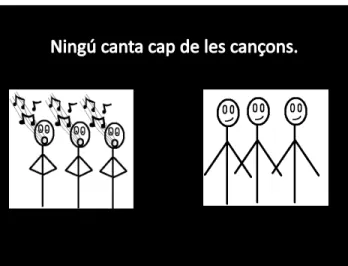
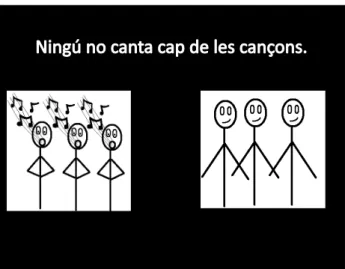
The speakers were presented with two scenes, each representing a situation that 588
corresponded to a distinct reading of the sentence. A sample visual stimulus is given in 589
Figure 1 for Experiment 1 (without no), and in Figure 2 for Experiment 2 (with no). 590
591
592
Figure 1. Slide used in Experiment 1 (without no). The text translates literally as
593
‘nobody sings none of the songs’. The image on the right is true for the NC or single 594
negation interpretation of the sentence, the one on the left represents the DN reading. 595
597
Figure 2. Slide used in Experiment 2 (with no). The text translates literally as ‘nobody
598
not sings none of the songs’. The image on the right corresponds to a NC or single 599
negation interpretation of the sentence (i.e., ‘Nobody sings any of the songs’) and the one 600
on the left to a DN reading cancelling out to a positive statement (i.e., ‘Nobody doesn’t 601
sing none of the songs’; that is, Everybody sings some song). 602
For Figure 1 and 2, we expected speakers interpreting the target sentence as meaning 603
‘Nobody sings any of the songs’, i.e., an NC reading, to click on the right picture, and 604
speakers interpreting it as ‘Nobody sings none of the songs’, i.e., an DN reading to click 605
on the left picture. 606
The sentences used in the two experiments were organised as follows: four critical 607
conditions, which featured sequences of two NCIs that vary in internal syntactic 608
complexity (simple pronouns −encoded Pro− vs. full noun phrases −encoded DP−), their 609
syntactic position (verbal or post-verbal), and parallelism (same NCI type in pre-610
verbal and post-verbal position, distinct NCI type in both positions). This yielded the 611
following four combinations: critical DP DP, critical Pro Pro, critical Pro DP and critical 612
DP Pro. 613
Items exemplifying these four critical conditions contained the four different 614
combinations of NCIs listed and illustrated in (23), where DP means that the NCI has 615
both a prenominal Specifier and a noun phrase or a partitive complement, and Pro means 616
that the NCI is a one-word pronominal form. Since sample sentences in Experiment 1 617
(without no) and Experiment 2 (with no) only differed with respect to the presence vs. 618
absence of the sentential negative marker no ‘not’, this is indicated in (23) by means of 619
parentheses. 620
(23) Critical DP DP (parallel complex) 621
a. Cap dels alumnes (no) llegeix cap llibre. 622
none of.the students (not) reads no book 623
‘None of the students reads any book.’ 624
Critical DP Pro (non-parallel complex subject)
625
b. Cap dels nens (no) beu res. 626
none of.the children (not) drinks nothing 627
‘None of the children drink anything.’ 628
Critical Pro DP (non-parallel simple subject)
629
c. Ningú (no) canta cap de les cançons. 630
nobody (not) sings none of the songs 631
‘Nobody sings any of the songs.’ 632
Critical Pro Pro (parallel simple)
633
d. Ningú (no) trenca res. 634
nobody (not) breaks nothing 635
‘Nobody breaks anything.’ 636
The four control conditions are listed and illustrated in (24). The control DN 637
condition was introduced to test the capacity of speakers to produce DN readings in 638
unambiguous biclausal sentences containing two sentential negative markers. We 639
reasoned that speakers that could not get DN readings in these unambiguous cases would 640
not get DN readings in our critical conditions. As it turns out, one of our participants in 641
Experiment 2 failed this control (with a 100% error) and was removed from further 642
analysis. 643
The control Universal Quantifier was introduced to test the capacity of speakers to 644
interpret sentences with universal quantifiers in subject position in combination with 645
existential quantifiers in post-verbal position; we reasoned that DN readings can logically 646
correspond to Universal Quantifier readings (i.e., if there is something that none of the 647
characters in the pictures do not do, then this is something that all of them in fact do). 648
Thus, we needed to check that participants could independently get such readings. 649
Sentences exemplifying this control were judged as true of a pictorially represented 650
situation where a specific action was performed by all the characters in the picture. 651
The control Negative Quantifier set of sentences aimed to check the capacity of 652
native speakers to associate a single negation reading to sentences with only one pre-653
verbal NCI. Both Experiment 1 (with no) and Experiment 2 (without no) shared the same 654
set of sentences. 655
Finally, control NPI aimed to check the interpretation associated with pre-verbal 656
NCIs followed by an indefinite expression, without no ‘not’ in Experiment 1 and in 657
combination with no ‘not’ in Experiment 2. Both are equally described as conveying a 658
single negation interpretation in traditional and descriptive grammars of Catalan, where 659
no is described as simply optional.
660
(24) Control DN 661
a. No és el cas que els turistes no pesquin cap peix. 662
not is the case that the tourists not fish no fish 663
‘It is not the case that the tourists did not catch any fish.’ 664
Control Universal Quantifier
665
b. Tothom mou alguna cosa. 666
everybody moves some thing 667
‘Everybody moves something.’ 668
Control Negative Quantifier
669
c. Ningú perd les claus. 670
nobody loses the keys 671
‘Nobody loses the keys.’
672
Control NPI
673
d. Ningú (no) neteja alguna cosa. 674
nobody not cleans some thing 675
‘Nobody cleans something.’
676
A set of the 32 filler sentences (four fillers per critical sentences) meant to distract 677
the participants from focusing on negative sentences. A sample of these items is given in 678
(25), with various combinations of nominal expressions in pre-verbal and post-verbal 679
position of a transitive verb: with definite or indefinite articles, demonstratives, bare 680
plurals, positive indefinite quantifiers, and a few more sentences with universal 681
quantifiers as objects. 682
(25) a. Els nens miren un programa. 683
the children watch a programme 684
‘The children watch a programme.’ 685
b. Aquests convidats beuen sucs. 686
these guests drink juices 687
‘These guests drink juice.’ 688
c. Uns turistes pesquen aquests peixos. 689
some tourists fish these fish 690
‘Some tourists catch these fish.’ 691
d. Cada home tiba una caixa. 692
every man pulls a box 693
‘Every man pulls a box.’ 694
695
3.3. Procedure
696
Participants were individually seated in a quiet computer room at the Universitat 697
Autònoma de Barcelona. The stimuli presentation used the Neurobehavioral Systems’ 698
Presentation 17.0 software. Participants were presented with a set of instructional slides, 699
the body of the experiment, and a final sociolinguistic questionnaire on their age, sex, 700
birthplace, current place of living, and amount of Catalan use. Participants were 701
instructed to read aloud the stimulus sentences as naturally as possible, and then press the 702
space bar to display the relevant two pictures on the screen. The reading was recorded 703
and the stimulus sentence remained on the screen to prevent confusion.9 Picture choice
704
was made by mouse click on the centre of the picture. Mouse trajectory and time to 705
picture choice were measured, starting from the moment when the pictures appeared to 706
the choice click. From time to time (approximately every 10 pictures) participants were 707
asked to explain their choice orally responding to the question: why this choice? The 708
experimenter listened to these responses. A total of 6,624 responses were obtained, 3,360 709
for Experiment 1 (32 critical + 32 controls + 32 fillers x 35 participants), and 3,264 for 710
Experiment 2 (32 critical + 32 controls + 32 fillers x 34 participants). Each of the 711
experiments lasted approximately between 10 and 15 minutes. 712
713
3.4. Measures and analyses
714
The responses were analysed using a Generalized Linear Mixed Model fit by maximum 715
likelihood (R packages lme4, Bates et al. 2014a, 2014b, and multcomp, Hothorn et al., 716
2008) with a logistic regression (logit). Picture choice was recorded with two measures: 717
mouse tracking (trajectory) from centre point, and mouse clicking (the final choice). The 718
9 The reading was recorded to allow for subsequent prosodic analysis. Note that since in our design, the presentation of stimuli sentences was visual, participants were free to produce the prosodic contour they thought best fit the interpretation they chose. It is thus expected that the prosodic realisation of NC vs. DN readings could differ as a reflection of the interpretation given by participants to the sentence stimuli. A pitch track analysis of the prosodic contour produced by our subjects could thus turn out to be particularly revealing for the question of whether interpretation correlates with prosody, since it would allow us to compare the prosody of NC choices to that of DN. At present, however, since this analysis is not completed, discussion of the prosodic realisation must be left for further research. It must be noted, however, that in our design, prosody can in no way alter the results reported here. It could reflect our participants’ choice of interpretation (and it hopefully does), but it could not be the source of it or influence it, since it was not given to our participants, but it was produced by them as a function of their chosen interpretation.
In addition, no information was given to the participants regarding the pragmatic setting against which the sentence could be interpreted. That is, the experiment did not contain any explicit contextual information that deliberately favoured the emergence of DN readings. Clearly, as noted by a reviewer, the fact that we provided no context does not entail that participants did not make one up for themselves. But in this respect our experimental design does not differ from any experimental setting in which speakers are asked to evaluate sentences without a context.
time between picture appearance (after bar-pressing) and picture choice (by mouse 719
clicking on the picture chosen) was also recorded. 720
In the next section we report our results on picture choice (NC / single negation vs. 721
DN interpretation for our critical items, and true vs. false for the control conditions and 722
fillers), as well as on the time that the choice took for distinct readings. A prosodic 723
analysis of the recorded readings and a quantitative analysis of the mouse trajectory have 724
been left for future analysis. 725
726
4. Results
727
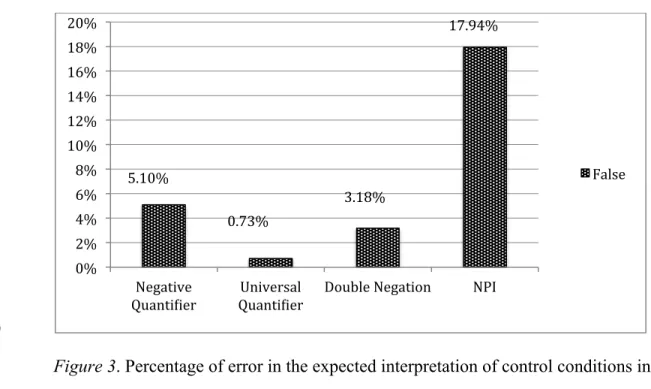
In this section, we start by considering responses to our control items represented in 728
Figure 3. 729
730
Figure 3. Percentage of error in the expected interpretation of control conditions in
731
Experiment 1 (without no) and Experiment 2 (with no). 732
Figure 3 shows the percentage of errors participants made under the control 733
conditions described in Section 3.2 above. Considering the overall results of the two 734
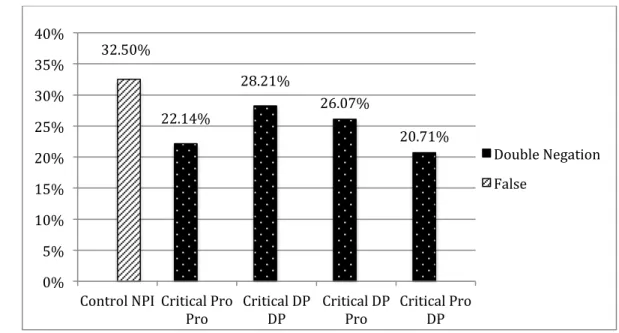
experiments together, the total percentage of errors on control items amounted to 6.88% 735 5.10% 0.73% 3.18% 17.94% 0% 2% 4% 6% 8% 10% 12% 14% 16% 18% 20% Negative
Quanti8ier Quanti8ier Universal Double Negation NPI