HAL Id: tel-03143732
https://tel.archives-ouvertes.fr/tel-03143732
Submitted on 17 Feb 2021HAL is a multi-disciplinary open access archive for the deposit and dissemination of sci-entific research documents, whether they are pub-lished or not. The documents may come from teaching and research institutions in France or abroad, or from public or private research centers.
L’archive ouverte pluridisciplinaire HAL, est destinée au dépôt et à la diffusion de documents scientifiques de niveau recherche, publiés ou non, émanant des établissements d’enseignement et de recherche français ou étrangers, des laboratoires publics ou privés.
Metallic Substrates : Experimental X-ray Absorption
Spectroscopy and Ligand Field Multiplet Calculations
Luqiong Zhang
To cite this version:
Luqiong Zhang. Magnetic Molecular-based Materials Assembled on Metallic Substrates : Experimen-tal X-ray Absorption Spectroscopy and Ligand Field Multiplet Calculations. Coordination chemistry. Université Paris Saclay (COmUE), 2019. English. �NNT : 2019SACLS587�. �tel-03143732�
Magnetic Molecular-based Materials
Assembled on Metallic Substrates:
Experimental X-ray Absorption
Spectroscopy and Ligand Field
Multiplet Calculations
Thèse de doctorat de l'Université Paris-Saclay préparée à l’Université Paris Sud
École doctorale n°571 Sciences chimiques : molécules, matérieux, instrumentation et biosystèmes (2MIB)
Spécialité de doctorat: Chimie
Thèse présentée et soutenue à Orsay, le 18 Décembre 2019, par
Mme Luqiong ZHANG
Composition du Jury :
M. Ally AUKAULOO
Professeur, ICMMO, Université Paris Sud Président Mme. Amélie JUHIN
Chargé de recherche, IMPMC, Université de Sorbonne Rapporteur Mme. Valérie MARVAUD
Directrice de Recherche, IPCM, Université de Sorbonne Rapporteur M. Rodrigue LESCOUEZEC
Professeur, IPCM, Sorbonne Université Examinateur M. Talal MALLAH
Professeur, ICMMO, Université Paris Sud Directeur de thèse M. Philippe SAINCTAVIT
Directeur de Recherche, IMPMC, Université de Sorbonne Co-Directeur de thèse
N N T : 2 0 19 S A C LS 5 87
Table of Contents
Acknowledgments ··· I Abstract ··· III Résumé ··· V Abbreviations ··· VII Overview ··· 1Chapter 1 General Introduction ··· 3
-1.1 Introduction ··· 3
-1.1.1 Magnetism ··· 3
-1.1.2 Molecular Magnetism and NanoMagnetism ··· 6
-1.1.2.1 Molecular Magnetism··· 6
-1.1.2.2 Single Molecular Magnets (SMMs) ··· 7
-1.1.3 Bistability of Magnetism ··· 8
-1.1.4 Applications ··· 9
-1.2 Prussian Blue Analogues ··· 9
-1.2.1 General History ··· 9
-1.2.2 General Formula for PBAs ··· 10
-1.2.3 Magnetic Properties in PB and PBAs ··· 12
-1.2.3.1 Magnetic Coupling in PB and PBAs ··· 12
-1.2.3.2 Prussian Blue Analogues at the Nanoscale ··· 12
-1.3 Spin Crossover Compounds ··· 14
-1.3.1 Ligand Field Considerations ··· 14
-1.3.2 Thermal Driven SCO Mechanism··· 15
-1.3.3 Cooperativity ··· 16
-1.4 Objectives of the Present Work ··· 20
References ··· 21
Chapter 2 Methodologies ··· 27
-2.1 Xray Absorption Spectroscopy (XAS) Technique ··· 27
-2.1.1 General Introduction for XAS ··· 27
-2.1.1.1 Fermi Golden rule ··· 28
-2.1.1.2 DEIMOS Beamline ··· 29
-2.1.1.3 Electric Polarizations ··· 29
-2.1.1.4 Chemical and Orbital Selectivity ··· 30
-2.1.2 Xray Natural Linear Dichroism ··· 31
-2.1.3 Xray Magnetic Circular Dichroism ··· 32
-2.2 Ligand Field Multiplet Calculations ··· 32
-2.2.1 Ligand Field Multiplet Theory ··· 33
-2.2.2 Suit of TTMultiplet Programs ··· 34
References ··· 36
Chapter 3 6nmsized CsNiCr PBA NCs Assembled Monolayer on HOPG ··· 37
-3.1 Introduction ··· 37
-3.2 Experimental Section ··· 39
-3.2.1 Assembly on HOPG··· 39
-3.2.2 XRay Absorption Measurements ··· 40
-3.3 Ligand Field Multiplet Calculations ··· 42
-3.4 Results and Analysis ··· 43
-3.4.1 Structural and Electronic Anisotropy ··· 43
-3.4.1.1 XAS and XNLD at Ni L2,3 edges··· 43
-3.4.1.2 XAS and XNLD at Cr L2,3 edges ··· 48
-3.4.2 Magnetic Anisotropy ··· 49
-3.4.2.1 XMCD measurements at 2T ··· 49
-3.4.2.2 Magnetization Curves and Remnant Magnetizations ··· 51
-3.5 Discussion ··· 53
References ··· 58
Chapter 4 Fe(II)SCO Compounds Assembled on Metallic Substrates ··· 63
-4.1 General Introduction ··· 63
-4.2 Magnetic Behavior of a Thick Film ··· 65
-4.3 Analysis Methods ··· 66
-4.3.1 Experimental XAS Spectra for Pure HS and LS states ··· 66
-4.3.2 Calculated Pure HS and LS Spectra ··· 68
-4.3.3 Normalized Reference Spectra Combined Calculations and Experiments ··· 69
-4.3.4 Analysis Method between Reference and Realtime Spectra ··· 71
-4.4 Definition of the Thickness of Different Samples ··· 73
-4.5 Results ··· 74
-4.5.1 FeIISCO@Cu ··· 75
-4.5.1.1 Thermal Dependence of the FeIISCO Molecules on Cu(111) ··· 75
-4.5.1.2 Thermal Dependence in the Presence of Blue Light for FeIISCO@Cu ··· 77
-4.5.1.3 Time Dependence of Blue Light and X-ray Effect on FeIISCO@Cu at 4 K ··· 79
-4.5.1.4 Scanning Tunneling Microscopy (STM) Observation of Light Effect ··· 81
-4.5.2 FeIISCO@Au(111) ··· 82
-4.5.2.1 Thermal and Blue Light effect on FeIISCO@Au(111) ··· 82
-4.5.2.2 Time Dependence of Blue Light on FeIISCO@Au at 20 K ··· 84
-4.5.2.3 Time Dependence of Red Light on FeIISCO@Au at 4 K ··· 85
-4.6 Discussion about Mechanism of LIESST Effect ··· 86
-4.7 Conclusion ··· 88
References ··· 89
Chapter 5 General Conclusions and Future Work ··· 93
-5.1 General Conclusions ··· 93 -5.2 Future Work ··· 95 References ··· 97 APPENDIX I ··· 99 References ··· 108 APPENDIX II ··· 109 APPENDIX III ··· 113
-I
Acknowledgments
Primarily, I would like to express my deep gratitude to my supervisors: Prof. Talal MALLAH and Dr. Philippe SAINCTAVIT. It is really a great honor and fortune for me have a chance to continue my graduate career under their supervisions, and to study and work in the Laboratoire Chimie Inorganique (LCI), Institut de Chimie Moléculaire et des Matériaux d’Orsay (ICMMO) and IMPMC (Institut de mineralogie, de physique des matériaux et de cosmochinie) of Sorbonne university. They both offer me abundant help in this new scientific field of magnetism. What they have done (invaluable guidance, support, encouragement, understanding and insight vision) and imparted to me (new knowledge, research skills, research experiences and critical thinking) are a tremendous treasure in my lifetime. Form my viewpoint, they are not only supervisors but also amiable elders. Again, I do really feel grateful and lucky to have my PhD study under their supervisions.
I appreciate Marie-Anne Arrio a lot, who is very nice, warm, patient and amiable. She leads me to mastering calculated skills and theories step by step, and also, she provides a lot of help in study and life. We get along well with each other in these three years. Besides, many deep thanks to great researchers for their help and preliminary preparation: 1) Marie-Laure BOILLOT, Laure CATALA, Riviére ERIC and Sandra MAZERAT in ICMMO; 2) Edwige OTRRO and Philippe OHRESSER in SOLEIL (DEIMOS beamline); 3) Amandine BELLEC, Vincent REPAIN and Yongfeng TONG in LMPQ of Paris-Diderot University. All of them help me to synthesize nanoparticles and compounds, to characterize magnetic/structural properties by SQUID and XAS measurements, and to take STM measurements. It is their work, support and aid that enriches my study, without them, my work cannot progress smoothly and nice. Their guidance, encouragement, knowledge and skills are the driving forces for my work during my PhD study period.
I would like to thank all group members of LCI (present and past) in ICMMO. Members in our group, especially Yiting, Fatima, Linh, Adama, Amanda, Khaled, Youngju, Asma, Philippe, Antonie, Laure, Marie, Axel, Tam, Bamjamine, Christian and so on (actually so many members), are very friendly, mutual helpful, dynamics and energetic, which makes the lab full of happiness and love. It is my pleasure and fortune to work with them throughout 3 years. Thanks to this group, this period of work is one unforgettable memory in my life. I am grateful to all permanent staffs, Sandra, Laure, Marie-Laure, Pei, Anne-Bleuzen, Amelie, Jean-Jacques, Ally, Jean-Noel, Eric and so on, for their help, guidance and advice. I also want to acknowledge colleagues in IMPMC lab of Sorbonne Université because of their kindness. I still remember the first time we went to a noodle bar together, and they introduced how they are working. Scientific atmosphere there is quite harmonious and warm. And a special gratitude to Gérald and Andrew in ISMO (Institue des sciences moléculaires d’Orsay) for
II their kindly help and understanding.
This experience during my PhD study makes me realize clearly that teamwork and collaboration are the essential compositions of scientific research. The overall work of each researcher not only depends upon the subject and technical skills, but also upon the teamwork, collaborations and the surrounding atmosphere. Thanks to my colleagues in LCI and IMPMC, collaborators of DEIMOSE in SOLEIL and LMPQ.
In addition, I would like to express my gratitude to friends who are in China or abroad. They all are very kindhearted, hospitable and accommodating. On the way to chase my dream, my friends provide a lot of psychological and financial help to me. I do really appreciate them for their trust and help. And I would also express my acknowledgement to friends in France who gave me vast courage, support, understanding, comfort and help when I met one healthy problem in the first year of PhD study. During these four years, their words and behaviors facilitate me to keep optimistic and positive. Laughters, dinners, parties, short holidays we shared together are one of my precious memory in my life, impressive and unforgettable, which still plays out in my mind vividly as if it were yesterday. A non-negligible gratitude I would show it to my previous supervisors and colleagues in master period: Asso.Prof. Wei Shen, Prof. Rongxin He, Dr. Cheng Huang, Meiyuan Guo, and Yulan Dai et.al. On the way to pursue my dream, my master supervisor (Asso.Prof. Wei Shen) and researcher in this group provide me with enormous guidance, help and financial support as well as their trust. Meiyuan, Yulan and Xiaorui are the guys we will share our scientific ideas and thoughts before and now. I would acknowledge greatly to the financial support from the China Scholar Council (CSC) for providing me this opportunity to study and work abroad in France. It is thanks to the Collaborative Program between CSC and Université Paris-Sud that I won this opportunity to study abroad and be more closely to my idol (Curie Marie). Although there is a long-term laborious work I should persist on, I still believe firmly that one day I would become a better eligible researcher.
Last but not least, I would like to express my personal gratitude to my families, especially my beloved husband, Nicolas. Thanks a lot for your thoughtfulness, understanding, encouragement and your deep love. All the time you support me the best and now you give me a warm family.
My family, friends, colleagues and collaborators: this manuscript is for you. ZHANG Luqiong
张露琼 2019-12-18
III
Abstract
The research work in this thesis is focused on the investigation of the magnetic properties of magnetic nanoparticles and spin crossover complexes assembled as monolayer or submonolayer on different substrates by X-ray Absorption Spectroscopy (XAS) at the L2,3 edges of metallic atoms. We use
X-ray Magnetic Circular Dichroism (XMCD) and X-ray Natural Linear Dichroism (XNLD) to do so. Simulations of the experimental data are carried out by Ligand Field Multiplet (LFM) Theory. The thesis is divided into two parts. The first part aims at studying the magnetic anisotropy of Prussian blue analog magnetic coordination nanoparticles that were assembled as single layers on Highly Oriented Pyrolytic Graphite (HOPG). The sample was examined by XNLD measured with the light polarization vector at different angles to the normal to the substrate plane that evidences an electronic anisotropy at the Ni and Cr L2,3 edges in line with a structural distortion of the coordination sphere of
the atoms belonging to the surface of the particles. The structural distortion of the Ni(II) coordination sphere corresponds to an elongation along the axis perpendicular to the particles’ surface and, therefore, is responsible of a zero-field splitting (ZFS) of the Ni(II) S = 1 magnetic moment, confirmed by LFM calculations. The presence of ZFS is responsible for a magnetic anisotropy when a magnetic field is applied corresponding to an easy plane of magnetization in the case of an elongated structural distortion. The examination of the magnetic properties of the single layer by XMCD at different values of the magnetic field and different orientations of the sample with respect to the applied field reveals the presence of a hysteresis loop when the magnetic field is at 60° to the normal to the substrate plane. This result is compatible with an easy plane of magnetization within the plane of the single layer in line with the results deduced from the electronic distortion.
The second part of the work is devoted to the investigation of the thermal and light-induced switching of spin crossover (SCO) Fe(II) containing molecules assembled as submonolayer on metallic substrates namely Au(111), Ag(111) and Cu(111). The analysis of the data is based on a comparison with those obtained for a thick film (7 microns). The XAS data at the Fe L2,3 edges of the thick film
show a complete spin crossover upon cooling from 300 to 80 K. While for the submonolayer samples an incomplete crossover occurs with residual high spin species whose percentage depends on the nature of the substrate. Complementary Scanning Tunnel Microscopy (STM) studies reveal that on Au(111) an ordered high spin/low spin phase is present with 2:1 ratio that was confirmed by the XAS study. The incomplete transition on Cu(111) does not reveal any ordered phase by STM, highlighting the effect of the molecules/substrate interface on the crossover phenomenon. We have checked that the crossover of an additional layer is complete confirming the major role of the interface. The dynamic of the crossover was studied by light irradiation (blue and green) at low temperature (4 K).
IV
An anomalous transformation from high spin to low spin is observed and was tentatively assigned to a plasmonic effect of the metallic substrates that excites some vibration modes of the high spin molecules inducing a population of the low spin state and therefore a high spin to low spin crossover.
V
Résumé
Les travaux de recherche de cette thèse focalisent sur l'étude des propriétés des deux nano-objets magnétiques différents: les nanocristaux appartenant à la famille des analogues du bleu de Prusse (PBA) et de complexes à transition de spin assemblés en monocouches sur substrats métalliques. Afin d'interpréter les propriétés magnétiques et les propriétés structurelles de ces nano-objets assemblés sur des substrats métalliques, des expériences de spectroscopie d'absorption des rayons X (XAS) aux bords L2,3 des atomes métalliques ont été menées en combinant avec le multiplicateur de champ de ligand (LFM) correspondant calculs. Les spectres pourraient contenir du XAS expérimental, du dichroïsme circulaire magnétique à rayons X (XMCD) et du dichroïsme linéaire naturel à rayons X (XNLD), ainsi que ceux simulés à partir de calculs LFM.
La thèse est divisée en deux parties. La première partie porte sur l’étude de l’anisotropie magnétique de nanoparticules de coordination qui sont des analogues du bleu de Prusse assemblées en monocouche sur du graphite pyrolytique orienté (HOPG). L’échantillon a été examiné par XNLD, et a été mesuré avec le vecteur de polarisation de la lumière à différents angles par rapport à la normale au plan du substrat, mettant en évidence une anisotropie électronique aux seuils de Ni et Cr due à une distorsion structurale de la sphère de coordination des atomes présents à la surface des particules. La distorsion structurale de la sphère de coordination du Ni(II) correspondant à un allongement le long de l'axe perpendiculaire à la surface des particules est donc responsable de la levée de dégénérescence en champ nul (ZFS) du moment magnétique S = 1 du Ni(II), confirmée par des calculs LFM. La présence de ZFS est responsable d'une anisotropie magnétique lorsqu'un champ magnétique est appliqué ceci correspondant à un plan de facile aimantation dans le cas d'une élongation. L’examen des propriétés magnétiques de la monocouche par XMCD à différentes valeurs du champ magnétique et à différentes orientations de l’échantillon par rapport au champ appliqué révèle la présence d’une boucle d’hystérèse lorsque le champ magnétique est à 60° de la normale au substrat. Ce résultat indique la présence d’un plan de facile aimantation dans le plan de la monocouche compatible avec les résultats déduits de la distorsion électronique.
La deuxième partie au Chapitre 4 du travail est consacrée à l’étude de la commutation induite thermiquement et par la lumière de complexes à transition de spin des molécules Fe(II)-SCO, (FeII[HB(3,5-Me
2Pz)3]2), assemblées en sous-monocouches sur des substrats métalliques (Au (111),
Ag (111) et Cu (111). L'analyse des données est comparée à celle d'un film épais (7 microns). Les données XAS au seuil L2,3 de Fe du film épais montrent une transition complète lors du
refroidissement entre 300 et 80 K. Tandis que pour les échantillons en sous-monocouches, une transition incomplète se produit avec des espèces haut spin résiduelles dont le pourcentage dépend de
VI
la nature du substrat. Des études complémentaires en microscopie tunnel à balayage (STM) révèlent que, sur Au (111), une phase ordonnée haut spin/bas spin est présente avec un rapport de 2:1 confirmée par l'étude XAS. La transition incomplète sur Cu (111) ne révèle aucune phase ordonnée par STM, mettant en évidence l'effet de l'interface molécules/substrat sur le phénomène de transition. Nous avons vérifié que la transition d'une couche supplémentaire était complète, confirmant ainsi le rôle majeur de l'interface. La dynamique de la transition a été étudiée par irradiation lumineuse (lumière bleue et verte) à basse température (4 K). Une transformation anormale de l’état haut spin vers l’état bas spin est observée et a été provisoirement attribuée à un effet plasmonique des substrats métalliques qui excite certains modes de vibration des molécules à spin élevé induisant une population de l’état bas spin et donc la transition haut spin vers bas spin.
VII
Abbreviations
AFM Atomic Force Microscopy
AFOM Antiferromagnets
CF Crystal Field
CN- Cyanide Anions
CTA Cetyltrimethyllammonium
D4h Tetrahedron/Tetrahedral Group
DODA dimethyl dioctadecyl ammonium
fcc Face-centered cubic
FOM Ferromagnets
FIM Ferrimagnets
HC Coercive Field
Heff Effective magnetic field
Hext External magnetic field
HOPG Highly Oriented Pyrolytic Graphite
HS High Spin
HT High Temperature IR Infrared-red
LFM Ligand Field Multiplet
LIESST Light Induced Excited Spin State Trapping (LS to HS)
LS Low Spin
LT Low temperature
M Magnetization ML Molecular layer
Mrem Remnant Magnetization
NCs Nanocrystals
NEXAFS Near-Edge X-rays Absorption Fine Structure
NPs Nanoparticles
Oh Octahedron/Octahedral group
PB Prussian Blue
PBA Prussian Blue Analogues
PVP Organic Polymer Polyvinylpyrrolidone
QTM Quantum Tunneling of Magnetization
VIII
Reverse-SOXIESST Reverse- Soft X-ray Induced Excited Spin State Trapping (HS to LS)
SAMs Self-Assembled Molecules
SCO Spin Crossover
SMMs Single Molecular Magnets
SOC Spin-Orbit Coupling
SO-SI Spin-Orbit State-Interaction
SOXIESST Soft X-ray Induced Excited Spin State Trapping (LS to HS)
SQUID Superconducting Quantum Interference Device
ST Spin Transition
STM Scanning Tunnel Microscopy T Temperature
TB Blocking Temperature
TC Curie Temperature
TEY mode Total Electron Field mode
T1/2 Temperature at which 50 per cent of the “SCO-active” molecules
have changed the spin state
texposure Exposure time under an illumination with light (red, green and blue
laser) and/or X-rays
UV-Vis Ultra Violet-Visble
XAS X-ray Absorption Spectroscopy
XMCD X-ray Magnetic Circular Dichroism
XNLD X-ray Natural Linear Dichroism
XRD X-ray Diffraction
ZFS Zero-Field Splitting
D Zero Field Splitting parameter G Gibbs Free Energy
HS HS fraction
HS(T) HS fraction as a function of temperature
H Enthalpy
g Landé factor
M Molar magnetic susceptibility
P Pairing Energy
Splitting Energy S Entropy
- 1 -
Overview
The present PhD study is centered on molecular magnetism. I have mainly been working with two different systems: nanocrystals belonging to the family of the Prussian blue analogues (PBAs) and molecules belonging to the group of Iron spin cross-over (SCO). In both cases, the systems belong to the state-of-the-art chemistry and in both cases my work has been to bring a fine characterization of the electronic and magnetic structures by using experimental spectroscopic techniques and by applying theoretical methods in order to interpret the experimental features. This thesis is composed of five chapters.
Chapter 1 is a general brief introduction on magnetism, molecular magnetism including Prussain blue analogs and spin crossover materials that constitute the two systems investigated in this work.
Chapter 2 is devoted to the general methodology used to analyze the X-ray Absorption Spectra including Ligand Field Multiplet calculations.
In Chapter 3, a combinational study of XAS and LFM calculations is implemented for the PBAs CsNiIICrIII[6] nanoparticles (NPs) deposited monolayer on HOPG (highly oriented purely graphite).
This chapter is to expound the electronic and structural information of NiII and CrIII sites in NPs
deposited on a solid surface of HOPG by using XAS technique. Then a series of sophisticated calculations being the ancillary technique are carried out by the multiplet program based on the ligand field theory, which favors to gaining a deeper insight of understanding the intrinsic structural properties at metal ions sites and the intermolecular interaction in the case of the self-assembled molecules (SAMs).
In Chapter 4, monolayer or submonolayer Fe (II) compounds directly contacting to different metallic substrates are investigated by XAS experiments to explore their SCO behaviors. It is of great significance and interest to investigate the SCO phenomenon among Fe (II) compounds since the applied metallic substrates would have interplay with Fe (II) compounds under the circumstance of external stimuli. Primarily, the thermal dependence of Fe (II)-SCO is recorded from 4.5 K to 300 K and then the light induced excited state effect is carried under the illumination with blue laser and red laser. A theoretically multiplet study is used to provide a fundamental reference for real-time spectra and to give a relatively accurate spin state at a quantitatively scale.
In Chapter 5, general conclusions are presented which I have obtained from the case of PBAs CsNiIICrIII[6] assembled monolayer on HOPG and the case of Fe(II) spin crossover compounds
deposited submonolayer on different metallic substrates. Also, the challenges and emerging new thoughts are listed in this chapter.
- 3 -
Chapter 1 - General Introduction
1.1 Introduction
1.1.1 Magnetism
General history of magnetism. The first discovery of magnetism was found in lodestones which could attract iron naturally in antiquity from the ancient world.1 The lodestone is composed of the
magnetite that is an iron oxide. As for the terminology of magnet, it stemmed ultimately from "" (magnetis lithos) and “the Magnesian stone” (lodestone) in Greek (seeing the link: http://languagehat.com/magnet/), while the concept of magnetism was firstly named by the philosopher Thales of Miletus in ancient Greece, during the 6th century BC (625-547 BC).2 Due to
magnetic interaction, lodestone minerals could be rotated and moved by other pieces of lodestone, the first magnetic devices have been invented by Chinese people and they were mainly used for divination purposes before military applications to orientation and early navigation.1, 3-5 During Han
dynasty of China, one special spoon, called “directional spoon”, was invented by Wang Chong (in Lun Heng, 27-97).5 This “directional spoon” was the first compass which always directs towards to
the south when placing on a plate on the ground (seeing Figure 1-1) due to the magnetic properties of lodestone. Compasses are still used in the 21st century based on this ancient use of magnets for
orientation.
- 4 -
Today magnetism is depicted as the response of a magnetic material to an external magnetic field. It originates from the intrinsic magnetic moments of ions and from electric currents. Except for the lodestone (i.e. Fe3O4: magnetite) found in ancient world, there are various natural minerals based on
Fe possessing a permanent magnetization (for instance -Fe2O3: hematite, -Fe2O3: maghemite).
These iron oxides are either antiferromagnets, weak ferromagnets or ferrimagnets, which have a large enough magnetic anisotropy to present a net magnetization and form permanent magnets (at least for ferrimagnets such as -Fe2O3 and Fe3O4). There also exist other magnetic minerals, such as iron
sulfiVacudes, or titanium, chromium, cobalt, or nickel oxides.
When a material is submitted to an external magnetic induction B, its Helmotz free energy (F=U-TS, where U is the free energy, T the temperature and S the entropy) becomes a function of B. By definition, the magnetization M (B,T) of a material is given by
M(B,T) = − . , (1 − 1) and the magnetic susceptibility is defined by
𝜒(𝑩, 𝑇) = . = − . , (1 − 2) where 𝜇 is the magnetic permeability of vacuum. Classically magnetic materials are classified into two different groups according to the sign of the magnetic susceptibility:
--those for which the magnetic susceptibility is negative are called diamagnetic materials, --those for which the magnetic susceptibility is positive are called paramagnetic materials. On one hand, atoms with closed shells are diamagnetic so that most materials are diamagnetic (for instance rare gases in their solid phase are diamagnets). The related diamagnetic properties, called diamagnetism, appear in all materials since all atoms have closed. Diamagnetism tends to repel the external magnetic field. On the other hand, materials containing 3d, 4d, 5d (transition metals), 4f (lanthanides) and 5f (actinides) may have open shells with unpaired electrons and most of them are paramagnetic materials.
For the materials containing paramagnetic atoms, there is a further classification depending on the existence or the absence of a long-range magnetic order where long range generally refers to lengths that are much larger than interatomic distances:
--materials for which there is no long-range magnetic order are called paramagnets (for instance metallic Ti or Cr);
--materials with a long-range magnetic order but no net magnetic moment are called antiferromagnets (AFOM);
--materials which possess a long-range magnetic order with a net magnetization are called ferromagnets (FOM) or ferrimagnets (FIM). FOM have only one magnetic lattice or sub-lattice (for instance metallic Fe or CrO2). FIM have several magnetic sub-lattices and the contribution from each
- 5 -
sub-lattice does not cancel so that a net magnetization is observed (for instance maghemite or magnetite are ferrimagnets; hematite above 260 K is a ferrimagnet although it commonly receives the name of weak FOM)
A schematic representation of the various types of magnetic materials is provided in Figure 1-2.
Figure 1-2. Schematic types of magnetic systems depending upon the magnetic ordering.
For ferro- or ferrimagnetic materials, one observes a Curie Temperature, TC. Above TC, there is no
long-range magnetic order so that the material is a paramagnet, whereas below TC one observes a
long-range magnetic order and a net magnetic moment is generally observed. In addition to the existence of a long-range order, one also generally observes an opening of the magnetic hysteresis loops: when a ferromagnetic or ferrimagnetic material is submitted to an external magnetic field, its magnetization changes. One then observes that its magnetization depends on the history of the material: if the material is first submitted to a positive external magnetic field then its magnetization in zero external magnetic field is different from the one observed if the material is first magnetized in a negative magnetic field. This means that a magnetized ferrimagnet or ferromagnet is not in a thermodynamic state since its energy is not only a function of the thermodynamic parameters (temperature, external magnetic induction) but also a function of its history.
Figure 1-3. The hysteresis Loop obtained from the induced magnetic flux density (B). https://www.nde-ed.org/EducationResources/CommunityCollege/MagParticle/Physics/HysteresisLoop.php.
In a hysteresis loop (Figure 1-3), one records the magnetic moment of a sample as a function of the external magnetic induction. From a magnetization curve, one can extract two quantities that help
- 6 - summarizing the shape of the hysteresis:
--the remnant magnetization, Mrem, is the magnetization that is observed in zero magnetic
induction after the sample has been fully magnetized up to saturation in a given direction;
--the coercive field, HC, is the field with direction opposite to the one of the saturating field,
which is necessary to cancel any magnetization of the material.
1.1.2 Molecular Magnetism and Nano-Magnetism
The above description of magnetism holds for bulk materials such as large single crystals, powders with large grains or thick films. Beyond the usual description of magnetism for macro-crystals, the situation for nanoparticles, nanocrystals, ultra-thin films is a bit more subtle because the intrinsic absence of range crystallographic order in nanoparticles prevents the existence of any long-range magnetic order.6-7 Then for paramagnetic nanoparticles (NPs), one observes another order
temperature that is called the blocking temperature, TB. When the temperature of a NP is below TC
of the associated bulk material, the whole magnetic ions of the NP are coupled so that one observes a magnetic order between the various magnetic ions and the NP presents an instantaneous, net magnetic moment. Because of thermal energy and the absence of long-range crystallographic order, the net magnetic moment keeps on changing between directions that are crystallographically equivalent so that on a "large" (i.e. several nanoseconds) time scale, the average net magnetic moment is zero. In this case the magnetic behavior of the NP is called superparamagnetic. When the temperature is lowered, the thermal energy lowers and can eventually become less that the magnetic anisotropy associated to the re-orientation of the NP net magnetic moment. Below TB the NP presents
a net magnetic moment and mostly behaves as a ferromagnet or a ferrimagnet.
1.1.2.1 Molecular Magnetism
Molecular magnetism is a multidisciplinary field involving coordination chemistry, synthetic chemistry, theoretical chemistry, solid state physics, condensed matter physics, quantum physics, and functionalized material science. It is a rather new emerging field in which chemists and physicists pay huge attention to studying the local structure and magnetic properties of molecular magnetic systems. The specificities of molecular magnets make them good candidate for information storage and the elaboration of spintronics devices.8 Importantly, the discovery of single molecule magnets
(SMMs) by Dante Gatteschi et al9-11 contributed to making the field of molecular magnetism more
attractive thanks to the existence of superparamagnetic behavior above a blocking temperature (TB)
and quantum spin relaxation below TB. In general, the magnetic centers of SMMs are transition metal
ions, sometimes lanthanide ions, in coordination with organic ligands. The main feature of SMMs is the existence of a dynamical opening of the magnetic hysteresis loops, the origin of which stems from a local magnetic anisotropy. These openings by contrast to traditional magnetic systems are mostly
- 7 -
dynamical and highly temperature dependent. The origin of magnetism is mostly governed by the intramolecular coupling and intermolecular dipolar interactions between molecules.
1.1.2.2 Single Molecular Magnets (SMMs)
SMMs are one example of magnetic NPs presenting outstanding magnetic properties. SMMs are systems that behave as macroscale magnets with the addition of quantum properties because of their nanoscale nature. SMMs are synthesized as organometallic compounds where transition metal ions or lanthanide ions are coordinated to organic ligands. These SMMs behave as molecules with a giant spin, S, in the ground state and because of a large magnetic anisotropy the 2S+1 levels of the giant spin are split.12-17 At low enough temperature, it has been found that when a SMM is prepared in one
state, for instance the |S,M=-S> state, then a very slow relaxation of magnetization is observed when the external magnetic is reversed so that an hysteresis loops is observed.17-21 Since the relaxation rate
strongly depends on the intensity of the external magnetic field, the magnetization curve present a series of plateau characteristic for SMMs. At the difference of conventional magnets, the hysteresis loops also depend on the rate at which the external magnetic induction is swept, hence its dynamical nature.
In general, SMMs are studied as molecules present in molecular crystals, bulk crystals and in the recent decade, individual SMMs grafted on surfaces have also been studied. For instance, Mannini et al. chemically grafted SMMs on a gold Au(111) surface,22-24 with the idea that isolated, grafted
molecules on a surface have no large intermolecular interactions at the difference of what happens when they are embedded inside a crystal. The objective was to check that the characteristics of SMMs grafted on surfaces were preserved when isolated.
Figure 1-4. (a) Schematic representation of the energy landscape of a SMM with a spin ground state S = 10. The magnetization reversal can occur via quantum tunnelling between energy levels (blue arrow) when the energy levels in the two wells are in resonance. Phonon absorption (green arrows) can also excite the spin up to the top of the potential energy barrier with the quantum number M = 0, and phonon emission descends the spin to the second well. (b) Hysteresis loops of single crystals of [Mn12O12(O2CCH2C(CH3)3)16(CH3OH)4] SMM at different
temperatures. The loops exhibit a series of steps, which are due to resonant quantum tunnelling between energy levels.17
- 8 -
Intriguingly, SMMs are ingredients to link spintronics and molecular electronics, in order to create the novel discipline of molecular spintronics.17, 25 Dynamics of SMMs is schemed in Figure 1-4,
which illustrates the relationship between quantum tunneling effect and the magnetization reversal mechanism.17
1.1.3 Bistability of Magnetism
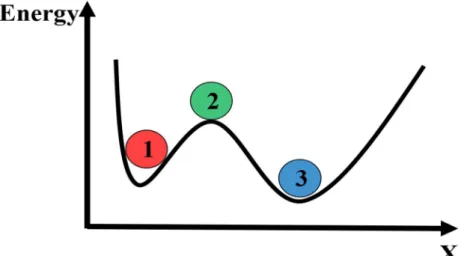
In functionalized materials, bistability results from the presence of two stable or metastable states which coexist at a given temperature and pressure. Due to external stimuli (such as light, thermal history, pressure history), one observes a reversible transition from one of the metastable state (shown as 2) to the other (shown as 1 and 3) illustrated as Figure 1-5. Molecular magnetism is one of the fields where bistability has been widely investigated. Magnetic bistability is considered as a promising property for molecular materials that could be applied for spintronic devices, data storage, and photo-responsive devices.8
Figure 1-5. The potential energy of a bistable system. Balls signed as “1” and “3” are in two stable positions while “2” ball is in the unstable equilibrium between “1” and “3”.
The TTTA organic molecule is an example of such bistable molecular complex. TTTA was first synthesized by Wolmershauser and Johann in 198928 and well characterized by Barcaly et al. (in
1998)29, MaManus et al. (in 2001)30, W Fujita (in 1999)31 as a bistable molecule-based magnetic
material. TTTA presents bistable magnetic interactions (a diamagnetic-to-paramagnetic transition) at room temperature (305 K). The appealing phenomenon is discovered by Gatteschi et al (in 1993)32,
that metallic clusters of Mn12 exhibit magnetic hysteresis different from the one of an ordered
magnetic material below TB and a superparamagnetic behavior exist at a low temperature with a slow
relaxation ascribed to the single-ion anisotropy. Another interesting work is to study the multiferroic crossover by the electrical control for Co3+: PTO.33 Co3+ are doped into the nonmagnetic ferroelectric
host PbTiO3 (PTO). It is found Co3+ ions are bistable magnetism, and the electric field contributes to
have the spin crossover phenomenon due to a strong spin-lattice coupling. And Mannini et al,24, 34 in
- 9 -
explore SMMs as monolayer different from the bulk systems. Lastly, one important case for magnetic bistability is the case belonging to FeII-SCO systems, in which SCO behaviors are induced by
changing temperature and light, in some cases, researchers pay attention to synthesize and characterize new Fe(II)-SCO molecules due to the bistability of metastable state.27 The presence of
bistability in molecular materials may bring a strong signal for hysteresis loops by varying external stimuli, which is quite useful and meaningful for devices applied for information storage and spintronic devices.
1.1.4 Applications
Magnetic materials are widely applied in the industry and in our daily life. They are obviously used on our fridges to hold shopping lists, in most of the electric motors, in captors, in sensors, in our smart-phones. They can also be used in the automotive industry where for instance car dampers of Audi cars rely mainly on the magnetic properties of nanoparticles. In art, one also finds artists creating pieces of art with magnetic liquids (ferrofluids). Another wide and obvious field of application is the communication industry and the computer industry where magnetic materials are ubiquitous in data storage. In order to store information, materials must have open hysteresis loops with a large enough coercive field (HC) and high remnant magnetization (Mrem). HC and Mrem are both important to
characterize memory storage capacity. Currently, people are using molecules to create molecular magnets. This new research direction has potential applications to create spintronic devices, data storage devices, quantum gates and qubits, but they obviously not replace classical magnets with which they cannot compete. New original applications where molecular materials may bring an added-value are sought.
1.2 Prussian Blue Analogues
1.2.1 General History
For the sake of understanding the Prussian Blue analogues (PBAs) compounds, it is interesting to have information on its history35-36 because Prussian Blue is an oldest coordination compound.
Prussian blue, first synthesized by Diesbach, a paint maker, in Berlin around 1706, was used as a blue pigment in painting.35, 37 It is made of iron cations (FeII and FeIII), cyanide anions (CN-) and water
molecules. Its structure was determined by X-ray diffraction (XRD), Infrared-red (IR) spectroscopy
and neutron crystallography, which finally found that PB has a 3D cubic lattice structures (Figure 1-6).38-40 By means of structural analysis from the stoichiometric viewpoint, its composition
is FeIII
4[FeII(CN)6]3•xH2O (or Fe7(CN)18), where x is ranging from 14 to 16. This cubic 3D network
- 10 -
In ideal PB crystals, the bond distances of Fe(II)-C and Fe(III)-N are 1.92 Å and 2.03 Å, respectively. The FeII ions are low spin (LS) ions and FeIII ions are high spin (HS). For both ions the 6-fold sites
are almost octahedral. PB are used for medical applications.41-42
Figure 1-6. The chemical schematic of Prussian blue in 3D. The cubic pores are filled with water molecules and these water molecules are omitted for the clarity. Fe(II) ion is shown in the color orange, Fe(III) ion is in color of red, and potassium (K) is in yellow. Carbon and nitrogen are in black and blue, respectively. This structure of PB is cited from the following link: https://chemicalstructure.net/portfolio/prussian-blue/.
1.2.2 General Formula for PBAs
Coordination networks based on bimetallic cyanide-bridged Prussian Blue Analogues (PBAs) have been extensively investigated because of their highly symmetric structure where the electronic and magnetic interactions can be varied by playing with the nature of the 3d transitions metal elements. 42-43 These coordination networks are believed to receive applications in the fields of data storage,
biology, catalysis and optics by predominately tailoring the magnetic and photomagnetic properties.44-54 Bulk PBAs crystalize in a face-centered cubic (fcc) structure, (Figure 1-7), with space
group F-43m, and with a general formula AIMII[M’III(CN)
6]43, where AI is an alkaline ion (K, Rb,
and Cs), MII is a 3d divalent metallic ion (Cr, Mn, Ni, Co, Fe, or Cu), and M’III is a trivalent metallic
ion (Cr or Fe). 44-46,55-68
The trivalent ion (M’III) is surrounded by six cyanido bridges in octahedral coordination, i.e. the ion
is connected to the carbon atoms of the cyanido bridges. This geometry is highly stable and departure from pure octahedral symmetry for the first neighbors has not been often observed. On the other hand, the divalent ion (MII) is connected to the nitrogen atom of the cyanido bridge and its environment is
much less rigid than for the trivalent ion.
Depending on the alkaline content, the ratio between the divalent and the trivalent transition ion can be varied to insure charge equilibrium. When there is one monovalent alkaline ion per unit formula,
- 11 -
the ratio between the divalent and the trivalent ions is 1:1. When the amount of alkaline ion is lowered, the amount of divalent ion has to be increased up to the ratio 3:2. The fcc (F-43m) network imposes a 1:1 ratio so that departure from the 1:1 ratio must be accompanied by vacancies on the sites that should have been occupied by trivalent ions. These M'III(CN)
6 vacancies are occupied by water
molecules. Then the 2:3 stoichiometry induces some disorder in the whole structure and 6-fold coordinated divalent ions are coordinated to nitrogen atoms from the cyanido ligands or oxygen atoms from water molecules.55-56
Figure 1-7. Scheme of unit cell of a Prussian blue analog. Left: alkali free (x = 0). Right: with alkali in the tetrahedral sites (x = 1).57 Trivalent metallic ions are drawn in green, divalent ions are in magenta, alkaline ions are in transparent
bule, carbon in black and nitrogen in blue.
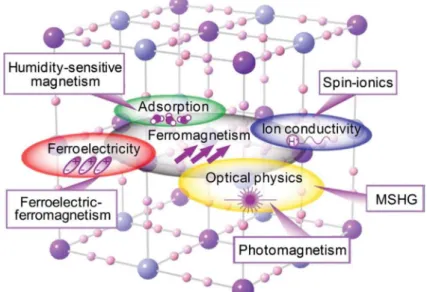
Potential applications (Figure 1-8) range from information storage, medical imaging, data recording, or spintronics. They make use of charge-transfer phase transition, reversible photo-magnetism, second harmonic generation, ferroelectric ferromagnetism (in some special cases when a tetragonal phase transition is observed), humidity-sensitive magnetism, high ionic conductivity, and magnetic switching behaviors.45-47, 50-51, 55-65
- 12 -
1.2.3 Magnetic Properties in PB and PBAs
1.2.3.1 Magnetic Coupling in PB and PBAs
Prussian blue is a ferromagnet with Curie temperature TC = 5.6 K39 with ferromagnetic exchange
coupling between FeIII(HS, S=5/2) ions that are separated by around 10 Å. The presence of an
inter-valence band located at 700 nm gives to PB its intense blue color. The inter-inter-valence band is caused by an optically activated electron transfer from FeII(LS) to FeIII(HS).66-67 The intrinsically mixed
valence of PB induces the ferromagnetic coupling as well the intense blue color.
On the other hand, the separation distance between two metal ions in a unit of PBAs is 5 Å since the metal ion that is 6-fold coordinated to cyanides is also paramagnetic. As a consequence, single electrons of metal ions can interact each other directly via the cyanide bridge yielding a much stronger exchange coupling. This magnetic coupling is dominated by the electrostatic interaction between the unpaired electrons. Depending on the relations of orthogonality between the orbital part of the unpaired electrons, one observes antiferromagnetic or ferromagnetic coupling. When the orbital part of the unpaired electrons are orthogonal, one generally observes ferromagnetic coupling. When they are not orthogonal, one generally observes antiferromagnetic coupling. The general magnetic coupling is shown as below Figure 1-9.
CrIII-MnII CrIII-NiII CrIII-VII
Figure 1-9. Contribution of the different exchange pathways to the overall exchange interaction: t2g/t2g, JAF and
t2g/eg, JF.
In summary, PBAs, may have ferro- or ferrimagnetic ordering with Curie temperature (Tc) ranging between 66 and 315 K.41 The magnetic nature (ferro- or ferri-) of the order depends on the nature of
the divalent magnetic ions; VII, CrII and MnII leads to a ferrimagnetic order while for FeII it depends
on the trivalent ion (FeIII or CrIII).41, 59-60, 68-69
1.2.3.2 Prussian Blue Analogues at the Nanoscale
The first research focusing on PBA NPs was reported by Yamada et al. (1997 solid)70 and Moulik
- 13 -
PBA CsNiIICrIII nanoparticles. Previous work by Catala et al. have reported the synthesis and the
magnetic behavior of nanoparticles of the CsNiIICrIII network.55, 72-81 This network was already
studied by Gadet et al. and found to behave as a ferromagnet with TC = 90 K.68 The nanocrystals are
obtained by the reaction of [Ni(H2O)]2+ with freshly prepared Cs2K[Cs(CN)6] in concentrated
aqueous solution with the molar ratio of 1/1. The nucleation and growth processes of the particles are affected dramatically by the molar ratio between the two precursors.55, 72-73 NPs with different sizes
can be obtained by different molar ratio : 1) when CrIII/NiII = 2/3 in water, large particles can form
within several minutes and finally precipitate; 2) when CrIII/NiII = 1/1, the NPs have smaller sizes,
lower than 15 nm. The 6-nm particles are obtained by including Cs in the tetrahedral sites of the cubic network.
The 6nm-sized CsNiIICrIII NPs have been initially studied as powders diluted in PVP (Polyvinyl
Pyrrolidone) or coated with CTA cations (Cetyltrimethyllammonium),72-74,76 The NPs present
superparamagnetic properties with blocking temperature TB = 9 K. Studies of CsNiIICrIII NPs reported
size effects of NPs78, core-shell NPs77-81, different effects of surfactants55, 73, dipolar interactions82. In
the core-shell NPs of CsNiIICrIII, the anisotropies in magnetism and structure are given in a detailed
study by Prado et al. who investigated the dipolar interaction and surface effects.77-81
Figure 1-10. Structure of NanoRbCoFe before and after irradiation. Typical irradiation conditions are as follows: 10 K, λ = 635 nm, PW = 50 mW·cm–2, 30 min.83
PBA CoII-FeIII Nanoparticles. CoFe PBA are fascinating because their mixed valence behavior. Two
stable states can be present at low temperature namely CoIIFeIII and CoIIIFeII. Because Fe is in carbon
cavity, it is always in the low spin state. Co is known to be low spin in the oxidation degree III, so that the CoIIIFeII phase is diamagnetic, while the CoIIFeIII is paramagnetic at high temperature and
ferrimagnetic below 21 K.45-46, 61 Because the magnetic behavior and the electron transfer may be
affected by structural distortion, it is important to have information on the structural nature of the surface when nanoparticles are studied. Bleuzen et al. studied a series of nanoparticles of CoFe PBA
- 14 -
compounds in different states45-46,61,69,84-86 and demonstrated thanks to X-ray Absorption
Spectroscopy that the surface and the core of the objects possess different structures forming a kind of core-shell heterostructure as depicted in Figure 1-10.86
1.3 Spin Crossover Compounds
The spin crossover (SCO) phenomenon may occur in molecular complexes, where high spin (HS) and low spin (LS) states are allowed from the electronic configuration of the complex, which correspond to the d4, d5, d6 and d7 configurations of the metal ion.87-93 Experimentally, FeII (d6) metal
ions in octahedral geometry are dominating so that the discussion will focus on this type of complexes.87, 91, 94-96
1.3.1 Ligand Field Considerations
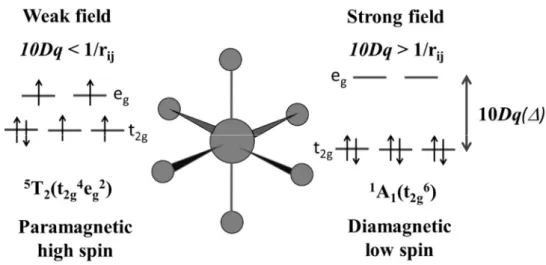
Considering a simple ligand field approach, FeII containing octahedral complexes may have two
electronic configurations namely t2g6eg0 and t2g4eg2 that correspond to the LS and HS states
respectively. Depending on the relative magnitude of the spin pairing energy (P) that depends on the electronic repulsion (1/rij) and the ligand field parameter 10Dq (), such complexes may be in the
high or the low states (Figure 1-11).27, 97 When the two energies are close, some complexes may
undergo a spin crossover between the LS to the HS state thermally upon heating up or by light illumination providing the temperature is below a given value (Light-induced Spin State Trapping; LIESST see Figure 1-12).87, 94, 98-100 Related Tanabe-Sugano diagrams are shown in Figure I-1 in
Appendix I.101
Figure 1-11. The electronic configuration of two possible ground states for Fe(II) in an octahedral compound. Copyright from@2004 Springer-Verlag Berlin Heidelberg.97
More generally, spin crossover systems may be addressed by different external stimuli such as temperature, light irradiation, pressure, magnetic field and electric field).27, 84, 102-106
- 15 -
Figure 1-12. Schematic potential surfaces of low-lying ligand field states for a d6 spin-crossover complex. The
arrows indicate the mechanism for L1ESST (𝐿𝑆 → 𝐻𝑆 ) and reverse LIESST (𝐿𝑆 ← 𝐻𝑆). It described when introducing green light(=514.5nm) induces the LS states converting into the metastable HS states; while as the introduction of red light (=820nm) the stable HS states are converted into metastable LS states.102
1.3.2 Thermal Driven SCO Mechanism
Figure 1-13. (a)The thermal spin transition curve of the fraction of high spin (HS) state vs temperature (T/K). (b)Adiabatic potentials for the high-spin and the low-spin state along the most important reaction coordinate for spin crossover, namely the totally symmetric metal-ligand stretch vibration denoted r(Fe-L).97 Note: in the figure
of 1-13(a) the insets are corresponding to the three complete cases of potential surfaces for HS state and LS state. Thermal energy difference between HS state and LS state is denoted as (HL), the Gibbs free energy between two states. When (HL)>0, it is LS dominate and at the low LT it is mainly LS; (HL)=0 means the fraction of HS state and the one of LS state both are 50% by varying temperatures; (HL)<0, HS state predominates along with heating and up to 100% as the temperature is heat to a relatively high. And the fraction of HS (HS) and the fraction of LS(LS) are conformed to a linear combination, that is, HS+LS=100%.
- 16 -
The spin crossover is governed by the difference of the Gibbs free energy (G) between the two electronic states.
𝐺(𝑇, 𝑃) = 𝐻 − 𝑇𝑆 (1 − 3) 𝐺(𝑇, 𝑃) = 𝐻 − 𝑇𝑆 (1 − 4) 𝐺(𝑇, 𝑃) = 𝐻 − 𝑇𝑆 (1 − 5) ∆𝐺 (𝑇) = 𝐺(𝑇, 𝑃) − 𝐺(𝑇, 𝑃) = ∆𝐻 − 𝑇∆𝑆 (1 − 6)
At equilibrium, ∆𝐺 (𝑇) = 0, and the transition temperature is defined as T1/2 = . In such a case, because of the
larger entropy energy of the HS state (electronic state 5T
2g) compared to the LS state (1A1g) and the larger enthalpy
energy of the LS state, the HS state has lower energy at high temperature, while the reverse occurs at low temperature as depicted in Figure 1-13.
1.3.3 Cooperativity
The spin crossover for a single molecule or for an assembly of non-interacting molecules correspond to a smooth conversion form one state to another. For such a case, no genuine bistability is present. This is observed in solution or in the solid state when the SCO complexes are well isolated. However, when molecules are interacting (H-bonds, 𝜋 − 𝜋 stacking, electrostatically, etc…)27, the crossover
may become abrupt and may in some cases lead the presence of a thermal hysteresis loop as depicted in Figure 1-14.94, 104 Taking into account this phenomenon, it is possible to introduce a new term (𝛤)
in the expression of the Gibbs free energy which involves the interaction among the molecules. As Figure 1-13 shown, this SCO behavior is interpreted by the thermal force and expressed as follows: ∆𝐺 = (1 − 𝛾 )𝐺 + 𝑟𝛾 𝐺 + 𝛤 − T∆𝑆 , (1 − 7) with
𝛤 = 𝛬𝛾 (𝛾 ) = 𝛬𝛾 (1 − 𝛾 ) , (1 − 8) and
∆𝑆 = −𝑅[𝛾 ln(𝛾 ) + (1 − 𝛾 ) ln(1 − 𝛾 )] . (1 − 9)
Figure 1-14. Principal types of spin transition curves in terms of the molar fraction of HS state (HS: y axis) vs temperature (T: x axis): a) gradual; b) abrupt; c) with hysteresis. (Reproduced with permission from reference of Philippe Gutlich et.al. 94, 104 (Copyright 2003 Wiley-VCH Verlag GmbH & Co. KGaA).
- 17 -
In e.q.(1-8), the parameter is used to describe the degree of the interplay interaction between LS and HS state.26 If is negative (< 0), LS-HS pair is more stable than the average of LS-LS and
HS-HS pairs, Hmix is also negative (since -TSmix is always negative), thus it is always possible to
have a mixture of LS and HS state. If is zero, it means that the state of one molecule in a crystal is independent upon the state of the neighbouring molecues. If is positive (> 0), LS-HS pair is less stable than the average of LS-LS and HS-HS pairs, then there exists a competition between the entropy and enthalpy terms. In e.q.(1-9), ∆𝑆 expresses an additional entropy due to entropy difference between molecules that have the spin state, on one hand, and molecules that have different spin states when they are close in the mixture. This allows deriving an expression of the transition temperature that depends on the interaction parameter 𝛬.26 Such relationship between T
C and 𝛬 is
depicted as e.q.(1-10):
𝑇 = ∆𝐻 + 𝛬(1 − 2𝛾 )
𝑅𝑙𝑛 1 − 𝛾𝛾 + ∆𝑆
. (1 − 10)
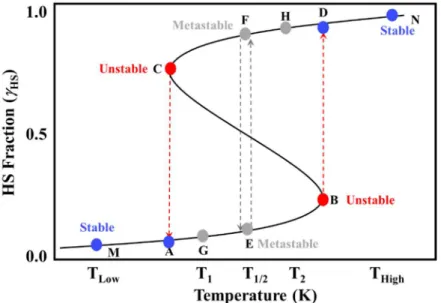
It is possible to show that when < 2RTC (no cooperativity), the inter-molecular interaction is very
weak and the transition curve is smooth without hysteresis; when = 2RTC, the cooperativity is
strong and the spin transition is abrupt, but no hysteresis loop is observed and when > 2RTC, a
hysteresis loop is present as illustrated in Figure 1-15.
Figure 1-15. The fraction of high spin (HS) as a function of temperature for a strongly cooperation system (G > 2 RT ≈5000 cm). From low temperature (TLow) to T1/2 the lower branch of LS is more stable, while from T1/2
to high temperature (THigh) the upper branch of HS is more stable. Red dotted arrows: route without demixing; grey
dotted arrows: route with demixing. At T1/2, it means that the gibbs energy of system G is equavilent to zero (G
= 0), and system can stay at two different spin states with the same energy (seeing the section of 1.3.2).
One of the challenges in this area is to investigate the behavior of a small assembly of molecules in order to build devices for information processing using their bistability or their ability to switch from one to state to another by an electric field or/and by light. The group of Wolfang Kuch in Berlin has
- 18 -
made a series of pronounced investigations of SCO complexes assembled on HOPG using X-ray Absorption Spectroscopy (XAS).107-112 It is worth noting XAS is among the rare techniques that
allows investigating a submonolayer of molecules, particularly, as we will see below, the L2,3 of Fe
is very sensitive to change of the spin state. In 2012, the XAS studies demonstrated that a submonolayer of the Fe(phen)2(NCS)2 complex (where phen is o-phenantroline) displayed a
thermally reversible SCO behavior when assembled on HOPG directly (Figure 1-16).107 In 2013, W.
Kuch and his colleagues studied the different SCO behaviors as a function of the number of layers, one single layer and multilayers of the iron (II) compounds [Fe(bpz)2(phen)] on Au(111) by a
combinational study using STM and NEXAFS (Near-Edge X-rays Absorption Fine Structure).108 In
2015 they discovered a highly thermal and light induced SCO phenomena of [Fe(bpz)2phen] on
HOPG, which was investigated by a comparative study with the effect of light, temperature and X-rays (Figure 1-17).109
B. Warner et al.113-114 studied [Fe(H
2B(pz)2)2(2,2’-bipy)] molecules on Au(111) using two different
systems: (i) [Fe(H2B(pz)2)2(2,2’-bipy)] molecules evaporated as submonolayer and
(ii) [Fe(H2B(pz)2)2(2,2’-bipy)] molecules deposited as submonolayer and bilayers. These two studies
reveals clearly that the thickness of Fe[(H2B(pz)2)2(2,2’-bipy)] molecules influenced the surface
sensitivity towards the substrate. The general SCO behaviors of [Fe(H2B(pz)2)2(2,2’-bipy)] molecules
assembled as submonolayer is illustrated as Figure 1-18(a). Besides, Bairagi et al.115-116 studied
another Fe(II) SCO complex (Fe[HB(3,5-(Me2)(pz)3)2]) assembled as monolayers on gold and
demonstrated the presence of a complete thermal spin crossover and efficient LIESST effect shown in Figure 1-18(b). Light effect induced an incomplete spin transition between HS and LS state.
Figure 1-16. XAS spectra at L3 edge of Fe(II) sites for submonolayer Fe[(phen)2(NCS)2] deposited on HOPG
- 19 -
Figure 1-17. (a) Temperature-dependent Fe L2,3 X-ray absorption spectra of 0.4 ML of [Fe(bpz)2phen] on HOPG.
Spectra before and after illuminating the sample with green light at T = 6 K are shown in blue and green, respectively and (b) Fraction of HS molecules as a function of temperature during cooling the sample without illuminations (black solid symbols) and after saturation of the light-induced HS state during heating the sample (green solid symbols), reproduced with permission from ref 117.117
Figure 1-18. (a)HS fraction vs temperature for [Fe(H2B(pz)2)2(2,2’-bipy)] evaporated as submonolayer on
Au(111).113 All values of HS fraction are derived from the linear interpolation of the XAS spectra for the bulk
compound before (filled black squares) and after illumination (empty black squares) and the 300 nm thick film before (filled blue triangles) and after illumination (empty blue triangles) compared to the magnetometric results on the bulk compound before (full line) and after illumination (red dotted line). (b) HS fraction vs temperature for Fe[HB(3,5-(Me2)(pz)3)2] assembled as monolayer on Au(111).115 HS fraction as a function of temperature as
cooling down the sample from 300 to 4.4 K(red down triangles), exposing it with the illumination of soft X-ray (eight green points) and blue light(three blue square), and warming it up to 250 K (labled as black up triangles).
- 20 -
1.4 Objectives of the Present Work
The objective of this thesis is to investigate the electronic and magnetic properties of molecular materials assembled on metallic surfaces. Two main challenges are addressed.
The first one is the study of the relationship between magnetic and electronic anisotropy of coordination nanoparticles based on the Prussian blue analogs and establish the role played by surface of the particles on the local magnetic anisotropy and on anisotropy of a single monolayer. Indeed, the surface of 6 nm nanoparticle contribute to 40% to its overall volume and any structural anisotropy may induce an electronic anisotropy and, hence, also magnetic in the presence of a magnetic field. The second challenge is the investigation of the switching behavior of spin crossover complexes at the nanoscale and, in particular, when assembled as organized islands on metallic surfaces. SCO molecular materials have been studied for decades in the solid state and the mechanism of the switching phenomena established as being mainly due to elastic interaction among the molecules. The magnitude of this long-range interaction may lead to large cooperativity resulting in bistability behavior. When the size of the grain is decreased and obviously when dealing with an island of a single layer, the elastic interaction is confined which may lead to a disappearance of bistability. The present work aims at (partially) addressing this question. SCO materials, also, display a LIESST effect at low temperature that transforms LS to HS. We, therefore, also investigate the effect of light on a submonolayer of SCO molecules. And finally, because we are dealing with a submonolayer, the nature of the substrate and the substrate/molecules interface may play a major role in the switching behavior either when the stimulus is light or a change of temperature.
Because we are dealing with submonolayer s of molecular materials assembled on surfaces, we use X-rays Absorption Spectroscopy (XAS) at the L2,3 edges of metal ions that is extremely sensitive to
small amount of matter. XAS at the L2,3 edges using total electron yield detection technique is
extremely sensitive to the change in the electronic structure and is, therefore, perfectly adapted to SCO systems. X-ray Magnetic Circular Dichroism (XMCD) allows qualitatively measuring the magnetic moment of a submonolayer of magnetic objects, while X-ray Natural Linear Dichroism (XNLD) may give information of the anisotropy of the electronic distribution in the coordination sphere of a metal ion. It, therefore, allows us 1) to determine the orientation of the objects on a substrate and 2) have information on nature of the local distortion of the coordination sphere that together with XMCD give information on the magnetic anisotropy. Since XAS gives qualitative information, the analysis of the data quantitatively cannot be conducted without the help of calculations. We use Ligand Field Mutiplet (LFM) calculations to calibrate the experimental data for XAS, XMCD and XNLD. This allows us to determine the high to low spin ratio of the SCO molecules and the magnetization of the magnetic nanoparticles. For the last case, the sum rule must also be used.
- 21 -
References
1. Getzlaff, M., Fundamentals of magnetism. Springer Science & Business Media: 2007.
2. Fowler, M., Historical beginnings of theories of electricity and magnetism. Recuperado el 1997, 23 (5), 2012.
3. Dill, J. G., Lodestone and needle: the rise of the magnetic compass. Ocean Navigator 2003, 1. 4. Bullard, E. C., The magnetic field within the Earth. Proceedings of the Royal Society of London. Series A. Mathematical and Physical Sciences 1949, 197 (1051), 433-453.
5. Ronan, C. A.; Needham, J., The Shorter'Science and Civilisation in China'. Cambridge University Press Cambridge: 1978; Vol. 1.
6. Papaefthymiou, G. C., Nanoparticle magnetism. Nano Today 2009, 4 (5), 438-447. 7. Kahn, O., Molecular magnetism. VCH Publishers, Inc.(USA), 1993 1993, 393.
8. Kahn, O.; Martinez, C. J., Spin-transition polymers: From molecular materials toward memory devices. Science 1998, 279 (5347), 44-48.
9. Caneschi, A.; Gatteschi, D.; Sessoli, R.; Barra, A. L.; Brunel, L. C.; Guillot, M., Alternating current susceptibility, high field magnetization, and millimeter band EPR evidence for a ground S= 10 state in [Mn12O12 (Ch3COO) 16 (H2O) 4]. 2CH3COOH. 4H2O. Journal of the American Chemical Society 1991, 113 (15), 5873-5874.
10. Sessoli, R.; Tsai, H. L.; Schake, A. R.; Wang, S.; Vincent, J. B.; Folting, K.; Gatteschi, D.; Christou, G.; Hendrickson, D. N., High-spin molecules:[Mn12O12 (O2CR) 16 (H2O) 4]. Journal of the American Chemical Society 1993, 115 (5), 1804-1816.
11. Sessoli, R.; Gatteschi, D.; Caneschi, A.; Novak, M., Magnetic bistability in a metal-ion cluster. Nature 1993, 365 (6442), 141.
12. Heinze, S.; Bode, M.; Kubetzka, A.; Pietzsch, O.; Nie, X.; Blügel, S.; Wiesendanger, R., Real-space imaging of two-dimensional antiferromagnetism on the atomic scale. Science 2000, 288 (5472), 1805-1808. 13. Leuenberger, M. N.; Loss, D., Quantum computing in molecular magnets. Nature 2001, 410 (6830), 789.
14. Zhao, A.; Li, Q.; Chen, L.; Xiang, H.; Wang, W.; Pan, S.; Wang, B.; Xiao, X.; Yang, J.; Hou, J., Controlling the Kondo effect of an adsorbed magnetic ion through its chemical bonding. Science 2005, 309 (5740), 1542-1544.
15. Gatteschi, D.; Sessoli, R.; Villain, J., Molecular nanomagnets. Oxford University Press on Demand: 2006; Vol. 5.
16. Hirjibehedin, C. F.; Lutz, C. P.; Heinrich, A. J., Spin coupling in engineered atomic structures. Science 2006, 312 (5776), 1021-1024.
17. Bogani, L.; Wernsdorfer, W., Molecular spintronics using single-molecule magnets. Nature Materials 2008, 7 (3), 179-186.
18. Friedman, J. R.; Sarachik, M.; Tejada, J.; Ziolo, R., Macroscopic measurement of resonant magnetization tunneling in high-spin molecules. Physical review letters 1996, 76 (20), 3830.
19. Thomas, L.; Lionti, F.; Ballou, R.; Gatteschi, D.; Sessoli, R.; Barbara, B., Macroscopic quantum tunnelling of magnetization in a single crystal of nanomagnets. Nature 1996, 383 (6596), 145.
20. Kim, G.-H.; Kim, T.-S., Electronic transport in single-molecule magnets on metallic surfaces. Physical review letters 2004, 92 (13), 137203.
21. Rocha, A. R.; Garcia-Suarez, V. M.; Bailey, S. W.; Lambert, C. J.; Ferrer, J.; Sanvito, S., Towards molecular spintronics. Nat Mater 2005, 4 (4), 335-9.
22. Mannini, M.; Pineider, F.; Sainctavit, P.; Joly, L.; Fraile‐Rodríguez, A.; Arrio, M. A.; Cartier dit Moulin, C.; Wernsdorfer, W.; Cornia, A.; Gatteschi, D., X‐ray magnetic circular dichroism picks out single‐molecule magnets suitable for nanodevices. Advanced Materials 2009, 21 (2), 167-171.
23. Mannini, M.; Pineider, F.; Danieli, C.; Totti, F.; Sorace, L.; Sainctavit, P.; Arrio, M.-A.; Otero, E.; Joly, L.; Cezar, J. C., Quantum tunnelling of the magnetization in a monolayer of oriented single-molecule magnets.



![Figure 1-16. XAS spectra at L 3 edge of Fe(II) sites for submonolayer Fe[(phen) 2 (NCS) 2 ] deposited on HOPG varying temperatures](https://thumb-eu.123doks.com/thumbv2/123doknet/14657154.738843/31.892.253.640.739.1124/figure-spectra-sites-submonolayer-deposited-hopg-varying-temperatures.webp)