HAL Id: hal-01966868
https://hal-amu.archives-ouvertes.fr/hal-01966868
Submitted on 30 Dec 2018
HAL is a multi-disciplinary open access
archive for the deposit and dissemination of
sci-entific research documents, whether they are
pub-lished or not. The documents may come from
teaching and research institutions in France or
abroad, or from public or private research centers.
L’archive ouverte pluridisciplinaire HAL, est
destinée au dépôt et à la diffusion de documents
scientifiques de niveau recherche, publiés ou non,
émanant des établissements d’enseignement et de
recherche français ou étrangers, des laboratoires
publics ou privés.
Simulation Model of a SiC Power MOSFET Variables
Estimation and Control of a Power Source
E Baghaz, N. M’Sirdi, K Frifita, A Naamane, M Boussak
To cite this version:
E Baghaz, N. M’Sirdi, K Frifita, A Naamane, M Boussak. Simulation Model of a SiC Power MOSFET
Variables Estimation and Control of a Power Source. ICINCO 2017- International Conference on
Infor-matics in Control, Automation and Robotics, Jul 2017, madrid, Spain. �10.5220/0006460806370643�.
�hal-01966868�
Simulation Model of a SiC Power MOSFET
Variables Estimation and Control of a Power Source
E. Baghaz, N.K. M’Sirdi, K. Frifita, A. Naamane and M. Boussak
Aix Marseille Universit´e, CNRS, ENSAM, Universit´e de Toulon, LSIS UMR 7296, 13397, Marseille France LSIS UMR 7296 and HyRES Lab, RMEI
Keywords: Electro-thermal Model, boost DC/DC converter, Power source, SiC MOSFET Behavior, Estimation and control
Abstract: An electro-thermal model of a power SiC MOSFET is proposed. The thermal model, is coupled with the physical model through the interaction between the transistor power loss and the junction temperature. For validation of this model, the simulation curves are compared to the manufacturer’s experimental curves. As first application, a boost DC/DC converter is considered. An observer is proposed to estimate the MOSFET voltage VDS, the power and the junction temperature. These estimates are used to control the converter. The proposed model and estimator give sufficiently good temperature and power estimation. The Power source obtained using DC/DC converter is efficient, allowing the power loss reduction and robust.
1
INTRODUCTION
SiC MOSFET devices have a wide operation ranges in voltage, current and temperatures, then the knowledge of their characteristics and disposal of a good model become necessary . As wide as is the model validity domain, more and more high can be the control precision to achieve a high efficiency (Maxim and Maxim, 1999; Pushpakaran et al., 2015). A simple analytical PSpice model for SiCMOSFET have been proposed for high power modules in (Jo-hannesson and Nawaz, 2016). In this paper we are in-terested by the SiC MOSFET C2M0025120D CREE (1200V, 90A), when operating at very high frequen-cies.
The MOSFET device characteristics can be ex-tracted from manufacturer’s experimental curves (data sheets). Simulations are very important in elec-tric systems design as well as for mechatronics case study. Prototyping is necessary for the optimization of power electronic circuits. To get realistic simula-tions and accurate results, we need good and precise models for an operating domain as wide as possible (Leonardi et al., 1997).
The models proposed in the well known simu-lation softwares like Psim, Pspice, LMS AMESIM, Saber and other are often limited in their precision, field of application or complexity. The most of them are piece-wise linear. They are very, often valid only in a restricted area and must be completed us-ing the components Data Sheet. To get reliable
re-sults based on simulations, we need accurate models, with acceptable precision.The precision of these mod-els are very often limited to some operational points or region. The devices may be, in some applica-tions, used in very wide operation ranges (Bejoy et al., 2015a)(Bejoy et al., 2015b).
In this paper, we propose an electro-thermal be-havior model of a Silicon Carbide MOSFET (SiC). The electrical behavior sub-model is based on the well known EKV MOSFET Model (see (Enz et al., 1987)). Then a thermal dissipation model, expressed like Resistance-Capacitance (RC) Foster network, is coupled to the electrical model. The lost power con-tributes to the heating of the MOSFET internal junc-tion. The heat transfer is described by a Foster elec-trical equivalent network.
For validation of this model, the simulation curves are compared to the manufacturer’s experimental data (curves of data sheets).
The efficiency of the PhotoVoltaic (PV) system, obtained using this DC/DC converter and the pro-posed control, is robust against temperature varia-tion. When Temperature varies from 25°C to 150°C, the PV system efficiency is reduced globally by only 4%.The SiC MOSFET power loss is analyzed to re-duce its effect on the PV source efficiency.
2.1
System description
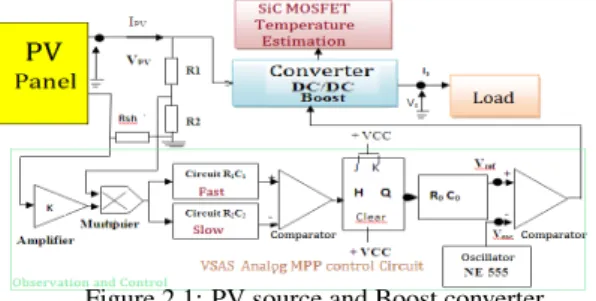
As a first application using this SiC MOSFET model, we consider an energy source (PV panel) connected trough a boost DC/DC converter driven by an analog MPPT based control, with as load a 50Ω resistance. This device is used to control a PV panel (PV S75), see figure (2.1). The proposed control system is ana-log to avoid the use of a computer based architecture.
Figure 2.1: PV source and Boost converter
We have developed an analog circuit which esti-mates, on the fly, the needed MOSFET voltage, the power dissipated and the Junction temperature.
2.2
DC/DC conversion with a SiC
MOSFET
In DC/DC converters, the most important power loss is due to the ON and OFF switching transition. The losses are proportional to the switching frequency and the values of the parasitic capacitances of power MOSFET component. So the characteristics ot the SiC MOSFET used for commutation are of main im-portance (Time of response, Rdson,. . . ).
The efficiency of the PV system depends on the used power converter and the control robust-ness against temperature variations and perturbations. When Temperature varies form 25°C to 150°C, the PV system efficiency is reduced and the system char-acteristics are perturbed.
This led us to choose a recently proposed SiC MOSFET which can operate under high frequen-cies and temperature condition. The SiC MOSFET, C2M0025120D, proposed by CREE is studied and used in a PV system (Figure 2.1 and 2.2) which is composed by:
- PV panel SP75 which can generate a voltage VPV=13V a current IPV=4.2A and a power PPV=55W
- DC/DC Boost using the SiC MOSFET proposed by CREE: C2M0025120D, operating at a control fre-quency f=10kHz (Figure 2.2),
- a Schottky diode C3D04060,
- an analog circuit used to estimate the MOSFET junction temperature, as proposed in this paper, - an analog circuit proposed for the MPPT control, - The system load is resistance RL=50Ω.
Figure 2.2: DC/DC Boost Converter
Figure 3.1: Model of a SiC MOSFET
3
DYNAMIC MODEL
The model is developed for the SiC MOSFET and is included to PSpice simulation software library. The electrothermal behavior of SiC MOSFET is analyzed, modeled and simulated under PSpice software.
3.1
SiC MOSFET component model
In a DC/DC converter the most important component is the MOSFET which is subject to the perturbations and thermal effect. Switching transition at high fre-quency (to control the input and output signals) lead to power dissipation and heating of the system. Ther-mal flux propagation will then impact the circuit be-haviour. This is mainly due to the signals distortions (PWM) and parasitic impedance. A good behavior model is needed to describe the MOSFET dynamics. 3.1.1 SiC MOSFET Electric Model
In figure 3.1, we present the model we have developed for and implemented under Pspice, to simulate the the SiC MOSFET C2M0025120D proposed by CREE. Note that this model is more precise, with regard to the LTspice model proposed by the manufacturer CREE (Bejoy et al., 2015b) (Bejoy et al., 2015a), as it is composed by 2 switched current sources.
In addition it takes into account package parasitic inductances (LG, LD, LS) connected to the gate, drain,
source and resistances (RG, RDSon). The inductances
and resistances allow description of power losses in commutations. The resistance RG describes the Gate
power losses in high frequencies operation.
α and n define the triode r´egion and λ is the length of the MOSFET conduction channel. The gate thresh-old voltage is noted Vth.
The output current IDS= IG1 - IG2 (Enz et al.,
1987).The MOSFET equations (VDS, IDS, Rdson,
VGS. . . ) are the following
IDS= IG1(Vp−Vs) − IG2(Vp−VD) (1)
IG1= IS∗ (Ln(1 + exp
Vp−Vs
2UT
IG2= IS∗ (Ln(1 + exp
Vp−VD
2UT
))2 (3) Where VS, VG, VD are the source, gate and drain
voltages of the MOSFET, respectively. Vp=(V G−UKs T)
is the pinch-off voltage and Is = 2 ∗U2
T∗ Ks∗ gmis the
specific current (gm is a trans-conductance and Ks a
slope factor). The model equations are in function of the MOSFET junction temperature. UTis the
thermo-dynamic voltage. 3.1.2 Thermal Model
To describe the thermal behavior, expressing that the power losses are dissipated heating the MOSFET junction which has thermal exchanges with the case and the component environment, we consider a Fos-ter’s RC network. We use 14 RC cells to describe the thermal coupling. The junction and case temperatures Tj and TCare related through the thermal impedance
ZT Hand depend on the power losses PPerte(see figure
3.2). Tj= TC+ PPerte∗ ZT H zT H= 14
∑
i=1 Ri∗ (1 − expR−tiCi) (4)Figure 3.2: Thermal propagation model
3.2
Simulations and Model Validation
The developed model has been implemented in Saber, Pspice, Psim and Matlab softwares and compared to the experimental curves presented by the SiC MOS-FET data sheet for its validation (Mudholkar et al., 2015). The figure3.3compares the Drain-Source cur-rent (Ids) versus the MOSFET output voltage (VDS) for
several Gate-Source voltages (Vgs) under a
tempera-ture of 25°C. Simulation results (continuous lines) are in good aeement with the data sheet values (bars).
Figure 3.3: IDSand VDSfor different VGS
- For VGS values less than 4V, the MOSFET is
not controlled because the threshold voltage Vthis not
reached. When the MOSFET start operation VGS>
Vth> 4V , and then the current IDSincreases gradually
with VGS. The results are in good agreement.
Figure 3.4: Variation of Rdsonversus the temperature Tj
Figure 4.1: Rdsonin function of the temperature Tj
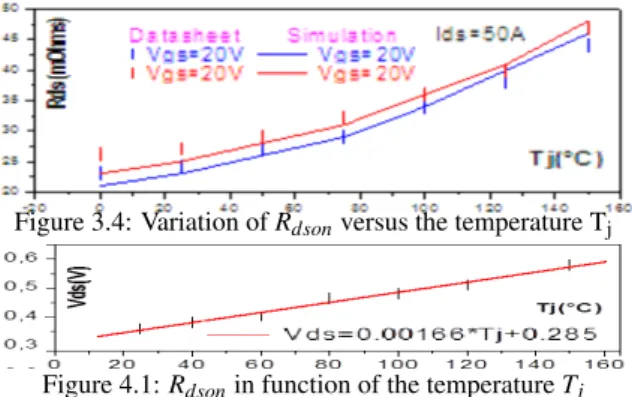
The figure 3.4 shows the simulated and the ac-tual Drain-Source resistance (Rdson) in function of the temperature variation for a current equal to IDS=50A
and voltage VGS=20V. The obtained curves are very
close in a wide temperature range (up to T=150°C). In conclusion, the proposed electrothermal model is very accurate and able to describe the dynamic be-havior of the SiC MOSFET with a very good preci-sion.
4
ESTIMATION AND CONTROL
4.1
Observer for variables estimation
As seen in figure 3.5 the variation of the resistance RDSonin function of the temperature Tjcan be
approx-imated by the following equation:
RDSon(Tj) = RDSon(300°K)(1 +100α )(Tj−300)
VDS= ζ.(RDSon(Tj)).ID
(5)
Let us introduce the variable ζ to account for the variable structure feature of the system. ζ = 0 means that the MOSFET is off and ζ = 1 means that it is on. The junction temperature Tjgrows with the MOSFET
output voltage VDSand power losses. In the figure 4.1,
we note that the relation between VDSand Tjis almost
linear.
For parameters estimation and variables observa-tion we can consider a first order (linear) regression model, during the period where the MOSFET is on. The solid line (in red) of the figure ?? confirms, from the simulations and data sheet experiments, the good precision of this approximation. Thus we cant write.
VDS= A ∗ Tj+ B (6)
From the simulation result of figure 4.1, we can deduce by estimation that A = 0.001666 and B = 0.285 and then we can consider to estimate the junc-tion temperature in average by Tj=< (VDS− B)/A>.
Figure 4.2: Estimation of the state Variables
4.1.1 Estimation of Electric variables
The subsystem model is obvious if we take P = V.I as output and the current and voltage as inputs. Let us consider the estimations of the PV panel voltage ˆVPV
and current ˆIpv. These estimations are implemented in
the circuit of figure (2.1). The small shunt resistor Rsh
gives us an image of the current by the voltage Vrand
an image of the PV voltage is produced by the bridge of resistances R1and R2.
Vr= a1. ˆIκv= Ipv∗ Rsh
Vp= a2. ˆVPV=R1R+R2 2∗VpV
(7) The estimation of the instantaneous PV power is needed for the control, at two time instants t1and t2,
in order to estimate its gradient. We can then deduce, using a signal multiplier, the produced PV power by
ˆ
P= ˆVPV. ˆIpv.
It remains now to estimate the power difference between two time instants. This can be done through two different time delays circuits τ1= R1C1and τ2=
R2C2 to get the delayed power estimations ˆP1 and
ˆ
P2and their difference 4P = ˆP1− ˆP2, using a signal
comparison component.
4.1.2 Observer for Temperature Estimation The Drain-Source voltage (VDS) must be estimated
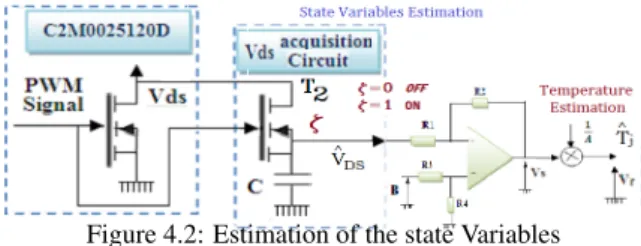
when the MOSFET turns ON (ζ = 1 means that the MOSFET state is ON). To get, in practice, the vari-able ζ which accounst for the MOSFET state we use an additional MOSFET (T2) connected to to Gate and
the Drain of the previous MOSFET. As shown in fig-ure 4.2, T2is controlled by the same PWM signal and
receives the voltage VDS.
Its source is connected to a capacitance C to which it transmits the voltage v = ζ.VDS. Then the MOSFET
T2controls the charge of the capacitance C, under the
voltage VDS(when it is ON ζ = 1 ). When the
capaci-tance is charged, the voltage will reach the value ˆVDS,
as an estimation of the Drain-Source voltage VDS). Its
discharge will be slow as it is connected to an Opera-tional Amplifier, in the other side (when ζ = 0). Then it will keep the estimation ˆVDS.
The next estimations are obviously produced by an inverse-amplifier (defined with the resistances R1, R2, R3and R4) and a signal multiplier to get
Vs= ˆVDS− B and Vf = ˆTj=1AV s= Tj (8)
Then we are able to develop analog estimations of the voltages ˆVPV , and ˆVDS, current ˆIpv, the power ˆP1
at t-τ1and ˆP2at t-τ2and their difference 4P = ˆP1− ˆP2,
with in addition the temperature ˆTj.
4.2
Control Circuit (MPPT)
The behavior of the conversion systems of this kind of renewable energy is VSAS (Variable Structure Au-tomatic Systems) and highly dependent on variations in climate parameters, such as temperature and irra-diation. The MPPT algorithms are expected to maxi-mize, at each time instant, the produced power. Sev-eral techniques have been designed to search this op-timal MPP. In figure 2.1, we propose and analog cir-cuit which produces the MPPT control signal as given by the algorithms developed in our previous work ((M’Sirdi et al., 2014)).
If the PV panel power increases or decreases(∆P ≥ 0 or ∆P ≤ 0), the JK Flip-Flop state changes correspondingly. The flip-flop output Q is used to produce a triangular signal (Vre f as
a reference for commutation) and then the PWM required for the MOSFET control. The reference signal frequency is fixed to 10kHz, by means of the choice of τ0= R0C0the integrator time constant. Vre f
allows to adjust the duty factor.
4.3
Simulation results and discussion
4.3.1 The PV control System simulation
The PV system, described in section 2, plus the esti-mation and control circuits of section 4, are simulated under the physical modeling oriented software Pspice. The irradiation is considered, for the first simu-lation, fixed at 100W /m2 with the temperature Tj=
25°C. The proposed control generates a good PWM signal with as duty factor 0.7. In the same figure 4.3-F1 and F2 show the voltage and current of the PV panel in green (Vpv, Ipv) and the outputs of the DC/DC
converter (Vs, Is).
Figure 4.3: Global PV system electric variables
The PV output voltage is Vpv = 13.36V . The
DC/DC output voltage is Vs=49V>Vpv, and the
The figure 4.3-F3 shows that the PV output power Ppv = 54, 6W (in green) is practically completely
transmitted by the DC/DC converter to the load Ps=
50, 43W (in red). The instantaneous powers (Ppv, Ps)
oscillate in the neighborhood of the Maximum Power Point (F3 and F4). The global PV system has an effi-ciency equal to η = 92% (see figure 4.3-F4). In figure 4.3-F1 (respectively F2) we show the voltages (cur-rents) at converter input DC/DC Boost VPV (IPV in
green) and output Vs (Is in red). Figure 4.3-F4 shows the overall performance of the PV system.
The PWM signal produced by our control MPPT circuit allows us to retrieve the MOSFET state (On/Off) giving a very good estimation of the infor-mation signal ζ. This signal is important for the es-timation of VDS. It allows us to distinguish the
pe-riod where the MOSFET (C2M0025120D) is OFF and when it is ON. When the MOSFET state is ON ζ = 1, the estimated voltage ˆVDS converges to the
MOSFET one VDS. When the state MOSFET is OFF
ζ = 0, the second MOSFET T2 is also OFF (as it re-ceives the same PWM signal). The estimated voltage
ˆ
VDSis kept, more or less, constant by the capacitance
C.
This proves the efficiency of the proposed SASV MPPT control algorithm combined whit the proposed estimation circuits.
4.3.2 Thermal behavior and temperature estimation
Simulations have been done for different values of the studied MOSFET junction temperature going from 25°C up to 110°C. The estimated temperatures are presented in table 1. We can remark than the maxi-mum error is 3°C.
TjMOSFET SiC °C Estimated (°C)
25 25 30 31 40 39 50 47 75 72 100 100 110 112
Table 1: The estimated temperatures
The estimated voltage is VDS=320mV (see figure
4.4-F1 in green), The voltage Vds acquired (in Fig-ure 4.4-F2 in red) equals the average value of actual the voltage Vds of the investigated transistor, during his On state (see figure 4.6-F2 in green), justifying good Vds earned value. The output voltage of the am-plifier of figure 4.2 Subtractor is 40mV order (Figure 4.4-F3), which shows that the constant B in equation 6 equals 280mV. Finally F4 compares the MOSFET
Figure 4.4: Signaux des diff´erents g´en´er´es par diff´erents blocs de circuit de temp´erature
Temperature C2M0025120D Efficiency of PV system
25°C 92% 50°C 90% 75°C 89.93% 100°C 88.9% 125°C 88.5% 150°C 88%
Table 2: Influence of Temperature on efficiency
temperature Tj (in green) to its estimation given by
the thermal model (in red).
The investigated transistor temperature is of the order of 25.45 ° C (Figure 4.6-F4), in other words, the transistor switches under a room temperature, which confirms the good functioning of the overall PV sys-tem. Temperature issued by the circuit developed dur-ing this work is identical with that given by the ther-mal model of the MOSFET in figure 2, with a differ-ence less than 0.2 ° C.
4.3.3 Power losses in the PV system
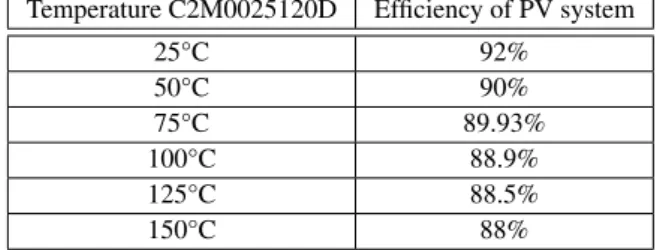
As already mentioned DC/DC power converters suf-fer from loss of power loss due to components heat-ing. In this context, we have studied the influence of the temperature on the MOSFET Characteristics.
The table2 summarizes the results obtained when the junction temperature increases from 25 ° C to 150 ° C. The system performance decreases of 4%. Which shows that the monitoring of the MOSFET temper-ature, in a power converter is necessary to reduce power losses.
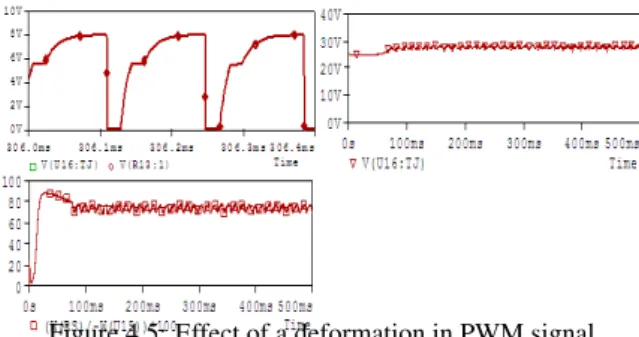
In order to show performance degradations when the MOSFET is poorly controlled (deformation of the PWM signal), we compare the simulation results in figure 4.8 to the normal situation (when the MOSFET is controlled by a PWM signal without deformation Figure 4.3-F1). F1 shows a distorted signal of PWM and F2 the junction temperature.
Note that this study was conducted on the same PV system, under the same climate conditions, namely a 1000W/m² irradiance and a temperature of 25°C. When the MOSFET of the DC/DC Boost con-verter is controlled by a deformed PWM signal (Fig-ure 4.5-F1), its temperat(Fig-ure rises to 30°C (Fig(Fig-ure F2)
instead of 25°C in normal operation case (Figure 4.3 F4). That is to say a temperature increase of 16.66% leads to the overall performance from 92% (during normal operation) down to 73.8% (Figure 4.8-F3). This represents a decline of efficiency of 18.2%.
Figure 4.5: Effect of a deformation in PWM signal
5
CONCLUSIONS
An electro-thermal model of a power SiC MOS-FET is proposed for efficient circuits simulation. This model describes the links of the various physical pa-rameters of the MOSFET (Vds, Ids, Tj...), which clar-ify the electrical and thermal coupling. This allows to get more realistic simulations. To validate the pro-posed model equations and parameters, we have com-pared simulation results with those of datasheet of the MOSFET. It appears that the electro-thermal model has high accuracy even in high temperatures and high voltages.
Then, we have developed a circuit that gives mea-sures and estimates of the system state variables and the junction temperature of the MOSFET. The com-parison of the temperature of the thermal model of the MOSFET with that of the developed estimation circuit shows that there is a good agreement. In or-der to show the good convergence of the estimates, we have used this power componet in a DC/DC Boost converter for adaptation between a PV source and a 50Ω resistive load.
The converter is controlled by an analog MPPT control proven to be efficient, fast and robust. Then we have studied the influence of the temperature on the overall performance of the same PV system. It appears that by varying the temperature of the junc-tion of the transistor from 25 ° C to 150 ° C, the over-all performance of the PV system decreases by 4%. In the same work, we consider also the effect of de-formation on the PWM signal and we show how the system performance degrades.
The PV system with DC/DC converter control is investigated using Pspice. The results show that the proposed model is the most precise compared to all the literature existing models. An analog circuit ob-server is then implemented. The control based on the
observer estimations is also implemented as an analog circuit. This model can be used for simulation of any application using this SiC MOSFET into Pspice soft-ware. The simulation results show that the proposed model is efficient, reliable and show that our electro-thermal model approach and the proposed estimator give good temperature estimation and control.
Acknowledgements
This research is activity is held by the SASV group of the LSIS and funded by the BPI in a FUI projects. Special aknowledgements are addressed to all our project partners.
REFERENCES
Bejoy, N., Pushpakaran, N., Stephen, B., Bayne, B., Wang, G., and Mookken, J. (2015a). Fast and accurate electro-thermal behavioral model of a commercial sic 1200v, 80 mohm power mosfet. IEEE Transactions on Electron Devices.
Bejoy, N., Pushpakaran, N., Stephen, B., Bayne, B., Wang, G., and Mookken, J. (2015b). A simple approach on junction temperature estimation for sic mosfet dy-namic operations within safe operating area. IEEE Transactions on Electron Devices, 12.
Enz, C., Krummenacher, F., and Vittoz, E. (1987). A cmos chopper amplifier. IEEE Journal of Solid-State Cir-cuits, 22.
Johannesson, D. and Nawaz, M. (2016). Analytical pspice model for sic mosfet based high power modules. Mi-croelectronics Journal, 53:167–176. QC 20170410. Leonardi, C., Raciti, A., Frisina, F., , and Letor, R.
(1997). A new pspice power mosfet model with temperature dependent parameters: evaluation of per-formances and comparison with available modelsl. Thirty-Second Conference Record of the 1997 IEEE IAS Annual Meeting, IAS97.
Maxim, A. and Maxim, G. (1999). A high accuracy power mosfet spice behavioral macromodel including the de-vice selfheating and safe operating area simulation. 40th APEC Dallas.
M’Sirdi, N., Nehme, B., Abarkan, M., and Rabbi, A. (2014). The best mppt algorithms by vsas approach for renewable energy sources (res). In EFEA 2014, pages 1–7, Paris France.
Mudholkar, M., Ahmed, S., Ericson, M., Frank, S. S., Brit-ton, C. L., and Mantooth, H. A. (2015). Datasheet driven silicon carbide power mosfet model. IEEE Transactions on Power Electronics.
Pushpakaran, B., Bayne, S., Wang, G., and Mookken, J. (2015). Fast and accurate electro-thermal behavioral model of a commercial sic 1200v 80 mohms. IEEE Pulsed Power Conference (PPC).