UNIVERSITÉ DU QUÉBEC
Research ProposaI Presented to
Université du Québec à Trois-Rivières
As a partial requirement
Masters of Business Administration (MBA)
By
Joyce Atwi
The relationship between customer loyalty and
customer satisfaction among SMEs in the service
sector: The case of a chain of restaurants
Université du Québec à Trois-Rivières
Service de la bibliothèque
Avertissement
L’auteur de ce mémoire ou de cette thèse a autorisé l’Université du Québec
à Trois-Rivières à diffuser, à des fins non lucratives, une copie de son
mémoire ou de sa thèse.
Cette diffusion n’entraîne pas une renonciation de la part de l’auteur à ses
droits de propriété intellectuelle, incluant le droit d’auteur, sur ce mémoire
ou cette thèse. Notamment, la reproduction ou la publication de la totalité
ou d’une partie importante de ce mémoire ou de cette thèse requiert son
autorisation.
To my husband and my son who bared with me ail this time. To my mother who have encouraged me ail the way and still is.
SUMMARY
Our study focuses on the relationship between customer satisfaction and customer loyalty among SMEs in the service sector. We studied a chain of full-service restaurants in the Quebec region.
The respondents were 136. The self-administered questionnaire was placed on the website of the restaurant. It was open for any customer in the Province of Quebec to answer.
We had more women who answered than men. We discovered that the food aspect was so important for the clients in intluencing their returning to the same restaurant and recommending the restaurant to others. We had a high number of satisfied customers. We do not know if only the satisfied customers felt like answering the questionnaire.
We advise the restaurant managers to keep up the good work, focusing on the quality, the taste, the temperature, the presentation of the food on the plate and the smile of the employees.
SUMMARY TABLE OF CONTENTS LIST OF TABLES LIST OF FIGURES ACKNOWLEDGEMENTS INTRODUCTION TABLE OF CONTENTS
CHAPTER 1: THE RESEARCH PROBLEM
1.1 RESEARCH THEME
1.1.1 Marketing Approach of Products versus Services 1.1.2 Three additional Ps for Service Marketing 1.1.3 The Service Business as a System
1.1.4 Three Types of Marketing in Service Industries 1.2 THE GENERAL PROBLEM
1.3 THE PROBLEM ACTORS 1.3.1 The Managerial Question 1.3.2 The Specific Questions 1.3.3 The Managerial Objectives 1.3.4 The Specific Objectives
1.4 THE RESEARCH PERTINENCE AND JUSTIFICATION CHAPTER 2: LITREA TURE REVIEW
2.1 FULL-SERVICE RESTAURANTS AS SME 2.2 THE SME
2.2.1 Origin of SME 2.2.2 SME in Canada
2.2.3 SME versus Franchise in Quebec region 2.3 THE FRANCHlSE, AN SME?
2.4 NOTION OF SA TISF ACTION 2.4.1 Definition
2.4.2 Types of Consumers 2.4.3 The Restaurant Facility 2.4.4 Customer Satisfaction 2.4.5 Service Quality 111 iv vi viii 9 10 12 12 15 17 18 19 20 22 26 27 28 29 29 31 31 33 33 34 36 36 38 38 40 41 42 43
2.5 NOTION OF LOYAL TY 2.5.1 Definition ofLoyalty
CHAPTER 3: CONCEPTUAL FRAMEWORK 3.1 RESEARCH OBJECTIVES
CHAPTER 4: METHODOLOGY CONSIDERED 4.1 TYPE OF STUDY
4.2 SAMPLING 4.3 MEASUREMENT 4.4 DATA COLLECTION
CHAPTER 5: RESUL TS INTERPRETATION 5.1 FACTOR ANALYSIS
5.2 RELIABILITY 5.3 RESEARCH DESIGN 5.4 ETHICS CONSIDERATION
5.5 LIMITS TO THE PRESENT RESEARCH
5.6 RECOMMENDATIONS FOR RESTAURANT-MANAGERS CONCLUSION BIBLIOGRAPHIES APPENDIX A 46 46 51 55 56 56 57 57 58 59 72 87 89 89 91 92 94 96 101
LISTE OF TABLES
Table 1 N umber of establ ishments of restaurants in the Quebec Province Table 2 Total number of Business Locations
Table 3 SME Good sector versus SME.service sector in Canada Table 4 Gender Respondents
Table 5 Age Group
Table 6 Level of Education Table 7 Annual Income
Table 8 Frequency of Going to the Restaurant Table 9 Annual Expenses at the Restaurant Table 10 Monthly Expenses at the Restaurant Table Il Weekly Expenses at the Restaurant
Table 12 Type of Restaurant frequented by the respondents Table 13 Main Areas ofEmployment
Table 14 Relative share of food services in sales Table 15 Reason of Choice
Table 16 Type of Ordering Table 17 Importance of Choice Table 18 Customer's Satisfaction
Table 19 Returning to the restaurant - Behavioral fidelity Table 20 Recommending the restaurant - Attitudinal fidelity
Table 21 Overall satisfaction with respect to the restaurant experience Table 22 Factor Matrixa
Table 23 Rotated Factor Matrixa Table 24 Descriptive Statistics Table 25 Pattern Matrixa
Table 26 Total Variance Explained Table 27 Component Correlation Matrix Table 28 Total Variance Explained
Table 29 Pattern Matrixa Without Waiting Time at the restaurant
14 34 35 59 60 60 61 62 63 63 64 64 65 65 66 66 67 68 70 71 72 74 75 76 77 78 79 8\ 82
Table 30 Component Correlation Matrix 2 Table 31 Factor analysis of Satisfaction
Table 32 Spearman's rho correlation coefficient
83
84
86
LIST OF FIGURES
Figure 1 Four service characteristics Figure 2 The Service Business as a System
Figure 3 Three types of Marketing in Service Industries Figure 4 Interaction between players
Figure 5 The distribution of SMEs by region Figure 6 A GAP model of service quality Figure 7 Exceeding Expectations
Figure 8 Satisfaction Tree Figure 9 Satisfaction outcome Figure 10 Scree Plot
Figure 11 Screen shot of etab
15 18 19
26
35 4549
52 53 79 93ACKNOWLEDGEMENTS
1 would like to name and thank ail the people who have made it be possible for me to continue my graduate studies, complete my research project and achieve my goal.
1 offer my gratitude to Professor Dr. William Menvielle, my research director. 1 had the privilege of being. his student. He has guided me, advised me, shared his expertise and mainly encouraged me when 1 needed encouragement. T am thankful for his guidelines and help for identifying problems. 1 thank Professor Dr. Jocelyn Perreault and Professor Dr. Léonard Dumas for their supporting comments to improve the content of my research project.
Without the inspiration and hard support of my family, ] wouldn't have been able to finalize my research project. 1 would thank my husband who has supported me throughout my research and especially in the data analysis on the SPSS program. 1 would thank my son, Michael (4 years old), who understood that marna wasn't always available to spend time with him. 1 would like to thank my mother, Grace, who has encouraged me since the beginning. It is because of her that 1 have not abandoned my research and she never lost faith in me. 1 would also like to thank my grandmother, 87 years old, who has been very understandable ail the way through my research.
1 would like to thank my best friend, Nancy Francis, for her proofreading. She was always there wh en 1 needed her, even the last minute before handing in my research.
1 cannot but thank my creator, because "1 can do ail things through Christ, who strengthens me" Philippians 4: 13.
INTRODUCTION
The constant and rapid evolution of customers urges the restaurant managers to meet their clients' needs in a more adequate way. The ultimate goal of our study is to satisfy each and every client and make sure each one is loyal to the restaurant in question. In order to reach our goal we need to find out what hinders our clients from being satisfied, because a satisfied client has the tendency to come back. In today's highly competitive marketplace, companies can weil afford to lose money on one transaction if it helps to cement a profitable long-term customer relationship.
Marketing studies have shown that it is 10 times more expensive to seek a new customer than to establish customer loyalty. "In the long run, the development of customer loyalty will yield 6 to 8 times more than one new costumer at the end of7 years" (Ray, 2001).
It needs more than putting a smile on the face, acting ntce and having an office especially for complaints to keep clients satisfied. Companies that do the best job of taking care of customers, set high customer service standards and often make seemingly outlandish efforts to achieve them. No doubt, satisfaction is a difficult concept to measure due to its abstractedness and to the fact that it emerges directly from the clients according to Kotler and Cunningham (2004).
In order to identify and respond appropriately to the research problem, this work will be established in 5 chapters where the reader will constantly monitor the research.
In Chapter 1, we will discuss the research problem which includes 4 sub-titles: Research theme, general problem, problem actors and research pertinence and justification.
In Chapter 2, we will discuss the literature review, where we will discuss the fact that the full-service restaurants are SMEs and th en we will define the SME; its origin and percentage of each province of Canada.
In Chapter 3, we will discuss the specifie conceptual framework that we found relevant to our work.
In Chapter 4, we will mention the methodology we used, the type of study, the sampling, the measurement and how our data was collected.
In Chapter 5, we will interpret the results, discuss the ethics considered, and mention what our research limits were and our recommendations to the restaurant manager in question.
CHAPTER 1: THE RESEARCH PROBLEM
In this first chapter we invite you to become acquainted with the spirit of our research and issues on which we have addressed. We will present the general problem full-service restaurants face and then we will show you the players who come into relationship in our context. Then we will end by confirming the research pertinence and justification.
1.1 RESEARCH THEME
The theme of this paper is the measuring of customer satisfaction and customer loyalty in the service sector, being applied in the restaurants with full-service. This study thus proposes to enlighten the concept of satisfaction of full-service restaurants (SME) in the province of Quebec that are surrounded by a large population of consumers. The awaited results should make it possible for managers of full-service restaurants (SME) to bring modifications to the service being offered and to the quality of its products.
1 have translated from the French version what Filiatrault (2005) mentions about what managers need to do.
Managers need to recognize that the market is changing rapidly and understand that they need to adapt their products and services by striving to offer the best possible quality. They need to do ail that in order for the company to achieve its goals ofprofitability and survival.
Later, the methodology and the results will be supplemented by the approach that was retained as weil as the pros and cons of the research.
The service companies are becoming increasingly important in today's market. Therefore, it is necessary to take special attention to the clients of these firms. That is why the managers must rapidly develop marketing action plans to satisfy their customers.
According to the North American Industry Classification System (NAICS), the full-service restaurants classification number is 722110 and describes it as follows:
"This Canadian industry compnses establishments primarily engaged in providing food services to patrons who order and are served while seated and pay after eating. These establishments may sell alcoholic beverages, provide take-out
services, operate a bar or present live entertainment, in addition to serving food and beverages. Example activities are: Diner, dining lounge, family restaurant,
fine-dining restaurants and full-service restaurants."
According to MAPAQ, Mr. Félicien Hitayezu an agricultural economist at MAPAQ whom we consider a reliable source explained that the information they have is more accurate than Industry Canada. At Industry Canada, people reply to an optional survey,
not everybody replies and sometimes there is information missing. While at MAPAQ, it is obligatory to reply, plus they have the correct address and telephone number of each restaurant. He also mentioned that l ndustry Canada as of 2010 does not provide the number of establishments anymore, but at MAPAQ they have continued to count the establishments. (MAPAQ Ministère de l'Agriculture, des Pêcheries et Alimentation au
Québec, were contacted on December 12,2012).
We will show you the difference of the number of establishments of restaurants between Industry Canada and MAPAQ in Table 1 below.
Table 1: Number of establishments of restaurants in the Quebec Province
2009 Industry Canada MAPAQ Difference
Number of establishments of 15,333 19,279 3,946
restaurant service (722)
Number of establishments of full- 7,800 10,762 2,962 service restaurants (722110)
Percentage 50.87% 55.82% 4.95%
2011 Industry Canada MAPAQ
Number of establishments of Unknown 19,790
restaurant service (722)
Number of establishments of full- Unknown 13,390 service restaurants (722110)
Percentage Unknown 67.66%
The table demonstrates that the figures and numbers from MAPAQ are more reliable. So we can deduce that the full-service restaurants are increasing rapidly, as was shown above. Therefore managers need to take action soon to stay ahead of the current trends. In 2011, we have 67.66% of the restaurant industry that is quite a high percentage, we can't neglect the fact that satisfying our clients and making sure they won't go elsewhere is crucial.
It is essential to know the clients' needs, but it is not enough. We need to know how the consumer chose between different possibilities (Mai sonnas and Dufour, 2005, p.70).
Below we will briefly discuss the difference between products and services and then elaborate on the four characteristics of services since the service sector is what concerns our research.
1.1.1 Marketing approach of products versus services
Filiatrault (2005 p.39) mentions that we no longer sell heating-oil, but we sell home comfort instead. Pre-sales and after-sales are offered with services. When customers evaluate a service, they consider not only the benefits but also the decoration of the office, the staff and periodical reports.
Grewal, Gauvin, Menvielle and Garnier (20 Il) explain that a company must consider four service characteristics when designing marketing programs: intangibility, inseparability, inconsistency, and inventory. These characteristics are summarized in Figure 1.
Figure 1: Four Service Characteristics
Intangibility Services cannot be seen, tasted, felt, heard, or smelled before purchase
lnseparability Services cannot be separated from their providers The unique characteristics having an incident on the SERVICE
i
Inventory Services cannot be stored for later sale or useSource: Grewal, Gauvin, Menvielle and Garnier (20 Il)
lnconsistency Quality of services depends on who provides them and when, where, and how
Service intangibility means that you cannot hold or touch a service unlike a product. The service provider's task is to make the service tangible in one or more ways. Whereas
product marketers try to add intangibles to their tangible offers, service marketers try to
add tangibles to their intangible offers.
Service inseparability means that physical goods are produced, and then stored, later
sold, and still later consumed. In contrast, services are first sold, then produced and
consumed at the same time. For example, when visiting a restaurant: you order your
meal, then wait for the delivery, and the service provided by the waiter/ress is ail a part
of the service production process and are inseparable, the staff in a restaurant is part of
the process as weil as the quality of food provided.
Service inconsistency: Service firms can select and carefully train their personnel to give good service. They can provide employee incentives that emphasize quality, such
as employee-of-the-month awards or bonuses based on consumer feedback. A firm can
check customer satisfaction regularly through suggestion and complaint systems, customer surveys, and comparison shopping. When poor service is found, it can be corrected.
Service inventory: The perishability of services is not a problem when demand is ready. However, wh en demand fluctuates, service firms often have difficult problems. In order
not to throw away food, sorne restaurants lower the price by the end of the day.
Complementary services can be offered during peak times to provide alternatives to waiting customers, such as cocktail lounges to sit while waiting for a table. Restaurants cali in part-time waiters and waitresses to handle busy shifts.
After stating the characteristics of the service, we can explain the service marketing.
Marketing has four aspects that can apply to products as weil as service: Price, Product, Promotion and Place. Aiso we have 3 additional Ps that concern only the service sector,
1.1.2 Three additional Ps for Service Marketing
The three additional Ps are people, physical evidence, and process (Booms and Bitner 1981).
1- People: The people are the personal contact with clients. Most services
are provided by people. These people need training and motivation in order to give the best service. Ideally, employees should display competence, a caring attitude, responsiveness, initiative, problem-solving ability, and goodwill in order to provide the service.
2- Physical evidence: Companies try to demonstrate their service quality through physical evidence and presentation. A restaurant will make sure
it is c1ean, weil decorated, has comfortable chairs, etc.
3- Process: Service encounters can choose among different processes to deliver their service. Restaurants have developed such different formats as cafeteria-style, fast-food, buffet, full-service, and candlelight service.
The 3Ps together represent the service and provide the evidence that makes services
more tangible.
Now that we have mentioned what the service sector is, its characteristics, its marketing approach, we can discuss how the service sector works and what it is influenced by and
th en we will give a con crete example. Later we will end with how many types the
1.1.3 The Service Business as a System
In order for things to work smoothly, they need to be systematised. Our research deals with a full-service sector which is a service business. For it to be holistic, it needs a system. Within the system we have internai and external factors. We have visible and invisible elements. Kotler and Cunningham (2004) have weil placed ail these elements in a figure shown below.
Figure 2: The Service Business as a System
Service Business Internai Organizational System Not visible to customer Physical Environment Personnel Contact Visible to customer 4 • Direct interactions • . _._._ . .- Secondary interactions Service X ~ ~---' Other servIces Customer A Other customers
Source: Slightly modified from P. Eiglier and E. Langeard (1981), "A conceptual Approach to the Service Offering."
We will explain the figure by a concrete example. Consider a customer entering a full-service restaurant (service X). The customer sees other customers waiting to be seated.
The customer also sees a physical environment consisting of a building, interior,
equipment, and furniture. He/She also sees waiters/waitresses serving other customers.
that supports the visible business. The service system is influenced by a host of variables. This is the way how the system of the service business runs.
1.1.4 Three Types of Marketing in Service Industries
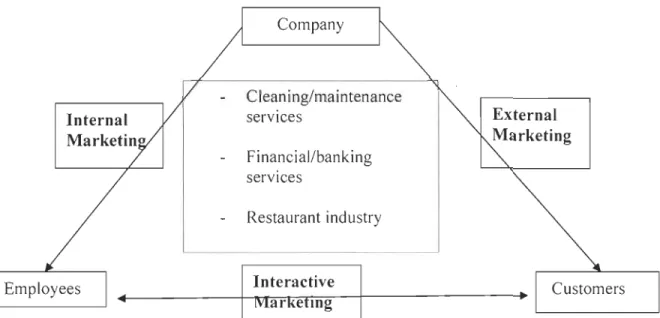
After having an idea of how the service system works, now we can check the three types of marketing. In Figure 3 you will observe that service marketing requires not only external marketing, but also internai and interactive marketing (Gronroos 1984).
Figure 3: Three Types of Marketing in Service Industries
Internai Company Cleaning/maintenance services Financiallbanking services Restaurant industry Interactive MarketIng
Source: Gronroos, C. (1984). "A Service Quality Model and its Marketing Implications."
External Marketing describes the normal work to prepare, priee, distribute, and promote the service to customers (Gronroos 1984). Tt is the relationship between the company and the external customers. To determine the external marketing, we ask the following questions. How is the service being promoted to customers? Is it weil delivered? Are the supporting systems in place to deliver the promised service?
InternaI Marketing describes the work to train and motivate employees t.o serve customers weil (Gronroos 1984). lt helps communication between the company (the
management) and the employees. It helps overcome any resistance to change. ft informs,
and involves ail employees in new initiatives and strategies. Employees are seen as customers within the corporation.
Interactive Marketing describes the employees' skills in serving the client. The prime
relationship in interactive marketing is the physical interaction between the front-end
personnel and the customers (Gronroos 1984).
Now that we were able to have a global idea of the service sector, we can state sorne of
the problems that the service sector faces every day.
1.2 THE GENERAL PROBLEM
We are living in an era where finding solutions to problems is a little easier than it was
in the past due to internet access, to the globalization and being more open to the world.
People have the chance to exchange their ideas more freely and broaden their horizons.
The full-restaurant service sector is facing problems like ail other sectors: being product or service. The restaurant sector has increased sharply during the 1990s and then increased at a slightly slower pace thereafter. The difficult working hours: evening,
week-ends, seasons, part-time, etc ... make it hard to keep employees. There are quite a
number of employees who are students that change jobs after graduating.
The economy has a major part in the restaurant industry since dining out is one of the
main spending eut that clients consider. What is interesting, is when the economy improves, going to a restaurant is the first luxury that customers start doing. Also economy affects tourism, if tourism is low, so is the restaurant industry. Also the
demographic factor plays a role; usually it is the older aged people who use the full-service restaurant and the younger age prefer fast-food restaurants. The restaurant industry is fiercely competitive, whether in a chain or independently, since a restaurant is one of the easiest businesses to start, but almost the first to close (Bottin statistique de l'alimentation, 2010).
So when managers know what problems they might face and are able to define the problems, they will be able to make better decisions so that they will have more profit and survive in this competitive market.
As we saw in the service business, we need customers in order to have a system, in our case it is the full-service restaurant. So according to Bowden-Everson, Dagger and Ell iott (2013), the primary objective of the restaurants should be establ ishing and maintaining persistent customer relationships. Their study was done in four high-end restaurants. They had 474 participants: 213 responses from first time customers, and 261 from repeat customers. The authors measured customer satisfaction, customer commitment, customer delight, and trust. They used the scales of coefficient alpha and standardized loadings.
An example of the question they asked to measure involvement was: Choosing restaurants is an important decision for me. As for the loyalty aspect, they asked: How willingly would you be to say positive things about this restaurant? The end result indicated that satisfaction, commitment, trust and customer delight produce customer loyalty. They also found that the relationship between satisfaction and commitment,
trust and delight was stronger th an the relationship between satisfaction and loyalty. This led to the assumption that satisfaction by itself may not be enough to create an enduring loyalty in the restaurant sector. Finally, their analysis suggested that commitment, trust and delight also have an important influence on the development of customer loyalty with the restaurant sector.
As we can notice, many problems face the restaurant industry. We do not have an exhaustive list, but these are sorne of the problems the restaurant face. We will identify
the actors and elaborate more on each one.
1.3 THE PROBLEM ACT ORS
Since our restaurant in question is a franchisor, we will add its component to our
problem actors. As problem actors we have: The franchisor, the franchisee, the restaurant
manager, the employees behind the scene, the employees in contact with the customers,
the clients, the provider (caterer, office supplier, etc.) and the competitor. We will be separating them into two categories: external and internai in relation to the restaurant. The external actors are in contact with the internai ones and vice versa.
External actors includes: Franchisor, the franchisee, the provider and the competitor.
Internai actors includes: the restaurant manager, the employees behind the scene, the employees in contact with the clients and the clients themselves.
The franchisor and the franchisee both work together to create and expand a successful
business concept. Their contribution to the process is unique to each person, but what affects the final result is the consumer's present and future choice.
1. The Franchisor: He has already built a successful business and is willing to sell the
right to use that business. The goal is to increase the value and maximize profit of the business. It is in the franchisor's best interest to continue to support the franchisee and make sure ail is going weil.
The Franchisor dictates how the business will be operated by the franchisee
including pricing policy, standards of cleanliness, hours of operation, sources of supplies, hiring and employee's training, quality of service and the lists go es on and
on. The Franchisor may also restrict the products, the area of operation, the restaurant's physical appearance and the methods of operation (Filiatrault 2005).
2. The Franchisee: When the Franchisee signs the contract with the Franchisor, he/she
is signing an ongoing relationship with the Franchisor. This relationship is based on the premise that mutual contribution leads to mutual benefit. The Franchisee pays an initial Franchise fee plus a continuing royalty fee. Also, he/she has to abide strictly
by the rules set out by the Franchisor. The Franchisee is buying a successful ready-made trade-name. The initial capital investment required of the franchisee will generally be lower than that required to start up a new business. The rules with which the Franchisee has to abide, might be a stumbling block for a business man who wants to implement innovative ideas as the business develops, or who wants to acquire cheaper equipment from a different provider (Filiatrault 2005).
3. The Provider: Is the one who provides the food, the restaurant equipment, office supplies, etc. But since the restaurant is a Franchise, the Franchisee has no control over that even if elsewhere he could have had a lower price and better quality. Sometimes, the provider may not abide by the deadline. This would be frustrating for the restaurant manager, because clients could be waiting for this special product. We could conclude that the provider has an indirect relationship to the restaurant with no control from neither the Franchisee nor the restaurant manager.
4. Competitors: It could be any industry that threatens the full-service restaurant from growing or making a higher profit. Tt could be another Franchisor offering better conditions with lower royalty fees. In order to succeed, every restaurant has to be alert to any new changes or developments in the environment. The Franchisee has to be vigilant of what is going around and where does he/she stand with respect to the new changes. Are they really behind, or not?
Now that we have discussed the indirect elements that relate to the clients, we will discuss the elements that have a direct influence on our clients.
1. Restaurant manager: Could be the owner himself, or someone whom the Franchisee has employed for the job. He/She acts primarily on the attributes of meals being served and on the attributes of the service being offered. The restaurant manager works with employees to provide the clients with what they desire.
He/She might be in direct contact or in indirect contact with the clients. When a problem is brought up, the restaurant manager is the tirst to know about it and to tind an immediate solution. He should be very attentive to what takes place. lt
would be valuable to have training sessions from time to time for problem solving and quick decision making.
The quotation of Brown (1995) for the managers tits our subject: "Do unto your internaI customers as you would have them do unto your external customers." What he means by this quotation is for managers to treat their employees very weil and take good care ofthem in order for employees to treat their clients properly.
2. Employees behind the scene: These employees work in the kitchen: the chef, the person who does the paper work, any other employee who contributes within the restaurant but is not in direct contact with the clients. They do not have a direct relationship with the clients, but they must be very attentive to the clients' request. They are an important element in giving the maximum so the client is satistied and cornes back.
3. Employees in contact with the clients: Hostess, waiters and waitresses. They are the first contact the client receives. It is the tirst impression that the client builds about the restaurant. They are the image of the restaurant. They are to be
well-dressed, smile ail the time even though they had experienced a tough day, even though they have just got out of an argument with the manager, etc ...
4. Client: an individual who enters the restaurants and purchases a meal. The client cou Id be a regular customer or a first time customer.
It could be a brand customer from a different place, passing by a new area, but the minute he finds his favorite chain restaurant, goes in without hesitating expecting to find the same service. There are the same old clients and new clients. We should always be attentive to what clients want, mainly the old ones, since they are our target. Keep them satisfied and keep them coming is our main goal. We should know our clients, cali them by name if known, they would feel honored. No doubt that outside, there are competitors trying to take our best clients away. Also ask our usual customers if they have any suggestions on how we could improve our service or meals.
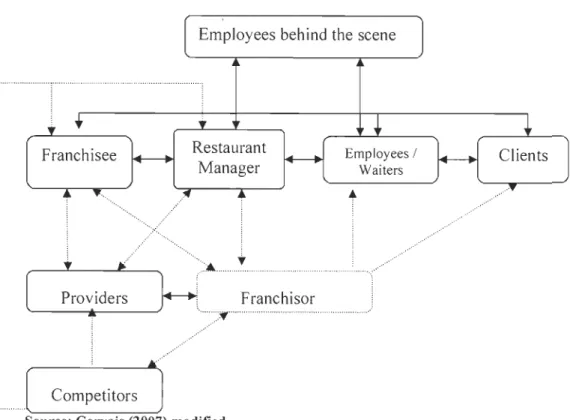
Whatever is presented separately, these players are nonetheless closely intertwined. Indeed, without interrelations among them, everyone can lose the reason to exist. We notice that most are two-way related, except the Franchisor has a one way link with clients and employees. The competitor has a one way link with Providers, Franchisee and Restaurant Manager.
As for our restaurant in question, we face problems with internaI and external actors as weIl. We have placed ail the actors in one figure, and we have linked them accordingly. Figure 4 shows us the internaI and external actors discussed previously.
Figure 4 - Interaction Between Players
Employees behind the scene
Franchisee ... ... ;-... . Restaurant Manager ... Employees / Waiters
[
provide:
~
,
.
. ... : ... . Franchisor ' - - - _ _ . . . . . . - -_ _ . - J ...•. : • ...•..•...•.•.•.•.•.•.•••••••••••••••••••.••••.... ... ... CompetitorsSource: Gervais (2007) modified
After defining our problem actors we can proceed to the managerial question.
1.3.1 The Managerial Question
The general problem that will be discussed in this paper concerns the relationship between customer satisfaction and customer loyalty, which leads to the general question:
"How to improve customer satisfaction in order to increase the development of customer
loyalty?"
We have seen earlier that 67.66% in 2011 of the food industry is a full-service one, meaning the competition level is very high and risky. So another question we need to deal with is: "What needs to be done that distinguishes one restaurant from another in
After stating the managerial question we can define the specifie questions and the managerial and specifie objectives of the research.
1.3.2 The Specifie Questions
As Statistics Canada (2012) mention that the increased level of working women, the lifespan increase, the decline of the household size and the cultural diversity are sorne of the factors that influence the restaurant industry. More and more customers are preoccupied by their health; they look for organic and healthy food. So we came up with three specifie questions:
1- Which dimensions of satisfaction are the most important for the customers? 2- Why does customer satisfaction and customer loyalty need to be measured? 3- Does a relation exist between the dimensions of satisfaction and the
development of customer loyalty?
These questions lead us to find the dimensions that customers are looking for. We have the physical setting, the atmospheric setting, the food quality and the service quality,
which includes server attentiveness and rapidity, server greeting and host-staff pol iteness.
A study was done by Mattila and Hanks (2012) demonstrating if waiting-time had a negative or positive impact on customer satisfaction in a crowded or non-crowded environment. The responses were 233 by the eut-off date. Their results indicated that waiting time in a crowded environment resulted in negative emotions, including frustration, anger, irritation and annoyance. They divided the respondents into 2 groups: those who score high on economic time style and those who scored low on economic time style. Those who scored high on economic time style were less satisfied while they
were waiting in a crowded area. On the other hand, the respondents who scored low on economic time style, the waiting time did not affect their level of satisfaction.
So if we go back to our research, it is done for "slow food restaurants", meaning customers who chose the full-service should not be in a hurry and waiting time should not have a great impact on their level of satisfaction. Therefore, customers may not mind waiting for a table if they think the meal is worth the wait. Customers care more about the host being consistently polite and attentive than waiting in line to be seated.
Sorne of the factors that influence customer satisfaction do not affect the repeat-patronage decision. This is not surprising, since no one really decides to go back to a restaurant again and again just because the seating process is fair or the dining area has an acceptable decoration or because the last time he/she visited the restaurant no waiting in line was needed. Only food, prepared the way customers enjoy it, can attract the customer back for many return visits. In contrast, unfair treatment during the seating process can diminish a customer's overall perception of a single dining experience, but it will not prevent a customer from ever returning.
1.3.3 The Managerial Objectives
Due to the fierce competitive world we are living in, from time to time the restaurant needs to evaluate its current position and suggest future plans accordingly. Check if possible market opportunities are available. By measuring customer satisfaction and loyalty, the restaurant will be able to understand the customer, understand hislher needs, expectations and what hinders him/her from coming back. By that, restaurants will be able to find what they need to correct in managing their company. It is by satisfying customers that the SME achieves its objectives.
1.3.4 The Specifie Objectives
An objective is what the company is looking forward to achieve. Sorne examples are being a profitable company, having a higher volume of sales, having a high satisfaction rate with customers and employees as weil and where does the company -stand with respect to other companies offering the same service. This is what Filiatrault (2005) mentions. Then he adds that there are quantitative and qualitative objectives as weil. By quantitative he means: sales, rate of satisfaction and by qualitative he means: enhance the service quality, ensure customer loyalty and position the company as one that offers the highest quality of customer service.
After defining our problem actors, specifying our objectives and finding the dimensions to answer our specifie questions, we need to know if it is worthwhile continuing our research or not.
1.4 THE RESEARCH PERTINENCE AND JUSTIFICATION
As was mentioned earlier, the competition is high in the restaurant industry mainly in the full-service one. Since around 67.66% of restaurants in 2011 were full or complete service restaurants, clients had more choice. Therefore, satisfying our clients and providing everything possible for them to come back is a very important aspect. So will the full-service restaurant survive the current competitive market? Customers' intention of going out to a restaurant is also changing, not just for socializing, it also includes eating food that is more healthy and of a superior quality to promote better health. In the past, women used to stay home to take care of children and prepare the meals for the whole family. This has changed because more and more women are working full-time and lack time to prepare the meals, so they look for healthy food to be served for the family.
We can conclude from the above mentioned reasons that it is worthwhile to continue our research. It is not to be forgotten that dissatisfied customers complain to a minimum ten other people. Later on, we will provide recommendations for the restaurant managers to satisfy their clients and make sure they will come back.
In order to answer the questions raised and find solutions to the problems facing the full-service restaurant, we suggest a literature review. From our literature review we will define the conceptual framework that will serve as the foundation of our specifie framework that will be used.
CHAPTER 2: LITERA TURE REVIEW
To understand the environment of restaurants with full-service, we will define the term in question; explain the relation between the franchisor and franchisee and introduce the concept of SMEs (Small and medium enterprises) since we consider the full-service restaurant a SME. Therefore, we should be dealing with the SMEs in order to enable the reader to understand the reason for our association. We will also treat the restaurant industry, so that the reader can appreciate the importance of this business.
2.1 FULL-SERVICE RESTAURANTS AS SME
The restaurant is regarded as small SMEs, with the exception of corporate entities headed directly by the parent company. The decision-making power is not the same for ail restaurants with service. However, whether independent or linked to a franchisor, the manager-restaurateur can always act on the fifth variable marketing mix: Personal contact with customers (Filiatrault, 2005). The price and the menu are often dictated by the franchisor and the distribution (the location of the restaurant) is granted by the franchisor.
To better understand the restaurant in our research paper, we will define only three aspects although the restaurant includes more th an that. The three aspects of the restaurant are: physical setting, atmosphere and food quality.
The physical setting of the full-service restaurant includes waiting period, seating arrangements, fairness of waiting period, fairness of seating and number of places available. If the area ofwaiting period is crowded and tiny, it will affect the customers' satisfaction level and increases tension. If chairs are not comfortable or too close to the other tables and conversations can be heard, this also affects the level of satisfaction and the customer loses his/her privacy. Clients expect to be seated fairly. A study done in
20 Il by Robson, Kimes, Becker and Evans found out that having adequate personal space is an important aspect. Seating dissatisfaction may lead to early departure or a disinclination to spend. However, clients were less likely to return to a restaurant with uncomfortable table spacing. Close table spacing made respondents feel less private,
more crowded, less likely to have a positive meal experience, and more dissatisfied with the table to which they were assigned. The study was a web-based survey with more than 1,000 Americans who responded.
The atmospheric setting of the full-service restaurant includes decoration, noise level, temperature, c1eanliness, odour, lighting, music and color. The customer will start to create an idea of his/her expectation before even being served, just by observing the atmospheric setting is enough. For example, if the restaurant was not tidy, the customer will remember this aspect more th an if the service was excellent. The atmospheric setting has an impact on the decision making of the next visit.
The food quality is the third aspect that is found in the full-service restaurant. Food quality judges on food safety, appeal and dietary acceptability as Sulek and Hensley (2004) mention. In food safety we find undercooked meal, a meal with an off-taste or a foreign materiel inside. Appeal includes plate representation, freshness of the food, taste,
texture, tempe rature, quality, quantity and quality/price. As for dietary aspect, it includes meals with low in fat, low in carbohydrates, cholesterol free or vegetarian. We have already mentioned earlier that nowadays customers are more health conscious.
We have been frequently mentioning the word SME, but what is it? Below we will define it, discuss its origin. We will mention how much we have in Canada and specifically in Quebec.
2.2 THE SME
There are several definitions for SME, but the most used is the European Commission one. It defines the SME as follows in the Enterprise and Industry Publications:
'Micro, small and medillm-sized enterprises (SMEs) are the engine of the European economy. They are an essential source of jobs, create entrepreneurial spirit and innovation in the EU and are thus crucial for fostering competitiveness and employment. The new SME definition, which entered into force on 1 Janllary 2005, represents a major step towards an improved business environment for SMEs and aims at promoting entrepreneurship, investments and growth. This detinition has been elaborated after broad consultations with the stakeholdersinvolved which proves that listening to SMEs is a key towards the successful implementation of its goals. The category of micro, small and medium-sized enterprises (SMEs) is made up of enterprises which employ fewer than 250 persons and which have an annual turnover not exceeding 50 million euro, and/or an annual balance sheet total not exceeding 43 million euro.'
The article in the Enterprise and lndustry Publications continue to mention that SMEs are the major source of entrepreneurial skills, innovation and employment. Often in the early start-up, they have difficulty in obtaining capital or credit. These restricted resources have an impact on the reduced access to new technologies and innovation.
2.2.1 Origin of SME
We will discuss the origin of the SME according to the European Commission (EC) Brussels 2009. They mention that it is essential to have a common definition of an SME to improve their consistency and effectiveness, and to limit distortions of competition. In
1996, a recommendation establishing a tirst common SME definition was adopted by the Commission. This definition has been widely applied throughout the European Union.
On the 6th of May 2003, the Commission adopted a new recommendation in order to
January 2005 and will apply to ail the policies, programs and measures that the Commission operates for SMEs (Key Small Business Financing Statistics 2012).
2.2.2 SME in Canada
According to Key Small Business Statistics (2012), Statistics Canada's Business Register maintains a count of business locations and publishes results twice a year. Business locations can belong to the same company; each company owns at least one business location. For an individual business location to be included in the Business Register, the company to which it belongs must meet at least one of the following minimum criteria: it must have at least one paid employee, it must have annual sales revenues of $30,000, or it must be incorporated and have filed a federal corporate income tax return at least once in the previous three years. As of December 20 Il, there were about 1.1 million business locations in Canada, as shown in Table 2.
Table 2: Total number of Business Locations
Province Employer Percentage of
Businesses total SMEs
Quebec 244,940 22% Ontario 392,320 35 % Manitoba, Saskatchewan, 21 % Alberta 228,402 British Columbia 173,589 15 % Newfoundland, Labrador
Prince Edward Island, 79,723 7%
Nova Scotia, New Brunswick Yukon, Northwest Territories,
0,30%
Nunavut 3,782
Canada -Total 1,122,306 100 %
Source: Statistics Canada, Business Register, December 2011
Note: Figures may not add up to 100 due to rounding
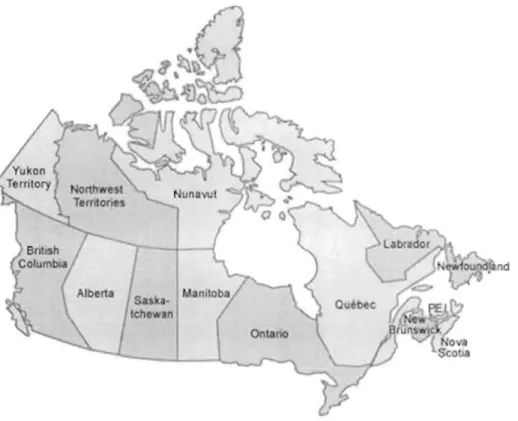
Approximately 57 percent of ail business locations in Canada are located in Ontario and Quebec. Virtually ail the rest are divided between the western provinces (37 percent)
and the Atlantic Provinces (7 percent). The Northwest Territories, Yukon and Nunavut represent only 0.3 percent of Canada's businesses.
The SMEs have been distributed by region; we can see the regions in Figure 5 below.
Figure 5: The distribution of SMEs by region
Table 3: SME Good sector versus SME Service sector in Canada
Employer Businesses Goods-Producing Sector Service-Prod ucing Sector
1,122,306 239,057 883,249
100 % 21 % 79%
Source: Statlstlcs Canada, BUSIness Reglster, December 2011
As table 3 shows us that in Canada we have 79 % SMEs in the service sector and the remaining 21 % are in the goods sector.
Canadian SMEs are found to have greater reliance on loans from individuals (family,
friends and others) and less reliance on loans from financial institutions. "This result can be interpreted either as indicative of lower availability or lower need of formaI credit in Canada" (Leung, Meh and Teraj ima, October 2008).
Klyuev (2008) found that the results of interviews with Canadian bank representatives show that there is a uniform pricing policy; clients receive a loan on the same conditions, regardless of location, nature and history of their business. He also speculates that this approach leaves high risk borrowers without access to credit. If this
is true, then the lower effective interest rates differentials in Canada could be due to the absence ofhigher risk loans.
2.2.3 SME versus Franchise in Quebec region
According to the Conseil Québécois de la franchise of January 2012, we have Il,366 business franchises in Quebec. They estimate that 65.6 % ofthese businesses (7,455) are owned and operated by Franchisees. While the remaining 3,911, are managed by the franchisors themselves. They continue to mention that there are 315 franchisors In Quebec.
The Business Register of Statistics Canada mentioned earlier that we have 244,940 SMEs in Quebec region. So after finding how many Franchises we have, we can deduce that we have Il,366 Franchises out of the 244,940 SMEs, giving us 4.65 %.
2.3 THE FRANCHISE, AN SME?
Presently, we would like to define the Franchisor according to Murray (2006):
"Franchising today is a business format franchising, it is a tried and tested system of doing business - of selling goods or services - is in
place and can be replicated by others. The term 'franchise package' is
often used, and it is a helpful one. For what the franchisee gets in return for his or her money - paid in the shape of an initial fee plus continuing
royalties or 'management fees' - is a bundle of items, which, taken
together, form ail that he or she l'1eeds to operate a clone of the original pilot project."
He continues to mentions that the franchise must have four characteristics, if one is
missing, the franchise will have difficulty in developing and maturing. We will briefly
explain the four characteristics: Standardization, unique selling proposition, ease of
operation and gross margin on sales.
1. Standardization: The Franchise business must allow itselfto be re-copied. Yes it
should offer the same services and products but it can't have the same
employees. So what differentiates a Franchise from another is the way the
service is delivered, some try harder, smile more and focus on giving a higher
customer satisfaction. In addition, some employees have the ability, strength and
the gift of making themselves enjoyable.
2. Unique selling proposition (USP): lt is when the product or service has a special
quality when no other can compete with. So if the Franchisor wants to succeed, he needs to have this kind of monopoly (USP).
3. Ease of operation: Tt is when the Franchisor chooses employees with many
skills, many abilities and a vast range of experience. The Franchisor offers the
new employees training so they will be able to work in any department.
4. Gross margin on sales: Opening another Franchise is about making money and
whatever cornes next is secondary.
If we consider ail the Franchise's as one company, then it is no more an SME, but the
own market, own clients' preferences, own competitors, etc ... so then yes we can consider the Franchise as an SME.
After defining the SME, its origin and its impact in the Quebec region, we can now define the core terms of our research: customer satisfaction and customer loyalty and their impacts on the full-service restaurant.
2.4 NOTION OF SATISFACTION 2.4.1 Definition
The simplest way to define a term is to refer to it by the dictionary. WordNet is an online dictionary used by Princeton University. It defines satisfaction by five levels, but
one level corresponds to our study.
1- The contentment one feels when one has fulfilled a desire, need, or
expectation; "The chef tasted the sauce with great satisfaction."
The definition establishes our problem since it introduces psychological dimensions
such as "fulfill a desire or an appetite".
We have also checked the English Collins Dictionary online and it gave us seven
definitions:
1- The act of satisfying or state of being satisfied
2- The fulfilment of a desire
3- The pleasure obtained from such fulfilment 4- A source of fulfilment
5- Reparation or compensation for a wrong do ne or received
6- The performance by a repentant sinner of a penance (Church ofEngland) 7- The atonement for sin by the death of Christ (Christianity)
For our research we will use the first four definitions, since they comply with our subject.
Afterwards, we looked up the Merriam-Webster dictionary online and found four definitions for the concept of satisfaction:
1- a: the payment through penance of the temporal punishment incurred by sin b : reparation for sin that meets the demarids of divine justice
2- a: fulfillment of a need or want
b : the quai ity or state of being satisfied: contentment c : a source or means of enjoyment: gratification
3- a: compensation for a loss or in jury: atonement, restitution b : the discharge of a legal obligation or claim
4- Convinced assurance or certainty
The second definition concords better with our research.
The Merriam- Webster dictionary states the origin of satisfaction: Middle English, from Anglo-French, from Late Latin satisfaction-, satisfaction, from Latin, reparation, amends, from satisfacere to satisfy. The first known use took place in the 14th century.
The different aspects of satisfaction make definition difficult, mainly because it IS
related to the complete consumption experience (Oliver, 1997): • Satisfaction with events that happen during consumption. • Satisfaction with final outcome.
• Satisfaction with level of satisfaction received.
In this context, satisfaction is viewed in terms of singular events leading to up to a consumption outcome (collective impression of these events), and finally to the entire
experience judgment. A comprehensive definition of customer satisfaction in terms of
pleasurable fulfillment is given by Oliver (1997):
" ... Satisfaction is the consumer's fu lfi liment response. It is a
judgment that a product or service feature, or the product or service
itself, provided (or is providing) a pleasurable level of
consumption-related fulfillment, including levels of under or over fu lfi liment.. ."
2.4.2 Types of Consumers
By knowing our customers and understanding what they are looking for, helps in
responding to their service in a better way. According to Clow and Baack (2010), we
have at least four types of consumers: Promotion-prone consumers; priee-sensitive consumers; brand-loyal consumers and preferred-brand consumers. We will briefly explain one by one.
A promotion-prone consumer regularly responds to coupons, discounts or priee-off.
These customers are not brand loyal, they switches brands easily due to the priee.
Priee-sensitive consumers are what their name says. They focus on the priee only.
Brands are not important for them. They look for cheap products.
Brand-loyal consumers purchase only one particular brand no matter what the price is. Tt
is hard for them to try a different brand.
Preferred-brand consumers have more th an one brand that they prefer. If one of their
brands was on sale, they will choice it. If a brand not from their preferred list was on sale, it needs to be an exceptional promotion deal for them to choose or else they will stick to their brand list.
We just want to draw the attention that we have to keep in mind that not ail consumers are alike. Therefore, when we are trying to find ways of satisfying our clients so they continue corning, we have to find different approaches in order to rneet ail types of consurners.
Now by knowing that different types of customers exist, we need to find what goals need to be set in order to satisfy thern.
2.4.3 The Restaurant Facility
Clow and Baack (2010) state that the restaurant faci 1 ity needs to focus on at least three goals in order to be able to make decisions and meet their objectives: Customization, cost efficiency and quality.
Customization approach focuses mainly on custorners. In a full-service restaurant it would irnplicate cornfortable chairs, exclusive decoration, greater space between tables for custorners' privacy, etc. The restaurant would be extrernely unique from other restaurants to attract customers.
Cost efficiency doesn't concern our full-restaurant industry too rnuch, so we will go right away to the quality approach.
Quality: Service quality focuses on consumers' needs. Clow and Baack (2010) give us sorne guidelines for employee behaviors in order to satisfy our clients and build custorner loyalty. Employees are to greet customers like guests. For exarnple, remove their coats then hang thern up and take them to their seats. Another would be to cali custorners by narne: this will boost customers' esteem. Employees can use body
language as eye contact and keep a smile on their face no matter what they are going through. The list goes on and on.
After stating the three goals, we need to understand customer satisfaction and what steps we need to take to keep customers satisfied.
2.4.4 Customer satisfaction
Daghfous and Filiatrault (20 11) demonstrate that customer satisfaction is interacting with customers and building relationships with them. Tt also includes face-to-face communication, being that employees need to listen carefully to what the customer is asking, stay polite and reassure the client that they have made the right decision in choosing this particular restaurant today. This strengthens and builds positive relationship.
Face-to-face communication is a powerful one. It is the first impression a client can make about the restaurant. Methods of face-to-face vary with culture. In sorne countries standing close to someone is a sign of trust, in other countries, it is intimidating. The same goes for eye contact and physical contact. Nowadays, we are seeing more and more clients from different countries are settling in Quebec, so we are to be careful how to deal with each culture, the best thing would be to study the differences in people before reacting with them.
In order for employees to give the best service, they need to greet customers with a smile, be attentive to what the client wants; he/she has to be satisfied with the work being accomplished. The way we see it, ail is inter-related. If the Franchisor and Franchisee are in good terms, then the Franchisee or the restaurant manager and the employees have a good relationship. Then the atmosphere in the restaurant is pleasant, so the service delivered is weil done. Then the outcome would be satisfied clients, and
when they àre satisfied they will return. The ultimate goal will be achieved, the restaurant's sales will go higher and higher.
"Customer satisfaction is considered today as a baseline standard of performance and a possible standard of excellence for any business organization" (Grigoroudis and Siskos, 20] 0).
When discussing customer satisfaction we cannot ignore the notion of service quality. There is no customer satisfaction without service quality. We agree with Kotler and Armstong (1996) that service quality begins with customer needs and ends with customer satisfaction. We will demonstrate the service quality model formulated by Parasuraman, Zeithaml, and Berry (1985).
2.4.5 Service Quality
The service quality plays a very important role in the customer satisfaction and customer loyalty aspect. If a waiter/waitress seems bored, no smile on the face, cannot answer simple questions, or talking with other waitresses while customers are waiting in line, customers will think twice about coming back to the same restaurant.
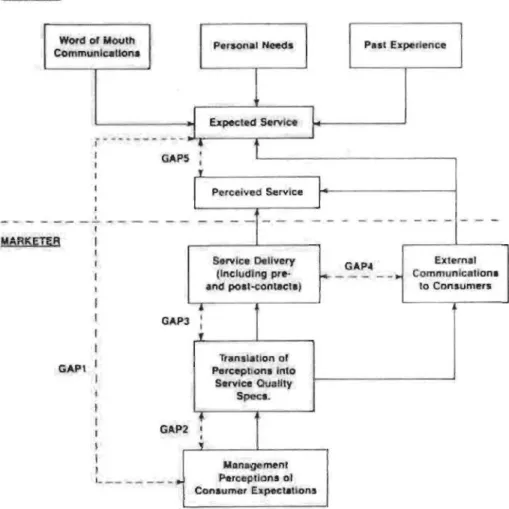
Parasuraman, Zeithaml, and Berry (1985) formulated a service-quality model shown in Figure 6 below. The expected service is a function of word of mouth communication, personal need and past experience. The perceived service is a product of service delivery and external communications to customers. We would like to draw the attention to our readers that the conceptual cadre that we used was not inspired from the SERVQUAL mode!. The model identifies five gaps that cause unsuccessful delivery:
1- Gap 1: The promotional gap: It is the gap between management perceptions and expected service. Management does not always correctly perce ive what consumers want.
2- Gap 2: The understanding gap: The gap is between management perception and service-quality specification. Management might correctly perce ive customers'
wants but not set a performance standard.
3- Gap 3: The procedural gap: lt is the gap between service-quality specifications and service delivery. Personnel might be poorly trained, or incapable or
unwilling to meet the standard.
4- Gap 4: The behavioral gap: It is the gap between service delivery and external communications. Consumer expectations are affected by statements made by company representatives and ads.
5- Gap 5: The perception gap: It is the gap between perceived service and expected service. This gap occurs when the consumer received a different service than expected.
Figure 6: A GAP Model of Service Quality
ÇONSUMER
Worrl Of Mouth Perton.' Nad. Put Experience COmmunlullon.
l
1 ~WS.lVc. j - - •• ______J."
1 GAPS.
l
1,
1,
1 P rcelv d Serv ce L 1 MARKET 1----l
---_..!..---
1--
-
-
-
---
- -
--ER 1 1 Externat 1 Service o.Ul/ttry GAP"1 (Includlng pre· f-- - - - -.. Commun c< tians
1 and posH:onUICII) ta Consumen
1
..
l
1 G.AP3 : 1 f t 1 rr.n.~tlon orGAPI
,
PerceptJoM Inlo Serl/lee Ou.IIIY 1 Spec;s. 1 1 GAP2 ;r
1 1 ~ 1 .... n.gement 1 1.. _ _ _ _ _ _ _ ... Pe.rcep!.lons 01 COnsumar Expec;tatlonsSource: Parasuraman, Zeithaml and Berry (Fall 1985).
We could conclude from this model how important it is for communication between ail
members involved to flow within the industry. The sa me message should be consistently
delivered.
The gap that is researched in this thesis is the gap between expectations and perceptions
(Gap 1). According to Roy (2010), an important step in c10sing Gap 1 is to keep in touch
with what customers want by doing research or complaint analysis or customer panels
synchronization will take place between perceptions of customers' expectations and expected service when the gap shrinks or disappears.
After mentioning the definition, the types, the approaches of satisfaction, then we can proceed to the second important concept in our research paper: Loyalty.
2.5 NOTION OF LOY ALTY 2.5.1 Definition of Loyalty
As for the customer loyalty or fidelity, WordNet mentions four levels that ail are
relevant to our topic:
1- The state or quality of being loyal; faithfulness to commitments or
obligations.
2- Faithful adherence to a sovereign, government, leader, cause. 3- A feeling or attitude of devoted attachment and affection.
4- The act of binding yourself (intellectually or emotionally) to a course of
action.
These four definitions support the problem concretely. They explain the behaviour on behalf of the customer wanting to remain faithful and committed to his/her obligations by their repetitive actions of purchasing a service or a product.
Clow and Baack (2010) mention that there are three pillars of customer loyalty:
Developing customer loyalty, maintaining quality relationships with loyal customers and
customer recovery. What concerns our research is the first pillar.
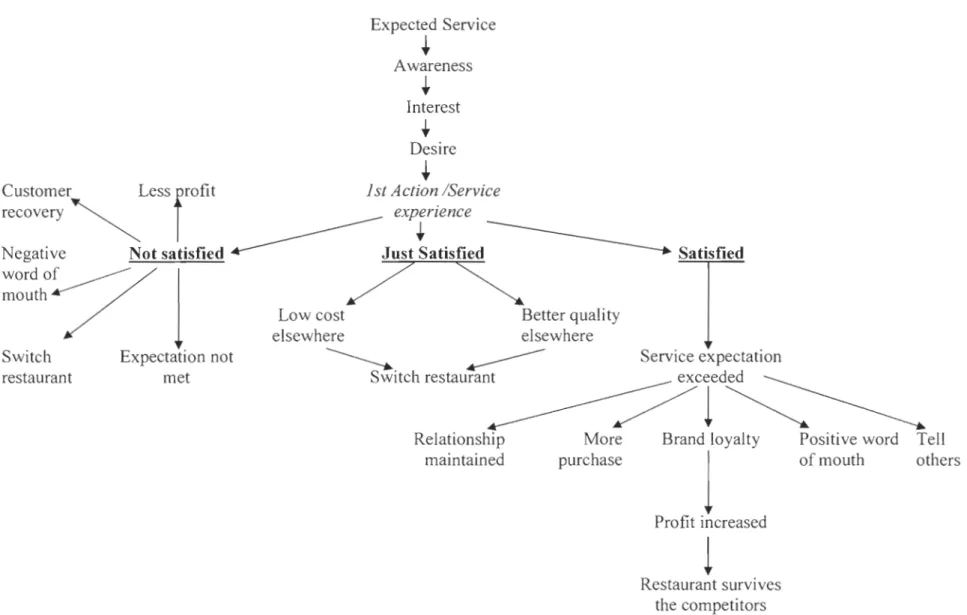
Customer loyalty evolves from an AIDA (Awareness, Interest, Desire and Action)
process. First, customers are aware of the service provided, either by a friend, or advertising or passing by the restaurant. Then they are getting interested in the service, it
may take a few days to be nurtured. Then the feeling of desire to acquire the service has arrived, and nothing can stop it. So, the first action takes place. The customer enters and tries to fulfill the desire that has been dwelling inside for sorne time now. This first action has a large impact if the client returns or not (Clow and Baack 2010).
So now it is the employees' part of motivating the client to like the service and make further purchases in the future which leads to brand loyalty. The client may change to another brand, no problem with that. But the restaurant manager has to make sure that even if the client went elsewhere, he/she will remember that the best quality was achieved in the first place.
This leads us to the fact that there are several types of customer loyalty: No loyalty, latent loyalty, inertia loyalty and brand loyalty (Clow and Baack 2010). Not ail customers are the same. Loyalty consists of emotional attachment and behaviour.
No loyalty is when the customers have no emotional attachment and rarely buys. Latent
loyalty includes high level of emotional attachment but doesn't purchase much due to other reasons. For example, a particular restaurant is the wife's favourite but since the restaurant doesn't offer what the husband likes; she is obliged to switch to another restaurant that they both like. lnertia Loyalty includes almost no emotional attachment acquired while high level of purchases due to convenience or no other restaurant in the area. Brand loyalty customers have both high scores in emotional attachment and purchase behaviour. No matter what it takes they will continue going to the same restaurant. These clients do not worry us, because they will keep coming but a reward action is needed.
The two types of customer loyalty that concerns us are the latent and inertia. As for the latent, we can search closely to see what the other partner likes so we can provide it in our restaurant. For the inertia customers, it may be a little harder to satisfy them, but we
have to find ways to strengthen the relationship with them, since they have a very high risk of drifting away.
According to Clow and Baack (2010), there are three factors that generate greater loyalty: Customer relationships, exceeding expectations and improving quality. We will discuss just the first two.
When a client starts to feel that the restaurant sees him/her as a person and does care what he/she is seeking, that's a big step and the client starts to establish an emotional attachment that leads to brand loyalty.
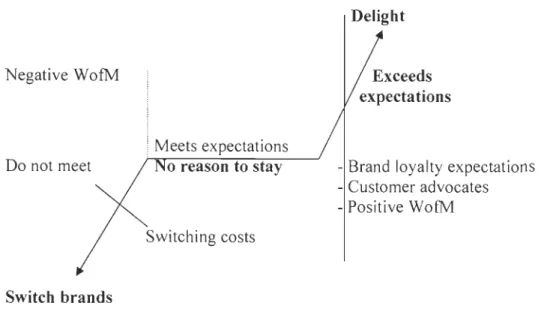
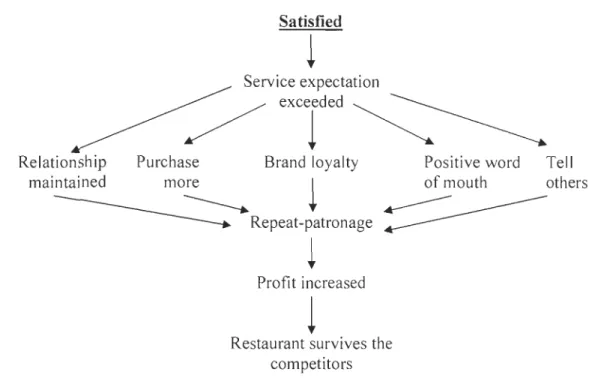
When a client asks for a service but the restaurant glves him/her more than was expected, it could be because it is the first visit to the restaurant or it could be a reward after several visits. Here the client also establishes an emotional attachment and as a result starts telling others how good the service was and even more th an expected. And who doesn't like MORE!!!! A positive word ofmouth starts spreading.