HAL Id: hal-01086622
https://hal.archives-ouvertes.fr/hal-01086622
Submitted on 24 Nov 2014HAL is a multi-disciplinary open access archive for the deposit and dissemination of sci-entific research documents, whether they are pub-lished or not. The documents may come from teaching and research institutions in France or abroad, or from public or private research centers.
L’archive ouverte pluridisciplinaire HAL, est destinée au dépôt et à la diffusion de documents scientifiques de niveau recherche, publiés ou non, émanant des établissements d’enseignement et de recherche français ou étrangers, des laboratoires publics ou privés.
Visual constraints in written word recognition: evidence
from the optimal viewing-position effect
Marc Brysbaert, Tatjana Nazir
To cite this version:
Marc Brysbaert, Tatjana Nazir. Visual constraints in written word recognition: evidence from the optimal viewing-position effect. Journal of Research in Reading, Wiley, 2005, 28, pp.216 - 228. �10.1111/j.1467-9817.2005.00266.x�. �hal-01086622�
V
ISUAL CONSTRAINTS IN WRITTEN WORD RECOGNITION
:
E
VIDENCE FROM THE
O
PTIMAL
V
IEWING
P
OSITION EFFECT
Marc Brysbaert
1Tatjana
Nazir
21
Royal Holloway, University of London
2
CNRS, Université Lyon 1
address : Marc Brysbaert
Royal Holloway, University of London Department of Psychology
Egham TW20 OEX
United Kingdom
ABSTRACT
In this paper we review the literature on visual constraints in written word processing. We notice that not all letters are equally visible to the reader. The letter that is most visible is the letter that is fixated. The visibility of the other letters depends on the distance between the letters and the fixation location, whether the letters are outer or inner letters of the word, and whether the letters lie to the left or to the right of the fixation location. Because of these three factors, word recognition depends on the viewing position. In languages read from left to right, the optimal viewing position is situated between the beginning and the middle of the word. This optimal viewing position is the result of an interplay of four variables: the distance between the viewing position and the farthest letter, the fact that the word beginning is usually more informative than the word end, the fact that during reading words have been recognised a lot of times after fixation on this letter position, and the fact that stimuli in the right visual field have direct access to the left cerebral hemisphere. For
languages read from right to left, the first three variables pull the optimal viewing position towards the right side of the word (which is the word beginning), but the fourth variable counteracts these forces to some extent. Therefore, the asymmetry of the OVP curve is less clear in Hebrew and Arabic than in French and Dutch.
V
ISUAL CONSTRAINTS IN WRITTEN WORD RECOGNITION
:
E
VIDENCE FROM THE
O
PTIMAL
V
IEWING
P
OSITION EFFECT
It is now abundantly clear that reading and visual word recognition are not simply based on orthographic information but involve the activation of phonological codes. This has been shown both at the level of individual word processing (e.g., Drieghe & Brysbaert, 2002; Harm & Seidenberg, 2004) and at the level of sentence and
discourse understanding (e.g., Brysbaert, Grondelaers, & Ratinckx, 2000; Inhoff, Connine, Eiter, Radach, & Heller, 2004). Also, children with deficient phonological awareness (i.e., awareness that spoken words consist of sequences of sounds, phonemes) are at risk for not acquiring good reading skills (e.g., Schatschneider, Fletcher, Francis, Carlson, & Foorman, 2004).
Unfortunately, the recent emphasis on phonological coding in reading has
overshadowed the fact that a written or printed word is a visual stimulus in the first place and that limitations of the human visual system put strong constraints on the speed and the accuracy with which words can be recognised. To redress the balance, we will review these constraints in the present paper.
1.
T
HE DROP OF VISUAL ACUITY OUTSIDE THE FIXATION LOCATIONThe most important variable that limits visual word recognition is the steep drop of visual acuity outside the centre of fixation. Even at an eccentricity of 1 degree, there is already a reduction in visual acuity to about 60% of maximum (Wertheim, 1894). This makes that humans find it difficult to recognise words presented a few letter positions to the left or to the right of the fixation location (unless these words are large enough). In such situations, participants have a strong tendency to move their eyes so that the stimulus word becomes fixated.
Starting from the observation that in reading participants mainly fixate words between the beginning and the middle of the word, O’Regan (1981) wondered whether the drop of acuity outside the fixation location not only had implications for the processing of parafoveally presented words (i.e., words presented a few letter positions away from the fixation location) but also for the processing of foveally presented words. His reasoning was that if the drop of visual acuity is important enough, it should be easier to recognise words after fixation on the middle letter than after fixation on the first or the last letter. Central fixation makes maximally use of the high acuity region around the fixation location, whereas fixation on the first letter makes the last letters fall more than 1 degree away from the fixation location (under usual reading conditions there are some 3 to 4 letters per degree of visual angle). The same is true for fixations on the last letter: They make the first letters fall in
parafoveal vision.
To test the idea, O’Regan, Lévy-Schoen, Pynte, and Brugaillère (1984) systematically manipulated the participants’ initial fixation location within a word by displaying words in such a way that they were shifted horizontally relative to an imposed fixation
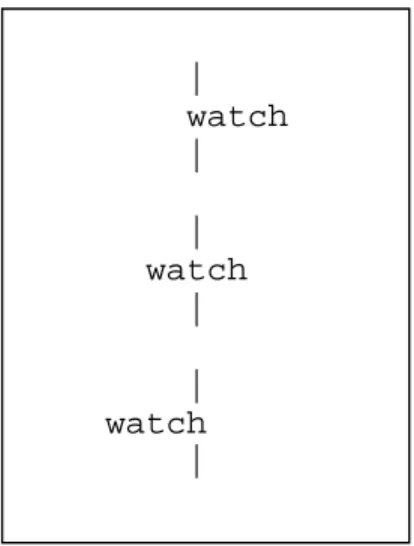
location. More specifically, participants had to fixate a gap between two vertically aligned fixation lines placed just above and below the horizontal position where the words were presented. Then, a word appeared shifted so that a different letter position fell between the two fixation lines (see Figure 1).
Figure 1: Example of how the initial fixation position is manipulated in the optimal viewing position paradigm. The participant is asked to fixate the gap between two vertically aligned lines. Words are presented in such a way that the participants initially look at different letter positions within the words.
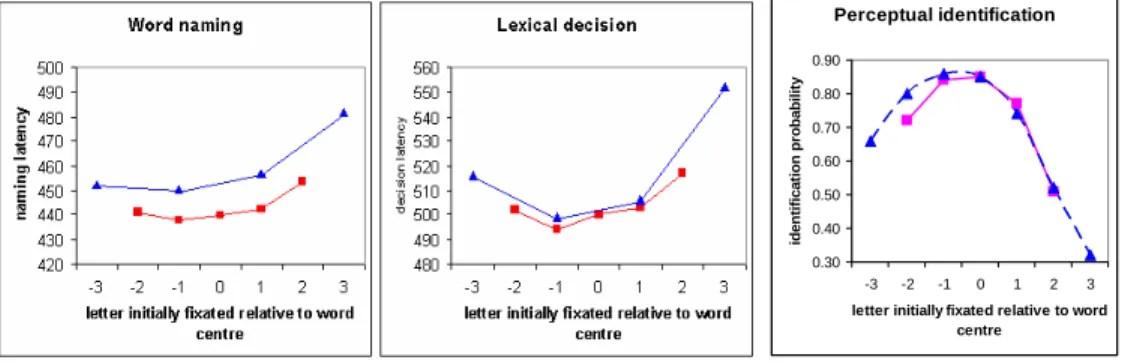
An impressive series of experiments has established a consistent pattern of results due to the fixation position manipulation. This pattern is present in word naming, lexical decision, and perceptual identification. In addition, it has been observed in many different languages (French, Dutch, Hebrew, Arabic, Hebrew, Japanese). Figure 2 shows this pattern, which has been called the Optimal Viewing Position (OVP) effect, for words of 5 and 7 letters in three different tasks: Word naming, lexical decision, and perceptual identification. In all tasks, word identification was best when the words were fixated between the beginning and the middle, and performance dropped when participants were forced to fixate on the extreme letters of the words. The processing cost was larger for fixations on the end letters than for fixations on the beginning letters.
Figure 2 : OVP effect for 5-letter (squares) and 7-letter (triangles) words. Left panel: word naming; middle panel: lexical decision (data from Brysbaert, 1992, 1994). Notice that for these two panels, not all letter positions within the 7-letter words were tested. Right panel: perceptual identification (data from Stevens & Grainger, 2003). | watch | | watch | | watch |
Perceptual identification 0.30 0.40 0.50 0.60 0.70 0.80 0.90 -3 -2 -1 0 1 2 3
letter initially fixated relative to word centre id e n ti fi c a tio n p ro b a b ilit y
To directly test the idea that the drop of visual acuity is equally important for foveally presented and parafoveally presented words, Brysbaert et al. (1996) investigated perceptual identification for 5-letter words presented so that the observers looked either four character spaces in front of the word, two character spaces in front of the word, on the first letter of the word, on the middle letter of the word, on the last letter of the word, two character spaces after the word, or four character spaces after the word. Presentation duration of the words varied from 14 ms to 70 ms. Figure 3 shows the results. As can be seen, there was no discontinuity between the performance to foveally and parafoveally presented words. Performance levels at all fixation positions were well captured by a Gaussian curve that was shifted slightly to the left (accounting for the fact that performance was better when words were presented in the right visual field than in the left visual field; see below).
Figure 3 : The continuity of the drop of performance for foveally presented and parafoveally presented 5-letter words (data from Brysbaert et al., 1996). Five different presentation durations were used. The data for each duration fell on a Gaussian distribution that was slightly shifted to the left of the word centre.
2.
M
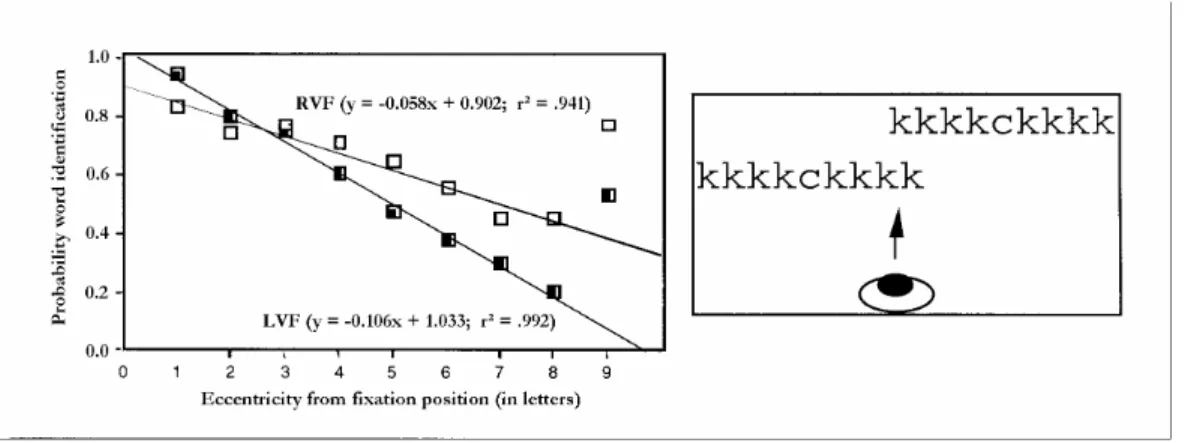
EASURING THE DROP OF PERCEPTIBILITY FOR EMBEDDED LETTERSTo get a more precise measure of the drop of letter perceptibility as a function of stimulus eccentricity, Nazir, O’Regan, and Jacobs (1991) inserted lower-case target letters in tachistoscopically presented strings of 8 k’s (e.g. kkkkckkkk) and asked participants to identify the target letter. The strings were presented in such a way that participants either fixated on the first or the last k. Target letters could be presented at each location of the k-string. Figure 4 shows the findings of the study, as a function of fixation position (beginning vs. end) and position of the target letter.
Figure 4 : Recognition probability of letters presented within a sequence of ks, either fixated on the first letter (open symbols) or on the last letter (closed symbols; Nazir et al., 1991).
Nazir et al. (1991) observed three important effects. First, identification of the most extreme letter (i.e., the last letter when fixated at the beginning or the first letter when fixated at the end) was better than identification of the nearby inner letters. This is due to the well-known phenomenon of lateral inhibition (Bouma, 1970): Letters are more difficult to recognise when they are embedded within other letters than when they are presented against an empty background. Second, when the most extreme letter was discarded the drop of performance could be approximated rather well with a linear regression (notice that a large part of the slopes of the normal distributions in Figure 3 can also be approximated by a linear regression line). Finally, Nazir et al. observed that the drop of perceptibility was stronger in the left visual field (when participants fixated on the last k) than in the right visual field (when participants fixated on the first k). The slope of the linear regression line was 1.8 times steeper in the left visual field than in the right visual field.
3.
S
IMULATINGOVP
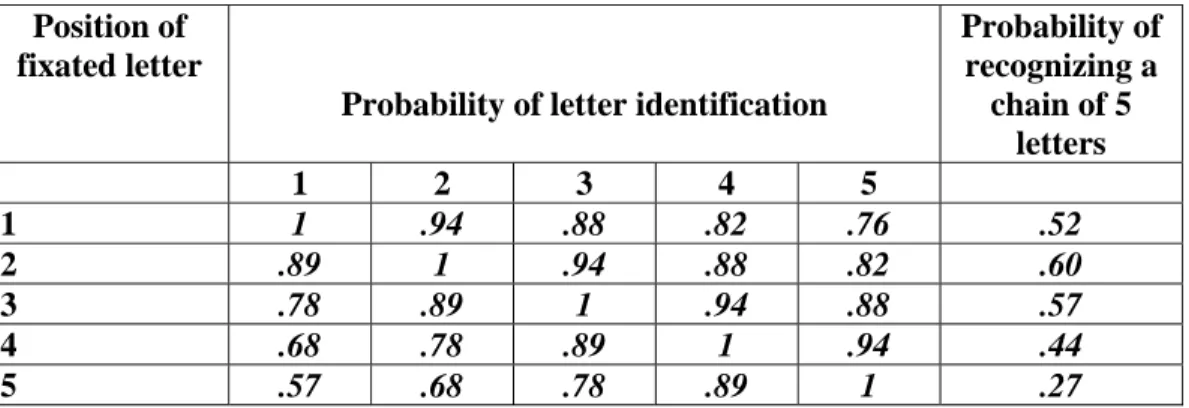
CURVES ON THE BASIS OF LETTER PECEPTIBILITY MEASURESSubsequently, Nazir et al. (1991) examined whether they could predict the OVP curves obtained in perceptual identification, on the basis of the perceptibility of the individual letters and by assuming that a word is recognised only when all its constituent letters are recognised. Table 1 illustrates the reasoning. The first row
shows the probability of identifying each letter when the participant fixates on the first letter. The probability of identifying the first letter when the eyes are on this letter is 1.00. The probability of identifying the second letter is .94 (a drop of .06). The probability of identifying the third letter is .88 (another drop of .06), and so on. Likewise, when the eyes are looking at the last letter (the last line of Table 1), the probability of identifying this letter is 1.00. The probability of identifying the second last letter is .89. This is a drop of .11, due to the fact that the perceptibility of letters decreases 1.8 times more rapidly as a function of eccentricity in the left visual field than in the right visual field. Chances of identifying the third last letter when the eyes are looking at the last letter, are .78 (i.e., another drop of .11) and so on.
Position of fixated letter
Probability of letter identification
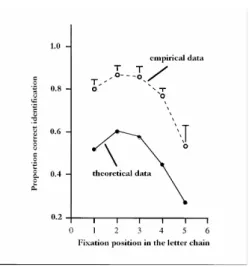
Probability of recognizing a chain of 5 letters 1 2 3 4 5 1 1 .94 .88 .82 .76 .52 2 .89 1 .94 .88 .82 .60 3 .78 .89 1 .94 .88 .57 4 .68 .78 .89 1 .94 .44 5 .57 .68 .78 .89 1 .27
Table 1 : Probability of identifying a word under the assumptions (1) that all letters must be identified, (2) that the chances of perceiving a letter drop linearly as a function of the distance from the fixation location, and (3) that the drop of perceptibility is 1.8 times higher in the left visual field than in the right visual field.
Figure 5 shows the results of the simulation and compares them with empirical data obtained for 5-letter words. As can be seen, the simulation captures the asymmetry in the OVP curve very well, but underestimates the overall recognition probability of the words. Further simulations indicated that the model predicts a strong word length effect (poorer performance for long words than for short words), which is not observed in the empirical data of adults either (although it is present in the data of beginning readers; Aghababian, & Nazir, 2000).
Figure 5 : Theoretical and empirical OVP curves (theoretical data based on the model presented in Table 1; empirical data from Nazir et al. (1991).
There are two reasons why the Nazir et al.’s (1991) simulation underestimated the overall word recognition probability. The first is that it did not take into account the higher perceptibility of the first and the last letter (see the rightmost data points in Figure 4). The second is that the model assumed that all letters must be recognised before a word can be identified. The latter assumption is not realistic, given that many words can be guessed on the basis of a subset of the letters that make the word (e.g., tabl-, h-us-).
Stevens and Grainger (2003) examined whether it was possible to predict the empirical OVP curves on the basis of individual letter recognition probabilities by taking into account the probabilities of recognising words on the basis of incomplete information. They were able to do so, if they used a coding scheme in which not the absolute letter positions were used (1st, 2nd, 3rd, …) but relative letter positions (first, last, or middle letter). The latter observation agrees with the fact that words can be recognised rather easily when the positions of middle letters have been swapped (Grainger & Whitney, 2004; Perea & Lupker, 2004). Ben Boutayab (2004) recently also showed that it is possible to simulate empirical OVP curves on the basis of individual letter recognition probabilities and the probability of producing the target word on the basis of partial input.
4.
A
CCOUNTING FOR THE ASYMMETRY IN THEOVP
EFFECTIn the previous sections, we have seen that because of the drop of visual acuity outside the fixation location and because of the existence of lateral inhibition not all letters of a word are equally visible. This makes that a word is more rapidly
recognised when readers fixate on the centre letters than when readers fixate on the outer letters. Two factors are involved in the word processing quality (either accuracy or speed): (1) the perceptibility of the individual letters as a function of the fixation location, and (2) the extent to which the most visible letters isolate the target word from its competitors.
One element that still has to be accounted for, however, is the asymmetry in the OVP curve. Why are words recognised better after fixation on the first letters than after fixation on the last letters? Three factors seem to be involved
The first factor is the observation that in general the initial letters of a word are more informative about the identity of the word than the last letters. Some authors have argued that this is due to the way spoken words are recognised (for a review, see Shillcock, Ellison, & Monaghan, 2000). Because the production of a spoken word takes a few hundred milliseconds (depending on the length), it is more efficient and communicatively effective to pack the maximum possible information at the
beginning of the word. Then, spoken words can be recognised before the speaker has ended the pronunciation, leaving more time for other (syntax and discourse-related) processes.
The effect of the information distribution within words has been examined in a number of papers (Brysbaert et al., 1996; Farid & Grainger, 1996; O’Regan et al., 1984; Pynte, Kennedy, & Murray, 1991) and the results have been consistent. The information distribution has some influence, but on its own it does not reverse the asymmetry of the OVP effect. Figure 6 shows the results of Brysbaert et al. (1996). Five-letter words were used that had a high informative beginning (the words had a chance of 84% to be correctly produced by participants given the first 3 letters, against a chance of only 9% when given the last 3 letters) or that had a high
informative end (71% correct target production on the basis of the last 3 letters vs. 8% correct target production on the basis of the first 3 letters). The task was perceptual identification after tachistoscopic presentation.
0.40 0.50 0.60 0.70 0.80 0.90 1 3 5
letter fixated in 5-letter word
p e rcen ta g e co rr e c t
Figure 6: Identification probability for five-letter words as a function of initial fixation (first, middle, last letter) and information distribution within the word (informative beginning [squares] vs. informative end).
As can be seen in Figure 6, the OVP pattern indeed changed as a function of the most informative word part, but whereas for words with a high informative beginning performance was much better after initial fixation on the first letter than after initial fixation on the last letter, no comparable word end advantage was observed for words with a high informative end. For these words, performance was equal after fixation on the first letter and fixation on the last letter.
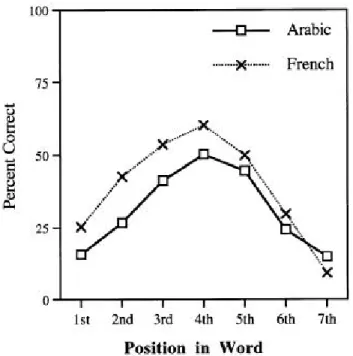
A second factor that plays a role in the left-right asymmetry of the OVP effect is the reading direction. The OVP curve is much more symmetric for languages read from right to left (Arabic and Hebrew) than for languages read from left to right (French and Dutch). Figure 7 shows perceptual identification data for tachistoscopically presented Arabic and French words (Farid & Grainger, 1996). As can be seen, the OVP curve for Arabic has become symmetric; it has not turned into an advantage for fixations on the rightmost (initial) letter of the word. A similar pattern has been observed in Hebrew (Nazir, Ben-Boutayab, Decoppet, Deutsch, & Frost, 2004).
Figure 7: The OVP effect for Arabic and French seven-letter words; perceptual identification (figure from Farid & Grainger, 1996).
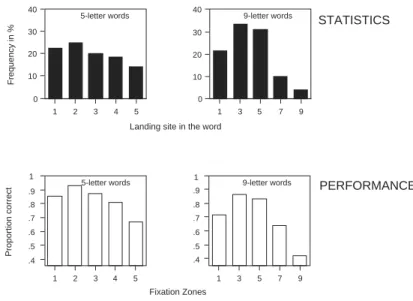
The main reason why the reading direction influences the OVP effect probably has to do with low-level perceptual learning. Nazir (2000; Nazir et al., 2004) argued that left to right text reading results in many words being recognised in the right visual field (either when they are in parafoveal vision or after fixation on the initial letters). There is evidence that repeated presentation of a visual stimulus in the same region of the visual field leads to enhanced discrimination of that stimulus at that particular region (Nazir & O’Regan, 1990) but not at other nearby parts of the visual field. Given this location-dependent perceptual learning, words will be more easily recognised after fixation on the first letters than after fixation on the last letters, because during reading the eyes land more often on the first part of a word than on the last part of a word (see Figure 8).
0 10 20 30 40 1 2 3 4 5
5-letter words STATISTICS
Frequenc
y
i
n
%
Landing site in the word
9-letter words 0 10 20 30 40 1 3 5 7 9 P roporti on c o rrec t PERFORMANCE .4 .5 .6 .7 .8 .9 1 9-letter words 1 3 5 7 9 .4 .5 .6 .7 .8 .9 1 5-letter words 1 2 3 4 5 Fixation Zones
Figure 8. Correlation between the distribution of the landing sites of the eyes during reading and word recognition performance. Top panel. Distribution of landing positions in 5- and 9- letter Roman words, observed during reading. Bottom panel. Probability of correct responses for 5- to 9- letter words as a function of the location of the eyes on the word (from Nazir, 2000).
Notice that the perceptual learning factor, just like the information distribution factor, predicts that the OVP effect in a language read from right to left (Arabic, Hebrew) should be the mirror image of the effect observed in languages read from left to right (French, Dutch). So, one final factor must be invoked to explain why the OVP effect is more asymmetric for languages that are read from left to right than for languages read from right to left.
Brysbaert (1994, 2004) argued that this factor is the asymmetry of the brain for language processing. For the vast majority of people, the left cerebral hemisphere is more important for language processing than the right cerebral hemisphere. Because information in the right visual half field is projected directly onto the left cerebral hemisphere whereas information in the left visual half field requires interhemispheric transfer to reach the left cerebral hemisphere, word recognition will be slightly easier after fixation on the leftmost letter of a word than after fixation on the rightmost letter. This will be true both for languages read from left to right and for languages read from right to left (remember that the leftmost letter is the first letter of a word when the word is read from left to right, but the last letter of the word when the word is read from right to left).
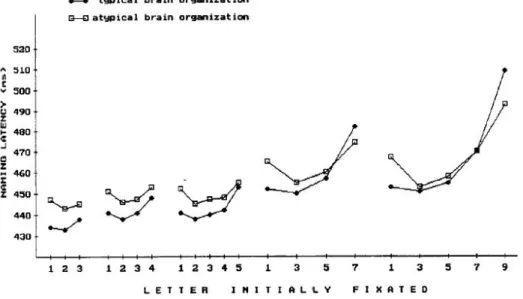
Brysbaert (1994) tested the laterality hypothesis by comparing the OVP effect in participants with left hemisphere language dominance and participants with atypical
language dominance 1. Participants named words of three, four, five, seven, and nine letters. Figure 9 shows the results.
Figure 9: Naming latencies for words of 3, 4, 5, 7, and 9 letters as a function of the initial fixation location and the cerebral dominance of the participants (figure from Brysbaert, 1994).
As can be seen in Figure 9, the word beginning advantage observed in unselected participants (the vast majority of whom are left dominant for language) did not turn into a word end advantage for participants with right hemisphere dominance, but the effect of cerebral dominance on the asymmetry of the OVP curve was significant. So, a third reason for the strong word beginning advantage in words that are read from left to right is related to the fact that fixation on the leftmost letter makes the whole word fall in the right visual half field which has direct connections to the dominant left hemisphere. This finding also implies that the fovea does not project information bilaterally to both hemispheres, as is sometimes assumed (see Brysbaert, 2004; Lavidor & Walsh, 2004; Leff, 2004; Monaghan, Shillcock, & McDonald, 2004; Whitney, 2004 for further discussion of this issue).
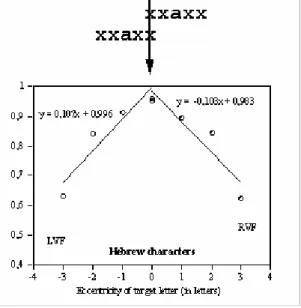
To further test the laterality hypothesis, Nazir et al. (2004) examined the letter perceptibility as a function of eccentricity for Hebrew letters. Remember from Figure 4, that for French participants the drop of letter visibility as a function of letter eccentricity is 1.8 times steeper in the left visual field than in the right visual field. If perceptual learning is the only factor that contributes to this left-right asymmetry, then for Hebrew readers and Hebrew letters, the pattern should be reversed with an 1.8 times steeper drop in letter perceptibility for letters presented in the right visual field than for letters presented in the left visual field. On the other hand, if the right visual
1
Assessment procedures available at the time did not allow the author to be 100% sure that participants were right hemisphere language dominant; some participants could have had a symmetric language representation. Therefore, the data of figure 9 are likely to slightly underestimate the effect due to cerebral dominance. We intend to repeat the study in the near future using brain imaging to assess the cerebral dominance (Knecht et al., 2000).
field advantage for French participants is the sum of perceptual learning and cerebral asymmetry, then the asymmetry should be much smaller for Hebrew participants, because for them perceptual learning (which favours the left visual field) and cerebral dominance (which favours the right visual field) should cancel each other out. This is exactly the pattern Nazir et al. (2004) obtained (see Figure 10). There was no
difference between the regression lines in the left and the right visual field.
Figure 10: Recognition probability of Hebrew letters in a homogenous string of characters, as a function of letter eccentricity and fixation location (left character of the string or right character).
5.
C
ONCLUSIONIn this paper, we have reviewed the literature on visual constraints in written word processing. We have seen that not all letters are equally visible to the reader. The letter that is most visible is the letter that is fixated. The visibility of the other letters depends on (1) the distance between the letters and the fixation location, (2) whether the letters are outer or inner letters of the word, and (3) whether the letters lie to the left or to the right of the fixation location. Because of these three factors, word recognition depends on the viewing position. In languages read from left to right, the optimal viewing position is situated between the beginning and the middle of the word. This optimal viewing position is the result of an interplay of four variables: (1) the distance between the viewing position and the farthest letter, (2) the fact that the word beginning is usually more informative than the word end, (3) the fact that during reading, words have been recognised a lot of times after fixation on this letter
position, and (4) the fact that stimuli in the right visual field have direct access to the left cerebral hemisphere. For languages read from right to left, the first three variables pull the optimal viewing position towards the right side of the word (which is the word beginning), but the fourth variable counteracts these forces to some extent. Therefore, the asymmetry of the OVP curve is less clear in Hebrew and Arabic than in French and Dutch.
Our review has concentrated entirely on the recognition of individual words. This raises the question to what extent the OVP phenomenon has implications for text reading, given that in this situation several words are presented on a line of text. We venture that the implications of the OVP phenomenon will be particularly strong for beginning readers, because for quite some time they read text materials word by word. The situation is slightly more complicated for proficient readers, because they pick up information from the parafoveal word n+1 while they are still fixating on word n. This can be concluded from the fact that the reading rate slows down when letter information from the parafoveal word is denied (e.g., because the word remains masked until the eyes land on it) and also from the fact that skilled adult readers skip about one third of the English words (predominantly the short ones; Brysbaert, Drieghe, & Vitu, in press). This means that in text reading proficient readers quite often have rudimentary information about the word, in particular the word beginning, when they land on a word. This advance knowledge is likely to attenuate the OVP effect in text reading relative to isolated word recognition, as has indeed been observed by Vitu, O’Regan, & Mittau (1990). However, it seems unlikely that the advance knowledge could nullify the visual constraints discussed in this paper. Indeed, the research group of McDonald and Shillcock recently showed that several of these constraints are needed for a good understanding of eye movement control both in normal (McDonald & Shillcock, 2005) and in dyslexic readers (Kelly, Jones, McDonald, & Shillcock, 2004).
References
Aghababian, V., & Nazir, T.A. (2000). Developing normal reading skills: Aspects of the visual processes underlying word recognition. Journal of Experimental Child
Psychology, 76, 123-150.
Ben Boutayab, N. (2004). Interactions des facteurs visuels et lexicaux au cours de la reconnaissance des mots écrits. University of Lyon : Unpublished PhD thesis. Bouma, H., (1970). Interaction effects in parafoveal letter recognition. Nature, 226,
177-178.
Brysbaert, M. (1992). Interhemispheric transfer in reading. University of Leuven: Unpublished PhD Thesis.
Brysbaert, M. (1994). Interhemispheric transfer and the processing of foveally presented stimuli. Behavioural Brain Research, 64, 151-161.
Brysbaert, M. (2004). The importance of interhemispheric transfer for foveal vision: A factor that has been overlooked in theories of visual word recognition and object perception. Brain and Language, 88, 259-267.
Brysbaert, M., Drieghe, D., & Vitu, F. (in press). Word skipping: Implications for theories of eye movement control in reading. In G. Underwood (Ed.), Cognitive
Processes in Eye Guidance. Oxford: Oxford University Press.
Brysbaert, M., Grondelaers, S., & Ratinckx, E. (2000). Sentence reading: Do we make use of orthographic cues in homophones? Acta Psychologica, 105, 31-56.
Brysbaert, M., Vitu, F., & Schroyens, W. (1996). The right visual field advantage and the optimal viewing position effect: On the relation between foveal and parafoveal word recognition. Neuropsychology, 10, 385-395.
Drieghe, D., & Brysbaert, M. (2002). Strategic effects in associative priming with words, homophones, and pseudohomophones. Journal of Experimental
Psychology: Learning, Memory, and Cognition, 28, 951-961.
Farid, M., & Grainger, J. (1996). How initial fixation position influences visual word recognition: A comparison of French and Arabic. Brain and Language, 53, 351-368.
Grainger, J., & Whitney, C. (2004). Does the huamn mnid raed wrods as a wlohe?
Trends in Cognitive Science, 8, 58-59.
Harm, M.W., & Seidenberg, M.S. (2004). Computing the meaning of words in reading: Cooperative division of labor between visual and phonological processes. Psychological Review, 111, 662-720.
Inhoff, A.W., Connine, C., Eiter, B., Radach, R., & Heller, D. (2004). Phonological representation of words in working memory during sentence reading.
Psychonomic Bulletin & Review, 11, 320-325.
Kelly, M.L., Jones, M.W., McDonald, S.A., & Shillcock, R.C. (2004). Dyslexics’ eye fixations may accommodate to hemispheric desynchronization. Neuroreport, 15, 2629-2632.
Knecht, S., Drager, B., Deppe, M., Bobe, L., Lohmann, H., Floel, A., Ringelstein, E.G., & Henningsen, H. (2000). Handedness and hemispheric language dominance in healthy humans. Brain, 123, 2512-2518.
Lavidor, M., & Walsh, V. (2004). Magnetic stimulation studies of foveal vision.
Brain and Language, 88, 331-338.
Leff, A. (2004). A historical review of the representation of the visual field in primary visual cortex with special reference to the neural mechanisms underlying macular sparing. Brain and Language, 88, 268-278.
McDonald, S.A., & Shillcock, R.C. (2005). The implications of foveal splitting for saccade planning in reading. Vision Research, 45, 801-820.
Monaghan, P., Shillcock, R., & McDonald, S. (2004). Hemispheric asymmetries in the split-fovea model of semantic processing. Brain and Language, 88, 339-354. Nazir, T.A. (2000). Traces of print along the visual pathway. In A. Kennedy, R.
Radach, D. Heller, & J. Pynte (Eds.), Reading as a perceptual process (pp. 3-22). Oxford: Elsevier.
Nazir, T.A., Ben-Boutayab, N., Decoppet, N., Deutsch, A., & Frost, R. (2004). Reading habits, perceptual learning, and recognition of printed words. Brain and
Language, 88, 294-311.
Nazir, T.A., & O’Regan, J.K. (1990). Some results on the translation invariance in the human visual system. Spatial Vision, 3, 81-100.
Nazir, T.A., O’Regan, J.K., & Jacobs, A.M. (1991). On words and their letters.
Bulletin of the Psychonomic Society, 29, 171-174.
O’Regan, J.K. (1981). The convenient viewing position hypothesis. In D.F. Fisher, R.A. Monty, & J.W. Senders (Eds.), Eye movements, cognition, and visual
perception (pp. 289-298). Hillsdale, NJ: Erlbaum.
O’Regan, J.K., Lévy-Schoen, A., Pynte, J., & Brugaillère, B. (1984). Convenient fixation location within isolated words of different length and structure. Journal
Perea, M., & Lupker, S.J. (2004). Can CANISO activate CASINO? Transposed letter similarity effects with nonadjacent letter positions. Journal of Memory and
Language, 51, 231-246.
Pynte, J., Kennedy, A., & Murray, W. (1991). Within-word inspection strategies in continuous reading: Time course of perceptual, lexical and contextual processes.
Journal of Experimental Psychology: Human Perception and Performance, 17,
458-470.
Schatschneider, D., Fletcher, J.M., Francis, D.J., Carlson, C.D., & Foorman, B.R. (2004). Kindergarten prediction of reading skills: A longitudinal comparative analysis. Journal of Educational Psychology, 96, 265-282.
Shillcock, R., Ellison, T.M., Monaghan, P. (2000). Eye-fixation behavior, lexical storage, and visual word recognition in a split processing model. Psychological
Review, 107, 824-851.
Stevens, M., & Grainger, J. (2003). Letter visibility and the viewing position effect in visual word recognition. Perception & Psychophysics, 65, 133-151.
Vitu, F., O’Regan, J.K., & Mittau, M. (1990). Optimal landing position in reading isolated words and continuous text. Perception & Psychophysics, 47, 583-600. Wertheim, T. (1894). Uber die indirekte Sehschärfe. Zeitschrift für Psychologie, 7,
172.
Whitney, C. (2004). Hemiphere-specific effects in word recognition do not require hemisphere-specific modes of access. Brain and Language, 88, 279-293.
![Figure 6: Identification probability for five-letter words as a function of initial fixation (first, middle, last letter) and information distribution within the word (informative beginning [squares] vs](https://thumb-eu.123doks.com/thumbv2/123doknet/14655488.738459/10.918.170.514.630.837/identification-probability-function-fixation-information-distribution-informative-beginning.webp)