HAL Id: tel-01211090
https://tel.archives-ouvertes.fr/tel-01211090
Submitted on 3 Oct 2015HAL is a multi-disciplinary open access archive for the deposit and dissemination of sci-entific research documents, whether they are pub-lished or not. The documents may come from teaching and research institutions in France or abroad, or from public or private research centers.
L’archive ouverte pluridisciplinaire HAL, est destinée au dépôt et à la diffusion de documents scientifiques de niveau recherche, publiés ou non, émanant des établissements d’enseignement et de recherche français ou étrangers, des laboratoires publics ou privés.
spin-crossover fe(II) complexes with photoisomerizable
ligands
Luong-Lam Nguyen
To cite this version:
Luong-Lam Nguyen. Nanoparticles of molecular photoswitches based on spin-crossover fe(II) com-plexes with photoisomerizable ligands. Inorganic chemistry. Université Paris Sud - Paris XI, 2014. English. �NNT : 2014PA112267�. �tel-01211090�
UNIVERSITE DE PARIS-SUD
ÉCOLE DOCTORALE DE CHIMIE DE PARIS-SUD
Institut de Chimie Moléculaire et des Matériaux d’OrsayDISCIPLINE : CHIMIE INORGANIQUE
THÈSE DE DOCTORAT
Soutenue le 08/10/2014 par
Luong Lam NGUYEN
NANOPARTICULES DE PHOTOCOMMUTATEURS
MOLECULAIRES BASES SUR DES COMPLEXES DE FE(II) A
CONVERSION DE SPIN ET A LIGANDS
PHOTO-ISOMERISABLE
S
Directeur de thèse : Dr Marie-Laure BOILLOT (Directrice de recherches, Université Paris-Sud)
Composition du jury :
Président du jury : Prof. Talal MALLAH (Professeur, Université Paris-Sud)
Rapporteurs : Dr Jean-François LETARD (Directeur de recherches, Université de Bordeaux) Dr Sébastien FLOQUET (Directeur de recherches, Université de Versailles) Examinateurs : Dr Gabor MOLNAR (Directeur de recherches, LCC-Toulouse)
UNIVERSITE PARIS-SUD
DOCTORAL SCHOOL OF CHEMISTRY OF PARIS-SUD
Institut de Chimie Moléculaire et des Matériaux d’OrsaySPECIALITY : CHEMISTRY
THESIS
Ph-D defense, Oktober 8, 2014
by
Luong Lam NGUYEN
NANOPARTICLES OF MOLECULAR PHOTOSWITCHES
BASED ON SPIN-CROSSOVER Fe(II) COMPLEXES WITH
PHOTOISOMERIZABLE
LIGANDS
Thesis Supervisor : Dr Marie-Laure BOILLOT (Directrice de recherches, Université Paris-Sud)
Jury Committee :
President : Prof. Talal MALLAH (Professeur, Université Paris-Sud)
Reviewer: Dr Jean-François LETARD (Directeur de recherches, Université de Bordeaux) Reviewer: Dr Sébastien FLOQUET (Directeur de recherches, Université de Versailles) Examinator : Dr Gabor MOLNAR (Directeur de recherches, LCC-Toulouse)
Remerciements
Cette thèse a été effectuée dans l’Equipe de Chimie Inorganique de l’Institut de Chimie Moléculaire et des Matériaux d’Orsay (UMR 8182) de l’Université Paris-Sud.
Je remercie vivement ma directrice de thèse, le Docteur Marie-Laure Boillot, pour m’avoir encadré et soutenu pendant ces trois années de thèse.
Je voudrais exprimer ma gratitude aux Docteurs Jean-Francois Létard et Sébastien Floquet, qui ont accepté d’être rapporteurs de ma thèse. Je souhaite également remercier sincèrement le Docteur Gabor Molnar et le Professeur Talal Mallah pour avoir accepté de juger mon travail.
Merci également à toutes les personnes de l’ICMMO avec lesquelles j’ai eu l’occasion de travailler : François Brisset pour la mesure de EDS, Régis Guillot pour la diffraction des rayons X sur monocristal, Eric Rivière pour m’avoir enseigné l’art des mesures magnétiques. Je remercie également les nombreux collaborateurs extérieurs qui ont largement contribué aux résultats présentés dans ce manuscrit : pour la spectrométrie Raman et la Microscopie optique, Lionel Rechignat et Gabor Molnar (LCC, Toulouse); également pour des mesures de spectrométrie Raman, Ali Tfayli (Faculté de pharmacie, Chatenay).
Je remercie très chaleureusement le Ministère de l'Education et de la Formation du Vietnam, l’Université des Sciences et Technologies de Hanoi et le Consortium de USTH pour m'avoir donné la chance d'étudier et de travailler en France.
Je remercie enfin le CROUS de Versailles et Campus-France pour m'avoir aidé pendant ces trois années.
Je remercie mes parents pour l’éducation et le soutien qu’ils m’ont donnés. Merci également à
mes sœurs pour leurs encouragements.
Je remercie tout particulièrement ma femme et ma fille qui m’ont permis de faire tout cela et attendu pendant plus de trois ans.
Merci à toutes et à tous …
Contents Abbreviations ... 1 Introduction ... 2 Introduction ... 3 Reference ... 5 Chapter I ... 7 I. 1 Introduction ... 8
I.1.1 The Spin-Crossover Properties ... 9
I.1.1.1 Ligand-Field Considerations ... 9
I.1.1.2. Thermodynamical Analysis ... 12
I.1.1.3. Thermally-Induced Spin-Crossover at Solid-State ... 12
I.1.1.4. Pressure-Induced Spin-Crossover ... 13
I.1.2. Theoretical Models ... 14
I.1.2.1. Model of Slichter and Drickamer ... 14
I.1.2.2. Model of Sorai and Seki (Domain Model) ... 16
I.1.2.3. Model of Spiering ... 16
I.1.2.4. Elastic Ising-like Model ... 17
I.2. Examples of iron SCO Systems ... 17
I.2.1. Monomeric SCO Systems ... 17
I.2.1.1. Intermolecular Interactions Influence ... 18
I.2.1.2. Importance of Polymorphism ... 19
I.2.1.3. Influence of Solvent Molecules ... 19
I.2.1.4. Influence of Non-Coordinating Anions ... 20
I.2.2. Polymeric SCO Systems ... 20
I.2.2.1. One-dimensional SCO Systems ... 20
I.2.2.2. Two-dimensional SCO Systems ... 21
I.2.2.3 Three-dimensional SCO Systems ... 21
I.3. Light-Induced Spin-Crossover : The LIESST Approach ... 23
I.4. Light Induced Spin Change based on LD-LISC Process ... 25
I.4.1. Introduction ... 25
I.4.2. LD-LISC Effect in Iron Complexes ... 27
I.4.2.2. LD-LISC Effect in Iron(III) Complexes ... 31
I.5. SCO Nanomaterials and Thin Films ... 32
I.5.1. Elaboration of Nanoparticles: Fundamental Concept ... 32
I.5.2. Methods for the Preparation of Spin-Crossover Nanoparticles ... 34
I.5.2.1. Reverse Micelle Method ... 34
I.5.2.2. Sol-gel Method ... 36
I.5.2.3. Laser Ablation Method ... 36
I.5.3. SCO Thin Films ... 37
I.5.3.1. Langmuir-Blodgett ... 37
I.5.3.2. Spin Coating ... 37
I.5.3.3. Constructive Method ... 38
I.5.3.4 Vacuum Sublimation ... 38
References ... 40
Chapter II ... 46
II.1. Introduction ... 47
II.2. Results ... 48
II.2.1. Characterization of the Precursor ... 48
II.2.1.1. X-ray Structure Analysis ... 48
II.2.1.2. TGA Analysis ... 51
II.2.1.3. Observation of Crystals upon the Thermal Evolution ... 52
II.2.2. Elaboration of FeII(Me2-bpy)2(NCSe)2 ... 53
II.3. Discussion ... 60
II.4. Experimental ... 61
II.4.1. Chemical Syntheses ... 61
II.4.2. Physical Measurements ... 62
II.5. Conclusions ... 64 References ... 65 Chapter III ... 68 III.1 Introduction ... 69 III.2. Experimental ... 70 III.2.1. Syntheses ... 70
III.2.1.2. 4-methyl-2,2’-bipyridine-4’-carboxaldehyde ... 70
III.2.1.3. c-msbpy Isomer ... 71
III.2.1.4. Photocyclized Ligand ... 71
III.2.1.5. [Fe(msbpy)3](NCSe)2.nH2O ... 72
III.2.2. Physical Measurements ... 73
III.3. Results and Discussion ... 74
III.3.1. Structural Characterization of t-msbpy ... 74
III.3.2. Electronic Absorption of msbpy Isomers ... 75
III.3.3. Photoisomerization of msbpy Isomers ... 76
III.3.3.1. UV-Vis Measurements ... 76
III.3.3.2. 1H NMR Measurements ... 77
III.3.3.3. Reactivity of msbpy Isomers upon a 254 nm Irradiation ... 78
III.3.4. Iron(II) Complexes Characterizations ... 79
III.3.4.1. Electronic Absorption of [Fe(msbpy)3](NCSe)2.nH2O Complexes ... 79
III.3.4.2. Photoisomerization of [Fe(msbpy)3](NCSe)2.nH2O Complexes under UV Excitation ... 80
III.3.4.3. Reactivity of [Fe(msbpy)3](NCSe)2.nH2O Complexes under High-energy Excitation ... 81
III.3.5. Analysis of Results ... 82
III.4. Conclusions ... 85
Footnotes ... 85
References ... 86
Chapter IV ... 88
IV.1. Introduction ... 89
IV.2. Experimental Section ... 90
IV.2.1. Nanoparticles Syntheses : ... 90
IV.2.2. PMMA Thin Films of Fe(t-msbpy)2(NCSe)2 ... 92
IV.3. Physical Measurements ... 93
IV.3. Results and Discussion ... 94
IV.3.1. Elaboration of Nanoparticles ... 94
IV.3.2. Investigation of Nanoparticles Dispersed in PMMA Thin Films ... 102
IV.4. Conclusions ... 113
References ... 115
Conclusions ... 117
Appendix ... 121
Appendix: Chapter II ... 122
Appendix: Chapter III ... 131
Appendix: Chapter IV ... 144
Abbreviations
: Molar extinction coefficient : Wavelength
M : Molar magnetic susceptibility
c-msbpy : 4-methyl-4’-cis-styryl-2,2’-bipyridine
E : Energy
EDS : Energy-Dispersive X-ray Spectroscopy
G : Gibbs free energy
H : Enthalpy
HS : High Spin
L : Ligand
LD-LISC : Ligand-Driven Light-Induced Spin Change LIESST : Light-Induced Excited Spin
State Trapping LS : Low Spin M : Metal Me2-bpy : 4,4’-dimethyl-2,2’-bipyridine MLCT : Metal-to-Ligand Charge-Transfer MPs : Micro-Particles NCS : isothiocyanato NCSe : isoselenocyanato NPs : Nano-Particles P : Pressure Phen : 1,10-phenanthroline
PMMA : Polymethyl Methacrylate
PSS : Photo-Stationary State
S : Entropy
SCO : Spin Crossover
T : Temperature
Tc or T1/2 : Transition Temperature
TEM : Transmission Electron Microscopy
t-msbpy : 4-methyl-4’-trans-styryl-2,2’-bipyridine
Introduction
Introduction
A contemporary challenge in materials science, that is the design of functional systems for high-density information storage, can be addressed through the optical switching of bistable molecular materials[1]. Iron (II) spin-crossover[2] complexes stand out as excellent candidates in the development of such bistable and photoswitchable systems. Indeed, these compounds exist in two electronic spin states (low-spin, S = 0 and high spin, S = 2) with distinctive physical properties (magnetic, optical, structural and vibrational) that interconvert under the effect of various stimuli including light. In spin-crossover type materials, the light-induced excited spin state trapping (LIESST) effect[3] proceeds as established by Hauser, via the low-spin metal centered excitation, then the coupled electronic and structural relaxations leading at cryogenic temperatures, to the trapping in the metastable high-spin state. High working temperature and long lifetime of the photoinduced state may be achieved by alternative approaches, using either a macroscopic transformation of the solid (photoinduced phase transition)[4] or the synergy at the molecular level between the spin crossover and the photoswitching of kinetically stable components. This second approach is the ligand-driven light induced spin change (LD-LISC) effect,[5] first demonstrated at ICMMO laboratory, which consists in the incorporation of a photoisomerizable ligand in the coordination sphere of a spin-crossover center. It has been developped with different photoactivable groups (stilbenoids,[6] diarylethene,[7] diazobenzene,[8]). Recently, strategies based on a large configurational relaxation of ligands[9] or a change of the number of donating atoms of ligands[10] have been also explored.
Photoinduced transformations of molecular switches[11] were usually investigated in solution, in highly diluted composites and more scarcely in crystalline materials.[12,3] Nevertheless, the exploitation of photoactivable materials requires their integration in functional devices and also their adaptation for optimized properties, for instance the photoconversion related to the depth of light penetration. Therefore, the nanoscale downsizing of these functionalized materials represents an important issue for applicative goals (photonic, molecular memory and switching devices) and for fundamental investigations focusing on the switching properties as a function of size reduction and environment.[13] Along this line, important developments on methods and materials have been done recently. Different classes of switchable materials (spin-crossover, photochromic compounds) have been prepared as nanoparticles by top-down[14] or bottom up[15,16,17] approaches. The group has especially
focused on the nanoscale processing of molecular materials[18] and the integration of particles in stabilized, well-adapted and easy-to-handle materials.[19]
The objective of the present work is to investigate the metal-centered spin-crossover, the ligand-centered photoswitching and the ligand-driven light-induced spin change properties with functionalized FeII complexes in the form of nanoparticles dispersed in transparent thin films. For this investigation, we have selected a set of mononuclear complexes incorporating a bipyridine ligand substituted either with a methyl group (electronic and structural function) or a styryl group (photoactivable function). The introduction in the coordination sphere of three (strong ligand-field case) or two (intermediate ligand-field strength) bipyridine ligands (with NCSe- co-ligands) has allowed the modulation of the ligand-field strength experienced by the metal ion in different systems. Optical and thermal switching properties of solids have been investigated in polycrystalline powders and in dispersion of size-reduced objects (micro-, nanoparticles).
In chapter I of this manuscript, we have reported the general properties of spin-crossover materials, the methods developed for the nanoscale processing and the photoswitching properties of this class of materials. In chapter II, is presented the elaboration of micro- and nanoparticles derived from a Fe(Me2-bpy)2(NCSe)2 spin-crossover compound. In chapter III, the photoactivity of a styryl attached bipyridine in free-base molecules and diamagnetic Fe(II) complexes is investigated in solution. In chapter IV, the elaboration of spin-crossover nanoparticles based on the latter Fe(II) complexes is described; the switching of these particles embedded in thin films and the LD-LISC effect are investigated. The work presented in chapter II that has been done with the contributions of Gabor Molnar and coworkers, has been published in New Journal of Chemistry, 2014 (DOI: 10.1039/C4NJ01257G).
Reference
[1] Special issue on ‘Molecular materials in electronic and optoelectronic devices’: Acc. Chem. Res., 1999, 32, p. 191; O. Sato, J. Tao and Y.-Z. Zhang, Angew. Chem., Int. Ed., 2007, 46, 2152.
[2] Spin-Crossover in Transition Metal Compounds, Gütlich P., Goodwin H. A. Eds., Top. Curr. Chem., Springer, Heidelberg, 2004, Vol. 233-235; Spin-Crossover Materials: Properties and Applications; Halcrow M. A., Wiley, Chichester, 2013; Sato O., Tao J., Zhang Y.-Z. Angew. Chem. Int. Ed. 2007, 46, 2152.
[3] S. Decurtins, P.Gütlich, H. Spiering and A. Hauser, Inorg. Chem., 1985, 24, 2174; A. Hauser, Top. Curr. Chem., 2004, 234, 155.
[4] S. Bonhommeau, G. Molnar, A. Galet, A. Zwick, J. A. Real, J. Mc Garvey and A. Bousseksou, Angew. Chem., Int. Ed., 2005, 44, 4069.
[5] C. Roux, J. Zarembowitch, B. Gallois, T. Granier and R. Claude, Inorg. Chem., 1994, 33, 2273; M.-L. Boillot, J. Zarembowitch and A. Sour, Top. Curr. Chem., 2004, 234, 261
[6] M.-L. Boillot, S. Pillet, A.Tissot, E. Rivière, N. Claiser, C. Lecomte Inorg. Chem. 2009, 48, 4729 ; A. Tissot, M.-L. Boillot, S. Pillet, E. Codjovi, K. Boukheddaden, L. M.lawson-Daku J. Phys. Chem. C 2010, 114, 21715.
[7] K. Sénéchal-David, N. Zaman, M. Walko, E. Halza, E. Rivière, R. Guillot, B. L. Feringa, M.-L. Boillot Dalton Trans. 2008, 1932 ; Y. Garcia, V. Ksenofontov, R. Lapouyade, A. D. Naik, F. Robert, P. Gütlich Opt. Mater. 2011, 33, 942 ; M. Nihei, Y. Suzuki, N. Kimura, Y. Kera, H. Oshio Chem. Eur. J. 2013, 19, 6946 ; M. Milek, F. Heinemann, M. M. Khusniyarov Inorg. Chem. 2013, 52, 11585.
[8] Y. Hasegawa, S. Kume, H. Nishihara Dalton Trans. 2009, 280 ; Y. Hasegawa, K. Takahashi, S. Kume, H. Nishihara Chem. Commun. 2011, 47, 6846 ; K. Takahashi, Y. Hasegawa, R. Sakamoto, M. Nishikawa, S. Kume, E. Nishibori, H. Nishihara Inorg. Chem. 2012, 51, 5188 ; Y. Hasegawa, R. Sakamoto, K. Takahashi, H. Nishihara Inorg. Chem. 2013, 52, 1658.
[9] C. Brady, P. L. Callaghan, Z. Ciunik, C. G. Coates, A. Døssing, A. Hazell, J. J. McGarvey, S. Schenker, H. Toftlund, A. X. Trautwein, H. Winkler and J. A. Wolny, Inorg. Chem., 2004, 43, 4289–4299 ; M.M.N. Wolf, R. Gro, C. Schumann, J. A. Wolny, V. Schünemann, A. DØssing, H. Paulsen, J. J. McGarvey Phys. Chem. Chem. Phys. 2008, 10, 4264.
[10] S. Venkataramani, U. Jana, M. Dommaschk, F. D. Sönnichsen, F. Tuczek, R. Hergès Science 2011, 331, 445 ; S. Thies, H. Sell, C. Bornholdt, C. Schütt, F. Köhler, F. Tuczek, R. Hergès Chem. Eur. J. 2012, 18, 16368.
[11] B. L. Feringa J. Org. Chem. 2007, 72, 6635-6652 ; B. L. Feringa, Molecular Switches, Wiley-VCH, Darmstadt, Germany 2001.
[12] Photochromism : Molecules and Systems, Elsevier Science, H. Dürr and H. Bouas-Laurent Eds, 2003 ; Special issue on Photochromism: Memories and switches, Chem. Rev. 2000, 100, 1685 ; K. Amimoto, T. Kawato Journal of Photochemistry and Photobiology C: Photochemistry Reviews 6 (2005) 207–226.
[13] A. Bousseksou, G. Molnár, L. Salmon, W. Nicolazzi, Chem. Soc. Rev. 2011, 40, 3313–3335. [14] A. Spangenberg, R. Métivier, J. Gonzalez, K. Nakatani, P. Yu, M. Giraud, A. Léaustic, R.
Guillot, T. Uwada, T. Asahi Adv. Mater. 2009, 21, 309.
[15] N. Sanz, A. C. Gaillot, P.L. Baldeck, A. Ibanez J. Mater. Chem., 2000, 10, 2723.
[16] (a) E. Coronado, J. R. Galan-Mascaros, M. Monrabal-Capilla, J. Garcia-Martinez and P. Pardo-Ibanez, Adv. Mater., 2007, 19, 1359; (b) T. Forestier, S. Mornet, N. Daro, T. Nishihara, S. Mouri, K. Tanaka, O. Fouche, E. Freysz and J.-F. L_etard, Chem. Commun., 2008, 4327; (c) T. Forestier, A. Kaiba, S. Pechev, D. Denux, P. Guionneau, C. Etrillard, N. Daro, E. Freysz and J.-F. L_etard, Chem.–Eur. J., 2009, 15, 6122; (d) J. R. Galan-Mascaros, E. Coronado, A. Forment-Aliaga, M. Monrabal-Capilla, E. Pinilla-Cienfuegos and M. Ceolin, Inorg. Chem., 2010, 49, 5706; (e) A. Tokarev, L. Salmon, Y. Guari, W. Nicolazzi, G. Molnar and A. Bousseksou, Chem. Commun., 2010, 46, 8011; (f) L. Salmon, G. Molnar, D. Zitouni, C. Quintero, C. Bergaud, J.-C. Micheau and A. Bousseksou, J. Mater. Chem., 2010, 20, 5499; (g) C. Faulmann, J. Chahine, I. Malfant, D. de Caro, B. Cormary and L. Valade, Dalton Trans., 2011, 40, 2480; (h) A. Tokarev, L. Salmon, Y. Guari, G. Molnar and A. Bousseksou, New J. Chem., 2011, 35, 2081.
[17] J. Larionova, L. Salmon, Y. Guari, A. Tokarev, K. Molvinger, G. Molnar and A. Bousseksou, Angew. Chem., Int. Ed., 2008, 47, 8236.
[18] A. Tissot, L. Rechignat, A. Bousseksou, M.-L. Boillot J. Mater. Chem. 2012, 22, 3411 ; P. Chakraborty, M.-L. Boillot, A. Tissot, A. Hauser Angew. Chem. Int. Ed. 2013, 52, 7139. [19] A. Tissot, J.-F. Bardeau, E. Rivière, F. Brisset and M.-L. Boillot, Dalton Trans., 2010, 39,
7806 ; R. Bertoni, M. Lorenc, A. Tissot, M. Servol, M.-L. Boillot, E. Collet Angew. Chem. Int. Ed. 2012, 51, 7485.
Chapter I
Spin-State Switching of Spin-Crossover Materials, Nanoscale Processing and Conversion with Light
I. 1 Introduction
The first report on spin-crossover (SCO) phenomenon was done by Cambi and al[1] in 1931. The temperature dependent magnetic moments of iron(III) tris-dithiocarbamate materials was described as resulting from an equilibrium between the two magnetic isomers. Later, Baker and al[2] have recognized the occurrence of strongly cooperative spin transitions of iron(II) complexes of general formula [Fe(L)2(X)2] (where L = 2,2’-bipyridine, 1,10-phenanthroline and X = NCSe-, NCS-). For some of them, the abrupt switching between the low-spin state at low temperature and the high-spin state at high temperature was associated to a hysteresis effect. Therefore, the research works have been centered on the elaboration of new spin-crossover materials and subsequent investigations and theoretical analyses of cooperative processes. The spin-crossover process was identified for various transition metal complexes including iron(III) (3d5), iron(II) (3d6), cobalt(II) (3d7), cobalt(III) (3d6) and manganese(III) (3d4) ions.[3]
The SCO field has received further interest, when Kahn and Kröber[4] in the early nineties have demonstrated, that such materials could be useful for technological applications (display, optical storage).[4-5] Using a class of FeII-triazole polymeric materials undergoing cooperative spin transitions with relatively large thermal hystereses, these authors have shown, that the temperature range of bistability (or memory effect) might be centered at ambient temperature by appropriate chemical modifications.
Figure 1: Images of the Fe(Htrz)3-3x(4-NH2-trz)3x(ClO4)2.nH2O complex with x = 0.05 in the LS (a,
pink color) and HS (b, white color) states at the room temperature; the curve of MT vs T (M= molar
In the Figure 1, the bistability in the hysteresis loop is illustrated by the powder colored in pink (low-spin state) or white (high spin state) at 21°C depending on the thermal history of the FeII-triazole solid.[4]
Light Induced Excited Spin State Trapping (LIESST) effect was discovered by Decurtins, Hauser and Gütlich[6] who showed in 1984 that the spin state switching could be triggered at low temperature by light irradiation. From this seminal discovery of LIESST, important developments have emerged, that cover a broad field: photomagnetism, switchable molecular materials, multifunctional compounds and new research areas aiming to control the state of matter.
The current research on this class of compounds, considered as archetypes of bistable and switchable molecular materials, is directed towards the downsizing and processing of materials, the incorporation into multifunctional devices for probing their technological potentialities and addressing the fundamental issues related to the scaling effects.
The first paragraph will deal with the ligand-field considerations allowing the molecular properties to be rationalized; we will then briefly discuss the variety of solid state properties reported in the literature as well as related theoretical models, approaches for photo-induced spin-crossover and finally, we will describe basic features concerning nanochemistry applied to spin crossover materials.[7]
I.1.1 The Spin-Crossover Properties
I.1.1.1 Ligand-Field Considerations
The spin-crossover (SCO) phenomenon occurs in 3d4-3d7 pseudo-octahedral (Oh) transition metal complexes[7a, 7c, d] under the effect of a weak external perturbation (T, P, h, H, …) when the low spin (LS) or high spin (HS) state of the metal ion are in a close energy proximity. In the case of 3d6 iron(II) ions, the SCO process takes place between the diamagnetic (S=0) and paramagnetic (S=2) states associated to the electronic configurations shown in Figure 2. From Ligand-field theory, the five 3d iron(II) ion’s orbitals in an ideal octahedral coordination geometry split into non-bonding t2g orbitals (dxy, dyz and dzx) and anti-bonding eg orbitals (dx2-y2 and dz2) pointing towards the ligand donor atoms. The energy difference between the t2g and eg orbitals is called the ligand-field strength parameter (∆), while P denotes the mean spin-pairing energy. The FeII ion (3d6) in this environment is found
in two electronic configurations depending on ∆ and P values. In a strong ligand field (∆ larger than P), the six 3d electrons will fully pair up in the t2g orbitals of lowest energy.
Figure 2: Electronic configurations of an octahedral 3d6 iron(II) complex. The relative stabilization of the LS state and HS states depends on the importance of ∆, the energy gap between the t2g and the
eg orbitals and the mean spin-pairing energy P.
The (t2g)6(eg)0 configuration gives rise to a low-spin (LS, S = 0, 1A1) electronic state. Conversely, if ∆ is smaller than P (case of weak ligand field), the 6 electrons will occupy the five 3d orbitals according to Hund’s rule with a maximum spin multiplicity as for the free ion. The (t2g)4(eg)2 configuration gives rise to a fundamental high-spin (HS, S = 2, 5T2) electronic state. When ∆ and P compare, a spin state switching between the LS and HS states may occur under the effect of a small external perturbation. This phenomenon named spin-crossover (or spin transition in case of cooperative transformation) is accompanied by the switching of all properties including the structural ones.
Indeed (it must be emphasized that) the change of electronic configuration (from t2g6eg0 to t2g4eg2) is coupled to the rearrangement of the coordination sphere. The distances between metal and donor atoms of ligands necessarily lengthen in the HS state due to the population of antibonding eg orbitals and the loss of backdonation effect resulting from (t2g6eg0) configuration. This LS –HS rearrangement thus corresponds to a molecular swelling (ca. 3-5 %, estimated from the volume change of the unit-cell volume per formula unit, VHS-VLS)/V = VHL/V = ca. 25 Å3) and a change of the average metal-donor atoms distance (ca. 10 %, rHL = rHS-rLS = 0.20 Å for Fe(II) ion). It means that the ligand field strength ∆ , which varies as 1/rn (n = 5-6) on the average metal–ligand distance , increases by a factor estimated to ca. 1.75 = ∆LS/∆HS. Other factors influencing this ∆ parameter are the nature and charge of donor atoms and the valence of metal ion. The spin-crossover process can be monitored through changes in magnetic, optical, vibrational or structural responses.
In Figure 3, the Tanabe-Sugano diagram of a transition metal ion with a 3d6 configuration (for example, iron(II)) shows the energies of the excited electronic states relative to the ground state in units of the Racah parameter B (electron-electron repulsion) as a function of the ligand field strength (also given in units of B).[8]
Under the effect of the ligand field, the free ion ground state (5D) splits into the 5T2 (t2g4eg2) HS state (ground state) and a 5Eg (t2g3eg3) excited state. Above the critical value of the ligand field strength, the 1A
1(t2g6eg0) LS state is stabilized relative to the HS state and it becomes the electronic ground state[8a]. In the vicinity of the crossover, when the zero point energy difference between the two spin states °HL = °HS- °LS compares to the thermal energy kT, the spin state switching results from a change of temperature. It has to be noted that the continuous variation of /B parameter plotted in Figure 3 does not correspond to geometries maintained at equilibrium because of the structural reorganization at the crossover leading to distinct LS and HSparameters, distinct vibrational modes.
The spin-crossover process is most conveniently discussed on the basis of the diagram pictured in Figure 4 showing potential energy curves of each state as a function of the metal-donor atom distance (rFe-L). The larger the vertical shift HL, the higher the temperature at which the spin-crossover occurs. The most common way to control the spin-state of a SCO compound is a variation of temperature. The range of thermal stability of LS and HS species is determined by the thermodynamic.
Figure 3: Tanabe-Sugano diagram for a transition metal ion with six d
electrons.[8b]
Figure 4: Representation of the potential energy wells of the 1A
1 and 5T2 states of
I.1.1.2. Thermodynamical Analysis
For an assembly of Fe(II) spin crossover species in equilibrium with their environment, we have to consider the variation of standard Gibbs free energy (∆GHL= GHS-GLS) that comprises enthalpic (∆HHL=HHS-HLS) and entropic (∆SHL = SHS-SLS) contributions.
∆SHL = SHS-SLS = ∆SHLspin + ∆SHLvib > 0
as, ∆SHLspin= R[Ln(2S+1)HS - Ln(2S+1)LS] = RLn(5) > 0 and ∆SHLvib = ∆Sintravib +∆Sintervib with ∆Sintravib >> ∆Sintervib > 0
The higher electronic (spin multiplicity, 2S+1 = 5 (HS, S=2) or 2S+1 = 1 (LS, S=0)) and vibrational (mainly at intra-molecular level) degeneracies in the HS state result in a positive ∆SHL entropy variation. At the transition temperature (T1/2), the fractions of spin crossover species in the HS (nHS) and LS state are equal (nLS = 1- nHS = 1/2) and ∆GHL = ∆HHL-T∆SHL vanishes. Therefore ∆HHL = T1/2∆SHL is a positive component and at very low temperature, the stable phase (∆GHL > 0 as HHL>>T∆SHL) is the LS one. Conversely, at high temperature, the stable phase is the HS one. Therefore the switching between the low-spin state at low temperature and the high spin state at high temperature is an entropy-driven process. Typical values for Fe(II) spin crossover complexes are ∆SHL = 40-65 Jmol-1K-1 while the sole electronic contribution due to the spin degeneracy is RLn(2SHS+1)/(2SLS+1) = 13.4 Jmol-1K-1 .
I.1.1.3. Thermally-Induced Spin-Crossover at Solid-State
Upon a thermal spin-crossover, the change of bond distances (and bond angles) of a coordination complex is associated to a local distortion in the lattice that produces stresses on the neighboring sites and by extension on the sites constituting the whole solid. Therefore the process depends on the solid-state properties, especially on the ability of the solid to accommodate structural changes through cooperative elastic interactions. This assertion is supported by the comparison of spin-crossover behaviors of distinct solid-state modifications pertaining to the same molecular compound (Section I.3.1).
In Figure 5, are schematized the variety of spin-crossover curves observed at solid state: progressive (a), cooperative (b), hysteretic (c), step-wise (d) or uncompleted gradual (e) conversion. The transformations with variable cooperative character and occurrence of thermal hysteresis have been rationalized from different theoretical models (Section I.2). I.1.1.4. Pressure-Induced Spin-Crossover
The SCO phenomenon may also result from the effect of an applied pressure. We know that the metal ligand bond distances and the molecular volume are larger in the HS state than in the LS one.[9] Therefore the application of a positive pressure stabilizes the LS species of lower volume. Depending on the importance of pressure, some decrease of metal-ligand bond distances and thus a change of the intramolecular vibrational entropy may be also expected. The enthalpic contribution is written as,
∆ ∆ ∆
for taking into account the ∆ energy term due to the pressure forces (∆V = VHS - VLS, difference of volume between HS and LS states and P, applied pressure). In absence of applied pressure, Patm∆V is small and ∆H is approximated by ∆E. In the general case, we can define the gap between the potential energy curves by the equation:
∆ ° ° ∆ °
In Figure 6, is schematically shown the influence of pressure on the potential energy wells of the spin states of an iron(II) ion. By increasing the applied pressure, the zero point energy
Figure 5: The nature of spin transition behaviors for SCO system in the solid states: a) gradual, b) abrupt, c) hysteretic, d) step-wise, e) incomplete.[7a]
difference ∆E°HL increases by P∆V°HL, whereas the activation energy ∆W°HL decreases. This change along the vertical axis shifts the spin transition to higher temperatures.
The relationship between the characteristic temperature (T1/2) at which the spin-crossover is halfway completed and the pressure is given by a Clausius-Clapeyron type equation:
/ ∆
∆
Depending on the nature of SCO systems, the applied pressure can lead to a decrease or increase of the cooperative character of the transition.
I.1.2. Theoretical Models
Different macroscopic thermodynamical or microscopic Ising like approaches have been developed for rationalizing the main features of the spin-crossover phenomenon including the observation of gradual, abrupt or hysteretic transformations in the solid state, the role of elastic interactions or dynamical evolutions resulting from photoexcitation studies.
I.1.2.1. Model of Slichter and Drickamer
The thermodynamical model proposed by Slichter and Drickamer was derived from the model of regular solid solutions.[10] In the Gibbs free energy, an interaction term Г(nHS, T, P) was added to the enthalpic and entropic contributions due to the mixing of NA molecules in the HS and LS state:
Γ
Г (nHS, T, P) = γnHS(1-nHS)
Figure 6: Scheme showing the influence of the applied pressure on the LS and HS potential wells
where Smix ln ln is the mixing entropy and γ the interaction parameter, nHS = 1-nLS the high spin molar fraction, GHS (or GLS) the standard Gibbs free energy of NA molecules in the HS (LS) state.
GLS is considered as the origin of energy and ∆G = ∆H - T∆S, so G is written:
∆ 1 1 ln 1 ln ∆S/
The equilibrium condition, the derivative )T, P = 0 leads to the relationship between T and the HS fraction:
ln 1 / ∆ ∆ 1 2
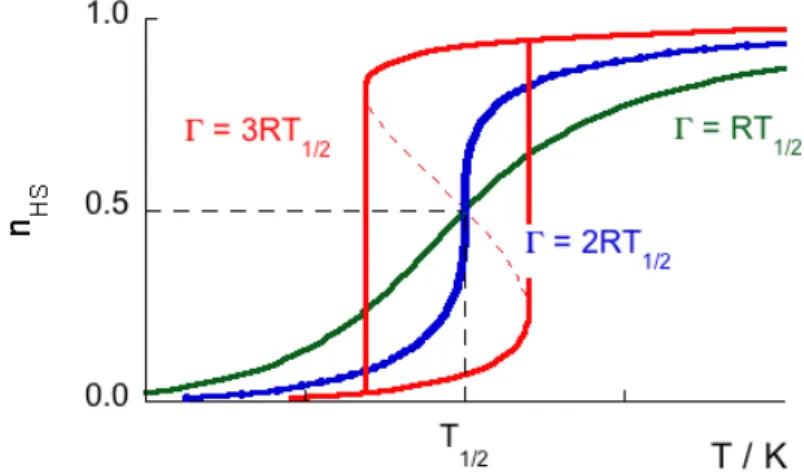
As shown in Figure 7, different features are considered depending on γ and T1/2 values:
- For γ < 2RT1/2, the cooperativity parameter is low, the derivative is always positive between nHS = 0 and 1 and the versus T curve is continuous. This process is named spin crossover (case of non- or weakly interacting complexes). - For γ = 2RTc, the derivative vanishes for nHS = 0.5, the transition curve is very
abrupt at T1/2 (case of strongly cooperative solids, designed by the term spin transition).
- For γ > 2RT1/2, the cooperativity is very high, the derivative vanishes for two values of nHS and thus the transition curve occurs with a thermal hysteresis corresponding to the two temperature extremes. The observation of a thermal hysteresis associated to a spin transition characterizes a first-order phase transition.
Figure 7: Variation of HS molar fraction versus temperature, calculated by Slichter and Drickamer model with ∆H = 7 kJ.mol-1, ∆S = 50 Jmol-1K-1n and T
This model allows an analysis of the spin crossover curve as a function of an interaction parameter and the thermodynamic ones.
I.1.2.2. Model of Sorai and Seki (Domain Model)
From experimental investigations based on heat capacity measurements of cooperative compounds Fe(II)(phen)2(X)2[11] and others;[12] (with phen = 1,10-phenanthroline, X = NCS and NCSe), Sorai and Seki have considered that the molecules with the same spin state form domains and thus, interact in the crystal lattice. The size of these domains is unchanged whatever the temperature value. These authors have introduced two related parameters:“N”, the number of domains per mole of compound and “n” , the number of molecules per domain (nN=1). In the molar Gibbs energy, the mixing entropy Smix was developed as :
ln ln 1 ln 1
The relationship between temperature and HS fraction was extracted from the equation )T, P = 0,
1
1 exp ∆ 1 1
/
including the number of molecules per domain “n”. The larger the n value (or the larger the size of domain), the smaller the N number of domains, and the more abrupt the transition. This approach was applied to the analysis of very abrupt transformations without hysteresis. I.1.2.3. Model of Spiering
In the previous phenomenological approaches, the intermolecular interactions were taking into account without considering their physical origin. Spiering has proposed an interesting model based on the elasticity properties and their fundamental role on the cooperativity of spin-crossover materials.[13] The latter results from the local lattice distorsion associated to the relatively large variation of metal-ligand bond distances (ca. 10 %) and the propagation of the strain fields in the crystal.
In this model, the spin-crossover centers are described by hard spheres (of HS and LS volumes) inserted into holes (of fixed sizes) within an homogeneous, isotropic and elastic medium. It can be shown that this model leads to an equation similar to the one of Slichter
and Drickhamer model except that the interaction term (-2nHS) should be replaced by (1-2nHS). The and terms are parameters depending on the difference of volume between the HS and LS species and also on the bulk modulus of the cristal. In this model, the spin-crossover cooperativity related to long-range interactions increases with the difference of volume between the HS and the LS species and also with the stiffness of solid. This model was extended to the case of an anisotropic deformation of the spin crossover compound. I.1.2.4. Elastic Ising-like Model
The Ising-like approach derived from Wajnflasz[14] works has been widely developed for the simulation of spin crossover curves and the analysis of size effects on the spin transition. The metal center is modeled by a system with two levels, with distinct degeneracies, each level corresponding to a given electronic configuration.[15] The Ising Hamiltonian can be written as
∆ 2
where J is the interaction parameter between the centers, i = 1 stands for fictitious spin of the i center (-1: for LS state, +1: for HS state), ∆eff(T) stands for ∆eff = (∆ - (kBT/2)ln g) in which ∆ is the energy difference between the LS and HS states, and g is the degeneracy ratio g = gHS/gLS between HS and LS states. The transition temperature corresponds to ∆eff = 0, 2∆ = (kBT1/2)ln g. This Hamiltonian was solved in the mean-field approximation. Bousseksou and coworkers have modified this Ising-like model to take into account the contribution of intramolecular vibrations within the thermodynamical parameters.[15a, 16]
I.2. Examples of iron SCO Systems
Numerous classes of spin-crossover materials (based on Fe(II), Fe(III) and Co(II) mononuclear compounds, polynuclear compounds, coordination polymers are described in different reviews.[7b, 17]
I.2.1. Monomeric SCO Systems
The structural analyses allow distinguishing packing controlled by intermolecular forces in between the complexes (case of electrically neutral complexes) and/or involving counter-ions, possibly solvent molecules (case of charged complexes). The versatility of molecular packing
is shown by polymorphism that can be exploited for analyzing the magnetostructural relationship. In the following, some examples are described.
I.2.1.1. Intermolecular Interactions Influence
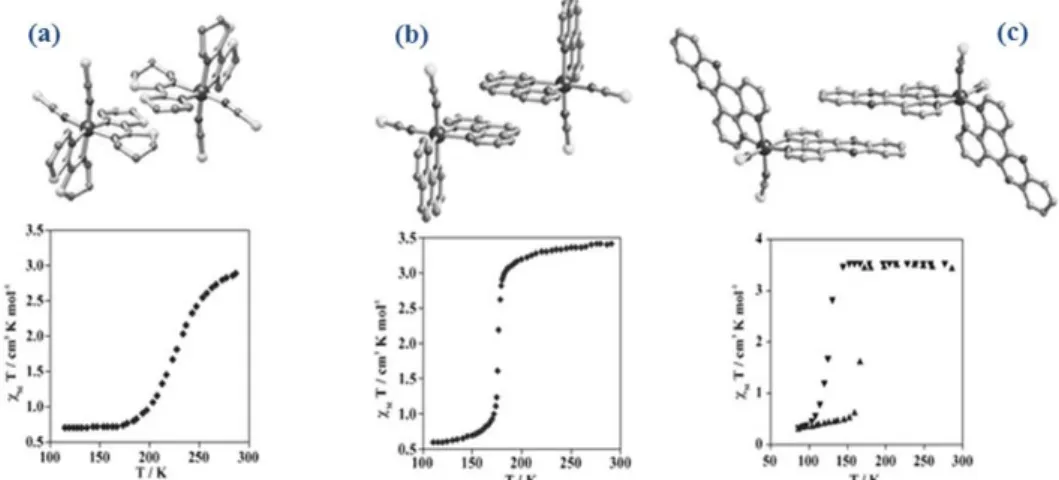
The spin-crossover behavior and the cooperative character of molecular materials critically depend on the intermolecular interactions (hydrogen bonding, aromatic - stacking interactions or Van der waals interactions). In Figure 8 is shown the thermal properties observed for a family of Fe(L)2(NCS)2 spin-crossover compounds isolated with [N2] bidentate ligands (L being btz = 2,2’-bithiazoline, phen = 1,10-phenanthroline or dppz = dipyrido[3,2-a:2’,3’-c]phenazine). The bidentate ligands are aliphatic and distorded (btz), aromatic (phen) or aromatic with an extended system (dppz). From the magnetostructural analysis of these similar compounds, it was pointed the importance of intermolecular interaction based on -stacking interactions. In their absence (btz) the molecular packing only results from Van der waals contact while in presence of - stacking effects involving the polyaromatic ligand (phen and dppz), the solids were structured in densely packed and strongly interacting complexes in a 2-D organization. The strong cooperativity manifested here by the abrupt transition (phen) and the occurrence of a thermal hysteresis (dppz) is directly related to the structuration of these solids via a network of strong -stacking interactions.[18] Therefore, the presence of -stacking interactions, together with their strength and directionality, are important parameters that have been exploited for the design of cooperative and bistable solids. It can be added that the crystallization of the compound synthesized with dppz with a solvent molecule also influences the magnetic behavior.
Figure 8: Structure representation of intermolecular interactions and magnetic properties of the complexes: Fe(btz)2(NCS)2 (a), Fe(phen)2(NCS)2 (b), Fe(dppz)2(NCS)2.pyridine (c).[18]
I.2.1.2. Importance of Polymorphism
The polymorphism known as the ability of a compound to exist at least in two crystalline forms characterized by distinct arrangements (or architectures, conformations) of molecules in the solid is common property in the material science. Tao and coworkers have reviewed the importance of polymorphism on the spin-crossover properties.[19] One nice example is provided by the fac-[Fe(dppa)2(NCS)2] compounds (where dppa = 3-aminopropyl-bis(2-pyridylmethyl)amine) which crystallize in the form of yellow green plates A (triclinic space group P1), yellow prisms B (monoclinic space group P21/c), and pale yellow elongated hexagonal plates C (orthorhomic space group Pbca). The magnetic behaviors of these polymorphs, determined from variable temperatures magnetic susceptibility measurements, are: (A) a gradual and complete spin crossover (at at T1/2 ~ 176 K); (B) a paramagnetic behavior corresponding to a S=2 state; (C) a very cooperative transition with a 8 K hysteresis loop (at T1/2 = 120 K).
I.2.1.3. Influence of Solvent Molecules
The solvent molecule inserted in the lattice via supramolecular effects (-stacking, hydrogen bonding or Van der Waals interactions), necessarily impacts the solid-state properties of spin-crossover compounds. As shown in literature, it may modulate the ligand-field strength (as a consequence of interaction with the donor atoms), contribute to the collective transformation of the lattice (propagation of elastic deformations) or play a role of spacer leading to the unit-cell expansion. Their influence on the spin-crossover process is related to the nature, strength and dimensionality of interactions in the range of temperature of the process. In the family of Fe(2-pic)3Cl2.S complexes (2-pic = 2-picolylamine and S = water, methanol, ethanol) studied by Gütlich and coworkers,[20] the ground state properties of complexes clearly depend on the nature of the solvent molecule. The dihydrate compound (triclinic phase, P1) exists in a LS form at any temperature. The monohydrate compound exhibits a spin transition with a huge hysteresis (Tup = 295 K, Tdown = 204 K). The methanolate derivative (orthorhombic phase, Pbca) shows a gradual spin crossover centered at T1/2 = 150 K. Finally, the compound isolated with ethanol (monoclinic, P21/c), characterized by a two-step process centered at 121 K, was shown to result from a symmetry breaking upon successive order-disorder phase transitions that are coupled to the spin crossover process and involving the solvent molecule.[21]
I.2.1.4. Influence of Non-Coordinating Anions
The importance of crystalline structure on the spin-crossover properties was also illustrated in the case of non-coordinating anions. Lemercier and co-workers[22] have investigated a family of [Fe(TRIM)2(A)x.S] (TRIM = 4-(4-imidazolylmethyl)-2-(2-imidazolylmethyl)imidazole, A = F-, Cl-, Br- (S = MeOH), I- (S = MeOH)) complexes. The hydrogen bonding interactions between anions and imidazole rings affect the ligand field strength around the metal center, as demonstrated by an impressive variation of the characteristic temperature of the spin crossovers ([Fe(TRIM)2](F)2 that is essentially HS above 50 K, [Fe(TRIM)2](I)2.MeOH), T1/2 = 380 K). The trend observed by the authors supports a decrease of the temperature of spin transition with an increase of inductive effect (or halides electronegativity).[22]
I.2.2. Polymeric SCO Systems
The role of intermolecular interactions in cooperative solids can be played by ligands bridging several metal centers in coordination polymers. Such polymers (one-, two or three-dimensional systems) form classes of robust spin-transition materials with enhanced cooperative properties.[7a, 7c, 18]
I.2.2.1. One-dimensional SCO Systems
The chemistry of N-donating ligands based on triazole with iron(II) ions initiated at Novosibirsk and Leiden,[24] has led to one of the most investigated series of spin-transition polymeric materials.[18, 25] Kröber and co-workers have reported the very abrupt spin transition of Fe(H-trz)2(trz)(BF4), centered at 365 K with a large hysteresis (T1/2 = 385 K, T1/2 = 345 K) and analyzed this finding in the perspective of the design of molecular memory.[23]
Figure 9: Temperature dependence of MT
of [Fe(H-trz)2(trz)](BF4) complex; where H-trz is 1,2,4-1H-triazole.[23]
I.2.2.2. Two-dimensional SCO Systems
Vreugdenhil and co-workers have elaborated with a bis-triazole derivative the neutral Fe(btr)2(NCS)2.H2O (where btr is 4,4’-bis-1,2,4-triazole) 2D compound[26] whose single-crystal X-ray structure (in Figure 10) shows a 2D network of interconnected Fe(II) sites.
The successive plans also interact via a hydrogen bonding interaction between a water molecule and the non-bonded nitrogen atom of the triazole moiety. The strongly cooperative spin transition at ca. 134 K associated to a 20 K hysteresis characterizes the monohydrated compound. By replacing bis-triazole by another bidentate and rigid spacer, the 4,4’-bipyridine, in the 2D Fe(bipy)2(NCX)2.Solv (X = S or Se, Solv = 4CHCl3) compound, Adam and co-workers have reported a special example of a cooperative spin transition occurring in two steps and thermal hysteresis (X=S) or a half spin transition (X=Se).[27] These behaviors were accounted for by a spin state switching coupled to a crystal phase transition and a change of space group.
I.2.2.3 Three-dimensional SCO Systems
A 3D structure, based on the coordination of three 4,4’-bis-1,2,4-triazole per Fe(II) ion in a Fe(btr)3(ClO4)2 compound (Figure
11) in presence of a non coordinating anion, was described by Garcia and co-workers.[28] The magnetic behavior consists in a two-steps spin transition, a gradual one at high temperature and a cooperative one with a thermal hysteresis at low temperature (Figure 12). The first order phase transition manifested by the thermal hysteresis preserves the space group of the solid. Thus the stepwise behavior was rationalized as
Figure 10 Structural representation of Fe(btr)2(NCS)2.H2O complex
Figure 11: Coordination sphere of the Fe(II) center (a) and its 3D connectivity (b) in Fe(btr)3(ClO4)2. The
hydrogen atoms and the perchlorate anions are omitted for clarity.[18, 28]
resulting from successive conversions of two complexes with slightly different ligand-field strengths and environments in the unit-cell.
More recently, a series of 3D Hofmann-like frameworks exhibiting unique spin-crossover properties has been developed in Valencia and
in Kyoto.[29] In the
Fe(pyrazine)2[MII(CN)4].2H2O (where M is Ni, Pd, Pt) compounds, the Fe(II) ions bound to tetracyanometallates form dense planes that are interconnected via the coordination of Fe(II) to bidentate spacers like pyrazine (in Figure 13: structure of Fe(pyrazine)2[PtII(CN)4].2H2O). As shown by Niel and co-workers,[30] this family of porous coordination polymers displays strongly cooperative spin transitions and bistabilities centered around room temperature. The bistability can be chemically modulated by guest molecules (gas, solvent) and detected by thermochromism, findings that have been investigated for applications as sensors.[30]
The importance of the lattice stiffness and dimensionality of framework on the magnetic bistability was nicely demonstrated by the comparison between the properties of Hofmann-like frameworks build with a pyrazine (3D structures) and a pyridine (2D analogues) linker. As displayed in Figure 14, both the characteristic T1/2 temperature (stabilization of LS species in the more rigid structure) and the width of hysteresis (extended cooperative interactions) increase in 3D structures with respect to the 2D ones.
Figure 12: Temperature dependence of the MT product of Fe(btr)3(ClO4)2 complex.[28]
Figure 13: Structure of the 3D Hofmann-like frameworks of Fe(pyrazine)2PtII(CN)4.2H2O.[30]
Figure 14: Comparison of temperature independence of the MT of 2D Fe(pyridine)2[MII(CN)4] (1a-c)
with 3D Fe(pyrazine)2[MII(CN)4].2H2O (2a-c) where M = Ni (a), Pb (b), Pt (c).[30]
I.3. Light-Induced Spin-Crossover : The LIESST Approach
Light-induced phenomena are important for triggering the spin state switching in molecular materials as they allow efficient and rapid transformations that may be implemented by playing with a number of variable parameters in size-reduced systems. The first light-induced spin-state change of a spin-crossover compound was recognized by McGarvey and co-workers.[31] The authors have used the nanosecond laser irradiation to perturb the equilibrium between the singlet (1A) and quintet (5T) states of different iron(II) complexes in solutions. The excitation with a wavelength lying in the LS metal-ligand charge transfer (MLCT, (d)6(*)0 to (d)5(*)1 transition) absorption band has provided spectroscopic evidences for the formation of transient HS species and has allowed the kinetic analysis of the ground state recovery. In 1984, Decurtins and coworkers revealed that the irradiation at cryogenic temperature of a iron(II) spin-crossover single-crystal with a green Ar+ laser produces a quantitative LS to HS conversion as the HS form remains trapped during hours if the temperature is lower than 50 K. The discovery of this phenomenon named “Light-Induced Excited Spin State Trapping” (LIESST) was followed by the one of the reverse-LIESST effect by Hauser,[32] who has resolved the mechanism shown in Figure 15.[33]
In Figure 15, the green light (λexc = 514.5 nm) induces the excitation from the ground state1A1 (LS state) to the excited spin singlet MLCT or ligand-field (LF) states. These excited states have short lifetimes and relax within picoseconds to the lowest LS excited state, 1T1. The relaxation to the ground state may take place via two ways, one way back to the ground state (1A1) via the spin triplet state 3T1, another way from 3T1 to the metastable HS state (5T2). At low temperature, the metastable HS state has a very long lifetime. Indeed, a radiative process is forbidden (S=2 spin-state change). The thermal relaxation process, that is determined by the overcoming of the energy barrier between the two potential wells, requires relatively high temperature. The low temperature relaxation rates are controlled by the nuclear tunneling effect. Thus depending on the compound, the trapping of HS state may be observed during weeks at sufficiently low temperature. As shown in Figure 15, the reverse-LIESST effect occurs by irradiating with red light (λexc = 820 nm) the compound prepared at low temperature in the metastable HS state. The excitation induces the transition from 5T2 to 5E states and then the excited 5E state relaxes to the 1A1 ground state via the 3T1 state.
A number of iron(II) SCO materials exhibiting the LIESST effect has been reported and Létard and co-workers have proposed to use a TLIESST temperature for the comparison of their HS to LS relaxation properties. The TLIESST value corresponds to the temperature at which the derivative of the physical response (like magnetization) is optimal (for comparison purpose the scanning rate of the measurement should be 0.3 K min -1).[34] From this database, it was possible
Figure 15: Schematic of proposed mechanism of LIESST and reverse-LIESST effects of iron (II) SCO complexes.[18]
Figure 16: Variation of TLIESST versus T1/2, the
characteristic temperature at which the conversion is halfway completed.[34]
to show main tendencies in the plot of TLIESST versus T1/2 (Figure 16).
In Figure 17 is plotted the variation of the MT product vs the temperature for a compound undergoing a strongly cooperative spin transition associated to a thermal hysteresis.
The in-situ photoexcitation at 10 K was revealed by the increase of MT value from a value typical for a LS species up to the value expected for a fully HS species. The light was switched off and the measurement was pursued up to ca. 100 K in darkness. A plateau was observed up to ca. 100 K and above this temperature, the signal decayed down to values expected for the LS ground state as in this range of temperature, the relaxation rate became much larger than the typical time scale of the technique. These observations characterize a photomagnetic effect associated to the LIESST effect. I.4. Light Induced Spin Change based on LD-LISC Process
I.4.1. Introduction
As mentioned above, the discovery of the LIESST effect has demonstrated the possibility to control the spin-state of molecular materials by light and the present investigations focus on mechanism, dynamic of the underlying molecular and solid-state processes, and also on systems and conditions required for slowing down the LIESST relaxation even at temperature close to the ambient one.[34] It was recently reported that convenient optical excitation may convert a spin-transition material within the hysteresis loop centered around room temperature but this requires nanosecond laser with important heating effects.[35]
One prototypical molecular system whose geometric and electronic structure efficiently switch upon light irradiation is the retinal, the polyene chromophore in the visual system. The investigation of this primary transformation, as those of a number of photoresponsive compounds (like spiropyran, spiroxazine, chromene, fulgide, diarylethene, stilbene or azobenzene)[36] constitutes the active field of photo-chemistry and photophysic. The
Figure 17: Temperature dependence of MT for
Fe(bpp)2(BF4)2 showing the thermal spin-crossover
(), the effect of light irradiation at 10 K (), and the T(LIESST) experiment ().[34]
properties of these materials based on organic (and more scarcely inorganic)[37] components were explored for fundamental knowledge and technological applications (such as optical switches in memory devices, optical information storage and display devices).[5]
Therefore, Zarembowich and coworkers have proposed an original approach for elaborating non-destructive optical memories based on the coupling between a photoresponsive ligand and a spin-crossover complex. The approach named Ligand-driven light-induced spin change effect allows the separation of the writing/erasing (ligand functionality, for example trans-cis photoisomerization of stilbenoids) and read-out (response of the spin-crossover ion). The light is used to switch the ligand structure and to modify the electronic environment of the metal ion (or ligand-field strength). A suitable variation of the ligand-field strength drives the spin-state conversion of the metal ion and the change of the related properties (Figure 18).
Figure 18: Scheme of LD-LISC complexes, in which the spin-crossover metal ion M is coordinated to a
photoisomerizable ligand.[38]
Figure 19: The magnetic behaviors of complexes (noted C1, C2) incorporating each isomer of ligand
are different on a range of temperature as a first one presents almost degenerated low-spin and high-spin states (high-spin-crossover case, C1) and the second one, a larger energy gap between the two spin
states (for example a stabilization of HS state, C2). The photoisomerization of ligands ( λ1, λ2 ) is
expected to trigger the reversible spin state conversion of the metal ion, when at the working temperature C1 is in the LS ground state (HS=0) and C2, in the HS state (HS = 1).[38-39]
The essential criterion of long lifetimes of photoisomers at ambient temperature is determined by the energy barriers between the ligand isomers and the ligand field strength of coordinating groups and thus on the molecular engineering.
I.4.2. LD-LISC Effect in Iron Complexes
I.4.2.1 LD-LISC Effect in Iron(II) Complexes
In the very first report on LD-LISC by Roux and co-workers,[39] the 4-styrylpyridine (stpy) was selected as photoisomerizable ligand. Each isomer being thermally stable because of energy barriers much higher than kT, the authors have incorporated each of them in Fe(II)(stpy)4(NCS)2 complexes (noted Ct or Cc depending on the trans- or cis-stpy isomer). The Ct complex exhibits a thermal SCO centered around 108 K whereas the Cc analogue remains in the HS state at any temperature (in Figure 20). It was checked that as expected, the ligand-field strength was determined by the ligand configuration and was strongly enhanced for the most planar isomer (trans-stpy). One limitation pointed here was the temperature required for probing the photoisomerization and any LD-LISC effect as for such values (T < 100 K) the values reported for quantum yields of isomerization are especially weak.
Figure 20: Molecular structures of Fe(cis-stpy)4(NCS)2 (a) and Fe(trans-stpy)4(NCS)2 (c) complexes
at 293 K; The hydrogen atoms are omitted for clarity. Temperature dependence of the MT product
for both complexes (b).[39]
Therefore the working temperature was shifted to higher values by varying the anionic ligand (X- = NCBH3-, NCBPh3-) and increasing the ligand field strength.[40] Boillot and co-workers have demonstrated the LD-LISC effect at 140 K with Fe(stpy)4(NCBPh3)2 complexes processed in cellulose acetate films. Optical measurements were used to analyze the thermal spin crossover as well as the temperature independent behavior of Ct and Cc, respectively. The comparison between these spectra and those collected after the thin films irradiation (T =
140 K, λct = 260 nm and λtc = 322 nm) indicated the formation of photostationary states containing the photoisomers with the corresponding spin states as shown by the temperature dependence of their spectra (Figure 21).
Figure 21: Temperature dependence of MT for Fe(stpy)4(NCBPh3)2 complexes (a). The 140 K
UV-visible spectra of Fe(stpy)4(NCBPh3)2 in cellulose acetate film before and after the irradiation: (b) Ct
irradiated at 322 nm, (c) Cc irradiated at 260 nm.[40]
The photomagnetism associated to the ligand isomerization was evidenced later with complexes of this series. The stilbenoids are strong UV absorber and thus a high dilution of samples in soft matrices was required for optimizing the light penetration and allowing the configurational changes of the -C=C- double bond. Conversely, the magnetic behavior of spin-crossover complexes processed in polymeric matrices is hardly determined by standard magnetic measurements, as, in such highly diluted samples, the paramagnetic responses become much more weaker than the diamagnetic ones. Therefore prior to this investigation conducted with NCSe analogues,[41] the magnetic properties of complexes dispersed in PMMA thin films were examined by magnetic circular dichroism measurements.[42] The working temperature for probing the LD-LISC activity was fixed at 130 K, as Cc was found in the HS state and Ct, partly in the LS state. The photomagnetic measurements were performed at 130 K on thin films irradiated (λexc = 355 nm) within the SQUID magnetometer. The results are presented in Figure 22.
Figure 22: (left) Molecular structures of Fe(stpy)4(NCSe)2 complexes ;(right) The evolution of PMMA films doped with Fe(stpy)4(NCSe)2 versus the irradiation time (exc = 355, 313 or 254 nm): the 130 K magnetization and optical absorption of the complex formed with trans-stpy (top) or cis-stpy (bottom) isomer.[41]
As the analyses of single-crystal X-ray structures indicated a large fraction of free-volumes in the unit cells of both Fe(II) compounds, this investigation was pursued on the crystalline samples.[43] Evidences were provided for an unidirectional and quantitative cis trans isomerization of stpy that was detected from a visible excitation corresponding to an MLCT pathway. This solid-state transformation has led to a large change of electronic environment of the metal ion as shown by the magnetic switching between a HS ground state (starting isomer with cis-stpy) and a spin-crossover behavior (photoproduct), this first observation in a pure solid was related to the LD-LISC effect.
The general method for increasing the working temperature up to room temperature, that is an important criterion for LD-LISC applications, consists to increase the ligand-field strength around the spin-crossover metal ion. This was achieved by substituting in the Fe(II) coordination sphere monodentate (pyridine derivatives) by bidentate (bipyridine derivatives) ligands. Boillot and
Figure 23: UV-visible spectra of an acetonitrile solution of Fe(trans-msbpy)2(NCS)2 before (a, initial spectrum) and after (b,
photostationary state) irradiation with λexc = 334 nm.[44]
FeII(HS)-cis stpy FeII(LS)-trans stpy FeII(LS)-trans stpy FeII(HS)-cis stpy
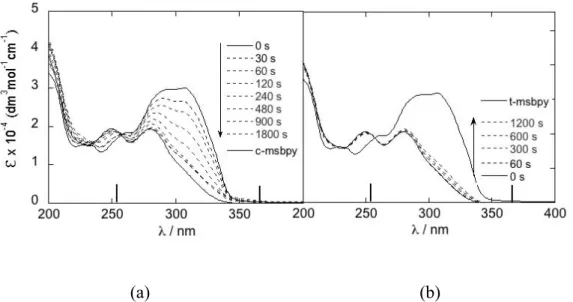
coworkers[44] have reported with Fe(trans-msbpy)2(NCS)2 (trans-msbpy = 4-methyl-4’-trans-styryl-2,2’-bipyridine) the first LD-LISC effect at room temperature in solution. Evidences of these ligand- and metal-centered transformations were provided by optical and NMR measurements (Figure 23).
Along this approach, the Nihishara’s team has elaborated Fe(II) complexes containing tridentate ligands[45] substituted by styryl group.
Figure 24: Photoisomerization of cis-(Z-2) to trans-(E-2) (a) and temperature dependence of MT for
Z-2 before and after its irradiation withvisible light (>420 nm) for 115 hours.[45a]
The Fe(cis-2,6-di(1H-pyrazol-1-yl)-4-styrylpyridine)2(BF4)2 complex (Z-2) was shown to react at solid state as shown in Figure 24. The visible irradiation induces a one way cis-to-trans photoisomerization and concomitantly the metal ion conversion between a HS species and a spin-crossover one leading to LD-LISC effect at room temperature (Figure 24).
Various photoactivable functions (isomerization of double-bond, electrocyclization, proton transfer) may be considered for triggering the spin-state conversion based on LD-LISC. Accordingly, different photochemical characteristics (excitation wavelength, quantum yield, thermal or optical reversion) of the organic part may be exploited in combination with the spin-crossover ones. Hasegawa and co-workers have investigated the properties of soluble [Fe(L)3](BF4)2.3H2O (L = phenyl(2-pyridin-2yl-3H-benzoimidazol-5-yl)diazene) complexes incorporating a bidentate ligand substituted by a azobenzene function. Upon the transformation of the spin crossover complex (Figure 25), which was induced by irradiating the solution at room temperature, a reversible change of magnetic susceptibility, i.e. a photomagnetic effect, was resolved by NMR measurements.
Diarylethene molecules offer enormous advantages (large and optically reversible photochromism, high quantum yields, resistance to fatigue and potentially crystalline photochromism) that have been exploited by a few groups in combination with spin-crossover type Fe(II) components. A solid-state photochromism was observed for a HS Fe(II) complex isolated with a diarylethene monopyridyl ligand.[47] It was concluded from the weak modulation of the paramagnetic susceptibility at room temperature, that a stronger ligand-field strength was required for ensuring a thermal spin crossover behavior of one photoresponsive complex and thus changing the metal ion spin state through the LD-LISC effect. Recently this issue was addressed with a neutral [Fe(bpz)2(phen)] complex ((bpz_=dihydrobis(1-pyrazolyl)borate) incorporating a bidentate photoactive phen ligand (phen = 5,6-bis(2,5-dimethyl-3-thienyl)-1,10-phenanthroline).[48] The authors have reported an efficient photoswitching of magnetic properties in solution at room temperature that was driven by the photocyclization/photocycloreversion of ligand. At solid-state, low temperature LIESST and reverse LIESST effects were required to achieve the reversible spin state switching of the spin-crossover compound as the latter crystallized with the inactive isomer of ligand.
I.4.2.2. LD-LISC Effect in Iron(III) Complexes
The LD-LISC approach may be applied to any metal ion capable of undergoing a spin crossover. It was probed with a few Fe(III) complexes including a pentadentate Schiff base and a monodentate photoswichable ligand. The spin crossover Fe(salten)(mepepy)BPh4 (H2salten = 4-azaheptamethylene-1,7-bis(salicylideneminate); mepepy =
1-(pyridine-4-yl)-2-Figure 25: (a) Schematic drawing of Fe(II) complexes; (b) Temperature dependence of MT for the
trans-complex in solid state; (c) room temperature UV-Visible spectra of the trans-complex in acetone (solid line), in photostationary states obtained after irradiation at 365 nm (dotted line) and 436 nm (broken line).[46]
(N-methylpyrrol-2-yl)ethane)[49] compound was investigated in solution with RMN and optical measurements which indicated that the trans cis isomerization of the –CH=CH- group here induced with blue light was associated to a slight decrease of the 293 K magnetic susceptibility. Analogues of this complex with styrylpyridine isomers were reported by Hirose and coworkers.[50] The phenylazopyridine was selected by Bannwarth and coworkers[51] for studying the switching properties of Fe(salten)(3-azpy)BPh4 and Fe(salten)(4-azpy)BPh4 spin crossover complexes in solutions. The fact that the photoisomerization of azpy coordinated to a Fe(III) ion - predominantly HS - was associated to a very small magnetic change was rationalized from DFT calculations. In view of the larger effects detected with Fe(II) complexes, the authors have proposed to account for the results by the weakness of -backbonding in Fe(III) complexes and the limitation due to an unique photoactive center per metal ion.
I.5. SCO Nanomaterials and Thin Films
I.5.1. Elaboration of Nanoparticles: Fundamental Concept
It is well established that materials processed at nanoscale present unique properties as a consequence of their limited size, the importance of surface over volume ratio or their shape considerably impact chemical (for instance reactivity) or physical (collective or macroscopic) properties. The nanoparticles are elaborated by different approaches such as the top-down approach (based on physical techniques) or the bottom-up approach (based on colloidal chemistry). The research in this area has been intensified as today, applications of nanoparticles in electronic devices, medicine, chemical catalysis demonstrate the considerable potentialities related to the nanoscale control of properties.
The chemical approach used for the elaboration of nanoparticles lies on the solid precipitation in solution. The nucleation and growth processes that should be controlled have been rationalized by a kinetic model first proposed by LaMer and co-worker.[52] The formation of particles in a solvent occurs as soon as the solute concentration exceeds the compound solubility at equilibrium. Therefore, the formation of particles requires the use of supersaturated solution, that is prepared by going away from equilibrium for example with the compound dissolution at high temperature followed by a sudden cooling (or by adding reactants). At this stage, the precipitation takes place through nucleation and growth processes.[53] One distinguishes the homogeneous nucleation corresponding to the formation of small nuclei. The driving force of this reaction is the thermodynamical instability of the
supersaturated solution that is reflected by the balance in overall free energy G between a negative term, the free energy variation associated to the solid formation and a positive term, the energy required for the appearance of a liquid-solid interface (Figure 26):
∆ 4 ln 4
V being the volume of the precipitated species; r, the radius of the nuclei, kB, the Boltzmann constant; S, the supersaturation ratio, and , the surface free energy per unit of surface area.
Figure 26: Curve of the overall free energy G as a function of the particle size r corresponding to the case of a supersaturation solution.[53b]
When S > 1 (supersaturation case, Figure 27), G shows a positive maximum at a critical size, r*. The critical nuclei r* can be calculated from dG/dr = 0:
∗ 2
3 ln
The maximum of free energy G* is the activation energy for nucleation. The larger nuclei with r > r* will be stabilized (decrease of G) by additional growing while, the smaller ones (r < r*) will be dissolved. The formation of seeds (step I in Figure 27) reduces the concentration of solute and leads to the slowing down, stopping of nucleation reactions. This is followed by the step of nuclei growing (step II in Figure 27), which takes place till the solute concentrations reach the values associated to the equilibrium state. During this step, the growth of smaller particles is the quickest as a consequence of a more important driving force. The slow evolution - the Ostwald ripening - (step III in Figure 27) occurs when the solute concentration becomes closer to the limit of solubility. The small particles, that are unstable, dissolve and the deposition of of matter onto larger particles gives rise to the broadening of size distributions.[52, 54]

![Figure 32: Schematic procedure of the layer by layer assembly approach of Fe(pz)[Pt(CN) 4 ] thin films](https://thumb-eu.123doks.com/thumbv2/123doknet/14669506.741405/46.892.136.745.468.726/figure-schematic-procedure-layer-layer-assembly-approach-films.webp)
 2 .2CH 3 OH at 100 K. Hydrogen atoms are omitted for clarity](https://thumb-eu.123doks.com/thumbv2/123doknet/14669506.741405/57.892.137.747.255.646/figure-molecular-structure-ncse-hydrogen-atoms-omitted-clarity.webp)
 2 .3H 2 O performed at 2 °C/min under air atmosphere](https://thumb-eu.123doks.com/thumbv2/123doknet/14669506.741405/60.892.194.697.107.479/figure-tga-analysis-fe-bpy-ncse-performed-atmosphere.webp)