HAL Id: tel-02974989
https://tel.archives-ouvertes.fr/tel-02974989v2
Submitted on 7 Jan 2021
HAL is a multi-disciplinary open access archive for the deposit and dissemination of sci-entific research documents, whether they are pub-lished or not. The documents may come from teaching and research institutions in France or abroad, or from public or private research centers.
L’archive ouverte pluridisciplinaire HAL, est destinée au dépôt et à la diffusion de documents scientifiques de niveau recherche, publiés ou non, émanant des établissements d’enseignement et de recherche français ou étrangers, des laboratoires publics ou privés.
Privacy challenges in wireless communications of the
Internet of Things
Guillaume Celosia
To cite this version:
Guillaume Celosia. Privacy challenges in wireless communications of the Internet of Things. Net-working and Internet Architecture [cs.NI]. Université de Lyon, 2020. English. �NNT : 2020LYSEI069�. �tel-02974989v2�
Nod’ordre NNT : 2020LYSEI069
THÈSE DE DOCTORAT DE L’UNIVERSITÉ DE LYON
opérée au sein de INSA Lyon École Doctorale ED 512 InfoMaths Spécialité/discipline de doctorat : InformatiqueSoutenue publiquement le 22/09/2020, par :
Guillaume CELOSIA
Privacy Challenges in Wireless
Communications of the Internet of Things
Devant le jury composé de :
Kasper RASMUSSEN Associate Professor Univ. of Oxford Rapporteur Bernard TOURANCHEAU Professeur des Universités Univ. Grenoble Alpes Rapporteur Sonia BEN MOKHTAR Directeur de Recherche CNRS Examinateur Jean-Marie GORCE Professeur des Universités INSA Lyon Examinateur Vincent NICOMETTE Professeur des Universités INSA Toulouse Examinateur Valérie VIET TRIEM TONG Professeur CentraleSupélec Examinateur Daniel LE MÉTAYER Directeur de Recherche Inria Directeur de thèse Mathieu CUNCHE Maître de Conférences INSA Lyon co Directeur de thèse
Cette thèse a été préparée à :
Laboratoire CITI (Centre d’Innovation en Télécommunications et Intégration de
services) – INSA Lyon Bâtiment Claude Chappe
6 Avenue des Arts 69100 Villeurbanne
France
dans le cadre de :
Équipe Inria PRIVATICS Centre Inria Grenoble – Rhône-Alpes
Inria – Antenne Lyon – La Doua Bâtiment CEI-2
56 Boulevard Niels Bohr 69100 Villeurbanne
France
sur un financement de :
Département FEDORA – INSA Lyon – Écoles Doctorales – Quinquennal 2016-2020
SIGLE ÉCOLE DOCTORALE NOMRESPONSABLEET COORDONNÉES DU
CHIMIE CHIMIE DE LYONhttp://edchimie-lyon.fr Sec. : Renée EL MELHEM Bâtiment Blaise Pascal – 3eétage
INSA : R. GOURDON
M. Stéphane DANIELE
Institut de Recherches sur la Catalyse et l’Environnement de Lyon
IRCELYON-UMR 5256 Équipe CDFA
2 Avenue Albert Einstein 69100 Villeurbanne
[email protected] E.E.A. ÉLECTRONIQUE,ÉLECTROTECHNIQUE, AUTOMATIQUE
http://edeea.ec-lyon.fr
Sec. : M.C. HAVGOUDOUKIAN
M. Gérard SCORLETTI École Centrale de Lyon 36 Avenue Guy de Collongue 69130 Ecully
Tél. : 04 72 18 60 97, Fax : 04 78 43 37 17
[email protected] E2M2 ÉVOLUTION, ÉCOSYSTÈME,MICROBIOLOGIE, MODÉLISATION
http://e2m2.universite-lyon.fr
Sec. : Sylvie ROBERJOT Bâtiment Atrium, UCB Lyon 1 Tél. : 04 72 44 83 62
INSA : H. CHARLES
M. Philippe NORMAND
UMR 5557 Lab. d’Écologie Microbienne Université Claude Bernard Lyon 1 Bâtiment Mendel
43 Boulevard du 11 Novembre 1918 69100 Villeurbanne
EDISS INTERDISCIPLINAIRE SCIENCES-SANTÉ http://ediss-lyon.fr
Sec. : Sylvie ROBERJOT Bâtiment Atrium, UCB Lyon 1 Tél. : 04 72 44 83 62
INSA : M. LAGARDE
Mme Sylvie RICARD-BLUM
Institut de Chimie et Biochimie Moléculaires et Supramoléculaires
ICBMS-UMR 5246 CNRS, Univ. Lyon 1 Bâtiment Curien – 3eétage Nord
43 Boulevard du 11 Novembre 1918 69100 Villeurbanne
Tél. : 04 72 44 82 32
[email protected] INFOMATHS INFORMATIQUE ETMATHÉMATIQUES
http://edinfomaths.universite-lyon.fr
Sec. : Renée EL MELHEM Bâtiment Blaise Pascal – 3eétage
Tél. : 04 72 43 80 46 [email protected] M. Hamamache KHEDDOUCI Bâtiment Nautibus 43 Boulevard du 11 Novembre 1918 69100 Villeurbanne Tél. : 04 72 44 83 69 [email protected]
Matériaux MATÉRIAUX DE LYONhttp://ed34.universite-lyon.fr Sec. : Stéphanie CAUVIN Bâtiment Direction Tél. : 04 72 43 71 70 [email protected] M. Jean-Yves BUFFIÈRE INSA Lyon MATÉIS Bâtiment Saint-Exupéry 7 Avenue Jean Capelle 69100 Villeurbanne
Tél. : 04 72 43 71 70, Fax 04 72 43 85 28
[email protected] MEGA MÉCANIQUE, ÉNERGÉTIQUE, GÉNIECIVIL, ACOUSTIQUE
http://edmega.universite-lyon.fr
Sec. : Stéphanie CAUVIN Bâtiment Direction Tél. : 04 72 43 71 70 [email protected] M. Jocelyn BONJOUR INSA Lyon Laboratoire CETHIL Bâtiment Sadi-Carnot 9 Rue de la Physique 69100 Villeurbanne [email protected] ScSo ScSo* http://ed483.univ-lyon2.fr
Sec. : Véronique GUICHARD Tél. : 04 78 69 72 76
INSA : J.Y. TOUSSAINT
[email protected] M. Christian MONTES Université Lyon 2 86 Rue Pasteur 69007 Lyon [email protected]
Remerciements
La réalisation de cette thèse a été possible uniquement grâce au concours de plusieurs personnes auxquelles je souhaite adresser mes remerciements, mon respect, et ma gratitude. En particulier...
...à mon encadrant, Mathieu Cunche, pour ta confiance, ainsi que pour le travail scientifique et administratif fourni;
...à mon directeur de thèse, Daniel Le Métayer, pour tes conseils avisés;
...aux assistantes d’équipe, Helen Pouchot, Aurélie Reymond, et Linda Soumari, pour la facilitation des démarches administratives, aussi nombreuses et interminables furent-elles; ...à Célestin Matte, à Alexis Duque, au groupe de recherche Furious MAC de la United States Naval Academy, ainsi qu’aux examinateurs de la conférence PETS, pour leurs idées, pour le partage d’un corpus de traces de trafic réseau (voir Section III.5.4.1), et pour leurs commentaires perspicaces en vue d’améliorer les articles scientifiques publiés;
...à mon Arnestre1, pour tes bons petits plats, et pour les parties de rigolade que nous avons partagé ensemble. Merci également d’avoir fait vivre en moi cette passion pour l’informatique, pour les valeurs de la vie que tu m’as inculqué, ainsi que pour l’éducation exemplaire que j’ai eu la chance de recevoir de ta part;
...à mon Simi1, pour ces soirées films endiablées, et pour ces innombrables maux que tu as su soigner de tes mains d’or. Merci pour nos discussions, pour cet idéal que tu représentes quotidiennement et vers lequel j’ambitionne à tendre, ainsi que pour avoir façonné de ta bienveillance la personne que je suis aujourd’hui;
...à mon Didodu1, pour ces années passées à tes côtés, pour ces sessions de jeux vidéos déjantées, et pour cette complicité que nous avons su entretenir pendant plus de vingt-deux ans. Merci d’être ce frère extraordinaire, qui nourrit ma culture sur des sujets divers et variés, et qui fleurit mon chemin de vie de par sa simple présence;
...à ma Memel1, pour ton amour, pour ton soutien permanent, et pour nos longs débats métaphysiques qui réchauffent mon cœur. Merci pour toutes ces fois où tu as su trouver les mots justes afin de me permettre d’avancer significativement dans mes recherches. Tout au long de cette thèse tu as été mon atout majeur, et je t’en serai éternellement reconnaissant.
1. Cette thèse est l’aboutissement d’une longue période durant laquelle vous n’avez jamais cessé de croire en moi. Ce manuscrit vous est intégralement dédié. “Unis nous sommes, unis nous avons vaincu, unis nous vaincrons“.
“Moi, l’informatique, je n’y comprends ria.“ Arnestre de Saint-Barthre
Résumé
Également connue sous le nom d’Internet des Objets (IdO), la prolifération des objets connectés offre des opportunités sans précédent aux consommateurs. Des moniteurs d’acti-vité physique aux assistants médicaux, en passant par les appareils électroménagers pour maisons intelligentes, les objets IdO évoluent dans une pléthore de domaines d’application. Cependant, les avantages qu’ils peuvent apporter à notre société augmentent conjointement avec leurs implications en matière de vie privée. Communiquant continuellement de précieuses informations par le biais de liaisons non filaires telles que le Bluetooth et le Wi-Fi, ces appareils connectés accompagnent leurs propriétaires dans leurs activités. La plupart du temps émises sur des canaux ouverts, et parfois en l’absence de chiffrement, ces informations sont alors facilement accessibles pour tout attaquant passif à portée. Dans cette thèse, nous explorons deux problèmes de vie privée majeurs résultant de l’expansion de l’IdO et de ses communications sans fil : le traçage physique et l’inférence d’informations utilisateurs. Sur la base de deux grands ensembles de données composés de signaux radio issus de périphériques Bluetooth/BLE, nous mettons d’abord en échec les fonctionnalités anti-traçage existantes avant de détailler plusieurs applications invasives pour la vie privée. En s’appuyant sur des attaques passives et actives, nous démontrons également que les messages diffusés contiennent des informations en clair allant des caractéristiques techniques des appareils aux données personnelles des utilisateurs telles que des adresses e-mail et numéros de téléphone.
Dans un second temps, nous concevons des contre-mesures pratiques pour résoudre les problèmes de vie privée identifiés. Dans ce sens, nous fournissons des recommandations aux fabricants, et proposons une approche afin de vérifier l’absence de failles dans l’implé-mentation de leurs protocoles.
Enfin, dans le but d’illustrer davantage les menaces de vie privée enquêtées, nous implé-mentons deux démonstrateurs. Par conséquent, Venom introduit un système de traçage physique visuel et expérimental, tandis qu’Himiko propose une interface humaine permet-tant d’inférer des informations sur les appareils IdO et leurs propriétaires.
Mots-clés : Vie privée; Réseaux sans fil; Internet des Objets; Objets connectés; Traçage physique; Inférence d’informations utilisateurs; Bluetooth; BLE.
Abstract
Also known as the Internet of Things (IoT), the proliferation of connected objects offers unprecedented opportunities to consumers. From fitness trackers to medical assistants, through smarthome appliances, the IoT objects are evolving in a plethora of application fields.
However, the benefits that they can bring to our society increase along with their privacy implications. Continuously communicating valuable information via wireless links such as Bluetooth and Wi-Fi, those connected devices support their owners within their activities. Most of the time emitted on open channels, and sometimes in the absence of encryption, those information are then easily accessible to any passive attacker in range.
In this thesis, we explore two major privacy concerns resulting from the expansion of the IoT and its wireless communications: physical tracking and inference of users information. Based on two large datasets composed of radio signals from Bluetooth/BLE devices, we first defeat existing anti-tracking features prior to detail several privacy invasive applications. Relying on passive and active attacks, we also demonstrate that broadcasted messages contain cleartext information ranging from the devices technical characteristics to personal data of the users such as e-mail addresses and phone numbers.
In a second time, we design practical countermeasures to address the identified privacy issues. In this direction, we provide recommendations to manufacturers, and propose an approach to verify the absence of flaws in the implementation of their protocols.
Finally, to further illustrate the investigated privacy threats, we implement two demonstra-tors. As a result, Venom introduces a visual and experimental physical tracking system, while Himiko proposes a human interface allowing to infer information on IoT devices and their owners.
Keywords : Privacy; Wireless networks; Internet of Things; Connected objects; Physical tracking; Inference of users information; Bluetooth; BLE.
Contents
List of Figures . . . xiv
List of Tables . . . xviii
List of Acronyms . . . xx
List of Contributions . . . xxiv
I Introduction . . . 1
I.1 Internet of Things and privacy . . . 1
I.2 Background . . . 3
I.2.1 Bluetooth . . . 3
I.2.2 Bluetooth Low Energy (BLE) . . . 5
I.2.2.1 Protocol . . . 5
I.2.2.2 Device addressing and privacy features . . . 7
I.2.2.3 Advertisement . . . 8
I.2.2.3.1 Discovery mechanism . . . 8
I.2.2.3.2 Advertising data . . . 8
I.2.2.3.3 Service Universally Unique Identifiers (UUIDs) . 9 I.2.2.4 Generic Attribute (GATT) . . . 10
I.3 Document structure . . . 12
I.4 Contributions notice . . . 12
II State of the Art . . . 14
II.1 Service discovery mechanisms in the wireless era . . . 14
II.2 Radio signals as a source of privacy leaks . . . 16
II.3 Physical tracking and device fingerprinting . . . 18
II.4 Inferring users information in the physical world . . . 22
II.5 Privacy protections in wireless technologies . . . 24
II.6 Overview of the Internet of Things deployment and its privacy implications 26 II.6.1 The Internet of Things paradigm . . . 26
II.6.2 Radio communications in the Internet of Things . . . 27
II.6.3 Privacy aspects of the Internet of Things . . . 29
II.6.4 Privacy in a connected world . . . 30
II.6.5 Concluding remarks and open questions . . . 32
II.7 Thesis motivation . . . 33
III Tracking users leveraging advertising data and metadata . . . 37
III.1 Introduction . . . 37
III.2 Methodology and datasets . . . 39
III.2.1 Data collection protocol . . . 40
III.2.2 Data structure . . . 40
CONTENTS xi
III.2.4 Datasets sanitization and preprocessing . . . 41
III.3 Passive tracking . . . 43
III.3.1 Attacker model . . . 43
III.3.2 Adoption of the LE Privacy feature . . . 44
III.3.3 Device address randomization scheme analysis . . . 44
III.3.3.1 Lifetimes of device addresses . . . 45
III.3.3.2 Uniformity of random addresses distribution . . . 45
III.3.3.3 Unsuccessful IRK brute forcing . . . 47
III.3.4 Defeating device address randomization . . . 48
III.3.4.1 Static advertising identifiers . . . 49
III.3.4.2 Proximity protocols . . . 50
III.3.4.2.1 Apple Handoff and Apple Nearby Info . . . 50
III.3.4.2.2 Microsoft Connected Devices Platform (CDP) . . 52
III.3.4.2.3 Google Nearby . . . 53
III.3.5 Practical application: Venom, an experimental BLE tracking system 54 III.3.5.1 The Venom tracking system . . . 55
III.3.5.2 Privacy protection feature . . . 56
III.3.5.3 Interaction with participants . . . 56
III.4 Active tracking based on GATT profiles . . . 57
III.4.1 Attacker model . . . 57
III.4.2 GATT profiles fingerprinting . . . 58
III.4.2.1 GATT fingerprint artifacts . . . 59
III.4.2.2 Fingerprinting evaluation . . . 59
III.4.2.3 Empirical entropy . . . 60
III.4.2.4 Anonymity sets . . . 62
III.5 Verification of privacy provisions in wireless networks . . . 63
III.5.1 Address randomization and its limitations . . . 63
III.5.2 Privacy properties of network traffic . . . 64
III.5.2.1 Frame unlinkability . . . 64
III.5.2.2 Empirical unlinkability properties . . . 65
III.5.3 Design and implementation . . . 66
III.5.3.1 Rules syntax . . . 66
III.5.3.2 Verification process . . . 67
III.5.3.3 Address reuse detection . . . 67
III.5.4 Experimental evaluation . . . 68
III.5.4.1 Tested devices . . . 68
III.5.4.2 Traffic capture protocol . . . 69
III.5.4.3 Rules specifications . . . 69
III.5.4.4 Results . . . 70
III.5.4.5 Evaluation summary . . . 72
III.6 Conclusion . . . 72
IV Inferring users information from Bluetooth/BLE wireless communications . . . 76
IV.1 Introduction . . . 76
CONTENTS xii
IV.3 Passive information inference based on advertising data . . . 80
IV.3.1 Inferring information on manufacturers . . . 80
IV.3.1.1 Manufacturers OUI . . . 81
IV.3.1.2 Company Identifiers . . . 81
IV.3.2 Inferring information on devices and their owners . . . 83
IV.3.2.1 Device model and manufacturer . . . 84
IV.3.2.2 Device type . . . 85
IV.3.2.3 Identity of the owner . . . 87
IV.4 Active information inference . . . 87
IV.4.1 Observations on the dataset . . . 88
IV.4.1.1 Services and characteristics . . . 88
IV.4.1.2 Readable characteristics . . . 89
IV.4.2 Inferring information from GATT profiles . . . 90
IV.4.2.1 Human readable identifiers . . . 91
IV.4.2.2 Digital identifiers . . . 91
IV.4.2.3 Enumerated type values . . . 92
IV.4.2.4 Measurement values . . . 93
IV.4.2.5 Names of services and characteristics . . . 94
IV.4.2.6 Misused characteristics . . . 94
IV.4.3 Activity inference through a Bluetooth based timing attack . . . . 95
IV.4.3.1 Device address acquisition . . . 95
IV.4.3.2 Attack description . . . 96
IV.4.3.3 State change identification . . . 96
IV.4.3.4 Measurements of the L2CAP ping RTTs . . . 98
IV.4.3.5 Experimental evaluation . . . 98
IV.4.3.5.1 Considered devices and states . . . 99
IV.4.3.5.2 Experimental protocol . . . 99
IV.4.3.5.3 Results . . . 100
IV.4.3.6 Applicability to IoT devices . . . 102
IV.5 Implementation: Himiko, a Human Interface for Monitoring and Inferring Knowledge on Bluetooth Low Energy Objects . . . 102
IV.5.1 The Himiko tool . . . 102
IV.5.2 Interaction with participants . . . 104
IV.6 Recommendations . . . 104
IV.7 Conclusion . . . 106
V The case of personal data leaks in Apple BLE Continuity protocols . . . 110
V.1 Introduction . . . 110
V.2 Reverse engineering of Apple Continuity protocols . . . 113
V.2.1 Continuity protocols . . . 113
V.2.2 Methodology . . . 113
V.2.3 General features of Apple Continuity messages . . . 114
V.2.3.1 Content protection . . . 115
V.2.3.2 Use of random device addresses . . . 116
V.2.4 Details of Apple Continuity protocols . . . 116
V.3 Passive tracking . . . 121
CONTENTS xiii
V.3.2 AirPods battery levels and Lid Open Count . . . 122
V.4 Active tracking/linking . . . 123
V.4.1 Replay of corrupted Handoff messages . . . 124
V.4.2 Experimental evaluation of replay attacks . . . 126
V.4.3 Device linking . . . 126
V.5 Exposed device status and characteristics . . . 127
V.5.1 Applications . . . 128
V.6 Leaking smarthome activity . . . 128
V.7 Leaked e-mail addresses and phone numbers . . . 129
V.7.1 Recovering hashed identifiers . . . 130
V.7.1.1 A posteriori confirmation . . . 131
V.7.2 Identifier sets for the guesswork . . . 131
V.7.2.1 E-mail addresses . . . 132
V.7.2.2 Phone numbers . . . 132
V.7.3 Simulation results . . . 133
V.8 Voice Assistant commands . . . 133
V.8.1 Perceptual hashing . . . 134
V.8.2 Observations on Siri’s perceptual hash . . . 134
V.8.3 Exploiting Siri’s perceptual hash . . . 135
V.8.3.1 Dictionary attack on perceptual hashes . . . 135
V.8.3.2 Building a dictionary of commands and digests . . . 136
V.8.3.3 Evaluation . . . 136
V.9 Impact of the attacks . . . 137
V.10 Recommendations . . . 139
V.11 Conclusion . . . 140
V.12 Concluding remarks . . . 142
VI Conclusion . . . 144
VI.1 Summary . . . 144
VI.2 Limitations and perspectives . . . 148
VI.3 Impacts of our research . . . 151
VI.4 Concluding remarks . . . 152
Bibliography . . . 155
A Appendix: Example output of Venom . . . 175
B Appendix: Example of a GATT profile from an Apple iPhone 8 smartphone . . 176
C Appendix: Device names, 16-bit and 128-bit service UUIDs found in BLE advertisement packets . . . 178
D Appendix: AD types distribution in datasetP assive . . . 180
E Appendix: Additional results for the Bluetooth state change identification attack 181 F Appendix: Example output of Himiko . . . 182
G Appendix: Reverse engineered codes of Apple BLE Continuity protocols . . . . 183
H Appendix: Siri voice commands . . . 187
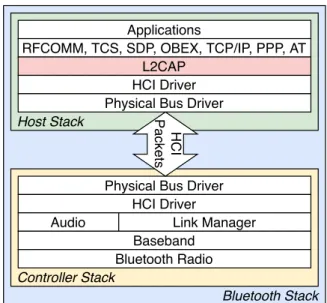
List of Figures
I.1 Representation of the Bluetooth stack along with its Logical Link Control
and Adaptation Protocol (L2CAP) layer. . . 4
I.2 Format of the L2CAP Echopacket. . . 4
I.3 Format of the Bluetooth device address (BD_ADDR) including the Non-significant Address Part (NAP), the Upper Address Part (UAP) and the Lower Address Part (LAP). . . 5
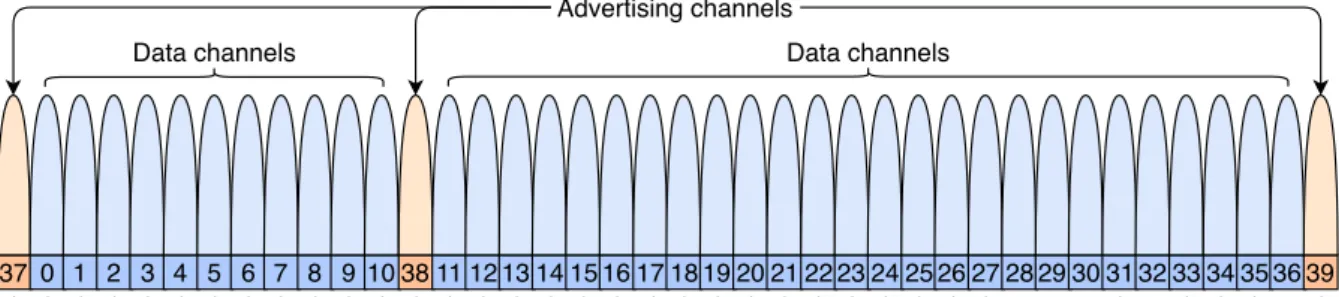
I.4 Representation of the Bluetooth Low Energy (BLE) spectrum emphasizing the advertising channels (channel 37 (2402 MHz), 38 (2426 MHz) and 39 (2480 MHz)). . . 6
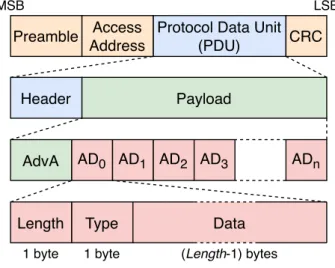
I.5 Format of the BLE advertisement packet. The payload part of the Protocol Data Unit (PDU) contains the Advertising Address (AdvA) field followed by Advertising Data (AD) structures. The Length field represents the length of the AD structure (excluding itself);Type specifies the nature of the following data and Dataare the advertising data. . . 7
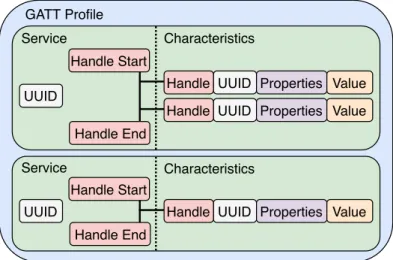
I.6 Structure of a GATT profile. Services are composed of a UUID along with two handles (Handle StartandHandle End) delimiting the hierarchically dependent characteristics. Characteristics are each constituted of a handle, a UUID, a set of properties and a value containing data. . . 11
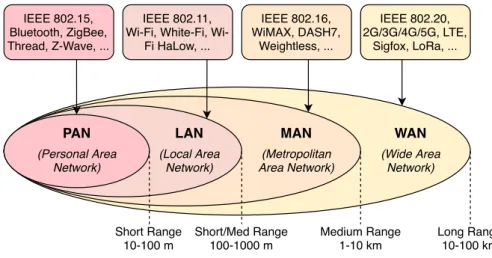
II.1 Scale based classification of data networks. . . 16
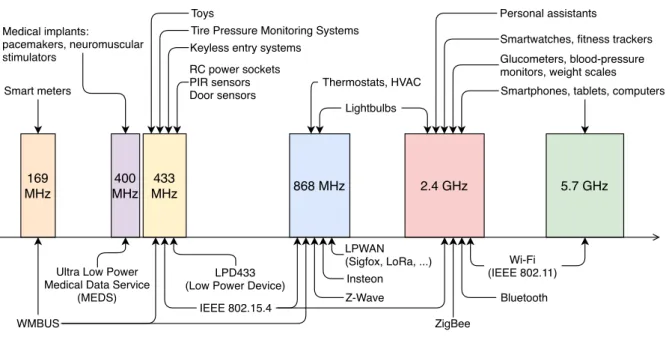
II.2 Example of radio technologies used by wireless devices along with associ-ated frequency bands and applications. . . 17
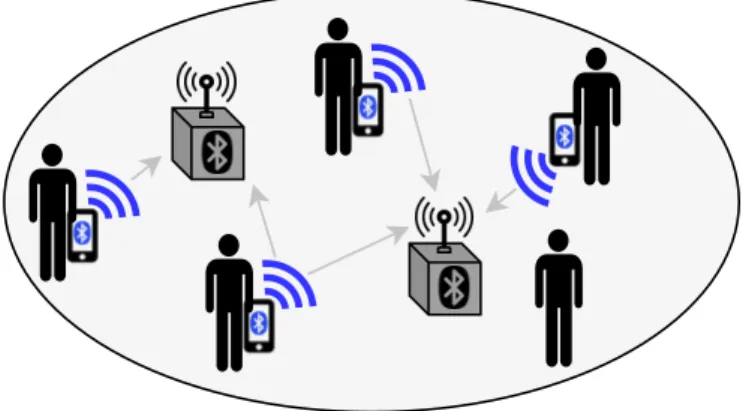
II.3 Representation of a Bluetooth based physical tracking system. . . 20
II.4 Example of IoT devices surrounding users. . . 27
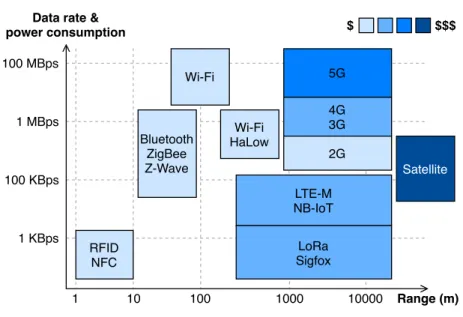
II.5 Representation of wireless technologies used by IoT devices. . . 28
III.1 Representation of a successful attack. The BLE device is randomizing its BD_ADDR (in italic) over time while keeping a static identifier (in bold) in the advertising data. Such a 5-byte identifier can be used by a passive attacker to link together the packets generated with the three different BD_ADDR. . . 44
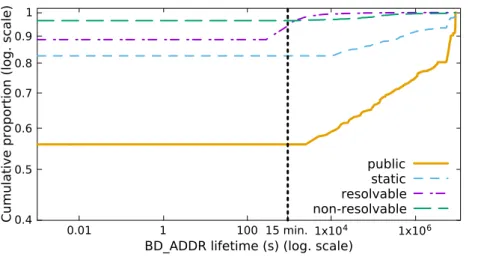
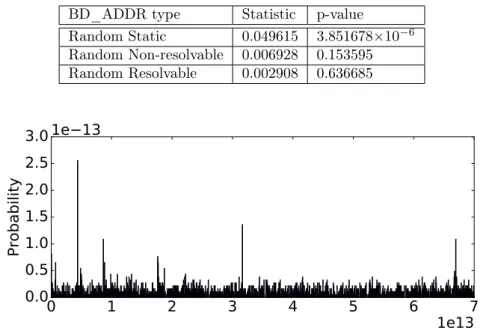
III.2 Empirical cumulative distribution function for lifetimes of device addresses. 46 III.3 Distribution of Random Static addresses using a resolution of 1024 bins (size of a bin = 236). . . 47
III.4 Format of the Apple Handoff Manufacturer Specific DataAD structure. 51 III.5 Sequence of Apple Handoff advertisement packets showing that the IV is not reset after the change of BD_ADDR at 900.003. . . 51
LIST OF FIGURES xv III.6 Format of the Apple Nearby InfoManufacturer Specific DataAD
struc-ture. . . 51 III.7 Sequence of Apple Nearby Info advertisement packets showing that the
BD_ADDR and Apple Nearby InfoAuth Tag changes are not synchro-nized. At 900.091, the oldAuth Tag is used with the new BD_ADDR. . 52 III.8 Format of the Microsoft CDPManufacturer Specific DataAD structure. 52 III.9 Sequence of Microsoft CDP advertisement packets in which the lifetime
of theDevice Hash overlaps the BD_ADDR randomization scheme. At 959.719, the BD_ADDR changes while theDevice Hashremains identical until 3599.113. . . 53 III.10 Format of the Google Nearby Service Data-16-bit UUID AD structure. 54 III.11 Architecture of the Venom tracking system. . . 56 III.12 Representation of a successful attack. The BLE device is randomizing
its BD_ADDR (in italic) over time while keeping a static GATT profile. Such a GATT profile can be leveraged by an active attacker to generate a fingerprint of the device before to link together its three different BD_ADDR. 58 III.13 Anonymity sets of GATT profiles in datasetActive. The dot size is
propor-tional to the number of devices in the set. . . 62 III.14 Example of the device address linking via a non-reset Sequence Number
field. The device is randomizing its address (in italic) over time while incrementing the Sequence Number (in bold) in the broadcasted data. Such a 2-byte long counter can be leveraged by a passive attacker to link together frames generated with the three different device addresses. . . . 64 III.15 Functional diagram of Valkyrie. A network trace along with a set of rules
are provided as inputs to the tool. TheWireshark dissector is leveraged for the protocol field denomination that must be specified in rules. At the end of the analysis, Valkyrie outputs a report specifying verified rules and breached ones with detailed warning messages. . . 66 IV.1 Distribution of OUI among Public device addresses. . . 81 IV.2 Distribution of the Bluetooth SIG assigned company IDs among Stable and
Private addresses. . . 83 IV.3 Bluetooth ping flood RTTs (individual and average), percentage change
and actual state (ground truth) while alternating between the idle and locked states. The percentage change is computed from the average RTTs. Vertical bars correspond to the times of the actual state changes. . . 97 IV.4 Representation of the Bluetooth based timing attack. The attacker floods
his target with L2CAP ping requests while measuring their corresponding RTTs. Note that, only Echo Response of B ping class are represented. . 98 IV.5 ROC curves for the state change identification from the idle state with
the Apple iPhone 6 smartphone. . . 101 IV.6 Architecture of the Himiko tool. . . 103
LIST OF FIGURES xvi V.1 Structure of a BLE advertisement packet used to carry data of Apple
Continuity protocols. The data are stored in a Manufacturer Specific Data AD structure (0xff) which starts with the company identifier of Apple (0x004c), followed by one or several continuity messages (CM) presented as a TLV format. Flags is an optional AD structure that is not specific to Apple Continuity protocols, and that can be included by any
devices to indicate their discoverable modes and capabilities. . . 115
V.2 Format of the AirPrint message. . . 116
V.3 Format of the AirDrop message. . . 117
V.4 Format of the HomeKit message. . . 117
V.5 Format of the Proximity Pairing message. . . 118
V.6 Format of the "Hey Siri" message. . . 118
V.7 Format of the AirPlay message. . . 118
V.8 Format of the Magic Switch message. . . 118
V.9 Format of the Handoff message. . . 119
V.10 Format of the Tethering Target Presence (Instant Hotspot) message. . . . 119
V.11 Format of the Tethering Source Presence (Instant Hotspot) message. . . . 120
V.12 Format of the Nearby Action (iOS Setup) message. . . 120
V.13 Format of the Nearby Action (Wi-Fi Password) message. . . 120
V.14 Format of the Nearby Info message. . . 121
V.15 Evolution of battery levels and the Lid Open Count from Proximity Pair-ing messages broadcasted by a set of AirPods earphones. Different device addresses are represented by grey/white areas. Those data depict a day during which AirPods are used intermittently and the case is never charged. Battery levels and the Lid Open Count remain stable during periods longer than the lifetime of the random device addresses. . . 123
V.16 Replay of Tethering Target Presence (Instant Hotspot) messages as pre-sented in [1]. By replaying such messages emitted by a Device A, an at-tacker triggers the emission of Tethering Source Presence (Instant Hotspot) messages by the Device B associated with the same iCloud account. . . . 124
V.17 Replay of Handoff messages with a modified IV. By replaying a Handoff message including an IV less than the last one received (i.e. in this case, 0xe35a), the attacker forces Device B to initiate a new synchronization procedure with Device A through a connection request. . . 125
V.18 Representation of the GSN changes extracted from HomeKit messages during two days. For both the Eve Motion sensor and Osram Smart+ lightbulb, theGSN changes can be leveraged as an indicator that leaks the presence and activity of the user in its office. . . 129
V.19 Description of the process used to compute hashed identifiers found within AirDrop and Nearby Action messages. The identifier (i.e. an e-mail address or a phone number) is first hashed with SHA-256 then truncated to keep only the 16 and 24 MSB respectively for AirDrop and Nearby Action messages. . . 130
LIST OF FIGURES xvii V.20 Performance evaluation of the dictionary attack on Siri’s perceptual hashes.
The precision and recall are presented as a parametric curve computed using the threshold ε. The distance threshold ε covers the interval [0; 4]. . 137 A.1 Example output of a Chipolo Classic BLE keyring device. . . 175 B.1 Example of a GATT profile collected from an Apple iPhone 8 smartphone
(and formatted as a JSON string). . . 176 F.1 Example output of a Chipolo Classic BLE keyring device. . . 182 I.1 Representation of a one-month collection of TPMS messages broadcasted
List of Tables
I.1 Description of the most commonly advertised AD types. . . 9 II.1 Non-exhaustive list of personal information inferred from types of connected
devices. . . 23 III.1 Beacon filtering regular expressions statistics. . . 42 III.2 Distribution of BD_ADDR and records among the device address types. . 43 III.3 Results of the Kolmogorov-Smirnov test on the random part of random
addresses against a uniform distribution. . . 47 III.4 List of IRK values used during the brute force attack. hexstringis defined
as 0x0123456789abcdef. . . 48 III.5 Summary of the studied proximity protocols along with their benched
elements and tracking sources. . . 50 III.6 Average time to collect a GATT profile among different devices. . . 58 III.7 Empirical entropy computed from datasetActive for services and
characteris-tics exposed within GATT profiles. For each item: the entropy brought by the attribute, the percentage of devices for which this item is stable over time, and the percentage of devices that include this item in their GATT profiles. . . 61 III.8 List of specified rules for the experimental evaluation. . . 69 III.9 List of evaluated devices along with their OS versions and identified issues.
Gray lines depict a software update of the involved devices. . . 71 IV.1 Distribution of company IDs assigned by the Bluetooth SIG among
regis-tered OUI of Public addresses. Numerical values are numbers of Public ad-dresses. . . 82 IV.2 Summary of the information that can be inferred from BLE advertising data. 83 IV.3 Distribution of the top 10 services and characteristics in datasetActive. . . . 88 IV.4 Selection of Bluetooth SIG defined characteristics values that have been
observed as readable at least once in datasetActive. Percentages reported for readable values are fractions of devices for which this value is readable. 90 IV.5 List of Body Sensor Locationvalues extracted from [2, sec. 3.24.2.1]. . . 93 IV.6 List of Sensor Locationvalues extracted from [2, sec. 3.152.2.1]. . . 93 IV.7 List of tested devices . . . 99 IV.8 Apple iPhone 6 state change identification with AUC values. . . 101
LIST OF TABLES xix IV.9 Empirical entropy of characteristics exposed within GATT profiles of
datasetActive, without values (i.e. only handles, UUIDs and properties are
considered). . . 105
V.1 Experimental evaluation of replay attacks based on Handoff and Tethering Target Presence (Instant Hotspot) messages against different Apple devices.126 V.2 Evaluation of hypothetical guesswork attacks on hashed e-mail addresses and phone numbers. For each set of identifiers, the corresponding size is used to evaluate the cost of the attack and the average number of values that will be returned as matching the digest (supposing the set includes the original identifier). The hashing speed of the attacker is assumed to be 2000 kH/s. . . 133
V.3 Perceptual hashes obtained from voice commands issued by two male individuals. The Hamming distances are computed between hashes of U serA and U serB considered as binary values (i.e. sequences of bits). . . . 135
V.4 Experimental evaluation of the range of Apple Continuity BLE messages leveraging various Apple devices in different environment settings. . . 138
V.5 Summary of the Apple Continuity messages (CM) with their conditions of emission and associated privacy threats. . . 139
C.1 Extended list of experimental regular expressions of device names. . . 178
C.2 Extended list of experimental 16-bit service UUIDs. . . 179
C.3 Extended list of experimental 128-bit service UUIDs. . . 179
D.1 Presence of AD types in advertising payloads found within datasetP assive. Numerical values are fractions of addresses associated with each type. . . . 180
E.1 Apple iPhone 4 state change identification with AUC values. . . 181
E.2 Samsung Galaxy A3 state change identification with AUC values. . . 181
G.1 Extended list of Magic Switch Confidence on Wrist codes. . . 183
G.2 Extended list of Nearby Action Action Type codes. . . 183
G.3 Extended list of HomeKit Category codes. . . 184
G.4 Extended list of "Hey Siri" Device Class codes. . . 184
G.5 Extended list of Nearby Action Device Class codes. . . 184
G.6 Extended list of Proximity Pairing Device Model codes. . . 185
G.7 Extended list of Nearby Action Device Model codes. . . 185
G.8 Extended list of Proximity Pairing Device Color codes. . . 185
G.9 Extended list of Nearby Action Device Color codes. . . 185
G.10 Extended list of Nearby Action OS Version codes. . . 186
G.11 Extended list of Proximity Pairing UTPcodes. . . 186
G.12 Extended list of Nearby Info Activity Level codes. . . 186
G.13 Extended list of Tethering Source Presence Network Type codes (as re-ported in [1]). . . 186
H.1 Complete list of Siri commands used for the dictionary attack on perceptual hashes. . . 187
List of Acronyms
1xRTT (1x) Radio Transmission Technology AD Advertising Data
AdvA Advertising Address
AES Advanced Encryption Standard API Application Programming Interfaces AR Activity Recognition
ATT Attribute
AUC Area Under the Curve
BD_ADDR Bluetooth Device Address BLE Bluetooth Low Energy
BT Bluetooth
CDP Connected Devices Platform CM Continuity Messages
CNIL Commission Nationale de l’Informatique et des Libertés COVID-19 Corona Virus Disease 2019
CPU Central Processing Unit CRC Cyclic Redundancy Check CSR Cambridge Silicon Radio CSS Cascading Style Sheets D2D Device-to-Device
DPA Data Protection Authorities DRM Digital Rights Management DSID Destination Signaling Identifier ECB Electronic Code Book
List of Acronyms xxi ePR ePrivacy Regulation
EU European Union
EV-DO Evolution-Data Optimized FFT Fast Fourier Transform
FIPS Federal Information Processing Standards FPR False Positive Rate
GATT Generic Attribute GCM Galois/Counter Mode
GDPR General Data Protection Regulation GHz Gigahertz
GNU GNU’s Not Unix GPL General Public License
GPRS General Packet Radio Service GPS Global Positioning System
GSM Global System for Mobile communications GSN Global State Number
H/s Hashes per second
HAP HomeKit Accessory Protocol HEC Header Error Check
IAB Interactive Advertising Bureau
ICT Information and Communications Technology ID Identifier
IdO Internet des Objets IE Information Element
IEEE Institute of Electrical and Electronics Engineers IETF Internet Engineering Task Force
IFTTT If This Then That
INSA Institut National des Sciences Appliquées
INSEE Institut National de la Statistique et des Etudes Economiques IoT Internet of Things
IP Internet Protocol
IRK Identity Resolving Key
ISM Industrial, Scientific and Medical IV Initialization Vector
List of Acronyms xxii JSON JavaScript Object Notation
KS Kolmogorov-Smirnov
L2CAP Logical Link Control and Adaptation Protocol LAP Lower Address Part
LE Low Energy
LINC Laboratoire d’Innovation Numérique de la CNIL LPD433 Low Power Device 433 MHz
LPWAN Low Power Wide Area Network LSB Least Significant Bit
LTE Long Term Evolution LTS Long Term Support M2M Machine-to-Machine MAC Media Access Control MEDS Medical Data Service MHz Megahertz
MLS Mozilla Location Service MS Media Service
MSB Most Significant Bit
NAP Non-significant Address Part NCS Notification Center Service NFC Near Field Communication NIC Network Interface Controller OS Operating System
OSI Open Systems Interconnection OUI Organizationally Unique Identifier PAN Personal Area Network
PDU Protocol Data Unit
PETS Privacy Enhancing Technologies Symposium PHP PHP: Hypertext Preprocessor
PIA Privacy Impact Assessment PII Personally Identifiable Information PnP Plug and Play
PRH Philips Robust Hash
List of Acronyms xxiii RFC Request For Comments
RFID Radio-Frequency Identification ROC Receiver Operating Characteristic RSSI Received Signal Strength Indication RTT Round-Trip Time
SHA Secure Hash Algorithm SIG Special Interest Group SNR Signal-to-Noise Ratio SSID Service Set Identifier TLV Type-Length-Value
TPMS Tire Pressure Monitoring System TPR True Positive Rate
TV Television
UAP Upper Address Part
UDHR Universal Declaration of Human Rights UHF Ultra High Frequency
USB Universal Serial Bus
UTF Universal Character Set Transformation Format UUID Universally Unique Identifier
W3C World Wide Web Consortium WAN Wide Area Network
WMBUS Wireless Meter Bus
WPAN Wireless Personal Area Network WPS Wi-Fi Protected Setup
List of Contributions
From our work, emerging results have been disseminated in some top ranking conferences for privacy and security. Similarly, we implemented and released several software under an open-source license (GNU General Public License (GPL) v3.0) in order to promote their wide diffusion. Listed as follows, publications, presentations and produced software are sorted from the most recent to the oldest.
Journal Articles
1. Guillaume Celosia and Mathieu Cunche. Discontinued Privacy: Personal Data Leaks in Apple Bluetooth-Low-Energy Continuity Protocols. Proceedings on Privacy Enhancing Technologies, 2020(1):26–46, 2020
International Conferences
1. Guillaume Celosia and Mathieu Cunche. Valkyrie: A Generic Framework for Verifying Privacy Provisions in Wireless Networks. In Proceedings of the 13th Conference on Security and Privacy in Wireless and Mobile Networks, pages 278–283, 2020
2. Guillaume Celosia and Mathieu Cunche. DEMO: Venom: a Visual and Experimental Bluetooth Low Energy Tracking System. In Proceedings of the 13th Conference on Security and Privacy in Wireless and Mobile Networks, pages 346–348, 2020
3. Guillaume Celosia and Mathieu Cunche. Saving Private Addresses: An Analysis of Privacy Issues in the Bluetooth-Low-Energy Advertising Mechanism. In MobiQui-tous 2019 – 16th EAI International Conference on Mobile and UbiquiMobiQui-tous Systems: Computing, Networking and Services, pages 444–453, 2019
4. Guillaume Celosia and Mathieu Cunche. DEMO: Himiko: A Human Interface for Monitoring and Inferring Knowledge on Bluetooth-Low-Energy Objects. In Proceedings of the 12th Conference on Security and Privacy in Wireless and Mobile Networks, pages 292–293, 2019
5. Guillaume Celosia and Mathieu Cunche. Detecting smartphone state changes through a Bluetooth based timing attack. In Proceedings of the 11th ACM Conference on Security & Privacy in Wireless and Mobile Networks, pages 154–159, 2018
List of Contributions xxv International Workshops
1. Guillaume Celosia and Mathieu Cunche. Fingerprinting Bluetooth-Low-Energy De-vices Based on the Generic Attribute Profile. In Proceedings of the 2nd International ACM Workshop on Security and Privacy for the Internet-of-Things, pages 24–31, 2019
National1 Conferences/Workshops
1. Guillaume Celosia and Mathieu Cunche. Saving Private Addresses: An Analysis of Privacy Issues in the Bluetooth-Low-Energy Advertising Mechanism. In Atelier sur la Protection de la Vie Privée (APVP), 2019
2. Guillaume Celosia and Mathieu Cunche. Detecting smartphone state changes through a Bluetooth based timing attack. In Atelier sur la Protection de la Vie Privée (APVP), 2018
3. Guillaume Celosia and Mathieu Cunche. Protection de la Vie Privée dans les Communications Sans Fil de l’Internet des Objets (IoT). In Rendez-vous de la Recherche et de l’Enseignement de la Sécurité des Systèmes d’Information (RESSI), 2018
4. Guillaume Celosia and Mathieu Cunche. POSTER: Preserving Privacy in Wireless Communications of the Internet of Things (IoT). In Rendez-vous de la Recherche et de l’Enseignement de la Sécurité des Systèmes d’Information (RESSI), 2018 Additional presentations
1. Guillaume Celosia and Mathieu Cunche. Discontinued Privacy: Personal Data Leaks in Apple Bluetooth-Low-Energy Continuity Protocols. In Annual seminar of the Inria PRIVATICS team, 2020
2. Guillaume Celosia and Mathieu Cunche. DEMO: Himiko: A Human Interface for Monitoring and Inferring Knowledge on Bluetooth-Low-Energy Objects. In Salon de l’Internet Des Objets (SIDO), 2019
3. Guillaume Celosia and Mathieu Cunche. Privacy Threats from the Bluetooth Low Energy Service Discovery Mechanism. In Annual seminar of the Inria PRIVATICS team, 2019
4. Guillaume Celosia and Mathieu Cunche. Detection of Bluetooth surveillance systems. In Presentation for Inria EPI: Data and Algorithmic Transparency and Accountability (DATA), 2018
5. Guillaume Celosia and Mathieu Cunche. Privacy concerns in IoT radio communica-tions. In Pitch for the INSA Lyon – SPIE ICS IoT chair, 2018
6. Mathieu Cunche, Célestin Matte, and Guillaume Celosia. Wi-Fi Scanner: How many data can be collected on your smartphone ? In The Web Conference, 2018
List of Contributions xxvi 7. Guillaume Celosia and Mathieu Cunche. Preserving Privacy in Wireless Communi-cations of the Internet of Things (IoT). In Annual seminar of the Inria PRIVATICS team, 2018
Software production
1. Valkyrie [21], a generic framework for verifying privacy provisions in wireless networks 2. Joker [22], aWiresharkdissector for BLE advertisement packets of Apple Continuity,
Microsoft CDP and Garmin proprietary protocols
3. Venom, an experimental BLE tracking system (not public yet)
4. Himiko, a human interface for monitoring and inferring knowledge on BLE objects (not public yet)
Chapter I
Introduction
This chapter introduces the privacy challenges induced by the increasing adoption of wireless communicating devices. To glimpse the purpose of our study, the Internet of Things (IoT) concept as well as its privacy implications are clarified in Section I.1. Afterwards, Section I.2 provides technical details on the radio communication standards considered throughout this thesis. Synthesizing its content, the structure of this manuscript is developed in Section I.3. To finish, Section I.4 furnishes a brief notice delimiting the efforts and contributions of each researcher who participated in this work.
I.1
Internet of Things and privacy
The Internet of Things (IoT) is a concept introduced to designate connected objects that form a network of physical devices. Emerging from overlapping trends such as the miniaturization, widespread network access and location positioning technology, the number of IoT devices is growing quickly. As of today, those connected objects are estimated to 31 billion units, and it is predicted that they will reach 75 billion in 2025 [23]. Generally equipped with sensors and/or actuators, IoT devices share the ability to sense, analyze their environments and communicate. To this end, they rely on autonomous communication between physical objects within the Internet infrastructure. Therefore, it is possible to augment those objects with knowledge of the Internet in various fields of application such as transport, manufacturing and agriculture, for instance.
With the wide and rapid adoption of the IoT, the number of applications in which users are involved as well as the level of interaction with the user are both bound to increase. As an illustration, temperatures and lights of a smarthome adapt to inhabitants, while smart meters collect and report their energy consumption; in healthcare, medical sensors and implants check the health of the patients and provide medical assistance; in fitness, applications on wristbands record and monitor physical activities of sportsmen; etc.
I.1. Internet of Things and privacy 2 Overall, the IoT redefines the digital frontiers impacting our society on the economic, technical, social, industrial and political levels [24]. Moreover, focusing on the ameliorations brought by the deployment of such connected devices, the IoT can be beneficial for humanity. As an example, it has the potential to improve road safety, children care, health related analysis, entertainment and even the knowledge of ourselves through the quantified self. To be efficient, the IoT applications require ever more sensors to be set up into our environments. From microphones to video cameras, through thermal and motion sensors, the establishment of such a diverse and broad sensor fabric into our society induces risks that have to be investigated.
As one of the most discussed risk, the privacy protection of users represents an important obstacle to the IoT adoption [25]. From one side, privacy is assimilated as a problem that is not relevant in our current society as it goes against the constant exhibition of our daily lives through social networks [26]. From the other side, privacy is believed not to be necessary if you have nothing to hide [27].
Within this heterogeneous situation, legislators are working to establish a legal framework for privacy. For instance, the European Parliament seriously takes into account this problem along with its associated debates to legislate on those questions [28]. Note that, specified as a fundamental right for everyone in the Universal Declaration of Human Rights (UDHR) [29], the privacy protection is still one of the discussion subjects in the European
Parliament.
However, privacy remains difficult to define and formalize because of the complexity of the contexts that have to be considered. To glimpse this complexity, privacy is first defined in 1890 as "the right to be left alone" [30], while Westin [31] later considers that privacy "provides individuals and groups in society with a preservation of autonomy, a release from role-playing, a time for self-evaluation and for protected communication". In turn, the UDHR stipulates that "no one shall be subjected to arbitrary interference with his privacy, family, home or correspondence, nor to attacks upon his honour and reputation. Everyone has the right to the protection of the law against such interference or attacks" [29, Article 12]. As a result, whether it is focused on what happens to individuals when their information are used [30,29] or on access and exposition of users information [31], there exist essential differences between those definitions.
In the meantime, behaviors, preferences, and activities of consumers are being more regularly recorded and monitored with the rise of the IoT. Indeed, connected objects are collecting data on users prior to send them to remote servers in order to enable a variety of services.
As a consequence, privacy have to be ensured within devices, during the storage, transmis-sion and processing of users information [32]. In this direction, we can cite works done on data protection and privacy in IoT [33, 34], but also on the formalization of privacy policies and preferences to protect consumers [35, 36, 37].
I.2. Background 3 In those researches, we noticed the difficulty that users can have to manually define their own privacy policies depending on each context. Actually, they are often ill-prepared to deal with the complexity of the systems, and thus do not manage to conceive the impact of sharing their data on their privacy. During our study, we faced supplementary privacy related ambiguities such as the lack of information on how users information are stored and the lack of guidelines plainly stating how to delete those data. As there is a clear momentum in the development of the IoT, companies have to better explain their practices regarding the processing of personal information.
In this thesis, we explore privacy challenges that wireless communications of the IoT devices can raise. More precisely, we focus our work on the data exposed by connected objects to physically track and infer information on their corresponding owners.
I.2
Background
In this section, we furnish technical details on both the Bluetooth and Bluetooth Low Energy (BLE) radio communication standards to understand our research. In this regard, we underline that we do not provide a complete overview of such standards. Nevertheless, we cover particular points that are further exploited during our studies.
I.2.1
Bluetooth
Bluetooth operates within the 2.4 GHz Industrial, Scientific and Medical (ISM) band through 79 1-MHz channels. To exchange data over radio communications, this technology leans on a multi-layered stack split into two parts [38, Vol 4, Part E, sec. 1.1] (see Figure I.1).
Implemented in microprocessors dongles, the Controller stack contains the Bluetooth radio interface, while the Host is an operating system part that processes high level data. Actually, the Logical Link Control and Adaptation Protocol (L2CAP) layer provides a link between those two stacks. Moreover, this packet based protocol follows channels communication models where specific commands can be sent between devices.
As defined in the Bluetooth Core Specification [38, Vol 3, Part A, sec. 4.8], ping relies on a request-response mechanism of the L2CAP layer: an Echo Request command is sent to a remote L2CAP device, and solicits an Echo Response back. As those requests are only designed to test a link between two Bluetooth devices, it is important to mention that they do not require any mutual authentication.
I.2. Background 4
Controller Stack Host Stack
Applications
RFCOMM, TCS, SDP, OBEX, TCP/IP, PPP, AT L2CAP
HCI Driver Physical Bus Driver
Physical Bus Driver HCI Driver
Audio Link Manager
Baseband Bluetooth Radio
Bluetooth Stack
HCI
Packets
Figure I.1 –Representation of the Bluetooth stack along with its Logical Link Control and Adaptation Protocol (L2CAP) layer.
Code Identifier Length Data (optional)
LSB MSB
1 byte 1 byte 2 bytes Length bytes
Figure I.2 – Format of the L2CAP Echo packet.
As presented in Figure I.2, the Echo RequestandEcho Response packets share the same format and include the following fields:
— A Bluetooth device address (BD_ADDR) (48 bits): the destination device address; — Code (8 bits): identifies the command type (0x08 and 0x09 respectively specify
Echo Request and Echo Response);
— Identifier(8 bits): used to match Echo Request with Echo Response; — Length (16 bits): represents the length of theData field;
— Data: contains optional and implementation specific data to be sent. If present, L2CAP entities shall ignore the content of this field [38, Vol 3, Part A, sec. 4.8]. In addition, theIdentifier, Length andData fields of the Echo Request are copied to the Echo Response during the request-response exchanges.
As a manufacturer unique device identifier [38, Vol 2, Part B, sec. 1.2], the BD_ADDR is divided into three parts: the Non-significant Address Part (NAP), the Upper Address Part (UAP) and the Lower Address Part (LAP), which are respectively the 16 most significant bits (MSB), the following 8 bits and the 24 least significant bits (LSB) of the BD_ADDR (see Figure I.3).
I.2. Background 5 : : : : NAP UAP
MSB 2 bytes 1 byte 3 bytes LSB
LAP
a6 23 d5 : 8b 9c b1
BD_ADDR
Figure I.3 – Format of the Bluetooth device address (BD_ADDR) including the Non-significant Address Part (NAP), the Upper Address Part (UAP) and the Lower Address Part (LAP).
Note that, the (UAP, LAP) pair is the minimum needed to establish a link with a remote device.
I.2.2
Bluetooth Low Energy (BLE)
Bluetooth Low Energy (BLE) is a lightweight subset of Bluetooth that has been introduced in 2010 as part of the Bluetooth Core Specification version 4.0 [39, Vol 6]. In fact, BLE and Bluetooth share elements such as range and radio frequency band1 but differ on several points such as channel mapping, data transfer rate and power consumption. Indeed, although Bluetooth can handle a lot of data at the cost of a high energy con-sumption, BLE is plebiscited by battery-powered appliances that only need to periodically exchange small amounts of data.
As a consequence, the BLE technology is more suitable for connected objects with low power computing resources which need to synchronize data with their applications. For instance, heart rate monitors and smartwatches rely on BLE to communicate with nearby smartphones and tablets.
I.2.2.1 Protocol
Instead of the Bluetooth 79 1-MHz channels, BLE operates on 40 2-MHz physical channels. Three of those channels – channel 37 (2402 MHz), 38 (2426 MHz) and 39 (2480 MHz) – are dedicated to the discovery mechanism called advertisement, while the 37 remaining ones are leveraged for data transmissions [38, Vol 6, Part B, sec. 1.4] (see Figure I.4). As a result, BLE communications can be of two types: broadcasted and connected. Com-pared to connection, we highlight that the broadcasting provides neither security nor privacy protection as BLE devices in range are able to receive data emitted in clear over advertisement packets.
I.2. Background 6 2402 37 2404 0 2406 1 2408 2 2410 3 2412 4 2414 5 2416 6 2418 7 2420 8 2422 9 2424 10 2426 38 2428 11 2430 12 2432 13 2434 14 2436 15 2438 16 2440 17 2442 18 2444 19 2446 20 2448 21 2450 22 2452 23 2454 24 2456 25 2458 26 2460 27 2462 28 2464 29 2466 30 2468 31 2470 32 2472 33 2474 34 2476 35 2478 36 2480 39 Advertising channels Frequency (MHz)
Data channels Data channels
Figure I.4 –Representation of the Bluetooth Low Energy (BLE) spectrum emphasizing the advertising channels (channel 37 (2402 MHz), 38 (2426 MHz) and 39 (2480 MHz)).
Depending on the situation, a BLE device can endorse various roles following a Client-Server scheme. In order to simplify our explanations, we solely define the two most important roles: Central and Peripheral.
A Peripheral device periodically broadcasts advertisement packets to announce its presence and, if connectable, accepts an incoming connection request from a Central. Meanwhile, a Central device listens to advertisement packets and, when applicable, initiates a connection with a Peripheral. As an illustration, a smartphone can connect to a smartwatch to send notifications and collect sensor readings.
Note that, a Peripheral stops to advertise as soon as a Central is connected to it. Until the existing connection is ended, it thus undermines the possibility for other Centrals in range to discover and connect to it. Moreover, we emphasize that a BLE device cannot endorse both roles at the same time.
At the physical layer [38, Vol 6, Part B, sec. 2.1], BLE packets are split into four fields: the Preamble, the Access Address, the Protocol Data Unit (PDU) and the Cyclic Redundancy Check (CRC) (see Figure I.5). In the case of advertisement packets, the Access Address shall be set to the predefined value 0x8e89bed6[38, Vol 6, Part B, sec. 2.1.2]. Divided into two parts, thePDUembeds a 2-byte header and a variable size payload. On the one hand, the header describes the type of the PDU and indicates the class of the BLE device address (i.e. Public or random) [38, Vol 1, Part A, sec. 3.2.2]. On the other hand, the payload part contains the BD_ADDR followed by the advertising data. Finally, used for internal protocol management, the Preamble and CRC fields are automatically computed then filled by the Bluetooth stack prior to emit advertisement packets.
I.2. Background 7 Header Payload Data Length Type AdvA AD0 AD1 AD2 AD3 MSB
1 byte 1 byte (Length-1) bytes
Preamble Access
Address
Protocol Data Unit
(PDU) CRC
ADn
LSB
Figure I.5 –Format of the BLE advertisement packet. The payload part of theProtocol Data Unit
(PDU) contains theAdvertising Address(AdvA) field followed by Advertising Data (AD) structures. TheLengthfield represents the length of the AD structure (excluding itself); Typespecifies the nature of the following data and Data are the advertising data.
I.2.2.2 Device addressing and privacy features
During communications, a BLE device is identified by its BD_ADDR contained within the Advertising Address (AdvA) field of its advertising payload (see Figure I.5).
As part of the LE Privacy features [38, Vol 1, Part A, sec. 5.4.5], BLE has introduced random addresses allowing devices to replace their real BD_ADDR with temporary pseudonyms when broadcasting advertisement packets [40].
In addition to the globally unique Media Access Control (MAC) address, BLE supports three types of random addresses which can be identified leveraging the two MSB of the BD_ADDR [38, Vol 6, Part B, sec. 1.3.2]. As a consequence, there are four types of BD_ADDR in BLE:
— Public: the address uniquely allocated to the device by the manufacturer in accor-dance to the Institute of Electrical and Electronics Engineers (IEEE) specifications of MAC addresses [41, sec. 8.2];
— Random Static (MSB=0b11): a randomly generated device address that can be renewed after each power cycle, and that shall not change during the use of the device;
— Random Non-resolvable (MSB=0b00): a randomly generated address that can be renewed at any time, and that shall not be equal to either the Random Static nor the Public device address;
— Random Resolvable (MSB=0b01): an address composed of a 22-bit random number prand and a 24-bithash produced by the hashing ofprand with a 128-bit secret Identity Resolution Key (IRK). Shared between two BLE devices at the time
I.2. Background 8 of pairing, the IRK allows the Central device to resolve the Peripheral address that would look random otherwise. For further details on the generation and resolution of such Random Resolvable addresses, we refer the interested readers to the Bluetooth Core Specification [38, Vol 6, Part B, sec. 1.3.2.2/3].
Based on their temporal persistence, we also classified those device address types into two categories:
— Stable: device addresses that are used by a device indefinitely or for an extended period of time (i.e. Public and Random Static addresses);
— Private: device addresses that are supposed to change frequently1 (i.e. Random Non-resolvable and Random Resolvable addresses).
I.2.2.3 Advertisement
Aforementioned in Section I.2.2.1, advertisement is the name of the BLE discovery mechanism that allows Central devices to discover Peripherals in range. More precisely, it is used to broadcast connectionless data for applications as well as a prerequisite for a Central to set up a connection with a Peripheral.
I.2.2.3.1 Discovery mechanism
When a Peripheral is in advertising mode, advertisement packets are periodically broad-casted on each advertising channels. In addition to the frame header, advertisement packets can contain up to 31 bytes of data called advertising data. Those packets being broadcasted in clear, we draw the attention to the fact that their content can be thus collected and processed by any nearby device.
Furthermore, a Central can query a Peripheral by sending a directed scan request that triggers back a scan response. Transmitted over the three identical physical advertising channels, scan responses follow the same format as advertisement packets but carry different elements of information.
I.2.2.3.2 Advertising data
The BLE advertising payload consists of the AdvAfield (equal to the BD_ADDR of the advertising Peripheral) followed by a sequence of one or more Advertising Data (AD) structures including items of information.
In particular, an AD structure is composed of a 1-byte field indicating the length of the
1. The Bluetooth Core Specification [38, Vol 3, Part C, App. A] recommends to renew Random Non-resolvable and Random Resolvable addresses at most every 15 minutes.
I.2. Background 9 Table I.1 – Description of the most commonly advertised AD types.
AD
Name Description
type
0x01 Flags Indicates discoverable modes and device
capabilities
0x03 Complete List of 16-bit Service Class UUIDs Lists 16-bit UUIDs of the supported
ser-vices
0x09 Complete Local Name Contains a string providing a user-friendly
description of the device
0x0a Tx Power Level Indicates the transmitted power level of the
advertisement packet
0x0d Class of Device Indicates the type of device (computer,
phone, wearable, etc.)
0x12 Slave Connection Interval Range Contains the preferred connection interval
range of the Peripheral
0x16 Service Data-16-bit UUID Consists of a 16-bit service UUID along
with the data associated with this service
0x19 Appearance Describes the physical representation of the
device (sports watch, insulin pen, etc.)
0x26 Transport Discovery Data Determines the organization and transport
of the supported service
0xff Manufacturer Specific Data Contains custom data for
manufacturer-defined applications
AD structure (excluding itself), followed by a 1-byte field specifying the type of the AD and finally, a sequence of up to 29 bytes of data (see Figure I.5).
Generally, AD structures embed device characteristics, capabilities and supported services, but also data coming from custom applications. Leveraging online resources of the Bluetooth Special Interest Group (SIG) [42], we noticed a total of 44 AD types, and listed some of the most commonly advertised in Table I.1.
With regard to the advertising payload, it can be either 1) set by the application or 2) automatically filled by the Bluetooth stack based on services configured into the Generic Attribute (GATT) profile of the Peripheral (see Section I.2.2.4). Between those two options, the single difference is that the first option allows the appliance to have full control over the advertising payload. Especially, it is useful to send proprietary data such as those that can be carried by the Manufacturer Specific Data AD structure (see Table I.1).
I.2.2.3.3 Service Universally Unique Identifiers (UUIDs)
Complying with RFC 4122 [43], a UUID is a 128-bit identifier that is mostly used to identify devices and resources. In the context of Bluetooth/BLE, UUIDs are leveraged to identify services [38, Vol 3, Part B, sec. 2.5].
I.2. Background 10 Inventoried by the Bluetooth SIG [42], a Peripheral can rely on 12 AD types dedicated to the broadcasting of UUIDs to advertise its services. Among them, the most commonly practiced are the Complete List of 16-bit Service Class UUIDs and the Service Data-16-bit UUID AD types (see Table I.1).
For the sake of space saving into the 31-byte long advertising payload, some of those AD structures include the full UUID (i.e. 128-bit long), while others embed a truncated version (i.e. 16 or 32-bit long). To make this possible, the Bluetooth SIG adopted XXXXXXXX-0000-10008000-00805f9b34fb [38, Vol 3, Part B, sec. 2.5.1] as the standard base UUID where the 32 MSB (represented by X) are up to manufacturers.
Overlaying a 16-bit UUID in theX digits above, all Bluetooth SIG specified services [44] such as the Heart Rate Service and Continuous Glucose Monitoring then use this base UUID. As an example, the Heart Rate Service is advertised as 0x180d (i.e. a 16-bit UUID) but actually represents 0000180d-0000-1000-8000-00805f9b34fb, the cor-responding 128-bit UUID.
Also, 128-bit UUIDs can be fully customized by manufacturers (see Table C.3 in Ap-pendix C). Nevertheless, we point out that the generated UUIDs are for practical purposes unique. Furthermore, unlike most numbering schemes, their uniqueness does not depend on a central registration authority. As a consequence, RFC 4122 compliant UUID generators such as [45,46] shall be then used to avoid collisions.
I.2.2.4 Generic Attribute (GATT)
In BLE, the Attribute (ATT) is a Client-Server stateless protocol based on attributes where devices can endorse each role regardless of their BLE role (i.e. Peripheral or Central) [38, Vol 3, Part F, sec. 2].
Data exposed by a Server are presented in a GATT profile which is a hierarchical structure of attributes allowing the transfer of information between a Client and a Server. Likewise, it provides a reference framework for all GATT based profiles covering precise use cases and ensuring interoperability between devices from different vendors.
As data related to applications and users must be formatted then sent according to its rules, this makes GATT a key element of the Bluetooth Core Specification. Note that, a GATT profile is only accessible after a connection has been established between two BLE devices meaning that they have already gone through the advertising process.
Identified by a UUID (see Section I.2.2.3.3), attributes within a GATT profile can be either services or characteristics. In the hierarchical structure, conceptually related characteristics are grouped below a same service (see Figure I.6).
I.2. Background 11
GATT Profile
UUID Properties Value UUID Properties Value Handle Start
Handle End
UUID Properties Value Handle Start Handle End Handle Handle Handle UUID UUID Service Characteristics Service Characteristics
Figure I.6 – Structure of a GATT profile. Services are composed of a UUID along with two handles (Handle Start and Handle End) delimiting the hierarchically dependent characteristics. Characteristics are each constituted of a handle, a UUID, a set of properties and a value containing data.
of properties and a value. The handle specifies the position of the characteristic in the profile, while the value holds the actual data of the characteristic. Properties are metadata that specify which ATT operations (i.e. read, write, etc.) can be executed on each particular attribute and with which security requirements (i.e. encryption, authentication). Independently applied on each characteristic, such access permissions are mostly implementation specific1.
Similarly, a service is identified by its UUID and associated with two handles (Handle Start and Handle End ) specifying a range of characteristics that are hierarchically dependent from this service.
In fact, vendors are free to define their own services and characteristics, but the Bluetooth SIG has already set up a number of them [47]. For instance, the Device Information[48] service contains the Model Number String,Software Revision String and System ID characteristics. As another example, the Battery Service [49] embeds the Battery Level characteristic.
Lastly, the BLE includes security mechanisms such as encryption and authentication that can be used within the ATT protocol. Certain values of characteristics can be then exclusively accessed by an authenticated Client [38, Vol 3, Part C, sec. 10.3]. Note that, the value is the sole element protected by this feature. Therefore, the list of services and characteristics as well as the associated metadata (i.e. handles and properties) do not require any authentication to be accessed [38, Vol 3, Part G, sec. 8.1].
I.3. Document structure 12
I.3
Document structure
In addition to this introductory chapter that provides the prerequisites for understanding our studies, this manuscript is composed of five chapters.
To start, a state of the art dealing with radio signals, connected objects and their privacy aspects is established in Chapter II. Thereafter, Chapter III describes how passive and active eavesdroppers can leverage BLE advertising data and metadata to physically track devices and their corresponding owners over time. As the second investigated privacy threat, the exploitation of the Bluetooth/BLE wireless communications in order to infer information on remote users is presented in Chapter IV. Applied to the specific case of Apple BLE Continuity protocols, Chapter V discloses a collection of personal data leaks ranging from device technical characteristics to e-mail addresses and phone numbers of consumers. To finish, the limitations of our research along with its perspectives for future work as well as its industrial, social and media impacts conclude this document in Chapter VI.
Note that, throughout our work, we aim to illustrate that the wireless communications of the IoT can raise privacy concerns. In this direction, we set up and experiment attacks based on the Bluetooth/BLE radio communication standards. However, we highlight that the scope of this thesis can be further extended to wireless standards in general as they could imply similar privacy issues (see Section VI.2).
I.4
Contributions notice
Within this manuscript, each chapter results from scientific papers that are all co-authored with Mathieu Cunche [50], one of the supervisors of this thesis.
To define methodologies and protocols for experiments, Mathieu guided this research considering insights that I, Guillaume Celosia [51], provided. The design and prototyping of tools, the building of datasets through collections of radio signals, the processing of data as well as the software production only involved me.
Finally, the writing of the papers was fairly shared between us. To be transparent, this means that some reformulated parts of this document originally come from Mathieu.
Chapter II
State of the Art
This chapter reviews the state of the art relevant to the domains and techniques approached in this thesis. In particular, service discovery mechanisms used in wireless technologies are first introduced in Section II.1. Then, Section II.2 demonstrates that radio signals broadcasted by such discovery mechanisms are a source of privacy leaks. Physical tracking and device fingerprinting techniques along with their applications are detailed in Section II.3. Section II.4 discusses additional privacy threats that aim to infer users information based on their carried connected devices. Technical as well as legal existing privacy protections in wireless technologies are analyzed in Section II.5. Section II.6 presents the paradigm of the Internet of Things (IoT) before providing an overview of its deployment and privacy implications. To finish, the motivation for this thesis and its contributions to the state of the art are outlined in Section II.7.
II.1
Service discovery mechanisms in the wireless era
Service discovery is defined as the action of finding a service provider for a requested service. As a consequence, service discovery mechanisms are network protocols allowing the detection of services offered by devices on a computer network. As such, a network service can be any software or hardware entity that a user might be interested to use. For instance, printing, sharing photos and file transfer are network services.
In the context of wireless technologies, discovery of service1 is provided prior to establish a connection between devices. Service discovery protocols are then specifically designed as the set of available services dynamically changes based on the proximity of mobile devices. For instance, the pairing of Bluetooth earphones requires the remote smartphone to determine 1) which Bluetooth profiles such as hands free and advanced audio distribution profiles are supported by the earphones, and 2) what protocol multiplexer settings are