
HAL Id: tel-01123984
https://tel.archives-ouvertes.fr/tel-01123984
Submitted on 23 Mar 2015HAL is a multi-disciplinary open access archive for the deposit and dissemination of sci-entific research documents, whether they are pub-lished or not. The documents may come from teaching and research institutions in France or abroad, or from public or private research centers.
L’archive ouverte pluridisciplinaire HAL, est destinée au dépôt et à la diffusion de documents scientifiques de niveau recherche, publiés ou non, émanant des établissements d’enseignement et de recherche français ou étrangers, des laboratoires publics ou privés.
in Virtual Cities by a Scene Description Language
Shih-Han Chan
To cite this version:
Shih-Han Chan. COLLADA Audio : A Formal Representation of Sound in Virtual Cities by a Scene Description Language. Sound [cs.SD]. Conservatoire national des arts et metiers - CNAM, 2012. English. �NNT : 2012CNAM0872�. �tel-01123984�
CONSERVATOIRE NATIONAL DES ARTS ET MÉTIERS
École Doctorale Informatique, Télécommunication et Électronique
Equipe ILJ – Groupe MIM – Laboratoire CEDRIC
THÈSE
présentée par :
SHIH-HAN CHAN
soutenue le : 20 Décembre, 2012
pour obtenir le garde de :
Docteur du Conservatoire National des Arts et Métiers
Informatique / Multimédia
COLLADA Audio:
A Formal Representation of Sound in Virtual Cities
by a Scene Description Language
Thèse dirigée par : Jury :
NATKIN Stéphane ARNAUD Rémi
TOPOL Alexandre CUBAUD Pierre (Président du Jury)
ESTRAILLIER Pascal JANG Jyh-Shing Roger LARCHER Véronique
Rapporteurs : NATKIN Stéphane
ESTRAILLIER Pascal SCHWARZ Diemo
JANG Jyh-Shing Roger TOPOL Alexandre
Your hearts know in silence the secrets of the days and the nights. But your ears thirst for the sound of your heart's knowledge.
ACKNOWLEDGMENT
I have always been lucky enough to meet great people who give me a hand to conquer the tasks throughout my adventures. My appreciation to all of those who have practically and/or mentally helped me in any respect:
First and foremost, I am sincerely grateful to my Ph.D. supervisor, Prof. Stéphane Natkin, for giving me a lot of freedom in my work. He enlightened me and guided me through the confusion. With his advice, enthusiasm and encouragement, he has served the most important role in facilitating my growth as a researcher and making this thesis possible. I would also like to state my gratitude to my co-advisor Dr. Alexandre Topol, who I enjoy having discussions with. I deeply appreciate his efficient working style, positive attitude and brilliant inspirations, which I always find helpful.
I am indebted to my ILJ staffs and colleagues I had the pleasure to work with. I would like to thank Cécile Le Prado and Guillaume Tiger for sharing valuable opinions and knowledge in aspect of sound design and engineering, Guillaume Levieux for helping to sort out problems during the project, and Shuohsiu Hsu for sharing survival tips even before I took the challenge to come to CNAM without knowing how to speak French.
I am grateful to my NTHU master’s thesis advisor, Prof. Jang Jyh-Shing Roger, as well as my NCTU college project advisor, Prof. Chuang Jen-Hui, for bringing me to world of entertainment technology and, moreover, encouraging me to step forward to explore the beyond. I am also heartily thankful to my CMU-ETC mentor, Prof. Donald Marinelli, for providing me opportunities to learn and/from play across the globe.
I wish to thank my family, my brother and sister-in-law, and most importantly, my parents Chan-Chen Tsung and Chiang Jui-Ying, for their infinite love and support. When it comes to “compromise”, it most likely ends up with them letting me do whatever makes me happy, including pursuing a Ph.D. degree in France.
I wish to thank my companion, Treasure Bowl, for your extreme patience with the most dislikable side of me. You are the faith that made me believe I could actually accomplish this. With no doubt I know that in the coming decades, when I look back on these difficult days of writing, it will certainly be your face and voice on my 3.5” phone screen and the window view of the little park from my 24 flat that will first come to mind.
Lastly, I thank myself for being who I am.
ABSTRACT
Standardized or normalized file formats has been conceived and argued since many years to write, read, and exchange 3D scene descriptions. These descriptions are mainly for visual contents whereas options given for audio compositions of virtual scenes are either lacking or poor. Therefore, we propose to include rich sound descriptions in the COLLADA, which is a standard format for scene descriptions and digital asset exchanges.
Most scene description languages that include a sound description factorize common elements needed by the graphical and auditory information. Both aspects are, for example, described with the same coordinate system. However, as soon as a dynamic description or external data are required, this benefit is lost and all the glue must be done by a programming approach that does not fit designers or authors usual skills. In this thesis, we address this problem and propose to give the bigger role back to the designers even when the scene is dynamic or based on procedural synthesizers. This solution is based on the COLLADA schema in which we have added sound support, scripting capabilities and external extensions. The use of this augmented COLLADA language is illustrated through the creation of a dynamic urban soundscape.
Our work is supported by a collaborated research project, Terra Dynamica, which aims to develop 3D urban simulation technology that can be applied to various purposes. The task assigned is to integrate a 3D sound engine into the project to simulate real-time sound behaviors within a dynamic urban scene. In this context, we implement and experiment sound capabilities in COLLADA.
Keywords: COLLADA, scene description language, audio scene graph, soundscape, virtual cities
This page intentionally left blank.
TABLE OF CONTENTS
ACKNOWLEDGMENT ... III
ABSTRACT ... V
TABLE OF CONTENTS ... VIII
TABLE OF FIGURES ... XII
CHAPTER 1. INTRODUCTION ... 1
1.1 SCENE DESCRIPTION AND COLLADA ... 1
1.2 PROPOSITION OF COLLADAAUDIO ... 3
1.3 ORGANIZATION OF THE THESIS ... 5
CHAPTER 2. STATE OF THE ART ... 7
2.1 VIRTUAL ENVIRONMENT AND TECHNIQUES ... 8
2.1.1 Overview ... 8
2.1.2 Sound in Virtual Cities ... 9
2.1.3 Content Pipeline of Interactive Applications...20
2.1.4 Architecture for Games ...22
2.2 SCENE REPRESENTATIONS ... 27
2.2.1 Scene Graph ...27
2.2.2 Scene Description Languages ...27
2.3 COLLADA ... 38
2.3.1 Overview ...38
2.3.2 Design Considerations ...39
2.3.4 Scenes ...41
2.3.5 Document ...49
2.3.6 Level of Detail...55
2.4 SUMMARY ... 57
CHAPTER 3. SOUND IN COLLADA ... 59
3.1 GOAL AND PRINCIPLE ... 60
3.1.1 Overview ...60
3.1.2 Coherence and Compatibility ...62
3.1.3 Sharing and Reusability ...63
3.1.4 Configuration and Extensibility ...63
3.1.5 Sound Level of Detail ...65
3.2 STATIC SCENE ... 70 3.2.1 Overview ...70 3.2.2 Audio Nodes ...71 3.2.3 Audio Scene ...89 3.3 DYNAMIC SCENE ... 94 3.3.1 Overview ...94 3.3.2 COLLADA Extensibility ...95 3.3.3 Scripting Language ...98
3.4 PIPELINE AND ARCHITECTURE ... 106
3.4.1 Overview ... 106
3.4.2 Selection of the API-Specific Profiles ... 108
3.4.3 COLLADA with Game Development Toolsets ... 109
3.5 SUMMARY ... 112
CHAPTER 4. EXPERIMENTS AND EVALUATION ... 117
4.1 EARLY IMPLEMENTATION... 118
4.1.1 Overview ... 118
4.1.2 COLLADA Compliant Game Engines ... 118
4.1.3 Audio Content Control ... 122
4.2 SOUND DESIGN ... 123
4.2.1 Overview ... 123
4.2.2 Interactive Sound Moving to Procedural Production ... 123
4.2.3 Pure Data ... 125
4.2.4 FMOD... 129
4.3 TERRA DYNAMICA AND SOUND ENGINE ... 132
4.3.1 MAC and SoundController ... 132
4.3.2 Terra Dynamica Demo ... 134 ix
4.3.3 Integration with Game Engines ... 136
4.4 SUMMARY ... 137
CHAPTER 5. CONCLUSION AND FUTURE WORK ... 141
APPENDIX A MPEG-4 AUDIOBIFS NODES ... 145
A.1. AUDIOBIFSVERSION 1 ... 145
A.2. AUDIOBIFSVERSION 2(AABIFS) ... 150
A.3. AUDIOBIFSVERSION 3 ... 152
APPENDIX B COLLADA AUDIO REFERENCE ... 157
B.1. AUDIO_SOURCE ... 157 B.2. AUDIO_BUFFER ... 159 B.3. AUDIO_DELAY ... 160 B.4. AUDIO_MIX ... 160 B.5. AUDIO_SWITCH ... 161 B.6. SOUND ... 161 B.7. SOUND_2D ... 162 B.8. SOUND_EXT ... 162 B.9. AUDIO_OBJECT ... 163 B.10. AUDIO_DSP ... 165 B.11. ACOUSTIC_ENVIRONMENT ... 167 B.12. AUDIO_SCENE... 168
APPENDIX C COMMON DSP FUNCTIONS ... 171
C.1. COMPRESSOR ... 171
C.2. FEEDBACK DELAY ... 172
C.3. PARAMETRIC EQUALIZER ... 173
C.4. FREQUENCY-BASED FILTER ... 174
BIBLIOGRAPHY ... 177
ANNEXE E RÉSUMÉ EN FRANÇAIS ... 187
E.1. INTRODUCTION ... 188
E.2. ETAT DE L’ART ... 189
E.2.1. Environnements virtuels urbains ... 190
E.2.2. Les langages de description de scènes ... 191
E.3. LE SON DANS COLLADA ... 195
E.3.2. Objectifs de notre proposition ... 197
E.3.3. La scène statique ... 198
E.3.4. La scène dynamique ... 200
E.4. MISE EN ŒUVRE ET EVALUATION ... 203
E.4.1. Introduction ... 203
E.4.2. Pipeline et architecture ... 203
E.5. IMPLANTATION DU MOTEUR SON ... 208
E.5.1. Projet Terra Dynamica ... 208
E.6. TRAVAUX FUTURS ... 210
TABLE OF FIGURES
FIGURE 2-1. Google Earth (Google). ... 10
FIGURE 2-2. Second Life (Linden Lab). ... 11
FIGURE 2-3. Prototype (Radical Entertainment). ... 11
FIGURE 2-4. Soundwalk (Soundwalk.com)... 12
FIGURE 2-5. Locustream SoundMap (Locus Sonus). ... 12
FIGURE 2-6. Paradigm of sound-source clustering techniques [TGD03]. (Blue dots: sound sources; Colored dots: representative.) ... 14
FIGURE 2-7. Game audio workflow [VNL06]. ... 19
FIGURE 2-8. Content pipeline process. ... 22
FIGURE 2-9. Mechanisms of production and display for a game [N06]. ... 23
FIGURE 2-10. Software and hardware architecture [N06]. ... 24
FIGURE 2-11. The three-layer structural of game audio work division. ... 26
FIGURE 2-12. The ellipsoid sound attenuation model of X3D. ... 30
FIGURE 2-13. MPEG-4 and VRML scene graphs with sound nodes [TS01]. ... 32
FIGURE 2-14. The MPEG-4 Audio system [S98]. ... 34
FIGURE 2-15. Intermediate format of choice in the content pipeline. ... 41
FIGURE 2-16. The COLLADA duck. (Left: COLLADA document; Right: 3D model rendered in Unity3D.) ... 43
FIGURE 2-17. Relationship of COLLADA elements [AB06]. ... 46
FIGURE 3-1. The organization of Niessen et al.’s hybrid approach to soundscape research [NCD10]. ... 67
FIGURE 3-2. Audio rendering pipelines with clustering using a combination of APU, CPU and GPU [TGD03]. (Top: a classical audio rendering pipeline with clustering; Bottom: a
perceptually-driven audio rendering pipeline with clustering.) ... 68
FIGURE 3-3. Example of grouping sound sources. ... 69
FIGURE 3-4. The hierarchical structure of the audio nodes in COLLADA. ... 72
FIGURE 3-5. Example of <audio_dsp> presented in COLLADA. ... 82
FIGURE 3-6. Paradigm of the scene graph in COLLADA. ... 90
FIGURE 3-7. Relationship of COLLADA audio-visual elements. ... 91
FIGURE 3-8. Two steps to determine default soundscape layers for the representation of COLLADA sound. ... 94
FIGURE 3-9. The realization process of a COLLADA 3D model. ... 107
FIGURE 3-10. Paradigm of selecting an API-specific profile using the switch-case method. ... 108
FIGURE 3-11. Workflow of using COLLADA files in the game development. ... 109
FIGURE 3-12. Integration of COLLADA in sound engine architecture. ... 111
FIGURE 4-1. Screenshot of the early game prototype using Ogre3D... 120
FIGURE 4-2. Screenshot of the early game prototype using Panda3D. ... 120
FIGURE 4-3. Screenshot of the early game prototype using Unity3D. ... 121
FIGURE 4-4. Screenshot of the game prototype with moving NPCs using Unity3D. ... 122
FIGURE 4-5. Flows coming in and out of the standard pure data patch. ... 126
FIGURE 4-6. Basic Pure Data patch for the <audio_source> nodes. ... 128
FIGURE 4-7. Creation of FMOD events in FMOD Designer. ... 129
FIGURE 4-8. Example of the naming rule for FMOD events in COLLADA. ... 130
FIGURE 4-9. Class diagram of the sound engine execution. ... 133
FIGURE 4-10. The framework of the Terra Dynamica system. ... 134
FIGURE 4-11. Screenshots of the Terra Dynamic simulation from different viewpoints using ThalesView. ... 135
FIGURE 4-12. Integration of MAC and SoundController with the game engine. ... 136
FIGURE 4-13. The working environment of the Terra Dynamic simulation using CryENGINE. ... 137
FIGURE C-1. Two main methods of dynamic range compression. ... 172
FIGURE C-2. Different compression ratios for DSP compression process. ... 172
FIGURE C-3. The feedback delay processor. ... 173 xiii
FIGURE C-4. A frequency boosts using a parametric EQ. ... 174
FIGURE C-5. Gain curve of low-pass and high-pass filters. ... 175
FIGURE C-6. Gain curve of band filters. ... 175
FIGURE E-1. La carte sonore de Loocustream. ... 191
FIGURE E-2. Une scène MPEG4 et VRML [TS01] ... 195
FIGURE E-3. La description d’un canard en COLLAD. ... 196
FIGURE E-4. La structure hiérarchique des noeuds COLLADA. ... 199
FIGURE E-5. Parallélisassions des processus de rendu d'un modèle COLLADA. ... 204
FIGURE E-6. Workflow de l'utilisation de fichiers COLLADA dans le développement de jeux. ... 205
FIGURE E-7. Intégration de COLLADA dans l'architecture du moteur sonore. ... 207
This page intentionally left blank.
CHAPTER 1.
Introduction
OUTLINE
1.1 SCENE DESCRIPTION AND COLLADA ... ERREUR !SIGNET NON DEFINI.
1.2 PROPOSITION OF COLLADAAUDIO ... ERREUR !SIGNET NON DEFINI.
1.3 ORGANIZATION OF THE THESIS ... ERREUR !SIGNET NON DEFINI.
1.1 Scene Description and COLLADA
Nowadays, almost all applications exploit the senses of sight and hearing of users in order to notify tasks execution and achievement. Visual and aural objects can be generated in different ways, by several techniques, which might be used within the same application. For example, in a video game, graphics can be made of 3D models textured with still (2D bitmap) or moving (2D videos) images and be animated either by key-framed (animation files) or physics (a set of parameters). For the auditory part, on the other hand, a game can play stereo music or synthetized ambiance mixed with spatialized sound sources with different effects. One of the common approaches to associate all these different resources together is to code inside the application the initialization of individual assets and the connection
between them. This can be done either in a fixed way by hard-coding it or by using a “level editor” like those implemented in many popular game engines (e.g., Unity3D, UDK, or CryENGINE). The second way of building a scene by spatializing audio-graphic objects (or assets or prefabs) is undeniably very powerful as it vastly simplifies the work of programmers and their communications needed with game designers. However this method is proprietary and exploits generated files in an unknown binary syntax and is tightly linked to the underlying game engine. It is absolutely not a general description that can be shared between different software solutions to ease the sharing of resources. For this reason, many content creators prefer to use open, loyalty-free scene languages to describe 3D multimedia environments.
Standard interchange format files enable assets to be exchanged across applications and platforms and prevent the loss of data during the transport. It has been many years since the technique was applied to describe virtual audio-graphic three-dimensional scenes. Nevertheless, the descriptions are mainly for visual representations including the information of transforms, textures, and visual effects, whereas there is a lack of options for sound simulations. Acoustic utilities in existing scene description formats are incomplete, out of date, or too sophisticated for practical realization. Although, from the audio aspect, MPEG-4 AudioBIFS provides the most advanced ability, the interpretation of the whole capability of MPEG-4 scene description has never been implemented. Moreover, present standards are usually dedicated to computer music technology (e.g., SDIF and SpatDIF) or web content delivery (e.g., SMIL and X3D) instead of virtual world interactivities. We figure that a scene description that meets our expectation of bringing sound into the simulations of urban environment has not yet been created. Consequently, a novel standard for sound representation is demanded.
COLLADA is a favored option as it is easy to use, exchangeable and transportable among various applications and platforms. The visual contents of virtual agents are able to be described in a COLLADA file, whereas sound capabilities are not. To be consistent, there are two possible solutions for us to add sounds to this virtual muted COLLADA description: First, to describe the whole sound scene independently in a convenient file format that would be generated from the database. Second, to add the sound description correlated with the graphics scene description. Since computing an image viewed and computing a sound heard from a given position in a virtual environment both require a common set of data, it would be disk and memory consuming to duplicate the mutual information. Furthermore, the time required to generate, read and interpret both files would be greater than with a single file in which data is optimized. Therefore we choose the second solution: to add the
sound description in the COLLADA standard which has already support the visual capability.
1.2 Proposition of COLLADA Audio
As we propose to introduce sound capability into the COLLADA schema, there are some principles and goals that we consider. First, we want the COLLADA audio scene to be well-matched in spirit and syntax with the current COLLADA schema so the representation can be coherent and comprehensible. Second, we need to avoid specifying data that are already in the scene description in case of repetition. Third, sound in COLLADA must provide the basic acoustic capabilities defined in MPEG-4 AudioBIFS and support advanced developments in sounds that were not included. Lastly, we suggest the integration of the urban soundscape layers with the scene-graph hierarchy of COLLADA in order to increase a sense of aural depth.
The implementation of COLLADA audio scene design includes both static and dynamic descriptions. The classic static part of the audio scene is an object-oriented composition of numerous audio nodes of which the definition and functionality rely on existing scene description standards, such as MPEG-4 AudioBIFS and AAML. The scene represents a flow graph from bottom to top describing digital signal processing manipulations. There are basically three varieties of the auditory nodes: Audio Stream elements contain sound stream data throughout the signal processing chain; Audio Effect elements provide the control of DSP sound effects; and Audio Scene element specifies an environment where acoustic objects are instantiated and simulated. Since COLLADA has already contained three natures of scene descriptions (i.e., visual, physics, and kinematics), it is important to follow the same design philosophy when defining the audio scene in order to maintain the consistency of the overall structure.
On the other hand, we integrate the event-driven programming technique (i.e., event detection/selection and event handling) into the hierarchical XML schema of COLLADA in order to provide some more dynamic control compared to the traditional capability. The dynamic section of the audio description also takes the advantage of COLLADA programmable units to allow inline or external scripting codes for handling complex objects and interactivities. We suggest that the adaptive descriptions should be available for not only the sound representation but also the other categories of simulations, such as visual and physics. Although, COLLADA is meant to provide a standard format to define 3D assets
but not their runtime semantic, it is not our intention to change its position in the content pipeline. Despite the fact that the behaviors of sound are comprehensively described within the COLLADA script, it is the application side that will determine which contents to be realized.
A traditional application initializes and renders the visual and audio contents independently. Rendering one by one at a time is obligatory since they do not use the same pipeline and the same rendering device. An application loads or generates the correct parameters for each media in the initialization process so it will most likely have to make some changes to the coordinate system and/or duplicate some structures in memory. Hence, associating graphical and acoustic information together in the same resource file would ease the overall audiovisual description of an application. We argue that our proposal is economic in terms of resources needed for implementing an application. The audio profile is organized together with profiles in other categories inside a unified scene description language instead of being described in its own sound description file or being programmed directly inside the application.
The CEDRIC (Computer Science laboratory of the CNAM) is involved in Terra Dynamica, a project funded by the French government. The purpose of this three-year project is to bring life to Terra Numerica, a static virtual city (Paris in experiment). Terra Dynamica aims to develop 3D urban simulation technology that can be applied to various domains, such as realistic simulations of urban transportation, city security, and citizen behaviors, as well as video games and interactive art installations. Bringing life is basically putting animated characters in the city. Nevertheless, making pedestrian and car agents behave properly would not be realistic if they were muted. Even though sounds are often simply noises in a city, they still carry important information for real or virtual citizens. In this context, one of the tasks assigned to the CNAM is the development of a 3D sound engine that simulates real-time sound behaviors within dynamic urban scenes. The investigation mainly focuses on the nature of the urban acoustic scene and its symbolic representation and layout structure, as well as the dynamic synthesis of the soundscape. The virtual city of Terra Dynamica, composed by the terrain, roads, buildings or furnishings, is depicted in a database which is translated to a COLLADA document. For this reason, the project provides us a great platform to demonstrate the idea of representing sound in virtual cities by the COLLADA sound capabilities.
1.3 Organization of the Thesis
The next chapter investigates the state-of-the-art technologies and practices with regard to virtual environments, scene representations, and the COLLADA standard. We present the possibility of delivering promising sounds in virtual worlds. There is a discussion of missing functionalities of the current scene description languages for the purpose of reproducing the daily acoustic experience in a variety of virtual environments applications. So we propose to enhance the COLLADA format with the audio capability.
Chapter 3 introduces a novel approach to standardize audio description in virtual cities using the COLLADA schema. The implementation of the audio scene design, including both static and dynamic descriptions, is in line with the proposed design principles. Furthermore, we discuss the use of COLLADA audio during the development of interactive applications with regard to the software tools. For instance the sound engine and game engine that control the playback and spatialization of the sound representation in game worlds. Besides, a scene editor is expected for designers to establish COLLADA audio scenes, and to enable the import and export of the auditory scenes with the COLLADA standard.
In chapter 4, we present several prototypes and a 3D sound engine as the proof of concept to validate the proposed method. The 3D sound engine that we developed has been integrated with the core of Terra Dynamica API so can be employed to a wide range of interactive virtual city applications in this project. Moreover, from the point of view of sound design, we examine the feasibility of the support of designer-generated sound contents, such as FMOD events and Pure Data patches.
Lastly in the final chapter, the contribution of this study is concluded. It presents some suggestions for potential future works. Following the conclusion are the appendices for the references of MPEG-4 and COLLADA audio nodes, and common acoustic DSP functions.
For the video/audio demonstrations, please refer to the link below:
http://sites.google.com/site/shihhanchan/thesis/collada-audio
CHAPTER 2.
State of the Art
OUTLINE
2.1 VIRTUAL ENVIRONMENT AND TECHNIQUES ... ERREUR !SIGNET NON DEFINI. 2.1.1 Overview ... Erreur ! Signet non défini. 2.1.2 Sound in Virtual Cities ... Erreur ! Signet non défini. 2.1.3 Content Pipeline of Interactive Applications... Erreur ! Signet non défini. 2.1.4 Architecture for Games ... Erreur ! Signet non défini. 2.2 SCENE REPRESENTATIONS ... ERREUR !SIGNET NON DEFINI.
2.2.1 Scene Graph ... Erreur ! Signet non défini. 2.2.2 Scene Description Languages ... Erreur ! Signet non défini. 2.3 COLLADA ... ERREUR !SIGNET NON DEFINI.
2.3.1 Overview ... Erreur ! Signet non défini. 2.3.2 Design Considerations ... Erreur ! Signet non défini. 2.3.3 Intermediate and Interchange Format ... Erreur ! Signet non défini. 2.3.4 Scenes ... Erreur ! Signet non défini. 2.3.5 Document ... Erreur ! Signet non défini. 2.3.6 Level of Detail... Erreur ! Signet non défini. 2.4 SUMMARY ... ERREUR !SIGNET NON DEFINI.
Before putting forward the proposal of creating a formal representation of sound in virtual cities, it is essential to have a fundamental understanding of the related research works, including their evolution and the cutting-edge achievements. Thus in this chapter, we survey the state-of-the-art technologies and practices.
In the first part of the chapter, the knowledge of virtual urban environment is reviewed with a concentration on the audio aspect. We look into how auditory space can be composed and categorized, from abstract to applicable analysis, based on the soundscape theory; we also study what kinds of roles sounds play and how it is developed in different fields of interactive applications. Furthermore, the generic technologies and techniques applied for building interactive virtual worlds and experiences are investigated.
A virtual scene can be presented not only graphically but also acoustically. Scene description languages are becoming a mainstream to depict the virtual space and the complex dynamic behaviors of the components residing in it. Many of these languages are scene-graph oriented. The second section of this chapter brings together different scene description languages cited explicitly in the sound compositing capabilities. We evaluate the audio capability in major scene description formats, arguing the lack of some sound functionality for interactive simulations.
Lastly, as we suggest supplementing the COLLADA format with an audio scene, we must examine the design philosophy of COLLADA in order to keep the big picture in focus.
2.1 Virtual Environment and Techniques
2.1.1Overview
Virtual Reality (VR) or Virtual Environment (VE) refers to digital computer-based environments that represent the simulation of the real world or the creation of imaginary worlds. Having the capability of user interaction, virtual reality technology can be applied in a tremendous variety of domains, such as entertainment, education, arts, training, product evaluation and testing, and so on. Video games are a representative type of interactive virtual media presenting rich contents like text, graphics, audio, video and animation.
Senses of immersion, engagement, and presence (or so-called “flow”) have been believed as the pleasure principle as well as crucial analysis aspects of three-dimensional interactive virtual reality environments [DH00][M03]. That is to say, the player must feel in an open interactive world, and should be driven to the game solution. To solve this paradox, the game industry has invented several techniques derived from the game theory and object oriented specification [VLN02].
The video game industry in particular has contributed to visual and audio experiences that engineers can incorporate into the design of virtual reality systems. During the game development, several professions are involved, including game designers, level designers, User Interface (UI) designers, artists, sound engineers and designers, programmers (software engineers), and game testers. Technical efforts are specifically across the following disciplines: graphics, sound, physics, Artificial Intelligence (AI), network, gameplay, scripting, UI, input processing, and game tools.
In this section, the knowledge of virtual urban environment is reviewed with a concentration on the audio aspect.
2.1.2
Sound in Virtual Cities
The need for representations of the urban sound comes from acoustic ecology and noise pollution issues. Two main numeric linear mapping tools arise from these researches: sound maps (referencing static field recordings or dynamic soundwalk recordings) and noise maps (representing the sound level distribution and deduced qualitative attributes). Mapped representations are most of the time empirical auditory content overlaid on mapped space. Considering the city as a designed space, its relationship to sound can be understood as a dynamic interaction, first through the analysis and composition paradigms of the soundscape theory, then with regard to the architectural digital acoustic tools and finally as a real-time construction within video games.
2.1.2.1 Usages of Sound in Virtual Cities
Sound in virtual cities can be deliberated from an applicable usage policy. In the following, we select five representative applications of sound in virtual cities and analyze the auditory functionality in each of the media.
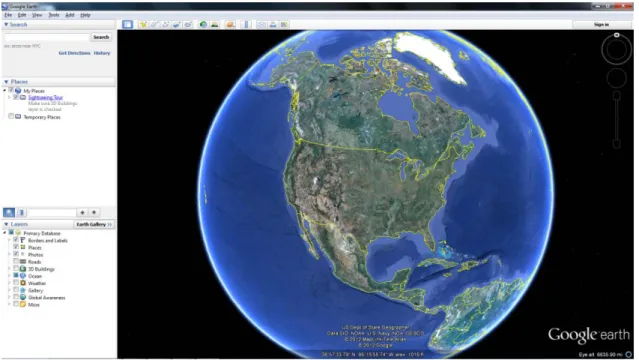
• Google Earth
Google Earth is a virtual earth representation (globe, map and geographical information) that is recognized worldwide. It lets users fly anywhere on Earth to view satellite imagery, maps, terrain, 3D buildings, from galaxies in outer space to the canyons of the ocean[GEARTH]. Users are allowed to add their own data in Google Earth. Some developers, including the company “Wild Sanctuary”, have released a 3D sound layer for the application using a collection of recorded sound sources.
FIGURE 2-1. Google Earth (Google).
• Second Life
Second Life is a well-known multipurpose online virtual world where “residents” (Second Life users) can interact with each other through avatars. Second Life supports in-world sound clips (.wav format), which can be played to all residents within range.
FIGURE 2-2. Second Life (Linden Lab).
• Prototype
Prototype is an action-adventure video game developed by Radical Entertainment. It intends to reproduce a dynamic ambience of New York City using an original recorded sound map [M08]. A three-tire soundscape ambience is applied based on the objects inside the game world and their relative densities, populations, and emotional states.
FIGURE 2-3. Prototype (Radical Entertainment).
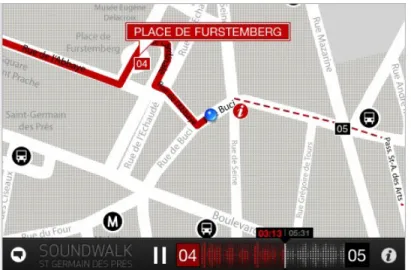
• Soundwalk
Soundwalk allows combining a localized sound recording with the real sound of the city. It is used for various purposes, such as noise evaluation, soundscape analysis and urban planning, real world walks, musical composition.
FIGURE 2-4. Soundwalk (Soundwalk.com).
• Locustream
Locustream is an “openmike” soundmap employed for several practices, for example, webstream, art installations, raw material for live music.
TABLE 2-1 summarizes the usages of sounds in the above example of interactive applications in different genres.
TABLE 2-1. Intersection of different types of virtual urban media and sound functions.
MEDIA FUNCTIONS
EARTH SECOND LIFE PROTOTYPE SOUND WALK.COM LOCUS STREAM
IMMERSION Static recordings
Public spaces, sound art works and private spaces Music, surround sound, real-time spatialization Ambient sound, read text Real-time audio streams NAVIGATION
HELP 3D sound Audio guide
INFORMATION Relative to listenable audio files Positioning objects (3D sound), relative to audio content Character behaviors, density / proximity of agents Historical and culture information, localization Relative to audio stream broadcasts SOCIALIZATION Concerts, adding sounds to avatars, private audio broadcasts User community
STORYTELLING Interactive music, dialogues
Sound path divided into sequences REUSE OF DATA Utilization of streams as sources *Red text shows functions for which users may bring content.
As a conclusion of our analysis, textures, rhythm, and discontinuity are features specific to virtual urban sound spaces. Applications constructed in layers remind us of the classical theory of soundscapes. The dynamic organization of the soundscape is based on the needs created by the gameplay or rules of the media.
2.1.2.2 Sound-Source Clustering
Level Of Detail (LOD) is a technique widely applied in 3D computer graphics. The norm of managing LOD is to increase the efficiency of graphics rendering by decreasing the complexity (quality) of 3D object visual representation and can still preserve the fidelity of the simplified models. The most common LOD approach is based on mesh polygon reductions of distant or small objects.
Given that more and more interactive virtual cities are involved with an enormous number of graphical actors with sounds, an analogous capability of levels of detail for audio is revealed for memory and disk saving. The process of Sound Level Of Detail (SLOD) for audiovisual scene is similar in concept to the LOD for graphics. One of the SLOD solutions is grouping sound sources by the similarity.
Traditional audio source clustering techniques, as depicted in FIGURE 2-6, group point-sources by their distances to the listener. Each set of sound point-sources is meant to be replaced by a single representative (usually at the center point of the group), possible with more complex acoustic characteristic (e.g., impulse response). Such impostor sound sources are used to render or spatialize the aggregate audio streams. Some other sound-source clustering strategies have been described on the basis of re-synthesis [TGD04] [SCB11].
FIGURE 2-6. Paradigm of sound-source clustering techniques [TGD03]. (Blue dots: sound sources; Colored dots: representative.)
2.1.2.3 Soundscape
2.1.2.3.1 TheoryThe term soundscape is the combination of sound and landscape. It is coined by Canadian composer and environmentalist, R. Murray Schafer [S77]. According to Schafer, a sonic environment is depicted with three major layers of the soundscape: keynote sounds, soundmarks, and sound signals, creating multidimensional objects. Walter Murch echoes this theory in film sound taxonomy in [WB85], where sound is categorized into background, midground, and foreground respectively.
• Background (Keynote Sounds)
Keynote as a musical term identifies the lowest note upon which a scale is based. In the soundscape theory, it refers to background listening that all other pieces of sounds in the soundscape are associated to. The keynote sounds outline the character of the people living in the certain community, but it may not always be audible. In general, sounds created by nature form the environmental keynote: water, winds, animals, etc. In urban spaces, traffic is considered as the background sound.
• Midground (Soundmarks)
The soundmark is derived from the term landmark. It is a unique audio component specifically to a certain place or region. The audible zone of a soundmark helps to sonically define a community with social and cultural associations. The repeating bell ringing sound in a church is a common soundmark. London’s Big Ben and the Steam clock in Gastown in Vancouver are some other classic examples of soundmarks.
• Foreground (Sound Signals)
Signals are foreground sounds that often carries encoded and interpretable messages. Therefore, in contrast to the keynote sounds, they are listened to consciously. The examples would be sounds that are generated as warnings, for example, whistles, vehicle honks, or sirens.
2.1.2.3.2 Applicability
The soundscape concept may be applied, for analytic and creative purposes, to real environments or abstract constructions, including virtual ones [LN07]. The techniques used
to simulate the urban soundscape range from layering of prerecorded sounds to various methods of synthesis [VLS09][VAM10][SCB11].
Due to that the basic soundscape taxonomies are significantly related to human perceptual habits, they are easily applicable for the synthesis and analysis of all such electroacoustical soundscapes, usually referring to virtual acoustic environments [T08]. Today, auditory environment design is not bounded in film soundtracks composing but largely being invested in the digital game industry where complex and detailed soundscapes are the norm, both for realistic and fantasy worlds [T07].
Prototype, a Radical Entertainment game, intends to create a dynamic ambience of New York City [M08]. Not separating the city zone-by-zone with detailed sounds, the desire was alternatively to base the ambience on the objects inside the game world and their relative densities, populations, and emotional states. To do so, they broke the ambience down into three “tiers” based on the concept of soundscape theory.
• The background ambiences were a quadraphonic track of the more distant perspective recordings of Manhattan: a Central Park background and a rooftop background that would fade based on the position of the listener.
• The midground layer was composed of a collection of clustered components in the game world, including grouped pedestrians, vehicles and infected crowds.
• Lastly, foreground ambiences were a composition of sounds from single objects in the environment, played based on the changes of state of these objects.
A smooth transition from foreground through midground to background provides a sense of aural depth of the field while limiting the number of individual foreground sound components thank to the support of the midground ambiences.
2.1.2.4 Sound in Architectural Simulations
It has been believed that spatial audio is an essential element to deliver a more immersive and believable virtual reality experience. A sound is not merely an emission from a source. That is to say, sound waves can be absorbed (attenuated), reflected or refracted by the medium. Audio in soundscape theory, architectures and video games, is characterized by its
strong relationship to space regarding both analytic and creative perspectives. This non-linear relationship exists through time and is developed within many cross-disciplinary works [F06].
In terms of virtual representations, architecture provides advanced acoustic space simulations [FJT02]. As it is dynamically organized in propagation fields (direct, diffuse, critical), the architecture auditory space is related to soundscapes perspective though the aim of acoustic simulation providing an objective auralized simulation based either on deterministic or newer probabilistic models. These models require heavy computation and seem not to be yet effective in the reproduction of large and highly interactive environments.
Numerical simulations of the propagation of the sonic wave in acoustic spaces are presented for architectural design. In some interactive media, such as video games, dynamic factors are then added-up in accordance with the gameplay design. In addition, game sound middleware provides a choice of high-level runtime capabilities, such as aural levels of detail [TGD03], interactive spatialization mixing, and runtime reverberation and filtering [M08].
2.1.2.5 Sound in Video Games
Some video games, such as Grand Theft Auto, Prototype, Mirror’s Edge, offer large real-time, interactive and three-dimensional urban environments. Unlike architectural simulations, video game sound design attempts to reproduce the physical phenomenon of sounds but tends to create a credible environment [C08b]. The strategies developed to reach such result rely on the exchanges between the sound engine and the game engine. Sound engines provide some high-level real time capabilities as SLODs, interactive spatialization mixing, runtime reverberation and filtering.
2.1.2.5.1 A Brief History
According to Natkin [N06][GLM02] and Collins [C08a], the evolution of audio technology within games may be divided into three ages. In the first generation of the development, early distribution systems, such as floppy disks and cartridges with read-only memory (ROM), had constrained the sound design by the lack of space for storage and computing power. The earliest video games and home consoles were even silent. Space Invaders developed by Taito/Midway first introduced the idea of a continuous background
soundtrack. The tempo of the music was affected by the player’s progress in the game, reflecting that soundtrack could dynamically interact with the player.
The majority of 8-bit machines (and early arcade and pinball machines) used sound chips known as Programmable Sound Generators (PSGs), usually limiting sounds to single waveforms without much manipulation ability. Nintendo improved on the 8-bit console sound with the release of Nintendo Entertainment System (NES). The NES used a built-in five-channel sound chip with one waveform for each channel and came prepacked with its famous game Super Mario Bros. The 8-bit games produced a type of aesthetic for game music that can still be heard today and has its fans.
Instead of samples, a standardized protocol – MIDI was stored in code, revolutionizing the possibilities for game audio composing. During the mid-1980s, add-on PC sound cards began to develop. Techniques like FM synthesizer allowed game developers to use a broader assortment of instruments and sounds. Although by the early-1990s most FM sound cards supported MIDI, the sound quality was rather poor and disappointing.
The revolution came with the arrival of CD-ROMs available on personal computers and consoles (e.g., Sony PlayStations) offering a wavetable synthesizer and a rough 3D sound generator. With it high-quality recorded audio could be stored, real-time effects were allowed, and adaptive music would react to player and game engine input. However, to control the processor-load and RAM allocated to the sampled sound, synthesis and transformations are limited to the minimum necessary for managing the interactivity. Therefore, the composition was commonly a mix of multiple channels composing, for example, continuous stream of music for non-interactive animation or dialogues, recorded short loops used in ambience, and recorded or generated Foley effects with a simple real-time treatment. The sound design of present prevalent games rests on the same principles. The soundtracks of games like GTA 3, Jack and Dexter, and Silent Hill 2 are typical examples in this context.
We are now in the third period in the advancement of sound within games. Computers and video game consoles in the latest generation (the seventh generation), including Microsoft Xbox 360, Sony PlayStation 3 and Nintendo Wii, have eliminated many of the technological difficulties of earlier games. New capabilities and the use of powerful sound cards, such as Creative Labs’ Sound Blaster, perform efficient signal processing and real-time synthesis. Complex acoustic simulations as 3D localization and reverberation are involved as well. The potential of interactive and dynamic aspects of games audio has risen and begun to be explored. Games that use music as the primary narrative element, such as Dance Dance
Revolution and Rez, give interesting examples of the promising evolution aspects for the future progression.
2.1.2.5.2 Design and Production
To have a clear understanding of the modeling tools and sound design procedure, it is necessary to evaluate the production constraints. FIGURE 2-7 illustrates a common workflow of game audio production. In the early stage of the production workflow, sound designers produce auditory contents and classify them into three categories of audio components namely music, voices (dialogues) and sound effects. The actions of integration and tuning are taken in the next step, and then the final task is submitted to the editorial team for approval.
FIGURE 2-7. Game audio workflow [VNL06].
The creation of a game is carried out in four stages of process: Specification and planning, Pre-production, Development, and Validation and testing. The pre-production phase is mainly devoted to the game design, the creation of a significant prototype, and the refinement of cost and planning evaluation [GLN02]. The steps of a functional evaluation (Alpha) and a debugging process (Beta) are considered as the late period of the production.
Audio Components Creation Audio Components Integration Editorial Evaluation Release Content Rejected Content Approved 19
The essential choices in the matter of sound, including the architecture of the three components and their relationships to game structure and to the images, are defined during the phase of game design [N06]. Unfortunately, as shown in TABLE 2-2, the sound is generally integrated into the game at the late stage of the production, when the other elements have already been constructed. The sound designer must therefore prepare all of the sonic elements without being able to test them in advance. Since there is only little time in prior to a complete content lockdown, any notion of post-production audio is challenged. While sound is now involved in game production a lot earlier, particularly by those with in-house audio teams who are involved in the planning and production of the games from day one, it is in fact the post-production audio phase that is overlooked during the scramble to lock down and stabilize the game [B07].
TABLE 2-2. An audio production model [B07].
Pre-Alpha Alpha Beta Sound Beta Gold master
candidate Gold master (Major features complete) (Rigorous testing of the features in the game begins) (Feature complete and tuning complete) (All sound content and code is finalized, mixed and tuned) (Submitted to console manufacturers for testing) (General availability release)
2.1.3
Content Pipeline of Interactive Applications
In general, an interactive application comprises two primary components: The first is the application providing real-time information to the user and the means to interact with it; and the second is the content containing the information which the application navigates through and provides a view to the user.
To separate the data physically from the code would allow creating several products with the same application but with different data. The content is the parts of the interactive application that do not execute managed code. It includes all art assets (e.g., models, meshes,
textures, sprites, effects, terrains, fonts, animations), audio assets (e.g., music, sound effects), and data assets (e.g., tables of levels, character attributes) [XNA]. The content can be generated in a wide variety of ways and stored in a wide variety of file formats.
The real-time application was referred to as the “runtime,” and the content for the runtime was stored in the “runtime database.” In the game industry, the runtime is called the “game engine.”
Digital Content Creation (DCC) tools, such as a 3D model editor, are used by artists to create and update the source data. However, the data structures and algorithms used for modeling may not match with the data that can be processed in real time by the application. Interactive applications need not only the advanced modeling techniques, but also the simpler representation usable in real time. For this reason, compilation techniques were adapted for the content processing to compile the source data and transform it into the runtime data.
The content tends to change frequently in the course of the progress of interactive applications. The process starts with the source data in its original form as a file, and it continues to its conditioning transformations, and finally is encoded to be retrieved and read by the given runtime and often for the given target platform. This link between the content creation and the runtime is termed the “content pipeline.” For example, an artist who creates a car model can add the resulting file into the game project, assign the model an id and/or a name, and select an importer and content processor for it. Then a game developer can load the car model in the game scene by its id (or name). This simple flow helps both designers and software engineers focus on their own work without having to spend much time on content transformation.
3D environments are time and money consuming to create and manage. Content creation is reputed to be the largest budget in the cost of developing 3D interactive applications. Therefore, the more that existing content and code for assets (e.g., textures, models, animation, shading, effects, physics) can be shared and reused, the more efficiently production pipelines can be made available. Given the need for larger and more interactive content, developers must spend substantial resources on this technology. The content pipeline is designed to be extensible, so that it can easily support new input file formats and new types of conversion.
FIGURE 2-8. Content pipeline process.
2.1.4
Architecture for Games
What characterizes a game and more generally a virtual reality system is the fact that the image and sound must be generated in real time, in other words, in time with the player’s perceptions.
FIGURE 2-9 schematically shows the mechanisms of production and display for a game. This process is a simulation that synthesizes or generates the images and sounds that the player perceives as a function of his actions. The top of the figure represents game production; the bottom represents what happens when a player is using the game.
Following the previous steps, a programming environment is built to allow game advancements. Visual and aural contents specified in the game design are respectively created by the teams of graphic artists and sound designers. Level designers define the geometry using a standard 3D tool such as Autodesk’s Maya or 3ds Max. A scripting language is then used to specify the level in term of objects in the space. Programmers then implement the assets as classes in an oriented library using all the facilities of object-oriented programming (e.g., heritage and polymorphism).
Next, we look into the generic architecture and tools used through the process for game making with a specific interest in sound technology.
Intermediate Format Source Assets DCC Tool Content Processor
(back-end) Runtime Assets Content
DOM Exporter
FIGURE 2-9. Mechanisms of production and display for a game [N06].
2.1.4.1 Game Engines
The implementation of game is typically dependent on software termed a “game engine”, which is a collection of software libraries. Each library in game engine executes a set of functions to perform the dynamic behaviors and interactivities in the game.
G a m e Pr od G a m e Pl 23
Architecture Level Examples Level Design Scripts Editors God.move(right, 2); Wait_Event; onButton.click God_Anger:=new(thunder) God_Anger.lightening, God_Anger.sound
Game Classes class thunder methods: lightening, sound
General Game Engines Create_new_object(God,
god_geometry.vrml, god_texture.gif, god_voice.wav Graphics
Engine Engine Sound Physics Engine Engine AI Network Engine General Multimedia API (Application Program Interface)
(DirectX, OpenGL, OpenAL…) GIMatrixMode(); alsourceplay(source1)
Operating System Windows, PS3 Monitor…
Hardware
PC, PS3, Xbox 360, Wii Central Processor,
memory, etc. Accelerator Graphics Sound Card
FIGURE 2-10. Software and hardware architecture [N06].
The general-purpose game engines provide a software framework for the game creation. The essential functionality given by a game includes a 3D graphic engine used to display visual rendering results and handle interactive animations, a sound engine that manages sound synthesis, effects and spatialization functions, as well as some more specific libraries like a physics engine for physical system simulations and also an AI engine for gameplay.
These days, many of game engines have a software monitor, which is defined by the level design script, scheduling either on a synchronous mode or asynchronous mode. The synchronous monitor approach is almost always used on console platforms, whereas on PCs, the asynchronous approach is possible.
The use of portable game engines allows minimizing the work to be done to create multi-platform games. Typical example of game engine, such as Unity3D, Crytek’s CryENGINE, and Epic’s Unreal Engine (via the Unreal Development Kit, UDK), contains a 3D graphics rendering engine, a sound engine that is built in-house or originated from a third-party audio solution, a physics engine and an AI engine. Games developed with these
game engines can be, in principle, ported to cross-platforms including computers, consoles, and/or mobile phones.
Given the demands of faster adding or subtracting features, game development regularly uses scripting languages for enabling tweak-and-run cycles. Scripting languages have the facility to make changes on the fly without recompiling the project. Many game engines include an idiomatic scripting language tailored to the needs of the application user. Each game engine may interpret specifically the authenticate languages. For example, Unity3D has the self-defined UnityScript scripting language based on the fashion of JavaScript but it also recognizes C#; UDK supports its custom object-oriented scripting language UnrealScript (UScript); and CryENGINE uses C++ in combination with Lua.
2.1.4.2 Sound Engines
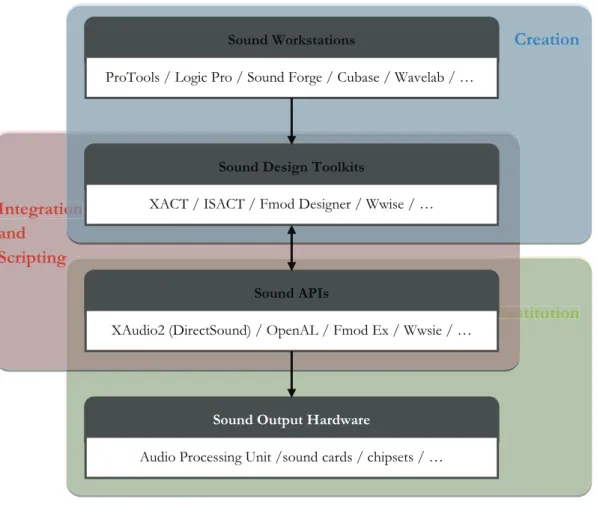
Game audio projects are commonly built upon a three-layer architecture – creation, integration and scripting, and finally restitution, illustrated in FIGURE 2-11.
The first layer of the structure includes signal processing operators, such as sound synthesizers and real-time filters that can compose and be applied to a sound stream which asks for balance between procedural sound design and wavetable playback. This is the level where programming code or sound editing tools operate directly on audio samples. Digital audio workstations, such as ProTools, Audition, Logic Pro, can be involved in this stage. Produced sound can be in diverse formats (e.g., wav, mp3, ogg, midi), sent to the sound engine for manipulations, such as spatialization or reverberation.
In the middle, the sound engine integrates the acoustic contents and transforms them to runtime assets by spatial audio composing toolsets. Most of the popular audio designing tools, such as Microsoft’s XACT, Creative’s ISACT, Firelight’s FMOD Designer and Audioinetic’s Wwise, have a Graphical User Interface (GUI) editor and/or native scripting language available for sound design and manipulations.
The base of the sound engine relies on an audio Application Program Interface (API), which provides an interface communicating between higher-level audio libraries and sound cards or other sound output hardware. Corresponding examples to the mid-layer of the audio architecture are XAudio2 (the successor to DirectSound), OpenAL, FMOD and Wwise. This is mostly where game audio programmers are involved.
FIGURE 2-11. The three-layer structural of game audio work division.
The borderlines between each layer of the sound engine architecture are sometimes vague since the new generation sound design tools are capable of performing a complex and complete synchronized sound editing. The so-called “Sound Engine” software is basically a real-time mixers and sequencers that can manage most of the mandatory functionalities across the three layers.
Restitution Res Integration and Scripting on Creation Sound Workstations
ProTools / Logic Pro / Sound Forge / Cubase / Wavelab / …
Sound Design Toolkits
XACT / ISACT / Fmod Designer / Wwise / …
Sound Output Hardware
Audio Processing Unit /sound cards / chipsets / …
Sound APIs
2.2 Scene Representations
2.2.1Scene Graph
A common method to manage components within an audio-graphic scene is to use the scene graph structure, which is a tree-like data organization that illustrates a virtual space itself and the objects located in that. Each node of the scene graph hierarchy may represent an object, properties of the object (i.e., geometry and physical attributes), transformation of a part of the scene (e.g., location, rotation, scale), the procedural descriptions of the object behaviors which can be triggered by events, or the instructions to be followed by the renderer. The scene graph in virtual-world applications, video games for example, describes a logical relationship between objects so that an object can be considered an extension to another. It may also, but not necessarily, arranges the spatial relationship of the entities.
XML, the eXtensible Markup Language, provides a well-defined framework for structure content, making it a trendy choice for the textural demonstration of scene-graph-based virtual environment. There are XML parsers and text editors for nearly every language on every platform, making the documents easily accessible to almost any application.
Many scene description standards, such as VRML/X3D and MPEG-4, rely on the scene graph to hierarchically organize multiple nodes. Several runtime technologies have been developed to exploit the scene graph approach.
2.2.2
Scene Description Languages
Interactive rich multimedia (i.e., a broad range of digital media choreographing audio, video, text, graphics and synthetic animation in real time) presentations are making their entrance into the world and are being increasingly used for newscasts, education material, entertainment [SVS06]. In this context, a scene description language that enables complex synchronization and authoring interactivity for content production is demanded.
A scene description language refers to any description language to describe an audiovisual presentation composited from several medial components. The language can be
interpreted by a rendering program that will generate, either in real time or in batch, a perceptive (animated image and sound) representation of the scene.
Among an assortment of scene description languages for sounds, there are SMIL, VRML/X3D and MPEG-4 BIFS containing descriptions of both visual and audio, and others like SDIF, SpatDIF, ASDF and XML3DAUDIO composing pure-aural scenes. In the following, we elucidate an overall idea of sound capability in each of these formats.
2.2.2.1 SMIL
Synchronized Multimedia Integration Language (SMIL) is a World Wide Web Consortium (W3C) recommended XML markup language to write interactive multimedia presentation. Temporal behaviors and spatial properties of media objects are able to be integrated by using such a format. The latest W3C Recommendation for SMIL is the version 3.0 released in 2008.
The SMIL syntax and semantics are allowed to be reused and further joint with other XML-based standards (e.g., SVG, XHTML, VoiceXML, MusicXML, X3D), for the purpose to have 2D graphics, formatted text or timing representation and synchronization. However, this need for several specifications at a time could lead to some interoperability problems. It could be the case if one wants rich content that mixes 2D/3D graphics, text and video [CD02].
One of the design strategies for integrating relevant functionality with other XML-based languages is along with the notions of modularization and profiling. In SMIL, markup functionality is specified as a collection of semantically-related elements, attributes, and attribute-values in the modularization approach. The modules are then combined to form Language Profiles. SMIL 3.0 specifies 12 functional areas (i.e., Animation, Content Control, Layout, Linking, Media Objects, SmilText, Metainformation, Structure, Timing, Time Manipulations, State, and Transitions), which are then partitioned into 64 corresponding modules. The Media Object modules can be applied to include a single generic media object (i.e., ref) element into a presentation by referencing it with a Uniform Resource Identifier (URI). In addition to the ref element, SMIL defines the following collection of synonyms: animation, audio, img, text, textstream, and video. The Layout modules describe the spatial positioning of media objects in a scene with left, width, right, top, height, and bottom attributes. The AudioLayout module also supports the aural volume control. It is possible to assign a multimedia object to a region causing the region to reproduce its audio portion at
the given relative sound intensity via the use of the soundLevel attribute. When used in conjunction with SMIL 3.0 Animation (and if supported by the profile), the value of the attribute may be varied over time [SMIL].
2.2.2.1.1 AAML
The traditional SMIL standard defines and manages only two-dimensional render scenes and yet there is only one controllable parameter in the audio object. That is the sound level. Therefore, Pihkala et al. proposed an extension, which is named Advanced Audio Markup Language (AAML), with 3D audio to SMIL [PL03].
In AAML, a third dimension is supplemented to SMIL’s 2D coordinates with a similar layout system by adding front, back, and depth attributes. The AAML namespace introduces six types of new elements and their attributes to SMIL. The first is the audio3d element playing 3D audio and locating its sound source (i.e., URL of the audio file) by the region or left / top / front (i.e., X / Y / Z coordinates respectively) attributes. Audio is played at a given sound level within minDistance (i.e., the minimum distance) whereas it becomes silent outside the range of maxDistance (i.e., the maximum distance); between the two distances is attenuation by that the sound loudness is decreased linearly. The scale, rotate, and translate elements are children of audio3D that scales, rotates, and translates the 3D respectively. The listener element specifies its reference position in the scene. Its rolloffFactor is the amount of the attenuation applied to sounds, based on the distance between the sound source and the listener. In addition, Doppler effects are also of use in AAML. The pitch of the sound is affected by the movement velocity of the listener or the sound object itself. Doppler shift can be increased or decreased with the distanceFactor and dopplerFactor properties. Finally, the audio environment can be modeled with perceptual parameters, specified in the environment element. The attributes of the environment in AAML are one-to-one mapped to Creative’s Environmental Audio Extensions (EAX) 2.0 assets. It has 25 preset environments that can be chosen from the preset attribute. The rest of the attributes can be used to override individual preset parameters.
2.2.2.2 VRML / X3D
The VRML, standing for Virtual Reality Modeling Language, is a scene graph programming model defined for representing 3D virtual reality as well as a universal interchange format for integrated 3D graphics and multimedia. The latest release of the format was the version 2.0. In 1997, it became an international standard as ISO/IEC 14772, also referred to as VRML97.
The VRML has been superseded by eXtensible 3D (X3D). However, unlike the VRML that is a text-based, X3D expresses scenes in XML file format. Each X3D application represents an interactive 3D time-based audio-graphic space. The display multimedia contents can be dynamically modified through various mechanisms like scripts and routes.
Sounds in X3D are spatialized, giving auditory cues and basic ambient mood of the scene. X3D introduces two kinds of audio nodes, Sound and AudioClip that are derived from the X3DSoundNode and X3DSoundSourceNode abstract node types respectively. The Sound node describes sounds in an actual presentation whereas AudioClip provides sound source for use. Each node has several fields which identify the particular behaviors of the object. The semantic declaration of a node includes the name of the node with a list of its fields. Each field’s label, type, name, and default values are specified in that order.
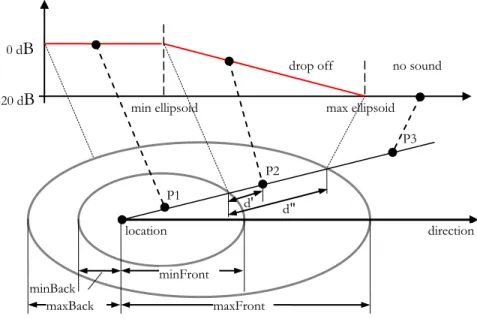
FIGURE 2-12. The ellipsoid sound attenuation model of X3D.
minBack maxBack maxFront max ellipsoid min ellipsoid -20 dB 0 dB location minFront direction P3 drop off d' d" no sound P2 P1
The sound node geometry is illustrated in FIGURE 2-12, where the sound is emitted in an elliptical pattern formed by two nested ellipsoids. The loudness attenuation can be obtained from the below equation.
The Equation of Sound Loudness Attenuation:
(2-1)
, where d' is the distance along the location-to-listener vector, measured from the transformed minimum ellipsoid boundary to the virtual listener, and d" is the distance along the location-to-listener vector from the transformed minimum ellipsoid boundary to the transformed maximum ellipsoid boundary [P07a].
Topol et al. proposed an enhancement of sound description with a sound-cone definition to “shape” sound sources as well as a room-effect definition for more realistic atmosphere [TS01].
2.2.2.3 MPEG-4
MPEG-4 included object-based audio-video coding for web streaming media and CD distribution, voice and television broadcasting applications, but also digital data storage. Among the existing scene description languages, MPEG-4 provides probably the most advanced scene language considering the sound aspect [S98][SVH99][SYE00]. MPEG-4 consists of several “parts” (standards), among which Part 3 is termed “MPEG-4 Audio” consisting a set of compression technologies for perceptual coding of audio signals. The audio profiles of MPEG-4 includes the Speech, Synthesis, Scalable, High Quality Audio, Low Delay Audio, Natural Audio, Mobile Audio Internetworking, as well as the Main Profile, which is a rich superset of all the other profiles, also containing coding tools supporting natural and synthetic audio. MPEG-4 Audio facilitates a wide variety of applications which could range from intelligible speech to high quality multichannel audio, and from natural sounds to synthesized sounds.
2.2.2.3.1 BIFS
The BInary Format for Scenes (BIFS) is comprised of both 3D and 2D objects interlinked to form the scene graph of a MPEG-4 world. For the reason that it has a great portion of the structure inherited from VRML, BIFS is almost equivalent to the VRML scene graph.
FIGURE 2-13. MPEG-4 and VRML scene graphs with sound nodes [TS01].
In addition to the functions originated from VRML, BIFS has added up distinguishing features so that it can be streamed and can evolve over time if the MPEG-4 server sends modification to the client. This update mechanism consists of two toolsets: BIFS-Command and BIFS-Anim. First, the BIFS-Command allows the manipulations (modification, addition, deletion, replacement) of either a single 2D/3D object or of the entire scene. The second tool, BIFS-Anim, continuously sends an updating stream in a sequence in order to achieve fast animation of components. The updating feature shows how BIFS is stream-dependant; thereby a communication is a request between the bitstreams generators/servers and the MPEG-4 terminals/clients. It requires a heavy on-the-fly calculation of transmission in response to user actions, scene evolution and the renderer. For offline interactive or
![FIGURE 2-9. Mechanisms of production and display for a game [N06].](https://thumb-eu.123doks.com/thumbv2/123doknet/14590223.730044/40.918.138.788.138.796/figure-mechanisms-production-display-game-n.webp)
![FIGURE 2-13. MPEG-4 and VRML scene graphs with sound nodes [TS01].](https://thumb-eu.123doks.com/thumbv2/123doknet/14590223.730044/49.918.161.755.330.702/figure-mpeg-vrml-scene-graphs-sound-nodes-ts.webp)
![FIGURE 2-14. The MPEG-4 Audio system [S98].](https://thumb-eu.123doks.com/thumbv2/123doknet/14590223.730044/51.918.184.737.147.711/figure-the-mpeg-audio-system-s.webp)

![FIGURE 3-1. The organization of Niessen et al.’s hybrid approach to soundscape research [NCD10]](https://thumb-eu.123doks.com/thumbv2/123doknet/14590223.730044/84.918.150.778.154.487/figure-organization-niessen-hybrid-approach-soundscape-research-ncd.webp)