POPULAR AND DEMOCRATIC REPUBLIC OF ALGERIA
MINISTRY OF HIGHER EDUCATION AND SCIENTIFIC RESEARCH
UNIVERSITY OF TLEMCEN
FACULTY OF LETTERS AND LANGUAGES
DEPARTMENT OF FOREIGN LANGUAGES
SECTION OF ENGLISH
This dissertation is submitted to the department of foreign languages as a
partial fulfillment for the requirement of the ‘Magister’ degree in ESP
Work presented by: Supervised by:
Miss.YAHIAOUI Nadjia Dr. BENYELLES Radia
Jury Members:
Dr.BENMOUSSAT Smail (Professor) President (University of Tlemcen) Dr.BENYELLES Radia (MC ‘A’) Supervisor (University of Tlemcen) Dr.HAMZAOUI Hafida (MC ‘A’) Internal Examiner (University of Tlemcen) Dr.MELLOUK Mohammed (MC ‘A’) External Examiner (University of Bel Abbes) Dr.SENOUCI Faiza (MC ‘A’) Internal Examiner (University of Tlemcen)
Academic Year: 2011 - 2012
An Assessment of Teaching the Speaking Skill:
The Case of Second-Year LMD Physics Students at Abou
I
II
Acknowledgements
I would like to express first my gratitude to my supervisor: Dr. BENYELLES Radia who guided me during the whole of the year to obtain this work, as she helped me, encouraged me and advised me. I would like to thank her a lot for all the great efforts and all what she did for me in my research work.
I would like to thank the members of the jury: Dr.BENMOUSSAT Smail, Dr.HAMZAOUI Hafida, Dr.SENOUCI Faiza and Dr.MELLOUK Mohammed who came from university of Bel Abbes. Thanks for devoting your time and accept reading my dissertation.
Special thanks go to my teacher who guided us in the first year magister in ESP, Dr. Hamzaoui hafida. It was a fruitful experience through which I have learned lot of things. I really thank her for her advice, guidance and help.
I would like also to thank all my teachers in the university among them: Dr.BELMEKKI Amine, Mr.BERRABAH, Dr.NEGADI Nassim and Pr. BENMOUSSAT Smail.
My thanks go also to students of Physics for their collaboration and the teachers of English: Mr. HABIBES, Mr.HAMMIDOU and Mr.HADJ ALI who help me to conduct this research.
III
Abstract
English is the language of Science and Technology as it is a means of
communication. It is also the language which taught in different fields to achieve occupational and academic purposes.Accordingly, the present study dealt with teaching English in the field of Physics. It is taught in this field at university for scientific and technical purposes. Learners of second year in Physics, in the faculty of Sciences at Tlemcen University face problems in using the English language. However, they have to use this language effectively in their field of study for scientific purposes.
Thus, the aim of this research work was to investigate the status of the speaking skill in this field. The present study also tried to identify the reasons behind learners’ weaknesses in this skill. Yet, to povide some suggestions that may enhance the teaching of this skill in this field to help learners face their difficulties.
This dissertation is a case study research since it dealt with an in-depth description of the speaking skill in Physics. In order to answer the research questions and to confirm the research hypotheses, this research work focused on three research instruments for data collection which are : students’ questionnaire, teachers’ interview and classroom observation. Both qualitative and quantitative methods for data analysis were used in this research work to analyse this data.
The results shed light on the idea that the teacher did not focus on the speaking skill when teaching English in this field. Moreover, these learners had weaknesses in vocabulary and grammar. On the other hand, the teacher did not use activities for these learners, because they were not motivated as they relied on translation of technical words.
IV
Table of Contents
Dedication………I Acknowledgements……….II Abstract………..III Table of Contents………..IV List of Tables………..X List of Figures………XI List of Pie-Charts……….XII List of Bar-Graphs………XIII List of Acronyms………...XIIII General Introduction………1Chapter 1: Literature Review
1-1 Introduction………..61-2 Background of ESP………..6
1-2-1 The Concept of Specialized Language………...6
1-2-2 Types of ESP………..7 1-3 Needs Analysis………9 1-3-1 Definition………...9 1-3-2 Types of Needs………..12 1-3-2-1 Target Needs……….12 1-3-2-1-1 Necessities……….12
V
1-3-2-1-2 Lacks……….12
1-3-2-1-3Wants ……….12
1-3-2-2 Learning Needs……….13
1-3-3 Approaches to Needs Analysis………...14
1-3-3-1 Target-Situation Analysis………14
1-3-3-2 Present-Situation Analysis………..15
1-3-3-3 Strategy Analysis………..15
1-3-3-4 Means Analysis………...15
1-3-4 The Role of Needs Analysis in an ESP Course Content………...16
1-4 The Speaking Skill……….17
1-4-1 The Nature of Oral Communication………...19
1-4-2 Oral Communication Techniques………...21
1-4-2-1 Group Work………..21
1-4-2-2 Problem Solving………...22
1-4-2-3 Role Play………..23
1-4-2-4 Discussion………...24
1-5 The Speaking skill in ESP………..24
1-5-1 Spoken Interaction in EAP and EOP………...25
1-5-2 The Teaching of Spoken Interaction………..25
1-6 The Spoken Language: key Descriptive Features………...25
VI
1-6-1-1The Transaction………..26
1-6-1-2The Exchange………...27
1-6-1-3The Adjacency Pair………...27
1-6-2Interactional Features……….28 1-6-2-1 Turn-Talking………...28 1-6-2-2 Discourse Marking………...…..28 1-6-2-3 Information Staging………...28 1-6-3 Generic Features………...29 1-6-4 Contextual Constraints………...29
1-7The Speaking Skill in Physics………...29
1-8 Conclusion………..30
Chapter 2: Methods and Procedures for data collection
2-1 Introduction……….332-2 General Description of Teaching/Learning English in Physics………...33
2-3Research Questions and Hypotheses………...34
2-4 Informants………...35
2-4-1 Learners’ Profile………..35
2-4-2 Teachers’ Profile………...35
2-5 Research Methods …………..………36
2-5-1 Students’ Questionnaire………36
2-5-1-1 Aims of the Questionnaire……….37
VII
2-5-2 Teachers’ Interview………...39
2-5-2-1 Aims of Teachers’ Interview……….40
2-5-2-2 Description of teachers’ Interview………...40
2-5-3 Classroom Observation………....42
2-5-3-1Aims of Classroom Observation………...42
2-5-3-2 Description of Classroom Observation………...42
2-6 Piloting the Study………...45
2-7Categorization of Research………...45
2-7-1 Case Study Research………...45
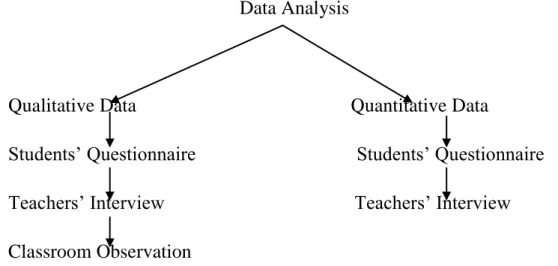
2-8Approaches to Data Analysis………...47
2-8-1 Qualitative Research Method………47
2-8-2 Quantitative Research Method………...48
2-9 Conclusion………...50
Chapter 3: Data Analysis and Interpretation.
3-1 Introduction………...533-2 Analysis of Students’ Questionnaire………....53
3-2-1 Results of students’ Questionnaire………53
3-2-2 Discussion of the Results………...60
3-3 Analysis of Teachers’ Interview………...60
3-3-1 Results of Teachers’ Interview………...61
3-3-2 Discussion of the Results………...65
VIII
3-4-1 Results of Classroom Observation………...66
3-4-1-1 Classroom Activities……….66
3-4-1-1-1The Type of Activity………...66
3-4-1-1-2Participant Organization………...66
3-4-1-1-3Content………...67
3-4-1-1-4Student Modality………...67
3-4-1-1-5Materials………67
3-4-1-2 Classroom Language………...67
3-4-1-2-1 Use of Target Language………...67
3-4-1-2-2 Reaction to Code or Message………...68
3-4-1-2-3Discourse Initiation………...68
3-4-1-2-4 Incorporation of Preceding Utterance………...68
3-4-1-2-5The Difficulties Faced by both Teacher and Students……...68
3-4-2 Discussion of the Results………...69
3-5 Interpretation of the Main Results………70
3-5-1Necessities………70
3-5-2Lacks………....70
3-5-3Wants………71
3-5-4 Learning Needs……….71
3-6 Conclusion………...72
Chapter 4: Suggestions and Recommendations.
4-1 Introduction……….74IX
4-2 Summary of the Main Results. ………...74
4-3 Suggestions for Teaching the Speaking Skill………...75
4-3-1Organizing a Speaking Syllabus………75
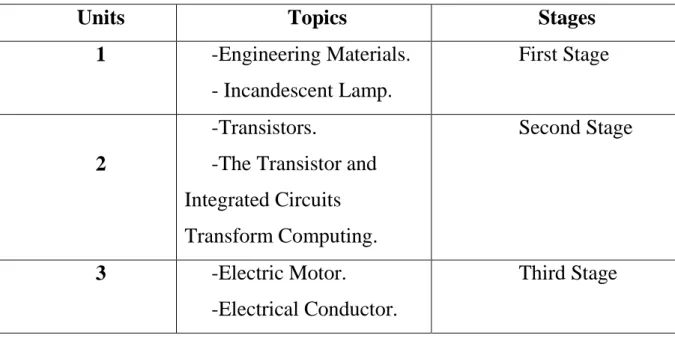
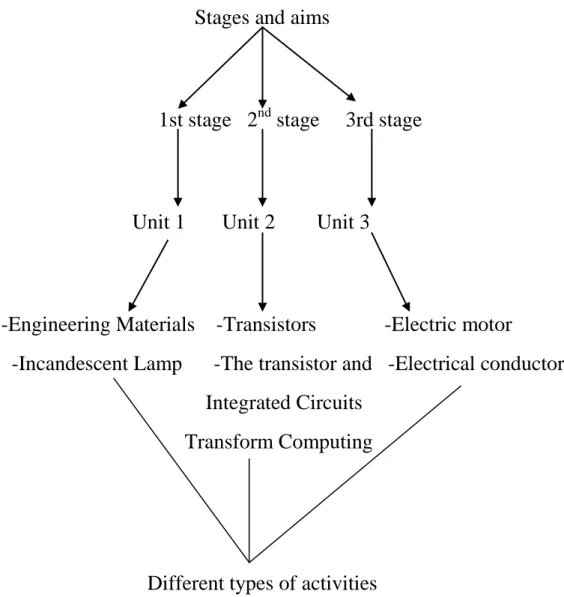
4-3-2 Integrating the Speaking Syllabus in Physics……….77
4-4Types of Activities to promote the Speaking Skill through the Speaking Syllabus………79
4-4-1 Communication Activities………..79
4-4-2 The Design of Activities through the Speaking Syllabus………...80
4-5 The Effects of the Speaking Syllabus on Learners’ Strategies………..91
4-5-1 Input –Based Strategies………...92
4-5-2 Output-Based Strategies………...92
4-5-3 Developing Target Performance Competencies………...94
4-6 Conclusion………...95
General Conclusion……….97
Bibliography………...99
Appendices………...104
Appendix (A): Students’ Questionnaire in English………...105
Appendix (B): Students’ Questionnaire in French………....110
Appendix (C): Teachers’ Interview………...115
X
List of Tables
Table 2-1Time Alloted for Teaching English in Physics………..33
Table 2-2 Description of Students’ questionnaire………...39
Table2-3 Grid of Classroom Observation………...44
Table3-1Learners’ Baccalaureate Streams………54
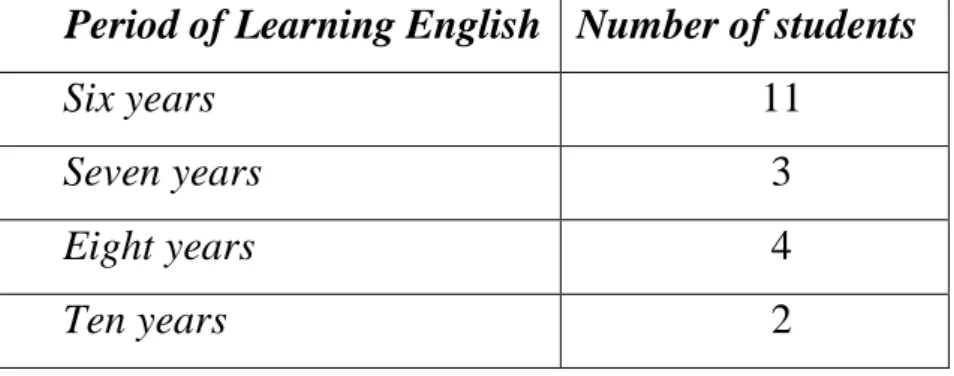
Table 3-2 Period of Learning English………...55
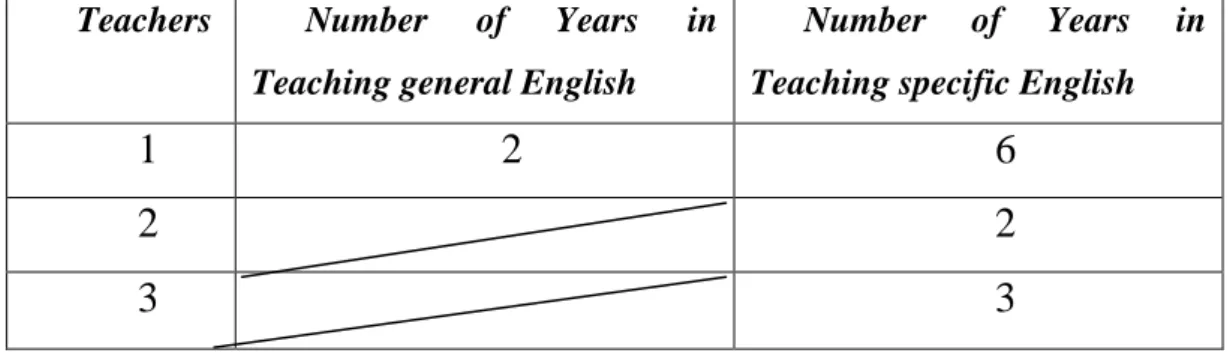
Table 3-7 Teaching Experiences of Teachers………...62
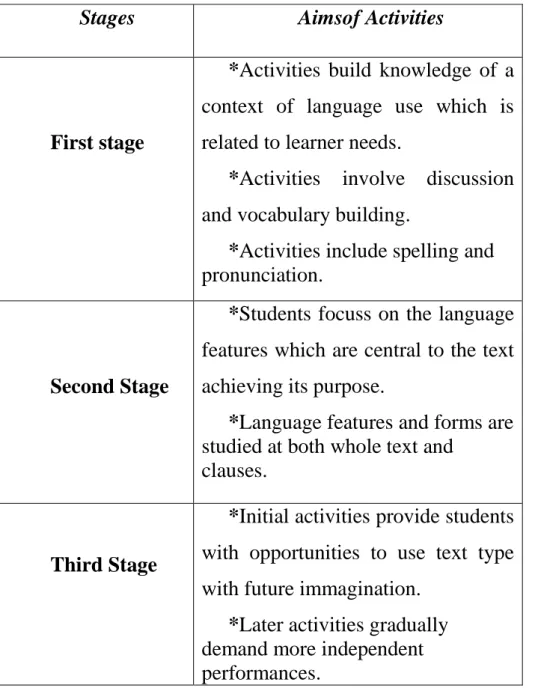
Table 4-1Organizing Speaking Syllabus Through Activities Aims…………...76
XI
List of Figures
Figure1-1 ESP Classification by Professional Area………...8
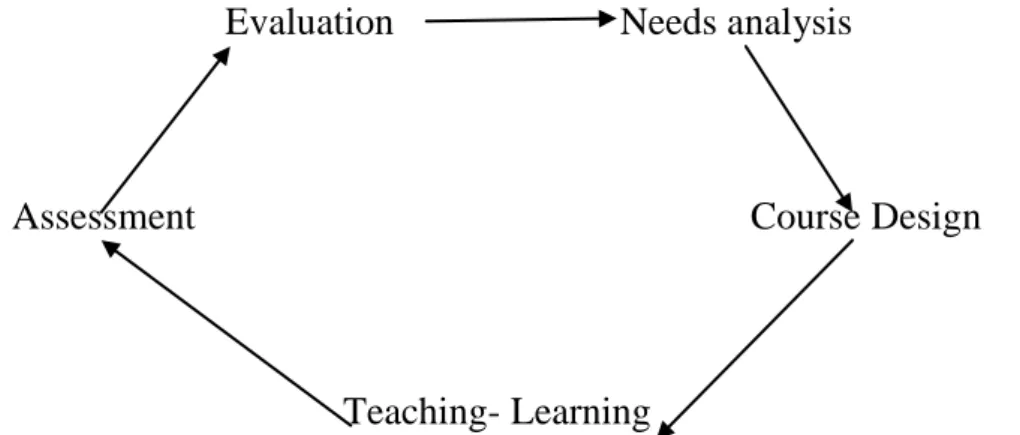
Figure1-2 Stages in the ESP Process: Theory………...10
Figure1-3 The Taxonomy of Needs Analysis………...14
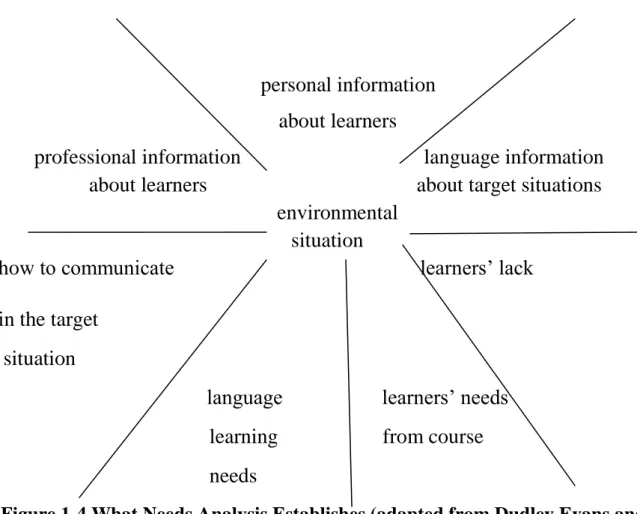
Figure1-4 What Needs Analysis Establishes………...17
Figure1- 5 Inter-Relationship of the Four Skills………...18
Figure1-6 Skill Getting and Skill Using………...19
Figure2- 1Types of Research Design………49
Figure2-2 Methods of Data collection and Analysis Used in this research………...49
XII
List of Pie-Charts
Pie-Chart 3.1 The Reasons behind the Importance of English for Students………56 Pie-Chart 3.2 Learners’ Difficulties in terms of Language Skills………57
XIII
List of Bar-Graphs
Bar-Graph 3.1 Students’ Difficulties in Using English……….58 Bar-Graph 3.2 The Importance of Language Skills for Teachers………..63
XIV
List of Acronyms
COLT :Communicative Orientation of Language Teaching. EAP :English for Academic Purposes.EBP :English for Business Purposes. EFL :English as a Foreign Language. ELP :English for Legal Purposes. ELT :English Language Teaching. EMP :English for Medical Purposes. EOP :English for Occupational Purposes. ESP :English for Specific Purposes.
EST :English for Science and Technology. LMD :Licence-Master-Doctorat.
PMC :Physics, Mathematics and Chemistry. PSA :Present Situation Analysis.
TSA :Target Situation Analysis. USA :United States of America.
1
General Introduction
The widespread use of English as a means of global and international
communication has maintained a huge need to learn and teach it for specific purposes, since it imposes itself in all the domains. Businessmen, engineers and scientists must know this language because it is the international means of exchanging information and experience.English is the language of Science and Technology as it is a means of communication. For this reason, the speaking skill is one of the necessities of these learners. They face communicative situations through which they have to use this language in their speciality.
Moreover, the primary goal of the ESP course is to be communicatively competent in English according to the situation, purpose and specific roles. It extends the learner’s grammatical, lexical and functional skills. As a result, this research work deals with the teaching of the speaking skill among LMD Physics students, in the faculty of Sciences at Tlemcen University.
These learners do not use the English language in the classroom since they face weaknesses in this skill. On the other hand, during the course, only the teacher speaks. Also, he does not focus on activities to make them speak. This has given birth to the lack of interest from learners towards English. However, second year LMD students of physics do not study English in the first year.
Accordingly, this dissertation tries to answer the following research questions:
1)-Does the teacher of English focus on the speaking skill when teaching English to second year LMD students of Physics?
2)-What are the reasons behind learners’ weaknesses in speaking English during the course?
3)-What are the difficulties that the teacher encounters when designing activities for these learners?
2
The answer to these questions may raise the following research hypotheses:
1)-The teacher of English in Physics does not focus on the speaking skill because learners are not motivated.
2)-The reasons behind learners’ weaknesses in speaking English during the course are: The use of technical questions by the teacher.
Difficulties in terms of pronunciation. Lack of vocabulary to speak.
3)-The difficulties that the teacher encounters when designing activities to these learners are:
To select activities to make learners speak.
Students rely on translation of technical words and they speak in French during the course
The teacher does all the work in the classroom.
Accordingly, this research work is divided into four chapters. The first chapter is a
literature review. It attempts to give a background and definitions about both the speaking skill and ESP in order to provide a description of this skill in an ESP context. Furthermore, it focuses on needs analysis and findings related to it.The second chapter deals with the methods and procedures for data collection. It describes the three research instruments used in this study to draw a profile of learners needs and the aims of each one. In addition to that, it provides an idea about the category of this research as well as approaches to data analysis that are used in order to analyse the collected data.
The third chapter is about data analysis and interpretation. It is devoted for the analysis of this data about students’ needs according to the description of each research instrument. These results give a final answer to the research questions and confirm the research hypotheses too. The discussions of these results are also available in this chapter with an interpretation of the main results.
3
The last chapter is devoted to suggestions and recommendations. It attempts to propose some solutions in order to enhance the teaching of the speaking skill for the students of Physics. All the suggestions and recommendations that are mentioned in this chapter are based on the results obtained from the previous chapter. These suggestions rely on activities that may help learners to overcome their weaknesses in this skill.
4
Chapter 1: Literature Review
1-1 Introduction………..6
1-2 Background of ESP………..6
1-2-1 The Concept of Specialized Language………...6
1-2-2 Types of ESP………..7 1-3 Needs Analysis………9 1-3-1 Definition………...9 1-3-2 Types of Needs………12 1-3-2-1 Target Needs……….12 1-3-2-1-1 Necessities………..12 1-3-2-1-2 Lacks………..12 1-3-2-1-3Wants ……….12 1-3-2-2 Learning Needs……….13
1-3-3 Approaches to Needs Analysis………...14
1-3-3-1 Target-Situation Analysis………14
1-3-3-2 Present-Situation Analysis………..15
1-3-3-3 Strategy Analysis………..15
1-3-3-4 Means Analysis………...15
1-3-4 The Role of Needs Analysis in an ESP Course Content………...16
1-4 The Speaking Skill……….17
5
1-4-2 Oral Communication Techniques………...21
1-4-2-1 Group Work………...21
1-4-2-2 Problem Solving………....22
1-4-2-3 Role Play………...23
1-4-2-4 Discussion………...24
1-5The Speaking skill in ESP………24
1-5-1 Spoken Interaction in EAP and EOP………...25
1-5-2 The Teaching of Spoken Interaction………...25
1-6 The Spoken Language: key Descriptive Features………....25
1-6-1Structural Features………...26
1-6-1-1The Transaction………...26
1-6-1-2The Exchange………...27
1-6-1-3The Adjacency Pair………...27
1-6-2Interactional Features……….28 1-6-2-1 Turn-Talking………...28 1-6-2-2 Discourse Marking………...…..28 1-6-2-3 Information Staging………...28 1-6-3 Generic Features………....29 1-6-4 Contextual Constraints………...29
1-7The Speaking Skill in Physics………...29
6
Chapter 1:
Literature Review
1-1 Introduction:
The emergence of English as a global language gives birth to the appearance of a new field in English language teaching which is ESP. Hence, there is a necessity to cope the different teaching situations and needs of learners. ESP addresses the communicative needs and practices of particular professional or occupational groups. Thus, the students need to be communicatively competent in this language. Such needs require a deep understanding of different concepts, features and classification of ESP. Accordingly, this chapter deals with the background of ESP in terms of the concept of specialized language, types of ESP and needs analysis. It also provides different aspects in the speaking skill. Finally, it represents a relationship between ESP and the speaking skill.
1-2 Background of ESP:
The field of English for Specific Purposes has developed to become a major force and prominent area in ELT and research. It refers to the teaching of a specific language whether scientific or technical to students with specific goals in all domains.
1-2-1The concept of Specialized Language:
ESP is an approach to language teaching. In this new branch of teaching, the methods
and content are based on learner’s goals. In other words, it looks for the reasons behind learning this language as well as the nature of the learning context. Hutchinson and Waters (1987:19) state that: “ESP is an approach to language teaching in which all decisions are based on learner’s reason for learning”. Thus, ESP is an approach to language teaching which is directed by specific and determined reasons for learning.7
The term specialized represents situations where the learner has some specific goals
to learn English. In the same vein, Harmer (1983:1) defines ESP as follows: “Situations where the student has some specific reasons for wanting to learn a language” .i.e. ESP has developed to meet specific learners’ needs of language.Moreover, Basturkmen (2006:18) argues that:
In ESP, language is learnt not for its own sake or for the sake of gaining a general education, but to smooth the path to entry or greater linguistic efficiency in academic, professional or workplace environments.
This means that ESP seeks to develop the learners’ competencies in different areas, such as: specific filed, profession or workplace.
Finally, it is necessary to add that ESP is an important branch of ELT. To the extent that it gives importance to the learning process. In other words, the focal point of this area of research is the learners’ needs in their speciality. This enable them to use the language appropriately in the different specific contexts.
1-2-2Types of ESP:
Due to its development, ESP is divided into two main categories according to
Hutchinson and Waters (1987) which are: English for Academic Purposes (EAP). English for Occupational Purposes (EOP). Robinson (1991:2) points out that:
The students study English not because they are interested in the English language or English culture as such but because they need it for study or work purposes.
That is to say, English is learned whether for Academic or Occupational Purposes. This is related on the field of study in which English is taught. Evans and St John (1998:7) have provided a diagram through which they classify EAP and EOP according to discipline or professional area:
8
English for Specific Purposes
English for Academic Purposes English for Occupational Purposes
English for English for English for English for English for English for Science and Medical Legal Management Professional Purposes Vocational Purposes Technology Purposes Purposes Finance and
Economics English for English for Pre- Vocational
Medical Business Vocational Purposes
Purposes Purposes Purposes
Figure1-1 ESP Classification by Professional Area (adapted from Dudley Evans and ST John, 1998:6).
In EAP, English for Science and Technology (EST) has been the main area. It is a
discipline that includes this language at tertiary level. English is also taught for Medical Purposes (EMP) and for Legal Purposes (ELP) at this level. English is taught in all the domains: Business, Finance, Banking and Economics. Thus, learners have to study English to achieve educational purposes as Kennedy and Bolitho (1984) note that: “EAP is taught, generally within educational institutions to students needing English in their studies”. Thus, English is available in all the domains for making learners as competent as possible to communicate in different specialities.Whereas the term EOP refers to professional purposes in administration, Medicine, Law and Business. Moreover, in vocational purposes, there are two subdivisions: Vocational English is concerned with the language of training for specific trades or occupations, and Pre- Vocational English is concerned with finding job through interview skills, Dudley Evans (1998).
This research is concerned with English in Physics for scientific purposes. It is considered as a branch of EST. Thus, learners have to be informed with all the new investigations in this area which is provided in English language.
9
1-3 Needs Analysis:
After dealing with the concept of specialized language and the types of ESP. This chapter also speaks about needs analysis because ESP course is designed to meet specific needs of the learners. Therefore, it is necessary to analyse the needs of second year LMD students of Physics.
1-3-1Defnition:
ESP is understood to be about preparing learners to use the English language within academic, professional or workplace environments. So that, the first step in an ESP course design is Needs Analysis .It is also known as needs assessment. It has an important role in the process of designing and carrying out any language course, especially in English for Specific Purposes (ESP). In this vein Hutchinson and Waters (1987:54) argue that:
If we had to state in practical terms the irreducible minimum of an ESP approach to course design, it would be needs analysis.
Evans (1998:121) has established the key stages in ESP which are needs analysis, course and syllabus design, teaching and learning situation, assessment and evaluation. These are the major steps of ESP content as they are shown in the following cycle:
Evaluation
Needs analysisAssessment Course Design
Teaching- Learning
Figure 1-2 Stages in the ESP Process: Theory (adapted from Dudley Evans and ST John, 1998:121).
10
Thus, Evans sees that these are the major steps to contribute ESP content. One of them is needs analysis. In the same vein, Nunan (1988:13) focuses more on information-gathering process, he states that: “techniques and procedures for collecting information to be used in syllabus design are referred to as needs analysis.” According to Iwai et al (1999), the term needs analysis generally refers to the activities that are involved in collecting information. It will serve the basis for developing a curriculum that will meet the needs of a particular group of students. On the other hand, Richards and Platt (1992: 242-243) define needs analysis as: “the process of determining the needs for which a learner or group of learners requires a language and arranging the needs according to priorities”.
Thus, this explains the specific purposes for which the language is needed and the situation in which the language will be used. It relies on gathering information about learners’ level of proficiency in the English language through different methods taking into account:
Age, sex, previous experience with second language learning, proficiency in the native language, personality factors, language attitudes and motivation, learning intelligence, sense modality preference, sociological preference, cognitive style, learner’s strategies and learner’s errors.
(Altman and James, 1980: 5)
As a result, the notion of needs analysis deals with both personal and social
developments of learners. It tries also to identify their behaviours through this language as well as methods of learning.
Moreover, needs analysis is interpreted in two different ways. This represents what has been stated earlier:
On the one hand, it can refer to what learner needs to learn to do with language once he or she has learned it. This is goal-oriented definition of needs and relates to terminal
11
behaviour, the ends of learning. On the other hand, the expression can refer to what the learner needs to do actually to acquire the language. This is a process-oriented definition of needs to transitional behaviour, the means of learning.
(Widdowson, 1981:2)
As a result, needs analysis explains what and how of a course. In other words, it determines the content of the course and behaviours of learners towards the language. In addition to this, it denotes what learners have to do in order to acquire the language in the specific context.
1-3-2 Types of Needs:
Hutchinson and Waters (1987:55) identify the following sub-divisions or taxonomies of needs analysis:
1-3-2-1 Target Needs:
They see that target needs are an important aspect in needs analysis, since they fall under three types of distinctions which are:
1-3-2-1-1Necessities:
Necessities are determined by the demands of the target situation (Hutchinson and Waters: 1987), what the learner has to know in order to function effectively in the target situation. Thus, it is concerned with learners’ needs in the target language for the sake of being communicatively competent and to use the language effectively in the specialized field.
1-3-2-1-2Lacks:
Learners’ necessities are not enough step in target needs. According to Hutchinson and Waters (1987:55-56) the concern in ESP is with the needs of particular learners. It is necessary to know what the learner knows already in order to decide which of the necessities the learner lacks.
12
1-3-2-1-3Wants:
This step takes into consideration learners’ views and wants and the reasons behind
integrating this language in their specialization. Since they have an idea about their necessities as well as their lacks, certainly they can detect their wants from the previous steps towards that language. This step can help a lot teacher for course design since, they are informed about learners’ wants for successful language learning and teaching Hutchinson and Waters (1987).
1-3-2-1 Learning Needs:
This step will determine how learners will be able to move from the point of lacks to necessities. Hutchinson and Waters (1987:61) claim that:
It is naive to base a course design simply on the target objectives, and that the learning situation must also be taken into account. Since the target situation is not a reliable indicator.
Accordingly, learning needs seek for more steps in the target language. It includes: knowledge, skills, strategies and motivation of learning. These concepts are very important aspects to conduct learning needs as a step in needs analysis.
Bowers (1980) quoted in Jordan (1997: 26) has also noted the importance of learning needs:
If we accept…that a student will learn best if what he wants to learn, less well what he only needs to learn, less well still what he either wants or needs to learn, it is clearly important to leave room in a learning program for the learner’s own wishes regarding both goals and processes .
Thus, target needs cannot fulfill the concept of needs analysis, since it does not look for the learning needs which are a necessary step in course design. It also looks for what learners need to learn as well as their language background.
13
Accordingly, needs analysis is divided into two main types: target needs and learning needs. The first one has three main steps which are: Necessities, Lacks and Wants. All these steps can be shown in the following diagram:
Needs Analysis
Target Need Learning Needs
Necessities Lacks Wants
Figure1-3 The Taxonomy of Needs Analysis (adapted from Ounis, 2005) 1-3-3 Approaches to Needs analysis:
Under the classification of Hutchinson and Waters (1987) of needs analysis, the following elements have been developed:
1-3-3-1 Target -Situation Analysis:
Munby’s approach (1978:23) focuses on students’ needs at the end of a language course and target-level performance. Thus, he is concerned with communicative syllabus design. He adds that:
Model collects data about the learner rather than from a learner …as a reaction, more recent needs analysis procedures have been developed which deliberately adopt a very different starting point, reasserting the value of the judgment of the teacher or involving the learner from the start.
Thus, he argues that practical constraints should be considered in the needs analysis. Munby’s approach is influential to the extent that it focuses on learners’ development from starting point. In the same vein, Hutchinson and Waters (1987:59) claim that:
The analysis of target situation needs is in essence a matter of asking questions about the target situation and the attitudes towards that
14
situation of the various participants in the learning process.
Hence, they see that target situation analysis is concerned with questions about the target language in the learning process. Furthermore, these questions include attitudes and participant’s level in the target situation.
1-3-3-2 Present-Situation Analysis:
It is provided by Richterich and Chancerel (1977). The PSA deals with the students’ state of language development at the beginning of the language course. Information is sought on levels of ability, resources and views on language teaching/learning. Thus, it is a combination between the two approaches: TSA and PSA.
1-3-3-3 Strategy Analysis:
Allwright (1982) is a pioneer in this area. His starting point was from the perception of the students of their needs. In this sense, he made a distinction between needs (the skills which a student sees as being relevant to himself), wants (those needs on which the student puts a high priority in the available, limited time), and lacks (the difference between the student’s present competence and the desired competence). Allwright’s concern is also to help students to identify skill areas and their preferred strategies of achieving the skills.
1-3-3-4 Means Analysis:
An important step in the development of needs analysis is the attempt to adapt language courses to local situations, for example: materials, cultural attitudes and methods. This approach has been called means analysis (Holliday and Cooke 1982). The importance of this approach is that it starts from positive points. In other words, what might be achieved with certain given factors.It allows sensitivity to situations which acknowledges the social context of education and gives more attitudes to teacher.
15
1-3-4 The Role of Needs Analysis in an ESP Course Content:
Needs analysis has a vital role in the process of designing and carrying a course in
an ESP context as it explains by Basturkmen (2006:18) who states that: “the task of the ESP course developer is to identify the needs of the learner and design a course around them”.
Accordingly, Evans and John (1998:125) argue that needs analysis in ESP determine the following steps (see figure 1-4):
1-Profesional information about the learners: the tasks and activities learners are/will be using English for- target situation analysis and objective needs.
2-Personal information about the learners: factors which may affect the way they learn such as previous learning experiences, cultural information, reasons for attending the course and expectations of it, attitude to English- wants, means and subjective needs.
3-English language information about the learner: what their current skills and language use are- present situation analysis.
4-The learners lacks: the gap between present situation analysis and target situation analysis-lacks.
5-Language learning information: effective ways of learning the skills and language- learning needs.
6-Professional communication information about learners: knowledge of how language and skills are used in the target situation.
7-Wat is wanted from the course.
16
personal information
about learners
professional information language information
about learners about target situations
environmental
situation
how to communicate learners’ lack
in the target
situation
language learners’ needs
learning from course
needs
Figure 1-4 What Needs Analysis Establishes (adapted from Dudley Evans and ST John, 1998:125).
Therefore, the aim of needs analysis is to know about learners as language users and as language learners. In other words, to know how language learning and skills learning can be maximized for a given learner group .Finally, to know the target situations and learning environment for an appropriate interpretation of data.
1-4 The Speaking Skill:
All four language skills (Listening, Speaking, Reading and Writing) are needed in an ESP context according to the needs of particular group of learners in the specialized area. One of these skills is sometimes more emphasized than the others. This depends on the objectives of language course, methods of teaching and needs of learners Derradji (1995). However the four skills are interrelated. This is clarified in the following diagram:
17
Language
Spoken Written
Listening Speaking Reading Writing
Receptive Skills Productive Skills
Communication
Figure1-5 Inter-Relationship of the Four Skills (adapted from Robinett: 1978).
Language can be either spoken or written. Spoken language is divided into:
listening and speaking. Whereas, reading and writing are classified under the written language. Furthermore, Listening and Reading skills are considered as receptive skills since there is a direct contact to the target language. In addition to this, speaking and writing are productive skills through which there is a performance of language capacities in terms of speaking the language.Furthermore, Rivers and Temperley (1978) provide a diagram which represents the processes involved in learning to communicate and which distinguishes between skill-using and skill-getting.
The authors make two points about this diagram: firstly, skill-getting and skill-using do not represent successive stages in language learning. Secondly, there is a gap bridged between the two processes. For this reason, they suggest using pseudo-communicative to skill getting activities which lead naturally into spontaneous communication.
18
Perception
Cognition (of units, categories, and interaction) (Knowledge) Abstraction
Skill- (internalizing rules relating categories and functions) Getting
Production Articulation (practices of sequences of sounds) (pseudo-
communication) Construction (practice in formulating communication)
Reception (comprehension of message) Skill- Interaction
using (real communication) expression(convey personal meaning)
Figure1-6 Skill Getting and Skill Using (adapted from Rivers and Temperley’s Framework, 1978:55).
We can deduce from this diagram that language skills are divided into: skill getting and skill using. Skill Getting is divided into cognition which derived from perception or abstraction, in addition to production through practicing sounds which leads to spontaneous communication. Skill using deals with interaction through reception and expression for conveying message and this is a real communication.
1-4-1 The Nature of Oral Communication:
Oral communication is a process between speaker and listener which involves the productive skill of speaking and receptive skill listening with understanding.
19
The interaction between speaker and listener is a complex process since the speaker has to encode the message he wishes to convey, while listener has to decode or interpret it.
One of the most important constraints under which the language is produced is time pressure which tends to affect communication in two main ways. On one hand, speakers use some strategies in order to facilitate production, and on the other hand, they often have to compensate for the difficulties they face while performing a language.
Brown and Yule (1983: 13) refer to two main types of talk: interactional and transactional. Interactional talk is concerned with maintaining social relationship, assumes shared knowledge between speaker and listener. Whereas the transactional one deals with the conveying of information and message oriented which is often involved more specific vocabulary. According to Brown and Yule (1983), foreign students needing to learn spoken English outside an English speaking environment are likely to acquire it for a transactional purpose for requiring information.
They maintain that most foreign students need to be able to produce long transactional turns in the foreign language and to acquire the ability to sustain spoken discourse. As a result, they suggest to concentrate on mastering language at sentence level.
This can be reached by the support of teachers to make learners use the language appropriately in their field. As it is stated by Broughton et al (1980:76):
The speech produced by the student should be tightly controlled at first by the teacher, and then as progress is made there should be less guidance where the student is free to produce utterances appropriate to the situation.
As a result, guided oral practice aims to give the student limited freedom to use and
practice what he has learnt. For this reason, the teacher should take into consideration the speaking skill in the classroom .This leads to a direct contact with the target language.20
1-4-2 Oral Communication Techniques:
There are techniques for oral communication that facilitate and stimulate the
interpretation of a message, self expression and collective negotiation. These techniques can be: Group Work, Problem Solving, role play and discussion. These areas overlap and relate to each other.
1-4-2-1 Group Work:
It is considered as a classroom situation where the students work through smaller groups. This creates an atmosphere to oral exchanges and learner-learner interaction. For example: students listen to, or read a text of five paragraphs as they are divided into groups. Each one of them chose a paragraph of the text just to read it and prepare themselves to answer questions asked by the other groups. This technique will promote oral interaction asking and answering questions, proposing, agreeing or disagreeing Derradji (1995). Furthermore, it gives an opportunity to the student to interact and to develop the speaking skill under the teacher’s control of students’ mistakes .
Moreover, group work draws the following advantages:
1)-The members of group engage in authentic negotiation, Breen (1979) is an attempt to solve a problem as they interact orally with a purpose.
2)-Students can speak and use the language spontaneously.
3)-During this oral interaction between learners, there is a presence of interpreting and evaluating utterances as well as expressing own views.
On the other hand, group work involves also communicative tasks which are an essential step for promoting communication, since it creates a situation of learner-learner interaction.
Finally, we can conclude that this technique is important because it requires
maximum students’ participation in an oral activity with a specific purpose.21
1-4-2-2 Problem Solving:
At this level, learners are required to interpret a task and develop it through oral expression and negotiation. Problem solving can either be an individual or collective basis. It calls for cooperative negotiation. It is divided into two kinds: short term task and project. The first one can be completed during the course, while the second needs more preparatory research.
An example of short term task in problem solving activity, is to provide the students with a text which is unfinished so that, they have to make an end or a conclusion. An example can be also explained through recordings presented to the students. They have to listen to and the teacher asks them to indicate the speakers, the place and the situation. All these tasks seemed to be achieved in one class session.
Concerning group project, students are asked to make an oral presentation in which they present a work related to their field Derradji (1995). This indicate that a project is more time consuming as it requires more information search and information exchange.
Both short term task and project tasks enhance students to interact orally and collaborate in order to accomplish the task. The selection of activities should take into consideration the learners’ level. In addition to their language proficiency and the language skills that are needed to be used.
Problem solving is an important technique for developing oral proficiency because: 1)-Students will find themselves in a direct contact with the language as they are motivated by producing this type of tasks.
2)-Self expression is enhanced through projects in which each student attempts to find solutions to problems during and after the presentations.
3)-Through this technique, students can communicate orally with group members for the exchange of information on the subject.
22
4)-Oral presentations give opportunity to the others to ask questions, make comments and different observations. By this way, there is a deep oral communication.
Problem solving situation has limitations which can be summarized in the following points:
1)-The teacher do not possess all the variables needed by a subject specialist to assess the technical content.
2)-It is difficult to supervise various activities and projects at the same time.
We can conclude by adding that problem solving is an opportunity to create an interactive atmosphere that helps learners to develop their speaking skill. Moreover, it includes two aspects short term task and project. They contain different activities to make learners speak according to the context.
1-4-2-3 Role Play:
Revell (1979:60) sees role play as: “an individual’s spontaneous behavior reacting to others in a hypothetical situation”. This explains that this technique relies on a fictitious identity in an imagined situation to present the view of a person without sharing that with them.
Role play is an appropriate technique to develop interaction in foreign language
classes. It represents a shift of emphasis to more realistic conversation and communication. Role play encourages interaction among the learners as they relate to each other through their new identities and roles.
Robinson (1981) suggests that role play may take many forms where the participants build up their own characters, talk, movements, situations, themes and messages. Role play presents the following advantages at the level of oral communication: 1)-There is an active participation from students, as it encourages spontaneous oral exchanges between participants.
23
2)-Learner’s language fluency and knowledge of syntax can be tested through this technique since there is an increase in individual’s speaking time.
1-4-2-4 Discussion:
It is intended to provide an open atmosphere for learner’s views about certain issues to learn from others in order to exchange ideas on certain areas of topical interest. It is also necessary to mention that topics for discussion are not selected randomly. There are parameters for selection of topics Derradji (1995):
1)-Relevant to professional/educational and age of learners’ needs.
2)-The level of student’s knowledge in order to feel comfortable with the topic. 3)-In order to enable learners to concentrate on discussion, a short text is enough. This technique encourages learners to interpret utterances through which they can initiate their own language and put it to communicative use. Also, there is an exchange of information to the extent that there is a great deal with the subject during the session.
Furthermore, the student has to prepare himself in advance for debates and discussion since it does not involve only the speaking and listening skills, comprehending or interpreting utterances but also responding appropriately.
1-5 The Speaking Skill in ESP:
Speaking for academic purposes in an ESP context used to describe spoken language in various academic settings that is associated with the genre or activity. Moreover, Richards and Rodgers (2001:161) offer the four communicative views of language in which the researcher find that they focus more on the speaking skill:
Language is a system for the expression of meaning.
24
The structure of language reflects its functional and communicative
uses.
The primary units of language are not its grammatical and structural
features, but categories of functional and communicative meaning.
1-5-1 Spoken Interaction in EAP and EOP:
The speaking skill is required in these circumstances where participants have
dual roles as listeners and speakers. The term Spoken Interaction is used by
Evans and St Jon (1998) to cover situations where both these skills are
employed as it received no attention in the earlier years of ESP development. In
EOP, teaching has been more attention to Spoken Interaction. In fact, courses
may concentrate on this aspect only for more effective spoken language which
encourages talking as well as it controls the direction of the interaction.
1-5-2 The Teaching of Spoken interaction:
Evans and St John (1998) add that in an ESP course, the teaching of effective
Spoken Interaction involves task-based activities and group works to provide
learners with practice of the language. they also argue that speaking activities
often provide interaction where learners may find it helpful and successful.
Accordingly, it emphasizes on the use of appropriate language and skills. For
instance, evaluation at the level of learners’ feedback.
1-6 The Spoken Language: Key Descriptive features.
Carthy (1998:50) argues that there are four main features that describe spoken language in terms of sentence structure and discourse, they are:
1-6-1 Structural Features:
Three fundamental structural units to all spoken interaction emerge from a wide range of studies in discourse and conversational analysis: transaction, the exchange and adjacency pair.
25
1-6-1-1 The Transaction:
The term transaction here is used broadly in the sense that Sinclair and Coulthard (1975) use it to label stretches of talk identified by certain type of activity uttered with intonation. For example, in the classroom, the teachers will typically divide the business of a lesson by marking the transition to new phase with some sort of conventional marker (now, so, right). They also argue that the transaction as a unit of discourse may present a problem on two distinct levels.
First level, there may be a problem of awareness among teachers and learners in the transaction. Also, it is an important part of behaving linguistically in the target language.
Second level, the problem is concerned with a lexical one: how does the target language realizes such marking? .But even if the awareness of lexical problems can be resolved, there is still problem of generating classroom activities that offer the learner opportunities for transaction-marking in different setting.
According to Carthy (1998:51) the notion of transaction includes the questions asked
for all the discourse features, they are:1)-Are discourse features automatically transferred from L1 behaviour to L2?
2)-Is teacher/learner awareness of the spoken language sufficient to address the possible problems?
3)-Is communication in foreign language without the performance of features such as transaction-marking adequate, sati and satisfying for learners?
All these questions bring the awareness of spoken language. They may also indicate types of classroom activities. Thus, learners participate in discourse by transaction marking.
1-6-1-2 The Exchange:
According to Carthy (1998) the exchange is the minimal structural unit of interaction, consisting of an initiation and a response (For example, a question and its
26
answer or greeting and a return greeting). But this minimal condition is typically elaborated in casual conversation to include a third function, follow-up, and is in fact realized in quite complex situations. It is sometimes noticeable in classroom pair-work where the teacher is often monitoring performance. The exchange has interactional function where relational features seemed as the same priority of transactional ones. He adds that the awareness problem in this case is usually related to learner’s expectations that it will be the teacher who follows up, normally by evaluating the linguistic quality of learner’s response (whether a response to a teacher-initiation or initiation by student in pair or group work).Thus, careful observation have to be present in this case.
1-6-1-3 The Adjacency Pair:
It is a unit associated with American conversation analysis. Carthy (1998:54) states that: “It is typically concerned with how participants behave in interaction in terms of alignment (how they make position for themselves socially to achieve goals and negotiate)” .As a result, speakers naturally orientate themselves to bring together in the discourse utterances.
Thus, adjacency, as a global notion, is interesting but may not be an essential component of a relevant linguistic model for pedagogy according to Carthy (1998). Probably, it does not need to be taught and it can be treated as an aspect of the lexico-grammatical content of syllabus.
Consequently, according to him, learners gain better awareness from exploratory and problem-solving encounter with real data, rather than having it interpreted for them and presented by teachers.
1-6-2 Interactional Features:
This type of features includes situations where speakers make interaction in order to proceed effectively towards their goals .According to Carthy (1998), these features include the following points:
27
1-6-2-1 Turn-Talking:
He argues that it is the area where English language teaching materials do not succeed in terms of lexical issue and cultural problems which need to be conducted in the classroom. It is closely related to the term interruption where conventional phrases are present such as: sorry to interrupt, may I add something. So that, here the conversation is interrupted and facilitates the interaction and discussion whether in academic or professional settings.
1-6-2-2 Discourse Marking:
Discourse marking has a relationship with transaction marking but it is widely used for different functions in conversation. Watts (1989) speaks about how unconscious native speakers can be of their own use of discourse markers that seem to display an automaticity characteristic of the more routine of speech.
Furthermore, an available method can be provided for learners for inputting discourse markers. According to Carthy (1998), this is for producing them successfully in pair or group-work to allow the use of these markers in suitable opportunities.
1-6-2-3 Information Staging:
Carthy (1998) states that information staging focuses on the grammatical level as opposed to lexically and culturally-oriented interpretations. He Adds that it allows students to write correct sentences. It also enable teachers and learners to reconstruct the original utterances through tasks and tails in which also interaction function is present.
1-6-3 Generic Features:
Carthy (1998) refers the term genre in spoken language to the participant who is involved in a particular language event. It is possible to define the elements or phrases which are usually recognized in their linguistic realizations in different contexts. They need to know just what sort of language event they are involved with the evidence of
28
learners’ awareness about activities. Also, how their previous experiences influenced their views through this feature and to contribute the classification of texts.
1-6-4 Contextual Constraints:
Carthy (1998) explains this feature in the way speakers encode contextual features in spoken language, such as language in action where it is generated by some tasks as it enhance oral communication. So, learners offer lexical items appropriate to the natural context without translation to other languages. This feature can be considered as an interesting step in classroom for language learning.
Finally, one can say that these features can describe spoken language in terms of markers, grammatical functions, discourse comprehension and especially language interaction and interpretation. Through these features, students can participate in conversation with the intervention of the teacher.
1-7 The Speaking Skill in Physics:
As it has been stated earlier, ESP is about to meet the learner’s needs to learn the language. Also, it is concerned with their communicative needs whether in academic, professional or workplaces. So, it is necessary to include productive skills and particularly the speaking skill in an ESP course. This can be achieved through oral communicative techniques or task-based activities. This creates a sort of interaction between learners which leads to spontaneous communication. This can be applied for EAP.
On the other hand, learners of physics in second year LMD learn English for scientific and technical purposes. They need to develop the speaking skill in English language, in order to prepare them for future researches.
1-8 Conclusion:
This chapter has given an overview on the field of ESP. The researcher also tried to show that the speaking skill can be a requirement of the target situation in an ESP context.
29
Furthermore, the chapter shows the importance of needs analysis to determine the content of an ESP course. Accordingly, different methods are used to draw the profile of needs of learners which is the concern of the following chapter.
30
Chapter 2: Methods and Procedures for data collection
2-1 Introduction………...33 2-2 General Description of Teaching/Learning English in Physics………...33 2-3Research Questions and Hypotheses………...34 2-4 Informants………....35 2-4-1 Learners’ Profile………...35 2-4-2 Teacher’s Profile………...35 2-5 Research Methods …………..………36 2-5-1 Students’ Questionnaire………36 2-5-1-1 Aims of the Questionnaire……….37 2-5-1-2 Description of the Questionnaire………...38 2-5-2 Teacher’s Interview………...39 2-5-2-1 Aims of Teachers’ Interview………..40 2-5-2-2 Description of teachers’ Interview………...40 2-5-3 Classroom Observation………....42 2-5-3-1Aims of Classroom Observation………...42 2-5-3-2 Description of Classroom Observation………...42 2-6 Piloting the Study………...45 2-7Categorization of Research………...45 2-7-1 Case Study Research………...45 2-8Approaches to Data Analysis………...4731
2-8-1 Qualitative Research Method………47 2-8-2 Quantitative Research Method………...48 2-9 Conclusion………...50
32
Chapter 2:
Methods and Procedures for Data Collection
2-1 Introduction:
This research work is conducted in order to investigate the status of the speaking skill when teaching English in Physics. Furthermore, it seeks for the difficulties faced by both teachers and learners in this skill. In order to reach these objectives, different methods of data collection are used which are: Students’ questionnaire, teachers’ interview and classroom observation.
Accordingly this chapter describes the different research instruments used to collect data. In addition to this, it explains the categorization of this research.
2-2 General Description of Teaching/Learning English in Physics:
This research work involves Physics students of second year LMD in the faculty of Sciences, in the department of Physics at Tlemcen University.In this field, English is not taught from the first year. In other words, these learners have this module in the second and third years. Whereas, the period allotted for teaching this module is one hour and a half a week. The following table shows the time allotted for the English module in the second and third years:
Table2-1 Time Allotted for Teaching English in Physics.
Years
1
styear
2
ndyear
3
rdyear
Time allotted/
Per week
Chapter Two Methods and Procedures for Data Collection
33
The teaching of this module is divided into two semesters. The first one deals with:
visions and impressions about science through texts. In the second semester, these students have terminology such as: Physics, Science, and chemistry.Consequently, they possess some concepts about the field of Physics because learning English is important for scientific and technical purposes. Furthermore, language structure is integrated in this field during the course.
2-3 Research Questions and Hypotheses:
English is the language of Science and Technology as it is a means of communication. For this reason, the speaking skill is one of the necessities of these learners since they face communicative situations through which they have to use this language.
However, Physics students of second year LMD do not use English language in the classroom. On the other hand, during the course, only the teacher speaks. This has given birth to the lack of interest from learners towards English.
1)-Does the teacher of English focus on the speaking skill when teaching English to second year LMD students of Physics?
2)-What are the reasons behind learners’ weaknesses in speaking English during the course?
3)-What are the difficulties that the teacher encounters when designing activities for these learners?
The answer to these questions may raise the following research hypotheses:
1)-The teacher of English in Physics does not focus on the speaking skill because learners are not motivated.
53
The use of technical questions by the teacher. Difficulties in terms of pronunciation.
Lack of vocabulary to speak.
3)-The difficulties that the teacher encounters when designing activities to these learners are:
To select activities to make learners speak.
Students rely on translation of technical words and they speak in French during the course
The teacher does all the work in the classroom.
2-4 Informants:
This research work involves teachers of English and Physics students, in the faculty of Sciences, in the department of Physics at Tlemcen University. We can describe these learners as follows:
2-4-1 Learners’ Profile:
The sample population included in this research work is aged between twenty and twenty four years old. Most of them obtained the baccalaureate exam from mathematic, natural and experimental sciences as well as electrotechnics streams. There are two sections of Physics students. They study English through sections; each section is composed of two groups. Most of the students do not attend the English lectures as they do not give importance to this module. Thus, the researcher decided to take the two sections; that is to say, 10 students from each section. Therefore, this research work includes 20 students from both sections.
2-4-2 Teachers’ Profile:
This research work involves three teachers .One of them is in charge of teaching English for second year Physics students for both sections.
54
He holds a doctorate degree in technical English. He has been teaching English for eight years: he taught English in secondary school for two years in technical stream. In addition to this, he taught English in the faculty of Technology for six years. Moreover, he also teaches students of second year in Mechanical Engineering as well as students of master in Computer Sciences and in Civil Engineering.
Since students of Physics have the English module in the third year. This dissertation also involves two other teachers of English in third year. The first one holds a master degree in Network and telecommunication systems in USA. Thus, he is a subject specialist. He has been teaching English for two years in telecommunication. Whereas the second teacher holds a licence degree in English as he is preparing for his master in English with the university of Hispano in Brazil. He is a language teacher. He has been teaching English for three years to students of third year in the faculty of technology in: Automatics, Micro Electronics and telecommunications as he never teaches English neither in the middle school nor in the secondary school.
2-5 Research Methods:
In order to confirm the research hypotheses stated before, this research work focuses on three research instruments to collect data about the teaching of the speaking skill in this area of research. It is also conducted in order to draw a profile of students’ needs, i.e. to identify the needs of learners in terms of target needs and learning needs. These instruments are:
2-5-1 Students’ Questionnaire:
This questionnaire was given to 20 students, 10 students from each section. Only six students answered in English and fourteen of them answered in French. Thus, the researcher translates the questionnaire in French (see appendix B).