HAL Id: hal-01785230
https://hal-amu.archives-ouvertes.fr/hal-01785230
Submitted on 16 May 2018
HAL is a multi-disciplinary open access
archive for the deposit and dissemination of
sci-entific research documents, whether they are
pub-lished or not. The documents may come from
teaching and research institutions in France or
abroad, or from public or private research centers.
L’archive ouverte pluridisciplinaire HAL, est
destinée au dépôt et à la diffusion de documents
scientifiques de niveau recherche, publiés ou non,
émanant des établissements d’enseignement et de
recherche français ou étrangers, des laboratoires
publics ou privés.
A BTP-Based Family of Variable Elimination Rules for
Binary CSPs
Achref Mouelhi
To cite this version:
Achref Mouelhi. A BTP-Based Family of Variable Elimination Rules for Binary CSPs. Thirty-First
AAAI Conference on Artificial Intelligence, Feb 2017, San Francisco, United States. �hal-01785230�
A BTP-Based Family of Variable Elimination Rules for Binary CSPs
Achref El Mouelhi
Aix Marseille Univ, Universit´e de Toulon CNRS, ENSAM, LSIS
Marseille, France [email protected]
Abstract
The study of broken-triangles is becoming increasingly ambi-tious, by both solving constraint satisfaction problems (CSPs) in polynomial time and reducing search space size through value merging or variable elimination. Considerable progress has been made in extending this important concept, such as dual broken-triangle and weakly broken-triangle, in order to maximize the number of captured tractable CSP instances and/or the number of merged values. Specifically, m-wBTP allows to merge more values than BTP. k-BTP, WBTP and m-BTP permit to capture more tractable instances than BTP. Here, we introduce a new weaker form of BTP, which will be called m-fBTP for flexible broken-triangle property. m-fBTP allows on the one hand to eliminate more variables than BTP while preserving satisfiability and on the other to define new bigger tractable class for which arc consistency is a decision procedure. Likewise, m-fBTP permits to merge more values than BTP but less than m-wBTP.
1 Introduction
A wide range of real-life problems issue from Artificial In-telligence (AI) and Operational Research (OR) can be ex-pressed as Constraint Satisfaction Problems (CSPs (Mon-tanari 1974)). A constraint network consists of a set of
vari-ables X, each one has a finite set of values called domain D, and a finite set of constraints C. Each constraint is
de-fined over a set of variables and represents a set of valid (or invalid) assignment of values to variables involved by the constraint. A solution to a CSP is an assignment of values to each variable which satisfies all the constraints. Checking whether a given CSP instance has a solution is known to be NP-complete. In general, the main techniques to achieve this task are based on backtracking algorithms, whose worst-case time complexity is O(edn)where e, n and
dare the number of constraints, the number of variables and
the maximum domain size, respectively. In order to reduce this exponential time complexity, many different approaches have been proposed. The first one, called filtering by consis-tency, consists in removing inconsistent values (Mackworth 1977). This approach leaves the set of solutions unchanged. The second relies on merging values, satisfying some condi-tions, without affecting the existence of a solution (Freuder 1991; Likitvivatanavong and Yap 2013; Cooper et al. 2014; 2016). The last eliminates variables (Cohen et al. 2013;
2015) or constraints (Dechter and Dechter 1987) while pre-serving the satisfiability of the instance.
In a somewhat orthogonal direction, much research has been devoted to identifying tractable classes. In the litter-ature, several tractable classes have been defined but the
broken-triangle property (BTP (Cooper, Jeavons, and
Sala-mon 2008; 2010)) still remains at the heart of this research area. This property has some interesting characteristics from a solving viewpoint as well as reduction operations view-point. Indeed, BTP is not only defined for solving CSP in polytime, but also for reducing the size of CSP instances while preserving satisfiability. Specifically, the absence of broken-triangles has led, under some conditions, to variable elimination or domain reduction by merging domain values while preserving satisfiability. More recently, it has been proved that the presence of certain broken-triangles does not necessarily preclude defining tractable classes (Naanaa 2013; 2016; El Mouelhi, J´egou, and Terrioux 2014; 2015; J´egou and Terrioux 2015; Cooper, J´egou, and Terrioux 2015; Cooper, El Mouelhi, and Terrioux 2016) and/or merging values (Cooper, El Mouelhi, and Terrioux 2016). For ex-ample, k-BTP authorizes some broken-triangles and defines larger tractable classes than BTP but does not permit value merging. Likewise, m-wBTP does not forbid all broken-triangles and defines a maximal value-merging condition. Unfortunately, none of them allow variable elimination (see (Cooper, El Mouelhi, and Terrioux 2016)) although the ini-tial definition of BTP permits it (Cohen et al. 2015). More-over, k-BTP seems to be unusable beyond k = 3 and m-wBTP appears to be inexploitable when m > 2.
The main contribution of this work is providing a new weaker-form of BTP, called m-fBTP, which allows variable elimination and defines a new tractable class for which arc consistency is a decision procedure. The results proven in this paper also provide theoretical insight into the relation-ship between m-fBTP and some others previous extension of BTP such as k-BTP, m-wBTP, WBTP (Naanaa 2016).
So, our paper will be organised as follows: Section 2 re-calls some definitions and notations. In section 3, we intro-duce the flexible broken-triangle property. Next, we show that m-fBTP is a maximal variable elimination condition. Section 4 defines a family of tractable classes based on m-fBTP. In section 5, we compare m-fBTP to some known tractable classes like k-BTP and WBTP. Finally we give a discussion and perspective for future work.
2 Formal background
Constraint satisfaction problems constitute an important tool for modeling and solving many different practical problems in Artificial Intelligence and Operations Research. In this paper, we consider only binary CSP instances, defined for-mally as follows:
Definition 1 (CSP). An input binary CSP instance is a
cou-ple I = (X, C), with
• X = {x1, ..., xn}: a set of n variables. each variable xi
has adomain D(xi)containing at most d values.
• C: a set of e binary constraints. Each constraint cij is a
couple (Scp(cij), Rel(cij))where:
– Scp(cij) ={xi, xj} ⊆ X, is the scope of cij,
– Rel(cij)⊆ D(xi)× D(xj), is the compatibility
rela-tion.
If the constraint Cij is not defined in C, then we consider
Cij to be a universal constraint (i.e. such that Rel(Cij) =
D(xi)× D(xj)).
The output is called solution, i.e. an assignment of values to each variable in X which satisfies all constraints in C. A partial solution is an assignment A = (v!1, . . . , v!m) ∈
D(x!1)× . . . × D(x!m)which satisfies all constraints Cij
such that {xi, xj} ⊆ {x!1, . . . , x!m}.
Given a binary instance I, deciding whether I has a solu-tion is well known to be NP-complete even for binary CSPs. Neverthless, there are some cases for which solving can be realized in polynomial time. In this case we speak about
tractable classes. For example, BTP (for broken-triangle Property (Cooper, Jeavons, and Salamon 2010)) represents
an important tractable class from a solving viewpoint as well as reduction operations viewpoint. The broken-triangle Property requires the absence of broken-triangles with re-spect to a given variable ordering. Formally, BTP is defined as follows:
Definition 2 (Broken-Triangle Property (Cooper, Jeavons, and Salamon 2010)). Given a binary CSP instance I with
a variable order <. A pair of values v!
k, vk!! ∈ D(xk)
sat-isfiesBTP if, for each pair of variables (xi, xj)such that
xi < xj < xk, ∀vi ∈ D(xi), ∀vj ∈ D(xj), if (vi, vj) ∈
Rel(Cij), (vi, v!k) ∈ Rel(Cik) and (vj, v!!k) ∈ Rel(Cjk),
then either (vi, vk!!)∈ Rel(Cik)or (vj, vk!)∈ Rel(Cjk).
If (vi, vk!!) /∈ Rel(Cik)and (vj, vk!) /∈ Rel(Cjk), we say that
(v!
k, vi, vj, v!!k) constitute a broken-triangle on the values vk!
and v!!
k. A variable xk satisfies BTP if each pair of values
in D(xk)satisfies BTP. An instance satisfies BTP if all its
variables satisfy BTP.
Graphically, BTP can be represented in the micro-structure1 (J´egou 1993) of I as shown in Figure 1. In the
following, the absence of edge and the dotted edge will be used to represent forbidden tuples (tuples which violate the constraint).
1Given a binary CSP instance I = (X, C), the micro-structure of I is the undirected graph µ(I) = (V, E) with:
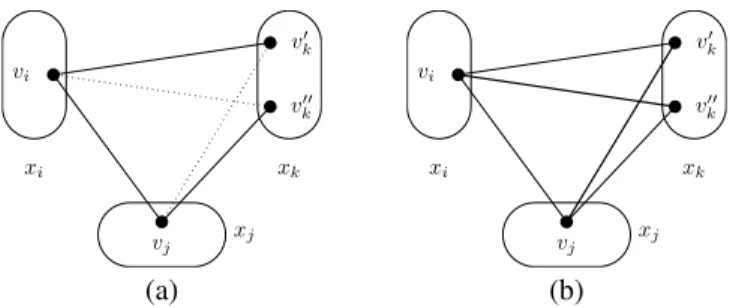
• V = {(xi, vi) : xi∈ X, vi∈ D(xi)}, • E = { {(xi, vi), (xj, vj)} | i "= j, Cij ∈ C or C/ ij ∈ C, (vi, vj)∈ Rel(Cij)} vi v!! k v! k vj xi xk xj vi v!! k v! k vj xi xk xj (a) (b)
Figure 1: The assignments (v!
k, vi, vj, vk!!) form a
broken-triangle in (a) but do not in (b) thanks to edges between (vi, vk!!)and (vj, vk!).
Considering the variable ordering xi< xj < xk, the CSP
instance of Figure 1(a) is not BTP because of the incompat-ibility of (vj, v!k)and (vi, v!!k). Thus, (vi, vj, vk!, v!!k)
consti-tute a broken-triangle. In Figure 1(b), (vi, vk!!) ∈ Rel(Cik)
and (vj, v!k)∈ Rel(Cjk), then the BTP is satisfied.
We now define value merging and variable elimination operations.
Definition 3. (Cooper et al. 2016) Merging the values
v!
k, v!!k ∈ D(xk) in a binary CSP instance I consists of
replacing v!
k, vk!! ∈ D(xk) by a new value vk which is
compatible with all values which are compatible with ei-ther v!
k or vk!!. A value-merging condition is a
polytime-computable property such that when it holds on a pair of values v!
k, v!!k ∈ D(xk), the instance obtained after merging
the values v!
kand v!!k is satisfiable iff I was satisfiable.
Definition 4. (Cohen et al. 2015) Eliminating a variable
xk in a binary instance I = (X, C) consists in
replac-ing X by X \ {xk} and C by C \ {Cik ∈ C | i %= k}.
Avariable-elimination condition is a polytime-computable property such that when it holds on a variable xk, the
in-stance obtained after eliminating xk is satisfiable iff I was
satisfiable.
In (Cohen et al. 2015), it has been shown that if there is no broken-triangles on each pair of values of a given vari-able xkin an arc-consistent binary CSP instance I, then xk
can be eliminated from I without changing the satisfiability. Next, (Cooper et al. 2016) proved that even when this rule cannot be applied because of the presence of some broken-triangles, it is possible that there is a pair of values (v!
k, vk!!)
in D(xk)which satisfies BTP. In this case, these two values
are mergeable. For example, in Figure 1(b), the values v! k
and v!!
k are mergeable. More recently, (Cooper, El Mouelhi,
and Terrioux 2016) showed that even when some broken-triangles are present on a pair of values (v!
k, vk!!)which
sat-isfies m-wBTP, merging v!
k and vk!!does not affect the
satis-fiability. Formally, m-wBTP is defined as follows: Definition 5. A pair of values v!
k, v!!k ∈ D(xk) satisfies
m-wBTP where m ≤ n − 3 if for each broken-triangle
(v!
k, vi, vj, v!!k) with vi ∈ D(xi) and vj ∈ D(xj), there
is a set of r ≤ m support variables {x!1, . . . , x!r} ⊆
X\ {xi, xj, xk} such that for all (v!1, . . . , v!r)∈ D(x!1)×
. . .× D(x!r), if (v!1, . . . , v!r, vi, vj)is a partial solution,
then there is α ∈ {1, . . . , r} such that (v!α, v!k), (v!α, v!!k) /∈
Graphically, this definition can be represented through the micro-structure graph of Figure 2. The pair (v!
k, vk!!)satisfies
1-wBTP because the value v!in D(x!)is compatible with
both viand vjbut is not with v!kand v!!k. So we say that the
assignments (v!
k, vi, vj, v!!k)forms a weakly broken-triangle
which is supported by x!. v! v!! k v! k vj vi x! xk xj xi
Figure 2: A weakly broken-triangle (v!
k, vi, vj, v!!k) since
(vk!, v!), (v!!k, v!) /∈ Rel(Ck!).
Contrary to BTP, m-wBTP does not allow variable elim-ination (see Section 5 in (Cooper, El Mouelhi, and Ter-rioux 2016)). So, next section introduces the flexible broken-triangle concept which allows merging value and variable elimination while preserving satisfiability.
3 Flexible broken-triangles
A total absence of broken-triangles on a given variable in an arc-consistent CSP instance allows us to eliminate it without changing the satisfiability of the initial instance. In contrast, a total absence of weakly broken-triangles does not permit variable elimination. In practice, we have many examples of variables which can be eliminated despite the presence of certain broken-triangles while preserving satisfiability.
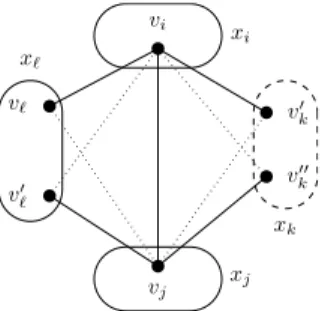
v! v! ! v!! k v! k vj vi x! xk xj xi
Figure 3: The dashed variable xk can be eliminated despite
the presence of a broken-triangle.
As shown in the inconsistent CSP instance of Figure 3, there is a broken-triangle on v!
kand vk!!, but after eliminating
xkthis CSP instance still remains inconsistent. So, the
pres-ence of some broken-triangle on a given variable does not preclude variable elimination while preserving satisfiability. For this, we introduce the flexible broken-triangles.
Like m-wBTP, the m-fBTP is based on the concept of
support variables. From a micro-structure viewpoint, these
variables prevent the emergence of a new clique2
(corre-sponds to a partial solution) which was not previously. We begin by formally defining m-fBTP.
Definition 6. A pair of values v!
k, vk!! ∈ D(xk)
satis-fies m-fBTP where m ≤ n − 3 if for each broken-triangle (v!
k, vi, vj, vk!!) with vi ∈ D(xi) and vj ∈
D(xj), there is a set of r ≤ m support variables
{x!1, . . . , x!r} ⊆ X \ {xi, xj, xk} such that for all
par-tial solution (v!1, . . . , v!r)∈ D(x!1)× . . . × D(x!r), there
is α ∈ {1, . . . , r} such that if (v!α, vi) ∈ Rel(C!αi),
then (v!α, vj) /∈ Rel(C!αj). In this case, we say that
(vk!, vi, vj, v!!k)is a flexible broken-triangle. A variable xk∈
X satisfies m-fBTP if each pair of values vk!, vk!! ∈ D(xk)
satisfies m-fBTP.
In other words, there is at least one value belonging to each parial solution which cannot be compatible with both vi
and vjat the same time. If there is no variable which satisfies
the previous conditions, then we will say that (v!
k, vi, vj, v!!k)
is a purely broken-triangle. For example, the assignments (v!
k, vi, vj, v!!k)in Figure 2 form a purely broken-triangle
be-cause (vi, v!)∈ Rel(Ci!)and (vj, v!)∈ Rel(Ci!).
Conse-quently, the pair (v!
k, v!!k)does not satisfy 1-fBTP.
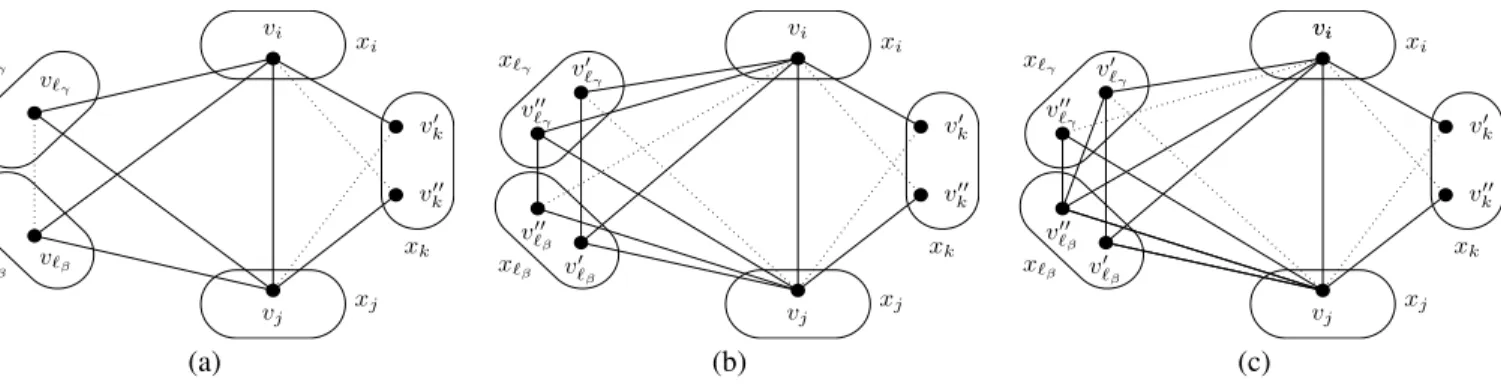
Three different configurations of Definition 6 are given in Figure 4. In (a), there is no partial solution on the set of variables {x!β, x!γ}. Hence vk!, v!!kin D(xk)clearly satisfies
2-fBTP. In (b), the pair of values v!
k, v!!k in D(xk)satisfies
2-fBTP because for the two partial solutions (v! !β, v ! !γ)and (v!! !β, v !! !γ), we have (v ! !γ, vj) /∈ Rel(C!γj)and (v!!!β, vi) /∈
Rel(C!βi). In (c), the pair of values vk!, vk!! in D(xk)
also satisfies 2-fBTP because for the two partial solutions (v! !β, v ! !γ)and (v !! !β, v !! !γ), we have (v ! !γ, vj) /∈ Rel(C!γj) and (v!! !γ, vi) /∈ Rel(C!γi).
One can observe that in Figure 4 (c), the variable x!γ
alone supports the broken-triangle (v!
k, vi, vj, vk!!), so we can
deduce that x!γ and x!β together support it. In Figure 4 (a)
and (b), x!γ and x!β together support the broken-triangle
(v!
k, vi, vj, v!!k)none of them alone support it.
Proposition 1. Given a binary CSP instance I = (X, C),
if a pair of values v!
k, vk!! ∈ D(xk)satisfies m-fBTP then it
satisfies (m + 1)-fBTP (0 ≤ m ≤ n − 4).
We now define the relationship between wBTP and m-fBTP.
Proposition 2. In a binary CSP instance I = (X, C),
∀m, 0 ≤ m ≤ n − 4, if a pair v!
k, v!!k ∈ D(xk)satisfies
m-fBTP, then it also satisfies m-wBTP. Proof. For each broken-triangle on v!
k, v!!k, there is a set
of r ≤ m (with 0 ≤ m ≤ n − 3) support variables
{x!1, . . . , x!r} ⊆ X \ {xi, xj, xk} such that for all partial
solution (v!1, . . . , v!r) ∈ D(x!1)× . . . × D(x!r), there is
α ∈ {1, . . . , r} such that if (v!α, vi) ∈ Rel(C!αi), then
(v!α, vj) /∈ Rel(C!αj). So each value v!αin D(x!α)cannot
be compatible with vi and vj at the same time. Thus, there
can be no partial solution (v!1, . . . , v!r). As a result, the pair
vk!, v!!k ∈ D(xk)also satisfies m-wBTP.
2A complete subgraph where each pair of vertices are con-nected.
v!! k v! k vj v!β vi v!γ xk xj xi x!β x!γ v!! k v! k vj v! !β v!! !β vi v! !γ v!! !γ xk xj xi x!β x!γ v!! k v! k vj v! !β v!! !β vi v! !γ v!! !γ vi xk xj xi x!β x!γ (a) (b) (c)
Figure 4: Three different cases of two values v!
kand v!!k which satisfy 2-fBTP.
The converse is obiously false by means of Figure 2 where the pair (v!
k, vk!!)is 1-wBTP but is not 1-fBTP.
Corollary 1. In a binary CSP instance I = (X, C),
merg-ing a pair of values v!
k, v!!k ∈ D(xk)which satisfies 1-fBTP
does not change the satisfiability of I.
If we denote by m-fBTP-merging the merging operation based on m-fBTP, we can deduce that 0-wBTP-merging (Cooper, El Mouelhi, and Terrioux 2016) and 0-fBTP-merging correspond to BTP-0-fBTP-merging defined in (Cooper et al. 2016) since they are based on zero support variables. Since BTP-merging generalises both neighbourhood substi-tution (Freuder 1991) and virtual interchangeability (Likit-vivatanavong and Yap 2013) and m-fBTP-merging gener-alises BTP-merging for all m ≥ 0, we immediately obtain the following result:
Corollary 2. m-fBTP-merging generalises neighbourhood
substitution and virtual interchangeability.
It is known that if a given variable xkin an arc-consistent
binary instance I satisfies BTP then xk can be eliminated
without modifying the satisfiability of I (Cohen et al. 2015). A similar result can also be shown for the variables satisfy-ing m-fBTP. To do it, we should prove the followsatisfy-ing lemma: Lemma 1. Given a variable xkwhich satisfies m-fBTP,
af-ter merging a pair of values v!!
k, vk!!! ∈ D(xk)into a new
value v!
k, no purely broken-triangle can appear on xk.
Proof. We assume, for a contradiction, that after
merg-ing a pair of values v!!
k, v!!!k of a variable xk which
satis-fies m-fBTP into a new value v!
k, we introduced a new
purely broken-triangle (vk, vi, vj, v!k). So we have (vi, vj)∈
Rel(Cij)(1), (vi, vk)∈ Rel(Cik)(2), (vj, v!k)∈ Rel(Cjk)
(3), (vj, vk) /∈ Rel(Cjk) (4) and (vi, v!k) /∈ Rel(Cik)
(5). By definition 3, we obtain (vi, vk!!) /∈ Rel(Cik) (a),
(vi, v!!!k ) /∈ Rel(Cik)(b), and either (vj, vk!!) ∈ Rel(Cjk)
(c) or (vj, v!!!k)∈ Rel(Cjk)(d).
(2), (1), (c), (a), and (4) ⇒ a broken-triangle (vk, vi, vj, vk!!)and (2), (1), (d), (b) and (4) ⇒ a
broken-triangle (vk, vi, vj, v!!!k ). In both cases, we had at least one
broken-triangle before merging v!!
k and vk!!!. So, there is a
set of r ≤ m support variables {x!1, . . . , x!r} ⊆ X \
{xi, xj, xk} such that for all partial solution (v!1, . . . , v!r)∈
D(x!1)× . . . × D(x!r), there is α ∈ {1, . . . , r} such that
if (v!α, vi) ∈ Rel(C!αi), then (v!α, vj) /∈ Rel(C!αj).
In this way, the set of r support variables {x!1, . . . , x!r}
also support the broken-triangle (vk, vi, vj, v!k). Thus,
(vk, vi, vj, v!k)is not a purely broken-triangle. But this
con-tradicts our initial assumption. Finally, merging two values
vk!!, v!!!k in the domain of a variable xk which satisfies
m-fBTP does not introduce a purely broken-triangle.
Lemma 1 cannot be extended to all pair of values which satisfies m-wBTP (and does not satisfy m-fBTP (Cooper, El Mouelhi, and Terrioux 2016)). Indeed, Figure 5(a) illustrates the case of a variable x4which satisfies 1-wBTP since the
variable x3supports all the broken-triangles on x4. Figure
5(b) is obtained after merging the values 2 and 1 into a new value 3. Hence, the variable x3no longer support the
broken-triangle (3, 2, 2, 0) (in bold) because the value 2 ∈ D(x3)is
compatible at the same time with 2 (∈ D(x1)), 2 (∈ D(x2))
and 3 (∈ D(x4)). 1 2 0 0 2 1 1 0 2 1 0 2 x3 x4 x2 x1 1 2 0 0 3 1 0 2 1 0 2 x3 x4 x2 x1 (a) (b)
Figure 5: (a) A variable x4 which satisfies 1-wBTP in an
arc-consistent CSP instance. (b) The CSP instance obtained from I after merging the values 1 and 2 into a new value 3.
We now establish the link with variable elimination. Theorem 1. Given an arc-consistent CSP instance I = (X, C), if a variable xk ∈ X satisfies m-fBTP, then it can
be eliminated from I while preserving satisfiability.
Proof. Given an arc-consistent CSP instance I = (X, C)
and a variable xk ∈ X which satisfies m-fBTP. Since value
merging makes no empty domain, we will merge each pair of values in D(xk)until obtaining a unique value since
broken-triangle on xk(thanks to Lemma 1). As I is arc-consistent,
so any consistent assignment A to X\{xk} can be extended
to xkbecause D(xk)contains a unique value and each value
A[xi]has a support in D(xk). So, the unique value in D(xk)
is compatible with each value in A. Thus, xkcan be
elimi-nated without changing the satisfiability of I.
4 A maximal variable-elimination condition
It has been proved that the variable which satisfies BTP can be eliminated while preserving satisfiability (Cohen et al. 2015). In section 3, we have shown that even if a variable does not satisfy BTP it can be eliminated without changing the satisfiability of the instance while this variable satisfies
m-fBTP. Thus, in an obvious sense, satisfying BTP is not a
maximal variable-elimination condition.
Definition 7. A variable-elimination condition is maximal if
the elimination of any other variable not respecting the con-dition necessarily leads to a modification of the satisfiability of some instance.
In this section, we show that m-fBTP is a maximal variable-elimination condition when m = n − 3.
Theorem 2. In an unsatisfiable binary CSP instance I = (X, C), there is no variable not satisfying m-fBTP for m =
n− 3 and which can be eliminated while preserving satisfi-ability.
Proof. Considering an unsatisfiable binary CSP instance I = (X, C)and a variable xk which does not satisfy
m-fBTP for m = n − 3. By the definition of m-m-fBTP, there is a broken-triangle (v!
k, vi, vj, vk!!), with vi ∈ D(xi), vj ∈
D(xj)and vk!, vk!! ∈ D(xk). And there is (v!1, . . . , v!m) ∈
D(x!1)× . . . × D(x!m), where {x!1, . . . , x!m} = X \
{xi, xj, xk}, such that (v!1, . . . , v!m) is a partial solution
and for all α ∈ {1, . . . , m} we have (v!α, vi)∈ Rel(C!αi)
and (v!α, vj)∈ Rel(C!αj). In terms of micro-structure we
have a (n − 1)-clique (a subset of n − 1 vertices that induces a complete subgraph) that we denote Cl.
We have a broken-triangle, and so: (vi, vk!!) /∈ Rel(Cik),
(vj, vk!) /∈ Rel(Cjk), (vi, vk!) ∈ Rel(Cik)and (vj, vk!!) ∈
Rel(Cjk). After eliminating xk, and by definition of
elim-ination, the obtained instance I! has (n − 1) variables and
its micro-structure contains the (n − 1)-clique Cl. Accord-ing to Property 2 in (J´egou 1993), Cl corresponds to a so-lution of I!. Thus, we introduced a solution which did not
exist in the initial instance since (vi, v!!k) /∈ Rel(Cik)and
(vj, vk!) /∈ Rel(Cjk). It follows that the elimination of
vari-able which does not satisfy m-fBTP does not preserve satis-fiability.
We can now deduce the desired result.
Corollary 3. (n − 3)-fBTP is a maximal
variable-elimination condition.
5 Tractability of m-fBTP instances
Contrary to k-BTP and m-wBTP which sometimes need a high level of consistency, we show that arc consistency is a decision procedure for m-fBTP. We firstly start with extend
m-fBTP definition to instances.
Definition 8. A binary CSP instance I with a variable
or-dering < satisfies m-fBTP relative to this order if for all variables xk, each pair of values in D(xk)satisfies m-fBTP
in the sub-instance of I on variables xi≤ xk(m ≤ n − 3).
We now prove that m-fBTP is conservative3 (Cooper,
Jeavons, and Salamon 2010), m-fBTP holds even after en-forcing any filtering consistency which only removes values from domains.
Lemma 2. m-fBTP with respect to any fixed variable
order-ing is conservative.
Proof. It is clear that m-fBTP holds for a binary CSP
in-stance thanks to the absence of some tuples. Obviously, re-moving values from the domain of any variable in a CSP in-stance cannot add new tuples. Thus, m-fBTP still holds. Theorem 3. Arc consistency is a decision procedure for any
binary CSP instance I = (X, C) which satisfies m-fBTP (1 ≤ m ≤ n − 3).
Proof. Let I = (X, C) be a binary CSP instance
satisfy-ing m-fBTP with respect to a variable ordersatisfy-ing <. We begin by enforcing arc consistency. If this results to an empty do-main, then obviously the obtained instance has no solution. Otherwise, thanks to Lemma 2, we know that the obtained instance will also satisfy m-fBTP. According to Theorem 1, we can proceed iteratively to eliminate the last variable with respect to < until obtaining an instance with three variables
x1, x2 and x3. As I is becoming arc-consistent, so there is
no empty domain. Hence, D(x1)(respectively D(x2)) must
contain at least a value v1 (resp. v2) such that (v1, v2) ∈ Rel(C12)(1). We will suppose, for a contradiction, that the assignment A = (v1, v2)cannot be consistenly extended to x3. For this, we assume that there is no v3 ∈ D(x3)
which is consistent with both v1and v2. But, by arc
consis-tency, we should have two values v!
3, v!!3 ∈ D(x3)such that
(v1, v!
3)∈ Rel(C13)(2) and (v2, v3!)∈ Rel(C23)(3). Note
that v!
3 and v3!! must be different and (v1, v3!!) /∈ Rel(C13)
(4) and (v2, v!
3) /∈ Rel(C23)(5) (otherwise we contradicts
our hypothesis).
In this way, (1), (2), (3), (4) and (5) form a purely broken-triangle on xkwhich can be supported by no other variable.
Indeed, by Definition 6, any variable x! must be different
from {xi, xj, xk}. Thus, this contradicts our assumption.
Fi-nally, A can be consistenly extended to x3.
The following theorem is a logical consequence of Corol-lary 3 and Theorem 3.
Theorem 4. The class of binary CSP instances which satisfy (n− 3)-fBTP defines the biggest tractable class resolved by
variable elimination.
As with m-wBTP, checking whether it is possible to com-pute, in polytime, a variable ordering for which a binary CSP instance satisfies m-fBTP still remains an open question.
3A class Γ of CSP instances is said conservative with respect to a filtering consistency φ if it is closed under φ, that is, if the instance obtained after the application of φ still belongs to Γ.
6 m-fBTP vs some tractable classes based on
BTP
We now compare m-fBTP to some tractable classes based on BTP. We start with k-BTP4(Cooper, J´egou, and Terrioux
2015).
Theorem 5. m-fBTP and k-BTP are incomparable.
Proof. Figure 2 shows a binary CSP instance which
satis-fies 3-BTP but does not satisfy 1-fBTP. Figure 6 illustrates the case of an instance which satisfies 1-fBTP but does not satisfy 3-BTP. Indeed, there are broken-triangles on the vari-able xk for each pair of other variables, but in each case the
fourth variable is a support variable.
v! v! ! v!! k v! k vj vi x! xk xj xi
Figure 6: An instance which satisfies 1-fBTP but does not satisfy 3-BTP, for the variable ordering x!< xi < xj< xk.
We move to WBTP5(Naanaa 2016).
Theorem 6. 1-fBTP ! WBTP.
Proof. Obviously because both WBTP and 1-fBTP use a
unique support variable and their condition depends only from viand vj.
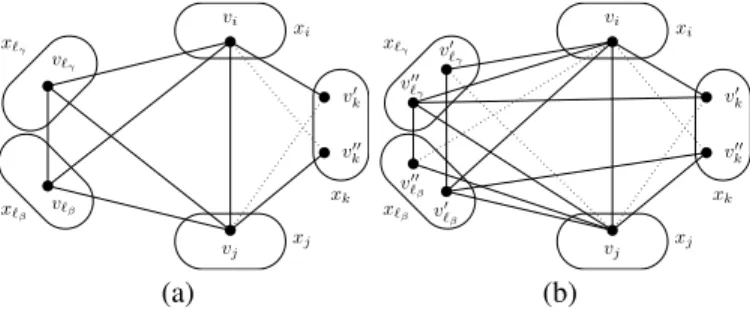
The converse is false by means of Figure 7(a). In fact, the binary CSP instance satisfies WBTP (both x!βand x!γ
sup-port the broken-triangle (v!
k, vi, vj, vk!!)) but does not satisfy
1-fBTP.
Theorem 7. 2-fBTP and WBTP are incomparable.
Proof. Figure 7(a) shows a binary CSP instance which
sat-isfies WBTP but does not satisfy 2-fBTP. More precisely, (v!β, v!γ) is a partial solution but (v!γ, vj) ∈ Rel(C!γj),
(v!β, vi) ∈ Rel(C!γi), (v!γ, vi) ∈ Rel(C!γi), (v!β, vj) ∈
Rel(C!γj). Figure 7(b) illustrates the case of an instance
4A binary CSP instance I satisfies the k-BTP property for a given k (2 ≤ k < n) relative to a variable order < if, for all subsets of variables xi1, xi2, . . . , xik+1 such that xi1 < xi2 <
· · · < xik+1, there is at least one pair of variables (xij, xij!)with
1 ≤ j < j! ≤ k such that there is no broken-triangle on xk+1
relative to xij and xij!.
5A binary CSP instance equipped with an order < on its vari-ables satisfies WBTP (Weak broken-triangle Property) if for each triple of variables xi < xj < xkand for all vi ∈ D(xi), vj ∈
D(xj)such that (vi, vj)∈ Rel(Cij), there is a variable x!< xk
such that when v! ∈ D(x!)is compatible with vi and vj, then
∀vk ∈ D(xk), if (v!, vk)∈ Rel(C!k)then (vi, vk) ∈ Rel(Cik)
and (vj, vk)∈ Rel(Cjk)
which satisfies 2-fBTP but does not satisfy WBTP because
v!!!γ is compatible with vi, vjand v
! k, and v!!β is compatible with vi, vj and vk!!. v!! k v! k vj v!β vi v!γ xk xj xi x!β x!γ v!! k v! k vj v! !β v!! !β vi v! !γ v!! !γ xk xj xi x!β x!γ (a) (b)
Figure 7: (a) A binary CSP instance which is WBTP but is not 2-fBTP. (b) A binary CSP instance which is 2-fBTP but is not WBTP.
Figure 8 summarizes some relation between tractable classes based on BTP. An arc from c1to c2 (resp. a dashed
line between c1and c2) means that c1! c2(resp. c1and c2
are incomparable). BT P 1-fBTP WBTP 1-wBTP 2-wBTP 2-fBTP m-wBTP m-fBTP k-BTP
Figure 8: Relationship between tractable classes based on BTP.
7 Conclusion
BTP relies on absence of broken-triangle to define an impor-tant tractable class and to allow reducing search space size through value merging or variable elimination. Recently, many new weaker versions of BTP, which authorize the presence of some broken-triangle like k-BTP, WBTP and m-wBTP, have been studied but none of them define tractable class and permit variable elimination and value merging simultaneously. Moreover, much of these versions, except WBTP, require a high level of consistency. In this paper, we have proposed a new light version of BTP, called m-fBTP for flexible broken-triangle property. m-fBTP is based on support variable concept and permits to cover some imper-fections of previous versions. More precisely, it allows value merging, represents a maximal variable-elimination condi-tion and also defines a tractable class solved by arc consis-tency. m-fBTP is incomparable with the patterns described in (Cooper and Zivny 2016) and which characterise tractable classes for CSPs defined by partially-ordered forbidden pat-terns and solved by arc consistency. It would be interesting to generalise this family of definitions to non-binary CSPs.
Acknowledgments
I would like to thank Martin C. Cooper and Wady Naanaa for their useful comments during preparation of this work.
References
Cohen, D. A.; Cooper, M. C.; Escamocher, G.; and Zivny, S. 2013. Variable Elimination in Binary CSP via Forbid-den Patterns. In IJCAI 2013, Proceedings of the 23rd
Inter-national Joint Conference on Artificial Intelligence, 2013,
517–523.
Cohen, D. A.; Cooper, M. C.; Escamocher, G.; and Zivny, S. 2015. Variable and value elimination in binary con-straint satisfaction via forbidden patterns. J. Comput. Syst.
Sci. 81(7):1127–1143.
Cooper, M. C., and Zivny, S. 2016. The power of arc consis-tency for CSPs defined by partially-ordered forbidden pat-terns. In Proceedings of the 31st Annual ACM/IEEE
Sympo-sium on Logic in Computer Science, LICS ’16, 2016, 652–
661.
Cooper, M. C.; El Mouelhi, A.; Terrioux, C.; and Zanuttini, B. 2014. On Broken Triangles. In Principles and Practice
of Constraint Programming - 20th International Conference, CP 2014. Proceedings, 9–24.
Cooper, M. C.; Duchein, A.; El Mouelhi, A.; Escamocher, G.; Terrioux, C.; and Zanuttini, B. 2016. Broken triangles: From value merging to a tractable class of general-arity con-straint satisfaction problems. Artificial Intelligence 234:196 – 218.
Cooper, M. C.; El Mouelhi, A.; and Terrioux, C. 2016. Ex-tending broken triangles and enhanced value-merging. In
Principles and Practice of Constraint Programming - 22nd International Conference, CP 2016, Proceedings, 173–188.
Cooper, M. C.; Jeavons, P.; and Salamon, A. 2008. Hybrid tractable CSPs which generalize tree structure. In
Proceed-ings of ECAI, 530–534.
Cooper, M. C.; Jeavons, P.; and Salamon, A. 2010. General-izing constraint satisfaction on trees: hybrid tractability and variable elimination. Artificial Intelligence 174:570–584. Cooper, M. C.; J´egou, P.; and Terrioux, C. 2015. A microstructure-based family of tractable classes for CSPs. In Principles and Practice of Constraint Programming - 21st
International Conference, CP, 2015, Proceedings, 74–88.
Dechter, A., and Dechter, R. 1987. Removing redundancies in constraint networks. In Proceedings of the 6th National
Conference on Artificial Intelligence., 105–109.
El Mouelhi, A.; J´egou, P.; and Terrioux, C. 2014. Hid-den Tractable Classes: From Theory to Practice. In 26th
IEEE International Conference on Tools with Artificial In-telligence, ICTAI, 2014, 437–445.
El Mouelhi, A.; J´egou, P.; and Terrioux, C. 2015. A Hy-brid Tractable Class for Non-Binary CSPs. Constraints 20(4):383–413.
Freuder, E. C. 1991. Eliminating interchangeable values in constraint satisfaction problems. In Proceedings of the 9th
National Conference on Artificial Intelligence, 1991, Volume 1., 227–233.
J´egou, P., and Terrioux, C. 2015. The extendable-triple prop-erty: A new CSP tractable class beyond BTP. In Proceedings
of AAAI, 3746–3754.
J´egou, P. 1993. Decomposition of Domains Based on the Micro-Structure of Finite Constraint Satisfaction Problems. In Proceedings of the 11th National Conference on Artificial
Intelligence, 1993., 731–736.
Likitvivatanavong, C., and Yap, R. H. C. 2013. Many-to-many interchangeable sets of values in csps. In Proceedings
of SAC, 86–91.
Mackworth, A. K. 1977. Consistency in Networks of Rela-tions. Artificial Intelligence 8:99–118.
Montanari, U. 1974. Networks of Constraints: Fundamental Properties and Applications to Picture Processing. Artificial
Intelligence 7:95–132.
Naanaa, W. 2013. Unifying and extending hybrid tractable classes of csps. J. Exp. Theor. Artif. Intell. 25(4):407–424. Naanaa, W. 2016. Extending the broken triangle property tractable class of binary csps. In Proceedings of the 9th
Hellenic Conference on Artificial Intelligence, SETN, 2016,