HAL Id: hal-02095905
https://hal-amu.archives-ouvertes.fr/hal-02095905
Submitted on 22 May 2020
HAL is a multi-disciplinary open access
archive for the deposit and dissemination of
sci-entific research documents, whether they are
pub-lished or not. The documents may come from
teaching and research institutions in France or
abroad, or from public or private research centers.
L’archive ouverte pluridisciplinaire HAL, est
destinée au dépôt et à la diffusion de documents
scientifiques de niveau recherche, publiés ou non,
émanant des établissements d’enseignement et de
recherche français ou étrangers, des laboratoires
publics ou privés.
A New Hybrid Approach for Machine Layout Design
UnderFamily Product Evolution For Reconfigurable
Manufacturing Systems.
Hichem Haddou Benderbal, Lyes Benyoucef
To cite this version:
Hichem Haddou Benderbal, Lyes Benyoucef. A New Hybrid Approach for Machine Layout Design
UnderFamily Product Evolution For Reconfigurable Manufacturing Systems.. IFAC-PapersOnLine,
Elsevier, 2019, 52 (13), pp.1379-1384. �10.1016/j.ifacol.2019.11.391�. �hal-02095905�
2405-8963 © 2019, IFAC (International Federation of Automatic Control) Hosting by Elsevier Ltd. All rights reserved. Peer review under responsibility of International Federation of Automatic Control.
10.1016/j.ifacol.2019.11.391
A New Hybrid Approach for Machine Layout Design Under Family Product
Evolution for Reconfigurable Manufacturing Systems
Hichem Haddou Benderbal and Lyes Benyoucef
Aix-Marseille University, University of Toulon, CNRS, LIS, Marseille, France {hicham.haddou-benderbal, lyes.benyoucef}@lis-lab
Abstract: Reconfigurable manufacturing system (RMS) is a new paradigm that answers many of the chal-lenges that the market nowadays imposes. In this paper, we address one of the most important aspects re-lated to the reactivity of RMSs. We consider the relations, which link the conceived system with two im-portant environments: its logical environment, i.e., the product family in which the RMS can evolve, and its physical environment, i.e., the physical workshop that implements this RMS. More specifically, we study the machine layout problem by considering the family product evolution where two sub-problems are considered. The first sub-problem concerns the evolution of the product, in the same family, towards new products to meet the evolutions and the requirements of the customers. The second sub-problem deals with the machine layout problem based on the results of the first sub-problem. We develop an approach which combines the well-known metaheuristic, archived multi-objective simulated annealing (AMOSA), with an exhaustive search-based heuristic to determine the best machine layout for all the selected ma-chines of our product family. The approach is based on the initially generated process plans of products (in the product family) for the RMS design under performance metrics. The proposed layout must at its best, respects both the constraints imposed by the generated process plans and those depicting the available lo-cation in the shop floor where machines can be placed. To show the applicability of our approach, we pre-sent a simple numerical example and discuss the obtained numerical results. Copyright © 2019 IFAC Keywords: Reconfigurable manufacturing system (RMS); changeable manufacturing system; layout; ma-chine layout design; mama-chine importance index; performance metrics; AMOSA.
1. CONTEXT AND MOTIVATIONS
Manufacturing is and has always been a cornerstone of the global economy. Nevertheless, to be relevant in nowadays’ highly competitive market, the manufacturing system of a company has to be, simultaneously, cost and time efficient and more flexible. According to a visionary report of Manu-facturing Challenges 2020 conducted in USA, this trend will continue, and one of the six grand challenges of this visionary report is the ability to reconfigure manufacturing systems rapidly in response to changing needs and opportunities. Re-configurable manufacturing system (RMS) is one of the latest manufacturing paradigms where, machines components, ma-chines software’s or material handling units can be added, removed, modified or interchanged as needed and when im-posed by the necessity to react and respond rapidly and cost-effectively to changing requirements.
RMS is a logical development of the two manufacturing sys-tems already used in the industries, respectively, the dedicated manufacturing system (DMS) and the flexible manufacturing system (FMS). It is designed to combine the high flexibility of FMS with the high production ratio of DMS (Koren et al. 2010). In fact, the high responsiveness and performance effi-ciencies of RMS make it a convenient manufacturing para-digm and flexible enabler of mass customization to face the complexity of manufacturing environments. This is possible, thanks to reconfigurable machine tool (RMT) which gives the RMS its customized flexibility and variety of alternatives.
In this research work, we consider the reconfigurable manu-facturing systems (RMSs) design problem. Nevertheless, reconfigurability is a non-functional requirement of the sys-tem, linked to its long-term behavior (Andersen, 2017). This implies that conventional approaches that consider only the immediate requirements of the system will not necessarily lead to dynamically changeable systems. Thus, it is necessary to design systems with a dynamic capacity for change and include the key factors of reconfigurability through adapting design approaches and/or developing new design methodolo-gies. Hence, our goal is to design responsive systems based on reconfigurability features key. For that, we address the RMS design problem on the machine level and their interactions, while considering the product family (products that share similarities) in which the RMS can evolve. This is done through studying the relation that links the conceived RMS to its two environments respectively logical (i.e., the family of products in which this RMS can evolve) and physical (i.e., the physical workshop implementing this RMS). These later are treated as two sub-problems in this paper.
Linked to the logical environment, the first sub-problem con-cerns the evolution of the product, in the same family, towards new products to meet the evolutions and the requirements of the customers. Three criteria are optimized respectively: (1) the minimization of the evolution effort of the system during the transition within the product family, (2) the maximization of the average use of the machines in order to reduce at best the imbalance of the loads and (3) the maximization of the presence of replacement machines in the production lines of
Copyright © 2019 IFAC 1396
A New Hybrid Approach for Machine Layout Design Under Family Product
Evolution for Reconfigurable Manufacturing Systems
Hichem Haddou Benderbal and Lyes Benyoucef
Aix-Marseille University, University of Toulon, CNRS, LIS, Marseille, France {hicham.haddou-benderbal, lyes.benyoucef}@lis-lab
Abstract: Reconfigurable manufacturing system (RMS) is a new paradigm that answers many of the chal-lenges that the market nowadays imposes. In this paper, we address one of the most important aspects re-lated to the reactivity of RMSs. We consider the relations, which link the conceived system with two im-portant environments: its logical environment, i.e., the product family in which the RMS can evolve, and its physical environment, i.e., the physical workshop that implements this RMS. More specifically, we study the machine layout problem by considering the family product evolution where two sub-problems are considered. The first sub-problem concerns the evolution of the product, in the same family, towards new products to meet the evolutions and the requirements of the customers. The second sub-problem deals with the machine layout problem based on the results of the first sub-problem. We develop an approach which combines the well-known metaheuristic, archived multi-objective simulated annealing (AMOSA), with an exhaustive search-based heuristic to determine the best machine layout for all the selected ma-chines of our product family. The approach is based on the initially generated process plans of products (in the product family) for the RMS design under performance metrics. The proposed layout must at its best, respects both the constraints imposed by the generated process plans and those depicting the available lo-cation in the shop floor where machines can be placed. To show the applicability of our approach, we pre-sent a simple numerical example and discuss the obtained numerical results. Copyright © 2019 IFAC Keywords: Reconfigurable manufacturing system (RMS); changeable manufacturing system; layout; ma-chine layout design; mama-chine importance index; performance metrics; AMOSA.
1. CONTEXT AND MOTIVATIONS
Manufacturing is and has always been a cornerstone of the global economy. Nevertheless, to be relevant in nowadays’ highly competitive market, the manufacturing system of a company has to be, simultaneously, cost and time efficient and more flexible. According to a visionary report of Manu-facturing Challenges 2020 conducted in USA, this trend will continue, and one of the six grand challenges of this visionary report is the ability to reconfigure manufacturing systems rapidly in response to changing needs and opportunities. Re-configurable manufacturing system (RMS) is one of the latest manufacturing paradigms where, machines components, ma-chines software’s or material handling units can be added, removed, modified or interchanged as needed and when im-posed by the necessity to react and respond rapidly and cost-effectively to changing requirements.
RMS is a logical development of the two manufacturing sys-tems already used in the industries, respectively, the dedicated manufacturing system (DMS) and the flexible manufacturing system (FMS). It is designed to combine the high flexibility of FMS with the high production ratio of DMS (Koren et al. 2010). In fact, the high responsiveness and performance effi-ciencies of RMS make it a convenient manufacturing para-digm and flexible enabler of mass customization to face the complexity of manufacturing environments. This is possible, thanks to reconfigurable machine tool (RMT) which gives the RMS its customized flexibility and variety of alternatives.
In this research work, we consider the reconfigurable manu-facturing systems (RMSs) design problem. Nevertheless, reconfigurability is a non-functional requirement of the sys-tem, linked to its long-term behavior (Andersen, 2017). This implies that conventional approaches that consider only the immediate requirements of the system will not necessarily lead to dynamically changeable systems. Thus, it is necessary to design systems with a dynamic capacity for change and include the key factors of reconfigurability through adapting design approaches and/or developing new design methodolo-gies. Hence, our goal is to design responsive systems based on reconfigurability features key. For that, we address the RMS design problem on the machine level and their interactions, while considering the product family (products that share similarities) in which the RMS can evolve. This is done through studying the relation that links the conceived RMS to its two environments respectively logical (i.e., the family of products in which this RMS can evolve) and physical (i.e., the physical workshop implementing this RMS). These later are treated as two sub-problems in this paper.
Linked to the logical environment, the first sub-problem con-cerns the evolution of the product, in the same family, towards new products to meet the evolutions and the requirements of the customers. Three criteria are optimized respectively: (1) the minimization of the evolution effort of the system during the transition within the product family, (2) the maximization of the average use of the machines in order to reduce at best the imbalance of the loads and (3) the maximization of the presence of replacement machines in the production lines of Berlin, Germany, August 28-30, 2019
Copyright © 2019 IFAC 1396
A New Hybrid Approach for Machine Layout Design Under Family Product
Evolution for Reconfigurable Manufacturing Systems
Hichem Haddou Benderbal and Lyes Benyoucef
Aix-Marseille University, University of Toulon, CNRS, LIS, Marseille, France {hicham.haddou-benderbal, lyes.benyoucef}@lis-lab
Abstract: Reconfigurable manufacturing system (RMS) is a new paradigm that answers many of the chal-lenges that the market nowadays imposes. In this paper, we address one of the most important aspects re-lated to the reactivity of RMSs. We consider the relations, which link the conceived system with two im-portant environments: its logical environment, i.e., the product family in which the RMS can evolve, and its physical environment, i.e., the physical workshop that implements this RMS. More specifically, we study the machine layout problem by considering the family product evolution where two sub-problems are considered. The first sub-problem concerns the evolution of the product, in the same family, towards new products to meet the evolutions and the requirements of the customers. The second sub-problem deals with the machine layout problem based on the results of the first sub-problem. We develop an approach which combines the well-known metaheuristic, archived multi-objective simulated annealing (AMOSA), with an exhaustive search-based heuristic to determine the best machine layout for all the selected ma-chines of our product family. The approach is based on the initially generated process plans of products (in the product family) for the RMS design under performance metrics. The proposed layout must at its best, respects both the constraints imposed by the generated process plans and those depicting the available lo-cation in the shop floor where machines can be placed. To show the applicability of our approach, we
pre-sent a simple numerical example and discuss the obtained numerical results.Copyright © 2019 IFAC
Keywords: Reconfigurable manufacturing system (RMS); changeable manufacturing system; layout; ma-chine layout design; mama-chine importance index; performance metrics; AMOSA.
1. CONTEXT AND MOTIVATIONS
Manufacturing is and has always been a cornerstone of the global economy. Nevertheless, to be relevant in nowadays’ highly competitive market, the manufacturing system of a company has to be, simultaneously, cost and time efficient and more flexible. According to a visionary report of Manu-facturing Challenges 2020 conducted in USA, this trend will continue, and one of the six grand challenges of this visionary report is the ability to reconfigure manufacturing systems rapidly in response to changing needs and opportunities. Re-configurable manufacturing system (RMS) is one of the latest manufacturing paradigms where, machines components, ma-chines software’s or material handling units can be added, removed, modified or interchanged as needed and when im-posed by the necessity to react and respond rapidly and cost-effectively to changing requirements.
RMS is a logical development of the two manufacturing sys-tems already used in the industries, respectively, the dedicated manufacturing system (DMS) and the flexible manufacturing system (FMS). It is designed to combine the high flexibility of FMS with the high production ratio of DMS (Koren et al. 2010). In fact, the high responsiveness and performance effi-ciencies of RMS make it a convenient manufacturing para-digm and flexible enabler of mass customization to face the complexity of manufacturing environments. This is possible, thanks to reconfigurable machine tool (RMT) which gives the RMS its customized flexibility and variety of alternatives.
In this research work, we consider the reconfigurable manu-facturing systems (RMSs) design problem. Nevertheless, reconfigurability is a non-functional requirement of the sys-tem, linked to its long-term behavior (Andersen, 2017). This implies that conventional approaches that consider only the immediate requirements of the system will not necessarily lead to dynamically changeable systems. Thus, it is necessary to design systems with a dynamic capacity for change and include the key factors of reconfigurability through adapting design approaches and/or developing new design methodolo-gies. Hence, our goal is to design responsive systems based on reconfigurability features key. For that, we address the RMS design problem on the machine level and their interactions, while considering the product family (products that share similarities) in which the RMS can evolve. This is done through studying the relation that links the conceived RMS to its two environments respectively logical (i.e., the family of products in which this RMS can evolve) and physical (i.e., the physical workshop implementing this RMS). These later are treated as two sub-problems in this paper.
Linked to the logical environment, the first sub-problem con-cerns the evolution of the product, in the same family, towards new products to meet the evolutions and the requirements of the customers. Three criteria are optimized respectively: (1) the minimization of the evolution effort of the system during the transition within the product family, (2) the maximization of the average use of the machines in order to reduce at best the imbalance of the loads and (3) the maximization of the presence of replacement machines in the production lines of
Copyright © 2019 IFAC 1396
A New Hybrid Approach for Machine Layout Design Under Family Product
Evolution for Reconfigurable Manufacturing Systems
Hichem Haddou Benderbal and Lyes Benyoucef
Aix-Marseille University, University of Toulon, CNRS, LIS, Marseille, France {hicham.haddou-benderbal, lyes.benyoucef}@lis-lab
Abstract: Reconfigurable manufacturing system (RMS) is a new paradigm that answers many of the chal-lenges that the market nowadays imposes. In this paper, we address one of the most important aspects re-lated to the reactivity of RMSs. We consider the relations, which link the conceived system with two im-portant environments: its logical environment, i.e., the product family in which the RMS can evolve, and its physical environment, i.e., the physical workshop that implements this RMS. More specifically, we study the machine layout problem by considering the family product evolution where two sub-problems are considered. The first sub-problem concerns the evolution of the product, in the same family, towards new products to meet the evolutions and the requirements of the customers. The second sub-problem deals with the machine layout problem based on the results of the first sub-problem. We develop an approach which combines the well-known metaheuristic, archived multi-objective simulated annealing (AMOSA), with an exhaustive search-based heuristic to determine the best machine layout for all the selected ma-chines of our product family. The approach is based on the initially generated process plans of products (in the product family) for the RMS design under performance metrics. The proposed layout must at its best, respects both the constraints imposed by the generated process plans and those depicting the available lo-cation in the shop floor where machines can be placed. To show the applicability of our approach, we pre-sent a simple numerical example and discuss the obtained numerical results. Copyright © 2019 IFAC Keywords: Reconfigurable manufacturing system (RMS); changeable manufacturing system; layout; ma-chine layout design; mama-chine importance index; performance metrics; AMOSA.
1. CONTEXT AND MOTIVATIONS
Manufacturing is and has always been a cornerstone of the global economy. Nevertheless, to be relevant in nowadays’ highly competitive market, the manufacturing system of a company has to be, simultaneously, cost and time efficient and more flexible. According to a visionary report of Manu-facturing Challenges 2020 conducted in USA, this trend will continue, and one of the six grand challenges of this visionary report is the ability to reconfigure manufacturing systems rapidly in response to changing needs and opportunities. Re-configurable manufacturing system (RMS) is one of the latest manufacturing paradigms where, machines components, ma-chines software’s or material handling units can be added, removed, modified or interchanged as needed and when im-posed by the necessity to react and respond rapidly and cost-effectively to changing requirements.
RMS is a logical development of the two manufacturing sys-tems already used in the industries, respectively, the dedicated manufacturing system (DMS) and the flexible manufacturing system (FMS). It is designed to combine the high flexibility of FMS with the high production ratio of DMS (Koren et al. 2010). In fact, the high responsiveness and performance effi-ciencies of RMS make it a convenient manufacturing para-digm and flexible enabler of mass customization to face the complexity of manufacturing environments. This is possible, thanks to reconfigurable machine tool (RMT) which gives the RMS its customized flexibility and variety of alternatives.
In this research work, we consider the reconfigurable manu-facturing systems (RMSs) design problem. Nevertheless, reconfigurability is a non-functional requirement of the sys-tem, linked to its long-term behavior (Andersen, 2017). This implies that conventional approaches that consider only the immediate requirements of the system will not necessarily lead to dynamically changeable systems. Thus, it is necessary to design systems with a dynamic capacity for change and include the key factors of reconfigurability through adapting design approaches and/or developing new design methodolo-gies. Hence, our goal is to design responsive systems based on reconfigurability features key. For that, we address the RMS design problem on the machine level and their interactions, while considering the product family (products that share similarities) in which the RMS can evolve. This is done through studying the relation that links the conceived RMS to its two environments respectively logical (i.e., the family of products in which this RMS can evolve) and physical (i.e., the physical workshop implementing this RMS). These later are treated as two sub-problems in this paper.
Linked to the logical environment, the first sub-problem con-cerns the evolution of the product, in the same family, towards new products to meet the evolutions and the requirements of the customers. Three criteria are optimized respectively: (1) the minimization of the evolution effort of the system during the transition within the product family, (2) the maximization of the average use of the machines in order to reduce at best the imbalance of the loads and (3) the maximization of the presence of replacement machines in the production lines of
Copyright © 2019 IFAC 1396
A New Hybrid Approach for Machine Layout Design Under Family Product
Evolution for Reconfigurable Manufacturing Systems
Hichem Haddou Benderbaland Lyes Benyoucef
Aix-Marseille University, University of Toulon, CNRS, LIS, Marseille, France {hicham.haddou-benderbal, lyes.benyoucef}@lis-lab
Abstract: Reconfigurable manufacturing system (RMS) is a new paradigm that answers many of the chal-lenges that the market nowadays imposes. In this paper, we address one of the most important aspects re-lated to the reactivity of RMSs. We consider the relations, which link the conceived system with two im-portant environments: its logical environment, i.e., the product family in which the RMS can evolve, and its physical environment, i.e., the physical workshop that implements this RMS. More specifically, we study the machine layout problem by considering the family product evolution where two sub-problems are considered. The first sub-problem concerns the evolution of the product, in the same family, towards new products to meet the evolutions and the requirements of the customers. The second sub-problem deals with the machine layout problem based on the results of the first sub-problem. We develop an approach which combines the well-known metaheuristic, archived multi-objective simulated annealing (AMOSA), with an exhaustive search-based heuristic to determine the best machine layout for all the selected ma-chines of our product family. The approach is based on the initially generated process plans of products (in the product family) for the RMS design under performance metrics. The proposed layout must at its best, respects both the constraints imposed by the generated process plans and those depicting the available lo-cation in the shop floor where machines can be placed. To show the applicability of our approach, we pre-sent a simple numerical example and discuss the obtained numerical results. Copyright © 2019 IFAC Keywords: Reconfigurable manufacturing system (RMS); changeable manufacturing system; layout; ma-chine layout design; mama-chine importance index; performance metrics; AMOSA.
1. CONTEXT AND MOTIVATIONS
Manufacturing is and has always been a cornerstone of the global economy. Nevertheless, to be relevant in nowadays’ highly competitive market, the manufacturing system of a company has to be, simultaneously, cost and time efficient and more flexible. According to a visionary report of Manu-facturing Challenges 2020 conducted in USA, this trend will continue, and one of the six grand challenges of this visionary report is the ability to reconfigure manufacturing systems rapidly in response to changing needs and opportunities. Re-configurable manufacturing system (RMS) is one of the latest manufacturing paradigms where, machines components, ma-chines software’s or material handling units can be added, removed, modified or interchanged as needed and when im-posed by the necessity to react and respond rapidly and cost-effectively to changing requirements.
RMS is a logical development of the two manufacturing sys-tems already used in the industries, respectively, the dedicated manufacturing system (DMS) and the flexible manufacturing system (FMS). It is designed to combine the high flexibility of FMS with the high production ratio of DMS (Koren et al. 2010). In fact, the high responsiveness and performance effi-ciencies of RMS make it a convenient manufacturing para-digm and flexible enabler of mass customization to face the complexity of manufacturing environments. This is possible, thanks to reconfigurable machine tool (RMT) which gives the RMS its customized flexibility and variety of alternatives.
In this research work, we consider the reconfigurable manu-facturing systems (RMSs) design problem. Nevertheless, reconfigurability is a non-functional requirement of the sys-tem, linked to its long-term behavior (Andersen, 2017). This implies that conventional approaches that consider only the immediate requirements of the system will not necessarily lead to dynamically changeable systems. Thus, it is necessary to design systems with a dynamic capacity for change and include the key factors of reconfigurability through adapting design approaches and/or developing new design methodolo-gies. Hence, our goal is to design responsive systems based on reconfigurability features key. For that, we address the RMS design problem on the machine level and their interactions, while considering the product family (products that share similarities) in which the RMS can evolve. This is done through studying the relation that links the conceived RMS to its two environments respectively logical (i.e., the family of products in which this RMS can evolve) and physical (i.e., the physical workshop implementing this RMS). These later are treated as two sub-problems in this paper.
Linked to the logical environment, the first sub-problem con-cerns the evolution of the product, in the same family, towards new products to meet the evolutions and the requirements of the customers. Three criteria are optimized respectively: (1) the minimization of the evolution effort of the system during the transition within the product family, (2) the maximization of the average use of the machines in order to reduce at best the imbalance of the loads and (3) the maximization of the presence of replacement machines in the production lines of Berlin, Germany, August 28-30, 2019
Copyright © 2019 IFAC 1396
A New Hybrid Approach for Machine Layout Design Under Family Product
Evolution for Reconfigurable Manufacturing Systems
Hichem Haddou Benderbal and Lyes Benyoucef
Aix-Marseille University, University of Toulon, CNRS, LIS, Marseille, France {hicham.haddou-benderbal, lyes.benyoucef}@lis-lab
Abstract: Reconfigurable manufacturing system (RMS) is a new paradigm that answers many of the chal-lenges that the market nowadays imposes. In this paper, we address one of the most important aspects re-lated to the reactivity of RMSs. We consider the relations, which link the conceived system with two im-portant environments: its logical environment, i.e., the product family in which the RMS can evolve, and its physical environment, i.e., the physical workshop that implements this RMS. More specifically, we study the machine layout problem by considering the family product evolution where two sub-problems are considered. The first sub-problem concerns the evolution of the product, in the same family, towards new products to meet the evolutions and the requirements of the customers. The second sub-problem deals with the machine layout problem based on the results of the first sub-problem. We develop an approach which combines the well-known metaheuristic, archived multi-objective simulated annealing (AMOSA), with an exhaustive search-based heuristic to determine the best machine layout for all the selected ma-chines of our product family. The approach is based on the initially generated process plans of products (in the product family) for the RMS design under performance metrics. The proposed layout must at its best, respects both the constraints imposed by the generated process plans and those depicting the available lo-cation in the shop floor where machines can be placed. To show the applicability of our approach, we pre-sent a simple numerical example and discuss the obtained numerical results. Copyright © 2019 IFAC Keywords: Reconfigurable manufacturing system (RMS); changeable manufacturing system; layout; ma-chine layout design; mama-chine importance index; performance metrics; AMOSA.
1. CONTEXT AND MOTIVATIONS
Manufacturing is and has always been a cornerstone of the global economy. Nevertheless, to be relevant in nowadays’ highly competitive market, the manufacturing system of a company has to be, simultaneously, cost and time efficient and more flexible. According to a visionary report of Manu-facturing Challenges 2020 conducted in USA, this trend will continue, and one of the six grand challenges of this visionary report is the ability to reconfigure manufacturing systems rapidly in response to changing needs and opportunities. Re-configurable manufacturing system (RMS) is one of the latest manufacturing paradigms where, machines components, ma-chines software’s or material handling units can be added, removed, modified or interchanged as needed and when im-posed by the necessity to react and respond rapidly and cost-effectively to changing requirements.
RMS is a logical development of the two manufacturing sys-tems already used in the industries, respectively, the dedicated manufacturing system (DMS) and the flexible manufacturing system (FMS). It is designed to combine the high flexibility of FMS with the high production ratio of DMS (Koren et al. 2010). In fact, the high responsiveness and performance effi-ciencies of RMS make it a convenient manufacturing para-digm and flexible enabler of mass customization to face the complexity of manufacturing environments. This is possible, thanks to reconfigurable machine tool (RMT) which gives the RMS its customized flexibility and variety of alternatives.
In this research work, we consider the reconfigurable manu-facturing systems (RMSs) design problem. Nevertheless, reconfigurability is a non-functional requirement of the sys-tem, linked to its long-term behavior (Andersen, 2017). This implies that conventional approaches that consider only the immediate requirements of the system will not necessarily lead to dynamically changeable systems. Thus, it is necessary to design systems with a dynamic capacity for change and include the key factors of reconfigurability through adapting design approaches and/or developing new design methodolo-gies. Hence, our goal is to design responsive systems based on reconfigurability features key. For that, we address the RMS design problem on the machine level and their interactions, while considering the product family (products that share similarities) in which the RMS can evolve. This is done through studying the relation that links the conceived RMS to its two environments respectively logical (i.e., the family of products in which this RMS can evolve) and physical (i.e., the physical workshop implementing this RMS). These later are treated as two sub-problems in this paper.
Linked to the logical environment, the first sub-problem con-cerns the evolution of the product, in the same family, towards new products to meet the evolutions and the requirements of the customers. Three criteria are optimized respectively: (1) the minimization of the evolution effort of the system during the transition within the product family, (2) the maximization of the average use of the machines in order to reduce at best the imbalance of the loads and (3) the maximization of the presence of replacement machines in the production lines of Control
Berlin, Germany, August 28-30, 2019
the product family. While, linked to the physical environment, the second sub-problem is related to the machine layout. It is based on the results of the first sub-problem. Indeed, the phys-ical structure of the workshop must be able to guarantee the necessary flexibility to follow the evolutions of the RMS in an efficient and fast way.
In this paper, we propose a new hybrid approach that com-bines an exhaustive search based heuristic, with the known metaheuristic, archived multi-objective simulated annealing (AMOSA). The objective of our approach is to find the best transition between different process plans of products within the product family (first sub-problem). This is done by finding the best layout of the nominated machines (second sub-problem). Additionally, we use an adapted machine im-portance index (firstly developed by Haddou Benderbal et al. (2017c)) to guide the selection of the RMTs that comprise our designed RMS. The adapted importance index considers the evolution of the product family. It helps considering the prod-uct family’s imposed changes while ensuring a better respon-siveness and high performances for the designed RMS. The rest of the paper is organized as follows: Section 2 briefly reviews the literature regarding machine layout design prob-lems as well as RMS design. Section 3 presents the consid-ered problem with its mathematical formulation. Section 4 illustrates our hybrid approach. Section 5 presents an illustra-tive numerical example. Section 6 presents the conclusion with some future work directions.
2. RELATED WORKS
Designing a RMS undergoes two main and distinct tasks. The first task deals with the selection of the set of machines that will realize the production process. Once the set of machines is selected, the second task addresses the problem of finding an optimal layout of the selected machines on the shop floor. The state of the art related to process plan generation in the context of RMS, is very rich. Process plan is defined by Nallakumarasamy (2011) as “the activity that decides the
sequence, which the manufacturing process must follow”.
This latter determines the required order to complete opera-tions of a single unit of product. This is done by assigning the proper machine with the suitable configuration to each opera-tion. ElMaraghy (2007) discussed the importance of reconfig-urable process plans to encompass changes and evolutions of both products and manufacturing systems. In other studies, authors emphasized the importance of integrating perfor-mance metrics at the early stage of RMS design. The objec-tive of this early consideration is enhancing the performance of the designed RMS (Haddou Benderbal et al., 2018). Had-dou Benderbal et al. (2017a) proposed a new flexibility metric to generate efficient process plan by integrating unavailability constraints of the selected machines. The resulting multi-objective problem is solved using an adapted version of the non-dominated sorting genetic algorithm (NSGA-II).
It is well known that machine layout influences the entire manufacturing system in terms of productivity and respon-siveness. Thus, the machine layout problem is regarded as a facility layout problem (FLP) by several authors (Altuntas and Selim, 2012). Drira et al. (2007) and Singh and Sharma
(2006) analyzed the literature by presenting existing works that treated the FLP through larger and non-restricted ap-proaches. For conventional manufacturing systems like flexi-ble manufacturing systems (FMS), the literature identified five different configurations of machine layout— open field layout, loop layout, single row layout (known also as spin layout), multi-row layout (known also as ladder layout) and robot centered layout (Yang et al., 2005, Drira et al., 2007). Moreover, based on the chosen material handling system and possible flows allowed for products, many configurations could be determined for machine layout (Devise and Pierreval, 2000). Heragu et al. (2001) presented a framework that determines the layout of manufacturing systems that are defined by recurrent product volumes and mix change. In the same context and to handle the next generation factory layouts design, Benjafaar et al. (2002) argued that there are two major approaches. First, by considering various manufacturing peri-ods through the development of more robust layouts. Second, by developing flexible layouts. The authors stated that the reconfiguration of these layouts must be ensured by minimal effort in order to fulfill the frequent production requirement changes. Sharma and Singhal (2016) handled the layout de-sign problem using a procedural approach based on an altered version of the traditional systematic layout planning (SLP). Even though the layout is considered as one of the main steps in RMS design as stated earlier, we find a dearth of research works when it comes to the integration of layout problems with the design of RMS. Goyal et al. (2016) studied the de-sign of an economic RMS flow line configuration and pro-posed a multi-objective optimization approach. However, they didn’t consider the layout design problem properly. Haddou Benderbal et al. (2017b) quantified the layout evolution effort by developing a metric that considers product family to guar-antee the high performances of RMS. To solve the optimiza-tion problem, the authors proposed an adaptaoptimiza-tion of AMOSA. In a later work, Haddou Benderbal et al. (2017c) resolved the machine layout problem while considering the RMS design through an exhaustive search based approach. Nevertheless, the authors didn’t consider the influence of the product family on the machine layout.
To the best of our knowledge, we observe that little works have considered the machine layout problem for RMS design while considering the product evolution within the product. In
this paper, we try to tackle the problem using a combination and an adaptation between the works of Haddou Benderbal et al. (2017b and 2017c).
3. PROBLEM DESCRIPTION AND FORMULATION Machine layout problem in an RMS context, must account for other dimensions. Hence, the problem considers classical layout constraints, and must consider RMS core characteris-tics, specifically those related to its reconfigurability. This early consideration of characteristics in the workshop design phase will ensure a high performance level of the RMS (e.g. ability to reconfigure, flexibility, ...) as well as a better re-sponsiveness. Our objective is to maximize the benefits from the RMS intrinsic capacities which increases the system re-sponsiveness. Moreover, knowing that RMS is built around a product family which tend to evolve throughout the system life cycle, we aim to ensure a better transition between
differ-2019 IFAC MIM
Berlin, Germany, August 28-30, 2019
the product family. While, linked to the physical environment, the second sub-problem is related to the machine layout. It is based on the results of the first sub-problem. Indeed, the phys-ical structure of the workshop must be able to guarantee the necessary flexibility to follow the evolutions of the RMS in an efficient and fast way.
In this paper, we propose a new hybrid approach that com-bines an exhaustive search based heuristic, with the known metaheuristic, archived multi-objective simulated annealing (AMOSA). The objective of our approach is to find the best transition between different process plans of products within the product family (first sub-problem). This is done by finding the best layout of the nominated machines (second sub-problem). Additionally, we use an adapted machine im-portance index (firstly developed by Haddou Benderbal et al. (2017c)) to guide the selection of the RMTs that comprise our designed RMS. The adapted importance index considers the evolution of the product family. It helps considering the prod-uct family’s imposed changes while ensuring a better respon-siveness and high performances for the designed RMS. The rest of the paper is organized as follows: Section 2 briefly reviews the literature regarding machine layout design prob-lems as well as RMS design. Section 3 presents the consid-ered problem with its mathematical formulation. Section 4 illustrates our hybrid approach. Section 5 presents an illustra-tive numerical example. Section 6 presents the conclusion with some future work directions.
2. RELATED WORKS
Designing a RMS undergoes two main and distinct tasks. The first task deals with the selection of the set of machines that will realize the production process. Once the set of machines is selected, the second task addresses the problem of finding an optimal layout of the selected machines on the shop floor. The state of the art related to process plan generation in the context of RMS, is very rich. Process plan is defined by Nallakumarasamy (2011) as “the activity that decides the
sequence, which the manufacturing process must follow”.
This latter determines the required order to complete opera-tions of a single unit of product. This is done by assigning the proper machine with the suitable configuration to each opera-tion. ElMaraghy (2007) discussed the importance of reconfig-urable process plans to encompass changes and evolutions of both products and manufacturing systems. In other studies, authors emphasized the importance of integrating perfor-mance metrics at the early stage of RMS design. The objec-tive of this early consideration is enhancing the performance of the designed RMS (Haddou Benderbal et al., 2018). Had-dou Benderbal et al. (2017a) proposed a new flexibility metric to generate efficient process plan by integrating unavailability constraints of the selected machines. The resulting multi-objective problem is solved using an adapted version of the non-dominated sorting genetic algorithm (NSGA-II).
It is well known that machine layout influences the entire manufacturing system in terms of productivity and respon-siveness. Thus, the machine layout problem is regarded as a facility layout problem (FLP) by several authors (Altuntas and Selim, 2012). Drira et al. (2007) and Singh and Sharma
(2006) analyzed the literature by presenting existing works that treated the FLP through larger and non-restricted ap-proaches. For conventional manufacturing systems like flexi-ble manufacturing systems (FMS), the literature identified five different configurations of machine layout— open field layout, loop layout, single row layout (known also as spin layout), multi-row layout (known also as ladder layout) and robot centered layout (Yang et al., 2005, Drira et al., 2007). Moreover, based on the chosen material handling system and possible flows allowed for products, many configurations could be determined for machine layout (Devise and Pierreval, 2000). Heragu et al. (2001) presented a framework that determines the layout of manufacturing systems that are defined by recurrent product volumes and mix change. In the same context and to handle the next generation factory layouts design, Benjafaar et al. (2002) argued that there are two major approaches. First, by considering various manufacturing peri-ods through the development of more robust layouts. Second, by developing flexible layouts. The authors stated that the reconfiguration of these layouts must be ensured by minimal effort in order to fulfill the frequent production requirement changes. Sharma and Singhal (2016) handled the layout de-sign problem using a procedural approach based on an altered version of the traditional systematic layout planning (SLP). Even though the layout is considered as one of the main steps in RMS design as stated earlier, we find a dearth of research works when it comes to the integration of layout problems with the design of RMS. Goyal et al. (2016) studied the de-sign of an economic RMS flow line configuration and pro-posed a multi-objective optimization approach. However, they didn’t consider the layout design problem properly. Haddou Benderbal et al. (2017b) quantified the layout evolution effort by developing a metric that considers product family to guar-antee the high performances of RMS. To solve the optimiza-tion problem, the authors proposed an adaptaoptimiza-tion of AMOSA. In a later work, Haddou Benderbal et al. (2017c) resolved the machine layout problem while considering the RMS design through an exhaustive search based approach. Nevertheless, the authors didn’t consider the influence of the product family on the machine layout.
To the best of our knowledge, we observe that little works have considered the machine layout problem for RMS design while considering the product evolution within the product. In
this paper, we try to tackle the problem using a combination and an adaptation between the works of Haddou Benderbal et al. (2017b and 2017c).
3. PROBLEM DESCRIPTION AND FORMULATION Machine layout problem in an RMS context, must account for other dimensions. Hence, the problem considers classical layout constraints, and must consider RMS core characteris-tics, specifically those related to its reconfigurability. This early consideration of characteristics in the workshop design phase will ensure a high performance level of the RMS (e.g. ability to reconfigure, flexibility, ...) as well as a better re-sponsiveness. Our objective is to maximize the benefits from the RMS intrinsic capacities which increases the system re-sponsiveness. Moreover, knowing that RMS is built around a product family which tend to evolve throughout the system life cycle, we aim to ensure a better transition between
differ-ent products (respectively their process plans) within the same product family while preserving the high performances. In this context, our design RMS is facing a major challenge, which is the frequent evolution of the manufactured product. So, to increase its responsiveness, we must design the system with a number of alternative solutions within the generated process plans. Therefore, to react to products changes, our proposed approach privileges the reuse and integration of already selected RMTs in the next process plan when intro-ducing new products. Thus, we facilitate resources sharing to generate the different needed process plans of the product family. In our case, we note that resource sharing is anticipat-ed from the outset of the RMS design.
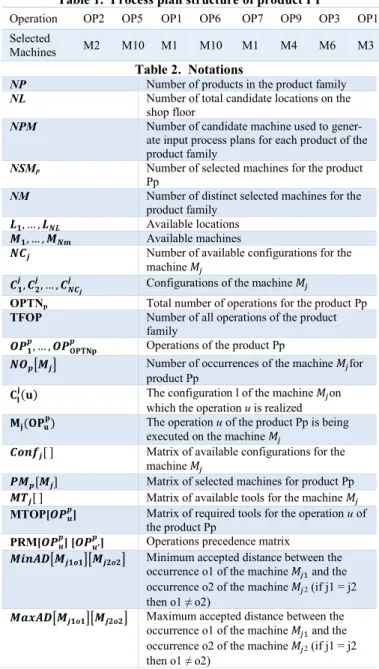
In this paper, we assume that the machines that comprise the RMS are previously selected. Thus, the preliminary process plans of products of the same family, are previously generated following the proposed approach of Haddou Benderbal et al. (2017a, 2018). Table 1 illustrates the structure of the used process plan. Moreover, for a better understanding of the problem, Table 2 presents the used notations.
Table 1. Process plan structure of product P1
Operation OP2 OP5 OP1 OP6 OP7 OP9 OP3 OP13 Selected
Machines M2 M10 M1 M10 M1 M4 M6 M3
Table 2. Notations
NP Number of products in the product family
NL Number of total candidate locations on the shop floor
NPM Number of candidate machine used to gener-ate input process plans for each product of the product family
NSMp Number of selected machines for the product Pp
NM Number of distinct selected machines for the product family
𝑳𝑳𝟏𝟏, … , 𝑳𝑳𝑵𝑵𝑳𝑳 Available locations 𝑴𝑴𝟏𝟏, … , 𝑴𝑴𝑵𝑵𝑵𝑵 Available machines
𝑵𝑵𝑵𝑵𝒋𝒋 Number of available configurations for the machine 𝑀𝑀𝑗𝑗
𝑵𝑵𝟏𝟏𝒋𝒋, 𝑵𝑵𝟐𝟐𝒋𝒋, … , 𝑵𝑵𝑵𝑵𝑵𝑵𝒋𝒋
𝒋𝒋 Configurations of the machine 𝑀𝑀 𝑗𝑗
OPTNp Total number of operations for the product Pp
TFOP Number of all operations of the product
family 𝑶𝑶𝑶𝑶𝟏𝟏𝒑𝒑, … , 𝑶𝑶𝑶𝑶
𝐎𝐎𝐎𝐎𝐎𝐎𝐎𝐎𝐩𝐩
𝒑𝒑 Operations of the product Pp
𝑵𝑵𝑶𝑶𝒑𝒑[𝑴𝑴𝒋𝒋] Number of occurrences of the machine 𝑀𝑀𝑗𝑗for
product Pp
𝐂𝐂𝐥𝐥𝐣𝐣(𝐮𝐮) The configuration l of the machine 𝑀𝑀𝑗𝑗on which the operation u is realized 𝐌𝐌𝐣𝐣(𝐎𝐎𝐎𝐎𝐮𝐮𝐩𝐩) The operation u of the product Pp is being
executed on the machine 𝑀𝑀𝑗𝑗
𝑵𝑵𝑪𝑪𝑪𝑪𝑪𝑪𝒋𝒋[ ] Matrix of available configurations for the
machine 𝑀𝑀𝑗𝑗
𝑶𝑶𝑴𝑴𝒑𝒑[𝑴𝑴𝒋𝒋] Matrix of selected machines for product Pp
𝑴𝑴𝑴𝑴𝒋𝒋[ ] Matrix of available tools for the machine 𝑀𝑀𝑗𝑗
MTOP[𝑶𝑶𝑶𝑶𝒖𝒖𝒑𝒑] Matrix of required tools for the operation u of
the product Pp
PRM[𝑶𝑶𝑶𝑶𝒖𝒖𝒑𝒑] [𝑶𝑶𝑶𝑶𝒖𝒖′𝒑𝒑] Operations precedence matrix
𝑴𝑴𝑴𝑴𝑪𝑪𝑴𝑴𝑴𝑴[𝑴𝑴𝒋𝒋𝟏𝟏𝑪𝑪𝟏𝟏][𝑴𝑴𝒋𝒋𝟐𝟐𝑪𝑪𝟐𝟐] Minimum accepted distance between the
occurrence o1 of the machine 𝑀𝑀𝑗𝑗1 and the occurrence o2 of the machine 𝑀𝑀𝑗𝑗2 (if j1 = j2
then o1 ≠ o2)
𝑴𝑴𝑴𝑴𝑴𝑴𝑴𝑴𝑴𝑴[𝑴𝑴𝒋𝒋𝟏𝟏𝑪𝑪𝟏𝟏][𝑴𝑴𝒋𝒋𝟐𝟐𝑪𝑪𝟐𝟐] Maximum accepted distance between the
occurrence o1 of the machine 𝑀𝑀𝑗𝑗1 and the occurrence o2 of the machine 𝑀𝑀𝑗𝑗2 (if j1 = j2
then o1 ≠ o2)
𝑶𝑶[𝑴𝑴𝒋𝒋𝑪𝑪] Position of occurrence o of the machine 𝑀𝑀𝑗𝑗
For our first sub-problem— i.e. logical environment that treats the transition effort evolution between products of the same family product — we adapted its formulation from Haddou Benderbal et al. (2017a). Consequently, we use the following concepts as basis for the first sub-problem:
Inclusion concept (i.e., inclusion of functionalities be-tween machines). It consists in choosing machines with richer functionalities compared to the needs of the initial product, thus offering the necessary functionalities to manu-facture the initial product, but also other additional func-tionalities that can facilitate the evolution (the transition) towards other products from the same family. Therefore, the question that arises is to assess the relevance of
replac-ing one machine (Mi) with another (Mj) that includes it
functionalities in all relevant process plans. It is a matter of finding the compromise between, on the one hand the need to minimize the effort of evolution between the products and on the other hand, the risks incurred related to the bal-ance of the loads and the presence of alternative machines. Preserving the system's capacities in terms of: (i) the bal-ance of loads and (ii) the presence of alternative machines. This is to take into consideration the risks involved with the inclusion concept of additional features.
Diversity of machines. It consists of selecting machines with partially similar capabilities in order to reduce exclu-sivity in the operations-machine relationships. This will duce the risk of load imbalance and the risk of missing re-placement machines.
Based on the above concepts, our first sub-problem is guided by three criteria to optimize respectively:
1. The maximization of the average use of machines to reach equilibrium if possible, depicted by the average machine us-age per product (AMUP) criterion as follows:
𝑀𝑀𝑀𝑀𝑀𝑀𝑝𝑝(𝑀𝑀𝑗𝑗) = (𝑁𝑁𝑁𝑁𝑁𝑁𝑂𝑂𝑂𝑂𝑁𝑁𝑝𝑝(𝑀𝑀𝑝𝑝𝑗𝑗)) × ∑𝑁𝑁𝑂𝑂𝑂𝑂𝑁𝑁𝑢𝑢=0 𝑝𝑝(𝛼𝛼𝑗𝑗(𝑂𝑂𝑂𝑂𝑢𝑢𝑝𝑝) × 𝑀𝑀𝑗𝑗(𝑂𝑂𝑂𝑂𝑢𝑢𝑝𝑝))
(1)
𝑀𝑀𝑀𝑀𝑀𝑀 { 𝐴𝐴𝑀𝑀𝑀𝑀𝑂𝑂 = (𝑁𝑁𝑂𝑂×𝑁𝑁𝑀𝑀𝑁𝑁1 ) ∑𝑁𝑁𝑀𝑀𝑁𝑁𝑗𝑗=1 ∑𝑁𝑁𝑂𝑂𝑝𝑝=0𝑀𝑀𝑀𝑀𝑀𝑀𝑝𝑝(𝑀𝑀𝑗𝑗)} (2) where: 𝑀𝑀𝑗𝑗(𝑂𝑂𝑂𝑂𝑢𝑢𝑝𝑝) = 1 if the machine Mj can accomplish opera-tion u of product Pp, 0 otherwise.
𝛼𝛼 = 1 if the machine Mj is selected to perform operation u of
product Pp, 0 otherwise.
2. The maximization of the presence of replacement machines in the production lines of the product family formulated as follows: 𝑀𝑀𝑀𝑀𝑀𝑀 {𝑀𝑀𝑀𝑀𝑂𝑂 = 1 𝑁𝑁𝑂𝑂∑ ( 1 𝑁𝑁𝑂𝑂𝑂𝑂𝑁𝑁𝑝𝑝×𝑁𝑁𝑁𝑁𝑀𝑀𝑝𝑝∑ ∑ ( 𝑀𝑀𝑗𝑗(𝑂𝑂𝑂𝑂𝑢𝑢𝑝𝑝) × 𝑁𝑁𝑂𝑂𝑝𝑝(𝑀𝑀𝑗𝑗)) 𝑁𝑁𝑁𝑁𝑀𝑀𝑝𝑝 𝑗𝑗=0 𝑁𝑁𝑂𝑂𝑂𝑂𝑁𝑁𝑝𝑝 𝑢𝑢=0 ) 𝑁𝑁𝑂𝑂 𝑝𝑝=0 } (3)
3. The minimization of the layout evolution effort (LEE). It quantifies the change that may occur to the selected machines and or to their rearrangement from one product to another among products of the family product. The LEE is based on two aspects namely:
Machine similarities (PSimMp). It allows selecting the
best machine layout in term of similarities between the se-lected machines. This later assesses the average similarity between selected machines of products from the product family. The similarity calculation is based on the number and type of configuration changes between two given ma-chines and it is formulated like so:
𝑃𝑃𝑃𝑃𝑃𝑃𝑃𝑃𝑃𝑃𝑝𝑝=𝑁𝑁𝑁𝑁𝑁𝑁1𝑝𝑝∑𝑗𝑗=1𝑁𝑁𝑁𝑁𝑁𝑁𝑝𝑝−1∑𝑁𝑁𝑁𝑁𝑁𝑁𝑘𝑘=𝑗𝑗+1𝑝𝑝 𝑃𝑃𝑃𝑃𝑃𝑃𝑃𝑃[𝑃𝑃𝑗𝑗][𝑃𝑃𝑘𝑘] (4) where: 𝑃𝑃𝑃𝑃𝑃𝑃𝑃𝑃[𝑃𝑃𝑗𝑗][𝑃𝑃𝑘𝑘] = β(j, k) −β(j,k)×|𝑁𝑁𝑁𝑁𝑁𝑁𝑁𝑁𝑁𝑁𝑗𝑗−𝑁𝑁𝑁𝑁𝑁𝑁𝑁𝑁𝑁𝑁𝑘𝑘| 𝑁𝑁𝑁𝑁𝑁𝑁𝑁𝑁𝑁𝑁𝑗𝑗+𝑁𝑁𝑁𝑁𝑁𝑁𝑁𝑁𝑁𝑁𝑘𝑘 and β(j, k) = {1, if machines 𝑃𝑃𝑀𝑀 𝑎𝑎𝑎𝑎𝑎𝑎 M𝑘𝑘 ℎ𝑎𝑎𝑎𝑎𝑎𝑎 𝑡𝑡ℎ𝑎𝑎 𝑠𝑠𝑎𝑎𝑃𝑃𝑎𝑎 𝑏𝑏𝑎𝑎𝑠𝑠𝑃𝑃𝑏𝑏 𝑃𝑃𝑚𝑚𝑎𝑎𝑚𝑚𝑚𝑚𝑎𝑎𝑠𝑠 0, 𝑂𝑂𝑡𝑡ℎ𝑎𝑎𝑒𝑒𝑒𝑒𝑃𝑃𝑠𝑠𝑎𝑎 𝑘𝑘, 𝑀𝑀 ∈ 1. . 𝑁𝑁𝑃𝑃𝑃𝑃
Selected machine type difference (SMDifp). It is related
to the type of selected machines. Through this aspect, we can see within the product family, which type of machines (SMT) are used for each product, how many machines are removed (RM) when passing from one product to the other and how many ones are added (AM).
𝑃𝑃𝑃𝑃𝑆𝑆𝑃𝑃𝑆𝑆
𝑝𝑝=
𝐴𝐴𝑁𝑁+𝑅𝑅𝑁𝑁𝑁𝑁𝑁𝑁𝑆𝑆 (5) where: 𝑃𝑃𝑃𝑃𝑆𝑆 = ∑ 𝑃𝑃𝑎𝑎𝑀𝑀(𝑃𝑃𝑃𝑃𝑝𝑝[𝑃𝑃𝑗𝑗], 𝑃𝑃𝑃𝑃𝑝𝑝′[𝑃𝑃𝑗𝑗]) 𝑁𝑁𝑁𝑁 𝑗𝑗=0 𝑅𝑅𝑃𝑃 = ∑ 𝑃𝑃𝑎𝑎𝑀𝑀(𝑃𝑃𝑃𝑃𝑝𝑝[𝑃𝑃𝑗𝑗] − 𝑃𝑃𝑃𝑃𝑝𝑝′[𝑃𝑃𝑗𝑗], 0) 𝑁𝑁𝑁𝑁 𝑗𝑗=0 𝐴𝐴𝑃𝑃 = ∑|𝑃𝑃𝑃𝑃𝑎𝑎(𝑃𝑃𝑃𝑃𝑝𝑝[𝑃𝑃𝑗𝑗] − 𝑃𝑃𝑃𝑃𝑝𝑝′[𝑃𝑃𝑗𝑗], 0)| 𝑁𝑁𝑁𝑁 𝑗𝑗=0 𝑃𝑃𝑃𝑃𝑝𝑝(𝑃𝑃𝑗𝑗) = {1, 𝑃𝑃𝑆𝑆 𝑝𝑝𝑒𝑒𝑚𝑚𝑎𝑎𝑚𝑚𝑏𝑏𝑡𝑡 𝑃𝑃𝑝𝑝 𝑃𝑃𝑠𝑠 𝑒𝑒𝑎𝑎𝑎𝑎𝑚𝑚𝑃𝑃𝑟𝑟𝑎𝑎𝑎𝑎 𝑏𝑏𝑏𝑏 𝑃𝑃𝑎𝑎𝑏𝑏ℎ𝑃𝑃𝑎𝑎𝑎𝑎 𝑃𝑃𝑀𝑀 0, otherwiseFollowing these two aspects, the LEE is given by: 𝑃𝑃𝑃𝑃𝑎𝑎 { 𝐿𝐿𝐿𝐿𝐿𝐿 =𝑁𝑁𝑁𝑁1 ∑ (𝑁𝑁𝑁𝑁𝑆𝑆𝑆𝑆𝑁𝑁𝑝𝑝
𝑁𝑁𝑁𝑁𝑆𝑆𝑃𝑃𝑁𝑁𝑝𝑝)
𝑁𝑁𝑁𝑁
𝑝𝑝=1 } (6)
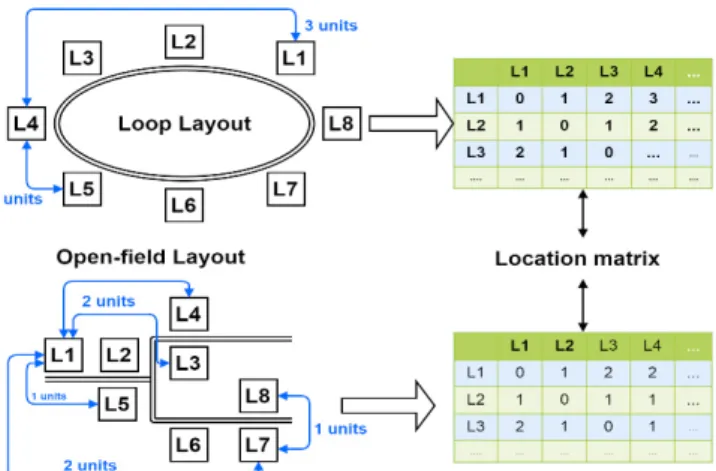
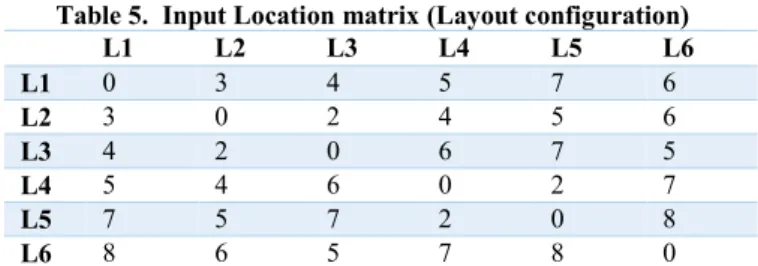
On the other hand, for our second sub-problem— i.e. physical environment that treats the machine layout problem — based on the numerous layout configurations of machines present in the literature, we used a generic model proposed in (Haddou Benderbal et al., 2017c) and depicted in Figure 1. This later allows the representation of machine layouts configurations in the form of a matrix called localization matrix (LoC). LoC makes it possible to represent a layout configuration by speci-fying the distances between machines in the workshop accord-ing to the capacities and constraints of the system (ex. the constraints of size) as well as the available positions. This assumption makes our model more generic to include all the possible layout configurations. Note that, the distances be-tween the positions (machines) rely on the transfer capacities between the machines and ensured by the chosen material handling system. They are provided by the decision maker and considered as input for our model. In Figure 1, L1, ..., L8 are the previously known candidate locations. They are in-tended to accommodate the selected machines to be part of the designed RMS, where the number of slots in the array corre-sponds to the total number of occurrences of the selected machines for the product family.
Fig. 1 Representation of layout configurations
We expect to determine the best machines layout based on the following information: (i) the characteristics and needs of the products to be considered from the product family, (ii) the process plans to adopt to manufacture these products, and (iii) the selected RMTs and the number of their respective occur-rences, to be included in the new designed RMS.
We consider a RMS composed of several RMTs, having the capacity to manufacture several products of the same family. Each RMT has one or more instances to integrate into the workshop according to the needs and requirements of the process plan of each product. Note that, we consider a single unit of each product of the product family with its initial pro-cess plan to accomplish this product. Accordingly, the ma-chines that comprise the RMS design and their respective occurrences are known. Moreover, a machine can be used several times in any process plan and this number of uses may exceed the number of available occurrences for this machine (i.e. each machine can have multiple occurrences and appear several times in the process plan). Based on these inputs, we are able to generate an initial layout using the given process plans of products from the product family.
The initial layout is generated according to the order of ap-pearance of the machines in the adopted process plans as well as to the importance of these machines to the whole product family. For example, if a machine 𝑃𝑃𝑗𝑗 is used directly after a machine 𝑃𝑃𝑗𝑗′, then the chosen layout must offer the possibility of a connection between the two machines. Hence, based on this initial layout as well as the constraints imposed by the adopted process plans, we define two new matrices respec-tively, maximum and minimum accepted distances (MaxAD,
MinAD) between different machines and their occurrences as
well. This set of information helps us to define the im-portance of each machine regarding the adopted process plans of all products from the product family.
Finally, our problem is to find the best RMTs layout. This layout must minimize the penalties engendered by the non-satisfaction of constraints related to machine-candidate posi-tion relaposi-tionship in the system. This non-satisfacposi-tion can be the result of conflicting requirements between different ma-chines. To compute the penalties, we use each machine im-portance regarding both the product family and the process plan.
The machine importance indicator 𝑃𝑃𝑀𝑀(𝑃𝑃𝑗𝑗) provides an insight over the dependency of different process plans of the product
2019 IFAC MIM
Berlin, Germany, August 28-30, 2019
Machine similarities (PSimMp). It allows selecting the
best machine layout in term of similarities between the se-lected machines. This later assesses the average similarity between selected machines of products from the product family. The similarity calculation is based on the number and type of configuration changes between two given ma-chines and it is formulated like so:
𝑃𝑃𝑃𝑃𝑃𝑃𝑃𝑃𝑃𝑃𝑝𝑝=𝑁𝑁𝑁𝑁𝑁𝑁1𝑝𝑝∑𝑗𝑗=1𝑁𝑁𝑁𝑁𝑁𝑁𝑝𝑝−1∑𝑁𝑁𝑁𝑁𝑁𝑁𝑘𝑘=𝑗𝑗+1𝑝𝑝 𝑃𝑃𝑃𝑃𝑃𝑃𝑃𝑃[𝑃𝑃𝑗𝑗][𝑃𝑃𝑘𝑘] (4) where:𝑃𝑃𝑃𝑃𝑃𝑃𝑃𝑃[𝑃𝑃𝑗𝑗][𝑃𝑃𝑘𝑘] = β(j, k) −β(j,k)×|𝑁𝑁𝑁𝑁𝑁𝑁𝑁𝑁𝑁𝑁𝑗𝑗−𝑁𝑁𝑁𝑁𝑁𝑁𝑁𝑁𝑁𝑁𝑘𝑘| 𝑁𝑁𝑁𝑁𝑁𝑁𝑁𝑁𝑁𝑁𝑗𝑗+𝑁𝑁𝑁𝑁𝑁𝑁𝑁𝑁𝑁𝑁𝑘𝑘 and β(j, k) = {1, if machines 𝑃𝑃𝑀𝑀 𝑎𝑎𝑎𝑎𝑎𝑎 M𝑘𝑘 ℎ𝑎𝑎𝑎𝑎𝑎𝑎 𝑡𝑡ℎ𝑎𝑎 𝑠𝑠𝑎𝑎𝑃𝑃𝑎𝑎 𝑏𝑏𝑎𝑎𝑠𝑠𝑃𝑃𝑏𝑏 𝑃𝑃𝑚𝑚𝑎𝑎𝑚𝑚𝑚𝑚𝑎𝑎𝑠𝑠0, 𝑂𝑂𝑡𝑡ℎ𝑎𝑎𝑒𝑒𝑒𝑒𝑃𝑃𝑠𝑠𝑎𝑎 𝑘𝑘, 𝑀𝑀 ∈ 1. . 𝑁𝑁𝑃𝑃𝑃𝑃
Selected machine type difference (SMDifp). It is related
to the type of selected machines. Through this aspect, we can see within the product family, which type of machines (SMT) are used for each product, how many machines are removed (RM) when passing from one product to the other and how many ones are added (AM).
𝑃𝑃𝑃𝑃𝑆𝑆𝑃𝑃𝑆𝑆
𝑝𝑝=
𝐴𝐴𝑁𝑁+𝑅𝑅𝑁𝑁𝑁𝑁𝑁𝑁𝑆𝑆 (5) where: 𝑃𝑃𝑃𝑃𝑆𝑆 = ∑ 𝑃𝑃𝑎𝑎𝑀𝑀(𝑃𝑃𝑃𝑃𝑝𝑝[𝑃𝑃𝑗𝑗], 𝑃𝑃𝑃𝑃𝑝𝑝′[𝑃𝑃𝑗𝑗]) 𝑁𝑁𝑁𝑁 𝑗𝑗=0 𝑅𝑅𝑃𝑃 = ∑ 𝑃𝑃𝑎𝑎𝑀𝑀(𝑃𝑃𝑃𝑃𝑝𝑝[𝑃𝑃𝑗𝑗] − 𝑃𝑃𝑃𝑃𝑝𝑝′[𝑃𝑃𝑗𝑗], 0) 𝑁𝑁𝑁𝑁 𝑗𝑗=0 𝐴𝐴𝑃𝑃 = ∑|𝑃𝑃𝑃𝑃𝑎𝑎(𝑃𝑃𝑃𝑃𝑝𝑝[𝑃𝑃𝑗𝑗] − 𝑃𝑃𝑃𝑃𝑝𝑝′[𝑃𝑃𝑗𝑗], 0)| 𝑁𝑁𝑁𝑁 𝑗𝑗=0 𝑃𝑃𝑃𝑃𝑝𝑝(𝑃𝑃𝑗𝑗) = {1, 𝑃𝑃𝑆𝑆 𝑝𝑝𝑒𝑒𝑚𝑚𝑎𝑎𝑚𝑚𝑏𝑏𝑡𝑡 𝑃𝑃𝑝𝑝 𝑃𝑃𝑠𝑠 𝑒𝑒𝑎𝑎𝑎𝑎𝑚𝑚𝑃𝑃𝑟𝑟𝑎𝑎𝑎𝑎 𝑏𝑏𝑏𝑏 𝑃𝑃𝑎𝑎𝑏𝑏ℎ𝑃𝑃𝑎𝑎𝑎𝑎 𝑃𝑃𝑀𝑀 0, otherwiseFollowing these two aspects, the LEE is given by: 𝑃𝑃𝑃𝑃𝑎𝑎 { 𝐿𝐿𝐿𝐿𝐿𝐿 =𝑁𝑁𝑁𝑁1 ∑ (𝑁𝑁𝑁𝑁𝑆𝑆𝑆𝑆𝑁𝑁𝑝𝑝
𝑁𝑁𝑁𝑁𝑆𝑆𝑃𝑃𝑁𝑁𝑝𝑝)
𝑁𝑁𝑁𝑁
𝑝𝑝=1 } (6)
On the other hand, for our second sub-problem— i.e. physical environment that treats the machine layout problem — based on the numerous layout configurations of machines present in the literature, we used a generic model proposed in (Haddou Benderbal et al., 2017c) and depicted in Figure 1. This later allows the representation of machine layouts configurations in the form of a matrix called localization matrix (LoC). LoC makes it possible to represent a layout configuration by speci-fying the distances between machines in the workshop accord-ing to the capacities and constraints of the system (ex. the constraints of size) as well as the available positions. This assumption makes our model more generic to include all the possible layout configurations. Note that, the distances be-tween the positions (machines) rely on the transfer capacities between the machines and ensured by the chosen material handling system. They are provided by the decision maker and considered as input for our model. In Figure 1, L1, ..., L8 are the previously known candidate locations. They are in-tended to accommodate the selected machines to be part of the designed RMS, where the number of slots in the array corre-sponds to the total number of occurrences of the selected machines for the product family.
Fig. 1 Representation of layout configurations
We expect to determine the best machines layout based on the following information: (i) the characteristics and needs of the products to be considered from the product family, (ii) the process plans to adopt to manufacture these products, and (iii) the selected RMTs and the number of their respective occur-rences, to be included in the new designed RMS.
We consider a RMS composed of several RMTs, having the capacity to manufacture several products of the same family. Each RMT has one or more instances to integrate into the workshop according to the needs and requirements of the process plan of each product. Note that, we consider a single unit of each product of the product family with its initial pro-cess plan to accomplish this product. Accordingly, the ma-chines that comprise the RMS design and their respective occurrences are known. Moreover, a machine can be used several times in any process plan and this number of uses may exceed the number of available occurrences for this machine (i.e. each machine can have multiple occurrences and appear several times in the process plan). Based on these inputs, we are able to generate an initial layout using the given process plans of products from the product family.
The initial layout is generated according to the order of ap-pearance of the machines in the adopted process plans as well as to the importance of these machines to the whole product family. For example, if a machine 𝑃𝑃𝑗𝑗 is used directly after a machine 𝑃𝑃𝑗𝑗′, then the chosen layout must offer the possibility of a connection between the two machines. Hence, based on this initial layout as well as the constraints imposed by the adopted process plans, we define two new matrices respec-tively, maximum and minimum accepted distances (MaxAD,
MinAD) between different machines and their occurrences as
well. This set of information helps us to define the
im-portance of each machine regarding the adopted process plans of all products from the product family.
Finally, our problem is to find the best RMTs layout. This layout must minimize the penalties engendered by the non-satisfaction of constraints related to machine-candidate posi-tion relaposi-tionship in the system. This non-satisfacposi-tion can be the result of conflicting requirements between different ma-chines. To compute the penalties, we use each machine im-portance regarding both the product family and the process plan.
The machine importance indicator𝑃𝑃𝑀𝑀(𝑃𝑃𝑗𝑗) provides an insight over the dependency of different process plans of the product
family regarding the selected machines. This later is adapted from the work of (Haddou Benderbal et al., 2017c) and for-mulated for all the given process plans of the product family as follows: 𝑀𝑀𝑀𝑀(𝑀𝑀𝑗𝑗) = ∑𝑁𝑁𝑁𝑁𝑝𝑝=1𝑀𝑀𝑀𝑀𝑝𝑝(𝑀𝑀𝑗𝑗)/𝑁𝑁𝑁𝑁𝑀𝑀𝑝𝑝 (7) where: 𝑀𝑀𝑀𝑀𝑁𝑁(𝑀𝑀𝑗𝑗) = ∑𝑗𝑗=1𝑁𝑁𝑁𝑁𝑝𝑝[𝑀𝑀𝑗𝑗]𝑀𝑀𝑀𝑀𝑀𝑀𝑝𝑝(𝑀𝑀𝑗𝑗𝑗𝑗) (8) 𝑀𝑀𝑀𝑀𝑀𝑀𝑁𝑁(𝑀𝑀𝑗𝑗𝑗𝑗) = 𝐶𝐶𝐶𝐶𝑁𝑁(𝑀𝑀𝑗𝑗𝑗𝑗) × ∑ 𝑀𝑀𝑀𝑀𝑃𝑃[𝑀𝑀𝑗𝑗𝑗𝑗][𝑀𝑀𝑗𝑗′𝑘𝑘]+𝑀𝑀𝑀𝑀𝑃𝑃[𝑀𝑀𝑗𝑗′𝑘𝑘][𝑀𝑀𝑗𝑗𝑗𝑗] 𝑁𝑁𝑁𝑁𝑝𝑝(𝑀𝑀𝑗𝑗) 𝑁𝑁𝑁𝑁𝑀𝑀𝑃𝑃𝑗𝑗 𝑗𝑗=1 (9)
𝐶𝐶𝐶𝐶𝑁𝑁 (Mjo): the number of occurrences of machine Mj
in the adopted process plan of the product Pp.
𝑀𝑀𝑀𝑀𝑁𝑁[𝑀𝑀𝑗𝑗𝑗𝑗][𝑀𝑀𝑗𝑗𝑗𝑗] : the relation between all the
occur-rences of the machines used in the process plan of product Pp given by:
𝑀𝑀𝑀𝑀𝑁𝑁[𝑀𝑀𝑗𝑗𝑗𝑗][𝑀𝑀𝑗𝑗′𝑗𝑗]
= { 1 if the occurrence o of the machine Mj is followedby the occurrence k of the machine Mj' 0 otherwise
Based on this importance indicator, we can formulate the penalty function that measure the level of satisfaction of the constraints of the different process plans by the generated layout of the RMTs. It quantifies to ‘what extent the locations chosen for the occurrences of the different machines respect the maximum and minimum distances?’, while considering the importance of each one. Therefore, our problem is to min-imize the penalty generated due to non-satisfaction of the constraints expressed by (eq 10):
𝑀𝑀𝑀𝑀𝑀𝑀 { 𝐶𝐶𝑃𝑃𝑀𝑀𝑃𝑃𝑃𝑃𝑀𝑀𝑃𝑃é = ∑𝑁𝑁𝑁𝑁𝑀𝑀𝑗𝑗=1 ∑𝑁𝑁𝑁𝑁𝑀𝑀𝑗𝑗=1 𝑋𝑋𝑗𝑗𝑗𝑗× 𝑀𝑀𝑀𝑀(𝑀𝑀𝑗𝑗)} (10) where:𝑋𝑋𝑗𝑗𝑗𝑗=
{1, 𝑀𝑀𝑖𝑖 𝑀𝑀𝑀𝑀𝑀𝑀𝑀𝑀𝑀𝑀[𝑀𝑀𝑗𝑗𝑗𝑗][𝑀𝑀𝑗𝑗′𝑗𝑗]≤ 𝐿𝐿𝑗𝑗𝐶𝐶[𝐶𝐶(𝑀𝑀𝑗𝑗𝑗𝑗)][𝐶𝐶(𝑀𝑀𝑗𝑗′𝑗𝑗)]≤ 𝑀𝑀𝑃𝑃𝑀𝑀𝑀𝑀𝑀𝑀[𝑀𝑀𝑗𝑗𝑗𝑗][𝑀𝑀𝑗𝑗′𝑗𝑗]
0, 𝑗𝑗𝑃𝑃ℎ𝑃𝑃𝑒𝑒𝑒𝑒𝑀𝑀𝑒𝑒𝑃𝑃
4. PROPOSED APPROACH
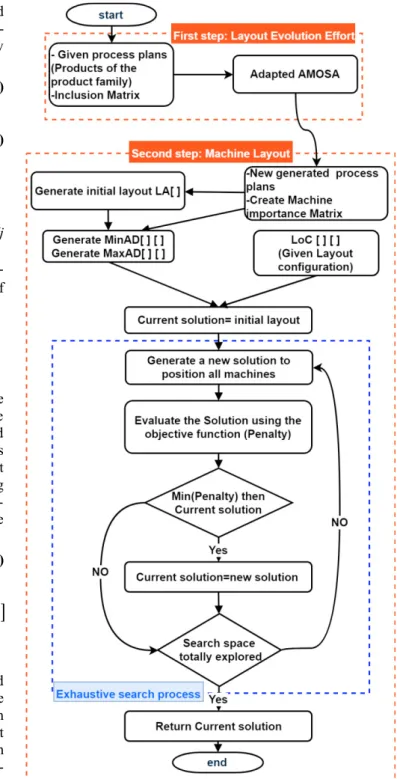
Hybrid algorithms are known to be very good search tools and displayed very satisfying results (El-Ghazali, 2009). They are often used to solve conventional and real-world optimization problems. In this context, we proposed a hybrid approach that combines between the well know metaheuristic AMOSA with an exhaustive-search based heuristic. From the multi-objective nature of our first sub-problem, our approach tries to solve it using an adapted version of AMOSA as shown in Figure 2. The obtained results are used, in a second step, as inputs for the exhaustive-search based heuristic to solve the second sub-problem (i.e., machine layout problem of the se-lected machines in our product family).
Table 3. Process plan of P2
Operation OP1 OP7 OP6 OP10 OP2 OP13 OP11 OP8
Selected
machines M1 M2 M8 M4 M2 M10 M3 M4
Fig. 2 Flowchart of the developed hybrid approach
5. ILLUSTRATIVEEXAMPLE AND DISCUSSION
In this section, digital experiments and analyzes are developed to show the applicability of our approach. We consider a family of three products namely P1, P2 and P3, with respec-tively 8, 8 and 7 operations. The total number of different operations required for all products is TFOP = 13. Table 1, Table 3 and Table 4 detail respectively the process plans of P1, P2 and P3.
Table 4. Process plan of P3
Operation OP3 OP5 OP2 OP12 OP6 OP4 OP7
Selected