HAL Id: hal-03199531
https://hal.archives-ouvertes.fr/hal-03199531
Submitted on 16 Apr 2021HAL is a multi-disciplinary open access archive for the deposit and dissemination of sci-entific research documents, whether they are pub-lished or not. The documents may come from teaching and research institutions in France or abroad, or from public or private research centers.
L’archive ouverte pluridisciplinaire HAL, est destinée au dépôt et à la diffusion de documents scientifiques de niveau recherche, publiés ou non, émanant des établissements d’enseignement et de recherche français ou étrangers, des laboratoires publics ou privés.
Southeast Pacific blue whale song recorded off Isla
Chañaral, northern Chile
Julie Patris, Susannah Buchan, Giselle Alosilla, Naysa Balcazar- Cabrera,
Franck Malige, Hervé Glotin
To cite this version:
Julie Patris, Susannah Buchan, Giselle Alosilla, Naysa Balcazar- Cabrera, Franck Malige, et al.. Southeast Pacific blue whale song recorded off Isla Chañaral, northern Chile. Marine Mammal Science, Wiley, 2020, 36 (4), pp.1339 - 1346. �10.1111/mms.12738�. �hal-03199531�
Southeast Pacific blue whale song recorded off Isla Chañaral, Northern Chile
Authors: Julie Patris(1), Susannah J. Buchan*(2,3,4), Giselle Alosilla(5), Naysa
Balcazar-Cabrera(4), Franck Malige(1), Hervé Glotin(1)
1) AMU, Université de Toulon, CNRS, LIS, Marseille, DYNI team, France
2) Centro de Estudios Avanzados en Zonas Áridas, Coquimbo, Chile
3) Center for Oceanographic Research COPAS Sur-Austral, University of Concepción,
Concepción, Chile
4) Woods Hole Oceanographic Institution, Biology Department, Woods Hole,
Massachusetts
5) Instituto de Biología, Facultad de Ciencias, Universidad de Valparaíso, Valparaíso,
Chile
* Correspondence
Email: [email protected]
* KEYWORDS: blue whale, migration, songs, Southeast Pacific
1 2 3 4 5 6 7 8 9 10 11 12 13 14 15 16 17 18 19 20 21 22 23 24 25
* Text:
Determining the distribution and seasonal movements of baleen whales is fundamental to the development of conservation strategies and marine spatial planning, which ensure
their continued protection (e.g., Pompa, Ehrlich, and Ceballos (2011), Mullen, Peterson,
and Todd (2013), Redfern et al. (2013a, 2013b)). One method widely used to monitor distribution and movements of cetaceans is Passive Acoustic Monitoring (PAM) (e.g.,
Mellinger, Stafford, Moore, Dziak, and Matsumoto (2007), Van Parijs et al. (2009)). The
loud, repetitive, low-frequency songs of baleen whales make these animals particularly
good candidates for acoustically determining their occurrence and in turn their
distribution (e.g., Stafford, Nieukirk, and Fox (1999a, 1999b), Cerchio, Jacobsen, and
Norris (2001), Širović, Hildebrand, Wiggins, and Thiele (2009), Buchan, Hucke-Gaete,
Rendell, and Stafford (2015)). Endangered (https://www.iucn.org/) blue whales
(Balaenoptera musculus) produce distinct song types recorded in different oceanic
regions with largely distinct spatial and temporal distributions (e.g., McDonald,
Mesnick, and Hildebrand (2006) and references therein, Stafford, Chapp, Bohnenstiel,
and Tolstoy (2011), Samaran et al. (2013), Buchan, Hucke-Gaete, Rendell, and Stafford
(2014), Buchan et al. (2015), Balcazar et al. (2017)). Song in blue whales is assumed to
serve some reproductive function as it is believed to be produced only by males (Oleson
et al., 2007a) and is produced throughout the animals' migratory range (Stafford et al.
(1999a), Stafford, Nieukirk, and Fox (2001)). Blue whale song remains relatively stable
over time, although there is some intra-annual variation in song production (Oleson,
Wiggins, and Hildebrand, 2007b) and a decrease in the frequency of tonal song
components has been reported over decadal timescales (McDonald, Hildebrand, and
Mesnick (2009), Gavrilov, McCauley, and Gedamke (2012)). Therefore, PAM offers a
26 27 28 29 30 31 32 33 34 35 36 37 38 39 40 41 42 43 44 45 46 47 48 49
very useful method to monitor the distribution of blue whale acoustic groups
worldwide.
The predominant song type of Southeast Pacific blue whales, known as the Southeast
Pacific 2, (SEP2) (Buchan et al., 2014) has been recorded in Chilean Patagonia (Buchan
et al., 2014, and 2015), off Juan Fernandez (Truong, Širović, Tripovich, and Rogers,
2016), and in the eastern Tropical Pacific (Stafford et al. (1999b), Buchan et al. (2015)).
This acoustic presence supports a migratory range for this group between Chilean
Patagonia and the eastern Tropical Pacific. This migratory range is also supported by
genetic sampling of the individuals within this range (Torres-Florez, Hucke Gaete, and
LeDuc, 2014), photo-identification (Torres-Florez et al., 2015), and studies using
satellite tags (Hucke-Gaete et al., 2018). Placed within the migratory corridor of south
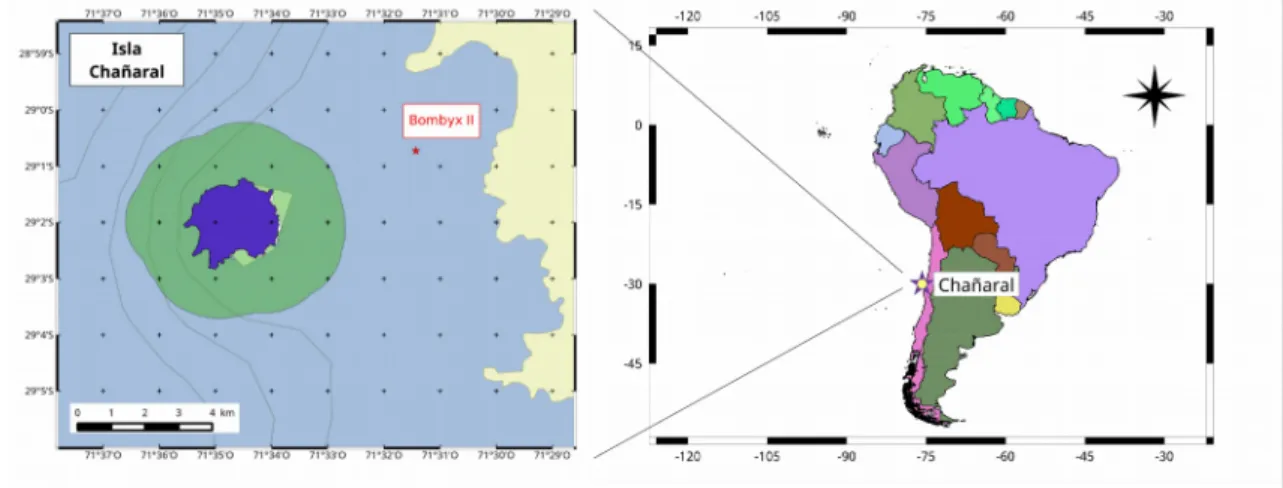
Pacific blue whales, Isla Chañaral is part of the Humboldt Archipelago, a series of
coastal islands within the productive Humboldt Current System (Thiel et al., 2007)
(Figure 1). The waters surrounding Isla Chañaral, which lies 3.5 nautical miles from the
mainland, are a known summer feeding ground primarily for fin whales (Balaenoptera
physalus) (Pérez-Álvarez et al. (2006), Toro, Vilina, Capella, and Gibbons (2016), Sepúlveda, Santos, and Pavez (2017), Sepúlveda, Pérez‐Álvarez, and Santos‐Carvallo (2018)), but also blue whales, humpback whales (Megaptera novaeangliae), sei whales
(Balaenoptera borealis), and minke whales (Balaenoptera bonaerensis) have also been
sighted (Capella, Vilina, and Gibbons (1999), Sepúlveda pers. Comm.). This area has
long since been the focus of a Marine Protected Area proposal. The acoustic identity of the blue whales that visit this area is unknown. In this study, we report the analysis of
new PAM data from Northern Chile to examine whether there is evidence of southeast
Pacific blue whales (SEP2 song type) in this area.
50 51 52 53 54 55 56 57 58 59 60 61 62 63 64 65 66 67 68 69 70 71 72 73 74
Passive acoustic data were collected within the Isla Chañaral channel, between the Isla
Chañaral and the mainland, at 29°00'44'' S and 71°31'26'' W (Figure 1) during three
periods of two weeks in January and February 2017 (see Patris, Malige, and Glotin
(2017) for details). A 'BOMBYX II', which includes a Cetacean Research C57
hydrophone (sensitivity of -187 dB re 1 V μPa ¹, flat response down to 20 Hz,⁻ omnidirectional at frequencies less than 10 kHz), powered by a 9V source and high-pass
filtered (C=47µF, frequency cut 0.15 Hz) and a commercial SONY PCM-M10 recording
device (gain 6, Rin = 22 kOhm) equipped with a 256 GB memory card, set up in a
specialized tube made by OSEAN SA (France) able to resist high pressure, was
deployed between 15 and 20 m below the surface on a mooring where the maximum
water column depth was 70 m. The 'BOMBYX II' was deployed by the University of
Toulon and CNRS (DYNI team, LIS).
Recording was done at a sample rate of 48 kHz so as to record a vast diversity of
cetaceans, ranging from large whales to dolphins, and at 16-bits, allowing for high
sensitivity without saturating the memory i. No low-pass filter (such as an anti-aliasing
filter) was used for this recording, since it was not considered necessary for our purpose.
Acoustic data were recorded between the 16 January and the 27 February 2017. No data
were recorded during the 30 and 31 January and during the night between the 13 and 14
February because of instrument redeployment.
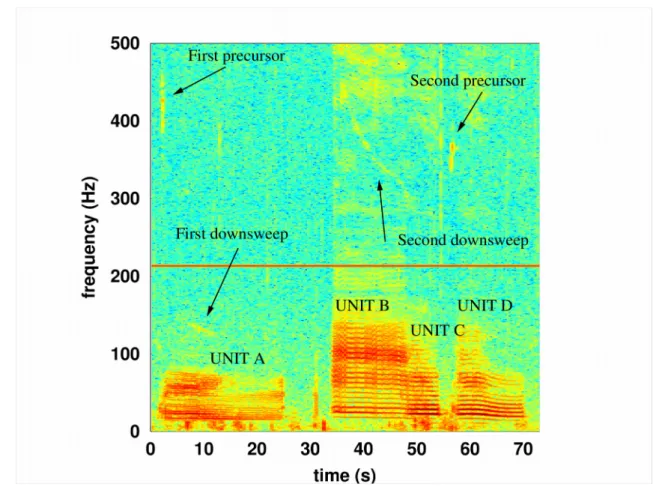
The SEP2 song is made up of a four-unit phrase (A, B, C, D, see Figure 2) lasting 60 s
that is repeated every two minutes, in long series lasting for hours. All units are long
and stable pulsed sounds; thus their power spectra show a set of discrete frequencies
75 76 77 78 79 80 81 82 83 84 85 86 87 88 89 90 91 92 93 94 95 96 97 98 99
(Patris, Malige, Glotin, Asch, and Buchan, 2019). The energy of the spectra is generally
concentrated around the 24 Hz peak. Unit A has an average duration of 22 s, unit B of
13 s, unit C of 5 s, and unit D an average duration of 13 s. Usually, not all units are
visible due to low signal to noise ratio (SNR) and units C and D contain most of the
signal's energy. In this study SEP2 song phrases were annotated whenever at least the 24
Hz-frequency peak of units C and D were visible. The SEP2 songs of Southeast Pacific
blue whales were annotated manually, i.e., a box was drawn around the C and D units of
the SEP2 song phrase, on the spectrogram visible in Raven Pro 1.5 (Bioacoustics
Research Program, 2012). The following parameters were used: 8,192 sample FFT, 50%
overlap, Hann window, with a Raven scale set to view 60 Hz over 200 s. Herein, we
refer to all phrases with at least C and D units as SEP2 song phrases.
A nonsystematic double check of the data by another analyst showed that few phrases (with only unit B visible) were not counted by the first analyst (missed detections). Units C and D were not visible due to noise or propagation effects that mask low frequencies. Furthermore, unit A and the pair C-D are sometimes confoundable (having
similar characteristics in duration and peak frequency). Thus, in some cases, unit A and
the pair C-D of the same phrase were counted as two distinct occurrences of a phrase
(false positive). As the second analysis was not systematic on all data but only on a
portion of it (one third), it served to evaluate the importance of errors during the counting of the first analysis. Based on this double check, we estimate the error in counting SEP2 occurrences to be less than 3%.
A total of 913 h of acoustic recordings were analyzed, over which 1,981 SEP2 song
phrases were identified, annotated and counted by the first analyst (Figure 3). As
100 101 102 103 104 105 106 107 108 109 110 111 112 113 114 115 116 117 118 119 120 121 122 123 124
presented in these studies, we also noted the presence of two short high frequency
precursors before units A (around 430 Hz) and D (around 350 Hz) (see Figure 2). Two
faint downsweeps are identified in phrases with high signal-to-noise ratio: in unit A
(duration of 5 s from 150 Hz to 120 Hz) (n = 10) and in unit B (duration of 12 s from
450 Hz to 300 Hz) (n = 10), see Figure 2. This sound may be a byproduct of the pulsed low frequency sound, a resonance artefact or sound made independently. In the latter, no mechanism of sound production has been proposed to explain this superposition of two sounds, called two-voiced sounds (Brown, 2008) and this has not been described for other blue whale's song types (McDonald et al., 2006).
There was no noticeable trend in the total number of SEP2 song phrases counted over
the study period although, overall, more phrases were counted in January (64
phrases/day in average) compared to February (36 phrases/day) (See Figure 3). No
significative difference was found between day and night in the number of phrases.
Although this is a short period study, these results show low but consistent acoustic
presence of Chilean blue whales throughout the months of January and February off Isla
Chañaral.
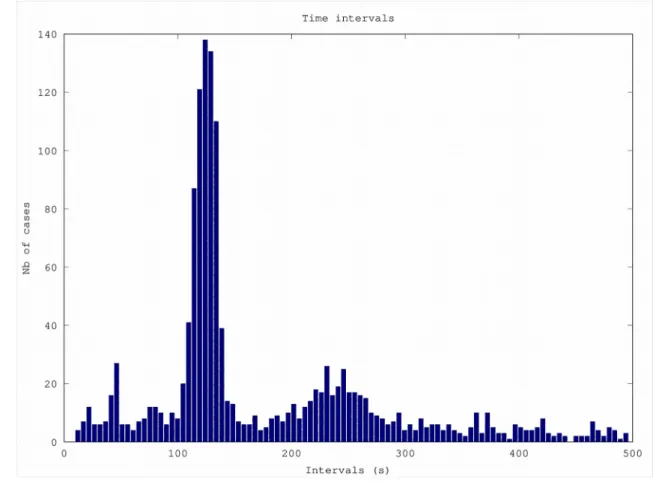
From the Raven Pro selection tables, we calculated the time between SEP2 phrases, i.e.,
the inter-phrase interval (IPI), (Fig. 4). The peaks at 2 and 4 min are characteristic of
SEP2 individual song (Buchan, Rendell, and Hucke-Gaete, 2010) and suggest that
phrases could be produced by single singers rather than multiple overlapping singers.
There is only one instance of song phrase overlap on January 28, 2017, reflected by
shorter IPIs of 50-70s, which might suggest the presence of two singers. This is
consistent with limited opportunistic sighting observations: A single blue whale
125 126 127 128 129 130 131 132 133 134 135 136 137 138 139 140 141 142 143 144 145 146 147 148 149
performing circular dives and fluking, consistent with foraging behavior (Buchan and
Quiñones, 2016), was observed by S. Buchan on February 15-17 and 23, 2017 within
the Chañaral Channel and to the South of Isla Chañaral; and sightings of two blue
whales together on January 16, 2017 (observed by J. Patris, S. Buchan, and F. Malige).
The number of phrases per day reported remains low compared to acoustic studies from
Chilean Patagonia, where over one thousand SEP2 phrases were automatically detected
per day between the months of March and May 2012-2013, which is thought to be the
time of maximum abundance of animals in this region (Hucke-Gaete, Osman, Moreno,
Findlay, and Ljungblad (2003), Buchan et al. (2015), Galletti-Vernazzani, Jackson,
Cabrera, Carlson, and Brownell Jr (2017)). Since there is not yet year-round data off Isla
Chañaral, it is impossible to compare seasonal trends in acoustic presence of Chilean
blue whales at both sites. However, sighting data off Isla Chañaral (Sepulveda et al.,
2017) and in Chilean Patagonia (Hucke-Gaete et al. (2013), Galletti-Vernazzani et al.
(2017)) still suggest much higher abundance in Chilean Patagonia, which is considered
the primary feeding ground for Chilean blue whales.
During visual inspection of the data set, no Antarctic blue whale song type (Ljungblad,
Clark, and Shimada (1998), Matsuoka, Murase, Nishiwaki, Fukuchi, and Shimada
(2000)) has been detected, although it has been recorded in the Chilean Patagonia
(Buchan, Hucke-Gaete, Stafford, and Clark, 2018) and also in low-latitude East Pacific
Ocean (Stafford et al., 2004). No SEP1 blue whale's song type (Cummings and
Thompson, 1971) has been detected in this data set. SEP1 has been recorded in Chilean
Patagonia, off Juan Fernandez Archipelago and in the East Tropical Pacific (Cummings
and Thompson (1971), Truong et al. (2016), Stafford et al. (1999b)) but is the least
150 151 152 153 154 155 156 157 158 159 160 161 162 163 164 165 166 167 168 169 170 171 172 173
common of the two Southeast Pacific song types (Buchan et al. (2015), Saddler et al.
(2017)).
This is the first report of Southeast Pacific blue whale song (or any baleen whale call) in
the coastal waters off Northern Chile and in the Humboldt Current System. Given the
high levels of productivity of this system, and considering that Southeast Pacific blue
whales are known to migrate between wintering grounds near Galapagos and summer
feeding grounds in Chilean Patagonia (Hucke-Gaete et al. (2003 and 2018), Buchan et
al. (2015), Torres-Florez et al. (2015), Buchan and Quinones (2016)), it would make
sense that some animals would take advantage of the available prey in the Humboldt
Current System. In particular, the dense patches of Humboldt Current krill (Euphausia
mucronata) known to be exploited by fin whales off Isla Chañaral (Toro et al., 2016)
would also offer foraging opportunities for blue whales that are on their way to or from
their primary feeding ground in Chilean Patagonia. The presence of southeast Pacific
blue whales off Isla Chañaral is further evidence of the importance of this area for the
conservation of endangered baleen whale populations.
Acknowledgments
The authors thank the research program BRILAM STIC AmSud 17-STIC-01. S.J.B.
acknowledges support from the Centro de Estudios Avanzados en Zonas Aridas
(CEAZA) (CONICYT Programa Regional Grant R16A10003) and the Center for
Oceanographic Research COPAS Sur-Austral (CONICYT PIA Grant AFB170006). J.P
and F.M. thank SABIOD MI CNRS, EADM MaDICS CNRS, and ANR-18-CE40-0014
SMILES for supporting this research. Finally, the authors are very grateful to Cesar
174 175 176 177 178 179 180 181 182 183 184 185 186 187 188 189 190 191 192 193 194 195 196 197
Villarroel and all the divers of Explorasub diving center (Chile), Eutropia NGO (Chile)
and the Agrupación turística Chañaral de Aceituno (Chile).
REFERENCES
Balcazar, N. E., Klinck, H., Nieukirk, S. L., Mellinger, D. K., Klinck, K., Dziak R. P.
and Rogers, T. L. (2017) Using calls as an indicator for Antarctic blue whale occurrence
and distribution across the southwest Pacific and Southeast Indian Oceans. Marine
Mammal Science,33,172–186.
Bioacoustic Research Program. (2012) Raven Pro: Interactive Sound Analysis Software
(version 1.5) [Computer Software]. Ithaca, NY: The Cornell Lab of Ornithology.
Available from: http://www.birds.cornell.edu/raven.
Brown, J. C. (2008). Mathematics of pulsed vocalizations with application to killer
whale biphonation, Journal of the Acoustical Society of America 123(5), 28752883.
Buchan, S.J., Rendell L.E. and Hucke-Gaete R., Preliminary recordings of blue whale
(Balaenoptera musculus) vocalizations in the Gulf of Corcovado, northern Patagonia,
Chile (2010), Marine Mammal Science, 26(2), 451–459
Buchan, S. J., Hucke-Gaete, R., Rendell, L. E. and Stafford, K. M. (2014). A new song
recorded from blue whales in the Corcovado Gulf, Southern Chile, and an acoustic link
to the Eastern Tropical Pacific. Endangered Species Research 23,241–252.
198 199 200 201 202 203 204 205 206 207 208 209 210 211 212 213 214 215 216 217 218 219 220 221
Buchan, S. J., Hucke-Gaete, R., Rendell, L. E. and Stafford, K. M. (2015). Seasonal
occurrence of Southeast Pacific blue whale songs in southern Chile and the eastern
tropical Pacific. Marine Mammal Science 31,440–458. NOTES 227
Buchan, S. J., and Quiñones, R. A. (2016). First insights into the oceanographic
characteristics of a blue whale feeding ground in northern Patagonia, Chile. Marine
Ecology Progress Series 554,183–199.
Buchan, S.J., Stafford, K., Hucke-Gaete, R., Clark, C.W., Balcazar-Cabrera, N.,
Gutierrez, L., Patris, J., Malige, F., Neira, S., Sepulveda, M., Santos-Carvallo, M., and
Olavarría, C. (2017). A review of blue and fin whale acoustically-inferred seasonal
movements in the eastern South Pacific, Poster in the Society for Marine Mammalogy’s
22nd Biennial Conference on the Biology of Marine Mammals.
Buchan, S.J., Hucke-Gaete, R., Stafford, K.M., and Clark, C.W. (2018). Occasional acoustic presence of Antarctic blue whales on a feeding ground in southern Chile.
Marine Mammal Science 34(1),220–228.
Capella, J., Vilina, Y., and Gibbons, J. (1999). Observación de cetáceos en laisla Chañaral y nuevo registros para el área de la reserva nacional Pinguino de Humboldt, norte de Chile, observación of cetaceans at Isla Chañaral and new records at the Humboldt Penguin national reserve, northern Chile. Estudios Oceanologicos 18,
57-64. 222 223 224 225 226 227 228 229 230 231 232 233 234 235 236 237 238 239 240 241 242 243 244 245
Cerchio, S., Jacobsen, J.K., and Norris, T.F. (2001). Temporal and geographical
variation in songs of humpback whales, Megaptera novaeangliae : synchronous change
in Hawaiian and Mexican breeding assemblages. Animal behaviour, 62, 313–329
Cummings, W.C., and Thompson, P.O. (1971). Underwater sounds from the blue whale,
Balaenoptera musculus. Journal of the Acoustical Society of America 50,1193–1198.
Eaton, J.W., Bateman, D., and Hauberg, S. (2009). GNU Octave version 3.0.1 manual:
a high-level interactive language for numerical computations (CreateSpace Independent
Publishing Platform, 2009). Available from
http://www.gnu.org/software/octave/doc/interpreter, 11ISBN 1441413006.
Galletti-Vernazzani, B., Carlson, C.A., Cabrera, E. and Brownell Jr, R.L. (2012).
Chilean blue whales off Isla Grande de Chiloe, 2004-2010: distribution, site-fidelity and
behavior. Journal of Cetacean Research and Management 12, 353–360.
Galletti-Vernazzani, B., Jackson, J.A., Cabrera, E., Carlson, C.A. and Brownell Jr, R.L.
(2017). Estimates of abundance and trend of Chilean blue whales off Isla de Chiloé,
Chile. PLOS ONE 12(1), e0168646.
Gavrilov, A. N., McCauley, R.D. and Gedamke, J. (2012). Steady inter and intra-annual
decrease in the vocalization frequency of Antarctic blue whales. Journal of the
Acoustical Society of America 131, 4476–4480.
246 247 248 249 250 251 252 253 254 255 256 257 258 259 260 261 262 263 264 265 266 267 268 269
Hucke-Gaete, R., Osman, L.P, Moreno, C.A., Findlay K.P. and Ljungblad, D.K. (2003).
Discovery of a blue whale feeding and nursing ground in southern Chile. Proceedings
of the Royal Society London B (Supplement) 271, S170–S174.
Hucke-Gaete, R. (2004). Distribución, preferencia de hábitat y dinámica espacial de la
ballena azul en Chile: 1997-2004 [Distribution, habitat preference and spatial dynamics
of the blue whale in Chile: 1997–2004]. Ph.D. thesis, Universidad Austral de Chile,
Valdivia, Chile.
Hucke-Gaete, R., Haro, D., Torres-Florez, J., Montecinos, Y., Viddi, F.,
Bedriñana-Romano, L., Nery, M. and Ruiz, J. (2013). A historical feeding ground for humpback
whales in the eastern South Pacific revisited: The case of Northern Patagonia, Chile.
Aquatic Conservation Marine and Freshwater Ecosystems. 23. 10.1002/aqc.2343.
Hucke-Gaete, R., Bedriñana-Romano, L., Viddi, F.A., Ruiz, J.E., Torres-Florez, J.P. and
Zerbini, A.N. (2018). From Chilean Patagonia to Galapagos, Ecuador : novel insights on
blue whale migratory pathways along the Eastern South Pacific. PeerJ 6, e4695,
Ljungblad, D. K., Clark, C.W. and Shimada, H. (1998). A comparison of sounds
attributed to pygmy blue whales (Balaenoptera musculus brevicauda) recorded south of
the Madagascar Plateau and those attributed to ‘true’ blue whales (Balaenoptera
musculus) recorded off Antarctica. Report of the International Whaling Commission 48,
439–442. 270 271 272 273 274 275 276 277 278 279 280 281 282 283 284 285 286 287 288 289 290 291 292 293
Matsuoka, K., Murase, H., Nishiwaki, S., Fukuchi, T. and Shimada, H. 2000.
Development of a retrievable sonobuoy system for whale sounds recording in polar
region. Paper SC/52/O7 presented to the IWC Scientific Committee, (2000), in Adelaide,
Australia (unpublished).
McDonald, M. A., Mesnick, S.L. and Hildebrand, J.A. (2006). Biogeographic
characterisation of blue whale song worldwide: Using song to identify populations.
Journal of Cetacean Research Management 8, 55–56.
McDonald, M. A., Hildebrand, J.A. and Mesnick, S. (2009). Worldwide decline in tonal
frequencies of blue whale songs. Endangered Species Research 9, 13–21.
Mellinger, D.K., Stafford K.M., Moore S.E., Dziak R.P. and Matsumoto H. (2007) An
overview of fixed passive acoustic observation methods for cetaceans. Oceanography.
20(4), 36–45.
Mullen, K.A., Peterson,M.L., and Todd, S.K. (2013) Has Designating and Protecting
Critical Habitat Had an Impact on Endangered North Atlantic Right Whale Ship Strike
Mortality? Marine Policy 42, 293–304.
Oleson, E. M., Calambokidis, J., Burgess, W.C., McDonald, M.A., LeDuc, C.A. and
Hildebrand, J.A. (2007a). Behavioural context of call production by eastern North
Pacific blue whales. Marine Ecology Progress Series 330, 269–284.
294 295 296 297 298 299 300 301 302 303 304 305 306 307 308 309 310 311 312 313 314 315 316 317
Oleson, E. M., Wiggins, S.M. and Hildebrand, J.A. (2007b). Temporal separation of
blue whale call types on a southern California feeding ground. Animal Behaviour 74,
881–894.
Piñones, A. and Fedorov, A.V. (2016). Projected changes of Antarctic krill habitat by the
end of the 21st century. Geophysical Research Letters 43, 8580–8589.228
Patris, J., Malige, F., and Glotin, H. (2017). Construction et mise en place d’un système
fixe d’enregistrement à large bande pour les cétacés “bombyx 2” isla de chañaral, été
austral 2017. Technical Report 2017-03, LSIS CNRS.
Patris, J. (2019). Contribution en méthodes pour le suivi de mysticètes par acoustique
passive, PhD thesis, Université de Toulon, France. Avaiblable from
http://www.theses.fr/2019TOUL0016
Patris, J., Malige, F., Glotin, H., Asch, M. and Buchan, S. (2019). A standardized
method of classifying pulsed sounds and its application to pulse rate measurement of
blue whale southeast Pacific song units. The Journal of the Acoustical Society of
America. 146, 2145-2154.
Perez-Alvarez, M., Thomas, F., Uribe, F., Sepúlveda, M., Flores, M. and Moraga, R.
(2006). Fin Whales (Balaenoptera physalus) Feeding on Euphausia mucronata in
Nearshore Waters off North-Central Chile. Aquatic Mammals. 32, 109-113.
318 319 320 321 322 323 324 325 326 327 328 329 330 331 332 333 334 335 336 337 338 339 340 341
Pompa, S., Ehrlich, P.R., and Ceballos G. (2011). Global Distribution and Conservation
of Marine Mammals. Proceedings of the National Academy of Sciences of the United
States of America 108 (33), 13, 600–605.
Redfern, J.V., McKenna, M.F., Moore, T.J., Calambokidis, J., Deangelis, M.L., Becker,
E.A., Barlow, J., Forney, K.A., Fiedler, P.C., and Chivers, S.J. (2013a) Assessing the
Risk of Ships Striking Large Whales in Marine Spatial Planning. Conservation Biology
27 (2), 292–302.
Redfern, J.V., Hatch, L.T., Caldow, C., DeAngelis, M.L., Gedamke, J., Hastings, S.,
Henderson, L., McKenna, M.F., Moore, T.J., and Porter, M.B. (2013b). Assessing the
risk of chronic shipping noise to baleen whales off Southern California, USA.
Endangered Species Research. 32, 53–167.
Saddler, M.R., Bocconcelli, A., Hickmott, L.S., Chiang, G., Landea-Briones, R.,
Bahamonde, P.A., Howes, G., Segre, P.S. and Sayigh, L.S. (2017) Characterizing
Chilean blue whale vocalizations with DTAGs: a test of using tag accelerometers for
caller identification, Journal of Experimental Biology (220), 4119-4129
Samaran, F., Stafford, K.M., Branch, T.A., Gedamke, J., Royer, J.R., Dziak, R.P. and
Guinet, C. (2013). Seasonal and geographic variation of the southern blue whale
subspecies in the Indian Ocean. PlOS ONE 8(8), 1–10.
342 343 344 345 346 347 348 349 350 351 352 353 354 355 356 357 358 359 360 361 362 363 364
Sepúlveda, M., Santos, M. and Pavez, G. (2017). Whale-watching en la Reserva Marina
Isla Chañaral: Manejo y planificación para una actividad sustentable. Primera Edición
2017, ISBN: 978-956-368-225-0
Sepúlveda, M., Pérez‐Álvarez, M.J., and Santos‐Carvallo, M. (2018) From whaling to
whale watching: Identifying fin whale critical foraging habitats off the Chilean coast.
Aquatic Conservation Marine and Freshwater Ecosystems 018, 1–9.
Širović, A., Hildebrand, J. A., Wiggins, S.M. and Thiele, D. (2009). Blue and fin whale
acoustic presence around Antarctica during 2003 and 2004. Marine Mammal Science
25, 125–136.
Stafford, K. M., Nieukirk, S.L. and Fox, C.G. (1999a). An acoustic link between blue
whales in the eastern tropical Pacific and the northeast Pacific. Marine Mammal
Science 15, 1258–1268.
Stafford, K. M., Nieukirk, S.L. and Fox, C.G. (1999b). Low-frequency whale sounds
recorded on hydrophones moored in the eastern tropical Pacific. Journal of the
Acoustical Society of America 106, 3687–3698.
Stafford, K. M., Nieukirk, S.L. and Fox, C.G. (2001). Geographical and seasonal
variation of blue whale calls of the North Pacific. Journal of Cetacean Research
Management 3, 65–76. 365 366 367 368 369 370 371 372 373 374 375 376 377 378 379 380 381 382 383 384 385 386 387 388
Stafford, K. M., Bohnenstiehl, D. , Tolstoy, M., Chapp, E.,Mellinger, D. and Moore, S.
(2004). Antarctic-type blue whale calls recorded at low latitudes in the Indian and
eastern Pacific Oceans. Deep Sea Research Part I: Oceanographic Research Papers.
51. 1337-1346. 10.1016/j.dsr.2004.05.007.
Stafford, K. M., Chapp, E., Bohnenstiel, D.R and Tolstoy M.. (2011). Seasonal detection
of three types of “pygmy” blue whale calls in the Indian Ocean. Marine Mammal
Science 27, 828–840.
Thiel, M., Macaya, E., Acuna, E., Arntz, W., Bastias, H., Brokordt, K., Camus, P.,
Carlos Castilla, J., Castro, L., Cortes, M., Dumont, C., Escribano, R., Fernandez, M.,
Gajardo, J.A., Gaymer, C., Gomez, I., Gonzalez, A.E., González, H.E, Haye, P. and
Vega, A. (2007). The Humboldt Current System of Northern and Central Chile.
Oceanography and marine biology. 45, 195-345
Toro, F., Vilina, Y.A., Capella, J. and Gibbons, J. (2016) Novel Coastal Feeding Area
for Eastern South Pacific Fin Whales (Balaenoptera physalus) in Mid-Latitude
Humboldt Current Waters off Chile, Aquatic Mammals 42(1), 47-55.
Torres-Florez, J.P., Hucke Gaete, R., and LeDuc, R. (2014). Blue whale population
structure along the eastern South Pacific Ocean: Evidence of more than one population.
Molecular Ecology 23(24), 5998–6010. 389 390 391 392 393 394 395 396 397 398 399 400 401 402 403 404 405 406 407 408 409 410
Torres-Florez, J.P., Olson, P.A., Bedriñana-Romano, L., Rosenbaum, H.C.R., Ruiz, J.,
LeDuc, R. and Hucke Gaete, R. (2015) First documented migratory destination for
eastern South Pacific blue whale. Marine Mammal Science, 31(4), 1580–1586
Truong, G., Širović, A., Tripovich, J., and Rogers, T. (2016). Seasonal patterns in
Chilean blue whale call detections between 2003 and 2015. SC/66b/SH/25,
International Whaling Commission.
Van Parijs, S.M., Clark, C.W., Sousa-Lima, R.S., Parks, S.E., Rankin, S., Risch, D.,and
Van Opzeeland, I.C. (2009). Management and research applications of real-time and
archival passive acoustic sensorsover varying temporal and spatial scales. Marine
Ecology Progress Series 395, 21–36.
411 412 413 414 415 416 417 418 419 420 421 422 423 424 425 426 427 428 429 430 431 432 433 434 435
Figure captions and captions
Figure 1. Map of the deployment zone of the BOMBYX II device (left). The green zone
around the Island is a marine protected area (Reserva Marina Isla Chañaral). General
location in South America (right).
436 437 438 439 440 441 442 443 444 445 446 447 448 449 450 451 452 453 454 455
Figure 2. Time frequency representation of a SEP2 song recorded off Isla Chañaral, on
February 2, 2017 (Fast Fourier transform, Blackman window of 65,536 points,
overlapping 75%) using Octave software (Eaton, Bateman, and Hauberg, 2009). The
line at 213 Hz is a constant electronic noise coming from the coupling between the
hydrophone and the recording device. Units A, B, C, D are clearly visible as well as
precursors and downsweeps belonging to the song.
456 457 458 459 460 461 462 463 464 465 466 467 468 469
Figure 3. Number of SEP2 phrases counted in the first season of recording off Isla
Chañaral. The device was off duty during January 30 and 31 (asterisks) and the
February 13 and 14. 470 471 472 473 474 475 476 477 478 479 480 481 482
Figure 4. Histogram of the inter-phrase intervals (IPIs) between two occurrences of
SEP2 phrases, from the Raven Pro selection table.
483 484 485 486 487 488 489 490 491
i During the analysis, other vocalizations were found: blue whale “D-calls”, fin whale
(Balaenoptera physalus) vocalizations, bottlenose dolphins' (Tursiops truncatus) echolocation clicks, whistles and low-frequency vocalizations, and dusky dolphin (Lagenorhynchus obscurus) burst of pulses (see Patris, 2019). This dataset can be obtained asking the authors.
1 2 3 4