HAL Id: tel-02911978
https://tel.archives-ouvertes.fr/tel-02911978
Submitted on 4 Aug 2020HAL is a multi-disciplinary open access archive for the deposit and dissemination of sci-entific research documents, whether they are pub-lished or not. The documents may come from teaching and research institutions in France or abroad, or from public or private research centers.
L’archive ouverte pluridisciplinaire HAL, est destinée au dépôt et à la diffusion de documents scientifiques de niveau recherche, publiés ou non, émanant des établissements d’enseignement et de recherche français ou étrangers, des laboratoires publics ou privés.
Documents Reengineering
Madjid Sadallah
To cite this version:
Madjid Sadallah. Models and Tools for Usage-based e-Learning Documents Reengineering. Tech-nology for Human Learning. Université Abderrahmane Mira de Béjaïa (Algérie), 2019. English. �tel-02911978�
République Algérienne Démocratique et Populaire
Ministère de l’Enseignement Supérieur et de la Recherche Scientifique Université A.MIRA-BEJAIA
Faculté des Sciences Exactes Département d’Informatique
THÈSE
Présentée par
Madjid Sadallah
Pour l’obtention du grade de
DOCTEUR EN SCIENCES
Filière : Informatique
Option : Cloud Computing
Thème
Models and Tools for Usage-based e-Learning Documents
Reengineering
Soutenue le : 25/04/2019 Devant le Jury composé de :
Nom et Prénom Grade
Mr Abelkamal TARI Professeur Univ. de Béjaia Président
Mr Yannick PRIÉ Professeur Univ. de Nantes Rapporteur
Mr Nadjib BADACHE Directeur de Recherche CERIST Examinateur
Mr Abdelouaheb ALOUI MCA Univ. de Béjaia Examinateur
Mr Azze-Eddine MAREDJ Maitre de Recherche A CERIST Examinateur
Mr Benoît ENCELLE MCF Univ. de Lyon1 Invité
Année Universitaire
: 2018/2019To my precious wife Saliha, for her affection, devotion and patience To our wonderful kids Ilyas, Malek and Maya for their loving little hearts To my whole family!
Completion of this doctoral dissertation was possible with the support of several people. I would like to express my sincere gratitude to all of them.
First and foremost, I would like to express my sincerest appreciation to Prof. Yan-nick Prié, who gave me the great opportunity to do my Ph.D. under his supervision. I am profoundly grateful for his thoughtful guidance, expert advice, supportive patience, and faithful encouragement, all along the journey. His intellectual rigor and integral view on research has made a deep impression on me and was my major source of inspiration.
I was fortunate to receive the unconditional, sustained and precious academic and personal support of Dr. Benoît Encelle. His persistence and insight are reflected in every part of this work. I would like to express the deepest appreciation to him for the attention, the commitment, and the continuous support with all the useful discussions and brainstorming sessions.
I would like also to render my warmest thanks to Dr. Azze-Eddine Maredj, my mentor and first line responsible at CERIST. His advice on research, my career and many other aspects of my life have been priceless. My heartfelt appreciation goes to him for the great gifts of time, compassion and support.
It gives me an immense debt of gratitude to express my sincere thanks and profound gratitude to Prof. Nadjib Badache, director of the CERIST Research Center, without whom I would probably never have done a Ph.D. at all.
I am really grateful to Prof. Abdelkamel Tari for having agreed to chair the jury and review this thesis work. In addition, it is an honor to have Prof. Nadjib Badache, Dr. abdelouaheb Aloui, and Dr. Azze-Eddine Maredj as examining committee in my thesis defense.
I would like to thank the OpenClassrooms staff members, especially Matthieu Nebra and Romain Kuzniak, for their cooperation and constructive exchanges. I acknowledge with gratitude their scientific and technological support, which allowed me to refine, test and validate several theoretical and practical aspects of this work. I have the chance to work in an exceptional environment at CERIST. I want to thank all of my friends and colleagues. Besides this, I would like to extend my gratitude to everyone who knowingly or unknowingly, directly or indirectly helped me in the successful completion of this work.
I owe my deepest gratitude to my parents and my family for their support, trust, and endless love. Nothing could have made sense without having my wonderful wife and our kids at my side. Thank you for being here for me, against all odds.
I thank the Almighty for giving me the strength and wisdom to keep going, even in moments of extreme doubt and confusion.
List of figures viii
List of tables x
1 Introduction 1
1.1 Background . . . 1
1.2 Rationale and problem statement . . . 1
1.3 Research goal, questions and objectives . . . 2
1.3.1 Research goal . . . 2
1.3.2 Research questions, objectives and methodology . . . 3
1.4 Research contributions . . . 4
1.5 Thesis outline . . . 6
I
Background & Related Research
8
2 Engineering and reengineering educational digital documents 9 2.1 Learning in the digital age . . . 92.1.1 Learning . . . 9
2.1.2 Learning in the digital age . . . 11
2.1.3 Educational technologies . . . 12
2.1.4 Learning management systems . . . 13
2.2 Digital document and their usages in e-learning . . . 14
2.2.1 “Document” as a concept . . . 14
2.2.2 Digital documents . . . 14
2.2.3 Document structures . . . 17
2.2.4 Digital documents in education . . . 18
2.3 Comprehension in reading for learning . . . 21
2.3.1 Comprehension as a measure of reading outcome . . . 21
2.3.2 Digital reading and comprehension . . . 21
2.3.3 Factors of comprehension . . . 23
2.3.4 Document readability assessment . . . 24
2.4 Document revision . . . 28
2.4.1 Revision in the writing process . . . 28
2.4.2 The revision process . . . 29
2.4.3 Taxonomy of revision . . . 30
2.4.4 Issues in document revision . . . 32
3 Usage analytics and knowledge discovery in educational documents 34
3.1 Tracing reading usages in e-learning . . . 34
3.1.1 Monitoring learning . . . 34
3.1.2 Monitoring approaches . . . 35
3.1.3 Computer-mediated activity traces . . . 36
3.1.4 Trace-based interaction indicators . . . 37
3.2 Analysis of learning traces . . . 39
3.2.1 Knowledge discovery in digital data . . . 39
3.2.2 Educational data mining (EDM) and Learning analytics (LA) . 40 3.2.3 Learning analytics lifecycle . . . 42
3.2.4 Methods, processes, and tools in EDM/LA . . . 44
3.3 Learning analytics dashboards . . . 49
3.3.1 Information visualization and visual analytics . . . 49
3.3.2 Educational dashboards . . . 50
3.3.3 Types of dashboards . . . 52
3.3.4 Data used by learning dashboards . . . 54
3.3.5 Evaluating learning dashboards . . . 54
3.3.6 Limitation of the existing dashboards . . . 55
3.4 Summary . . . 57
4 Summary and discussion of the related research 58 4.1 Importance of course quality for comprehension . . . 58
4.2 Course revision . . . 59
4.3 Monitoring digital reading in e-learning . . . 60
4.4 Towards assistive dashboards . . . 61
4.5 Summary . . . 61
II
Contributions
63
5 Usage-based document reengineering for sustaining reading and com-prehension 64 5.1 Educational document reengineering . . . 655.1.1 Document reengineering . . . 65
5.1.2 A conceptual framework for usage-based document reengineering 66 5.1.3 Document model . . . 68
5.2 Taxonomy of document reengineering actions . . . 69
5.2.1 Modeling reengineering . . . 69
5.2.2 Types of reengineering primitives . . . 70
5.3 Reading issues and reengineering actions related to document structures 72 5.3.1 Comprehension at the surface structure . . . 72
5.3.2 Comprehension at the conceptual structure . . . 75
5.4 Summary . . . 81
6 Usage-based Course Reading Analytics 82 6.1 Reading analytics approach for course revision . . . 82
6.1.2 Course reengineering approach based on reading analytics . . 83
6.2 Modeling learners’ reading activity . . . 84
6.2.1 Rationale . . . 84
6.2.2 Reading sessions . . . 84
6.2.3 Constructing learners’ sessions of reading . . . 84
6.2.4 A dynamic and local session identification method . . . 88
6.3 Reading session-based indicators . . . 91
6.3.1 Stickiness and interest . . . 91
6.3.2 Rereading . . . 93
6.3.3 Navigation . . . 94
6.3.4 Reading stop & resume . . . 96
6.4 Indicator-based reading issue detection and revision suggestion . . . . 98
6.4.1 Rationale . . . 98
6.4.2 Issue detection method . . . 98
6.4.3 Issues and revision suggestions related to stickiness . . . 99
6.4.4 Issues and revision suggestions related to rereading . . . 102
6.4.5 Issues and revision suggestions related to navigation . . . 104
6.4.6 Issues and revision suggestions related to stops & resumes . . 107
6.5 Summary . . . 109
7 CoReaDa: The COurse READing DAshboard 110 7.1 Rational and design methodology . . . 110
7.1.1 Conception methodology . . . 110
7.1.2 Functional features . . . 111
7.1.3 Design methodology . . . 111
7.2 System architecture and technological choices . . . 113
7.2.1 Architecture overview . . . 113
7.2.2 The development stack . . . 114
7.3 CoReaDa Analytics (server-side) . . . 115
7.3.1 Application manager . . . 115
7.3.2 Analytics engine . . . 117
7.3.3 Data models . . . 118
7.4 CoReaDa User Interface (front-end) . . . 121
7.4.1 Course analysis layout . . . 122
7.4.2 Help and assistance . . . 125
7.4.3 System administration . . . 125
7.5 Summary . . . 127
8 Evaluation and validation of the proposals 128 8.1 Evaluation objectives and settings . . . 128
8.1.1 Study context . . . 128
8.1.2 Objectives . . . 129
8.1.3 Participants and data used . . . 129
8.2 Study 1 – capabilities of the session identification approach . . . 130
8.2.1 Methodology . . . 130
8.2.2 Results . . . 131
8.3.1 Protocol . . . 134
8.3.2 Results . . . 134
8.4 Study 3 – capabilities of the issue detection and resolution mechanisms138 8.4.1 Protocol . . . 138
8.4.2 Results . . . 139
8.5 Study 4 – conformance of the detected issues with learners’ problems 140 8.5.1 Description . . . 140
8.5.2 Results . . . 142
8.6 Study 5 – evaluation of the dashboard . . . 143
8.6.1 Protocol . . . 143
8.6.2 Results . . . 145
8.7 Discussion . . . 147
9 General conclusion 151 9.1 Summary of the contributions . . . 151
9.2 Outlook & final reflections . . . 156
References 158
Appendix A Description of the technological stack 179
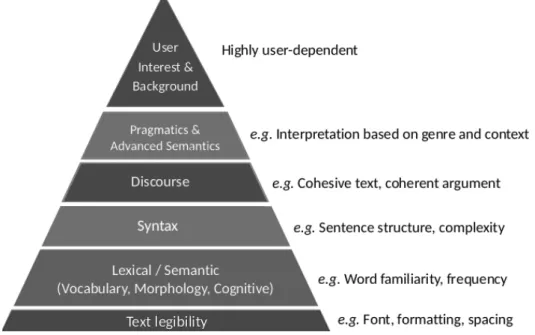
2.1 Key aspects of text readability, ordered from lowest level (text legibility)
to highest level (user interest and background) (Collins-Thompson, 2014) 27
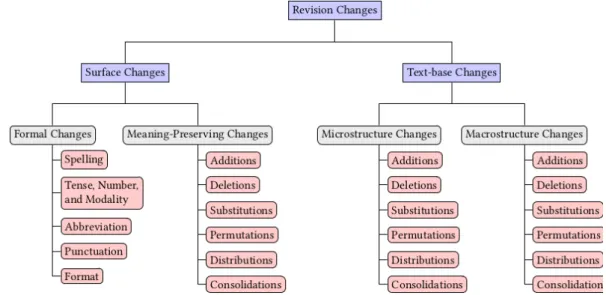
2.2 Taxonomy of revision changes (Faigley and Witte, 1981) . . . 31
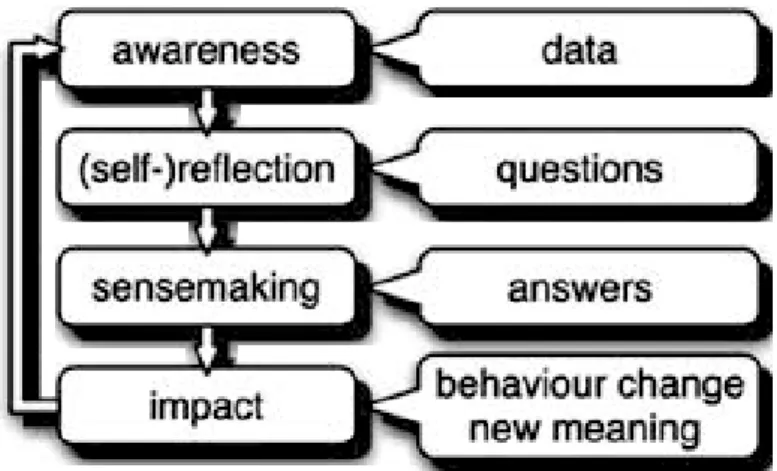
3.1 Monitoring, awareness and reflection (Rodríguez-Triana et al., 2017) . 34 3.2 The learning analytics cycle (Laurillard, 2002) . . . 43
3.3 Learning analytics process model (Verbert et al., 2013) . . . 43
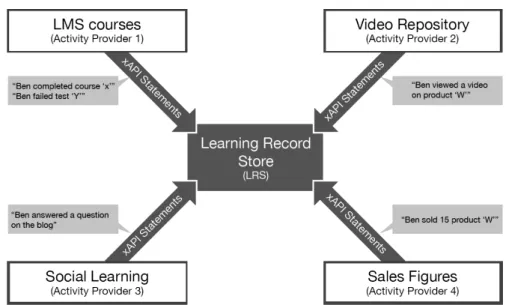
3.4 Basic principles of xapi . . . 45
3.5 Visual analytics and the related research areas . . . 49
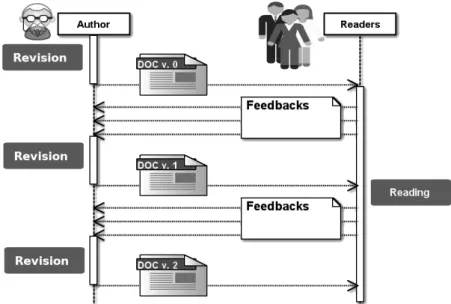
5.1 Document reengineering based on readers’ feedback . . . 65
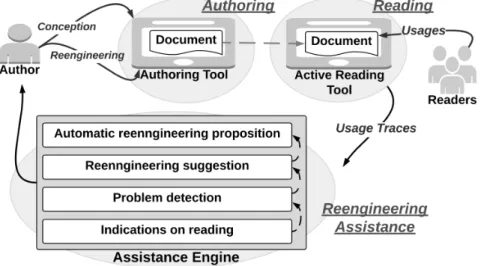
5.2 Overview of the usage-based reengineering framework . . . 66
5.3 Document structures . . . 68
5.4 Bloom’s taxonomy and the associated action verbs (Anderson et al., 2001) . . . 71
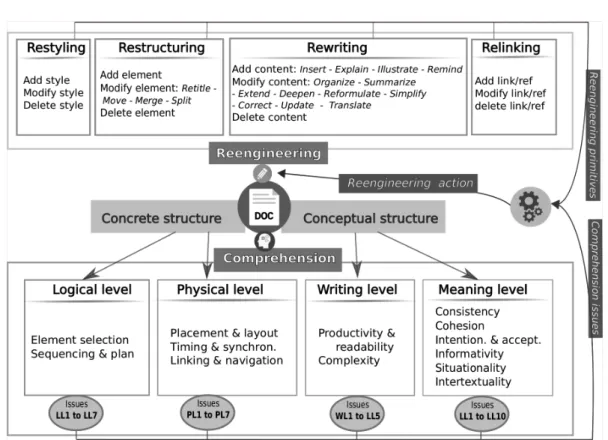
5.5 Summary of document reengineering based on comprehension issues related to document structures . . . 81
6.1 Author assistance approach . . . 83
6.2 Reading-sessions definition . . . 86
6.3 Constructing sessions using time-based heuristics . . . 87
6.4 Steps for computing reading sessions from learners’ log data . . . 89
6.5 Reading sessions data of a learner on a course . . . 91
6.6 Transitions to and from a chapter of a course . . . 94
7.1 The different prototypes of the dashboard . . . 112
7.2 Common MVC architecture communication . . . 113
7.3 Architecture of CoReaDa . . . 114
7.4 Overview of the used technological stack . . . 114
7.5 An excerpt of a json file providing the structure of a course . . . 116
7.6 An excerpt of a csv file describing the logged actions on a course . . . 117
7.7 Overview of the class diagram . . . 118
7.8 The Welcome screen of CoReaDa . . . 121
7.9 Screenshot of a CoReaDa instance . . . 122
7.10 CoReaDa heatmap within the data grid area . . . 122
7.11 The Stats tab of the Inspector . . . 123
7.12 The Issues tab of the Inspector . . . 123
7.13 The Tasks area of CoReaDa . . . 124
7.15 Managing the existing courses within CoReaDa . . . 125
7.16 Managing CoReaDa data sources . . . 126
7.17 Adding an new data source to CoReaDa . . . 126
8.1 Session size found by the power law distribution on the 12 courses . . 132
8.2 Course chapters reading duration statistics . . . 133
8.3 Authors’ rating of the indicators, aggregated by classes . . . 136
8.4 The relevance of the reading indicators, rated by 125 authors . . . 137
8.5 Distribution of the knowledge expected and the knowledge provided 139
8.6 Relevance of the suggestions . . . 140
8.7 Learners’ rating of the effectiveness of the issues (1 = very low, 5 =
1.1 Research questions, objectives and contributions in each chapter . . . 4
2.1 Comparison between the different types of learning contexts . . . 10
3.1 Key distinctions between EDM and LA . . . 41
5.1 Taxonomy of reengineering primitives . . . 70
5.2 Issues and reengineering primitives associated to the logical level . . . 73
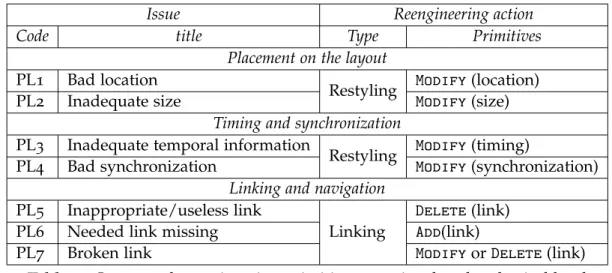
5.3 Issues and reengineering primitives associated to the physical level . . 74
5.4 Issues and reengineering primitives associated to the writing level . . 76
5.5 Issues and reengineering primitives associated to the meaning level . 78 6.1 Reading indicators computation and issue detection . . . 100
7.1 Course model . . . 118
7.2 Course element model . . . 119
7.3 Reading Session model . . . 119
7.4 Action model . . . 119
7.5 Indicator model . . . 120
7.6 Issue model . . . 120
7.7 Suggestion model . . . 120
7.8 Task model . . . 121
8.1 Basic statistics about the selected courses . . . 130
8.2 Constructed sessions using three methods : our proposal, fixed page threshold (10-min) and fixed session threshold (30-min). . . 132
8.3 Demographic description of the participating authors . . . 135
8.4 Statistics about authors’ ratings . . . 135
8.5 Issue detection using indicator value . . . 141
8.6 Main reading issues detected on four courses . . . 141
8.7 Statistics about learners’ rating of the effectiveness of the issues, and t-test results based on gender difference . . . 142
8.8 Inter-correlations (Spearman) among learners’ ratings of the detected issues . . . 143
8.9 Authors’ tasks . . . 144
8.10 TAM questionnaire items . . . 145
8.11 Performance metrics computed from the tasks results . . . 146
8.12 Results of the TAM questionnaire . . . 147
1
Introduction
1.1
Background
We are living a sustainable technological revolution, whose waves are reshaping different aspects of our lives. Digitization and online publishing have probably made the greatest difference to the production and dissemination of knowledge than any other technological innovation since the invention of the press. Digital documents are omnipresent in modern life, turning digital reading as a mainstream phenomenon. Current trends in the literature reveal that readers, particularly digital natives, are more inclined to read in digital format (Singer and Alexander, 2017). This is possibly due to the high availability of digital documents and to their innovative features such as the integration of rich contents (graphics, images, speech, videos, etc.) in an interactive way (possibility of interaction and non-linear navigation). These specific features of digital reading can also affect reading performance, as they require more attention from the reader and demand a higher cognitive load (Jeong, 2012).
Education is one of the areas most impacted by technological change: learning approaches and settings are rapidly evolving towards high integration of information technologies, making them increasingly present in the classroom and beyond. This has prompted the widespread adoption of distance or blended learning, the emer-gence of online educational portals and an increase in the number of registrations for online courses. As a result, more and more educational resources are being put online by thousands of course authors and consulted by millions of learners every day, both for quick reference and for in-depth and focused study.
1.2
Rationale and problem statement
A primary concern of the creators of contents, be it paper or digital, is to best convey knowledge by sustaining document reading, understanding and appropriation. However, designing documents that are received the way the author wishes has always been difficult, partly because of the intrinsic difficulty of structuring ideas and writing, partly because the readership and its reactions are not known at the time of writing. In general, authors “know comparatively little about the abilities, purposes, opinions, prior knowledge and circumstances of their readers”(Waller, 1979). The digital world increases this difficulty by multiplying the possibilities related to mixed media and interactivity, hence increasing the complexity of documents with the use of
multimedia, more and more interactivity, etc. While such documents promote innovative uses, their usages are neither totally known nor easily predictable.
Today, an important part of learning is done online, becoming distant and increasingly self-directed. The intrinsically sensitive nature of the world of education adds another level of complexity to the challenge of creating digital contents tailored to the needs of learners. This is particularly pronounced and is most noticeable in the context of informal learning where the educational environments allow a great diversity of profiles (ages, origins, needs) and very distinctive learners’ behaviors (in terms of usages, time, preferences, etc.). Because of this diversity, learners are expected to take primary responsibility for their learning process. However, many studies have shown that a significant proportion of learners still need support and guidance, and that otherwise, they may be disoriented, frustrated or confused (Hara,
2000). Therefore, course authors and instructors need to be the leaders and helpers
of learners, and their role should also encompass that of a facilitator who mentors learners throughout the course and delivers meaningful, learner-focused experiences (García-Solórzano et al., 2012). One way for authors to achieve this is to ensure that learners can understand the content provided, ensuring that it is continuously tailored to best meet the expectations and needs of these learners.
Reading a document implies processing and analyzing its content in the perspec-tive of comprehension (Oh, 2013). Previous research has shown that “course quality” is a crucial factor that shapes readers’ level of comprehension (Dascalu et al., 2014; McNamara and Magliano, 2009). This compels course authors to continually review their contents to continuously address quality improvements that support learners’ understanding. They are, however, challenged to identify which obstacles learn-ers encounter during their reading, and to design the necessary corrective actions accordingly. As a result, many authors not only review their courses infrequently and superficially, but do so very little, unless they receive effective support, such as informative feedback on learners’ reading experiences, comprehension difficulties and possible remedial solutions (Patchan and Schunn, 2015).
1.3
Research goal, questions and objectives
1.3.1
Research goal
The educational settings are cyclic, each arrival of new learners gives time to authors to improve their learning material: the documents of their courses evolve and hopefully get better (e.g. more precise, more comprehensible, more adapted to their students need, etc.). With logging capabilities afforded by the learning platforms, interaction traces (or logs) are automatically captured and made available for analysis. This enables course authors to consider learners’ traces as a valuable source of knowledge that provides them hints and guidance on how to evolve their courses.
Using data to act, solve a problem or facilitate decision-making is not new in education. However, in recent years, a significant increase in the amount of data available has transformed the way in which it is collected and used. This is largely due to the “big data” generated by learning platforms, as well as the emergence of advanced computing facilities with high capacities to analyze and transform data
into knowledge. The correct capture, analysis, and communication of learner data would open infinite perspectives for optimizing learning outcomes and performance. In this context, the analysis of learning based upon educational data to extract useful knowledge emerged as an area of research, known as learning analytics, with the aim to understand and optimize learning (Siemens and Gasevic, 2012). According to Gunn (2014), one of the most important research question for learning analytics at present is: how can available raw data be converted into actionable knowledge for teachers and learning designers who are not technical experts?
The main hypothesis of this research is that the application of learning analytics methods to learners’ traces of course reading could reveal the learners’ difficulties in understanding from their behaviors, and thus how to make these courses evolve in order to meet their requirements and needs. As content creators, course authors are in the best position to update their documents and we strongly believe that they should be supported during the analysis and revision phases. When presented timely and appropriately, the discovered knowledge can be used by authors to make sound decisions in improving the quality of the courses according to learners’ needs. Consequently, our main research goal can be formulated as follows:
Research aim
To investigate the use of reading analysis on learners’ traces in order to identify their comprehension issues and to assist authors in improving their contents accordingly.
1.3.2
Research questions, objectives and methodology
In relation to the research goal, this thesis addresses a set of research questions (RQ); for each research question, research objectives (RO) are mentioned.
RQ1: “What is the general conceptual framework for supporting authors to improve their courses and solve learners’ understanding issues?”. To answer this question, we provide a usage-based reengineering framework. The objective that relates to answering this question is:
RO1.1: To define a methodology for analyzing reading usages in order to identify understanding problems and support authors in solving those problems.
RQ2: “What are those understanding issues?”. To answer this question, we build on background related to document engineering, digital reading and comprehen-sion, and document revision. The related objectives are:
RO2.1: Identify the most important document properties that contribute to the level of ease of understanding afforded by these documents.
RO2.2: To identify the reading issues that may arise from these properties. RQ3: “According to those understanding issues, what remediation can be proposed to
authors?”. To answer this question, we consider the use of computational and analytical tools derived from the fields of educational data mining and learning analysis. The objectives that relate to answering this question are:
RO3.1: To design appropriate suggestions for solving these understanding issues.
RQ4 : ”How is it possible to detect those issues and associate suitable remediation actions?” The answer to this question requires the study of methods of analyzing learning traces. The objectives that relate to answering this question are:
RO4.1: To elaborate a reading analytics approach for reengineering courses based on learners’ usages.
RO4.2: To conceive a reading activity model allowing the analysis of learners’ traces.
RO4.3: To build an informed synthesis of reading activities using indicators. RO4.4: To build a strategy based on these indicators to detect the reading
issues and to suggest remediation actions.
RQ5 : “What kind of systems and tools can effectively support authors for course improve-ment?” This question is answered on the basis of research in learning analytics and the use of visualization for presenting the results of the analysis. The objectives that relate to answering this question are:
RO5.1: To identify functional and design requirements for implementing assis-tive systems that present the information timely and appropriately. RO5.2: To implement these requirements through a functional prototype for
course reading analysis, comprehension issues detection and remediation actions taking.
RO5.3: To validate the support methods and tools, and to evaluate a func-tional prototype for analyzing course readings, detecting comprehension problems and taking corrective action.
1.4
Research contributions
This research makes a set of contributions associated to our objectives. Table 1.1 summarizes these contributions and provides the related research questions and objectives according to the chapter where they are addressed.
Research Question RQ1 RQ2 RQ3 RQ4 RQ5
Research Objective 1.1 2.1 2.2 3.1 4.1 4.2 4.3 4.4 5.1 5.2 5.3
Contributions 1 2 3 4 5 6 7 8 9
Chapters 5 6 7 8
Table 1.1Research questions, objectives and contributions in each chapter
The contributions of this thesis are the following:
1. A general framework for usage-based document reengineering. This
frame-work uses readers’ usage feedback to generate reengineering actions that change the structures and the content of the document. The results are pre-sented to the author in order for him to assess possible document rewriting(s) that correspond to readers’ needs.
2. Factors of comprehension related to document structures, and the
asso-ciated issues. In order to identify the comprehension problems that can arise
from the design of a document, we first propose a document model and its associated structures. For each of these structures, we identify the factors that can influence the learner’s level of understanding. Each factor is examined to identify the reading problems with which it may be related.
3. Taxonomy of document reengineering actions. From the document model,
we identify the edition actions that can be performed by the author to update a document at the surface or in depth. We use these actions to generate revisions. To associate revision actions to the different types of reading issues, we first elaborated a taxonomy of primitives (atomic reengineering actions) that reflects the most common edition actions used in digital content production.
4. A reading analytics approach for course revision. Instantiating the
reengi-neering framework, we propose an approach for course revision that is based on the analysis of learners’ traces of reading. It is a non-intrusive approach that provides authors with insight into their course consumption at different levels of assistance, each level exploiting data from the previous one. These range from computing reading indicators to reflect documents consumption, detecting reading issues to highlight possible comprehension difficulties, to providing revision suggestions to guide authors in improving their courses.
5. “Reading sessions” concept and algorithm. In order to study reading activity
using the traces collected on learning platforms, we define the concept of “reading session” to denote the active period during which this activity takes place. We propose a new session identification approach where sessions are delimited more efficiently by: (1) considering solely reading activity; (2) using actual learners’ data that represent their interactions within the learning system; and (3) computing page per page stay time and threshold values. This approach defines a dynamic process that allows updating the detected sessions at each arrival of new traces (each page has its own values fixed until the arrival of new data).
6. Taxonomy of reading session-based indicators. Several indicators computed
using learners’ reading sessions are proposed, originated from widely used metrics in navigation analysis. Organized into four classes (stickiness, reread-ing, navigation, and stop & resume), they are intended to help characterize reading behavior from the following perspectives: (1) learners’ interest and their reading pace; (2) learners’ rereading usages; (3) learners’ navigation within the course; and (4) learners’ reading interruptions, stops and resumes.
7. Generating course suggestion according to the reading issues. We use the
taxonomy of revision actions that formulate appropriate revision actions to the different types of reading issues we have identified. These actions are finally rewritten into sentences, understandable by course authors.
8. CoReaDa: a reading analytics dashboard. CoReaDa is an implementation of
the approach for online courses reading analysis and revision, instantiated for courses delivered on a major European e-learning platform.
9. A set of evaluation and validation studies. We validated our different pro-posals (i.e. analyzing course reading, detecting reading issues, suggesting revision actions, and using CoReaDa for these tasks) through a series of studies that involved online course authors and learners. In these studies, the items under scrutiny were:
− The capabilities of the session identification approach and algorithm for
detecting sessions that are compliant with learners’ real ones (Study 1).
− The perceived relevance of the set of indicators for course revision, from
the authors’ perspective (Study 2).
− The capabilities of the issues detection approach in enhancing authors’
awareness about learners’ comprehension issues, and the usefulness of the provided suggestions (and thus relevance of the revision primitives) for giving authors guidance in performing revisions (Study 3).
− The conformance of the detected issues with actual learners’ reading
difficulties, according to learners’ opinion (Study 4).
− The usability of the dashboard, and the author’s level of acceptance and
attitude towards adopting the dashboard in their revision tasks (Study 5).
List of publications
− “A framework for usage-based document reengineering” (2013) in Proceedings
of the 2013 ACM Symposium on Document Engineering (DocEng’13), Florence, Italy, pages 99–102. ACM.
− “Towards reading session-based indicators in educational reading analytics”
(2015) in Design for Teaching and Learning in a Networked World. Lecture Notes in Computer Science, vol 9307, pages 297–310. Springer, Cham.
− “Leveraging Learners’ Activity Logs for Course Reading Analytics Using
Session-Based Indicators” (in press) in International Journal of Technology En-hanced Learning (IJ-TEL). Inderscience.
− “Towards fine-grained reading dashboards for online course revision” (2nd
revi-sion under review) submitted to Educational Technology Research and Development (ETR&D). Springer.
1.5
Thesis outline
The remainder of this thesis is structured into two parts as follows:
Part I: Background & Related Research – introduces the concepts and previous research related to the subject of this thesis. It consists of two chapters.
Chapter 2: Engineering and reengineering educational digital
docu-ments– highlights the impact of technology on reading and learning. It
then discusses the factors influencing learners’ level of comprehension in the context of online reading. Course quality being a decisive factor in the success of learning, the chapter establishes a logical connection
between course reading, learners’ level of comprehension, course content quality and authors’ tasks of revision. Finally, the complexity of the course revision process for online course author is discussed.
Chapter 3: Usage analytics and knowledge discovery in educational
documents– is related to methods of collecting reading usages, analyzing
them, and presenting the results in a meaningful way. It introduces the fields of learning analytics and educational data mining. It then discusses the potential use of learning analytics dashboards by course authors for revising their educational contents.
Chapter 4: Summary and discussion of the related research – concludes the first part of the thesis by discussing the presented related research. Part II: Contributions – is dedicated to the development of all our proposals, their
implementation and their evaluation. It consists of the following chapters: Chapter 5: Usage-based document reengineering for sustaining reading
and comprehension– introduces a generic framework for usage-based
document reengineering. The different structures that compose digital documents and that impact comprehension are investigated. This al-lows elaborating a taxonomy of comprehension issues and associated reengineering actions.
Chapter 6: Usage-based Course Reading Analytics – presents an instantia-tion of the reengineering approach for course revision. It introduces the concept of “reading sessions” computed for learners’ traces in order to model the reading activity and to define and compute a set of reading indicators. It then describes a methodology for assessing comprehension issues by the analysis of the values of the reading indicators. It finally presents a methodology for associating revision actions to the different types of reading issues.
Chapter 7: CoReaDa: The COurse READing DAshboard – presents an im-plementation of the theoretical proposals after discussing the functional and design requirements. CoReaDa is the name of the developed proto-type, instantiated for courses delivered on a major e-learning platform. Chapter 8: Evaluation and validation of the proposals – It presents the
methodology for evaluating and validating the different contributions presented in this thesis. It consists of several studies, each evaluating a particular aspect of our proposals. The chapter also presents the results, comments on them and discusses them.
Chapter 9: General conclusion – summarizes and discusses the research and its results. The contributions are reviewed, and reflections on the results are given. The thesis concludes with an outline of future work.
2
Engineering and reengineering
educational digital documents
Modern technology is transforming education and is profoundly reshaping how teachers offer their courses and how students learn from them. In this chapter, we begin by discussing some of the major paradigm shifts in educational practice that have followed the rise of the new digital age (§2.1). Reading is one of the most important learning activities that have been significantly influenced by technology (§2.2). We therefore review the impact of this transition to digital reading on learning behavior, reading performance and learning outcomes (§2.3). One measure of learners’ reading performance is their level of understanding, and an effective strategy to improve this level is to provide good quality contents. To fit learners’ need, these contents need to be maintained through updates and revisions. This chapter thus concludes with a review of the requirements and challenges related to identifying and fulfilling learners’ revision needs (§2.4).
2.1
Learning in the digital age
2.1.1
Learning
Definition 2.1 (Learning)
“Learning is a process by which an individual assimilates information, ideas and values and thus acquires knowledge, know-how, skills and/or competences. Learning occurs through personal reflection, reconstruction and social interaction. Learning may take
place in formal, non-formal or informal settings. ” (Cedefop, 2014)a
aEuropean Centre for the Development of Vocational Training (Centre européen pour le
développement de la formation professionnelle)
Learning is the process of acquiring new or modifying existing knowledge, behaviors, skills, values, or preferences (Gross, 2015). According to definition 2.1.1, learning may take place in formal, non-formal, or informal settings. Table 2.1 provides the official definitions adopted by several European educational policies as formulated by the European-Commission (2011) and Singh (2012).
Formal learning Non-formal learning Informal learning
Location
Organized and structured environment dedicated to learning (e.g. general edu-cation, vocational training, higher education)
Not provided by an insti-tution; learning takes place through planned activities (e.g. workplace training, structured online learning)
Daily activities related to work, family, or leisure and interests
Degree of structure
Highly structured obje-ctives, time and support (e.g. requirements)
Can be structured but
more flexible learning No structure
Intentionality Intentional from the learner’s perspective
Intentional from the learner’s perspective
Can be intentional but mostly unintentional or incidental
Certification Leads to a qualification,
certificate or diploma Not usually certificated No certificate Facilitator Teacher/trainer Trainer, coach, mentor
-Table 2.1Comparison between the different types of learning contexts
A. Formal learning
Formal learning takes place within an organized learning environment such as universities, institutions or the workplace. Its learning objectives are well structured and precisely defined. Usually, this form of learning is designed in such a way that time, objectives, tasks and resources are clearly communicated and learning leads to certification. Formal learning is intentional from the learners’ point of view.
B. Non-formal learning
Non-formal learning is not conducted by an education or training institution, and generally does not lead to certification. However, it is structured in terms of learn-ing objectives, time and/or support. Non-formal learnlearn-ing is intentional from the learner’s point of view, it is part of other planned activities without being explicitly structured in terms of precise deadlines, listed objectives and the support provided. Non-formal learning can still be validated, which can then lead to certification or recognition of prior learning, as non-formal learning is also sometimes described as semi-structured learning.
C. Informal learning
Informal learning takes place outside the curricula offered by formal and non-formal education institutions and programs. It results from activities of daily living related to work, family or leisure. It is not structured (in terms of learning objectives, learning time or learning support) and generally does not lead to certification. Cross (2011) claims that more than 80% of learning is informal, which corresponds to the unplanned and non-traditional method that most people learn to achieve, both professionally and personally. Unlike formal and non-formal learning, both of which are considered planned learning, informal learning is not planned.
2.1.2
Learning in the digital age
2.1.2.1 Distance learningDistance education has a history spanning almost two centuries and with roots
dating back several centuries1
. The historical evolution of distance learning can be divided into three main periods corresponding to the media used: printed materials, television, and the Internet, respectively. For Kaplan and Haenlein (2016), distance learning can be defined as providing education to students who are separated by distance (i.e., who are not physically present in the same space) or by time (they may learn at their own pace, in accordance with their schedules). It can be facilitated by a wide range of media, including letter correspondence, radio, TV and telephone.
Some of the most important developments in education have occurred with the invention and popularization of the Internet. The interest to use the Web as a learning medium is driven by the strong belief of teachers and education policy experts that this can foster new approaches to learning, such as the sharing of instructional materials between educators and learners. New and innovative methods of teaching and learning are being developed and exploited, bringing a new generation of distance learning modes, known as electronic learning, online learning or e-learning. Online learning can therefore be viewed as a modern version of distance learning that improves the learners’ access to educational opportunities.
2.1.2.2 e-Learning
The origin of the term e-learning is not certain. It is often suggested that the term originated most likely in the 1980s, which coincided with the emergence of another delivery mode known as online learning. Although the distinction between these two concepts is still subject to debate (Guri-Rosenblit, 2005; Moore et al., 2011), they are often taken as synonyms.
While the principles of e-learning have been well documented since the 1980s (and even before), the term “e-learning” only emerged in 1999. E-learning can be defined as follows:
Definition 2.2 (e-Learning)
The concept of e-learning relates to “the use of electronic media for a variety of learning purposes that range from add-on functions in conventional classrooms to full substitution for the face-to-face meetings by online encounters” (Guri-Rosenblit, 2005)
For Rosenberg and Foshay (2002), e-learning refers to using Internet technologies to deliver a wide spectrum of solutions that improve knowledge and performance. For the authors, e-learning is based on the following fundamental criteria:
1
The first documented example of correspondence training (as distance education was called for many years) dates back to 1828, when Professor C. Phillips published an advertisement in the Boston Gazette offering educational materials and tutorials by correspondence. In 1843, the Society of Phonographic Correspondence was founded, which could be considered the first official distance learning institution because it received, corrected and returned shorthand exercises performed by students taking a correspondence course.
1. It is networked: consequently, instant updating, storage and retrieval, distribu-tion and sharing of informadistribu-tion is possible.
2. It is delivered to the end-user using standard internet technologies.
3. It focuses on the broadest view of learning, going beyond the traditional
paradigms of training.
4. It involves the use of electronic device (e.g. computer, mobile phone) in some
way to provide training, educational or any other learning resources.
2.1.2.3 Implications of e-learning on education
An important part of today learning is done online, becoming increasingly self-directed, open and informal. Many education institutions are now fully based on online courses. For years, e-learning has been trying to complement the way we learn to make it more effective and measurable. It creates new opportunities for personalized learning both at home and at work, reduces the need for costly classroom training and reconciles traditional and new forms of knowledge transfer (Meinel et al., 2003). E-learning has emerged as mainstream learning and teaching mode both in distance learning institutions and in traditional universities, continuing education institutions and workplace training, and has recently been extended to primary and secondary schools.
E-learning has shifted from an instructor-centered approach (traditional class-room) to one that is more student-centered and where the students have a greater degree of responsibility for their learning. (Gros and García-Peñalvo, 2016). This has contributed to the growth of personalized learning where individuals are expected to take more responsibility for guiding their own learning. Knowles (1975) defines self-directed learning as a process in which individuals take the initiative, with or without the help from others, in diagnosing their learning needs, formulating goals, identifying human and material resources, choosing and implementing appropriate learning strategies, and evaluating outcomes. By emphasizing the freedom to choose one’ s learning path, self-determination, autonomy and the ability to learn inde-pendently are now important skills in education. Many students, even in academic settings, appreciate the self-determination of informal learning over teacher-led su-pervision in their formal learning (Lai and Smith, 2017). Nevertheless, the success of this learning form demands that learners be empowered to make their own learning decisions, which is probably not always the case.
2.1.3
Educational technologies
Educational technology is an inclusive term for both learning tools and the theoretical foundations for supporting learning and teaching. It encompasses a very wide range of computer-related technologies that support teaching or learning, like e-learning, Educational technology (EdTech), Computer-Based Training (CBT), Information and Communication Technology (ICT), Computer Aided Learning (CAL), and Virtual Learning Environments (VLE). Learning technology encompasses several domains including learning theory, computer-based training, online learning, and m-learning (the use of mobile technologies for educational purposes).
One of the innovative results of the opening of education is the availability of courses with a very large number of students, open to all and available online. These
types of courses are called “Massive Open Online Courses” or “MOOCs”2
. A MOOC is mainly an open-access online course (without specific participation restrictions) that allows for unlimited (massive) participations (Kaplan and Haenlein, 2016).
2.1.4
Learning management systems
A Learning Management System (LMS)3
is an environment intended for automating the management of teaching and learning, and facilitating the organization and provision of educational resources to students. Guy (2009) defines LMS as a form of software that is created to provide, track and supervise training and learning. An LMS implements tools for creating and structuring rich and possibly multimedia courses, publishing tests and/or surveys, and sharing various multimedia tools, services and resources to support the learning process.
Many education institutions use LMS solutions for the administration and organi-zation of their courses. Not only these systems are not only deployed in conventional learning contexts, but also in vocational training and by companies. They are being used to support face to face, collocated and traditional classrooms as well as distance
learning. Popular commercial platforms include Blackboard Learn4
, WBTmanager5
, Intralearn6
, Fronter7
and Desire2Learn8
. Popular open source platforms include:
Moodle9 , Canvas10 , dotLRN11 , ATutor12 , Claroline13 , and Sakai14 .
Different stakeholders may have different objectives for using an LMS. According to the survey of Romero and Ventura (2010) (of 304 studies): (1) students in general use these systems to customize their learning, to revise specific content and to engage in discussions related to exam preparation; (2) teachers and instructors use them to give and receive prompt feedback about their instruction, as well as to provide timely support to students; and (3) administrators use LMS to inform their allocation of institutional resources, and other decision-making processes.
2
The term MOOC was first coined in 2008 by David Cormier and George Siemens, describing a twelve-week course on Connectivism and Connected Knowledge at the University of Manitoba, Canada (Cormier and Siemens, 2010)
3
LMS is also known as: Computer Learning Content Information Management System (CLCIMS), Course Management System (CMS), Learning Content Management System (LCMS), Learning Management System (LMS), Learning Platform (LP), Learning Support System (LSS), and Managed Learning Environment (MLE).
4
http://www.blackboard.com (accessed on November 23th, 2018)
5
http://www.xperteam.net/produit/wbt-manager-lms (accessed on November 23th, 2018)
6
http://www.intralearn.com (accessed on November 23th, 2018)
7
http://www.itslearning.com/global/fronter (accessed on November 23th, 2018)
8
http://www.d2l.com (accessed on November 23th, 2018)
9
http://www.moodle.com (accessed on November 23th, 2018)
10
http://www.instructure.com (accessed on November 23th, 2018)
11
http://www.dotlrn.org (accessed on November 23th, 2018)
12
http://www.atutor.ca (accessed on November 23th, 2018)
13
http://www.claroline.net (accessed on November 23th, 2018)
14
2.2
Digital document and their usages in e-learning
2.2.1
“Document” as a concept
The word document was in antiquity not just something that stood in hand or a piece of written evidence, but also related to teaching and instruction. The Latin doceo means ’teach’; documentum is thus the act of teaching. The first serious reflection on the term ’document’ is probably that of Otlet (1934) who noted that objects such as sculptures, artifacts and other works of art could also be considered documents since they are an “expression of human thought”. Pushing the reflection even further, Briet (1951) defined a document as “any physical or symbolic sign, preserved or recorded, intended to represent, to reconstruct, or to demonstrate a physical or conceptual
phenomenon”15
. She remarked that an antelope can also be qualified as a document once it had become an object of study or physical evidence of specific events (e.g. a capture and placement in a zoo).
In the broad sense, a document can be any means (instrument or media) capable of transmitting knowledge or information in a more or less sustainable form. This traditionally amounts to using a record carrying written or graphical information. This concept of document has undergone a progressive “dematerialization” during the last century with digitization. In this vein, for Buckland (1997), “... whatever is displayed on the screen or printed out is a document. One might say that the algorithm is functioning as a document, as a dynamic kind of document,... it would be consistent with the trend, ... towards a defining document in terms of function rather than physical format”.
2.2.2
Digital documents
2.2.2.1 DefinitionWith digitization, documents have shifted from being only textual to becoming evidence of something and everything that has been observed or expressed. Their storage has shifted from paper to electronic, which increased their interactivity and their richness. For Pédauque (2006), these documents should be studied according to their three dimensions at the same time: (1) the document as a form (digital structure, i.e. a container assembling data content and structure in order to make it readable both by its designer and its readers), (2) the document as a sign (content, i.e. the text that should be processable by a knowledge system), and (3) the document as a medium (communication tool, i.e a means of information distribution even in the future). These dimensions relate to modalities that determine the degree of “maturity” of a document: anthropological (for legibility), intellectual (for assimilation) and social (for diffusion scope) (Yahiaoui et al., 2011).
A digital document can theoretically include any digital composition of content created on a computer. The existence of the electronic document is more of a logical matter than physical: they are fundamentally strings of bits rendered through a
15
”[un document est] tout indice concret ou symbolique, conservé ou enregistré, aux fins de représenter, de reconstituer ou de prouver un phénomène ou physique ou intellectuel” (Briet, 1951)
computer system, with no humanly discernible physical reality (Laha, 2010). While (Buckland, 1997) argued that the answer to the question of what actually constitutes a document is not obvious, Levy (2016) offered an open view by considering a docu-ment as simply “a way to delegate the ability to speak to inanimate objects”.
Definition 2.3 (Digital document)
“A digital text may be a linear text in digital format [...], a nonlinear text with hyperlinks [...], a text with integrated media [...]; and a text with response options [...]. In some cases, text represents a single text, but more often text includes multiple texts, and can be a Web site, a collection of Web sites, etc. The digital text may be client--side and closed (e.g., a CD--ROM Living Books story), or networked and either constrained or open (e.g., accessed via a server, which may or may not provide access to the Internet). Text is not restricted to written prose; text can be primarily visual, such as an animated graphic, video clip, photo slide show, or image with little accompanying verbal information, and verbal information may be presented in auditory rather than written format.” (Dalton and Proctor, 2008)
Digital documents are often thought of as digitized versions of physical doc-uments (paper-based or print docdoc-uments). As a result, they are often described by comparing their properties with those of their physical counterparts. Paper documents are tangible objects with an explicitly defined beginning and end and are supposed to be read as a linear sequence of texts, from top to bottom (although some sections may be omitted as a result of readers’ cognitive reading strategies) (Putro and Lee, 2017). They are therefore very distinct from the intangible, unlimited and intertextual nature of interactive digital documents. While paper documents have indivisible content and presentation, digital documents have a separate pre-sentation and storage, and it is only through the rendering device that the content gets a visual output. This makes it possible for digital documents to have different representations on different supports. Moreover, some types of documents, mainly web-based, have a more conditional, not permanent existence; they become unstable because of this possibility to their content to be updated and to their design features to be changed: therefore, each time a reader returns to a document, he may find it modified (Crystal, 2010, pp. 240). As they are generally displayed online, they allow additional features such as new means of access, easy handling and updating, new means of dissemination and a wider audience (Thompson, 2005, pp. 318-320).
2.2.2.2 Hypertext
The history of hypertext goes back to 1945 when Vannevar Bush published his article
“As We May Think”16
to describe a hypertext system called Memex, which would use microfilm technology to store a cohesive record of all human knowledge. (Bush et al., 1945). The term “hypertext” was first coined by Nelson (1965) when presenting his Xanadu system: “Let me introduce the word ’hypertext’ to mean a body of written or pictorial material interconnected in such a complex way that it could not
16
conveniently be presented or represented on paper”. He defined hypertext in the following words:
Definition 2.4 (Hypertext)
“’Hypertext’ is a recent coinage. ’Hyper-’ is used in the mathematical sense of extension and generality (as in ’hyperspace,’ ’hypercube’) rather than the medical sense of ’exces-sive’ (’hyperactivity’). There is no implication about size– a hypertext could contain only 500 words or so. ’Hyper-’ refers to structure and not size.”
Theodor H. Nelson, Brief Words on the Hypertexta, 23 January 1967
ahttps://archive.org/details/SelectedPapers1977
Hypertext enables readers to navigate within and between documents (hyperspace) in a non-linear way, and thus to read the texts in whatever order they deem most appropriate. Hyperlinks (hypertext links, or simply links) are the basis for creating and managing relationships and associations within and between documents. The actual sequence of the visited text is determined by the user’s choices at the time of navigation. Unlike the author’s historical full control over the reading order, in hypertext he can only suggest an order that he defines via the document plan and navigation links. Hypertext, therefore, frees the author from the obligation to create sequential text (Nielsen et al., 1990) and offers readers an autonomy over the text as they are free to decide whilst reading where to proceed in the text. With hypertext, the distinction between the active author and passive reader is totally blurred (van Ossenbruggen, 2001).
2.2.2.3 Multimedia
Multimedia documents are digital documents that include rich content of various types, such as text, audio, images, animations, video and interactive content. These objects are called media and their compositions constitute multimedia documents. They contrast with media that use only rudimentary computer displays such as text-only or traditional forms of printed or hand-produced material.
For Jourdan et al. (1998), a multimedia document is organized spatially and temporally, and has an integrated navigation structure. It is thus the interactive and heterogeneous arrangement, in time and in space, of data coming from several types of media. Multimedia documents share the non linear structure of the hypertext with the difference that the linearity is along a single temporal dimension, and not along a single text-flow dimension (van Ossenbruggen, 2001). In his thesis, Geurts (2010) characterized multimedia documents with two main properties:
− Heterogeneous media types such as image, text, audio, and video. The author of a
multimedia document uses media items that are, either specifically created or (re)used from existing resources, to represent the message he intends to convey.
− Spatio-Temporal dimensions, besides the spatial and temporal ones. Consequently,
the author of a multimedia document should, in addition to the spatial layout, synchronize media items in a meaningful way.
2.2.2.4 Hypermedia
Hypermedia is a concept that combines “hypertext” and “multimedia”. This designa-tion contrasts with the broader term multimedia, which may include non-interactive linear presentations as well as hypermedia. It hence extends the notion of the hyper-text link to include links among any set of multimedia objects, like graphics, audio and video file, and virtual reality. In addition to the logical (organizational), spatial and hypertextual (the links between parts) dimensions of hypertext document, the temporal dimension introduces time and synchronization into digital documents.
The hypermedia is based on the node/link model of hypertext, with the nodes possibly containing media types other than text. As point out by (Hardman et al.,
1994), many hypermedia systems employ hierarchically structured document formats
but offer support for dynamic media types only in the leaf nodes of the document tree structure. Because the addition of multimedia in these documents does not change the underlying data and process models, the terms “hypertext” and “hypermedia” are often used interchangeably.
The integration of richmedia content into hypermedia has enabled the advent of innovative tools for the delivery of knowledge. For instance, hypervideos resulted from the integration within hypermedia of audiovisual content augmented with several kinds of data in a time synchronized way (Aubert et al., 2008; Sadallah et al.,
2011). The integration of content-enriched video offers additional interaction and
navigation alternatives and additional information levels.
2.2.3
Document structures
The evolution of the concept of document has led to an increased complexity of the document landscape associated with the sophistication of writing and dissemination processes. As a result, new technical challenges have emerged, both in providing proper document templates and in designing effective systems and tools to manage and produce these documents in a timely and efficient manner. The study and solving of the aforementioned problems are one of the main goals of the disci-pline of “document engineering”, related to the design, development, testing, and maintenance of electronic documents.
Describing the composition, rendering and storage of a specific type of document requires the development of a suitable data model that discloses its different struc-tures. Such a data model defines the entities that can be included in the document and the relationships that may exist between them. It specifies the structuring rules for the different elements of the document in the information space, as well as the mechanisms allowing the user to perform the various possible manipulations.
Völkel (2007) proposed a generic data model where the document is seen as a knowledge artifact that consists of several structures or layers built on the top of its atomic objects. Those layers determine the characteristics of a document ranging from its structure to the semantics of the content. According to Christophides (1998), a digital document can be described through four levels, each level being characterized by a data structure can be defined:
− The semantic structure defines the organization of the document’s meaning (for instance, the narrative structure).
− The logical structure defines the organization of the document syntactic structure
(titles, chapters, paragraphs, etc.).
− The physical structure or layout defines the document’s appearance (typography,
functionalities, etc.). It corresponds to the rules for presenting the document on a particular medium.
2.2.4
Digital documents in education
2.2.4.1 Digital readingReading is about the interaction between a human and a support, regardless of the nature of that support (paper or digital). According to Grabe (2009, p.14), reading can be seen as a complex combination of processes that are rapid, efficient, interactive, strategic, flexible, evaluative, purposeful, comprehending, learning, and linguistic. It involves the “activation of prior knowledge, the evaluation of the text, and a monitoring of the reader’s own comprehension” (Alderson, 2000, p. 3). This process uses lower-level skills, such as the ability to recognize, decode and understand the meaning of words, and higher-level skills, such as the ability to make inferences that link information in a text, to understand the general context in which words are read (Duran, 2013; McNamara and Magliano, 2009).
Digital reading (also called online reading when done on the web) is the process of reading content that is in a digital format. Online reading was not considered an alternative reading method until the early nineties (Bawden et al., 2008). It has since grown at an increasingly rapid pace, becoming today a prominent mode of reading, especially for younger generations (Liu, 2005).
Digital reading has yielded numerous benefits that were absent on paper, includ-ing interactivity, non-linearity, immediacy of access to information, and richmedia use (text, images, audio and video) (Liu, 2005). With digital documents, cross-document referencing becomes a significant part of the entire reading process (Adler et al., 1998), allowing readers to leave one resource and explore a range of alternative ones. Whereas offline meaning construction is primarily invisible and internal, hyper-text reading demonstrates more external manifestations of meaning making through the choices of links followed (DeSchryver, 2015). Mangen et al. (2013) suggested that the navigation mode could affect the reading process. For instance, scrolling may lead to spatial instability and thus hamper the reader’s level of comprehension.
The digital reading typical characteristics of skimming and non-linearity are quite different from the deep and linear reading of print contents. Liu (2005, p.
705) argued that the digital reading mode results on “more time on browsing and
scanning, keyword spotting, one-time reading, nonlinear reading, and more reading selectively; while less time is spent on in-depth reading and concentrated reading, and sustained attention is decreasing”. Also noted was the potential for slow navigation and scrolling speeds, which hindered the reading of digital documents. The study presented by Chou (2012) revealed that readers of online contents tend to
first scan for hyperlinked headings and that the link within text are used to access some in-depth information.
2.2.4.2 Digital reading and learning
Although learning oriented reading is still supported by the conventional way of reading printed materials (e. g. books, newspapers and magazines), it is increasingly moving towards the use of electronic, computerized and on-screen media (Coiro,
2012). This is partially the result of e-learning that drives students to massively
integrate digital documents into their activities (Walsh, 2016).
Among learners, there is a consensus on the benefits of being able to access educational resources from anywhere at any time (Staiger, 2012). Digital documents are found to better convey data- and fact-based education material, compared to print documents more suitable to contents that required cognitive reasoning (Stoop et al., 2013a) and where readers are required to form a coherent cognitive map of the text (Jabr, 2013). Although some studies suggest that differences in speed and recall between media are insignificant (Eden and Eshet-Alkalai, 2013), they have also found that digital documents that optimize hypertext and multimedia engage learners better in an active reading form that can lead to improved learning outcomes (Rockinson-Szapkiw et al., 2013; Stoop et al., 2013a; Adler and Van Doren, 2014).
Active reading
A seamless and advantageous property of digital documents is their ability to engage learners in an interactive experience with contents be infused with richmedia contents to facilitate learning (Rockinson-Szapkiw et al., 2013; Stoop et al., 2013a). Reading activities where readers are actively engaged and have an interactive relationship with the text are known as “active reading” (Adler and Van Doren, 1972). According to (Schilit et al., 1999, p. 65), “Active reading combines reading with critical thinking, learning, and decision making, whereas passive reading is less careful and requires less effort”. Significant learning occurs when learners engage in active reading by selecting, organizing, and integrating relevant words and pictures into mental models embedded in working memory (Mayer, 2002). As a basic metacognitive function, active reading allows content to leave strong memory traces and thus helps learners to understand a text for a specific purpose, such as a future reminder (Adler and Van Doren, 2014). This may explain the effectiveness of digital reading environments in enhancing learning and comprehension (Ortlieb et al., 2014).
During active reading, the learner acquires an understanding of the reading material by applying specific strategies, such as searching, highlighting, annotating, summarizing, comparing, cross-referencing, and revisiting portions of a larger work (Palilonis and Bolchini, 2015). One possible reason for some learners to prefer printed contents is this ability to easily markup paper documents (Stoop et al.,
2013b). Annotation has been long recognized as a fundamental component of active
reading strategies and a crucial aspect of engaged reading activities. They can be reused in conjunction with the document for research, navigation, repurposing, and richmedia content generation(Aubert and Prié, 2005; Aubert et al., 2008). Annotations can range from simple highlighting of key words and phrases to more elaborated data structures (Sadallah et al., 2014), seeking to place core concepts within the