HAL Id: tel-01749219
https://hal.univ-lorraine.fr/tel-01749219
Submitted on 29 Mar 2018HAL is a multi-disciplinary open access archive for the deposit and dissemination of sci-entific research documents, whether they are pub-lished or not. The documents may come from teaching and research institutions in France or abroad, or from public or private research centers.
L’archive ouverte pluridisciplinaire HAL, est destinée au dépôt et à la diffusion de documents scientifiques de niveau recherche, publiés ou non, émanant des établissements d’enseignement et de recherche français ou étrangers, des laboratoires publics ou privés.
during diffusional phase transformation
Xiaoxue Zhang
To cite this version:
Xiaoxue Zhang. Effects of high magnetic field on high purity Fe-C alloys during diffusional phase transformation. Other. Université de Lorraine, 2012. English. �NNT : 2012LORR0052�. �tel-01749219�
AVERTISSEMENT
Ce document est le fruit d'un long travail approuvé par le jury de
soutenance et mis à disposition de l'ensemble de la
communauté universitaire élargie.
Il est soumis à la propriété intellectuelle de l'auteur. Ceci
implique une obligation de citation et de référencement lors de
l’utilisation de ce document.
D'autre part, toute contrefaçon, plagiat, reproduction illicite
encourt une poursuite pénale.
Contact : [email protected]
LIENS
Code de la Propriété Intellectuelle. articles L 122. 4
Code de la Propriété Intellectuelle. articles L 335.2- L 335.10
http://www.cfcopies.com/V2/leg/leg_droi.php
UNIVERSITÉDE LORRAINE NORTHEASTERN UNIVERSITYSITY
DISSERTATION
Presented at
Université de Lorraine and Northeastern University
ZHANG Xiaoxue
张晓雪
张晓雪
张晓雪
张晓雪
To obtain the doctor’s degree of
Université de Lorraine and Northeastern University
SPECIAL FIELD: Engineering SciencesOPTION: Materials Science
Effects of high magnetic field on high purity Fe-C alloys
during diffusional phase transformation
Defended on July 9th, 2012 in front of the jury:
Yevs Fautrelle Professor Institut National Polytechnique de Grenoble, France
Reviewer & Jury member Zhongming Ren Professor Shanghai University, China Reviewer &
Jury member Claude Esling Professor University of Lorraine, France Supervisor Tingju Li Professor Dalian University of Technology, China Jury member Philippe Martineau Doctor Service pour la Science et la Technologie,
Ambassade de France en Chine,France
Jury member
Yuansheng Yang Professor Institute of Metal Research Chinese
Academy of Sciences, China Jury member Liang Zuo Professor Northeastern University, China Supervisor Xiang Zhao Professor Northeastern University, China Co-Supervisor Yudong Zhang Doctor HDR University of Lorraine, France Co-Supervisor
Contents
Abstract ... I Résumé ... II 摘 摘摘 摘 要要要要 ... IIIChapter 1 Literature Review ... 1
1.1 General introduction ... 1
1.2 Basic mechanisms of the magnetic field influence on solid phase transformations in steels ... 3
1.3 Solid phase transformations in steels under magnetic field ... 7
1.3.1 Diffusionless transformation-Martensitic transformation ... 7
1.3.2 Semi-diffusional transformation-Bainitic transformation ... 10
1.3.3 Diffusion-controlled phase transformations under magnetic field... 11
1.4 Significance and content of this work ... 25
Chapter 2 Experimentals and Calculations ... 27
2.1 Materials preparation ... 27
2.2 Pre-treatment of high purity Fe-C alloys ... 28
2.3 Magnetic field heat treatment equipment and experiments ... 29
2.4 Specimen cutting and specimen geometry ... 32
2.5 Microstructure examinations and crystallographic characterizations ... 33
2.5.1 Specimen polishing ... 33
2.5.2 Optical microstructural examinations ... 33
2.5.3 Wavelength-dispersive spectroscopic (EPMA) analysis ... 34
2.5.4 Hardness tests ... 35
2.5.5 Scanning electron microscopic and crystallographic orientation analysis ... 35
2.5.6 Determination of orientation relationships between ferrite and cementite ... 40
Chapter 3 Magnetic-Field-Induced Microstructures Features during Austenitic
Decomposition ... 47
3.1 Magnetic-field-induced aligned and elongated microstructures ... 49
3.2 Magnetic-field-induced phase fraction modification of ferrite ... 57
3.3 Magnetic field-induced microstructure features in Fe-1.1C alloy ... 62
Chapter 4 Magnetic Field-Enhanced Carbon Solution in Ferrite ... 69
Chapter 5 Magnetic-Field-Induced Crystallographic Orientation Characteristics ... 77
5.1 Magnetic-field-induced texture in hypo-eutectoid alloys ... 77
5.2 Orientation relationships of pearlite under the magnetic field ... 83
Chapter 6 Conclusion and Perspectives ... 89
References ... 93
Acknowledgements ... 103
In this work, the influence of the magnetic field on diffusional phase transformation in high purity Fe-C alloys has been investigated theoretically and experimentally. The magnetic field induced microstructural features and crystallographic orientation characteristics have been thoroughly studied in three different carbon content alloys: Fe-0.12C, Fe-0.36C and Fe-1.1C alloys.
Magnetic field induces different aligned and elongated microstructures along the field direction, namely aligned and elongated pearlite colonies in Fe-0.12C alloy and elongated proeutectoid ferrite grains in Fe-0.36C alloy, due to the two scaled magnetic dipolar interaction. Magnetic field increases the amount of ferrite in hypoeutectoid alloys and this field effect becomes more pronounced with the increase of the carbon composition. Magnetic field inhibits the formation of Widmanstätten ferrite by introducing additional driving force to ferritic transformation and thus reducing the need for low energy interface which is required to overcome the transformation barriers during slow cooling process.
Magnetic field promotes the formation of abnormal structure by increasing the driving force of transformation from carbon-depleted austenite to ferrite and it enhances the spheroidization of pearlite due to its influence on accelerating carbon diffusion resulting from increased transformation temperature, together with its effect on increasing the relative ferrite/cementite interface energy.
The field induced enhancement of carbon solution in ferrite is evidenced through the WDS-EPMA measurements for the first time. Ab-initio calculations reveal that the presence of an interstitial carbon atom in bcc Fe modifies the magnetic moments of its neighboring Fe atoms. This leads to the decrease of the demagnetization energy of the system and makes the system energetically more stable under the magnetic field.
Due to the atomic-scaled magnetic dipolar interaction, magnetic field favors the nucleation and growth of the ferrite grains with their distorted <001> direction parallel to the transverse field direction, and thus induces the enhancement of the <001> fiber component in the transverse field direction. This field effect is related to the crystal lattice distortion induced by carbon solution and its impact becomes stronger with the increase of the carbon content and the field intensity.
Three ORs between pearlitic ferrite and cementite have been found in present work, namely Isaichev (IS) OR and two close Pitsch-Petch (P-P) ORs. Magnetic field hardly changes the types of the appearing ORs, but it considerably increases the occurrence frequency of the P-P2 OR, especially in Fe-1.1C alloy, by favoring the nucleation of ferrite. Keywords: Magnetic Field, Phase Transformation, Magnetic Dipolar Interaction,
Résumé
Dans ce travail, l'influence du champ magnétique sur la transformation de phase diffusionnelle dans des alliages Fe-C de haute pureté a été étudiée théoriquement et expérimentalement. Les caractéristiques microstructurales et celles d'orientations cristallographiques induites par le champ magnétique ont été soigneusement étudiées dans trois alliages Fe-C à différents taux de carbone, à savoir Fe-0.12C, Fe-0.36C, Fe-1.1C.
Le champ magnétique induit différentes microstructures alignées et allongées le long de la direction du champ, à savoir des colonies de perlite alignées et allongées dans l’alliage Fe-0.12C et des grains allongés de ferrite proeutectoïde dans l’alliage Fe-0.36C, en raison de l'interaction magnétique dipolaire à deux différentes échelles. Le champ magnétique augmente la quantité de ferrite dans les alliages hypoeutectoïdes et cet effet du champ est plus prononcé avec l'augmentation du taux de carbone. Le champ magnétique inhibe la formation de ferrite de Widmanstätten en introduisant une force motrice supplémentaire pour la transformation ferritique et réduisant ainsi la nécessité de l'interface de faible énergie qui est requise pour surmonter les barrières de transformation durant le processus de refroidissement lent.
Le champ magnétique favorise la formation de la structure anormale en augmentant la force d'entraînement de la transformation de l’ austénite appauvrie en carbone en ferrite et il améliore la sphereoidization de perlite en raison de son influence sur l'accélération de la diffusion de carbone entraînée par l’augmentation de la température de transformation, ainsi que son effet sur l'augmentation de l'énergie relative de l’interface ferrite /cémentite.
L‘augmentation de la solubilité du carbone dans la ferrite induite par le champ est mise en évidence à travers les mesures WDS-EPMA pour la première fois. Des calculas ab-initio montrent que la présence d'un atome de carbone interstitiel dans Fe C modifie les moments magnétiques des atomes de Fe voisins. Ceci conduit à la diminution de l'énergie de démagnétisation du système et rend le système énergétiquement plus stable dans le champ magnétique.
En raison de l’interaction dipolaire magnétique à l'échelle atomique, le champ magnétique favorise la nucléation et la croissance des grains de ferrite ayant leur direction <001> distordue parallèle à la direction du champ transversal, et induit donc l'augmentation de la composante de fibre <001> dans le sens transversal par rapport à la direction du champ. Cet effet du champ est relié à la distorsion du réseau cristallin induite par une solution de carbone et son impact devient plus fort avec l'augmentation de la teneur en carbone et l'intensité du champ.
Trois relations d’orientations (OR) entre la ferrite perlitique et la cémentite ont été trouvées dans ce travail, à savoir l’OR Isaichev (IS) et deux OR proches des OR Pitsch-Petch (PP). Le champ magnétique ne modifie guère les types d’OR qui apparaissent, mais il augmente considérablement la fréquence d'occurrence des OR P-P2, en particulier dans l’alliage Fe-1.1C, en favorisant la nucléation de la ferrite.
Mots-clés: Champ magnétique, Transformation de phase, Interaction Dipolaire Magnétique, Texture, Relation d’Orientation
摘
摘
摘
摘
要
要
要
要
本论文对强磁场下三种高纯铁碳合金(Fe-0.12C合金, Fe-0.36C合金 和 Fe-1.1C 合金)扩 散型固态相变过程中显微组织形貌以及晶体学特征进行了系统的实验研究和理论解析。 研究发现,由于微观尺度和原子尺度上的磁偶极子相互作用, 强磁场能诱发亚共析钢中沿 磁场方向排列和伸长的显微组织形貌的形成, 并且根据合金含碳量的不同, 显微组织形貌呈现不 同特点。含碳量很低的Fe-0.12C合金中, 珠光体团呈沿磁场方向排列和伸长的趋势, 而Fe-0.36C 合金中, 先共析铁素体呈沿磁场方向排列和伸长的形貌。由于强磁场对相平衡的影响, 使共析点 含碳量升高, 导致强磁场下相变产物中铁素体含量明显增加,并且强磁场对铁素体转变的促进 作用随合金含碳量的增加而增强。此外还发现,强磁场能明显抑制先共析魏氏体的形成。这是 由于强磁场能提高铁素体相变驱动力,从而降低了依靠形成先共析魏氏体借助低能界面来克服 相变阻力的需要。另外,强磁场通过提高铁素体相变驱动力,促进晶界渗碳体周围贫碳奥氏体 的分解, 促进Fe-1.1C 合金中反常组织的形成。同时,由于强磁场能提高珠光体相变温度, 促进 碳原子扩散明显加快球化过程, 并通过提高铁素体/渗碳体界面能, 增加球化驱动力, 导致强磁场 下Fe-1.1C 合金中珠光体的球化趋势显著增加。 本 研 究 从 利用 WDS/EMPA 技 术 从 实验 上 证 实了强 磁 场 能 提高 碳 原子 在铁 素 体 中 的溶 解 度。并利用第一性原理计算,模拟计算出碳原子对其周围铁原子磁矩的影响,从磁偶极子相互 作用角度探寻磁场作用的物理本质。结果表明,溶解在铁素体中的间隙碳原子能显著降低其周 围铁原子的原子磁矩, 降低系统中由于原子磁矩相互排斥而引起的退磁场能, 从而有利于提高系 统的稳定性。 强磁场能诱发亚共析钢中先共析铁素体沿横磁场方向<001>织构的增强。在强磁场下,由 于铁原子之间的磁偶极子作用, 使得平行于横磁场方向上的铁原子之间原子间距增大, 从而降低 了由碳原子引起的晶格畸变能。因此, 强磁场对<001>方向平行于横磁场方向的铁素体晶粒的形 核和长大过程有明显的促进作用, 导致横磁场方向上<001>织构的增强。由于该<001>织构的形 成取决于由间隙碳原子引起的晶格畸变, 因此,该<001>织构的强度与合金含碳量以及磁场强度 呈正比。 本论文中对珠光体的晶体学取向关系进行了研究,在每种合金中均发现了三种铁素体和渗 碳体取向关系, 分别为 IS, P-P1 和 P-P2取向关系。强磁场能促进高磁化率相-铁素体相的形核, 从而增加铁素体相优先形核的几率, 提高与铁素体相优先形核相对应的 P-P2取向关系的出现几 率。磁场的这一作用在 Fe-1.1C 合金中最为明显。但是, 强磁场对合金中出现的珠光体晶体学 取向关系的类型并没有明显影响。 关键词 关键词关键词 关键词:强磁场,相变,磁偶极子作用,织构,取向关系
Chapter 1 Literature Review
1.1 General introduction
The earliest known descriptions of magnets and their properties were around 2500 years ago, from Greece, India, and China, when man happened to notice the lodestones and their affinity to iron. Since then, people were undergoing a long period from being curious about its magnetic power, and attempting to uncover the physical essence, to fully understand it and even to establish corresponding theory to make use of it for every aspect of daily life and scientific researches.
Magnetic field is considered as a powerful tool for studying the properties of matter, because they couple directly to the electronic charge and magnetic moments of the protons, neutrons, and electrons of which matter is made up. In fact, all the matters are magnetic, but some materials are much more magnetic than the others. The origin of magnetism lies in the orbital and spin motions of electrons and the way by which the electrons interact with one another. The magnetic behavior of materials can be classified into five major groups: diamagnetism, paramagnetism, ferromagnetism, ferrimagnetism and antiferromagnetism (The ordering of magnetic moments in diamagnetism, paramagnetism, ferromagnetism, ferrimagnetism and antiferromagnetism materials have been shown in Figure 1.1). Diamagnetic substances are composed of atoms which have no net magnetic moments-all the orbital shells are filled and there are no unpaired electrons. Many everyday materials, e.g., water, wood, glass and many elements, e.g., H2, Ar, Cu, Pb, are diamagnetic. When a diamagnetic material is exposed to an external field, it magnetized: a negative magnetization is produced. If the field is removed, the magnetization of diamagnetic material vanishes. For paramagnetic materials, some of the atoms or ions have a net magnetic moment due to unpaired electrons in
partially filled orbitals. The individual magnetic moments do not interact magnetically, so the total magnetization is zero without a field. In the presence of a field, there is a partial alignment of the atomic magnetic moments in the direction of the field, resulting in a net positive magnetization and positive susceptibility. In addition, the efficiency of the field in aligning the moments is opposed by the randomizing effects of thermal agitation. This results in a temperature dependent susceptibility, known as the Curie Law. Unlike paramagnetic materials, the atomic moments in ferromagnetic materials exhibit very strong interactions. These interactions are produced by electronic exchange forces and result in a parallel or anti-parallel alignment of atomic moments. Ferromagnetic materials exhibit parallel alignment of moments resulting in large net magnetization even in the absence of a magnetic field. Even though electronic exchange forces in ferromagnets are very large, thermal energy eventually overcomes the exchange and produces a randomizing effect. This occurs at a particular temperature called the Curie temperature (Tc). Below Tc, the ferromagnet is ordered and above it, disordered. The saturation magnetization goes to zero at the Curie temperature. For ferrimagnetic materials, the magnetic moments of the atoms on different sublattices are antiparallel. However, the opposing moments are unequal and a resolved spontaneous magnetization remains. If the opposing moments are exactly equal, the net moment is zero. This type of magnetic ordering is called antiferromagnetism.
Diamagnetic Paramagnetic Ferromagnetic Ferrimagnetic Antiferromagnetic
Figure 1.1 Magnetic ordering in magnetic materials.
Under the magnetic field, the field effect on different materials will be verified according to their magnetic behaviors, this underlie the essence of the magnetic field effect in material science.
As the development of the magnetic field theories and technique the application of the high magnetic field is greatly encouraged. High magnetic field as a clean, non-contacting and powerful source of energy can affect atomic behaviors, such as atom arrangement, matching and migration and thus exert powerful influence on microstructures and properties of materials. Consequently, more and more meaningful results and new phenomena together with economic profits are brought, which in turn inspires stronger desire to conduct more widening and deepening research.
Recently, magnetic field has been introduced to solid phase transformations of metallic materials; especially Fe-C based alloys, for the purpose of microstructure control. As is known, steels are the most widely used materials related to every industry in daily live. Any small improvement in properties of Fe-C alloys means a big progress in human being and a huge amount of interests. Together with a bright prospective based on mature knowledge, the study of phase transformation of Fe-C based alloys under high magnetic field has attracted special attention from all over the world, and will become a popular topic in the following years.
1.2 Basic mechanisms of the magnetic field influence on solid phase
transformations in steels
Solid phase transformations in steels are often referred to the decomposition of austenite, which is usually classified into three groups: diffusionless, semi-diffusional and semi-diffusional transformations, from a viewpoint of atom moment. The diffusionless phase transformation is known as martensitic transformation which occurs without long-range diffusion of neither Fe nor C atoms; semi-diffusional
transformation refers to the bainitic transformation, when only C atoms diffuses; as for diffusional transformation, it usually corresponds to the pearlitic and ferritic transformations, in which cases, both Fe and C atoms can fulfill a long-range diffusion. In terms of these solid phase transformations in steels, the phases involved are with different magnetisms. There are three equilibrium phases with great engineering importance located within different carbon composition and temperature range. One is high temperature austenite; the others are ferrite and cementite, which are considered as basic components to the product of the austenite decomposition. High temperature phase austenite is paramagnetic; ferrite is ferromagnetic below ~770°C and cementite is paramagnetic at the formation temperature but becomes ferromagnetic below ~210°C. Due to the natural magnetic difference of parent and product phases, the transformation process and the resultant microstructure could be modified by an external magnetic field. This is because that magnetic field could modify the energy terms due to its magnetization effect during the phase transformation and thus affect the phase transformation both thermodynamically and kinetically.
Take the phase transformation from austenite to ferrite for an example, when an external magnetic field was applied, the phases under the magnetic field will be magnetized and their Gibbs free energy will be changed by introducing so-called intrinsic magnetization energy. This magnetization energy is also denoted as the “magnetic Gibbs free energy”, it can be written as V
∫
Mµ H dM0 0 0 , where V is the
volume of the phase, µ0 the permeability of free space (vacuum), H0 the magnetic field strength in free space and M the induced magnetization per unit volume. Therefore, for a transformation from austenite to ferrite in the presence of a magnetic field, the total Gibbs free energy change M
Gγ α γ→ +
the “chemical Gibbs free energy difference” C G
∆ and the “magnetic Gibbs free energy difference” ∆GM as follows:
M C M Gγ α γ→ + G G ∆ = ∆ + ∆ (1.1) 0 0 0 0 0 0 0 ( ( ) ( ) ( ) M M M M M G Hd M Hd M H dM dM α γ α γ α γ α γ µ µ µ ∆ = − − = − −
∫
∫
∫
∫
(1.2)where superscript and subscript α and γ denote ferrite and austenite and M the magnetization. As the magnetization of ferrite is higher than that of austenite at all the transformation temperature concerned, ∆GM has the same sign as ∆GC. The absolute value of the Gibbs free energy difference between the two phases is increased. This leads to the new phase equilibrium and phase stability under the magnetic field by modifying the phase equilibrium temperature and equilibrium composition, as shown in Figure 1.2.
Temperature
T0 T0 MG
ib
b
s
fr
e
e
e
n
e
rg
y
Gγγγγ Gαααα GγγγγΜΜΜΜ GααααΜΜΜΜFigure 1.2 Schematics of the Gibbs free energy of γ and α without and
The Gibbs free energy difference between the parent and the product phases is also denoted as the phase transformation driving force which deal with the nucleation and growth process of the product phases, thus magnetic field affects not only the phase transformation thermodynamics but also the transformation kinetics such as modifying the transformation rate.
In addition to the thermodynamic and kinetic effects, there also exists magnetization and demagnetization effect of the magnetic field resulting from the strong magnetic interaction among the magnetic moments of Fe atoms when placed in a magnetic field. It is called magnetic dipolar interaction. Each Fe atom can be treated as a magnetic dipole. When an external magnetic field is applied, the atomic moments tend to align along the field direction, as schematized in Figure 1.3. Then, there exists the dipolar interaction between neighboring dipoles. They attract each other along the field direction (magnetization), but repel each other in the transverse field direction (demagnetization).
Figure 1.3 A pair of magnetic dipoles in a magnetic field. FD: magnetic field direction.
This dipolar interaction has mainly microstructural effect as it works on the nucleation and the growth process of ferrite during the transformation from austenite to ferrite, especially when ferrite is ferromagnetic with high magnetization. By minimizing the demagnetization energy (repelling among magnetic moments), it
θ
FD
may bring about grain shape anisotropy by preferential grain growth in the field direction or crystallographic texture by selective grain nucleation or growth.
1.3 Solid phase transformations in steels under magnetic field
As mentioned above, since the magnetic natures of the parent and product phases involved in solid phase transformation in steels are usually different, the phase transformation process is expected to be modified by the application of magnetic field and the field influence is of great importance to be investigated.
In 1960’s, studies on the effects of the magnetic field on austenitic decomposition began with the diffusionless martensitic transformation. As for martensitic transformation, the transformation temperature is relatively low and transformation can only be studied under low magnetic fields. As soon as the maturity of superconducting technique, the generation of direct current high magnetic field was available. From then on, a number of high temperature phase transformations under magnetic field are studied including semi-diffusional transformations and diffusional transformations. Although the studies on diffusional phase transformation under the magnetic field had a relatively late start, the results on this issue are far more fruitful than the other two.
1.3.1 Diffusionless transformation-Martensitic transformation
Martensitic transformation is the representative diffusionless transformation in ferrous alloys which involves austenite with face-centered-cubic crystal structure transforms to carbon oversaturated martensite with basically body-centered-cubic or body-centered-tetragonal crystal structure depending on carbon oversaturation degree. In martensitic transformation, the parent austenite is paramagnetic; whereas the martensite is ferromagnetic. The induced magnetization of martensite is much higher than that of austenite. When the magnetic field is applied, the Gibbs free energy of austenite does not change much but that of martensite is greatly lowered.
Thus, the phase equilibrium between parent and product phases is changed by magnetic field. For many years, the investigations on martensitic transformation under the magnetic field were focused on the effect of the magnetic field on increasing the Ms temperature and enhancing the amount of transformed martensite.
In early 1960’s, studies on athermal martensitic transformation reported that magnetic field promoted martensitic transformation and increased the Ms temperature in ferrous alloys. Krivoglaz et al. [1] based on their thermodynamic analysis suggested that the effect of magnetic field on martensitic transformations be due only to the magnetostatic (Zeeman) energy. They proposed following formula to estimate the shift of Ms:
δT =δM ⋅H⋅δV⋅T0/q (1.3)
where δM is the magnetization difference between the product and the parent phases, Hthe strength of applied magnetic field, δV volume change between the two phases and q the latent heat of transformation. The calculated shift of Ms for Fe-Ni alloys fitted well the experimental results [2, 3] .
Based on this, Kakeshita et al. [4-21] carried out more systematical and deeper studies on this issue. They used pulsed magnetic fields to induce larger increases in
Ms and noticed that there existed a critical strength of magnetic field to effectively
induce martensitic transformation at the temperatures above Ms, and the higher the temperature was, the stronger the critical strength became. They also found that the experimentally measured increases in Ms temperature of the Fe-Pt ordered and disordered alloys [5, 20], Fe-Ni-Co-Ti thermo-elastic alloys [7] and Fe-Ni alloys [6, 9] were not in agreement with the calculated results using Krivoglaz’s formula (Eq. 1.3). They proposed a more accurate expression for the magnetic Gibbs free energy change by clarifying the unknown effects which Krivoglaz [1] did not find under
low field as the high field susceptibility and forced volume magnetostriction effects and gave the new estimation formula of the increase of Ms as follows [17]:
B H H w H H s M M Ms G Ms G −∆ =−∆ ′ ⋅ c− ⋅ hp⋅ c + ⋅ ∂ ∂ ⋅ c⋅ ∆ ( ) ( ') ( ) (1/2) χ 2 ε0 ( / ) (1.4)
in which ∆G(Ms) and ∆G(Ms')represent the difference in the Gibbs chemical free energy between the austenitic and martensitic phases at temperatures Ms and Ms’ (Ms’ the martensitic transformation start temperature under magnetic field)
( )
M Ms
∆∆∆∆ ′ the difference in spontaneous magnetization (magnetic moment) between
the austenitic and martensitic states, H the strength of magnetic field, Hc the critical magnetic field to induce martensitic transformation, χhpthe high field susceptibility
of the parent austenite, ε0the transformation strain, (∂w/∂H)the forced volume
magnetostriction and B the bulk modulus. The relations between ∆Ms(=Ms'−Ms)
and HC have been calculated for Fe-Pt alloys [5], Invar Fe-Ni [6], non-Invar Fe-Ni-C [8] and Invar Fe-Mn-Fe-Ni-C alloys [10], which are in good agreement with the experimental ones. The authors also clarified the influence of composition [6], grain boundaries [9], crystal orientations [8, 9], Invar characteristics [8], thermo-elastic nature [7, 20] and austenitic magnetism [14] on the magnetic field-induced martensitic transformations. Results showed that Eq. (1.4) suited well under the above conditions. Thus, the propriety of the newly derived equation is quantitatively verified.
As for the influence of the magnetic field on the kinetics of martensitic transformation, Kakeshita et al. [13, 14] conducted their investigation in Fe-Ni-Mn alloys. Their results suggest that, under high magnetic fields, the originally isothermal kinetics of martensitic transformation can be changed to the athermal one and the kinetics in both case can be evaluated from the same equation. They
also suggested [15] that the shift of the nose temperature and incubation time increase with increasing magnetic field.
The martensitic morphologies under the magnetic field have also been studied in a variety of Fe-based alloys. Many studies showed that the structure of the magnetic field-induced martensite did not show much difference [4-21]; whereas the amount of martensite was increased by the magnetic field [6, 12]. The increase in the amount of martensite is very meaningful and important, as it will result in further strengthening, considering that martensite is a hard phase, whereas austenite is a soft phase.
1.3.2 Semi-diffusional transformation-Bainitic transformation
The study on the effects of magnetic field on bainitic transformation has a relatively late start, and only a few researches have been done. In this case, the parent austenite is paramagnetic and the product bainite is ferromagnetic like martensite. In this content, the effect of magnetic field on bainitic transformation is similar to the case of martensitic transformation, on both thermodynamic and kinetic aspects.
Figure 1.4 A Fe-0.52C-0.24Si-0.84Mn-1.76Ni-1.27Cr-0.35Mo-0.13V (mass)
alloy austenitized at 1000°C and transformed isothermally to bainite, followed by helium quenching to ambient temperature. (a) 0T and (b) 10T [23].
Grishin [22] made an investigation on the transformation from austenite to bainite under a magnetic field based on three different structural steels. It revealed that the bainitic transformation was accelerated by magnetic field. The acceleration effect by field was also observed in Fe-0.52C-0.24Si-0.84Mn-1.76Ni-1.27Cr-0.35Mo-0.13V alloy by microstructural observation. As shown in Figure 1.4 [23], the amount of the transformed bainite (black) was greatly increased under the 10T magnetic field.
Later, effects of magnetic fields on transformation temperature, transformation behavior and transformed microstructure have been investigated for bainitic transformation in a Fe-3.6Ni-1.45Cr-0.5C steel [24, 25]. It was found that the Bs temperatures increase with the increase of the applied magnetic field. Bainitic transformation is accelerated by the applied magnetic field.
Although elongated and aligned microstructures were observed for austenite to ferrite transformation in a Fe-0.4C alloy, but no elongation or alignment of transformed structure has been observed for transformations to bainite and lath martensite.
1.3.3 Diffusion-controlled phase transformations under magnetic field
Compared with diffusionless and semi-diffusional transformation, the diffusion-controlled phase transformations in steels are more complicated and intricate, due to the variety of the proeutectoid phases diversified by carbon composition. As the diffusional phase transformations usually happen in relatively high temperature range, experimental studies are difficult to conduct, especially when high magnetic field is difficult to be obtained. Studies on this subject began from the theoretical simulation calculations instead. Only until 1980’s, magnetic field was tried to be applied to the diffusion-controlled transformation. Later, with the development of magnetic field technology, more experiments on diffusion-controlled transformations under magnetic field have been carried out in various Fe based alloys under the instruction of the calculated results. Since then, more and
more new phenomena have been uncovered and verified. In the meantime, corresponding theories have been explored for better understanding of magnetic field influential mechanisms. Unlike the martensitic transformation and bainitic transformation, in which the magnetic field effects were largely from energy aspects and work on the transformation thermodynamic and kinetic, but less on morphology, the influence of magnetic field on diffusional phase transformation were more widely and complicated, which also involved with the magnetic dipolar interaction and thus leads to the effects from both crystallographic and morphologic point of view.
1.3.3.1 New Fe-C phase equilibrium under the magnetic field
When people tried to understand the Fe-C solid phase transformation under magnetic field, they started from understanding the field effects on phase equilibriums. Even in earlier days, when experimental studies on the effects of magnetic field on diffusion-controlled solid phase transformation in steel were not available, thermodynamic calculations were carried out to explore field effects, and later the calculation results were applied to guide the experimental studies.
The influence of magnetic field on phase equilibrium first expressed as the shift of phase transformation temperature. In 1965, Sadovskii et al. [26] mentioned that with the increasing intensity of the magnetic field, the amount of the magnetic phase formed increases and the range of the existence of the phase increases with the degree of magnetization in a way similar to the effect of pressure. It was pointed out that the change in the temperature of the phase transformation under the influence of the magnetic field is expressed by the equation:
q JT dH
dT =∆ 0 (1.5)
where H is the intensity of the field; ∆J is the difference in the magnetization of the phase intervening in the transformation; T0 is the temperature of phase equilibrium;
q is the heat of transformation. Later, Ghosh et al. [27] investigated the change of
TTT diagram using a similar equation during austenite to ferrite transformation. This analysis did not take the magnetization of austenite into account, thus, it is only suitable for low magnetic field. When magnetic field is strong, the ignorance of the magnetization of austenite was quite a deviation from real situation, let alone the influence brought by composition changes. Although the equation is useful in a limited range, it is a very instructive calculation of the effects of magnetic field on solid phase equilibrium of iron based alloys.
The studies of phase diagram are meaningful and necessary due to its guiding role in designing heat treatment plan and developing new materials. The basic idea of building up a new Fe-C phase diagram is to determine the new phase equilibrium temperature and equilibrium composition under the external magnetic field. In terms of this, the change of the Gibbs free energy induced by the magnetic field of related phases has to be evaluated by using appropriate mode and magnetic parameters.
From last 90’s, studies on the Fe-C phase diagram under the field have been launched by researchers from Korea and Japan. Considering that the absence of high-field magnetic susceptibility data around Tc makes it impossible to construct the Fe-C phase diagram under the high magnetic field based on the experimental data, they used the molecular field theory, which is capable to provide a theoretical method to estimate the high-field magnetization in this temperature region. As a result, former studies were based on the Weiss molecular field theory together with the Curie-Weiss law to evaluate the change in Gibbs free energy of individual phases involved with the applied magnetic field.
Meanwhile, experimental measurements are important and needed to verify the validation of the calculated results. In term of this, experimental measurements of
phase transformation temperature and examination on transformed microstructure had been made as powerful and direct methods to offer comparative study.
The first comprehensive study on the prediction of the new Fe-C phase diagram under the magnetic field was carried out by Joo et al [28]. Considering the disagreament of magnetic susceptibility of ferrite from Curie-Weiss law and experimental data, the magnetization calculated by Weiss theory is used instead of susceptibility to calculate the magnetic Gibbs free energy of ferrite. In this work, the influence of the magnetic field on all phases was concerned, the Fe-C phase diagram were calculated under various applied magnetic fields and the eutectoid temperature, eutectoid composition as well as the γ/α transformation temperature were determined. Results showed that both Ac1 and Ac3 temperatures increase as
the magnetic field is applied, while the Acm temperature change is almost independent of the field. As a result, eutectoid point was shifted to high carbon and high temperature side, as seen in Figure 1.5.
Figure 1.5 Fe-C phase diagram associated with the α/γ+α, γ/α and γ/Fe3C equilibrium transformation for various applied magnetic fields [28].
It is regarded for the first time the simulation of the Fe-C phase diagram under the field. This study is quite limited, because the magnetic Gibbs free energy of ferrite is obtained by mathematic method without interpreting the inner physic relation between M, H and T. Moreover, the prediction of the magnetic Gibbs free energy at any field strength is not obtainable. This limits the application of this study to some extent. Despite of this, the results obtained from this work are of great importance and meaning. It showed that the applied magnetic field could affect the phase equilibrium temperature as well as the eutectoid composition, and thus change the microstructure at room temperature. This enables the application of magnetic field as a method of microstructure control and materials properties optimization. In addition, the shift of eutectoid point by magnetic field enables the possibility of improving mechanical properties by increasing carbon content without hypereutectoid transformation. Joo et al. [29] measured the γ-α transformation temperature under 10T magnetic field by thermo-dilatometer. It turned out that the increase of the γ-α transformation temperature in pure iron and the eutectoid temperature calculated on the basis of molecular field theory are in good agreement with measured results [28].
Similar calculations using Weiss molecular field theory to calculate Gibbs free energy change of the phases were also carried out by Choi et al. [30], Guo and Enomoto [31, 32] as well as Hao and Ohtsuka [24, 25, 33-38] in Fe-C system.
Choi et al. [30] combined the calculation studies with experimental examination and proved that magnetic field can also increase the carbon content in eutectoid composition and solubility in ferrite. Guo and Enomoto even further enlarged their studies to Fe-C-Mn and Fe-C-Si alloys [31, 32] by taking into account the interaction free energy of the alloying elements as well as the influence of the alloying elements on Curie temperature and the magnetic moments of the iron atoms. Considering the Curie-Weiss law can hardly offer reliable susceptibility data
of ferrite around Curie temperature, these calculations were very approximate around and above the Curie temperature. However, valuable results were obtained that the α-γ transformation temperature is raised 1-3°C per Tesla depending on the alloy composition and the intensity of the applied field, whereas the γ-δ transformation temperature is decreased about 0.4°C per Tesla. They also predicted that, at about 100T pure bcc iron may be more stable than the fcc iron at all temperature range. Hao and Ohtsuka [33] revealed that: It was found that when magnetic field is lower than 10T, the transformation temperature for pure Fe from austenite to ferrite has a linear relationship with magnetic field strength, increasing about 0.8°C per Tesla. For eutectoid transformation in Fe-0.8C alloy, similar relationship exists, the transformation temperature increases about 1.5°C per Tesla. Hao and Ohtsuka [33] used the thermocouple and a digital recorder to measure the transformation temperature. It was indicated that the measured transformation temperature data are not consistent with calculation results using Weiss molecular field theory and moreover, using the experimental measured susceptibility under a low magnetic field to conduct the simulation calculations for high magnetic field is not appropriate.
It was noted that Weiss model allows basic calculations for ferromagnetism and offers relatively accurate magnetization data of bcc Fe below Tc, however, it still had several shortcomings [32], which limited the application of Weiss model around and above Tc, especially when the applied magnetic field is high. Thus, new models were needed for simulation calculation of Fe-C equilibrium under the magnetic field.
To solve this problem, Zhang [39] revised the Weiss model by substituting the molecular field coefficient λ with a short-range-ordering coefficient γ around and above Tc and applied this revised mode to the susceptibility of bcc Fe above Tc, which turned out to be in good agreement with the ones measured experimentally.
Moreover, the electronic band model is used to calculate the temperature variation of susceptibility of fcc Fe. Based on these, the magnetization and further the magnetic Gibbs free energy of ferrite and austenite are calculated, thus the Fe-C phase diagram under the magnetic field was calculated, the shift of Ae3 temperature
and the eutectoid temperature and composition are predicted. It is found that in the phase diagram the magnetic field enlarges the ferritic phase area and shrinks the austenitic one. With pure iron, the Ae3 is raised by about 7°C under a magnetic field
of 10T. This result is in good agreement with the measured values by Ohtsuka et al. [33].
Generally, for Fe and Fe-0.8C the average γ-α transformation temperature measured experimentally was easily compared with the calculated results based on Weiss molecular field theory. The most accepted result was that the change of γ-α transformation temperature is almost proportional to the magnetic field when the ferrite phase is ferromagnetic at the transformation temperature (as is the case in Fe-0.8C), whereas it was proportional to the square of the magnetic field when the ferrite phase is paramagnetic (as is the case in pure iron). However, for intermediate pro-eutectoid steel, of which the (γ+α) region is large, this method is no longer valid [40] and it would have been meaningless to define an average γ/α transformation temperature in order to compare it with a calculated γ/α equilibrium temperature due to the large hysteresis of the transformations in these alloys. Considering this, another approach was proposed to discuss the magnetic field dependence of diffusional phase transformation temperatures, taking into account the existence of temperature hysteresis due to the large driving force required for transformation [41]. More recently, this new approach was applied to study the non-equilibrium α-γ and γ-α transformation temperature separately in Fe-Rh alloys [41], Fe-C-Mn alloys [42] and Fe–Ni alloys [43, 44].
Together with the development of new analysis approach, new devices to monitor high temperature phase transformations under magnetic field had emerged. Rivoirard and Garcin [42, 45, 46] developed a high magnetic field in situ dilatometer, ranging from room temperature up to 1500K, using a high resolution Michelson laser interferometer. This new devices were applied to monitor the austenite to ferrite transformation under a magnetic field of 16T in pure iron. Then, measured Ar3 temperatures were compared with the calculated results. In their studies, experimental magnetization data, measured up to 3.5 T and 1100 K by high-sensitivity magnetometer [47], were used to calculate the magnetic contribution to the Gibbs free energy instead of the calculated one from Weiss molecular field theory. In this approach, calculated Ar3 temperatures were found to be in good agreement with the experimental ones measured by dilatometer.
Besides the modification of γ-α transformation temperature, the eutectoid point shift has also been calculated and experimentally evidenced in hypereutectoid carbon steel [48, 49]. Microstructural observation, which indicates formation of ferrite in the hypereutectoid carbon steel under field, evidences the shift of the eutectoid point in the Fe-C system. It shifts under a 12 T magnetic field from 0.77 wt. %C to 0.8287 wt. %C.
Figure 1.6 Eutectoid carbon content and temperature as a function of the magnetic field induction [49].
Furthermore, Zhang et al. [48, 49] propose a general and comprehensive calculation method by combining the well-established statistical thermodynamic models with the magnetism theory to predict this eutectoid point shift (both in carbon composition and temperature scales) as shown in Figure 1.6.
The eutectoid carbon content and temperature calculated without and with a 12 T magnetic field is 0.779 wt. %C; 725.71 °C and 0.847 wt. %C; 754.68 °C. The eutectoid carbon contents without and with the magnetic field-as calculated-appears to be very close to the values determined experimentally. It shows that the equations proposed offer a relatively accurate prediction of the eutectoid point shift under a high magnetic field in both carbon content and temperature scales.
1.3.3.2 New microstructural features under the magnetic field
The most remarkable microstructural feature induced by magnetic field is the formation of the aligned and elongated microstructures during transformation between austenite and ferrite. Studies on this subject have been drawing increasing attention as it may lead to the control of the microstructure and thus the texture and the mechanical properties.
The first observation of the aligned microstructure was reported by Shimotomai [50] in Fe-0.1C alloy and Fe-0.6C alloy during the α to γ inverse transformation. The chains or columns of the paramagnetic austenite were found along the field direction in the ferromagnetic ferrite phase during the ferrite to austenite inverse transformation in 8T magnetic field, as shown in Figure 1.7.
They contributed the formation of the alignment to the dipolar interactions of the magnetic moments between the pairs of paramagnetic austenite nuclei which are regarded as magnetic hole in ferrite matrix. Later, the alignment of the γ nuclei under the field effect was even noticed above the Curie temperature during γ-α inverse transformation [51].
Figure 1.7 Microstructures of Fe-0.1C alloy (a) and Fe-0.6C alloy (b) subjected to the α/γ inverse transformation under 8T magnetic field [50]. (The dark spots are γ phase followed by quenching to a new martensite, while the light regions represent the annealed α
phase-initial martensitethe. The arrow indicates the direction of the magnetic field).
Later, Shimotomai and Maruta studied the magnetic field-induced alignment structures in Fe-0.6C alloy, Fe-0.2C-0.2Si-1.3Mn-0.1Ti alloy and Fe-0.1C-2.0Si-2.0Mn [51-53] during the γ-α transformation. A special experimental setup was designed, which features a combination of roller dice for hot deformation and a superconducting magnet for applying a magnetic field during the phase transformation. The concept is characterized by deforming steels prior to the transformation under the field in order to introduce more nucleation sites for transformation. In their studies, the formation mechanism of the aligned structures has been discussed from the point of view of nucleation and growth of the ferrite grains. They observed the ferrite nucleation sites under the field using SEM and drew a conclusion that no matter the nucleation site is at the grain boundary or in the austenite grain interiors, the long axis of the ferrite grain is always parallel to the field direction, as shown in Figure 1.8. Further analysis on ferrite morphology
showed that the ferrite particles nucleated and grew along the magnetic field direction are mostly ellipsoidal in shape and this is determined by a competition between the magnetic field energy that favors an elongated shape and the interfacial energy that favors a spherical shape. Moreover, it was reported that, though ferrite grains were elongated and aligned by applied field, no preferred crystallographic orientation of ferrite is developed.
Figure 1.8 SEM micrographs of Fe-0.1C alloy under 12T magnetic field (a) a ferrite particle nucleated inside an austenite grain,
(b) ferrite particles nucleated at the grain boundary of austenite.
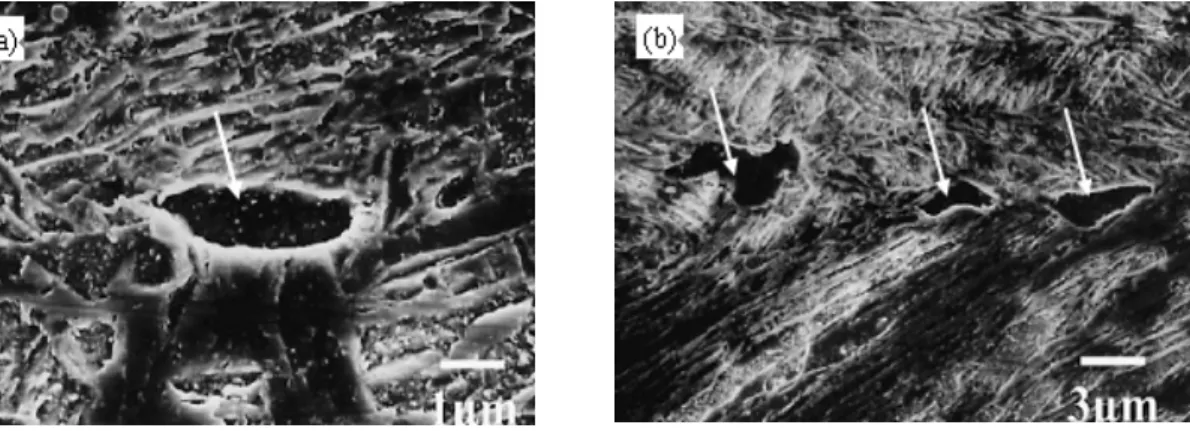
Shimotomai and Maruta considered a combination of prior rolling and transformation in an external field is essential for yielding an aligned structure during γ-α transformation. However, a similar aligned structures were reported by Ohtsuka et al in a Fe-0.4C alloy without prior deformation during continuous slow cooling under the 10T magnetic field [36]. As seen from Figure 1.9, each ferrite grain is elongated and these grains are distributed head to tail along the field direction.
Figure 1.9 Microstructures of Fe-0.4C alloy during continuous slow cooling from γ to α transformation under 10T magnetic field (The field direction is vertical) [36].
Later, Hao and Ohtsuka [34, 35, 37, 54] studies the effect of magnetic field on transformed structure for γ to α isothermal transformation in Fe-C alloys to clarify the mechanism of the elongation and alignment of ferrite grains. They found that during the isothermal transformation, the elongated and aligned structure is mostly formed during grain growth rather than nucleation. The degree of elongation of ferrite grains is determined by the competition between the demagnetization effect and the chemical driving force and their combined effects result in the degree of elongation reaching a peak value at approximately Tc. The degree of elongation of ferrite grains as a function of isothermal holding time and temperature in a magnetic field of 10T in Fe–0.4C were shown in Figure1.10.
Figure 1.10 The degree of elongation of ferrite grains as a function of isothermal holding time and temperature in a magnetic field of 10T in Fe–0.4C alloy [35].
The effects of magnetic field strength, cooling rate and austenite grain size on the transformed structure in a magnetic field were observed for Fe-Mn-C-Nb alloy, but no elongation or alignment of ferrite grains has been observed [36]. On this basis, the existence of alloying elements may totally eliminate this elongation and alignment morphology.
Later, Zhang et.al [55-57] found that the aligned structure formed during slow cooling process rather than fast cooling process, when they studied the austenite decomposition in a hot-rolled 42CrMo steel under the magnetic field. They suggested that when cooling rate is 10°C/min, due to the inhomogeneous deformation during rolling and the dipolar attraction between ferrite nuclei, the microstructure of alternately distributed ferrite grains and pearlite colonies along the field direction is obtained.
Figure 1.11 Microstructures after heating at 880°C for 33 min and cooling at 10°C /min with magnetic field of (a) 6T, (b) 10T, (c) 14T and (d) cooling at 46°C /min with 14T magnetic field.(the magnetic field direction and the rolling direction are vertical in the pictures) [56].
In the case of cooling at 46°C/min, the nucleation at high temperature is greatly inhibited; as a result, the nucleation is postponed at lower temperature, when more sites inside the austenite grains besides grain boundaries are available. Consequently, the microstructure is characteristic of randomly distributed ferrite grains and pearlite colonies with smaller sizes, seen in Figure 1.11.
The magnetic field-induced grain elongation mechanism was analyzed from physical point of view [58]. It revealed that the grain elongation is the results of the opposing contributions from the atomic dipolar interaction energy of Fe atoms and the interfacial energy.
The effect of magnetic field on the formation of elongated and aligned pearlite was investigated by Song et al [59]. It was reported that in the Fe-0.12C alloy, the pearlite was elongated and aligned along the field direction during its diffusional decomposition under the 12T magnetic field. Moreover, this tendency increased with increasing magnetic field strength and this field effect is dependent on the specimen orientation with respect to the field direction.
It should be noticed that, several works indicates that the nucleation and growth of ferrite grains happen preferentially along the field direction, however, no
preferred crystallographic orientations in the microstructure were formed [36, 50-53, 55-57].
Recently, magnetic field-induced microstructures features were investigated from crystallographic point of view. Zhang et al. applied a 12T magnetic field to a medium plain carbon steel during the diffusional decomposition of austenite and investigated the effect of a high magnetic field on the distribution of misorientation angles, grain boundary characteristics and texture formation in the ferrite produced [60]. It was reported that magnetic field can cause a considerable decrease in the frequency of low-angle misorientation and an increase in the occurrence of low Σ coincidence boundaries, especially the Σ3 of ferrite [60]. They attributed this to the elevation in the transformation temperature caused by the magnetic field and, therefore, the reduction of the transformation stress. It is also found that magnetic field enhances the <001> texture component along the transverse field direction due to the dipolar interaction between the magnetic moments of Fe atoms.
1.4 Significance and content of this work
The investigations on phase transformation under the magnetic field have been carried out for more than fifty years. Many meaningful experimental phenomena have been discovered and some related theories have been developed. Nowadays, as a new promising technique, magnetic field has been widely applied in materials processing. However, most of the former studies on the effect of the magnetic field on diffusional phase transformation are lack of regularity, and are not systematic either. The fundamental theories of magnetic field influence on phase transformation are still in need to be addressed. As alloying elements affect the phase transformation in steels to a large extent, the fundamental theories on field influential mechanism are hard to establish based on the existing studies, most of which were conducted in Fe-based alloys with considerable alloying elements. With
the development of the magnetic field generator technique, the application of magnetic field becomes more and more extensive. Deeper understanding of field influential mechanism is necessary and imperative. Based on such background, the present work has been carried out as a fundamental research to explore the magnetic field influential mechanism on diffusional phase transformation and also enrich the existing phase transformation theory. To examine the field effect without the involvement of impurities and alloying elements and to obtain a systematic result, three high purity Fe-C alloys in both hypo and hyper eutectoid composition range were prepared as experimental materials. The field induced microstructural features and the crystallographic characteristics have been thoroughly investigated. The main content of present work can be summed up as follows:
(1)Experimentally examine the microstructural features induced by magnetic field in both hypo and hyper eutectoid Fe-C alloys:
Magnetic field induced aligned and elongated microstructures are analyzed through a comparative study in Fe-0.12C alloy and Fe-0.36C alloy.
Microstructural modifications by magnetic field due to its thermodynamic influence on phase equilibrium in hypo and hyper eutectoid Fe-C alloys, respectively.
(2)Experimentally examine the modification of carbon solubility in ferrite under the magnetic field, conduct calculations on magnetic moments of the related atoms and underline the physical essence of the field influential mechanism using magnetic field dipolar interaction.
(3)By means of SEM/EBSD to examine the effect of the magnetic field on crystallographic orientation characteristics. The field induced preferred orientation distribution of ferrite and then the texture formation mechanism is investigated. The types of the orientation relationships in pearlite and the corresponding occurrence frequency have been examined.
Chapter 2 Experimentals and Calculations
2.1 Materials preparation
The materials used in this work are three high purity Fe-C alloys with different carbon content, namely, Fe-0.12C alloy, Fe-0.36C alloy and Fe-1.1C alloy. To minimize the involvement of impurities during the preparation, the alloys were prepared by vacuum induction melting using high purity constituent elements in EPM laboratory of Northeastern University, China.
The preparation of the high purity Fe-C alloys involves following two steps.
(1) Preparation of high purity cast iron as high carbon-content constituent for carbon content tuning of the alloys.
The high purity (99.99%) electrolytic iron was melted in a high purity graphite crucible (carbon 99.99%) by repeated vacuum induction melting, allowing carbon to diffusion into the iron melt from the graphite to produce cast iron. The chemical composition of the obtained cast iron is shown in Table 2.1.
Table 2.1 Chemical composition of cast iron, %.
C S O N Fe
4.39 0.001 0.0025 0.0003 Bal.
(2) Preparation of the final alloys with assigned carbon content.
The cast iron obtained in step (1) as high carbon constituent was melted with high purity (99.99%) electrolytic iron in water cooled copper crucible by vacuum induction levitation melting. By varying the quantity of the cast iron, the final Fe-C alloys with assigned carbon contents (0.12C, 0.36C and 1.1C in wt.%) were obtained. Figure 2.1 shows the top view of one high purity Fe-C alloy ingot.
Figure 2.1 Photo of the ingot of the Fe-C alloy.
2.2 Pre-treatment of high purity Fe-C alloys
In order to study the influence of the magnetic field on phase transformation without the interference from the inhomogeneity of the initial microstructure, the three high purity alloys were pre-treated to obtain the homogeneous and equilibrium microstructures for the subsequent magnetic field heat treatments.
First, the ingots were multidirectionally forged to homogenize the microstructure. The multidirectional forging was performed by first forging the ingots into cubes and then further forging the cubes along their three perpendicular edge directions to resume the initial cube form of the work pieces. This process was repeated 4 times. Finally the cube was forged along one of its diagonal direction into a pancake shape. The multidirectional forging was conducted within the temperature range from 1273K to 1073K without annealing between the forging steps. After forging, the work pieces were air cooled to the room temperature. To avoid the involvement of the outside oxide coating and decarburized layer in the specimens, a plate of 70mm×70mm×35mm in size was cut out from the centre of each forged pancake by electrical spark cutting.
Then, the plates were homogeneously annealed in vacuum at set temperature for 10 hours to homogenize the composition. (The annealing temperature is 1373K for Fe-0.12C alloy and Fe-0.36C alloy; 1323K for Fe-1.1C alloy).
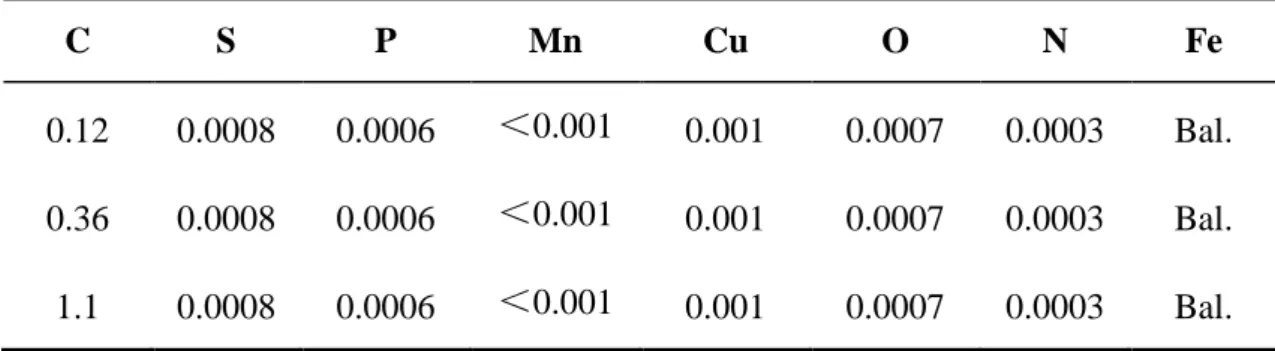
After that, full annealing was performed to obtain equilibrium microstructures. The alloys were fully austenitized for 45min, and cooled to 973K at 0.3K/min for proeutectoid and eutectoid transformation, and then cooled to room temperature at 1K/min (The austenitization temperatures for the full annealings are 1165K for Fe-0.12C alloy, 1099K for Fe-0.36C alloy and 1063K for Fe-1.1C alloy). The chemical composition of the high purity Fe-C alloys was analyzed using Carbon/Sulfur analyzer, Inductively Coupled Plasma spectrometer and Nitrogen/Oxygen exterminator, the result is shown in Table 2.2.
Table 2.2 Chemical composition of Fe-C alloys (wt.%).
C S P Mn Cu O N Fe
0.12 0.0008 0.0006 <0.001 0.001 0.0007 0.0003 Bal.
0.36 0.0008 0.0006 <0.001 0.001 0.0007 0.0003 Bal.
1.1 0.0008 0.0006 <0.001 0.001 0.0007 0.0003 Bal.
The corresponding phase equilibrium temperatures of the three alloys were calculated with Thermo-Calc Software. For the Fe-0.12C alloy and the Fe-0.36C alloy, their Ae3 temperatures are 1135K and 1069K, respectively; for the Fe-1.1C
alloy, Aecm temperature is 1128K.
2.3 Magnetic field heat treatment equipment and experiments
In this work, all the field heat treatments were conducted at EPM laboratory of Northeastern University, China. The magnetic field heat treatment furnace is set in a
12T cryo-cooled superconducting magnets with a bore sized 100mm in diameter (Figure 2.2 shows the photo (a) and the schema (b) of the magnetic field heat treatment furnace). The magnetic field ramping time from 0T to 12T is 39 minutes. For this magnetic field heat treatment furnace, the highest heating temperature is 1473K, the maximum heating rate is 5K/min and the maximum cooling rate is 23.5K/min. During the heat treatment, the vacuum degree in the heat treatment furnace can reach 10-3Pa.
Ar Pt-Rh thermocouple Cooling water Specimen H Furnace Pt heater Cooling water Magnet Field center Sample holder Water-cooled jacket Ar
Figure 2.2 Photo (a) and schema (b) of magnetic field heat treatment furnace.
For field heat treatments, the magnetic field was applied during the whole heating, isothermal holding and cooling process. For Fe-0.12C and Fe-1.1C alloys,
(a)
the 12T magnetic field was applied, while for Fe-0.36C alloy, both 8T and 12T magnetic fields were applied. The non-field heat treatments for comparison were carried out in the same furnace using the same heat treatment parameters only without switching on the magnetic field. During the field heat treatment, the specimens were kept in the centre (zero magnetic force) area with one of their length directions parallel to the field direction, as shown in Figure 2.2(b). The detailed heat treatment parameters used in this work for the three alloys are illustrated in Figure 2.3. In the figures, the respective Ae3 and Aecm temperatures of
the three alloys are from the Thermo-Calc calculations but the Ae1 temperatures are
from the common accepted theoretical value (1000K).
(a)
(b)
Ae3 Magnetic field: 0T/12T Magnetic field: 0T/8T/12T Ae3(c)
Figure 2.3 Heat treatment parameters for Fe-C alloys (a) Fe-0.12C (b) Fe-0.36C and (c) Fe-1.1 C. The respective Ae3 and Aecm temperatures are calculated by Thermo-Calc, but
the Ae1 temperatures are from the common accepted theoretical value (1000K).
2.4 Specimen cutting and specimen geometry
For the final heat treatments, small sized specimens were cut out from the center of the plates after the pre-heat treatment. The dimensions of the specimens are 7mm×7mm×1mm for the Fe-0.12C alloy and the Fe-0.36C alloy; and 10mm×10mm×3mm for the Fe-1.1C alloy, as illustrated in Figure 2.4.
Figure 2.4 Illustration of specimens for heat treatments (a) and the sizes of the specimens (b) for Fe-0.12C alloy and Fe-0.36C alloy; (c) for Fe-1.1C alloy.
Magnetic field: 0T/12T Aecm (a) 10mm 3mm (c) (b) 7mm 1mm

![Figure 1.5 Fe-C phase diagram associated with the α / γ + α , γ / α and γ /Fe 3 C equilibrium transformation for various applied magnetic fields [28]](https://thumb-eu.123doks.com/thumbv2/123doknet/14599820.730981/22.892.267.655.675.1033/figure-diagram-associated-equilibrium-transformation-various-applied-magnetic.webp)
![Figure 1.7 Microstructures of Fe-0.1C alloy (a) and Fe-0.6C alloy (b) subjected to the α / γ inverse transformation under 8T magnetic field [50]](https://thumb-eu.123doks.com/thumbv2/123doknet/14599820.730981/28.892.210.685.105.450/figure-microstructures-alloy-alloy-subjected-inverse-transformation-magnetic.webp)
![Figure 1.9 Microstructures of Fe-0.4C alloy during continuous slow cooling from γ to α transformation under 10T magnetic field (The field direction is vertical) [36].](https://thumb-eu.123doks.com/thumbv2/123doknet/14599820.730981/30.892.182.734.106.316/figure-microstructures-continuous-cooling-transformation-magnetic-direction-vertical.webp)