Asymptotic Performance of Queue Length Based
Network Control Policies
by
Krishna Prasanna Jagannathan
B.Tech., Indian Institute of Technology Madras (2004)
S.M., Massachusetts Institute of Technology (2006)
Submitted to the Department of Electrical Engineering and Computer
Science
in partial fulfillment of the requirements for the degree of
Doctor of Philosophy in Electrical Engineering and Computer Science
at the
MASSACHUSETTS INSTITUTE OF TECHNOLOGY
September 2010
@
Massachusetts Institute of Technology 2010. All rights reserved.
Author .
Department of__
icaEngineering and Computer Science
August 26, 2010
C ertified by ...
Eytan H. Modiano
Associate Professor
Thesis Supervisor
Accepted by ...
. .
.
Terry P. Orlando
Chair, Department Committee on Graduate Students
Asymptotic Performance of Queue Length Based Network
Control Policies
by
Krishna Prasanna Jagannathan
Submitted to the Department of Electrical Engineering and Computer Science on August 26, 2010, in partial fulfillment of the
requirements for the degree of
Doctor of Philosophy in Electrical Engineering and Computer Science
Abstract
In a communication network, asymptotic quality of service metrics specify the probability that the delay or buffer occupancy becomes large. An understanding of these metrics is essential for providing worst-case delay guarantees, provisioning buffer sizes in networks, and to estimate the frequency of packet-drops due to buffer overflow. Second, many network control tasks utilize queue length information to perform effectively, which inevitably adds to the control overheads in a network. Therefore, it is important to understand the role played by queue length information in network control, and its impact on various performance metrics. In this thesis, we study the interplay between the asymptotic behavior of buffer occupancy, queue length information, and traffic statistics in the context of scheduling, flow control, and resource allocation.
First, we consider a single-server queue and deal with the question of how often control messages need to be sent in order to effectively control congestion in the queue. Our results show that arbitrarily infrequent queue length information is sufficient to ensure optimal asymptotic decay for the congestion probability, as long as the control information is accurately received. However, if the control messages are subject to errors, the congestion probability can increase drastically, even if the control messages are transmitted often.
Next, we consider a system of parallel queues sharing a server, and fed by a statistically homogeneous traffic pattern. We obtain the large deviation exponent of the buffer overflow probability under the well known max-weight scheduling policy. We also show that the queue length based max-weight scheduling outperforms some well known queue-blind policies in terms of the buffer overflow probability.
Finally, we study the asymptotic behavior of the queue length distributions when a mix of heavy-tailed and light-tailed traffic flows feeds a system of parallel queues. We obtain an exact asymptotic queue length characterization under generalized max-weight scheduling. In contrast to the statistically homogeneous traffic scenario, we show that max-weight scheduling leads to poor asymptotic behavior for the light-tailed traffic, whereas a queue-blind priority policy gives good asymptotic behavior.
Thesis Supervisor: Eytan H. Modiano Title: Associate Professor
This dissertation is a humble offering at the Lord's feet.
"Whatever you do, whatever you eat, whatever you sacrifice, whatever you give away, and whatever austerities you practise - do it as an offering to Me." - Bhagavad Gita 9-27.
Acknowledgments
This section of the dissertation is unquestionably the pleasantest to write. Ironically, it is also the hardest to write. The pleasantness, of course, is due to the fact that the author finally gets an opportunity to express his gratitude towards everyone who made this docu-ment possible. The difficulty lies in finding the words that adequately reflect this sense of gratitude and indebtedness. I humbly embark on this highly satisfying task, fully realizing that my words are likely to fall short.
The sense of inadequacy that I feel in writing this section is at least partly due to the first recipient of my gratitude - my advisor, Professor Eytan Modiano. A student's thesis advisor is often the biggest influence in his or her professional making, and this is certainly true in my case. I suppose that the job of an advisor is relatively easy when things are progressing steadily and smoothly in a student's research. It is during the weeks and months of laborious plodding, crumbling confidence, and growing frustration that I most appreciate Eytan's patience and support. Always encouraging and never judgemental, his ability and willingness to see a student's frustrations as partly his own makes him an exemplary advisor. Overall, I feel lucky, privileged, and proud to have been at the receiving end of his mentorship.
It's been a pleasure, Eytan!
I am also deeply grateful to the members of my thesis committee, Professors John Tsitsiklis and Lizhong Zheng. Far from just being readers of my thesis, John and Lizhong acted more like co-advisors during the various stages of my thesis research, actively helping me with their valuable suggestions and perspectives.
While Eytan was away on a sabbatical at the University of Minnesota during 2007, Lizhong voluntarily acted as my de facto advisor at MIT. Much of the work in Chapter 2 was carried out during this time, with valuable inputs from him. I thank Lizhong for all his support and help during my stay at MIT. Oh, the two classes I took with him (6.441: Transmission of Information, and 6.452: Wireless Communications) were lots of fun too!
During the later stages of my doctoral research, and in particular during the past year, I have tremendously benefitted from my interactions with Prof. John Tsitsiklis. Although my interactions with him were very sporadic and brief, I obtained some very crucial insights during those brief meetings. As a matter of fact, the two main theorems in Chapter 5
materialized as a result of a 30 minute meeting with John in June this year. I am also fortunate to have been John's teaching assistant for 6.262 (Discrete Stochastic Processes) in Spring 2008, which was a greatly edifying and enjoyable experience.
The work reported in Appendix A was carried out in collaboration with Prof. Shie Mannor (Technion) and Dr. Ishai Menache. Although I had formulated the problem of scheduling over uncertain wireless links more than a year ago, I was hopelessly stuck on the problem for a few months, before our collaboration started paying off. Many thanks to Shie and Ishai for their valuable help and co-operation.
I am also grateful to all the students and post-docs in CNRG, with whom I have had the pleasure of interacting over the last six years.
I offer my profound gratitude to all my teachers. I refer not only to the many great lecturers at MIT who taught my classes at graduate school. I would be amiss to forget the teachers who taught circuit theory and communications to a reticent loner in IT Madras, or the teacher who taught sin2 0 + cos2 0 = 1 to a barefooted, street cricket-crazy boy in Chennai.
I could place here a cliched sentence thanking my parents for all they have done and been for me. Instead, I will make it less sheepish by placing a mere assertion: Any virtues that exist in me, including those that I exude in my work, are largely a result of the values instilled in me as a part of my upbringing.
As for my wife Prabha, I realize that jetting back and forth across this vast continent while having her own thesis to deal with should have been stressful at times, because it was for me. However, I will not thank my wife - one hand of a competent pianist does not thank the other for playing well in unison. Instead, I merely look forward to the tunes that lie ahead of us.
The late Prof. Dilip Veeraraghavan, my friend, teacher and exemplar in several ways, would have been boundlessly happy to see this day. I have learned a lot from his life; I have learned even more from his death.
Finally, my stay at MIT would have been much duller, if it was not for my circle of close friends. In no specific order, thanks to Arvind, Vivek, Lavanya, Mythili, and Aditi for all the good food, music, and conversations. Thanks in particular to Jaykumar for the above three, plus the occasional dose of queueing theory.
Contents
1 Introduction
1.1 Network Control and the Max-Weight Framework . . . . 1.2 Performance Metrics for Network Control . . . .
1.3 The Role of Control Information.... . . . . . ..
1.4 Thesis Outline and Contributions . . . . 1.4.1 Queue length information and congestion control... 1.4.2 Queue-aware vs. queue-blind scheduling under symmetric traffic
1.4.3 Queue-aware vs. queue-blind scheduling in the presence of heavy-tailed traffic . . . . 1.4.4 Throughput maximization over uncertain wireless channels . . 1.4.5 Reading suggestions... . . . .
On the Role of Queue Length Information in Congestion Co and Resource Allocation
2.1 Introduction.. . . . . . . . . ..
2.2 Preliminaries... . . . . . . . . . . . . . ..
2.2.1 System description . . . . . . . . ..
2.2.2 Markovian control policies... . . . . . . .. 2.2.3 Throughput, congestion, and rate of control . . . .
2.3 The Two-Threshold Flow Control Policy . . . .
2.3.1 Congestion probability vs. rate of control tradeoff . . . . . 2.3.2 Large deviation exponents... . . . . . . . . . . . .. 2.3.3 More general Markovian policies and relationship to RED
ntrol 27 27 30 30 32 32 33 34 36 38 2
2.4 The Effect of Control Errors on Congestion . . . . 2.4.1 The two-threshold policy over a loss-prone control 2.4.2 Repetition of control packets . . . .
2.5 Optimal Bandwidth Allocation for Control Signals . . . .
2.5.1 Bandwidth sharing model . . . .
2.5.2 Optimal fraction of bandwidth to use for control .
2.5.3 Discussion of the optimal solution ...
2.6 Queue Length Information and Server Allocation . . . . 2.7 Conclusions... . . . . . . . .. 2.A Proof of Theorem 2.3 . . . .
channel
3 The Impact of Queue Length Information on Buffer Overflow in
Parallel Queues 61
3.1 Introduction . ... ... 61
3.1.1 Related work ... ... 63
3.2 System Description and Preliminaries ... ... 63
3.3 Large Deviation Analysis of LQF Scheduling . . . . 66
3.3.1 Illustrative examples with Bernoulli traffic... .. 69
3.4 LQF vs. Queue-Blind Policies... . . . . . . 72
3.4.1 Buffer scaling comparison . . . . 75
3.5 Scheduling with Infrequent Queue Length Information. . . . . .. 77
3.6 Conclusions... . . . . . . . . . . . . . 78
3.A P roofs . . . . 78
3.A.1 Proof of Theorem 3.1 . . . . 78
3.A.2 Proof outline of Proposition 3.6 . . . . 85
3.A.3 Proof of Theorem 3.2 . . . . 85
4 Asymptotic Analysis of Generalized Max-Weight Scheduling in the presence of Heavy-Tailed Traffic 89 4.1 Introduction... . . . . . . . . .. 89
4.3 Definitions and Mathematical Preliminaries . . .
4.3.1 Heavy-tailed distributions . . . . 4.3.2 Assumptions on the arrival processes . . . 4.3.3 Residual and age distributions . . . . 4.4 The Priority Policies . . . . 4.4.1 Priority for the Heavy-Tailed Traffic . . .
4.4.2 Priority for the Light-Tailed Traffic . . . .
4.5 Asymptotic Analysis of Max-Weight-a Scheduling 4.5.1 Upper bound . . . ... . . 4.5.2 Lower bound . . . . 4.5.3 Fictitious system . . . . 4.6 Tail Coefficient of qL .. . . . - -.... 4.7 Log-Max-Weight Scheduling... . . . .. 4.8 Concluding Remarks... . . . . . . . . ..
4.A Technical Lemmata . . . .
5 Throughput Optimal Scheduling in the Traffic
5.1 System M odel . . . .
5.2 Priority for the Light-Tailed Traffic . . . 5.3 Max-Weight-a Scheduling . . . ...
5.3.1 Max-weight scheduling . . . .
5.3.2 Max-weight-a scheduling with aL
5.3.3 Max-weight-a scheduling with aL
5.3.4 Section summary . . . . 5.4 Log-Max-Weight Scheduling . . . . 5.5 Chapter Summary . . . . aH aH 6 Concluding Remarks 93 97 98 100 100 103 105 106 109 110 113 115 123 124 presence of Heavy-Tailed 131 132 133 144 146 155 163 165 166 171 173
A Throughput Maximization over Uncertain Wireless Channels - A
State Action Frequency Approach 175
A.1 Introduction ... 175
A.2 System Description ... ... ... 178
A.3 Optimal Policies for a Fully Backlogged System... . . . . . . . 180
A.3.1 MDP formulation and state action frequencies.. . . . . . . 182
A.3.2 LP approximation using a finite MDP . . . . 184
A.3.3 An outer bound.. . . . . . . . 188
A.3.4 Numerical examples... . . . . . . .. 189
A.4 A Throughput Optimal Frame-Based Policy. . . . .. 191
A.4.1 Simulation results for the frame-based policy . . . . 196
Chapter 1
Introduction
In today's increasingly connected world, data communication networks play a vital role in practically every sphere of our daily lives. Well established infrastructures such as satellite communications, trans-continental and inter-continental fiber-optic links, cellular phones, and wireless internet are taken for granted. An internet connection is often considered an essential utility in urban households, along with water supply and electricity. More recently, there has been a tremendous growth in voice-over-IP (Vovoice-over-IP) applications, and hand held devices that access both voice and data over cellular networks.
Whatever may be the specific application or the medium, it is essential to design effective data transport mechanisms in a network, so as to utilize the resources avail-able in an efficient manner. Network control is the generic and collective term used to refer to such transport mechanisms in a network.
From a theoretical perspective, the problem of optimally transporting data over a general network is a staggeringly complex one. Optimal data transmission over a single communication link has been well understood for over six decades now, since the inception of Shannon theory [57]. However, the extension of Shannon theoretic capacity results to the simplest of multi-user network models, such as the broadcast
[17] and relay channels [16], has proved notoriously hard. This being the case, we can
safely assert that a complete theoretical understanding of optimal data transmission over a general network is well beyond our grasp.
Due to the lack of a unified underlying theory [19], the study and design of com-munication networks has been dominated by 'divide and conquer' approaches, in which the various functionalities of a network are treated as separate modules that come together. This modularity of network design is achieved through layering in network architecture; see [5]. Layering was envisioned as a means to promote clean and modularized network design, in which the different layers in a network can treat the other layers as black boxes. Although layering is somewhat artificial in reality in the sense that the different layers in a network are invariably coupled, it effectively discourages 'spaghetti designs' that are less adaptable to future changes. Apart from promoting modularized and scalable design, layering also facilitates the analysis and theoretical understanding of communication networks. For example, once the com-munication links in a network are abstracted away as edges in a graph, standard results from combinatorics and graph theory can be brought to bear upon routing and scheduling problems. Queueing theoretic results can be used to characterize the delay experienced by data packets at various nodes in a stochastic network.
In the context of a layered architecture, various network control tasks are also thought of as operating within different layers. The most important examples of network control tasks include scheduling and resource allocation at the link layer, routing at the network layer, and flow control at the transport layer.
We next review some important results from the literature on network control.
1.1
Network Control and the Max-Weight
Frame-work
The theoretical foundations of network control, including the notions of stability, rate region, and throughput optimal control of a constrained queueing system were laid out
by Tassiulas and Ephremides in [63]. More importantly from a practical perspective,
the authors also propose a joint scheduling and routing policy which they show can stably support the largest possible set of rates in any given multi-hop network. Their
policy takes into account the instantaneous channel qualities and queue backlogs to perform maximum-weight scheduling of links and back-pressure routing of data. This algorithm is quintessentially cross-layer in nature, combining physical layer channel qualities and link layer queue lengths to perform link layer scheduling and network layer routing. An important and desirable feature of this approach is that no a priori information on arrival or link statistics is necessary to implement it. However, a centralized network controller is necessary to perform the network control tasks, and the computational complexity could be exponential for some networks.
The mathematical framework used in [63] for proving the stability of a constrained queueing network is known as Lyapunov stability. The idea is to define a suitable Lyapunov function of the queue backlogs in the system, and to prove that the ex-pected drift in the Lyapunov function is negative, when the queue backlogs are large. Lyapunov stability theory for queueing networks has been more thoroughly developed since its novel application in [63], see [42] for example.
As it sometimes happens with papers of fundamental theoretical value and sig-nificant practical implications, it took a few years for the networking community to fully realize the potential impact of the above work. However, during the last decade or so, the max-weight framework has been extended along several conceptual as well as practical lines. For example, in order to circumvent the potentially exponential computational complexity of the original algorithm in [63], randomized algorithms with linear complexity were proposed in [62] and [27]. Polynomial-time approxima-tion methods were proposed in [58]. Distributed and greedy scheduling approaches were proposed in [14] and [73].
The max-weight framework was adopted more thoroughly into a wireless setting by including power allocation in [46]. In [45], it was used to develop an optimal power control and server allocation scheme in a multi-beam satellite network. Maximum weight matching has been used to achieve full throughput in input queued switches [41]. Algorithms developed in [12] for the dynamic reconfiguring and routing of light-paths in an optical network are also based on back-pressure. Joint congestion control and scheduling for multi-hop networks was studied in [37,44], and [13], thus
bringing the transport layer task of congestion control also into a cross-layer max-weight framework.
In [20], queue length based scheduling is generalized to encompass a wide class of functions of the queue backlogs, and the relationship between the arrival statistics and Lyapunov functions is explored in detail. This work is directly useful to us in Chapters 4 and 5, where we use the traffic statistics to design the appropriate queue length function to be employed within a generalized max-weight framework.
1.2
Performance Metrics for Network Control
There are several performance metrics that gauge the merits of scheduling, routing and flow control policies. Examples of such performance metrics include throughput, delay, and fairness. Throughput, which measures the long term average rate at which data can be transported under a given control policy, is perhaps the most important performance metric. Throughput is often referred to as a 'first order metric,' due to the fact that it only depends on the expected values of the arrival and service processes in a stochastic network. Throughput optimality is the ability of a control policy to support the largest possible set of rates in a network.
A more discerning performance metric than throughput is delay. In a stochastic
network, the delay experienced by a packet at a node is a random variable, which is closely related to the buffer occupancy or the queue size at the node. The total end-to-end delay experienced by a packet is therefore a function of the buffer occupancies at each node traversed by a packet. Unlike throughput, the delay and buffer occupancy distributions depend on the complete statistical properties of the arrival and service processes, and not just on their means.
The requirements imposed on the delay experienced in a network are commonly referred to as Quality of Service (QoS) requirements. The recent burgeoning of VoIP applications, and hand-held devices that carry sensitive voice along with delay-insensitive data on the same network, has made these QoS constraints more important and challenging than ever before. These QoS requirements can take the form of
bounds on the average delay, or impose constrains on the behavior of the distribution function of the delay. For example, a worst case delay assurance such as 'the delay cannot exceed a certain value with at least 99% probability' necessitates the tail distribution of the delay to fall off sufficiently fast.
This brings us to the concept of asymptotic QoS metrics, which constitutes a recurring theme in this thesis. Loosely speaking, an asymptotic QoS metric captures the behavior of the probability that the delay or queue occupancy exceeds a certain large threshold. The manner in which the above tail probability behaves as a function of the large threshold sheds light on how 'likely' it is for large deviations from typical behavior to occur. Apart from being useful in the context of providing worst case delay assurances, asymptotic QoS metrics have other important applications. In particular, an understanding of the tail of the queue size distribution is essential for buffer provisioning in a network, and to estimate the frequency of packet drops due to buffer overflow. For example, if the tail of the queue occupancy distribution decays exponentially fast, it is clear that the buffer size needed to ensure a given probability of overflow, is usually much smaller than if the tail distribution were to decay according to a power-law.
Although the stability region and throughput optimality properties of the max-weight framework are well studied, there is relatively little literature on the QoS met-rics under the framework. Delay bounds are derived in [34] for max-weight scheduling in spatially homogeneous wireless ad hoc networks. In [31], a scheduling algorithm that simultaneously provides delay as well as throughput guarantees is proposed. In a parallel queue setting, max-weight scheduling is shown in [43] to attain order optimal delay for arrival rates within a scaled stability region. Delay analysis for switches under max-weight matching and related scheduling policies is studied in [54, 55], and [26]. Large deviation analysis of buffer overflow probabilities under max-weight scheduling is studied in [6, 56, 60, 65-68] and [76].
1.3
The Role of Control Information
Network control policies generally base their control decisions on the instantaneous network state, such as channel quality of the various links, and the queue backlogs at the nodes. For example, congestion control policies regulate the rate of traffic en-tering a network based on prevailing buffer occupancies. The max-weight framework, developed in [63] and extended in [46], utilizes instantaneous channel states as well as queue length information to perform joint scheduling and routing. We use the phrase 'control information' to denote the information about the network state that is necessary to operate a control policy.
Since this control information usually shares the same communication medium as the payload data, the exchange of control information inevitably adds to the sig-nalling overheads in a network. Therefore, it is important to better understand the role played by the control information in network control. In particular, we are inter-ested in understanding how various performance metrics are impacted if the control information is subject to delays, losses or infrequent updates.
Perhaps the earliest, and certainly the most well known investigation about con-trol information in data networks was carried out by Gallager in [23]. He derives information theoretic lower bounds on the amount of protocol information needed for network nodes to keep track of source and destination addresses, as well as message starting and stopping times. A paper that is closely related to our work in Chapter 2, and specifically deals with the role of queue length information in the congestion con-trol of a single- server queue, is [49]. In that paper, the authors consider the problem of maximizing throughput in a single-server queue subject to an overflow probability constraint, and show that a threshold policy achieves this objective.
Since the general max-weight framework utilizes both instantaneous channel states and queue length information, a question arises as to how the policy would perform if either the channel state or queue length information is delayed or conveyed imper-fectly. From the perspective of throughput, it turns out that the role of channel state information (CSI) is more important than that of queue length information (QLI).
There are several studies in the literature [28,47,74,75] that show that under imper-fect, delayed, or incomplete CSI, the throughput achievable in a network is negatively impacted. In contrast, when QLI is arbitrarily delayed or infrequently available, it is possible to ensure that there is no loss in throughput. However more discerning QoS metrics such as buffer occupancy and delay could suffer under imperfect or delayed
QLL
In this thesis, we investigate the role played by queue length information in the operation of scheduling, congestion control, and resource allocation policies. In par-ticular, we focus on the asymptotic QoS metrics under queue length based scheduling and congestion control policies in simple queueing networks. In Chapter 2, we consider a single-server queue with congestion based flow control, and study the relationship between the tail of the queue occupancy distribution, and the rate of queue length information available to the flow controller. In Chapters 3, 4, and 5, we consider a system of parallel queues sharing a server, and study the asymptotic behavior of buffer overflow probability under various queue-aware and queue-blind scheduling policies, and under different qualitative assumptions on the traffic statistics.
In Appendix A, we study the problem of scheduling over wireless links, when there is no explicit CSI available to the scheduler. This work is reported as an appendix rather than as a chapter, because the contents therein are not directly related to the rest of the chapters.
An outline of this thesis, including a summary of our main results and contribu-tions, is given in the following section.
1.4
Thesis Outline and Contributions
The recurring theme in this thesis is the role of control information in network con-trol, and its impact on the asymptotic behavior of queue occupancy distributions. We consider simple queueing models such as single server queues and parallel queues sharing a server, and study the interplay between network control policies, control information, traffic statistics, and the asymptotic behavior of buffer occupancy.
How-ever, we believe that the conceptual understanding and guidelines that are obtained from our study are more widely applicable.
1.4.1
Queue length information and congestion control
In Chapter 2, we consider a single server queue and deal with the basic question of how often control messages need to be sent in order to effectively control congestion in the queue. We separately consider the flow control and resource allocation problems, and characterize the rate of queue length information necessary to achieve a certain congestion control performance in the queue.
For the flow control problem, we consider a single server queue with congestion based flow control. The queue is served at a constant rate, and is fed by traffic that is regulated by a flow controller. The arrival rate at a given instant is chosen by a flow control policy, based on the queue length information obtained from a queue observer. We identify a simple 'two-threshold' flow control policy and derive the corresponding tradeoff between the rate of control and congestion probability in closed form. We show that the two threshold policy achieves the lowest possible asymptotic overflow probability for arbitrarily low rates of control.
Next, we consider a model where losses may occur in the control channel, possibly due to wireless transmission. We characterize the impact of control-channel errors on the congestion control performance of the two threshold policy. We assume a probabilistic model for the errors on the control channel, and show the existence of a critical error probability, beyond which the errors in receiving the control packets lead to a drastic increase in the congestion probability. However, for error probabilities below the critical value, the congestion probability is of the same exponential order as in a system with an error free control channel. Moreover, we determine the optimal apportioning of bandwidth between the control signals and the server in order 'to achieve the best congestion control performance.
Finally, we study the server allocation problem in a single server queue. In partic-ular, we consider a queue with a constant input rate. The service rate at any instant is chosen depending on the congestion level in the queue. This framework turns out
to be mathematically similar to the flow control problem, so that most of our results for the flow control case also carry over to the server allocation problem.
Our results in Chapter 2 indicate that arbitrarily infrequent queue length informa-tion is sufficient to ensure optimal asymptotic decay for the buffer overflow probability, as long as the control information is accurately received. However, if the control mes-sages are subject to errors, the congestion probability can increase drastically, even if the control messages are transmitted often.
In the remaining chapters of the thesis, we study a system of parallel queues, served
by a single server. In this setting, we characterize the asymptotic behavior of buffer
overflow events under various scheduling policies and traffic statistics. Specifically, we compare well known queue-aware and queue-blind scheduling policies in terms of buffer overflow performance, and the amount of queue length information required to operate them, if any. We incorporate two different statistical paradigms for the arrival traffic, namely light-tailed and heavy-tailed, and derive widely different asymptotic behaviors under some well known scheduling policies.
1.4.2
Queue-aware vs. queue-blind scheduling under
sym-metric traffic
Chapter 3 characterizes and compares the large deviation exponents of buffer overflow probabilities under queue-aware and queue-blind scheduling policies. We consider a system consisting of N parallel queues served by a single server, and study the impact of queue length information on the buffer overflow probability. Under statistically identical arrivals to each queue, we explicitly characterize the large deviation exponent of buffer overflow under max-weight scheduling, which in our setting, amounts to serving the Longest Queue First (LQF).
Although any non-idling scheduling policy would achieve the same throughput region and total system occupancy distribution in our setting, the LQF policy out-performs queue blind policies such as processor sharing (PS) in terms of the buffer overflow probability. This implies that the buffer requirements are lower under LQF
scheduling than under queue blind scheduling, if we want to achieve a given overflow probability. For example, our study indicates that under Bernoulli and Poisson
traf-fic, the buffer size required under LQF scheduling is only about 55% of that required
under random scheduling, when the traffic is relatively heavy.
On the other hand, with LQF scheduling, the scheduler needs queue length infor-mation in every time slot, which leads to a significant amount of control signalling. Motivated by this, we identify a 'hybrid' scheduling policy, which achieves the same buffer overflow exponent as the LQF policy, with arbitrarily infrequent queue length information. This result, as well as the ones in Chapter 2, suggests that the large deviation behavior of buffer overflow can be preserved under arbitrarily infrequent queue length updates. This is a stronger assertion than the well known result that the stability region of a queueing system is preserved under arbitrarily infrequent queue length information.
1.4.3
Queue-aware vs. queue-blind scheduling in the
pres-ence of heavy-tailed traffic
In the next two chapters, 4 and 5, we study the asymptotic behavior of the queue size distributions, when a mix of heavy-tailed and light-tailed traffic flows feeds queueing network. Modeling traffic using heavy-tailed random processes has become common during the last decade or so, due to empirical evidence that internet traffic is much more bursty and correlated than can be captured by any light-tailed random process
[35]. We consider a system consisting of two parallel queues, served by a single server
according to some scheduling policy. One of the queues is fed by a heavy-tailed arrival process, while the other is fed by light-tailed traffic. We refer to these queues as the 'heavy' and 'light' queues, respectively.
In Chapter 4, we consider the wireline case, where the queues are reliably con-nected to the server. We analyze the asymptotic performance of max-weight-a scheduling, which is a generalized version of max-weight scheduling. Under this throughput optimal policy, we derive an exact asymptotic characterization of the
queue occupancy distributions. Our characterization shows that the light queue oc-cupancy is heavier than a power-law curve under max-weight-a scheduling, for all values of the scheduling parameters. A surprising outcome of our asymptotic charac-terization is that the 'plain' max-weight scheduling policy induces the worst possible
asymptotic behavior on the light queue tail.
On the other hand, we show that under the queue-blind priority scheduling for the light queue, the tail distributions of both queues are asymptotically as good as they can possibly be under any policy. However, priority scheduling suffers from the drawback that it may not be throughput optimal in general, and can lead to instability effects in the heavy queue. To remedy this situation, we propose a log-max-weight (LMW) scheduling policy, which gives significantly more importance to the light queue, compared to max-weight-a scheduling. However, the LMW policy does not ignore the heavy queue when it gets overwhelmingly large, and can be shown to be throughput optimal.
We analyze the asymptotic behavior of the LMW policy and show that the light queue occupancy distribution decays exponentially fast. We also obtain the exact large deviation exponent of the light queue tail under a regularity assumption on the heavy-tailed input. Thus, the LMW policy has both desirable attributes - it is throughput optimal in general, and ensures an exponentially decaying tail for the light queue distribution.
In Chapter 5, we extend the above results to a wireless setting, where the queues are connected to the server through randomly time-varying links. In this scenario, we show that the priority policy fails to stabilize the queues for some traffic rates inside the rate region of the system. However, the max-weight-a and LMW policies are throughput optimal. Next, from the point of view of queue length asymptotics, we show that the tail behavior of the steady-state queue lengths under a given policy depends strongly on the arrival rates. This is an effect which is not observed when the queues are always connected to the server. For example, we show that under max-weight-a scheduling, the light queue distribution has an exponentially decaying tail if the arrival rate is below a critical value, and a power-law like behavior if the arrival
rate is above the critical value. On the other hand, we show that LMW scheduling guarantees much faster decay of the light queue tail, in addition to being throughput optimal.
Our results in Chapters 4 and 5 suggest that a blind application of max-weight scheduling to a network with heavy-tailed traffic can lead to a very poor asymptotic QoS profile for the light-tailed traffic. This is because max-weight scheduling forces the light-tailed flow to compete for service with the highly bursty heavy-tailed flow. On the other hand, the queue length-blind priority scheduling for the light queue ensures good asymptotic QoS for both queues, whenever it can stabilize the system. This is in stark contrast to our results in Chapter 3, wherein the max-weight policy outperforms the queue length-blind policies in terms of the large deviation exponent of the buffer overflow probability, when the traffic is completely homogeneous.
We also believe that the LMW policy represents a unique 'sweet spot' in the context of scheduling light-tailed flows in the presence of heavy-tailed traffic. This is because the LMW policy affords a very favorable treatment to the light-tailed traffic, without completely ignoring large build-up of the heavy-tailed flow.
1.4.4
Throughput maximization over uncertain wireless
chan-nels
In Appendix A, we consider the problem of scheduling users in a wireless down-link or up-link, when no explicit CSI is made available to the scheduler. However, the scheduler can indirectly estimate the current channels states using the acknowledge-ment history from past transmissions. We characterize the capacity region of such a system using tools from Markov Decision Processes (MDP) theory. Specifically, we prove that the capacity region boundary is the uniform limit of a sequence of Linear Programming (LP) solutions. Next, we combine the LP solution with a queue length based scheduling mechanism that operates over long 'frames,' to obtain a throughput optimal policy for the system. By incorporating results from MDP theory within the Lyapunov-stability framework, we show that our frame-based policy stabilizes the
system for all arrival rates that lie in the interior of the capacity region.
1.4.5
Reading suggestions
Chapters 2 and 3 can be read independently. Although Chapter 4 can also be read independently, it is recommended that Chapters 4 and 5 be read together, in that order. In any case, Chapter 5 should be read after Chapter 4. Finally, Appendix A is independent of the rest of the chapters.
Chapter 2
On the Role of Queue Length
Information in Congestion Control
and Resource Allocation
2.1
Introduction
In this chapter, we study the role played by queue length information in flow control and resource allocation policies. Flow control and resource allocation play an impor-tant role in keeping congestion levels in the network within acceptable limits. Flow control involves regulating the rate of the incoming exogenous traffic to a network, depending on its congestion level. Resource allocation, on the other hand, involves assigning larger service rates to the queues that are congested, and vice-versa. Most systems use a combination of the two methods to avoid congestion in the network, and to achieve various performance objectives [38,44].
The knowledge of queue length information is often useful, sometimes even nec-essary, in order to perform these control tasks effectively. Almost all practical flow control mechanisms base their control actions on the level of congestion present at a given time. For example, in networks employing TCP, packet drops occur when buffers are about to overflow, and this in turn, leads to a reduction in the window size
and packet arrival rate. Active queue management schemes such as Random Early Detection (RED) are designed to pro-actively prevent congestion by randomly drop-ping some packets before the buffers reach the overflow limit [21]. On the other hand, resource allocation policies can either be queue-blind, such as round-robin, first come first served (FCFS), and generalized processor sharing (GPS), or queue-aware, such as maximum weight scheduling. Queue length based scheduling techniques are known to have superior throughput, delay and queue overflow performance than queue-blind algorithms such as round-robin and processor sharing [6,43,64].
Since the queue lengths can vary widely over time in a dynamic network, queue occupancy based flow control and resource allocation algorithms typically require the exchange of control information between agents that can observe the various queue lengths in the system, and the controllers which adapt their actions to the varying queues. This control information can be thought of as being a part of the inevitable protocol and control overheads in a network. Gallager's seminal paper [23] on basic limits on protocol information was the first to address this topic. He derives information theoretic lower bounds on the amount of protocol information needed for network nodes to keep track of source and destination addresses, as well as message starting and stopping times.
This chapter deals with the basic question of how often control messages need to be sent in order to effectively control congestion in a single server queue. We sep-arately consider the flow control and resource allocation problems, and characterize the rate of control necessary to achieve a certain congestion control performance in the queue. In particular, we argue that there is an inherent tradeoff between the rate of control information, and the corresponding congestion level in the queue. That is, if the controller has accurate information about the congestion level in the system, congestion control can be performed very effectively by adapting the input/service rates appropriately. However, furnishing the controller with accurate queue length information requires significant amount of control. Further, frequent congestion no-tifications may also lead to undesirable retransmissions in packet drop based systems such as TCP. Therefore, it is of interest to characterize how frequently congestion
notifications need to be employed, in order to achieve a certain congestion control objective. We do not explicitly model the packet drops, but instead associate a cost with each congestion notification. This cost is incurred either because of the ensuing packet drops that may occur in practice, or might simply reflect the resources needed to communicate the control signals.
We consider a single server queue with congestion based flow control. Specifically, the queue is served at a constant rate, and is fed by packets arriving at one of two possible arrival rates. In spite of being very simple, such a system gives us enough insights into the key issues involved in the flow control problem. The two input rates may correspond to different quality of service offerings of an internet service provider, who allocates better service when the network is lightly loaded but throttles back on the input rate as congestion builds up; or alternatively to two different video streaming qualities where a better quality is offered when the network is lightly loaded.
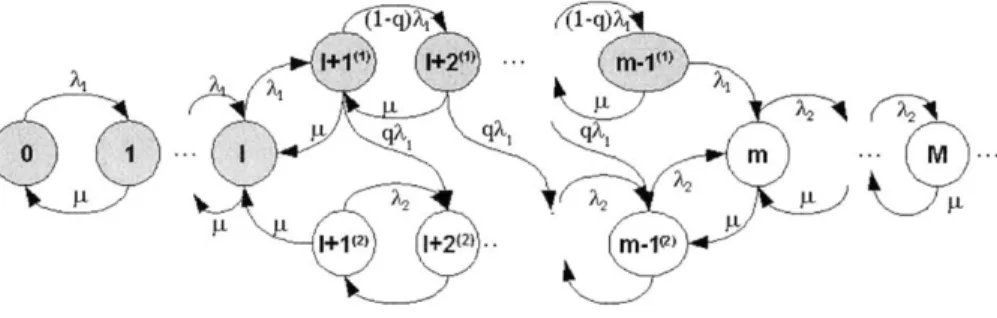
The arrival rate at a given instant is chosen by a flow control policy, based on the queue length information obtained from a queue observer. We identify a simple 'two-threshold' flow control policy and derive the corresponding tradeoff between the rate of control and congestion probability in closed form. We show that the two-threshold policy achieves the best possible decay exponent (in the buffer size) of the congestion probability for arbitrarily low rates of control. Although we mostly focus on the two-threshold policy owing to its simplicity, we also point out that the two-threshold policy can be easily generalized to resemble the RED queue management scheme.
Next, we consider a model where losses may occur in the control channel, possibly due to wireless transmission. We characterize the impact of control channel losses on the congestion control performance of the two-threshold policy. We assume a probabilistic model for the losses on the control channel, and show the existence of a critical loss probability, beyond which the losses in receiving the control packets lead to an exponential worsening of the congestion probability. However, for loss probabilities below the critical value, the congestion probability is of the same exponential order as in a system with an loss-free control channel. Moreover, we determine the optimal apportioning of bandwidth between the control signals and the server in order to
achieve the best congestion control performance.
Finally, we study the server allocation problem in a single server queue. In partic-ular, we consider a queue with a constant input rate. The service rate at any instant is chosen from two possible values depending on the congestion level in the queue. This framework turns out to be mathematically similar to the flow control problem, so that most of our results for the flow control case also carry over to the server allocation problem. Parts of the contents of this chapter were previously published in [32, 33].
The rest of the chapter is organized as follows. Section 2.2 introduces the system model, and the key parameters of interest in the design of a flow control policy. In Section 2.3, we introduce and analyze the two-threshold policy. In Section 2.4, we investigate the effect of control channel losses on the congestion control performance of the two-threshold policy. Section 2.5 deals with the problem of optimal bandwidth allocation for control signals in a loss-prone system. The server allocation problem is presented in Section 2.6, and Section 2.7 concludes the chapter.
2.2
Preliminaries
2.2.1
System description
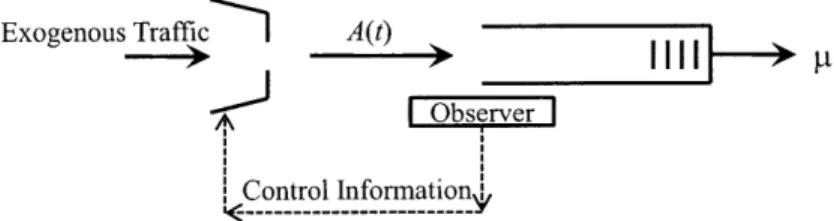
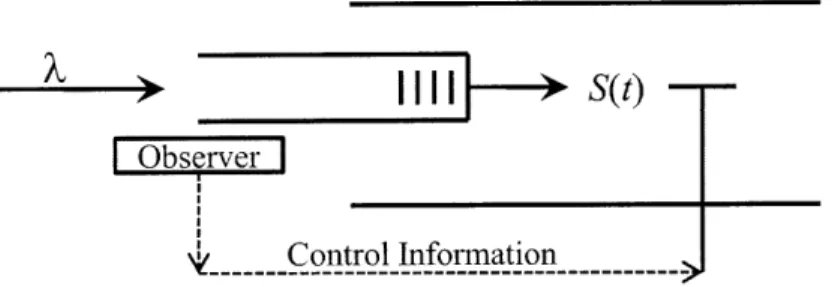
Let us first describe a simple model of a queue with congestion based flow control. Figure 2-1 depicts a single server queue with a constant service rate P. We assume that the packet sizes are exponentially distributed with mean 1. Exogenous arrivals are fed to the queue in a regulated fashion by a flow controller. An observer watches the queue evolution and sends control information to the flow controller, which changes the input rate A(t) based on the control information it receives. The purpose of the observer-flow controller subsystem is to change the input rate so as to the control congestion level in the queue.
We assume that the input rate at any instant is chosen to be one of two distinct possible values, A(t)
c
{A, A2}, where A2 < A, and A2 < P. Physically, this modelExogenous TrafficeI A(t)
A Observer I
Control Information
Figure 2-1: A single server queue with input rate control.
may be motivated by a DSL-like system, wherein a minimum rate A2 is guaranteed,
but higher transmission rates might be intermittently possible, as long as the system is not congested.
Our assumption about the flow control policy choosing between just two arrival rates is partly motivated by a theoretical result in [49]. In that paper, it is shown that in a single server system with flow control, where the input rate is allowed to vary continuously in the interval [A2, Al], a 'bang-bang' solution is optimal. That is,
a queue length based threshold policy that only uses the two extreme values of the possible input rates, is optimal in the sense of maximizing throughput for a given congestion probability constraint. Since we are interested in the rate of control in addition to throughput and congestion, a solution with two input rates may not be
optimal in our setting. However, we will see that our assumption does not entail any
sub-optimality in the asymptotic regime.
The congestion notifications are sent by the observer in the form of information-less control packets. Upon receiving a control packet, the flow controller switches the input rate from one to the other. We focus on Markovian control policies, in which the input rate chosen after an arrival or departure event is only a function of the previous input rate and queue length. Note that due to the memoryless arrival and service time distributions, there is nothing to be gained by using non-Markovian policies.
2.2.2
Markovian control policies
We begin by defining notions of Markovian control policies, and its associated con-gestion probability.
Let t > 0 denote continuous time. Let Q(t) and A(t) respectively denote the
queue length and input rate (A, or A2) at time t. Define Y(t) = (Q(t), A(t)) to be the state of the system at time t. We assign discrete time indices n E
{0,
1, 2, ...}
to each arrival and departure event in the queue ("queue event"). Let
Q,
and A, respectively denote the queue length and input rate just after the nth queue event. Define Y, =(Q,,
A,). A flow control policy assigns service rates A, after every queueevent.
Definition 2.1 A control policy is said to be Markovian if it assigns input rates A,
such that
P1 {An+1|IQn+1,
Yn,
--- ,Yo}
= P{An+1|JQn+1,
Yn} ,
(2.1)Vn = 0, 1, 2 ....
For a Markovian control policy operating on a queue with memoryless arrival and packet size distributions, it is easy to see that Y(t) is a continuous time Markov process with a countable state space, and that Yn is the imbedded Markov chain for the process Y(t). For a control policy under which the Markov process Y(t) is positive recurrent, the steady-state queue occupancy exists. Let us denote by
Q
the steady-state queue occupancy under a generic policy, when it exists.Definition 2.2 The congestion probability is defined as P
{Q
> M}, where M is some congestion limit.2.2.3
Throughput, congestion, and rate of control
We will focus on three important parameters of a flow control policy, namely, through-put, congestion probability, and rate of control. There is usually an inevitable tradeoff between throughput and congestion probability in a flow control policy. In fact, a
good flow control policy should ensure a high enough throughput, in addition to ef-fectively controlling congestion. We assume that a minimum throughput guarantee
-y should be met. Observe that a minimum throughput of A2 is guaranteed, whereas
any throughput less than min(Ai, pu) can be supported, by using the higher input rate
A, judiciously. Loosely speaking, a higher throughput is achieved by maintaining the
higher input rate A, for a longer fraction of time, with a corresponding tradeoff in the congestion probability.
In the single-threshold policy, the higher input rate A, is used whenever the queue occupancy is less than or equal to some threshold 1, and the lower rate is used for queue lengths larger than 1. It can be shown that a larger value of I leads to a larger throughput, and vice-versa. Thus, given the throughput requirement 7, we can determine the corresponding threshold I to meet the requirement. Once the threshold
I has been fixed, it can be easily shown that the single-threshold policy minimizes
the probability of congestion. However, it suffers from the drawback that it requires frequent transmission of control packets, since the system may often toggle between states I and I
+
1. It turns out that a simple extension of the single threshold policygives rise to a family of control policies, which provide more flexibility with the rate of control, while still achieving the throughput guarantee and ensuring good congestion control performance.
2.3
The Two-Threshold Flow Control Policy
As suggested by the name, the input rates in the two-threshold policy are switched at two distinct thresholds 1 and m, where m > 1
+
1, and 1 is the threshold determined by the throughput guarantee. As we shall see, the position of the second thresholdgives us another degree of freedom, using which the rate of control can be fixed at a desired value. The two-threshold policy operates as follows.
Suppose we start with an empty queue. The higher input rate A, is used as long as the queue length does not exceed m. When the queue length grows past m, the input rate switches to the lower value A2. Once the lower input rate is employed,
0 1 1 . ...
...
(2 M_29) M 1(2)
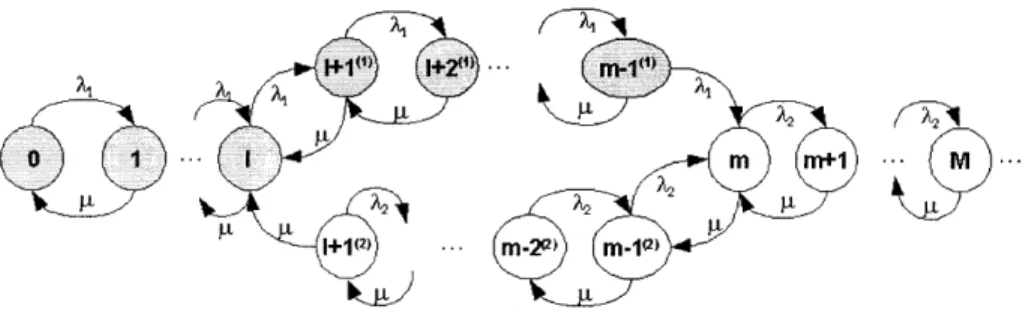
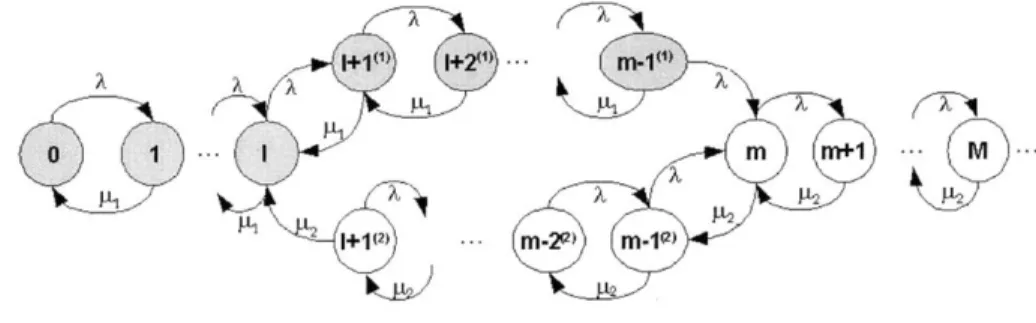
Figure 2-2: The Markov process Y(t) corresponding to the two-threshold flow control policy.
it is maintained until the queue length falls back to 1, at which time the input rate switches back to A,. We will soon see that this 'hysteresis' in the thresholds helps us tradeoff the control rate with the congestion probability. The two-threshold policy is easily seen to be Markovian, and the state space and transition rates for the process are shown in Figure 2-2.
Define k = m - I to be the difference between the two queue length thresholds.
We use the short hand notation I+ iu) and I+ i(2) in the figure, to denote respectively, the states (Q(t) = l + i, A(t) = A) and (Q(t) = l + i, A(t) =A), i = 1, . . ., k - 1.
For queue lengths I or smaller and m or larger, we drop the subscripts because the input rate for these queue lengths can only be A, and A2 respectively. Note that
the case k = 1 corresponds to the single threshold policy. It can be shown that the throughput of the two-threshold policy for k > 1 cannot be smaller than that of the single threshold policy. Thus, given a throughput guarantee, we can solve for the threshold 1 using the single threshold policy, and the throughput guarantee will also be met for k > 1. We now explain how the parameter k can be used to tradeoff the
rate of control and the congestion probability.
2.3.1
Congestion probability vs. rate of control tradeoff
Intuitively, as the gap between the two-thresholds k = m -1 increases for a fixed 1, the rate of control packets sent by the observer should decrease, while the probability of congestion should increase. It turns out that we can characterize the rate-congestion
tradeoff for the two-threshold policy in closed form. We do this by solving for the steady state probabilities in Figure 2-2. Define P2= pi = L, and q1 = 1/pi. Note
that by assumption, we have P2 < 1 and pi > P2.
Let us denote the steady state probabilities of the non-superscripted states in Figure 2-2 by pj, where
j
1, orj
> m. Next, denote by p (p ) the steady stateprobability of the state 1 + i(l) (1 + i(2)), for i = 1, 2,. .., k - 1. By solving for the
steady state probabilities of various states in terms of pi, we obtain:
p = pi7 -pm-j =71 ,j =1 ,...,k -1 p j P- = pi1 12 -i p - pp 2 1,j = 1, 1 2 2, ... , k- k 1, and pg =p m1 - p (). 1 - P2
The value of pi, which is the only remaining unknown in the system can be determined
by normalizing the probabilities to 1:
k(1-p2r71) _ +1
.11(1 _ )(1-P2) 1-1
p; = (2.2)
[ + k+ + ] , 1 = 1
Using the steady-state probabilities derived above, we can compute the probability of congestion as
IP{Q 2 M} = = p(1-)p 1p _ 2P 1. (2.3)
j>M P1.2)2
Pm-We define the control rate simply as the average number of control packets trans-mitted by the queue observer per unit time. Since there is one packet transtrans-mitted by
the observer every time the state changes from m - 1) to m or from 1 ) to 1, the
rate (in control packets per second) is given by
R =
ApL
1+ pp
.Next, observe that for a positive recurrent chain, AlpL 1 (2) Thus,
RM1
12A=pj
I
k 'where pi was found in terms of the system parameters in (2.2).
It is clear from (2.3) and (2.4) that k determines the tradeoff between the con-gestion probability and rate of control. Specifically, a larger k implies a smaller rate of control, but a larger probability of congestion, and vice versa. Thus, we conclude that for the two-threshold policy, the parameter I dictates the minimum throughput guarantee, while k trades off the congestion probability with rate of control packets. Next, we show that the increase in the congestion probability with k can be made slower than exponential in the buffer size.
2.3.2
Large deviation exponents
In many queueing systems, the congestion probability decays exponentially in the buffer size M. Furthermore, when the buffer size gets large, the exponential term dominates all other sub-exponential terms in determining the decay probability. It is therefore useful to focus only on the exponential rate of decay, while ignoring all other sub-exponential dependencies of the congestion probability on the buffer size M. Such a characterization is obtained by using the large deviation exponent (LDE). For a given control policy, we define the LDE corresponding to the decay rate of the congestion probability as
when the limit exists. Next we compute the LDE for the two-threshold policy.
Proposition 2.1 Assume that k scales with M sub-linearly, so that limm,o -M
0. The LDE of the two-threshold policy is then given by
E = log . (2.5)
P2
The above result follows from the congestion probability expression (2.3) since the only term that is exponential in M is pIm = pI-l-k Note that 1 is determined based on the throughput requirement, and does not scale with M. We pause to make the following observations:
* If k scales linearly with M as k(M) = OM for some constant /3> 0, the LDE becomes
1
P2
" The control rate (2.4) can be made arbitrarily small, if k(M) tends to infinity.
This implies that as long as k(M) grows to infinity sub-linearly in M, we can achieve an LDE that is constant (equal to - log P2) for all rates of control.
" As k becomes large, the congestion probability will increase. However, the
increase is only sub-exponential in the buffer size, so that the LDE remains
constant.
In what follows, we will be interested only in the LDE corresponding to the conges-tion probability, rather than its actual value. The following theorem establishes the optimality of the LDE for the two-threshold policy.
Theorem 2.1 The two-threshold policy has the best possible LDE corresponding to
the congestion probability among all flow control policies, for any rate of control. This result is a simple consequence of the fact that the two-threshold policy has the same LDE as an M/M/1 queue with the lower input rate A2, and the latter clearly