https://doi.org/10.4224/23000504
READ THESE TERMS AND CONDITIONS CAREFULLY BEFORE USING THIS WEBSITE. https://nrc-publications.canada.ca/eng/copyright
Vous avez des questions? Nous pouvons vous aider. Pour communiquer directement avec un auteur, consultez la première page de la revue dans laquelle son article a été publié afin de trouver ses coordonnées. Si vous n’arrivez pas à les repérer, communiquez avec nous à [email protected].
Questions? Contact the NRC Publications Archive team at
[email protected]. If you wish to email the authors directly, please see the first page of the publication for their contact information.
NRC Publications Archive
Archives des publications du CNRC
For the publisher’s version, please access the DOI link below./ Pour consulter la version de l’éditeur, utilisez le lien DOI ci-dessous.
Access and use of this website and the material on it are subject to the Terms and Conditions set forth at
Cathodic protection for steel reinforcement
Brousseau, R.
https://publications-cnrc.canada.ca/fra/droits
L’accès à ce site Web et l’utilisation de son contenu sont assujettis aux conditions présentées dans le site LISEZ CES CONDITIONS ATTENTIVEMENT AVANT D’UTILISER CE SITE WEB.
NRC Publications Record / Notice d'Archives des publications de CNRC:
https://nrc-publications.canada.ca/eng/view/object/?id=a236df74-c7d2-4619-884f-4adfa0547511 https://publications-cnrc.canada.ca/fra/voir/objet/?id=a236df74-c7d2-4619-884f-4adfa0547511Cathodic Protection for Steel Reinforcement
by R. Brousseau
Dr. R. Brousseau is a research officer in the Materials Laboratory of the Institute for Research in Construction.
Originally published in « Construction Canada » 34(5), Sept-Oct. 1992, p. 29, 32-33 Corrosion of reinforcing steel in bridges and parking garages is a well-known and costly problem. In the presence of chlorides, moisture and oxygen, corrosion takes place at
appreciable rates. The resulting corrosion products, which are more than twice the volume of the original uncorroded steel, create tensile stresses in the surrounding concrete. When these internal stresses are excessive, the concrete in the vicinity of the reinforcement cracks and eventually spalls or delaminates. Repairs then have to be done promptly before irreparable damage to the reinforcement occurs.
Removal of the salt-contaminated concrete, patching, and the application of waterproofing membranes, are some of the possible treatments that, alone or in combination, have been traditionally used to rehabilitate corrosion-damaged infrastructure. Unfortunately, these measures do not always stop corrosion. For example, in patch repair work, a galvanic cell is induced. The rebar areas exposed to fresh concrete will serve as the cathode, while in the salt-contaminated concrete around the patches, the rebars will serve as the anode and corrode at accelerated rates as shown in Figure 1.
Figure 1.Schematic representation of the galvanic cell at concrete patches. Accelerated
corrosion takes places in the salt-contaminated concrete surrounding the patches.
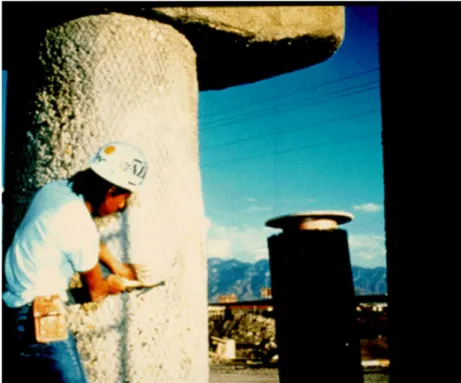
Figure 2.Application of the titanium anode mesh on a column with mechanical fasteners. The
titanium mesh will subsequently be encapsulated with a shotcrete overlay in order to ensure good electrical contact with the concrete structure.
The application of waterproofing membranes is of great benefit on new structures. These membranes prevent, or at least retard, the ingress of chlorides to the reinforcement. But when the chloride content in the concrete in contact with the rebars equals or exceeds the corrosion threshold, membranes will have no significant impact on reducing the corrosion. In concrete heavily contaminated by chlorides, membranes could only reduce corrosion rates if they
completely encapsulated the concrete, thereby preventing any access of oxygen to the steel reinforcement.
Introduction of
Electric Current
Cathodic protection (CP) is the only technique that can prevent corrosion in chloride-contaminated concrete structures. This was demonstrated on experimental systems
installed on reinforced bridges in the early 1970s. The first
commercially viable CP systems came on the market in the 1980s. Therefore, no track record was available to the civil engineering community until recently.
CP reduces corrosion by changing the thermodynamics of the steel, i.e., the chemical potential of the steel in contact with the concrete is changed to make it more inert. This is done by forcing an electrical current at the steel/concrete interface. Most CP systems are impressed current, i.e., the current is impressed by a rectifier and an anode (see Figure 2). The anode should cover as much of the surface of the protected concrete structure as possible in order to improve both the distribution of the current to the reinforcement and the service life of the system.
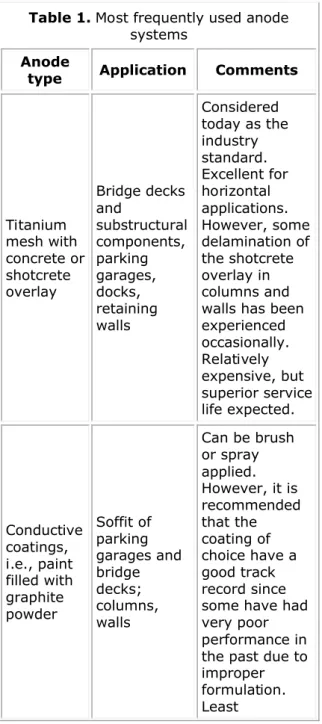
The best anode systems developed so far are listed in Table 1 along with recommended applications and comments.
Table 1. Most frequently used anode systems
Anode
type Application Comments
Titanium mesh with concrete or shotcrete overlay Bridge decks and substructural components, parking garages, docks, retaining walls Considered today as the industry standard. Excellent for horizontal applications. However, some delamination of the shotcrete overlay in columns and walls has been experienced occasionally. Relatively expensive, but superior service life expected. Conductive coatings, i.e., paint filled with graphite powder Soffit of parking garages and bridge decks; columns, walls Can be brush or spray applied. However, it is recommended that the coating of choice have a good track record since some have had very poor performance in the past due to improper formulation. Least
expensive systems, but service life is occasionally inferior depending on the coating quality. However, strongly recommended if scaffolding is not extensive or costly. Conductive coke breeze asphalt Bridge decks
Used with great success by some ministries of transport, especially Ontario. However, it adds extra dead load to the structure. Relatively inexpensive with good performance. Metallized zinc Bridge-deck soffits, columns. Could be used in parking garages (galvanic) Good track record on all systems tested. Long service life predicted. Costly as impressed-current anode, but could be used more affordably as galvanic anode when the concrete is relatively moist and the cover is thin, based on present experimental data.
One system that has gained a great deal of attention in recent years uses metallized zinc. In the metallizing, the zinc is first melted in small droplets by a flame or electric arc; these droplets are subsequently propelled at high velocity by an air jet onto the surface of the concrete. The first metallized-zinc impressed-current CP system was installed in 1983 on the San Rafael Bridge in the Bay of San Francisco, California. A second system was installed in
1985 on the Leslie Street Bridge at the intersection of Highway 401, in Toronto, Ontario. The excellent performance obtained on these two test systems has recently given rise to larger-scale projects using metallized zinc as the anode. More than 12 bridges have been or are in the process of being metallized with zinc. The largest bridge metallized with zinc so far is the Cape Creek Bridge, Devil's Elbow State Park, Oregon, where approximately 100,000 ft2 of concrete have been metallized. A even larger project is presently underway on the Yaquina Bay Bridge, Newport, Oregon, where approximately 175,000 ft2 of concrete are being arc-sprayed with zinc. In the fall of 1992, 30,000 ft2 of a bridge in Toronto are also being zinc-metallized for impressed-current CP.
Metallized-zinc coatings have also opened the door to a new form of CP for reinforced-concrete structures, i.e., galvanic cathodic protection. Galvanic CP is presently being tested on a few bridges in the Florida Keys, at the University of South Florida (see Figure 3), and at the Institute for Research in Construction (IRC). In a galvanic CP system, a sacrificial metal, such as zinc, is put in direct electrical contact with the steel at a few connecting points. The flow of current is induced by the difference in the electromotive force arising between the sacrificial metal and the steel. However, in order for such a system to deliver adequate polarization to the steel for prolonged periods, the moisture content of the concrete should be high or the concrete cover should be as small as possible. This could be the case in several marine structures and in some parking garages. Galvanic CP systems might not provide as much polarization to the steel as current systems. However, because of its simplicity compared to impressed-current systems, galvanic CP using metallized zinc could become an important rehabilitation
technique in the future.
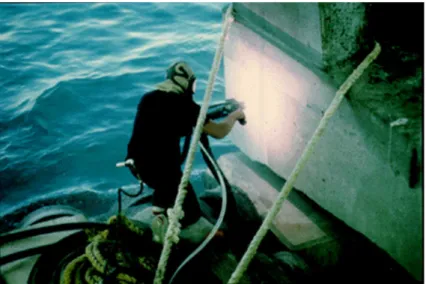
Figure 3.Arc spraying of zinc on a concrete bridge pier in the Florida Keys. In this case the zinc
acts as sacrificial anode, although it is more frequently used in impressed-current systems. Three impressed-current zinc systems have already been installed by the Ministry of Transportation of Ontario in Toronto.
In Canada and the United States alone, more than 500 concrete structures are cathodically protected by impressed-current systems. The best time to apply CP is in the early stages of corrosion before physical distress develops. However, if a bridge is corroded beyond repair, CP is of no benefit. In other cases, extensive delamination and spalling require so much concrete repair that additional installation of the CP system becomes economically unfeasible.
Steel-reinforcement corrosion cannot be mitigated by the more traditional repair techniques. CP has been demonstrated in laboratory experiments and on hundreds of structures to control steel-reinforcement corrosion. However, for an impressed-current CP system to work
successfully, it must be maintained in time by specialists and it must be ensured that the most suitable anode is applied on the reinforced structure to be protected. Metallized zinc is being
increasingly used as the impressed-current anode. It is also being tested as a galvanic anode and if successful, promises a good future for the CP industry.