HAL Id: hal-02933594
https://hal.univ-lorraine.fr/hal-02933594
Submitted on 8 Sep 2020
HAL is a multi-disciplinary open access
archive for the deposit and dissemination of
sci-entific research documents, whether they are
pub-lished or not. The documents may come from
teaching and research institutions in France or
abroad, or from public or private research centers.
L’archive ouverte pluridisciplinaire HAL, est
destinée au dépôt et à la diffusion de documents
scientifiques de niveau recherche, publiés ou non,
émanant des établissements d’enseignement et de
recherche français ou étrangers, des laboratoires
publics ou privés.
challenges and limitations
Maha Deeb, Peter M. Groffman, Manuel Blouin, Sara Perl Egendorf, Alan
Vergnes, Viacheslav Vasenev, Donna Cao, Daniel Walsh, Tatiana Morin,
Geoffroy Séré
To cite this version:
Maha Deeb, Peter M. Groffman, Manuel Blouin, Sara Perl Egendorf, Alan Vergnes, et al.. Using
constructed soils for green infrastructure – challenges and limitations. Soil, European Geosciences
Union (EGU), 2020, 6 (2), pp.413-434. �10.5194/soil-6-413-2020�. �hal-02933594�
https://doi.org/10.5194/soil-6-413-2020
© Author(s) 2020. This work is distributed under the Creative Commons Attribution 4.0 License.
SOIL
Using constructed soils for green infrastructure –
challenges and limitations
Maha Deeb1,6,9, Peter M. Groffman1,3, Manuel Blouin2, Sara Perl Egendorf1,3, Alan Vergnes4, Viacheslav Vasenev7,6, Donna L. Cao3, Daniel Walsh5, Tatiana Morin6, and Geoffroy Séré8
1Advanced Science Research Center, Graduate Center, City University of New York, 10031 New York, NY, USA
2Agroécologie, AgroSup Dijon, INRA, University of Bourgogne Franche-Comté, 21078 Dijon, France 3Department of Earth and Environmental Sciences, Brooklyn College, City University of New York,
11210 Brooklyn, NY, USA
4Department of Biology, Ecology and Environment, Université Paul-Valéry (Montpellier 3), 34090 Montpellier, France
5Lamont-Doherty Earth Observatory, Columbia University, 10964 Palisades, NY, USA 6New York City Urban Soils Institute, Brooklyn College, City University of New York,
11210 Brooklyn, NY, USA
7Department of Landscape Design and Sustainable Ecosystems, Peoples’ Friendship University of Russia (RUDN), 117198 Moscow, Russia
8Laboratoire Sols et Environnement, Université de Lorraine, INRA, UMR 1120, 54518 Vandœuvre-lès-Nancy, France
9Laboratoire Interdisciplinaire des Environnements Continentaux, Université de Lorraine, UMR 7360 CNRS, 57070 Metz, France
Correspondence:Maha Deeb ([email protected])
Received: 10 November 2019 – Discussion started: 13 December 2019 Revised: 14 July 2020 – Accepted: 29 July 2020 – Published: 8 September 2020
Abstract. With the rise in urban population comes a demand for solutions to offset environmental problems caused by urbanization. Green infrastructure (GI) refers to engineered features that provide multiecological func-tions in urban spaces. Soils are a fundamental component of GI, playing key roles in supporting plant growth, infiltration, and biological activities that contribute to the maintenance of air and water quality. However, urban soils are often physically, chemically, or biologically unsuitable for use in GI features. Constructed Technosols (CTs), consisting of mixtures of organic and mineral waste, are man-made soils designed to meet specific re-quirements and have great potential for use in GI. This review covers (1) current methods to create CTs adapted for various GI designs and (2) published examples in which CTs have been used in GI. We address the main steps for building CTs, the materials and which formulae should be used to design functional CTs, and the technical constraints of using CTs for applications in parks and square lawns, tree-lined streets, green buffer for storm water management, urban farming, and reclaimed derelict land. The analysis suggests that the composition and structure of CTs should and can be adapted to available wastes and by-products and to future land use and en-vironmental conditions. CTs have a high potential to provide multiple soil functions in diverse situations and to contribute to greening efforts in cities (and beyond) across the world.
1 Introduction
1.1 Environmental issues in urban areas
Urban areas are exposed to multiple global- (e.g., climate change and biodiversity loss; Czech et al., 2000; McKin-ney, 2002; Shochat et al., 2006; Zalasiewicz et al., 2008) and local-scale (e.g., urban heat island, increased air pollu-tion, and altered disturbance regimes; Bridgman et al., 1995; Lovett et al., 2000; Rao et al., 2014) environmental changes (Pickett et al., 2011). Urban development decreases forest and agricultural areas (Geneletti et al., 2017), which reduces ecosystem benefits (Foley et al., 2005) due to soil sealing and the alteration of soil properties (Pistocchi et al., 2015; Scalenghe and Marsan, 2009). Urban development fragments landscapes and leads to a loss of connectivity between habi-tats (Haddad et al., 2015; Madadi et al., 2017; Vergnes et al., 2012). These changes have marked effects on multiple ecosystem services linked to air and water quality (Cariolet et al., 2018; Doni et al., 2018; Jiang et al., 2018; Khan et al., 2018; Latif et al., 2018; Maurer et al., 2019), biodiversity (Guilland et al., 2018; McKinney, 2008; Pouyat et al., 2010), and human health and well-being (Das et al., 2018; Halonen et al., 2015; Säumel et al., 2012).
1.2 Green infrastructures: definition, benefits, and challenges
Green infrastructure has emerged as an important approach to urban environmental issues over the past 20 years. Green infrastructure is defined as engineered environmental design features built in interconnected natural and urban spaces to provide multiple ecological functions (Maes et al., 2015). Green infrastructure features can be completely man-made, such as green roofs and green walls, or can be based on an existing ecosystem with some intervention, such as parks, urban farms, and bioswales. Ecological functions associ-ated with green infrastructure include habitat for biodiver-sity (Vergnes et al., 2012), improving air and water quality (Pugh et al., 2012), reducing storm water flows into sanitary sewer networks (Lucas and Sample, 2015), filtering noise, microclimate stabilization (O’Neill et al., 2018), food supply (Specht et al., 2014), improving psychological and physio-logical human health (Tzoulas et al., 2007), and strengthen-ing social relationships by attractstrengthen-ing people to outdoor spaces (Coley et al., 1997). Economic advantages include increased tourism, reduced energy use for indoor temperature regula-tion, lower wastewater treatment costs, and increased prop-erty values and tax revenue (Mell et al., 2016).
Due to its ability to supply a wide range of ecosystem ben-efits (Flores et al., 1998; Kazemi et al., 2011; Keeley et al., 2013; Lee and Maheswaran, 2011; Opdam et al., 2006; Sand-ström, 2002), green infrastructure has attracted significant at-tention in both developed (Brunner and Cozens, 2013; Euro-pean Environment Agency, 2017; Davis et al., 2009; Hall,
2010; Kabisch and Haase, 2013; Lewis, 2005; Pauleit et al., 2005) and developing (Akmar et al., 2011; Byomkesh et al., 2012; Jim, 2005; Qureshi et al., 2010; Rafiee et al., 2009) countries and is now an important component of city plan-ning around the world (Tan et al., 2013; Zhao et al., 2013; Zhou and Wang, 2011). Interest in the use of green infrastruc-ture is likely to increase along with the ongoing expansion of cities.
There are numerous challenges associated with the devel-opment of green infrastructure (Haaland and van den Bosch, 2015; Jim, 1998). Building green infrastructure in densifying cities may pose challenges as there may be a conflict of in-terest among officials with regard to using the land for green spaces as opposed to residential, commercial, or service uses (Haaland and van den Bosch, 2015). Building a new green space requires a large of amount of financial and natural re-sources such as human labor, natural topsoils, and other im-ported materials. These costs are challenging because there is no easily measurable value for the economic benefits of green infrastructure (Haaland and van den Bosch, 2015).
Green infrastructures must provide suitable environmen-tal conditions to foster the growth of vegetation. There is a need for sufficient sunlight and high-quality water for plants to grow, low foot traffic to avoid soil compaction, and an ad-equate surface area for tree growth. There is a potential for the high mortality of plants due to suboptimal levels of water, light, and nutrients, contamination, compaction, and other ur-ban stressors.
1.3 Need for functional soils in urban areas
Soils in urban areas, especially nonsealed ones, are highly heterogeneous, varying from natural (e.g., relict forest soils) to fully artificial (De Kimpe and Morel, 2000; Huot et al., 2017). Many urban soils are derived from a combination of exogenous, anthropogenic (so-called “technic” materials), and natural geologic parent materials (Lehman, 2006). Urban soils have altered disturbance regimes from human activities (Godefroid and Koedam, 2007) and are frequently exposed to high volumes of storm water surface runoff (McGrane, 2016). As a consequence, urban soils frequently exhibit poor biological, physical, and chemical conditions that directly af-fect plant growth and reduce their ability to provide multiple ecological functions (De Kimpe and Morel, 2000; Morel et al., 2014).
Soils are a fundamental component of green infrastructure, playing key roles in supporting plant growth, infiltration of runoff, and microbial activities relevant to nutrient cycling and pollutant degradation (Deeb et al., 2018; Keeley et al., 2013). To ensure the development of vegetation and offset the low fertility of urban soils, large quantities of topsoil are imported from surrounding agricultural or forest areas (e.g., 3 million of m3yr−1 in France; Rokia et al., 2014). Taking soil from rural areas for urban use is not sustainable as it is costly and is accompanied by environmental risks, e.g.,
re-lease of carbon dioxide (Walsh et al., 2018, 2019). Soil is a complex ecosystem and a limited resource that forms slowly, e.g., the rate of soil production has been estimated to be be-tween 20–100 m My−1(i.e., 2–10 mm per century; Heimsath et al., 1997). Thus, soil cannot be considered to be a readily renewable resource that can be excavated and easily trans-ported from rural to urban areas (Walsh et al., 2019). These concerns have stimulated interest in the development and use of constructed soils for multiple urban uses.
1.4 Existing solutions for providing functional soils in cities
Solutions to the challenges of greening cities depend on the degree and type of soil degradation, the affected area, and the size of the project. The most widely applied solution is the complete removal of the topsoil and replacement with nat-ural, arable soil imported from nonurban areas (Dick et al., 2006; Dickinson, 2000). As noted above, it is expensive to transport soil, and the removal of the old soil creates a prob-lematic waste product. This solution is particularly difficult to implement in developing countries (Bradshaw, 1997; Hüttl and Bradshaw, 2000).
Another, less common, solution to urban soil problems that has been applied in specific cases on smaller scales is using organic amendments present in the city, such as composts, sludge, industrial by-products, and biosolids, to improve topsoil characteristics (Larney and Angers, 2012). Adding organic wastes to restore the ecosystem functions has received great attention in different scientific studies (Basta et al., 2016; Gómez-Sagasti et al., 2018; Kumar et al., 1985; McGeehan, 2012). Moreover, inexpensive sources of waste and by-products have become increasingly available in re-cent years, allowing for the improvement of soil quality while reducing landfill material (Vetterlein and Hüttl, 1999). The main drawback of this solution is concern about the trans-fer of pollutants, especially Pb, from wastes to groundwater and runoff and subsequently to organisms (Battaglia et al., 2007; Calace et al., 2005). Few studies have addressed the long-term sustainability of reclamation by organic waste (Ba-cholle et al., 2006; Nemati et al., 2000; Vetterlein and Hüttl, 1999; Villar et al., 1997). Key concerns in this regard are that composting is not widely practiced or integrated in policies worldwide, and the amount of available organic waste varies widely within and between cities (Narkhede et al., 2010).
Adding phosphate-bearing amendments such as chemical fertilizers or fish bone waste has been found to stabilize lead in urban agriculture (Ruby et al., 1994). Phosphate amend-ments bond to unstable lead and form insoluble pyromorphite minerals (Ma et al., 1995; Paltseva et al., 2018a, b). The long-term stability of these minerals is uncertain, however, as they can change with soil chemical conditions. Moreover, adding phosphate can mobilize arsenic through competitive anion exchange (Creger and Peryea, 1994; Paltseva et al., 2018a). In addition, chemical fertilizers can have a variety of negative
impacts on air and water quality in the surrounding environ-ment.
Using native instead of nonnative plants has been pro-posed as a reclamation solution in urban landscapes (Ries et al., 2001) for storm water management (Bartens et al., 2008; Culbertson and Hutchinson, 2004; Lucas and Green-way, 2007; Selbig and Balster, 2010), land use sustainabil-ity (Dornbush, 2004; O’Dell et al., 2007), conservation of wildlife habitat (Fletcher and Koford, 2002), erosion control (Beyers, 2004), carbon sequestration (Isaacs et al., 2009), and soil remediation (Swedo et al., 2008) and stabilization. Planting native species has an indirect influence on soils by promoting biodiversity and creating resilient communi-ties. However, there is no guarantee that native plants will grow in soils with significant anthropogenic impacts (Sud-ing et al., 2004). Moreover, this solution has been practiced mostly to restore natural landscapes and to reverse species loss (Richardson et al., 2007).
1.5 Opportunities to construct new soils
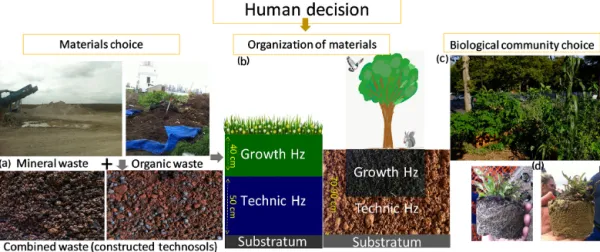
The “new” idea of building constructed Technosols is based on combining the biotic and abiotic characteristics of di-verse materials to produce specific functions and benefits (Fig. 1). Technosols are defined as deliberate mixtures of organic and mineral wastes and by-products constructed to meet specific requirements (Craul, 1999; Damas and Coulon, 2016; Rokia et al., 2014; Séré et al., 2008; Yilmaz et al., 2018). The process of constructing Technosols includes ex-isting approaches such as recycling organic materials or in-cluding native plants. The use of easily available materials provides economic benefits (Walsh et al., 2019), has limited impact on natural resources, and makes use of waste materi-als. Constructed Technosols can be created as new buildings are constructed from excavation and demolition waste, sav-ing on labor and transportation costs for both waste disposal and the importation of soils. Because the overall cost of con-structed soils is lower, green spaces built with concon-structed Technosols can be more easily integrated with city planning. These advantages can be particularly important in cities or neighborhoods with fiscal constraints, thus alleviating some environmental justice issues.
In the sections below, we review (1) current methods for creating constructed Technosols (CTs) adapted for various green infrastructure designs and (2) published examples in which CTs have been used in green infrastructure.
2 Materials and methods
2.1 What is a constructed Technosol?
Anthropization is the process of soil formation in urban en-vironments. The World Reference Base for Soil Resources (IUSS, 2015) defines Technosols as soils which contain greater than 20 % artificial materials by volume and are
Figure 1.Diagram presents abiotic and biotic components of constructed Technosols. (a) Example of waste mixture during Maha Deeb’s Master’s thesis. (b) Mixture organized in different layers, depending on the land use (SITERRE project). (c) Constructed Technosols for urban farming (carbon sponge project). (d) Constructed Technosols built by the youth club for research and development in the Lycée du Paysage et de l’Environnement (High School of Landscape and Environment) in Vaujours, France. Note: Hz – horizon.
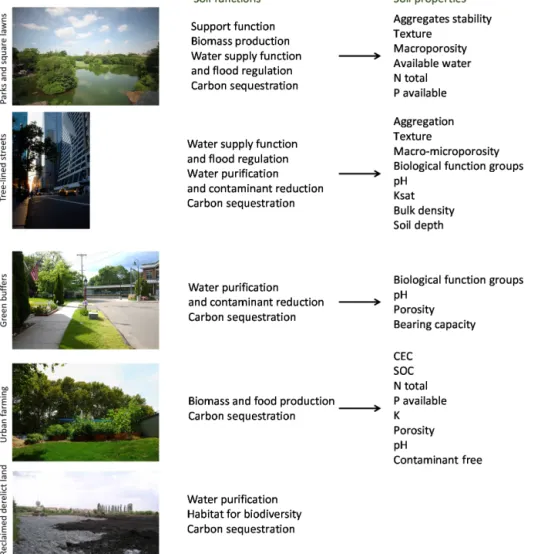
within the first 100 cm of the land surface. At the moment there is no universal definition of constructed Technosols. Séré et al. (2008) defined the construction of a Technosol as a process “using wastes and industrial by-products which are formulated and stacked in layers to build a new soil profile over in situ degraded substrates”. Prokofyeva et al. (2011), on the other hand, define constructed Technosols (“construc-tozems”) as bodies of soil with complicated stratification, greater than 40–50 cm in thickness, that are created for spe-cial purposes such as salt protection in semi- and severely dry areas (Smagin, 2012). In this review, we will define con-structed Technosols as the result of the voluntary action of creating a “soil” (soil made by humans) using artefacts (i.e., technogenic materials, particular wastes, or seminatural terials including deep materials such as sediments or soil ma-terial from C horizons) and intentionally shaping them to provide a suitable environment for vegetation growth. The choice of the vegetation may be for aesthetic (greenery), pro-tective (wind erosion and storm water), or productive (agri-culture) roles (Fig. 1). This new soil could be created for use in multiple green infrastructure designs including squares and parks, accompaniments for public buildings (tree-lined streets, flower beds, verges, pocket spaces, and green roofs), accompaniments for traffic lanes (roads and railway lines), storm water management, urban farming, household yards, and abandoned land reclamation (Fig. 2).
2.2 Bibliographic search
Structured and semistructured searches were conducted us-ing major scientific databases (namely, Scopus, Web of Knowledge, and Google Scholar) along with appropriate cross-referencing to obtain supporting literature. Additional searches were based on the authors’ own knowledge of
po-tentially relevant work and their experience with constructed Technosols. Structured searches were carried out with the following keywords (title, abstract, and keywords): con-structed Technosols, engineered soils, Anthroposols, green space, parks, green infrastructure, green roof, storm water management, street trees, ecosystem services, densification, abandoned land, food security, soil functions, biodiversity, urban farming, recycling, landfill, and waste management.
The literature considered for the review was published in English, French, and Russian. Other texts that were difficult to translate or locate were excluded from this review.
A total of five land uses were chosen for this review based on the land use classification and evaluation provided by Pan-duro et al. (2013) that included the following eight land uses: parks, common area apartments, common area houses, sports fields, agriculture fields, green buffers, nature, and lakes. We merged the first three land uses into a single group, namely “parks and squares with lawns”, assuming that these would create similar conditions for the use of constructed Tech-nosols. Sports fields were not included as they have already been discussed in the literature (Puhalla et al., 1999). Nature and lakes were excluded as the application of constructed Technosols is not needed in these land uses. Degraded land and tree-lined streets were added as complementary indepen-dent categories because they are commonly present in urban areas.
Figure 2.Soil properties to be considered for fulfilling soil functions provided by constructed Technosols in different land uses.
3 Results and discussion
3.1 Construction of Technosols for different land uses in green infrastructure
3.1.1 Characteristics needed to fulfill green infrastructure requirements
Green infrastructure features require functional soils or adapted substrates in order to be fully operational. Character-istics that should be considered for the construction of Tech-nosols include the following:
– Adapted chemical fertility (Rokia et al., 2014) suitable for specific vegetation with specific features (e.g., trees, lawns, grasslands, and flower beds) is needed;
– Sufficient soil depth for vegetation anchorage (Marié and Rossignol, 1997), e.g., trees with deep roots and high root system density, is required;
– Compatible concentrations of contaminants related to the actual use of the public spaces (Egendorf et al.,
2018) in terms of health risks (e.g., inhalation and soil ingestion) and land use (e.g., urban agriculture) are needed;
– Compatible bearing capacity for trampling, parking, or vehicle traffic (Grabosky and Basset, 1998) is needed; – Permeable soils are required for water infiltration in
or-der to limit floods (Liu et al., 2014);
– Sufficient water storage capacity to support green lawns and ornamental plants with limited irrigation is needed (Smagin and Sadovnikova, 2015; Vasenev et al., 2017); – Low bulk density and shallow root system depth (Vi-jayaraghavan, 2016) are required for specific substrates that are used on buildings (e.g., green roof);
– Minimal long-term maintenance, e.g., the addition of organic matter and frequent watering, is not necessary; – Stable soil structure is often desired to limit erosion and
– High hydraulic conductivity is required for land uses such as green roofs and storm water management sys-tems;
– Moderate ratios of mineral and organic content, gener-ally refraining from the addition of more than 30 % or-ganic matter is desired (Deeb, 2016a; Grosbellet, 2008; Vijayaraghavan, 2016) to avoid excessive loss of or-ganic matter by oxidation (CO2emissions) or leaching, which will change soil volume.
These characteristics vary depending on the intended uses and functions of the green infrastructure in question (Fig. 2; Table 1). For example, (i) tree-lined streets should have stronger physical support functions than green roofs, (ii) food production in community gardens requires parent materi-als with very low contamination, and (iii) organic contami-nant decomposition and water infiltration are important for bioswales (green infrastructure for storm water manage-ment).
3.1.2 Use of waste materials
The generation of waste is a negative anthropogenic impact – especially in urban areas, which are estimated to produce 2.2 billion tons of solid waste per year by 2025 with a cost of USD 375.5 billion (Wilson and Velis, 2015). Efforts to min-imize solid waste disposal in landfills and to encourage re-cycling are increasingly common (Krook et al., 2012). Con-structed Technosols are a viable solution for waste manage-ment.
There is a huge diversity of wastes and by-products gen-erated in cities. However, not all of them are considered rel-evant for the construction of Technosols (Table 2). Some re-searchers (Deeb et al., 2016a, b, 2017; Pruvost et al., 2018; Walsh et al., 2018, 2019) have focused on construction and demolition waste (CandD) mixed with organic waste because CandD debris generate high percentages (around 35 %) of the total solid waste worldwide (Hendriks and Pietersen, 2000). In Europe, CandD debris comprise 30 % of total waste (Eu-ropean Commission, 2020). Walsh et al. (2019) showed that an estimated 1.7 × 10⁶t of unused, uncontaminated native soil, consisting mainly of glacial sediments, is generated each year from building construction in New York City alone. Disposal of this clean material requires 60 000 truck trans-ports and 8.7 × 10⁶km of travel distance, using 4.3 × 10⁶L of petroleum products, emitting 11 800 t of CO2, and cost-ing over USD 60 million per year. Despite the large volumes of CandD waste produced, only small fractions are generally recycled (Gálvez-Martos et al., 2018).
The SITERRE project (Damas and Coulon, 2016), one of the first and largest projects to create constructed Technosols for greening urban spaces, was based on the European cata-logue of 836 urban waste types. The following three specific criteria were used to choose wastes for use in constructed Technosols:
1. Nontoxic: the waste should not be classified as danger-ous for human health or living organisms.
2. Easy to handle: liquid and pasty wastes were not consid-ered, and only granular solid materials could be used. 3. Suitable: the selected wastes have to generate minimal
disturbances to the local population and also be compat-ible with the lifestyle in densely populated urban areas in terms of their appearance, i.e., organoleptic criteria such as smell or color.
After satisfying the fundamental criteria above, the se-lected waste should additionally comply with at least one of the following:
1. Fertility: the materials should contribute positively to the germination or development of vegetation.
2. Capacity: the materials should have a positive impact in terms of geotechnical properties, i.e., soil stability, plasticity, and cohesion.
Based on these five criteria, five mineral and six organic by-products were chosen (Damas and Coulon, 2016), in-cluding (i) materials from excavated acidic soil deep hori-zons, (ii) materials from excavated basic soil deep horihori-zons, (iii) bricks, (iv) concrete, and unsorted demolition rubble, (v) track ballast (the material upon which railroad ties are laid), (vi) green wastes, (vii) sewage sludge, (viii) green waste compost, (ix) sewage sludge compost, (x) paper mill sludge, and (xi) street-sweeping wastes. Other researchers have investigated different waste materials including coffee grounds (Grard et al., 2015), backfill waste (Vergnes et al., 2017), thermally treated industrial soil (Séré et al., 2010), re-cycled ferrihydrites (Flores-Ramírez et al., 2018), and glass (NYCGIP, 2011).
A specific formula and/or mixture of waste ingredients must be determined to achieve the expected functions. A to-tal of 25 combinations were made by Rokia et al. (2014) us-ing the wastes selected in the SITERRE project, which were either binary mixtures at 5 different ratios (0/100, 20/80, 50/50, 80/20, and 100/0; volume/volume) or ternary mix-tures with 60 % v/v coarse mineral material and 40 % v/v mixtures of organic and mineral mixtures. While no single-stream waste material was adequate as a soil or horticul-tural substrate in isolation, the mixtures produced a range of chemical and physical properties. Both brick waste and ex-cavated deep horizons mixed with compost produced physi-cally and chemiphysi-cally fertile substrates, based on the chemical and physical characteristics of fertile soils – but not on their ability to sustain plant growth (Rokia et al., 2014). Mathe-matical models were developed to simulate the characteris-tics of mixtures from the characterischaracteris-tics of single materials (Rokia et al., 2014).
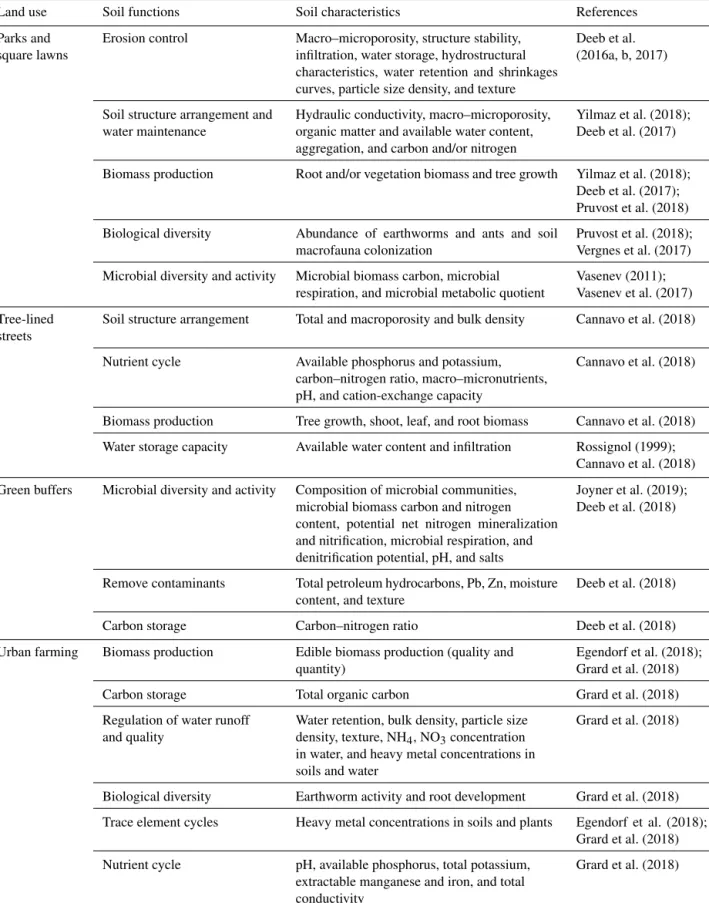
Table 1.Soil characteristics of constructed Technosols considered for assessing soil functions by different land uses of green infrastructure, as provided by the literature.
Land use Soil functions Soil characteristics References Parks and
square lawns
Erosion control Macro–microporosity, structure stability, infiltration, water storage, hydrostructural characteristics, water retention and shrinkages curves, particle size density, and texture
Deeb et al. (2016a, b, 2017)
Soil structure arrangement and water maintenance
Hydraulic conductivity, macro–microporosity, organic matter and available water content, aggregation, and carbon and/or nitrogen
Yilmaz et al. (2018); Deeb et al. (2017)
Biomass production Root and/or vegetation biomass and tree growth Yilmaz et al. (2018); Deeb et al. (2017); Pruvost et al. (2018) Biological diversity Abundance of earthworms and ants and soil
macrofauna colonization
Pruvost et al. (2018); Vergnes et al. (2017) Microbial diversity and activity Microbial biomass carbon, microbial
respiration, and microbial metabolic quotient
Vasenev (2011); Vasenev et al. (2017) Tree-lined
streets
Soil structure arrangement Total and macroporosity and bulk density Cannavo et al. (2018)
Nutrient cycle Available phosphorus and potassium, carbon–nitrogen ratio, macro–micronutrients, pH, and cation-exchange capacity
Cannavo et al. (2018)
Biomass production Tree growth, shoot, leaf, and root biomass Cannavo et al. (2018) Water storage capacity Available water content and infiltration Rossignol (1999);
Cannavo et al. (2018) Green buffers Microbial diversity and activity Composition of microbial communities,
microbial biomass carbon and nitrogen content, potential net nitrogen mineralization and nitrification, microbial respiration, and denitrification potential, pH, and salts
Joyner et al. (2019); Deeb et al. (2018)
Remove contaminants Total petroleum hydrocarbons, Pb, Zn, moisture content, and texture
Deeb et al. (2018)
Carbon storage Carbon–nitrogen ratio Deeb et al. (2018) Urban farming Biomass production Edible biomass production (quality and
quantity)
Egendorf et al. (2018); Grard et al. (2018) Carbon storage Total organic carbon Grard et al. (2018) Regulation of water runoff
and quality
Water retention, bulk density, particle size density, texture, NH4, NO3concentration
in water, and heavy metal concentrations in soils and water
Grard et al. (2018)
Biological diversity Earthworm activity and root development Grard et al. (2018) Trace element cycles Heavy metal concentrations in soils and plants Egendorf et al. (2018);
Grard et al. (2018) Nutrient cycle pH, available phosphorus, total potassium,
extractable manganese and iron, and total conductivity
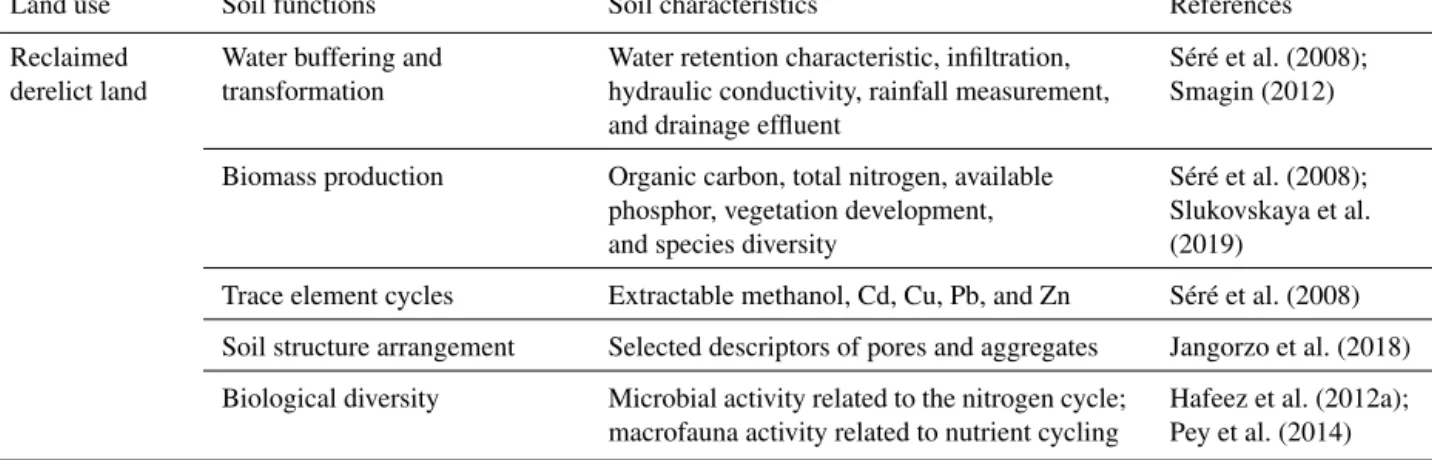
Table 1.Continued.
Land use Soil functions Soil characteristics References Reclaimed
derelict land
Water buffering and transformation
Water retention characteristic, infiltration, hydraulic conductivity, rainfall measurement, and drainage effluent
Séré et al. (2008); Smagin (2012)
Biomass production Organic carbon, total nitrogen, available phosphor, vegetation development, and species diversity
Séré et al. (2008); Slukovskaya et al. (2019)
Trace element cycles Extractable methanol, Cd, Cu, Pb, and Zn Séré et al. (2008) Soil structure arrangement Selected descriptors of pores and aggregates Jangorzo et al. (2018) Biological diversity Microbial activity related to the nitrogen cycle;
macrofauna activity related to nutrient cycling
Hafeez et al. (2012a); Pey et al. (2014)
3.1.3 Technical constraints
There are constraints that need to be considered when plan-ning to use constructed Technosols for developing green in-frastructure. Some waste materials are extremely heteroge-neous and thus difficult to characterize to ensure the safety of the environment and public health. In addition, differ-ent materials offer a wide range of physicochemical prop-erties. For example, even though brick and organic matter showed optimal chemical characteristics for plant growth in the SITERRE project (Rokia et al., 2014), these materials showed low potential for aggregation compared to excavated deep horizon material combined with organic matter (Vidal-Beaudet et al., 2016). Fourvel et al. (2018) compared six types of degraded excavated sediments with heterogeneous characteristics from France and found that biomass produc-tion varied greatly among the sediment types.
Mixed waste materials need a specific time period to form a stable structure; thus, erosion, runoff, and compaction are risks in the early stages of soil formation. The establishment of plants with high-density root systems (Deeb et al., 2017) or building erosion-control barriers around the constructed Technosols could reduce these risks.
Fresh organic waste can be problematic as it can have a toxic effect on plant growth (Yilmaz et al., 2016), some-times by creating anoxic conditions. Thoughtful choices, e.g., using mature compost or mixing in mineral material that drains well (such as sand) can avoid anoxic conditions. Even with these choices, the addition of organic material must be specific to its intended land use as amending or-ganic matter on a regular basis may lead to the accumulation of heavy metals over time. To mitigate this limitation, addi-tional organic matter should be avoided over time to improve Technosol quality and maintain the integrity of established soils. If organic waste must be added, organic matter with heavy metal contamination and pollutants may be mixed with other nontoxic waste ingredients in calculated proportions to lower the overall concentration into acceptable ranges. These
ranges will vary according to the land use and local regu-lations. For example, total petroleum hydrocarbons should not exceed 5000 mg kg−1, as defined in the European Union (Pinedo et al., 2013). In New York City, heavy metals and or-ganic contamination limits strictly depend on land use (NY-CRR, 2017).
Microplastics are another source of contamination that should be considered when building Technosols. Although the number of current studies is limited, plastic contamina-tion may negatively affect plant growth, soil organisms, and human health through integration in the food chain (Horton et al., 2017). Studies show that the use of sewage sludge compost as fertilizer increases microplastic contamination in soils (Corradini et al., 2019). To prevent microplastic con-tamination, sewage sludge compost should be avoided in high quantities, should only be used in low ratios, and should be tested for microplastic contamination before application.
Finally, one of the most important limits is social rejec-tion, especially since some organic waste (e.g., sewage) can have an objectionable odor. This problem can be avoided by applying such materials in deeper horizons. However, find-ing a solution for the general unpopularity of usfind-ing waste for developing green spaces could be more challenging as it re-quires specific education, observation over time, cooperation between biophysical and social science disciplines, and ac-tive engagement with communities. It can be expected that the increasing reuse of materials considered to be waste will influence norms and policies regulating their production in a way which could ease their recycling in the future.
3.1.4 Pedogenesis
The process of pedogenesis (soil formation), which is strongly controlled by local environmental conditions, dic-tates that the age of the Technosols is a key driver of their properties (Hui et al., 2017). Séré et al. (2010) demonstrated that artificial soils underwent pedogenic processes similar to natural soils (e.g., chemical weathering, soil structure
evo-Table 2.List of wastes previously used for constructed Technosols in the literature and their main characteristics.
Waste Main physical and/or chemical characteristics Reference Mineral Backfill Coarse grain size (>2 mm), basic or acidic pH
depend-ing on origin, and poor in nutrients.
Vergnes et al. (2017)
Railway ballast Coarse grain size (>2 mm), good mechanical resistance, basic pH (>7.5), very poor in nutrients, and good bearing capacity.
Yilmaz et al. (2018)
Bricks Coarse grain size (>2 mm), low mechanical resistance, basic pH (>7.5), poor in nutrients, and good bearing capacity.
Rokia et al. (2014); Vidal-Beaudet et al. (2016);
Yilmaz et al. (2018) Concrete waste Coarse grain size (>2 mm), average mechanical
resis-tance, basic pH (>7.5), nonhomogeneous waste, poor in nutrients, and good bearing capacity.
Yilmaz et al. (2018); Pruvost et al. (2018)
Demolition rubble Sandy to coarse grain size, pH on eluate with basic ten-dency (>7.5), and very poor in nutrients.
Yilmaz et al. (2018)
Excavated subsoil Sandy to coarse grain size, pH on eluate with basic tendency or acidic, depending on their origin, and poor in nutrients.
Egendorf et al. (2018); Vidal-Beaudet et al. (2016) Dredged sediment Sandy to coarse grain size, possible or frequent
pollution, basic or acidic pH, depending on origin, poor to very poor in nutrients, and high water infiltration.
Fourvel et al. (2018)
Thermally treated industrial soil
Depends on origin. Jangorzo et al. (2013); Séré et al. (2010) Recycled ferrihydrites Stable coating. Flores-Ramírez
et al. (2018) Glasses Coarse grain size (>2 mm), extremely poor in
nutrients, nonfavorable for macrofauna activities, and applicable on horizon C for water storage.
NYCGIP (2011)
Organic Green wastes High organic carbon content, high total nitrogen, high cation exchange capacity (CEC), presence of fine ma-terials, low bulk density, high available water capacity, and presence of macrofauna.
Yilmaz et al. (2018)
Green waste compost High organic carbon content, high total nitrogen, high CEC, presence of fine materials, low bulk density, high available water capacity, and presence of macrofauna.
Egendorf et al. (2018); Pruvost et al. (2020); Séré et al. (2010); Grosbellet et al. (2011); Vidal-Beaudet et al. (2012) Crushed wood from
public spaces
High organic carbon and total nitrogen, low bulk density, and high available water capacity.
Grard et al. (2015)
Coffee grounds High organic carbon and total nitrogen, good potassium content, low bulk density, high available water capacity, and low acidity.
Grard et al. (2015)
Sewage sludge compost Extremely high available P, high CEC, organic carbon, total nitrogen, and K. Possible presence of pollutants and fine materials and high available water capacity.
Vidal-Beaudet et al. (2016);
Yilmaz et al. (2018) Paper mill sludge High organic carbon, presence of fine materials,
extremely low bulk density, and high available water capacity.
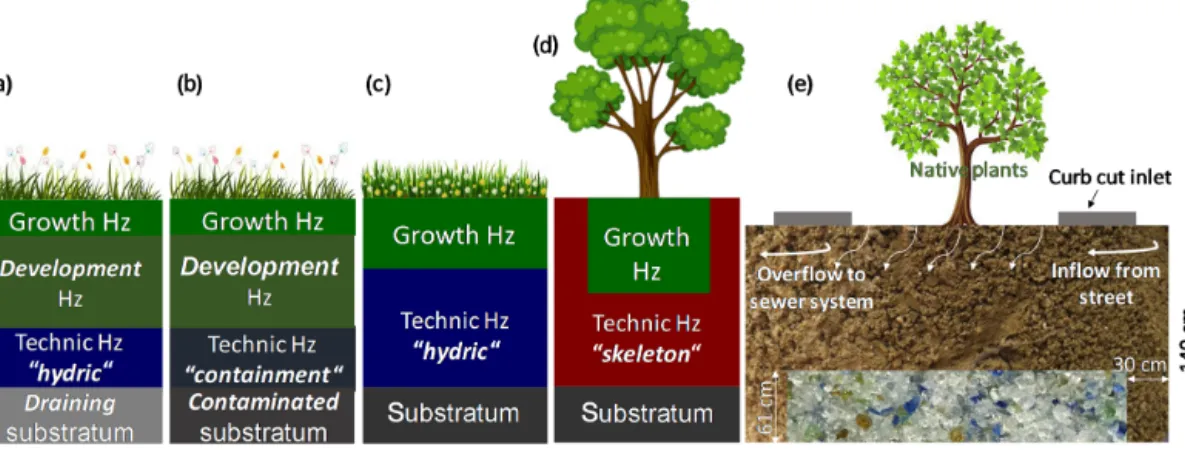
Figure 3.Examples of the organization of horizons in constructed Technosols noted in the literature for (a–b) extensive grassland (Biotech-nosol project), (c) parks and square lawns, (d) tree-lined streets (c and d from the SITERRE project), and (e) the storm water management system (DEPNY, 2010). Note: Hz – horizon.
lution, and horizonation) and Deeb et al. (2016a) showed that after one cycle of humidification (1 week in labora-tory conditions), constructed Technosols were able to de-velop hydrostructural behaviors similar to natural soils. Af-ter 5 months, the same Technosols showed a high ability to aggregate and, in some cases, enrich the carbon content of particular size fraction of aggregates (Deeb et al., 2017). High mineralization of organic matter may occur in the early stages of the pedogenesis of constructed Technosols, espe-cially when a high quantity of organic matter is used (Gros-bellet, 2008). Because the loss of organic matter will vary with environmental conditions, modifying the design of a constructed Technosol could be a solution. For example, in arid climates where the risk of hydromorphy is low, one can add a higher concentration of organic matter in subsurface deep horizons than in surface horizons so that organic mat-ter will be protected from oxidation and will improve the water availability surrounding the root system. Establishing an active plant community as an internal source of organic matter and as a driver of multiple biotic and abiotic interac-tions is also important (Deeb et al., 2016b; Jangorzo et al., 2018, 2014; Pey et al., 2013a, 2014). A 3-year monitoring plan of carbon balance in Technosols from Moscow, Russia, showed substantial carbon release during the first months af-ter construction, which was almost completely fixated in the next 3 years by carbon input from the root biomass growth (Shchepeleva et al., 2017, 2019). Given the specific growth requirements of different species, plant selection must be done with great care (Pruvost et al., 2018).
3.2 Construction of Technosols for specific land uses in green infrastructure
3.2.1 Parks and square lawns
The majority of studies of implementing parks or squares at-tempt to mimic natural soils by constructing Technosols with
one or two distinct horizons. Horizon A (growing horizon) is generally designed to support germination and the initial growth of grasses; as a result, high amounts of organic wastes are often used as dominant ingredients. Horizon B (technical horizon) is commonly designed to provide high storm water retention and to prevent the leaching of organic carbon and nitrate (Fig. 3a).
Deeb et al. (2016a, b, c, 2017) defined the optimal waste mixtures to fulfill specific soil functions such as erosion control, carbon and water storage, structural stability, and biomass production for the growing horizon. These authors built constructed Technosols under specific climate condi-tions and mixed different amounts of compost (0 %, 10 %, 20 %, 30 %, 40 %, and 50 %; v/v) with demolition waste to optimize the production of a grass, namely Lolium perenne. Depending on the desired function of the soils, different ra-tios of compost will complement certain soil functions more than others. For example, biomass production generally in-creases with increasing compost ratios. Structural stability was also found to increase with compost ratios but only in the presence of plants and macrofauna, the main drivers of soil structure. In terms of hydrostructural properties, the mixtures ranging from 20 % to 40 % compost exhibited similar char-acteristics. Therefore, it may be unnecessary to use excessive amounts of compost to achieve optimal available water con-tent in macro- and micropores. The interaction between par-ent materials (compost ratio) and biota played a major role in water storage and available water, explaining 39 % of the observed variance of these functions.
Other organic parent materials, such as uncomposted green waste (tree and grass cuttings) or urban sewage sludge, have also been evaluated. Yilmaz et al. (2018) studied four constructed Technosols for the development of parks, squares, lawns, and trees in in situ lysimeters. The artificial soils were either planted with trees (Acer platanoides) or rye-grass (Lolium perenne L.). The authors studied specific soil
functions such as soil structure arrangement and water main-tenance through analyzing hydraulic conductivity, macro– microporosity, organic matter content, and water availability. The results demonstrated that, compared to natural soils, con-structed Technosols provided high porosity, abundant water storage for plant use, and a high production of trees and rye-grass, likely due to the high organic matter content and soil pH of the Technosols. The study concluded that constructed Technosols have the capability to support vegetation growth for urban greening.
Our analysis of the results from previous studies sup-ports the recommendation of using a soil mixture with 20 % to 30 % compost for parks and lawns to avoid mineraliza-tion and nutrient leaching. In addimineraliza-tion, because macrofauna and macroflora have a positive effect on structural stability, porosity, and carbon storage, it is recommended to integrate biota, e.g., earthworms, as soon as possible when planning to build parks with constructed Technosols (Deeb et al., 2016c, 2017). Several ways exist for integrating biota; thus, one should conserve macrofauna in the rare cases where it is al-ready present in materials. When absent, one could also favor its recolonization from populated areas by planning ecologi-cal corridors or by inoculation with soil blocks or ex situ bred populations (Blouin et al., 2013). Vergnes et al. (2017) sur-veyed the habitat colonization of parks built using a mixture of excavated deep horizons and natural topsoils and noted that parks that had an addition of topsoil had significantly more earthworms and ants compared to parks without the topsoil addition.
Pruvost et al. (2018), in a 4-year field experiment, tested the potential of excavated soil deep horizons alone or mixed with green waste compost and/or concrete waste to sup-port the growth of six tree species for the development of parks. To assess the fertility of the recycled substrates, they measured tree growth, soil physicochemical characteris-tics, and soil macrofauna. Excavated deep horizons, indepen-dently and with other mixtures, showed promising results. The mixture with the highest tree mortality was excavated deep horizon and green waste compost. However, the addi-tion of crushed concrete to this mixture counteracted the neg-ative effects and decreased tree mortality. The mixture with 10 % green waste compost and 70 % crushed concrete had the most favorable outcome, with the highest tree survival, growth rate, and fastest soil macrofauna colonization. Acer campestre and Prunus avium were the tree species in the parks with no mortality and are likely the most adaptable. These results highlight the importance of balancing both the soil mixture and species choice (Fig. 1).
3.2.2 Tree-lined streets
Urban street trees frequently exhibit high mortality due to multiple factors (Jim, 1998; Rossignol, 1999) including lim-ited nutrients (Li et al., 2013), contamination (Muir and Mc-Cune, 1988), poor soil physical properties (Lindsey and
Bas-suk, 1992), inadequate light (Jim, 1998), and insufficient space for roots (Dubik et al., 1990; Lindsey and Bassuk, 1992). Additional literature has documented a conflict be-tween street trees and urban infrastructure (sidewalks, sew-ers, electricity cables, etc.; Lindsey and Bassuk, 1992). To avoid these conflicts, recommendations have been developed for suitable tree species (McPherson et al., 2016), their spa-tial distribution (Thomsen et al., 2016), and for providing sufficient surface area for root systems. Moreover, several researchers have documented how engineered (constructed) soils can reduce tree morality and conflicts with infrastruc-ture (Rossignol, 1999). The main idea of these recommenda-tions is to limit soil compaction and maximize water storage capacity and to avoid tree species that have a short life cy-cle and that damage surrounding infrastructure. For example, Daunay (1999) used horizons of different mixtures of natural and artificial materials including a 100–150 cm layer of 65 % ground stone and 35 % soil mixture, overlain by 30–50 cm of organic material. The ground stone mixture provided a firm foundation for plants with a low risk of compaction, creating a resilient soil structure with high infiltration capacity and no inhibition of root growth.
Damas and Coulon (2016) developed and tested a model soil for street trees (Fig. 3b) that includes a base layer skele-ton horizon composed of a mixture of coarse mineral par-ent materials (i.e., track ballast, concrete waste, and demoli-tion rubble). with a low content of organic materials, topped with a growing horizon layer of organic-rich materials for root growth. Cannavo et al. (2018) adopted a similar hori-zon order, using a layer of sand (0.15 m) as a base founda-tion for adequate drainage. For the skeleton horizon (1.85 m), they used three different mixtures. One contained fine min-eral material, demolition waste, and green waste; the second consisted of fine mineral material track ballast, and sewage sludge; and the third used chalcedony and leaf litter. These were covered by a growing horizon (0.8 m) comprised of 60 % crushed brick waste and 40 % sewage sludge and green waste. After 3 years, the two skeleton horizon mixtures that contained fine mineral, demolition waste, track ballast, green waste, and sewage sludge showed greater plant development than the mixture with chalcedony and leaf litter alone (Can-navo et al., 2018), suggesting that the skeleton horizons are an important source of nutrients for plant growth. Other stud-ies have documented the importance of the growing horizon, specifically the richness of the organic waste (Vidal-Beaudet et al., 2015) for tree rhizosphere development. While these constructed Technosols showed encouraging results for the growth and development of street-lining trees, it is important to note that these results were the outcome of innovative de-sign where each detail, such as the waste mixture, order of layers, depth, tree species, etc., was meticulously considered as the soil was engineered.
3.2.3 Green buffers for storm water management
The soils in storm water management systems face similar, if not greater, anthropogenic stress than other urban soils. Storm water management systems are designed to filter storm water that contains contaminants, with small areas receiving runoff from much larger areas of impervious surfaces, cre-ating physical, chemical, and biological stress for soils and plants. The main objective of storm water management sys-tems is to absorb runoff and avoid floods by improving wa-ter entry into the soil profile and by enhancing wawa-ter storage within the soil, which increases water retention for vegetation use. A range of biogeochemical processes affect greenhouse gas emissions, organic carbon storage, and the biofiltering of heavy metals and organic contaminants in these features (Deeb et al., 2018; McPhillips and Walter, 2015; McPhillips et al., 2018).
Given the high-stress conditions of storm water manage-ment systems, there is great potential for the use of con-structed Technosols in these features to optimize water stor-age and infiltration by providing high porosity, permeable surfaces, and supporting microbial activity by planting veg-etation with root systems that are resilient against physico-chemical pressures. Constructed Technosols have been used in several green infrastructure designs for storm water man-agement built by the Department of Environmental Protec-tion in New York City (NYDEP, 2010), including enhanced tree pits (ETPs) and street-side infiltration swales (SSISs). Both ETPs and SSISs are rectangular-shaped bioswales built on sidewalks adjacent to the street. ETPs typically cover an area of 9 m2, with a 0.6 m constructed soil layer underlain by different depths of gravel, recycled glass, or storage cham-bers (Fig. 3c). SSISs have an average area of 19 m2but do not have layers of gravel, recycled glass, or storage chambers. Water from the street enters the ETPs and SSISs through curb cuts and inlets into the storm water management system (NY-CGIP, 2011). The design (surface area, order of layers, dis-tance to soil from street, and shape) of the storm water man-agement system affects the bacterial community and func-tion (Joyner et al., 2019). Significant levels of denitrificafunc-tion (a water quality maintenance process that converts nitrate, an important agent of eutrophication, into nitrogen gas) have been observed in these green infrastructure systems (Deeb et al., 2018) and at other sites as well (Bettez and Groffman, 2012; Morse et al., 2017). Other studies have found high lev-els of microbial diversity and activity (Gill et al., 2017) and improved infiltration rates in these systems relative to urban soils (Alizadehtazi et al., 2016). The constructed storm wa-ter management soils studied by Deeb et al. (2018) had low levels of contamination by metals and total petroleum hydro-carbons. These results suggest that there is a high potential for the use of constructed Technosols in storm water systems. although further research, in a wider variety of settings (e.g., higher contaminant levels), is needed.
3.2.4 Urban farming
There is a significant body of work examining the possibil-ities and challenges of urban farming, but most research on this topic does not necessarily examine the soil that literally lays the ground for such endeavors. The most common atten-tion given to urban agriculture soils pertains to the presence of inorganic and organic contaminants (Brown et al., 2016; Kessler, 2013; Marquez-Bravo et al., 2016; McBride et al., 2014; Mitchell et al., 2014; Sipter et al., 2008; Spliethoff et al., 2016). Both ongoing and historic activities related to in-dustrial processes, the use of leaded paint and gasoline, and incineration have left a legacy of potentially toxic elements and compounds in urban soils that create risks for garden-ers and othgarden-ers who come into contact with the soil (Chill-rud et al., 1999; Laidlaw et al., 2017; Mielke et al., 1983; Root, 2015). While there are cases in which urban farmers use soils formed from naturally deposited parent materials, most proactive urban farmers deliberately avoid such prac-tices in order to mitigate contaminant exposure and enhance fertility. Most urban farmers grow plants in a wide range of constructed Technosols that are difficult to classify (i.e., raised beds built by composting local organic waste mixed with potting soil). These are valuable safety practices given the research showing that community growing spaces are less contaminated than home gardens or yards (Cheng et al., 2015). These findings may be due to a variety of factors, in-cluding the use of imported soil materials and amendments that dilute or immobilize pollutants.
Researchers have examined the potential for constructed Technosols to support nonedible biomass (Rodrigues et al., 2019). Rokia et al. (2014) characterized the agronomic phys-ical and chemphys-ical properties of a range of constructed Tech-nosols built by using a combination of waste materials. How-ever, these authors did not evaluate biological properties, es-pecially yield.
Very few studies have performed field-scale trials and analyses of constructed Technosols in urban agriculture set-tings. Brandon and Price (2007) investigated the use of sed-iments dredged from rivers and lakes and outlined an ap-proach for manufacturing soil. Such dredged sediments have been found to be appropriate for agricultural purposes (Dar-mody and Marlin, 2002). Similarly, Egendorf et al. (2018) used excavated deep horizon sediments from the New York City Clean Soil Bank (CSB) PUREsoil NYC program (Walsh et al., 2019) mixed with different percentages of compost (20 %, 33 %, and 50 %) to create constructed Technosols. These constructed Technosols were used for field-scale tri-als in urban farm settings and were found to be successful for urban agriculture (Egendorf et al., 2018). In these stud-ies, the constructed Technosols exhibited low levels of con-tamination, which did not increase over the span of 1 year of exposure to the urban atmosphere. The results from these authors suggest that there is high potential for constructed Technosols to be used in urban agriculture.
Figure 4.Examples of the organization of horizons in constructed Technosols noted in the literature for (a) green roof (Grard et al., 2018), (b) green roof (Bouzouidja et al, 2018), and (c) abandoned land (Séré et al., 2010). Note: (V:V) – volume/volume.
Grard et al. (2018) highlighted the importance of con-structed Technosol design (e.g., the order of substrate layers to specific biological activities; Fig. 4a) in green roofs. This author studied multiple plots filled with various urban wastes such as green waste compost, shredded wood, crushed tiles and bricks, used coffee grounds, and a biowaste compost. The different Technosols were evaluated in terms of food production, fertility, and water retention. Results showed that the constructed Technosols exhibited low contamination lev-els, were fertile, and could sustain high-quality food produc-tion for up to 5 years.
As mentioned above, urban farmers and growers are of-ten constructing their own Technosols when they import a variety of substrates as growing media. Similar to natural soils, applying crop rotation to constructed Technosols may improve the physicochemical characteristics, stability, and crop production. In addition, choosing a variety of species with different root systems may improve soil stability and nutrient absorption. Community-based participatory research projects could help in collecting data about the effects of amendments and other urban farmer practices on ecosystem services.
3.2.5 Reclaimed derelict land
A major focus of urban sustainability programs has been brownfield sites and other types of degraded land. By defini-tion, a brownfield site is a contaminated or degraded plot of land that formerly served as an industrial or commercial fa-cility but is no longer in use or operational (US EPA, 1997). Revitalizing brownfield sites, which are commonly located in low-income neighborhoods, may not only beautify these neighborhoods but may also bring about economic opportu-nities that arise from developing commercial, industrial, or residential properties in place of the brownfield. Aside from
economic opportunities, brownfield sites can also be recycled into green spaces or green infrastructures that will potentially introduce a wide variety of social, environmental, and health benefits. Although greening brownfields can potentially pro-duce numerous benefits, they are challenging to develop due to safety and liability concerns and high planning, construc-tion, and maintenance costs (De Sousa, 2003).
Soils are fundamental to brownfield redevelopment, and there is a high potential for the use of constructed Technosols in brownfield projects. For example, Séré et al. (2008) high-lighted the importance of shaping a functional soil for restor-ing abandoned land by focusrestor-ing on three main soil functions, namely water buffering and transformation, biomass produc-tion, and trace element cycles. These authors noted additional functions such as microbial activity related to the nitrogen cycle (Hafeez et al., 2012a, b), improving soil structure (Jan-gorzo et al., 2018, 2013, 2014), and macrofauna activity re-lated to nutrient cycling (Pey et al., 2013a, 2014). The French Scientific Interest Group (GISFI; http://gisfi.univ-lorraine.fr/ fr/, last access: 4 September 2020) conducted the first large-scale (100 m3) field experiment using waste comparing two types of constructed Technosols for the ecological reclama-tion of abandoned land (Fig. 4b) based on varying compo-sitions and the depths of three different materials, namely green waste compost, paper by-products, and treated indus-trial sediment wastes (Séré et al., 2008). These constructed Technosols provided several soil functions, such as water fil-tration for removing contaminants and supplying nutrients to surrounding plants (Séré et al., 2008). Over time, they de-veloped functional organo-mineral soil pedons (Séré et al., 2008) with active pedogenic process (Séré et al., 2010) and a wide range of biotic activities (Hafeez et al., 2012a; Pey et al., 2013b). These authors suggest that constructed Tech-nosols have an important role to play in brownfield recla-mation, but they make several recommendations that should
be considered, such as the choice of waste, especially in the early stages (Séré, 2007; Séré et al., 2008), the importance of stimulating pedogenic process (Séré et al., 2008), and care-ful consideration of the targeted land use functions (Séré et al., 2008). Slukovskaya et al. (2019) demonstrated the advan-tages of Technosol construction for reclaiming heavily con-taminated lands in the Russian subarctic zone. The imple-mentation of carbonatite and serpentinite–magnesite wastes covered by hydroponic vermiculite not only allowed them to immobilize considerable amounts of Ni and Cu but also increased biomass production, carbon sequestration, and mi-crobiological activity.
4 Conclusions
This review provides evidence that the construction of Tech-nosols for the design of urban green infrastructure is a valu-able alternative solution to the consumption of natural re-sources such as soil materials, wood chips, or peat coming from surrounding rural areas. Constructed Technosols can contribute to sustainable environments in urban contexts as they supply multiple functions and services in several land uses. Over the past 10 years, studies have confirmed the value of mixes that included organic material for soil functions. A dominant theme that has emerged over this time is mixing excavated deep horizons with organic waste due to the con-stant need to recycle and repurpose excavated deep horizon waste. Mixtures containing a small ratio of natural soils have also been shown to increase the colonization rate of macro-fauna. A dominant conclusion that has emerged is that cou-pling the choice of waste mixture ratios and plants leads to a greater positive impact on soil functions than the choice of waste mixtures alone. Advantages of using Technosols include reduced economic costs associated with deposition of materials in landfill sites, lower remedial costs, reduced spending on fertilizer, lower public health risks due to health-ier air quality from decreased transportation of dusty waste and urban-degraded soils, reduced soil and water pollution, increased vegetation which provides a cooler urban microcli-mate, lower greenhouse gas emissions, and greater food pro-duction in urban areas. However, this study confirmed that each element used to design constructed Technosols should be carefully considered. These elements include the ratio and the composition of waste, the order of horizons, environmen-tal conditions, the choice of plant species, the implementa-tion methods, and the critical need to foster pedogenic pro-cesses, especially during the first months following construc-tion. There is a strong need for further research on how con-structed Technosols can be used for multiple purposes in sites across the world. This research will contribute to urban sus-tainability and to fundamental knowledge on soil formation and function processes.
Data availability. All data are published material available from various journals, which are provided in the reference list.
Author contributions. The research goals and aims of this paper are based on an original idea from MD, and GS helped to carry them out. MD prepared the paper, with contributions from all coauthors. PMG supervised MD and amended the whole text with numerous improvements. MB, SPE, AV, VV, DLC, DW, and TM all partici-pated in editing the paper based on their respective expertise.
Competing interests. The authors declare that they have no con-flict of interest.
Acknowledgements. The authors are thankful to Landry Collet for allowing the use of his pictures for publication (all photos in this paper are from Landry Collet, unless stated otherwise).
Financial support. This research has been supported by the RUDN University’s “5-100” project (grant no. 19-77-300-12).
Review statement. This paper was edited by Cristine Carole Muggler and reviewed by two anonymous referees.
References
Akmar, A. N., Konijnendijk, C. C., Sreetheran, M., and Nilsson, K.: Greenspace planning and management in Klang valley, Peninsu-lar Malaysia, Arboric. Urban. For., 37, 99–107, 2011.
Alizadehtazi, B., DiGiovanni, K., Foti, R., Morin, T., Shetty, N. H., Montalto, F. A., and Gurian, P. L.: Comparison of observed infiltration rates of different permeable urban surfaces using a cornell sprinkle infiltrometer, J. Hydrol. Eng., 21, 06016003, https://doi.org/10.1061/(ASCE)HE.1943-5584.0001374, 2016. Bacholle, C., Leclerc, B., and Coppin, Y.: Utilisation de produits
organiques en reconstitution de sol – Inventaire des pratiques en France – Etat de l’art des connaissances liées aux impacts de ces pratiques [Use of organic products in soil reconstitution – Inven-tory of practices in France – State of the art of knowledge related to the impacts of these practices], Agence de l’environnement et de la maîtrise de l’énergie (Ademe), Paris, Angers, Valbonne, Revue bimestrielle consacrée à l’actualité des travaux sur les matières organiques Echo-MO 59, 119 pp., 2006.
Bartens, J., Day, S. D., Harris, J. R., Dove, J. E., and Wynn, T. M.: Can urban tree roots improve infiltration through compacted sub-soils for stormwater management?, J. Environ. Qual., 37, 2048– 2057, https://doi.org/10.2134/jeq2008.0117, 2008.
Basta, N. T., Busalacchi, D. M., Hundal, L. S., Kumar, K., Dick, R. P., Lanno, R. P., Carlson, J., Cox, A. E., and Granato, T. C.: Restoring ecosystem function in degraded urban soil using biosolids, biosolids blend, and compost, J. Environ. Qual., 45, 74–83, https://doi.org/10.2134/jeq2015.01.0009, 2016.
Battaglia, A., Calace, N., Nardi, E., Petronio, B. M., and Pietro-letti, M.: Reduction of Pb and Zn bioavailable forms in metal
polluted soils due to paper mill sludge addition: Effects on Pb and Zn transferability to barley, Bioresour. Technol., 98, 2993– 2999, https://doi.org/10.1016/j.biortech.2006.10.007, 2007. Bettez, N. D. and Groffman, P. M.: Denitrification potential in
stormwater control structures and natural riparian zones in an urban landscape, Environ. Sci. Technol., 46, 10909–10917, https://doi.org/10.1021/es301409z, 2012.
Beyers, J. L.: Postfire seeding for erosion control: Effectiveness and impacts on native plant communities, Conserv. Biol., 18. 947– 956, https://doi.org/10.1111/j.1523-1739.2004.00523.x, 2004. Blouin, M., Hodson, M. E., Delgado, E. A., Baker, G., Brussaard,
L., Butt, K. R., Dai, J., Dendooven, L., Peres, G., Tondoh, J. E., Cluzeau D., and Brun J. J.: A review of earthworm impact on soil function and ecosystem services, Eur. J. Soil Sci., 64, 161–182, https://doi.org/10.1111/ejss.12025, 2013.
Bouzouidja, R., Séré, G., Claverie, R., Ouvrard, S., Nut-tens, L., and Lacroix, D.: Green roof aging: Quantify-ing the impact of substrate evolution on hydraulic per-formances at the lab-scale, J. Hydrol., 564, 416–423, https://doi.org/10.1016/j.jhydrol.2018.07.032, 2018.
Bradshaw, A.: Restoration of mined lands – using natural pro-cesses, Ecol. Eng., 8, 255–269, https://doi.org/10.1016/S0925-8574(97)00022-0, 1997.
Brandon, D. L. and Price, R. A.: Summary of available guid-ance and best practices for determining suitability of dredged material for beneficial uses. Engineer Research and Develop-ment Center Vicksburg Ms EnvironDevelop-mental Lab, available online: https://www.semanticscholar.org/paper/ (last access: 4 Septem-ber 2020), 2007.
Bridgman, H. A., Warner, R. F., and Dodson, J. R.: Urban biophys-ical environments, Melbourne, Oxford University Press, 1–152, 1995.
Brown, S. L., Chaney, R. L., and Hettiarachchi, G. M.: Lead in urban soils: a real or perceived concern for urban agriculture?, J. Environ. Qual., 45, 26–36, https://doi.org/10.2134/jeq2015.07.0376, 2016.
Brunner, J. and Cozens, P.: Where Have All the Trees Gone?, Ur-ban Consolidation and the Demise of UrUr-ban Vegetation: A Case Study from Western Australia, Plan. Pract. Res., 28, 231–255, https://doi.org/10.1080/02697459.2012.733525, 2013.
Byomkesh, T., Nakagoshi, N., and Dewan, A. M.: Urbanization and green space dynamics in Greater Dhaka, Bangladesh. Landsc. Ecol. Eng., 8, 45–58, https://doi.org/10.1007/s11355-010-0147-7, 2012.
Calace, N., Campisi, T., Iacondini, A., Leoni, M., Petronio, B. M., and Pietroletti, M.: Metal-contaminated soil remedia-tion by means of paper mill sludges addiremedia-tion: chemical and ecotoxicological evaluation, Environ. Pollut., 136, 485–492, https://doi.org/10.1016/j.envpol.2004.12.014, 2005.
Cannavo, P., Guénon, R., Galopin, G., and Vidal-Beaudet, L.: Tech-nosols made with various urban wastes showed contrasted per-formance for tree development during a 3-year experiment, En-viron. Earth Sci., 77, 1–13, https://doi.org/10.1007/s12665-018-7848-x, 2018.
Cariolet, J.-M., Colombert, M., Vuillet, M., and Diab, Y.: Assess-ing the resilience of urban areas to traffic-related air pollution: Application in Greater Paris, Sci. Total. Environ., 615, 588–596, https://doi.org/10.1016/j.scitotenv.2017.09.334, 2018.
Cheng, Z., Paltseva, A., Li, I., Morin, T., Huot, H., Egendorf, S., Su, Z., Yolanda, R., Singh, K., Lee, L., Grinshtein, M., Green, K., Wai, W., Wazed, B., and Shaw, R.: Trace Metal Contamina-tion in New York City Garden Soils, Soil Sci., 180, 167–174, https://doi.org/10.1097/SS.0000000000000126, 2015.
Chillrud, S. N., Bopp, R. F., Simpson, H. J., Ross, J. M., Shuster, E. L., Chaky, D. A., Walsh, D. C., Choy, C. C., Tolley, L.-R., and Yarme, A.: Twentieth century atmospheric metal fluxes into cen-tral park lake, New York City, Environ. Sci. Technol., 33, 657– 662, https://doi.org/10.1021/es9807892, 1999.
Coley, R. L., Sullivan, W. C., and Kuo, F. E.: Where does community grow? The social context created by nature in urban public housing, Environ. Behav., 29, 468–494, https://doi.org/10.1177/001391659702900402, 1997.
Corradini, F., Meza, P., Eguiluz, R., Casado, F., Huerta-Lwanga, E., and Geissen, V.: Evidence of microplastic accumulation in agri-cultural soils from sewage sludge disposal, Sci. Total Environ., 671, 411–420, https://doi.org/10.1016/j.scitotenv.2019.03.368, 2019.
Craul, P. J.: Urban Soils: Applications and Practices, New York, John Wiley and Sons, 85–115, 1999.
Creger, T. L. and Peryea, F. J.: Phosphate Fertilizer En-hances Arsenic Uptake by Apricot Liners Grown in Lead-arsenate-enriched Soil, HortScience, 29, 88–92, https://doi.org/10.21273/HORTSCI.29.2.88, 1994.
Culbertson, T. L. and Hutchinson S. L.: Assessing Bioretention Cell Function in a Midwest Continental Climate, Ottawa, Canada 1– 4 August 2004, American Society of Agricultural and Biological Engineers, Meeting Paper No. 047051, ASAE, St Joseph, Mich., 7814–7852, 047051, https://doi.org/10.13031/2013.17124, 2004. Czech, B., Krausman, P. R., and Devers, P. K.: Economic Asso-ciations among Causes of Species Endangerment in the United States Associations among causes of species endangerment in the United States reflect the integration of economic sectors, sup-porting the theory and evidence that economic growth proceeds at the competitive exclusion of nonhuman species in the ag-gregate, BioScience, 50, 593–601, https://doi.org/10.1641/0006-3568(2000)050[0593:EAACOS]2.0.CO;2, 2000.
Damas, O. and Coulon, A.: Créer des sols fertiles: du déchet à la végétalisation urbaine, Create fertile soils: from waste to urban greening, Paris, Editions Le Moniteur, 335 pp., 2016.
Darmody, R. G. and Marlin, J. C.: Sediments and sediment-derived soils in Illinois: Pedological and agronomic assessment, Environ. Monit. Assess., 77, 209–227, https://doi.org/10.1023/A:1015880004383, 2002.
Das, I., Pedit, J., Handa, S., and Jagger, P.: Household air pollution (HAP), microenvironment and child health: Strategies for miti-gating HAP exposure in urban Rwanda, Environ. Res. Lett., 13, 045011, https://doi.org/10.1008/1748-9326/aab047, 2018. Daunay, M.: La création de sols de plantation en mélange
terre-pierres pour les arbres d’alignement, à travers l’exemple d’une réalisation faite par Viapark, à Nanterre, The creation of planting soil mixed land-stones to roadside trees, through the example of an achievement made by Viapark in Nanterre, Le sol, support de nos plantations, Livre blanc du colloque de l’UNEP, 2 Juin 1999, Paris, 44–47, 1998.
Davis, A. P., Hunt, W. F., Traver, R. G., and Clar, M.: Bioretention Technology: Overview of Current Prac-tice and Future Needs, J. Environ. Eng., 135, 109–117,