HAL Id: hal-00405925
https://hal.archives-ouvertes.fr/hal-00405925
Submitted on 11 Jan 2021
HAL is a multi-disciplinary open access
archive for the deposit and dissemination of
sci-entific research documents, whether they are
pub-lished or not. The documents may come from
teaching and research institutions in France or
abroad, or from public or private research centers.
L’archive ouverte pluridisciplinaire HAL, est
destinée au dépôt et à la diffusion de documents
scientifiques de niveau recherche, publiés ou non,
émanant des établissements d’enseignement et de
recherche français ou étrangers, des laboratoires
publics ou privés.
A new instrument for space plasma exploration: The
current density coil
A. Meyer, L. Rezeau, F. Mottez, H. de Feraudy, A. Roux
To cite this version:
A. Meyer, L. Rezeau, F. Mottez, H. de Feraudy, A. Roux. A new instrument for space plasma
exploration: The current density coil. Journal of Geophysical Research, American Geophysical Union,
2001, 106, pp.12999-13006. �10.1029/2000JA900131�. �hal-00405925�
JOURNAL OF GEOPHYSICAL RESEARCH, VOL. 106, NO. A7, PAGES 12,999-13,006, JULY 1, 2001
A new instrument for space plasma exploration:
The current density coil
A. Meyer, L. Rezeau,
F. Mottez, H. de Feraudy,
and A. Roux
Centre d'Etude des Environnements Terrestre et Planttaires, Universit6 de Versailles St Quentin en Yvelines, v61izy, France
Abstract. This paper presents
an instrument
aimed at measuring
current
densities
in space
plasmas:
a current
density
coil. Such
an instrument
already
exists
for the estimation
of currents
in
the laboratory.
A special
design
has been
developed
and tested
for use on board
spacecraft.
The
characteristics
of the instrument
are explained
in details and many tests
performed
on the ground
are presented.
It is shown
that the current
density
coil is sensitive
enough
to measure
ionospheric
currents.
1. Introduction
A new instrument is proposed to measure current densities in space plasmas: a current density coil (CDC). On existing spacecraft such a measurement has never been included, although attempts to develop a current sens• have already been done. A Danish team is developing a coil based •n Faraday rotation of laser light in an optical fiber [Primdahl et at 1•9.•86];
to our knowledge
its sensitivity
is around
10 I.
tAm -2. To obtain
such a sensitivity a very long fiber has to be used which leads to technical difficulties (the diameter of the coil is around 10 m). Another development of a coil similar to the CDC described here was undertaken by a Russian team [Krasnosel•kikh et al 1991], but it has been stopped, and no results are available.To date, the current density can be derived from particle instruments or magnetometers (DC or AC), but a direct measurement would greatly improve the understanding of the physics. Our aim is to fly this instrument on future spacecraft that will explore regions where the currents are expected to play an important role, mainly in the auroral region, but also in the solar corona. A first set of tests of the coil is presented in this paper, including laboratory tests and numerical simulations.
The paper is organized as follows: After a presentation of the principle on which the instrument works and a short description
of its technical realization, the testing equipment and the tests
procedures are presented in detail. Then the measurement
capabilities of the CDC are described, showing that it is suited for space plasma investigations and that the obtained sensitivity is accurate for the space plasma measurements that should be performed in the future. Of course, since no direct measurement of the current density has ever been performed before, no rigorous comparison can be made; we can only use estimates
deduced from other measurements.
Section 5 of the paper is dedicated to an analysis of the limits of the instrument. We study the magnetic field perturbations by
the instrument itself, the constraints due to the finite size of the
coil, the effects of the potential of the blanket which covers the coil on the electrons that carry the current, and the effect of secondary electrons emitted by the blanket. The study of the effects of variations of the coil potential is important since, in space, it has been shown that the potential of a spacecraft can Copyright 2001 by the American Geophysical Union.
Paper number 2000JA900131.
0148-0227/01/2000JA900131 $09.00
vary quite a lot and reach values as high as 100 V [Wahlund et
al, 1999].
2. Description of the Current Density Coils
2.1 Physical Principle on Which the Coil Works
The CDC consists of a large number of wire turns wounded on a toms made of magnetic material. As in an electric transformer,
an AC current passing through the surface of the torus induces
an AC magnetic field in the torus and therefore produces an emf
in the winding. The induced emf is, e=laOlarNSR/2 d<jn>/dt,
where N is the number of wire tums, S is the meridian cross
section of the loop, R is the main radius of the torus, and jn is the
current density in the direction normal to the loop plane. A
consequence of this formula is that the coil is not sensitive to
static currents; in fact, as it will be put on board a rocket or a
spacecraft, the relative motion of the vehicle with respect to the
plasma will provide temporal variations and make the current
measurable if its spatial scale is not too large. The principle of
the coil is not very different from that of the search coil
magnetometers that have been flown on many spacecraft to
measure AC magnetic fields [S-300 Experimenters; 1979,
Cornilleau-Wehrlin et al, 1997]; therefore one might imagine
that the CDC is sensitive also to magnetic fields. As will be
shown in section 3, a suitable design of the winding gives a strict cancellation of the magnetic flux, thus making the coil sensitive only to AC currents.
As can be seen from the formula given above, a CDC measures the projection of the current density on the direction
parallel to its axis. Therefore, to measure the vectorial current
density a set of three perpendicular coils is necessary.
2.2 Technical Realization
All the figures given in the paper correspond to technical characteristics of the same prototype coil (SN03, diameter 30 cm), although several coils have been tested, with sizes from 8 to 30 cm. The core of the coil is made of a high permeability material (relative permeability gr = 250,000) to reach a high sensitivity. The toms shape of the core is obtained by winding a continuous thin sheet of material in a circular shape until a square section of- 1 cm side is obtained (Figure l a.) Two flat washers of the same material are then placed on the top and the bottom of the core to isolate it from external magnetic fields.
13,000 MEYER ET AL.: TECHNIQUES
(b)
Figure 1. Schematic drawing of the coil illustrating (a) lhe winding of the magnetic material in the core (vertical
lines in the cross section), and (b) the successive layers of the wire that make the primary winding.
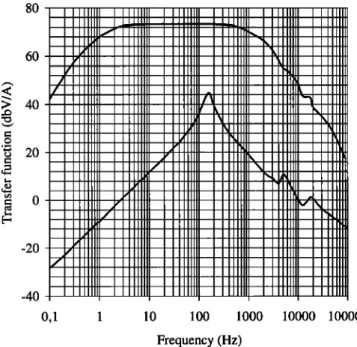
This toms is then wrapped with two windings (as for search coil magnetometers). The main winding has a very large number of tums (20,000), and it is wound alternately forward and backward to cancel the magnetic flux in the whole winding (Figure lb). Actually, each layer is equivalent to one turn of radius R that would be sensitive to DC or AC magnetic fields; by winding an even number of layers, symmetrically, this sensitivity is cancelled [Meyer, 1995]. As shown in Figure 2, the transfer function of this primary winding is a resonance curve with a maximum around 155 Hz, a low-frequency slope of 6 dB/octave (corresponding to the inductive behavior of the coil) and secondary resonances above 4 kHz. To obtain a flat transfer function in a wide frequency range, a secondary winding is used
to introduce flux feedback. To smooth the unavoidable
secondary resonances, a low-pass filter is added. A high-pass filter is also added, which modifies the low frequency slope to
12 dB/octave; its role is to lower the possible effects of parasitic very low-frequency signals, such as a possible DC drift of the
preamplifier or a signal at the spin frequency. Its cutoff
frequency is adjusted to the spin frequency of the spacecraft.
The resulting transfer function is shown on Figure 2: it is flat
over almost three decades. This frequency range can be adjusted
to the characteristics of the spacecraft on which the coil is
80 60 > 40 • 20 • 0 -20 -40
, IIIIII IIIIII • IIIII IIIII f I IIIIII IIIIII IIIIII '•111 IIIII ! I IIIIII IIIIII II!111 Ilgl, IIIII IIIIIII IIIIII IIIIII IIII1• IIIII IIIIIII IIIIII /• IIIIII IIII1• IIIII IIIIIII IIIIII r •, IIIIII IIIII • IIIII IIIitll IIIIII \ III111 IIIII •11111 IIIIIII IIIIII \ IIIIII IIIII NIIII II II111 IIIIII • •1111 IIIII I•111
IIIIII .' I III1• IIIII II1•1
I IIIII/ IIIIII \ IIIII IIIII I IIIIII II]1,I1 IIIIII •. •1111 IIIII
I IIIIII •1111 IIIIII ß •11 IIIII
IIIII/ IIIIII IIIIII IIIII '•111
I I Ik•l' IIIIII IIIIII IIIII I• I.•"1111 IIIIII IIIIII IIIII IIIII
/,4111111
IIIIII
IIIIII
IIIII
IIIII
ß I IIIIII IIIIII IIIIII IIIII IIIII
/ I IIIIII IIIIII IIIIII IIIII IIIII
IIIIIII IIIIII IIIIII IIIII IIIII IIIIIII IIIIII IIIII IIIII
I I I I
0,1 1 10 100 1000 10000 100000
Frequency (Hz)
Figure 2. Transfer functions of a 30-cm CDC (model SN03).
The lowest curve is the response curve of the main winding of
the coil alone. The highest one is the final transfer function, when feedback, preamplifier, and filters have been added.
flown: the low-frequency, cutoff is adjusted to the spin
frequency, and the high frequency cutoff depends on the scientific objectives and the regions that will be encountered.
The coil is finally wrapped in a conducting blanket in order to
provide a good uniformity of the potential around the probe to
minimize the perturbations of the local plasma. In the tests
described here the blanket is made of aluminum.
3. Means used to test the instrument
The preliminary tests have been performed using an AC current produced in a wire going through the coil. These tests
confirm that the principle of the instrument is valid, and they
give a calibration of its response, output volts for 1 A current in the wire. They also show that the behavior of the CDC is linear: the response does not depend on the amplitude of the current (provided that the current remains lower than values around 1 A, which is many orders of magnitude higher than the values expected in space). However, as the instrument is dedicated to measurements of currents in space plasmas, these test conditions are oversimplified. To bring complementary information about the workings of the instrument in space conditions, we have
used two different means: a test in a plasma chamber and
numerical simulations. 3.1. Plasma Chamber
We used the Jonas plasma chamber of Department
Environnement Spatial) at Office National d'Etudes et de Recherche A6rospatiales (ONERA) in Toulouse (France). It is a
3-m long stainless steel cylinder in which a cryogenic pumping
lowers
the pressure
to 10
-6 Pa. The Earth magnetic
field is
compensated by a set of coils surrounding the chamber. To reproduce realistic space conditions, a plasma can be introduced into the chamber, and an electron gun produces an electronbeam.
The plasma
is an argon
plasma,
with a density
of 105
cm
-3
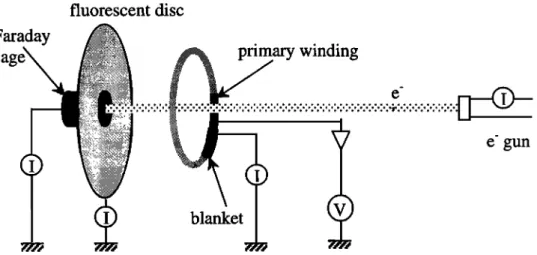
and a temperature of 1500 K. It simulates reasonably well the ionospheric plasma around an altitude of 400 km, except for the magnetic field, which is only a residue of a few microteslas. The electron gun produces a slightly diverging electron beam (its diameter is ~ 5 mm). The energy of the electrons is 3 keV, and they carry a 50 gA current. The beam is square modulated at a low frequency which allows one to test the frequency response of the coil on a wide frequency range Reulet et al., [ 1998].The current measured by the coil has to be checked against other measurements to be validated. Figure 3 shows a schematic view of the experimental setup. The electron beam goes first
through
the CDC and then into an 8-cm
2 Faraday
cage.
A
fluorescent ZnS disk surrounding the Faraday cage captures the electrons that have missed the cage. Both currents are measured. Also measured is the current flowing in the aluminum blanketMEYER ET AL.: TECHNIQUES 13,001 fluorescent disc
Faraday
o
,X
primary
winding
K
7
e- gun
½
blanket
/
Q)
Figure
3. Layout
of the instruments
in the plasma
chamber.
The CDC is represented
by a cut-away
sketch,
showing
the
toms
of magnetic
material,
the
primary
winding,
and
the
conducting
blanket.
I• is the
current
given
by
the
electron
gun,
I2 is the
current
captured
by the
Faraday
cage,
I3 is the
current
captured
by the
fluorescent
disk,
and
I4 is the current
captured
by the aluminum
blanket
of the CDC.
The output
of the CDC is the voltage
of the
preamplifier
which
is connected
to the
primary
winding
of the
CDC (Vc).
covering the CDC, as well as the current given by the electron gun. Thus a complete check of the current balance can be made.
3.2. Numerical Simulation
Because the current carried by the electron beam cannot be
varied much below 50 gA, the tests performed in the plasma
chamber do not give access to the sensitivity of the CDC. That is
why numerical simulations have complemented them. These
numerical tests also allow separate tests of various effects that
influence the behavior of the coil but cannot be distinguished in the plasma chamber experiments.
The simulation box is a 40 cm side cube filled with electrons
(we do not consider the behavior of ions, considered as a
neutralizing background). These electrons are initialized with
random positions, and a Maxwell-Boltzmann velocity
distribution, characterized by a uniform average density, a
parallel bulk velocity, and an isotropic temperature. Because of
the electron bulk velocity, this distribution carries a current. The
electrons are moving in external (not self-consistent) constant
magnetic and electric fields. These fields consist of a uniform
ambient magnetic field (parallel to the initial current), plus a
perturbation generated by the high permeability material (the
core of the loop), and an electric field caused by a potential drop
between the coil and its environment (this field is the solution of
the Laplace equation in vacuum; it does not take into account
the ambient plasma).
The CDC is placed in the middle of this box: It is a toroidal
loop with a square cross section, similar to the real one. The
comparison is made between the ambient ideal current density
determined by the initial conditions of the plasma and the current density flowing through the coil, obtained by counting
the electrons that cross the section defined by the inner part of
the loop. The discrepancy gives an indication of the error made
when using the CDC. In the simulation, unlike in real tests,
several effects can be switched off to understand their specific
role: (1) the perturbing magnetic field due to the magnetic core
of the coil and (2) the capture of the electrons which hit the coil.
If effect 2 is switched off, the coil becomes transparent to electron motion. Finally, the electric potential of the coil can be
set to three different values: 0, +10 V, and-100 V.
3.3 Comparison
of the Different
Methods
of Measuring
the
Current
In real life, in space, the current structure, whatever it is (tube,
sheet, etc,..), extends over distances much larger than the size of
the coil. Although no direct current measurements have ever
been performed, this assumption seems quite reasonable. Previous estimates made by particle or magnetic field
experiments indicate that scales as low as 100 m at an altitude of
400 km can be expected [Forget et al., 1991]. Some authors
suggest
that 100 m could be the smallest
scale
[Staciewicz
and
Potemra, 1998] which can be related to the fact that the inertial
length of the electrons at this altitude is around 100 m and that it
is the smallest physically significant scale. Observations of the
thickness of auroral arcs made from the ground give the same
order of magnitude [Borovsky, 1993]. Therefore, in any case, the
CDC will pass through current structures much larger than its
own diameter and will "catch" a small section of the current and
give a measure of the current density times its section.
In the numerical simulation the situation is similar except for
one difference: There is only an electron beam present in the
simulation box, and its charge is compensated by a stationary
ion background, and no space charge field is taken into account.
In the plasma chamber experiment, however the relative
dimensions of the coil and the current are reversed: the electron
beam covers only ~ 0.1% of the section of the coil. To explore
the whole surface and especially to study the edge effects, the
coil is translated in from of the electron beam.
4. Measurement Capabilities
4.1. Preliminary Tests in the Plasma Chamber Without
Plasma
With an electron beam carrying 50 BA, a numerical simulation shows that the current density is measured with a precision of 0.5%. With the real coil, we have to compare the obtained response in the chamber to a reference response. Calibrated with a current produced in a wire, the obtained reference transfer function at 55 Hz (in the flat part of the
function)
is 4640
V A 'l, that
is 73.3
dBV A 'l, when
the potential
13,002 MEYER ET AL.' TECHNIQUES
t•l iii• coil
cross
section
• ... . ... ? ... •. ... • ...
•
80
...
: ...
•.
...
¸ • 70 ... • ...•
...
t.
•
...
40 .... l J .... • .... • ... • .... i .... • ....-2ffi - 1 • - 1 ffi -• 0 • 1 ffi 1 • 2ffi
x(mm)
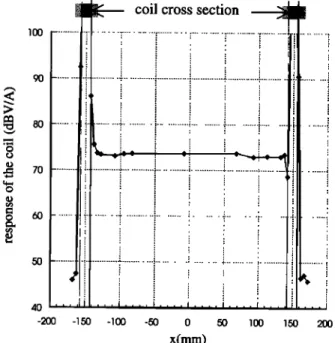
Fibre 4. Response of the CDC as a function of the position of
the incidem electron beam (model SN03). •e size of the coil is
superimposed (d•k shaded squares). The light shaded regions
have the size of the beam.
of the coil is fixed at 0 V. In the plasma chamber the current is
measured with the Faraday cage (I2); we obtain I2 = 30 gA for
the 55-Hz part of the signal. This is consistent with the results
expected for the first harmonic frequency of a 55-Hz square
signal of amplitude switching from 0 to 50 gA. The current
through the fluorescent disk is stable around 0.2 gA and
therefore always negligible compared to the measured current.
The current through the aluminum blanket of the coil is equal to
0 except when the beam hits the coil. The coil is moved
perpendicular to the electron beam, and its response is plotted in
Figure 4, where the size of the coil is shown for comparison.
When
the beam
passes
in the central
region
of the coil (between
+ 130 and - 130 mm), the transfer function varies between 72.88and 73.69 dBV/A, with an average
of 73.4 dBV A -1, which
ß represents an accuracy of less than 1%. When the beam hits the
coil, the measurement is disturbed because the current through
the aluminum shield reaches 15 gA. The asymmetry in the
response near the two edges of the coil is likely to be due to a
slight curvature of the beam (due to the magnetic field residue).
This is not comparable to the situation in space, where electrons
will continuously hit the whole surface of the coil; the shield is
designed with one strip over each of the four sides of the toms to
ensure a symmetry of the currents with respect to the axis of the
coil and therefore a balance of the currents in the shield. 4.2. Tests in the Presence of a Plasma
First of all, the CDC will be used in plasmas and therefore has
to be tested in the plasma chamber filled with plasma. In that
case, with the same current density as before and the potential of
the coil fixed to 0 V, the transfer
function
in the center
of the
coil is 73.3 dBV A -I, which is the nominal result. It is
interesting to note that the edge effects are less important when
the coil is embedded in a plasma: Considering the case where the beam is only 5 mm from the coil (if it is closer the current flows through the shield), the departure from the central measurement is 8.6% without plasma and only 3.2% with plasma. This improvement is likely to be due to the screening of the coil by the plasma, but it cannot be tested properly since the Debye length (= 8 mm) is of the same order as the beam. 4.3. Comparison of the Measurement Capabilities With the Known Values of Currents in Space Plasma
It must be noted that the current carried by the electron beam
in the plasma chamber (50 gA) corresponds to high values of the
current
density:
around
700 gA m
-2 if one assumes
that
the coil
is embedded in the current. In the auroral region the estimates of
the current are deduced from the magnetic measurements, and
the maximum values of the currents are expected to be around
300 gAm
'2 at the subkilometer
scale
[Berthelier
et al., 1991;
Staciewicz and Potemra, 1998]. Therefore the CDC must beable to measure current densities significantly lower than those
tested in the plasma chamber. In the numerical simulation it is
not difficult to decrease the current and to show that the coil can
measure
much
smaller
currents:
a 1 gA m
'2 current
is measured
with an accuracy of 0.2%.The sensitivity of the real coil can be tested in the laboratory,
in a magnetic environment that is cleaner than in a large plasma
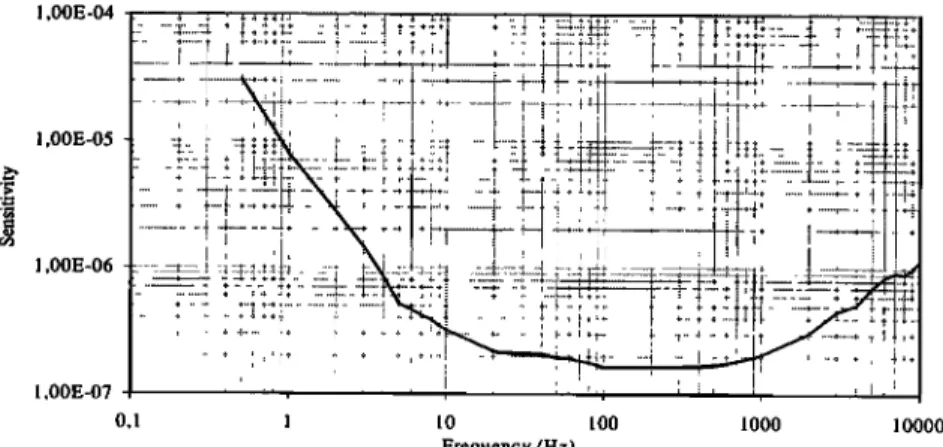
1,00E-05 1,00E-06 1,00E-07 1,00E-08 0,1 1 10 100 1000 10000 Frequency (Hz)
MEYER ET AL.: TECHNIQUES 13,003
chamber. The result obtained under these conditions is plotted in
Figure
5 and it can be compared
to the estimates
of currents
in
space.
if a relative velocity
of the spacecraft
and a current
structure of 1 km s '1 is assumed, a 100-m structure is crossed in
0.1 s and appears
as a 10-Hz signal.
For a current
density
of
200 gA m
'2 [Forget
et al., 1991]
and an analysis
with a 50%
bandwidth,
the coil needs
a 100 gA m
'2 Hz
'1/2
sensitivity
to be
able to detect the current structure. As shown in Figure 5, the CDC allows measurements of much smaller current densityvalues in that frequency range. Of course, the figures given here
depend on the velocity of the spacecraft
and on the
characteristics of the analysis and, hence the real sensitivity of
the coil might be slightly different. Nevertheless, it clearly
evidences that the instrument has the capability of studying
ionospheric currents. This curve also shows that structures
smaller than 100 m will also be resolved by the instrument
(corresponding
to higher frequencies),
thus allowing the
exploration
of a scale domain which so far has not been
explored.
5. Exploration of the limits of the instrument
5.1. Magnetic Perturbations Due to the Coil Material
The magnetic
material,
which
is the core of the CDC, creates
its own magnetic
moment,
which modifies
the field lines of the
nearby
external
magnetic
field. Of course,
with a real coil this
effect cannot be avoided. In the numerical simulations it can be
removed, since the measurements are made by counting the
particles
going through
the coil and not by measuring
the
induced
voltage.
One can expect
that the modification
of the
field lines will be more important if the external field lines are
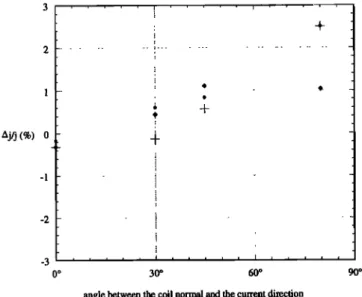
far from normal to the coil plane. This effect is tested in
Figure
6, where
a current
of 1 gA m
'2
is flowing
through
the
coil
at different angles. When the angle between the current and the
magnetic
field is small, there is no difference
between
the two
aj/j (%) o
0 o 30 ø
I I I I I I
60 ø 90 ø
angle between the coil normal and the current direction
Figure 6. Error on the measurement of the current deduced
from numerical simulations. Diamonds correspond to the case
where the coil is transparent and there is no perturbing magnetic
field, pluses correspond to the case where the coil is transparent
and the magnetic field of the magnetic core is present, and dots
correspond to the most realistic case where the coil is thick and
the field is perturbed.
cases, with or without the perturbing magnetic field. When the
angle is large (80ø), the part of the current that is measured is
small, and the error on the measurement reaches 2.5%. As will be shown in section 5.2, when the coil is in a set of three coils,
this error plays a minor role since it modifies a very small
component only. In the other case, when only one coil is used,
this error is more important since it cannot be corrected as the
direction of the current is unknown. 5.2. Geometrical Effects
The finite size of the CDC introduces some unavoidable
limitations. First, as already mentioned, a given coil measures only the component of the current density that is normal to its surface, but as the angle with the normal increases, the error on
the measurement also increases. The finite size of the section of
the toms induces a loss of the particles that hit the inner side of the sensor, giving rise to a dead angle (assuming that the particles are captured and that no secondary emission occurs). For a 30-cm coil this angle is equal to 87 ø. For angles smaller
than this limit but still far from the normal of the loop, the
thickness of the coil induces an error on the estimate of the
surface "seen" by the current. This surface is smaller than the
expected
value
of •R2cosot
and has to be used
to deduce
the
current density from the current measured by the loop. As shown in Figure 6, this error is smaller than the error due to the perturbing magnetic field, and the combination of both effects gives an accuracy of 2.5% for the measurement at 80 ø . These effects are drawbacks if the instrument is made up of only one coil. If, however, it is a set of three orthogonal coils, the errorcan be corrected. A first estimate of the direction of the current
can be calculated; then, knowing its direction relative to one coil, the error on the corresponding surface can be corrected,
and a refined estimate of the direction can be deduced. As soon
as the current density direction is close to the normal of one of the three coils, the precision of the estimate will be excellent since the maximum error will be on very small components. The
worst situation would be when the current is as far as possible
from all the nortnals, that is around 55 ø, but then the error is less
than 1% and can be corrected.
These orders of magnitude are given for a 30-cm-diameter coil. Clearly, they increase if the• coil is smaller, because it is not possible to reduce the section of the coil in proportion to the
radius of the toms, for obvious technical reasons. However,
even in that case, the geometrical errors can be corrected. Changing the size of the coil has a consequence on its sensitivity. The sensitivity shown here (Figure 5) is that of a 30- cm coil with 20,000 wire turns. It can be compared to the sensitivity of a 15 cm coil with 16,300 wire turns (Figure 7); there is a loss of ~ 1 decade in sensitivity when the dimension is reduced by a factor of 2. When the use of the coil fixes its size (for instance a large coil cannot be flown on a rocket), the sensitivity can be improved by increasing the number of wire tums. A new 15-cm coil is being built, with 40,000 wire tums; its sensitivity is expected to reach a value equal to twice the
sensitivity of the 30 cm coil. Therefore, although it will be less
sensitive than a 30-cm coil, it will be much better than the
previous 15-cm coil.
5.3. Influence of the Electrostatic Potential of the Coil
All the tests that have been discussed in the previous sections
were performed with a grounded conducting blanket. With the
13,004 MEYER ET AL.' TECHNIQUES 1,00E-04 1,00E-05 1,00E-06 1,00E-07
"i
...
'"'
...
0,1 1 10 100 1000 10000 Frequency (Hz)Figure
7. Sensitivity
(in A m
'2
Hz
'1/2)
of a 15-cm
coil
with
16,300
wire
turns.
since there is no ground and the ambient plasma influences the
potential of the instruments. Therefore tests have been
performed in the plasma chamber together with numerical
simulations with different potentials of the coil, including the
floating potential.
In the chamber, introducing a power supply in the branch where I4 is measured (see Figure 3) can modify the voltage of the coil aluminum blanket. The plasma potential is measured
during the experiments by a Langmuir probe; its value is around
0.6 V. When the potential of the blanket is left floating, it
reaches a value, around -0.6 V, which is a bit less than the
plasma potential; i.e., the coil behaves like a Langmuir probe.
Figure 8 shows the response of the CDC for different values of
the voltage of the coil blanket, with and without plasma in the
chamber. The main conclusion deduced from these tests is that
the reference response is obtained only when the potential of the
coil is kept near 0 V. When it moves away from this value, the response varies considerably. Therefore, to obtain precise
measurements in space, the voltage of the coil should be kept at
the spacecraft potential. Another interesting conclusion of this
study is about the edge effects. When the coil is tested in a
100,00 90,00
8o,0o
70,00
60,00 50,00 -100 V -50 V 0 V 50 V Potential of the coil blanketFigure 8. Response of the CDC in the plasma chamber as a
function of the voltage of the conducting blanket of the coil,
with plasma in the chamber (open squares) or without (solid diamonds). The thin line represents the nominal response (model
SN03).
plasma, there are less edge effects: The beam can pass closer to
the coil without being affected by it. This result, already evidenced at 0 V, is also valid at other voltages.
All these tests in the plasma chamber have been performed
with the same 3-keV electron beam. Of course, the influence of
the voltage of the coil on the beam is strongly related to the
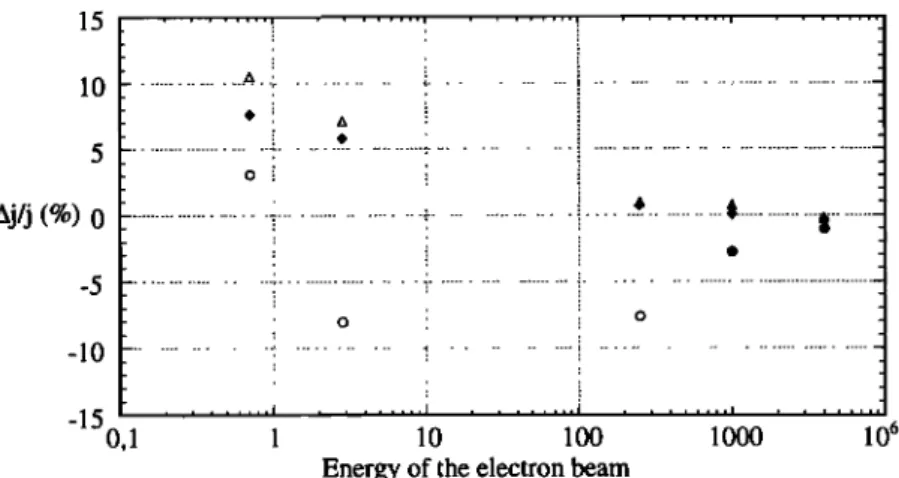
energy of the particles and to their charge. For a current carried by ions the above results should be reversed. The relative effects of the voltage of the coil and the energy of the electrons have been tested in numerical simulations. The results are presented in Figure 9, which shows that the error on the estimate of the current density increases when the energy of the beam
decreases. They also show that for low voltages the error
becomes large only for very low energies. On the other hand, for a-100-V voltage the error is higher than 5% as soon as the energy of the beam is less than a few 100 eV. These
observations are consistent with an electrostatic interaction between the beam and the coil. This means that with the real coil
in the plasma chamber the physical situation is more complicated, since the variations are not consistent with the simple electrostatic interaction. This difference is very likely due to the existence of secondary electrons emitted by the coil
itself, since in the numerical simulation this effect is not
included. Taking this effect into account, the results in Figure 8 become more clear: For a positive voltage the secondary electrons are recaptured after a short flight, and for a negative
potential the electrons are repelled from the coil and perturb the
estimate of the current. For a very negative voltage they are
strongly repelled from the coil and hence do not disturb any
longer the response of the coil; it goes very close to the nominal
one.
5.4. Perturbation
of the Measurement
by Secondary
Electrons and Photoelectrons.
As evidenced by the results shown in section 5.3, the emission
of secondary
electrons
is an important
problem
to consider
in
order to understand the behavior of the coil in all situations. A
similar problem in space, which has not been tested on the
ground,
is the emission
of photoelectrons.
The secondary-
electron
emission
yield has been
studied
for many
elements
and
compounds:
All show
the same
kind of response,
an increasing
emission
as a function
of the energy
of the incident
electrons
to
a maximum
yield and then
a decrease
[Scholtz
et al., 1996].
This
maximum
yield and the corresponding
incident
energy
then
characterize
a given
element.
For aluminum
the maximum
yield
MEYER ET AL.: TECHNIQUES 13,005 10 ... '• ... o
Aj/j
(%) 0 ...
!
...
* ...
$
...
! ' : 0 ! 0 ,, : ,ooo
Energy of the electron beamFigure 9. Error on the measurement of the current deduced from numerical simulations as a function of the energy of the electron beam. The diamonds correspond to a grounded coil, the triangles correspond to a +10-V voltage, and the dots correspond to a-100 V voltage. The symbols are solid when the energy of the beam is higher than the voltage of the coil, and they are open when it is of the same order of magnitude or lower.
is around 1 and is obtained for 300-eV electrons; for 3-keV
electrons the yield goes down to 0.6 [Garrett, 1980].
An estimate of the number of secondary electrons that are emitted by the coil blanket can be made, taking into account the
geometry of the instrument and the known dependency of the
yield as a function of the incidence angle [Vaughan, 1989]. The
coil is covered by four strips of aluminum, one on each side of
the toms. It is most likely that the electrons produced by the outside, top side, and bottom side will not disturb the current measurement to any large extent. The main perturbation will come from the inner side. As this surface is a cylinder, the incidence angle depends on the point of incidence. By
performing integration on the entire surface, we obtain a 7%
effective yield for the coil. This value corresponds to a normal incidence of the current with respect to the coil, as it was in the
plasma chamber experiment. If we study the secondary emission
as a function of the angle between the current and the normal to the coil, we find that it is stable for angles smaller than 45 ø,
while for larger angles it increases to 50% for an angle of 80 ø .
Therefore this emission becomes a large source of error in the measurements for very large incidence angles. The error behaves in a similar way to the geometrical effect studied above; that is, if them is a set of three coils on board the spacecraft, it is a minor problem.
One can think of reducing
the effect of the secondary
electrons by choosing the best material for the cover. A comparative study of many elements [Whetten, 1962] shows that carbon has the smallest efficiency, 0.45, obtained for a 500-eV
energy when it is in soot form. A similar study for
photoemission of amorphous materials [Grard, 1973] shows that
graphite is the material that produces the smallest number of
photoelectrons. Therefore we have decided to change the
conducting blanket of our coils and replace aluminum with carbon. Preliminary tests show that the voltage of the blanket (if it is left floating) reaches the plasma potential with a much better accuracy, which should minimize the effects of secondary
electrons.
6. Conclusion
The tests which have been presented here show that the CDC
is a new instrument that is capable of improving our knowledge
of space plasma properties. First of all, it is sensitive enough to
measure the current densities that are expected in the auroral
region, as far as we know. It will also make possible the
exploration of smaller scales than the scales that can be studied using magnetometers, that is, scales that have never been explored before. The sensitivity of the coil is higher when the coil is larger; therefore the size chosen for a given spacecraft has to be a compromise between sensitivity and bulk, although small coils can be improved by increasing the number of winding
tums.
Clearly, the number of CDCs on board the spacecraft is also very important. A set of three coils will always give a good estimate of the direction and the intensity of the current density. On the other hand, a single coil will give only an estimate of the
projection of the current density with an error which might be
very large if the angle of the current direction and the coil normal is large.
The tests performed on the coil show that its response is more reliable when its potential is maintained close to 0 V, which in the case of the plasma chamber was close to the plasma potential. This indicates that in a space experiment the potential of the coil should be kept at the spacecraft potential. When the voltage of the coil departs from the ground potential, the effects of secondary electrons or photoelectrons become more important. This problem is still under study, and some improvements can be included in future models, such as a
carbon blanket instead of an aluminum one for instance.
A set of three CDC is going to be flown in December 2001 on
a rocket launched in the cusp region. A full set of plasma instruments will be on board: particle measurements and DC and
AC magnetic field measurements. This will allow a detailed
comparison
of the current
estimates
obtained
by these
three
different means. Particle instruments can give a direct estimate of the current density, but they suffer from limitation in time resolution (due to the time needed to sample all directions and energies) and from the thresholds in energy. On the other hand,
magnetometers have a high time resolution but give only an
indirect estimate of currents since the relation between currents
and field is differential. Owing to these limitations, the results
from these two instruments will allow one to check some
properties of the currents, but will not be redundant with the
13,006
MEYER ET AL.: TECHNIQUES
Acknowledgments.
The tests in the plasma chamber have been performed with financial
support of the French space agency, CNES, and of Universit6 de Versailles-Saint-Quentin en Yvelines. The authors wish to thank Franqois Lefeuvre and Vladimir Krasnosel'skikh for fruitful discussions, and Bernard Poirier, Dominique Alison, and the ONERA team for their
technical support. The computations have been supported by the CNRS
and made on a Cray 98 at IDRIS (Orsay, France)
Michel Blanc thanks the referees for their assistance in evaluating this
paper.
References
Berthelier, A., J.C. Cerisier, J.J. Berthelier, and L. Rezeau, Low
frequency magnetic turbulence in the high-latitude topside
ionosphere: low-frequency waves or field-aligned currents, J. Atmos.
Terr. Phys., 53(3/4), 333-341, 1991.
Borovsky, J. E., Auroral arc thickness as predicted by various theories,
J. Geophys. Res., 98, 6101-6138, 1993.
Comilleau-Wehrlin, N., et al., The CLUSTER spatio-temporal analysis
of field fluctuations (STAFF) experiment, Space Sci. Rev., 79(1-2),
107-136, 1997.
Forget, B., J.-C. Cerisier, A. Berthelier, and J.-J. Berthelier, Ionospheric
closure of small-sacle Birkeland currents, J. Geophys. Res., 96, 1843-
1847, 1991.
Garrett, H. B., Spacecraft charging: a review, Space Systems and their
interactions with earth • space environment, Progress in astronautics
and aeronautics, vol. 71, edited by H. B. Garrett and C. P. Pike, published byAmerican Institue of Aeronautics and Astronautics, New
York, 1980.
Grard, R. J. L., Properties of the satellite photoelectrons sheath derived
from photoemission laboratory measurements, J. Geophys. Research,
78, 2885-29060, 1973.
Krasnosel'skikh, V.V., A.M. Natanzon, A.E. Reznikov, A. Y. Schyokotov, S.I. Klimov, A.E. Kruglyi, and L.Woolliscrofi, Current
measurements in space plasmas and the problem of separating between spatial and temporal variations in the field of a plane
electromagnetic wave, Adv. Space Res., 11, (9), 37-40, 1991.
Meyer, A., Boucle de courant h contre r6action de champ, note technique, Centre d'Etude des Environ. Terr. et Plan6t.,V61izy,
France, 1995.
Primdahl, F., P. Hoeg, C. J. Nielsen, and J. E. Schroder, A new method
for measuring space plasma current densities by the Faraday rotation of laser light in optical monomode fibers, DRI $ci. Rep. 4-86, 1986. Reulet, R., L. Levy, and D. Sarrail, Etude du comportement d'une
boucle de courant en pr6sence d'un plasma ionosph6rique, Assistance technique simulation spatiale, Rapp. ONERA RF/470900/470901,
1998.
S-300 Experimenters, Measurements of electric and magnetic wave fields and of cold plasma parameters on-board GEO$ 1. Preliminary
results, Planet. Space Sci., 27, 317-339, 1979.
$choltz, J. J., D. Dijkkamp, and R. W. A. Schmitz, Secondary electron
emission properties, Philips J. Res., 50, 375-389, 1996.
Staciewicz, K., and T. Potemra, Multiscale current structures observed
by Freja, J. Geophys. Res., 103, 4315-4325, 1998.
Vaughan, J. R. M., A new formula for secondary emission yield, IEEE
Trans. Electron Devices, 36, 1963-1967, 1989.
Wahlund, J. E., L. J. Wedin, T. Carrozi, A. I. Eriksson, L. Anderson,
and H. Laasko, Analysis of Freja charging events, IRF $ci. Rep. 253,
1999.,
Whetten, N. R., Secondary electron emission, Methods of Experimental Physics, vol. 4, Academic, San Diego, Calif., 1962.
H. de Feraudy, A. Meyer, F. Mottez, L. Rezeau, and A. Roux, CETP/
UVSQ, 10-12 avenue de l'Europe, V61izy, France. (rezeau•,cetp.ipsl.t¾) (Received May 31, 2000; revised September 5, 2000, ,