HAL Id: hal-00473260
https://hal.archives-ouvertes.fr/hal-00473260
Submitted on 14 Apr 2010
HAL is a multi-disciplinary open access archive for the deposit and dissemination of sci-entific research documents, whether they are pub-lished or not. The documents may come from teaching and research institutions in France or abroad, or from public or private research centers.
L’archive ouverte pluridisciplinaire HAL, est destinée au dépôt et à la diffusion de documents scientifiques de niveau recherche, publiés ou non, émanant des établissements d’enseignement et de recherche français ou étrangers, des laboratoires publics ou privés.
Robust badlands thalwegs network extraction from
DTM for topological characterisation
N. Thommeret, Jean-Stéphane Bailly, C. Puech
To cite this version:
N. Thommeret, Jean-Stéphane Bailly, C. Puech. Robust badlands thalwegs network extraction from DTM for topological characterisation. Geomorphometry, Aug 2009, Zurich, Switzerland. p. 218 - p. 224. �hal-00473260�
Robust badlands thalwegs network extraction from
DTM for topological characterisation
N. Thommeret1, J.S. Bailly2, C. Puech2 1UMR 8591- CNRS, Laboratoire de Géographie Physique,
1 place Aristide Briand, 92195 Meudon Cedex Telephone: +33145075583 Email: [email protected]
2UMR TETIS – AgroParisTech-Cemagref-Cirad, Maison de la Télédétection,
500 rue JF Breton, 34093 Montpellier Cedex 5 Telephone: +33467548720 Email: bailly, [email protected]
1. Introduction
To study the link between thalweg networks in badlands and hydrological functioning over eroded areas, digital indices describing the 3D network geometry and topology must be computed for different extents and resolutions. Thalwegs correspond to the line connecting the lowest points of the gully. In badlands, these networks are characterised by tree structure topologies. In case of large extents, grid DTM acquired by airborne or high resolution satellite sensors seem to be the most appropriate source of data for thalweg network extraction.
To extract and characterise thalweg networks from a grid DTM, various drainage algorithms (O’Callaghan and Mark 1984, Fairfield and Leymarie 1991, Lea 1992, Tarboton 1997) offer possibilities of computing drainage networks all over the grid surface. However, the transition from one drainage flow path to a vector thalweg network is not obvious (Martz and Garbrecht 1995, Tarboton 2001, Turcotte et al. 2001). Most of the time, the process uses a unique and arbitrary drainage surface threshold beyond which thalwegs, valleys or hydrographic networks are depicted. Since this criterion has no physical significance, where to start thalwegs upstream? How to get thalweg networks fitting to the amount of information really contained in a DTM? How to limit drainage algorithm artefacts in wide valleys disrupting the resulting network topology? In other words, how to compute robust thalweg network from a grid DTM?
This paper presents a method that combines existing drainage algorithm and a morphological index, first, to map gully floor pixels and then to define a continuous and tree-structured thalweg network. To run the method on a given DTM, only the spatial and statistical distribution of altimetrical error data is needed. This method aims to extract thalweg network objectively considering the significant landforms included in a DTM.
This method has been applied on two DTMs simulating virtual landscapes and on an LiDAR DTM acquired on the Draix badlands catchments (French Alps). Results are visually compared to those obtained with the usual drainage area threshold criteria. On the Draix test site, network topological index distributions are computed and compared together.
2. Method
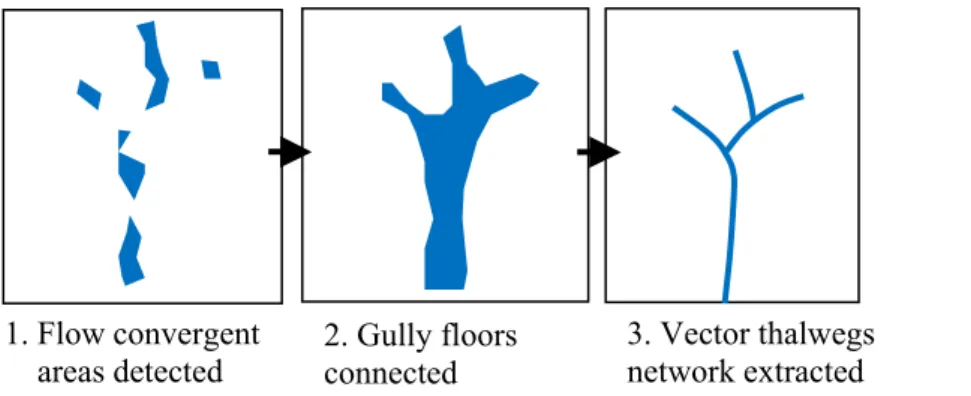
The method runs in three steps. In a first step using a convergence index defined by Kiss (2004), discontinuous terrain cells with significant curvature, where flow converges, are derived from the DTM. We assume that these cells reflect gully floors. In a second step, these cells are connected using an accumulated flow algorithm (Lea 1992) weighted by the results of the first step. A connected and tree-structured scheme is obtained at the end of this second step. The third step is a vectorisation and cleaning step to obtain a refined vector thalwegs network (Fig.1).
Figure 1. A three-step method.
2.1 Significant flow convergence areas detection
The convergence index (CI) is used to distinguish flow convergent areas from divergent ones in the DTM at initial spatial resolution. It is based on the aspect, which corresponds to the slope direction. Considering a 3*3 cells window (Fig. 2), for each external cell i, θi is the angle between the aspect of cell i and the direction to the centre
i.e. the direction of the vector joining the centre of cell i and the centre of the 3*3 window. The convergence index is the average of the θi minus 90°. CI ranges from
°
−90 to 90°.
Figure 2. Convergence Index calculation.
In the resulting grid, positive values represent divergent areas and negative values represent convergence areas. Null values relate to areas without curvature. To highlight the significant convergent cells, which should correspond to gully floors, a threshold is applied on these values. The DTM altimetrical error spatial distribution helps to objectively determine this threshold. The computation of CI from simulation of numerous tilted planes DTM, with a noise respecting the spatial altimetrical error distribution, provides a threshold beyond which CI values can be considered as
1. Flow convergent
areas detected 2. Gully floors connected
3. Vector thalwegs network extracted
θ
i Aspect Direction to centre ° − =∑
= 90 8 1 8 1 i i CI θsignificantly different from a plane landform. At the end of this step, disconnected convergence areas are identified and considered as gully floor features.
2.2 Tree-structured gully floors connection
The cells obtained previously are connected to create a continuous area. The use of drainage algorithms appears to be a good way to reach this goal. Indeed, these algorithms are usually based on the idea of flow accumulation and thus generate continuous drainage areas. Also, the choice of a unidirectional flow ensures the tree structure (each cell has a unique output).
Among the many drainage algorithms, we choose the kinematic routing algorithm (Lea 1992). The flow is compared to a rolling ball moving in the direction of the steepest slope on a plane surface. Then the flow accumulation for a given cell is calculated as the number of flow paths passing through that cell multiplied by the grid cell area (Wilson et al. 2008). We propose to weight the accumulation computation by the thresholded convergence grid in order to keep only the gully floors identified as draining cell. As a result, we obtain a continuous and tree-structured area corresponding to the gully floors.
2.3 Thalweg network extraction and topological analysis
The last step aims at doing a topological analysis of the network extracted. The network is settled from raster gully floors. It must be a vector object, corresponding to directed tree vector network. It also has to be as refined as possible (without artefacts) through a cleaning-up step. We successively use a vectorisation process based on skeletonisation and a vector filtering process. Finally, we compute topological indices on the resulting directed tree thalweg network.
We use the most known topological indices, the Horton-Strahler order and ratios (Strahler 1957). To add a third dimensional analysis, two slope indices are computed: a simple slope index and a developed slope index. The use of such indices allows description and comparison of 3D planar thalweg network structures. Consequently, comparison between different methods of thalweg network extraction is possible.
3. Material
The method was applied to both virtual and actual terrain cases. Virtual terrain catchments models were built as tilted plane in which simple shapes are embedded. The actual terrain model is a one-meter resolution DTM of the Moulin catchment produced by an airborne LiDAR. The Moulin (8 ha) is one of Draix experimental catchments that are labelled “Draix Observatory for Research on the Environment (ORE), a field laboratory for mountains erosion studies”.
4. Results
Figure 3. An example of networks extracted from a virtual catchment DTM: 1- the proposed method; 2- usual drainage area criteria.
The use of virtual catchment DTM permits representation and comparison of networks extracted using different methods while the initial shape of the valley is totally controlled (Fig. 3). Two major observations are made: 1) all existing drains are extracted and no more; 2) upstream limits appear to fit the valley heads (solving the problem of an arbitrary threshold).
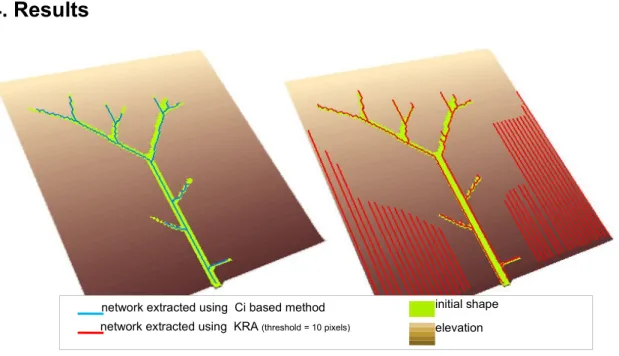
Figure 4. Comparison of networks extracted using the CI based method and the kinematic routing algorithm with an arbitrary drainage area threshold.
elevation initial shape network extracted using Ci based method
We also compare the networks extracted on the actual catchment using the proposed method (CI based) and an unique area threshold criterion on kinematic routing algorithm (KRA) drainage areas (Fig. 4). The use of a unique area threshold (here 50 m2) has resulted in both the presence of numerous drains disrupting the network
topology (left of Fig. 4) and the absence of drains that should be represented (right of Fig. 4). This means that not all the information of the DTM is used unlike with the CI based method. This is true regardless of the threshold.
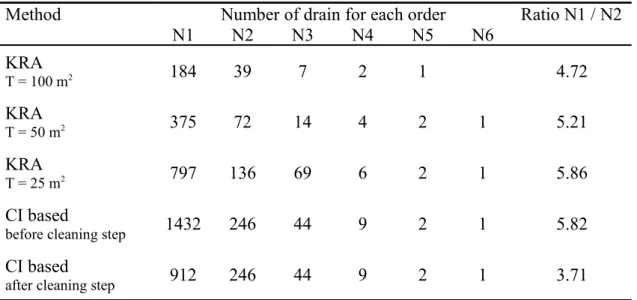
The network topology is described with Horton-Strahler stream orders and slope ratios. With classical methods of extraction, the number of drains, especially those of first orders, increases as the threshold area decreases (Table 1). The ratio between the first and second order underlines the perturbation and the instability of the extracted network. With the CI based methods, the number of first-order drains is drastically lower but the ones extracted correspond to the DTM information. So, the CI based method provides a stabilisation of the tree network topology.
Method Number of drain for each order Ratio N1 / N2
N1 N2 N3 N4 N5 N6 KRA T = 100 m2 184 39 7 2 1 4.72 KRA T = 50 m2 375 72 14 4 2 1 5.21 KRA T = 25 m2 797 136 69 6 2 1 5.86 CI based
before cleaning step 1432 246 44 9 2 1 5.82
CI based
after cleaning step 912 246 44 9 2 1 3.71
Table 1. Networks comparison using digital indices.
5. Discussion and Conclusion
In this paper, we proposed a method aiming at extracting tree-structured gully floors and corresponding continuous thalweg networks. Whereas classical methods of extraction are based on an arbitrary threshold, the presented method extracts thalwegs only where the DTM expresses a landform. Thus, this method allows a more robust computation of topological indices of thalweg networks that can otherwise be highly disrupted in geometry and topology.
This method is data dependent and data-driven. Results are available for a given spatial resolution of DTM. Moreover, the main parameter used in the method is the spatial distribution of the altimetrical error of DTM data, giving an objective threshold for the delineation of significant flow convergence areas. This means that some initial work on DTM quality evaluation has to be handled first.
Regarding the use of convergence index to decide the more upstream part of thalwegs, other curvature morphological indices could have been used. For instance, it would be interesting to test the use of plan curvature. In other contexts and for other resolutions, convergence indices performed on local neighbourhood can limit and be
unsuitable to show wide and rough valleys. In that case, a multi-resolution approach based on the same principles would be interesting to develop.
The proposed method is suitable for badlands areas or any other with bare soils. In other areas, like forested ones, results may be less effective but this would probably be due to the DTM quality rather than any method deficiency.
6. Acknowledgements
The authors would like to thank the Draix ORE and INSU that made this work possible.
7. References
Chorley RJ, 1971, Introduction to fluvial processes. Metheun & co, London.
Fairfield J., Leymarie P, 1991, Drainage network from grid digital elevation models, Water Resources
Research, 27(5): 709-717.
Kiss R, 2004, Determination of drainage network in digital elevation model, utilities and limitations,
Journal of Hungarian Geomathematics, 2:16-29.
Lea NJ, 1992, An aspect-driven kinematic algorithm. In: Parson AJ and Abrahams AD (eds), Overland
flow: hydraulics and erosion mechanics, UCL Press, London, 393-407.
O’Callaghan J, Mark D, 1984, The extraction of drainage networks from digital elevation data,
Computer vision, graphics and image processing, 28: 323-344.
Strahler AN, 1957, Quantitative analysis of watershed geomorphology, American Geophysical Union, 38: 913-920.
Tarboton, DG, Ames DP, 2001, Advances in the mapping of flow networks from digital elevation data. In: World Water and Environmental Resources Congress, Orlando, Florida.
Traboton DG, 1997, A new method for the determination of flow directions and contributing areas in grid digital elevation models, Water Resources Research, 33(2): 309-319.
Wilson JP, Aggett G, Deng Y, Lam CS, 2008, Water in the landscape: a review of contemporary flow routing algorithms. In: Zhou Q, Lees B, Tang G (eds), Adances in digital terrain analysis, LNG&C, Springer, 213-236.
Turcotte R, Fortin JP, Rousseau AN, Massicotte S, Villeneuve JP, 2001, Determination of the drainage structure of a watershed using a digital elevation model and a digital river and lake network,
Journal of Hydrology, 240: 225-242.
Martz LW, Garbrecht J, 1995, Automated recognition of valley lines and drainage networks from grid digital elevation models: a review and a new method – Comment, Journal of Hydrology, 167: 393-396.