HAL Id: hal-01171846
https://hal.archives-ouvertes.fr/hal-01171846
Submitted on 5 Jul 2019
HAL is a multi-disciplinary open access
archive for the deposit and dissemination of
sci-entific research documents, whether they are
pub-lished or not. The documents may come from
teaching and research institutions in France or
abroad, or from public or private research centers.
L’archive ouverte pluridisciplinaire HAL, est
destinée au dépôt et à la diffusion de documents
scientifiques de niveau recherche, publiés ou non,
émanant des établissements d’enseignement et de
recherche français ou étrangers, des laboratoires
publics ou privés.
Combining Existential Rules and Transitivity: Next
Steps
Jean-François Baget, Meghyn Bienvenu, Marie-Laure Mugnier, Swan Rocher
To cite this version:
Jean-François Baget, Meghyn Bienvenu, Marie-Laure Mugnier, Swan Rocher. Combining Existential
Rules and Transitivity: Next Steps. IJCAI: International Joint Conference on Artificial Intelligence,
Jul 2015, Buenos Aires, Argentina. pp.2720-2726. �hal-01171846�
Combining Existential Rules and Transitivity: Next Steps
Jean-Franc¸ois Baget
Inria, CNRS,
Univ. Montpellier
Montpellier, France
Meghyn Bienvenu
CNRS,
Univ. Paris-Sud
Orsay, France
Marie-Laure Mugnier
Univ. Montpellier,
Inria, CNRS
Montpellier, France
Swan Rocher
Univ. Montpellier,
Inria, CNRS
Montpellier, France
Abstract
We consider existential rules (aka Datalog±) as a formalism for specifying ontologies. In recent years, many classes of existential rules have been exhibited for which conjunctive query (CQ) entail-ment is decidable. However, most of these classes cannot express transitivity of binary relations, a fre-quently used modelling construct. In this paper, we address the issue of whether transitivity can be safely combined with decidable classes of existen-tial rules. First, we prove that transitivity is incom-patible with one of the simplest decidable classes, namely aGRD (acyclic graph of rule dependen-cies), which clarifies the landscape of ‘finite expan-sion sets’ of rules. Second, we show that transitiv-ity can be safely added to linear rules (a subclass of guarded rules, which generalizes the description logic DL-LiteR) in the case of atomic CQs, and also
for general CQs if we place a minor syntactic re-striction on the rule set. This is shown by means of a novel query rewriting algorithm that is spe-cially tailored to handle transitivity rules. Third, for the identified decidable cases, we pinpoint the com-bined and data complexities of query entailment.
1
Introduction
Ontology-based data access (OBDA) is a new paradigm in data management, which exploits the semantic information provided by ontologies when querying data. Briefly, the notion of a database is replaced by that of a knowledge base (KB), composed of a dataset and an ontology. Exis-tential rules, aka Datalog±, have been proposed to repre-sent ontological knowledge in this context [Cal`ı et al., 2009; Baget et al., 2009; 2011b; Kr¨otzsch and Rudolph, 2011]. These rules are an extension of function-free first-order Horn rules (aka Datalog), that allows for existentially quantified variables in rule heads. The addition of existential quan-tification allows one to assert the existence of yet unknown entities and to reason about them, an essential feature of ontological languages, which is also at the core of descrip-tion logics (DLs). Existential rules generalize the DLs most often considered in the OBDA setting, like the
DL-Lite and EL families [Calvanese et al., 2007; Baader, 2003; Lutz et al., 2009] and Horn DLs [Kr¨otzsch et al., 2007].
The fundamental decision problem related to OBDA is the following: is a Boolean conjunctive query (CQ) entailed from a KB? This problem has long been known to be undecidable for general existential rules (this follows e.g., from [Beeri and Vardi, 1981]). Consequently, a significant amount of research has been devoted to the issue of finding decidable subclasses with a good expressivity / tractability tradeoff. It has been observed that most exhibited decidable classes fulfill one of the three following properties [Baget et al., 2011a]: finite-ness of a forward chaining mechanism known as the chase, which allows inferences to be materialized in the data (we call such rule sets finite expansion sets, fes); finiteness of query rewriting into a union of CQs, which allows to the rules to be compiled into the query (finite unification sets, fus); tree-like shape of the possibly infinite chase, which allows one to finitely encode the result (bounded-treewidth sets, bts). The class of guarded rules [Cal`ı et al., 2008] is a well-known class satisfying the latter property.
Known decidable classes are able to express many use-ful properties of binary relations (e.g., inverses / symmetry) but most of them lack the ability to define a frequently re-quired property, namely transitivity. This limits their appli-cability in key application areas like biology and medicine, for which transitivity of binary relations (especially the ubiq-uitous ‘part of’ relation) is an essential modelling con-struct. The importance of transitivity has long been acknowl-edged in the DL community [Horrocks and Sattler, 1999; Sattler, 2000], and many DLs support transitive binary re-lations. While adding transitivity to a DL often does not increase the complexity of CQ entailment (see [Eiter et al., 2009] for some exceptions), it is known to complicate the design of query answering procedures [Glimm et al., 2008; Eiter et al., 2012], due to the fact that it destroys the tree structure of the chase upon which DL reasoning algorithms typically rely. In contrast to the extensive literature on transi-tivity in DLs, rather little is known about the compatibility of transitivity with decidable classes of existential rules. A no-table exception is the recent result of [Gottlob et al., 2013] on the incompatibility of transitivity with guarded rules, which holds even under strong syntactic restrictions (see Section 3). In this paper, we investigate the issue of whether transi-tivity can be safely added to some well-known rule classes
and provide three main contributions. First, we show that adding transitivity to one of the simplest fes and fus classes (namely aGRD) makes atomic CQ entailment undecidable, which clarifies the issue for fes classes (Theorem 1). Sec-ond, we investigate the impact of adding transitivity to linear rules, a natural subclass of guarded rules which generalizes the well-known description logic DL-LiteR. We introduce a
query rewriting procedure that is sound and complete for all rule sets consisting of linear and transitivity rules (Theorem 2), and which is guaranteed to terminate for atomic CQs, and for arbitrary CQs if the rule set contains only unary and bi-nary predicates or satisfies a certain safety condition, yielding decidability for these cases (Theorem 3). Third, based on a careful analysis of our algorithm, we establish tight bounds on the combined and data complexities of query entailment for the identified decidable cases. The obtained complexities are the lowest that could be expected, namely, NL in data complexity and PSPACEin combined.
Detailed proofs can be found in the accompanying techni-cal report [Baget et al., 2015].
2
Preliminaries
A term is a variable or a constant. An atom is of the form p(t1, . . . , tk) where p is a predicate of arity k, and the tiare
terms. We consider (unions of) Boolean conjunctive queries ((U)CQs), which are (disjunctions of) existentially closed conjunctions of atoms. Note however that all results can be extended to non-Boolean queries. A CQ is often viewed as the set of atoms. An atomic CQ is a CQ consisting of a single atom. A fact is an atom without variables. A fact base is a finite set of facts.
An existential rule (hereafter abbreviated to rule) R is a formula ∀~x∀~y(B[~x, ~y] → ∃~z H[~x, ~z]) where B and H are conjunctions of atoms, resp. called the body and the head of R. The variables ~z (resp. ~x), which occur only in H (resp. in B and in H) are called existential variables (resp. frontier variables). Hereafter, we omit quantifiers in rules and simply denote a rule by B → H. For example, p(x, y) → p(x, z) stands for ∀x∀y(p(x, y) → ∃z(p(x, z))). A knowledge base (KB) K = (F , R) consists of a fact base F and a finite set of rules R. The (atomic) CQ entailment problem consists in deciding whether K |= Q, where K is a KB viewed as a first-order theory, Q is an (atomic) CQ, and |= denotes standard logical entailment.
Query rewriting relies on a unification operation between the query and a rule head. Care must be taken when handling existential variables: when a term t of the query is unified with an existential variable in a rule head, all atoms in which t occurs must also be part of the unification, otherwise the result is unsound. Thus, instead of unifying one query atom at a time, we have to unify subsets (“pieces”) of the query, hence the notion of a piece-unifier defined next. A partition P of a set of terms is said to be admissible if no class of P contains two constants; a substitution σ can be obtained from P by selecting an element ei in each class Ci of P ,
with priority given to constants, and setting σ(t) = eifor all
t ∈ Ci. A piece-unifier of a CQ Q with a rule R = B → H
is a triple µ = (Q0, H0, Pµ), where Q0 ⊆ Q, H0 ⊆ H and Pµ
is an admissible partition on the terms of Q0∪ H0such that:
1. σ(H0) = σ(Q0), where σ is any substitution obtained from Pµ;
2. if a class Ciin Pµ contains an existential variable, then
the other terms in Ciare variables from Q0 that do not
occur in (Q \ Q0).
We say that Q0 is a piece (and µ is a single-piece unifier) if there is no non-empty subset Q00of Q0such that Pµrestricted
to Q00satisfies Condition 2. From now on, we consider only single-piece unifiers, which we simply call unifiers. The (di-rect) rewriting of Q with R w.r.t. µ is σ(Q \ Q0) ∪ σ(B) where σ is a substitution obtained from Pµ. A rewriting of
Q w.r.t. a set of rules R is a CQ obtained by a sequence Q = Q0, . . . , Qn (n ≥ 0) where for all i > 0, Qi is a
di-rect rewriting of Qi−1with a rule from R. For any fact base
F , we have that F , R |= Q iff there is a rewriting Qnof Q
w.r.t. R such that F |= Qn[K¨onig et al., 2013].
Example 1 Consider the rule R = h(x) → p(x, y) and CQ Q = q(u) ∧ p(u, v) ∧ p(w, v) ∧ r(w). If p(u, v) is unified withp(x, y), then v is unified with the existential variable y, hence p(w, v) has to be part of the unifier. The triple µ = ({p(u, v), p(w, v)}, {p(x, y)}, {{x, u, w}{v, y}} is a unifier. The direct rewriting ofQ associated with the substitution σ = {x 7→ u, w 7→ u, y 7→ v} is h(u) ∧ q(u) ∧ r(u).
We now define some important kinds of rule sets (see e.g., [Mugnier, 2011] for an overview). A model M of a KB K is called universal if for any CQ Q, M is a model of Q iff K |= Q. A rule set R is a finite expansion set (fes) if any KB (F , R) has a finite universal model. It is a bounded-treewidth set (bts)if any KB (F , R) has a (possibly infinite) universal model of bounded treewidth. It is a finite unification set (fus) if, for any CQ Q, there is a finite set S of rewritings of Q w.r.t. R such that for any fact base F , we have F , R |= Q iff there is Q0∈ S such that F |= Q0.
A Datalog rule has no existential variables, hence Datalog rule sets are fes. Other kinds of fes rules are considered in the next section. A rule B → H is guarded if there is an atom in B that contains all the variables occurring in B. Guarded rules are bts. A linear rule has a body composed of a sin-gle atom and does not contain any constant. Linear rules are guarded, hence bts, moreover they are fus.
As a special case of Datalog rules, we have transitivity rules, of the form p(x, y) ∧ p(y, z) → p(x, z), which are not fus. A predicate is called transitive if it appears in a tran-sitivity rule. If C is a class of rule sets, C+trans denotes the class obtained by adding transitivity rules to rule sets from C.
3
Combining fes / fus and Transitivity
A large hierarchy of fes classes is known (see e.g., [Cuenca Grau et al., 2013] for an overview). Beside Data-log, the simplest classes are weakly-acyclic (wa) sets, which prevent cyclic propagation of existential variables along pred-icate positions, and aGRD (acyclic Graph of Rule Dependen-cies) sets, which prevent cyclic dependencies between rules. Datalog is generalized by wa, while wa and aGRD are incom-parable. Some classes generalize wa by a finer analysis of
variable propagation (up to super-weakly acyclic (swa) sets). Most other fes classes generalize both wa and aGRD.
We show that aGRD+trans is undecidable even for atomic CQs. Since aGRD is both fes and fus, this negative result also transfers to fes+trans and fus+trans.
Theorem 1 Atomic CQ entailment over aGRD+trans KBs is undecidable, even with a single transitivity rule.
Proof:The proof is by reduction from atomic CQ entailment with general existential rules (which is known to be undecid-able). Let R be a set of rules. We first translate R into an aGRDset of rules Ra. We consider the following new predi-cates: p (which will be the transitive predicate) and, for each rule Ri ∈ R, predicates aiand bi. Each rule Ri= Bi → Hi
is translated into the two following rules: • R1
i = Bi→ ai(~x, z1) ∧ p(z1, z2) ∧ p(z2, z3) ∧ bi(z3)
• R2
i = ai(~x, z1) ∧ p(z1, z2) ∧ bi(z2) → Hi
where z1,z2and z3are existential variables and ~x are the
vari-ables in Bi.
Let Ra = {R1
i, R2i | Ri ∈ R}, and let GRD(Ra) be the
graph of rule dependencies of Ra, defined as follows: the nodes of GRD(Ra) are in bijection with Ra, and there is an
edge from a node R1to a node R2if the rule R2depends on
the rule R1, i.e., if there is a piece-unifier of the body of R2
(seen as a CQ) with the head of R1.
We check that for any Ri ∈ R, R1i has no outgoing edge
and R2i has no incoming edge (indeed the zj are existential
variables). Hence, in GRD(Ra) all (directed) paths are of
length less or equal to one. It follows that GRD(Ra) has no cycle, i.e., Rais aGRD.
Let Rtbe the rule stating that p is transitive. Let R0 = Ra ∪ {Rt}. The idea is that Rt allows to “connect” rules
in Ra that correspond to the same rule in R. For any fact
base F (on the original vocabulary), for any sequence of rule applications from F using rules in R, one can build a se-quence of rule applications from F using rules from R0, and reciprocally, such that both sequences produce the same fact base (restricted to atoms on the original vocabulary). Hence, for any F and Q (on the original vocabulary), we have that F , R |= Q iff F , R0|= Q. 2
Corollary 1 Atomic CQ entailment over fus+trans or fes+trans KBs is undecidable.
Most known fes classes that do not generalize aGRD range between Datalog and swa (inclusive). It can be easily checked that any swa set of rules remains swa when transitivity rules are added (and this is actually true for all known classes be-tween Datalog and swa).
Proposition 1 The classes swa and swa+trans coincide. Hence,swa+trans is decidable.
Proof:It suffices to note that the addition of transitivity rules does not create new edges in the ‘SWA position graph’ from [Cuenca Grau et al., 2013]. 2
It follows that the effect of transitivity on the currently known fes landscape is now quite clear, which is not the case for fus classes. In the following, we focus on a well-known fusclass, namely linear rules. We show by means of a query
rewriting procedure that query entailment over linear+trans KBs is decidable in the case of atomic CQs, as well as for general CQs if we place a minor safety condition on the rule set. Such an outcome was not obvious in the light of existing results. Indeed, atomic CQ entailment over guarded+trans rules was recently shown undecidable, even when restricted to rule sets that belong to the two-variable fragment, use only unary and binary predicates, and contain only two transitive predicates [Gottlob et al., 2013]. Moreover, inclusion depen-dencies (a subclass of linear rules) and functional dependen-cies (a kind of rule known to destroy tree structures, as do transitivity rules) are known to be incompatible [Chandra and Vardi, 1985].
4
Linear Rules and Transitivity
To obtain finite representations of sets of rewritings involv-ing transitive predicates, we define a framework based on the notion of pattern.
4.1
Framework
To each transitive predicate we assign a pattern name. Each pattern name has an associated pattern definition P := a1| . . . |ak, where each ai is an atom that contains the
spe-cial variables #1 and #2. A pattern is either a standard pat-ternP [t1, t2] or a repeatable pattern P+[t1, t2], where P is a
pattern name and t1and t2are terms. A union of patterned
conjunctive queries(UPCQ) is a pair (Q, P), where Q is a disjunction of conjunctions of atoms and patterns, and P is a set of pattern definitions that gives a unique definition to each pattern name occurring in Q. A patterned conjunctive query (PCQ) Q is a UPCQ without disjunction. For the sake of sim-plicity, we will often denote a (U)PCQ by its first component Q, leaving the pattern definitions implicit.
An instantiation T of a UPCQ (Q, P) is a node-labelled tree that satisfies the following conditions:
• the root of T is labelled by Q ∈ Q;
• the children of the root are labelled by the patterns and atoms occurring in Q;
• each node that is labelled by a repeatable pattern P+[t
1, t2] may be expanded into k ≥ 1 children labelled
respectively by P [t1, x1], P [x1, x2], . . ., P [xk−1, t2],
where the xiare fresh variables;
• each node labelled by a standard pattern P [t1, t2] may
be expanded into a single child whose label is obtained from an atom a in the pattern definition of P in P by substituting #1 (resp. #2) by t1(resp. t2), and freshly
renaming the other variables.
For brevity, we will often refer to nodes in an instantiation using their labels.
The instance associated with an instantiation is the PCQ obtained by taking the conjunction of the labels of its leaves. An instance of a UPCQ is an instance associated with one of its instantiations. An instance is called full if it does not contain any pattern, and we denote by f ull(Q, P) the set of full instances of (Q, P).
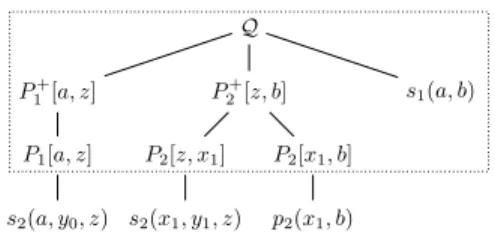
Q P+ 1[a, z] P2+[z, b] s1(a, b) P1[a, z] P2[z, x1] P2[x1, b] s2(a, y0, z) s2(x1, y1, z) p2(x1, b) Figure 1: Instantiations of a PCQ
Example 2 Let (Q, P) be a PCQ, where Q = P1+[a, z] ∧
P2+[z, b] ∧ s1(a, b) and P contains the pattern definitions:
P1 := p1(#1, #2)|s2(#1, y, #2) and P2 := p2(#1, #2)|
s2(#2, y, #1).
Two instantiations of Q are displayed in Figure 1. The smaller instantiation (within the dotted lines) gives rise to the (non-full) instanceQ1 = P1[a, z] ∧ P2[z, x1] ∧ P2[x1, b] ∧
s1(a, b). By expanding the three nodes labelled by patterns
according to the definitions in P, we may obtain the larger stantation (occupying the entire figure), whose associated in-stanceQ2= s2(a, y0, z) ∧ s2(x1, y1, z) ∧ p2(x1, b) ∧ s1(a, b)
is a full instance for(Q, P).
A UPCQ (Q, P) can be translated into a set of Data-log rules ΠP and a UCQ QQ as follows. For each defi-nition P := a1(~t1)| . . . |ak(~tk) in P, we create the
transi-tivity rule p+(x, y) ∧ p+(y, z) → p+(x, z) and the rules ai(~ti) → p+(#1, #2) (1 ≤ i ≤ k). The UCQ QQ is
ob-tained from Q by replacing each repeatable pattern P+[t 1, t2]
by the atom p+(t1, t2). Observe that ΠPis non-recursive
ex-cept for the transitivity rules. The next proposition states that (ΠP, QQ) can be seen as a finite representation of the set of full instances of (Q, P).
Proposition 2 Let F be a fact base and (Q, P) be a UPCQ. ThenF , ΠP|= QQiffF |= Q for some Q ∈ f ull(Q, P).
A unifier µ = (Q0, H, Pu) of a PCQ is a unifier of one
of its (possibly non-full) instances such that Q0 is a set of (usual) atoms. We distinguish two types of unifiers (internal and external), defined next.
Let T be an instantiation, Q be its associated instance, and µ = (Q0, H, P
u) be a unifier of Q. Assume T contains a
repeatable pattern P+[t
1, t2] that is expanded into P [u0, u1],
. . . , P [uk, uk+1], where u0 = t1 and uk+1 = t2. We call
P [ui, ui+1] relevant for µ if it is expanded into an atom from
Q0. Because we consider only single-piece unifiers (cf. Sec. 2), it follows that if such relevant patterns exist, they form a sequence P [ui, ui+1],P [ui+1, ui+2],. . . , P [uj−1, uj]. Terms
uiand uj are called external to P+[t1, t2] w.r.t. µ; the other
terms occurring in the sequence are called internal. The uni-fier µ is said to be internal if all atoms from Q0are expanded from a single repeatable pattern, and no external terms are unified together or with an existential variable; otherwise µ is called external.
Example 3 Consider Q2 from Example 2 and the rules
R1 = s1(x0, y0) → p2(x0, y0) and R2 = s1(x0, y0) →
s2(x0, y0, z0). The unifier of Q2withR1that unifiesp2(x1, b)
withp2(x0, y0) is internal. The unifier of Q2withR2that
uni-fies{s2(a, y0, z), s2(x1, y1, z)} with s2(x0, y0, z0) is external
because it involves two repeatable patterns.
4.2
Overview of the Algorithm
Our query rewriting algorithm takes as input a CQ Q and a set of rules R = RL∪ RT, with RLa set of linear rules and RT
a set of transitivity rules, and produces a finite set of Datalog rules and a (possibly infinite) set of CQs. The main steps of the algorithm are outlined below.
Step 1 For each predicate p that appears in RT, create a
pat-tern definition P := p(#1, #2), where P is a fresh patpat-tern name. Call the resulting set of definitions P0.
Step 2 Let R+Lbe the result of considering all of the rule bod-ies in RLand replacing every body atom p(t1, t2) such that p
is a transitive predicate by the repeatable pattern P+[t1, t2].
Step 3 (Internal rewriting) Initialize P to P0and repeat the
following operation until fixpoint: select a pattern definition P ∈ P and a rule R ∈ R+L and compute the direct rewriting
of P w.r.t. P and R.
Step 4 Replace in Q all atoms p(t1, t2) such that p is a
transi-tive predicate by the repeatable pattern P+[t1, t2], and denote
the result by Q+.
Step 5 (External rewriting) Initialize Q to {Q+} and repeat the following operation until fixpoint: choose Qi ∈ Q,
com-pute a direct rewriting of Qi w.r.t. P and a rule from R+L,
and add the result to Q (except if it is isomorphic to some Qj∈ Q).
Step 6 Let ΠPbe the Datalog translation of P, and let QQbe
the (possibly infinite) set of CQs obtained by replacing each repeatable pattern P+[t
1, t2] in Q by p+(t1, t2).
The rewriting process in Step 3 is always guaranteed to ter-minate, and in Section 6, we propose a modification to Step 5 that ensures termination and formulate sufficient conditions that preserve completeness. When QQ is finite (i.e., it is a UCQ), it can be evaluated over the fact base saturated by ΠP, or alternatively, translated into a set of Datalog rules, which can be combined with ΠP and passed to a Datalog engine for evaluation. Observe that the construction of ΠPis query-independent and can be executed as a preprocessing step.
5
Rewriting Steps in Detail
A PCQ that contains a repeatable pattern has an infinite num-ber of instances. Instead of considering all instances of a PCQ, we consider a finite set of ‘instances of interest’ for a given rule. Such instances will be used for both the internal and external rewriting steps.
Instances of interest Consider a PCQ (Q, P) and a rule R ∈ R+L with head predicate p. The instantiations of interest of (Q, P) w.r.t. R are constructed as follows. For each re-peatable pattern Pi+[t1, t2] in Q, let ai1, . . . , aini be the atoms
in the definition of Pi with predicate p. If ni > 0, then
ex-pand Pi+[t1, t2] into k standard patterns, where 0 < k ≤
min(arity(p), ni) + 2, and expand each of these standard
patterns in turn into some ai
`. An instance of interest is the
Example 4 Reconsider Q, Q2andR2from Examples 2 and
3. Q2 is not an instance of interest of Q w.r.t. R2 since
P2[x1, b] is expanded into p(#1, #2) whereas the head
pred-icate ofR2iss2. If we expandP2[x1, b] with s2(#2, y, #1)
instead, we obtain the instance of interestQ3= s2(a, y0, z)∧
s2(x1, y1, z) ∧ s2(b, y2, x1) ∧ s1(a, b).
We next show that the set of unifiers computed on the in-stances of interest of a PCQ ‘captures’ the set of unifiers com-puted on all of its instances.
Proposition 3 Let (Q, P) be a PCQ and R ∈ R+L. For every
instanceQ of (Q, P) and unifier µ of Q with R, there exist an instance of interestQ0 of(Q, P) w.r.t. R and a unifier µ0 of
Q0withR such that µ0is more general1thanµ.
5.1
Internal Rewriting
Rewriting w.r.t. internal unifiers is performed ‘inside’ a re-peatable pattern, independently of the other patterns and atoms in the query. We will therefore handle this kind of rewriting in a query-independent manner by updating the pat-tern definitions.
To find all internal unifiers between instances under a re-peatable pattern P+[t1, t2] and a rule head H = p(. . .), one
may think that it is sufficient to consider each atom aiin P ’s
definition and check if there is an internal unifier of ai with
H. Indeed, this suffices when predicates are binary: in an internal unifier, t1 and t2 are unified with distinct variables,
which cannot be existential; thus, the terms in H are frontier variables, and a piece must consist of a single atom. If the arity of p is greater than 2, the other variables can be existen-tial, so it may be possible to unify a path of atoms from P ’s definition, but not a single such atom (see next example). Example 5 Let R = s(x, y) → r(z1, x, z2, y) and P :=
r(#2, #1, x0, x1)| r(#1, x2, #2, x3)| r(x4, x5, #1, #2).
There is no internal unifier of an atom inP ’s definition with H = r(z1, x, z2, y). However, if we expand P+[t1, t2] into
a pathP [t1, y0]P [y0, y1]P [y1, t2], then expand the ith
pat-tern of this path into theith atom in P ’s definition, the re-sulting instance can be unified withH by an internal unifier (with the partition{{z1, y0, x4}, {x, t1, x2, x5}, {z2, x0, y1},
{y, x1, x3, t2}}).
Fortunately, we can bound the length of paths to be consid-ered using both the arity of p and the number of atoms with predicate p in P ’s definition, allowing us to use instances of interest introduced earlier.
A direct rewriting P0 of a set of pattern definitions P w.r.t. a pattern name P and a rule R = B → H ∈ R+L is the set of pattern definitions obtained from P by updating P ’s defi-nition as follows. We consider the PCQ (Q = P+
[x, y], P). We select an instance of interest Q of Q w.r.t. R, an internal unifier µ of Q with H, and a substitution σ associated with µ that preserves the external terms. Let B0 be obtained from
1
Consider unifiers µ = (Q, H, Pµ) and µ0= (Q0, H, Pµ0), and
let σ (resp. σ0) be a substitution associated with Pµ(resp. Pµ0). We
say that µ0is more general than µ if there is a substitution h from σ0(Q0) to σ(Q) such that h(σ0(Q0)) ⊆ σ(Q) (i.e., h is a homomor-phism from σ0(Q0) to σ(Q)), and for all terms x and y in Q0∪ H, if σ0(x) = σ0(y) then σ(h(x)) = σ(h(y)).
σ(B) by substituting the first (resp. second) external term by #1 (resp. #2). If B0 is an atom, we add it to P ’s definition. Otherwise, B0is a repeatable pattern of the form S+[#1, #2] or S+[#2, #1]. Let f be a bijection on {#1, #2}: if B0is of
the form S+[#1, #2], f is the identity, otherwise f permutes #1 and #2. For all siin the definition of S, we add f (si) to
P ’s definition.
Note that the addition of an atom to a pattern definition is up to isomorphism (with #1 and #2 treated as distinguished variables, i.e., #1 and #2 are mapped to themselves). Example 6 Reconsider R, µ, and the definition of P from Example 5. Performing a direct rewriting w.r.t.P using R andµ results in adding the atom s(#1, #2) to P ’s definition. Proposition 4 Let (Q, P) be a PCQ where P+[t1, t2] occurs
and R ∈ R+L. For any instanceQ of (Q, P), any classical direct rewritingQ0ofQ with R w.r.t. to a unifier internal to
P+[t1, t2], and any Q0 ∈ f ull(Q0, P), there exists a direct
rewriting P0 of P w.r.t. P and R such that (Q, P0) has a full instance that is isomorphic toQ0.
5.2
External Rewriting
Let (Q, P) be a PCQ, R ∈ R+L, T be an instantiation of
in-terest of (Q, P) w.r.t. R, Q be the instance associated with T , and µ = (Q0, H, P ) be an external unifier of Q with R. From this, several direct rewritings of Q w.r.t. P and R can be built. First, we mark all leaves in T that either have the root as parent or are labelled by an atom in Q0, and we restrict T to branches leading to a marked leaf. Then, we consider each instantiation Tithat can be obtained from Q as follows.
Replace each repeatable pattern P+[t1, t2] that has k > 0
children in T by one of the following: (i) P+[t1, x1] ∧ X[x1, x2] ∧ P+[x2, t2], (ii) P+[t 1, x1] ∧ X[x1, t2], (iii) X[t1, x2] ∧ P+[x2, t2], (iv) X[t1, t2], where X[v1, v2] is a sequence P [v1, y1], P [y1, y2], . . . ,
P [yk−1, v2]. Let Qibe the instance associated with Ti.
If P [x0, y0] in T has child a(~t), expand in Ti the
corre-sponding P [x, y] into a(ρ(~t)) where ρ = {x0 7→ x, y07→ y}.
If µ0 = (ρ(Q0), H, ρ(P )) is still a unifier of Qiwith H, we
say that Qiis a minimally-unifiable instance of Q w.r.t. µ. In
this case, Q0i= µ0(Qi) \ µ0(H) ∪ µ0(B) is a direct rewriting
of Q w.r.t. P and R.
Example 7 Reconsider Q3 and R2, and let µ =
({s2(a, y0, z), s2(x1, y1, z)}, H2, {{a, x1, x0}, {y0, y1, y0},
{z, z0}}). First, we consider the instantiation that
gener-atedQ3, and we remove the node labelledP2[x1, b] and its
child s2(b, y2, x1), since the latter atom is not involved in
µ. Next will replace the repeatable pattern P1+[a, z] (resp. P2+[z, b]) using one of the four cases detailed above, and we check whether µ0 (obtained from µ) is still a unifier. We obtain in this manner the following minimally-unifiable instances: Q1 = P1+[a, x2]∧ s2(x2, y0, z)∧ s2(x1, y1, z)∧
P2+[x1, b]∧ s1(a, b), and Q2 = s2(a, y0, z) ∧ s2(x1, y1, z)
into: Q0
1 = P
+
1 [a, x0] ∧ s1(x0, y0)∧ P2+[x0, b]∧ s1(a, b) and
Q0
2= s1(a, y0)∧ P2+[a, b]∧ s1(a, b).
Proposition 5 Let (Q, P) be a PCQ and R ∈ R+L. For every
Q ∈ f ull(Q, P) and every classical direct rewriting Q0ofQ withR w.r.t. an external unifier, there is a direct rewriting Q0 ofQ w.r.t. P and R that has an instance isomorphic to Q0.
6
Termination and Correctness
To establish the correctness of the query rewriting algorithm, we utilize Propositions 2, 4 and 5.
Theorem 2 Let Q be a CQ, (F , R) be a linear+trans KB, and (ΠP,QQ) be the (possibly infinite) output of the algorithm. Then:F , R |= Q iff F , ΠP|= Q0for someQ0∈ Q
Q.
Regarding termination, we observe that Step 3 (internal rewriting) must halt since every direct rewriting step adds a new atom (using a predicate from R+L) to a pattern definition, and there are finitely many such atoms, up to isomorphism.
By contrast, Step 5 (external rewriting) need not halt, as the rewritings may grow unboundedly in size. Thus, to ensure termination, we will modify Step 5 to exclude direct rewrit-ings that increase rewriting size. Specifically, we identify the following ‘problematic’ minimally-unifiable instances:
• Q0is composed of atoms expanded from a single pattern
P+[t1, t2], µ0(t1) = µ0(t2), and P+[t1, t2] is replaced
as in case (i), (ii) or (iii).
• Q0is obtained from the expansion of repeatable patterns,
a term t of Q is unified with an existential variable of the head of the rule, t appears only in repeatable patterns of form Pi+[ti, t] (resp. Pi+[t, ti]), and all these repeatable
patterns are rewritten as in case (ii) Pi+[ti, t0i] ∧ X[t0i, t]
(resp. as in case (iii) X[t, t0i] ∧ Pi+[t0i, ti]).
We will call a direct rewriting excluded if it is based on such a minimally-unifiable instance; otherwise, it is non-excluded. Example 8 The rewriting Q01from Example 7 is excluded be-cause it is obtained from the minimally-unifiable instanceQ1
in which the repeatable patternsP1+[a, z] is expanded as in case(ii) and P2+[z, b] as in case (iii), and z is unified with the existential variablez0.
Proposition 6 Let (Q, P) be a PCQ and R ∈ R+L. IfQ0is a
non-excluded direct rewriting ofQ with R, then |Q0| ≤ |Q|.
Let us consider the ‘modified query rewriting algorithm’ that is obtained by only performing non-excluded direct rewritings in Step 5. This modification ensures termination but may comprise completeness. However, we can show that the modified algorithm is complete in the following key cases: when the CQ is atomic, when there is no specialization of a transitive predicate, or when all predicates have arity at most two. By further analyzing the latter case, we can formulate a safety condition, defined next, that guarantees completeness for a much wider class of rule sets.
Safe rule sets We begin by defining a specialization rela-tionship between predicates. A predicate q is a direct special-izationof a binary predicate p on positions {~i,~j} (~i 6= ∅,~j 6= ∅) if there is a rule of the form q(~u) → p(x, y) such that ~i
(resp. ~j) contains those positions of ~u that contain the term x (resp. y). It is a specialization of p on positions {~i,~j} if (a) it is a direct specialization of p on positions {~i,~j}, or (b) there is a rule of the form q(~u) → r(~v) such that r(~v) is a spe-cialization of p on positions {~k,~l} and the terms occurring in positions {~k,~l} of ~v occur in positions {~i,~j} of ~u with ~i 6= ∅ and ~j 6= ∅. We say that q is a pseudo-transitive predicate if it is a specialization of at least one transitive predicate.
We call a linear+trans rule set safe if it satisfies the follow-ing safety condition: for every pseudo-transitive predicate q, there exists a pair of positions {i, j} with i 6= j such that for all transitive predicates p of which q is a specialization on positions {~i,~j}, either i ∈ ~i and j ∈ ~j, or i ∈ ~j and j ∈ ~i.
Note that if we consider binary predicates, the safety con-dition is always fulfilled. Then, specializations correspond exactly to the subroles considered in DLs.
Example 9 Let R1 = s1(x, x, y) → p1(x, y), R2 =
s2(x, y, z) → p2(x, y), R3 = s1(x, y, z) → s2(z, x, y), and
p1andp2be two transitive predicates.
The following specializations have to be considered: s1is
a direct specialization ofp1 on positions {{1, 2}, {3}}, s2
is a direct specialization ofp2 on positions{{1}, {2}}, s1
is a specialization ofp2 on positions{{3}, {1}}. We then
have two pseudo-transitive predicates:s1ands2. By
choos-ing the pair{1, 3} for s1 and{1, 2} for s2, we observe that
{R1, R2, R3} satisfies the safety condition.
If we replace R3 by R4 = s1(x, y, z) → s2(x, y, z),
s1 is a specialization of p2 on positions {{1}, {2}}, and
{R1, R2, R4} is not safe.
Theorem 3 The modified query rewriting algorithm halts. Moreover, Theorem 2 (soundness and completeness) holds for the modified algorithm if either the input CQ is atomic, or the input rule set is safe.
7
Complexity
A careful analysis of our query rewriting algorithm allows us to pinpoint the worst-case complexity of atomic CQ entail-ment over linear+trans KBs, and general CQ entailentail-ment over safe linear+trans KBs. As usual, we consider two complex-ity measures: combined complexcomplex-ity (measured in terms of the size of the whole input), and data complexity (measured in terms of the size of the fact base). The latter is often consid-ered more relevant since the fact base is typically significantly larger than the rest of the input.
With regards to data complexity, we show completeness for NL (non-deterministic logarithmic space), which is the same complexity as in the presence of transitivity rules alone. Theorem 4 Both (i) atomic CQ entailment over linear+trans KBs and (ii) CQ entailment over safe linear+trans KBs are NL-complete in data complexity.
Regarding combined complexity, we show that the addition of transitivity rules does not increase the complexity of query entailment for the two considered cases.
Theorem 5 Both (i) atomic CQ entailment over linear+trans KBs and (ii) CQ entailment over safe linear+trans KBs are PSPACE-complete in combined complexity.
8
Conclusion
In this paper, we made some steps towards a better under-standing of the interaction between transitivity and decidable classes of existential rules. We obtained an undecidability re-sult for aGRD+trans, hence for fes+trans and fus+trans. More positively, we established decidability (with the lowest pos-sible complexity) of atomic CQ entailment over linear+trans KBs and general CQ entailment for safe linear+trans rule sets. The safety condition was introduced to ensure termination of the rewriting mechanism when predicates of arity more than two are considered (rule sets which use only unary and binary predicates are trivially safe). We believe the condition can be removed with a much more involved termination proof.
In future work, we plan to explore the effect of transitiv-ity on decidable rule classes that are incomparable with linear rules, namely frontier-one rules, a bts class that has close con-nections to Horn DLs, and two fus classes: domain-restricted and sticky rule sets [Baget et al., 2011a; Cal`ı et al., 2010].
Acknowledgements
This work was supported by ANR project PAGODA (contract ANR 12 JS02 007 01).
References
[Baader, 2003] F. Baader. Terminological cycles in a de-scription logic with existential restrictions. In Proc. of IJ-CAI, pages 325–330, 2003.
[Baget et al., 2009] J.-F. Baget, M. Lecl`ere, M.-L. Mugnier, and E. Salvat. Extending decidable cases for rules with existential variables. In Proc. of IJCAI, pages 677–682, 2009.
[Baget et al., 2011a] J.-F. Baget, M. Lecl`ere, M.-L. Mugnier, and E. Salvat. On rules with existential variables: Walking the decidability line. Art. Intell. (AIJ), 175(9-10):1620– 1654, 2011.
[Baget et al., 2011b] J.-F. Baget, M.-L. Mugnier, S. Rudolph, and M. Thomazo. Walking the com-plexity lines for generalized guarded existential rules. In Proc. of IJCAI, pages 712–717, 2011.
[Baget et al., 2015] J.-F. Baget, M. Bienvenu, M.-L. Mug-nier, and S. Rocher. Combining existential rules and tran-sitivity: Next steps. abs/1504.07443, 2015.
[Beeri and Vardi, 1981] C. Beeri and M. Y. Vardi. The impli-cation problem for data dependencies. In Proc. of ICALP, volume 115 of LNCS, pages 73–85. Springer, 1981. [Cal`ı et al., 2008] A. Cal`ı, G. Gottlob, and M. Kifer.
Tam-ing the infinite chase: Query answerTam-ing under expressive relational constraints. In Proc. of KR, pages 70–80, 2008. [Cal`ı et al., 2009] A. Cal`ı, G. Gottlob, and T. Lukasiewicz. A
general Datalog-based framework for tractable query an-swering over ontologies. In Proc. of PODS, pages 77–86, 2009.
[Cal`ı et al., 2010] A. Cal`ı, G. Gottlob, and A. Pieris. Query answering under non-guarded rules in Datalog+/-. In Proc. of RR, pages 1–17, 2010.
[Calvanese et al., 2007] D. Calvanese, G. De Giacomo, D. Lembo, M. Lenzerini, and R. Rosati. Tractable rea-soning and efficient query answering in description log-ics: The DL-Lite family. J. Autom. Reasoning (JAR), 39(3):385–429, 2007.
[Chandra and Vardi, 1985] A. K. Chandra and M. Y. Vardi. The implication problem for functional and inclusion de-pendencies is undecidable. SIAM J. Comput., 14(3):671– 677, 1985.
[Cuenca Grau et al., 2013] B. Cuenca Grau, I. Horrocks, M. Kr¨otzsch, C. Kupke, D. Magka, B. Motik, and Z. Wang. Acyclicity notions for existential rules and their application to query answering in ontologies. J. Art. Intell. Res. (JAIR), 47:741–808, 2013.
[Eiter et al., 2009] T. Eiter, C. Lutz, M. Ortiz, and M. Simkus. Query answering in description logics with transitive roles. In Proc. of IJCAI, pages 759–764, 2009. [Eiter et al., 2012] T. Eiter, M. Ortiz, M. Simkus, T.-K. Tran,
and G. Xiao. Query rewriting for Horn-SHIQ plus rules. In Proc. of AAAI, 2012.
[Glimm et al., 2008] B. Glimm, C. Lutz, I. Horrocks, and U. Sattler. Conjunctive query answering for the descrip-tion logic SHIQ. J. Artif. Intell. Res. (JAIR), 31:157–204, 2008.
[Gottlob et al., 2013] G. Gottlob, A. Pieris, and L. Ten-dera. Querying the guarded fragment with transitivity. In Proc. of ICALP, volume 7966 of LNCS, pages 287–298. Springer, 2013.
[Horrocks and Sattler, 1999] I. Horrocks and U. Sattler. A description logic with transitive and inverse roles and role hierarchies. J. Log. Comput., 9(3):385–410, 1999. [K¨onig et al., 2013] M. K¨onig, M. Lecl`ere, M.-L. Mugnier,
and M. Thomazo. On the exploration of the query rewrit-ing space with existential rules. In Proc. of RR, pages 123– 137, 2013.
[Kr¨otzsch and Rudolph, 2011] M. Kr¨otzsch and S. Rudolph. Extending decidable existential rules by joining acyclicity and guardedness. In Proc. of IJCAI, pages 963–968, 2011. [Kr¨otzsch et al., 2007] M. Kr¨otzsch, S. Rudolph, and P. Hit-zler. Complexity boundaries for Horn description logics. In Proc. of AAAI, pages 452–457. AAAI Press, 2007. [Lutz et al., 2009] C. Lutz, D. Toman, and F. Wolter.
Con-junctive query answering in the description logic EL us-ing a relational database system. In Proc. of IJCAI, pages 2070–2075, 2009.
[Mugnier, 2011] M.-L. Mugnier. Ontological query answer-ing with existential rules. In Proc. of RR, pages 2–23, 2011.
[Sattler, 2000] U. Sattler. Description logics for the repre-sentation of aggregated objects. In Proc. of ECAI, pages 239–243, 2000.