Publisher’s version / Version de l'éditeur:
Physical Review A, 55, 5, pp. 3826-3831, 1997-05-01
READ THESE TERMS AND CONDITIONS CAREFULLY BEFORE USING THIS WEBSITE. https://nrc-publications.canada.ca/eng/copyright
Vous avez des questions? Nous pouvons vous aider. Pour communiquer directement avec un auteur, consultez la première page de la revue dans laquelle son article a été publié afin de trouver ses coordonnées. Si vous n’arrivez pas à les repérer, communiquez avec nous à [email protected].
Questions? Contact the NRC Publications Archive team at
[email protected]. If you wish to email the authors directly, please see the first page of the publication for their contact information.
NRC Publications Archive
Archives des publications du CNRC
This publication could be one of several versions: author’s original, accepted manuscript or the publisher’s version. / La version de cette publication peut être l’une des suivantes : la version prépublication de l’auteur, la version acceptée du manuscrit ou la version de l’éditeur.
For the publisher’s version, please access the DOI link below./ Pour consulter la version de l’éditeur, utilisez le lien DOI ci-dessous.
https://doi.org/10.1103/PhysRevA.55.3826
Access and use of this website and the material on it are subject to the Terms and Conditions set forth at
Free-induction decay after a pulse saturation for systems with
noncorrelated frequency exchange
Malinovsky, Vladimir S.; Szabo, Alex
https://publications-cnrc.canada.ca/fra/droits
L’accès à ce site Web et l’utilisation de son contenu sont assujettis aux conditions présentées dans le site LISEZ CES CONDITIONS ATTENTIVEMENT AVANT D’UTILISER CE SITE WEB.
NRC Publications Record / Notice d'Archives des publications de CNRC:
https://nrc-publications.canada.ca/eng/view/object/?id=29ed4880-d417-4d82-aee6-9529d9af7539 https://publications-cnrc.canada.ca/fra/voir/objet/?id=29ed4880-d417-4d82-aee6-9529d9af7539Free-induction decay after a pulse saturation for systems with noncorrelated frequency exchange
Vladimir S. Malinovsky1,2and Alex Szabo31Institute of Thermophysics, Russian Academy of Sciences, Novosibirsk, 630090, Russia 2Chemical Physics Department, Weizmann Institute of Science, Rehovot 76100, Israel
3Institute for Microstructural Sciences, National Research Council of Canada, Ottawa, Ontario, Canada K1A 0R6
~Received 18 June 1996!
The free-induction decay ~FID! after saturation by a laser radiation pulse of finite duration is studied for systems with spectral diffusion. The exact solution of the FID signal shape has been obtained in the framework of a model of noncorrelated spectral exchange. The analysis accounts for the finite duration of the saturating field and is valid at an arbitrary value of the spectral exchange rate and amplitude of the coherent field. An exact expression for the FID signal is derived in the weak-external-field limit. A self-consistent explanation of the experimental field dependence of the FID rate @A. Szabo and T. Muramoto, Phys. Rev. A 39, 3992 ~1989!# is obtained using a model of slow noncorrelated spectral diffusion. @S1050-2947~97!00105-4#
PACS number~s!: 42.50.Md
I. INTRODUCTION
Investigation of coherent nonlinear phenomena gives in-formation about the microscopic mechanisms of relaxation processes in impurity-ion crystals. One of these phenomena is free-induction decay ~FID! after steady-state saturation or after excitation by a laser pulse. Recently, a number of stud-ies @1–10# of FID in ruby have been published that demon-strate the inapplicability of Bloch equations as a description of the field dependence of the FID rate. This results from the fact that the Bloch equations do not properly take into ac-count the random modulation of impurity-ion frequencies in solids. The frequency modulation of the ruby R1transition is
due to random reorientation of spins in the crystal lattice. The reorientation leads to a change in the local fields and correspondingly to a change in the impurity-ion frequencies. The random frequency modulation connected with the dephasing perturbations evokes a relaxation in the system. However, the coherent field influences the dephasing pro-cesses. As a result, the relaxation coefficients depend on the amplitude and frequency of the field in the master equation for the density matrix when averaged over the random per-turbations. There is no such dependence in the Bloch scheme.
In study @11#, the analysis of existing theories of FID, based on various models of random modulation of the tran-sition frequency, was performed. In particular, the telegraph noise model was examined and the inability to explain the experimental data @2# was demonstrated. In this paper we restrict our theoretical discussions to the FID after pulse saturation in a system with noncorrelated spectral exchange. The purpose of this study is to present a general theory of a FID signal shape after saturation by a strong-field impulse of arbitrary duration, as well as to explain the experimental field dependence of the FID rate @2,3#.
II. FID AFTER PULSE SATURATION
Let us consider an ensemble of impurity ions that inter-acts with a perturber reservoir and is driven by a resonant monochromatic radiation field E5E0exp$ivt%within the time
T. Polarization of the ions is induced by the radiation im-pulse and a FID signal is observed just after switching off the field. Each impurity ion is modeled by a two-level system ~TLS! whose frequency @E2(t)2E1(t)#/\5v01e(t) is a
stationary random process and whose mean value v0 and
equilibrium distribution w(e) is conserved with respect to time @E1,2(t) are the energy levels of the TLS#.
Since the value of v0 is distributed over the
inhomoge-neous line shape F(v0) caused by the crystal-field
disper-sion, the FID signal shape is defined by
R~ T1t!5F0Im
E
dDvs12~ T1t,Dv!, ~1!where Dv5v02v is the detuning frequency, v is the
saturating field frequency, F05F(v05v)5const, s12(T1t,Dv) is the off-diagonal element of a density
ma-trix that determines the polarization at time t after switching off the field. The general expression for s12(T1t,Dv) has
the following form:
s12~ T1t,Dv!5
K
s12~ T,Dv!expH
iDvt1i
E
T T1t
«~ t
8
!dt8
2t/T2J
L
, ~2! where the angular brackets denote averaging over random realizations of the process «(t),s12(T,Dv) is the initialpo-larization induced by the saturating field, and T2 takes into
account the spontaneous decay of the excited level ~i.e., T252T1 where T1 is the lifetime!.
Usually when calculating R(t), the correlation of the TLS frequency fluctuations before and after switch off of the field is neglected. This makes possible the decoupling procedure in Eq. ~2!, wheres12(T,Dv) and the exponent are averaged
separately. We obtain
s12~ T1t,Dv!5s12~ T,Dv!K~ t !exp$iDvt2t/T2%, ~3!
where
55
K~ t !5
K
expH
iE
0
t
«~ t
8
!dt8
J
L
~4!is the correlation function of the frequency modulation. It has been shown @9,12# that when exact expressions are used for the average s12(T,Dv) and K(t), then results for the
FID signal shape are obtained that are valid beyond the ap-plicability range of perturbation theory ~PT! for random de-tuning of the frequency. The condition for which PT is ap-plicable ~fast frequency modulation limit! is
q25«2t02
!1, ~5!
where «2 is the dispersion of the frequency distribution and
t021 is the spectral exchange rate. It is in the framework of
approximation ~5! that the majority of theoretical efforts @2–6# to explain the experiments @2# were undertaken. We note that the applicability range of Eq. ~3! must be examined in each particular case.
Expressions ~1! and ~2! are exact and determine the FID signal shape in the general case. It has not yet been possible to carry out the averaging procedure defined in Eq. ~2! in a generalized form. Therefore, we specifically model the ran-dom process «(t) and, in particular, consider the case where the TLS frequency is modulated by a Markovian noncorre-lated random process. This specification of the random pro-cess «(t) allows the averaging in Eq. ~2! to be performed and an exact expression for the FID signal shape to be obtained. If the frequency of the TLS interacting with the laser ra-diation field is modulated by a purely discontinuous Markov-ian process, then in agreement with the sudden modulation theory @13#, the averaging in Eq. ~2! can be represented as
s12~ T1t,Dv!5exp$iDvt2t/T2%
3
E
d« K~ «,t !s12~ «,T,Dv!, ~6!where K(«,t) ands12(«,T,Dv) are marginal or conditional
averages @13# whose argument is equal to « when the field is switched off.
Applying the Laplace transformation to Eq. ~6!, we get
s12~ p, p1,Dv!5
E
d« K~ «, p1!s12~ «, p,Dv!, ~7! where K~ «, p1!5E
0 ` dt K~ «,t !exp$2 p1t1iDvt2t/T2%. ~8!The frequency modulation function for Markovian spec-tral exchange has been thoroughly investigated @13–15#. To obtain a general solution for the FID signal, we have to find
s12(«, p,Dv) ~which describes the polarization induced by
the radiation field! as a function of «. For this purpose we will use the kinetic equations of the Markovian sudden modulation theory @13#.
III. THE NONCORRELATED MARKOVIAN FREQUENCY MODULATION
In this section we consider noncorrelated Markovian fre-quency modulation. This model assumes that the frefre-quency exchange takes place inside of packets whose centers are uniformly distributed over a wide spectral range. The fre-quency of the TLS changes instantly and then remains con-stant until the next jump. The distribution of the frequency value after the jump does not depend on the one before the jump @13#.
If the process is noncorrelated, then the kinetic equation for the density matrix may be written as
r˙~ « !52Lˆ~«!r~«!1w~ « !~ Gˆ r¯1Lˆ!, ~9! where r~ « !5
S
s12~ « ! s21~ « ! n~ « !D
, Lˆ~ « !5Lˆ01i«Lˆ11Gˆ, Lˆ05S
1 T22iD v 0 2ix 2 0 1 T21iD v ix 2 2ix ix 1 T1D
, Lˆ15S
21 0 0 0 1 0 0 0 0D
, Gˆ5S
1/t2 0 0 0 1/t2 0 0 0 1/t1D
, Lˆ 5S
0 0 n0 T1D
,s125s21*5̺12exp$ivt%, n5̺222̺11 is the population
dif-ference, n0 is the equilibrium population difference, x5d12E0 is the Rabi frequency, T1 and T2 are the
longitu-dinal and transverse relaxation times due to spontaneous de-cay, and w(«) is a static equilibrium frequency distribution. We modified the terms that take into account the fre-quency exchange in the system by introducing two different parameters, 1/t1 and 1/t2. These parameters are the
ex-change rate for the populations and coherence, respectively. The same modifications have been used for another systems @16#. We will use following correlations t15tc and
t25ut1. In the case u51, we have the model studied earlier for the FID signal after steady-state saturation @9#.
Employing the Laplace transformation, we can easily ob-tain
r~ «, p !5 w~ « ! p1Lˆ~«! Gˆ 1 12 w ~ « ! p1Lˆ~«! Gˆ Gˆ21
S
r 01 1 pL ˆD
. ~10! According to study @13–15#, we have for the Laplace rep-resentation of the marginal function of the frequency modu-lation K~ «, p1!5 1 p11t22i~ Dv1« ! 3 1 12t1 2E
w~ « !d« p11t22i~ Dv1« ! . ~11!To obtain an analytical solution for the FID signal shape, we now make the distribution w(e) more concrete. From a physical point of view, the choice of a static contour shape is determined by the spatial packing of nuclei surrounding an ion. It is known that the dipole-dipole interaction with the nuclei yields a Gaussian inhomogeneous contour when the packing is regular, and a Lorentzian contour if it is random @17#. So, the Gaussian contour is more suitable as w(e) in the case of impurity-ion crystals. But it is difficult to get a simple analytical expression for the FID signal for a Gauss-ian contour. However, we know that the shape of distribution
w(e) is not important for the case of the fast modulation; only the second moment of the distribution. The analysis shows that the situation is the same in the limit of slow noncorrelated exchange of frequency. In this case, we have to know just the rate of the spectral exchange. We consider the limits of fast and slow modulation for values of the spec-tral exchange parameters far from the threshold «2t
0 2
51. The final result depends on the shape of the distribution
w(e) only around the range of the parameters where «2t
0
2'1. Looking ahead, we have a case of slow frequency
exchange and, in principle, we are free to choose the static equilibrium distribution.
So we consider the model of the Lorentzian contour which allows development of an analytical solution. Using a Lorentzian for the equilibrium distribution w(e) in general expressions ~7! and ~1!, we obtain for the FID signal shape
R~ p,t !5pF2 pF0n0xexp
H
2 t T2JH
R0exp@2~a1F!t# 2AexpF
2S
t1 21 kD
tGJ
, ~12!where a is the width of the Lorentzian distribution,
R05 ~ p1t2!a k 2F1 p1 1 T21A, A5 a
F
p1 1 T21 ~ p1t2!~ a1F! kGS
12 k p1t2D
1/t21k2a2F , k2 5~ p1t2!21x2 p1t2 p1t1 , F25F
p1 1 T21 ~ p1t2!a kGF
p1 1 T21 ak p1t21 x2 p11/T1G
, t1,25 1 T1,21 1 t1,2 .Equation ~12! is exact and determines the FID signal shape after saturation by a strong-field impulse assuming noncorrelated frequency modulation. The expression is valid for the arbitrary strength of the saturating field and for the arbitrary transition frequency modulation rate. In the limit
Rs~ t !5 lim p→0
pR~ p,t !, ~13! we obtain an expression for the FID signal shape in the case of steady-state saturation @9#. Naturally it is possible to com-pare this result to the one we obtained within the range of
T@T1 and, thus, observe the approach to steady-state
satu-ration.
The approximate solution ~3!, neglecting correlation of the system motion before and after switch off of the field, can be represented as
s12~ p, p1,Dv!5K~ p1!s12~ p,Dv!, ~14!
where according to Eq. ~11!
K~ p1!5
E
d«w~ « !K~ «, p1!51
p111/T21a2iDv
, ~15! ands12( p,Dv) is determined by Eq. ~10! after the averaging
by «.
In this case, we finally find for the FID signal
Rd~ p,t !5pF0n0x 2 pF
S
p1 1 T21 ~ p1t2!a k 2FD
3expH
2S
T1 21a1FD
tJ
. ~16!The same result can be readily obtained from Eq. ~12! in the limit A50. It is evident that the appearance of the terms proportional to A in the exact solution ~12! is related to the correlation of the TLS frequency fluctuations before and af-ter switching off the field @9#.
IV. DISCUSSION A. Weak-external-field limit
The final expression for the FID signal shape contains two independent parameters a andtc. To determine these values
de-pendence of the FID rate, the experimental data on the pho-ton echo are usually employed. For the noncorrelated fre-quency modulation model, it is shown that the echo decay is exponential both for the fast @Eq. ~5!# and slow spectral ex-change (atc@1) @14#. In these cases, the echo decay rate is
equal to ge51/T21a ~fast exchange! and ge51/T211/t2
~slow exchange!. Thus, if the echo decay is exponential, we can determine either a assuming a fast spectral exchange, or
t2 for a slow spectral exchange.
The expression for the FID signal after the steady-state excitation in the limit x→0 is obtained in Ref. @18# ~in the framework of different spectral exchange models! for the fast and slow spectral exchange. In this regard, analysis of the FID signal shape for an arbitrary value of the spectral ex-change rate will be of interest within the framework of our model.
Using Eq. ~12!, we obtain for the FID signal ~for fre-quency modulation by a Markovian noncorrelated process! in the third-order contribution inx
R~ p,t !52x3n0pF0 4 exp$2~ p12/T2!t%F~ p,t !, ~17! where F~ p,t !5 1 p~ p1a11/T2!
HF
a ~ p1t1!~ 1/t22a ! 1 1 p11/T1G
exp~ 22at! 2 a~ p1a11/T2! ~ p1t1!~ p1t2!~ 1/t22a ! expS
22tt 2DJ
. Thus the FID signal shape is given byR~ T,t !5
H
2x 3n0pF0 4 exp$22t/T2%f~ T2t!, T.t>0 0, T,t. where f~ T2t!521piE
b2i` b1` exp$p~ T2t!%F~ p,t !d p. Taking into account the form F( p,t), we can write the expression for the FID signal at x→0 under T.t>0 asR~ T,t !52x3n0pF0 4 exp
H
2 2t T2J
j51(
j55 Bj~ t !exp$pj~ T2t!%, ~18! where pj and Bj(t) are defined byp150, B1~ t !5 exp~ 22at! a11/T2
F
a t1~ 1/t22a !1T1G
2 aexpS
22t t2D
t1t2~ 1/t22a ! ; p252a2 1 T2 , B2~ t !52 exp~ 22at! a11/T2F
aS
t12a2 1 T2D
~ 1/t22a ! 11 1 T12a2 1 T2G
; p352t1, B3~ t !5 a t1~ 1/t22a !F
exp~ 22at! t12a2 1 T2 1 expS
22t t2D
t22t1G
; p452t2, B4~ t !52 aexpS
22tt 2D
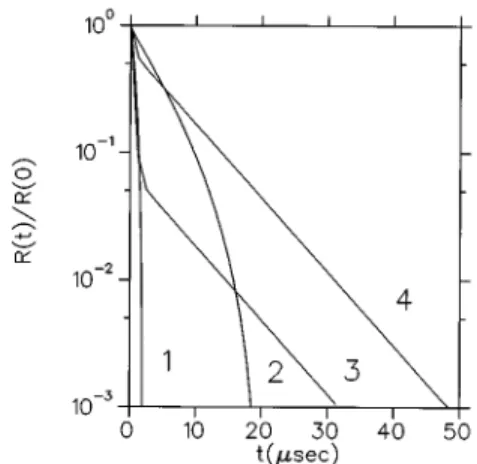
t2~ 1/t22a !~ t22t1! ; p552 1 T1 , B5~ t !5 T1exp~ 22at! 1 T12a2 1 T2 .Figure 1 shows FID signal shapes @Eq. ~18!# in the weak-external-field limit for different coherent pulse durations. In general, the FID signal after steady-state excitation or after excitation by a pulse of finite duration is biexponential. The FID signal is mainly determined by exp$22at% for the fast modulation and exp$22t/t2%for the slow modulation of the
frequency. The FID signal behavior at long times is the same as that for the standard Bloch equations with a finite pulse
FIG. 1. The FID signals vs time for noncorrelated frequency modulation ~plane-wave excitation! at x→0. t25t1,atc520,T154200 msec, ge21515 msec. ~1! T52 msec, ~2!
T520 msec, ~3! T5200 msec, ~4! steady-state regime.
duration @11#. It is seen that the FID signal suddenly disap-pears after a time equal to the pulse duration. This type of behavior has been discussed theoretically @19,20# and ob-served experimentally @21#. Qualitatively, the effect is re-lated to the fact that a pulse of duration T excites a frequency band of 'p/T. The dipoles then dephase completely in a time T which is the Fourier transform of the bandwidth.
It should be noted that forx→0, the theorem on coherent transients @20# for the Bloch model is also valid both for the noncorrelated frequency modulation and anticorrelated fre-quency modulation models @11#.
B. The FID signal after saturation
To analyze the FID signal shape after saturation by a fi-nite duration impulse, we employed an algorithm for the Laplace numerical inverse transformation @22#. The correct-ness of performing the numerical transformation of R( p,t) was tested by comparing the results in the case of T>T1,
where the exact analytical solution for the FID signal is
known @9#. Our study showed that when the saturating im-pulse duration increases, i.e., with T→T1, the FID signal shape approaches the steady-state saturation shape. We note that this result is true both for the case of a fast and slow exchange. Moreover, we have shown that the condition
T@ge21, with T
1.T is far from sufficient to employ the
expression for the FID signal shape under steady-state satu-ration.
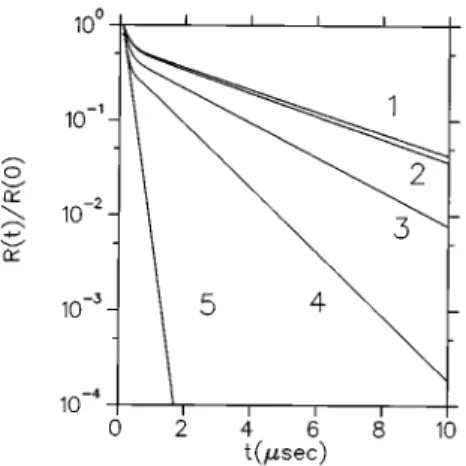
Figure 2 shows the FID signal shape calculated for differ-ent values of the Rabi frequency. It demonstrates the influ-ence of the field strength on the FID kinetics. As the Rabi frequency increases, the decay rate of the induced polariza-tion is accelerated. The increase of the FID rate with increas-ing Rabi frequency is related to the power broadenincreas-ing of the hole burned into the inhomogeneous profile during the preparation pulse. A stronger field burns a wider hole and the FID rate increases after the field is switched off.
In general, the kinetics of the FID signal is described by two exponents at a noncorrelated exchange. For fast modu-lation, the main term is the first one in the expression for
F( p,t) while the second term is dominant for slow ex-change. The correction ~second! term in the equation for
F( p,t) accounts for the correlation of the frequency fluctua-tions before and after turn off of the field. The calculated FID signal, using the approximate expression ~16!, is also shown in the Fig. 2. It is emphasized that we have to take into consideration the correlation of the system motion before and after switch off of the field.
We used a plane-wave model and infinitely wide inhomo-geneous line in the discussion of the FID signal above. To allow comparison of the theory with experimental data, we have to account for the Gaussian shape of the laser beam used in the experiments @2,3#. As is easily shown, the beam shape can be included in the theory as follows:
S~ T,t !5const
E
0 x
dx
8
R~x8
,T,t !, ~19!where R(x
8
,T,t) is determined by Eq. ~12!.FIG. 2. The FID signals vs time for noncorrelated frequency modulation ~plane wave excitation!. t25t1,atc520,T154200
msec, ge21515 msec, T5200 msec. ~1! x/2p50.5 kHz, ~2!
x/2p55 kHz, ~3! x/2p520 kHz, ~4! x/2p550 kHz, ~5! the ap-proximate solution at x/2p55 kHz @Eq. ~16!#.
FIG. 3. Field dependence of the FID rate for a Gaussian shaped beam. ~1! Bloch theory, ~2! exact theory for noncorrelated spectral exchange at atc5100,t252tc,tc57.5 msec, T5200 msec, h, ex-perimental data ~Ref. @2#!, the point designated by 3 at zero Rabi frequency is obtained from photon-echo data.
FIG. 4. Field dependence of the FID rate for a Gaussian shaped beam. ~1! Bloch theory, ~2! exact theory for noncorrelated spectral exchange at atc5100,t252tc,tc57.5 msec, T550 msec, h, ex-perimental data ~Ref. @3#!, the point designated by 3 at zero Rabi frequency is obtained from photon-echo data.
Experimental studies @2,3# showed that the shape of the FID signal is nearly exponential. However, as has been dis-cussed earlier @11#, FID decay is not an exponential function of the time in the telegraph noise model. To explain the experimental results @2,3# of the FID rate dependence on the field strength in ruby, we used a noncorrelated frequency modulation model. Figures 3 and 4 compare theory and ex-periment fort252tc,tc57.5msec and atc5100. The good
agreement supports our conclusion is that the spectral ex-change in ruby is slow and the noncorrelated frequency modulation model is more suitable than the telegraph noise model for this system.
V. CONCLUSION
The exact solution of the FID signal shape after saturation by a radiation pulse of finite duration under noncorrelated spectral exchange has been obtained. Analysis of the FID signal for an arbitrary spectral exchange rate and Rabi fre-quency showed that the correlation of the fluctuations before
and after the turn off of the field must be taken into consid-eration.
The exact analytic expressions of the FID signal were derived in the weak-external-field limit. These expressions are valid for an arbitrary frequency modulation rate. It was shown that a decrease of the saturation pulse duration leads to nonexponential decay of induced polarization for the lim-its atc!1 and atc@1, while the FID signal after steady-state saturation is exponential. It was demonstrated that the field dependence of the FID rate found by Szabo and co-authors @2,3# have a self-consistent explanation in the limit of the slow noncorrelated spectral diffusion.
ACKNOWLEDGMENTS
One of the authors ~V.S.M.! thanks the INTAS ~Grant No. 93-2492! and International Center for Fundamental Physics in Moscow for financial support. A.S. thanks J. Froemel for technical assistance.
@1# R.G. DeVoe and R.G. Brewer, Phys. Rev. Lett. 50, 1269 ~1983!.
@2# A. Szabo and T. Muramoto, Phys. Rev. A 39, 3992 ~1989!. @3# A. Szabo and R. Kaarli, Phys. Rev. B 44, 12 307 ~1991!. @4# A. Schenzle, M. Mitsunaga, R.G. DeVoe, and R.G. Brewer,
Phys. Rev. A 30, 325 ~1984!.
@5# M. Yamanoi and J.H. Eberly, J. Opt. Soc. Am. B 1, 751 ~1984!.
@6# P.A. Apanasevich, S.Ya. Kilin, A.P. Nizovtsev, and N.S. Onis-chenko, Opt. Commun. 52, 279 ~1984!.
@7# J. Javanainen, Opt. Commun. 50, 26 ~1984!.
@8# P.R. Berman and R.G. Brewer, Phys. Rev. A 32, 2784 ~1985!. @9# A.I. Burshtein, A.A. Zharikov, and V.S. Malinovsky, Phys.
Rev. A 43, 1538 ~1991!.
@10# K. Wodkiewicz and J.H. Eberly, Phys. Rev. A 32, 992 ~1985!. @11# V.S. Malinovsky, Phys. Rev. A 52, 4921 ~1995!.
@12# V.S. Malinovsky, Opt. Spektrosk. 70, 681 ~1991! @Opt. Spec-trosc. ~USSR! 70, 399 ~1991!#.
@13# A.I. Burshtein, Lectures on Quantum Kinetics ~NSU,
Novosi-birsk, 1968!; A.I. Burshtein, Zh. Eksp. Teor. Fiz. 48, 850 ~1965! @Sov. Phys. JETP 21, 567 ~1965!#; 49, 1362 ~1966! @22, 939 ~1966!#; A.I. Burshtein and Yu. S. Oseledchik, ibid. 51, 1071 ~1966! @ibid. 24, 716 ~1967!#.
@14# A.B. Doktorov and A.I. Burshtein, Zh. E´ksp. Teor. Fiz. 63, 784 ~1972! @Sov. Phys. JETP 36, 411 ~1973!#.
@15# A.I. Burshtein, Zh. E´ksp. Teor. Fiz. 62, 1695 ~1972! @Sov. Phys. JETP 35, 882 ~1972!#; A.I. Burshtein, S.G. Fedorenko, and A.Yu. Pusep, Chem. Phys. Lett. 100, 155 ~1983!. @16# H. Wang and D.G. Steel, Phys. Rev. A 43, 3823 ~1991!. @17# A. Abragam, The Principles of Nuclear Magnetism
~Claren-don, Oxford, 1961!.
@18# P.R. Berman, J. Opt. Soc. Am. B 3, 572 ~1986!. @19# F.A. Hopf and M.O. Scally, Phys. Rev. 179, 399 ~1969!. @20# A. Schenzle, N.C. Wong, and R.G. Brewer, Phys. Rev. A 22,
635 ~1980!.
@21# R.G. Brewer and R.L. Shoemaker, Phys. Rev. A 6 ~6!, 2001 ~1972!.
@22# H. Stehfest, Commun. ACM 13, 47 ~1970!.