HAL Id: hal-00746580
https://hal.archives-ouvertes.fr/hal-00746580
Submitted on 18 Apr 2018
HAL is a multi-disciplinary open access
archive for the deposit and dissemination of
sci-entific research documents, whether they are
pub-lished or not. The documents may come from
teaching and research institutions in France or
abroad, or from public or private research centers.
L’archive ouverte pluridisciplinaire HAL, est
destinée au dépôt et à la diffusion de documents
scientifiques de niveau recherche, publiés ou non,
émanant des établissements d’enseignement et de
recherche français ou étrangers, des laboratoires
publics ou privés.
Distributed under a Creative Commons Attribution| 4.0 International License
Tungsten-enhanced growth of Methanosphaera
stadtmanae
Bédis Dridi, Saber Khelaifia, Marie Laure Fardeau, Bernard Ollivier, Michel
Drancourt
To cite this version:
Bédis Dridi, Saber Khelaifia, Marie Laure Fardeau, Bernard Ollivier, Michel Drancourt.
Tungsten-enhanced growth of Methanosphaera stadtmanae. BMC Research Notes, BioMed Central, 2012, 5,
pp.238. �10.1186/1756-0500-5-238�. �hal-00746580�
S H O R T R E P O R T
Open Access
Tungsten-enhanced growth of
Methanosphaera stadtmanae
Bédis Dridi
1, Saber Khelaifia
1, Marie-Laure Fardeau
2, Bernard Ollivier
2and Michel Drancourt
1*Abstract
Background: The methanogenic Archaea Methanosphaera stadtmanae has been detected in the human gut microbiota by both culture and culture-independent methods. Its growth reaches an exponential phase after 5 to 7-day culture in medium 322 (10% vol). Our recent successful isolation of Methanomassiliicoccus luminyensis, a tungstate-selenite-requiring Archaea sharing similar metabolism characteristics with M. stadtmanae prompted us to study the effects of tungsten and selenium on M. stadtmanae growth.
Findings: Addition of 0.2 mg/L sodium tungstate to medium 322 yielded, 48 hours after inoculation, a growth rate equivalent to that obtained after 6 days with control culture as measured by methane monitoring and optical density measurement. Addition of 50μg/mL sodium selenate had no effect on M. stadtmanae growth. Quantitative real-time PCRs targeting the M. stadtmanae 16S rRNA confirmed these data.
Conclusions: These data provide new information regarding the poorly known nutritional requirements of the human gut colonizing organisms M. stadtmanae. Adding sodium tungstate to basal medium may facilitate phenotypic characterization of this organism and additionally aid the isolation of new Archaea from complex host microbiota.
Keywords: Methanogenic Archaea, Methanosphaera stadtmanae, Methanomassiliicoccus luminyensis, Tungsten, Selenium
Findings
Methanosphaera stadtmanae is a spherical-shaped, non-motile archaeon initially isolated from human feces [1]. M. stadtmanae was the first human Archaea to be genome sequenced and analysis of the genome confirmed that M. stadtmanae belonged to Methanobacteriales [2]. PCR-based analyses further indicated that M. stadtmanae-specific sequences could be detected in stool specimen in up to 30% of individuals [3]. However, M. stadtmanae is a fastidious organism, with only one M. stadtmanae iso-late reported and accordingly only one M. stadtmanae strain available in public collections. M. stadtmanae oxi-dizes hydrogen to reduce methanol into methane [1,2]. This metabolic trait has been already reported for M. stadtmanae [4], and more recently for members of the genus Methanobacterium (e.g. M. veterum and M. lacus;
[5,6]) within the order Methanobacteriales. We recently isolated Methanomassiliicoccus luminyensis, the first cul-tured representative of new order of methanoarchaea [7]. This archaeon exhibits a metabolic trait similar to that of M. stadtmanaeby using hydrogen as electron donor and methanol as electron acceptor [7]. Unexpectedly, we observed that addition of tungstate-selenite to culture medium had been a key factor for successful isolation of M. luminyensis and that this archaeon indeed required tungstate-selenite as an essential element for growth. We therefore tested the hypothesis that the addition of so-dium tungstate or soso-dium selenate or both to basal cul-ture medium would also enhance the growth of M. stadtmanae.
M. stadtmanae DSMZ 3091 T (ATCC 43021T) pur-chased from the German Collection of Microorganisms and Cell Cultures (DSMZ, Braunschweig, Germany) was grown on medium 322 (http://www.dsmz.de) incubated at 37°C in Hungate tubes (Dutscher, Issy-les-Moulineaux, France) under 2-bar pressure of a H2/CO2 (80–20)
at-mosphere. The inoculated medium (10% vol) was
* Correspondence:[email protected]
1Unité de Recherche sur les Maladies Infectieuses et Tropicales Emergentes
UMR CNRS 6236 IDR 198, IFR48, Institut Méditerranée Infection, Aix-Marseille-Université, Marseille, France
Full list of author information is available at the end of the article
© 2012 Dridi et al.; licensee BioMed Central Ltd. This is an Open Access article distributed under the terms of the Creative Commons Attribution License (http://creativecommons.org/licenses/by/2.0), which permits unrestricted use, distribution, and reproduction in any medium, provided the original work is properly cited.
incubated at 37°C with shaking. On the exponential phase of this first culture, a second inoculation was per-formed by 10% vol. in the same basal medium modified or not by the addition of Na2O4W (0.2 mg/L) and/or
Na2O4Se (50 μg/L) (Sigma, Saint-Quentin Fallavier,
France). Non-inoculated media were used as negative controls and each experiment was repeated ten times.
Growth was assessed by optical microscope observa-tion, parallel methane production measurement and measurement of the optical density of the medium. Methane production measurement used a GC-8A gas chromatograph (Shimadzu, Champs-sur-Marne, France) equipped with a thermal conductivity detector and a Chromosorb WAW 80/100 mesh SP100 column (Alltech, Carquefou, France). N2at a pressure of 100 kPa
was used as the carrier gas. The detector and the injector temperatures were 200°C, and the column temperature was 150°C. H2 consumption and CH4 production were
measured every 6 hours for 24 hours and then every 12 hours for 6 days. The optical density at 580 nm was measured by inserting Hungate tubes into the spectrophotometer (Varian Cary50; Agilent Technologies, Massy, France). Experiment was done in triplicate and average optical density value for the three replicates was calculated.
M. stadtmanaeDNA extraction, quantification and se-quencing were performed as previously described based on specific quantitative real-time PCR targeting 16S rRNA gene [3].
Negative controls (with and without tungstate and sel-enium) remained negative with no growth occurring after one-week incubation indicating that results herein reported did not merely result from carry-over of organ-isms. The exponential phase of M. stadtmanae growth cultured in medium 322 was reached at 6-day incuba-tion. At this point microscopic observation disclosed organisms with morphology compatible with M. stadt-manae and no contaminant. Also, qPCR detected an equivalent of 3.22E + 12 ± 1.53E + 11 copies of 16S rRNA gene/mL (Table 1). Sequencing of 16S rRNA gene PCR products from all specimens yielded a sequence similar-ity of 99-100% with the reference M. stadtmanae DSM 3091 sequence.
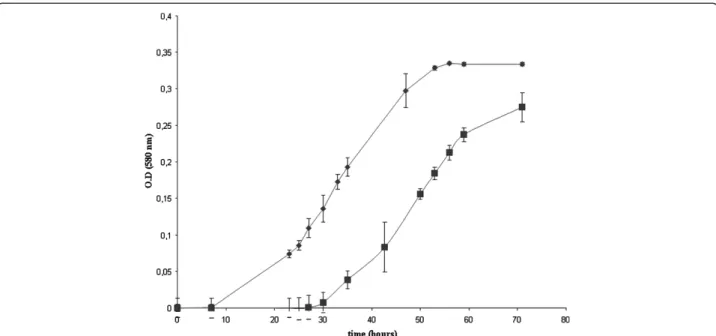
The addition of sodium selenate alone has no effect on the growth curve of M. stadtmanae. However, the addition of sodium tungstate alone or in combination with sodium selenate shortened the lag period to 2 days post-inoculation with an equivalent 16S rRNA and rpoB genes copy number and with equivalent rates of me-thane production (Figure 1). In the absence of tungstate, M. stadtmanae exhibited a 30-hour log phase. Adding tungsate to the culture medium reduced the delay of this log-phase so that it took 47 hours instead of 72 hours to achieve a 0.35 optical density of the culture (Figure 2). These results correlated with the fact that M. stadtma-nae genome encodes a formylmethanofuran dehydro-genase comprising of five sub-units (Genes IDs: 3855499-3855500-3855501-3855502-3855503), an en-zyme found in methanogenic Archaea. In strict anaer-obic micro-organisms, this enzyme catalyzes the reversible dehydrogenation of formylmethanofuran into CO2and methanofuran. The formylmethanofuran
dehy-drogenases are either molybdenum- or tungsten-iron-sulfur proteins. The tungsten is likely bound to the same
Figure 1 Visualizations of H2used (in mM; left Y axis) and CH4
(in mM; right Y axis) produced by M. stadtmanae with and without addition of sodium tungstate solution (Na2O4W) (over
140 hours (X axis).♦ H2used with sodium tungstate (Na2O4W),
■ CH4production with sodium tungstate (Na2O4W),▲ H2used
without sodium tungstate (Na2O4W), and● CH4production
without sodium tungstate (Na2O4W).
Table 1 M. stadtmanae 16S rDNA gene copy number after 48-hour culture with Na2O4W + Na2O4Se or only Na2O4W
and a 6-day culture with no Na2O4W + Na2O4Se or only with Na2O4Se (Mean and standard deviation were calculated
for 10 independent culture tests for each condition)
48-hour culture 6-day culture
without with with with without
Na2O4W + Na2O4Se Na2O4W + Na2O4Se Na2O4W Na2O4Se Na2O4W + Na2O4Se
Means 2.13E + 10 4.42E + 12 3.93E + 12 4.02E + 12 3.22E + 12
Standard deviation 5.56E + 09 1.84E + 11 3.67E + 11 2.23E + 11 1.53E + 11
Dridi et al. BMC Research Notes 2012, 5:238 Page 2 of 4 http://www.biomedcentral.com/1756-0500/5/238
skeleton as the molybdenum in the so-called molybdop-terin dinucleotide cofactor [8-10].
Previous reports described the requirement of tungsten for growing numerous methanogens including Metha-nothermobacter wolfeiwhich has an obligate requirement for tungsten to maintain autotrophic growth, Methano-coccus vannielii requiring tungsten as a cofactor for the enzyme formate dehydrogenase [11], Methanogenium tatii [12] and Methanocorpusculum parvum [13] also re-quiring tungsten for growth (Table 2). Selenium has also been reported as stimulatory and may be required for many methanogens, especially members of the genus Methanococcus as Methanococcus vannielii [11], Metha-nococcus jannaschii [14], Methanococcus maripaludis [15], Methanococcus voltae [16] and Methanococcus ther-molithotrophicus[17] (Table 1). Requirement for selenium could have enzymatic basis, since it was reported that M. vannielii possesses a selenium-dependant formate
dehydrogenase [18]. Selenium was also reported as a component of both a hydrogenase [19] and tRNA [20].
In the absence of tungstate, M. stadtmanae exhibited a growth delay of 5–7 days which is long for testing in vitro susceptibility to antibiotics [22]. As we now observed that tungsten enhances the growth of two taxonomically unrelated methanogens, M. stadtmanae and M. luminyensis, we suggest that tungsten-containing media could be incorporated into the panel of media used for the isolation and culture of new methanogens from clinical and environmental specimens, and for test-ing their in-vitro susceptibility to antibiotics.
Methanogenic Archaea recently emerged as normal components of the human gastrointestinal and oral mi-crobial ecosystems, where they could play important roles in health and diseases [23]. However, the isolation of such organisms requires long incubation times and strict anoxic atmosphere and is hampered by the incom-plete knowledge of their nutritional requirements [23]. In fact, the result obtained in the present study may prompt further phenotypic characterization including extended antibiotic susceptibility testing [22] and even allowing isolation of new Archaea in order to assess understanding their contribution in the physiology of complex human microbiomes and their potential role in the course of infections.
Competing interests
The authors declare that they have no competing interests. Author’s contributions
BD, SK, MLF designed and performed analyses, BO, MD interpreted data and wrote the draft. All authors read and approved the final manuscript. Figure 2 The effect of addition of selenite/tungstate solution on growth of M. stadtmanae. ♦ Growth of M. stadtmanae with tungstate (Na2O4W).■ Growth of M. stadtmanae without tungstate (Na2O4W).
Table 2 Requirement of tungsten or/and selenium for growth of methanogens as reported in bibliography
Species Tungsten Selenium References
Methanothermobacter wolfei YES NA [21] Methanococcus vannielii YES YES [11,18]
Methanogenium tatii YES NA [12]
Methanocorpusculum parvum YES NA [13]
Methanococcus jannaschii NA YES [14]
Methanococcus maripaludis NA YES [15]
Methanococcus voltae NA YES [16]
Author details
1
Unité de Recherche sur les Maladies Infectieuses et Tropicales Emergentes UMR CNRS 6236 IDR 198, IFR48, Institut Méditerranée Infection,
Aix-Marseille-Université, Marseille, France.2Laboratoire de Microbiologie IRD, UMR D180, Microbiologie et Biotechnologie des Environnements Chauds, Aix-Marseille-Université, ESIL, Marseille, France.
Received: 16 November 2011 Accepted: 25 April 2012 Published: 15 May 2012
References
1. Miller TL, Wolin MJ: Methanosphaera stadtmaniae gen. nov., sp. nov.: a species that forms methane by reducing methanol with hydrogen. Arch Microbiol 1985, 141:116–122.
2. Fricke WF, Seedorf H, Henne A, Kruer M, Liesegang H, Hedderich R, et al: The genome sequence of Methanosphaera stadtmanae reveals why this human intestinal archaeon is restricted to methanol and H2 for methane formation and ATP synthesis. J Bacteriol 2006, 188:642–658.
3. Dridi B, Henry M, El Khéchine A, Raoult D, Drancourt M: High prevalence of Methanobrevibacter smithii and Methanosphaera stadtmanae detected in the human gut using an improved DNA detection protocol. PLoS One 2009, 4:e7063.
4. Kendall M, Boone D: The Order Methanosarcinales. In The Prokaryotes. Edited by Dworkin M, Falkow S, Rosenberg E, Schleifer KH, Stackebrandt E. New York: Spriger; 2006:244–256.
5. Krivushin KV, Shcherbakova VA, Petrovskaya LE, Rivkina EM:
Methanobacterium veterum sp. nov., from ancient Siberian permafrost. Int J Syst Evol Microbiol 2010, 60:455–459.
6. Borrel G, Joblin K, Guedon A, Colombet J, Tardy V, Lehours AC, Fonty G: Methanobacterium lacus sp. nov., a novel hydrogenotrophic methanogen from the deep cold sediment of a meromictic lake. Int J Syst Evol Microbiol 2011, Sep 2. [Epub ahead of print] PubMed PMID: 21890730. 7. Dridi B, Fardeau ML, Ollivier B, Raoult D, Drancourt M:
Methanomassiliicoccus luminyensis, gen. nov., sp. nov., a novel methanogenic Archaea isolated from human feces. Int J Syst Evol Microbiol 2012, 62:1902–1907. in press.
8. Karrasch M, Borner G, Enssle M, Thauer RK: The molybdoenzyme formylmethanofuran dehydrogenase from Methanosarcina barkeri contains a pterin cofactor. Eur J Biochem 1990, 194:367–372. 9. Karrasch M, Borner G, Enssle M, Thauer RK: Formylmethanofuran
dehydrogenase from methanogenic bacteria, a molybdoenzyme. FEBS Lett 1989, 253:226–230.
10. Borner G, Karrasch M, Thauer RK: Molybdopterin adenine dinucleotide and molybdopterin hypoxanthine dinucleotide in formylmethanofuran dehydrogenase from Methanobacterium thermoautotrophicum (Marburg). FEBS Lett 1991, 290:31–34.
11. Jones JB, Stadtman TC: Methanococcus vannielii: culture and effects of selenium and tungsten on growth. J Bacteriol 1977, 130:1404–1406. 12. Zabel HP, König H, Winter J: Isolation and characterization of a new
coccoid methanogen, Methanogenium tatii spec. nov. from a solfataric field on Mount Tatio. Arch Microbiol 1984, 137:308–315.
13. Zellner G, Alten C, Stackebrandt E, Conway De Macario E, Winter J: Isolation and characterization of Methanocorpusculum parvum gen. nov., spec. nov., a new tungsten requiring, coccoid methanogen. Arch Microbiol 1987, 147:13–20.
14. Jones WJ, Leigh JA, Mayer F, Woese CR, Wolfe RS: Methanococcus jannaschii sp. nov., an extremely thermophilic methanogen from a submarine hydrothermal vent. Arch Microbiol 1983, 136:254–261. 15. Jones WJ, Paynter MJB, Gupta R: Characterization of Methanococcus
maripaludis sp. nov., a new methanogen isolated from salt marsh sediment. Arch Microbiol 1983, 135:91–97.
16. Berghöfer Y, Agha-Amiri K, Klein A: Selenium is involved in the negative regulation of the expression of selenium-free [NiFe] hydrogenases in Methanococcus voltae. Mol Gen Genet 1994, 242:369–373.
17. Belay N, Sparling R, Daniels L: Relationship of formate to growth and methanogenesis by Methanococcus thermolithotrophicus. Appl Environ Microbiol 1986, 52:1080–1085.
18. Jones JB, Stadtman TC: Selenium-dependent and selenium-independent formate dehydrogenases of Methanococcus vannielii. Separation of the two forms and characterization of the purified selenium-independent form. J Biol Chem 1981, 256:656–663.
19. Yamazaki S: A selenium-containing hydrogenase from Methanococcus vannielii, Identification of the selenium moiety as a selenocysteine residue. J Biol Chem 1982, 257:7926–7929.
20. Ching WM, Wittwer AJ, Tsai L, Stadtman TC: Distribution of two selenonucleosides among the selenium-containing tRNAs from Methanococcus vannielii. Proc Natl Acad Sci U S A 1984, 81:57–60. 21. König H, Semmler R, Lerp C, Winter J: Evidence for the occurrence of
autolytic enzymes in Methanobacterium wolfei. Arch Microbiol 1985, 141:177–180.
22. Dridi B, Fardeau ML, Ollivier B, Raoult D, Drancourt M: The antimicrobial resistance pattern of cultured human methanogens reflects the unique phylogenetic position of archaea. J Antimicrob Chemother 2011, 66:2038–2044.
23. Dridi B, Raoult D, Drancourt M: Archaea as emerging organisms in complex human microbiomes. Anaerobe 2011, 17:56–63.
doi:10.1186/1756-0500-5-238
Cite this article as: Dridi et al.: Tungsten-enhanced growth of Methanosphaera stadtmanae. BMC Research Notes 2012 5:238.
Submit your next manuscript to BioMed Central and take full advantage of:
• Convenient online submission • Thorough peer review
• No space constraints or color figure charges • Immediate publication on acceptance
• Inclusion in PubMed, CAS, Scopus and Google Scholar • Research which is freely available for redistribution
Submit your manuscript at www.biomedcentral.com/submit
Dridi et al. BMC Research Notes 2012, 5:238 Page 4 of 4 http://www.biomedcentral.com/1756-0500/5/238