Facult´e des Sciences D´epartement d’Astrophysique, G´eophysique et Oc´eanographie
Characterizing extrasolar planetary
systems using infrared interferometry
TH`
ESE
pr´esent´ee pour l’obtention du diplˆome de
Docteur en sciences
par
Denis Defr`ere
Soutenue publiquement le ThesisDate devant le Jury compos´e de: Pr´esident : Pr. Serge HABRAKEN
Superviseur : Pr. Jean SURDEJ Examinateurs : Dr. Olivier ABSIL
Dr. Vincent COUD´E DU FORESTO Dr. Malcolm FRIDLUND
Pr. Claude JAMAR Pr. Jean-Pierre SWINGS
Acknowledgments
The work presented in this thesis has benefited greatly from interactions with many people. First of all, I want to express my deepest gratitude to my academic supervisor, Professor Jean Surdej. Thank you Jean for giving me the opportunity to work in your team, and all your wise advice all along this thesis. I have really appreciated your infaillible enthusiasm and continuous encouragement. Thank you also for always finding me a financial support, to let me attend my favourite conferences or meetings.
My utmost gratitude goes also to Dr. Olivier Absil for his expert advice and constant guidance all along my PhD thesis. Olivier has been an invaluable source of inspiration since the very beginning of this thesis. The present work greatly benefits from his work and insights into stellar/nulling interferometry. I am also very grateful to him for having fostered so many fruitful international collaborations and for his diligence with the corrections of my manuscripts.
I am also grateful to Pr. Serge Habraken, Dr. Vincent Coudé du Foresto, Dr. Malcolm Fridlund, Pr. Claude Jamar, and Pr. Jean-Pierre Swings, for accepting to read and evaluate this dissertation. I also want to express a particular thank to Professor Jean-Pierre Swings who has given me the opportunity to achieve important experiences in my starting scientific career.
My warmest thank goes also to the former Darwin Team at ESA/ESTEC. A special thank to Malcolm Fridlund and Anders Karlsson, for inviting me at the TE-SAT meetings, and Roland den Har-tog for his expert advice on simulating nulling interferometers. I take also the opportunity to thank Darwin/Pegase collaborators: Marc Barillot, Jean-Michel Le Duigou, Alain Léger, Marc Ollivier, and Yvan Stockman. I wish also to thank American colleagues for important collaborations on TPF/FKSI: Richard Barry, William Danchi, Lisa Kaltenegger, Peter Lawson, Oliver Lay and Chris Stark.
I am also very grateful to my CHARA/FLUOR colleagues for all the good work in obtaining nice fringes at the CHARA array on the Mount Wilson and memorable moments spent in Los-Angeles. Thanks a lot to Jean-Charles Augereau, Vincent Coudé du Foresto, Emmanuel Di Folco, Pierre Kervella, Antoine Mérand and Theo Ten Brummelaar. Thanks also to Jean-Philippe Berger, Jean-Baptiste Le Bouquin and Hughes Sana, VLTI collaborators for the good work done in Paranal and the nice moments in Santiago.
I would like also to acknowledge the support of all my colleagues and friends at the Institut d’Astrophysique et de Géophysique de Liège. First, I would like to thank my roommate, Arnaud (aka Mister ILMT) for the countless discussions about nothing and everything, the famous “tite heure” in which we rebuilt the world, as well as his unconditional availability and kindness all along this thesis. Special thanks go also to “Sawyer” for all the funny discussions and nice moments we spent together. Special thanks go also to Pierre Riaud (aka Poulpe), Charles Hanot and Dimitri Mawet who have nicely carried this work forward. Finally, I also want to thank Denise for taking care of my travels and refunds with so much availability and patience.
Last but not least, I would like to express my warmest thanks to my parents and family for their incommensurable support back from the beginning of my studies. Thanks also a lot to all my friends, particularly Add, Chris, Fred, Greg, Minh, Raph and Minh for their support and help during this thesis and a long time before.
This research was supported by a fellowship from the Belgian National Science Foundation (“Bour-sier FRIA”), the Communauté française de Belgique - Actions de recherche concertées - Académie uni-versitaire Wallonie-Europe, and the International Space Science Institute (ISSI) in Bern, Switzerland (“Exozodiacal Dust discs and Darwin” working group, http://www.issibern.ch/teams/exodust/ ).
Contents
Foreword 1
I Extrasolar planetary science 3
1 Introduction 5
1.1 Extrasolar planets . . . 5
1.1.1 Planet population in our galaxy . . . 6
1.1.2 Principles of planet formation . . . 7
1.1.3 Characterisation by transit and direct imaging . . . 11
1.1.4 Searching for life . . . 15
1.2 Circumstellar discs . . . 17
1.2.1 Protoplanetary discs . . . 18
1.2.2 Debris discs . . . 20
1.3 Detection and characterisation techniques . . . 25
1.3.1 Overview . . . 25
1.3.2 Indirect detection methods . . . 25
1.3.3 Direct detection methods . . . 28
1.4 Prospects for future observations . . . 29
1.4.1 Extrasolar planets . . . 29
1.4.2 Circumstellar discs . . . 30
II Study of debris discs with infrared stellar interferometry 33 2 Overview of stellar interferometry 35 2.1 The need for interferometry . . . 35
2.2 Basics of stellar interferometry . . . 36
2.2.1 Interferometric observables . . . 38
2.2.2 Fringe signal coding . . . 39
2.2.3 Van Cittert-Zernike theorem . . . 40
2.3 Applications of stellar interferometry . . . 41
2.3.1 First and second generation . . . 41
2.3.2 A new generation . . . 43 iii
2.3.3 Upcoming facilities . . . 44
2.3.4 Major scientific results . . . 45
3 Debris disc detection with IOTA/IONIC 47 3.1 Principle and goals of the study . . . 47
3.1.1 The IOTA/IONIC instrument . . . 48
3.1.2 Strategy for near-infrared debris disc detection . . . 49
3.1.3 Extracting visibility measurements . . . 50
3.2 Observations of two A-type stars with IOTA/IONIC . . . 52
3.2.1 The targets: Vega and β Leo . . . 52
3.2.2 The observations . . . 54
3.2.3 Data analysis . . . 55
3.2.4 Data reduction . . . 64
3.2.5 Interpretation of the data . . . 67
3.3 Ongoing work and prospects . . . 67
3.3.1 Debris disc programme at the CHARA array . . . 67
3.3.2 Prospects with the Keck nuller . . . 69
3.3.3 Further perspectives: Antarctica and space . . . 69
III Debris discs: prospects with infrared nulling interferometry 71 4 Overview of nulling interferometry 73 4.1 Principle of nulling interferometry . . . 73
4.1.1 Instrument response . . . 74
4.1.2 Main noise sources . . . 77
4.1.3 Sensitivity to perturbations . . . 79
4.2 The need for chopping . . . 80
4.3 First ground-based nulling instruments . . . 81
4.3.1 BLINC at the MMT . . . 81
4.3.2 Keck Interferometer Nuller (KIN) . . . 82
4.3.3 Large Binocular Telescope Interferometer (LBTI) . . . 83
4.4 The European projects . . . 83
4.4.1 GENIE . . . 83
4.4.2 ALADDIN . . . 84
5 Pegase and FKSI: towards the detection of zodiacal cloud analogs 87 5.1 Introduction . . . 87
5.2 Instrumental concepts . . . 88
5.2.1 Pegase . . . 88
5.2.2 The Fourier-Kelvin Stellar Interferometer (FKSI) . . . 89
these:version du mercredi November 4, 2009 à 20 h 04 v
5.3.1 Circumstellar disc science . . . 91
5.3.2 Sub-stellar objects . . . 92
5.3.3 Additional programmes . . . 93
5.4 Performance for exozodiacal disc detection . . . 94
5.4.1 The GENIEsim software . . . 94
5.4.2 Vibrations in the ambient space environment . . . 96
5.4.3 Real-time correction of spacecraft vibrations . . . 97
5.4.4 Paper: Nulling interferometry: performance comparison between space and ground-based sites for exozodiacal disc detection . . . 98
IV Unveiling hidden worlds with space-based nulling interferometry 111 6 Prospects for single infrared Bracewell interferometers 113 6.1 Science case . . . 113
6.1.1 Hot extrasolar giant planets . . . 113
6.1.2 Super-Earth extrasolar planets . . . 114
6.2 Pegasus: an enhanced version of Pegase . . . 115
6.2.1 Concept overview . . . 116
6.2.2 The split-pupil technique . . . 117
6.2.3 The OPD modulation technique . . . 119
6.3 Performance predictions for Pegase and Pegasus . . . 119
6.3.1 The simulation software . . . 119
6.3.2 Paper: Potential of space-based infrared Bracewell interferometers for planet detection . . . 123
6.3.3 Complementary results . . . 137
6.4 Performance predictions for FKSI . . . 138
6.4.1 Detection of known super-Earths . . . 140
6.4.2 General sensitivity . . . 141
6.4.3 An enhanced version of FKSI . . . 142
7 The exo-Earth characterisation missions 143 7.1 The Darwin/TPF mission . . . 143
7.1.1 Instrumental concept . . . 143
7.1.2 Scientific objectives . . . 145
7.2 Science performance predictions . . . 146
7.2.1 DARWINsim, the Darwin science simulator . . . 146
7.2.2 Paper: Nulling interferometry: Impact of exozodiacal clouds on the perfor-mance of future life-finding space missions . . . 148
Conclusions 168
Notations and acronyms 171
Foreword
T
he existence of other habitable worlds and the possible development of life elsewhere in the Universe have been among mankind’s fundamental questions for thousands of years. Already in antiquity, the presence of planets like Earth, orbiting other stars and hosting a biological activity, was speculated (Epicurus, 300 B.C.). These interrogations, which remained philosophical for at least 2300 years, are today at the dawn to be answered in scientific terms. The key year was 1995 with the discovery of the first extrasolar planet orbiting around a solar-type star (namely 51 Peg b, Mayor and Queloz 1995). About 350 extrasolar planets are known today and the recent detection of Earth-mass planets suggests that low mass extrasolar planets do exist. The possibility to identify habitable worlds and even life among them currently contributes to the growing interest about their nature and properties. In particular, another milestone in the quest for life elsewhere in the Universe has been reached in 2007 with the conclusive detection of water vapor (presumably necessary for the emergence of life) in the atmosphere of hot giant extrasolar planets (Grillmair et al. 2008). While it is unlikely that life exists on such planets, this result supports the idea that significant quantities of water could exist in extrasolar planetary systems.Detecting ? Most known extrasolar planets have been detected indirectly by measuring the effects they induce on their parent star. Except in very specific favorable cases, indirect detections generally do not enable the characterisation of planetary atmospheres, mandatory to search for traces of biological activity. Indeed, directly detecting planets around distant stars is a very challenging task due to both the high contrast and the small angular separation between the host stars and their environment. To tackle this fantastic observational challenge, infrared interferometric techniques have emerged during the past decades. The principle of interferometry is to synthesise the resolving power of a large monolithic telescope by combining the light collected by several smaller telescopes, separated by a distance equivalent to the required diameter of the large telescope. In addition to providing the required spatial resolution, this technique can also allow to strongly reduce the stellar emission by combining the light from two telescopes in phase opposition (so that a dark fringe appears on the line of sight). This technique first proposed by Bracewell (1978), is referred to as nulling interferometry. Whereas it is already used in several ground-based instruments, ambitious projects of space-based nulling interferometers promise outstanding science in a relatively near future. In particular, discovering other worlds like Earth and probing their atmosphere for evidence of life seem within reach with future exo-Earth characterisation nulling interferometry missions. By observing in the mid-infrared (6-20 µm), these space-based nulling interferometers would enable the spectroscopic characterisation of the atmosphere of habitable extrasolar planets orbiting nearby main sequence stars. The ability to study distant planets will however strongly depend on exozodiacal clouds around the stars, which can hamper the planet detection. In that respect, several proposals have been made, using the simplest nulling scheme composed of two collectors (i.e., the original Bracewell interferometer), in order to characterise the circumstellar dust clouds around nearby main sequence stars. Two of these projects are named Pegase and FKSI. They are conceived as scientific precursors and technological demonstrators for these future exo-Earth characterisation missions. Their main scientific goals would be to enable the high-angular resolution study of extrasolar planets and exozodiacal dust clouds at infrared wavelengths.
The present dissertation is devoted to the characterisation of extrasolar planetary systems using the high angular resolution and dynamic range capabilities of infrared interferometric techniques. After reviewing the state of extrasolar planetary science in Chapter 1, the second part of the present work
is devoted to the detection of warm dust within the first few astronomical units of massive debris discs around nearby stars with current interferometric facilities (Chapters 2 and 3). In Chapter 4, the principles of nulling interferometry are presented, together with existing facilities. The prospects for the detection and characterisation of circumstellar dust around nearby main sequence stars is then presented in Chapter 5, as well as a performance comparison with the main ground-based projects.
The last two chapters are dedicated to the search for extrasolar planets from space. In Chapter 6, we investigate the performance of planet detection with Pegase and FKSI with a special focus on hot giant and super-Earth extrasolar planets. Two ambitious Bracewell interferometers are also discussed and investigated: an enhanced version of Pegase (namely Pegasus) and an upgraded version of FKSI. Compared to Pegase and FKSI, these enhanced concepts are particularly efficient to probe the habitable zone of nearby main sequence stars for super-Earth extrasolar planets. Finally, in Chapter 7, the simulated performance of Darwin/TPF is given, in terms of the number of planets for which a robust detection of biological activity could be performed. The last part of this work is dedicated to the impact of exozodiacal discs on the performance of future life-finding space missions, the goal being to characterize extrasolar planets with sizes down to that of Earth.
Part I
Extrasolar planetary science
1
Introduction
Contents
1.1 Extrasolar planets . . . 5
1.1.1 Planet population in our galaxy . . . 6
1.1.2 Principles of planet formation . . . 7
1.1.3 Characterisation by transit and direct imaging . . . 11
1.1.4 Searching for life . . . 15
1.2 Circumstellar discs . . . 17
1.2.1 Protoplanetary discs . . . 18
1.2.2 Debris discs . . . 20
1.3 Detection and characterisation techniques . . . 25
1.3.1 Overview . . . 25
1.3.2 Indirect detection methods . . . 25
1.3.3 Direct detection methods . . . 28
1.4 Prospects for future observations . . . 29
1.4.1 Extrasolar planets . . . 29
1.4.2 Circumstellar discs . . . 30
Abstract. The study of extrasolar planets and the search for other habitable worlds are just begin-ning. About 350 extrasolar planets are known today and the recent detection of planets with masses approximately 2 times that of Earth confirms that low mass extrasolar planets exist. The possibility to identify habitable worlds and even life among them currently contributes to the growing interest about their nature and properties. Daunting questions about their formation, their evolution, and their ability of sustaining life, are asked more than ever before. These interrogations have triggered the emergence of new technological concepts and a strong will for pushing existing technologies to their limit, with the purpose of tackling the fantastic observational challenges that are implied. In the coming decades, next generation space instruments will directly detect photons from planets in the habitable zone of nearby stars, opening the era of comparative planetology. After a brief overview of the current observational results for extrasolar planets and circumstellar discs, this chapter presents the main instruments which promise exceptional breakthroughs in the field of exoplanetary science.
1.1
Extrasolar planets
Extrasolar planets became reality in the 1990s with the first discoveries by Wolszczan and Frail (1992) and by Mayor and Queloz (1995). Since then, the observational field of extrasolar planet search has seen a rapid evolution leading to numerous additional discoveries of planets orbiting other stars. Several
instruments are now operational or foreseen for the near future and first dedicated space-based telescopes are currently finding planets. So far, about 350 extrasolar planets have been reported1
, suggesting that planetary systems are very common in our galaxy. Some of these discovered planets, and multiple plan-etary systems, were totally unexpected. After the surprise that planets exist around pulsars (Wolszczan and Frail 1992), the first extrasolar planet detected around another solar-type star (namely 51 Peg) unveiled a new type of planets: hot Extrasolar Giant Planets (EGPs). Unlike any planet in our Solar system, “51 Peg b” is a Jupiter-mass planet (minimum mass of 0.468 MJ) with a very short orbital period
(4.23 days). This corresponds to a semi-major axis of 0.052 astronomical unit (AU) which is much closer than Mercury from the Sun (0.39 AU). Due to this proximity to its parent star, “51 Peg b” is heated up to about 1000 K and is often referred to as “hot Jupiter”. The existence of such a massive planet that close of its parent star was not predicted by theoretical models on planetary system formation. An-other interesting discovery was the extrasolar planetary system with three Neptune-mass planets around HD 69830 (Lovis et al. 2006; Alibert et al. 2006). These discoveries have triggered numerous theoretical studies about the formation and evolution of these planets. Key physical processes in planet formation and evolution could be identified whose importance was not fully realized in previous works based on the Solar system alone.
1.1.1 Planet population in our galaxy
Most of the planets discovered so far, i.e. 327 out of 353 planets, were indirectly detected by the so-called radial velocity (RV) technique in which the wobble of the star moving around the center of mass of the star-planet system is measured with spectral Doppler information. This provides a measurement of M sin i, where M is the planetary mass and i the planetary system inclination with respect to the plane of the sky. The latter being generally unknown, only a lower limit can be inferred for the planetary mass. To date, the lowest mass planet detected by RV is the newly discovered Gliese 581e (Mayor et al. 2009b), which has a minimum mass of 1.9 M⊕. This planet orbits at 0.03 AU around a star 3 times less massive than the Sun and causes a radial velocity deflection of about 1.2 meters per second (m/s). Note that to detect Earth-mass planets in the middle of the habitable zone (see the definition in Section 1.1.4), the accuracy on velocity measurements has to be at least a factor 10 better, since Earth causes a reflex motion of order 0.1 m/s in the solar spectrum. Another successful technique for extrasolar planet detection relies on the dimming of the apparent stellar flux as the planet transits in front of the stellar photosphere. Even though the probability to detect such a transit is rather low, 59 hot planets have either been found or confirmed using this technique. From space, transit measurements have recently unveiled CoRoT-7b, a 1.68-R⊕ planet orbiting at 0.017 AU around a G9V star located at 140 pc (Léger et al. subm) while from the ground, transit measurements have enabled the detection of a Neptune-mass planet (GJ 436b, Butler et al. 2004; Gillon et al. 2007; Figueira et al. 2009). The transit method has the advantage to provide the radius of the extrasolar planet, which allows to constrain the planet bulk composition if the planet mass is known by radial velocity measurements.
The success of these two techniques is however biased towards the detection of high mass/short orbital period planets. For RV detection, high mass and short orbital period planets are likely to produce a large Doppler shift of the stellar light (depending on the orbital inclination). For the transit technique, massive planets occult a large fraction of the stellar light with a probability inversely proportional to the orbital period. This observational bias explains why among the 353 planets detected so far, about 100 have been found with semi-major axes smaller than 0.1 AU (see Figure 1.1, left), i.e. with orbital periods shorter than about 10 days. The mass distribution of the detected planets is shown in Figure 1.1 (right), with masses ranging from the deuterium-burning limit of 13 MJ (Chabrier et al. 2000) down
to 2 Earth masses (1 Earth mass ≃ 0.0031 MJ). These planets are found in orbits ranging from less
than 0.05 AU out to 670 AU with a wide range of orbital eccentricities. The dearth of companions with M sin i larger than 13 MJ, confirms the presence of a “brown dwarf desert”, at least for companions with
orbital periods up to about 10 days. 1
these:version du mercredi November 4, 2009 à 20 h 04
1.1. Extrasolar planets 7
Figure 1.1: Left: Extrasolar planet population synthesis, distributed as minimum mass versus semi-major axis. Hot regime planets are concentrated at the left of the dotted line. Right: number of detected extrasolar planets versus minimum mass. The lack of companions with M sin i larger than 13 MJconfirms the presence of a “brown-dwarf desert” (data taken from Schneider 2009).
There are several reasons to expect that many more small planets exist, and will be detected with more sensitive instruments (see Section 1.1.2). Despite this inevitable observational bias, remarkable statistical properties have emerged from the 353 known planets:
• The incidence of planets around solar-type stars has been estimated by Lineweaver and Grether (2003). At least ∼9% of Sun-like stars have planets in the mass and orbital period ranges M sin i > 0.3 MJand P < 13 years, and at least ∼22% have planets in the larger range M sin i > 0.1
MJ and P <60 years. This large area of the log(mass)-log(period) plane covers less than 20% of
the area occupied by our planetary system, suggesting that this estimate still constitutes a lower limit of the true fraction for Sun-like stars with planets.
• 36 multiple systems have also been detected so far presenting a tendency for the inner planets to be less massive, which can be interpreted either as suppressed accretion from the outer disc or as a mere selection effect (Marcy et al. 2005).
• The median semi-major axis is about 0.8 AU, partly reflecting an instrumental bias towards smaller values, but also showing that giant planets mostly exist much closer to their parent star than would be expected from our Solar system case. The inference is that they have migrated from larger distances, which in turn raises many questions about what started and stopped the migration, what happened to planets that were in the migration path, and whether the stars without such migrated planets in fact have terrestrial planets instead (see Section 1.1.2 for further details). Further statistical investigations have also revealed correlations between stellar metallicity and planet occurrence rate, suggesting that planets form more easily in a metal-rich environment (e.g., Marcy et al. 2005; Santos et al. 2005). Other unexpected behaviors are the prevalence of high eccentric orbits. This is in sharp contrast with the planets of our Solar system. These observational results provide strong reasons to believe that extrasolar planets are formed by a different mechanism than low-mass companion stars and are thereby putting strong constraints on the planetary formation theories.
1.1.2 Principles of planet formation
Understanding the formation and evolution of planetary systems has become one of the biggest challenges in astronomy, since the imaging of a debris disc around β Pictoris in the eighties (Smith and Terrile
Figure 1.2: Timeline for planet formation and evolution of circumstellar discs (Figure from Roberge et al. 2009). Above the arrow, the main theoretical phases in planetary formation are shown. Below, three classes of circumstellar discs are identified. A coronagraphic image of a disc from each class is shown; AB Aurigae at left (Grady et al. 1999), HD 141569A in the center (Clampin et al. 2003), and AU Microscopii at right (Krist et al. 2005).
1984) and the discovery of the first extrasolar planet around the Sun-like star 51 Peg during the nineties (Mayor and Queloz 1995). The current paradigm for formation of a mature planetary system has three main phases: formation of gas giant planets, formation of terrestrial planets, and removal of most leftover planetesimals (i.e., asteroids and comets). This timeline is represented in Figure 1.2. Observations have revealed three classes of circumstellar discs that appear to roughly correspond to each phase: primordial discs which are massive and gas-rich, transitional discs which appear to be clearing material from their inner discs and debris discs which are made of material produced by the destruction of planetesimals (see Section 1.2 for further details). The discovery of such discs around nearby stars has provided the opportunity to study planet formation in real time, rather than extrapolating backward from completed or mature systems like the Solar system. These different phases are described hereafter.
Giant planet formation
The presence of planets orbiting other stars is a natural consequence of the process of stellar formation (see e.g., Bodenheimer 1997; Mannings et al. 2000; Boss 2003). Stars are formed out of interstellar clouds of gas and dust where turbulent processes lead sufficiently dense regions to collapse, leading to an embedded pre-stellar core and a circumstellar disc, which retains most of the angular momentum of the cloud. The planets are believed to form from the material in the circumstellar disc, which is in this stage referred to as the “protoplanetary” disc. This material consists in micron-size particles of rocky or icy dust, which makes up about 1% of the mass of a typical protoplanetary disc.
At this stage, two representative models have been proposed to explain the planetary formation process; the core-accretion scenario (Pollack 1984) and the disc instability scenario (Cameron 1978). According to the core-accretion scenario, a heavy element core is first assembled by the accretion of planetesimals in the outer part of protoplanetary discs, beyond the snow line2
(Sasselov and Lecar 2000). As these cores grow, they eventually become sufficiently massive to gravitationally bind the nebular gas. While this gas accretion proceeds slowly in the early phases, it eventually runs away when a critical mass is reached (the so-called cross-over mass, typically at around 10 Earth masses), allowing
2
The snow line refers to the distance from the star at which the mid-plane temperature of the protoplanetary disc drops below the sublimation temperature of ice.
these:version du mercredi November 4, 2009 à 20 h 04
1.1. Extrasolar planets 9
the formation of a gas giant within 10 Myr (Pollack et al. 1996). Because this timescale is uncomfortably close to the typical lifetime of protoplanetary discs, believed to be of the order of 1-10 Myr (Haisch et al. 2001), a long-discarded mechanism, based on local gravitational collapse of the protoplanetary disc, has been reevaluated by Boss (1998) to allow for a more rapid formation of giant planets. In this disc instability scenario, the discs fragment into a dense core if it is sufficiently massive. Such clumps can contract to form giant gaseous planets in several hundred years. Gas giants are quickly formed before the gas in the disc depletes. Unfortunately, this model is unable to account for the period-eccentricity relations of the observed systems.
In any case, formation scenarios require giant planets to be formed in the outer part of protoplanetary discs. These theories are obviously incompatible with the observation of giant planets orbiting close to their parent star, where a sufficient amount of gas is not available to form such large bodies and the temperature far too high to allow the condensation of solid particles. This apparent contradiction is now understood in the framework of migrating planets, a process already suggested in the eighties in which planetary orbits evolve subsequent to planet formation (Goldreich and Weber 1980). Migration involves the tidal interaction between the protoplanet and the gas in the surrounding protoplanetary disc by means of angular momentum exchange and density waves that propagate on both sides of the planet orbit (Goldreich and Tremaine 1979; Lin et al. 1996). Three types of migration mechanisms can be distinguished:
• type I migration, for which planetary embryos embedded in a protoplanetary disc suffer a decay in semi-major axis due to the asymmetric torques produced by the interior and exterior wakes raised by the body (Ward 1997). The increased amount of mass outside the planetary orbit causes the planet to lose angular momentum as the material outside its orbit is moving more slowly. The planet then migrates inwards on timescales short relative to the million-year lifetime of the disc; • type II migration, for which the planet is sufficiently massive (more than about 10 Earth masses)
to open a gap in the protoplanetary disc (Goldreich and Weber 1980; Lin and Papaloizou 1986). As material enters the gap over the timescale of the larger accretion disc, the planet and the gap move inward over the accretion timescale of the disc. This is presumably how hot EGPs form; • type III migration, which is a new form of potentially fast migration applicable to massive discs
that could be driven by orbital torques (Ward 2004).
Comparison with observations shows that 90% of the detected planets are consistent with the core-accretion model regardless of the spectral type (Matsuo et al. 2007). The remaining 10% are not in the region explained by the core-accretion model, but are instead explained by the disc instability model. Extended core-accretion models, including in particular migration, disc evolution and gap formation, lead to a much more rapid formation of giant planets, making it compatible with the typical disc lifetimes inferred from observations of young circumstellar discs (Alibert et al. 2005). This speed up is due to the fact that migration prevents the severe depletion of the feeding zone as observed in classical core accretion simulations. Hence, the growing planet is never isolated and it can reach the cross-over mass over a much shorter timescale. Based on this extended model, synthetic planet populations can be computed, allowing a statistical comparison with observations (see Figure 1.3). Several studies have shown that the distribution of observed planets in orbital radius and planetary mass is broadly consistent with theoretical expectations based on disc migration within an evolving protoplanetary disc (Armitage et al. 2002; Trilling et al. 2002; Ida and Lin 2004; Mordasini et al. 2009). While these models are not specific to terrestrial planets (they are initialized with a mass of 0.6 M⊕), they demonstrate that if planetary embryos can form, only a small fraction of them will grow sufficiently fast and large to eventually become giant planets. Given that EGPs orbit around about 7% of the stars surveyed, there must be plenty of terrestrial planets out there. According to Mordasini et al. (2009), the planets detected so far might represent only 9% of all the existing planets.
Figure 1.3: Left: extrasolar planet population predicted by the extended core accretion scenario and that are potentially detectable by radial velocity technique (with a 10 m/s accuracy). The big dots represent planets actually detected orbiting solar type stars. Right: Underlying population of planets. Most embryos do not grow to become gas giants, leaving many potentially detectable lower-mass planets (Figures from Mordasini et al. 2009).
Terrestrial planet formation
Earth-like planets form in the wake of giants. Kenyon and Bromley (2006) have developed models of planetesimal disc evolution that indicate that terrestrial planet formation begins near the star, where the disc surface density is the highest, and propagates outward with time. Terrestrial embryos, being closer to the star, have less material available and hence they empty their feeding zone before growing massive. They must then rely on distant gravitational perturbations to induce further collisions. As a result, the growth of terrestrial planets occurs over longer timescales than for the giants. Simulations have revealed that Earth-like planets can be formed with some help from a wandering giant. In particular, a study has shown that planet formation can occur after a giant planet has migrated through the “habitable zone” (Raymond et al. 2006), suggesting that migration does not suppress the formation of Earth-like planets by either capturing protoplanetary material or causing the material to be ejected from the habitable zone. Migration could even support the creation of Earth-like planets by concentrating water and heavier materials into the habitable zone. Since about 40% of known planetary systems may have undergone a migration, more than one third of all known planetary systems would include Earth-like planets.
Terrestrial planets have not yet been detected but low-mass companions are discovered at an acceler-ating pace, with the detection of so-called “hot Neptunes” or “super-Earths”. These planets have masses 2-10 times larger than Earth and are mainly found on close-in orbits with periods of 2-15 days. These detected intermediate-mass planets raise the question of their possible internal composition. In this re-spect, the diversity of the discovered systems so far was fully unexpected and new kinds of planets have been imagined such as “ocean planets” (Léger et al. 2004) and “carbon planets” (Kuchner and Seager 2005). It is interesting to note that ocean planets would rather be easily detectable by transit space missions (CoRoT, Kepler, Selsis et al. 2007).
these:version du mercredi November 4, 2009 à 20 h 04
1.1. Extrasolar planets 11
1.1.3 Characterisation by transit and direct imaging
Theoretical planet emission
From a theoretical point of view, the total emergent flux from a planet can be decomposed as the sum of three contributions (Chabrier et al. 2004):
- the emission due to the reflection of starlight by the atmosphere and the surface of the planet, which strongly depends on the star-planet distance. The reflected-light luminosity (Lrefl
pl ) is given
by
Lreflpl (t) = Apl× L⋆×
πR2pl
4πa2 (1.1)
with Apl the planet Bond albedo3, L⋆ the luminosity of the star, Rpl the planet radius and a the
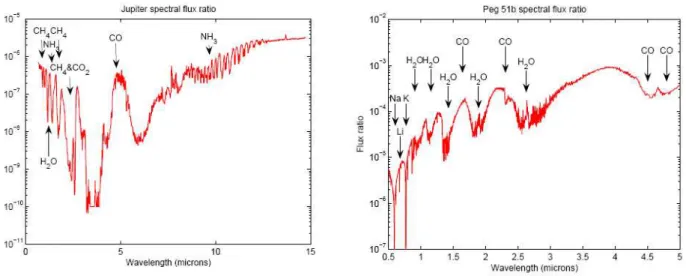
distance from the planet to the star. Depending on the proximity of the planet to its parent star, the Bond albedo can take various values ranging from 0.02 to 0.8 for giant planets (Sudarsky et al. 2000). Physical processes taking place in the atmosphere of irradiated giant planets have been investigated by several authors (e.g., Barman et al. 2001; Sudarsky et al. 2000, 2003; Burrows et al. 2004, see Fig. 1.4).
- the thermal emission of the planet (Leq
pl), which strongly depends on the spectral type of the
star and is characterised by spectral features, mostly due to CH4 and H2O absorption bands
(Fig. 1.4), commonly found in spectra of Saturn mass objects up to brown dwarfs (0.3 - 30 MJ).
The corresponding luminosity is given by
Leqpl = 4πRpl2 × σTeq4 , (1.2)
where Teq is the equilibrium temperature of the planet given by
Teq = T⋆× (1 − Apl)1/4×
r R⋆
2a, (1.3)
where T⋆ and R⋆ are respectively the temperature and the radius of the star. Approximating the
thermal emissions from the star and the planet by the equivalent blackbody emissions at effec-tive temperatures T⋆ and Teq respectively, this equilibrium temperature results from the balance
between the received and the emitted fluxes (Paczynski 1980).
- the intrinsic emission of the planet, due to residual cooling after their formation
Leffpl = 4πRpl2 × σTeff4 , (1.4)
where Teff is the intrinsic effective temperature of the planet. In the absence of external irradiation,
the photosphere of a gaseous planet would cool down to an intrinsic temperature of about 100 K in a few Gyr (Baraffe et al. 2003). The equilibrium temperature of hot EGPs is therefore much higher than their intrinsic temperature (Chabrier et al. 2004). Under such conditions, the surface temperature is simply equal to the equilibrium temperature.
The left part of Figure 1.5 shows the relative fluxes of Earth and Jupiter with respect to the Sun from the visible to the thermal infrared wavelengths. The reflected flux is dominant at short wavelengths (in the visible) where the star is brighter while the thermal emission is dominant in the thermal infrared. The right part of Figure 1.5 shows the corresponding flux ratio with respect to the Sun, showing the difficulty of high contrast imaging of extrasolar planets. Indeed, the flux reflected by Earth-like planets is not expected to represent more than a few 10−10 of the stellar flux in the visible range, while its
thermal emission should amount to a few 10−7 of the stellar flux around 10 µm, where it peaks. 3
Figure 1.4: Left: Jupiter spectral contrast, dominated by methane features notably at 1.65 µm (Mawet 2006). Right: Peg 51b (EGP) expected spectral contrast, very different from that of Jupiter (Sudarsky et al.2003).
Based on the above expressions, the wavelength-dependent infrared flux emitted by the planet and actually detected by an Earth-based observer reads:
Fp(λ) = Aλ πR2⋆ d2 Bλ(T⋆)Φ(Θ) πR2 p 4a2 + πR2 p d2 Bλ(Tp) , (1.5)
where Bλ(T) represents the surface brightness per wavelength unit for a blackbody at temperature T, d
the distance to the target star, Aλ the albedo and Φ(Θ) a phase function affecting the reflected emission
only. Such phase variations have been observed by the Spitzer space telescope (Werner et al. 2004) at 24 µm, revealing a temperature difference between day and night faces of several EGPs (e.g., Barman et al. 2005; Harrington et al. 2006; Knutson et al. 2009, see Figure 1.6). Such observations help in constraining the temperature, radius, and albedo of the planets and enable the study of the weather on distant planets. Two techniques have chiefly allowed the characterization of extrasolar planets: direct imaging and transit. The main results obtained so far with these techniques are described in the following sections.
Characterisation by transit
Characterising the composition of extrasolar planets is a huge observational challenge because it requires to distinguish the planet spectrum from the stellar light. Whereas the radial velocity technique is not appropriate for such a task, physical and atmospheric characteristics of transiting extrasolar planets can be inferred when the contrast is not too large. The first method consists in measuring the absorption of starlight passing through the planet atmosphere during transit. This tells us the composition and scale height of the extrasolar planet atmosphere (e.g., Charbonneau et al. 2002; Swain et al. 2008b; Pont et al. 2009). Another successful technique relies on the fact that almost all planets that transit their stars will also pass behind the star at a given time. Measuring the system before or after this secondary eclipse4
gives the light of the star plus its planet, but a measurement of the system when the planet is behind the star gives the stellar light in isolation. Subtracting one measurement from the other reveals the contribution of the planet. This technique has allowed the physical characterisation of several transiting planets with the detection at infrared wavelengths5 by the Spitzer Space Telescope (e.g., Charbonneau
et al. 2005; Deming et al. 2005; Burrows et al. 2006; Grillmair et al. 2007; Richardson et al. 2007; Swain 4
The secondary eclipse is the phase during which the planet is occulted by its host star.
5
Since the planet emergent radiation peaks in the infrared spectral range, secondary eclipse measurements rely primarily on observations in the infrared.
these:version du mercredi November 4, 2009 à 20 h 04
1.1. Extrasolar planets 13
Figure 1.5: Left: Comparison between Sun, Jupiter and Earth spectral fluxes from the visible to thermal infrared wavelengths. Right: Flux ratio for Jupiter and Earth with respect to the Sun (Figures from Mawet 2006).
et al. 2008a). Using the secondary eclipse technique with Spitzer, Grillmair et al. (2008) have reported the unequivocal signature of water vapour in the atmosphere of HD 189733b, the brightest transiting exoplanet yet detected. Previous results from primary transit observations of HD 189733b using Spitzer had already been published but led to two different conclusions: Tinetti et al. (2007) concluded that water vapor was detected in the atmosphere of the planet, whereas Ehrenreich et al. (2007) claim that uncertainties on the measurements are too large to draw any firm conclusion. Independently, a detection of water, carbon monoxide and carbon dioxyde has also been obtained using observations from the Hubble Space Telescope (HST, Swain et al. 2009). While it is unlikely that life exists on HD 189733b, these results support the idea that significant quantities of water could exist in extrasolar systems.
The different geometries of transit and secondary eclipses provide distinct clues on the atmospheric composition: transit spectroscopy probes the atmospheric interface between the day and night hemi-spheres of a tidally-locked planet (Swain et al. 2008b), whereas secondary eclipse measurements probe the emergent spectrum of the dayside. Moreover, measurements of transiting systems can be extended well beyond the times of transit and eclipse, to include observations in the combined light of the star and the planet at a large range of orbital phases. For instance, such measurements can be inverted if the planet is tidally locked to its orbit to yield the distribution of emergent intensity versus longitude on the planet (Knutson et al. 2007). The observational techniques used for transiting systems can also be extended to non-transiting systems, so it is valuable to consider a generalisation of the transit technique, namely exoplanet characterisation in combined light. Without a transit, the planet radius cannot be measured directly, but much can be learned, from observing fluctuations in IR intensity that are phased to the planet known radial velocity orbit (e.g., Harrington et al. 2006).
Characterisation by direct imaging
Whereas the ability to find planets using radial velocity and transit techniques rapidly decreases for semi-major axes beyond about 5 AU, direct imaging of extrasolar planets is a powerful technique that can reveal giant planets in wider orbits and enable the detailed characterisation of their atmospheres. Imaging detections are challenging because of the combined effect of small angular separation and large luminosity contrast between a planet and its host star. The first image of a planetary mass companion in a different system than our own has been reported 10 years after the detection of Peg 51b by Chauvin
Figure 1.6: The Spitzer telescope has detected the thermal emission of the EGP companion of Upsilon Andromedae, throughout the entire 4-day period. The solid curve shows a model of a tidally locked planet with a sub-stellar point that is considerably hotter than the backside due to the relatively poor global circulation of winds.
et al. (2005a) who presented deep VLT6
/NACO7
infrared imaging observations of the young, nearby brown dwarf 2MASSWJ1207334-393254. Around this 25-MJ brown dwarf located 70 pc from Earth,
Chauvin et al. (2005a) identified a very faint companion at an angular separation of 778 mas (55 AU). The characteristics of the planet according to evolutionary models are a mass of about 5 MJand effective
temperature of about 1250 K.
Since the discovery of Chauvin et al. (2005a), several other companions have been imaged around low-mass stars (e.g., Neuhäuser et al. 2005; Chauvin et al. 2005b; Biller et al. 2006). Most of these imaged companions are only a few Myr old so that they are generally much brighter than older sub-stellar objects because of on-going contraction and possibly accretion. In addition, they orbit a low luminosity star so that the contrast is favorable and the imaging of these objects much easier. The planetary status of these companions is not yet clearly established since the derived mass of these objects is very close to 13.6 MJ (the mass threshold dividing planets from brown dwarfs).
More recently, several authors have reported the imaging of low-mass companions around A stars (e.g., Kalas et al. 2008; Marois et al. 2008; Lagrange et al. 2009). So far, A stars have been mostly neglected due to their higher stellar luminosity (and thus less favorable contrast). However, main se-quence A-type stars have some other advantages. The higher-mass A stars can retain heavier and more extended discs and thus might form massive planets at wide separations, making their planets easier to detect. The most famous detection was made by Kalas et al. (2008) around Fomalhaut, a bright A star located at about 8 pc from Earth, and harboring a belt of cold dust with a structure consistent with gravitational sculpting by an orbiting planet (see Figure 1.7). Using HST, Kalas et al. (2008) imaged Fomalhaut b lying about 119 AU from the star and 18 AU from the dust belt, matching predictions of its location (Kalas et al. 2005). Dynamical models of the interaction between the planet and the belt indicate that the mass of the planet is at most three times that of Jupiter; a higher mass would lead to gravitational disruption of the belt.
6
VLT stands for “Very Large Telescope”. This observatory of the European Southern Observatory (ESO) is installed in Cerro Paranal (Chile).
7
NACO stands for NAOS-CONICA, i.e., Nasmyth Adaptive Optics System Coronagraphic Near-Infrared Camera. This adaptive optics system is installed on the VLT’s fourth Unit Telescope (UT4, Yepun).
these:version du mercredi November 4, 2009 à 20 h 04
1.1. Extrasolar planets 15
Figure 1.7: HST coronagraphic image of Fomalhaut at 0.6 µm, showing the location of Fomalhaut b (white square) 12.7 arcsec radius from the star and just within the inner boundary of the dust belt. The yellow circle marks the location of the star behind the occulting spot. The yellow ellipse has a semi-major axis of 30 AU at Fomalhaut (3.9 arcsec) that corresponds to the orbit of Neptune in our Solar system. The inset is a composite image showing the location of Fomalhaut b in 2004 and 2006 relative to Fomalhaut (Kalas et al. 2008).
1.1.4 Searching for life
The habitable zone (HZ) is defined as the region around a star within which a planet can sustain liquid water on its surface, a condition necessary for photosynthesis. Within the HZ, starlight is sufficiently intense for a greenhouse atmosphere to maintain a surface temperature above 273 K, and low enough not to initiate runaway greenhouse conditions that can vaporize the whole water reservoir, allowing photo-dissociation of water vapor and the loss of hydrogen to space (Kasting et al. 1993). If the region remains habitable for a duration longer than 1 Gyr, the HZ is then referred to as “continuous”. For the Sun, the continuous habitable zone extends roughly from 0.76 to 1.6 AU. The limits of the continuous HZ as a function of the stellar mass is represented in Figure 1.8.
Planets located inside the HZ are not necessarily habitable. For instance, planets which are too small, like Mars, cannot maintain active geology since most of their atmosphere escapes in space. They can not either be too massive, like HD 69830d, that accreted a thick H2-He envelope below which water cannot
be liquid (Lovis et al. 2006). Anyhow, planet formation models predict abundant Earth-like planets with the right range of masses (0.5-8 M⊕) and water abundances (0.01-10% by mass, Raymond et al. 2006).
In order to determine if a planet in the HZ is actually “inhabited”, its atmosphere has to be probed to search for the spectral features that are specific to biological activity, the biosignatures. According to Lovelock (1975), the simultaneous presence of large amounts of reducing and oxidizing gases in an atmosphere out of thermodynamic equilibrium can be a criterion for the presence of biological activity. All planetary atmospheres are out of thermodynamic equilibrium because their photochemistry is driven by UV photons from their parent star. For instance, Owen (1980) argued that a large-scale biological activity on a telluric planet necessarily produces a large quantity of oxygen (O2). By analogy with Earth,
the following elements are considered as potential biosignatures :
• Water vapor (H2O). A baseline sign, indicating the presence of liquid water, a requirement of
known life;
• Carbon dioxide (CO2). Although it can be created by biological and non-biological processes,
Figure 1.8: Continuous Habitable Zone (blue region) around M, K, G, and F stars. The region around the Sun that remains habitable during at least 5 Gyr extends from approximately 0.76 to 1.63 AU.
• Methane (CH4). It is considered as suggestive of life, it can also be made both by biological and
non-biological processes;
• Oxygen (O2) and its tracer, Ozone (O3). The best indicator of biological modification of a
planetary atmosphere.
Unless molecular oxygen in the Earth atmosphere is constantly replenished by photosynthesis, it is quickly consumed in chemical reactions, in the atmosphere, on land and in seawater. So the presence of a large amount of oxygen in an extrasolar planet’s atmosphere would be a sign that it might host an ecosystem like that of present-day Earth. Concerning methane, detecting it on a distant world would not automatically indicate the presence of life, although it is often biogenic. For instance, Jupiter and Saturn have traces of it. However, a sufficiently high methane level (around 1000 ppm) may have been produced as a waste byproduct by primitive microorganisms. Even if methane is largely considered as a suggestive but not convincing biosignature, finding oxygen along with methane might constitute the most convincing biosignature.
In addition, the reliability of O2 and O3 as signatures of biological activity has been thoroughly
addressed by Léger et al. (1999) and Selsis et al. (2002). Considering various abiotic production processes, such as photo-dissociation of CO2 and H2O, and the possible escape of hydrogen from the atmosphere,
they conclude that a simultaneous detection of a significant amount of H2O and O3 in the atmosphere
of a planet in the habitable zone presently stands as a criterion for large-scale photosynthetic activity on the planet. Such an activity on a planet illuminated by a Sun-like star is likely to be a significant indication that there is local biological activity. Detecting O3 in addition to H2O seems to be a robust
biosignature because no counter example has been identified. This is not true for O2 for which false
positive could be detected (Selsis et al. 2002).
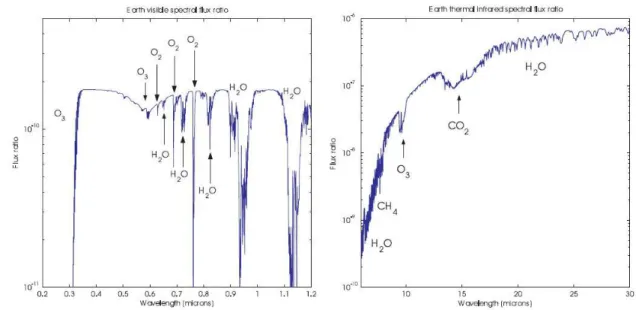
To reveal the effects of these biosignatures, low-resolution mid-IR (6-20 µm) observations are par-ticularly suited. As shown in Figure 1.9, the wavelength range displays the 9.6 µm O3 band, the 15
µm CO2 band, the 6.3 µm H2O band and the H2O rotational band that extends longward of 12 µm.
The visible wavelength range presents also the main biosignature features but the planet-star contrast is much less favorable than in the mid-IR (see Figure 1.9, left). Note also that a low-resolution spectrum spanning the 6-20 µm region has the advantage to allow the measurement of the effective temperature of the planet, and thus its radius and albedo. For all these reasons, the mid-IR range is currently considered as an optimal observation window for the future life-finding missions.
The atmosphere spectrum also depends on the distance between the planet and its host star. Within the HZ, the partial pressure of CO2 and H2O at the surface of an Earth-like planet is a function of
these:version du mercredi November 4, 2009 à 20 h 04
1.2. Circumstellar discs 17
Figure 1.9: Left: Earth spectral contrast in the visible. Spectral features of biosignatures like O2, O3 and H2O clearly appear. Note that the CO2feature is absent in the visible. Right: Earth spectral contrast in the thermal infrared where the CO2 feature is present (figure from Mawet 2006).
the distance from the star. Water vapour is a major constituent of the atmosphere for planets between 0.84 AU (inner edge of the HZ) and 0.95 AU. Figure 1.10 shows the estimated evolution of the H2O, O3
and CO2 features in the spectra of an Earth-like planet as a function of its location in the HZ. Carbon
dioxide is a tracer for the inner region of the HZ and becomes an abundant gas further out.
Considering the solar system, the right part of Figure 1.10 shows the spectra of Venus, Earth and Mars. For instance, Venus, closer to the Sun than the HZ, has lost its water reservoir and accumulated a thick CO2 atmosphere. Planets like Venus can be identified as uninhabitable by the absence of water
and by the high-pressure CO2 absorption bands between 9 and 11 µm. The Earth’s spectrum is also
clearly distinct from that of Mars which does not present any H2O and O3 feature. According to Segura
et al. (2003), the ozone absorption band is observable for O2 concentrations higher than 0.1% of the
present terrestrial atmospheric level. Concerning the Earth spectrum, it has displayed this feature for the past 2.5 Gyr (Kaltenegger et al. 2007b). Other spectral features of potential biological interest include methane (CH4 at 7.4 µm), and species released as a consequence of biological fixation of nitrogen, such
as ammonia (NH3 at 6 and 9-11 µm), nitrous oxide (N2O at 7.8, 8.5 and 17 µm) and nitrogen dioxide
(NO2 at 6.2 µm). The presence of these compounds would be difficult to explain in the absence of
biological processes.
1.2
Circumstellar discs
The presence of dust around a mature main sequence star is a reminder that the star was born by accretion in a dense protostellar disc of gas and dust and that any planet orbiting the host star was born out of that same material (see Section 1.1.2 for further information on planet formation). In the process of star and planet formation, circumstellar discs represent different evolution stages between spherical collapsing clouds and fully assembled main sequence stars surrounded by planets. Disc evolution is typically divided into four observationally-determined evolutionary classes (0, I, II, and III)8
:
- Class 0 objects are thought to be protostars surrounded by roughly spherical collapsing envelopes from which forming young stars are still accreting substantial fractions of their final mass. Because 8
This classification scheme was originally defined based on infrared spectral index and the ratio of sub-millimeter to bolometric luminosity (Lada et al. 1984; Wilking et al. 1984; Lada 1987).
Figure 1.10: Left: Synthetic spectra of an Earth-like planet computed at different orbital distances across the solar habitable zone (courtesy J. Paillet). Right: Mid-IR spectra of Venus, Earth and Mars as seen from a distance of 10 pc.
of the very high columns of cold dust in these envelopes, these objects emit most of their radiation at sub-millimeter wavelengths.
- Class I objects are still deeply embedded and have high mass accretion rates. At this time, bipolar outflows appear and start to clear away material from the polar regions. These sources are still not directly visible, and emit most of their radiation at far-IR wavelengths due to reprocessing of the stellar radiation by warm dust.
- Class II sources or Young stellar objects (YSO), including Herbig Ae/Be9 and T Tauri stars 10
respectively with masses above and below 2 M⊕, are optically-visible young stars, which have
probably already assembled almost all of their final mass. They show excess emission at infrared and millimeter wavelengths indicative of optically-thick circumstellar discs.
- Class III sources appear to be pre-main sequence stars that have already depleted most of the gas reservoir in their circumstellar discs so that the accretion has stopped, leaving planetesimals and forming planets in a more tenuous disc. This marks the end of the protoplanetary disc phase and the start of the debris disc phase, which is likely replenished by collisions of planetesimals. While the first image of a circumstellar disc was obtained from scattered light by a dust disc around the nearby main sequence star β Pic (Smith and Terrile 1984), images of protoplanetary discs around young pre-main sequence stars have now been obtained as well (e.g., Koerner and Sargent 1995; Dutrey et al. 1996; Malbet et al. 1998; Millan-Gabet et al. 1998). The current observational results are summarised below for the protoplanetary and debris disc phases separately. Photometric and interferometric results are also presented separately for each case, the latter allowing to investigate the inner disc properties which is of utmost importance for understanding the initial conditions and steps of planet formation.
1.2.1 Protoplanetary discs
Studying gas-rich protoplanetary discs is very important since relatively modest amounts of gas could strongly affect the dynamics of small dust grains, leading to the formation of azimuthally symmetric structures such as cleared zones or dust rings (Takeuchi and Artymowicz 2001). This conclusion is
9
Herbig Ae/Be stars are pre-main sequence stars (younger than 10 Myr) of spectral types A and B, still embedded in gas-dust envelopes and surrounded by a circumstellar disc.
10
T Tauri stars are a class of variable stars named after their prototype, T Tauri. They are found near molecular clouds and identified by their optical variability and strong chromospheric lines.
these:version du mercredi November 4, 2009 à 20 h 04
1.2. Circumstellar discs 19
supported by other modelling (Klahr and Bodenheimer 2006), which also showed that such gas-formed structures can persist after the gas is completely gone. Gas-rich circumstellar discs around YSOs have now been demonstrated convincingly in several cases. Infrared excess emission from Herbig Ae/Be and T Tauri stars was initially detected by photometric surveys (e.g., Mendoza V. 1966; Rydgren et al. 1976). It was originally explained by the presence of geometrically thin, optically thick discs (Lada and Adams 1992; Hillenbrand et al. 1992), a model that has been modified to include central-star irradiation (Calvet et al. 1991), disk flaring (Chiang and Goldreich 1997; Kenyon and Hartmann 1987), and other structures to explain features in the spectral energy distributions, such as an inner hole, innerwall heating, and self-shadowing (Dullemond et al. 2001, 2002). Alternative explanations for circumstellar emission take the form of dusty envelope models (Hartmann et al. 1993; Miroshnichenko et al. 1999), as well as optically thin “halos” in combination with discs (Vinković et al. 2003, 2006). The Orion nebula (M42, NGC1976) has been the most observed and studied area, harboring one of the richest and youngest clusters in the solar neighborhood, spanning the full spectrum of masses (from stellar to a few MJ, Lucas and Roche
2000). Since the early 1990s, HST observations of the Orion nebula have been fundamental for clarifying the main characteristics of YSOs and their protoplanetary discs. Disc-like brightness distributions have been imaged directly at optical wavelengths, showing flattened distributions of dust and gas in the Orion nebula (e.g., McCaughrean and O’dell 1996; O’dell and Wong 1996). Following these discoveries, other HST programs have increased the number of known objects (e.g., Bally et al. 1998, 2000; O’Dell et al. 2001; Smith et al. 2005), and a total of about 200 discs in the Orion nebula are known so far (Ricci et al. 2008). In the meantime, a wealth of information has been obtained on YSOs by stellar interferometry. The main results are presented hereafter.
Interferometric view
During the last decade, the study of circumstellar discs by stellar interferometry has been mostly limited to YSO surrounded by significant amounts of dust and gas arranged in optically thick accretion discs. In particular, infrared interferometers directly probe the temperature and density structure of gas and dust within the first few AU of YSO discs, which are relevant parameters driving the planet formation process. The discoveries brought by interferometry have been strongly supported by major advances in theoretical models of YSO in the past ten years, which have seen simple accretion scenarios of passively-heated discs be complemented by a richer set of phenomena (Hartmann et al. 1993; Chiang and Goldreich 1997).
The first YSO observed by stellar interferometry was achieved with the Palomar Testbed Interfer-ometer (PTI, see Section 2.3 for further details) on FU Ori, a rare type of T Tauri star whose emission is dominated by accretion luminosity (Malbet et al. 1998). The disc size was then found to be roughly consistent with expectations from a simple flat disc model. Four T Tauri stars were then resolved at PTI, revealing a larger near-infrared emitting region than predicted by simple accretion models (Akeson et al. 2000). This result was confirmed two years later (Akeson et al. 2002) by additional observations of T Tau and SU Aur, and by the first scientific observations of the Keck-I on DG Tau (Colavita et al. 2003). In the meantime, the first Herbig Ae/Be star was resolved by interferometry using the IOTA interferometer (see Section 3.1.1, Millan-Gabet et al. 1998). The near-infrared emission of AB Aur was found to be much larger than expected from theoretical models. This discovery was then confirmed by a survey of 15 similar stars at IOTA (Millan-Gabet et al. 2001). In addition, no variation of the visibilities was observed while the baseline orientation was changed, favouring a spherical envelope for the dust emission. The same survey, complemented by observations of T Tauri stars, was used by Monnier and Millan-Gabet (2002) to produce a diagram showing a significant correlation between the size of the near-infrared excess emission and the luminosity of the star, as one would expect for an inner dust disc (or envelope) truncated by dust evaporation close to the star. An optically thin cavity was thus suggested around YSOs, while the classical model assumed the presence of optically thick gas. This result was later confirmed by additional observations at the Keck-I (Monnier et al. 2005).
Based on these observations, new models have been built, including disc flaring and puffed-up inner rims as proposed by Dullemond et al. (2001) except for the most massive Herbig Be stars. Further
observations at PTI (Eisner et al. 2004; Akeson et al. 2005a) and Keck-I (Eisner et al. 2005) are generally in agreement with these revised models, and show that the presence of gas within the sublimation radius of dust, probably extending down to the magnetospheric truncation radius, can also be a significant component to the inner disc flux. Unlike the previous one, the survey of (Eisner et al. 2004) allowed for a determination of the disc inclination for most targets, which reconciles the interferometric view with a disc-like geometry. A range of inner dust disc properties have been recently suggested by Akeson et al. (2005b) with the Keck-I, possibly related to the various evolutionary statuses of the target sources. These observations also have important implications for planet formation scenarios, as the measured inner dust radii (typically ranging from 0.04 to 0.3 AU) prove the presence of dust in the habitable zone (near 1 AU) at early stages of planet formation. This suggests that giant planets can penetrate the sublimation zone by migration mechanisms triggered by the large quantity of gas. Finally, observations of FU Ori (Malbet et al. 2005) have confirmed that, unlike most T Tauri stars, this source is compatible with a standard disc model, i.e., geometrically flat and optically thick. This may be due to the enhanced accretion rate, as suggested by Eisner et al. (2005) on another accretion-dominated source. Such a behaviour has also been observed on massive Herbig Be stars Eisner et al. (2004). However, observations of three FU Orionis objects by Millan-Gabet et al. (2006) contradict these conclusions, as a simple accretion disc does not reproduce the low visibilities measured with the Keck Interferometer. A significant contribution to the near-infrared flux might come from scattering in the upper atmosphere of the disc (the presence of an optically thin inner disc is very implausible in the case of FU Orionis objects). This scenario is supported by recent models where circumstellar haloes account for both infrared spectroscopic and imaging data (Vinković et al. 2006).
The VLTI has also recently obtained important results on Herbig Ae/Be stars. In particular, the MIDI instrument has provided the first spatially and spectrally resolved mid-infrared view of these objects, with characteristic sizes of 1 to 10 AU for the mid-infrared emitting regions (Leinert et al. 2004). Although in qualitative agreement with the predictions from passively heated models, the data show quantitative discrepancies with these models and therefore ask for a next step in the modelling of circumstellar discs. This study supports the phenomenological classification of Herbig Ae/Be stars into categories by their mid-infrared colour and the distinction of these categories by flaring-dominated versus non flaring-dominated circumstellar dust distributions. The spectroscopic capabilities have also contributed to the study of these stars, showing the dust in the innermost regions of the disc to be highly crystallised and to be dominated by olivine, while outer regions have a lower degree of crystallinity (van Boekel et al. 2005). These observations imply that silicates crystallise before any terrestrial planets are formed. Other results obtained from VLTI are observations with the AMBER instrument of MWC 297, an embedded Be star, which have shown the star to be surrounded by a possibly still accreting flat equatorial disc and an outflowing wind presenting a much higher velocity in the polar region than at the equator (Malbet et al. 2005). More recently, the radial structure of the circumstellar inner disc around AB Aur has been directly determined by MIDI, revealing a flared inner disc (di Folco et al. 2009)
Finally, nulling interferometry has also been used to observe YSOs, reporting conclusive resolved warm dust surrounding three objects: HD 100546, AB Aur, and HD 179218 (Hinz et al. 2001; Liu et al. 2003, 2005, 2007). Assuming a Gaussian disc or a ring, the spatial extent of the emitting region in the resolved systems ranges from 15 to 30 AU in diameter. Both HD 100546 and AB Aur show a significant variation of the null versus the position angle of the emitting region semi-ajor axis, evidencing an elongated structure such as an inclined disc. For HD 179218, little variation of null was detected, consistent with an axisymmetric distribution (such as a face-on disc) for the dust, although a significant inclination cannot be ruled out given the lack of accuracy in the measurements (Liu et al. 2007).
1.2.2 Debris discs
First discovered by the InfraRed Astronomical Satellite (IRAS), the “Vega phenomenon” characterises main sequence stars presenting a significant deviation from their expected Rayleigh-Jeans emission (Au-mann et al. 1984). These photometric excesses are now commonly understood as the signature of dust
these:version du mercredi November 4, 2009 à 20 h 04
1.2. Circumstellar discs 21
surrounding the stars, analogous to the zodiacal cloud and/or the Kuiper belt in our own solar system (Backman and Paresce 1993). This dust originates mainly from collisions between small bodies or from outgassing comets (Beust et al. 1996), and has a limited lifetime due to physical effects such as radiation pressure, collisions and drag. Extrasolar systems with IR excess presumably have their own supply of large, solid planetesimals and, perhaps, large planets like those in our system. The gravitational influence of such planets is suspected to be at the origin of the structures (like rings, warps and gaps) observed in the handful of visible and sub-millimetric images of debris discs that have been obtained during the last decade (Augereau and Papaloizou 2004).
Characterisation of warm circumstellar dust (≥ 300 K) in the inner part of debris discs is particu-larly important to understand the physical and dynamical properties of the discs, including planetary formation and evolution mechanisms in the regions where terrestrial planets are supposed to be located. In fact, the few resolved images of debris discs obtained so far in the visible (e.g., Heap et al. 2000; Kalas et al. 2004, 2006) and sub-mm (e.g., Holland et al. 1998, 2003; Greaves et al. 2004) regimes have revealed the presence of extended structures associated with a void of matter in the central region (< 50 AU). Warps, gaps and clumpy structures have been repeatedly detected and attributed to the gravitational influence of planets, which may also be the cause for the apparent void of matter in the inner region (e.g., Wyatt and Dent 2002). Several studies have already searched for warm dust in these cavities using mid-IR photometry, but with poor results. For instance, Fajardo-Acosta et al. (1998) have only found 5 systems with weak 10 µm excess, suggesting the presence of dust between 1 and 10 AU with median grain temperatures ranging between 200 and 350 K. Such an excess is most of the time not detectable by classical aperture photometry because both the photometric accuracy and the precision on the mid-IR photospheric fluxes are of the order of or larger than the excess to be measured.
One of the main questions is whether inner dust reservoirs can survive the suspected planetary migra-tion, and continue to replenish the inner disc at advanced ages. It is in fact expected that planetesimals trapped in mean motion resonances with the migrating planet could be pushed towards the innermost regions as the planet migrates inwards during the early system evolution, and thereby constitute a significant reservoir of solid bodies.
Photometric view
The surveys performed by IRAS, ISO and more recently by the Spitzer Space Telescope have shown that about 15% of mature solar-type stars (F0 - K0) harbour cold debris discs (Beichman et al. 2006c). These observational results have greatly improved our understanding of the incidence of exozodiacal clouds as a function of age, spectral type and metallicity. For instance, older stars tend to present less infrared excess than younger ones. Specific programs focused on main sequence stars with planetary companions have shown that this proportion increases to 24 ± 10% for old (∼ 5 Gyr) planet-bearing stars, while the overall frequency of excesses at similar ages is about 10% (Beichman et al. 2005b). On the contrary, the established correlation between stellar metallicity and the presence of extrasolar planets is not observed in the case of debris discs (Greaves et al. 2006). All these elements raise the question of how planets, planetesimals and dust grains interact and evolve in extrasolar systems.
At 70 µm, Spitzer is sensitive to levels of exozodiacal emission in the range of 35 - 75 K dust with Ldisc/L⋆ ∼ 10−6 to 10−5, or roughly 5 - 10 times the expected level of emission of our own Kuiper Belt.
A wide variety of Spitzer programmes have found the following characteristics of exozodiacal emission: • Approximately 14 ± 3% of mature, solar type stars (spectral type in the F5-G5 range) have
detectable 70 µm zodiacal emission at a level of Ldisc/L⋆ = 10−5 to 10−6 (Bryden et al. 2006).
This rate is somewhat higher among A and early F stars (± 25%) and smaller for stars later than K (< 4%) (Beichman et al. 2006b). A more recent study including 350 main sequence AFGKM stars has shown that the incidence of debris discs is about 4.2% at 24 µm for a sample of 213 Sun-like (FG) stars and about 16.4% at 70 µm for 225 Sun-like (FG) stars. The excess rates for