Admissible Nilpotent Coadjoint Orbits of p-adic Reductive Lie Groups
by
Monica Nevins
B.Sc.(Hon) Mathematics and Computer Science
Summa Cum Laude
University of Ottawa, 1994
SUBMITTED TO THE DEPARTMENT OF MATHEMATICS IN PARTIAL
FULFILLMENT OF THE REQUIREMENTS FOR THE DEGREE OF
DOCTOR OF PHILOSOPHY
AT THE
MASSACHUSETTS INSTITUTE OF TECHNOLOGY
JUNE 1998
Copyright 1998 Monica Nevins. All rights reserved.
The author hereby grants to MIT permission to reproduce
and to distribute publicly paper and electronic
copies of this thesis document in whole and in part.
Signature of Author:..
Certified by...
Accepted by ...
(
. . . . .. .. . .. .. .. .. .. . .. .. .. ... . . . .. .Department of Mathematics
April 2, 1998
.
...
David A. Vogan, Jr.
Professor of Mathematics
Thesis Supervisor
...
Richard Melrose
Professor of Mathematics
Dhair, Departmental Committee on Graduate Students
JUN 01198B
science
Admissible Nilpotent Coadjoint Orbits of p-adic Reductive Lie Groups
by
Monica Nevins
Submitted to the Department of Mathematics on April 2, 1998 in Partial Fulfillment of the Requirements for the Degree of Doctor of Philosophy
ABSTRACT
The orbit method conjectures a close relationship between the set of irreducible unitary representations of a Lie group G over a local field, and admissible coadjoint orbits in the
dual of the Lie algebra.
We define admissibility for nilpotent coadjoint orbits in p-adic reductive Lie groups, and compute the set of admissible orbits for a range of examples. We find that for unitary, symplectic, orthogonal, general linear and special linear groups defined over p-adic fields, the admissible nilpotent orbits coincide with the special orbits defined by Lusztig and Spal-tenstein in connection with the Springer correspondence. We also show that for the p-adic Lie group of type G2, all special orbits are admissible, and further that the minimal orbit is a nonspecial admissible orbit.
Thesis Supervisor: David A. Vogan, Jr. Title: Professor of Mathematics
Acknowledgements
I would like to thank my advisor, David Vogan. Without his guidance and goodwill, this thesis certainly would not have been possible. My four years at MIT were a wonderful experience, thanks in no small part to his very generous sharing of his time and knowledge. Thanks are also due: to Konstanze Rietsch, an invaluable resource for knowledge about algebraic groups and number theory, and a very good friend; to Peter Trapa, for his expertise in everything I ever wanted to know about Lie groups; to Eric Sommers, for countless enlightening conversations, mathematical and not; and to Dana Pascovici, a ceaselessly inquisitive mathematical mind, and cat-sitter extraordinaire.
I thank my family and circle of friends for their love and support, especially Ralph, and Spot (in loving memory), and Euler & Euclid, for their patience and willingness to listen.
I was supported by a teaching assistantship in the Department of Mathematics at MIT, and by an NSERC 1967 Scholarship from the Natural Sciences and Engineering Research Council of Canada.
Contents
1 Introduction 11
2 Background: p-adic Fields 17
2.1 The Hilbert Symbol ... 17
2.2 The Exponential Map ... ... 18
3 The Metaplectic Group 21 3.1 The Segal-Shale-Weil Representation ... ... . 21
3.2 The Metaplectic Group ... ... 22
3.3 Coverings of Subgroups ... 24
3.3.1 Symplectic Decompositions . ... . . .... . 25
3.3.2 Lagrangian Decompositions ... .. . . . . . 27
3.3.3 Metaplectic Covers of SL(2, F) ... 28
4 Admissibility of an Orbit 31 5 Symplectic, Orthogonal and Unitary Groups 34 5.1 Structure of GO and g[1] ... 35
5.2 Decomposition of g[1] under the action of GO . ... . . 37
5.3 Finding GO-invariant Lagrangian Decompositions . ... 40
5.4 Symplectic Group ... ... 42
5.5 Orthogonal Group ... ... .. ... 42
5.6 Unitary Group ... 42
6 Deciding Admissibility for the Special and General Linear Groups 45 7 The Exceptional Lie Group of Type G2 48 7.1 Explicit Triples for Oa andOp O ... ... 48
7.2 Admissibility for a p-adic Lie Group of type G2 . . . . . . . 50
1
Introduction
A fundamental problem in the theory of Lie groups over local fields is the classification and construction of the irreducible unitary representations of a reductive Lie group G. One promising approach to this problem is known as the orbit method.
The orbit method seeks to associate irreducible unitary representations of G to coadjoint orbits in the dual of the Lie algebra of G. The former are algebraic objects; the latter have rich geometric structure. One can hope, and in many cases is able, to use this geometry to construct the associated representation. Kirillov provided the first success of the orbit method, with the following theorem.
Theorem 1.1 (Kirillov [K]). Let G be a nilpotent connected simply connected real Lie
group. There is a constructive bijection
Sirreducible
unitary coadjoint G-orbits1Gu = representations of in = *//G.
G "I
For example, if G = ], then g* = g*//G = R. The representation associated to the orbit
x E R is given by qx(y) = exp(2rxixy) for each y E IR. When G fails to be simply connected,
however, the conclusion of the theorem can fail as well. For instance, let G = R/Z. Then we again have g* = g*//G = R, but the unitary representations are only those ox with x E Z.
In other words, not all coadjoint orbits arise in an orbit correspondence.
We thus seek to refine our statement of the orbit correspondence by describing those coadjoint orbits to which representations can conjecturally be associated. The first attempts in this direction led to the subset of integral orbits. They are defined as follows.
Fix an additive unitary character V of the base field F. For instance, if F = R, we may choose 0(x) = exp(21rix).
Definition 1.2. An element f E g* is integral if there exists a unitary representation 7 of
Gf = {g EG g - f = f} satisfying --(exp(X)) = i(f(X)) for all X in gf n domain of exp.
This criterion is sufficient for the case of G = R/Z; in fact it is enough to obtain a stronger version of Kirillov's theorem.
Theorem 1.3 (Kirillov [K], Moore [Mo]). Let G be nilpotent connected Lie group over
a real or p-adic field. Then there is a constructive bijection
Sintegral
coadjoint G-orbits in g*J
Partial Proof. Let f be an element of g*. The coadjoint orbit G - f - GIGf is naturally a symplectic manifold: its tangent space g/gf at f carries the Kostant-Kirillov symplectic form wf, defined by
Suppose now that f is integral. To construct a representation of G associated to f, we choose a real polarization of g. A real polarization is a Gf-invariant subalgebra [ of g containing
g, such that
/gf
is a Lagrangian subspace of g/gf. Such an 0 always exists when G is nilpotent.Since f is integral, we may define a representation of H = exp(b) by
a(exp(X)) = O(f(X))
for all X E b. Integrality guarantees the existence of a on gf; since here /gf is an affine space, there is no obstruction to extending a to all of [.
Finally, we induce this representation from H to G, and define p(f, j) = IndG a to be
the representation associated to the orbit G - f.
What remains to be shown (and what we regrettably omit) is: that p(f, j) is irreducible and unitary; that p(f, ~j) is independent of the choice of representative f or polarization [; and that all irreducible unitary representations of G arise in this way. OE
Kostant and Auslander were able to prove that integrality is the correct criterion for type I simply connected solvable real Lie groups as well. Nevertheless, the next example shows that integrality is not a sufficiently precise criterion to fully describe the desired set of orbits.
Let G be a reductive Lie group. Then we can identify g and g* via a nondegenerate G-invariant bilinear form on g. Thus for each f E g, we obtain a Jordan decomposition
f = f, + fs, where f,, is nilpotent, and f, is semisimple. In other words, they act by nilpotent, respectively semisimple, endomorphisms in any algebraic representation.
It is easy to see that if f is nilpotent, then f igf 0. Thus all nilpotent orbits are automatically integral. Not all nilpotent orbits arise in the orbit correspondence, however. One example is that of the minimal nilpotent orbit of the real symplectic group Sp(2n, IR) for
n > 1. The only irreducible representations associated to this orbit are ones of the two-fold covering group of the symplectic group (the metaplectic group).
Hence we would like to find a refinement of integrality, one which gives a more restrictive condition on nilpotent orbits.
To motivate the refinement proposed by Duflo, let us consider just one more extension of Kirillov's result [LP].
Suppose G is real or p-adic Lie group containing a nilpotent connected normal subgroup
N. Denote the Lie algebra of N by n. Let f be an integral element of n*. By Theorem 1.3, we have an associated irreducible unitary representation (p, Vp) of N.
We want to construct an irreducible unitary representation of G associated to the coad-joint orbit G - f, built out of p. We will need to use "Mackey theory," as defined by the following theorem.
Theorem 1.4 (Mackey [Ma, Theorem 8.1]). Suppose G is a Lie group, and N a type
representation of N. For each g E G, define the representation p9 of N via p9(n) = p(g-lng) for n E N. Set
GP = {g E G I p9 p,
the stabilizer of p under G, and denote by G - p the G-orbit of p. Then we have a bijection irreducible unitary represen- irreducible unitary
represen-tations a of GP for which aIN +-- tations a' of G such that a' N
is a multiple of p
is supported on G -p
The correspondence is given by a -+ IndGP a.
In our case, we can use Theorem 1.3 to describe GP as the quotient
GP= GI N N/N
where Nf embeds into the semidirect product as n - (n, n-l).
The space Vp carries a distinguished projective representation 7r 0 p of Gf x N, where 7r is related to p by the equation
7r(g)p(n) = pg(n)ir(g) for all g E G, n E N. (1.1)
This determines 7r only up to a scalar of modulus one, and in general it is not possible to choose 7r to be a homomorphism. We must pass to a particular two-fold cover of GI to get a (true) representation. The remarkable fact is that via the map
Ad: G -+ Sp(n/n),
the cocycle of the projective representation ir coincides with that of the restriction to Ad(Gf) of the Segal-Shale-Weil representation of Sp(n/nf) (see [W]). In other words, the two-fold cover in question is exactly the pullback of the metaplectic group Mp(n/nf) to Gf . Denote this cover by (Gf)Mp. Thus, the projective representation r ® p of Gf x N leads to a (true) representation 7rMP of (GI)Mp on Vp having the property that r
M
P
0
p is a representationof (Gf)Mp x N.
This does not, however, give us a representation of GP on that space. To see this, note that
GP = (Gf)Mp x N/ (Nf)M .
The restriction of irMp 0 p to (Nf)MP is nontrivial; it is given by a character 7-1 , where 7 satisfies
1. 7(E) = -1, where e is the nontrivial element of (Nf)Mp lifting the identity; 2. r(exp(X)) = i(f(X)) for all X E nf .
Therefore, to get a representation a of GP with the desired property - that CaN is a multiple of p - we must choose a representation 0 of (Gf)Mp whose restriction to (Nf)Mp is given by r. Then the exterior product of the representations 0 0 1 and 7rMP 0 p gives such an
irreducible unitary representation a of GP. (This representation 0 is not unique. In fact, we
get all irreducible unitary representations of GP whose restriction to N are multiples of p from different choices of 0.)
We may now apply Mackey's theorem, to get an irreducible unitary representation of G. This completes our construction.
In 1980, Duflo generalized these ideas and proposed, for real Lie groups, the criterion of
admissibility of an orbit. We extend it to include the p-adic case as well. It naturally arises
from the question of the existence of the representations 0 of the construction above, and is defined as follows.
Let G be an arbitrary Lie group over F, and let f be an element of 9*. Note that Gf preserves the symplectic form wf on g/gf. Hence we may define a group (Gf)Mp such that the diagram
(Gf)Mp - + Mp(g/f)
S
AdSp(/f)
commutes. This is analogous to the metaplectic cover that arose in the construction above. Let e denote the nontrivial element in the kernel of the map p.
Definition 1.5. An element f E g* is admissible if there exists an irreducible unitary representation 7 of (Gf)Mp satisfying
1. 7(e) = -1, that is, r is a genuine representation;
2. -T(exp(X)) = (f(X)) for all X in gf n domain of exp.
Such a pair (f, T) is called an admissible orbit datum.
Duflo's work suggests that there should be a correspondence
u--+ {admissible orbit data}.
Although there are known examples where this fails to give a bijection [V1], it is a close approximation to what we expect to hold true.
Let us now provide evidence that the admissibility criterion is a good one. Firstly, note that the theorems proven using integrality can be restated using admissibility. It turns out that in those cases, roughly speaking, the "integral 7" and the "admissible 7" are related by tensoring with the square root of a character related to an existing polarization.
Secondly, we note that for reductive Lie groups, admissibility is at least not a trivial criterion for nilpotent orbits G •
f.
Instead, it becomes a question of the splitting of the covering group (Gf )Mp over Gf.Thirdly, for real reductive Lie groups, there is an abundance of evidence linking admis-sible orbits and unitary representations. For the semisimple admisadmis-sible orbits, we can use the known techniques of parabolic and cohomological induction to construct associated rep-resentations [V1]. For the case of nilpotent orbits, the situation is far less well understood. For one, there is as yet no definition for what it should mean for a representation to be "as-sociated to" a nilpotent orbit, except in certain cases - such as those arising in the following theorem. There, a natural association of a representation to a nilpotent orbit comes out of the theory of primitive ideals and associated varieties.
Theorem 1.6 (Vogan [V2, Theorem 8.7]). Suppose G is a real reductive Lie group.
Suppose that a nilpotent orbit G - f satisfies a certain nice algebraic condition. If 7 is an irreducible unitary representation of G associated to G f, then G f is admissible.
It is the case of nilpotent orbits in a reductive Lie group that we wish to investigate further. One hopes to generalize Theorem 1.6, and to understand how representations associated to nilpotent orbits might be constructed. We hope to gain a first insight into this problem by determining the set of admissible nilpotent orbits.
Inspiration [V1] from Lusztig's work with representations of Lie groups over finite fields, and from the Langlands' program, suggest a strong link between admissible nilpotent orbits and the so-called special orbits defined by Lusztig and Spaltenstein (see, for example, [Ca, §12.7]). We conjecture that, for nilpotent orbits in split reductive Lie groups over local fields, special should imply admissible. The converse cannot hold because, for example, all nilpotent orbits of a complex group are automatically admissible: the complex symplectic group is simply connected and hence admits no nontrivial covers.
Schwarz [Sch] computed the admissible nilpotent coadjoint orbits for the real classical groups. He proved that the special orbits coincided with the admissible orbits for all groups except the (nonsplit) unitary groups. In this last case, all orbits are special, but not all orbits are admissible.
In the present thesis, we extend Duflo's admissibility criterion to nilpotent orbits in p-adic Lie groups (as summarized above), and use this criterion to prove the following theorem (Theorems 5.10, 6.2, and 7.1).
Theorem 1.7. Let F be a p-adic field. Let G be a reductive Lie group over F. Then
1. if G = SL(n, F) or G = GL(n, F), then all orbits are admissible; in particular, the admissible orbits coincide with the special orbits;
2. if G = Sp(2n, F), G = O(V) (an orthogonal group) or G = SO(V) (a special orthog-onal group), then the admissible orbits coincide with the special orbits;
3. if G = U(V) (a unitary group) or G = SU(V) (a special unitary group) then the admissible orbits coincide with the special orbits;
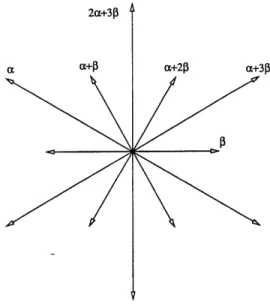
4. if G is a split group of type G2, then all special orbits are admissible; the minimal orbit is admissible but not special.
For the case of the group G2, Savin [Sav] has constructed a representation of a three-fold cover of G associated to the minimal orbit. That this does not descend to a representation of G is a matter for further study: it suggests that admissibility alone is not enough to guarantee the existence of an associated representation. This is a fact known for certain examples of real Lie groups as well [V1]. Nevertheless, this theorem provides evidence that the admissibility criterion that we have defined for p-adic groups is the correct analog of Duflo's admissibility criterion, and that it gives a close approximation to the set of orbits arising in the orbit correspondence.
The first few sections of this paper treat the requisite background material. In Sec-tion 2, we fix our notaSec-tion and terminology, and recall the noSec-tion of the Hilbert symbol and exponential map for p-adic fields. In Section 3, we outline Weil's construction of the Segal-Shale-Weil representation, its corresponding cocycle, and the metaplectic group. We omit all proofs; see [LV] and [Pe] for a complete treatment of the subject. We also consider the metaplectic covers of certain interesting subgroups of Sp(W) and construct criteria for when these covers split.
In Section 4, we begin our discussion of admissibility. We define a criterion for the admissible nilpotent coadjoint orbits following Duflo [D] and Lion, Perrin [LP]. We then proceed to special cases. In Section 5 we consider the symplectic, orthogonal and unitary groups, using ideas of Moeglin in [M] for the classical groups. We proceed to the case of the special and general linear groups in Section 6. In Section 7, we classify the nilpotent orbits for the split p-adic group G2, as well as presenting a treatment for the real case.
2
Background: p-adic Fields
By a local field we mean a locally compact, nondiscrete (commutative) field. The archime-dean local fields are R and C, the fields of real and complex numbers, respectively.
A nonarchimedean local field of characteristic zero is called a p-adic field. It is a finite algebraic extension of
Qp,
the p-adic completion of the field of rational numbers for some prime p. The nonarchimedean local fields of positive characteristic are the fields Fq ((t)), power series in one variable over the field with q elements. Although we are primarily interested in p-adic fields, we will often state results in the broader context of all local fields.2.1 The Hilbert Symbol
We adopt the following notation for a nonarchimedean local field F:
val, valF: the unique discrete valuation on F which gives a surjective map of F* onto Z, and sends 0 to co;
91: = {a E F I val(a) 0}, the integer ring of F;
p, PF: = {a E F I val(a) > 1}, the maximal ideal in 91;
q: cardinality of the residue field 91/p;
p: characteristic of the residue field, also called the residual characteristic of F; e, eF: = valF(p), the degree of ramification of F over Qp.
In general, we will denote our base field by F. A quadratic extension of F is denoted
E = F(w), where w F, but w2 E F. Then any element of E can be expressed as a sum
z = x + wy, with x and y in F. With this notation, the conjugate of z is - = x - wy. The trace of E over F is the map TrE/F : E -+ F defined by TrE/F(z) = z + -5. The norm (over F) of an element of E is defined as NE/F(Z) = zz.
Set F*2 _ {a 2 I a E F*}; this is a subgroup of the multiplicative group of F. By way of
example, the group F*/F*2 has four elements when F is a p-adic field with p odd, but 2n-2 elements when F is a degree n extension of Q2. This gives the number of distinct quadratic extensions of F (with the trivial extension F = F(1) included).
Let (a/b)F denote the Hilbert symbol of two nonzero elements a and b in F [N, 111.5]. We recall some of its properties now.
Lemma 2.1. Let F be a local field and a, b, c elements of F*. The Hilbert symbol (a/b)F
equals 1 if a is the norm of an element of F(xi/), and -1 otherwise. It satisfies: 1. (ab/c)F = (a/c)F(b/c)F, (a/b)F = (b/a)F, (a/a)F = (a/ - 1)F;
3. (a/b)F = 1 for all b E F* if and only if a E F*2 Also
4. (a/b)c = 1 for all a, b E C;
5. (a/ - 1)R = sign(a).
6. If F is nonarchimedean, of residual characteristic different from 2, then (a/ - 1)F = (-1)val(a) 2
In particular, (a/ - 1)F = 1 for every a E 91*.
7. If F =
Q2,
then (-1/ - 1)F = -1, although (a/ - 1) = 1 for any a E 1 + 2.This final case of residual characteristic 2 is not well understood in general. We do have the following result, however, which will be useful for our study. Recall that eF denotes the degree of ramification of the p-adic field F over
Qp.
Lemma 2.2 (Fesenko, Vostokov [FV, VII, §4, Ex.6(c)]). Let F be a p-adic field of
residual characteristic 2, and let a, b E F*. If
val(a - 1) + val(b - 1) > 2eF,
then (a/b)F = 1.
2.2 The Exponential Map
Suppose from now on that the characteristic of F is zero. Then one can formally define an exponential map F -+ F* as an infinite power series centered at 0 E F. This series converges
everywhere for F = R or C, but for p-adic fields, it converges only on a neighborhood of zero. More precisely, we have the following theorem.
Theorem 2.3 ([N, 111.1.2]). Let F be a p-adic field of residual characteristic p and let n
be an integer satisfying n > eF/(p - 1). Then the power series
x2 x3 exp(x) = 1 + x + + +-- (2.1) 2! 3! and X2 x3 log(1 + x) = x-- + 2 3
give mutually inverse isomorphisms (and homeomorphisms)
What is of interest to us here is the exponential map from a Lie algebra to the corre-sponding group. For linear groups, it is defined by the power series expansion (2.1), where this time we let x = X denote an element of the Lie algebra g.
Lemma 2.4. Suppose G C GL(n, F) is a linear Lie group over a p-adic field F, with Lie
algebra g C End(Fn). Then the exponential map defines a continuous map from an open neighborhood of 0 E g onto an open neighborhood of 1 e G.
Proof. We need to understand the domain of the exponential map. Where it converges, it
will be continuous. Let X be an element of g. There is some finite algebraic field extension of F, say F, over which X has a complete Jordan decomposition. Specifically, there exists a matrix h E GL(n, F) such that h- 1Xh = D + N, where D is diagonal (with entries equal
to the eigenvalues of X), N is strictly upper triangular (hence nilpotent), and DN = ND. It is easy to see that exp(X) converges if and only if exp(h-'Xh) = h- 1 exp(X)h converges,
which happens if and only if exp(D) converges.
Hence the convergence of the exponential map on X is equivalent to the convergence of the exponential map on the eigenvalues of X, which is determined by Theorem 2.3 above. Explicitly, each eigenvalue A of X must satisfy
valp(A) >
p-1
This domain might be viewed as a "tubular neighborhood" of the nilpotent cone in g. In particular, it is an open neighborhood of 0 E g. The same construction at the group level shows that the image of exp is an open neighborhood of 1 E G. O
We make the following definition.
Definition 2.5. Let Go denote the open normal subgroup of G generated by the image of
the exponential map.
When F = IR or C, Go coincides with the topological identity component of G. Recall, however, that p-adic groups are totally disconnected, so such a description does not apply.
If G is a simple, simply connected algebraic group defined over F and isotropic over F, and G = G(F) is its group of F-points, then Go = G by a theorem of Kneser and Tits [P1].
Such groups include G = SL(n, F) and G = Sp(2n, F), for example.
If G = O(V, F) is an orthogonal group (the group of all transformations preserving a
nondegenerate quadratic form on a vector space V), then Go C SO(Q, F), as the following proposition shows.
Proposition 2.6. Suppose G is a linear Lie group defined over a p-adic field F of residual
characteristic p. Then for all g E Go, we have
det g 1 +p if p is odd;
The stated result is weaker than what we are able to prove, but is sufficient for our applications.
Proof. Embed G in some GL(n, F) and its Lie algebra g in End(Fn). It suffices to prove
the proposition for g = exp(X), where X is in the domain of the exponential map in g. We use the notation F, F, N, D of the proof of Lemma 2.4.
We wish to compute det(exp X). Since det(exp N) = 1, we have
det(exp X) = det(exp D) = exp(trace(D)).
The trace lies in F; let n = valF(trace(D)) = valF(trace(X)). By Theorem 2.3, this expres-sion converges if and only if n > eF/(p - 1), in which case det(exp X) takes values in 1 + pn. Since n is an integer and eF = valF(p) > 1, this proves the proposition. O
Corollary 2.7. If G is a linear Lie group defined over a p-adic field F, then (det g/-1)f = 1
for all g E Go. Moreover, det g = -1.
Proof. The second assertion follows from the equality -1 = (p - 1) + (p - 1)p+ (p - 1)p2 +...,
and the preceding theorem.
The first assertion follows immediately from Lemma 2.1[6] and Proposition 2.6 for the case of residual characteristic different from 2.
If F has residual characteristic 2, then we must apply Lemma 2.2. Since -1 = 1 + 2 +
22 + 23 +..., we know valF((-1) - 1) = valF(- 2) = eF. On the other hand, if g E Go,
then by Proposition 2.6, valF(det g - 1) > eF + 1. Hence the hypotheses are satisfies, and
3
The Metaplectic Group
3.1 The Segal-Shale-Weil Representation
Let F be a local field, and V) a nontrivial unramified unitary character of F. For convenience, not necessity, we assume the characteristic of F is different from 2; see [W]. Let W be a symplectic vector space over F, with symplectic form (,). The Heisenberg group H(W) is the set W x F with multiplication given by:
1
(v, s) -(w, t)
=
(v + W, s + t + -(v, w)).
2If 1 is a Lagrangian subspace of W, then 1 x F is an abelian subgroup of H(W). We can define a representation of H(W) by:
irl
= Ind, )id x4.
By the Stone-von Neumann theorem [LV, 1.3.3 and A.1], this induced representation is irreducible and, up to equivalence, does not depend on the choice of Lagrangian 1. Further-more, any irreducible representation of H(W) for which the center acts by this character
4
is equivalent to 7re.Let Sp(W) be the symplectic group of W, that is, the group of automorphisms of W preserving the symplectic form (,). We have a natural action of Sp(W) on H(W), given by
g (v, t) = (gv, t).
Define a new representation of H(W) by
7r (v, t) = rl (gv, t);
it is equivalent to 7rj by the Stone-von Neumann theorem. Hence there exists a unitary
intertwining operator T(g), unique up to a scalar of modulus one, such that
T(g) o
7r
g o T(g- 1 ) = it. (3.1)Denote the space of unitary operators on the space of 7r by U(7). One can check that for any gi, g2 in Sp(W), the operator T(gl)T(g2) E U(ir) intertwines 7r919g 2 and
rl,
and so mustbe a multiple of T(glg2). Hence the map g '-+ T(g) defines a projective representation of Sp(W), called the Segal-Shale- Weil representation.
We would like to be much more explicit in our understanding of this representation. Consider the bundle over Sp(W) given by
{(g,T(g)) E Sp(W) x U(r)
I
T(g) satisfies (3.1)}. (3.2) The fibre over each point is isomorphic to C = {z E C IIzl
= 1}. There is a canonical section of this bundle, depending on the choice of I [LV, 1.6.9 and A.9]; denote it by g (g, RI (g)). For any gl, g2 in Sp(W), we can find cl(gl, g2) EC'
such thatThis defines cl E H2(Sp(W), C1), a 2-cocycle of Sp(W). We use this section to identify our bundle (3.2) with the group GMp(W) = Sp(W) x C1, where the multiplication in GMp(W) is given by
(91, t ) (g2, t2) = (9192, tlt2 Cl (91, 92))"
This Cl-covering group of Sp(W) is called the Mackey obstruction group. Note that the Segal-Shale-Weil representation gives rise to an honest representation of GMp(W) via
(g, t) F+ tR (g).
This is called the metaplectic representation.
3.2 The Metaplectic Group
We now need an explicit formula for the 2-cocycle cl.
For any three Lagrangian subspaces 11, 12, 3 of W, let 7(11, 2, 3) denote the equivalence class of the quadratic form on 11 $ 12
E
13 given by:(Xl,X2, X3) '- (X1, X2) + (X2, X3) + (X3,X1)
(see [LV]). The invariant of this form we need to consider is called the Weil index.
The Weil index y(Q) of a nondegenerate quadratic form Q is a unitary character of the Witt group of F. It is defined by an integral equation in [W, §14], and has been computed explicitly for all local fields in, for example, [Pe, Appendix]. (Although this explicit form is quite complicated for p-adic fields, for F = R, y(Q) is simply 0(l signature of
Q).)
Denote the quadratic form on F sending x to ax2 by a. For any nondegenerate m-dimensional quadratic formQ
on F, with discriminant D F*/F 2,-(Q) 2 = (D/ - 1)F -(1)2m; (3.3)
see [W, §28]. We extend -y to degenerate quadratic forms, by defining y(Q) = -y(Q/rad(Q))
and y(O) = 1.
Lemma 3.1 (Vergne [LV], Perrin [Pe], Ranga Rao [RR]). Let W be a symplectic vector space. With respect to a choice l of Lagrangian subspace of W, the 2-cocycle of the Segal-Shale-Weil representation is given by
cl(gl, g2) = y(7((, 91l, 91921))
for any gl, g2 E Sp(W).
This cocycle, or the quadratic form 7(11l12, 13), are variously called the Leray invariant, the Maslov index (over R) and the Kashiwara index (over any local field). Weil described the cocycle only on an open subset of Sp(W) in his original work [W, §43].
Vergne [LV, §1.7] gives a nice interpretation of the cocycle in terms of oriented La-grangian planes for the real case; Perrin [Pe] describes an analogous construction in the
local nonarchimedean case. We will use their results.
Before proceeding to the construction of the metaplectic group, let us illustrate the above construction with a particular case where the cocycle can be described concretely.
Let W be a symplectic space, and choose a decomposition W = I $ I' of W into com-plementary Lagrangian subspaces. With respect to this decomposition, we can write any
g E Sp(W) as a block matrix of the form
g= CD
in the usual way.
Lemma 3.2 ([LV, 1.6.22, A.9]). On the open set of Sp(W) x Sp(W) consisting of pairs
of block matrices
A, B1 A2 B2
(gC g2 1 Dr ' C2 D2
such that C1 and C2 are invertible, the quadratic form r(l, gl, g919g21) is given by the matrix
C1-1(CiA 2 + D1C2)C2-1 = A2C2- 1 + C1-1D1. (3.4)
The middle term on the left arises in the product gig2*
The proof is a straightforward calculation, and is omitted.
The final step in our construction is to find a smallest closed subgroup of GMp(W) covering Sp(W); in essence, reducing the cover to its non-trivial core. Note that when
F = C, GMp(W) splits as a covering group for topological reasons, so we may exclude this case from now on.
Following [W, §43] and [LV, 1.7.8 and §A.16], we will define a map
: Sp(W) -- 4
which satisfies
(g)I(g92) = C (gl, g2)2 '(9192). (3.5)
Then the subgroup
Mp(W) = {(g,t) I I(g)- = t2}
of GMp(W) is what we will call the metaplectic group. It is a non-trivial double cover of
Sp(W). The restriction of the metaplectic representation of GMp(W) to Mp(W) takes the
form
(g,t) tR (g) = p(g)-1/2Rl(g).
It is also called the metaplectic representation.
Lemma 3.3 ([LV]). For any g E Sp(W), consider the isomorphism
algg: 1/(in gl) - (gl/(in gl))*
v -+ (.,v)>.
Choose orientations on the vector spaces I and 1
n
gl; these give orientations on 1/(l n gl) and (gl/(l n gl))*. If 1 = gl, then this map has a well-defined determinant D(aqgl) modulo F*2. When I = gl, set D(alagl) = det(gjl), reflecting the extent to which g isorientation-preserving on 1. These values D(aagt) depend only on g, and not on the choices made.
From the property (3.3) evolves the following proposition.
Proposition 3.4 (Vergne [LV], Perrin [Pe]). For any g
ESp(W), the map
'I(g)
= (D(aj.gj)/ - 1)F y(1)2(diml-dim( n gl))satisfies (3.5).
Note that this result is in some sense an extension of that in Lemma 3.2.
Remark 3.5. If -1 is a square in F, then in fact I'(g) = 1 for all g E Sp(W).
3.3 Coverings of Subgroups
Suppose we have a homomorphism i: G -+ Sp(W), where G is Lie group over F. Then we can define the metaplectic cover (with respect to i) of G to be the group GMP = GM(W) defined by the commutative diagram
GMP > Mp(W)
G
S(W).
More explicitly, it is the subgroup of G x Mp(W) defined by
{(g,x ) E G x Mp(W) I i(g) = p(x)}.
We say that the metaplectic cover of G (corresponding to W) splits if there is a section of this bundle, that is, a homomorphism r of G into Mp(W) satisfying p o 7r = i.
In this section, we consider various kinds of groups G and maps i: G -+ Sp(W), with the
intent of understanding the factors leading to a splitting of a metaplectic double covering group.
3.3.1 Symplectic Decompositions
In this section, we discuss the case where G preserves a decomposition of W into symplectic subspaces. Let e represent the nontrivial element in the kernel of the projection map p.
Lemma 3.6. Let W1 and W2 be two symplectic vector spaces, and set W = W1 EW 2. Then,
viewing Sp(Wi) x Sp(W2) as a subgroup of Sp(W), we have
(Sp(Wl) x Sp(W2))Mp(W) = (Mp(W) x Mp(W2)) /(1,), (E, E)
Proof. Choose Lagrangian subspaces li of W1 and 12 of W2. Set 1 = 11
e
12; then I is aLagrangian subspace of W. An easy computation shows that for any two elements (gl, g2) and (hi, h2) in Sp(W) x Sp(W2),
cl ((gl2), g2 , I h2)) = cl (91, hl)c(92 g h2)
and
'1((g9,
92))= 1 91)12(2)-Thus the map
Mp(WI) x Mp(W2) -- (Sp(Wl) x Sp(W2))Mp(W) (3.6)
given by
((91, t1)7 (92 7 2)) ((91 92) tl2)1
is a homomorphism. It is surjective, and its kernel is precisely the set {((gl, t1), (g2, t2))
g91 = 1, g2 = 1, tlt2 = 1}, as required. O
Proposition 3.7. In the setting of Lemma 3.6, suppose we have a pair of group
homomor-phisms i1: G1 -+ Sp(W1i) and i2: G2 -+ Sp(W2). Then the metaplectic cover of G1 x G2
induced by the map il x i2 into Sp(W) splits if and only if each of the metaplectic covers
(G1)MP(W1) and (G2)Mp(W2) split.
Proof. First suppose that we have a section
G1 x G2 -+ (Sp(W) x Sp(W2))Mp(W).
Given any element (g, 1) E G1 x G2, write its image under this homomorphism as
(g, 1)
((i1 (g), i2 1)) S9, 1)
)
By Lemma 3.6, the homomorphism s decomposes as s(g, 1) = sl(g)s2(1), where sl,s2 are sections of G1M p (W ) , GMp (W 2) respectively, determined a priori only up to sign. In this case,
however, we can fix 82(1) = 1, which leaves us with a well-defined homomorphism
G1 - Mp(Wi)
We construct a section of GMp(W2) in the same way.
Conversely, suppose we have sections sl, 82 of GMP(W1), GMp(W2), respectively. Compos-ing sl x s2 with the projection homomorphism (3.6), we get a section of (G1 x G2)Mp(W),
as desired. O
Corollary 3.8. Let G be a Lie group. In the setting of Lemma 3.6, suppose we have a pair of group homomorphisms ii: G -+ Sp(W1) and i2: G -+ Sp(W2). Assume the metaplectic cover of G induced by i2 splits. Then the metaplectic cover of G induced by the map il x i2 splits if and only if the metaplectic cover of G induced by il splits.
Proof. Suppose the metaplectic covers GMp(W1) and GMP(W2) of G induced by the maps il
and i2, respectively, split. Then by Proposition 3.7, the metaplectic cover of G x G induced
by the map il x i2 splits, and hence in particular splits over the diagonal subgroup isomorphic
to G.
Conversely, suppose the metaplectic covers GMp(W2) and GMp(W1BW2) both split over
G. The first part of the proof of Proposition 3.7 will serve us here: replace the element (g, 1) E G1 x G2 with the diagonal element (g, g) E G x G, and the well-defined section S2(1) = 1 with a section over all of G determined by the splitting of GMp(W2). The effect is the same: to remove the ambiguity of sign, and hence give a well-defined splitting of
GM(W1). O
The hypothesis in this corollary - that GMp(W2) splits - is essential. We conclude this section by showing that two nontrivial metaplectic double covers can induce a trivial cover over the diagonal subgroup.
Let A denote the diagonal embedding of Sp(W) into Sp(W) x Sp(W).
Lemma 3.9. Let W, W1 and W2 be symplectic vector spaces. Suppose we have homomor-phisms ii: Sp(W) -+ Sp(W1) and i2: Sp(W) -+ Sp(W2), such that the metaplectic covers of Sp(W) arising from each of il and i2 are nontrivial. Then the metaplectic cover of Sp(W) induced by the map
(it x i2) o A: Sp(W) -+ Sp(W1
e
W2) (3.7) splits.Proof. Up to inner isomorphism, there is a unique nontrivial two-fold covering group of the
symplectic group Sp(W) [MVW, Ch2.II.1]. Hence our hypothesis implies that
Sp(W)Mp(W1) - Sp(W)Mp(W2) - Mp(W).
It then follows from Lemma 3.6 that the metaplectic cover of Sp(W) x Sp(W) induced by the map il x i2 is isomorphic to (Mp(W) x Mp(W))/Z, where Z is the central subgroup
{(1, 1), (E, e)}. The cover of Sp(W) induced by (3.7) is the diagonal subgroup
For each g E Sp(W), let P(g) be a square root of xI(g)-, the character defining Mp(W) (cf. (3.5)). Then we have a well-defined splitting homomorphism
Sp(W) --* A(Mp(W) x Mp(W))/Z,
defined by sending g to the class modulo Z of the element ((g, P(g)), (g, P(g))). O
As a special and important case of these last two results, we record the following propo-sition.
Proposition 3.10. Let W be a symplectic vector space, and W' an orthogonal vector space.
Then W ® W' is symplectic, and there is a natural map
Sp(W) -- Sp(W 0 W') (3.8)
given by g(w 9 w') = gw 0 w'. The metaplectic cover of the symplectic group Sp(W) arising from this map splits if and only if dim W' is even.
Proof. We prove this by induction on the dimension of the orthogonal space W'. Suppose
dim W' = 1. Then W 0 W' - W, since both are symplectic vector spaces of the same
dimension. It follows that (3.8) is an isomorphism, and so the metaplectic cover of Sp(W) is just Mp(W), which does not split.
Now suppose we have the result for any dimension less than k. Let W' be an orthogonal vector space of dimension equal to k. Choose an orthogonal decomposition W' = W1 e W2,
with dim W1 = 1 and dim W2 = k - 1. Then Sp(W) preserves the decomposition
w
W'= (W W1) e (WOW2).If k - 1 is even, then apply Corollary 3.8 to deduce that the metaplectic cover of Sp(W) does not split for k odd. If k - 1 is odd, then apply Lemma 3.9 to deduce that the metaplectic
cover of Sp(W) splits for k even. OE
3.3.2 Lagrangian Decompositions
Now suppose that G preserves a decomposition of W into Lagrangian subspaces. Without loss of generality, identify G with its image under the homomorphism i: G -+ Sp(W).
Proposition 3.11. Let W be a symplectic subspace over a p-adic field F, and G a closed
linear subgroup of Sp(W). Suppose G preserves a Lagrangian subspace I C W. Then the map
Go - Mp(W) (3.9)
gd (g, 1) defines a splitting of the metaplectic cover of G over Go.
Proof. Since G preserves 1, the quadratic form -(1, gll, gig21) is identically zero for all gl, g2 E G. It follows that c(gl, 9g2) = 1, so (3.9) defines a homomorphism of Go into GMp(W). It is certainly continuous.
To see that it takes values in Mp(W), first note that dim l-dim(lIngl) = dim l-diml = 0, so the y(1) term in Proposition 3.4 disappears. Moreover, since G C Sp(W) is linear, we may apply Corollary 2.7 to deduce that in fact (det(g i)/ - 1)F = 1 for all g E Go. Thus we have '(g) = (det(gll)/ - 1)F = 1 for all g E Go, which completes the proof. ]E
Although in this thesis we confine ourselves to linear Lie groups, it is worthwhile to note here an important case where a metaplectic splitting can be determined without using results from Section 2.2.
Proposition 3.12. Let W be a symplectic subspace over a p-adic field F of residual
char-acteristic different from 2, and G a Lie group. Suppose we have a map i: G -+ Sp(W), and two Lagrangian subspaces 1 and 1' of W satisfying the following conditions:
a) Inl'= {0};
b) i(G) preserves I and 1';
c) there is an isomorphism L: 1 - I' intertwining the G-actions on I and 1'. Then the metaplectic cover GMP defined by i splits.
Proof. Choose dual bases of I and 1', so that together they form a standard symplectic basis
of W. With respect to this basis, the action of any element g E G is given by a matrix
[A
0 tA-10]
where A = i(g)ll and tA-1 = i(g)ll,. Condition (c) above can then be stated as L o A = tA-1 o L, from whence it follows that det(A) = det(A)- 1. Hence, det(i(g)lI) =
+1
for allg E G. Since the residual characteristic of F is assumed different from 2, we can apply
Lemma 2.1[5] to deduce that (det(i(g) l)/ - 1)F = 1. Hence the result follows from the proof
of Proposition 3.11. EO
3.3.3 Metaplectic Covers of SL(2, F)
We include one final observation about splittings of metaplectic covers over subgroups iso-morphic to SL(2, F). This particular result will be of use to us in Section 7.
First let us introduce some notation. Let Wk denote the unique k-dimensional irreducible representation of SL(2, F). It carries an SL(2, F)-invariant bilinear form which is orthogonal if k is odd and symplectic if k is even. In the latter case, we write simply Sp(k, F) for the corresponding symplectic group.
Proposition 3.13 (Vogan). Let F be R or a p-adic field of residual characteristic not
equal to 2, and let m be a positive integer. Corresponding to the action of SL(2, F) on W2m, we have a homomorphism
SL(2, F) -+ Sp(2m, F). (3.10)
The metaplectic cover of SL(2, F) induced by this map splits if and only if m is even.
Note that the embedding of SL(2, F) into Sp(2m, F) described here is not equivalent to the kind arising in Proposition 3.10, if m > 1.
Proof. The proof is by induction on m, using the isomorphism of SL(2, F)-spaces W 2m- 1 & W 2 2m E W2m
- 2 .
First note that if m = 1, then the map (3.10) is an isomorphism. By [W], the corresponding metaplectic cover is nontrivial. We prove here in detail the case m = 2; the general inductive
step is no harder.
Consider the representation of SL(2, F) given by
W = W3 ® W2 = W4 W2.
We compute the covering group SL(2, F) = SL(2, F)Mp(W) in two different ways; comparing
them determines the cover of SL(2, F) induced from its action on W4, as required.
Since W3 is an orthogonal space, and W2 symplectic, we have the following commutative diagram:
SL(2, F) ---- (O(W 3) x Sp(2, F))MP(W) - Mp(W, F)
SL(2, F) ----+ O(W3) x Sp(2,F) ---- Sp(W,F).
We first determine the pullback of Mp(W, F) over the group O(W3) x Sp(2, F). If we choose a Lagrangian I of W2, then W3 01 is a Lagrangian of W. Moreover, O(W3) preserves W3 01,
so the metaplectic cover induced by W splits over O(W3)o by Proposition 3.11. On the other hand, applying Proposition 3.10, we see that this cover does not split over Sp(2, F), since the orthogonal space W3 is odd-dimensional. By [MVW, p34], the metaplectic group is the only nontrivial two-fold cover of the symplectic group. Hence we have the isomorphism
(O(W 3)o x Sp(2, F))Mp(W) c O(W
3)0 x Mp(2, F).
It follows that SL(2, F) - Mp(2, F).
On the other hand, using W = W4 E W2 and Lemma 3.6, we have
(Mp(4,F) x Mp(2,F))/Z --- Mp(W,F)
I
I
where Z denotes the diagonal central subgroup {(1, 1), (e, e)}. Let A denote the diagonal embedding of G -+ G x G for G = SL(2, F), and let H be the group SL(2, F)Mp(4,F) that
we wish to determine. This group H is defined by the diagram
SL(2, F) - (H x Mp(2, F))/Z - (Mp(4, F) x Mp(2, F))/Z
I
I
t
SL(2, F) SL(2, F) x SL(2, F) --- + Sp(4, F) x Sp(2, F).
This group H is a double cover of SL(2, F), so must be one of Mp(2, F) or SL(2, F) x {+1}. If H = Mp(2, F), then by Lemma 3.9, SL(2, F) must be the trivial double cover of SL(2, F). This contradicts our earlier computation.
4
Admissibility of an Orbit
Let G be a reductive algebraic group defined over a local field F of characteristic zero. Let g be the Lie algebra of G. Choose a nilpotent element f in g*, the dual of the Lie algebra, and consider its orbit under the coadjoint action of G. This orbit G -f has a natural symplectic manifold structure, given on the tangent space at the base point f by the Kostant-Kirillov symplectic form
w(X1, X 2) = f([XI, X 2 ),
where X1 and X2 are in g/gf.
For our purposes it is convenient to work in the Lie algebra. Choose some faithful finite-dimensional representation p of g, and define a G-invariant nondegenerate bilinear form B on g via
B(X1,X 2
)
= Tr p(Xl)p(X2) VX 1,X2 Eg.
Identify f with its preimage under the isomorphism X ~4 B(X,
.).
Then we can choose aLie triple in g having f as its nilnegative element; that is, we can find an isomorphism
: sl(2F) -+ g
sending Y to f, where {H, X, Y} denotes the usual basis of sl(2, F), with Lie bracket given by:
[H, X] = 2X
[H, Y] = -2Y
[X, Y] = H.
To simplify notation, we write ¢ for q(sl(2, F)).
The action of GI on g/gf clearly preserves the symplectic form w, and hence gives rise to a homomorphism (denoted Ad by abuse of notation)
Ad: G -+ Sp(g/gf).
Recall the subgroup Go = (Gf)0 of Definition 2.5, and the character
1 of F fixed at the
beginning of Section 3.
If f is nilpotent, then we can easily check that f
igf
0. Hence every nilpotent coadjoint orbit is integral, that is, there exists a character X of Gf satisfying x(exp X) = 0(f(X)) for all X in the domain of the exponential map. Thus Duflo's condition for admissibility - that there exist a genuine character of the metaplectic double cover of Go with this integrality property [D, p154] - reduces to the following in our case.Definition 4.1. A nilpotent coadjoint orbit G - f is admissible if the metaplectic cover of
GI corresponding to g/f splits over the subgroup Go .
It is, however, unnecessary to consider all of Gf for admissibility. We can write GI =
GO v U(Gf), where GO is the centralizer of
4
in G, and U(Gf) is the unipotent radical of GI [Ca, Prop. 5.5.9]. The latter term is a unipotent subgroup, isomorphic to a vector space (its Lie algebra) via the exponential map. It is easy to show that this implies that any double cover of U(Gf) must split.Hence the condition for admissibility can fail only over Go, and we restrict ourselves to considering the diagram
(GA)MP Mp(g/gf)
G O > Sp(171)"
There is one further reduction to make. Decompose g/gf into weight spaces under O(H), the semisimple element of
4.
We writeg/f
=
(gl/f)
[i].
It is easy to see that the +1 weight space of g/gf is equal to g[1], and that g[1] is a symplectic subspace of g/gf preserved by Gk.
Remark 4.2. If g[1] = 0 then necessarily g[2m + 1] = 0 for all integers m, and the orbit
G -f is said to be even. In the classical Lie algebras, it is equivalent to the condition that in
the partition type classification of the orbit, all parts have the same parity. In general, one can partially classify nilpotent orbits by their weighted Dynkin diagrams; the even orbits are those for which only even weights occur [CMcG].
Definition 4.3. Call a nilpotent coadjoint orbit G -f pseudo-admissible if the double cover of GO defined by
(G) "MP - Mp(g[1])
1
1.
G - Ad Sp(g[1])
splits over G0.
Proposition 4.4. Suppose G is a linear Lie group over a p-adic field F. Then a nilpotent
orbit G - f is admissible if and only if it is pseudo-admissible.
Proof. Write g/gf = W
e)
[1] where W denotes the sum of the remaining weight spaces. Both W and g[1] are symplectic subspaces preserved by GO. Let us first prove that the metaplectic cover of Go induced by its map into Sp(W) splits.The subspaces
1= (g/g) [i] and 1' =
(g/g)
[i]i>1 i<1
are non-intersecting Lagrangians of W preserved by G1. Moreover, there is an obvious linear isomorphism of I onto 1' commuting with the action of GO, defined by
for all i > 1. Apply Proposition 3.11.
The equivalence of admissibility and pseudo-admissibility now follows from Corollary 3.8,
applied to the symplectic decomposition g/gf = W E 0[1]. E
Thus the question of admissibility is determined on g[1]. It follows, for example, that even orbits are always admissible.
5
Symplectic, Orthogonal and Unitary Groups
Let F be RI or a p-adic field. We analyze the following cases together.Symplectic Let V be a vector space over F equipped with a symplectic form (,). Then G is the symplectic group Sp(V, F).
Orthogonal Let V be a vector space over F equipped with an orthogonal form (,). Then let G be either: the orthogonal group O(V, F), the group of automorphisms of this form; or the special orthogonal group SO(V, F), consisting of those automorphisms of determinant equal to 1.
Unitary Choose a quadratic extension E = F(w) of F. Let V be a vector space over E
equipped with a hermitian-form (,), and denote by U(V) C GL(V, E) the group of automorphisms of this form. Let G be either the unitary group U(V), or its subgroup the special unitary group SU(V).
We first fix some notation. If ir: s[(2, F) -+ End(V) is a representation, let
V[i] = {v e V I ir(H)v = iv}
denote its ith weight space under the semisimple element of s(2, F). Let Wm denote the unique (up to equivalence) irreducible representation of sr(2, F) of dimension m. If wm E
Wm[m - 1] is a nonzero highest weight vector of Wm, then a basis of the sl(2, F)-module Wm is
{wm, Ywm, . . ., ym-wm}, (5.1)
where we recall from Section 4 that Y E sf(2, F) is the lowering operator.
Choose a nilpotent orbit G -f and a Lie triple q as in Section 4. Since g acts on V, so does the subalgebra 0(s[(2, F)). Decompose V into irreducible subrepresentations under b. We can write
v =
Vm,
(5.2)
m>1
where Vm is the subspace of all copies of Wm in V.
Remark 5.1. This decomposition is strongly related to the partition classification of
nilpo-tent orbits under F. If Vm Z 0, then m occurs in the partition for G
f,
with multiplicity equal to the number of times Wm occurs in Vm.5.1
Structure of G
4and g[1]
Our first step is to understand these Vm subspaces better. Define V(m) to be the GO -space Homl(2,F) (Wm, V), with the action of g E GO on an element T E V(
m) given by (g - T)(w) = g(T(w)), for all w E Wm. There is a GO-equivariant isomorphism
W
m0®
(m) -+ Vm
(5.3)
w T 4 T(w),
where GO acts only on the second factor of the tensor product.
The direct sum in (5.2) is orthogonal with respect to the form (,) on V, and hence we can consider the restriction of (,) to each Vm.
Recall that there is a nondegenerate bilinear form bm, unique up to multiplication by a scalar, on each irreducible representation Wm of sl(2, F). It is sl(2, F)-invariant, and has the property that for all x E Wm [i] and y E Wm[j], both nonzero,
bm(x, y) L 0 i = -j. (5.4)
Lemma 5.2. The form bm on Wm is orthogonal if m is odd, and symplectic if m is even. Proof. Let us choose a basis for Wm of the form in (5.1). The sl(2, F)-invariance of bm implies
bm(wm, ym-lwm) = - bm(Ywm, ym-2Wm)
=(1)m- 1 bm(Ym-l Wm, Wm),
which by the nondegeneracy of bm and property (5.4) is nonzero. It follows that bm in
symmetric if m is odd and skew-symmetric if m is even. O
Without loss of generality, we fix a scaling of bm so that
bin(win,
ym-lwm) = 1for each m. (This depends of course on our choice of Wm made earlier.) We can now relate the form (,)Ivm to a form on V(m )
Lemma 5.3. Define a nondegenerate bilinear form (,)m on V(m) by
(S, T)m = (S(wm), T(ym-lwm)) = (S(wm), 0(Y)m-T(wm))
for all S, T E V(m ) . Then the form on Wm
0
V(m) defined by(x ® S, y ® T) = bm(x, y) - (S, T)m, (5.5)
Proof. To prove the equivalence of the form defined in (5.5) and the form (,), we use (5.3)
and compare them explicitly on a spanning set of the form
{Ykwm OT 10< k < m - 1, T E V(m)}.
Let Ji,j denote the Krcenecker delta function. Using the sl(2, F)-invariance of bm, we have
(YkWm 9 S, Y'wm
0
T) - bm(YkWm, yl'm) (S, T)m= (-1)kbm(wm, yk+Wm) (S(wm), T(ym-llm)) = (-1)k Sk+l,m-1 (S(wm),T(ym-1wm)).
On the other hand, by the q-invariance of (,), we have
(S(YkWm), T(Y' m) = (¢(Yk)S(wm), ¢(yz-(m-1))T(ym-lwm))
= (-1)k (S(wm), q(y)k+-(m-1)T(ym-lwm)) = (- 1 )k Jk+l-(m-1),O (S(wm), T(ym-lWm)).
So the two forms are equal, as required. O
Remark 5.4. It follows from Lemma 5.2 and Lemma 5.3 that this form (,)m is of the same type (symplectic, orthogonal or Hermitian) as (,) if m is odd, and of opposite type if m is even. (In the Hermitian case, take "opposite type" to mean skew-Hermitian.)
Now set GO,m = Aut(V(m), (,)m) -+ Aut(V, (,)) = G. By the preceding lemma, we have a natural isomorphism
GO= 1 Gm (5.6)
m>1
for G symplectic, orthogonal or unitary. For the special orthogonal and special unitary groups, GO is the subgroup given by the intersection of the product in (5.6) with G. In the question of admissibility, however, we shall see that this distinction is irrelevant: for the special orthogonal group, Go = Im>1 Gom (see Section 5.3), so the splitting is the same; for the special unitary group, we shall see that the metaplectic cover of (U(V)O)MP induced by its map into Sp(g[1]) splits completely (see Section 5.6), and therefore must also split completely over the subgroup (SU(V)O)MP. We will thus simplify our notation by writing
(5.6) in all cases.
In Section 5.2, it will be convenient to identify V(m) with each of the weight spaces Vm [i]
which are nontrivial, via the map
T -+ T(y(m-l-i)/2wm). (5.7)
This identification gives rise to a form (,)m,i on Vm[i], which we describe in the following
![Figure 5.1: The symplectic vector space gm,n' [1]. Dotted lines join spaces which admit a non-zero pairing under w](https://thumb-eu.123doks.com/thumbv2/123doknet/13873937.446370/41.918.131.741.160.303/figure-symplectic-vector-space-dotted-lines-spaces-pairing.webp)
![Table 7.1: Nilpotent Orbits in Type G2 [CMcG, 128]](https://thumb-eu.123doks.com/thumbv2/123doknet/13873937.446370/48.918.337.621.399.568/table-nilpotent-orbits-type-g-cmcg.webp)