Implicit foreign language learning
after minimal exposure
across the lifespan
Dissertation for obtaining the Degree of Doctor at the
Philosophicаl Faculty of the University of Fribourg (Switzerland)
Nuria Ristin-Kaufmann
From Baar, Zug (Switzerland)
Department of Languages and Literatures
Section of Multilingualism and Foreign Language Didactics
Approved by the philosophical Faculty on request of professors
Raphael Berthele (1
stexaminor) und Marianne Gullberg (2
ndexaminor).
Freiburg, 10
thJune 2014.
Prof. Marc-Henry Soulet, Dean.
Implicit foreign language learning
after minimal exposure
across the lifespan
Nuria Ristin-Kaufmann
Cite as:
Ristin-Kaufmann, Nuria (2014). Implicit foreign language learning after
minimal exposure across the lifespan. PhD thesis. University of Fribourg
(Switzerland).
Contents
Acknowledgements ... IV
Abstract ... VI
List of Figures ... VIII
List of Tables... XI
Abbreviations... XIV
1
Introduction ...1
1.1
How and when do we learn foreign languages?...1
1.2
Overall Research Questions and Outline ...3
2
Theoretical background...4
2.1
How do we learn foreign languages? ...4
2.1.1 Role of input ...4
2.1.2 Speech perception and segmentation...10
2.1.3 Artificial and statistical language learning ...15
2.1.4 Tutored versus untutored foreign language learning at first exposure ..20
2.2
When do we learn foreign languages? ...26
2.2.1 Age and cognitive variables ...34
2.2.2 Production versus comprehension...42
2.2.3 Predecessor studies...44
2.2.4 The current studies ...46
3
А lifespan perspective (Study 1)...48
3.1
Introduction and Background...48
3.1.1 From language input to learning...48
3.1.2 Age and Cognition...49
3.1.3 Research questions ...50
3.2
Methods ...51
3.2.1 Participants ...51
3.2.2 Experimental Materials ...54
3.2.3 Cognitive Tests: additional Materials...57
3.3
Data Analysis ... 65
3.3.1 Data cleaning... 65
3.3.2 Statistical analyses ...66
3.3.3 Hypotheses ... 68
3.4
Results ...69
3.4.1 Mean accuracy and reaction times per syllable condition... 69
3.4.2 Comparison of syllable conditions... 70
3.4.3 Comparison of performance to chance level...72
3.4.4 Words compared to non-words ... 72
3.4.5 Development across the lifespan... 73
3.4.6 Correlations with cognitive variables... 75
3.4.7 Summary ... 79
3.5
Discussion...80
3.5.1 ‘Learning’ after minimal exposure... 80
3.5.2 Development across the lifespan... 83
3.5.3 Conclusion... 88
4
Influence of the input (Study 2) ... 89
4.1
Introduction and Background ...89
4.1.1 From input to consolidation ...89
4.1.2 Research questions ...91
4.2
Methods ...92
4.2.1 Participants ... 92
4.2.2 Experimental Materials ...93
4.2.3 Cognitive Test: additional Material ... 94
4.2.4 Procedure... 94 4.3
Data Analysis ... 95
4.3.1 Data cleaning... 95 4.3.2 Statistical analyses ...96 4.3.3 Hypothesis... 97 4.4
Results ...98
4.4.1 Mean Accuracy and Reaction times per syllable condition – T1 & T2 98 4.4.2 Across groups – Comparison of syllable conditions (T1)... 99
4.4.3 Comparison to chance level across groups at T1 ... 101
4.4.4 Across groups – Words compared to non-words (T1) ... 101
4.4.5 Between groups – Comparison of non-word conditions (T1)...105 4.4.6 T1 versus T2 – adults’ versus children’s performance on non-words 110
4.4.7 Within subjects comparisons (T1 versus T2) ...112
4.4.8 Correlations with cognitive variables...115
4.4.9 Summary...119
4.5
Discussion ...121
4.5.1 Effects of input or of previous intake? ...122
4.5.2 Consolidation effects? ...123
4.5.3 Cognitive or multilingual advantage? ...124
4.5.4 Conclusion...125
5
Summary and General Conclusions ...126
5.1
Summary of findings ...126
5.2
Theoretical Implications ...128
5.2.1 Minimal exposure, implicit and statistical learning ...128
5.2.2 Age, L1 influence and cognitive variables ...130
5.2.3 Quasi-longitudinal perspective...133
5.3
Comments on Methodology ...135
5.3.1 Participant selection...135
5.3.2 LDT paradigm ...136
5.3.3 Language background & proficiency ...137
5.4
Practical Implications ...140
5.5
Outlook ...142
5.6
Conclusions ...144
References ...146
Appendices ...165
A - The Mandarin Weather Report ...165
B – The Chinese Lexical Decision Task ...172
C – Statistical Analysis: additional Figures and Tables...174
Data Analysis Study 1 - Cross-validation...174
ANOVA Study 1...176
ANOVA Study 2...176
Acknowledgements
The creation of this thesis required the help of various individuals and institutions to whom I would like to express my gratitude.
This thesis was written as part of the project “Multilingualism through the lifespan” funded through the Sinergia programme of the Swiss National Science Foundation (SNF-130457, PI Raphael Berthele), whom I thank sincerely, and specifically under sub-project ‘D’ “The effects of first exposure to an unknown language” (Marianne Gullberg).
I also thank Lundbergska IDO-fonden, Sweden, for a grant awarded to Marianne Gullberg, which funded Study 2 in this thesis.
Foremost, I offer my deepest gratitude to my supervisor, Marianne Gullberg, for her continual wise and patient support throughout my thesis. Despite the 1200 kilometers between our workspaces, our weekly virtual meetings were a true enrichment, scientifically as well as humanly and a great opportunity for exchanging ideas and concerns. Conferences and meeting times that we spent together were always very enjoyable, eventful and memorable. I could not have wished for a better advisor and mentor for my PhD.
Special thanks also go to Raphael Berthele for initiating and encouraging the Sinergia project and for providing moral support and encouragement from the first day onward when I applied for the position with an unstable internet connection while peddaling in the Argentinian pampa.
I am very grateful to my colleagues on the Sinergia project, especially to Irmtraud Kaiser, Lenny Bugayong and Jan Vanhove for their collaboration during data collection and collegial words of advice.
I owe a very important debt to Leah Roberts, Christine Dimroth, Aoju Chen, Peter Indefrey and Marianne Gullberg for letting me use their experimental paradigm and
stimulus material that they have prepared with much effort and great care. I want to thank Aoju Chen particularly for re-recording the stimulus material.
I am deeply grateful to Joost van de Weijer for statistical support and advice. Thank you for your patience and promt assistance in moments of despair, especially if they occurred a few hours before a presentation or paper deadline.
Study 2 could not have been realized equally swiftly if it was not for the help and organisational talent of my student assistant, Ilias Kaufmann.
Study 1 and Study 2 would not happen to be possible without the willingness and endurance of our participants to all of whom I want to express my gratitude. I specially thank Marina Midic, Eva Bühler, Shoshana Bauer, Marco Utiger and Rahel Moos-Dettwiler to wake the motivation of their students and children for participation in our studies.
Thank you to Stephan Schmid and Adrian Leemann for advice on phonetics.
I would like to also thank Muriel Clausen for proofreading this thesis and Martina Zimmermann for helping me with the printing.
The most special thanks go to my family for supporting me throughout everything.
Abstract
This thesis examined how people at different ages approach a new language input, looking specifically at the ability to implicitly acquire phonotactic information after minimal, first exposure to continuous audiovisual speech.
In the second-language-acquisition literature, age as a constraint is hotly debated, while the artificial grammar literature has shown that children as well as adults are able to segment and generalize unknown patterns after only brief exposure. Our goal was therefore three-fold: to cover a bigger age-range (instead of comparing 2-3 different age groups), to examine how natural (instead of artificial) complex speech is processed at first exposure, and to examine the potential influence of cognitive variables and previous language skills operationalised as the number of foreign languages (L2s) known.
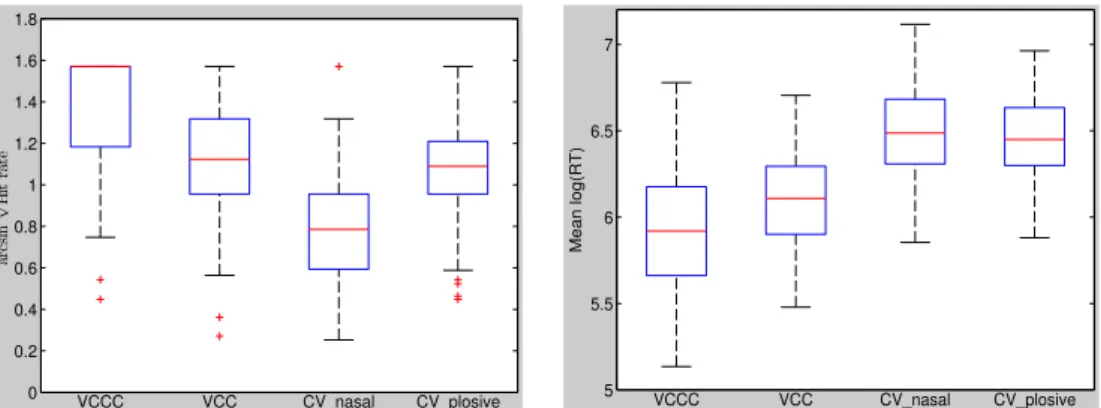
In Study 1, we tested whether 152 Swiss-German speaking multilinguals between the ages of 10 and 86 could detect violations to syllable structure in a Lexical Decision Task after listening to a seven minute Weather Report in Mandarin Chinese, and whether they could apply phonotactic knowledge derived from the input to new items of the language. Phonotactically violated three- and two-consonant-clusters and CVC syllables ending in an illegal plosive were significantly easier to reject than CVC syllables ending in an illegal nasal. Overall, participants rejected all consonant clusters (except CV_nasal) correctly significantly above chance level. Importantly, this ability improved with increasing age. Moreover, crystallized intelligence and number of L2s positively correlated with age and positively predicted higher accuracy in the Lexical Decision Task.
In Study 2, we tested what effect input had on an adult (ages 30-40) and a child (ages 10-11) group compared to two matching control groups that did not receive any input. Adults in the exposure condition performed significantly better than control adults on the critical stimulus condition CV_nasal, but not on any other syllables. Children did not differ. Both adults and children maintained their level of performance after one week of consolidation, suggesting that adults were able to learn implicitly and that implicit learning effects were embedded in memory.
These results provide evidence for a life-long ability to learn abstract linguistic patterns not only from artificial but also from natural continuous speech already after seven minutes of contact with an unknown language. Additionally, this ability seems to improve with increasing age, which speaks against a simplistic age effect for the perception and generalization of newly acquired phonotactic knowledge to non-native language input, and challenges claims against an adult capacity for implicit learning.
List of Figures
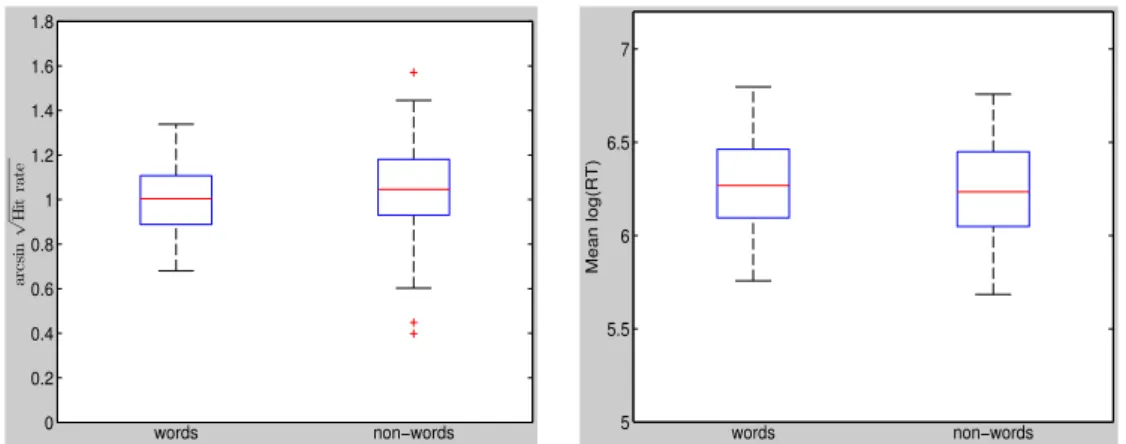
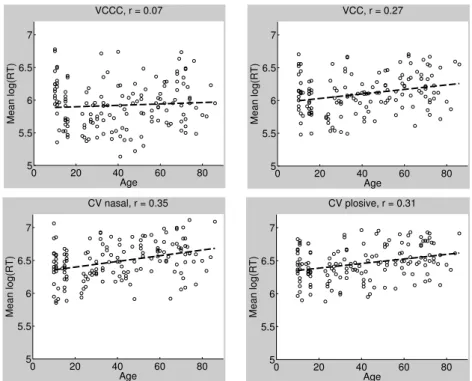
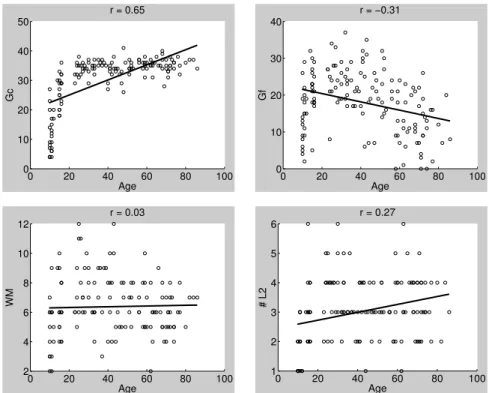
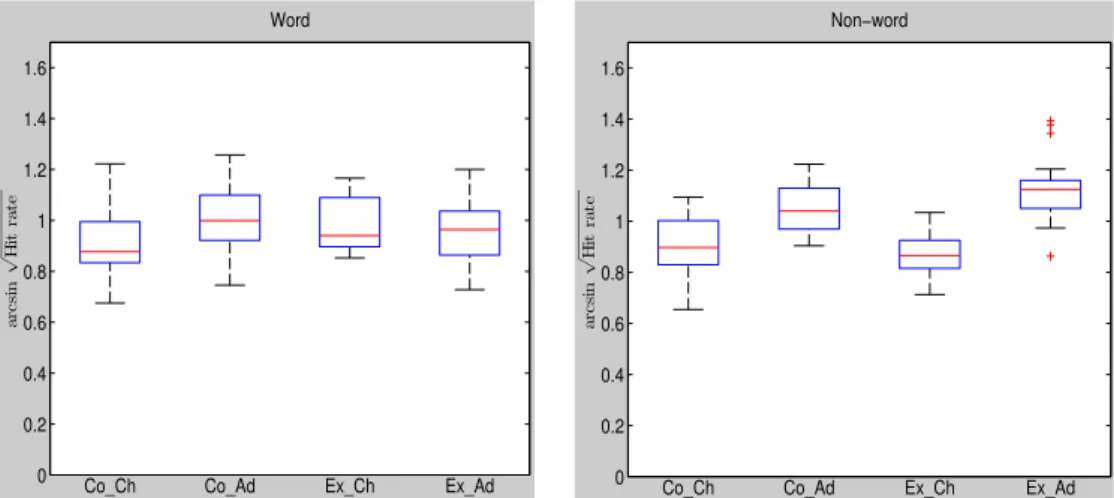
Figure 1: A video-frame from the Weather Report ... 54 Figure 2: left panel: raw reaction times across all subjects, across all conditions after removal of responses <100ms and >2000ms; right panel: log-transformed reaction times...66 Figure 3: Boxplots comparing (left) the mean transformed hit rate and (right) the mean transformed reaction times, averaged across all participants in each syllable condition. Arcsine-square-root-transformed hit rate at the chance level equals 0.79, n = 152... 70 Figure 4: Boxplots comparing (left) the mean transformed hit rate and (right) the transformed mean reaction times, averaged across all participants in words and non-words. Arcsine-square-root-transformed hit rate at the chance level equals 0.79, n = 152...73 Figure 5: Linear models for transformed hit rate in the four syllable conditions and age. Transformed hit rate at the chance level equals 0.79, n = 152...73 Figure 6: Linear models for mean transformed reaction times in the four syllable conditions and age, n = 152. ...74 Figure 7: Linear correlation between age and cognitive variables. Top panel from left to right: crystallized intelligence (Gc), fluid intelligence (Gf); bottom panel from left to right: working memory (WM), number of foreign languages without German (#L2), n = 152...75 Figure 8: Linear correlation between crystallized intelligence and hit rate for each experimental condition, n = 152. ...76 Figure 9: linear model for fluid intelligence and probability of correct rejection in each experimental condition, n = 152... 77 Figure 10: Linear correlation between working memory and hit rate for each experimental condition, n = 152. ...77 Figure 11: Linear correlation between number of foreign languages and hit rate for each experimental condition, n = 152... 78 Figure 12: left panel: raw reaction times across all subjects, across all conditions after removal of responses <100ms and >2000ms; right panel: log-transformed reaction times...95
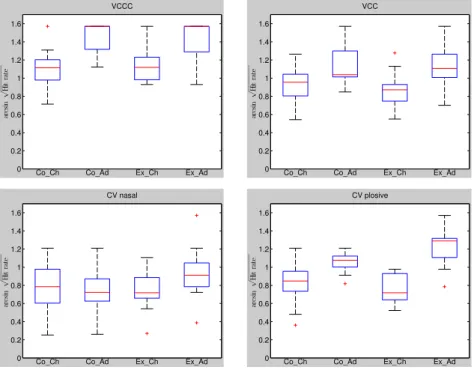
Figure 13: Boxplots comparing (left) mean transformed hit rates and (right) mean transformed reaction times, averaged across all four groups (Control Children, Control Adults, Experimental Children time 1, Experimental Adults time 1, n = 68), for all four conditions (VCCC, VCC, CV_nasal, CV_plosive). ...99 Figure 14: Boxplots to compare mean transformed hit rate for words and non-words, for all four groups (Co_Ch = Control Children, Co_Ad = Control Adults, Ex_Ch = Experimental Children time 1, Ex_Ad = Experimental Adults time 1;
n = 68). Transformed chance level equals .79. ...102
Figure 15: Boxplots to compare mean transformed reaction times, for words and non-words, for all four groups (Co_Ch = Control Children, Co_Ad = Control Adults, Ex_Ch = Experimental Children time 1, Ex_Ad = Experimental Adults time 1; n = 68). Transformed chance level equals .79...103 Figure 16: Boxplots to compare mean transformed hit rate per condition for each group (Co_Ch = Control Children, Co_Ad = Control Adults, Ex_Ch = Experimental Children time 1, Ex_Ad = Experimental Adults time 1, n = 68). Transformed chance level equals .79...105 Figure 17: Boxplots to compare mean transformed reaction times, per condition for each group (Co_Ch = Control Children, Co_Ad = Control Adults, Ex_Ch = Experimental Children time 1, Ex_Ad = Experimental Adults time 1, n = 68).
...107 Figure 18: Boxplots to compare the mean transformed hit rate per condition, comparing the two experimental groups at T1 and T2 (Ex_Ch = Experimental Children T1, Ex_Ch_w = Experimental Children T2, Ex_Ad = Experimental Adults T1, Ex_Ad_w = Experimental Adults T2). Ex_Ch/Ex_Ch_w: n = 14; Ex_Ad/Ex_Ad_W: n = 18. Transformed chance level equals .79...110 Figure 19: Boxplots to compare the mean transformed reaction times per condition, comparing the two experimental groups at T1 and T2 (Ex_Ch = Experimental Children T1, Ex_Ch_w = Experimental Children T2, Ex_Ad = Experimental Adults T1, Ex_Ad_w = Experimental Adults T2). Ex_Ch/Ex_Ch_w: n = 14; Ex_Ad/Ex_Ad_W: n = 18...111 Figure 20: Individual subject comparisons per condition of mean transformed hit rate T1 versus T2 (Ad = Experimental Adults, n = 18). Transformed chance level equals .79. ...112 Figure 21: Individual subject comparisons per condition of mean transformed hit rate T1 versus T2 (Ch = Experimental Children, n = 14). Transformed chance level equals .79. ...113
Figure 22: Individual subject comparisons per condition of mean transformed reaction times T1 versus T2 (Ad = Experimental Adults, n = 18). ...114 Figure 23: Individual subject comparisons per condition of mean transformed reaction times T1 versus T2 (Ch = Experimental Children, n = 14). ...114 Figure 24: Linear correlation between age and cognitive variables; (left) working memory (WM); (right) number of foreign languages without German (#L2), n = 32. ... 115 Figure 25: Linear correlation between working memory and transformed hit rate for each experimental condition, n = 32. Transformed chance level equals .79...116 Figure 26: Linear correlation between number of foreign languages and transformed hit rate for each experimental condition, n= 32. Transformed chance level equals .79. ...117 Figure 27: Linear correlation between age and cognitive variables; (left) working memory (WM); (right) number of foreign languages without German (#L2), n = 36. ... 117 Figure 28: Linear correlation for working memory and transformed hit rate for each experimental condition, n = 36. Transformed chance level equals .79. ...118 Figure 29: Linear correlation for number of foreign languages and transformed hit rates for each experimental condition, n = 36. Transformed chance level equals .79. ... 119 Figure 30: Cross-validation plots for all six syllable conditions, comparing a linear and quadratic model, in terms of the arcsine of the mean hit rate, across the lifespan...174 Figure 31: Cross-validation plots for all six syllable conditions, comparing a linear and quadratic model, in terms of the log of mean reaction times to correct answers, across the lifespan...175
List of Tables
Table 1: Participant characteristics in terms of the distribution of gender, age, number of foreign languages (Mean #L2s) and which foreign languages (L2s) were spoken by how many participants in each age group, n = 152. ...53 Table 2: Four violation types of the 128 non-words used in the Lexical Decision Task...55 Table 3: Experimental design of ten tasks ...63 Table 4: The four non-word conditions in the LDT. The illegal consonants are underlined. ...69 Table 5: Mean and standard deviation (in brackets) of untransformed hit rate and reaction times (in ms) on the Lexical Decision Task per non-word syllable condition and real words...69 Table 6: Tukey's honestly significant difference criterion for mean transformed hit rate in the comparisons of the four conditions VCCC, VCC, CV_plosive and CV_nasal...71 Table 7: Tukey's honestly significant difference criterion for mean transformed reaction times in the comparisons of the four conditions VCCC, VCC, CV_plosive and CV_nasal...71 Table 8: Participant characteristics in terms of the distribution of gender, age, average number of foreign languages (Mean #L2s), and which foreign languages (L2s) were spoken by how many participants in each group, n = 68.
...93 Table 9: The four non-word conditions in the LDT. The illegal consonants are underlined. ...98 Table 10: Mean and standard deviation (in brackets) of untransformed hit rates on the Lexical Decision Task per non-word syllable condition and real words...98 Table 11: Mean and standard deviation (in brackets) of untransformed reaction times on the Lexical Decision Task per non-word syllable condition and real words.
...98 Table 12: Tukey's honestly significant difference criterion for mean transformed hit rate, between the four conditions (VCCC, VCC, CV_plosive and CV_nasal)
across the four groups (Control Children, Control Adults, Experimental Children time 1, Experimental Adults time 1). ...100 Table 13: Tukey's honestly significant difference criterion for mean transformed reaction times in between the four conditions (VCCC, VCC, CV_plosive and CV_nasal) across the four groups (Control Children, Control Adults, Experimental Children time 1, Experimental Adults time 1)... 101 Table 14: Tukey's honestly significant difference criterion for mean transformed hit rate in the comparisons of words (W) and non-words (NW), across the four groups (Co_Ch = Control Children, Co_Ad = Control Adults, Ex_Ch = Experimental Children time 1, Ex_Ad = Experimental Adults time 1). ...103 Table 15: Tukey's honestly significant difference criterion for mean transformed reaction times in the comparisons of words (W) and non-words (NW), across the four groups (Co_Ch = Control Children, Co_Ad = Control Adults, Ex_Ch = Experimental Children time 1, Ex_Ad = Experimental Adults time 1). ...104 Table 16: Tukey's honestly significant difference criterion for mean transformed hit rate between the four conditions (VCCC, VCC, CV_plosive and CV_nasal) across the four groups (Control Children, Control Adults, Experimental Children time 1, Experimental Adults time 1). ...106 Table 17: Tukey's honestly significant difference criterion for mean transformed reaction times between the four conditions (VCCC, VCC, CV_plosive and CV_nasal) across the four groups (Control Children, Control Adults, Experimental Children time 1, Experimental Adults time 1)... 109 Table 18: Analysis of Variance to compare the mean transformed hit rates of the different syllable conditions (VCCC, VCC, CV_nasal and CV_plosive)...176 Table 19: Analysis of Variance to compare the mean transformed reaction times of the different syllable conditions (VCCC, VCC, CV_nasal and CV_plosive). 176 Table 20: Omnibus ANOVA to compare the mean transformed hit rates of the different groups for words and non-words (VCCC, VCC, CV_nasal, CV_plosive)...176 Table 21: Omnibus ANOVA to compare the mean transformed reaction times of the groups for words and non-words (VCCC, VCC, CV_nasal, CV_plosive). ....176 Table 22: ANOVA to compare the mean transformed hit rates of the different syllable conditions (VCCC, VCC, CV_nasal and CV_plosive) across the four groups (Control Children, Control Adults, Experimental Children time 1, Experimental Adults time 1)...177 Table 23: ANOVA to compare the mean transformed reaction times of the different syllable conditions (VCCC, VCC, CV_nasal and CV_plosive) across all four
groups (Control Children, Control Adults, Experimental Children time 1, Experimental Adults time 1)...177 Table 24: Omnibus ANOVA to compare the mean transformed hit rates of the different groups per syllable conditions (VCCC, VCC, CV_nasal, CV_plosive).
...177 Table 25: Omnibus ANOVA to compare the mean transformed reaction times of the groups per Syllable condition (VCCC, VCC, CV_nasal, CV_plosive)...177 Table 26: Repeated-measures ANOVA for mean transformed hit rate over experimental groups (Children versus Adults), time 1 versus time 2, given VCCC...178 Table 27: Repeated-measures ANOVA for mean transformed hit rate over experimental groups (Children versus Adults), time 1 versus time 2, given VCC. ...178 Table 28: Repeated-measures ANOVA for mean transformed hit rate over experimental groups (Children versus Adults), time 1 versus time 2, given CV_nasal...178 Table 29: Repeated-measures ANOVA for mean transformed hit rate over experimental groups (Children versus Adults), time 1 versus time 2, given CV_plosive. ...178 Table 30: Repeated-measures ANOVA for mean transformed reaction times over experimental groups (Children versus Adults), time 1 versus time 2, given VCCC...178 Table 31: Repeated-measures ANOVA for mean transformed reaction times over experimental groups (Children versus Adults), time 1 versus time 2, given VCC. ...179 Table 32: Repeated-measures ANOVA for mean transformed reaction times over experimental groups (Children versus Adults), time 1 versus time 2, given CV_nasal...179 Table 33: Repeated-measures ANOVA for mean transformed reaction times over experimental groups (Children versus Adults), time 1 versus time 2, given CV_plosive. ...179
Abbreviations
Ad_Co Adult Control group Ad_Ex Adult Experimental group
Ad_Ex_w Adult Experimental group after one week AGL Artificial Grammar Learning
AIT Autonomous Induction Theory ANOVA Analysis of Variance
AoA Age of Acquisition AoAr Age of Arrival
BAF Barcelona Age Factor project CAH Contrastive Analysis Hypothesis
CEFR Common European Framework of Reference for Languages Ch_Co Child Control group
Ch_Ex Child Experimental group
Ch_Ex_w Child Experimental group after one week
Cohen’s d Cohen’s measure of sample effect size for comparing two sample means
CP Critical Period
CPH Critical Period Hypothesis
CVC Consonant-Vowel-Consonant syllable CV_nasal Consonant-Vowel-nasal syllable CV_plosive Consonant-Vowel-plosive syllable
df Degrees of Freedom
EEG Electroencephalography ERP Event-Related Potential
F F distribution, Fisher’s F ratio
F(v1, v2) F with v1 and v2 degrees of freedom
fMRI functional Magnetic Resonance Imaging FT/FA Full Transfer/Full Access model
Gc Crystallized intelligence
Gf Fluid intelligence
HSD Tukey’s honestly significant diference criterion i-learning inductive learning
L1 First language
L2 Second language
#L2 Number of second languages LDT Lexical Decision Task LMH Less is More Hypothesis
n Number of participants MMN Missmatch Negativity
NLNC Native Langauge Neural Commitment NLM Native Language Magnet
NW Non-word
p Probability
PAM Perceptual Assimilation Model PDH Proceduralization Deficit Hypothesis PET Positron Emission Tomography
r Estimate of the Pearson product-moment correlation coefficient
SD Standard deviation
SLA Second Language Acquisition SLM Speech Learning Model
SMMT Sound-to-meaning mapping task
t Student’s t distribution; a statistical test based on the Student t distribution; the sample value of the t-test statistic
T1 (testing) time 1
T2 (testing) time 2
UCM Unified Competition Model
VCC Vowel-two-Consonant-cluster syllable VCCC Vowel-three-Consonant-cluster syllable
W Word
WM Working Memory
WR Weather Report
1 Introduction
1.1 How and when do we learn foreign languages?
It remains a hotly debated topic what adult learners are or are not capable of in language learning, and especially what they can do with input. A fundamental question is how adults break into a foreign language system at first contact, when they have no pre-existing knowledge to draw on, and what they can learn. Perdue (1996, p. 138) noted, “Far too little empirical attention has been paid to the very beginnings of the acquisition process”. Since then, first-exposure studies have focused on two main areas of research: First, the learner’s ‘problem of analysis’, as noted by, for example, Klein (1986). The second area has focused around VanPatten’s (1996) framework of input processing principles. This thesis situates itself within the first strand of research. Many authors (e.g. Christiansen, Allen, & Seidenberg, 1998; Klein, 1986) have noted that the second language learner's task at first exposure consists of different sub-tasks, such as comprehending the utterance, encoding statistical regularities, and integrating these regularities. The aim of this thesis is to contribute to the question of how the learner tackles these three tasks.
Typically, people argue that children are better language learners than adults. The slogan “Younger is better, older is faster” (Long, 2005) is often justified with the explanation that children’s brains are more flexible and more plastic than those of older learners. However, so far no target language property has been identified that adults cannot acquire (compare e.g. Birdsong, 2005). Rather than the notion “use it,
then lose it”, a better way to describe the faculty of second language (L2) learning
and mastery seems to be “use it, or lose it” (compare e.g. Diamond, 1996). In this vein, usage-based approaches stress the importance of frequency, assuming that knowledge of language emerges from actual events of language usage (compare Birdsong & Gertken, 2013). We learn language by forming associations between probabilities of occurrence and form-function mappings (Ellis, 2002, p. 144), and tend to understand new utterances based on how frequent we previously perceived and analyzed such utterances (p. 145). Investigating the very initial stage of L2 perception therefore necessitates the control of learners’ prior knowledge and L2 background in order to ensure that learners are genuine beginners with no experience of the language in question.
The acquisition of an L2 obviously differs from the process of acquiring one’s first language (L1). Three main aspects of difference are seen (compare e.g. Ellis, 2002; MacWhinney, 2005). Firstly, in the L1, the conceptual development (knowledge about the world) occurs parallel to the acquisition of language and serves as a starting point in adult second language acquisition (SLA). Secondly, exposure conditions in SLA are typically more formal and less naturalistic (e.g. in school contexts), and more varied (e.g. through interactions with other non-native speakers and teachers, and through more distraction in the acquisition process by various other commitments). Thirdly, there is usually some interference or transfer of the L1 to the L2, which, by converging evidence, is explained by similar brain structures processing the L1 and the L2 (compare e.g. Abutalebi, 2008; Abutalebi & Green, 2007; Friederici, Steinhauer, & Pfeifer, 2002; Reichle & Birdsong, in press; Steinhauer, White, & Drury, 2009). Another central aspect underlying the three already mentioned, is the development of cognitive variables across the lifespan and their various influences on language processes (compare e.g. Baltes, 1987; Bialystok, Craik, Klein, & Viswanathan, 2004; Ellis & Sagarra, 2010; Gathercole & Baddeley, 1993; Park & Payer, 2006; Sparks & Ganschow, 2001). We regard it as important to take the developmental stage of these variables into consideration when examining the L2 perception ability.
While supporters of the so-called Critical Period Hypothesis (CPH) consider these diverging starting points of L1 and L2 learning as unfavorable to SLA, doubters of the CPH regard language learning and its opportunities from a completely different angle. Instead of referring to a monolingual standard of ‘nativelikeness’ and the ideal (L1-like) language acquisition process, language development is referenced to individuals and their distinct language repertoires (that are constituted by the number and order of acquired languages). This perspective emphasizes the notion of ‘multi-competence’ for speakers of more than one language rather than ‘deficient’ competences in the various L2s (compare e.g. Birdsong & Gertken, 2013; Cook, 1992; Ortega, 2013). In this thesis, multilingualism is regarded as a holistic concept, independent of proficiency and, for reasons of simplification, we quantified this variable as the number of L2s participants indicated to master.
1.2 Overall Research Questions and Outline
The aim of this thesis is to explore the human perceptual learning mechanism across the lifespan by examining what information can be extracted from rich, complex, continuous natural speech, after minimal exposure, by multilingual learners of different ages and different cognitive abilities, without any prior instruction or training. Despite recent contributions to the investigation of input processing at first exposure, there are still gaps to be filled in the understanding of natural L2 perception and acquisition across the lifespan and the influence of cognitive skills. This thesis seeks to fill these gaps by the means of two empirical studies.
Study 1 asked three main questions: First, how quickly can adults distinguish sound regularities in natural language input? Second, if adults can extract abstract phonotactic knowledge, does this ability change across the lifespan? That is, do adults or children learn these things more easily? Third, how does the development of cognition and/or multilingualism help language users grasp the phonotactic structure of an unknown foreign language?
Study 2 asked three additional questions: First, is there evidence of real learning from input or is general inferencing from prior experience or knowledge enough? Second, do children differ from adults in this regard? Third, is there evidence of real learning with consolidation of phonotactic knowledge after one week?
In what follows, we first present the relevant theoretical and empirical background to this thesis. The two empirical studies will then be presented individually, introduced by a brief summary of the relevant literature and research questions, the description of the methods used, the results and the discussion thereof. The last chapter summarizes the studies and provides a general discussion of the findings, together with comments on the methodology, as well as methodological suggestions for future research, and an overall conclusion.
2 Theoretical background
First, we will review theories and studies debating the role of input and the work a learner must perform on it at first exposure, such as perception and segmentation. This line of investigation is related to previous research on the possible difference between ‘input’ and ‘intake’, the role of attention and noticing differences, and the difference between intentional and incidental, explicit and implicit L2 learning. The different research strategies of artificial, classroom and training studies will be outlined.
Second, we will review theories and studies concerned with the notion of age effects in L2 learning, including the Critical Period Hypothesis and studies by supporters and doubters thereof. Likewise, the influence of cognitive variables and multilingualism will be reviewed.
Finally, predecessor and present studies are presented.
2.1 How do we learn foreign languages?
2.1.1 Role of input
How L2 learning proceeds from the very initial stages of contact with a new language to different levels of proficiency is still a matter of debate. Discussions typically concern adult L2 learners who have already spent plenty of time getting familiar with the L2 and accumulated considerable knowledge. In consequence, there is a scarcity of studies that have looked at the very initial stage of L2 learning (compare e.g. Perdue, 1996) and at what adult learners can or cannot do with input at this stage. The role of input is pivotal because language learning cannot take place without it (Gass, 1997). In an illuminating series of studies, Carroll has discussed how input is processed during L2 learning and how it is incorporated into the learner’s perceptual system (Carroll, 1999, 2000, 2002, 2004). In the Autonomous Induction Theory (AIT), Carroll re-conceptualized second language acquisition (SLA) and proposed an SLA processing framework that involes the acquisition of L2 knowledge representations and L2-appropriate segmentation strategies (2004, p. 234). In this framework, two types of innate and automatically operating mechanisms process input. The integrative processor at the lower level combines
smaller representations into larger units, and the correspondence processor at the higher level moves representations from one level (for example the acoustic level) to the next (for example the phonological level). Rules to categorize and combine representations are activated if this parsing procedure is successful. The two processors form a sequential parsing module process input regardless of its linguistic origin. Therefore, L1 parsing procedures initially also apply to L2 stimuli. Parsing, however, is different from acquisition. Acquisitional mechanisms are triggered when parsing fails as a consequence of missing or inadequate categorization rules. This process is described as inductive learning (i-learning). It triggers the acquisitional mechanisms to revise perceptual and parsing procedures in order to analyse novel stimuli (Carroll, 2002, p. 229). Carroll distinguishes i-learning from inductive reasoning in that i-learning is influenced by symbolic representations from long-term- and working-memory. However, this stage of processing remains largely automatic and outside of conscious control. Attention is rather a result than a prerequisite of preliminary input processing. Although Carroll was cautious to use attention as a blanket term, her notion differs slightly from what Gass (1997) considered to be a required element to convert input into learner internal representations. The contradiction might, however, stem from the differing definitions of intake. The possible difference between ‘input’ and ‘intake’ (e.g. Corder, 1967) are therefore related to this line of investigation.
Input and intake
Corder (1967) discussed the notion of intake in his seminal paper on how input is perceived, stating:
The simple fact of presenting a certain linguistic form to a learner in the classroom does not necessarily qualify it for the status of input, for the reason that input is ‘what is going in’ not what is ‘available’ for going in, and we may reasonably suppose that it is the learner who controls this input, or more properly his intake. This may well be determined by the characteristics of his language acquisition mechanism. (p. 165).
Input is therefore defined as what is available to be learnt, while intake is what learners cognitively register for further processing. In consequence, the role of input and intake is further related to research on attention and noticing differences (e.g. Ellis & Sagarra, 2010).
Noticing and attention
The noticing hypothesis proposed by Schmidt (1990) goes back one more step by stating that learners cannot register anything without first noticing it. Schmidt argued
that the subjective experience of ‘noticing’ or a sense of awareness of aspects of the ‘surface structure’ of input is necessary for learning to take place, even if ‘unconscious’ learning in the sense of learning without intention or learning without metalinguistic understanding is possible. Schmidt equated awareness with attention. Viewed in that light, all learning is conscious, because input only becomes intake for learning if it is noticed (for a review on noticing see Truscott, 1998) (for a review on attention see Robinson, Mackey, Gass, & Schmidt, 2012). A study by Ellis and Sagarra (2010) examined ways to overcome learner’s attentional biases during initial L2 learning by manipulating their current attention. They found that adults’ L1 experience with finding relevant cues in the input blocked their attention during initial L2 learning. The authors viewed this phenomenon as jointly responsible for differing levels of success in associative learning between child L1 and adult L2 learners. They proposed that attentional difficulties in L2 learners can be overcome by pedagogical interventions and pre-training of relevant cues. At this point, it is again crucial to examine the very initial state of learning and perception in order to know what influences and moderates noticing and attentional processes at the very beginning. Influences of different learning modes, such as the difference between intentional and incidental and implicit and explicit L2 learning (e.g. DeKeyser, 2003; Hulstijn, 2003; Williams, 2009), are therefore also important to consider while studying L2 perception and segmentation.
Incidental and intentional learning
Incidental learning means learning without the intention to learn, but by ‘picking up’ while engaging in a variety of communicative activities (for example reading and listening), where the focus lies on meaning. This kind of learning starts from the very first exposure to a new language and is opposed to intentional learning, which is goal-directed and with the focus on the form of the language where deliberate commitment to memory comes to play, for example while trying to remember something (cf. Hulstijn, 2003, p. 349). Incidental and intentional learning were originally tested in stimulus-response-learning experiments where the forming of associations was examined under different instruction settings (e.g. Gagné, 1965). The critical feature was whether or not participants were told that they were going to be tested (Hulstijn, 2003). Hulstijn differentiated two types of designs: a between-group (type 1) design and a within-between-group (type 2) design. The type 1 design was developed earlier and mostly served to demonstrate that incidental learning exists. There are no instructions to learn and no information that learning is going to be tested. The type 2 design instructed participants to learn some stimuli, but not others
that were then tested unexpectedly, in such a way that participants could be used as their own controls for the difference between incidental and intentional learning. The criteria that participants are not told whether there will be testing or not also applies to implicit learning experiments (see below Williams, 2009).
Implicit and explicit learning
Implicit learning means incidental learning of complex information without the awareness of what was learnt. In one of the earliest studies of implicit learning of artificial grammar by Reber (1967), implicit learning was described as a process of acquiring knowledge without the intention and the awareness to do so. Reber interpreted implicit learning as an inductive process similar to perceptual learning described in Gibson and Gibson (1955), and as an intrinsic part of language learning and pattern perception (Reber, 1967, p. 863). Again, this process is thought to be involved at the earliest stages of language acquisition.
Krashen (1981) initiated the discussion of the contrast between implicit and explicit second language acquisition and learning with the Acquisition-Learning Hypothesis, claiming a strict separation of acquisition and learning. While he considered acquisition to be a purely subconscious process upon which the improvement in language ability was dependent on, he believed the conscious process of learning to be independent thereof. The most important distinction from explicit learning according to Ellis (1994) is the absence or presence of ‘conscious operations’ (cf. p. 1). Conscious intentions to find regularities in the input that lead to the exploration of underlying concepts and rules are characteristic of explicit learning (Hulstijn, 2005).
The definition of the concept of implicit learning is still developing and subject of controversy. Criteria about the learnt information’s status, content and manner were proposed (cf. Seger, 1994, p. 164): First, the acquired knowledge is not fully accessible to consciousness. Second, the learnt information is more complex than a simple association or frequency count. Third, learning happens incidentally as a consequence of the type and amount of cognitive processing on the stimuli. Moreover, implicit learning is considered to be robust over time and preserved in cases of amnesia (cf. ibid.). While the neural basis of explicit learning is hippocampal, (non-hippocampal) structures of the basal ganglia, the association cortex, and of the frontal cortex seem to be involved in implicit learning (cf. p. 184). Using fMRI, Seger, Prabhakaran, Poldrack, and Gabrieli (2000) found that the neural substrates of implicit and explicit learning of an artificial grammar differed. Reber, Allen and Reber (1999) supported the claim that implicit learning and
memory depend on disparate brain areas (cf. p. 482). As opposed to cognitive explicit learning, implicit learning is therefore often described as (incidental) associative learning (Kaufman et al., 2010, p. 323).
Implicit learning research can be categorized in three areas (2003): artificial grammars, sequence learning and the control of complex systems. Within these areas, implicit learning has been tested in many different tasks, for example in artificial grammar learning, visuospatial concept learning, co-variation learning and serial reaction time learning tasks (cf. Seger, 1994). Reber (1967) was one of the first to study implicit sequence learning with an artificial grammar learning task. In two experiments, he showed that participants became increasingly sensitive to the grammatical structure by perceptual learning and that the information could be extended to new stimuli in a recognition task. The grammatical rules that are implemented in artificial grammar learning (AGL; see below) studies are typically very complex. Usually, the amount of learning is not very large, yet, in a very short time, participants perform significantly above chance level (50 percent represents mere chance) – a typical score lies between 55-70 percent (cf. DeKeyser, 2003, p. 319). The acquired quasi-abstract knowledge is unconscious if participants believe that they are guessing (for example in a Lexical Decision Task), but indeed succeed to discriminate new stimuli above chance level. This is called the ‘Guessing Criterion’ (cf. Cleeremans & Dienes, 2008). Implicit learning studies are thus interested in producing quasi-abstract knowledge structures which in turn allow generalizations of the implicitly acquired knowledge to new stimuli (cf. e.g. Cleeremans & Dienes, 2008).
Implicit and incidental learning
Implicit learning happens always incidentally, but incidental learning does not entail implicit learning (2003). During implicit learning, the perception of information automatically and autonomously triggers the formation of implicit knowledge (cf. Hulstijn, 2007, p. 706). Listening, for example, is mostly an implicit process, because we cannot influence how quickly we process incoming speech (cf. p. 709). The resulting (implicit) knowledge is difficult to express, it cannot be consciously ‘inspected’ or verbalized. As opposed to this, explicit knowledge is knowledge that we (consciously) know and can access deliberately (cf. Dienes & Perner, 1999). The storing of implicit knowledge is designed to allow rapid, parallel processing (cf. Hulstijn, 2007). This processing mode is distinctive of native speakers’ (linguistic)
behaviour, such as fluent listening and speaking (cf. p. 706). Connectionist models1 were considered adequate to capture the two most important characteristics of implicit learning insofar as the connectionist concept of knowledge is based on statistical associations in the absense of rules (cf. DeKeyser, 2003, p. 329).
Robinson (2002, 2005) compared implicit artificial grammar learning to incidental natural learning of Samoan and examined the influence of individual differences in language learning aptitude, intelligence and working memory. He found that explicit memory was significantly positively correlated with the performance of the incidentally learned Samoan items, but not with the implicitly learned artificial grammar items. The two learning conditions were unrelated in all the post-test measures. Robinson (2010) concluded that incidental natural language learning and implicit artificial grammar learning are related but are different, separable processes. Learning was not significant in either condition, but there was evidence that sensitivity to frequency in the input (‘chunk strength’) and individual differences exerted a different influence on the two learning conditions. Robison thereby specified the interpretation of Reber et al.’s (1991) findings. Reber and colleagues (1991) claimed that implicit learning is independent of intelligence while explicit learning is sensitive to individual differences in intelligence. Robinson (2010) concluded that implicit but not incidental learning is related to intelligence, such as intelligence and implicit learning are correlated significantly negatively.
Williams (2005) pointed out the importance of prior knowledge for implicit learning. The ability to extract lexical information from speech input correlated with the knowledge of languages that encode grammatical gender. Learners were able to use miniature, non-instructed language input as training to generalize the animacy of noun determiners to new items, although they reported not being aware of having learned anything. Williams (2009) endeavoured to develop better models and theories of implicit learning and the establishment of implicit knowledge. According to Williams, a more scientific criterion is needed to guide researchers in planning their experimental procedures, since all the models developed so far contain some elements or procedures that make them less reliable. He criticized that the definition of implicit learning as ‘learning without awareness’ only allows an operationalisation of implicitness through the assessment of awareness, which is a
1 Cleeremans and Dienes (2008) modelled many aspects of implicit learning in order to
illustrate associative learning processes, to explore computational principles in exemplar-based models, and to make the comparisons of models and their predictions possible.
subjective mental state. According to Williams, much more research needs to be done to specify exactly what this powerful associative implicit learning mechanism does and how it contributes to learning.
2.1.2 Speech perception and segmentation
How do we perceive an unknown language?
Speech perception is a complex process by which language sounds are noted, taken in and interpreted in terms of their features, which are then processed and stored as mental representations of abstract categories (cf. Hulstijn, 2007, p. 708). Electrophysiological evidence suggests influence of language experience on stimulus processing at very early stages (cf. e.g. Näätänen et al., 1997; Winkler et al., 1999; Zhang, Kuhl, Imada, Kotani, & Tohkura, 2005). Nenonen, Shestakova, Huotilainen and Näätänen (2005) found evidence of a strong L1 influence on L2 contrast detection even in a well-learned L2.
Effects of the L1 on L2 perception
The field of L1 effects in L2 acquisition has a longstanding tradition, with much of the work focusing on production. While the Identity Hypothesis (cf. e.g. Jakobovits, 1970; Klein, 1986), for example, asserts that the acquisition of one language has no influence on the acquisition of another, the Contrastive Analysis Hypothesis (CAH) (Lado, 1957) claims that the structure of an earlier acquired language largely determines the acquisition of a second language. Lado assumed that similar structures are assimilated with ease, while dissimilar structures present difficulties in the form of ‘negative transfer’, which can result in a significant indicator of a foreign accent in the L2 (cf. also Wardhaugh, 1970). Krashen (1981) formulated the Monitor Theory that put primary importance on the comprehensibility of the input that language learners are exposed to. Kellerman (1983) defined psychotypology as the learner’s perceived distance of the L1 and the L2. Following on from this, much work has focused on transfer or crosslinguistic influence (Kellerman, 1979, 1983; Sharwood Smith, 1986; Jarvis & Pavlenko, 2008; Odlin, 1989, 2003) across various domains. A more recent transfer theory is the Full Transfer/Full Access (FT/FA) model by Schwartz and Sprouse (1996; cf. also Dekydtspotter, Schwartz, & Sprouse, 2006). This model is concerned with cognitive states in the L2, as well as with the question of what the ‘initial state’ in L2 acquisition is. In this respect, the FT/FA model holds that the early L2 state is full transfer of the L1 and is influenced by prior linguistic experience (Schwartz & Eubank, 1996).
Concerning the effect and extent of L1-influence on L2-speech perception, there are differing views (cf. e.g. Klein, 1986). A prominent model is MacWhinney’s Competition Model (1987) followed by the Unified Competition Model (UCM) (2005, 2008), dealing specifically with the role of input and the growth of cue strength (how often a form is used) in transfer processes. According to MacWhinney (2005), L1 and L2 acquisition rely on the same mechanisms. Language comprehension is based on the detection of a set of valid cues whose strength is determined by their reliability and availability (cue validity – how reliable is a form-meaning association). Language acquisition, consequentially, is cue-driven learning, a mechanism that is relevant for lexical, phonological and grammatical forms of language in both the L1 and the L2. Since the L1 is already established and repeatedly co-activated, it is thought to entrench cue-driven learning in the L2. Transfer effects from the L1 can be blocked using meta-cognitive strategies. The L2, on the other hand, is parasitic on the L1 for being clustered in similar brain regions as the L1. High similarities between L1 and L2 forms are thought to be facilitative for the acquisition of similar L2 forms, while competition between differing forms might negatively affect successful acquisition. Especially for similar forms, neuro-cognitive representations and processing of the L1 and the L2 are expected to overlap (cf. also fMRI and ERP evidence by Hernandez, Li, & MacWhinney, 2005; Tokowicz & MacWhinney, 2005). An interesting recent development along these lines is the Convergence Hypothesis (Abutalebi, 2008; e.g Abutalebi & Green, 2007; cf. also Morgan-Short & Ullman, 2012). It proposes that the L2 relies on the same processing mechanisms as the L1 and that L2 processing ‘converges’ with L1 processing with increased L2 proficiency. In this regard, the hypothesis is largely consistent with the claims of the Competition Model. There is increasing neurocognitive evidence in support of the hypothesis (cf. e.g. Abutalebi, 2008; Abutalebi & Green, 2007; Friederici et al., 2002; Reichle & Birdsong, in press; Steinhauer et al., 2009).
Looking specifically at phonological effects, two frequently cited models make opposite predictions regarding whether L2 sounds that are more similar or more dissimilar to the L1 sound category are easier to perceive. The speech Learning Model (SLM) by Flege (1993) suggested that new (dissimilar) sounds of the L2 are more easily processed than (similar) sounds that share a phonetic category in the L1 and the L2 (p. 1589). The perceived similarity between L2 and L1 sounds consequently determines the probability of category establishment. According to the SLM, advanced L2 users have two ways of processing L2 sounds: either by
establishing new phonetic categories for some L2 sounds or by linking new L2 sounds with similar L1 sounds, which are then processed in the same phonetic category. The establishment of new phonetic categories would thus only be possible for L2 sounds that an L2 user can perceive as dissimilar to the closest L1 sound.
Best (1995), on the other hand, assumed that similarity of the L2 sound to the listener’s L1 facilitates rather than hinders discrimination. Listeners were observed to require more attention discriminating non-native consonants or non-linguistic details that did not belong to their native language frame (Best, McRoberts, & Goodell, 2001). Thus, the authors generally regarded a stable L1 to be supportive for the perception of foreign utterances. The Perceptual Assimilation Model (PAM) by Best (1995, p. 194) predicted three ways of processing an auditory articulation. First, if a novel sound is perceived as a potential phonological unit, it will be assimilated as an acceptable example of a native phoneme category. Second, if the articulation is only similar to two or more phonemes, the sound falls somewhere between native phonemes as an uncategorized consonant or vowel. Third, if the articulation bears no detectable similarity to any native phoneme, the sound is categorized as a ‘non-assimilable’ non-speech sound. Additionally, six pair-wise assimilation types with assigned discrimination levels are possible. PAM predicts infants’ developmental progress to reach from detecting only non-linguistic information in speech, through recognizing how phonetic variants fit into language-specific phonetic classes, to discovering functions of phonological contrasts that help to distinguish native words (Best et al., 2001).
Usage-based approaches postulate input to be the driving force of language acquisition, whose regularities are analyized by learners with various cognitive (non-linguistic) tools (cf. e.g Zyzik, 2009, p. 49). For example, the language acquisition mechanism is extremely sensitive to usage frequency at all levels of language processing (cf. Ellis, 2002; Ellis, 2012). The repeated analysis of distributional characteristics of the input results in the acquisition of language rules (e.g. structural regularities) and associative learning of form-meaning mappings. Therefore, statistical learning processes (see below 2.1.3) and linguistic input are at the core of scientific inquiry in usage-based studies. Linguistic input, together with cognitive skills, are seen as the crucial factors in the distinction of the L1-L2 acquisition processes (cf. Slabakova, 2013). In this thesis, we are specifically interested in the L2 processing of phonotactics.
Phonotactics – regularities and constraints
Phonotactics define what combinations of phonemes, consonant clusters and vowel sequences are legal in a language and phonotactic constraints define illegal combinations. They are both highly language specific and therefore have to be learnt in the acquisition of an unknown language (cf. e.g. Dell, Reed, Adams, & Meyer, 2000, p. 1357). Knowledge of L2 phonotactic regularities and constraints affect both L2 speech perception (cf. e.g. the identification of speech sounds Massaro & Cohen, 1983; and the identification of word boundaries McQueen, 1998; Norris, McQueen, Cutler, & Butterfield, 1997; Pitt, 1998) and production (cf. e.g. Vitevitch, Luce, Charles-Luce, & Kemmerer, 1997).
Studies have shown that L2 learners use phonetic and phonotactic information from the L1 to detect word boundaries in the L2. Flege and Wang (1989), for example, compared the listening performance of three Chinese L1 groups on the identification of an English L2 phonetic contrast. The contrast between /t/ and /d/ exists word initially in Chinese, but not word-finally like in English. Cantonese, Mandarin and Shanghainese present different phonotacitic constraints regarding the word-final plosives. Participants performed according to the authors’ prediction and showed increased sensitivity after training. L1 phonotactic constraints were interpreted to influence L2 syllable processing. Comparing English and Japanese listeners in six phoneme detection experiments, Cutler (1994) showed that both Japanese and English listeners apply their L1-specific pre-lexical processing patterns to L2 input, even if they are not appropriate in the L2. In a summary paper by Cutler (2001), the process of L2-word recognition again emerged to be highly dependent on and constrained by the learner’s L1. L1-experience affected listener’s expectations of L2 syntax, L2 semantics, and most importantly, L2 phonotactics. Cutler concluded that L2-learners use their L1 phonotactics to segment speech, and that they do this even though it may lead to inefficient processing of the L2, but that it would be possible to inhibit this misapplication with increasing L2 competence.
Broersma (2005) compared Dutch learners of English with English native speakers and showed that lexical activations in L2-learners were increased compared to lexical activations in L1-speakers. The increased activations lead to less efficient phonetic processing. Yet, sounds could still be recognized just as accurately as native speakers did, even if phonetic processing was not native-like. In two studies with a similar design, Broersma and Cutler (2008, 2011) showed that activation in non-native listeners was again higher and involved phantom word competition that
was not present in native listeners. In a comparison of German users of English L2 and English L1 speakers, Weber and Cutler (2006) found that even highly proficient L2 listeners who had acquired phonotactic probabilities of the L2 were not able to prevent L1 phonotactics to interfere. Finn and Hudson Kam (2008) found further evidence for indirect and direct constraints of the L1 in L2 listening and in the ability to use statistical information to segment L2 words. They reused the same set of synthesized English words and non-words in four different experiments to examine whether adult learners can indeed inhibit L1 knowledge and learn to track transitional probabilities of a new system. Despite increased amounts of exposure and indirect information about how to segment words, prior linguistic knowledge interfered with learners’ segmentation abilities.
How do we segment unknown L2 speech?
The process of identifying phoneme, syllable and word boundaries in spoken language is called speech segmentation. Contrary to the expectations we might obtain from reading written words, boundaries between lexical units in most spoken languages are surprisingly difficult to identify. In natural speech, many consecutive words are uttered without pauses between them. As if this was not difficult enough, the way an utterance is split into words can have effects on its meaning. A frequently quoted example in artificial intelligence technology is the phrase ‘How to wreck a nice beach you sing calm incense’, which sounds very similar to ‘How to recognize speech using common sense’ (cf. Lieberman, Faaborg, Daher, & Espinosa, 2005, p. 507). The problem can thus not be adequately solved in isolation but requires contextual references, grammar, and semantics.
Listeners use different strategies to segment speech input into separate words, depending on the rhythmic structure of the language. Languages are classified into two or three isochronic (or rhythmic) categories, by implication into in syllable-timed, mora-syllable-timed, or stress-timed languages. Pike (1972 [1945]) first expressed the idea in 1945 and was supported by many linguists (cf. e.g. Abercrombie, 1967; Ladefoged, 1967), which has contributed to the general acceptance of the theory. Mandarin Chinese, for example, is commonly considered as an example of syllable-timed languages, while German is considered stress-syllable-timed (cf. also Bertrán, 1999). In consequence, L2-listeners typically apply the rhythmic strategy they know from their L1 instead of the one appropriate for the L2 (cf. Cutler, Mehler, Norris, & Segui, 1986; Otake, Hatano, Cutler, & Mehler, 1993), which might be a problem in cases where the L1 and L2 do not share the same rhythmical structure (like Chinese
and German). In these cases, non-native listeners encounter more difficulties in dividing the speech stream into separate words. Cutler and colleagues (1986), for example, investigated and found language-specific segmentation processes in French and English listeners. While native speakers of French segmented their language syllable-by-syllable, English speakers used segmentation strategies based on syllable stress. In their follow-up study (Cutler, Mehler, Norris, & Segui, 1989), the authors also examined French-English and English-French bilinguals. They found limits to bilingualism insofar as the dominant language affected whether participants were able to switch from the segmentation strategy suited for the dominant language to the segmentation strategy of the second language or not. Cutler et al. concluded that only one language is basic for any speaker (cf. p. 230). However, different from the monolingual speakers, the bilinguals ‘knew’ when not to apply the inefficient segmentation strategy.
Phonotactic regularities and constraints in an L2 are first encountered and acquired through listening to the unknown language (cf. Kittredge & Dell, 2011, p. 2679). As outlined above, identifying word and syllable boundaries in order to segment speech of an unknown language is a challenging task for the L2 learner. Phonotactic competence emerges from using language, because language learning is associative learning (2002). Exposure to accurate and adequate input is therefore essential for new associations and L2 acquisition to emerge. One problem with examining learners’ work on the input concerns control of learners’ prior experience and knowledge. Artificial and statistical language learning studies have solved this problem by controlling the language input.
2.1.3 Artificial and statistical language learning
Artificial language learning studies have examined the influence of statistical properties of language on the acquisitional learning mechanism using completely controlled L2 input. They typically present short strings of often-repeated syllables and then go on to test whether learners have detected regularities in the input (e.g. Peña, Bonatti, Nespor, & Mehler, 2002; Perruchet & Poulin-Charronnat, 2012; Saffran, Newport, & Aslin, 1996). In this way, transitional probabilities between syllables are the only cues for word segmentation. The Artificial Grammar Learning (AGL) paradigm allows researchers to test whether child and adult learners use this kind of phonotacitc and statistical information or not.