HD28 .M414
WORKING
PAPER
ALFRED
P.SLOAN
SCHOOL
OF
MANAGEMENT
ECONOMIC BEHAVIOR & SOCIAL LEARNING
August 1986 Sharone L. Maital Shlomo Maital Nava Pollak WP#1807-86
MASSACHUSETTS
INSTITUTEOF
TECHNOLOGY
50MEMORIAL
DRIVE CAMBRIDGE.MASSACHUSETTS
02139ECONOMIC BEHAVIOR ^ SOCIAL LEARNING
August 1986 Sharone L. Maital
Shlomo Maital
ECONOMIC BEHAVIOR & SOCIAL LEARNING
Sharone L. Maital Shlomo Maital * Nava Pollak
Staff Psychologist Associate Professor Graduate Student Faculty of Industrial Engineering &
Haifa School Management,
Psychological Services Technion - Israel Institute of Technology
HAIFA ISRAEL
The nature and evolution of the social learning approach to human behavior is described and
summarized and its theoretical and empirical application to economic behavior in general, and to
intertemporal choice in particular, is summarized. The actual and potential contribution of social learning theory to improving our understanding of economic choice is discussed. By way of example, results from a
longitudinal panel study that began in 1975, focusing
on delay of gratification and its relation to
educational achievement, are described.
VohXhcomiiiQ, ktoix McFadijun S HzatkeA McFadf/eii, e.ditou,
ECOUOmC PSVCHOLOGV, Hofitii Holland, AmteAdam, 19S6
* currently Visiting Professor, Management of Technology Program, Sloan School of Management, M.I.T.
M.I.T. LIBRARIES
APR 1 6 1987
"There is no more powerful, pervasive influence on how
individuals think and cultures interact than our different perspectives on time
—
the way we mentally partition timeinto past, present and future. Every child learns a time
perspective appropriate to the values and needs of his
society."
-Alexander Gonzalez & Philip G. Zimbardo (1985)
INTRODDCTION
Social learning theory posits that the choices people make depend on the subjective value of each choice, the expectancy that it
will indeed occur, and the ability to implement the choice decision;
emphasis is placed on the interaction of the nature of the choice situation, how people perceive it, and what they know and have learned about it and similar choices in the past. We contend that the social learning model is a theoretically sensible and empirically viable paradigm of economic behavior, being an integration of dynamic and
cognitive approaches (which interpret behavior mainly as a function of
individual nature and internal thought processes) and the stimulus-response approach, which sees behavior as solely determined by the
consequences of actions. The purpose of this paper is to summarize the
social learning view of behavior, as it has evolved since its
inception in 1954, and to apply this model empirically to a
particularly important type of economic behavior: the choice of
immediate present rewards versus delayed-but-larger future ones.
The structure of this paper is as follows. The first section defines social learning theory (SLT) as first conceived by Julian Rotter in 1954 and expanded upon by Bandura (1977) , and discusses how
it has evolved to the present. Emphasis is placed on the SLT view of
motivation: WHY people act as they do. Section Two discusses how SLT can explain important aspects of economic behavior in general, and in
particular, how SLT illuminates the economic theory of intertemporal choice. Section Three describes a longitudinal panel study of time
preference (willingness to defer gratification) among a group of
Israeli teenagers, built on the social learning paradigm, aimed at
discovering the psychological and socio-economic determinants of
economic and educational achievements. The last section summarizes
and concludes.
THE NATURE AND EVOLUTION OF SOCIAL LEARNING THEORY
Social learning theory was first fully enunciated in Julian Rotter's book Social Learning & Clinical Psychology (1954). The
objective. Rotter later wrote, was "to integrate two diverse but
n
reinforcement" theories, on the one hand, and the "cognitive" or
field" theories on the other" (Rotter, Chance & Phares, 1972, p. 2).
The S-R (stimulus-response) model asserts the preeminence of the
environment in determining behavior: "A person does not act upon the
world, the world acts upon him" (Skinner, 1971, p. 211). In contrast,
humanist, existentialist and cognitive psychologists emphasize that
individuals have the capacity for purposive action and conscious judgment, sufficient to act upon the world.
Somewhere along a continuum between these two poles lies the
"reciprocal determinism" (Bandura, 1978, p. 345) of social learning
theory, which asserts that complex interactions exist among behavior,
cognition, and the external environment, and that behavior can best be
understood in terms of these interactions. Rotter's fundamental SLT
equation states that behavior potential (BP) , the potentiality of any
behavior's occuring in a given situation, is a function of expectancy
(E) , the probability held by the individual that a particular
reinforcemment will occur as a result of a specific behavior on his
part, and reinforcement value (RV) , the degree of a person's
preference for that reinforcement if the possibilities of occurrence
of all alternatives were equal:
[1] BP = F(E, RV)
Rotter emphasizes that subjective reinforcement value is
systematically independent of expectancy.
To economists, equation [1] is instantly recognizable as a close
cousin to the definition of expected utility (the product of the
probability of an outcome and that outcome's utility,summed over all
possible outcomes) . The expected utility [EO] approach, pioneered by
von Neuman and Morgenstern (1944), remains the bricks-and-mortar of
the economic theory of behavior under uncertainty. However, SLT
(unlike EU) emphasizes the subjective nature of expectancy:
A variety of other factors [in addition to people's actuarial experience with the event in the past] operate in specific instances to influence one's probability estimates. Such factors may include the nature or the categorization of a situation, patterning and sequential considerations, uniqueness of events,
generalization, and the perception of causality. (Rotter, 1972,
p. 13).
In addition, SLT emphasizes the crucial importance of past learning experience, which shapes both reinforcement values and expectancy.
Rotter emphasized that "the psychological situation is an
extremely important determinant of behavior... in sharp contrast to
those positions that.. .assert that once the basic elements of
personality are identified, reliable prediction follows" (Rotter et
al, 1972, p. 37). Experiences with one particular situation,
particularly those involving social interaction with other people, are
often generalized to other, similar situations. SLT calls this
attitudes. The distinction between specific and generalized expectancies is an important one in SLT. Specific expectancies result
from one's previous experiences with reinforcement in the same
situation. This expectancy is subject to change and manipulation. Given a sufficient number of replications, changes in specific situational expectancies can lead to changes in generalized expectancies, which are part of one's personality. A major role of
socialization is the development of generalized expectancies.
According to SLT, behavior is in part learned because both expectancies and reinforcement values are influenced by past experiences. Behavior is in part socially determined because both expectancies and reinforcement values are shaped by relations with other persons and groups.
Rotter led efforts to develop empirical measures of "generalized expectancies". His scale for the measurement of interpersonal trust
(Rotter, 1967), defined as "the expectancy held by an individual or a
group that the word, promise, verbal or written statement of another individual or group can be relied upon", was found to have predictive value for a wide range of behaviors. Another personality variable
with roots in social learning theory is "internal-external locus of
control", "the degree to which [people] accept personal responsibility
for what happens to them, in contrast to the attribution of
responsibility to forces outside their control (Battle & Rotter,
1963). I-E Locus of Control has been used in over a thousand studies
of behavior; see, for example, early studies by Liverant and Scodel
(1960) and Gore and Rotter (1963).
Theories, like people, change and evolve as they mature, and SLT
is no exception. Different adherents have chosen to emphasize different aspects of SLT. One of SLT's most important contributions
to methods of psychological intervention has been its focus on
"observational learning" (a process whereby one learns new behaviors simply by observing and imitating another person or "model") (Bandura and Mischel, 1965). Modelling, which is most often an incidental process explaining many social behaviors learned in the course of
socialization, has been used to alter behavior constructively and
permanently. More recently, Albert Bandura (1977, 1982) has stressed
the importance of perceived self-efficacy ("judgments of how well one can execute courses of action required to deal with prospective situations", Bandura, 1982, p. 122) as a key part of social learning theory. An individual's feeling of capability plays an important role
in how we perceive reality, in motivating our actions and in how well we carry them out, Bandura has argued. The important role of self-efficacy in the social learning theory view of motivation will be
discussed later.
The two leading current proponents of social learning theory,
Albert Bandura and Walter Mischel, have each stressed an
"interactionist" position. Mischel asserts that "we continuously influence the 'situations' of our lives as well as being affected by
them in a mutual, organic interaction. . .such interactions reflect not
only our reactions to conditions but also our active selection and
continuously select, change and generate conditions just as much as
they are affected by them." (Mischel, 1984, p. 350). Bandura has
stated this position even more forcefully, by defining what he terms
reciprocal
determinism": "a process [in which] ...behavior, internal personal factors and environmental influences all operate asinterlocking determinants of each other... [in a] triadic reciprocal interaction rather than a dyadic conjoint or a dyadic bidirectinal
one" (Bandura, 1982, p. 346. (See Table 1).
Model 1. Pure cognitive and dynamic 2. Pure stimulus-response 3. Unidirectional interaction 4. Bidirectional Interactionist Equation B = F(P) B = F(E) B = F(P,E) B = F(P,E) P=f(E), E=g(P)
5. Social learning B = F(P,E),
Interactionist P = G(B,E),
(reciprocal determinism) E = H(B,P)
Comment
Behavior is a function solely
of cognitive and other internal events that affect perceptions and actions.
Behavior is a function solely
of the external environment Behavior is a function of both personal and environmental variables, where P and E are
independent of one another
Like the eclectic model, but
with P and E dependent on one
another
Internal personal factors,
environmental conditions and
behavior operate as mutually reciprocal determinants of one another
Table 1. Five Models of Behavior. Recent developments in social learning theory have emphasized behavior itself as a variable that
influences personal factors and environment, as well as being influenced by them. (Based on Bandura, 1978).
One of the standard definitions of economics, due to Frank Knight
(1933), is: the science that examines five basic questions: "what to
produce, where and how to produce it, who should get the output, and
when resources should be used." The question glaringly absent is the
"why"
—
why do we produce, or engage in any particular economicbehavior. The proximate answer of microeconomics to the "why" is: in
order to maximize "utility". The failure of the utility-maximization postulate, and of the utility-function black box, to capture any
element of reality has been clear for many years.
Social learning theory in general, and self-efficacy in particular, provide a useful and sensible motivational framework for economics. What people do, according to SLT, depends on who they are, what their tastes and abilities are, what they have experienced in their lives, by whom they are influenced, to which groups they belong, and the
particular choices they face. According to SLT, "performance differences in any situation depend on differences in expectancies,
...in the subjective values of the expected outcomes. .. [and in]
differences in the self-regulatory systems and plans that each individual brings to the situation." (Mischel, 1984, p. 346). The
ability (or inability) of individuals to actually carry out actions previously decided upon is often a crucial determinant of behavior. With notable exceptions (Shefrin and Thaler, 19 ), economic theory
has not taken into account the possibility of incongruity between desire and deed (Maital, 1986), an incongruity which SLT (and of
course many other psychological theories) incorporates in its paradigm almost from the outset.
Motivation rests in part on whether individuals believe themselves able to do what they want to do. As Bandura has noted:
In their daily lives people continuously make decisions about what courses of action to pursue and how long to
continue those they have undertaken. Self-efficacy judgments, whether accurate or faulty, influence choice of
activities and environmental settings. People avoid activities that they believe exceed their coping capabilities, but they undertake and perform assuredly those
that they judge themselves capable of managing. Judgments
of self-efficacy also determine how much effort people will expend and how long they will persist in the face of
obstacles or aversive experiences. (Bandura, 1982, p. 123).
Perceived self-efficacy, measured empirically, has been able to
account for a wide range of behaviors, such as career and occupational choice, success in reducing dependence on drugs and alcohol, reactions
to stress and even physical stamina.
SOCIAL LEARNING APPROACHES TO ECONOMIC BEHAVIOR
Economic choice falls into two categories: intratemporal choice among a set of alternatives at a given point in time, and
intertemporal choice, among different alternatives available now and
in the future. Maital (1986) has argued that virtually all economic
choice is intertemporal in nature, because in addition to choosing which good or service to consume, we almost invariably decide at what
rate to consume it
—
an inherently intertemporal problem.We shall argue that social learning theory provides a powerful
tool for both broadening and deepening the economic theory of present-future choice. This section provides an SLT-inspired model of
inter-temporal choice and cites empirical evidence in support of the model.
The following section describes preliminary results from our own
Consume now, or save and invest, in order to consume more later?
This is a fundamental economic question faced by individuals,
families, corporations, and entire nations. Individuals and families
build human and physical capital by saving part of their current income and using it to accumulate claims on future consumption. Corporations grow by retaining profits, instead of distributing them to shareholders, and reinvesting those profits in enlarging the
productive capacity of the company. The rate at which the actual and
potential output of a nation grows depends on the intertemporal choices of its individuals, families and corporations.
Economic theory expresses individual preferences for immediate utility, as opposed to utility deferred in time, as an interest rate; the higher the interest rate, the greater the premium attached to
immediate gratification. In general, it is assumed that these interest rates, or "subjective rates of time preference", are
equalized across individuals by borrowing and lending in capital markets. The argument is one based on arbitrage. If Smith has a
subjective interest rate of 10%, and Jones, 5%, it pays Jones to lend to Smith at, say 8% interest. For Smith, this interest rate provides current consumption at a cost (of reduced future consumption) less
than he would be willing to pay; and for Jones, this interest rate
provides an incentive to forego current consumption greater than the
minimum one necessary. In the course of Jones lending to Smith,
Smith's current consumption increases, and as it does, the marginal value to Smith of an added dollar of current consumption declines; as
a result. Smith's subjective interest rate declines. At the same
time, as Jones' current consumption declines (in order to lend to
Smith) , the marginal value to Jones of an added dollar of current
consumption increases, and with it, Jones' interest rate. This
process will continue (because it is mutually beneficial to both borrower and lender) until Smith's and Jones' interest rates are
equal. In reality, there are financial intermediaries (banks,
brokers, etc.) who mediate the process
—
but in principal, the resultis the same: subjective interest rates come into general equality.
Social learning theory, in contrast, posits that: subjective time preference (or "willingness to defer gratification", as it is
known in the SLT literature) , is learned in the course of
socialization (especially from parents and peers) beginning at very early ages; is influenced by such general expectancies as
interpersonal trust; becomes relatively stable in the early teens;
differs widely across persons, even (and especially) after it has
stabilized in late childhood ; may be situationally specific; and is a
two-part process, consisting of first the learning of the 'delay'
value or preference, and second and separately, the acquisition of the
ability to implement the chosen preference (Mischel, 1974, 1986;
Mischel and Ebbesen, 1970; Mischel, Ebbesen and Zeiss, 1972; Mischel
and Moore, 1973) .
Economic theory accepts ex ante differences in time preference,
and posits that ex post differences are smoothed out by 'buying' and
'selling' current consumption in free markets. In this view, saving
point where such differences disappear. Social learning theory argues
that differences in time preference persist throughout life, and are
therefore important personal variables that help explain many types of
economic behavior.
Delay of gratification [DG] has abeen studied extensively as a
testable reward choice situation, in exploring and verifying SLT. All
of this research, especially its empirical content, is relevant to the
economic theory of intertemporal choice, asking as it does how time
preference is learned, how it changes with maturity, how it differs across individuals, and how it can be changed or influenced. A summary
of the main findings is given in Table 2.
Table 2. Correlates of Preference for Deferred Rewards
Variable 1. social responsibility 2. tendency to cheat 3. delinquency 4. ego strength 5. father absence 6. socioeconomic status 7. IQ 8. school adjustment and achievement 9. n-achievement 10. waiting-time activity 11. trust 12. role models Direction positive negative negative positive negative positive positive positive positive positive positive positive Source Mischel (1961a, b) Lanese (1967) Mischel (1961a) Shybut (1970) Mischel (1958)
Walls & Smith
(1970)
Mischel & Metzner
(1962)
Mendell (1967),
Davids & Sidman
(1962)
Mischel (1961b)
Shack & Massari
(1973)
Mahrer (1956),
Glass (1969),
Mischel & Staub
(1965)
Bandura & Mischel
The view that each individual carries a distinctive subjective
rate of interest, as different from that of others as his fingerprint,
is a simple yet powerful idea that can illuminate many types of
behavior:
o why some persons invest dollars and years in education, while others do not;
o why some people buy expensive, long-lasting durable goods,
while others buy cheaper, shorter-lived products;
o why some persons commit economic crimes, even when certain they will ultimately be caught and punished,
o why entire nations set aside large portions of their national income for investment and lending to other countries, while other nations prefer to consume almost all of their income.
Fuchs (1980) conducted an empirical study designed "to
measure differences in time preference across individuals and to test for relationships between time preference, health behaviors and
schooling". Of the 500 adults aged 25-64 surveyed by telephone,
two-thirds gave consistent responses to a series of six questions asking
the respondent to choose between a sum of money now and a larger sum
at a specific point in the future. Fuchs found that the implicit interest rate revealed in their replies is weakly correlated with years of schooling (negative) , cigarette smoking (positive) and health
status (negative) , thus confirming that present orientation is related
to behaviors that emphasize current (as opposed to future)
gratification, in education and health. He also found that family background, especially religion, was an important determinant of time
preference.
We now turn to a longitudinal panel study of willingness to defer
gratification, as an illustration of how social learning theory can
serve as a guide for behavioral study of intertemporal choice. A LONGITUDINAL EMPIRICAL STUDY OF TIME PREFERENCE
An overview: In 1975 Sharone L. Maital (1976) investigated a
group of 142 Grade 8 children, aged 13-14, in four different Israeli
schools. The main objective of the study was to test Mischel's
two-part process theory of delay of gratification, among children older
than those studied in previous research, and to determine whether the
'delay preference' and 'actual waiting' stages are empirically
distinguishable. Extensive socioeconomic, educational and
psychometric data were collected for each child, along with both behavioral and stated time preference measures.
A decade later, efforts were made to locate as many of the
original 142 participants as possible and reinterview them, after they
had completed their high school educations and military service, and
were about to marry, take jobs, and begin careers, at ages 23-24. We felt that even if the reinterviewed group was small, it would permit
us to test many interesting hypotheses about the antecedents of time
preference, its stability over time, its relation with educational, social and economic achievements, and in general about the empirical
link between socioeconomic and psychological variables measured in
early adolescence and the same variables measured ten years later, in
early adulthood. A total of 41 persons from the original group were located and interviewed.
What follows is a description of some of the main empirical
results, including those from the earlier 1975 study, none of which
have been previously published. The design of the study, and the
theoretical constructs used in it, were framed according to social learning theory. The overall aim of the study is better described by
a question, rather than a clear-cut hypothesis, a question of interest
to economics and psychologists alike:
* Which personal and social characteristics of young adolescents are most helpful in predicting their later educational, social and
economic behaviors?
In the study, social learning theory is directly applied to the
understanding and prediction of intertemporal choice, in a manner that
neither denies the importance of economic and social variables nor
asserts their preeminence over personal variables. STUDY 1 (1975)
METHOD
Subjects: A total of 142 grade eight students from five classes in
four elementary schools in a suburban Tel Aviv district were tested during the second trimester of the school year: 73 girls and 69 boys.
Design and procedure: The analysis of delay of gratification behavior was based on questionnaire responses, plus a behavioral test for the willingness to wait for a deferred reward. The questionnaires measured preference for larger-but-delayed rewards, interpersonal
trust, and attributed parental norms for delay of gratification and
were administered in a classroom setting. Six weeks later, the
subjects were presented with an actual behavioral choice. Each subject received a coupon, that could be redeemed for a small sum immediately
(5 Israeli pounds) or a larger sum after a two-week interval (7.50
Israeli pounds) . The experimenter returned to the classroom each day
for the full two weeks, to determine whether those who had chosen the
larger, deferred reward would stick by their choice, or instead opt for the immediate reward.
Among data collected on each of the 142 schoolchildren were:
socioeconomic background (ethnic origin, social rank of father's and
mother's occupation, number of children in household); intelligence (vocational school aptitude. Ravens Matrix, verbal achievement score);
interpersonal trust (Hochreich adaptation of Rotter scale) , along with
sociometric trust and mistrust and self-evaluated trust; stated preference for immediate or delayed rewards; actual waiting behavior; waiting time activities; child's perception of parents' delay preferences; and, for some of the children, parents' actual delay-of-gratif ication preference, measured by questionnaire.
RESULTS
The Mischel hypothesis that the delay-of-gratification preference,
and the actual waiting behavior, are distinct from one another, was
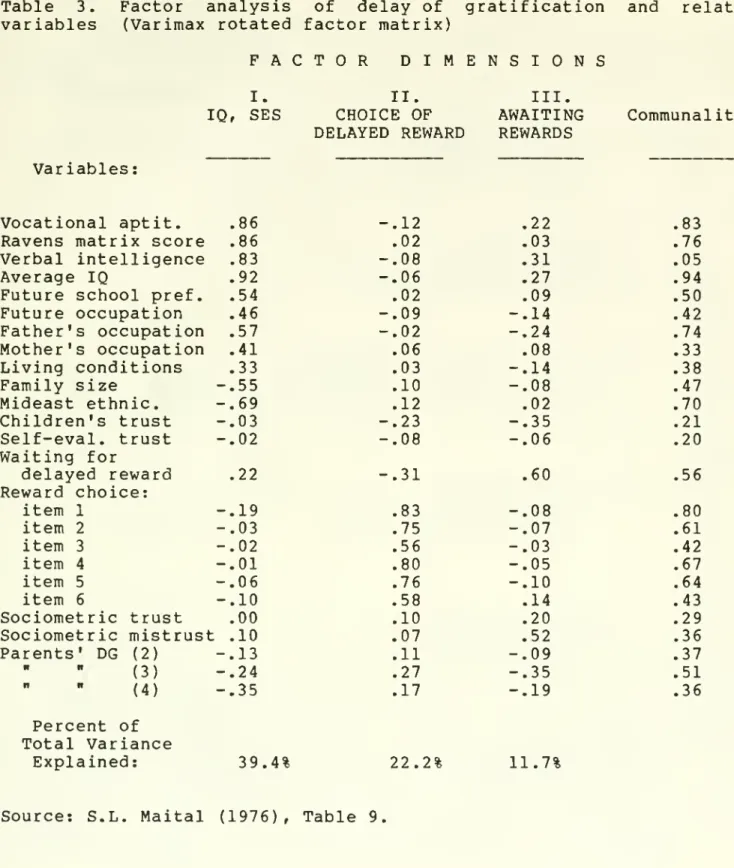
supported. A factor analysis of the variables revealed three main factors (See Table 3): the first factor comprised mainly intelligence
and socioeconomic status; the second had the largest factor loadings
on the questionnaire choices of delayed rewards; and the third reflected principally the actual waiting for delayed reward in the
experiment.
A simpler portrayal of this result is shown in Figure 1. The
shaded bars show the number of subjects who had subjective interest
rates of 10, 20, 50, 70 and 100 percent. The striped bars show the
number of subjects, with each of the above five interest rates, who chose the larger, delayed prize and actually waited for it. Almost forty percent of the 50 subjects who indicated that a 50 percent
interest rate would be sufficient to induce choice of a delayed
reward, failed to actually wait for such a reward when it was offered.
Table 3. Factor analysis of delay of gratification and related variables (Varimax rotated factor matrix)
FACTOR
DIMENSIONS
I. II. III.
IQ, SES CHOICE OF AWAITING Communality
DELAYED REWARD REWARDS Variables:
CO rs
<
o
m
rnH
m
rn roo
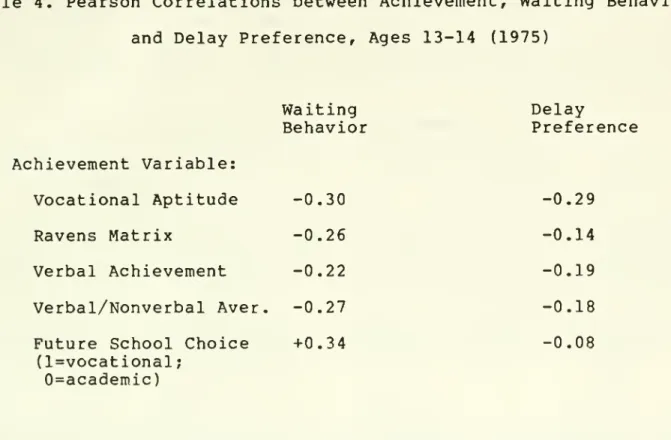
"nActual waiting behavior was found to be more strongly correlated with achievement than delay preferences (see Table 4) , suggesting that
where possible, behavioral measures of time preference are a better predictor of delay-related behaviors than questionnaire-based preference measures.
Table 4. Pearson Correlations between Achievement, Waiting Behavior
and Delay Preference, Ages 13-14 (1975)
Waiting Delay Behavior Preference Achievement Variable: Vocational Aptitude -0.30 -0.29 Ravens Matrix -0.26 -0.14 Verbal Achievement -0.22 -0.19 Verbal/Nonverbal Aver. -0.27 -0.18 Future School Choice +0.34 -0.08
(l=vocational; 0=academic)
Studies by Nisan and Koriat (1977) and Toner, Holstein and
Hetherington (1977) indicate that choice of delayed rewards and
maintained delay behavior were relatively independent, among young children. The present study indicates that even in older children, separation of the preference and behavior persists. This raises
interesting and important question: In the process of socializion, in
which social norms are acquired by children, adolescents and young adults, are there norms which are learned and acquired without ever
being expressed in actual behavior? The links between what people believe, what they want to do, what they say they will do, and what they actually end up doing, appear intricate and complex; this
complexity has so far found little expression in the theory of
economic choice.
STUDY 2 (1985)
METHOD
Subjects: A total of 41 of the original 142 participants were
reinterviewed, locating from records in the comprehensive high school they had attended. An initial letter was sent, followed by a
telephone call requesting a personal interview.
Design and Procedure: As far as possible, delay preferences, trust
and other variables were measured by instruments identical to, or
similar to, the instruments used a decade earlier. Interpersonal trust was measured using the Rotter I-P trust scale itself, rather than the version of it adapted for children. Delay of gratification
was measured by a series of questions similar to those administered in
the earlier study; for instance:
In your present situation, suppose you won a tax-free money
prize. You are offered one of two choices. I will read the
choices available to you; for each pair, say which you would
choose. $1,500 now or $4,000 in five years; $1,000 now or $6,000
in 5 years, . . . .etc.
Suppose you have won a $10,000 prize. You can take the money now
or leave it in the bank for a year. What rate of interest would cause you to leave the money in the bank for a year? 6%, 8%, 10% 50%, etc.
Choose one of the following:
a) a new car, now. b) a new car, superior to the one available
now, in a year from now; c) (a) and (b) are equally good to
me.
Among variables on which data were collected: high school
matriculation grades, marital status, high school specialty, length
and nature of military service, future plans with regard to education, occupation and family; along with internal-external attribution of
success, Rotter Interpersonal Trust, and, as mentioned, delay of
gratification preferences.
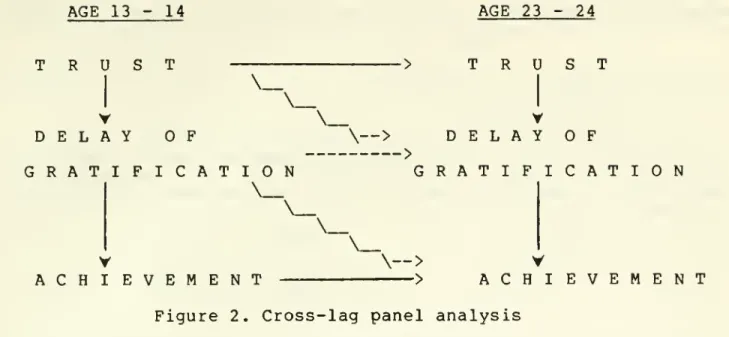
A statistical technique known as "cross-lag panel analysis" was
used (Campbell and Stanley, 1963). (See Figure 2). This method,
applied to longitudinal panel studies, calls for measuring a set of
variables (in our case, the main ones are interpersonal trust, delay
of gratification, and achievement) at two or more points in time, then
measuring correlations: a) horizontally, to determine stability in
each variable over time, b) vertically, to determine relationships at
each given point in time, and finally c) diagonally, to test
antecedent relations across time.
AGE 13 - 14 AGE 23 - 24
TRUST
TRUST
DELAY
OF
GRATIFICATION
\—
>DELAY
OF
>GRATIFICATION
ACHI
EVEMENT
\—
> >ACHIEVEMENT
Figure 2. Cross-lag panel analysis
Our interper over t socializ expectan 13-14 an of grati 14, she Finally, ages 13-pre sonal ime, ation cy, d 23-ficat uld we 14 an liminar trust as by ea be corr 24; tr ion at be cor antici d achie y hypotheses and delay o each variabl rly adolescen elated with d ust at ages 1 ages 23-24; related with pated strong vement at age were: according to f gratification should e is essentially fo ce; trust should, as
elay of gratification,
3-14 should be correlat
and delay of gratificat achievement measured at correlations between a s 23-24. RESULTS SLT, both remain stable rmed through a generalized
both for ages
ed with delay ion, ages 13-ages 23-24. chievement at 1. We found statis correlations between: tr between DG (age 13-14)
findings by Mischel and
and DG. In a recent
followup of those he stud Mischel found signific behavior and reports gratification ten years 1
and 1985 were ones of gre
inflation rates ranging a
that this instability aff
creating pressures for si
the link between person
tically insignificant or
ust (age 13-14) and trust
and DG (age 23-24) . Th
others, which affirm the
report by Mischel (1984) ied in preschool, and la
ant correlations betwee
of behaviors reflecting
ater. In Israel, the te
at economic instability i
s high as 450 per cent a
ected those in our panel tuational specificity of
al variables in early ado
weakly significant (age 23-24); and is is contrary to stability of trust of a longitudinal ter as adolescents, n preschool delay ability to defer n years between 1975 n Israel, including year; we conjecture differentially, thus
choices and breaking lescence and early
adulthood. Apparently, with sufficient change in the environment, personal variables that in normal conditions are stable after age 13
may be overshadowed by cross-context discriminativeness in behavior.
2. For ages 13-14, the relation between trust variables and DG
was much stronger for the behavioral (actual waiting) DG variable,
than for preference measures.
3. Higher subjective interest rates (at age 13-14) were associated with later lower matriculation grades; Table 1 suggests
that moderate inability to defer gratification does not much affect grades, but extreme impatience (interest rates of 200%) is highly
dis-functional.
Table 4. Subjective interest rates and High School
Matriculation Grades {N=30)
Table 5. Pearson Correlations Between High School Matriculation Grade And Achievement Variables (Age 13-14) (N=30)
Achievement Variable: Correlation: Vocational aptitude 0.703
Ravens Matrix 0.473
Verbal Achievement 0.642
Academic aptitude 0.710
(average of Ravens and
Verbal Achievement)
CONCLUSION
The economic model of intertemporal choice places emphasis on the
choice situation itself, and the circumstances and constraints pertaining to the chooser, while tending to disregard the nature of
the individual making the choice; in this sense, economics is closer
to the stimulus-response school than to other branches of psychology.
Social learning theory, particularly in its current versions,
emphasizes the importance of interactions among behavior, personality
and situation, and points to an intertemporal choice model in which personal variables, situation variables and behavior all play a role and all influence one another. An economic choice model that takes
into account perception and cognition, learning, experience, and
persisting differences across individuals in time preference, as
social learning theory prescribes, will prove better able to
understand microeconomic behavior, and as a consequence provide a
firmer microeconomic foundation for the understanding of aggregate
macroeconomic behavior.
ACKNOWLEDGEMENTS
This study was partially supported by grants from the Ford
Foundation, through the Israel Foundations Trustees, and the Israel Academy of Sciences, as well as the Technion Vice-President's Fund. An earlier version of this paper was presented to the annual meeting
of the Israel Sociological Association, February 1986; we are grateful
to participants for their helpful comments and criticism.
REFERENCES
[I] Bandura, A., Social Learning Theory (Prentice-Hall, Englewood
Cliffs, N.J., 1977)
.
[2] Bandura, A. The self system in reciprocal determinism. American
Psychologist, April (1978), 344-358.
[3] Bandura, A. Self efficacy mechanism in human agency. American Psychologist, February (1982), 122-147.
[4] Bandura, A. and Mischel, W. "The influence of models in modifying
delay of gratification patterns. Journal of Personality and
Social Psychology, 2 (1965), 698-705.
[5] Battle, E. and Rotter, J.B. Children's feelings of personal control as related to social class and ethnic group. Journal of
Personality, 31 (1963), 482-490.
[6] Campbell,D.T. and Stanley, J.C. Experimental & quasi-experimental
designs for research. (Rand McNally, Chicago, 1963).
[7] Davids, A. and Sidman, J. A pilot study
—
Impulsivity, timeorientation and delayed gratification in future scientists and in
underachieving high school students. Exceptional Children, 29
(1962), 170-174.
[8] Fuchs, V. Time preference and health: an exploratory study.
National Bureau of Economic Research Working Paper #539, Stanford University, August (1980).
[9] Furnham, A. and Lewis, A. The economic imagination. (Wheatsheaf
Books, Brighton, Sussex, U.K., 1986).
[10] Glass, T.A. Effects of three situational variables and type of
reinforcement on delay preference. American Journal of
Psychology, 82 (1969), 241-247.
[II] Gonzalez, A. and Zimbardo, P.G. Time in perspective. Psychology
Today, March (1985), 21-26.
[12] Gore, P.M. and Rotter, J.B. A personality correlate of social
action. Journal of Personality, 31 (1963), 58-64.
[13] Knight, F. The economic organization. University of Chicago
Press, Chicago, 1933.
[14] Lanese,R.R. Expectancy for delayed reward, situational trust and
reponses to temptation. Dissertation Abstracts, 27 (1967), 3289-3290.
[15] Liverant, S. and Scodel, A. Internal and external control as
determinants of decision making under conditions of risk.
Psychological Reports, 7 (1960), 59-67.
[16] Mahrer, A.R. The role of expectancy in delayed reinforcement. Journal of Experimental Psychology, 52 (1956), 101-105.
[17] Maital, S.L. An analysis of delay of gratification as a two part process. Unpublished master's thesis, Tel Aviv University, Tel
Aviv, Israel, 1976.
[18] Maital, S.L. and Maital, S. Economics and psychology, in: Marc L.
Bornstein, ed.. Psychology & Its Allied Disciplines, vol. 2:
Psychology and the Social Sciences (Erlbaum, Hillsdale, N.J.,
1985), 55-87.
[19] Maital, S. Minds, markets and money. (Basic books. New York,
1982) .
[20] Maital, S. Novelty, comfort and pleasure: Inside the utility
function black box. Presented at the Eighth Annual Middlebury College Conference on Economic Issues, Middlebury VT., 1985.
[21] Maital, S. Prometheus rebound: On welfare-improving constraints.
Invited paper presented at the Eastern Economic Asociation annual meeting, Philadelphia, PA., 1986 (April).
[22] Maital, S. and Maital, S.L. Is discounting the future irrational? Discussion paper, Technion, Haifa Israel, undated.
[23] Maital, S. and Maital, S.L. Economic games people play. (Basic
Books, New York, 1984).
[24] Mischel, W. Preference for delayed reinforcmenet : an experimental
study of a cultural observatin. Journal of Abnormal and Social
Psychology, 56 (1958), 57-61.
[25] Mischel, W. Father absence and delay of gratification. Journal of
Abnormal and Social Psychology, 63 (1961), 116-124.
[26] Mischel, W. Delay of gratification, need for achievement and
acquiescence in another culture. Journal of Abnormal and Social Psychology, 62 (1961), 543-552.
[27] Mischel, W. Process in delay of gratification, in: L. Berkowitz,
Advances in experimental social psychology, vol. 7 (Academic
Press, New York, 1974).
[28] Mischel, W. Convergences and challenges in the seach for
consistency. American Psychologist, April (1984), 351-364.
[29] Mischel, W. and Ebbesen, E.B. Attention in delay of
gratification. Journal of Personality and Social Psychology, 16 (1970) 329-337.
sso
ilee
Mischel, W. , Ebbesen, E.B. and Zeiss, A.R. Cognitive and
attentional mechanisms in delay of gratification. Journal of
Personality and Social Psychology, 21 (1972), 204-218.
Mischel, W. and Metzner, R. Preference for delayed reward as a
function of age, intelligence and length of delay interval.
Journal of Abnormal and Social Psychology, 64 (1962), 425-431.
Mischel, W. and Moore, B. Effects of attention to symbolically presented rewards on self control. Journal of Personality and
Social Psychology, 28 (1973), 172-179.
Mischel, W. , Peake, P.K. and Zeiss, A.R. Longitudinal studies of
delay behavior, (manuscript in preparation), Stanford University, undated.
Mischel, W. and Staub, E. Effects of expectancy on working and
waiting for larger rewards. Journal of Personality and Social
Psychology, 2 (1965), 625-633.
Nissan, M. and Koriat, A. Children's actual choices and their
conception of the wise choice in a delay-of-gratif ication
situation. Child Development, 48 (1977), 488-494.
Rotter, J.B. Social learning and clinical psychology. (Prentice
Hall, Englewood Cliffs, N.J., 1954).
Rotter, J.B. A new scale for the measurement of interpersonal
trust. Journal of Personality, 35 (1967), 661-665.
Rotter, J.B., Chance, J.E., and Phares, E.J. Applications of a
social learning theory of personality. (Holt, Rinehart & Winston,
New York, 1972) .
Shack, M.L. and Massari, D.J. Effects of temporal aids and
frustration on delay of gratification. Developmental Psychology,
8 (1973), 168-171.
Shefrin, H. and Thaler, R. An economic theory of self control.
National Bureau of Economic Research Working Paper no. 208,
Stanford University (1978) .
Shybut, J. Internal versus external control, time perspective and
delay of gratification among high and low ego strength groups.
Journal of Clinical Psychology, 26 (1970), 430-431.
Toner, I.J., Holstein, and Hetherington, Reflection- impulsivity
and self control in preschool children. Child Development, 48,(1977), 239-245.
Von Neumann, J. and Morgenstern, 0. Theory of Games and Economic Behavior. (Princeton University Press, Princeton NJ., 1944).
VJalls, R.T. and Smith, T.s. Development of preference for delayed
reinforcement in disadvantaged children. Journal of Educational Psychology, 61 (1970), 118-123.
9911
025
^aVDate