An Economic Development Strategy for Mission Hill:
A HOPE VI Initiative
by
M. Patricia Quesada
B.A. English and B.A Interdisciplinary Studies Field Major
University of California at Berkeley
(1993)
Submitted to the Department of
Urban Studies and Planning in Partial Fulfillment of
the Requirements for the
Degree of
MASTER IN CITY PLANNING
at the
MASSACHUSETTS INSTITUTE OF TECHNOLOGY
June 1996
© 1996 Massachusetts Institute of Technology
All rights reserved
Signature of Author ....
Department of Urban Studies and Planning
, ... . 6 . . . . . . . . . . . . . . . . . . . . . . . . ..
Professor Karl Seidman
A - Tha-iC
Supervisor
Certified by. .
Accepted by ... . .. ...
Professor Mark S. Schuster
OAFsA s V-4
Chairman of Master of City Planning Program,
JUL
021996
ROWe
AN ECONOMIC DEVELOPMENT STRATEGY FOR MISSION HILL:
A HOPE VI INITIATIVE
by
M. PATRICIA QUESADA
Submitted to the Department of Urban Studies and Planning
on May
22,
1996 in partial fulfillment of the
requirements for the Degree of Master of City Planning.
ABSTRACT
In August 1993, the Boston Housing Authority (BHA) was awarded $50 million from the U.S. Department of Housing and Urban Development (HUD) in Urban Revitalization Demonstration (URD) monies for a proposal to thoroughly renovate its Mission Main public housing development in Roxbury. Under the
guidelines of the HOPE VI program, recipient public housing authorities are free to design their own revitalization agenda, ideally fashioning uniquely local solutions to suit local contexts. The indigenous
authorities make their own trade-offs between different possible approaches to revitalization such as physical reconstruction, management and security improvements, the provision of social services, and the
introduction of economic development initiatives. This thesis attempts to address the basic, operational issues inherent to the BHA's effort to fashion and realize HOPE VI URD economic development goals. Although implementation efforts have concentrated on property development and the provision of social
and community services, this thesis argues that economic development activities, the least developed of the Boston URD, are central to the stated goals of revitalization. Furthermore, only through the aggressive pursuit of economic development strategies can the revitalization effort reach the level of
comprehensiveness stressed in the URD grant application. In addition, the renovation of the site provides the entire Mission Hill community with an enormous resource on which to build a greater neighborhood
development effort. In order to realize this potentially synergistic relationship, some entity, formulated through HOPE VI resources, should be in charge of fostering relationships and facilitating collaboration.
This study explores the following economic development models as potential HOPE VI initiatives: job readiness and placement clearinghouse; small-scale commercial strip development along Tremont Street;
and technical assistance to Mission Hill entrepreneurs. Ultimately the concern of this study is to identify the sources of leadership, opportunities, resources and organizational capacity to sustain these activities at different phases of the renovation process. Another study goal is to develop an understanding of how the transition of leadership in this area from the BHA to another organization may be realized.
Because of the complexities associated with program design itself and with the realities of limited funding, the greatest gains toward diversifying the range of URD-initiated economic development strategies will come from investing in the infrastructure to maintain programmatic continuity beyond the demonstration project years. Only by aggressively pursuing economic development strategies through a well-developed vision, can the URD achieve the level of comprehensive renovation stressed in the proposal. Therefore, the BHA should focus on utilizing available funds where it is essential to building the infrastructure that will survive beyond the five years of HOPE VI demonstration programming, and not exclusively toward service contracting. The role of the BHA in this endeavor should be one of facilitation and coordination in the program development phase.
Thesis Supervisor: Karl Seidman
Title: Lecturer on Community Economic Development Thesis Reader: Frank Levy
ACKNOWLEDGEMENTS
I would like to thank Karl Seidman for his assistance in producing this thesis, especially for his contributive insights and generosity with his time. I am also grateful to the practitioners who agreed to an interview. Their comments proved invaluable to my research.
To my friends who have become family, especially Elsa Gutierrez, Armindo Goncalves, and J.C.: thank you for making these past two years memorable and I look forward to enjoying the many coming years of our friendship. To my friends at home and abroad: thank you for the midnight calls and replenishing visits. A mis padres, hermanas y sobrino quienes tanto quiro y admiro, les dedico esta obra.
TABLE OF CONTENTS
I Introduction
Study Design 7
Significance of Study 8
Economic Development for Mission Main and Mission Hill 9 II The Boston HOPE VI Urban Revitalization Demonstration Program
The Boston Housing Authority: History and Operations 14 The HOPE VI Mission Main URD Program: 1993 and 1996 17 BHA/HOPE VI Institutional Capacity and URD Implementation Progress 22 Implications for Economic Development Program Design 27 III Key Institutional Factors
A. Capacity of the BHA in Service Coordination and Delivery 30 B. BHA Relations with Tenants and Tenants' Contributions to the
Implementation Process 33
C. The Tension Between Current Pressures and the Need for Longer
Term Planning 40
URD Implementation Implications 41
IV Institutional Requirements of Proposed Economic Development Program Models The Significance of Economic Development Initiatives to the
Revitalization Effort 46
Managing Expectations 48
Economic Development Models: Short and Long Term Action
A. Job Training and Clearinghouse Program Components 49
B. Commercial Strip Development 57
C. Technical Assistance to Mission Main Entrepreneurs 62
URD Implementation Implications 65
V. Conclusions and Recommendations
The URD Proposed Organizational Plan for Economic Development 66
Preliminary Implementation Steps 68
Appendices
A. List of Interviews 72
B. Boston Housing Authority Urban Revitalization Demonstration
Program Organization Plan 74
6
List of Figures, Maps and Tables
List of Figures:
3-1. Sector Employment of Mission Main Residents: 1980-1995
5-1. Proposed URD Organizational Plan for Economic Development
Appendix B.
Boston Housing Authority, Urban Revitalization Demonstration
Program Organizational Plan
List of Maps:
2-1. Mission Hill District
2-2. Mission Hill District Concept Plan
2-3. Mission Main Site Redevelopment: Concept Plan A
4-1. The Ledge Site: Site Plan
List of Tables:
I Introduction
The HOPE VI Urban Revitalization Demonstration (URD) program was developed by the United States Department of Housing and Urban Development (HUD) to provide troubled public housing authorities nationwide with large, flexible grants. These allocations are designed to affect multi-faceted, locally-driven revitalization efforts through the relaxation of federal oversight in local implementation procedures. HOPE VI monies can be used on any number of sites under the purview of the awarded public housing authority to fund physical renovation, support services provision and/or economic development strategies. In August 1993, the Boston Housing Authority (BHA) was awarded $50 million from HUD in URD monies for a proposal to thoroughly renovate its Mission Main public housing development in Roxbury. The BHA has
also successfully applied for another $30 million in URD Plus funds to expand the scope of the revitalization project to include Orchard Park, another troubled site in Roxbury.
What is unique about this program, aside from the size of the awards, is the flexibility that accompanies the grants. Recipient public housing authorities are free to design their own revitalization agenda, ideally fashioning uniquely local solutions to suit local contexts. The indigenous authorities make their own trade-offs between different possible approaches to revitalization such as physical reconstruction, management improvements and security
improvements, the provision of social services, and the introduction of economic development initiatives. The Boston URD site elected to spend the majority of funds on a complete physical renovation of the Mission Main site, setting aside roughly 12% or six million dollars for both the
delivery of social and community services and to support economic development activity. HOPE VI staff have made significant strides in setting the social and community service delivery agenda, as they have in defining the parameters and coordinating the principals of the physical
7 Introduction renovation. However, the development of creative approaches to leveraging HOPE VI funds to generate economic gains is not among the most current BHA priorities.
Study Design
This thesis attempts to address the basic, operational issues inherent to the BHA's effort to fashion and realize HOPE VI URD economic development goals. This study builds upon the
URD oversight model presented in the grant application, to propose a revised model specific to the implementation of economic development strategies. The proposal states that the
BHA/HOPE VI staff will establish a Partnership for Economic Development entity that will oversee these activities. The following three possible economic development strategies are explored to identify key concerns that the BHA must consider when making resource allocation decisions: a job training/placement and information clearinghouse; commercial strip
development along Tremont Street; and entrepreneurial assistance for Mission Main and Mission Hill residents to compliment strip development. These strategies will be examined in the
particular context of the BHA's ability to deliver services, the Mission Main site itself and the surrounding Mission Hill neighborhood.
Several key factors influence the feasibility of alternative approaches to economic development program design and implementation. Examples of such factors are the
organizational capacity of the BHA, the goals of the Boston HOPE VI Demonstration Program, the local economic and policy context, the ability of the BHA to coordinate partnerships with local community-based organizations (CBO's) and the contribution of residents toward developing and implementing a strategy. However, in discussing the means by which these factors affect the feasibility of the three models, this study will pay particular attention to the distinct role of the BHA in program development, implementation and monitoring. Specifically, this thesis explores how these models meet the goals of the URD program and how they might
8 Introduction prove feasible to implement vis a vis the organizational structure of the Boston Housing
Authority, the position of the HOPE VI staff within it and the aforementioned set of constraints and considerations to program development.
This study will also present opportunities for integrating efforts with existing projects to minimize BHA direct costs, while at the same time leveraging HOPE VI dollars with local resources, another major URD program parameter. In order to better understand these model's capacity to leverage resources in this way, I will analyze the BHA's potential incentives under
each economic development approach. Based upon the experiences of other organizations dedicated to realizing similar goals, I will examine the short, intermediate and long-term role of the BHA in this effort. Ultimately the concern of this study is to identify the sources of the leadership, initiative, resources and organizational capacity to sustain these activities at different phases of the renovation process and to develop an understanding of how the transition of leadership in this area from the BHA to another organization may be realized.
Significance of Study
This study is timely for several reasons. The HOPE VI URD proposal for Mission Main calls for the physical renovation of the site, the provision of social and community services and the use of economic development strategies to reintegrate the residents into the surrounding Mission Hill neighborhood and Boston's mainstream economy. The original proposal does not present a well-developed economic development strategy, although its key objectives include economic development goals and the intention to incorporate this type of activity into the overall
revitalization strategy.
As far as the actual implementation work is concerned, the BHA/HOPE VI staff have made strides in meeting the physical renovation and services provision goals. Although several
9 Introduction job training and readiness programs have been incorporated into the scope of the social and
community services branch of the plan that do meet economic development goals, very little attention has been dedicated to developing an overall strategy in this area. Due primarily to a number of logistical factors, this independent and comprehensive HOPE VI economic
development strategy has not materialized. However, it is mainly due to a lack of immediacy assigned to these strategies, until very recently, relative the other two main components of the revitalization effort. This study will identify and inform the fundamental considerations that must be addressed before taking on the task of individually instituting any of the strategies mentioned in the proposal, or much less, developing a comprehensive economic development
agenda.
Economic Development for Mission Main and Mission Hill
Economic development is a commonly used term to describe a recent shift in community development focus from housing and social concerns, to initiatives that address neighborhood, regional and/or state-level economic considerations. Although many different types of very familiar activities fall within the broad category of economic development, it may be defined as:
"...an increase in economic activity (more or better jobs, housing or public services) that results in a wider distribution of the quantities being measured (income is more evenly distributed, the housing stock is not simply in a few very
large homes) and an economy that is capable of sustaining the higher level of activity in the future from its own resources." (Kieschnick/Parzan, 6)
The original proposal calls for a mix of economic development activities to affect the goal of integrating the development into the fabric of the neighborhood. Yet, thus far, activity in this area appears to be limited to small-scale job training, overall readiness and placement activities. This approach concentrates on increasing individual residents' income and improves
10 Introduction their connection to the mainstream economy, but it does not incorporate the place-based, larger-scaled approaches necessary to meet several of the stated proposal goals. The prime location of Mission Main with the wide range of nearby institutions and excellent transit access was stressed in the original proposal. The discussion of these amenities implied that they would be used to maximize federal dollars by leveraging the grant with an array of local resources. In order to address these broader concerns, the Mission Main revitalization proposal envisioned the partnership of CBO's, government agencies, private industry and the BHA. This idealized
collective effort would rely upon creativity in assigning responsibilities and in designing the process of collaboration. These types of organizational issues that influence the broader HOPE VI economic development initiatives and the identification of those investments that best leverage HOPE VI dollars will be the focus of this thesis.
Chapter Two provides background information on the HOPE VI project, paying specific attention to the developer/property manager relationship with the BHA and the ongoing role of the BHA in overseeing the project, specifically in overseeing the economic development efforts. This chapter provides a description of the proposed project, and of BHA operations, including the interaction between HOPE VI staff and the larger BHA, and an update of the first two and a
half years of programming. Chapter Three outlines a series of the key institutional factors, some of which I have already identified as influencing the BHA action in the area of economic
development programming. The key issues I will stress are the influence of declining federal subsidy to public housing authorities, the capacity and limits to service delivery inherent in the BHA's institutional structure, tenant needs, the implications of the project's development and management model and a series of current pressures that will affect immediate allocation decisions. Chapter Four is a discussion of the three proposed economic development models: a job training clearinghouse, commercial strip development along Tremont Street and
11 Introduction entrepreneurial assistance to Mission Main residents. This chapter presents a discussion of the importance of economic development activities to the overall project. and outlines particular
organizational requirements to implementing these programs. Those requirements are based upon previous Mission Main programs, current related projects and the experiences of outside
practitioners involved in similar endeavors. Chapter Five offers strategic recommendations to cultivate and begin committing resources toward broader HOPE VI economic development goals.
12 Chapter 2-The Boston HOPE VI Urban Revitalization Demonstration Program
1I The Boston HOPE VI Urban Revitalization Demonstration Program
The national US public housing program, first implemented in 1937, was originally intended by policymakers to address the immediate needs caused by the Great Depression, namely the lack of capital in urban economies. The idea of massive public housing construction efforts were politically expedient because these projects translated into jobs through the public
works endeavors. (Halpern, 58) The humanitarian origins of the idea of American public housing aimed at addressing the needs of the poorest citizens served as a policy foundation for realizing those economic goals.(M.Kennedy 2) Essentially public housing authorities were conceived of as public corporations whose purpose it is to provide a city's lower-income population with safe, livable and affordable housing. In this initial stage, public housing was envisioned as strictly transitional housing, and not as a long term low-income housing option. However, following the second world war, public housing became the permanent destination of dislocated, poor residents of central cities and incoming immigrants who were not able to follow the middle class flight to the suburbs. According to Marie Kennedy,
"public housing in Boston (and nationally,) increasingly became a relocation resource for people displaced by public demolition for urban renewal and highways and later by gentrification linked to economic restructuring...that underlay the physical redevelopment
of Boston." (Kennedy, 4)
Therefore, directly following the urban renewal initiative in 1951, those public housing sites designated for people of color in the openly segregated system, were populated predominately by African Americans and newly arriving Puerto Ricans.
A series of federal trends in housing policy have contributed to this concentration of urban poor in public housing nationwide. Among these policies is the regulation prohibiting ceiling rents, which limit the maximum amount that PHA s may charge as rent. Through another
13 Chapter 2-The Boston HOPE VI Urban Revitalization Demonstration Program federal initiative, housing policy had until very recently, effectively mandated the preference of homeless and non-working applicants over those who are working poor. Since September of
1991, 93% of all admissions have been homeless families. (BHA2, 6) Although, created with the intention of providing for the neediest of citizens, this regulation actively discourages working class families from seeking housing in PHA's because there is no limit to the amount of rent charged to those with incomes. Therefore public housing may cost more than a comparable market rate apartment. Another argument for the establishment of ceiling rents is that their lack presents a disincentive to work because earning gains are absorbed by immediate rent increases, calculated by income. This policy creates concentrations of people in public housing who have
little or no resources to live elsewhere or often, even to pay rent.
Current changes in housing policy, however, are indicative of a greater trend toward economically reintegrating public housing sites, specifically by attracting working class tenants. More recent legislative scrutiny of housing policy has taken aim at the 1969 "Brooke
Amendment," which set the standard for public housing rent collection at a 30% cap of the resident's income. (Grunwald, 3)1 House republicans in Congress seek to repeal this amendment, thereby deregulating public housing and allowing local authorities to set their own fair market rents. The range between discussed federally-required affordable housing unit set-asides for families bellow 30% of the median income ranges between 30% in the House and 40% in the Senate. It remains to be seen how federal policy will mandate PHA's rate of rent collections and intake procedures.
'The Brook Amendment originally set the rent collection standard to 25% of the resident's income. It was later amended to 30% which is currently used.
14 Chapter 2-The Boston HOPE VI Urban Revitalization Demonstration Program The Boston Housing Authority: History and Operations
The Boston Housing Authority was one of the first to be established following an initiative by the Franklin Roosevelt administration in 1937 to create PHA's. The Mission Main
and Extension (Alice Heyward Taylor) public housing projects were completed in 1940 and
1952, containing 1,611 units.(BHA2, 37) The nationwide trends in public housing leading to site
deterioration and the resident's increasing social and economic isolation also describe the experience in Boston. Middle class flight from the central city to nearby suburbs decreased property values, and exacerbated an already troubled housing market following the destructive effect of urban renewal initiatives in the 1950s on poorer neighborhoods. These conditions strained an already deteriorating public housing stock. These problems culminated in 1975 with a successful lawsuit against the BHA by several residents for violations to the Sanitary Code which resulted in City Housing Court-ordered improvements. Again, in 1980 the BHA was taken to task for failing to satisfy the requirements of the implementation progress, but this time, it was put under receivership. Those four years proved to be a period of immense transition for the BHA under the temporary leadership of the dynamic and well-respected Harold Spence. During
this time of uncertainty, the authority was not only stabilized, but several key site renovations took place. Satisfied with the level of compliance, the Court removed the BHA from
receivership in 1984 and administrative control was returned to the Mayor of Boston.
Three BHA sites represent prominent national examples of management and physical revitalization innovation. Bromley Heath is one of the first tenant-managed public housing developments in the nation and has retained national status as a successful model. The other two developments, Commonwealth and Harbor Point (Columbia Point, prior to renovation) were also renovated using private management and development resources along with massive public
15 Chapter 2-The Boston HOPE VI Urban Revitalization Demonstration Program far, have called for the removal of these sites from the daily managing purview of the authority. It is also important to note that these demonstrations have been initiated by strong tenant
organization and supported by private management and private dollars.
The BHA has made tremendous strides since 1980 when it was placed in receivership, mainly in efforts to stabilize the authority and regain control of the properties under its purview. The managerial reform accomplishments cited in the 1993 URD application include: being
removed from the federal troubled PHA list; closing the budget deficit; reducing outstanding obligations by almost ten million dollars; and totally reorganizing the Planning, Design and Development Division, (now the Planning, Design and Construction Division. (BHA2, cover letter) In order to address some of its long-standing organizational shortcomings, the BHA has recently instituted the practice of cluster meetings, convening employees who are involved with separate management functions for the same development This initiative was implemented to provide an opportunity for interaction among employees who work in the historically
compartmentalized fashion in which tasks are currently allocated to create synergistic
relationships, a heightened level of inter-divisional cooperation, and to foster efficiency. The BHA, through their Community Initiatives Department has also explored alternative security models to improve on-site safety, to provide social services, particularly elder services, and
coordinate community service opportunities for youth in the BHA-wide Peer Leader program. In particular, the legal and administrative arms of the Authority have provided support to HOPE VI staff, perhaps not as quickly as they would ideally like, however it is an improvement.
Despite the prospect of a new, permanent and very well-respected Administrator, Sandra Enriquez, (formerly of Maloney Properties), these institutional dynamics are particularly charged especially because of the long period of transition. This is true given the fact that the HOPE VI grant calls upon the BHA to venture into the relatively unfamiliar territory of large-scale resident
16 Chapter 2-The Boston HOPE VI Urban Revitalization Demonstration Program service provision and the wholly unfamiliar territory of economic development. Since it was released from receivership in 1984, the vision of the BHA as a transformed authority has not been realized. In the URD project, the BHA faces the triple challenge of reforming its fundamental operations, undertaking two major development projects and venturing into new programmatic activities. Clearly, strides have been made to diversify the authority's functions and operational procedures, to improve its responsiveness, and to accommodate the HOPE VI
staff. However, its ability to deliver on the HOPE VI promise to reform the authority itself is still doubtful.
The BHA is headed by an administrator who is appointed directly by the mayor and is overseen by the mayor's development staff, the Boston Redevelopment Authority/Economic Development Industry Council (BRA/EDIC.) These public property managers, rarely have been called upon to re-examine their mission statements or to expand their duties by exploring resident services or private models of property management. Maintenance of the status quo, perhaps even an avoidance of worsening site conditions have been the order of the day. The style of
management associated with the BHA has been described as overly bureaucratic, with operations that are "centralized to the point of dysfunction."(Adams et al., 3) Purchases, rent collection, and tenant selection functions are performed at the central level, with little or no on-site staff
participation. Given the history of this recently troubled authority, in which attempts at reform are consistently met with union and general staff opposition, it would take a great deal of institutional will to effect changes in the work environment of the authority.
This working dynamic becomes increasingly significant to the revitalization process in light of recent developments in federal fiscal policy which indicate that innovations in
low-income housing projects will take place with much less federal programmatic initiative and subsidy. The decision to continue serving the poorest people will be made at the state and
city-17 Chapter 2-The Boston HOPE VI Urban Revitalization Demonstration Program level, if it is made at all. In order to make up for a shortfall of federal financial and program guideline support, public housing authorities will be called upon to change their mode of operations to achieve greater efficiency. They will also have to look outside their own organizations and maximize local/regional resources to carry out this self-imposed mandate. This trend in housing policy is of major significance to the URD process as well, given the
structure of the authority itself, which rewards systematic behavior and not necessarily effective or creative working habits, such as intra-agency collaboration.
The HOPE VI Mission Main URD Proposal: 1993 and 1996
The Mission Main revitalization proposal envisioned a complete physical renovation of the site. The following are the stated goals of the project presented in the application executive summary:
1. Make Mission Hill safe;
2. Make the housing sound and attractive; 3. Improve BHA responsiveness;
4. Reward personal responsibility;
5. Integrate the development into the neighborhood; 6. Reinforce community. (BHA2, 1)
These goals were developed collaboratively by residents, local institutional partners and BHA staff. The "institutional" feel of the development was a primary theme in the initial design charettes used to formulate a shared vision for the proposal. The original plan does not call for a reconfiguration of the street or building layout. Rather, the renovation was limited to
rehabilitation of the original buildings, using breakthroughs to enlarge individual units and enclosing yard space between buildings to create more private spaces. The common hallways would have been replaced with private entryways to better simulate private market housing, and a community center, a Family Investment Center, would be erected in the middle of the
18 Chapter 2-The Boston HOPE VI Urban Revitalization Demonstration Program Map 2-1
MISSION MILL DISHTICT
19 Chapter 2-The Boston HOPE VI Urban Revitalization Demonstration Program addition, as part of an overall management reform effort, an aggressive community policing program and neighborhood safety program would be implemented. Specifically, the author, Amy Schectman argued that HOPE VI would reform the BHA itself, enabling the renovation process to be completely delivered by the authority. By improving responsiveness, the author referred mainly to the relationship between on-site management and residents, rather than to the operations within the BHA.
Citing the familiar planning phrase: "it takes more than bricks and mortar," the proposal stresses the importance of comprehensiveness to the overall renovation. Using a partnership approach, unprecedented resources would be committed to human development programs ranging from basic health services, to parent support groups and specialized youth vocational education. In order to accomplish this endeavor, the original proposal envisioned the partnership of CBO's, private industry, service providers and the BHA, necessitating creativity and
tremendous organizational capacity in assigning responsibilities and in designing the process of collaboration. Throughout the effort, the URD project is expected to leverage federal support with local resources and private funds. The prime location of Mission Main with the wide range
of nearby institutions and transit access was stressed in the original proposal, implying that these resources would be incorporated into the revitalization effort, thereby maximizing federal
dollars. In fact, the site's location was one of the main reasons the BHA selected Mission Main from among the developments that met the prospective HOPE VI site eligibility guidelines.
To the extent that the application proposal describes an economic development strategy, it does so in the context of the surrounding uses, the existing service providers willing to go into partnership with the BHA, and current local development endeavors. Named as potential strategies are a small-scale youth enterprise program and small business or micro-enterprise development for Mission Main residents with an existing business. However, any particular
20 Chapter 2-The Boston HOPE VI Urban Revitalization Demonstration Program efforts to further define potential training programs place this revitalization component firmly within the better-developed social and community service network. The exception to this classification is the small business development strategy which proposes a partnership with local community colleges to provide training, but little else is described in detail. The proposal also call for the creation of a coordinating entity called the Partnership for Economic Development consisting of residents, HOPE VI staff, and area institutions.
The economic development model described in the proposal relies heavily on
neighborhood institutions to define the commercial development agenda and to develop a role for Mission Main residents in their activities. Through a Partnership for Economic Development, HOPE VI staff would actively link the interests of the resident to the two abutting institutional districts, the Longwood Medical Area (LMA) and the East Fenway. The Mission Hill Concept Plan highlights areas of institutional expansion as "economic development areas." This activity is centered on the LMA district, the Southwest Corridor economic development zone, and a new police headquarters. (BHA2, 52)
Many elements of the original proposal remain, specifically the goal of
comprehensiveness. However, the revised proposal widens the scope of the demonstration project beyond the site itself to include the abutting properties. In the Mission Main
redevelopment RFP, HOPE VI staff include among the project's goals the "social, economic and physical integration of the site with the broader Mission Hill neighborhood." Instead of site renovation, the project has envisioned the HOPE VI demonstration project as a neighborhood development strategy. The design guidelines include a minimum of 535 public housing units within a larger mixed income community better resembling a typical urban family housing neighborhood. The plan must "to the largest extent possible, address the edge conditions," particularly a street reconfiguration. The site boundaries have been moved beyond Parker street,
21 Chapter 2-The Boston HOPE VI Urban Revitalization Demonstration Program Map 2-2
MISSION HILL DISTRICT CONCEPT PLAN
T~. -
~
22 Chapter 2-The Boston HOPE VI Urban Revitalization Demonstration Program leaving a piece of property along Ward Street to offer to Northeastern University in exchange for another key parcel.
In addition, the developer team is expected to maximize the array of resources from different city departments, CBO's and industry associations in setting the social and community and economic development agenda, as well as the physical renovation. Priority is given to making "the connections and (building) the relationships that will create an infrastructure that
survives beyond the term of the HOPE VI funding", and presumably beyond BHA leadership. (BHA3, 4,7) However, the primary shift in philosophy from the original proposal is the belief that in order for the revitalization effort to succeed, it must be distanced from the BHA.
BHA/HOPE VI Institutional Capacity and URD Implementation Progress
HOPE VI presents an unusual set of circumstances in which the funding is available, but the technical experience, long term goals, and the commitment to economic development action
as a recognized goal are not in place. Even in the original proposal, its was clear that the BHA had no intention of directly providing services. Rather, staff had envisioned a collaborative of providers and an effective use of funds. Whether the BHA is providing services, or simply the initiative and financial support for their development, their knowledge of the area is difficult to determine. Staff have limited experience in large-scale resident services provision, especially economic development initiatives. The proposal specifically calls for decentralized service delivery. However, for several reasons the capacity of the BHA to effectively coordinate the
stakeholders is in question. Therefore, a major test of the BHA's ability to carry out the
directives of the proposal will be its demonstrated capacity to coordinate partnerships with local CBO's.
23 Chapter 2-The Boston HOPE VI Urban Revitalization Demonstration Program HOPE VI staff consists of a Project Director who oversees all activity and coordinates the long term planning effort for both the Mission Hill and Orchard Park URD sites, a Social and Community Services Coordinator who oversees and manages the array of services supported by the HOPE VI funding for both sites, the Project Architects, an Economic Development
Coordinator, Project Associates and the development Site Manager. With the exception of the Project Architects and the current Social and Community Services Coordinator, HOPE VI staff have been recruited from without the BHA.
In its short history, the Boston HOPE VI URD has seen a great deal of top-level
administrative turnover. The BHA administrator at the time the proposal was written, was asked to resign by the mayor. The current Program Director is not the original architect of the
proposal, but was recruited from the Public Facilities Department by the Mayor's development staff specifically for her expertise in real estate finance and public and private development. The original Social and Community Services Coordinator was recruited by Goodwill Industries in January of 1996 and has since been replaced by her former assistant, the director of the on-site youth services organization, overseen by the BHA Community Initiatives Department. A major change in HOPE VI staff is the addition of a full-time individual dedicated to developing the economic development component of the demonstration program.
Although this strategic hire, the Economic Development Coordinator, was made at the suggestion of a member of the Academic Advisory Panel, (MIT), this action nevertheless, displays substantial commitment to idea that the economic development approaches are
important to the overall revitalization effort and that they require special oversight. The fact that these two areas, social services and economic development have been so markedly separated in terms of staff responsibilities, is also encouraging. However in year three of the demonstration project, considering the minimal exploration of action in this area, it appears that efforts in this
24 Chapter 2-The Boston HOPE VI Urban Revitalization Demonstration Program direction are limited to job training programmatic activity as an extension of the more familiar social and community service effort. In fact the job description for the HOPE VI Economic Development Director mentions only job training and placement programs as initiatives that will be under her purview.
Despite the turnover, HOPE VI staff, largely new to the BHA, have risen to the occasion, managing a complex process with many stakeholders, some not as obvious as others. According to their HUD overseers, HOPE VI staff have utilized innovative approaches and have
"revolutionized the RFP process" for public/private partnerships in public housing-related projects. Until very recently, both HOPE VI sites were managed through the compartmentalized structure of management functions with which the BHA has historically managed its sites. Purchases were made at the central level, with little or no on-site management input. Similarly, issues of security were managed from one central location, without the benefit of on-site staff participation. However, in recognition of the need for greater efficiency and responsiveness, the staff has already made strides to streamline and centralize the management of the HOPE VI sites, while the ongoing effort to forge an understanding with a developer and private manager
proceeds.
The authority has not yet started the actual physical renovation which is the cornerstone of the HOPE VI plan. In fact only within the last few months have prospective developers been invited to submit a bid, after completing a request for qualifications process. The final plan has been virtually finalized, yet the effects have not yet been made tangible to residents or to Mission Hill neighbors who have endured numerous delays and plan adjustments. Meanwhile, the authority has been subject to pressure from HUD to utilize the funds which have been idle since the transfer was made two years ago or to present a case for not doing so. The current staff have demonstrated their ability to think through the situation and risk sustaining wide-ranging
25 Chapter 2-The Boston HOPE VI Urban Revitalization Demonstration Program Map 2-3
ST. ALHONSUS STREET
***--26 Chapter 2-The Boston HOPE VI Urban Revitalization Demonstration Program criticism in a very reactionary environment in order to address root concerns, that present
substantial, if not readily obvious obstacles to the redevelopment effort. It was only after a visit from HUD officials that HOPE VI staff began to explore the possibility of razing all the
buildings rather than proceeding with the rehabilitation plan. Although this was a period of high scrutiny, the staff used this time to explore a very politically-charged approach that seemed to make more sense but would prove to be a very hard sell to the residents. This is also evident in the initiative to centralize the management of both HOPE VI sites under the purview of HOPE VI staff, in conjunction with a single senior BHA on-site manager. This decision is significant from an operational perspective because it marks the first formalized commitment to shift
administrative control over to the HOPE VI sites and away from the BHA's portfolio. The way in which the Boston HOPE VI URD has progressed, the developer selected from a highly structured bidding process, will assume ownership of the buildings. In addition, the developer must take on a private property managing entity as a partner for a holding period of fifteen years in which the corporation is eligible for low income housing tax credits. The BHA will extend a long term lease to the corporation, allowing the authority a certain level of control over the site and the development process. Different approaches are currently being explored to include residents as limited general co-partners in the corporation that will retain ownership of the buildings. In addition, the two designated developers Peabody and Winn must collaborate to delegate responsibilities and set the renovation agenda. In the redevelopment RFP, however, HOPE VI staff include among the program components "Resident Services and
Economic Development." In this section the BHA stipulates that it will:
"be an active partner in planning and executing the strategy that developers, residents, the BHA and social service agencies finally create. The BHA is willing to consider any responsible suggestion regarding the long-term administration of services-including an ongoing role for the BHA, assumption of the role by the development team, or the
27 Chapter 2-The Boston HOPE VI Urban Revitalization Demonstration Program involvement of a third party. The BHA will look for Proposers to supply some initial creative thinking for this effort in their response to this RFP." (BHA3, 7)
The redevelopment and operational phases overseer role for the BHA/HOPE VI staff calls into question the viability of long term resident service provision and economic development
initiatives, because the liability for these components is placed on the future private management entity. The terms of the management entity's responsibilities and the long-term role of the BHA
are still being discussed.
URD Implementation Implications
This troubled history of unresolved operational shortcomings, combined with the effects of changing federal and state policy effectively shrinking subsidies, have created a very
challenging environment for the BHA. The combined effect of factors such as regional
economic retraction, a shrinking affordable housing stock, and changes in federal public housing policy have contributed to the transformation of some public housing stock in Boston and other larger cities into "housing of last resort", as Amy Schectman, then Planning Director and author of the HOPE VI proposal referred to Mission Main. This concentration of poverty has created hardships for tenants and neighboring residents alike, and a very challenging environment to realize institutional change.
One of the lessons of Columbia Point, particularly of the privatization of public housing is that "the people thrown together in Columbia Point had the qualities needed to build a vital community- if only they had been given the chance." (Kennedy, 1) Harbor Point has been modeled as a success because of the stark difference in the quality of the developments' offerings following renovation. However the project's ability to retain a low-income resident population has not yet been proven. Considering this case and given the similarities between the
28 Chapter 2-The Boston HOPE VI Urban Revitalization Demonstration Program BHA's commitment to retain existing residents. The influence of land speculation in the case of Columbia Point contributed to the loss of public housing units. In fact, only 400 of the original
1504 units designated and subsidized for low-income people remained after renovation.
(Kennedy, 5) Mission Main, like the case of Columbia Point, has been the target of private land speculation due to the dynamic uses in its immediate vicinity. In light of such pressures, early efforts to retain the current community and to invest them in the process of redevelopment are integral to the success of the mixed-income model. It is vital that the BHA continue providing vision and continuity in its oversight capacity.
The project has evolved in such a way that HOPE VI staff sought private expertise in carrying out the key functions of redevelopment. Rather than using the demonstration grant to directly fund an internal revitalization effort, HOPE VI staff have elected to coordinate private principals based on centralized guidelines. The implications of having out-sourced all of the major components of the revitalization effort from design, development, management and perhaps the services provision and economic development oversight implies that the revitalization effort is concentrated strictly upon improving sight conditions and not on
addressing the organizational shortcomings of the BHA. However it is important that the project remain BHA-driven enterprise such that HOPE VI staff remain at the forefront of evaluating the process of renovation, developing the guiding vision and facilitating those relationships that will ensure the URD's success.
The fact that there is no institutional precedent for economic development activities within the BHA beyond limited job training and an abandoned micro-enterprise development program in its initial stages, presents obstacles for HOPE VI staff. This is particularly true because of the uncertainty over whether the developer/manager will be primarily responsible for initiating and administering these activities. Given the profile of Mission Main residents, service
29 Chapter 2-The Boston HOPE VI Urban Revitalization Demonstration Program providers will play a critical role in the success of job readiness programs. Only through
cooperative partnerships can the program address formidable obstacles to employment such as requisite child-care, linguistic isolation and lack of a work history. This issue is critical to the economic development component because much of that work will depend on the organizing entity's ability to coordinate stakeholders and programs.
Although, the application proposal does not represent the range of possibilities that are currently being explored as potential strategies, efforts in the area of job training have relied heavily on Mission Main's institutional neighbors. Not only is this approach limiting, but it may present obstacles in reintegrating residents into the surrounding community. The history of
Mission Hill, specifically the neighborhood's opposition to institutional encroachment, should be considered when attempting to tie residents interests inextricably to those of the surrounding institutions. It is not necessarily a poor choice of action, however it should be done thoughtfully and with an eye to preserving gains in relations with the greater, twenty-four hour neighborhood residents. In addition the Mission Main Concept Plan does not include within its definition of economic development area projects, those concerns that address neighborhood commercial, primary market service needs. HOPE VI staff should not underestimate the URD's potential to
address these concerns and to use this opportunity to improve resident's connection to the greater Mission Hill neighborhood.
30 Chapter 3- Key Institutional Factors III Key Institutional Factors
A number of key institutional factors affect the project's implementation process and its probability of success. The key issues I will stress are:
1. The capacity of the BHA to coordinate the service delivery component of the URD, specifically its ability to coordinate partnerships with CBO's;
2. A description of the resident profile and the issues that influence the likelihood of meaningful collaboration between the BHA/HOPE VI staff and residents,
specifically in developing and implementing an economic development strategy; 3. From the perspective of HOPE VI staff, the ongoing tension between committing
resources toward current pressures that demand programmatic resources or toward longer-term, more investment-oriented planning.
A. Capacity of the BHA in Service Coordination and Delivery
Although the BHA itself will not be involved in providing direct services or even exclusive oversight of the project, its institutional pressures still have the potential to affect the HOPE VI revitalization process. Examples of these pressures are: upcoming fiscal hardship placed on the BHA due to shrinking federal resources; the strained relationship between HOPE VI staff and the greater BHA; and the uncertainty associated with the BHA's continued role in the revitalization process and management model.
HOPE VI Staff and the BHA
The HOPE VI proposal brought integral operational concerns to the fore. In the grant proposal submitted to HUD, the BHA staff proposed that a HOPE VI grant would provide the opportunity not only to remake an entire development, but to change the very way that the BHA actually does business. This potential was made a centerpiece of the proposal, demonstrating the
staff's understanding of the broader concerns of implementation and the degree of organizational capacity required to realize those goals. However, the ability of the HOPE VI staff and the BHA staff to work collectively has been severely tested by resource allocation issues, and conflict over administrative control of the revitalization process.
31 Chapter 3- Key Institutional Factors There are several reasons to explain the strained relationship between the project staff and the permanent authority personnel. The BHA has not had a permanent administrator since David Cortiella was asked by the Mayor to resign in Fall of 1994. The HOPE VI project brings the authority high visibility from the media and overseeing agencies such as BRA/EDIC during a
very unstable time. The nature of the project makes demands on the BHA's administrative and legal arms that are not covered by HOPE VI resources. In addition, the staff's drive and time pressures often put them at odds with BHA staff with whom they must collaborate and who are not as invested in the project, and therefore unwilling to commit special attention to HOPE VI-related assignments. Ultimately, it is the impression of HOPE VI staff as attempting to usurp a leadership role that creates the conflict. From the perspective of permanent BHA employees, these outside professionals have been immediately placed in senior level management positions, coordinating a multi-faceted, large scale project focused on addressing what has essentially been
framed as a glaring BHA failure. All of these dynamics are at work in an organization with many long-time employees, and whose incentive structure values seniority above performance.
The project's resource demands in terms of space, staff time and collaboration with other BHA departments have also contributed to a strained relationship. As I mentioned earlier, HOPE VI staff have largely been recruited to work on this particular project and as a result work very separately from the rest of the BHA. HOPE VI staff at one point were going to move all their administrative functions on-site. However it soon became evident that good communication and
cooperation with the highest level of the authority administration would be severely
compromised if operations for HOPE VI staff and that of BHA administrative, and legal arms in particular were not housed in close proximity to one another. HOPE VI staff is currently housed in the Planning, Design and Construction Division, where it has been since the program's
32 Chapter 3- Key Institutional Factors Director. Their operation has since grown, creating space demands in an already tight office environment. Currently, a move of HOPE VI operations within the BHA downtown office is being discussed.
The new environment for public housing, necessitates creative solutions to long-standing problems which may no longer be addressed by federal support. Legislative threats to the Brooke Amendment, should they succeed, will force a redefinition of the development agreement. The Republican lawmakers contend that the Brooks Amendment provides a
disincentive to work. "In an era of declining federal aide, the flexibility to raise rents and attract higher-income tenants may save housing agencies from fiscal disaster." (Grunwald, 3)
Opponents argue that the a broader income mix would promote stability in public housing, but complete deregulation will lead to rent hikes and gentrification.
Another major component to the BHA's role in the revitalization effort, are the terms of the private management/development corporation. These issues are currently being worked out between the two designated developers and the BHA. In the Mission Main Redevelopment RFP, it is stated that the BHA will maintain an oversight position. It is as yet unclear what relationship the BHA/HOPE VI staff will maintain in programmatic activities beyond the actual renovation. If the BHA is cut out of the process on a day to day basis, already having developed working relationships, it may affect the project's ability to secure outside partnerships, particularly with the social service community and job training practitioners.
The previous Social and Community Services Coordinator had a long work history in private non-profit community and was very familiar with array of services available. However, very little long range planning went into the first year of implementation. Much of her effort was geared toward managing the convoluted system of the BHA. The state mandate for public spending supersedes the federal waiver requested and won in the proposal process, requiring
33 Chapter 3- Key Institutional Factors every service contract to be awarded through an RFP process, though staff sought very specific services that only a handful of providers were prepared to meet. This requirement created more work than was necessary, putting HOPE VI staff at the mercy of the BHA legal division for timely responses. As a result, this process often strained relationships with participating organizations who have very strict programmatic guidelines. In effect, this system forced the BHA to utilize providers that were large enough to survive the BHA RFP and reimbursement processes.
B. BHA Relations with Tenants and Tenants' Contributions to the Implementation Process
Resident profile: Mission Main and Mission Hill Neighborhood
Before the design of appropriate economic development programming can occur, a description of the target population's basic demographic profile, including labor market participation should be
formulated. Accoding to April 1995 BHA data, 549 households live at Mission Main, comprising a population of 1549 people, whose average tenure is 11 years. Mission Main residents are very young. In fact according to 1990 census data, over one third (35%) of Mission Main residents were younger than 15, making the median age as low as 21.9 years. The same proportion of residents (35%) are within the prime employment years of 25 to 54 years of age, as opposed to the city average proportion of the same age cohort of 45%. (BHA2, 41)
Households are headed predominately by women. Of all current households and all households with more than one person, 87% and 92% are headed by women. The proportion of children living with one parent is 80%, almost double the city-wide proportion of 42%. Racially, Mission Main is mainly African-American and Latino. The majority of current residents, 60%, are classified as "Spanish" and about 37% are of African descent (predominately African
34 Chapter 3- Key Institutional Factors American).' (Very few Caucasians or Asians live in the development.) In addition, those
claiming AFDC income comprise 41% of current households.(Johnson, 1)
Educational attainment, like the rate of employment among residents is very low. Of all persons 18 years or older, 31% have completed less than 9 years of school and another 28% have passed the ninth grade, but have not graduated from the 12th grade. However, 10% hold a college degree or higher. Those Mission Main residents who were currently enrolled in college, at the time of the last population census in1990 total 156 people, representing only 9% of persons over 18 years of age, about one half the city-wide average.(BHA2, 42)
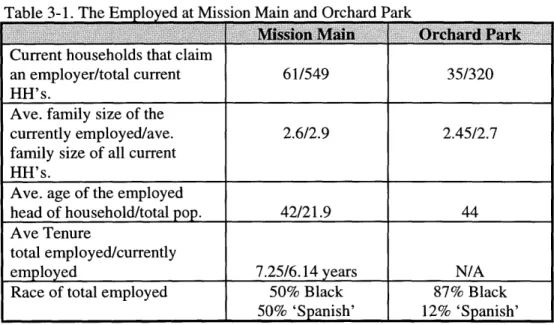
Employment at Mission Main and Orchard Park2
Table 3-1. The Employed at Mission Main and Orchard Park
Mission Main Orchard Park
Current households that claim
an employer/total current 61/549 35/320
HH's.
Ave. family size of the
currently employed/ave. 2.6/2.9 2.45/2.7
family size of all current
HH's.
Ave. age of the employed
head of household/total pop. 42/21.9 44
Ave Tenure
total employed/currently
employed 7.25/6.14 years N/A
Race of total employed 50% Black 87% Black 50% 'Spanish' 12% 'Spanish'
Source: BHA Data as of April 1995.
'Racial profiles are tricky in the sense the data collected by the BHA does not differentiate between race
and ethnicity. For example Black and Latino are not comparable categories, because Latino is an ethnic
orientation, not racial membership, and Latinos can be of any racial descent.
2
The rationale for including Orchard Park data is that HOPE VI staff will develop an economic
development strategy which will be applicable to both sites. This data on employed residents, especially as it is compared to that of the other HOPE VI site, are relevant to that endeavor and will inform broader program development.
35 Chapter 3- Key Institutional Factors In general, the basic head of household characteristics suggest that there is very little discernible difference between the employed and the unemployed. This is especially true for the race, gender of household head and average family size. The only variables that seem to differ between the employed and unemployed heads of household is average tenure and age of
household head. The average tenure for all Mission Main residents is 11 years, however among the employed, average tenure is little over 6 years. This is a significant difference which suggests that those residents who work, tend to stay in the development for fewer years than those who do not. For this residential subset, it seems that public housing is a transitional expenence.
Figure 3-1
Sector Employment of Mission Main
Residents: 1980-1995 (total 208)
11% O Commercial 17% 45%N
Institution I Public O Other27%
Source: BHA Data as of April 1995.
Out of 549 current households at Mission Main only 61 claim employment and out of 320 current households at Orchard Park, only 35 claim employment. The majority of employers of Mission Main residents are within a two-mile radius of the site. It seems that these figures are artificially low, and that it is not entirely a result of the disincentive to reporting income.3 In
3These data have been compiled by the BHA as part of the annual contract renewal process. Lease holders are asked to provide information about their households, including whether they or another member of their household is employed. Because rents are calculated based on their reported incomes, residents have a strong disincentive to report a job as a source of income.
36 Chapter 3- Key Institutional Factors analyzing these data, it is important to remember that roughly 50% of the population is old enough to work. In addition, many people most likely have access to temporary and/or informal work such as childcare and domestic services which is difficult to monitor.
Considering the proximity of so many prominent universities and hospitals, and the past efforts to involve the administrators of these institutions in connecting Mission Main residents to the local labor market, it is not surprising that institutions had employed 27% of residents. Because public service is the most prominent employment source in Boston, it is somewhat unexpected, however, that the rate of public sector employment for both sites is so low.
Similarly, it is somewhat surprising to find that the number of people claiming employment is very similar for both sites, though Mission Main is a much larger development. The data seem to indicate that the rates of employment participation at Orchard Park are greater than at Mission Main. This finding is interesting when considering the radically different surroundings of the
two sites. Mission is almost an anomaly for a public housing site because of the wealth of dynamic daytime uses in its immediate vicinity and its excellent public transportation service. Orchard Park however is in a much less active area, surrounded mainly by residential property, some commercial development along Dudley Street, and a major vehicular transportation route. Yet, the proportion of Orchard Park residents employed by the commercial sector almost mirrors that of Mission, at 44% and 45% respectively. Differences between the two sites include a much higher rate of employment in the institutional sector for Mission Main residents. The sectors that make up the difference for Orchard Park are Public (6% points higher for Orchard) and Other (9% points higher for Orchard.) The section of Roxbury where Orchard Park is located has a long history of social and community activism. This is reflected in the number of non-profits and community organizations that have employed Orchard Park residents, (classified as Other.)