Effect of Litigation Risk on Management Forecasts*
William A. Powley
B.A. Economics and Mathematics, 2011
SUBMITTED TO THE DEPARTMENT OF ECONOMICS, FINANCE AND ACCOUNTING IN PARTIAL FULFILLMENT OF THE REQUIREMENTS FOR THE
DEGREE OF
MASTER OF SCIENCE IN MANAGEMENT RESEARCH AT THE
MASSACHUSETTS INSTITUTE OF TECHNOLOGY June 2018
Signature of Author:_
Certified By:
Certified By:____
Accepted By:_
Sign
MASSACHUSETTS INSTITUTE OF TECHNOLOGY
JUN 15 2018
LIBRARIES
ARCHIVES
C 2018 William Powley. All rights reserved.
Signature redacted
* ri r~'
1/
Dppaiment of Economics, Finance and Accounting~+
tr4 + tMay
11, 2018JI"J I~UI K I K
~
.U)
? 9eorge)4averick Bunker Professor of ManagementJoseph Weber~nature
redacted
Rodrigo Verdi A d, Tgalogical University Professor of Accounting
ature red acted
Chair, Accounting GroupCatherine Tucker Sloan Distinguished Professor of Management Professor of Marketing Chair, MIT Sloan PhD Program
The author hereby grants to MIT permission to
reproduce and to distnbute pubiely paper and electronic co*pis of this thesis docu*mnt i" wholO or in part in any medium now known or
Effect of Litigation Risk on Management Forecasts By
William A. Powley
Submitted to the Department of Economics, Finance and Accounting
on May 11, 2018 in Partial Fulfillment of the Requirements for the Degree of Master of Science in Management Research
I examine the link between changes in the disclosure behavior of firms and changes in ex ante litigation risk as proxied by changes in the firms' director and officer insurance premiums. I find evidence that there is a negative link between the voluntary disclosure of bad news and ex ante litigation risk. I find no evidence of a statistically significant link between the voluntary disclosure of good news and ex ante litigation risk.
Thesis Supervisor: Joseph Weber
Title: George Maverick Bunker Professor of Management
*Contact email: wpowleymit.edu. I sincerely thank Joe Weber for invaluable guidance and support. I thank Georg Rickmann, Andrew Sutherland, Eric So, Rodrigo Verdi, John Core, and Allen Ferrell. I also thank a large insurer and its management team who wish to remain anonymous, the Texas, New York, Massachusetts and California Departments of Insurance, the Administrative Office of United States Courts and Harvard Law School. I appreciate the financial support of the Massachusetts Institute of Technology.
I.
IntroductionDoes securities litigation encourage or deter timely and informative disclosure? Prior literature in finance and accounting has found a negative relationship between litigation risk and voluntary disclosure.' The central arguments explaining this negative link are that disclosure can prejudice litigation and voluntary disclosure can create an affirmative obligation for more disclosure, which can further prejudice litigation. Prior literature has established preliminary evidence of this negative link using realized litigation and a macro change to regulation via the Private Securities Litigation Reform Act (hereafter: "PSLRA"). Yet, only approximately 3% of publicly-traded firms have realized securities litigation.2 Every finrm faces the constant threat of litigation risk, and therefore, prior literature may understate the true effect of litigation risk on voluntary disclosure.
A larger question remains: how does the threat of ex ante securities litigation, which affects all publicly-traded firms every year affect voluntary disclosure decisions? That is, the purpose of securities litigation is to serve as a governance mechanism ensuring timely and informative disclosure by firms to shareholders. However, if instead of ensuring timely and informative disclosure, the threat of securities litigation reduces disclosure, then this suggests securities litigation as a governance mechanism may have widespread, unintended consequences.
I seek to extend this research on securities litigation by investigating whether changes in ex ante litigation risk are associated with changes in voluntary disclosure. My paper does this by introducing three new datasets. First, a large panel of director and officer insurance premiums, which measures liability, an important determinant of litigation risk. Second,
'Johnson et al. (200 1) and Rogers and Van Buskirk (2009).
claims, which are relevant, as outlined in Core (1997), because presumably firms sued in the past have higher litigation in the future. Third, rate filings, which are relevant, because they speak to how director and officer insurance premiums are calculated in any given year.
To motivate my analysis, I begin by studying within-firm changes in ex ante litigation risk during my sample period. Between 2003 and 2016, the typical firm's ex ante litigation risk changed by 8.4% per year. Firms at the 1st quartile of ex ante litigation risk volatility changed by 5.4% per year. Firms at the 3rd quartile of ex ante litigation risk volatility changed by 14.8% per year. In sum, my descriptive evidence indicates that firms' ex ante litigation risk changes regularly. The question remains what impact do these changes in ex ante litigation risk have on firms' voluntary disclosure decisions.
In my next analysis, I regress levels of voluntary disclosure on levels of ex ante litigation risk with firm fixed effects. After controlling for time-varying factors (e.g., firm size and growth opportunities), I find consistent evidence that firms reduce the amount of information provided to investors in response to increases in litigation risk. This reduction is concentrated primarily in the firm's proclivity to issue bad news.
Overall, my findings raise the question of whether the higher litigation risk disclosure behavior displayed by firms is consistent with the goals of regulators. That is, although the purpose of securities litigation is to encourage timely and informative disclosure (especially the timely and informative disclosure of bad news), my findings suggest the current securities litigation environment results in exactly the opposite when firms face higher levels of litigation risk. That is, when firms face higher litigation risk, they are less likely to disclose bad news.
My paper adds to the accounting literature in that I am able to help mitigate a number of concerns with prior studies that have previously examined the link between ex ante
litigation risk and voluntary disclosure, including introducing a measure of ex ante litigation risk that captures the full level of state and federal litigation against firms, is timely, and avoids look-ahead bias. The remainder of the paper is organized as follows: Section II provides the institutional context and hypothesis development. Section III provides the literature review. Section IV describes the data. Section V describes the empirical design. Section VI describes the empirical results. Section VII is the conclusion.
II. Hypothesis Development and Institutional Context
Hypothesis Development
Arguments for a negative link between ex ante litigation risk and voluntary disclosure
The two central reasons why there may be a negative link between ex ante litigation risk and voluntary disclosure are (1) disclosure can prejudice litigation and (2) , as explained in Cox et al. (2001), voluntary disclosure can give firms an affirmative obligation to continue to disclose, potentially increasing the opportunity to further prejudice litigation. When firms face more litigation risk, they may be more concerned about the potential of voluntary disclosure to prejudice litigation or the potential of voluntary disclosure to create an affirmative obligation to continue to disclose potentially further prejudicing litigation.
There may also be a negative link between ex ante litigation risk and the voluntary disclosure of bad news. In response to higher litigation risk, managers may be reluctant to disclose negative news as doing so could affect compensation, tenure, and labor market prospects. That is, when firms face higher ex ante litigation risk, a firm may already have made a misrepresentation or omission and therefore if a firm chooses to voluntarily disclose negative news, that disclosure may serve as the corrective disclosure, driving down the stock price, and alerting potential plaintiffs to the material misrepresentation that occurred. While
this voluntary disclosure has the potential to shorten the class window and potentially reduce any alleged damages (to the benefit of the firm's insurer), this corrective disclosure will likely also invite securities litigation against the firm that could have a material, adverse effect on the management's compensation, tenure and labor market prospects. Therefore, I hypothesize that managers will delay bad news disclosures with the hope that in the meantime circumstances will change and a corrective disclosure will no longer be needed. This hypothesis is consistent with prior literature (Kothari et al., 2009).
There may also be a negative link between ex ante litigation risk and the voluntary disclosure of good news. In response to higher litigation risk, managers may be reluctant to voluntarily disclose positive news as positive news has the potential to prejudice future litigation and the voluntary disclosure of positive news may also create an affirmative obligation to disclose negative news later if circumstances change. For firms facing higher litigation risk, both of these factors may serve as a substantial deterrent to the voluntary disclosure of positive news.
Arguments for a positive link between ex ante litigation risk and voluntary disclosure
The three central reasons why there may be a positive link between ex ante litigation risk and voluntary disclosure are (1) ceteris paribus it becomes more difficult to allege that a firm withheld information when it frequently voluntarily discloses (2) voluntary disclosure can shorten the class window (Field et al., 2005) and therefore reduce any possible alleged damages and (3) voluntary disclosure can have benefits including potentially lowering forecast revision variability (Lang and Lundholm, 1993), increasing consensus among analysts (Lang and Lundholm, 1993), and reducing information asymmetry among shareholders (Cohen, 1992).
There may be a positive link between ex ante litigation risk and the voluntary
disclosure of bad news. The primary allegation in most securities litigation cases is that firms failed to disclose bad news. Firms facing higher ex ante litigation risk may choose to disclose bad news more readily as doing so may make it more difficult for plaintiffs to allege that bad news was intentionally withheld.
There may be no link or a positive link between ex ante litigation risk and the voluntary disclosure of good news. Firms facing higher litigation risk may have managers who are particularly concerned about reputation, career concerns, and labor market prospects. As a result, these managers may seek to mitigate these risks by disclosing good news.
Institutional Context
The central question my paper seeks to answer is whether the threat of securities litigation encourages or deters voluntary disclosure. In particular, how do changes in ex ante litigation risk relate to changes in voluntary disclosure? In order to understand the nature of this relationship, my measure of litigation risk needs to account for a firm's wrongdoing (hereafter: "liability "). The reason this matters is because I hypothesize that firms who are guilty will behave differently than firms who are innocent. That is, I hypothesize firms who are guilty will disclose less out of fear of self-incrimination and firms who are innocent will disclose more to mitigate career concerns and calm
shareholders. In order to understand how my measure accounts for liability, it is important to understand the timing of securities litigation, how premiums are calculated, and the timing of the coverage.
parts: pre-damages, damages, revelation, suit-filing, and post-filing. The pre-damages period is prior to any alleged wrongdoing by the firm. The damages period begins when a firm allegedly materially misrepresents or omits information to shareholders and that action leads to an inflated stock price. The stock price then trades at an inflated value for a period of time. This serves as the damages period. The revelation period begins when the market is informed of the material misrepresentation or omission via a corrective
disclosure and the stock price drops. The damages period and the revelation period together represent the class window. The suit filing period begins when plaintiffs file securities litigation against the firm. The post-filing period is the year after the litigation is filed. Rogers and Van Buskirk (2009) calculated the average duration of each of these periods and found the class window is, on average, approximately 10 months. The figure below, borrowed from Rogers and Van Buskirk (2009), illustrates the timeline:
Regresion Periods Class Window
Median Period length
(Days)
Litigation Events Class perod begins Cause penod ends S,g Dais
Next, how premiums are calculated: Prior to insuring a firm for the first time or renewing a D&O insurance policy, insurers engage in an extensive due diligence process that includes reviewing both public and private information about the prospective insured. Insurers review SEC filings, analyst reports, and news articles.3 Insurers provide
prospective insureds with questionnaires and surveys that inquire about the prospective insured's plan to make acquisitions, issue securities, knowledge of any activities that are
Baker, Tom, and Sean J. Griffith. Ensuring corporate misconduct: How liability insurance undermines
shareholder litigation. University of Chicago Press, 2010.
likely to lead to litigation, and knowledge of the firm's business models, strategies, and risks. These questionnaires and surveys are often forward-looking.4 All statements made to the insurer by the prospective insured must be true and complete or the insurer reserves
the right to void coverage.'
Next, the timing of the coverage: Given the average length of a class period, the insurer's interview process is likely to occur at some point during the class period and therefore through the forward-looking questionnaires and surveys, insurers are likely to be able to uncover the material misrepresentation or omission that likely has already occurred and may serve as the basis of the securities litigation. In an interview of a corporate risk manager conducted by Baker and Griffith for their seminal book on director and officer insurance Ensuring Corporate Misconduct, the risk manager stated, "I can recall probably fifteen years ago where a D&O renewal might take me a half hour to fill out the
applications. It [now] takes me about a week to do all the financial [projections], just to get them assembled and to determine where I need to go for information.... They want detailed information...."6 I hypothesize that given how thorough the D&O insurance interview process is the insurer is able to uncover managerial actions that may serve as the basis for future litigation and price the director and officer insurance premiums
accordingly. The figure below illustrates the relationship between the timing of the securities litigation and the timing of the director and officer insurance underwriting process.
4 Ibid. Ibid.
Baker, Tom, and Sean J. Griffith. Ensuring corporate misconduct: How liability insurance undermines
shareholder litigation. University of Chicago Press, 2010.
Figure 1 -Timeline
"d" am cow pom
Toa ese
gsee
& i ns ranee fit * in g s tia d
sThse fnra yoal of 2my parirs and mared the t umr satstit of eanescrthes lii,3 in0 i0o firms ' voeb ylunare islsure decso . 2 I orm er boay m eas reshentruefct
itsigtn ratietyr a oceriendap
Peisaranaccurate measure of ex ante litigation risk. Maed ietr nfie nagersance reawidely hl.Mngrhaelittle choice yewt-errgrithe respect o hoingry insurance. oeaeThey Tilinas
th Ca rv, Z helad Ga ntis.ran miverthy., "thereffesanfexptigatiorsn anagmen eri gsl fore nsu.rCnem itirar cnting eena c ers 28.the(2ore): ca25-aeds73.r
11
Imitigating~ concerns.d Fbmrlzailt
Themicentra aofmyraert measure te lttre effect ofexantgr e srties l
litt isirtn tatodirectr arn offielvlormr insurance beerg wieyhl nhteiumslbe anda
7 acur ate masure pti .Nrynaorh."Teefc ofexat litigation risk.Ideircoan oce iansamneaisdl
illustrated in Table 2 Panel B, the level of primary insurance coverage rarely changes. In
Ensuring Corporate Misconduct, the authors state that "In the late-2005 market, few
insurance carriers were offering a policy larger than $25 million and that most policies had limits of $10 million or less."' Given this, a firm's insurance premium is a good summary statistic for a firm's ex ante litigation risk.
III. Related Literature
The central question I seek to answer in my paper is whether the threat of securities litigation encourages or deters voluntary disclosure. Prior literature has attempted to answer this question in two ways: First, by measuring the relationship between realized litigation and levels of voluntary disclosure.' Second, by measuring the relationship between levels of ex
ante litigation risk and whether or not a firm will provide an early warning of a large,
imminent earnings miss."0
With respect to the first stream of literature, given only approximately 3% of
publicly-traded, insured firms are sued for securities litigation, prior literature may understate the true effect of securities litigation on firms' decisions to voluntarily disclose. With respect to the second stream of literature, prior literature has used two coarse measures of ex ante litigation risk that may inaccurately measure ex ante securities litigation risk and bias the results in favor a positive link: (1) a measure using logit and probit models with realized
' Baker, Tom, and Sean J. Griffith. "Predicting Corporate Governance Risk: Evidence from the Directors' & Officers' Liability Insurance Market." The University of Chicago Law Review (2007): 487-544.
9 Rogers and Van Buskirk (2009).
10 Kasznik and Lev (1995) use the industry-based measure from Francis et al (1994) to proxy for ex ante litigation risk and finds that firms in high litigation risk industries have a higher probability of warning before large earnings surprises. Johnson et al (2001) find that firms with higher ex ante litigation risk also have a higher probability of warning before large earnings surprises. Brown et al (2005) discuss what impact litigation risk has on the issuance and characteristics of management earnings forecasts. The authors find that higher litigation risk increases the likelihood that a firm will release a forecast. Predictions are also found to be made earlier and more precisely when firms face higher litigation risks. Similarly, companies with higher litigation risk are more likely to release bad news once it arises.
securities litigation as the dependent variable and ability to pay and damages as the explanatory variables" and (2) a measure based on industry.'2
My paper. introduces a new market-based measure of ex ante litigation risk that accounts for ability to pay, damages, and wrongdoing (hereafter: "liability"). As outlined in the institutional context section of my paper, liability matters, because I hypothesize that firms who are guilty will behave differently than firms who are innocent. That is, guilty firms will disclose less out of fear of self-incrimination and firms who are innocent will disclose more to mitigate career concerns and calm shareholders.
My market-based measure of ex ante litigation risk helps mitigate three central concerns regarding the existing logit and probit models that have potentially biased prior literature towards finding a positive link between ex ante litigation risk and voluntary disclosure. The first concern is that managers forecast in a self-serving fashion when faced with litigation risk. The assumption is that the probability of litigation affects management's decision to issue forecasts or make disclosures. Yet, prior literature's measure of litigation suffers from look-ahead bias. That is, it assumes that the level of litigation risk the managers perceived when they made the management forecast is equal to that predicted by the litigation risk model developed ex post. The second criticism is the choice of the dependent variable.
1 Jones and Weingram (1996a) regress realized litigation on ability to pay (proxied for by market capitalization) and damages (proxied for by firm characteristics such as stock return distributions, the proportion of the firm's shares traded in the past year, the share price decline over the past year and extreme stock price movements (e.g., single day declines of 10% or more)). Johnson et al (2001) regress realized litigation on ability to pay (proxied for by market capitalization) and damages (proxied for by stock beta, cumulative stock return, minimum stock return, return skewness, stock turnover, CEO power, management monitoring, external financing, and insider trading). Kim and Skinner (2012) regress realized litigation on ability to pay (proxied for by firm assets) and damages (proxied for by growth opportunities, cumulative stock return, return skewness, return standard deviation, stock turnover, and insider trading).
1 Francis et al (1994) developed a commonly used measure of litigation risk that measures the frequency of
securities litigation by industry. Francis et al (1994) found that the following industries represent a high level of securities litigation: biotechnology, computers, electronics and retailing. This measure is used extensively in the literature, including in Kasznik and Lev (1995), Skinner (1997), and Johnson et al (200 1).
These measures of litigation risk are based exclusively on securities litigation that occurred in federal court. This fundamentally underestimates the true litigation firms face, which includes litigation in state courts. Third, many of the litigation risk measures used above use a first-age dependent variable of whether or not the firm got sued. However, this includes both
meritorious and frivolous litigation alike, and inclusion of dismissed cases has been found to alter results (Field et al, 2005).
My market-based measure of ex ante litigation risk avoids several of these concerns. First, D&O premiums are chosen annually by managers to protect the firm from all litigation up to a chosen level of coverage. This measure is more robust than standard models as it can predict the probability of litigation, as well as the ex post costs a company faces following litigation. Second, D&O premiums protect against look-ahead bias and includes litigation from all courts. Third, D&O premiums account for all frivolous and meritorious litigation in state and federal courts and uses market pricing of D&O insurance to weight the various types of litigation appropriately.
Director and officer insurance premium data for the United States has been used in prior literature in a small number of cases. Cao and Narayanamoorthy (2011) use director and officer insurance data in the United States from 2001-2002 to measure the link between litigation risk and managers' decision to issue earnings forecasts. The authors find that firms facing higher litigation are more likely to issue earnings forecasts, but only if they have bad news to disclose. The authors also find that managers with bad news are more likely to
release forecasts sooner, and to produce more accurate forecasts. The authors find no effect of litigation risk on firms with good news. My paper differs from Cao and Narayanamoorthy (2011) in that I have large-sample director and officer insurance data from the years 2003 through 2016. Given that there are substantial market cycles in director and officer insurance
and both Enron and Worldcom occurred in 2001 and 2002, the underlying director and officer insurance data used by Cao et. al. (2011) is not representative of how litigation is usually priced. Finally, I find opposite results from Cao et. al. (2011) in that I find a negative link between litigation risk and the voluntary disclosure of bad news.
IV. Data
The main analysis in my paper examines the link between changes in ex ante litigation risk and changes in voluntary disclosure. To conduct this analysis, I use a comprehensive proprietary dataset of director and officer insurance premiums from a large insurer. The large insurer's director and officer insurance data has never before been released and this is the first paper in the accounting literature to use large-sample director and officer insurance data. The data spans 14 years (2003 to 2016). The insurer's data is based on the insurer's nearly 1,300 publicly-traded clients, who collectively represent the largest pool of D&O insureds in the world. In the current sample, I have data from 211 insureds between the years 2003 and 2016. 1 have run summary statistics for the 211 firms and compared them to summary statistics for the approximately 1,300 firms and I believe my sample is broadly representative. For each stock in the database, the large insurer provides annual insurance premiums, annual insurance coverage, annual insurance deductible, annual insurance limits, among many other variables.
The D&O insurance premium serves as my main proxy for ex ante litigation risk. I also collect management forecast data from I/B/E/S for the years 2003 through 2016 and securities litigation data for the years 2003 through 2016 from ISS, LexisNexis and
Bloomberg. The stock return data was collected from CRSP and firm fundamental data was collected from Compustat.
V. Empirical Design
In my study, I address the specific question of how changes in ex ante litigation affects changes in voluntary disclosure.
5.1. Empirical Model
Answering the question of whether changes in ex ante litigation risk is associated with changes in voluntary disclosure rests on my ability to control for other factors that might cause a change in disclosure. Therefore, I adopt a research design that controls for firm
specific, time-invariant factors that may influence changes in disclosure choices along with firm-specific, time-varying factors (e.g., firm size, growth opportunities, firm stock price performance, stock price volatility, turnover, skewness, securities offerings, and M&A activity) that may influence changes in disclosure choices. My primary regression is as follows:
Disclosure Proxy = P ILitigation Risk+p2lnsurance Limit + Control Variables +Firm Fixed Effect+e.
I proxy for disclosure behavior using management proclivity to issue guidance, management proclivity to issue any good news, management proclivity to issue any bad news, and management forecast characteristics. These dependent variables are described in detail in Section 5.2. I control for other factors that might cause a change in voluntary disclosure including firm size and growth opportunities. I also control for measures of litigation risk used in prior literature and show that my measure offers additional explanatory power. These independent variables are described in detail in Section 5.3.
5.2 Direct Disclosure Proxies
5.2.1. Direct Disclosure Proxies -Frequency
I use several direct proxies to detect changes in the type or amount of information provided by the firm. The first set of direct proxies focuses on management forecasts and management forecast characteristics.
Any Forecast -- a dummy variable that equals one if there is at least one management earnings forecast (annual or quarterly) in the policy year and zero otherwise.
Bad News Forecast -- an indicator variable that equals one if a firm made at least one "bad news" forecast (annual or quarterly) during the policy year and zero otherwise. A forecast is said to contain "bad news" if First Call qualifies the forecast as a negative surprise.
Good News Forecast -- an indicator variable that equals one if a firm made at least one "good news" forecast (annual or quarterly) during the policy year and zero otherwise. A forecast is said to contain "good news" if First Call qualifies the forecast as a positive surprise.
Forecast Frequency - the number of forecasts provided by management in a given policy year.
Bad News Forecast Frequency -- the number of "bad news" forecasts provided by management in a given policy year. A forecast is said to contain "bad news" if First Call qualifies the forecast as a negative surprise.
Good News Forecast Frequency -- the number of "good news" forecasts provided by management in a given policy year. A forecast is said to contain "good news" if First Call qualifies the forecast as a positive surprise.
5.2.2. Direct Disclosure Proxies - Forecast Properties
Once a manager has decided to provide a forecast, he/she faces choices about the properties of the forecast (King et al., 1990). Specifically, managers face choices about forecast horizon (Baginski et al., 2002), specificity (Baginski et al., 1993; Baginski and Hassell, 1997) and precision (Baginski et al., 1993; Bamber and Cheon, 1998; and Baginski et al., 2002). I follow the prior literature that uses these directly observable forecast properties to assess management forecasting behavior.
Forecast Horizon - the natural logarithm of one plus the days between forecast date and actual report for forecast
j
made during the one-year period t covered by a D&O insurance contract. Increasing the horizon of a forecast is consistent with management providing more timely information to the market. For example, a manager who immediately provides a forecast when his/her expectation of earnings changes will tend to have a longer forecast horizon than a manager who delays the release of a forecast. Prior research finds longer horizon forecasts are more effective at reducing information asymmetry among investors (Rogers, 2007).Amount of News in the Forecast -- the split-adjusted difference between forecasted value (a point estimate or the mean of a range estimate) and the I/B/E/S consensus estimate. The amount of news captures the revealed (dependent variable) and the market expectation of earnings.
Forecast Specificity - the top of the management forecast range less the bottom of the range divided by two deflated by the bottom of the range; it equals 0 for point estimates. Ceteris Paribus, tighter estimates should provide more information to market participants than wider estimates. Consistent with this notion, Baginski et al. (1993) demonstrate that prices
react more strongly to tighten estimates, while Rogers (2007) finds that tighter estimates result in greater liquidity benefits.
5.3. Control Variables
I use a number of control variables to help control for other factors that might cause a change in disclosure.
Log Premium -- LogPremium,: the natural logarithm of the D&O premium a firm
paid to obtain insurance coverage for the year.
Insurance Limit -- LogLimit,: the natural logarithm of the limit of the insurance
coverage a firm held in a given year.
Firm Assets -- LTA,_1 : the natural logarithm of the total assets from the previous
year. Sales Growth -- SG,_1 : sales growth in the previous year.
Prior Year Performance -- RET, 1 : market-adjusted stock return from the previous
year. Skewness of Returns -- Skret,_, : skewness of returns from the previous year.
Volatility of Prior Year Returns -- Sdret 1 : standard deviation of the returns from the
previous year.
Turnover -- Turnover,_, : trading volume accumulated over the previous year.
Firm Market Value -- LogMV,, : the natural logarithm of the equity's market value
for the previous year.
Mergers and Acquisitions -- MergersAcquisitionst is whether or not the firm
conducted at least one merger and acquisition in a given year.
Securities Offerings -- SecuritiesOfferings, is whether or not the firm conducted at
least one securities offering in a given year.
5.3.1. Timing of the Control Variables
The figure below illustrates the timing of the control variables. I use control variables that (1) would have been available to the insurer at the time they were underwriting the
director and officer insurance and are known to be priced risk factors or (2) could have caused a change to the firm's voluntary disclosure. I use cumulative returns, skewness, standard deviation, and stock turnover from the year before the coverage year to proxy for potential damages. I use firm total assets from the year before the coverage year to proxy for ability to pay. I use merger and acquisition activity and security issuances from the coverage year to proxy for two priced risk factors known to significantly influence insurance premiums and that would have been asked about during the interview process. I use the limit of the policy in the coverage year to proxy for the amount of coverage. These variables are all priced risk factors as reported by the insurers and the purpose of controlling for them is to account for any variation in the insurance premium or limit that can be explained by a firm's ability to pay or damages so that any additional explanatory power offered by the insurance premium can plausibly for the firm's liability. I also use firm market capitalization and firm growth opportunities in the year prior to the policy year to control for two factors known to affect disclosure choices.
AMIePwrbo-UkOW
ansnes~vlemytenve WUMMecvs eweonrs
VI. Empirical Results
Table I provides summary statistics on the variables used in this study. Panel B presents the statistics on D&O insurance limit and premium, forecast frequencies and other firm characteristics. Of the 1,127 firm-years, the median and mean of the D&O limit amount (totlim) are $10,000,000 and $11,027,707, respectively, with a standard deviation of
$5,869,663. The mean (median) premium (totprem) paid for the coverage is $316,124
($198,488). The mean (median) size of the company, as measured by total market value (mv), is $7,534,260,000 ($575,393,000). Of the 1127 firm-years, 49% contain at least one
management earnings forecast and 2% (35%) contain at least one good news (bad news) forecast as defined by the First Call's classification on the nature of news. There are on average more than 4 analysts (n analyst) issuing forecasts for the sample firms, indicating a reasonable demand for information for the sample firms.
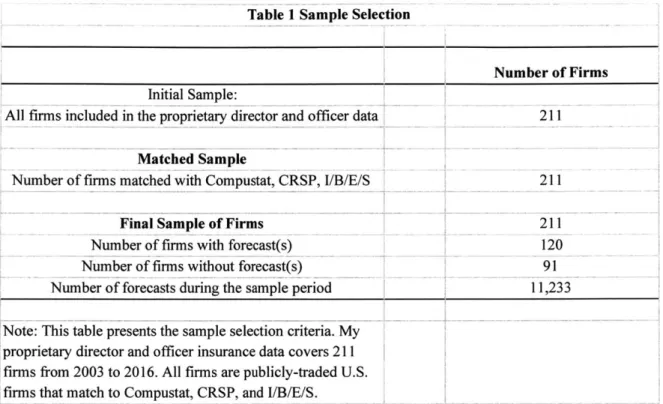
Panel B of Table 1 B reports descriptive statistics on forecast characteristics. I take the entire set of forecasts (11,233 forecasts) for all firms in my sample (120 firms have at least one forecast; 91 do not). For my goodnews variables, I construct an indicator variable equal to 1 if a firm voluntarily discloses any good earnings news in a given year. For my horizon variable, I select the first forecast made for each date. Point and range estimates are used to compute the extent of news released in forecasts. This variablefcast diffis the difference between the midpoint of the range estimate and the consensus estimate when the estimate is announced by the firm. The median value offcast diff is zero, indicating that the
middle-level forecast does not deviate from the proxy for market expectation. My final sample of forecasts includes 663 forecasts for the 120 firms who forecast.
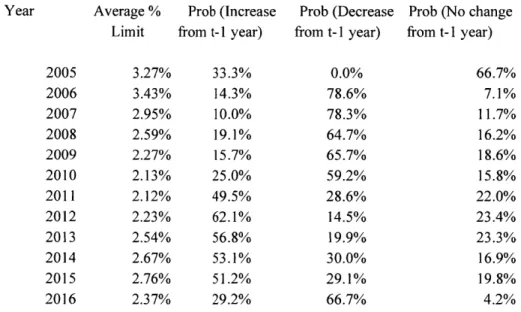
Table 2 provides a transition matrix examining within-firm changes in premiums, limits, and deductibles. Each table compares an annual premium, coverage limit or deductible
in a given year to the prior year. I present figures for a sample of firms between the years 2005 and 2016 in order to mitigate generalizability concerns associated with a relatively small sample of firms in the early sample years (2003 and 2004). In 2006, 92.9% of firms experienced a change in ex ante litigation risk as proxied by the firms' insurance premiums, either increasing (14.3%) or decreasing (78.6%) from their 2005 level. Panels B and C show that coverage limits and deductibles are much more stable. In 2006, only 14.3% of firms
experienced a change in their coverage limit (10.7% increased; 3.6% decreased). In 2006, only 14.3% of firms experienced a change in their deductible (3.6% increased; 10.7% decreased).
Insurance premium changes also occur nearly every year for a given firm such that over time, there is substantial variation in a firm's insurance premium. Between 2003 and 2016, the typical firm's ex ante litigation risk changed by 8.4% per year. Firms at the 1st quartile of ex ante litigation risk volatility changed by 5.4% per year. Firms at the 3rd quartile of ex ante litigation risk volatility changed by 14.8% per year. While individual years vary, overall firms are roughly equally likely to experience an increase or decrease in their
insurance premium.
In sum, I show that litigation risk is far from the static construct prior literature, including Francis et al. (1994), has represented it to be, but rather varies substantially and that variation is concentrated primarily in the firm's insurance premium. In my next analysis, I exploit this variation in ex ante litigation risk and variation in voluntary disclosure to establish the link.
The central question my paper seeks to answer is does the threat of securities litigation encourage or deter timely and informative voluntary disclosure. Following prior literature (Rogers and Van Buskirk, 2009; Cao et al., 2011), my first tests attempt to answer three variations of this question: (1) does the threat of securities litigation encourage or deter firms from making any voluntary disclosures? (2) does the threat of securities litigation encourage or deter firms from making any voluntary disclosures of bad news? (3) does the threat of securities litigation encourage or deter firms from making any voluntary disclosures of good news? Tables 3 attempts to answer the first question. Table 4, the second. Table 5, the third.
My empirical design that I use to answer this question is three logit regressions of whether or not a firm issued any forecast, any bad news forecast, or any good news forecast on the firm's ex ante litigation risk with firm fixed effects. These logit regressions are functionally similar to a regression of changes in disclosure choices on changes in ex ante litigation risk. That is, when a firm's litigation risk changes, how do their voluntary disclosure choices change?
In all three logit specifications, my main variable of interest is litigation risk, proxied for by logpremium, .I also control for loglimit, which is the natural logarithm of the limit of the firm's primary director and officer insurance. I also include control variables prior literature has used to proxy for ability to pay", damages, 4 and firm growth opportunities". Given the controls, any additional explanatory power offered by my main variable of interest,
logpremium,, is intended to capture evidence of a firm's wrongdoing ("liability").
13 Prior year total assets and prior year market value (ltat-1 and logMVt-1).
" Past returns (rett- I), skewness of returns (skrett- 1), standard deviation of returns (sdrett- 1).
" Sales growth (SGt-1).
In the logit specification shown in Table 3, the table shows that the coefficient on
logpremium is not statistically significant, suggesting that managers' general propensity of
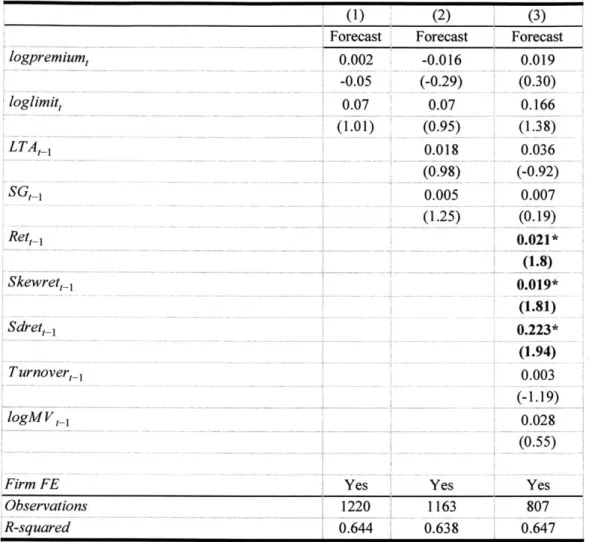
issuing an earnings forecast neither increases or decreases with litigation risk.'6 This result does not change after controlling for proxies for damages,7
ability to pay,18
, and growth opportunities.'9
While these results are consistent with Rogers and Van Buskirk (2009) who finds that realized litigation has no statistically significant relationship with a firm's decision whether or not to make management forecasts and the frequency of those forecasts, this result is counter to my hypothesis that firms facing higher litigation risk will voluntarily disclose less out of a fear of potential self-incrimination and firms facing lower litigation risk will
voluntarily disclose more as in Johnson et al. (2001).
In Table 4, I address the question of whether or not securities litigation encourages or deters the timely and informative voluntary disclosure of bad news. Given firms are most often sued for withholding bad news, if securities litigation encourages or deters the voluntary disclosure of any type of news, I would expect it to be bad news. The table shows that the coefficient on logpremium, is significantly negative (coeff. = -0.127, t-stat = -1.68),
suggesting that managers' general propensity of issuing a negative earnings forecast
decreases with litigation risk. That is, if a firm's litigation risk increases, they are less likely to disclose bad news. If a firm's litigation risk decreases, they are more likely to disclose bad
16 Abramova et al. (2017) shows that while there is meaningful variation in the within-firm frequency of
management forecasts, there is more limited variation in whether or not a given firm provides any management forecast year-to-year. Given firm's decision of whether or not to disclose any guidance is relatively sticky, I ran two additional analyses of (1) the frequency of management forecasts on ex ante litigation risk with the same
controls and firm fixed effects and (2) the frequency of 8-K's on ex ante litigation risk with the same controls and firm fixed effects and found no statistically significant relationship in either specification.
" Past returns (rett-1), skewness of returns (skrett-l), and standard deviation of returns (sdrett-1).
' Total assets (ltat- 1) and market value (logMVt-I). ' Sales growth (SGt-1).
news. This result loads after controlling for log limit ( loglimit,), proxies for firms' ability to
pay,20
damages,2' and growth opportunities.22
There are three possible confounding effects that could potentially drive these results: (1) mergers and acquisitions (2) securities issuances (3) changes in economic performance. I find strong evidence against all three possible explanations. With respect to the first two possible confounding effects, based on rate filings I received from state departments of insurance, plans to engage in mergers and acquisitions and securities issuances are priced risk factors for D&O insurance. Both mergers and acquisitions and securities issuances can also reduce a firm's proclivity to disclose bad news. In order to mitigate this endogeneity concern, I control for both mergers and acquisitions and securities issuances in the insurance policy year and the statistically significant negative link between ex ante litigation risk and the proclivity to disclose bad news still holds. The third potentially confounding effect, changes in economic performance, is controlled for by prior year cumulative returns and the proclivity to disclose b
In Table 5, 1 address the question of whether or not securities litigation encourages or deters the timely and informative voluntary disclosure of good news. The table shows that the coefficient on logpremium, is not statistically significant, suggesting that managers' general propensity of issuing a good news forecast neither increases nor decreases with litigation risk. This result does not change after controlling for past returns (ret,_, ), skewness of returns (
skret,_, ), standard deviation of returns (sdrety ), total assets (11a,_1 ), sales growth (SG,_)
or market value (logMV,_, ).
20 The natural log of the firm's year ago total assets (ltat-1) and market value (logMVt-l).
21 Year ago returns (rett- 1), skewness of returns (skrett- 1), standard deviation of returns (sdrett- I). 22 Sales growth (SGt-1).
This result contradicts my hypothesis that firms who face higher litigation risk due to evidence of potential wrongdoing ("liability") would voluntarily disclose less good news out of fear of prejudicing future litigation and also giving themselves an affirmative obligation to disclose later if circumstances change, and therefore potentially introducing further litigation risk and opportunity for prejudice. This result also contradicts my hypothesis that firms who face lower litigation risk would be more likely to voluntarily disclose good news conditional on there being good news to disclose as firms have many incentives to disclose good news and few incentives other than the threat of securities litigation not to.
Regression offorecast characteristics on litigation risk
Tables 6 through 8 present the regression results on three forecast characteristics: forecast horizon, amount of news revealed and forecast precision. These characteristics are relevant only if the managers issue at least one forecast.
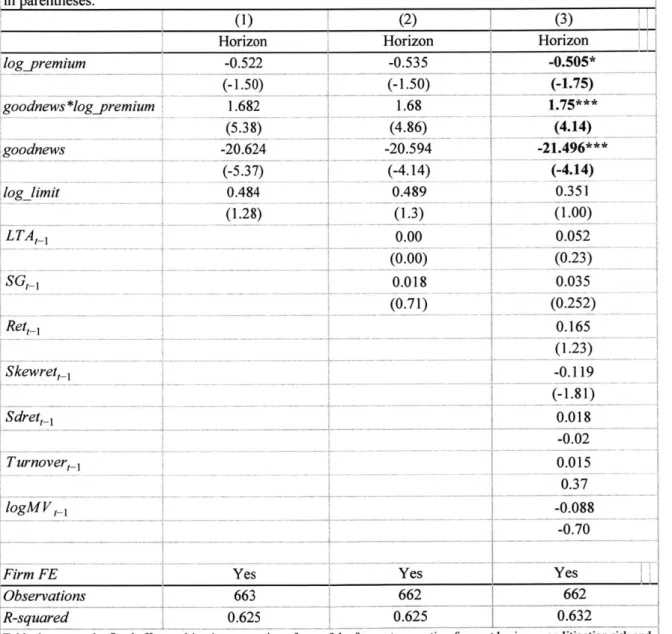
Table 6 reports the regression estimates for forecast horizon (loghorizon). The coefficient on logpremium is significantly negative (coeff. = -0.505, t-stat = -1.75), suggesting that forecasts are released later when a firm faces higher litigation risk. The coefficient on goodnews* logpremium, is significantly positive, which means that firms with greater litigation risk do reveal good news earlier than firms with lower litigation risks. The coefficient on goodnews is significantly negative (coeff.= -21.496, t-stat = -4.14), suggesting that good news forecasts are released later than bad news forecasts. These results are
consistent with my fourth hypothesis, which is that firms who face higher litigation risk will voluntarily disclose good news sooner than bad news as while the voluntary disclosure of bad news may shorten the class window and save the insurer money, it could also trigger
securities litigation against the firm and/or the managers which could have a material adverse effect on the managers' compensation, tenure and career prospects.
Table 7 presents the results for the amount of news revealed in the forecast. I perform the regression for a sample of firms with point or closed-range estimates from which the dependent variable (fcast difj) can be quantified. The coefficient on logpremium, is insignificant, implying that in good news periods firms with high litigation risk reveal approximately the same amount of news as firms with low litigation risk. The coefficient on
goodnews * logpremium, is significantly negative (coeff. = -4.2, t-stat= -2.16). This suggests
that the amount of news contained in good news disclosures is less for firms with higher litigation risk. This is consistent with my hypothesis that firms facing higher litigation risk will likely be reluctant to make disclosures that with the benefit of hindsight could be used against them.
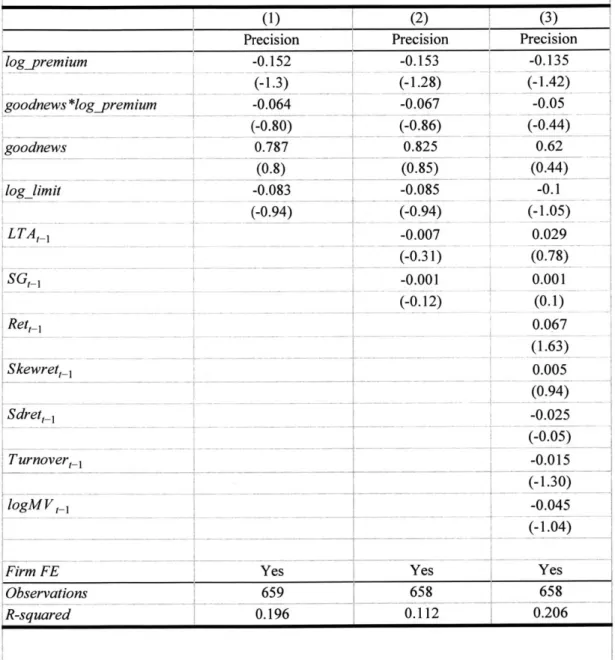
Table 8 presents the results for the precision of news revealed in the forecast. I perform a regression for a sample of firms with point or closed-range estimates from which the dependent variable (precision) can be quantified. The coefficient on logpremium, is insignificant, implying that in bad news periods firms with high litigation risk reveal news with the same precision as firms with low litigation risk.
To summarize, the results in Tables 6 through 8 suggest that firms with high litigation risk tend to issue news sooner when they have good news. Firms in good news periods reveal less news in the forecasts if facing higher litigation risk both in the absolute sense and relative to bad news periods. Finally, as litigation risk increases, forecasts regarding good news are more prone to be less precise while forecasts about bad news remain the same.
VII. Conclusion
I examine the relationship between changes in ex ante litigation risk and changes in voluntary disclosure. This relationship is of interest to stock market participants, regulators and accounting standard setters. By choosing a new ex ante measure of litigation risk, I skirt econometric problems associated with using ex post litigation to proxy for litigation risk. My results provide new insights into the relationship between litigation risk and management forecasts. That is, when faced with ex ante litigation risk, managers, with bad news, are less likely to voluntarily disclose. This suggests that securities litigation in its current form may deter the type of disclosure it is intended to encourage.
I also examine the effect of litigation risk on three forecast characteristics: forecast horizon, extent of earnings news revealed and forecast precision. Managers, facing litigation risk, issue good news earnings forecasts earlier but do not issue bad news forecasts
particularly earlier or later. They also release less information in their good news forecasts. This paper adds to Rogers and Van Buskirk (2009) who establish preliminary evidence of a negative link between realized litigation and voluntary disclosure.
References
Abramova, Inna, John Core, and Andrew Sutherland. "Institutional Investor Attention and Demand for Inconsequential Disclosures." (2017).
Baker, Tom, and Sean J. Griffith. Ensuring corporate misconduct: How liability insurance
undermines shareholder litigation. University of Chicago Press, 2010.
Baker, Tom, and Sean J. Griffith. "Predicting Corporate Governance Risk: Evidence from the Directors' & Officers' Liability Insurance Market." The University of Chicago Law
Review (2007): 487-544.
Baker, Tom. "Medical Malpractice and the Insurance Underwriting Cycle." DePaul Law
Review 54.2 (2005): 393.
Baginski, Stephen P., Edward J. Conrad, and John M. Hassell. "The effects of management forecast precision on equity pricing and on the assessment of earnings uncertainty."
The Accounting Review (1993): 913-927.
Baginski, Stephen P., John M. Hassell, and Michael D. Kimbrough. "The effect of legal environment on voluntary disclosure: Evidence from management earnings forecasts issued in US and Canadian markets." The Accounting Review 77.1 (2002): 25-50. Beyer, A., D.A. Cohen, T.Z. Lys, and B.R. Walther. "The financial reporting environment:
Review of the recent literature." Journal ofAccounting and Economics 50 (2010): 296-343.
Bamber, Linda Smith, and Youngsoon Susan Cheon. "Discretionary management earnings forecast disclosures: Antecedents and outcomes associated with forecast venue and forecast specificity choices." Journal ofAccounting Research 36.2 (1998): 167-190.
Basu, Sudipta. "The conservatism principle and the asymmetric timeliness of earnings."
Journal ofAccounting and Economics 24.1 (1997): 3-37.
Bergstresser, Daniel, and Thomas Philippon. "CEO incentives and earnings management."
Journal ofFinancial Economics 80.3 (2006): 511-529.
Brown, Stephen, Stephen A. Hillegeist, and Kin Lo. "Management forecasts and litigation
risk." Sauder School of Business Working Paper (2005).
Cao, Zhiyan, and Ganapathi S. Narayanamoorthy. "The effect of litigation risk on
management earnings forecasts." Contemporary Accounting Research 28.1 (2011): 125-173.
Chambers, Anne E., and Stephen H. Penman. "Timeliness of reporting and the stock price reaction to earnings announcements." Journal ofAccounting Research (1984): 21-47. Cheng, Qiang, and Terry D. Warfield. "Equity incentives and earnings management." The
Accounting Review 80.2 (2005): 441-476.
Cohen, D. A., A. Dey, and T. Lys. "Real and accrual-based earnings management in the pre-and post-Sarbanes-Oxley periods." The Accounting Review 83 (2008): 757-787. Core, John E. "The directors' and officers' insurance premium: An outside assessment of the
quality of corporate governance." Journal ofLaw, Economics, and Organization 16.2
(2000): 449-477.
Cox, James D., Robert W. Hillman, and Donald C. Langevoort. Securities regulation: cases and materials. Wolters Kluwer Law & Business, 2016.
Field, Laura, Michelle Lowry, and Susan Shu. "Does disclosure deter or trigger litigation?." Journal ofAccounting and Economics 39.3 (2005): 487-507. Francis, Jennifer, Donna Philbrick, and Katherine Schipper. "Shareholder litigation and
corporate disclosures." Journal ofAccounting Research (1994): 137-164.
Harrington, Scott E. "Tort liability, insurance rates, and the insurance cycle."
Brookings-Wharton Papers on Financial Services 2004.1 (2004): 97-13 8.
Johnson, Marilyn F., Ron Kasznik, and Karen K. Nelson. "Shareholder wealth effects of the private securities litigation reform act of 1995." Review ofAccounting Studies 5.3
(2000): 217-233.
Jones, Christopher L., and Seth E. Weingram. "The determinants of 1 Ob-5 litigation risk." Available at SSRN 2684 (1996).
Kasznik, Ron, and Baruch Lev. "To warn or not to warn: Management disclosures in the face of an earnings surprise." The Accounting Review (1995): 113-134.
Kim, Irene, and Douglas J. Skinner. "Measuring securities litigation risk."Journal of
Accounting and Economics 53.1 (2012): 290-310.
Kothari, Sabino P., Susan Shu, and Peter D. Wysocki. "Do managers withhold bad news?."
Journal ofAccounting Research 47.1 (2009): 241-276.
Lang, Mark H., and Russell J. Lundholm. "Corporate disclosure policy and analyst behavior."
Accounting review (1996): 467-492.
Lang, Mark, and Russell Lundholm. "Cross-sectional determinants of analyst ratings of corporate disclosures." Journal ofAccounting Research (1993): 246-271.
Lev, Baruch. "Information disclosure strategy." California Management Review 34.4 (1992): 9-32.
McGee, Robert T. "The cycle in property/casualty insurance." Quarterly Review Aut (1986): 22-30.
Nagar, Venky, Dhananjay Nanda, and Peter Wysocki. "Discretionary disclosure and
stock-based incentives." Journal ofAccounting and Economics 34.1 (2003): 283-309.
Rogers, Jonathan L. "Disclosure quality and management trading incentives." Journal of Accounting Research 46.5 (2008): 1265-1296.
Rogers, Jonathan L., Andrew Van Buskirk, and Sarah LC Zechman. "Disclosure tone and shareholder litigation." The Accounting Review 86.6 (2011): 2155-2183.
Rogers, Jonathan L., and Andrew Van Buskirk. "Shareholder litigation and changes in disclosure behavior." Journal ofAccounting and Economics 47.1 (2009): 136-156. Watts, Ross L. "Conservatism in accounting part I: Explanations and implications."
Accounting Horizons 17.3 (2003): 207-221.
Watts, R. L. "Conservatism in accounting part II: Evidence and Research Opportunities."
Accounting Horizons 18 (2003b): 287-301.
Shroff, Nemit, Rodrigo S. Verdi, and Benjamin P. Yost. "When Does the Peer Information Environment Matter?." (2017).
Skinner, Douglas J. "Earnings disclosures and stockholder lawsuits." Journal ofAccounting
and Economics 23.3 (1997): 249-282.
Skinner, Douglas J. "Why firms voluntarily disclose bad news." Journal ofAccounting
Research 32.1 (1994): 38-60.
Appendix A
Definition Variable
Disclosure Variables
cast dff captures the revealed differences between the true earnings
number and the market expectation of earnings. In particular, it is the
dcastdff
log_horizon
goodnews badnews dfcast precision (0/1) act diff Explanatory Variable totlim totprem log-limit log premiu ita ret t skewret sdret sg log mv priorclaim cumret turnover levsplit-adjusted difference between forecasted value (a point estimate or the mean of a range estimate) and the I/B/E/S consensus estimate.
log horizon is the natural logarithm of one plus the days between
forecast date and actual report date for an annual or quarterly earnings forecast j made during the one-year period t covered by a D&O insurance contract.
goodnews is a dummy variable that equals one if First Call characterized
the forecast as a positive earnings surprise and zero otherwise.
badnews is a dummy variable that equals one if First Call characterized
the forecast as a negative earnings surprise and zero otherwise.
This is a dummy variable for whether a firm issued at least one earnings forecast (annual or quarterly) in the year.
precisIon (01) equals one if a forecast is quantitative (i.e., a point,
open-range or closed-range estimate) and zero if qualitative. The assumption is that in general quantitative forecasts are more precise than forecasts that use qualitative terms to describe the earnings.
act_diff is the split-adjusted difference between actual reported earnings
and the I/B/E/S consensus estimate.
'Total annual D&O insurance coverage limit Total annual D&O insurance premium Natural logarithm of the D&O insurance limit
atural logarithm of the D&O insurance premium
Natural logarithm of a firm's total assets in a given year Cumulative return in a given year
Third moment of returns in a given year Standard deviation of returns in a given year
Percent growth in sales for a given year as compared to the prior year Natural logarithm of the market value of a firm's equity
Standard deviation of daily stock returns for the previous year
Indicator for whether the firm had D&O claims during the past 10 years,
=1 if yes;= 0 otherwise
TCumulative abnormal returns (based on CRSP weighted index) for the previous year
Average daily trading volume (in shares percentage) for the previous year
Total debt (debt in current liabilities plus long-term debt) as a percentage 'of total assets
riskind regulated techind retailind nanalyst m&acount securitiesissuance Interaction Terms lgoodnews*log premium
Indicator for risky industries including biotechnology industry (SIC 2833-2836), computer hardware industry (SIC 3570-3577), electronics industry (SIC 3600-3674), retailing industry (SIC 5200-5967) and computer software industry (SIC 7371-7379); = 1 if yes; = 0 otherwise Indicator for whether a fmn is in the regulated industry (2-digit SIC = 49 or 1-digit SIC = 6), = 1 if yes; =0 otherwise
Indicator for whether a firm is in the technology industry (SIC code in 2833-2836, 3570-3577, 3600-3674,
7371-7379 or 8731-8734), = 1 if yes;= 0 otherwise
Indicator for whether a firm is in the retail industry (SIC code between 5200 and 5961), = 1 if yes; = 0
otherwise
Number of analysts issuing earnings forecasts for a firm. This number is calculated based on the number of analysts following the firm in the IBES summary history table, the IBES excluded estimates table, and the IBES stopped estimates table
The number of mergers or acquisitions a firm engaged in in a given year
Whether or not a firm issued debt or equity securities in a given year
This is the interaction term between goodnews and logpremium which tells me the relationship between voluntary disclosure and litigation risk
Table 1 Sample Selection
Number of Firms Initial Sample:
All firms included in the proprietary director and officer data 211 Matched Sample
Number of finns matched with Compustat, CRSP, I/B/E/S 211
Final Sample of Firms 211
Number of firms with forecast(s)
120
Number of firms without forecast(s) 91
Number of forecasts during the sample period 1I,233 Note: This table presents the sample selection criteria. MY
proprietary director and officer insurance data covers 211 firms from 2003 to 2016. All firms are publicly-traded U.S. firms that match to Compustat, CRSP, and I/B/E/S.
Table 1B Panel A: Summary Statistics
D&O insurance and firm characteristics (1,127 firm-year observations)
Variable Qi Median Q3 Mean Stdev
totlim 10,000,000 10,000,000 15,000,000 11,027,707 5,869,663 totprem 108,272 198,488 340,000 316,1241 458,290 logjimit 16.118 16.118 16.524 16.051 0.635 logpremium 11.592 12.198 23 12.167 0.976 my (in $millions) 88.347 575393 86.74 7,534.268 22,936.83 logmv 4.515 6.363 8.164 6.404 2.473 vol 0.066 0.103 0.165 0.13 0.100 cumret -0.268 -0.056 0.197 0.043 0.660 risk ind 0_ 1 0.547 0.498 lev 0 0.144 0.366 0.228 0.366 n analyst 0 0 7 4.525 .960 regulated 0 0 0 0.014 0.116 0_ind - 0 1 .488 0.500 retailind -0 0 0 0.093 0.290 dfcast 0 0 1 0.461 0.499 dgoodnews 0 0 0 0.018 0.133 dbadnews 0 0 1 0.334 0.472
Panel B: Forecast Properties
Overall sample (663 forecasts for 120 firms):
Variable Q1 Median Q3 Mean Stdev
goodnews 0 0 0 0.018 0.133
horizon 299 327 405 372.93 234.77
fcast diff -0.082 -0.008 0.027 0.815 28.878
Table 2: Litigation Risk Transition Matrix
Panel A studies within-firm changes in litigation risk as proxied by premiums. Panels B and C report the changes in limits and deductibles. Each panel summarizes the average value for the given litigation risk variable, the probability of increasing or decreasing the
litigation risk variable from the previous year, and the cumulative number of changes to that year. The sample consists of observations from 2004 to 2016 for firms with observations in each year.
Year Average % Prob (Increase Prob (Decrease Prob (No chang from t- 1 year) 33.3% 14.3% 10.0% 19.1% 15.7% 25.0% 49.5% 62.1% 56.8% 53.1% 51.2% 29.2% from t-
1
year) 0.0% 78.6% 78.3% 64.7% 65.7% 59.2% 28.6% 14.5% 19.9% 30.0% 29.1% 66.7% from t- 1 year) 66.7% 7.1% 11.7% 16.2% 18.6% 15.8% 22.0% 23.4% 23.3% 16.9% 19.8% 4.2% Limit 2005 2006 2007 2008 2009 2010 2011 2012 2013 2014 2015 2016 3.27% 3.43% 2.95% 2.59% 2.27% 2.13% 2.12% 2.23% 2.54% 2.67% 2.76% 2.37% 37 ePanel B: Limits
Average Prob (Increase Deductible from t- 1 year)
Prob (Decrease from t- 1 year)
Prob (No change from t-