Published by Oxford University Press on behalf of the Journal of Medicine and Philosophy, Inc. 2014.
Treatment Decision Making for Incapacitated
Patients: Is Development and Use of a Patient
Preference Predictor Feasible?
ANNETTE RID
*
King’s College London, Department of Social Science, Health & Medicine, London, UK University of Zurich, Institute of Biomedical Ethics, Zurich, Switzerland
DAVID WENDLER
NIH Clinical Center, Department of Bioethics, Bethesda, Maryland, USA
*Address correspondence to: Annette Rid, MD, PhD, Department of Social Science, Health & Medicine, King’s College London, Strand, London WC2R 2LS, UK. E-mail: [email protected]
It has recently been proposed to incorporate the use of a “Patient Preference Predictor” (PPP) into the process of making treatment decisions for incapacitated patients. A PPP would predict which treatment option a given incapacitated patient would most likely prefer, based on the individual’s characteristics and information on what treatment preferences are correlated with these charac-teristics. Including a PPP in the shared decision-making process between clinicians and surrogates has the potential to better realize important ethical goals for making treatment decisions for inca-pacitated patients. However, developing and implementing a PPP poses significant practical challenges. The present paper discusses these practical challenges and considers ways to address them.
Keywords: advance care planning, advance directives,
deci-sional incapacity, surrogates, treatment decision making
I. INTRoDUCTIoN
Clinical practice relies on patients to make their own treatment decisions, typically in consultation with a clinician. This practice is consistent with patients’ rights to make their own medical treatment decisions but raises questions regarding how to treat patients who are unable to make deci-sions. The standard response is to attempt extending the right of competent patients to decide how they are treated to situations involving decisional incapacity. Patients are encouraged to discuss with their clinicians and loved doi:10.1093/jmp/jhu006
ones how they want to be treated in the event of incapacity and to docu-ment their treatdocu-ment preferences in an advance directive. A clear advance directive is regarded as speaking for which treatments the patient prefers. In the absence of a clear advance directive, a surrogate decision maker—usu-ally a family member or loved one—exercises the patient’s right to make treatment decisions on behalf of the patient. The surrogate is asked to make these decisions based on his or her best estimate of how the patient would want to be treated (“substituted judgment”) or, if this is unclear, to choose the course of treatment that best promotes the patient’s clinical interests (Buchanan and Brock, 1989).
This standard approach works well when it is clear which treatments a given incapacitated patient would want and/or which treatments best pro-mote the patient’s clinical interests. However, in many cases, the standard approach fails to promote important ethical goals for making treatment decisions for incapacitated patients (Rid and Wendler, 2010). The majority of patients do not complete an advance directive or otherwise document or discuss their treatment preferences and values. Even when completed, advance directives often do not provide clear guidance for which treatments should be provided in the circumstances. Surrogate decision makers predict patients’ treatment preferences only somewhat better than chance, and data suggest this inaccuracy is not amenable to significant improvement. often, it is also unclear—even to expert clinicians—which course of treatment would best promote the patient’s clinical interests. In this situation, surrogates fre-quently experience anxiety and stress as a result of helping to make treat-ment decisions.
The shortcomings of the standard approach provide compelling reason to search for ways to improve it. Introducing “shared decision making”— which emphasizes the joint responsibility of clinicians and surrogates for making treatment decisions—into clinical practice has been an important step forward. However, shared decision making does not provide a way to determine the patient’s treatment preferences and leaves families with the burden of trying to identify the patient’s preferred treatment option. A recent proposal aims to address the problem of identifying the patient’s treatment preferences by incorporating the use of a “Patient Preference Predictor” (PPP) into the shared decision-making process between surro-gates and clinicians (Shalowitz, Garrett-Mayer, and Wendler, 2007; Rid and Wendler, 2014).
A PPP predicts incapacitated patients’ treatment preferences based on their individual characteristics and information on how these characteris-tics influence individuals’ preferences regarding treatment during periods of decisional incapacity. As we argue in more detail below, the PPP is likely to predict patients’ treatment preferences more accurately than surrogate decision makers. It therefore has the potential to improve realization of the ethical goals for treatment decision making: in particular, consistently
treating patients with their preferences and values and lessening the burden on patients’ surrogates.
The present paper outlines the design and development of a PPP and criti-cally discusses, based on the available empirical data, to what extent incor-porating the use of a PPP into the shared decision-making process would indeed improve current practice. An accompanying paper addresses the rel-evant conceptual and normative questions about using a PPP: in particular, how the PPP should be incorporated into the decision-making process, how stereotyping of patients is avoided, and how the validity of PPP predictions can be ensured (Rid and Wendler, 2014).
II. SHARED DECISIoN MAKING CoMBINED WITH A PPP
Patients’ treatment preferences often are influenced by their individual characteristics, such as age and gender. A PPP would be designed to take advantage of this fact. A PPP would be developed, based on empirical data on how individuals want to be treated in various scenarios involving deci-sional incapacity. These data would be collected in a representative survey of adults living in a region (e.g., the United States). The data would be used to identify, by means of statistical analysis and modeling, how various indi-vidual characteristics are correlated with indiindi-viduals’ treatment preferences in the event of decisional incapacity. Summarized in a statistical model—the PPP—these correlations could be used to predict the treatment preferences of a given incapacitated patient based on his or her individual characteristics. For example, if a 57-year-old female with a college education is unconscious after a head trauma and the chance of her recovering to the point where she can reason, remember, and communicate is less than 1%, the PPP could be used to predict the patient’s treatment preferences based on her age, education, and other individual characteristics and how these characteristics influence individuals’ treatment preferences in similar circumstances. Use of a PPP would be incorporated into the shared decision-making process between surrogates and clinicians when it is unclear both how the patient would want to be treated and which treatment would best promote the patient’s clinical interests.
Advantages
Preliminary data suggest that a PPP is likely to predict the treatment prefer-ences of incapacitated patients more accurately than their surrogate decision makers (see below). Hence, incorporating a PPP into the shared decision-making process between surrogates and clinicians has the potential to pro-mote several important ethical goals for treatment decision making better than standard practice or shared decision making alone. Assuming the PPP predicts patients’ treatment preferences more accurately than surrogates,
providing surrogates with information about the PPP’s predictions would likely improve their ability to predict how their loved one would want to be treated in a given situation. This would promote the goal of providing treatment consistent with patients’ preferences and values. Moreover, being provided with a prediction of which treatment the patient most likely prefers might significantly reduce the burden on surrogates of choosing a course of treatment. The resulting relief of stress and anxiety associated with determin-ing the patient’s preferred treatment would foster the goal of respectdetermin-ing and helping patients’ families and loved ones.
Knowing which treatments the patient likely would have wanted also may help to reduce conflict among family and loved ones and between families and clinicians, thereby promoting the goal of making timely treat-ment decisions. Finally, patients might prefer incorporating the use of a PPP over current practice if it offers these improvements. If so, modifying the shared decision-making approach to include a PPP would also promote the goal of respecting patients’ preferences regarding how treatment decisions are made.
The PPP’s potential virtues press two sets of important practical ques-tions. First, are patients amenable to the idea of incorporating a PPP into the shared decision-making process? A survey investigating this question is currently underway. Second, could a reliable and valid PPP be developed? And would the use of a PPP improve treatment decision making over current practice? The present paper focuses on these latter two questions.
III. DEVELoPING THE PPP
The PPP would be created based on empirical data—gathered in a represent-ative survey—on how individuals would want to be treated during periods of decisional incapacity. The validity and accuracy of the PPP will therefore depend both on the quality of those data and on the quality of the statistical methods used to analyze them. We do not address questions related to the choice of statistical methods in this paper. The following paragraphs focus on how to gather data on the considered treatment preferences of a wide range of individuals, a question that involves complex methodological con-siderations. Is there any sensible way of “measuring” something as complex as individuals’ considered treatment preferences? our goal here is not to describe a survey instrument but to provide a framework for developing it. The PPP Survey
The PPP survey would need to cover three categories: (1) individual
char-acteristics, including sociodemographic factors (e.g., age, gender, education,
religiousness), current physical, psychological, and social functioning (e.g., perceived quality of life, social support), attitudes and values (e.g., valued
life activities), and personal experience (e.g., experience with medical care or incapacitated patients); (2) general goals for care; and (3) preferences for
or against given sets of treatments, as well as the strength of these
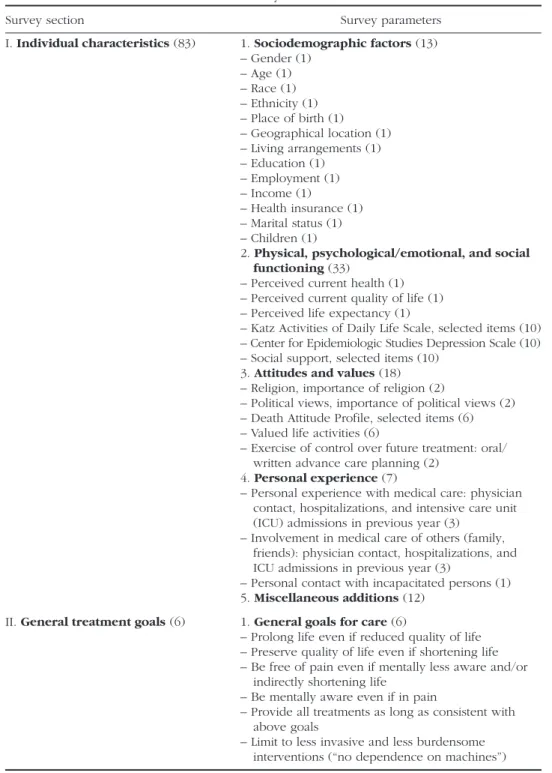
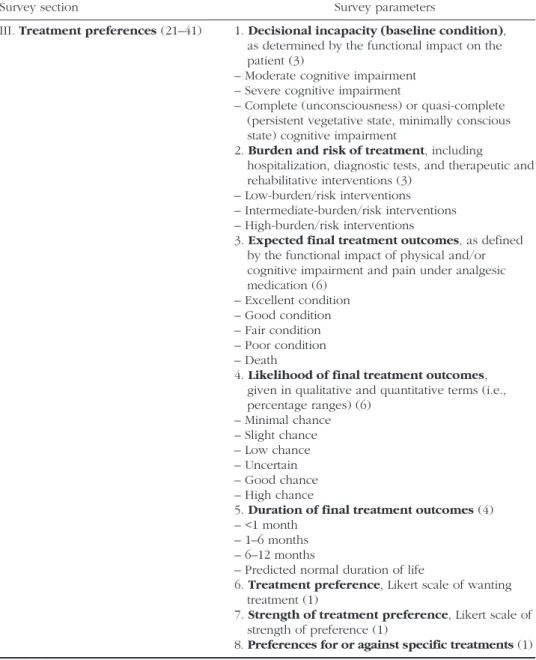
prefer-ences and any preferprefer-ences for or against specific treatments (see table 1 for details). Established survey items exist for the majority of individual char-acteristics, given that these characteristics are commonly screened in health surveys and other empirical research. There is also some experience with documenting patients’ general goals for care in advance directives (Doukas and McCullough, 1991; Emanuel, 1991; Doukas and Gorenflo, 1993) and in research studies on patients’ treatment preferences (Covinsky et al., 1996; Weeks et al., 1998; Volandes et al., 2008). A cross-sectional national study surveyed US patients for factors they consider important at the end of life (Steinhauser et al., 2000). Survey items regarding individuals’ general goals for care could thus be distilled from existing work.
Ideally, the items for surveying treatment preferences would also be derived from existing instruments. However, a review of the literature reveals that the existing instruments for recording or surveying treatment preferences would have to be substantially modified for the purposes of creating a PPP. Existing Approaches to Recording or Surveying Treatment Preferences Existing approaches to recording or surveying individuals’ treatment prefer-ences have been developed in the context of advance care planning and empirical research that attempts to identify predictors of patients’ treatment preferences. Two basic approaches to surveying how individuals want to be treated in the event of decisional incapacity emerge from the literature.
The first approach, exemplified by the Advance Medical Directive (Emanuel and Emanuel, 1989) and the Life Support Preferences Questionnaire (Coppola et al., 1999), elicits preferences for specific treatments in a prede-fined hypothetical health state. This approach defines a baseline health state through a particular—for example, Alzheimer’s disease or coma—and asks whether a list of specific treatments, such as cardiopulmonary resuscitation or gallbladder surgery, would be desired if an acute clinical event occurred in this situation. The given prognosis is tied to the patient’s baseline condi-tion, not to the expected outcome after treatment. For instance, a treatment scenario may state that there is no chance of recovery from Alzheimer’s dis-ease but may be silent on the prognosis after surgery for a life-threatening gallbladder infection.
The strength of this approach is that the patient’s baseline cognitive func-tion is clearly described. This is important because cognitive impairment can significantly influence patients’ experience of treatment. For example, a patient with moderate Alzheimer’s disease will almost certainly find gall-bladder surgery more burdensome than a competent patient. However, by eliciting preferences for specific treatments without specifying the treatment
Table 1. Basic structure of the PPP survey
Survey section Survey parameters
I. Individual characteristics (83) 1. Sociodemographic factors (13) – Gender (1) – Age (1) – Race (1) – Ethnicity (1) – Place of birth (1) – Geographical location (1) – Living arrangements (1) – Education (1) – Employment (1) – Income (1) – Health insurance (1) – Marital status (1) – Children (1)
2. Physical, psychological/emotional, and social
functioning (33)
– Perceived current health (1) – Perceived current quality of life (1) – Perceived life expectancy (1)
– Katz Activities of Daily Life Scale, selected items (10) – Center for Epidemiologic Studies Depression Scale (10) – Social support, selected items (10)
3. Attitudes and values (18) – Religion, importance of religion (2)
– Political views, importance of political views (2) – Death Attitude Profile, selected items (6) – Valued life activities (6)
– Exercise of control over future treatment: oral/ written advance care planning (2)
4. Personal experience (7)
– Personal experience with medical care: physician contact, hospitalizations, and intensive care unit (ICU) admissions in previous year (3)
– Involvement in medical care of others (family, friends): physician contact, hospitalizations, and ICU admissions in previous year (3)
– Personal contact with incapacitated persons (1) 5. Miscellaneous additions (12)
II. General treatment goals (6) 1. General goals for care (6)
– Prolong life even if reduced quality of life – Preserve quality of life even if shortening life – Be free of pain even if mentally less aware and/or
indirectly shortening life
– Be mentally aware even if in pain
– Provide all treatments as long as consistent with above goals
– Limit to less invasive and less burdensome interventions (“no dependence on machines”)
Survey section Survey parameters
III. Treatment preferences (21–41) 1. Decisional incapacity (baseline condition), as determined by the functional impact on the patient (3)
– Moderate cognitive impairment – Severe cognitive impairment
– Complete (unconsciousness) or quasi-complete (persistent vegetative state, minimally conscious state) cognitive impairment
2. Burden and risk of treatment, including
hospitalization, diagnostic tests, and therapeutic and rehabilitative interventions (3)
– Low-burden/risk interventions – Intermediate-burden/risk interventions – High-burden/risk interventions
3. Expected final treatment outcomes, as defined by the functional impact of physical and/or cognitive impairment and pain under analgesic medication (6) – Excellent condition – Good condition – Fair condition – Poor condition – Death
4. Likelihood of final treatment outcomes, given in qualitative and quantitative terms (i.e., percentage ranges) (6) – Minimal chance – Slight chance – Low chance – Uncertain – Good chance – High chance
5. Duration of final treatment outcomes (4) – <1 month
– 1–6 months – 6–12 months
– Predicted normal duration of life
6. Treatment preference, Likert scale of wanting treatment (1)
7. Strength of treatment preference, Likert scale of strength of preference (1)
8. Preferences for or against specific treatments (1)
Note:The approximate number of items and questions is given in parentheses, the estimated total number of questions being 110–130 (including 12 miscellaneous questions that might or might not be added). These numbers may change as the survey is being developed in the context of a PPP pilot study and accompanying research. Specifications and descriptions of the items would be developed with the input from patients, health professionals, families, and other relevant par-ties.
burden and expected treatment outcomes (including their likelihood and duration), key information about the given treatment option is not provided. Because clinical interventions are means to patient-specified ends (Brett, 1991), this information will significantly influence how people want to be treated in the event of decisional in capacity. By failing to specify the burden and expected outcomes of treatment, this approach to surveying treatment preferences can only provide very limited data on how people would like to be treated.
The second approach elicits individuals’ preferences for treatments that are described with respect to the treatment burden and the expected ment outcomes. Based on the idea that the burden and outcomes of treat-ment are the strongest predictors for treattreat-ment preferences, this approach provides information about possible health states after treatment, but no information about the health state before treatment. The only instrument that systematically implements this approach is the Willingness to Accept Life-Sustaining Treatment (WALT) instrument (Fried, Bradley, and Towle, 2002). The WALT instrument uses four domains to describe the burden and expected outcomes of treatment: the treatment burden, the expected health state after treatment, the likelihood of this health state, and duration of this health state. For each domain, it specifies several categories. For instance, the domain for treatment outcomes has four categories, ranging from “return to current state of health” to “death.” Treatment scenarios are then constructed by combining items from each domain. For example, a respondent might be asked whether he or she would want to undergo high-burden therapeu-tic interventions, such as one month or more of hospitalization with many diagnostic tests and major treatments (e.g., intensive care), when—following the interventions—the likelihood of being severely cognitively impaired for at least one year is 50%. All treatment scenarios stipulate certain death in the absence of treatment and in the case of treatment failure. Importantly, the WALT instrument does not elicit preferences for specific treatments but for combinations of diagnostic and therapeutic interventions with a defined degree of burden on the patient.
This approach to surveying treatment preferences is clearly superior to the first approach. It uses factors that strongly influence how people want to be treated: the treatment burden (Pearlman et al., 2000; Bookwala et al., 2001; Fried et al., 2002; Fried and Bradley, 2003), the expected health state after treatment (Ditto et al., 1996; Patrick et al., 1997; Fried, Bradley, and Towle, 2002, 2003; Fried and Bradley, 2003), the likelihood of that health state (Murphy et al., 1994; Weeks et al., 1998; Coppola et al., 1999; Fried and Bradley, 2003), and the expected duration of that health state ( Cohen-Mansfield, Droge, and Billig, 1992; Weeks et al., 1998). This approach also offers greater flexibility, given that essentially any treatment scenario can be described by combining categories from the four domains. Finally, this approach avoids a narrow focus on specific treatments, such as gallbladder
surgery, by eliciting preferences regarding combinations of clinical and diag-nostic interventions. For these reasons, the PPP survey should adopt the second approach to surveying people’s treatment preferences.
However, the only available instrument that fully implements this approach—the WALT instrument (Fried et al., 2002)—is unfortunately not nuanced enough to collect the detailed data necessary for creating a PPP. The WALT instrument does not provide enough categories in some of its domains to accurately describe treatment scenarios. For example, the “treatment bur-den” domain contains only two categories: low-burden and high-burden interventions. To accurately describe the range of possible treatment bur-dens, at least a third category or level of burden seems necessary. Moreover, the scenarios provide no information about the level of cognitive impair-ment involved (presumably because the instruimpair-ment was not developed to survey treatment preferences during periods of decisional incapacity but to survey and document the preferences of competent patients). Hence, the WALT instrument does not allow respondents to fully assess treatment bur-den. This is problematic for the purposes of creating a PPP because reduced cognitive function can influence patients’ treatment experience, particularly if treatments include longer periods of rehabilitation, such as major surgery. Finally, it seems unlikely that the six treatment scenarios included in the WALT instrument are sufficient to determine which aspects of a given treat-ment influence individuals’ treattreat-ment preferences.1 To collect the data
nec-essary for creating a PPP, it will therefore be necnec-essary to modify the WALT instrument.
A Modified Approach
To guide modification of the WALT instrument, it is helpful to make explicit the requirements that a treatment preference survey should meet for the purposes of creating a PPP: (1) treatment options should be specified with regard to four aspects: the treatment burden, the expected health state(s) after treatment, the likelihood of those health states, and duration of those health states; (2) the level of cognitive impairment at baseline should be specified, given that it can influence the level of burden posed by some treat-ments; (3) there should be no a priori limitations on combining domains— notably, it should be possible to elicit preferences for treatments with several possible outcomes; (4) a given treatment option should be summarized in bundles of diagnostic and therapeutic interventions that are associated with a given level of burden and/or risk; (5) the strength of treatment preferences should be elicited; and (6) respondents should be able to record preferences regarding specific treatments that might be refused, or wanted, on religious or other grounds (e.g., blood products).
Mindful of these requirements and using the basic structure of the WALT instrument, we propose the following approach to surveying individuals’
treatment preferences for the purposes of developing the PPP. Treatment preferences and their strength would be elicited in 10–20 treatment scenarios involving decisional incapacity.2 These scenarios would be defined by a
treatment option that is specified in five domains: (D1) decisional incapacity in the baseline condition, as determined by the impact on the patient’s func-tional status; (D2) burden and risk associated with the treatment option in question, conceived as a bundle of diagnostic, therapeutic, and rehabilitative interventions with a certain burden and/or level of risk for the patient (i.e, specific treatments, such as antibiotics or mechanical ventilation, would be mentioned only for illustrative purposes); (D3) the likely final outcomes after completion of therapy and/or rehabilitation, as defined by the functional impact of the patient’s condition after completion of therapy: physical and/ or cognitive impairment and pain with and without analgesic medication; (D4) the likelihood of the different possible final treatment outcomes, given in both qualitative and quantitative terms; and (D5) the duration of the dif-ferent possible final treatment outcomes.
Categories would be specified for each of these domains as the survey is developed. For example, the “decisional incapacity” domain D1 might contain three categories: moderate, severe, and complete or quasi-complete cognitive impairment (this assumes that mild cognitive impairment typically is compatible with patients being able to make their own treatment deci-sions). Each category in the domains would be described using general terms and specific examples. “Complete cognitive impairment” in D1, for instance, might be described as an absence of cognitive functioning that leaves the patient unable to remember, reason, and communicate, and unable to per-form activities of daily life (e.g., personal hygiene, eating). A given treatment scenario would then be described by combining categories from the five domains, D1–D5. By definition, each possible treatment outcome would be described as a combination of categories from domains D3, D4, and D5. For example, a treatment scenario might stipulate the option of receiving (D2) high-burden/risk interventions in (D1) a state of complete or quasi-complete cognitive impairment, where there is (D4a) a good chance of returning to (D3a) good physical and cognitive condition (D5a) for the predicted normal duration of life; (D4b) a low chance of being in (D3b) a poor condition (D5b) for 6–12 months; and (D4c) a slight chance of (D3c) death—which is, by defi-nition, (D5c) permanent. The alternative to treatment would be stipulated as palliative care and death.
The categories for each domain would be specified and defined with input from patients and others as the PPP survey is being developed. Based on preliminary estimates of these categories (see table 1 above), there are mil-lions of possible combinations of categories and hence milmil-lions of treatment scenarios involving decisional incapacity. It would not only be impossible to survey individuals’ treatment preferences in this number of scenarios but also be unhelpful because human psychology often is unable to distinguish
between situations differing only with respect to one of multiple factors. The challenge, therefore, is to identify those factors that are likely to influence how different individuals want to be treated during periods of decisional incapacity and create treatment scenarios accordingly.
Moreover, because the PPP’s ultimate goal is to help surrogates and clini-cians in practice, the scenarios should include the most difficult and frequent cases. A careful review of the available literature, as well as input from patients, healthy individuals, and health professionals, would be necessary to specify the categories of the five survey domains and create meaningful treatment scenarios using these categories. The experiences and results of a PPP pilot study could further refine the survey instrument. our current working hypothesis is that 10–20 treatment scenarios would be necessary to capture important differences in how individuals want to be treated during periods of decisional incapacity and reflect the most important and frequent cases occurring in practice. A set of 10–20 treatment scenarios should also be feasible to consider for participants in the PPP survey.
Development of the PPP Survey
A significant challenge in developing the PPP survey will be to identify the relevant predictors of patients’ treatment preferences that need to be assessed. Previous research reveals numerous individual factors that influ-ence patients’ treatment preferinflu-ences, including age (Covinsky et al., 1996; Phillips et al., 1996; Rosenfeld et al., 1996; Pearlman et al., 2000), gender (Garrett et al., 1993; Phillips et al., 1996; Rosenfeld et al., 1996; Pearlman et al., 2000; Bookwala et al., 2001; Fried et al., 2007; Barnato et al., 2009), race (Garrett et al., 1993; Covinsky et al., 1996; Phillips et al., 1996; Cicirelli, 1997; Fried et al., 2007; Barnato et al., 2009), marital status (Fried et al., 2007), geographical location (Phillips et al., 1996), education (Garrett et al., 1993; Cicirelli, 1997; Pruchno et al., 2006), occupational status (Cicirelli, 1997), income (Fried et al., 2007), religiousness (Pruchno et al., 2006; Balboni et al., 2007), fear of end-of-life suffering or the dying process (Cicirelli, 1997; Pruchno et al., 2006), reduced functional status (Pearlman et al., 2000), pres-ence of pain (Covinsky et al., 1996), and previous experience with medical care (Danis et al., 1988; Pruchno et al., 2006).
Previous research has also identified treatment-related factors, including the treatment burden (Pearlman et al., 2000; Bookwala et al., 2001; Fried et al., 2002; Fried and Bradley, 2003), the expected health state after treat-ment (Ditto et al., 1996; Patrick et al., 1997; Fried, Bradley, and Towle, 2002, 2003; Fried and Bradley, 2003), the likelihood (Murphy et al., 1994; Weeks et al., 1998; Coppola et al., 1999; Fried and Bradley, 2003), and the expected duration of that health state (Cohen-Mansfield, Droge, and Billig, 1992; Weeks et al., 1998). Various other factors might also influence individu-als’ preferences for or against treatment. For example, having had significant
personal contact with an incapacitated person might influence willingness to undergo treatment if permanent cognitive impairment is a likely treatment outcome. Input from patients and healthy individuals will be important for identifying the most important additional factors.3
Effective Conduct of the PPP Survey
In addition to the PPP survey instrument itself, methods will be needed to ensure the effective implementation of the PPP survey. The first challenge is to recruit a representative sample of respondents. A PPP would be used only in situations where the incapacitated patient’s treatment preferences are unclear, and it is not certain which treatment best promotes the patient’s clinical interests.4 This situation is a result of the fact that many people prefer
not to discuss how they want to be treated in the event of decisional inca-pacity. If it turned out that certain groups of people refuse to think or talk about issues related to decisional incapacity and death, recruiting them for the PPP survey could be difficult. This would not only distort the data about individuals’ treatment preferences and hence the PPP’s predictions but also reduce the PPP’s practical impact by rendering the PPP unable to predict the treatment preferences of the very patients who are least likely to have left clear evidence regarding how they want to be treated. Developing effective recruitment strategies for the PPP survey is therefore essential to ensure its validity and practical impact.
The second challenge is to ensure that respondents to the PPP survey are informed and cognizant of relevant psychological biases and hence able to report their considered treatment preferences. Strategies to meet this chal-lenge, including methods to reduce the impact of biases that influence health state evaluations, are discussed in detail in an accompanying paper (Rid and Wendler, 2014). The goal of these measures is not to question peoples’ treat-ment preferences but to ensure that the preferences reflected in the database are their considered preferences. Methods to best achieve this would have to be developed and tested in a PPP pilot study before the PPP could be implemented on a large scale.
IV. EVALUATING THE PPP IN PRACTICE
The success of incorporating a PPP into the shared decision-making pro-cess rests on several empirical assumptions regarding how the PPP would work in practice. For example, a key hypothesis is that a PPP would predict patients’ treatment preferences more accurately than surrogate decision mak-ers. These assumptions must be carefully evaluated in a pilot study before the PPP can be promoted for wider use. The pilot study should include (1) administering the PPP survey to a representative sample of people living in a reasonably sized geographical area; (2) creating a PPP based on the survey
results; (3) evaluating the PPP’s predictive accuracy by comparing the treat-ment preferences of competent patients, as well as the predictions of their surrogates, to the treatment preferences predicted for them by the PPP5; and
(4) assessing, ideally in a randomized controlled trial, the impact of different ways of using the PPP on surrogate decision makers and clinicians. The goal of the following section is to review and critically discuss the available evi-dence regarding the benefits of using a PPP. Because the PPP has not been developed yet, the available data only provide indirect evidence for how it would work in practice. Ultimately, the advantages and disadvantages of incorporating a PPP into the shared decision-making process must be evalu-ated in a PPP pilot study.
Predictive Accuracy
one of the central assumptions underlying the PPP is that it will predict incapacitated patients’ treatment preferences more accurately than surrogate decision makers and thus better promote the goal of providing treatment consistent with patients’ preferences and values. In addition, the other possi-ble benefits of incorporating a PPP into the shared decision-making process, especially helping patients’ families and loved ones, largely depend on the PPP’s improved accuracy over surrogates. What is the current evidence, then, that a PPP will predict patients’ preferences more accurately than surrogates?
There are currently no data on how accurately patients’ treatment prefer-ences could be predicted, based on their individual characteristics and on information regarding how these characteristics influence people’s prefer-ences for treatment during periods of decisional incapacity. However, exist-ing evidence suggests that the treatment preferences of the average person predict patients’ preferred treatment option just as accurately as surrogates. In one study, the average treatment preferences of 401 individuals and their chosen surrogates were equally accurate in predicting patients’ treatment preferences (Smucker et al., 2000; Houts et al., 2002). A second study found similar results when applying a common view about life-saving treatment to 47 treatment scenarios used in previous research about surrogate accuracy (Shalowitz, Garrett-Mayer, and Wendler, 2007). These findings are consistent with results from research that compares the predictive accuracy of expert or “clinical” judgment (where a judge puts data together using informal, “subjective” methods) with the accuracy of mechanical predictions (which are based on statistical models). Conducted in a broad range of areas, this research has found that expert judgment and mechanical prediction are equivalently accurate 40% of the time and that mechanical prediction is superior to expert judgment 60% of the time (Dawes, Faust, and Meehl, 1989; Grove et al., 2000).
Based on these data, our hypothesis is that individualized predictions of patients’ treatment preferences will be more accurate than predictions
that are based on the preferences of the average person. Moreover, since the treatment preferences of the average person predict patients’ preferred treatment option just as accurately as surrogates (Smucker et al., 2000; Houts et al., 2002; Shalowitz, Garrett-Mayer, and Wendler, 2007), we hypothesize that individualized predictions would also be more accurate than patients’ surrogates. Research on patients’ treatment preferences supports this assump-tion, showing that various individual characteristics, such as age and gen-der, influence how patients want to be treated during periods of decisional incapacity (see above for citations). The PPP would combine these factors, including their relative weight and possible interaction with other factors, in a statistical model that provides predictions about the individual patient.6
obviously, there are limits to maximizing the PPP’s predictive accuracy. For several reasons, the PPP’s predictions will never be 100% accurate. First, the PPP survey’s treatment scenarios might not exactly map onto actual clinical cases involving incapacitated patients. Reality is more diverse and complex than the 10–20 scenarios that will be given in the PPP survey. It is therefore possible that a PPP makes predictions that do not pertain fully to a given clinical case. However, although clinical situations have thousands of different aspects, often only a few of these aspects are relevant to how patients want to be treated. For example, if a treatment does not pose signifi-cant burdens and offers a good chance—say, a likelihood of around 80%— of returning to good health, many people will not care about the details of the other 20 possible treatment outcomes. As long as the PPP makes its predictions based on the most relevant factors, it is not very concerning that actual clinical cases are often more complex. The challenge is to identify, as the PPP is being developed, which factors are relevant for how people want to be treated during periods of decisional incapacity.
Second, it might be unclear how a given clinical situation should be clas-sified using the PPP’s domains and categories, and thus how the PPP should be applied. For example, clinicians might be uncertain whether a given set of treatments qualifies as a low-burden/risk or a moderate-burden/risk inter-vention or whether a given patient suffers from moderate or severe cognitive impairment. Although all domains and categories of the PPP survey will be defined and illustrated by examples, ambiguities will remain and reduce the PPP’s predictive accuracy.
Third, the PPP’s predictive accuracy might be reduced by surrogates’ lim-ited knowledge of the patient. Use of the PPP requires information about the patient’s individual characteristics, and surrogates are the primary source of this information. Yet, depending on which individual characteristics turn out to be the strong predictors of patients’ treatment preferences, surrogates’ knowledge about these characteristics might be limited. Families may not know, for example, to what extent their loved one feared end-of-life suffer-ing. Moreover, the same biases that skew surrogates in their prediction of the patient’s preferred treatment option (Rid and Wendler, 2010) might distort
surrogates’ perception of the patient’s individual characteristics. For exam-ple, surrogates may project their own religious attitude on their loved one when asked about the patient’s religiousness. The PPP will lose in predictive accuracy if initial information about the patient is either missing or incorrect.
The extent to which this could be a problem depends on the type of initial information about the patient that is necessary to use the PPP. If the required initial information about the patient is largely “objective,” surrogates’ limited knowledge will not have a significant impact on the PPP’s accuracy. For example, the patient’s gender, age, and race are usually easy to determine. If, by contrast, the necessary initial information requires intimate but unbi-ased knowledge of the patient, surrogates might not be a reliable source of information. Available data suggest that several “objective” individual charac-teristics, including gender (Garrett et al., 1993; Phillips et al., 1996; Rosenfeld et al., 1996; Pearlman et al., 2000; Bookwala et al., 2001; Barnato et al., 2009; Fried et al., 2007), age (Covinsky et al., 1996; Phillips et al., 1996; Rosenfeld et al., 1996; Pearlman et al., 2000), and race (Garrett et al., 1993; Covinsky et al., 1996; Phillips et al., 1996; Cicirelli, 1997; Fried et al., 2007; Barnato et al., 2009) are important predictors of patients’ treatment preferences. The PPP pilot study will have to clarify these questions and determine whether the PPP predicts patients’ treatment preferences overall more accurately than surrogates.7
Impact on Surrogates
Another key hypothesis is that use of a PPP will reduce the emotional stress and burden that at least one-third of surrogates experience as a result of helping to make treatment decisions for an incapacitated loved one and thus promote the goal of helping and respecting patients’ families and loved ones. A recent systematic review shows that anxiety over whether surrogates made the right decision significantly adds to the stress of losing or worry-ing about a loved one (Wendler and Rid, 2011). Having confidence in their knowledge of the patient’s treatment preferences eases the emotional bur-den for many surrogates. When surrogates believe they are able to ibur-dentify the patient’s preferred treatment option, they sometimes describe making treatment decisions as simply reporting or implementing the patient’s prefer-ences, as opposed to deciding for the patient (Wendler and Rid, 2011). In the words of one surrogate: “That’s why I basically have no regrets. I was carrying out her [the patient’s] wishes” (Tilden et al., 1999). Similarly, many surrogates experience lower levels of stress when the patient has completed an advance directive (Wendler and Rid, 2011). In one study, surrogates expe-rienced significantly lower stress on the Horowitz Impact of Event Scale when patients had an advance directive (Davis et al., 2005). These findings suggest that many surrogates could benefit from information on which treat-ments their loved one most likely would have chosen.
At the same time, it is conceivable that such predictions would overall have no beneficial impact on surrogates. For example, surrogates might be con-cerned that the PPP’s predictions do not reflect the individuality of their loved one. These concerns might merely substitute concerns about identifying the loved one’s preferred treatment options. Indeed, considering the PPP’s predic-tions might increase the stress on some surrogate decision makers. The confi-dence of surrogate decision makers who feel that they know which treatments their loved one would want might be undermined by use of the PPP. The PPP provides a probabilistic estimate for the possibility that the patient would have wanted to a particular treatment. By implication, the PPP provides an estimate for the chances that this prediction of the patient’s treatment preferences is mis-taken. In this way, the PPP makes explicit the possibility of mistakes. This could increase the burden on surrogates or neutralize any beneficial effects from having additional information about the patient’s likely treatment preferences.
Surrogates also might perceive the PPP’s predictions as questioning their judgment or as excluding them from the treatment decision-making pro-cess. Finally, surrogates might be stressed by having to deal with predictions of their loved one’s treatment preferences that they believe to be false. A controlled trial of the PPP will have to assess the PPP’s overall impact on surrogates, including whether different ways of using the PPP—providing its predictions as additional information or using them as a weak or strong default recommendation for treatment—vary in how they affect patients’ families and loved ones.8
Acceptance by Patients, Surrogates, and Clinicians
A further assumption underlying our proposal is that incorporating a PPP into the shared decision-making process will be accepted by patients, surrogates, and clinicians and thus promote the goal of respecting patients’ preferences regarding how treatment decisions are made, as well as the goal of promot-ing timely decision makpromot-ing. one of patients’ primary goals for treatment decision making in the event of decisional incapacity is to reduce the bur-den on their families (Kelly, Rid, and Wendler, 2012). If use of the PPP eases stress in surrogates, patients may well endorse this approach. Final deter-mination regarding the acceptance of a PPP will have to await collection of the requisite empirical data. Acceptance is likely to depend on whether the PPP would be used in a way that promotes the ethical goals for treatment decision making that patients—and to a lesser extent surrogates—prioritize. It is therefore necessary to conduct research on how patients prioritize and/ or balance the ethical goals for treatment decision making. Acceptance will also depend on the extent to which use of the PPP improves realization of these goals over current practice. Finally, patients and surrogates are likely to accept use of a PPP better when effective mechanisms for opting out of its use are in place.9
Potential for Abuse
An important aspect of both the acceptance and the ethical acceptability of a PPP is its potential for abuse or perceived abuse. Patients’ families and loved ones, clinicians, and hospital managers might manipulate the PPP to justify decisions that promote their own interests over the patient’s interests. or fami-lies might have concern that hospitals are using the PPP in this way. However, conflicts of interest in the care for incapacitated patients are not unique to using the PPP. Reliance on surrogates, for example, is vulnerable to the possi-bility that surrogates will make decisions that further their interests, even when doing so conflicts with the patient’s preferences and interests. The question, therefore, is whether including the PPP into the shared decision-making pro-cess increases the chance that patients’ clinical interests will not be protected. There is little reason to believe that this will be the case due to PPP abuse by families. Patients’ families might attempt to distort the patient’s individual characteristics, for example, to generate predictions favoring treatment if the patient’s benefits are their main source of income. However, clinicians who care for incapacitated patients must be wary of deception or manipulation by surrogates whether or not a PPP is used in the decision-making process. In fact, the PPP might help clinicians protect their patients’ clinical interests if the PPP predicts treatment preferences based on more “objective” individual characteristics of the patient, such as age and gender, which clinicians could determine without input from surrogates.
By contrast, there is a risk that patients’ clinical interests would be more difficult to protect because the PPP might be abused by clinicians and hospi-tal managers. For example, hospihospi-tal managers and clinicians might manipu-late the PPP to make predictions that are favorable for the hospital budget, empty a needed bed, or help getting rid of a difficult patient—while they mask their true motivations with the alleged preferences and values of the patient. To address this concern, it is important that the PPP be operated by an independent nonprofit organization that ensures its proper develop-ment and use in actual clinical cases and reassures the public that it has been developed properly. This would be best achieved by making the PPP publicly available—for example, as an online version that people could use to enter their or their loved ones’ individual characteristics and see what the PPP would predict in different treatment scenarios—and establishing a low-threshold mechanism for complaints about PPP abuse. Such complaints would have to be investigated independently and, if necessary, pursued by legal means. This setup should help patients’ families and loved ones exercise their role as the patient’s advocate. It seems that involving both sur-rogates and clinicians in use of the PPP will allow each party to monitor the other and reduce the likelihood of PPP abuse. Abuse of the PPP also might be minimized by granting surrogates or family the ultimate power to over-ride any decisions based on the PPP.
V. LEGAL CoNSIDERATIoNS
Incorporating a PPP into the shared decision-making process is only a slight modification of the standard approach toward treatment decision making for incapacitated patients. Implementation of the PPP would therefore be con-sistent with the current ethical and legal framework for making these deci-sions in many countries. For example, the majority of states in the United States now have statutes regulating who can serve as a surrogate decision maker and what type of decisions the surrogate can and cannot make. Use of a PPP would not undercut surrogates’ right to make the final treatment decision consistent with these statutes. As discussed above, the PPP’s predic-tions could be used as additional information for the surrogate to consider, or they could be used as a default recommendation for treatment. Either of these approaches would protect surrogates’ legal right to make treatment decisions for their loved one.
VI. CoST
Assuming the PPP can be developed and it proves helpful in practice, its overall feasibility will be at least partially determined by considerations of cost. The costs of developing the survey and conducting a PPP pilot study should not exceed the range for a larger research project with a budget of several million dollars. The costs of developing and implementing the PPP on a larger scale, however, are harder to project. In particular, it is difficult to estimate the sample size of the initial PPP survey, which would largely determine the costs of conducting the survey.10 Several activities related to
developing the PPP, including analyzing the data, making the PPP publicly accessible, and informing the public, would lead to further costs. Although it is hard to provide precise estimates at this point, it seems reasonable to assume that the costs of developing a PPP would not exceed the costs of national research projects in medicine, which can amount to several tens of millions of dollars.
Maintenance and administration of the PPP would require further expen-ditures. Maintenance would necessitate regular updates of the PPP survey (e.g., every 5–10 years). The costs of these updates, however, would be dramatically lower than the costs of developing a PPP because they could be conducted with much smaller cohorts. Administration of the PPP by a nonprofit organization would primarily include managing complaints about abuse and continuing to promote the PPP through information campaigns. The annual budget to cover these activities would probably be relatively low, in the range of a few million dollars.
It is clear that the total costs of a PPP would be significant, in particular, since changes in end-of-life care may not lead to cost savings (Emanuel
and Emanuel, 1994). However, the costs of a PPP have to be put into the larger context of health expenditures at the end of life, which currently con-sume significant portions of the total health care budget. For example, in the US 10%–12% of total health expenditures are spent on end-of-life care (Emanuel, 1996). Given that the US health care budget in 2007 was $2.2 trillion, $220 billion was spent on end-of-life care that year. The one-time investment of several tens of millions of dollars, and the annual maintenance costs of at most a few million dollars, do not seem excessive in relation to these numbers. In fact, the PPP might be a good investment if patients are more likely to receive the treatments they would want, and patients’ families and loved ones suffer less stress and anxiety during a difficult time. In the end, the PPP’s practical impact will determine whether it would be a good investment of public money.
VII. CoNCLUSIoNS
Can a PPP be developed? If it can be developed, how well would it work in practice? The present paper has provided an affirmative answer to the first question and outlined a research plan to answer the second ques-tion. Development and implementation of a PPP would require significant resources. However, given that incorporating the use of a PPP into the shared decision-making process is justifiable both conceptually and norma-tively (Rid and Wendler, 2014), and given that shared decision making com-bined with a PPP is likely superior to alternative proposals for improving the standard approach to treatment decision making for incapacitated patients (Rid and Wendler, 2010), pursuing the development of a PPP appears to be worth the effort.
NoTES
1. The WALT instrument reduces the number of treatment scenarios, first, by limiting the combina-tions of categories and/or domains and, second, by asking clinicians which scenarios are most frequent in practice. Seeking input from clinicians and other stakeholders is the right strategy for narrowing the number of treatment scenarios. However, by limiting the combinations of categories and/or domains a priori, it is possible that some of the most frequent and most important scenarios in clinical practice can-not be accurately described. For example, the WALT instrument stipulates that treatments have no more than two possible outcomes: death if treatment fails or is foregone, and some other condition if treatment succeeds. This, however, does not reflect the realities of clinical practice. Undergoing intensive care, for instance, is often associated with a good chance of returning to good physical and cognitive condition, a low chance of being in a poor condition, and a slight chance of death. Considering that the PPP aims to make highly individualized predictions about patients’ treatment preferences, the PPP survey should not set a priori limits for or against including treatment scenarios in the survey.
2. It might be useful to incorporate questions about why people have the treatment preferences they do, an idea we do not discuss here.
3. There is a possibility that relevant predictors of incapacitated patients’ treatment preferences will remain unidentified and will thus not be included in the PPP survey. For example, pet ownership or a preference for the color yellow might be strongly associated with a preference for maximal treatment,
but these relationships are unlikely to be discovered. However, although the final PPP survey may not include every relevant predictor of people’s treatment preferences, the chance of missing important pre-dictors can be reduced by developing the PPP survey in close interaction with those patients and healthy individuals.
4. When some treatment clearly promotes the patient’s clinical interests, the PPP might be used to exclude that the patient would not have wanted this particular treatment. In this situation, the patient’s clinical interests should only be overridden if the PPP provides compelling evidence that the patient strongly rejected the given treatment. We discuss this situation in more detail in an accompanying paper (Rid and Wendler, 2014).
5. This should include testing the possibility of making inferences about unstated preferences from stated preferences, such as not wanting high-burden interventions if moderate-burden interventions are rejected (Emanuel et al., 1994; Pearlman et al., 2000).
6. The above-mentioned study (Smucker et al., 2000) found that including age, education, and other covariates into the predictive model for patients’ treatment preferences did not improve the model’s predictive ability. However, this is likely explained by the homogenous sample of patients used in the study. All study participants were >65 years of age, ~90% were white, ~80% were in very good/excellent or good health, ~70% were married, and another ~70% were protestant.
7. our considerations regarding the PPP’s predictive accuracy are based on the assumption that the treatment preferences elicited by the PPP survey are indeed correlated to real-life events. A skeptic might question this assumption and object that a PPP pilot study would only test how accurately the PPP predicts what is being measured. We address this concern in an accompanying paper (Rid and Wendler, 2014).
8. The different ways of incorporating the use of a PPP into the shared decision-making process are discussed in detail in an accompanying paper (Rid and Wendler, 2014).
9. See accompanying paper for a detailed discussion of opt-out mechanisms (Rid and Wendler, 2014).
10. Although there is a considerable body of research on predictors of patients’ treatment prefer-ences, existing data are not homogenous enough to make a reliable sample size estimate. In particular, it is unclear whether there will be interaction effects between various factors that predict people’s treatment preferences. For example, one study found an interaction term for race by education that was, however, no longer statistically significant after it was adjusted for other variables (Garrett et al., 1993). If the PPP pilot study shows that interaction effects do not occur, the necessary sample size would be significantly reduced.
ACKNoWLEDGMENTS
The authors thank Bob Wesley and Ben Berkman for helpful comments on previous versions of this paper. Annette Rid received financial support from the Swiss National Science Foundation (PA00B-117505/1 and PA0033-117505/2) to work on this project. This work was completed as part of the authors’ official duties as employees of the NIH Clinical Center. However, the opinions expressed are the authors’ own. They do not represent any position or policy of the National Institutes of Health, Public Health Service, or Department of Health and Human Services.
REFERENCES
Balboni, T. A., L. C. Vanderwerker, S. D. Block, M. E. Paulk, C. S. Lathan, J. R. Peteet, and H. G. Prigerson. 2007. Religiousness and spiritual support among advanced cancer patients and associations with end-of-life treatment preferences and quality of life. Journal of
Clinical Oncology 25:555–60.
Barnato, A. E., D. L. Anthony, J. Skinner, P. M. Gallagher, and E. S. Fisher. 2009. Racial and ethnic differences in preferences for end-of-life treatment. Journal of General Internal
Bookwala, J., K. M. Coppola, A. Fagerlin, P. H. Ditto, J. H. Danks, and W. D. Smucker. 2001. Gender differences in older adults’ preferences for life-sustaining medical treatments and end-of-life values. Death Studies 25:127–49.
Brett, A. S. 1991. Limitations of listing specific medical interventions in advance directives. The
Journal of the American Medical Association 266:825–28.
Buchanan, A. E. and D. W. Brock. 1989. Deciding for Others: The Ethics of Surrogate
Decision-Making. Cambridge: Cambridge University Press.
Cicirelli, V. G. 1997. Relationship of psychosocial and background variables to older adults’ end-of-life decisions. Psychology and Aging 12:72–83.
Cohen-Mansfield, J., J. A. Droge, and N. Billig. 1992. Factors influencing hospital patients’ preferences in the utilization of life-sustaining treatments. Gerontologist 32:89–95. Coppola, K. M., J. Bookwala, P. H. Ditto, L. K. Lockhart, J. H. Danks, and W. D. Smucker.
1999. Elderly adults’ preferences for life-sustaining treatments: The role of impairment, prognosis, and pain. Death Studies 23:617–34.
Covinsky, K. E., C. S. Landefeld, J. Teno, A. F. Connors, Jr., N. Dawson, S. Youngner, N. Desbiens et al. 1996. Is economic hardship on the families of the seriously ill associ-ated with patient and surrogate care preferences? SUPPoRT investigators. Archives of
Internal Medicine 156:1737–41.
Danis, M., D. L. Patrick, L. I. Southerland, and M. L. Green. 1988. Patients’ and families’ pref-erences for medical intensive care. The Journal of the American Medical Association 260:797–802.
Davis, B. A., J. Burns, D. Rezac, B. Dillard, E. Kieffner, J. Gargus, A. S. Tiberi, and J. Waters. 2005. Family stress and advance directives: A comparative study. Journal of Hospice and
Palliative Nursing 7:219–27.
Dawes, R. M., D. Faust, and P. E. Meehl. 1989. Clinical versus actuarial judgment. Science 243:1668–74.
Ditto, P. H., J. A. Druley, K. A. Moore, J. H. Danks, and W. D. Smucker. 1996. Fates worse than death: The role of valued life activities in health-state evaluations. Health Psychology 15:332–43.
Doukas, D. J. and D. W. Gorenflo. 1993. Analyzing the values history: An evaluation of patient medical values and advance directives. The Journal of Clinical Ethics 4:41–45.
Doukas, D. J. and L. B. McCullough. 1991. The values history. The evaluation of the patient’s values and advance directives. The Journal of Family Practice 32:145–53.
Emanuel, E. J. 1996. Cost savings at the end of life. What do the data show? The Journal of the
American Medical Association 275:1907–14.
Emanuel, E. J. and L. L. Emanuel. 1994. The economics of dying. The illusion of cost savings at the end of life. The New England Journal of Medicine 330:540–44.
Emanuel, L. 1991. The health care directive: Learning how to draft advance care documents.
Journal of the American Geriatrics Society 39:1221–28.
Emanuel, L. L., M. J. Barry, E. J. Emanuel, and J. D. Stoeckle. 1994. Advance directives: Can patients’ stated treatment choices be used to infer unstated choices? Medical Care 32:95–105.
Emanuel, L. L. and E. J. Emanuel. 1989. The medical directive. A new comprehensive advance care document. The Journal of the American Medical Association 261:3288–93.
Fried, T. R. and E. H. Bradley. 2003. What matters to seriously ill older persons making end-of-life treatment decisions? A qualitative study. Journal of Palliative Medicine 6:237–44.
Fried, T. R., E. H. Bradley, and V. R. Towle. 2002. Assessment of patient preferences: Integrating treatments and outcomes. The Journals of Gerontology. Series B, Psychological Sciences
and Social Sciences 57:S348–54.
———. 2003. Valuing the outcomes of treatment: Do patients and their caregivers agree?
Archives of Internal Medicine 163:2073–78.
Fried, T. R., E. H. Bradley, V. R. Towle, and H. Allore. 2002. Understanding the treatment preferences of seriously ill patients. The New England Journal of Medicine 346:1061–66. Fried, T. R., P. H. Van Ness, A. L. Byers, V. R. Towle, J. R. o’Leary, and J. A. Dubin. 2007.
Changes in preferences for life-sustaining treatment among older persons with advanced illness. Journal of General Internal Medicine 22:495–501.
Garrett, J. M., R. P. Harris, J. K. Norburn, D. L. Patrick, and M. Danis. 1993. Life-sustaining treat-ments during terminal illness: Who wants what? Journal of General Internal Medicine 8:361–68.
Grove, W. M., D. H. Zald, B. S. Lebow, B. E. Snitz, and C. Nelson. 2000. Clinical versus mechanical prediction: A meta-analysis. Psychological Assessment 12:19–30.
Houts, R. M., W. D. Smucker, J. A. Jacobson, P. H. Ditto, and J. H. Danks. 2002. Predicting elderly outpatients’ life-sustaining treatment preferences over time: The majority rules.
Medical Decision Making 22:39–52.
Kelly, B., A. Rid, and D. Wendler. 2012. Systematic review: Individuals’ goals for surrogate decision-making. Journal of the American Geriatrics Society 60:884–95.
Murphy, D. J., D. Burrows, S. Santilli, A. W. Kemp, S. Tenner, B. Kreling, and J. Teno. 1994. The influence of the probability of survival on patients’ preferences regarding cardiopul-monary resuscitation. The New England Journal of Medicine 330:545–49.
Patrick, D. L., R. A. Pearlman, H. E. Starks, K. C. Cain, W. G. Cole, and R. F. Uhlmann. 1997. Validation of preferences for life-sustaining treatment: Implications for advance care planning. Annals of Internal Medicine 127:509–17.
Pearlman, R. A., K. C. Cain, H. Starks, W. G. Cole, R. F. Uhlmann, and D. L. Patrick. 2000. Preferences for life-sustaining treatments in advance care planning and surrogate deci-sion-making. Journal of Palliative Medicine 3:37–48.
Phillips, R. S., N. S. Wenger, J. Teno, R. K. oye, S. Youngner, R. Califf, P. Layde et al. 1996. Choices of seriously ill patients about cardiopulmonary resuscitation: Correlates and outcomes. SUPPoRT investigators. Study to understand prognoses and preferences for outcomes and risks of treatments. The American Journal of Medicine 100:128–37. Pruchno, R. A., E. P. Lemay, Jr., L. Feild, and N. G. Levinsky. 2006. Predictors of patient
treat-ment preferences and spouse substituted judgtreat-ments: The case of dialysis continuation.
Medical Decision Making 26:112–21.
Rid, A. and D. Wendler. 2010. Can we improve treatment decision-making for incapacitated patients? Hastings Center Report 40:6–45.
———. 2014. Use of a Patient Preference Predictor to help make medical decisions for inca-pacitated patients. Journal of Medicine and Philosophy 39:104–29.
Rosenfeld, K. E., N. S. Wenger, R. S. Phillips, A. F. Connors, N. V. Dawson, P. Layde, R. M. Califf et al. 1996. Factors associated with change in resuscitation preference of seriously ill patients. The SUPPoRT investigators. Study to understand prognoses and preferences for outcomes and risks of treatments. Archives of Internal Medicine 156:1558–64. Shalowitz, D. I., E. Garrett-Mayer, and D. Wendler. 2007. How should treatment decisions be
Smucker, W. D., R. M. Houts, J. H. Danks, P. H. Ditto, A. Fagerlin, and K. M. Coppola. 2000. Modal preferences predict elderly patients’ life-sustaining treatment choices as well as patients’ chosen surrogates do. Medical Decision Making 20:271–80.
Steinhauser, K. E., N. A. Christakis, E. C. Clipp, M. McNeilly, L. McIntyre, and J. A. Tulsky. 2000. Factors considered important at the end of life by patients, family, physicians, and other care providers. The Journal of the American Medical Association 284:2476–82. Tilden, V. P., S. W. Tolle, C. A. Nelson, M. Thompson, and S. C. Eggman. 1999. Family
deci-sion-making in foregoing life-extending treatments. Journal of Family Nursing 5:426–42. Volandes, A. E., M. Paasche-orlow, M. R. Gillick, E. F. Cook, S. Shaykevich, E. D. Abbo, and
L. Lehmann. 2008. Health literacy not race predicts end-of-life care preferences. Journal
of Palliative Medicine 11:754–62.
Weeks, J. C., E. F. Cook, S. J. o’Day, L. M. Peterson, N. Wenger, D. Reding, F. E. Harrell et al. 1998. Relationship between cancer patients’ predictions of prognosis and their treatment preferences. The Journal of the American Medical Association 279:1709–14.
Wendler, D. and A. Rid. 2011. Systematic review: The effect on surrogates of making treatment decisions for others. Annals of Internal Medicine 154:336–46.