Conditional human VEGF-mediated vascularization in
chicken embryos using a novel
temperature-inducible gene regulation (TIGR) system
Wilfried Weber, Rene R. Marty, Nils Link, Martin Ehrbar
1, Bettina Keller,
Cornelia C. Weber
1, Andreas H. Zisch
1, Christoph Heinzen
2, Valentin Djonov
3and
Martin Fussenegger*
Institute of Biotechnology, Swiss Federal Institute of Technology Zurich, ETH Hoenggerberg, CH-8093 Zurich, Switzerland,1Department of Materials and Institute for Biomedical Research, ETH Zurich and University of Zurich,
CH-8044 Zurich, Switzerland,2Inotech Encapsulation AG, Kirchstrasse 1, CH-5605 Dottikon, Switzerland and 3Institute of Anatomy, University of Bern, CH-3009 Bern, Switzerland
Received February 26, 2003; Revised and Accepted April 28, 2003
ABSTRACT
Advanced heterologous transcription control sys-tems for adjusting desired transgene expression are essential for gene function assignments, drug discovery, manufacturing of dif®cult to produce protein pharmaceuticals and precise dosing of gene-based therapeutic interventions. Conversion of the Streptomyces albus heat shock response regulator (RheA) into an arti®cial eukaryotic tran-scription factor resulted in a vertebrate thermo-sensor (CTA; cold-inducible transactivator), which is able to adjust transcription initiation from chimeric target promoters (PCTA) in a
low-inducible manner. Evaluation of the temperature-dependent CTA±PCTA interaction using a tailored
ELISA-like cell-free assay correlated increased af®nity of CTA for PCTAwith temperature downshift.
The temperature-inducible gene regulation (TIGR) system enabled tight repression in the chicken bursal B-cell line DT40 at 41oC as well as precise
titration of model product proteins up to maximum expression at or below 37oC. Implantation of
microencapsulated DT40 cells engineered for TIGR-controlled expression of the human vascular endothelial growth factor A (hVEGF121)
provided low-temperature-induced VEGF-mediated vascularization in chicken embryos.
INTRODUCTION
Molecular responses to environmental temperature changes have evolved throughout living systems. Major response phenotypes include cold tolerance (1±3) and heat shock phenomena (1,4±7). In prokaryotes, adaptation to elevated temperatures may result from short-term climatic changes or habitat switches, which are typical for human pathogenic
bacteria. The molecular basis for temperature sensing includes (i) chaperone-mediated detection of denatured or misfolded proteins (8); (ii) temperature-dependent allosteric changes in thermosensors (7,9); (iii) promoter-adjusting DNA supercoiling (10); or (iv) translation-modulating temperature-responsive mRNA secondary structures (5,11).
In Streptomyces albus, thermotolerance is mediated by the heat shock protein 18 (HSP18) whose expression is controlled by a divergently encoded thermosensor RheA (12). At low temperature, <30°C, RheA binds to a dyad symmetrical operator (rheO) overlapping the ±35 and ±10 boxes of the divergently oriented rheA and hsp18 promoters (PrheA and
Phsp18) and represses both genes (13). Within <1 min
following a temperature upshift to 41°C, allostery-based disruption of the RheA±rheO interaction results in con-comitant derepression of PrheA and Phsp18 and induction of
HSP18-mediated thermotolerance. Autoregulated RheA expression at elevated temperatures provides high repressor levels, which are required for immediate reversion of the HSP18 production mode following a shift back to standard growth temperatures (30°C) (7).
In order to evaluate whether molecular thermometers are functional in a eukaryotic cell context, we have converted the Streptomyces RheA±rheO interaction into a temperature-inducible gene regulation (TIGR) system. TIGR-controlled expression of human vascular endothelial growth factor A (hVEGF121) in chicken bursal B cells (DT40) was silent at
41°C and could be cold induced to maximum expression levels at 37°C. Cold-induced angiogenesis was con®rmed in chicken embryos following implantation of micro-encapsulated DT40 cell derivatives encoding a TIGR-based temperature-responsive hVEGF121expression unit.
MATERIALS AND METHODS Plasmid construction
The cold-inducible transactivator CTA (RheA-VP16) was constructed by cloning the S.albus G (strain J1074) rheA gene,
*To whom correspondence should be addressed. Tel: +41 1 633 3448; Fax: +41 1 633 1051; Email: [email protected]
ampli®ed from pOLP12B [kindly provided by P. Mazodier (7)] by PCR using oligonucleotides OWW127: 5¢-gtacgaattcc-caccatgaccaccgccgaccgccc-3¢ and OWW128: 5¢-gcgcgcggc-tgtacgcggaggaccgcccggacgaggcc-3¢, digested by EcoRI± BssHII into the corresponding sites of pWW35 (14) (pWW251). pWW255 was constructed by cloning of PhEF1a
[excised from pWW29 (14)] digested by SspI±EcoRI into pWW251. The cold-inducible CTA-dependent promoter PCTA was assembled by amplifying PhCMVminfrom pWW37
(14) using oligonucleotides OWW129: 5¢-gatcgacgtc-tgtcatcgttcggatgacacctgcaggtcgagctcggtacccgggtc-3¢ [RheA-speci®c operator site (rheO) underlined] and OWW22 (14) and cloning it digested by AatII±EcoRI into pWW37 (pWW253). For construction of pWW254, the Bacillus stearothermophilus-derived secreted a-amylase (SAMY)-encoding SpeI±HindIII fragment from pSS193 (15) was ligated (XbaI±HindIII) into pWW253. The autoregulated SAMY expression vector pWW259 was constructed by cloning CTA excised (SpeI±XbaI) from pWW255 into the NheI site of pWW254. hVEGF121was ampli®ed by RT±PCR
from a human aortic smooth muscle cell mix using oligonucleotides OCW76: 5¢-cgcggtaccatgaactttctgctgtctt-ggg-3¢ and OCW77: 5¢-cgcggatcctcaccgcctcggcttgtc-3¢ and cloned (KpnI±BamHI) into pcDNA3 (Invitrogen, Carlsbad, CA) (pcDNA-hVEGF121). hVEGF121 was reampli®ed using
OWW134: 5¢-ggtctagaccaccatgaactttctgctg-3¢ and OWW135: 5¢-ctcgagtcaccgcctcgg-3¢ and ligated into pEF6/V5-His TOPO (Invitrogen) (pWW276). pWW277 was constructed by excis-ing hVEGF121from pWW276 using XbaI±XhoI and cloning it
into pWW253. The prokaryotic CTA expression vector pWW317 was constructed by ampli®cation of CTA from pWW255 using OWW312: 5¢-cggaattcccaccatgcatatgaccac-cgccgaccgc-3¢ and OWW313: 5¢-gctctagagcaagcttctacccaccg-tactcgtcaattc-3¢ and ligation (NdeI±HindIII) into pRSETmod [modi®ed pRSET vector (16)]. A 227 bp biotinylated rheO-encoding DNA fragment was assembled by ampli®c-ation of rheO using oligonucleotides OWW64: biotin-5¢-ggggttccgcgcacatttcccc-3¢ and OWW22 (14) and pWW254 as template. All PCR products were con®rmed by DNA sequencing.
Cell culture and reporter gene assays
The chicken bursal lymphoma cell line DT40 (ATCC CRL-2111) was cultivated as described (17).
SAMY was quanti®ed as units per liter (U/l) as described before (15), and hVEGF121was assessed using a human VEGF
DuoSet enzyme-linked immunosorbent assay (ELISA; R&D Systems, Minneapolis, MO; cat. no. DY293) according to the manufacturer's protocol.
Electroporation of DT40 cells
For electroporation-based transfection, 5±8 3 105
exponen-tially growing DT40 cells/ml were centrifuged at 450 g for 3 min, and 4 3 106cells were resuspended in 0.4 ml of
serum-free RPMI-1640 medium. The cells were mixed with 30 mg of DNA per plasmid and transferred to a Gene Pulser Cuvette (Bio-Rad Laboratory AG, Glattbrugg, Switzerland; cat. no. 165-2088). Electroporation was performed using a Bio-Rad Gene Pulser II and the following settings, resulting in typical time constants of 45 ms: capacitance, 960 mF; voltage, 360 V; resistance, R = `. Electroporation of
DT40 resulted in a typical transfection ef®ciency of 42 6 5%. After electroporation, the transfected cells were diluted in 12 ml of complete RPMI-1640 medium and cultivated as described.
Western blot analysis of CTA
A 1 ml culture from an Escherichia coli CTA production strain was subjected to western blotting following detection using a mouse anti-VP16 antibody (Santa Cruz Biotechnology Inc., Santa Cruz, CA; cat. no. sc-7545) and an anti-mouse horseradish peroxidase (HRP)-coupled secondary antibody as described below.
ELISA-based cell-free analysis of CTA±PCTA
interactions
For production of CTA, pWW317 (PT7-CTA-pA) was
trans-formed into E.coli BL21* (DE3)pLysS (Invitrogen; cat. no. C6010-03) and transgenic E.coli strains were grown to an OD600 of 1.2 prior to isopropyl-b-D
-thiogalactopyranoside-(1 mM) mediated induction for 3±4 h. Lysates were produced by lysozyme treatment (0.2 mg/ml) for 45 min at 37°C and the DNA was fragmented by sonication (®ve bursts of 2 s at 75 W using a Branson Soni®er 450; Branson Ultrasonic Corp., Carouge, Switzerland). The supernatant was clari®ed by centrifugation at 21 000 g for 30 min and 4°C. ELISA plates (Corning, New York, NY; cat. no. 3590) were coated overnight with 100 ml/well streptavidin solution (6 mg/ml) at 37°C while shaking at 250 r.p.m., and blocked for 2 h using blocking solution [1% blocking reagent (Roche Molecular Biochemicals, Rotkreuz, Switzerland; cat. no. 1-096-176) in TBS (20 mM Tris±HCl, 150 mM NaCl, pH 7.6) and 10 mM EDTA]. The blocking solution was removed and the plates were washed four times with TBS±Tween (TBST). A 100 ml aliquot of a 2 mg/ml solution containing biotinylated rheO-encoding DNA in blocking solution was added per well and incubated for 1 h. As in all subsequent incubation steps, the sample was kept at 23°C and was shaken at 250 r.p.m. After washing each well four times with 400 ml of pre-warmed TBST, 30 ml of CTA-containing crude cell extract (containing 0.5 mg of CTA in 100 ml of protein in blocking solution) was added per well, followed by incubation for 1 h. The wells were washed four times with 400 ml of TBST, ®lled with 100 ml of blocking solution per well and incubated at different temperatures for 1 h. After washing four times with 400 ml of TBST pre-warmed at appropriate temperatures, the wells were incubated with a 1:200 dilution of monoclonal mouse anti-VP16 antibody (Santa Cruz Biotechnology; cat. no. sc-7545) in blocking solution for 1 h. The primary antibody was removed, and the wells were washed four times with 400 ml of TBST and incubated for 30 min with the secondary HRP-coupled anti-mouse IgG (Amersham Pharmacia Biotech, Dubendorf, Switzerland; cat. no. NA931, lot. no. 168416) diluted 1:200 in blocking solution without EDTA. The chromogenic reaction was initiated by addition of 100 ml of 3,3¢,5,5¢-tetramethylbenzidine (TMB) substrate solution (Sigma Chemicals, St Louis, MO; cat no. T-8665), stopped by addition of 25 ml of 1 M H2SO4, and quanti®ed by
absorbance readings taken at 450 nm on a SpectraMax Plus (Molecular Devices, Sunnyvale, CA).
Microencapsulation of DT40 cells
At 20 h post-electroporation, DT40 cells were micro-encapsulated in alginate±poly-L-lysine±alginate beads using
the Inotech Encapsulator Research IER-20 as previously described (14). Microencapsulated DT40 cells were cultivated in 10 ml of complete RPMI-1640 medium for 24 h at 41°C prior to implantation into the chicken embryo (14,16). Monitoring vascularization in chicken embryos
Experiments involving chicken embryos were conducted following the shell-free cultivation protocols of Djonov et al. (18). After 3 days of incubation at 37°C, Brown Leghorn eggs were opened and their contents carefully poured into plastic Petri dishes of 80 mm in diameter. The chicken embryos were incubated further for 6 days at 37°C in a humidi®ed atmosphere. On embryonic day 9, 50 ml of a concentrated capsule solution (750 microcapsules containing 200 DT40 cells/capsule) containing microencapsulated DT40 cells engineered for TIGR-controlled hVEGF121 production
was injected under the chorioallantoic membrane (CAM) or placed onto the CAM. The embryos were cultivated for a further 2 days at 37 and 41°C, respectively. At embryonic day 11, the CAMs were examined by in vivo ¯uorescence microscopy. Micrographs were taken following intravenous injections of 100 ml of 2.5% ¯uorescein isothiocyanate (FITC)±dextran 2 000 000 (Sigma Chemicals) (19). The developing blood vessels were monitored using a Polyvar-Reichert ¯uorescence microscope (Leica AG, Heerbrugg, Switzerland) at 25-fold magni®cation. The microscope was equipped with a custom-built heating table to maintain the temperature of the specimens at the desired temperatures (37 or 41°C). Blood circulation and microvascular patterns were monitored for 15 min for every CAM using a LE CCD Optronics video camera (Visitron system, Puchheim, Germany) and a digital video recorder (Sony, DHR-1000 VC, Sony AG, Schlieren, Switzerland).
Morphological analysis of vascularization
CAM samples were ®xed at embryonic day 11 in 2.5% glutaraldehyde [buffered with 30 mM potassium phosphate (370 mOsm; pH 7.4)], stained in 1% osmium tetroxide [buffered with 0.1 M sodium cacodylate (340 mOsm; pH 7.4)], dehydrated in ethanol, and embedded in Epon 812 as described before (20). Sections 1 mm thick were prepared using glass knives, stained with toluidine blue, and examined on an Leitz DM-RBE light microscope (Leica AG, Heerbrugg, Switzerland) equipped with a JVC KY-F70 video camera (Spietzer Electronic AG, Oberwil, Switzerland). Furthermore, 80±90 nm thick sections were generated, transferred onto Formvar-coated (polyvinyl formal; Fluka Chemie AG, Buchs, Switzerland) copper grids, double-stained with lead citrate and uranyl acetate, and monitored using a Philips EM 400 transmission electron microscope (18).
Methylmethacrylate (Mercoxâ) casting
Mercoxâ(Japan Vilene Company) casts of CAM vessels were
prepared at embryonic day 11. The vasculature was perfused with a 0.9% sodium chloride solution containing 1% Liqeminâ and Procaineâ, followed by a freshly prepared
Mercoxâsolution containing 0.1 ml of accelerator per 5 ml of
resin. At 2 h after perfusion, the CAMs were excised and immersed in Ringer's solution for ~2 h and subsequently transferred to 15% KOH for 2±4 weeks for dissolution of the tissue. After washing, the casts were dehydrated in a graded series of increasing ethanol concentrations and dried in a vacuum desiccator (18). Samples were mounted on aluminum stubs with carbon and sputtered with gold. They were examined in a Philips XL 30 FEG scanning electron microscope.
RESULTS
Design of the low temperature-inducible gene regulation system
Previous design concepts of heterologous transgene control systems for vertebrates/vertebrate cells included a regulating small molecule that modulates the af®nity of an arti®cial transactivator for its speci®c target promoter and thus adjusts desired transgene expression in response to a molecule-speci®c dosing regime (21,22). Unfortunately, many regulat-ing agents proved to be toxic, elicited short- and long-term side effects or have not yet been clinically licensed (21±25). In order to avoid de®ciencies often found to be associated with regulating small molecules, gene control systems that could be ®ne-tuned by physical parameters such as tempera-ture would represent a valuable alternative to current technologies.
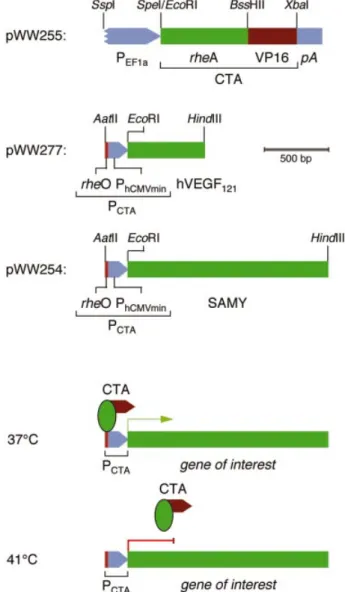
The generic cold-inducible transcription control system consists of two chimeric genetic determinants, CTA and its cognate promoter (PCTA). CTA was constructed by fusing the
S.albus heat shock response regulator RheA 3¢ to the herpes simplex VP16 transactivation domain [CTA, RheA-VP16 (7,26)]. PCTA was assembled by cloning a RheA-speci®c
operator module (rheO, TGTCATCGTTCGGATGACA) 5¢ to a minimal version of the human cytomegalovirus immediate early promoter [PhCMVmin; PCTA, rheO±PhCMVmin
(14,27)] (Fig. 1). Western blot analysis of CTA produced in E.coli revealed a protein of 38 kDa correlating with the deduced molecular weight of a full-length RheA-VP16 fusion protein (36.8 kDa) (pWW317, PT7-CTA-pA; data not
shown).
Thermosensitivity assessment of the CTA±PCTA
interaction using a cell-free assay
Investigation of whether CTA retains its RheA-typical thermo-adjustable af®nity for rheO required the design of an ELISA-based set-up tailored to quantify the CTA±PCTA
interaction in a cell-free assay. A biotin-labeled PCTA
-encoding PCR fragment immobilized on a streptavidin-coated multi-well plate was incubated with the lysate of an E.coli CTA production strain at varying temperatures prior to VP16-targeted quanti®cation of CTA±PCTA interaction using a
standard colorimetric assay (Fig. 2). When con®gured in this way, the ELISA demonstrated that decreasing binding af®nity of CTA for PCTAcorrelated with increasing
tempera-tures (23, 25, 28, 31 and 37°C, Fig. 2). Thus, CTA has the potential to function as a molecular thermometer that trans-lates temperature changes into site-speci®c DNA-binding capacity. Furthermore, since CTA has been designed as a generic sequence-speci®c transcription activator, its binding to
PCTAat low temperatures is expected to initiate transcription
of PCTA-driven transgenes in the absence of any exogenous
molecule.
Temperature-dependent ®ne-tuning of TIGR-driven transgene expression in vertebrate cells
Since chicken cells show an unmatched range of cultivation temperatures, we chose the chicken bursal lymphoma cell line
DT40 for validation of the TIGR technology in vertebrate cells (17,28). When cloned into a vertebrate expression con®gur-ation (pWW255, PhEF1a-CTA-pA) and transfected into DT40
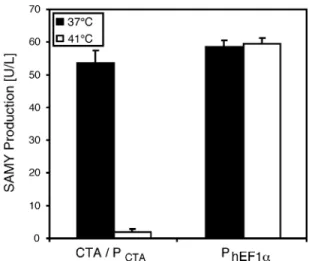
cells, CTA production did not change the growth pro®le of the chicken cell line, indicating that this chimeric transactivator has no signi®cant impact on host cell physiology (doubling times of 15.3 and 15.8 h for wild-type and CTA-expressing DT40 cells cultivated at 41°C). When co-transfected with a reporter plasmid encoding PCTA-driven SAMY [pWW254;
PCTA-SAMY-pA (15)], CTA transactivates SAMY at 37°C,
while expression of this reporter gene remains silent at 41°C (Fig. 3). CTA-mediated transactivation of PCTA results in
expression levels comparable with wild-type PhEF1a, which
itself remains insensitive to temperature changes (Fig. 3). In principle, TIGR-controlled gene expression also works in mammalian cells, as exempli®ed by CHO cells transfected by TIGR-controlled SAMY expression (34°C, 90 6 11 U/l; 41°C, 34 6 8.7 U/l).
Figure 1. TIGR system. Top three expression units show the molecular details of TIGR. The cold-inducible transactivator (CTA) was constructed by fusing the S.albus heat shock response regulator rheA to the VP16 trans-activation domain of herpes simplex virus (CTA, rheA-VP16). CTA was placed under control of the human elongation factor 1-a promoter, which mediates constitutive high level expression in chicken cells (pWW255, PhEF1a-CTA-pA). The CTA-responsive target promoter PCTAwas assembled
by cloning a single rheA-speci®c operator module (rheO) adjacent to a minimal version of the human cytomegalovirus immediate early promoter (PhCMVmin) (PCTA, rheO-PhCMVmin). PCTAwas con®gured to drive either the
cDNA encoding the human vascular endothelial growth factor A (hVEGF121; pWW277, PCTA-hVEGF121-pA) or the SAMY reporter gene
(pWW254, PCTA-SAMY-pA). Selected sites for restriction endonucleases
are indicated. Bottom two expression units illustrate TIGR-controlled trans-gene expression at different temperatures. At the permissive temperature of 37°C, CTA binds and transactivates PCTA, which results in expression of the
gene of interest. At 41°C, the PCTAbinding af®nity of CTA is abolished and
expression of the gene of interest remains silent.
Figure 2. ELISA-based quanti®cation of the thermosensitivity of the CTA±PCTAinteraction. (A) Schematic representation for scoring the CTA
af®nity for PCTA. A PCR-generated biotin (BT)-labeled PCTAfragment is
immobilized via streptavidin (ST) in a multi-well chamber. This set-up is incubated with the lysate of an E.coli CTA production strain (harboring pWW317, PT7-CTA-pA) at different temperatures. After washing steps, the
af®nity of CTA for PCTAis quanti®ed by anti-VP16-based immunodetection
visualized by an HRP-conjugated secondary antibody (targeted against the Fc region of the anti-VP16 antibody) which converts TMB into a color readout at 450 nm. (B) Quantitative ELISA-based cell-free analysis of CTA±PCTA interaction at different temperatures. Whereas CTA showed
lower af®nity for its cognate rheO operator module at increasing tempera-tures (black bars), the interaction of the control con®guration consisting of the macrolide-responsive transactivator (ET1) and its target sequence ETR was insensitive to temperature changes (white bars). Furthermore, the CTA binding capacity was speci®c for rheO as it did not interact with the ETR operator module at any of the temperatures (shaded bars).
Beyond simple switch on and off characteristics, TIGR-controlled SAMY expression was adjustable and could be ®ne-tuned to any desired level following incubation of engineered DT40 cell lines at intermediate temperatures (doubling times: 37°C, 20.8 h; 38°C, 15.8 h; 39°C, 15.6 h; 40°C, 15.4 h; 41°C, 15.3 h). In this con®guration, the molecular thermometer CTA could reliably translate tem-perature changes of a degree with unmatched precision into desired transgene expression levels (Fig. 4). Interestingly, the temperature range effective for modulating the CTA±PCTA
interaction varies signi®cantly between cell-free (37±23°C) and cell-based systems (41±37°C). Thus, RheA fusions partners and/or cell-speci®c protein cocktails interacting with fused domains are expected to modify RheA's respon-siveness to temperature, which will enable precise adaptation of the TIGR system to a desired cellular context or temperature range.
The TIGR con®guration based on two plasmids encoding constitutive CTA and PCTA-driven transgene expression units
was further re®ned by designing a one-vector-based auto-regulated cold-inducible expression unit. This autoauto-regulated set-up consisted of a PCTA-controlled dicistronic expression
cassette encoding SAMY in the ®rst and CTA in the second cistron [pWW259, PCTA-SAMY-IRES-CTA-pA; IRES,
internal ribosome entry site of polioviral origin (29)]. Leaky PCTA-driven dicistronic transcript results in few CTAs that
initiate a positive feedback loop, resulting in high level expression of the transactivator as well as the co-cistronically encoded reporter gene SAMY at permissive temperatures. Besides its compact one-vector con®guration, the autoregu-lated expression set-up compares favorably with the binary TIGR design (autoregulated: 41°C, 5.8 6 0.2 U/l; 37°C, 65.1 6 4.3 U/l; binary: 41°C, 4.4 6 0.1 U/l; 37°C, 56.5 6 3.6 U/l).
TIGR-controlled production of human VEGF following implantation of microencapsulated and transfected DT40 cells into chicken embryos
For validation of the low-temperature-induced gene expres-sion system in vivo, we chose to transplant DT40 cells transfected for TIGR-controlled hVEGF121 into chicken
embryos (pWW255, PhEF1a-CTA-pA; pWW277, PCTA
-hVEGF121-pA). Since direct sub-CAM implantation of
DT40 cells was lethal for the chicken embryos in initial experiments, we encapsulated the DT40 cell derivatives in alginate±poly-L-lysine±alginate beads. Microencapsulated
TIGR-responsive hVEGF121 production cell lines showed
identical temperature induction pro®les and maximum expres-sion levels of this growth factor, indicating that encapsulation does not impair the overall regulation performance of the TIGR system (non-encapsulated DT40: 41°C, 25.9 6 3.5 ng/ml; 37°C, 168 6 19 ng/ml; encapsulated DT40: 41°C, 21.9 6 0.6 ng/ml; 37°C, 171 6 19 ng/ml). hVEGF121
produced in chicken cells is glycosylated in a different manner compared with mammalian cells (data not shown).
Microencapsulated DT40 cells engineered for TIGR-controlled hVEGF121expression were implanted into chicken
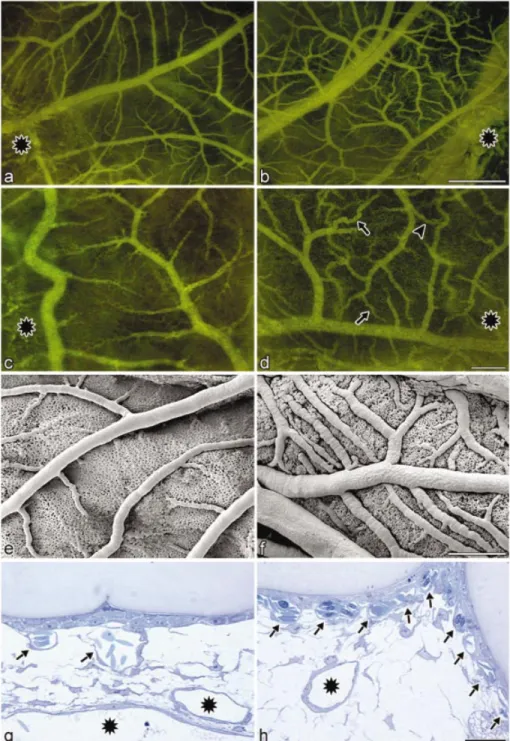
embryos and placed onto the CAM. The chicken embryos were grown at 37 and 41°C for 2 days prior to microscopical analysis of the vascularization of the CAM. hVEGF121
-mediated vascularization could only be monitored in chicken embryos incubated at 37°C, whereas control embryos con-taining capsules only or capsules with non-engineered DT40 cells displayed a regular wild-type pattern of blood vessels, which was insensitive to temperature changes (Fig. 5). Constitutive hVEGF121expression in DT40 cells transplanted
into chicken embryos cultivated at 41°C showed vasculariz-ation patterns comparable with TIGR-controlled growth factor production at 37°C, indicating that hVEGF121remains active
at elevated temperatures (data not shown). DISCUSSION
Gene±function correlations are one of the major challenges in the post-genomic era. Owing to their unmatched gene targeting frequencies, stability and easy handling, the chicken bursal B-cell line DT40 has become a cornerstone in recent
Figure 4. Temperature adjustability of the TIGR system. DT40 cells co-transfected with pWW255 (PhEF1a-CTA-pA) and pWW254 (PCTA
-SAMY-pA) were incubated at varying temperatures, and SAMY production pro®les were quanti®ed at different time points post-transfection.
Figure 3. TIGR-mediated temperature-dependent transgene expression switches in chicken DT40 cells. Triplicate DT40 cultures were co-trans-fected with the CTA expression construct pWW255 (PhEF1a-CTA-pA) as
well as the CTA-responsive SAMY expression vector pWW254 (PCTA
-SAMY-pA) and incubated at 37 and 41°C. At 48 h post-transfection, SAMY expression pro®les were quanti®ed in the supernatant of both cultures. DT40 control cells transfected with the constitutive SAMY expres-sion vector pSS211 (PhEF1a-SAMY-pA; S.Schlatter, unpublished) showed
reverse genetics initiatives (28,30). For example, DT40 cells have been essential for the elucidation of immunoglobulin somatic hypermutation and af®nity maturation of antibodies, gene conversion, homologous recombination, RNA editing
and the design of arti®cial chromosomes (17,31±35). Also, recent advances in the production of protein pharmaceuticals in the egg white of transgenic chickens and the use of chicken embryos for validation of tissue engineering and therapeutic
Figure 5. hVEGF121-mediated vascularization in chicken embryos. Parallel grafting experiments were performed following supra-CAM application of
micro-encapsulated DT40 cells engineered for TIGR-controlled hVEGF121and incubation at 41°C (a, c, e and g) and 37°C (b, d, f and h) for 2 days (until embryonic
day 11). (a±d) Still video images of the growing CAM microvasculature at embryonic day 11 (application site indicated by asterisks) following intravenous injection of FITC±dextran (a and b overview; c and d insets of a and b at higher magni®cation). As shown in (b) and (d) in comparison with (a) and (c), only TIGR-mediated induction of hVEGF121at 37°C results in a massive angiogenic response exempli®ed by (i) the increased number of the feeding vessels; and
(ii) their tortuous shape (arrows shown in d) and the formation of arterial venous shunts (arrowhead in d). Scanning electron micrographs con®rm increased numbers of arterioles and veins as well as a densely packed capillary plexus in CAMs incubated at 37°C (f) when compared with an isogenic set-up grown at 41°C (e). Cross-sections through microcapsules and underlying CAM reveal a local angiogenic response at sites of application at 37°C (h) but not at 41°C (g). The wild-type CAM consisting of capillary plexus (arrows in g) in the subepithelial region is transformed by TIGR-controlled production of hVEGF121at
permissive temperatures into a compact and stacked multitude of newly formed capillary vessels (arrows in h). The supplying vessels are indicated by asterisks. Size bars: (a) and (b) = 50 mm; (c), (d), (e) and (f) = 200 mm, (g) and (h) = 20 mm.
angiogenesis concepts puts the DT40 chicken model system into the limelight of basic and applied research (36±38).
Rational reprogramming of vertebrate cells by conditional molecular interventions has generated dramatic impact on gene±function analysis (39,40), prototype gene therapy scenarios (14,41,42), tissue engineering (43), design of animal models with human disease phenotypes (40,44,45), drug discovery (46) and biopharmaceutical manufacturing (47±49). A variety of heterologous small molecule-responsive gene regulation systems have been designed, improved and valid-ated in different cell culture and in vivo settings (21,22). Although most available heterologous gene control systems have shown excellent performance in modulating desired transgene expression in basic research settings, the use of many of these gene switches in biopharmaceutical manufac-turing, gene therapy or tissue engineering may be limited due to a combination of low or leaky expression, side effects of regulating molecules, and incompatibilities with regulatory guidelines. Antibiotic-responsive gene regulation systems (14,27,50,51) and the chemically induced dimerization tech-nology (52), which are currently competing for clinical applications, combine most assets of ideal gene control modalities: (i) regulation by a clinically licensed, bioavailable molecule devoid of long-term side effects; (ii) low leaky expression and high induction levels; (iii) optimal dose± response characteristics; (iv) compact, preferably one-vector design; and (v) low immunogenicity. Yet accumulation of antibiotics in bone and teeth following long-term administra-tion (23,25) and the long-awaited clinical approval of non-immunosuppressive dimerizer drugs put these systems on hold for many therapeutic settings (14,27,51,52). Furthermore, precise in vivo dosing of regulating molecules remains a challenge, as most currently available gene control systems are only adjustable within a narrow drug concentration window (14,27,51,52). The combination of reliable hetero-logous gene control con®gurations with physiological non-molecule inducers might represent a decisive advancement for the gene regulation territory.
Gene switches induced by a temperature downshift display a high degree of physiological compatibility since low-temperature cultivation is well tolerated by vertebrate cells and typically associated with increased speci®c productivity (53). In principle, any protein can be mutated to become temperature sensitive. For example, speci®c mutations ren-dered the RNA-dependent RNA replicase of alphaviruses temperature sensitive. Following a temperature downshift from 37 to 29°C, the viral replicase initiates an RNA ampli®cation loop resulting in high level expression of desired transgenes driven by subgenomic viral promoters (54,55). Concerns about safety, long-term cytopathy and accumulation of mutations in product proteins produced by a viral replicase devoid of any proof-reading capacity have so far limited the use of this technology beyond basic research.
TIGR includes the ®rst vertebrate thermosensor, which recruits the endogenous transcription initiation machinery for temperature-adjustable transgene expression. TIGR exhibits rapid response kinetics typically associated with natural temperature switches, low basal expression near the detection limit, high maximum expression levels comparable with PhEF1a, one of the strongest vertebrate promoters, and
induction ratios compatible with state-of-the-art conditional
molecular interventions in vertebrate cells (40,56). The TIGR performance was successfully tested in an in vivo angiogenesis model: TIGR promoted solid high level expression of human hVEGF121 in chicken embryos at 37°C, while expression of
this key angiogenic factor was completely neutralized as evidenced by wild-type-like vascularization at 41°C.
VEGF and its various splice variants are the most prominent representatives among angiogenic growth factors that induce new blood vessels from pre-existing vasculature. VEGF plays an essential role in embryonic development, normal growth of tissues, wound healing and the female reproductive cycle (38,57±59). The fact that the slightest disregulation of endogenous VEGF expression is associated with severe pathologies, upregulation with neoplasia and downregulation with ischemia, explains why production of this growth factor is tightly regulated at multiple levels (38,57±59). Therefore, it is not surprising that VEGF has been a 2-fold therapeutic target, and strategies to inhibit this growth factor or its targeted administration are currently in clinical trials. Although therapeutic angiogenesis achieved promising results in chronic myocardial and retinal ischemia, uncontrolled sys-temic delivery has been associated with hypotension, edema, accelerated atherosclerosis and endothelial cell-derived tumors (38,58,60). Milestones in adjustable therapeutic delivery of VEGF included third-generation biomaterials supporting wound healing by controlled release of recom-binant hVEGF and regulation of endogenous VEGF using a dimerization-dependent arti®cial transactivator targeted to the VEGF promoter region (61±63).
As of now, TIGR-based transcription control represents the ®rst non-viral thermosensor for controlled transgene expres-sion in vertebrates. Because of the simplicity of its inducer, i.e. temperature, TIGR will probably foster advances in pro®table biopharmaceutical manufacturing of dif®cult to produce protein therapeutics and the understanding of angiogenesis. ACKNOWLEDGEMENTS
We thank Philippe Mazodier for plasmid pOLP12B, Stefan Schlatter for plasmids pSS193 and pSS211, and Beat P. Kramer and Laetitia Malphettes for critical comments on the manuscript. This work was supported by the Swiss National Science Foundation (grant no. 631-065946), and the Swiss Federal Of®ce for Education and Science (BBW) within EC Framework 5.
REFERENCES
1. Iba,K. (2002) Acclimative response to temperature stress in higher plants: approaches of gene engineering for temperature tolerance. Annu. Rev. Plant Biol., 53, 225±245.
2. Fujita,J. (1999) Cold shock response in mammalian cells. J. Mol. Microbiol. Biotechnol., 1, 243±255.
3. Yamanaka,K. (1999) Cold shock response in Escherichia coli. J. Mol. Microbiol. Biotechnol., 1, 193±202.
4. Hurme,R. and Rhen,M. (1998) Temperature sensing in bacterial gene regulationÐwhat it all boils down to. Mol. Microbiol., 30, 1±6. 5. Johansson,J., Mandin,P., Renzoni,A., Chiaruttini,C., Springer,M. and
Cossart,P. (2002) An RNA thermosensor controls expression of virulence genes in Listeria monocytogenes. Cell, 110, 551±561.
6. Morimoto,R.I. (2002) Dynamic remodeling of transcription complexes by molecular chaperones. Cell, 110, 281±284.
7. Servant,P., Grandvalet,C. and Mazodier,P. (2000) The RheA repressor is the thermosensor of the HSP18 heat shock response in Streptomyces albus. Proc. Natl Acad. Sci. USA, 97, 3538±3543.
8. Gamer,J., Multhaup,G., Tomoyasu,T., McCarty,J.S., Rudiger,S., Schonfeld,H.J., Schirra,C., Bujard,H. and Bukau,B. (1996) A cycle of binding and release of the DnaK, DnaJ and GrpE chaperones regulates activity of the Escherichia coli heat shock transcription factor s32. EMBO J., 15, 607±617.
9. Hurme,R., Berndt,K.D., Normark,S.J. and Rhen,M. (1997) A proteinaceous gene regulatory thermometer in Salmonella. Cell, 90, 55±64.
10. Dorman,C.J., Hinton,J.C. and Free,A. (1999) Domain organization and oligomerization among H-NS-like nucleoid-associated proteins in bacteria. Trends Microbiol., 7, 124±128.
11. Hoe,N.P. and Goguen,J.D. (1993) Temperature sensing in Yersinia pestis: translation of the LcrF activator protein is thermally regulated. J. Bacteriol., 175, 7901±7909.
12. Servant,P. and Mazodier,P. (1995) Characterization of Streptomyces albus 18-kilodalton heat shock-responsive protein. J. Bacteriol., 177, 2998±3003.
13. Servant,P., Rapoport,G. and Mazodier,P. (1999) RheA, the repressor of hsp18 in Streptomyces albus G. Microbiology, 145, 2385±2391. 14. Weber,W., Fux,C., Daoud-el Baba,M., Keller,B., Weber,C.C.,
Kramer,B.P., Heinzen,C., Aubel,D., Bailey,J.E. and Fussenegger,M. (2002) Macrolide-based transgene control in mammalian cells and mice. Nat. Biotechnol., 20, 901±907.
15. Schlatter,S., Rimann,M., Kelm,J. and Fussenegger,M. (2002) SAMY, a novel mammalian reporter gene derived from Bacillus
stearothermophilus alpha-amylase. Gene, 282, 19±31.
16. Weber,W. and Fussenegger,M. (2002) Inducible Gene Expression in Mammalian Cells and Mice. In Balbas,P. and Laurence,A. (eds), Recombinant Protein Protocols, 2nd Edn. Humana Press, NJ, in press. 17. Arakawa,H., Hauschild,J. and Buerstedde,J.M. (2002) Requirement of
the activation-induced deaminase (AID) gene for immunoglobulin gene conversion. Science, 295, 1301±1306.
18. Djonov,V., Schmid,M., Tschanz,S.A. and Burri,P.H. (2000) Intussusceptive angiogenesis: its role in embryonic vascular network formation. Circ. Res., 86, 286±292.
19. Djonov,V.G., Galli,A.B. and Burri,P.H. (2000) Intussusceptive arborization contributes to vascular tree formation in the chick chorio-allantoic membrane. Anat. Embryol., 202, 347±357.
20. Djonov,V.G., Kurz,H. and Burri,P.H. (2002) Optimality in the developing vascular system: branching remodeling by means of intussusception as an ef®cient adaptation mechanism. Dev. Dyn., 224, 391±402.
21. Weber,W. and Fussenegger,M. (2002) Arti®cial mammalian gene regulation networksÐnovel approaches for gene therapy and bioengineering. J. Biotechnol., 98, 161±187.
22. Fussenegger,M. (2001) The impact of mammalian gene regulation concepts on functional genomic research, metabolic engineering and advanced gene therapies. Biotechnol. Prog., 17, 1±51.
23. Cohlan,S.Q. (1977) Tetracycline staining of teeth. Teratology, 15, 127±129.
24. Iuliucci,J.D., Oliver,S.D., Morley,S., Ward,C., Ward,J., Dalgarno,D., Clackson,T. and Berger,H.J. (2001) Intravenous safety and pharmacokinetics of a novel dimerizer drug, AP1903, in healthy volunteers. J. Clin. Pharmacol., 41, 870±879.
25. Kapunisk-Uner,J.E., Sande,M.A. and Chambers,H.F.S. (1996) Tetracycline, Chloramphenicol, Erythromycin and Miscellaneous Antibacterial Agents, 9th Edn. McGraw-Hill, New York.
26. Triezenberg,S.J., Kingsbury,R.C. and McKnight,S.L. (1988) Functional dissection of VP16, the trans-activator of herpes simplex virus immediate early gene expression. Genes Dev., 2, 718±729.
27. Gossen,M. and Bujard,H. (1992) Tight control of gene expression in mammalian cells by tetracycline-responsive promoters. Proc. Natl Acad. Sci. USA, 89, 5547±5551.
28. Buerstedde,J.M., Arakawa,H., Watahiki,A., Carninci,P.P.,
Hayashizaki,Y.Y., Korn,B. and Plachy,J. (2002) The DT40 web site: sampling and connecting the genes of a B cell line. Nucleic Acids Res., 30, 230±231.
29. Weber,W., Kramer,B.P., Fux,C., Keller,B. and Fussenegger,M. (2002) Novel promoter/transactivator con®gurations for macrolide- and streptogramin-responsive transgene expression in mammalian cells. J. Gene Med., 4, 676±686.
30. Hudson,D.F., Morrison,C., Ruchaud,S. and Earnshaw,W.C. (2002) Reverse genetics of essential genes in tissue-culture cells: `dead cells talking'. Trends Cell Biol., 12, 281±287.
31. Bezzubova,O., Silbergleit,A., Yamaguchi-Iwai,Y., Takeda,S. and Buerstedde,J.M. (1997) Reduced X-ray resistance and homologous recombination frequencies in a RAD54±/± mutant of the chicken DT40 cell line. Cell, 89, 185±193.
32. Brown,W.R., Mee,P.J. and Hong Shen,M. (2000) Arti®cial chromosomes: ideal vectors? Trends Biotechnol., 18, 218±223. 33. Cumbers,S.J., Williams,G.T., Davies,S.L., Grenfell,R.L., Takeda,S.,
Batista,F.D., Sale,J.E. and Neuberger,M.S. (2002) Generation and iterative af®nity maturation of antibodies in vitro using hypermutating B-cell lines. Nat. Biotechnol., 20, 1129±1134.
34. Di Noia,J. and Neuberger,M.S. (2002) Altering the pathway of immunoglobulin hypermutation by inhibiting uracil-DNA glycosylase. Nature, 419, 43±48.
35. Sale,J.E., Calandrini,D.M., Takata,M., Takeda,S. and Neuberger,M.S. (2001) Ablation of XRCC2/3 transforms immunoglobulin V gene conversion into somatic hypermutation. Nature, 412, 921±926. 36. Harvey,A.J., Speksnijder,G., Baugh,L.R., Morris,J.A. and Ivarie,R.
(2002) Expression of exogenous protein in the egg white of transgenic chickens. Nat. Biotechnol., 20, 396±399.
37. Ribatti,D., Vacca,A., Roncali,L. and Dammacco,F. (2000) The chick embryo chorioallantoic membrane as a model for in vivo research on anti-angiogenesis. Curr. Pharm. Biotechnol., 1, 73±82.
38. Yancopoulos,G.D., Davis,S., Gale,N.W., Rudge,J.S., Wiegand,S.J. and Holash,J. (2000) Vascular-speci®c growth factors and blood vessel formation. Nature, 407, 242±248.
39. Genoux,D., Haditsch,U., Knobloch,M., Michalon,A., Storm,D. and Mansuy,I.M. (2002) Protein phosphatase 1 is a molecular constraint on learning and memory. Nature, 418, 970±975.
40. Malleret,G., Haditsch,U., Genoux,D., Jones,M.W., Bliss,T.V., Vanhoose,A.M., Weitlauf,C., Kandel,E.R., Winder,D.G. and
Mansuy,I.M. (2001) Inducible and reversible enhancement of learning, memory and long-term potentiation by genetic inhibition of calcineurin. Cell, 104, 675±686.
41. Pollock,R., Issner,R., Zoller,K., Natesan,S., Rivera,V.M. and Clackson,T. (2000) Delivery of a stringent dimerizer-regulated gene expression system in a single retroviral vector. Proc. Natl Acad. Sci. USA, 97, 13221±13226.
42. Ye,X., Rivera,V.M., Zoltick,P., Cerasoli,F.,Jr, Schnell,M.A., Gao,G., Hughes,J.V., Gilman,M. and Wilson,J.M. (1999) Regulated delivery of therapeutic proteins after in vivo somatic cell gene transfer. Science, 283, 88±91.
43. Jin,L., Zeng,H., Chien,S., Otto,K.G., Richard,R.E., Emery,D.W. and Blau,C.A. (2000) In vivo selection using a cell-growth switch. Nature Genet., 26, 64±66.
44. Kurosinski,P., Guggisberg,M. and Gotz,J. (2002) Alzheimer's and Parkinson's diseaseÐoverlapping or synergistic pathologies? Trends Mol. Med., 8, 3±5.
45. Ngan,E.S., Schillinger,K., DeMayo,F. and Tsai,S.Y. (2002) The mifepristone-inducible gene regulatory system in mouse models of disease and gene therapy. Semin. Cell Dev. Biol., 13, 143±149. 46. Aubel,D., Morris,R., Lennon,B., Rimann,M., Kaufmann,H., Folcher,M.,
Bailey,J.E., Thompson,C.J. and Fussenegger,M. (2001) Design of a novel mammalian screening system for the detection of bioavailable, non-cytotoxic streptogramin antibiotics. J. Antibiot., 54, 44±55. 47. Fussenegger,M., Schlatter,S., Datwyler,D., Mazur,X. and Bailey,J.E.
(1998) Controlled proliferation by multigene metabolic engineering enhances the productivity of Chinese hamster ovary cells. Nat. Biotechnol., 16, 468±472.
48. Meents,H., Enenkel,B., Werner,R.G. and Fussenegger,M. (2002) p27Kip1-mediated controlled proliferation technology increases constitutive sICAM production in CHO-DUKX adapted for growth in suspension and serum-free media. Biotechnol. Bioeng., 79, 619±627. 49. Umana,P., Jean-Mairet,J. and Bailey,J.E. (1999) Tetracycline-regulated
overexpression of glycosyltransferases in Chinese hamster ovary cells. Biotechnol. Bioeng., 65, 542±549.
50. Favre,D., Blouin,V., Provost,N., Spisek,R., Porrot,F., Bohl,D., Marme,F., Cherel,Y., Salvetti,A., Hurtrel,B. et al. (2002) Lack of an immune response against the tetracycline-dependent transactivator correlates with long-term doxycycline-regulated transgene expression in nonhuman primates after intramuscular injection of recombinant adeno-associated virus. J. Virol., 76, 11605±11611.
51. Fussenegger,M., Morris,R.P., Fux,C., Rimann,M., von Stockar,B., Thompson,C.J. and Bailey,J.E. (2000) Streptogramin-based gene regulation systems for mammalian cells. Nat. Biotechnol., 18, 1203±1208.
52. Rivera,V.M., Clackson,T., Natesan,S., Pollock,R., Amara,J.F., Keenan,T., Magari,S.R., Phillips,T., Courage,N.L., Cerasoli,F.,Jr et al. (1996) A humanized system for pharmacologic control of gene expression. Nature Med., 2, 1028±1032.
53. Kaufmann,H., Mazur,X., Fussenegger,M. and Bailey,J.E. (1999) In¯uence of low temperature on productivity, proteome and protein phosphorylation of CHO cells. Biotechnol. Bioeng., 63, 573±582. 54. Boorsma,M., Nieba,L., Koller,D., Bachmann,M.F., Bailey,J.E. and
Renner,W.A. (2000) A temperature-regulated replicon-based DNA expression system. Nat. Biotechnol., 18, 429±432.
55. Lundstrom,K. (2001) Alphavirus vectors for gene therapy applications. Curr. Gene Ther., 1, 19±29.
56. Niwa,H., Miyazaki,J. and Smith,A.G. (2000) Quantitative expression of Oct-3/4 de®nes differentiation, dedifferentiation or self-renewal of ES cells. Nature Genet., 24, 372±376.
57. Blau,H.M. and Ban®,A. (2001) The well-tempered vessel. Nature Med., 7, 532±534.
58. Ferrara,N. and Alitalo,K. (1999) Clinical applications of angiogenic growth factors and their inhibitors. Nature Med., 5, 1359±1364. 59. LeCouter,J., Lin,R. and Ferrara,N. (2002) Endocrine gland-derived
VEGF and the emerging hypothesis of organ-speci®c regulation of angiogenesis. Nature Med., 8, 913±917.
60. Lee,R.J., Springer,M.L., Blanco-Bose,W.E., Shaw,R., Ursell,P.C. and Blau,H.M. (2000) VEGF gene delivery to myocardium: deleterious effects of unregulated expression. Circulation, 102, 898±901. 61. Pollock,R., Giel,M., Linher,K. and Clackson,T. (2002) Regulation of
endogenous gene expression with a small-molecule dimerizer. Nat. Biotechnol., 20, 729±733.
62. Rebar,E.J., Huang,Y., Hickey,R., Nath,A.K., Meoli,D., Nath,S., Chen,B., Xu,L., Liang,Y., Jamieson,A.C. et al. (2002) Induction of angiogenesis in a mouse model using engineered transcription factors. Nature Med., 8, 1427±1432.
63. Zisch,A.H., Schenk,U., Schense,J.C., Sakiyama-Elbert,S.E. and Hubbell,J.A. (2001) Covalently conjugated VEGF±®brin matrices for endothelialization. J. Control Release, 72, 101±113.