Prediction of Apple Maggot Fly1 Emergence from Thermal Unit Accumulation
2W. H. REISSIG, J. BARNARD!, R. W. WEIRES4, E. H. GLASS AND R. W. DEAN"
New York Slale Agricullural Experiment Station, Geneva 14456 ABSTRACT
Environ. Entomol. 8: 51-54 (1979)
The minimum temperature threshold for the development of apple maggot pupae,
Rhago-letis pomone//a. was 6.4°C. From 1951-75 the 1st flies emerged in cages over infested apples on the avg on June 15 near Highland, NY and on June 23 in Geneva, NY. The avg accumulated air temperature thermal units (T.U.'s) from Mar. 1 using a threshold of 6.4°C until 1st emergence were 614±53 and 641 ±48, respectively, at the 2 locations. The annual deviations between the actual first emergence and the date when the avg T. V. 's were accu-mulated ranged from 1-8 days with an avg of 3.5 at Geneva and from 1-14 days with an avg of 5.7 days at Highland. From 1975-77 the mean T.V. accumulation and the 99% confidence interval developed at Geneva was used to predict emergence in 5 locations in Wayne Co. The deviations between the observed emergence and dates in which the appro-priate number of T.U.'s was accumulated averaged 3.5 and 0.8 days, respectively.
Thermal Unit Determination
Records of apple maggot fly emergence were obtained from 1951-75 in central NY State at Geneva, and in southern NY in the Hudson Valley at Poughkeepsie in ] 954-62 and High]and 1963-75 from cages described by Glass (1960) and Dean and Chapman (1973). Al-though multiple cages were maintained at each site, data from these were combined to give one annual record for each location. Air temperature and rainfall were re-corded during this period from weather stations ca. 400
m from the emergence cages at Geneva, 1-5 m in
Poughkeepsie, and 600 m (1962-72) or 30-60 m
(1973-75) at Highland.
Therma] units (T.U.'s) were calculated as followS: the top of the containers to maintain the RH near 100% during the test. Containers were placed under a loose aluminum foil cover to shield pupae from radiant en-ergy. One container of pupae was kept at each of 5 con-stant temperatures ± 2°C: 10°, 15.5°, 18.3°,21.1°, and 26.7° in biotrons at 16:8 LD. Flies were removed from the containers daily until emergence was completed. The minimum temperature threshold for pupal development was calculated by fitting a linear regression line to the percent development/day calculated for the emergence of the 1st fly at the various temperatures and extrapolat-ing to determine the x-intercept. This method was used to determine the developmental threshold of apple mag-got pupae in Canada (Reid and Laing 1976) and also for various life stages of other insects (Chiang and Sisson
1968, Eckenrode and Chapman 1971, Litsinger and Ap-ple ]973, Obrycki and Tauber 1978).
The apple maggot, Rhagoletis pomone//a, a serious pest in New York State apple orchards, is currently con-trolled by insecticide sprays applied periodically when adults are active from late June-Sept. A reliable esti-mate of the start of adult emergence is essential because growers begin control sprays 7-10 days later, which is the normal pre-oviposition period of females. Emer-gence is currently estimated by daily observations and collection of flies in cages placed over areas seeded with infested fruit the previous fall. Cages are difficult to set up and tedious to maintain. Furthermore, this method does not predict emergence but only records the event after it has occurred.
Accumulated thermal units have been used to predict the seasonal development and emergence of various in-sects (Strong and App]e 1958, Eckenrode and Chapman 1971, Eckenrode et al. 1975, Sevacherian et al. 1977), including other Rhagoletis species (Jubb and Cox 1974, AIiNiazee 1975). In this study, we determined the de-velopmental temperature threshold for apple maggot pu-pae and used iterative analysis to compare field collected emergence data from several seasons and 2 locations in New York State so that thermal unit accumulations could be used to predict the initial emergence of apple maggot flies.
Materials and Methods
Developmental Threshold Temperature of Apple Maggot Pupae
Infested •Wealthy' apples were collected from the field and placed over moist sand in an insectary. Pupae were sifted from the sand Nov. 7 and stored at a constant temperature of 1°C for 5 mo. Lots of 600 were removed and spread evenly over 1.27 cm of dry sand in an opaque cylindrical plastic container ca. 11 cm diam and 7.5 cm high. A layer of sand
2.5
cm thick was placed over the pupae and moistened with 115 ml of distilled water. Saran wrap fastened with a rubber band was placed overT.V. daily max air temp
+
daily min air temp2 -Dev. Thresh. Temp (6.4°C)
IRhOROlt'/is pomonella: Diptera: Tephritidae.
, Approved by the Director of the New York State Agricultural Experiment Station as Journal Paper No. 3114. Received for publication May 15. 1978.
, Dcpt. Computer Services. N.Y. St. Agric. Exp. Sin.• Geneva 14456. • Hudson Valley Laboratory. P. O. Box 727. Highland. NY 12528.
;IProfessor Emeritus of Entomology, Cornell University. Present address: P.
O. Box 57. Lanai. HI 96765.
©
1979 Entomological Society of America51
Annual T.V. 's to 1st emergence using all combina-tions of beginning dates from Jan. I-June ], and threshold temperatures from - 17.8° to 10°C were com-pared. The annual deviations between the observed emergence and the date when the avg number of T. V. 's
52 ENVIRONMENTAL ENTOMOLOGY Vol. 8, no. I
FIG. I.-Relationship of apple maggot,Rhagoletis
pomo-nella, pupal development to temperature.
The standard error of prediction was <O.5%/day (Fig. I).
Thermal Unit Determination
The most satisfactory predictions at Geneva and in the Hudson Valley (C.I.=99) were obtained by accumulat-ing T.U.'s from Mar. 1 using the pupal development base temperature of 6.4°C. However, varying this base ± 5°C made the prediction only slightly less accurate. Emergence at the Geneva site was more accurately pre-dicted by the accumulation of T.U.'s than by the avg
30 25 15 20 "'CENTIGRADE '.0 >-« c ~ 3.0
~
z~
o m 2.0~
c~
~ 1.0 ResultsDetermination of Developmental Threshold Temperature
The minimum temperature threshold for the develop-ment of apple maggot pupae calculated from the emer-gence of the 1st fly at various temperatures was 6.4°C. were accumulated were determined for each combina-tion.
Validation of Prediction
Apple maggot activity was monitored from 1975-77 in Wayne CO., NY, which contains more acres of apples than any other county in the state, to determine if avg T.U. accumulations developed at Geneva and in the Hudson Valley could be used to predict initial emer-gence elsewhere in NY. Several yellow sticky traps (Reissig 1975) were deployed ca. 2 wk before antici-pated emergence in each of 5 heavily infested abandoned orchards during the 3-yr tests and checked daily throughout the season. Cumulative T.V. 's were calcu-lated as previously described from nearby weather sta-tions maintained by the NY State Apple Pest Manage-ment Program. The deviations between the observed 1st emergence in Wayne Co. and dates when the avg T.U. 's and the C.I. 99 developed at Geneva were accumulated are shown in Table 2.
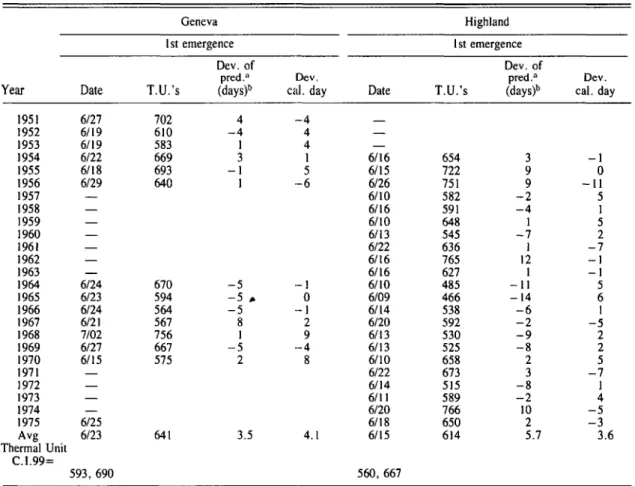
Table I.-Actual and predicted emergence dates of apple maggots from 1951-75 in Geneva and Highland, NY.
Geneva Highland
Ist emergence Ist emergence
Dev. of Dev. of
pred.n Dev. pred.n Dev.
Year Date T.U.'s (days)b cal. day Date T.U.'s (days)b cal. day
1951 6/27 702 4 -4 1952 6/19 610 -4 4 ]953 6/19 583 ] 4 ]954 6/22 669 3 ] 6/16 654 3 -1 1955 6/18 693 -1 5 6/15 722 9 0 1956 6/29 640 I ·-6 6/26 751 9 -11 1957 6/10 582 -2 5 ]958 6/16 591 -4 1 1959 6/10 648 1 5 1960 6113 545 -7 2 ]961 6/22 636 ] -7 ]962 6/16 765 12 -] ]963 6116 627 ] -] ]964 6/24 670 -5 --I 6/10 485 -I] 5 ]965 6/23 594 -5 _ 0 6/09 466 -14 6 1966 6/24 564 -5 -] 6/14 538 -6 1 1967 6/21 567 8 2 6/20 592 -2 -5 1968 7/02 756 1 9 6/13 530 -9 2 1969 6/27 667 -5 --4 6/13 525 -8 2 1970 6/15 575 2 8 6/10 658 2 5 ]971 6/22 673 3 -7 ]972 6114 5]5 -8 ] ]973 6/11 589 -2 4 1974 6/20 766 10 -5 1975 6/25 6/18 650 2 -3 Avg 6/23 641 3.5 4.1 6/15 614 5.7 3.6 Thermal Unit C.1.99= 593,690 560, 667
iiiDeviations between the observed emergence and the date when the avg T.U.'s were accumulated.
February ] 979 REISSIG ET AL.: ApPLE MAGGOT EMERGENCE PREDICTION 53
calendar date of 1st emergence (dev. 3.5 vs. 4.1 day), while in the Hudson Valley the calendar date was more accurate (dev. 5.7 vs. 3.6 day) (Table I). The avg cal-endar date for the emergence of the I st fly was one wk earlier in the Hudson Valley (June 15) than in Geneva (June 23). However, the avg T.U. accumulation was only slightly lower in the Hudson Valley (6]4±53) than in Geneva (641 ±48).
Validation of Prediction
During the 3-yr test in Wayne Co., the deviations be-tween the observed and pred icted ]st emergence of apple maggots averaged 3.6 days (Table 2). This was quite similar to the deviations occurring at Geneva where the T.U. avg was developed from the emergence cage data. The C.1. 99 was quite accurate in estimating the emer-gence in Wayne Co. since 3 of the actual dates were within this interval, and the avg deviations among the 5 sites were less than one day. Also, no flies emerged prior to the lower c.1. 99 limit, which suggests that this provides adequate advance notice of 1st emergence, which can be validated later by deploying traps within given sites.
Discussion
Slightly different minimum development temperature thresholds have been used to calculate T. U. 's for pupae of various Rlzagoletis species infesting cherries. A 5°C threshold has been used for R. indifferens and R. cerasi (AIiNiazee 1975, Boller 1964) and Jubb and Cox (1974) used 4.4°C for R. fausta and R. cingulata. The devel-opmental threshold reported here for apple maggot pu-pae, 6.4°C, is quite similar to the 5.5°C base tempera-ture that Max well and Parsons (1969) used to calculate thermal accumulations for this species, but is lower than the 8.7°C threshold reported for pupae from a Canadian population (Reid and Laing 1976). Future studies should be done in other areas to determine if the temperature requirements for the development of Rlzagoletis pupae vary not only among species but also among allopatric populations of the same species adapted to different cli-mates.
]n this study, and others attempting to relate the emer-gence of Rlzagoletis species to temperature, deviations
Table 2.-Prediction of initial emergence of apple maggot
mes in Wayne
Co.,
NY, using accumulated T.U.'s. Deviation" of prediction (days)from
Site Actual Avt
no. Year emergence T.U. T.U ..C C.1. 99b•c
1 1975 June 30 675 -2 0 2 1976 June 23 609 +3 0 3 ]976 June 28 752 -6 -3 4 1977 June 18 601 +3 0 5 1977 June 21 702 -4 -I Avg: 3.6 0.8
aDeviations between the observed emergence and the date when theappropriate
number of T.U.'s were accumulated.
bAvg T.U. (641) and C.I. 99 (S9~90 T.U.) were developed from observations in Geneva. NY.
, (-) signs indieate actual emergence occurred later than the predicted date.
between the actual and predicted 1st emergence based on T. U. accumulation usually averaged several days over a period of years at any given location (Maxwell and Parsons 1969, Jubb and Cox ]974), although AIi-Niazee (1975) obtained slightly better predictions of the Ist emergence of the western cherry fruit fly using soil temperatures 5 cm below the surface. These deviations are probably partially caused by factors other than tem-perature which also affect the emergence pattern of the flies. The most important other variables for apple mag-gots are soil type, rainfall, amount of sunlight, and host variety in which the larvae developed (Glass 1960, Dean and Chapman 1973, Neilson 1976). Thus, the annual emergence of apple maggots varies considerably among orchards within an area and even in various locations within a single orchard. This is illustrated by the large variations in ]st emergence recorded among adjacent cages in the same orchard (Glass ]960, Dean and Chap-man 1973).
New York apple growers have previously received in-formation about apple maggot emergence only from the 2 sites described in this study where emergence cages were maintained. Emergence predictions could only be based on the avg calendar dates which vary considerably between the 2 areas. The similarity of the avg accumu-lated T.U.'s required for 1st emergence at the 2 widely separated locations and the accuracy of prediction ob-tained using the average Geneva T.U.'s in the validation tests in Wayne Co. indicate that emergence can be pre-dicted with this system anywhere in the state where weather information is available. When the lower limit of accumulated T.U.'s in the C.1. 99 is reached, grow-ers in an area can be alerted that apple maggot emer-gence is imminent so that apple maggot traps (Reissig 1975) can be deployed in nearby abandoned orchards to detect emergence and monitor activity more specifically. This system will require considerably less labor than the maintenance of multiple emergence cage sites, and should provide growers with more specific information in lo-calized areas so that control measures can be timed more accurately.
REFERENCES CITED
AIiNiazce, M. T. 1975. Thermal unit requirements for deter-mining adult emergence of the western cherry fruit fly (Diptera: Tephritidae) in the Williamelle Valley of Ore-gon. Environ. Entomol. 5: 397-402.
Boller, E. F. 1964. Auftreten der Kirschenfliege (RhagoJelis
cerasi L.) Und. Pragnose millels Bodentemperature. Schweiz. Z. Obsl. Weinbou 73: 53-8.
Chiang, H. C., and V. Sisson. 1968. Temperature relation-ships of the development of northern corn rootworm eggs. J. Ecoll. Entomol. 6]: 1406-]0.
Dean, R. W., and P.J. Chapman. 1973, Bionomics of the apple maggot in eastern New York. ~earch 3(10): 64 pp. Eckenrode, C.J.,and R. K. Chapman. 1971. Effect of var-ious temperatures upon rate of development of the cabbage maggot under artificial conditions. Ann. Entomol. Soc. Am. 64: 1079-83.
Eckenrode, C.J., E. V. Yea, and K. W. Stone. 1975. Pop-u]ation trends of onion maggots correlated with air thermal unit accumulations. Environ. Entomol. 4: 785-9. Glass, E. H. 1960. Apple maggot fly emergence in western
54 ENVIRONMENTAL ENTOMOLOGY Vol. 8, no. I
Jubb, G. L., Jr., and J. A. Cox. 1974. Seasonal emergence of two cherry fruit fly species in Erie County, Pennsyl va-nia: 25 year summary. J. Econ. Entomo!. 67: 613-5. Litsinger, J. A., and J. W. Apple. 1973. Thermal
require-ments for embryonic and larval development of the alfalfa weevil in Wisconsin. Ibid. 66: 309-11.
Maxwell, C. W., and E. C. Parsons. 1969. Relationships be-tween hour-degree F soil temperature summations and ap-ple maggot adult emergence. Ibid. 62: 1310-3.
Neilson, W. T. A. 1976. The apple maggot (Diptera: Tephri-tidae) in Nova Scotia. Can. Entomo!. 108: 885-92. Obrycki, J. J., and M. J. Tauber. 1978. Thermal
require-ments for development of Coleomegilla maculata (Co-leoptera: Coccinellidae) and its parasite Perilirus
coccillel-lae (Hymenoptera: Braconidae). Ibid. 110: 407-12.
Reid, J. A., and J. E. Laing. 1976. Development threshold and degree-days to adult emergence for overwintering pu-pae of the apple maggot, Rhagoletis pomollella (Walsh), collected in Ontario. Proc. Entomo!. Soc. Ont. 197: 19-22.
Reissig, W. H. 1975. Evaluation of traps for apple maggot in unsprayed and commerical apple orchards. J. Econ. En-tomol. 68: 445-8.
Sevacherian, V., N. C. Toscano, R. A. Van Steenwyk, R. K. Sharma, and R. R. Sanders. 1977. Forecasting pink bollworm emergence by thermal summation. Environ. En-tomol. 6: 545-6.
Strong, F. E., and J. W. Apple. 1958. Studies on the thermal constants and seasonal occurrence of the seed com maggot in Wisconsin. J. Econ. Entomol. 51: 704--7.