806
The samples werethen mounted on aluminum stubs and sputter-coated with gold.
For comparison, tissue-culture cells without spirochetes were similarly prepared. Also, spirochetesgrown in BSKII alone were gently drawn down on a 0.2 um millipore filter and the filter was processedfor scanning electron microscopyas above (figure lA). In each instance, spirochetes could be seen attached to most (figure IB), but not all, of the cellsgrownin tissueculture. Higher magnification revealed that the spirochetes usually appeared as intertwined pairs at the host cell surface (figure Ie), and they were easily distinguished from the surface features of cultured cells that were not inoculated with spirochetes (figure ID). We did not observethe spirochetesassociated with small round bod-ies on the cell surface as reported with the spirochete-tick cell cultures [7].Wehaveestablishedconditionsthat allowtheB burg-dorferispirocheteto growand attach to mammalian cellsin vitro. This is the first step in the design of experiments for studying the parameters of attachment and the mechanisms of spirochete pathogenicity in mammalian cells.
KARIM E. HECHEMY, WILLIAM A. SAMSONOFF, MARY McKEE, JOSEPH M. GUTTMAN Wadsworth Center for Laboratories and Research,
New York State Department of Health. Albany
References
I. Christensen GO, Simpson WA, Beachy EH. Microbial adherence in infection. In: Mandell GL, Douglas RG, Bennett XX, eds.
Princi-Correspondence
pies and practices of infectious diseases. New York, John Wiley& Sons, 1985:6-23
2. Steere AC, Malawista SE, Bartenhagen NH, Spieler PN, Newman JH, Rahn OW, Hutchinson GJ, Green J, Snydman DR, Taylor E. The clinical spectrum and treatment of Lyme disease. Yale J Bioi Med 1984;57:453-456
3. Burgdorfer W, Barbour AG, Hayes SF, Benach JL, Grunwaldt E, Davis JP. Lyme disease-a tick-borne spirochetosis? Science 1982; 216:1317-1319
4. Benach JL, Fleit HB, Habicht GS, Coleman JL, Bosler EM, Lane BP. Interactions of phagocytes with the Lyme disease spirochete: role of the Fc receptor. J Infect Dis 1984;150:497-507
5. Fumarola D, Cedola MC, Guanti G, Matsuura A, Uede T, Jirillo E. Adherence of Lymedisease spirochetes to rat lymphocytes. Zentralbl Bakteriol Mikrobiol Hyg [Aj 1986;263:146-150
6. Peterson PK, Clawson CC,LeeDA, Garlich OJ, Quie PG, Johnson RC. Human phagocyte interactions with the Lymedisease spirochete. Infect Immun 1984;46:608-611
7. KurttiTJ,Munderloh UG, Ahlstrand GG, Johnson RC.Borrelia burg-dorferi in tick cell culture: growth and cellular adherence. J Med
Entomol 1988;25:256-261
8. Benach JL, Coleman JL, Garcia-Mono JL, Deponte PC. Biological activity ofBorrelia burgdorferiantigens. In: Benach JL, Bosler EM, eds. Lyme disease and related disorders. New York: Ann NY Acad Sci 1988;539:115-125
9. Madin SH, Darby NBJr.Established kidney cell lines of normal adult bovine and ovine origin. Proc Soc Exp BioI Med 1958;98:574-576 10. Barbour AG. Isolation and cultivation of Lyme disease spirochetes.
Yale J Bioi Med 1984;57:521-555
THE JOURNAL OF INFECTIOUS DISEASES. VOL. 159, NO.4. APRIL 1989 © 1989 by The University of Chicago. All rights reserved. 0022-1899/89/5904-0042$01.00
Single-Dose Therapy for Oral Candidiasis with Fluconazole in HIV-Infected Adults: A Pilot Study COLLEAGUES-Oral candidiasis is a common problemin neoplastic diseases, after prolonged antibiotic therapy, or in the aged, de-bilitated patient, but most cases are now seen in human immu-nodeficiencyvirus (HIV)-infected patients [I, 2]. In this setting, the infection is especially difficult to treat: topical antifungals are unpalatable, only partially effective,and relapses after treat-ment are generally observed. Systemic ketoconazole represents an efficient alternative, but hepatic toxicity [3] and the possibil-ity of drug interaction with other medications frequently taken by these patients, like zidovudine, are of concern.
Fluconazole, (Pfizer, Zurich) is a novelbis-triazole antifungal agent exhibiting the following favorable pharmacokinetic prop-erties:(1)good absorption after oral administration(85010
bioavail-This study was approved by the Research Ethics Committee of the Department of Internal Medicine at the Centre Hospitalier Universitaire Vaudois, Lausanne, and written informed consent was obtained from all subjects who received fluconazole.
Fluconazole was supplied by Pfizer, Fluelastrasse 7, 8048 Zurich, Swit-zerland.
Please address requests for reprints to Dr. M. P. Glauser, Division of Infectious Diseases, Centre Hospitalier Universitaire Vaudois, 1011 Lausanne, Switzerland.
ability), (2) long plasma half-life (30 h), (3) low-plasma protein binding (11 010) with a rapid distribution in tissue fluids such as saliva, and(4)predominantly renal excretion(60010) [4J. Prelimi-nary experience in 95 patients with oropharyngeal candidiasis showed the drug was effectiveand well tolerated when given as a 50 mg capsule once daily for a median period of 9 d [5]. How-ever, the above-mentioned pharmacokinetic properties suggest that a single-dosetreatment could be effective. Wetested this hy-pothesisin an open, noncomparativestudy in HIV-infected adults presenting with oral candidiasis.
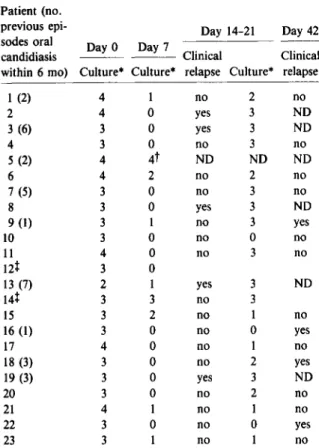
From I October 1987, all HIV-positive adults presentingat our institution with oral candidiasis wereproposed a singleoral dose of 150 mg fluconazole as sole treatment. Patients with mouth symptoms (pain, burning, and dryness) and characteristic signs (raisedconfluentwhitepatcheson a hyperemic base)were included if the swab culture of the lesions showed~1OCandidacolonies after inoculation on a whole Sabouraud agar plate at bedside. Eligiblepatients took a 150mg fluconazole capsule under di-rect medical supervision and were seen again on days 4, 7, and 14-21and then once a month (within the framework of an ongo-ing AIDS cohort study). The culture was repeated on days 7 and 14-21.The clinical response was defined by the total disappear-ance of signs and symptoms, and the microbiologic response by the disappearanceofCandidaon culture, or a drop of two grades or more on a four-grade semiquantitative culture scale (table I).
Correspondence 807
Table 1.
Clinical and microbiological evolution.
didiasis. The clinical response persisted in 22 (96070) of 23 pa-tients on day 7, in 16(73070) of 22 on days 14-21,and in 11 (52070)Patient (no. of 21 on day 42; 2 patients died from other complications of their
previous epi- Day 14-21 Day 42 HIV infection. A microbiologic response was documented in 20
sodes oral Day 0 Day 7 (87070) of 23 patients on day 7, and persisted in 9 (41070) of 22
candidiasis Clinical Clinical on days 14-21 (table I). Among the 10 patients in whom signs
within 6 mo) Culture" Culture" relapse Culture* relapse and symptoms recurred, the free interval after the
administra-1 (2) 4 1 no 2 no tion of fluconazole was 6-33 d (median: 18 d).
2 4 0 yes 3 ND In this observation, the successrate for a single-dosetreatment
3 (6) 3 0 yes 3 ND of oral candidiasis with fluconazole was 100070 at day 4, but signs
4 3 0 no 3 no and symptoms recurred in 10 patients during the study period.
5 (2) 4 4t ND ND ND Seven had one or more episode of oral candidiasis during the
6 4 2 no 2 no previous 6 mo, and six had AIDS. However,all responded again
7 (5) 3 0 no 3 no to a second 150mg dose of fluconazole. The drug was
welltoler-8 3 0 yes 3 ND ated in all patients, and no hepatic, renal, or hematologic side
9(I) 3 1 no 3 yes effects were observed. Among the 23 patients, 18 were enrolled
10 3 0 no 0 no in a prospectivezidovudine postmarketing surveillanceprogram,
11 4 0 no 3 no and fluconazoledid not appear to be associatedwith such
zidovu-12t 3 0 dine toxicityas granulocytopenia or anemia. As plasma drug levels
13 (7) 2 1 yes 3 ND werenot measured, the possibilityof subclinicalinteraction could
14t 3 3 no 3 not be excluded.The correlation betweenthe culture and the
clin-15 3 2 no 1 no ical responsewas weak after day 7: An increasingnumber of
Can-16 (1) 3 0 no 0 yes didaupon semiquantitative cultures was not predictiveof a
clini-17 4 0 no 1 no cal relapse. Culture was helpful only for the initial confirmation
18 (3) 3 0 no 2 yes of the clinical diagnosis.
19 (3) 3 0 yes 3 ND Single-dose fluconazole oral therapy for oropharyngeal
can-20 3 0 no 2 no didiasis was easy to administer, effective, and well tolerated in
21 4 1 no I no our limited pilot study. This therapeutic approach might avoid
22 3 0 no 0 yes continuous treatment in patients in whom advanced
immunosup-23 3 I no 1 no pression induces frequent relapses and is of special interest when
ketoconazole cannot be used. NOTE. No patients had clinical relapse on day 4. ND
=
noJ. P. CRAVE, A. CAlor, J. BILLE, M. P. GLAUSER analysis after first relapse.
Division of Infectious Diseases, Department of Internal
* 0
=
no growth, I=
1-9 Candida colonies, 2=
10-19colo-Medicine and Institute of Microbiology, Centre Hospitalier
nies, 3
=
~ 20 colonies, 4=
confluent growth.t Patient 5 had clinical relapse on day 7. Universitaire Vaudois, Lausanne, Switzerland t Died during study period.
References
We describe data from the first 31 patients. Three patients re-fused the protocol. One patient was excluded because she had pruritus and urticaria while receiving ketoconazole for a previ-ous episode,whichrecurred with a questionableangioedema soon after ketoconazole was given again; thus she was considered im-idazole intolerant. Four others werelost to follow-up. Among the 23 evaluable patients, 15 had AIDS,S had AIDS-related com-plex (ARC), and 3 had no symptom of HIV infection before this episode. Nine had suffered one or more episodes of oral candidi-asis within the previous 6 mo.
On day 4, no patients had signs and symptoms of oral
can-I. Warner LC, Fisher BK. Cutaneous manifestations of the acquired im-munodeficiency syndrome. Int J Dermatol 1986;25:337-350 2. Kaslow RA, Phair JP, Friedman HB, Lyter D, Solomon RE, Dudley
J, Polk BF, Blackwelder W. Infection with the human immunodefi-ciency virus: clinical manifestations and their relationship to immune deficiency. Ann Intern Med 1987;107:474-480
3. Tabor E. Hepatotoxicity of ketoconazole in men and in patients under 50. N Engl J Med 1987;316:1606-1607
4. Saag MS, Dismukes WE. Azole antifungal agents: emphasis on new triazoles. Antimicrob Agents Chemother 1988;32:1-8
5. Farrow PR, Brammer KW, Feczko JM. Fluconazole: a new treatment for oropharyngeal candidiasis in AIDS and malignancy [abstract 949]. In: Program and abstracts of the 27th Interscience Conference on Antimicrobial Agents and Chemotherapy. New York: American So-ciety for Microbiology, 1987