ORIGINAL ARTICLE
Additional surgical procedure is a risk factor for surgical site
infections after laparoscopic cholecystectomy
René Fahrner&Thomas Malinka&Jennifer Klasen&
Daniel Candinas&Guido Beldi
Received: 17 October 2013 / Accepted: 14 April 2014 / Published online: 23 April 2014 # Springer-Verlag Berlin Heidelberg 2014
Abstract
Purpose Surgical site infections (SSI) are associated with increased costs and length of hospital stay, readmission rates, and mortality. The aim of this study was to identify risk factors for SSI in patients undergoing laparoscopic cholecystectomy. Methods Analysis of 35,432 laparoscopic cholecystectomies of a prospective multicenter database was performed. Risk factors for SSI were identified among demographic data, preoperative patients’ history, and operative data using multi-variate analysis.
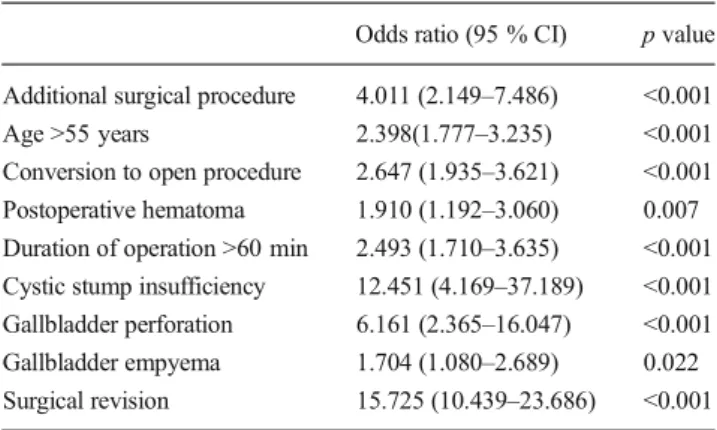
Results SSIs after laparoscopic cholecystectomy were seen in 0.8 % (n=291) of the patients. Multivariate analysis identified the following parameters as risk factors for SSI: additional surgical procedure (odds ratio [OR] 4.0, 95 % confidence interval [CI] 2.2–7.5), age over 55 years (OR 2.4 [1.8–3.2]), conversion to open procedure (OR 2.6 [1.9–3.6]), post-operative hematoma (OR 1.9 [1.2–3.1]), duration of operation >60 min (OR 2.5 [1.7–3.6], cystic stump insuffi-ciency (OR 12.5 [4.2–37.2]), gallbladder perforation (OR 6.2 [2.4–16.1]), gallbladder empyema (OR 1.7 [1.1–2.7]), and surgical revision (OR 15.7 [10.4–23.7]. SSIs were associated with a significantly prolonged hospital stay (p<0.001), higher postoperative mortality (p<0.001), and increased rate of surgical revision (p<0.001).
Conclusions Additional surgical procedure was identified as a strong risk factor for SSI after laparoscopic cholecystectomy. Furthermore, operation time >60 min, age >55 years, conver-sion to open procedure, cystic stump insufficiency, postoper-ative hematoma, gallbladder perforation, gallbladder empy-ema, or surgical revision were identified as specific risk fac-tors for SSI after laparoscopic cholecystectomy.
Keywords Laparoscopic cholecystectomy . Surgical site infection . Risk factor . Morbidity . Mortality
Introduction
Surgical site infections (SSI) are associated with increased costs and readmission rates [1,2]. The incidence of postoper-ative SSI has decreased with the introduction of laparoscopic procedures in comparison to open procedures [3–5]. Several risk factors to develop SSI after laparoscopic gastrointestinal surgery were identified in previous studies including long operation time, obesity, age, emergency procedure, American Society of Anesthesiologists (ASA) score, and male gender [4,6,7]. The use of prophylactic antibiotics reduced the incidence of postoperative SSI after laparoscopic chole-cystectomy only in part; however, additional factors impact on the incidence of SSI [8,9]. Laparoscopic cholecystectomy is frequently performed as an additional procedure during lapa-roscopic upper GI, bariatric, and colorectal surgeries, and we hypothesized that additional procedures impact on the incidence of postoperative SSI [10].
The aims of this multicenter registry-based study were to evaluate the incidence of postoperative SSI after laparoscopic cholecystectomy and to elucidate risk factors and in particular the role of additional surgical procedures for the development of SSI during a short-term postoperative follow-up.
Materials and methods
The prospective database of the Swiss Association of Laparoscopic and Thoracoscopic Surgery (SALTC), with vol-untary participation of over 70 Swiss surgical divisions, consisting of all consecutive patients undergoing laparoscopic cholecystectomies in Switzerland between 1995 and 2008 was
R. Fahrner
:
T. Malinka:
J. Klasen:
D. Candinas:
G. Beldi (*) Division of Visceral Surgery and Medicine, University Hospital Bern, 3010 Bern, Switzerlandexplored. All data were collected prospectively and entered in a centralized database (Qualicare®, Qualidoc, Liebefeld, Bern, Switzerland) by an independent data manager and were analyzed in a retrospective manner.
Demographic and clinical outcome parameters regarding age, gender, body mass index (BMI), previous biliary pancre-atitis or endoscopic retrograde cholangiopancreatography, elective or emergency procedure, primary or additional surgi-cal procedure, indication for laparoscopic cholecystectomy, use of intraoperative cholangiography, duration of operation, conversion to open procedure, surgeon’s experience measured by quantity of laparoscopic cholecystectomies, ASA score, need of surgical revision, postoperative hematoma (abdominal wall or abdominal cavity), perforation of gallbladder, cystic stump insufficiency, postoperative need of ICU therapy, length of hospital stay, in-hospital mortality, and occurrence of SSI were analyzed. Incidence of SSI was assessed in an adapted manner to previously published criteria [11] and included superficial incisional SSI, deep incisional SSI, and organ/space SSI. The study population was then divided into a group with and without documented SSI, and each recorded parameter was then analyzed for possible risk factor for SSI after laparoscopic cholecystectomy.
Statistics
Continuous variables are expressed as median with range and compared using unpaired t test. Preoperative characteristics and surgery-related data were compared using Pearson’s chi-square or Fisher’s exact test as appropriate for categorical variables.
Multivariate binary logistic regression analysis was used for the analysis of risk factors for SSI. Parameters with p<0.2 were included into multivariate logistic regression analysis. Data with p<0.05 were considered as statistically significant, and adjusted odds ratio with 95 % confidence intervals was derived from logistic regression analysis. Statistical analysis of the data was performed with SPSS 20.0 software package (SPSS, Chicago, IL, USA).
Results
Between 1995 and 2008, 35,432 patients undergoing laparo-scopic cholecystectomy were included into the database. The incidence of SSI after laparoscopic cholecystectomy was 0.8 % (291/35,432). In the majority of patients superficial incisional SSI (type I) occurred, and organ/space SSI (type III) occurred only in a minority of patients (Table1). Patients’
demographic characteristics and surgical details are given in Table2according to the presence of the outcome variable SSI. Laparoscopic cholecystectomy was performed as primary surgical procedure in 98.8 % and an additional procedure in
1.2 % of the patients. The postoperative mortality was signif-icantly increased after SSI than without SSI (2.1 vs 0.2 %, p<0.001). Length of hospital stay was significantly prolonged in patients with SSI than those without SSI (11 vs 3 days, p<0.001, Table2).
Use of intraoperative cholangiography, BMI, symptomatic cholelithiasis, incidence of gallbladder cancer, previous biliary pancreatitis, surgeon’s experience, and antibiotic prophylaxis had no significant impact in univariate analysis on the inci-dence of SSI.
Postoperative course and complications are given in Table 3. The incidence of postoperative complications was
Table 1 Total incidence of SSI and distribution of subtypes
Values are numbers (%) SSI surgical site infection
SSI Total 291 (100)
Type 1 273 (93.8)
Type 2 17 (5.9)
Type 3 1 (0.3)
Table 2 Demographic and technical operation data
SSI group Non-SSI group p valueb,c
n=291 n=35,141
Age (years)a,c 67.1 (18–92) 55.4 (3–100) <0.001
Gender
Male 123 (42.3) 11,446 (32.6) <0.001
BMI (kg/m2)a,c 27.98 27.56 0.266
ASA scorea,c 2 (1–5) 2 (1–4) <0.001
Exitus 6 (2.1) 61 (0.2) <0.001
Hospital stay (days)a,c 11 (1–87) 3 (0–374) <0.001
Additional surgical procedure 14 (4.8) 403 (1.1) <0.001
Cholecystolithiasis 281 (96.6) 34,294 (97.6) 0.247
Acute cholecystitis 105 (36.1) 7,698 (21.9) <0.001
Gallbladder empyema 25 (8.6) 935 (2.7) <0.001
Previous ERCP 55 (18.9) 4,775 (13.6) 0.011
Previous biliary pancreatitis 30 (10.3) 2,576 (7.3) 0.051
Intraoperative cholangiography
104 (35.7) 12,538 (35.7) 1.000
Emergency procedure 70 (24.1) 5,637 (16.0) <0.001
Conversion to open procedure 69 (23.7) 2,078 (5,0) <0.001
Gallbladder perforation 11 (3.8) 22 (0.1) <0.001
Surgeon’s experience
>50 operations 215 (73.9) 26,899 (76.5) 0.298
Duration of operation (min)
>60 min 181 (62.2) 11,746 (33.4) <0.001
aValues are median (range)
bFisher’s exact test unless indicated otherwise c
Unpaired t test
SSI surgical site infection, ASA American Society of Anesthesiol-ogists, BMI body mass index, ERCP endoscopic retrograde cholangiopancreatography
significantly increased in the SSI group compared to the group without SSI (46.7 vs 2.4 %, p<0.001). Patients with SSI had significantly higher incidence for hematoma in the abdominal wall (5.8 vs 0.6 %, p<0.001) and abdominal cavity (5.5 vs 0.6 %, p<0.001).
An additional surgical procedure together with laparoscop-ic cholecystectomy was associated with an increased risk for SSI (p<0.001). Further, additional surgical procedures to the initial cholecystectomy were associated with a significantly increased risk for cystic stump insufficiency (p=0.035, Table4).
The multivariate logistic regression analysis of the inde-pendent risk factors revealed additional surgical procedure as a significant risk factor for SSI among others (Table5). The association of operation time and incidence of SSI are shown in Fig. 1 with a distinct increase of the frequency of infections in operations with a prolonged duration of more than 60 min.
Discussion
The incidence of SSI after laparoscopic cholecystectomy is infrequent. This study identified several risk factors for SSI. In
particular, additional surgical procedure is a risk factor that can be addressed in the clinical routine.
Importantly, laparoscopic cholecystectomy as an additional surgical procedure during, e.g., fundoplication, bariatric sur-gery, or gastric sursur-gery, was a risk factor for SSI. A potential reason for that finding is a prolonged duration of operation as two operations are performed during one surgical procedure, which is associated with an increase of SSI. In addition of that, cholecystectomy as additional surgical procedure was associ-ated with a significantly higher rate for cystic stump insuffi-ciency and a higher incidence for intra-abdominal bleeding. Both factors for themselves were identified as risk factors for SSI in this analysis. On the other hand, the incidence of SSI is probably not only determined by the cholecystectomy itself but to the second operation. However, it was impossible to elucidate this problem in detail on the basis of the present database, as well as the impact whether laparoscopic chole-cystectomy was the primary or the secondary operation. Nevertheless, the indication to perform a cholecystectomy during a second operation should be carefully selected.
Table 3 Univariate analysis of postoperative complications
SSI group Non-SSI group p valuea
n=291 n=35,141
Surgical revision 70 (24.1) 260 (0.7) <0.001
Postoperative ICU 26 (8.9) 154 (0.4) <0.001
Postoperative hematoma 33 (11.3) 418 (1.2) <0.001
Cystic stump insufficiency 7 (2.4) 18 (0.1) <0.001
Values are numbers (%)
aFisher’s exact test
SSI surgical site infection, ICU intensive care unit
Table 4 Univariate analysis of postoperative complications after laparo-scopic cholecystectomy as primary or additional surgical procedure
Primary procedure Additional procedure p valuea n=35,015 n=417 SSI 277 (0.8) 14 (3.4) <0.001
Hematoma abdominal wall 235 (0.7) 2 (0.5) 1.000
Hematoma abdominal 1cavity 221 (0.6) 6 (1.4) 0.053
Cystic stump insufficiency 23 (0.1) 2 (0.5) 0.035
Values are numbers (%)
a
Fisher’s exact test SSI surgical site infection
Table 5 Multivariate binary logistic regression analysis of independent risk factors for SSI
Odds ratio (95 % CI) p value
Additional surgical procedure 4.011 (2.149–7.486) <0.001
Age >55 years 2.398(1.777–3.235) <0.001
Conversion to open procedure 2.647 (1.935–3.621) <0.001
Postoperative hematoma 1.910 (1.192–3.060) 0.007
Duration of operation >60 min 2.493 (1.710–3.635) <0.001
Cystic stump insufficiency 12.451 (4.169–37.189) <0.001
Gallbladder perforation 6.161 (2.365–16.047) <0.001
Gallbladder empyema 1.704 (1.080–2.689) 0.022
Surgical revision 15.725 (10.439–23.686) <0.001
SSI surgical site infection
Fig. 1 Incidence of SSI after laparoscopic cholecystectomy in relation-ship to duration of operation
The incidence of 0.8 % of SSI after laparoscopic cholecys-tectomy in this study was low but is comparable to that of the previous reports with an incidence between 0.6 and 1.1 % [7,
8,12,13]. With the introduction of laparoscopic cholecystec-tomy, the incidence of postoperative infections decreased compared to that of the open cholecystectomy [4, 7, 14]. The routine use of preoperative prophylactic antibiotics has been shown not to reduce the incidence of postoperative infections mainly after elective laparoscopic cholecystectomy. There are some small prospective studies, in which there was no reduction of SSI despite of antibiotics, whereas the overall incidence of SSI was low which both correspond to our results [8,9,15].
Patients older than 55 years were more predisposed for SSI than younger patients in this investigation. One reason might be that patients with SSI had significantly higher ASA score reflecting the collective of older patients in this study. Higher ASA score was reported as risk factor for SSI after laparo-scopic cholecystectomy and colorectal surgery [6,7].
Increased duration of operation longer than 60 min was associated with an increase of SSI in this investigation. Several studies have shown that an increase of the duration of the surgical procedure is associated with an increase of SSI [6,16–18]. Advanced disease or inflammation of the gallblad-der might be one reason for prolonged duration of the opera-tion and therefore associated with an increase of SSI.
The increased rate of SSI after loss of bile fluid into the abdominal cavity might be explained as bacteribilia in patients undergoing laparoscopic cholecystectomy that is common and was already shown as risk factor for SSI in open chole-cystectomy, whereas others could not detect a relationship between infected bile and the incidence of SSI [8,9,19–21]. The fact that acute cholecystitis or gallbladder empyema was found as risk factors for SSI after laparoscopic cholecystecto-my in this study, the infectious state of the bile seems to be a relevant cofactor for the development of SSI.
Open cholecystectomy has been shown to be associated with an increased rate of SSI than laparoscopic cholecystec-tomy [5,13,22]. Therefore, it is not surprising that conversion to an open procedure during laparoscopic cholecystectomy was associated with an increase of SSI in this investigation. On the other hand, conversion to laparotomy is mostly neces-sary due to technical problems or unclear anatomical situation with probable increase of intraoperative complications and consecutively higher risk for SSI.
The present study is limited by the biases that are typically associated with the analysis of outcome registries: Precision and completeness of data acquisition are very difficult to control and to evaluate specific questions that are sometimes impossible to address (e.g., exact localization of infection and use of harvesting bag). The quality and validity of such a large multicenter database are dependent on the collabo-ration of each participating surgical center. There is often not a
centralized control institution to check the correctness and completeness of the data. This study is based on short-term in-hospital outcome and does not reflect a 30-day follow-up as required in accordance with the Centers for Disease Control and Prevention guidelines, so that a certain percentage of patients with SSI dropped out of the database [11]. Thus, the incidence of SSI might be underestimated in this database as, e.g., wound infections often occur later than the median hos-pital stay of 3 days in the non-SSI group. In order to omit such bias, prospective protocols are required with a longer follow-up.
Conclusion
In conclusion, this analysis of a nationwide multicenter data-base revealed independent risk factors for SSI after laparo-scopic cholecystectomy such as age, acute cholecystitis, gall-bladder empyema, conversion, duration of operation, and surgical complications. In particular, cholecystectomy as ad-ditional surgical procedure seems to be an important addition-al risk factor that can be addressed during the planning of an operation. On the basis of these results, the surgeon’s tech-nique, timing, and indication for the operation may influence the risk of SSI besides of patient-related factors.
Conflicts of interest All authors have no conflicts of interest or financial ties to disclose.
Authors’ contributions: Study conception and design R. Fahrner, T. Malinka, J. Klasen, D. Candinas, G. Beldi Acquisition of data
R. Fahrner, T. Malinka, J. Klasen Analysis and interpretation of data
R. Fahrner, T. Malinka, J. Klasen, D. Candinas, G. Beldi Drafting of manuscript
R. Fahrner
Critical revision of manuscript
T. Malinka, J. Klasen, D. Candinas, G. Beldi
References
1. Galway UA, Parker BM, Borkowski RG (2009) Prevention of post-operative surgical site infections. Int Anesthesiol Clin 47:37–53 2. Mahmoud NN, Turpin RS, Yang G et al (2009) Impact of surgical site
infections on length of stay and costs in selected colorectal proce-dures. Surg Infect (Larchmt) 10:539–544
3. Howard DP, Datta G, Cunnick G et al (2010) Surgical site infection rate is lower in laparoscopic than open colorectal surgery. Colorectal Dis 12:423–427
4. Romy S, Eisenring MC, Bettschart V et al (2008) Laparoscope use and surgical site infections in digestive surgery. Ann Surg 247:627–632
5. Varela JE, Wilson SE, Nguyen NT (2010) Laparoscopic surgery significantly reduces surgical-site infections compared with open surgery. Surg Endosc 24:270–276
6. Kurmann A, Vorburger SA, Candinas D et al (2011) Operation time and body mass index are significant risk factors for surgical site infection in laparoscopic sigmoid resection: a multicenter study. Surg Endosc 25:3531–3534
7. Richards C, Edwards J, Culver D et al (2003) Does using a laparo-scopic approach to cholecystectomy decrease the risk of surgical site infection? Ann Surg 237:358–362
8. Chang WT, Lee KT, Chuang SC et al (2006) The impact of prophy-lactic antibiotics on postoperative infection complication in elective laparoscopic cholecystectomy: a prospective randomized study. Am J Surg 191:721–725
9. Sharma N, Garg PK, Hadke NS et al (2010) Role of prophylactic antibiotics in laparoscopic cholecystectomy and risk factors for surgical site infection: a randomized controlled trial. Surg Infect 11:367–370 10. Worni M, Guller U, Shah A et al (2012) Cholecystectomy concomitant
with laparoscopic gastric bypass: a trend analysis of the nationwide inpatient sample from 2001 to 2008. Obesity surgery 22:220–229 11. National Nosocomial Infections Surveillance System (2004) National
Nosocomial Infections Surveillance (NNIS) System Report, data summary from January 1992 through June 2004, issued October 2004. Am J Infect Control 32(8):470–85
12. Brummer S, Sohr D, Ruden H et al (2007) Surgical site infection rates using a laparoscopic approach: results of the German national noso-comial infections surveillance system. Chirurg 78:910–914 13. Fahrner R, Turina M, Neuhaus V, Schöb O (2012) Laparoscopic
cholecystectomy as a teaching operation: comparison of outcome
between residents and attending surgeons in 1,747 patients. Langenbecks Arch Surg 397(1):103–10
14. Shea JA, Berlin JA, Bachwich DR et al (1998) Indications for and outcomes of cholecystectomy: a comparison of the pre and postlaparoscopic eras. Ann Surg 227:343–350
15. Yildiz B, Abbasoglu O, Tirnaksiz B et al (2009) Determinants of postoperative infection after laparoscopic cholecystectomy. Hepatogastroenterology 56:589–592
16. Haridas M, Malangoni MA (2008) Predictive factors for surgical site infection in general surgery. Surgery 144:496–501, discussion 501-493
17. Leong G, Wilson J, Charlett A (2006) Duration of operation as a risk factor for surgical site infection: comparison of English and US data. J Hosp Infect 63:255–262
18. Malone DL, Genuit T, Tracy JK et al (2002) Surgical site infections: reanalysis of risk factors. J Surg Res 103:89–95
19. Chuang SC, Lee KT, Chang WT et al (2004) Risk factors for wound infection after cholecystectomy. J Formos Med Assoc 103:607–612 20. Garibaldi RA, Skolnick D, Maglio S et al (1986) Postcholecystectomy wound infection. The impact of prophylactic antibiotics on the epide-miology of infections. Ann Surg 204:650–654
21. Meijer WS, Schmitz PI (1993) Prophylactic use of cefuroxime in biliary tract surgery: randomized controlled trial of single versus multiple dose in high-risk patients. Galant Trial Study Group. Br J Surg 80:917–921
22. Biscione FM, Couto RC, Pedrosa TM et al (2007) Comparison of the risk of surgical site infection after laparoscopic cholecystecto-my and open cholecystectocholecystecto-my. Infect Control Hosp Epidemiol 28:1103–1106