S e c t i o n L i f e C y c l e M a n a g e m e n t L i f e C y c l e C o s t i n g
Section Life Cycle Management
Life Cycle Costing - Paving the Road to Sustainable Development?
David Hunkeler 1 and Gerald Rebitzer 2
1 AQUA+TECH Specialties SA, CH-1283 La Plaine, Geneva, Switzerland ([email protected]) 2 Swiss Federal Institute of Technology, CH-1015 Lausanne, Switzerland ([email protected])
Life Cycle Management (LCM) is a business toolbox in- volved in product- and firm-based decision-making (Row- ledge et al. 1999). It is complementary to existing manage- ment structures and sits at the finance-technology-en- vironment interface. The assessments involved in LCM are both quantitative and qualitative, the former often reduc- ible to quantifiable indicators (see e.g., Hunkeler and Biswas 2000), as is the norm in, for example, accounting. LCM, therefore, aims at integrating environmental concerns into industrial and business operations by considering off-site, or supply chain, impacts and costs. LCM seeks to increase the competitiveness of new, and existing, products by exam- ining advantages, and business risks, associated with the environmental and social aspects of a product, throughout its life cycle. Therefore, LCM can be seen as a means of putting sustainable development to work within a firm, given its temporal and financial constraints.
In the aforementioned context cost management plays a cru- cial role. As an example, one could pose the questions 'What does General Motors make, what does IBM provide?'. The answers invariably involve the provision of products and services, but also (or mainly?) money.
Environmental considerations are often viewed as obstacles to business development, particularly in the very short term. This is where the concept of life cycle costing (LCC) emerges. In the editors' view, one that is, in part, derived from discus- sions in international working groups relating to LCM, LCC is an essential link for connecting environmental concerns with core business strategies. An example where LCC inte- grates economics and the environment are the tradable per- mits that are part of the Kyoto protocol. Other examples include the implementation of Design for Environment (DfE) and Integrated Product Policy (IPP) within companies and along supply chains. Here, synergies between the environ- mental and economic considerations have to be utilized in order to move towards sustainable development.
There are several definitions of life cycle costing. The defini- tion of Blanchard and Fabrycky (1998) may serve as a com- mon basis: "Life-cycle cost refers to all costs associated with the system as applied to the defined life cycle". This seems consistent with SETAC's definition of life cycle management (Hunkeler et al. 2003). As in life cycle assessment (LCA) the systems approach is the core concept of LCC (see e.g., Rebitzer 2002). It is well known that costs and revenues (Ehrlenspiel 1985) as well as the environmental impacts of products (Keoleian 1996) are determined to a high percent- age in the design phase. However, in many instances busi- ness practices have sufficiently short perspectives which limit
the time, resources, or experience to consider costs outside of the company's gate, for example regarding usage and dis- posal of a product. With LCC being a major component of the new LCM section in the Int J LCA (Heinrich and K16pffer 2002) we, the editors, hope to be able to contribute a little share to the further proliferation and implementation of LCC ideas and practices, together with other ongoing activities as the new SETAC Working Group on life cycle costing (see Rebitzer and Seuring, p. 110-111 in this issue).
LCC challenges business management to incorporate envi- ronmental management into manufacturing and sales plan- ning and to interact with academia, governmental organiza- tions, NGOs and local interest groups to achieve business, environmental, and social advantages (as described e.g., in Fussler 1996). In short, LCC may be a means to move the environment from an indirect cost in the environmental health and safety (EHS) units of the actors in the value chain to considerations as a direct, manufacturing, and liability issue, and, under appropriate conditions, an asset.
The editors see LCC, apart from specific definitions and methods, as a broad term, encompassing cost management methods which attempt to integrate costing issues going be- yond the traditional cost management and accounting prac- tices (see Table 1) in order to implement more sustainable business practices. The terminology in the field of LCM/ LCC, however, is not uniform, with various disciplines us- ing different terms for similar problems or vice versa. For instance, the term life cycle might be referred to as the physi- cal life cycle as in LCA (ISO 14040) or the economic life cycle consisting of the market introduction-, growth-, and market saturation phases, etc. as it is commonly used in prod- uct planning (Brankamp 1996). Furthermore, the DfE, LCA, Industrial Ecology (see Ehrenfeld, Editorial, p. 59 in this issue), and Pollution Prevention communities, while having significant common interests, seldom interact in a synergistic way. We see this as an opportunity for the LCM section of this journal, together with the purely Internet-based Gate to EHS 1, to stimulate discussions, exchanges between the dis- ciplines and the creation of new ideas and concepts. This combination of a classical 'paper journal' with an ex- tended Internet platform (Web edition of the Int J LCA 2 and the Gate to EHS) is an excellent venue for a multidisciplinary field such as LCM for publishing up-to-date information, cut- ting edge research results, case studies, and comprehensive
www.scientificiournals.com/ehs/
2 www.scientificiou rnals.com/webeditions/IcaJ
Int J LCA 8 (2) 109 - 110 (2003)
9 ecomed publishers, D-86899 Landsberg, Germany and Ft. Worth/TX, USA 9 Tokyo, Japan 9 Mumbai, India ~ Seoul, Korea
Life Cycle Costing
Section Life Cycle Management
background information. Keyword searches by topic and author are possible for both publication forms in one com- bined database.
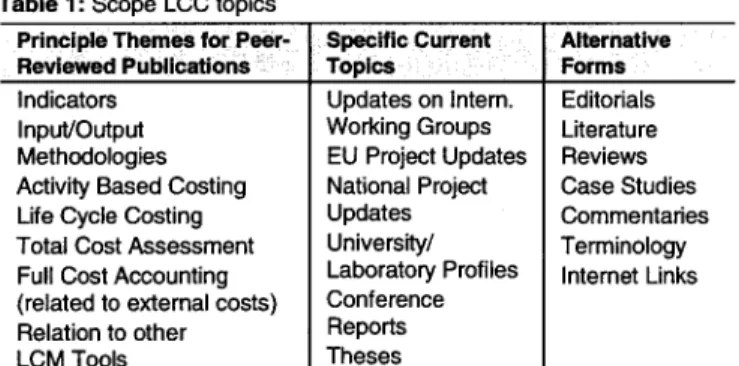
Table 1 lists the content we envisage in the area of LCC for the LCM section, though this is doubtless to change and expand in response to user, and author, input.
Table 1: Scope LOG topics Principle Themes for Peer- Reviewed PubliCations : Indicators
Input/Output Methodologies Activity Based Costing Life Cycle Costing Total Cost Assessment Full Cost Accounting (related to external costs) Relation to other LCM Tools Specific Current Topics Updates on Intem. Working Groups EU Project Updates National Project Updates University/ Laboratory Profiles Conference Reports Theses Alternative Forms Editorials Literature Reviews Case Studies Commentaries Terminology Intemet Links
We believe that the LCM toolbox, of which LCC is an im- portant part, will be required in new product development, product introduction, supply chain negotiation, environmen- tal product declarations, and cost reduction. A full account- ing of the indirect costs which often dominate businesses is good for the bottom line, provides competitive advantages, lowers credit risks, and enhances image. With this vision we would like to invite you to share your expertise, your expe- riences, but also your views on theses topics in this journal.
References
Blanchard B, Fabrycky WJ (1998): Systems Engineering and Analy- sis. Prentice Hall, Upper Saddle River, New Jersey, USA, p 560 Brankamp K (1996): Produktplanung - Produktentstehung. In: Evers-
heim W, Schuh G (eds): Produktion und Management- Betriebs- h0tte, part 1,7th edition, Springer, Berlin, Germany
Ehrenfeld JR (2003): Industrial Ecology and LCM: Chicken and Egg? Editorial. Int J LCA 8 (2) 59-60
Ehrlenspiel K (1985): Kosteng0nstig Konstruieren - Kostenwissen, Kosteneinflesse, Kostensenkung. Springer, Berlin, Germany, p 2 Fussier C (1996): Driving Eco Innovation. Pitman Publishing, Lon-
don, UK
Heinrich AB, KI6pffer W (2002): LCM - Integrating a New Section in Int J LCA (Editorial). Int J LCA 7 (6) 315-316
Hunkeler D, Biswas G (2000): Return on Environment. Int J LCA (5) 358-362
Hunkeler D, Saur K, Stranddorf H, Rebitzer G, Schmidt W.-P, Jensen AA, Christiansen K (2003): Ufe Cycle Management. SETAC, in re- view (to be published in 2003)
ISO 14040 (1997): Environmental Management- Life Cycle Assess- m e n t - Principles and Framework. International Standard 14040. International Standards Organization (ISO), Geneva, Switzerland Keoleian GA (1996): Life-Cycle Desing. In: Curran, M. A.: Environmen-
tal Life-Cycle Assessment. McGraw-Hill, New York, USA, p 6.32 Rebitzer G (2002): Integrating Life Cycle Costing and Life Cycle As-
sessment for Managing Costs and Environmental Impacts in Sup- ply Chains. In: Seuring S, Goldbach M (eds): Cost Management in Supply Chains. Heidelberg: Physica-Verlag, p 128-146
Rebitzer G, Seuring S (2003): Methodology and Application of Life Cycle Costing: A New SETAC Europe Working Group. Int J LCA 8 (2) 110-111
Rowledge LR, Barton RS, Brady KS (1999): Mapping the Journey. Greenleaf Publishing, Aizlewood's Mill, UK, p 179
Methodology and Application of Life Cycle Costing
Gerald Rebitzer 1. and Stefan Seuring 2
1Swiss Federal Institute of Technology, ENAC-GECOS, CH-1015 Lausanne, Switzerland
2Carl von Ossietzky University Oldenburg, Institute of Business Administration, D-26111 Oldenburg, Germany *Corresponding author ([email protected])
1 B a c k g r o u n d
Life cycle management (LCM) is a business driven approach including both environmental and economic aspects (Hun- keler et al. 2003). Furthermore, deliberations of the previ- ous SETAC Working Group on LCM, and others, have shown that conventional cost accounting and management has its limits when assessing costs and revenues over the life cycle of a product. Therefore, methods are necessary that can integrate existing financial data and specifically cost in- formation with metrics in life cycle approaches (in the fol- lowing such methods are summarized under the term life cycle costing - LCC). At present, there is neither scientific nor procedural agreement between the various stakeholders
regarding terminology, methodology, data formats, reporting, etc (James 2002). Therefore, there is a need to develop the methodological background of and application procedures for LCC. In addition, LCA and LCC, when carried out in an inte- grated manner and from a systems perspective (as in Rebitzer 2002), have a high potential for moving industrial practice towards sustainable development. For further background on the motivation for and potentials of life cycle costing method- ology and practice as well as what is encompassed by this concept (see Hunkeler and Rebitzer 2003).
To tackle the aforementioned challenges, a new SETAC Eu- rope Working (WG) on the topic of life cycle costing was launched at the end of 2002.