Relationship Between Behavior and Physiology in an Invasive Pest
Species: Oviposition Site Selection and Temperature-Dependent
Development of the Oriental Fruit Moth (Lepidoptera: Tortricidae)
CLAUDIA NOTTER-HAUSMANNANDSILVIA DORN1
ETH Zurich, Institute of Plant Sciences, Applied Entomology, CH-8092 Zurich, Switzerland
Environ. Entomol. 39(2): 561Ð569 (2010); DOI: 10.1603/EN09231
ABSTRACT Oviposition site selection is crucial for the reproductive success of a herbivore insect species with relatively sedentary larvae. The optimal oviposition theory, i.e., the preference-perfor-mance hypothesis, has thus far mainly been tested with a focus on nutritional quality of the host. This study investigates whether female oriental fruit moth Grapholita (Cydia) molesta choose a micro-habitat for oviposition characterized by a temperature range within which their offspring perform best. Thermal preferences of females during oviposition were assessed in a circular temperature gradient arena. Offspring performance and survival were assessed under different constant temperature conditions. Females preferred oviposition sites of⬃30⬚C over lower and higher temperatures. At this temperature, egg, larval, and pupal development was signiÞcantly faster than at 22 and 25⬚C, and larval development was also faster than at 33⬚C. At 30⬚C and at the lower temperatures tested, survival of eggs and larvae was signiÞcantly higher than at 33⬚C, whereas development was precluded at 35⬚C. Furthermore, female pupal weight attained at 30 and 33⬚C exceeded that reached at the lower temperatures tested. Considering the potentially reduced predation risk caused by the shorter developmental time of eggs and larvae, the laboratory data suggest that this species maximizes its Þtness by selecting a thermally optimal environment for its offspring, supporting the optimal ovipo-sition theory. Conversely, it is known that the codling moth (C. pomonella) lacks a mechanism to avoid temperatures lethal to progeny development, which may reßect the differences in geographic ranges of these tortricids.
KEY WORDS microhabitat, temperature, thermotaxis, Cydia molesta, Grapholita molesta
Oviposition site selection by herbivorous insects is crucial for their reproductive success. Theory predicts that oviposition preference by the adult female should correlate with host suitability for offspring develop-ment (Jaenike 1978). The suitability of a plant or a plant site for larval development is a function of many variables, including its chemical and physical proper-ties and the microhabitat (Jaenike 1978). It is well established that herbivorous insects can discriminate among plants by a variety of sensory modalities and thereby select or reject them. Biotic cues such as stem pubescence (Calatayud et al. 2008), plant colors or contrasts (Hausmann et al. 2004), plant odors (Pin˜ero and Dorn 2009), or chemical contact cues (Vogler et al. 2009) may inßuence a femaleÕs decision. The best-studied biotic stimulus for oviposition site selection is the nutritional quality of the host plant for the adult insect and/or its offspring (Scheirs et al. 2004, Heis-swolf et al. 2005 and references therein, Low et al. 2009).
Similarly, abiotic cues may exhibit direct or indirect effects on the value of a microhabitat, or the
behav-ioral patterns of the female, and hence its host choice. In lepidopteran herbivores, several species were ob-served to oviposit on the sunny side of plants, even in the absence of differences in leaf quality potentially affecting larval development (Bernays and Chapman 1994). Among the microclimatic factors, temperature has a crucial inßuence on the behavior of adult her-bivores (Ku¨hrt et al. 2006) and their interactions with plants (Shreeve 1986, Alonso 1999), as well as on the performance of their offspring (Hughes et al. 2004, Manrique et al. 2008). Temperature at the oviposition site may provide reliable cues for thermal conditions optimal for embryonic and larval development, given that the larvae are relatively sedentary and develop close to the oviposition site. Females in search of a suitable oviposition site might be sensitive to its phys-ical properties (Huey 1991), in particular to its tem-perature. However, little is known about the relation-ship between the temperature range preferred by the female and the most suitable temperature range for the development of her offspring (see reviews by Bernays and Chapman 1994, Heisswolf et al. 2005). Only few studies deal with microhabitat choices char-acterized by different microclimatic conditions. Three 1Corresponding author, e-mail: [email protected].
different lepidopteran species of the family Papilion-idae appeared to lay most of their eggs in sunny hab-itats, although shady habitats were found to be more suitable for juvenile development and survival (Rausher 1979). Similarly, infestation by the Þrst gen-eration of the codling moth Cydia pomonella L. (Lep-idoptera: Tortricidae) was lower at the north-facing tree side compared with the south- or east-facing side (Stoeckli et al. 2008). Laboratory experiments docu-mented that this species deposits its eggs on the warm-est site, whereas egg survival decreases rapidly with rising temperatures (Ku¨hrt et al. 2006). Hence, per-formance of preimaginal stages and microhabitat se-lection by the adult female were, contrary to expec-tations, not correlated in these cases.
An effective mechanism underlying microhabitat selection in many insect species is behavioral thermo-regulation. It leads to the choice of thermally favored microclimates, especially of sunny or shaded sub-strates (May 1979). Such temperature selection be-havior has been reported for a number of lepidopteran (Casey 1976, Ku¨hrt et al. 2005) and coleopteran spe-cies (May 1982, Kreuger and Potter 2001, Hausmann et al. 2005). Thermal orientation may lead the adult female to an optimal environment for development of her progeny, but, as mentioned above, there may be exceptions.
Tortricids of the tribe Grapholitini include a num-ber of economically important pests, in particular the codling moth and the oriental fruit moth Grapholita (Cydia) molesta (Busck) (Lepidoptera: Tortricidae). The oriental fruit moth is a key pest of peach and other fruits worldwide (Natale et al. 2003), with a prefer-ence for peach over apple (Myers et al. 2006). Its lifestages occupy different microhabitats (Rothschild and Vickers 1991). On the main stone fruit hosts, eggs are laid adjacent to young shoots. Neonate larvae quickly bore into nearby host plant tissue, typically within 2 h of hatching. Successive larval instars con-tinue to feed on this tissue, i.e., on shoots, stem, or fruit. On completion of feeding, the Þnal-instar larva leaves the plant material in search of an appropriate site for forming a silken cocoon, on the tree or on the ground, and to pupate (Rothschild and Vickers 1991). Al-though females can ßy considerable distances (Hughes and Dorn 2002, Hughes et al. 2004), feeding larvae are sedentary and usually complete their feeding period close to the penetration site, for instance, within the same fruit (Rothschild and Vickers 1991). Studies on the response of the oriental fruit moth to changing abiotic conditions (Hughes et al. 2004) indicate a high potential for adaptation. However, in contrast to the codling moth C. pomonella (Ku¨hrt et al. 2005, 2006), little is known on the thermal response of the oriental fruit moth, despite its high economic signiÞcance (Na-tale et al. 2003, IlÕichev et al. 2004, Evenden and Mc-Claughlin 2005).
The objective of this study was to test the optimal oviposition theory, i.e., whether females will choose a microhabitat for oviposition characterized by a tem-perature range within which their offspring perform best. Thermal preference of females during
oviposi-tion was assessed using a circular temperature gradi-ent arena, which prevgradi-ents any edge effects (Ku¨hrt et al. 2006). Performance of the offspring was studied under controlled conditions (Summers et al. 1984, Ku¨hrt et al. 2005) at different constant temperatures, thus potentially providing comparable insight into population dynamics of particular species. In view of the documented sensitivity to abiotic cues and the relatively sedentary behavior of the feeding larvae (Scheirs and De Bruyn 2002), the oriental fruit moth was considered a promising candidate for testing the oviposition preferenceÐ offspring performance hy-pothesis.
Materials and Methods
Behavioral Bioassays on Temperature Preference of Ovipositing Females. The oriental fruit moth culture originated from pupae obtained from a commercial rearing station in Italy (BioTechnologie, Todi-Peru-gia, Italy). Subsequently, insects were reared in our laboratory for⬎10 generations in a controlled envi-ronment room (23⫾ 0.5⬚C, 70 ⫾ 3% RH, 16 L: 8 D). Adults were collected on the day of eclosion and placed together in an oviposition cylinder (1,425-cm3
mesh-bottomed plastic cylinders). They were sup-plied with water from a reservoir with a cotton wool wick. The oviposition cylinders were lined with a plastic sleeve on which oviposition took place and which was replaced twice a week. Newly hatched larvae were placed singly in covered plastic rearing boxes (8.7 cm3) Þlled with⬇800 mg (1.8 cm3)
agar-based artiÞcial diet containing maize ßour, wheat ßakes, brewerÕs yeast, and preservatives (Huber et al. 1972). After reaching the Þnal (Þfth) instar, larvae were transferred all together into plastic boxes con-taining strips of corrugated cardboard for pupation.
Experiments were conducted with singly mated fe-males. Therefore, one male and one female moth (1 d old) were placed together in a mating cylinder (100-ml plastic cylinder). The moths were paired 3Ð 4 h before sunset and were separated ⬇24 h later, shortly before the start of the experiment. Only fe-males that laid a number of eggs exceeding six (see below) were considered for analyses.
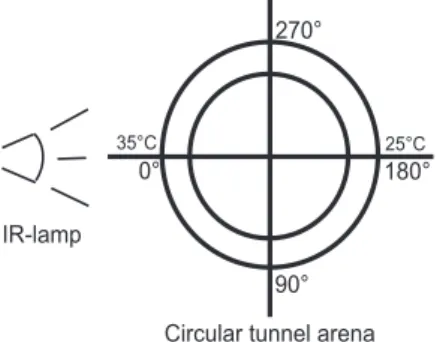
Eight identical circular arenas consisting each of an aluminum ring tunnel were set-up: four for tempera-ture gradient experiments and four for control exper-iments. Each ring tunnel (with an outer diameter of 32.6 cm and an inner diameter of 27.0 cm) was a hollow ring of aluminum, 2 mm thick, where the horizontal portion of the ring was 20 mm wide and the tunnel height was 20 mm. The ring tunnel was tightly covered with a 2-mm-thick lid (Ku¨hrt et al. 2006). A constant temperature gradient was generated with a single IR-lamp per ring (R125 IR R, 250 W; Philips, Roosendaal, The Netherlands), heating the ring horizontally at an angle of 0⬚ (Fig. 1). The opposite side of the ring was shielded from the radiation. The temperatures of the ring side walls were measured on the outer surface at each of 36 different 10⬚ sectors: 0Ð10, 10Ð20⬚, etc., with a thermocouple (type BT-1, accuracy⫾ 0.1⬚C;
Physi-temp Instruments, Clifton, NJ). These Physi-temperatures of the ring walls were considered relevant, because the female moths were in direct contact with the alumi-num surface and deposited their eggs directly on this substrate. The ambient temperature in the climate chamber for the temperature gradient experiments was 23⬚C (60% RH). The temperature gradient achieved in the ring arenas ranged from 25 to 35⬚C, and it was the same in the two halves of the ring at both sides of the lamp, with spatially less distinct temper-atures at the low-temperature end. Control experi-ments were carried out in circular arenas at constant temperature in a climate chamber at 26⬚C (60% RH). Temperature conditions around 30⬚C reßect mean monthly temperatures from May to September in a core distribution region of the insect, the Emilia-Ro-magna in Italy (Anonymous 2008).
Mated female moths at the age of 2Ð3 d after eclo-sion were tested individually. They were left for 24 h in the temperature gradient or the control setup, then the females were removed, and the eggs per 10⬚ sector were counted (36 sectors: 0 Ð10, 10 Ð20⬚, etc.) sepa-rately for the lid, bottom, and inner and outer side walls. The numbers of eggs were combined within six equal-sized sectors for each half of the ring (30⬚ sec-tors: 0 Ð30, 30 Ð 60⬚, etc.) to test for general distribution of the laid eggs and to compare egg distributions in the temperature gradient and the control trials. There was ample space in the arena for the females to lay all their eggs in the preferred temperature zone.
Because the temperature gradient in the rings was not linear, the numbers of eggs were additionally com-bined within 11 zones of equal temperature (1⬚C zones). Egg counts from the bottom surface (6.9% of the total number of eggs) were excluded, because the surface temperatures of the ring bottom could not be measured. Only females that laid at least six eggs (ac-cording to the number of the equal-sized sectors) were considered for analyses. A total of 45 individuals fulÞlling this criterion were analyzed each from the temperature gradient and control experiments. An index was calculated based on the proportion of eggs in a speciÞc temperature zone relative to the area of the temperature zone.
Physiological Experiments on Temperature Effects on Preimaginal Stages. For a preliminary physiological experiment with three temperatures (25, 30, and 35⬚C) carried out in parallel to the behavioral bioas-says, oriental fruit moth individuals from the same colony were used as described above. For the subse-quent main physiological experiment with Þve tem-peratures (22, 25, 30, 33, and 35⬚C), the stock colony had to be re-established. Insects were obtained again from Italy (by Þeld collection in orchards in the prov-ince Emilia Romagna) and reared for⬇10 generations under controlled conditions in an insectary that of-fered similar conditions as used for maintenance of the Þrst culture (25⫾ 1⬚C, 60 ⫾ 10% RH, 16 L: 8 D). Voucher specimens have been placed in the Entomo-logical Collection, ETH Zurich, Zurich, Switzerland. Two generations of prebreeding were realized to avoid sibling mating (inbreeding) among the parents of the insects to be tested in the physiological assay. Ninety male and 90 female pupae were taken from the stock colony and kept separated by sex in polystyrol rearing boxes (10 by 10 by 8 cm, 25 pupae per box) until adult emergence. On adult emergence, they were provided with a wet cotton wick. To establish families, one female and one male moth, each 1Ð3 d old, were paired together in transparent PVC boxes (60 by 35 by 15 mm). The progeny of each pair (fam-ily) was reared separately under the same conditions as the stock colony. On pupation, one male and one female were taken from different families to establish a second generation, following the same rearing pro-cedure as for the Þrst generation. The second gener-ation represented by a total of 83 ovipositing females was used for the experiments (few females laid no eggs; the minimum target of 15 females per temper-ature treatment⫽ 75 females was attained). The num-ber of females assigned to each temperature regimen amounted to 15Ð17.
To obtain eggs⬍24 h old, adults from egg-contain-ing boxes were transferred daily into a new box and provided again with a wet cotton wick. The eggs in the Þrst box were counted and randomly assigned to one distinct temperature regimen. All eggs led subse-quently by the same female were assigned to the same temperature. Temperature regimens chosen for the main experiment were derived from the preliminary experiment that indicated best performance of the oriental fruit moth at 30⬚C compared with 25 and 35⬚C, respectively. Hence, the main physiological experi-ment included 30⬚C along with two higher (33 and 35⬚C) and two lower (22 and 25⬚C) temperatures, under which the insects were kept from the egg to the adult stage. Test insects were checked every 24 h for survival and development.
Egg developmental time was recorded as the num-ber of days from oviposition to eclosion. Egg survival was determined by the number of larvae that hatched from the total of at least 1,700 eggs assigned to the same temperature. Subsequently, the number of the neo-nate larvae was reduced consistently in all treatments to approximate 600 individuals in each temperature regimen. This was achieved by twice transferring⬇20
270°
180°
90°
35°C 25°C
0°
Circular tunnel arena IR-lamp
Fig. 1. Trial design: circular tunnel arena used for the behavioral bioassays on temperature preference of ovipos-iting females.
larvae from each family into a petri dish of 14 cm diameter containing a 0.5-cm-thick layer of agar-based diet (Huber et al. 1972), using a desinfected Þne paint-brush. Three days later, corrugated cardboard strips were inserted into the petri dishes. Larval develop-mental time was recorded as the number of days from eclosion to larval entry into the corrugated cardboard strip for pupation. Larval survival was assessed by the number of individuals that had entered the strip in relation to those that had been set-up as neonate larvae. Corrugated cardboard strips were exchanged daily in the petri dishes. Insects in cardboard strips were maintained in vials (one per progeny of a fe-male) under the given temperature regimen. Subse-quently, pupae were sexed, weighed (Mettler AT 261 Delta range, accuracy⫾ 2g; Mettler-Toledo, Grei-fensee, Switzerland), and returned to their given tem-perature regimen until adult emergence. Pupal devel-opmental time was recorded as the period between larval entry into the cardboard strip and adult emer-gence from it, thus encompassing any nonfeeding pre-pupal stage the larva may have undergone. Pupal sur-vival was assessed by the number of emerged moths in relation to the number of individuals that had entered the cardboard strip.
Statistical Analyses. In the behavioral bioassays, rel-ative egg numbers were calculated as the proportion of eggs laid per female in the different sectors of the temperature gradient arenas. These relative egg num-bers of the different sectors did not fulÞll the as-sumptions of parametric statistics and could not be adequately transformed. Thus, the nonparametric statistics by Friedman were used for the control and the temperature gradient trials, as in Ku¨hrt et al. (2006). The Friedman test was followed by post hoc comparisons (DunnÕs test) to check for pairwise sig-niÞcant differences. The difference between temper-ature gradient and control trials was analyzed using repeated-measures analysis of variance (ANOVA), considering the arcsine-square-root transformed rel-ative egg numbers as repeated measurements with the factor treatment with the two levels temperature gra-dient and control. All analyses were run with SPSS 11.0.2 (SPSS, Chicago, IL) for Apple MacIntosh except the post hoc (DunnÕs test) comparisons, which were computed using SsS 1.1a (Rubisoft Software, Eichenau, Germany).
In the physiological experiments, egg, larval and pupal survival rates were calculated as percentage surviving individuals. Furthermore, overall survival from the larval to the adult stage was calculated as percentage of surviving individuals, which had been set-up as neonate larvae. Differences in survival be-tween temperature regimens were tested with a Kruskal-Wallis test in R (R 2.6.2, R Development Core Team 2008) and Wilcoxon test with an adjustment of the signiÞcance level according to the sequential Bon-ferroni test (Rice 1989) to account for multiple related tests on nonindependent data. To compare egg, larval, and pupal developmental time, as well as pupal weight and sex ratio (male to total number of individuals ratio) among the different temperature regimens,
mean values were calculated separately for the prog-eny of each female. Differences in developmental time, pupal weight, and sex ratio between different temperature regimens were analyzed with a Kurskal-Wallis test and a paired sample randomization test using SsS1.1a (Rubisoft Software) statistical software.
Results
Behavioral Bioassays on Temperature Preference of Ovipositing Females
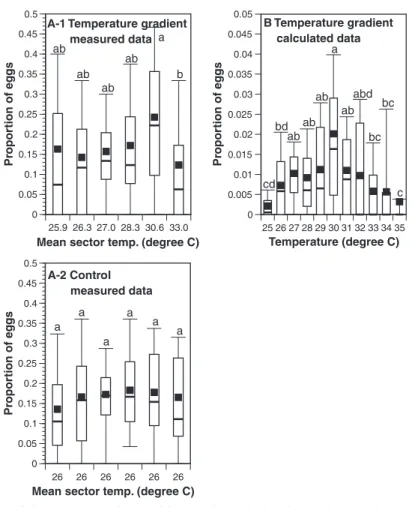
The distribution of the eggs laid by the 45 individ-ually tested oriental fruit moth females in the circular temperature gradient differed signiÞcantly among the different temperature sectors (Friedman test, n⫽ 45, 2⫽ 14.28, df ⫽ 5, P ⫽ 0.014; Fig. 2A1). SigniÞcantly
more eggs were laid in the sector with a mean tem-perature of 30.6⬚C than in the adjacent sector with the higher mean temperature of 33.0⬚C (DunnÕs post hoc,
P⬍ 0.05). The average proportion of eggs was also
larger at 30.6⬚C than in the adjacent sector with the lower mean temperature of 28.3⬚C, but in this case, the difference was not signiÞcant. In the control, no sig-niÞcant difference in egg distribution was found among the sectors (Friedman test, n⫽ 44,2⫽ 8.67,
df⫽ 5, P ⫽ 0.123; Fig. 2A2). The relative number of eggs in corresponding sectors of the temperature gra-dient and the control were signiÞcantly different (RM ANOVA, F⫽ 9.90, df ⫽ 1, 87, P ⫽ 0.002), thus indi-cating no spatial preference bias.
Dividing the temperature gradient into 1⬚C zones showed the highest proportion of eggs at a tempera-ture of 30⬚C with 21.7% of all eggs laid here (Friedman test, n⫽ 45,2⫽ 39.79, df ⫽ 10, P ⬍ 0.001; Fig. 2B).
Physiological Experiments on Temperature Effects on Preimaginal Stages
Survival. Preimaginal environmental conditions sig-niÞcantly inßuenced egg survival (Kruskal-Wallis test,
n⫽ 63,2⫽ 53.39, df ⫽ 4, P ⬍ 0.001), with high values
found at 22, 25, and 30⬚C. Egg survival was signiÞ-cantly reduced at 33⬚C, and no larvae hatched at 35⬚C (Table 1).
Larval survival was highest at 22, 25, and 30⬚C but signiÞcantly reduced at 33⬚C (Kruskal-Wallis test, n ⫽ 63,2⫽ 35.1, df ⫽ 3, P ⬍ 0.001; Table 1). Pupal survival
was signiÞcantly inßuenced by temperature (Kruskal-Wallis test, n⫽ 63,2⫽ 16.03, df ⫽ 3, P ⬍ 0.001), with
signiÞcantly higher pupal survival at 22⬚C than at 33⬚C (Table 1).
Overall survival from the larval to the adult stage was signiÞcantly inßuenced by temperature (Kruskal-Wallis test, n⫽ 63,2⫽ 35.94, df ⫽ 3, P ⬍ 0.001), with
reduced survival at 33⬚C compared with the high sur-vival at 22, 25, and 30⬚C (Table 1).
Sex ratio (male to total number of individuals ratio) of the surviving individuals determined at the pupal stage was signiÞcantly male biased at 33⬚C compared with 25⬚C (Kruskal-Wallis test, n ⫽ 63,2⫽ 10.39, df ⫽
Developmental Time. Temperature had a signiÞ-cant effect on the developmental time from egg to adulthood (Kruskal-Wallis test, n⫽ 63,2⫽ 57.02,
df⫽ 3, P ⬍ 0.001), as well as on the developmental time of each preimaginal stage: egg (Kruskal-Wallis test, n ⫽ 63,2 ⫽ 32.27, df ⫽ 3, P ⬍ 0.001), larva
(Kruskal-Wallis test, n⫽ 63,2⫽ 52.41, df ⫽ 3, P ⬍
0.001), and pupa (Kruskal-Wallis test, n⫽ 63,2⫽
57.08, df⫽ 3, P ⬍ 0.001).
Total developmental time from egg to adulthood was signiÞcantly shorter at 30⬚C than at 25 and 22⬚C (Paired sample randomization test; 25 and 30⬚C: Q ⫽ 25.9 26.3 27.0 28.3 30.6 33.0 0 0.05 0.1 0.15 0.2 0.25 0.3 0.35 0.4 0.45 0.5 Pr opor tion of eg gs b ab ab ab ab a
A-1 Temperature gradient measured data
Mean sector temp. (degree C)
25 26 27 28 29 30 31 32 33 34 35 0 0.005 0.01 0.015 0.02 0.025 0.03 0.035 0.04 0.045 0.05 Pr opor tion of eg gs Temperature (degree C) a ab ab ab ab abd bc bc c bd cd B Temperature gradient calculated data 26 26 26 26 26 26 0 0.05 0.1 0.15 0.2 0.25 0.3 0.35 0.4 0.45 0.5 Pr opor tion of eg gs a a a a A-2 Control measured data
Mean sector temp. (degree C)
a a
Fig. 2. Distribution of the proportions of oriental fruit moth eggs laid in the circular tunnel arena. (A1) Measured data in a temperature gradient of equally sized temperature zones ranging in mean temperature values from 25.9 to 33⬚C (Friedman test, P⫽ 0.014; n ⫽ 45). (A2) Measured data in the control experiment at 26⬚C (Friedman test, P ⫽ 0.123; n ⫽ 45). Midlines and Þlled squares correspond to the median and the mean, respectively. Rectangular boxes show the range from the 25th to the 75th percentile. Whiskers extend from the 10th to the 90th percentile. (B) Data from the temperature gradient plotted relative to the area of the different temperature zones (Friedman test, P⬍ 0.001). Midlines and Þlled squares correspond to the median and the mean, respectively. Rectangular boxes show the range from the 25th to the 75th percentile. Whiskers extend from the 10th to the 90th percentile. (A and B) Different letters indicate signiÞcant differences between sectors (DunnÕs post hoc, P⬍ 0.05).
Table 1. Percent survival of the immature stages of the oriental fruit moth at five different temperatures and sex ratio (male to total no. of individuals ratio) determined for survivors at the pupal stage
Temperature (⬚C) Egg Larva Pupa Larva to adult Sex ratio (m: N) 22 88.7⫾ 4.0a (n ⫽ 1890) 58.3⫾ 2.5a (n ⫽ 636) 97.2⫾ 6.1a (n ⫽ 371) 56.9⫾ 2.9a 0.59⫾ 0.02ab 25 74.6⫾ 6.4a (n ⫽ 1728) 68.9⫾ 4.0a (n ⫽ 605) 92.4⫾ 6.9ab (n ⫽ 417) 63.5⫾ 3.7a 0.54⫾ 0.03a 30 76.5⫾ 5.7a (n ⫽ 1891) 59.7⫾ 3.8a (n ⫽ 600) 93.8⫾ 10.0ab (n ⫽ 358) 56.0⫾ 3.5a 0.53⫾ 0.02ab 33 53.5⫾ 6.0b (n ⫽ 2131) 25.4⫾ 3.0b (n ⫽ 642) 79.2⫾ 15.2b (n ⫽ 164) 19.7⫾ 2.3b 0.68⫾ 0.05b 35 0.0⫾ 0.0 (n ⫽ 1953)
Values are means⫾ SE.
Different letters indicate signiÞcant differences in a column at P⬍ 0.05 (Kruskal-Wallis and Wilcoxon test with an adjustment of the signiÞcance level according to the sequential Bonferroni test).
⫺4.66, P ⬍ 0.001; 22 and 30⬚C: Q ⫽ ⫺7.21, P ⬍ 0.001; Table 2). Development at 30⬚C required only two thirds of the time compared with that required at the lowest temperature tested (22⬚C). Overall, mean val-ues for the complete development were lowest at 30⬚C and only slightly higher at 33⬚C, but this difference was not signiÞcant.
This difference between developmental time at 30 and 22⬚C was signiÞcant for the egg stage (paired sample randomization test; Q⫽ 5.49, P ⬍ 0.001; Table 2), the larval stage (paired sample randomization test; Q⫽ 7.21, P ⬍ 0.001), and the pupal stage (paired sample randomization test; Q⫽ 7.09, P ⬍ 0.001). Fur-thermore, the difference between developmental time at 30 and 25⬚C was signiÞcant for the egg stage (paired sample randomization test; Q⫽ 3.02, P ⬍ 0.02; Table 2), the larval stage (paired sample randomiza-tion test; Q⫽ 3.83, P ⬍ 0.001), and the pupal stage (paired sample randomization test; Q ⫽ 4.67, P ⬍ 0.001).
The preimaginal environment had a signiÞcant ef-fect on pupal weight of females (Kruskal-Wallis test,
n⫽ 63,2⫽ 34.72, df ⫽ 3, P ⬍ 0.001), with pupae
reared at 30 and 33⬚C weighing signiÞcantly more than at 25 and 22⬚C (Table 2). The pupal weight of males was also signiÞcantly inßuenced by temperature (Kur-skal-Wallis test, n⫽ 63,2⫽ 31.52, df ⫽ 3, P ⬍ 0.001),
with pupae reared at 33 and 30⬚C weighing signiÞ-cantly more than at 22⬚C (Table 2).
Discussion
This study documents that female oriental fruit moth respond behaviorally to temperature by select-ing oviposition sites at a temperature of⬃30⬚C. This temperature supports a more rapid embryonic, larval, and pupal development than the lower temperatures of 25 and 22⬚C, as well as a higher egg and larval survival rate than the higher temperatures of 33 and 35⬚C, the latter being lethal to the eggs. Moreover, the ambient temperature of 30⬚C led to a higher female pupal weight of the offspring than the lower temper-atures, indicating a Þtness gain for the femaleÕs off-spring (Carle 1965, Visser 1994). The microhabitat temperature favored for oviposition by female moths coincides with the temperature allowing for best per-formance of the offspring.
Insect body temperature can be regulated behav-iorally, particularly by microhabitat selection (Casey 1976, Ku¨hrt et al. 2005). Active microhabitat selection
is not possible for immobile stages such as eggs, and therefore, a femaleÕs choice of oviposition site can have a major impact on the Þtness of her offspring (Rosenzweig 1991). Accordingly, the ability to detect favorable oviposition sites and to avoid unfavorable ones can be expected to be under strong selection and has received intense scrutiny in studies of oviposition site preference (Bernays and Chapman 1994, Heiss-wolf et al. 2005). In the current study, oriental fruit moth females preferred oviposition sites culminating at a temperature of⬃30⬚C as was clearly shown when the data from the temperature gradient were plotted relative to the area of the different temperature zones in analogy to a recent study by Ku¨hrt et al. (2006). This behavior parallels the preference for a distinct tem-perature range within a gradient reported for different hematophagous hemipterans (Pires et al. 2002, Guar-neri et al. 2003, Schilman and Lazzari 2004) and for a detrivorous dipteran species (Fogleman 1979). How-ever, in a lepidopteran species closely related to the oriental fruit moth, the codling moth C. pomonella, females preferred the highest available temperature for oviposition regardless of the temperature ranges offered in a similar trial set-up (Ku¨hrt et al. 2006). Hence, within the same tribe (Grapholitini), the ori-ental fruit moth avoided oviposition sites with a tem-perature in excess of 30⬚C, whereas the codling moth proved to be strictly thermophilous.
Temperature is a key driving factor in insect devel-opment. The temperature ranges that allow develop-ment are characteristic of a species, and individuals cannot survive at temperatures outside this range (Willmer et al. 2000). We hypothesized that the pre-ferred temperature for oviposition in the oriental fruit moth may coincide with the most favorable temper-ature for development and survival of the preimaginal stages. Our results fully match this expectation. The microclimate of⬃30⬚C chosen by the adult moth fa-vors rapid embryonic, larval, and pupal development, whereas at lower temperatures (25 and 22⬚C), devel-opmental time of all preimaginal stages was prolonged. Whereas egg, larval, and pupal developmental time at 33⬚C was similar to that at 30⬚C, survival in the egg and larval stages was drastically reduced. No survival was observed at 35⬚C. In addition to the short develop-mental time and good overall survival, the tempera-ture favored by the adult female moth (30⬚C) resulted in an increased female pupal weight of the offspring compared with that obtained at lower temperatures. There is often a positive association between size
Table 2. Developmental time (d) of immature stages and pupal weight of the oriental fruit moth at four different temperatures
Temperature
(⬚C) Eggs (d) Larvae (d) Pupae (d) Egg to adult (d)
Pupal weight (mg)
Females Males
22 4.5⫾ 0.04a (n ⫽ 1677) 12.6⫾ 0.09a (n ⫽ 371) 13.0⫾ 0.10a (n ⫽ 362) 30.1⫾ 0.17a 14.5⫾ 0.18a (n ⫽ 150) 11.2⫾ 0.07a (n ⫽ 221) 25 4.0⫾ 0.07ac (n ⫽ 1383) 10.3⫾ 0.15b (n ⫽ 417) 11.0 ⫾ 0.10ac (n ⫽ 385) 25.3⫾ 0.24ac 15.1⫾ 0.26a (n ⫽ 196) 11.3⫾ 0.16ab (n ⫽ 221) 30 3.3⫾ 0.08b (n ⫽ 1489) 8.5⫾ 0.07c (n ⫽ 358) 8.1⫾ 0.04b (n ⫽ 350) 19.8⫾ 0.12b 16.4⫾ 0.24b (n ⫽ 168) 12.1 ⫾ 0.28bc (n ⫽ 190) 33 3.8⫾ 0.23bc (n ⫽ 1161) 10.1 ⫾ 0.13b (n ⫽ 164) 8.8⫾ 0.09bc (n ⫽ 127) 22.7⫾ 0.28bc 16.9⫾ 0.24b (n ⫽ 64) 12.5⫾ 0.14c (n ⫽ 100) Values are means⫾ SE.
Different letters indicate signiÞcant differences in a column at P⬍ 0.05 (Kruskal-Wallis and paired sample randomization test between temperatures for each insect stage).
and/or weight of immature stages and adult fecundity in Lepidoptera (Fantinou et al. 2004), and this is in-deed the case in the oriental fruit moth (Rothschild and Vickers 1991). Thus, pupal weight can be consid-ered a good measure for adult fecundity in this species (Hughes et al. 2004). Furthermore, sex ratio of the pupae was close to the expected 50:50% distribution at 30 and 25⬚C, whereas it became male biased at extreme temperature of 33⬚C. This suggests (assuming an even initial sex ratio of the neonate larvae) that survival rate of the offspring at 30⬚C is similarly high for females and males but signiÞcantly reduced for females at the high-est temperature thigh-ested. This Þnding indicates an ad-ditional beneÞt of a microhabitat temperature of ⬃30⬚C for this species.
The thermal orientation of the oriental fruit moth females is consistent with at least three explanations. First, it favors rapid embryonic development. The temperature favoring rapid egg development may be an easily detectable cue for a female in search of an oviposition site. Second, a temperature of⬃30⬚C in-dicates a favorable microclimate for future larval de-velopment. Development is accelerated compared with that at lower temperatures, whereas larval sur-vival remains unchanged. In the oriental fruit moth, neonate larvae only wander around for a short period of time on the surface of the plant before boring into the plant tissue (Rothschild and Vickers 1991), result-ing in a larval feedresult-ing site in close vicinity of the oviposition site. Larvae may beneÞt from a short de-velopmental time because they are particularly prone to mortality caused by a large number of larval para-sitoid species (Rothschild and Vickers 1991, Tschudi-Rein et al. 2004), which can be more effectively evaded when the duration of the vulnerable period is minimized. Third, the temperature preferred by the adult female eventually leads to a higher female pupal weight of the progeny, promising increased adult fe-cundity.
Oviposition by the individual oriental fruit moth females in the circular arena was never strictly con-Þned to the sector with the optimal thermal conditions for their offspring, because a minor portion of the egg load was also always deposited in sectors with lower and higher temperatures. Because precise predictions on future temperature development of a microhabitat are impossible at the time of oviposition, the oriental fruit moth may balance the risk associated with the choice of one single temperature by a risk distribution, as is known for this species in connection with its dispersal strategy (Hughes and Dorn 2002).
The temperature favored by the ovipositing females seems optimal in the oriental fruit moth but not in the codling moth (Ku¨hrt et al. 2006), considering good performance of the progeny as the decisive criterion. Codling moth females even deposited eggs at temper-atures far beyond those providing a good chance for survival of their progeny (Ku¨hrt et al. 2006). This discrepancy indicates a difference in adaptation to temperature in these two species belonging both to the internal fruit feeders of the tribe Grapholitini. Although there is an extended overlap of their
distri-bution in several regions of the world including North America (Borchert et al. 2004), their overall geo-graphic distribution ranges differ considerably in Eu-rope. Along a south-north transect through Europe, the oriental fruit moth is generally reported from Italy as a key pest of the stone fruit peach, requiring ele-vated temperatures (Hughes and Dorn 2002). Mean summer temperature conditions typical for the Italian peach-growing province Emilia-Romagna are⬃30⬚C (Anonymous 2008a). The oriental fruit moth has been located only exceptionally north of the Alps. It was found in northern Switzerland during the particularly warm summer of 2003 (Tschudi-Rein et al. 2004), but, to our knowledge, it has not been reported in Ger-many or more northern countries. In contrast, the codling moth is widely distributed as a pome fruit pest in these countries including Germany (Blago and Dickler 1990) and even Sweden (Witzgall et al. 1999). The codling moth seems well adapted to these north-ern regions with generally moderate average temper-atures. Frequently occurring short-term weather changes (Anonymous 2008b) may reduce the reliabil-ity of the temperature at the time of oviposition for predicting the temperature during development of the offspring, rendering evolution of an optimal prefer-ence less likely. In fact, the codling moth even lacks a mechanism to avoid temperatures lethal to progeny development. In contrast, the current study docu-ments a fail-safe mechanism for the oriental fruit moth, because its thermal orientation prevents choice of oviposition sites, which are too warm for subsequent successful development of the progeny. Generally more reliable warm temperature conditions such as are reported from Italy (Anonymous 2008a) might have contributed to the evolution of this trait.
In conclusion, the tortricid species G. molesta seems to be highly adapted to warm conditions. Our labo-ratory data suggest that this species maximizes its Þt-ness by providing a thermally optimal environment for the development and the fecundity of its offspring, supporting the preferenceÐperformance hypothesis in respect to temperature-driven microhabitat choice. Further studies under Þeld conditions are needed to verify these laboratory Þndings.
Acknowledgments
We thank S. Hein, D. Mazzi, and K. Mody for support with experiments and data analysis and K. Tschudi-Rein, F. Hatt, the editor, and two anonymous reviewers for useful com-ments on previous versions of this manuscript.
References Cited
Alonso, C. 1999. Variation in herbivory by Yponomeuta ma-halebellaon its only host plant Prunus mahaleb along an elevational gradient. Ecol. Entomol. 24: 371Ð379. Anonymous. 2008a. Klimadiagramme weltweit. (http://
www.iten-online.ch/klima/europa/italien).
Anonymous. 2008b. Wetter⫹ Klima News. (http://www. wetterklima.de/klima/weltklima/klimaschweden.htm).
Bernays, E. A., and R. F. Chapman. 1994. Host-plant selec-tion by phytophagous insects. Chapman & Hall, New York.
Blago, N., and E. Dickler. 1990. New method for monitoring egg phenology of the codling moth Cydia pomonella L. (Lep., Tortricidae). J. Appl. Entomol. 109: 98 Ð104. Borchert, D. M., J. F. Walgenbach, G. G. Kennedy, and J. W.
Long. 2004. Toxicity and residual activity of methoxy-fenozide and tebumethoxy-fenozide to codling moth (Lepidop-tera: Tortricidae) and oriental fruit moth (Lepidop(Lepidop-tera: Tortricidae). J. Econ. Entomol. 97: 1343Ð1352.
Calatayud, P.-A., P. O. Ahuya, A. Wanjoya, B. Le Ru¨, J.-F. Silvain, and B. Fre´rot. 2008. Importance of plant phys-ical cues in host acceptance for oviposition by Busseola
fusca.Entomol. Exp. Appl. 126: 233Ð243.
Carle, P. 1965. Essai dÕanalyse expe´rimentale des facteurs conditionnant la fe´condite´ chez la bruche de haricot (Acanthoscelides obtectus Say). Ann. Epiphyties 16: 215Ð 249.
Casey, T. M. 1976. Activity patterns, body temperature and thermal ecology in two desert caterpillars (Lepidoptera: Sphingidae). Ecology 57: 485Ð 497.
Evenden, M. L., and J. R. McClaughlin. 2005. Male oriental fruit moth response to a combined pheromone-based attracticide formulation targeting both oriental fruit moth and codling moth (Lepidoptera: Tortricidae). J. Econ. Entomol. 98: 317Ð325.
Fantinou, A. A., D. C. Perdikis, and K. F. Zota. 2004. Re-productive responses to photoperiod and temperature by diapausing and nondiapausing population of Sesamia
nonagrioidesLef. (Lepidoptera: Noctuidae). Physiol. En-tomol. 29: 169 Ð175.
Fogleman, J. C. 1979. Oviposition site preference for sub-strate temperature in Drosophila melanogaster. Behav. Genet. 9: 407Ð 412.
Guarneri, A. A., C. Lazzari, A.A.P. Xavier, L. Diotaiuti, and M. G. Lorenzo. 2003. The effects of temperature on the behaviour and development of Triatoma brasiliensis. Physiol. Entomol. 28: 185Ð191.
Hausmann, C., J. Samietz, and S. Dorn. 2004. Visual orienta-tion of overwintered Anthonomus pomorum (Coleoptera: Curculionidae). Environ. Entomol. 33: 1410Ð1415. Hausmann, C., J. Samietz, and S. Dorn. 2005. Thermal
ori-entation of Anthonomus pomorum (Coleoptera: Curcu-lionidae) in early spring. Physiol. Entomol. 30: 48 Ð53. Heisswolf, A., E. Obermaier, and H. J. Poethke. 2005.
Se-lection of large host plants for oviposition by a monopha-gous leaf beetle: nutritional quality or enemy-free space? Ecol. Entomol. 30: 299 Ð306.
Huber, J., G. Benz, and K. Schmid. 1972. Zuchtmethode und semisynthetische Na¨hrmedien fu¨r Apfelwickler. Ex-perimentia 28: 1260 Ð1261.
Huey, R. B. 1991. Physiological consequences of habitat se-lection. Am. Nat. 137: S91ÐS115.
Hughes, J., and S. Dorn. 2002. Sexual differences in the ßight performance of the oriental fruit moth, Cydia
mo-lesta.Entomol. Exp. Appl. 103: 171Ð182.
Hughes, J., A. Hern, and S. Dorn. 2004. Preimaginal envi-ronment inßuences adult ßight in Cydia molesta (Lepi-doptera: Tortricidae). Environ. Entomol. 33: 1155Ð1162. Il’ichev, A. L., D. G. Williams, and A. D. Milner. 2004. Mating disruption barriers in pome fruit for improved control of oriental fruit moth Grapholita molesta Busck (Lep., Tortricidae) in stone fruit under mating disrup-tion. J. Appl. Entomol. 128: 126 Ð132.
Jaenike, J. 1978. On optimal oviposition behavior in phyto-phagous insects. Theor. Popul. Biol. 14: 350 Ð356.
Kreuger, B., and D. A. Potter. 2001. Diel feeding activity and thermoregulation by Japanese beetles (Coleoptera: Scarabaeidae) within host plant canopies. Environ. En-tomol. 30: 172Ð180.
Ku¨hrt, U., J. Samietz, and S. Dorn. 2005. Thermoregulation behaviour in codling moth larvae. Physiol. Entomol. 30: 54 Ð 61.
Ku¨hrt, U., J. Samietz, and S. Dorn. 2006. Thermal response of adult codling moths. Physiol. Entomol. 31: 80 Ð 88. Low, C., S. N. Wood, and R. M. Nisbet. 2009. The effects of
group size, leaf size and densitiy on the performance of a leaf-mining moth. J. Anim. Ecol. 78: 152Ð160. Manrique, V., J. P. Cuda, W. A. Overholt, and R. Diaz. 2008.
Temperature-dependent development and potential dis-tribution of Episimus utilis (Lepidoptera: Tortricidae), a candidate biological control agent of Brazilian pepper-tree (Sapindales: Anacardiaceae) in Florida. Environ. En-tomol. 37: 862Ð 870.
May, M. L. 1979. Insect thermoregulation. Annu. Rev. En-tomol. 24: 313Ð349.
May, M. L. 1982. Body temperature and thermoregulation of the Colorado potato beetle, Leptinotarsa decemlineata. Entomol. Exp. Appl. 31: 413Ð 420.
Myers, C. T., L. A. Hull, and G. Krawczyk. 2006. Effects of orchard host plants on the oviposition preference of the oriental fruit moth (Lepidoptera: Tortricidae). J. Econ. Entomol. 99: 1176 Ð1183.
Natale, D., L. Mattiacci, A. Hern, E. Pasqualini, and S. Dorn. 2003. Response of female Cydia molesta (Lepidoptera: Tortricidae) to plant derived volatiles. Bull. Entomol. Res. 93: 335Ð342.
Pin˜ero, J. C., and S. Dorn. 2009. Response of female oriental fruit moth to volatiles from apple and peach trees at three phenological stages. Entomol. Exp. Appl. 131: 67Ð74. Pires, H.H.R., C. R. Lazzari, P. E. Schilman, L. Diotaiuti, and
M. G. Lorenzo. 2002. Dynamics of thermopreference in the Chagas disease vector Panstrongylus megistus (Hemiptera: Reduviidae). J. Med. Entomol. 39: 716 Ð719. R Development Core Team. 2008. R version 2.6.2. (http.//
r-project.org/).
Rausher, M. D. 1979. Larval habitat suitability and oviposi-tion preference in three related butterßies. Ecology 60: 503Ð511.
Rice, W. R. 1989. Analyzing tables of statistical tests. Evo-lution 43: 223Ð225.
Rosenzweig, M. L. 1991. Habitat selection and population interactions: the search for mechanism. Am. Nat. 137: S5ÐS28.
Rothschild, G.H.L., and R. A. Vickers. 1991. Biology, ecology and control of the oriental fruit moth, pp. 389Ð412. In L.P.S. van der Geest and H.H. Evenhuis (eds.), World crop pest, vol. 5, tortricid pestsÑtheir biology, natural enemies and control. Elsevier, Amsterdam, The Netherlands.
Scheirs, J., and L. De Bruyn. 2002. Integrating optimal for-aging and optimal oviposition theory in plant-insect re-search. Oikos 96: 187Ð191.
Scheirs, J., T. G. Zoebisch, D. J. Schuster, and L. Bruyn. 2004. Optimal foraging shapes host preference of a polypha-gous leafminer. Ecol. Entomol. 29: 375Ð379.
Schilman, P. E., and C. R. Lazzari. 2004. Temperature pref-erence in Rhodnius prolixus, effects and possible conse-quences. Acta Trop. 90: 115Ð122.
Shreeve, T. G. 1986. Egg-laying by the speckled wood but-terßy (Pararge aegeria): the role of female behavior, host plant abundance and temperature. Ecol. Entomol. 11: 229 Ð236.
Stoeckli, S., K. Mody, and S. Dorn. 2008. Inßuence of canopy astepct and height on codling moth (Lepidoptera:
Tor-tricidae) larval infestation in apple, and relationship be-tween infestation and fruit size. J. Econ. Entomol. 101: 87Ð 89.
Summers, C. G., R. I. Coviello, and A. P. Gutierrez. 1984. Inßuence of constant temperature on the development and reproduction of Acyrthosiphon kondoi (Homoptera: Aphididae). Environ. Entomol. 13: 236 Ð242.
Tschudi-Rein, K., N. Brand, U. Ku¨hrt, and S. Dorn. 2004. First record of Hyssopus pallidus (Askew, 1964) for Swit-zerland (Hymenoptera: Eulophidae). Rev. Suisse Zool. 111: 671Ð 672.
Visser, M. E. 1994. The importance of being large: the re-lationship between size and Þtness in females of the parasitoid Aphaereta minuta (Hymenoptera: Bra-conidae). J. Anim. Ecol. 63: 807Ð 815.
Vogler, U., A. S. Rott, C. Gessler, and S. Dorn. 2009. Ter-pene-mediated parasitoid host location behavior on transgenic and classically bred apple genotypes. J. Agric. Food Chem. 57: 6630 Ð 6635.
Willmer, P. G., G. N. Stone, and I. A. Johnston. 2000. En-vironmental physiology of animals. Blackwell Sciences, Oxford, United Kingdom.
Witzgall, P., A.-C. Ba¨ckman, M. Svensson, U. Koch, F. Rama, A. El-Sayed, J. Brauchli, H. Arn, M. Bengtsson, and J. Lo¨fqvist. 1999. Behavioral observations of codling moth, Cydia pomonella,in orchards permeated with synthetic pheromone. Biocontrol 44: 211Ð237.