Journal of Experimental Botany, Vol. 34, No. 144, pp. 927-935, July 1983
Inheritance of Naphthazarin Production and
Pathogenicity to Pea in Nectria haematococca
J. HOLENSTEIN AND G. DEFAGO
Institutfiir Phytomedizin, Eidgenossische Technische Hochschule, Zurich, Switzerland
Received 30 September 1982
ABSTRACT
A naphthazarin-producing (fusarubin, novarubin, javanicin, norjavanicin), highly pathogenic strain of
Nectria haematococca (sexual state of Fusarium solani var. martii) was crossed with a
non-naphthazarin-producing, slightly pathogenic mutant strain. This cross and several backcrosses were studied by unordered tetrad analysis.
In all tetrads a 4 : 4 ratio of naphthazarin-producing ascospore strains to non-naphthazarin-producing ones resulted. By two-factor analysis for this character and the markers determining mating type, sexual type, colonial growth, and perithecial colour respectively, parental-ditype, non-parental-ditype, and tetratype tetrads resulted. This indicates that the loss of the capacity to produce naphthazarins is due to a mutation at a single locus, which probably blocks the biosynthesis of a polyketide precursor.
When the same tetrads were tested for pathogenicity, the strains could not be classified into a group with high pathogenicity and one with low pathogenicity, as they showed intermediate degrees of pathogenicity. It is therefore concluded that the degree of pathogenicity is polygenically inherited.
The difference in the inheritance of the capacity to produce naphthazarins and of pathogenicity, as well as the appearance of highly pathogenic though non-naphthazarin-producing segregants, indicates that the capacity to produce novarubin, fusarubin, javanicin, and norjavanicin is not a major factor in the determination of a high degree of pathogenicity.
Key words: Naphthazarin; Pathogenicity; Genetic.
I N T R O D U C T I O N
Fusarium spp. of the Martiella group cause root and stem rots in peas. In vitro these
pathogens produce all or some of six toxic compounds: javanicin, fusarubin, novarubin,
norjavanicin, marticin and isomarticin. The structure of these compounds is known and all
have a naphthazarin structure (Kern and Naef-Roth, 1967). Naphthazarins, secondary
metabolites of the polyketide type, are mainly produced by fungi and hardly ever by higher
plants (Turner, 1971). They are all toxic to higher plants and micro-organisms but at different
degrees. Marticin and isomarticin are predominantly toxic to higher plants, fusarubin,
novarubin, javanicin and norjavanicin to bacterial growth and the latter two to fungal growth
also. Marticin, isomarticin, and fusarubin can be extracted from diseased tissue (Kern and
Naef-Roth, 1965).
During examination of the relationship between capacity to produce naphthazarins and
pathogenicity, several strains of Fusarium solani var. martii, including artificial mutants,
were compared with each other (Kern, 1976). Highly pathogenic strains were found to
produce greater concentrations of naphthazarin, especially marticins, than did weakly pathogenic strains. Mutants of a highly pathogenic strain of Fusarium solani var. martii which no longer produced naphthazarins were only weakly pathogenic.
This study is based on a cross between one of these mutants and a naphthazarin-producing (fusarubin, novarubin, norjavanicin, javanicin), highly pathogenic strain of Nectria
haematococca which is the perfect state of Fusarium solani var. martii. Genetic analysis of
the capacity to produce naphthazarins and of the degree of pathogenicity was facilitated by using the results of studies on the genetics of mating type, sexual reproduction, perithecial colour, growth types and fungicide tolerance in Nectria haematococca, reviewed by Snyder, Georgopoulos, Webster, and Smith (1975).
M A T E R I A L S A N D M E T H O D S
Fungal strains
The following strains were used as parents:
Fusarium solani (Mart.) App. et Wr. var. martii (App. et Wr.) Wr. (synonym: F. martii var. pis/)
ETH-strain No. M 808-1, highly pathogenic and highly toxigenic (Kern and Naef-Roth, 1965) and ETH-strain No. M 808-15, weakly pathogenic and weakly toxigenic mutant of M 808-1 (Dorn, 1974) obtained after treatment of M 808-1 with Ar-methyl-Ar'-nitro-Ar-nitrosoguanidine.
Nectria haematococca Berk, et Br. (mating population VI; Van Etten, 1978), strain No. 6-36,
mating type + and strain No. 6-94, mating type —. These two strains are hermaphrodite, have sporodochial type and white perithecia. This species has unifactorial incompatibility with two mating types and two sex types, unisexual male and hermaphrodite. These strains were kindly provided by Dr. H. D. Van Etten.
Mating procedure and isolation ofascospores
Cultures were grown on V8-vegetable juice medium in test tubes (15 cm x 1-5 cm) at 24 °C under fluorescent lighting (Philips TLF 20W/29) for 7 d. Crosses were made by pouring 10 ml of a conidial suspension of one isolate onto the surface of another. After 15 min the spore suspension was decanted and the fertilized cultures were incubated as above (Van Etten, 1978). After 2-3 weeks, perithecia developed in fertile crosses. For ascospore isolation single perithecia were transferred into a drop of water to wash their surface clean of conidia. The perithecia were then pressed with fine forceps to expel the asci. Under a dissecting microscope (magnification 80 x), the eight ascospores of a single ascus were isolated and singly transferred to a marked spot on a Petri dish containing malt agar medium. After 12 h small agar blocks, each with one germinated ascospore, were cut from the agar and transferred into individual tubes of malt agar medium.
Determination of genetic markers
The eight strains obtained from each ascus were tested for mating type, sexual type, growth type and perithecial colour (Table 1). Mating type and sexual type were determined by using each isolate as recipient or donor in crosses with strains of both mating types. The growth type of each isolate, whether sporodochial or mycelial, was examined after 10—15 d of growth. The perithecial colour depends only on the genotype of the recipient (female) strain. The allele concerned can only be determined in female isolates crossed with appropriate partner strains. The allele for perithecial colour of male strains must be evaluated by analysing the female isolates of the progeny of a cross between the male strain and a compatible partner strain. For this purpose these female F,-isolates had to be fertilized with partner strains of opposite mating type.
Naphthazarin production and identification of the derivatives
An inoculum of each ascospore isolate (3 plugs of a 6-d old malt agar culture) was transferred into a 100 ml Erlenmeyer flask containing 20 ml of Raulin medium (Dorn, 1974). These cultures were incubated at 27 °C in the dark. After 5 d the cultures were filtered through paper and teflon (0-6 //m) to eliminate the spores. The culture filtrates were lyophilized. Each of the dry filtrates was redissolved in 5 -0 ml of a solution of 100 parts of methanol and 5 parts of N HC1. Samples from these solutions of 50
fil each were layered on a silica-gel plate (Kieselgel 60, Merck No. 5553) in a line 12 mm long. The
chromatograms were developed in a liquid phase of freshly prepared CCl4:HCCl3:HAc (20:10:3) (Roos, 1976). Quantitative measurements of the bands of the naphthazarin derivatives were made on a
Holenstein and Defago—Inheritance of Naphthazarin Production
T A B L E 1. Genetic markers o/"Nectria haematococca929
Symbol a c spo" w nap Name mating type sexual type growth type perithecial colour naphthazarin production Alleles a+ = + polar a = — polar c+ = hermaphrodite c = unisexual male spo+ = sporodochial spo = mycelial w+ = red perithecia w = white perithecia nap+ = capacity to producenaphthazarins nap = loss of capacity to
produce naphthazarins
References
Hansen and Snyder, 1943. Georgopoulos, 1963. Hansen and Snyder, 1943. Snyder, 1940.
"The original symbols C for sporodochial and M for mycelial growth type (Hansen and Snyder, 1943) were changed into spo+ (C) and spo (M), to avoid confusion with similar symbols.
spectrophotometer (Zeiss PMQII) at a wavelength of 500 nm, the wavelength at which these compounds have a maximal absorption of light (Pflffner, 1963).
Degree ofpathogenicity
The degree of pathogenicity was measured by an assay based on the size of lesions in pea stems (modified after Van Etten, 1980). Plastic pots were filled with sterile sand (2-0-2-5 mm diameter) and 20 ml of KNOP-solution (Dorn, 1974). Pea seeds (Alaska) were surface-sterilized with 0 1 % HgCl2-solution for 4 min and rinsed thoroughly with sterile water. Five seeds were placed on the sand in each pot and covered with additional sterile sand. Seedlings were grown for 7 d in a moist chamber under the following conditions: 16 h light (Philips TLF 55) at 25 °C; 8 h darkness at 18 °C; 70% r.h. The plants were inoculated by pressing the mycelial surface of an inoculum disc (3-0 mm diameter) onto a wound (0-5 mm deep and 5-0 mm long) made in the stem with a needle 2-0 cm above the sand surface. The inoculum discs were prepared by inoculating the surface of water agar with a plug of an older culture on malt agar, incubating the cultures for 5 d at 24 °C and cutting the discs at the edge of the growing mycelium. The inoculated plants were covered with a plastic bag, returned to the illuminated moist chamber and after 12 d the length of the lesions was measured. Ten seedlings were used for each isolate in each experiment.
Unordered tetrad analysis
As the ascospore positions in the asci of Nectria haematococca do not provide reliable information concerning the sequence of meiotic events (Georgopoulos, 1963), data were obtained by the analysis of unordered tetrads. When two pairs of alleles are segregating, three tetrad types can be recognized; parental ditype, non-parental ditype, and tetratype. The proportions of the three types of tetrads provide information about the linkage relationship of loci. Evidence for independent segregation of two loci is given by equal numbers of parental and non-parental ditype tetrads. A A^-test was used to test equality. If the number of parental ditype tetrads exceeds that of non-parental ditype tetrads, then the two loci are likely to be situated in the same linkage group.
The tetratype tetrad frequencies of three unlinked loci allow the calculation of the post-reduction frequency {PRF) by using the Whitehouse formula- The PRF is a measure of the distance between a locus and its centromere (Burnett, 1975, p. 60). It is used in unordered tetrads instead of the second division frequency. The distance between two linked loci can then be calculated by subtracting the two respecting PRF values, if both loci are of the same arm of the chromosome; by the addition of the PRF values, if they are on opposite arms of the chromosome (Esser and Kiihnen, 1965).
RESULTS
Genetic analysis
Genetic data presented in this paper were derived by two-factor analysis of unordered tetrads
obtained in the 6 crosses mentioned in Table 2. All markers known previously (compatibility,
T A B L E 2. Crosses for two-factor analysis
Crosses (a) M 808-15 <b) F, (c) F, (d) F, (e) F, (f) F, (a.c, (H.C. (a, c. (a,c. (a, c4 (a,c* spo, w spo, w spo. w spo. w ,spo+. .spo*. .nap)x 6-36 . nap) x F, +, nap) x F, . nap) x F, w. nap*) x F, w, nap)x 6-36 (a* (a* (a* (a* (a* (a* .c*. spo* . c*. spo* .c*.spo* . c*. spo* .c*.spo* .c*.spo* w* w+ w. w, w+ w. .nap*) .nap*) nap) nap) • nap) nap*) Heterozygous for loci a. c. spo. w. nap a. c. spo. w. nap a. c. spo. w a. c. spo. a. w. nap a. nap Number of tetrads isolated from different pcmhecia (P> 29 from 10 P 10 from 3P 6 from 3 P 3 from 3 P 6 from 2 P 8 from 2 PF, = ascospore strains of cross (a)
T A B LE 3. Results from the two-factor crosses in Table 2
Combination of loci Number of tetrads a and c a and spo a and w c and spo c and w spo and w nap and a nap and c nap and spo nap and w PD 14 13 9 28 7 6 10 6 6 5 NPD 6" 10" 3" 0 4° 4" 5° 1 2 1 TT 16 15 17 5 17 15 34 18 19 18 Total 36 38 29 33 28 25 49 25 27 24 T% 44-4 39-5 58-6 15-2 60-7 6 0 0 69-4 72-0 70-4 72-0
PD = parental ditype tetrad. NPD = non-parental ditype tetrad. TT = tetratype tetrad. T% = number of TT x 100%/total number of tetrads (relative tetratype frequency).
0 Number of NPD equals that of PD with 5% significance in the A^-test.
sexual type, growth type and perithecial colour) could be analysed in combination with each
other and with the character for naphthazarin production. The results, summarized in Table
3, are the following:
Mating type (locus a). More than 60 tetrads were analysed for mating type. The ratio
obtained was always 4a
+:4a. Two-factor analysis of the combinations locus a with locus c
(sexual type), locus spo (growth type) or with locus w (perithecial colour) respectively gave
no significant excess of the numbers of parental ditype tetrads over the number of
non-parental ditype tetrads. There is no linkage of locus a with any of these markers. The
post-reduction frequency (PRF) was found to be 0-397.
Sexual type (locus c). More than 40 tetrads were analysed for sexual type. The ratio
obtained was always 4c
+:4c. Two-factor analysis of the combination locus c with locus spo
showed just 33 parental ditype tetrads. The lack of non-parental ditype tetrads indicates
linkage of these two loci. The PRF was found to be 0-335.
Growth type (locus spo). More than 40 tetrads were analysed for growth type. The ratio
obtained was always 4spo
+:4spo. The linkage with locus c was mentioned above. The PRF
was found to be 0-280.
Naphthazarin production. More than 50 tetrads were analysed for naphthazarin
production. Twenty nine of these tetrads were isolated from the cross M 808-15 x 6-36, 16
tetrads from two different crosses between F,-ascospore isolates of the cross M 808-15 x
Holenstein and Defago—Inheritance of Naphthazarin Production 931
6-36, and 8 tetrads from a backcross of an F
risolate with 6-36 (Table 2). These 4 crosses
were examined by two-factor analysis of the combination of capacity to produce
naphthazarins with the other loci such as compatibility, sexual type, growth type and
perithecial colour respectively. In all tetrads the ratio obtained for the capacity to produce
naphthazarins or not was always 4nap
+:4nap.
Parental ditype, non-parental ditype and tetratype tetrads could be found in each
two-factor combination of capacity to produce naphthazarins with loci a, c, spo and w
respectively (Table 3). Ascospore isolates of 10 tetrads derived from the cross 6-36 x 6-94
all produced naphthazarins in the same amounts as both parent strains. All ascospore isolates
of two crosses between two non-naphthazarin-producing Fj-isolates of the cross M 808—15 x
6-36 (Table 2) were unable to produce naphthazarins. The culture filtrates of all
naphthazarin-producing ascospore strains contained more than 3-0 fig total weight of
naphthazarins per ml, but in culture filtrates of non-naphthazarin-producing ascospore strains
no naphthazarin could be demonstrated (lowest determinable content 0-1 jig ml"
1).
The naphthazarin-producing ascospore strains of 6 tetrads of the cross M 808-15 x 6-36
were chosen for the quantitative analysis of the amounts of naphthazarin derivatives produced
in 5 d old cultures. In each tetrad, the ascospore strains which produced naphthazarins,
produced all the derivatives of the parent strain 6-36 in comparable concentrations,
derivatives in % total naphthazarins: fusarubin 53-78%, novarubin 8-34%, norjavanicin
and javanicin 2—12% each).
Degree of pathogenicity
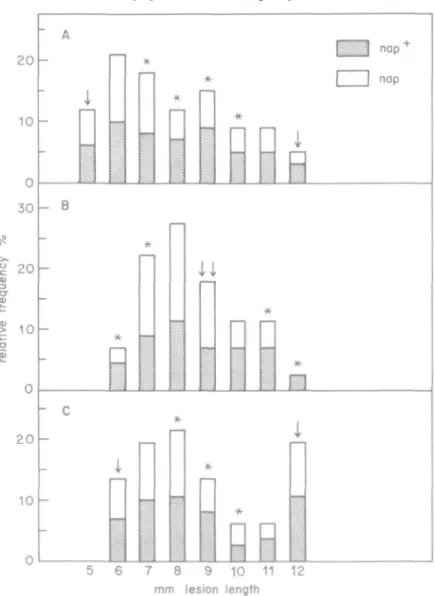
The ascospore isolates of the 50 tetrads analysed for naphthazarin production were also
examined for their degree of pathogenicity. The isolates of the cross M 808-15 x 6-36
showed degrees of pathogenicity corresponding not only to those of the parent strains, but
also to classes in between (Fig. 1A). In 13 tetrads, the degrees of pathogenicity of all eight
ascospore strains were intermediate and did not differ from each other (5% significance in
analysis of variance). In 16 tetrads, significant differences between the degrees of
pathogenicity of the ascospore strains were recognized. The ascospore strains of these tetrads
could be separated into two groups, one highly pathogenic, the other weakly pathogenic. The
ratio between the numbers of strains in these two groups was different for the various tetrads:
in only 6 tetrads the ratio was found to be 4:4, the ratios of the other tetrads varied between
2:6 and 6:2. Crosses between F,-ascospore strains (Table 2, letters b and e) yielded
progenies, whose degrees of pathogenicity were distributed in classes beyond those of the
intermediate parents (Fig. 1B). A backcross of an F,-isolate with 6-36 (Table 2, letter f)
yielded progenies, whose degrees of pathogenicity were distributed in classes between those of
the parents (Fig. 1 c).
Relationship between inheritance of naphthazarin production and pathogenicity
Only in 6 tetrads of the cross M 808-15 x 6-36 was naphthazarin production correlated
with pathogenicity (Table 4). The naphthazarin-producing ascospore isolates from each of
these tetrads showed significantly higher degrees of pathogenicity than those of
non-naphthazarin-producing ascospore strains. All other tetrads showed no correlation between
naphthazarin production and pathogenicity. The ratio between the number of
naphthazarin-producing and non-naphthazarin-naphthazarin-producing ascospore strains was approximately 50:50 in
all pathogenicity classes (Fig. 2). A slight trend for classes of high pathogenicity to contain
more naphthazarin-producing ascospore strains was noted, yet the proportion of
naphthazarin-producing ascospore strains is never significantly different from 50% (5%
significance in X
2-test).
20
10
-0
30
20
-I
I
10
8
" AI
ZI....1...
I
~~
l I
- B *" R
- c
4
T
*
r-.
*•I
*
*
-r—i * I I nap
1
R
*
n
RR
i
20
10
-5 6 7 8 9 10 11 12
mm lesion lengthFIG. 1. Distribution of the ascospore isolates from different crosses with relation to their degree of pathogenicity (lesion length), A: cross M 808-15 x 6-36. B: cross between middle pathogenic F, ascospore isolates (Table 2, letter b). c: backcrossing of a low pathogenic F, ascospore isolate with 6-36 (Table 2, leffer f). Abscisse: classes with the intervals (x - 0-5/x + 0-5). * Ascospore isolates in this class differ from their parents with 5% significance in the / test t Degree of pathogenicity of the
ascospore used as parent. nap+: capacity to produce naphthazarins. nap: loss of this capacity.
D I S C U S S I O N
The results of genetic analysis of the loci a, c, spo, w agree quite well with those reported by
other authors. Georgopoulos (1963) showed, that the locus a (mating type) is not linked with
locus c (sexual type), using additional markers such as resistance to PCNB. His assumption,
that locus w (penthecial colour) was situated on a third linkage group, is confirmed by our
results. Also the findings of Hansen and Snyder (1943), stating a linkage relationship of locus
spo (growth type) with locus c, are confirmed by our investigations. Post-reduction
frequencies were in good accordance with the data of Georgopoulos (1963), except that for
locus c, which differed markedly. However, one cannot presume that there are two different
Holenstein and Defago—Inheritance of Naphthazarin Production §33
T A B L E 4. Degree of pathogenicity and naphthazarin production of the ascospore strains of
six tetrads in which these characters are correlated
Naphthazarin production + + + + _ — —
-Degree of pathogenicity0 of the ascospore strains AscusO6-3 10-2 + 2-9 12-3 + 3-4 10-3 + 3-1 9-6 + 2-3 6-0+ 1-4 6-6+ 1-7 5-9+ 1-0 6-6+ 1-3 06-6 8-9+ 1-9 8-3 + 2-9 10-5 + 2-7 9-7 + 2-5 6-6+ 1-5 6-5+ 1-5 6-4 + 0-7 6-5 ± 1-4 0 6 1 6 9-4 + 0-8 8-2 + 2-1 7-8+ 1-6 7-2 + 0-8 6-6 ± 1-9 5-4 + 0-7 5-2 + 0-7 5-0 + 0-5 06-24 10-4 + 2-7 10-2 + 2-5 11-3 + 2-3 11-7 + 3-1 6-0+ 1-0 6-7 + 0-9 6-1 + 0 - 8 6-4+ 1-5 06-26 11-3 + 3-4 11-2 + 1-2 8-1 + 2-9 8-8 + 2-1 6-7+ 1-0 6-3 + 1-2 5-4 + 0-7 5-8 + 0-7 06-28 12-0 + 2-3 12-5 + 2 0 9-5 + 2-5 10-1 +2-3 6-7+ 1-3 5-2 + 0-7 5-0 + 0-5 5-0 + 0-5 ° Average and variation of the lesion length in the stem infection of 20 plants per ascospore strain (data from two essays).
The degrees of pathogenicity of the naphthazarin-producing ascospore strains were significantly different from those of the non-naphthazarin-producing ones, in all 6 asci (5% significance in the analysis of variance). 6 0
-1
d ^ 4 0
--c o Q. to O —20
-o -o .c tn tn o 1 1 1 1 1 1 — _m
—
5 6 7 8 9 10 11 12 mm lesion lengfFio. 2. Proportion of naphthazarin-producing ascospore isolates in the pathogenicity classes (see explanations Fig. 1). The share of naphthazarin-producing ascospore isolates is 50% in all classes with
5% significance in the XMest
loci for unisexual femaleness. The cause of this difference is more likely to be the relatively
small sample size or localization of chiasmata.
In all the tetrads analysed for naphthazarin production a 4:4 ratio for
naphthazarin-producing to non-naphthazarin-naphthazarin-producing, ascospore strains was found. Two-factor analysis
of naphthazarin production with all other markers (mating type, sexual type, growth type,
perithecial colour) always gave parental ditype, non-parental ditype and tetratype tetrads.
Thus, loss of capacity of M 808-15 to produce the naphthazarins, fusarubin, novarubin,
javanicin, norjavanicin, is caused by mutation of a single locus (locus nap). Tetratype tetrad
frequencies indicated no close linkage of the locus nap with any other loci considered in this
paper. The locus nap appears to be somewhat distant from its centromere.
As strain M 808-15 has lost not only the production of fusarubin, novarubin, norjavanicin
and javanicin but also of isomarticin and marticin (the two other toxins produced by the
wild-type strain F. solani var. martii) it is assumed that these two substances are also
controlled by the locus nap. It also seems likely that this mutation inhibits an early step in the
biosynthesis of a common precursor, most probably a polyketide, which could be
transformed into different naphthazarin products by oxidation, addition or degradation of
chemical side groups (Kurobane, Vining, Mclnnes, and Smith, 1978; Kern and Naef-Roth,
1965;Stoessl, 1981).
The results of the genetic analysis of the degree of pathogenicity of the progeny of N.
haematococca indicates that this character can be regarded as a biometric or quantitative
character because it was not expressed in two discrete states but varied continuously. Such
characters are often subject to oligogenic or polygenic controls (Mather and Jinks, 1971). In
the literature, references to investigations of the inheritance of the degree of the pathogenicity
for the same variety are rather scarce. Only Nelson and Kline (1969) indicate that genes for
host specificity in Cochliobolus heterostrophus can show markedly different degrees of
pathogenicity in the progeny.
The relationship between inheritance of toxin production and of pathogenicity for the
same host variety are not reported in the literature. On the other hand, Scheffer, Nelson, and
UUstrup (1967) showed by analysis of interspecific hybrids that host specificity in
Cochliobolus victoriae and in C. carbonum was correlated with the ability to produce
host-specific toxins. Our results of the tetrad analysis indicate that capacity to produce the
weakly phytotoxic compounds novarubin, fusarubin, norjavanicin and javanicin is not a
major factor in determination of the degrees of pathogenicity. This confirms the results of
physiological experiments of Roos (1976). Kern (1976) suggested a more important role for
the highly phytotoxic naphthazarin compound isomarticin in relation to pathogenicity. As
crosses with the isomarticin-producing wild-type strain of Fusarium solani var. martii did not
yield fertile perithecia, the influence of this compound could not be studied genetically. Strains
6—36 and 6-94 of Nectria haematococca are as pathogenic as the wild type strain M 808-1
of Fusarium solani var. martii, which additionally produces isomarticin and marticin
(Holenstein, 1982). If isomarticin really is an essential factor for a high degree of
pathogenicity, then strains 6-36 and 6-94 must possess several additional factors which give
all together an equivalent degree of pathogenicity. This is quite possible because of the
different origins of these strains.
A C K N O W L E D G E M E N T S
We thank Prof. H. Kern and F. Wiirgler (ETH) and Dr. I. Smith (EPPO) for help in
preparing this manuscript. This work was supported by a grant from Swiss Federal School of
Technology (O.33O.O79.O6/2).
LITERATURE CITED
BURNETT,
J. H., 1975. Mycogenetics. John Wiley and Sons. London, Sydney, New York, Toronto.
DORN, S., 1974. Zur Rolle von Isomarticin, einem Toxin von Fusarium martii var. pisi, in der
Pathogenese der Stengel- and Wurzelfaule an Erbsen. Phytopathologische Zeitschrift, 81,
193-239.
ESSER,
K., and
KOHNEN,R., 1965. Genetik der Pilze. Springer-Verlag, Berlin, Heidelberg, New York.
GEORGOPOULOS,
S. G., 1963. Genetic markers and linkage relationships from tetrad data in
Hypomyces solani f. cucurbitae. Canadian Journal of Botany, 41,649-59.HANSEN, H. N., and SNYDER, W. C , 1943. The dual phenomenon and sex in Hypomyces solani f.
cucurbitae. A merican Journal of Botany, 30,419—22.
HOLENSTEIN, J., 1982. Ueber die Vererbung der Naphthazarinproduktion und der Pathogenitat bei
Holenstein and De'fago—Inheritance of Naphthazarin Production 935
KERN, H., 1976. Les naphthazarines des Fusarium. Annales dephytopathologie, 10,327-45.and NAEF-ROTH, S., 1965. Zur Bildung phytotoxischer FarbstofTe durch Fusarien der Gruppe Martiella. Phytopathologische Zeilschrift, 53,45-64.
1967. Zwei neue, durch Martiella-Fusarien gebildete Naphthazarinderivate. Ibid. 60, 316-24.
KUROBANE, I., VINING, L. C , MCINNES, A. G., AND SMITH, D. G., 1978. Diastereomeric 4a, lOa-dihydrofusarubins: True metabolites of Fusarium solani. Canadian Journal of Chemistry, 56,1593-4.
MATHER, K., and JINKS, J. L., 1971. Biometricalgenetics. Chapman and Hall Ltd., London.
NELSON, R. R., and KLINE, D. M., 1969. Genes for pathogenicity in Cochliobolus heterostrophus.
Canadian Journal of Botany, 47,1311-14.
PFIFFNER, A., 1963. Isolierung und Konstitutionsermittlung von Marticin und Isomarticin, zwei neuen Welketoxinen von Fusarium martii. Diss. ETH Nr. 3361.
Roos, A., 1976. Zur Physiologie und Pathologie von Neocosmospora vasinfecta E. F. Smith.
Phytopathologische Zeitschrift, 88,238-71.
SCHEFFER, R. P., NELSON, R. R., and ULLSTRUP, A. J., 1967. Inheritance of toxin production and
pathogenicity in Cochliobolus carbonum and C. victoriae. Phytopathology, 57,1288-91.
SNYTJER, W. C , 1940. White perithecia and the taxonomy of Hypomyces ipomeae. Mycologia, 32, 646-8.
GEORGOPOULOS, S. G., WEBSTER, R. K., and SMITH, S. N., 1975. Sexuality and genetic
behaviour in the fungus Hypomyces solani f.sp. cucurbitae. Hilgardia, 43,161-85.
STOESSL, A., 1981. In Toxins in plant disease. Ed. R. D. Durbin. Academic Press, London and New York.
TURNER, W. B., 1971. Fungal metabolites. Academic Press, London and New York.
VAN ETTEN, H., 1978. Identification of additional habitats of Nectria haematococca MP. VI.
Phytopathology, 68,1552-6.
1980. The association of pisatin tolerance and demythelation with virulence on pea in Nectria