An assessment of the use of crown
structure for the determination of the
health of beech (Fagus sylvatica)
JOHN L. INNES
Swiss Federal Institute for Forest, Snow and Landscape Research, ZUrcherstrasse 111, CH-8903 Birmensdorf, Switzerland
Summary
Considerable difficulties exist with the standardization and interpretation of assessments of crown defoliation, the most commonly used index of tree health in Europe. A variety of other measures of crown condition exist and one that has received considerable attention, particularly for beech (Fagus sylvatica L.), is crown architecture. Four stages of crown development are gen-erally recognized, termed the exploration, degeneration, stagnation and resignation phases. An analysis of the available literature suggests that there are a number of problems surrounding the use of these classes to describe trees. Although the classes probably reflect the progressive deterioration of the crown of a tree, there are many factors that affect the assessment and inter-pretation of the scores, as is the case for defoliation estimates. Measurements of shoot elongation in the upper crown provide a more useful measure, but involve destructive sampling and are very time-consuming. Consequently, while crown architectural assessments should only be incorpo-rated into large-scale inventories of forest health with great care, they may be useful for case studies involving the detailed examination of a small number of sites.
Introduction ( S k e ] l y a n d lnn^ 1 9 9 4. K a n d l e r a n d I n n e s > y
The health of forests has always been of con- 1995), concern about the possible impact of air cern, but in the 1980s, fears of a large-scale of pollutants has meant that monitoring of forest decline of forests in Europe and North America health has continued. In the 1990s, the empha-prompted the development of national and sis in such monitoring has shifted away from international assessments of forest health at an the assessment of individual trees towards the unprecedented scale. In Europe, these have been assessment of forest ecosystem health (Innes, conducted using regular grid networks of plots, 1994: Krauchi, 1996), with research and moni-which in 1995 involved almost 650000 trees dis- toring studies now encompassing soil chemistry, tributed across 25000 sample plots. Although meteorology and the deposition of pollutants, the predicted massive mortality of trees in among others. With increasingly sophisticated Europe and North America has not materialized measurements being taken of environmental O Imitate of d u n e n d Forester, 1993 Forotry, Vol. 71, No. 2 , 1998
parameters within forests, there is a growing need for better assessments of the health of indi-vidual trees, as tree health is still generally con-sidered to be the primary response variable when looking at the impacts of air pollution and other forms of environmental change on forest ecosystems.
During the past 10 years, the most frequent index of crown health used in Europe has been crown defoliation. Strictly, crown defoliation is an estimate of the proportion of needles or leaves that should be present on a tree but which have been lost. However, it is rarely assessed as such in Europe. More often, it is considered as being synonymous with crown transparency, a phenomenon that can be brought about by various phenomena acting alone or together, including the sparse develop-ment of foliage, small foliage size, foliage loss, twig mortality, and changes to branch architec-ture (e.g. Westman and Lesinski, 1985). Direct damage to the crown caused by known agents, such as insects or hail, is sometimes taken into account, but practices differ between (and some-times within) countries. These difficulties should be borne in mind when considering the studies based on 'defoliation' that are described below, as the term defoliation has been used in its gen-eral sense throughout this paper.
In Europe, a defoliation figure of 25 per cent loss is normally taken as indicating ill-health of a tree, although doubts have been expressed over the appropriateness of this figure (e.g. Innes, 1993). For Europe as a whole, beech has shown a moderate increase in the proportion of trees with more than 25 per cent defoliation over the period 1988—1996. This has been interpreted as a worsening of the health of the species, and many reports in the 1980s and 1990s suggested that this could be attributed to air pollution, either acting alone or in combination with other factors (e.g. Gregor, 1990; Lorenz, 1995). However, consider-able difficulties have arisen with the use of crown defoliation scores, frequently related to the problems of reproducibility (Innes et al., 1993; Ghosh and Innes, 1995; Ghosh et al., 1995) and interpretation (e.g. Innes, 1992, 1993; Kandler and Innes, 1995; Skelly and Innes, 1994). Consequently, there has been considerable inter-est in developing alternative methods of crown assessment (cf. Richter, 1989).
Crown architecture has been considered as a useful index of crown condition for some species, particularly beech (Fagus sylvatica L.). The branch architecture of most beech trees changes during the life of the tree (Roloff, 1985c), and the premature onset of features nor-mally associated with old age may provide an index of the tree's condition. However, crown architecture also varies with light conditions (e.g. Le Tacon, 1983; Masarovicova and Stefancik, 1990; Nicolini and Caraglio, 1994), competition, and according to the genetic predisposition of the trees (Dupre et al., 1986; Tessier du Cros et al., 1988). Flowering may have a major impact on the development of the shoots, as both male and female flowers develop from buds that would otherwise have been shoots (Liischer, 1990). In beech, as in most species, crown archi-tecture may also be partly determined by site conditions (Dupre et al., 1986; Tessier du Cros et al., 1988; Power et al, 1995). A particularly important point is the influence of canopy expo-sure on the architecture, especially when this has changed suddenly, such as after opening up the canopy. This may have an undue influence on field observations, as the observer is likely to use any canopy openings to view the crown of a particular tree.
Architectural features take time to develop and therefore have the advantage that they do not vary annually to the same extent as crown defoliation (e.g. Merg et al., 1989). Conse-quently, it may be possible to determine the long-term condition of trees more quickly than with defoliation scores, but conversely, the determination of trends over time would take much longer. At present, there are no long-term (>20 years) series available to reveal the extent of changes in crown architecture, although some shorter series exist (see below).
It has been suggested that air pollution might affect crown architecture, but the evidence is rather circumstantial. In the work of Roloff (1984 et seq.), frequent references are made to the importance of air pollution as a cause of persistent growth reductions, but no data are presented to demonstrate a causal relationship between shoot growth in mature trees and air pollution impact. Lonsdale et al. (1989), Power (1994) and Stribley (1996a) all speculate that ozone could be a factor influencing crown
archi-115
tecture. Ozone is known to have an effect on the growth of young beech trees (e.g. Pearson and Mansfield, 1994; Mortensen et al., 1995), but changes in the branching architecture of seedlings in chambers do not appear to have been investigated in detail and, in any case, are of questionable relevance to mature trees grow-ing under forest conditions.
This paper is concerned with the use of crown architectural methods to identify poor health in beech trees, regardless of cause, although the possibilities of differential diagnosis are also examined. The development of a new indicator could have substantial repercussions for the large-scale assessments of forest health that are currently being undertaken, and is therefore of considerable importance.
Crown architecture and its classification for beech
Two different types of shoot occur in beech: long and short (Mathieu, 1897; Rcnard, 1971; Thiebaut et al., 1981). These represent a con-tinuum and a clear distinction between the two types is sometimes very difficult (Thiebaut and Puech, 1984). Long shoots (also known as exten-sion or exploratory shoots) may be up to 75 cm long in young trees, but generally are in the range 10-20 cm for 60-150-year-old trees. They normally have lateral shoots or, in the case of current-year shoots, lateral buds and alternating leaves (Wijk, personal communication). They make up about 60 per cent of the annual dry weight increment (Renard, 1971). Short shoots (also termed dwarf or exploitation shoots) are generally <5 cm long, have no lateral branches and leaves are restricted to a whorl at the tip of the shoot. They carry about 75 per cent of the foliage of the crown.
In an early paper, Schutt and Summerer (1983) listed a change in the relationship between short and long shoots as one of the symptoms of 'Waldsterben' on beech, specifi-cally arguing that in declining trees, short shoots were more apparent, even when the crown had adequate space for the development of long shoots. This theme was developed in a series of papers by Andreas Roloff (Roloff 1984a, b, 1985a, c, 1986, 1988, 1989a, b). Roloff
recog-nized four categories of crown (excluding dead trees), and named them the exploration, degen-eration, stagnation and resignation phases. These classes were equated to 'without damage', 'lightly damaged', 'medium damage' and 'heav-ily damaged' classes. Roloff (1989b) stressed that the four classes can be described as vitality classes on trees of all ages. However, as the development of crowns throughout the different classes occurs naturally with old age, it was argued that the vitality of trees older than about 150 years should not be assessed. As the upper crowns are virtually invisible from the ground in summer, the assessments are best done during winter (Clauser and Gellini, 1986; Roloff, 1989b). In addition, the scheme seems inapplic-able to very young trees, prompting Stribley (1993) to develop an alternative classification scheme (see below).
According to Roloff, the exploration phase is characterized by vigorous ramification of shoots in the upper crown and apical growth rates of >30 cm a"1 on suitable sites. The terminal and
upper lateral buds on a shoot developed within a particular year form long shoots, and the lower lateral buds form short shoots. The majority of the available crown space is utilized by the growing branches and the crown has a rounded appearance. In healthy stands, trees aged up to about 140 years normally show this form. In some studies (e.g. Stribley, 1996b), it has been assumed that any trees less than 140 years old that do not fall into this class must by definition be unhealthy. However, there is very little quantitative evidence to support such an assertion.
In the degeneration phase, growth is reduced (to c. 20 cm a"1), and the side shoots no longer
develop branches, leading to the occurrence of spear-like twigs. The terminal bud still develops into a long shoot, but the length of this is reduced in comparison to a healthy young tree. The lateral buds predominantly form short shoots. Gaps appear in the crown where side-shoots have failed to develop properly and the crown has a spiky appearance. In healthy stands located on suitable sites, this phase usually develops some time after about 150 years. 'Claw-like' twigs may be present, although they are usually rare (Stribley, 1993). This develop-mental stage was seen as being important by
Schiitt and Summerer (1983) as it indicated a disturbance to the normal ratio between ter-minal and lateral shoot growth, and was used independently by Lonsdale (1986a) in his assess-ment of beech health in Britain in 1985.
The stagnation phase has apical growth rates of a few centimetres each year and no or only very short side twigs on the main axes, leading to a brush-like appearance. The terminal bud produces a short shoot. In winter, the twigs may appear claw-like, as the short shoots begin to have slightly longer growth in compensation for the reduction in apical growth, with the growth oriented upwards towards the light. The short claw-like twigs are brittle and may break off easily, leading to a concentration of foliage towards the ends of the branches, giving the brush-like appearance. This phase is perhaps the most controversial, with considerable difficulties in its distinction from the preceding stage.
In the resignation phase, apical growth may be further reduced, to less than 1 cm a"1.
Alternatively, the resignation phase may arise because the tree has remained in the stagnation phase for several years. Many of the side twigs break off or fail to develop altogether and the main axis may also break. The main twigs may show a claw-like pattern. Roloff (1985a) also argued that the majority of trees in this category have chlorotic foliage, but there seems to be very little evidence of a consistent relationship between the occurrence of chlorosis and this stage of crown development. Larger branches may be broken and parts of the crown may show dieback. The crown generally has a frag-mented appearance. This phase was used by Lonsdale (1986b) as a separate assessment.
The sequence described above is typical of that which occurs through time on an individual beech tree as it moves into senescence and it has therefore been equated to a progressive loss of vitality or increase in degeneration. Some types of stress may accelerate the trend, and this is the basis for considering crown architecture as an indicator of tree health. The extent to which changes in crown architecture are a general response to stress is unclear. According to Roloff (1985b, 1989a), drought and air pollution induce different types of branch structure. Drought causes abrupt reductions in apical growth in specific years with little if any
mor-tality of the side shoots, and does not lead to a fundamental change in the branching structure (Roloff, 1989b). In contrast, Roloff argued that air pollution can cause a long-term reduction in growth rates, and many side-twigs are dead and/or broken. The apical shoot itself may eventually die. If these arguments are accepted, then drought would not be expected to cause any premature development of the later stages in the crown architecture patterns, whereas air pollution could cause such changes. However, when all the possible factors that could affect crown development are super-imposed on the trend that is believed to occur with age, a com-plex pattern of cause-effect emerges, which appears to be just as problematic as the dif-ficulties surrounding the interpretation of crown defoliation.
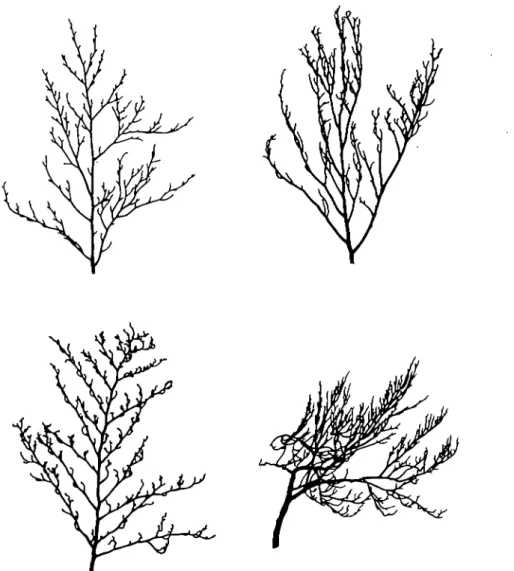
Classification schemes for crown architecture The simplest classification is to place a tree in one of the four categories proposed by Roloff. However, the classification suffers from a num-ber of drawbacks. For field assessments, the most important of these is that some trees do not readily fit into the classification. In Figure 1, the uppermost twigs of four different trees from Selborne, in southern England, are shown. The top-left tree appears to be in the exploration phase, possibly verging towards the degenera-tion phase. The top-right tree shows the 'claw'-like twigs normally associated with the stagnation phase, but which can also occur in the degeneration phase. The bottom-left tree also has 'claw'-like twigs but has a very differ-ent branching structure. Where does it fit in the classification? Similarly, the bottom-right tree might be classed in the resignation phase, but appears to be showing signs of recovery. To ensure the best possible standardization of methods, such difficulties need to be resolved before the method can be rigorously applied by field teams. If this is not done, then major diffi-culties can be expected with the reproducibility of the results in both time and space.
The classification developed for Roloff (here-after termed the Roloff classification) was for the uppermost 2 m of the crown, which is the most rapidly growing part (Thiebaut and Puech, 1984; Roloff, 1986) and therefore the part that is most
Figure 1. Examples of the branches from upper crowns of beech trees from Selborne, southern England. All trees were between 100 and 150 years old.
likely to react to stress first. However, sub-sequent studies have shown that it may be applicable for lower parts of the crown, pro-vided that differences in growth rates beneath the upper and lower crown and differences between dominant and suppressed trees are taken into account (SteinhUbel and Cicak, 1992). The classes derived by Roloff have primarily been applied to older trees (60-120 years). Stribley (1993) describes a method that can be used for saplings (<3 m tall). Four different measures are recognized:
• extent of primary shoot growth during the previous growing season. 0 = good growth (>15 cm), 1 = reasonable growth (10-15 cm), 2 = poor growth (<10 cm)
• proportion of restricted secondary shoots of total. 0 = <10 per cent, 1 = 11-50 per cent, 2 = >50 per cent.
• proportion of distorted secondary shoots using a scale of 0-2, as in the second measure. • proportion of secondary shoots at an angle of 40° or less to the main stem on a scale of 0-2 as for the second measure.
Restricted secondary shoots were defined as those of less than 4 cm. On older twigs, restricted shoots were those with 'total growth . . . less than the sum of 1 cm growth for each year plus 4 cm'. Distorted shoots were defined as those showing definite curving from the normal plane of growth.
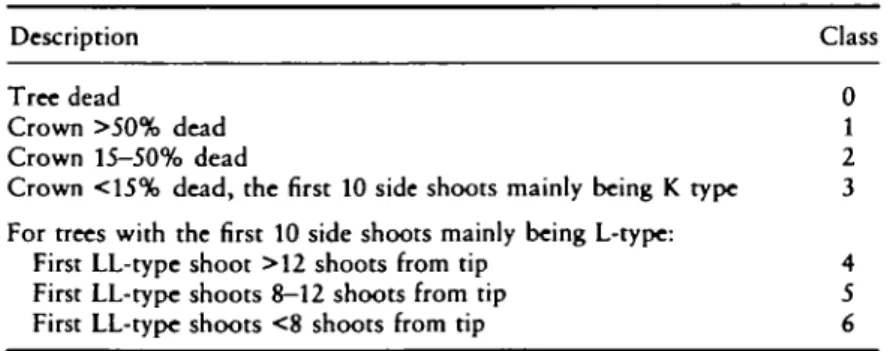
An alternative classification for mature trees has been developed by Richter (1989). This is based on the nature of the side shoots. Four dif-ferent categories are recognized:
• long shoot with a single terminal bud (K-type).
• long shoot with several side buds (L-type) • long shoot with short shoots ending in buds
(LK-type)
• long shoot with one or more long shoots emerging from it (LL-type).
The actual tree classification then combined this system with the presence of dieback in the crown (Table 1). The classification was sensitive to the degree of exposure of the trees.
A more complex measure has been proposed by Gies et al. (1988, 1989), based on the follow-ing relationship:
V =
In
where £ is length of the apical shoot, K is the number of buds on the apical shoot, S is the length of the uppermost lateral shoot and n is the number of measurements carried out on each tree.
This purportedly can be determined by pho-tographs taken in winter and the index appears to have a reasonable relationship with shoot growth (Braun etal., 1990). However, it has not been widely used.
In Sweden, a classification different from, but based on the Roloff scheme is used (Sture Wijk, personal communication). Trees are scored for several different parameters (Table 2). The method has only been used in Sweden and it is uncertain whether it could be readily applied to beech trees from other parts of Europe. However, a similar composite classification sys-tem was used successfully by Lonsdale (1986a, b) in Great Britain. A composite index was derived from scores for chlorosis, crown thin-ness (defoliation) and the occurrence of fasti-giate branching (trees in the degeneration phase):
100 Index = <=3
where tin, «i2 and tin are numbers of trees in score classes 1, 2 and 3 (a scale of increasing severity) and i refers to each of the three symp-toms included. «m a x is the maximum possible
cumulative score for the plot.
The absence of any general agreement over the classification system that should be used in large-scale inventories of crown architecture indicates that further work is required before the method can move from a research to an operational phase. Comparisons of the applica-bility of the different classification systems are required, and the results obtained by the differ-ent systems also need to be compared. At Table 1: Crown classification of beech as recommended by Richter (1989)
Description Class
Tree dead 0 Crown >50% dead 1 Crown 15-50% dead 2 Crown <15% dead, the first 10 side shoots mainly being K type 3 For trees with the first 10 side shoots mainly being L-type:
First LL-type shoot >12 shoots from tip 4 First LL-type shoots 8-12 shoots from tip 5 First LL-type shoots <8 shoots from tip 6
Table 2: Crown classification system used for beech in Sweden (Wijlc, personal communication) Growth of leading shoot axis over the past 3-5 years
Normal growth, with the majority of long shoots growing >10 cm a"1
Reduced growth, with the majority of shoot segments >10 cm, but both long and short shoots still present Strongly reduced growth, with the branches mainly consisting of short shoots (<2 cm growth a"1) with a
claw-like appearance
Shoot growth of lateral branches over the last 5—10 years
Normal growth, with the longest lateral branches mainly being long shoots
Reduced growth, with all lateral branches being short and consisting mainly of short shoots
Strongly reduced growth, with lateral branches consisting almost exclusively of short shoots (claw-like and without ramification)
Lateral branching during the last 5-10 years
Normal ramification, with at least two orders of lateral branches
Reduced ramification, with 1-2 orders of lateral branches and most lateral branches without ramification Strongly reduced ramification, with first order laterals rarely with ramifications
Broom-like branch structures
Percentage of branches in the canopy periphery with this form of structure Dieback of the branch system
Estimated as percentage of the branching system
present, it is not possible to say which of the systems is most appropriate or indeed if any one system is applicable throughout the range of beech in Europe.
Application of individual crown architec-ture classifications
The classification schemes proposed by Roloff and other workers have not yet been widely adopted within the framework of the European forest health monitoring programme. However, there have been a number of studies using either the Roloff indices or assessments similar to these.
Working independently of Roloff, Lonsdale (1986a) identified the proportions of trees at 19 British sites that were effectively in the Roloff damage class 1. As indicated above, he classified trees according to how fastigiate they were. Fifteen per cent were slightly fastigiate and only 3 per cent were classed as being moderately fastigiate. However he stressed that there was very little work on the normal level that might be expected, with various authors (e.g. Marshall Ward, 1904; Busgen and Munch, 1927; Brown,
1953) indicating that the development of 'claw' twigs was normal. LonsdaJe repeated his survey in 1986, this time taking into account the classi-fication proposed by Roloff. Small changes were apparent in the proportions of trees with fasti-giate crowns between the two years, that he (Lonsdale, 1986b) attributed to a combination of observer error and a slight worsening of the scores. The increase in scores could have arisen because of a possible recovery of apical growth following reduced growth in 1985 brought about by drought conditions in 1984. The recov-ery of apical growth in 1986, without a propor-tionate increase in lateral growth, could have caused an accentuation of the 'spear-like' branching form, leading to the worsening in the scores in that year.
In an assessment of 30 beech plots in south-ern Germany (all trees >60 years, mean stand age: 110 years), 57 per cent of the trees were classified as being in the degeneration phase (Perpeet, 1988). Defoliation increased with reduced crown vitality (as determined by crown architecture), although Perpeet argued that the degeneration phase should be seen as an inter-mediary stage between healthy crowns and declining crowns. Power et al. (1995) similarly
suggested that class 1 degeneration may be within the normal range of variation for trees. Perpeet (1988) went on to suggest that the class should perhaps be divided into three smaller classes, based on the degree of spear-like twig development in the crown. However, many of the trees in class 2 (stagnation) also had spear-type twigs present, suggesting that considerable overlap may occur.
Mohring (1991) looked at the development of decline symptoms on old (c. 140 years) beech trees at Soiling, Germany, over a 5-year period. On a branch that would be classified as class 3 (resignation phase) very little change was appar-ent over the 5 years, apart from the loss of some side twigs, although in the final year (1991), the branch had died. Mohring argued that the first pictures show the branch at the end of the stag-nation phase and that the sequence leading to death is: deformation, stagnation, leaf loss accompanied by fruiting, and death. In a more recent study (Mbhring, 1997), the death and progressive loss of twigs on individual branches over 5 years or more is evident. However, even over 10 years, very little change is apparent in the form of the live twigs.
One of the few published time series dealing with the evolution of crown structure is that of Eichhorn et al. (1995). Working in Hessen, Germany, they found that the proportion of trees in the exploration phase dropped from 63 per cent in 1988 to 46 per cent in 1993. The pro-portion of trees in the stagnation/resignation phases increased from 7 per cent to 20 per cent. The authors reported that trees can move from the exploration phase to the stagnation/ resignation phase within 6 years. Trees in the exploration and degeneration phases showed substantial increases in defoliation between 1988 and 1994 whereas trees in the stagnation and resignation phases showed no significant change. Only 1.5 per cent of trees showed an improvement from the degeneration phase to the stagnation phase. Since such a move was deemed virtually impossible (Eichhorn et al., 1995), the 1.5 per cent was believed to represent the estimate error.
In another study conducted over several years, Power et al. (1995) looked at the crown architecture of beech trees in southern England over a 6-year period. The proportion of trees in
Roloff damage classes 0 and 1 decreased from 70 per cent to 46 per cent between 1987 and 1993, whereas the proportion of trees in class 3 increased from 4 per cent to 19.5 per cent over the same period. The trend was in marked con-trast to the defoliation estimates, which showed a deterioration followed by a recovery. This led the authors to speculate that the different symp-toms were responding to different stresses, a phenomenon that may also be apparent from the work of Eichhorn et al. (1995) described above. Stribley (1993, 1996a, b) also looked at beech in southern England over several years. She used the basic crown classification system proposed by Roloff. The proportion of trees in classes 1 and 2 increased at one site between 1989 and 1992. At the second site, the overall proportion of trees remained the same, but a deterioration was evident in the form of an increase in the proportion of trees in class 2.
These studies seem to indicate that it is possible to apply the classification system in the field. The changes in crown architecture recorded in the studies described above suggest that the classification is sensitive to changes in the trees, although the extent to which these changes reflect observer variation is unknown. For example, the absence of any clear changes in the photographs taken by Mdhring (1991, 1997) suggests that individual branches may die without going through any progressive architec-tural changes. However, the sample size used by M6hring was relatively small, and it is possible that more obvious changes do occur in specific trees.
Shoot growth
Changes in crown architecture occur as a result of changes in the relative growth rates of long and short shoots. Consequently, measurements of shoot growth might provide a more objective assessment of the health of a tree than visual estimates of the relationship between long and short shoots. An added attraction of using shoot growth measurements is that they have some-times been considered to be more sensitive to external stress than radial growth (Wentzel, 1983), a frequently used index of tree vitality.
meas-uring the lengths between bud scars. These are usually visible on twigs for about 20-30 years for a slow-growing tree, but may be apparent for only 10-20 years on fast-growing trees. Cross-dating is done by reference to marker years, often 1976 and 1984. Measurements are made of the apical twig rather than laterals and so a direct relationship with crown architecture (based on short shoot: long shoot ratios) is dif-ficult to determine. To be consistent with the visual estimates of crown architecture, the mea-surements should be made from branches taken from the uppermost 2 m of the crown.
All studies relating shoot growth to crown architecture have been based on the assessment of the current crown architecture of a tree fol-lowed by retrospective investigations of the shoot growth rates. Roloff (1985c, 1989b) iden-tified clear relationships between trees in the dif-ferent crown classes and past shoot growth in the crowns. Trees in the resignation phase had had steadily reducing growth (from an initial figure of c. 20 cm a"1) since the early 1950s. The
growth of trees in the degeneration and stagna-tion phases relative to those in the explorastagna-tion phase dropped after 1970, having previously been higher. Stribley (1993) also found that past shoot growth was correlated with current Roloff scores. Given that the crown architecture scores are determined by the shoot growth rates in the recent past, this finding is not altogether unexpected.
The normal growth rates for long shoots in the upper crown have been estimated at 10-75 cm a"1. However, there appears to be a
thresh-old growth rate at which changes in crown structure might be expected. Working in west-ern Switzerland, Woodcock et al. (1995) found that a threshold stem extension rate of 20 cm a"1
existed, below which changes in crown mor-phology were apparent. The first changes included a reduction in the total number of branches produced per unit length and the development of more acute branching angles. Woodcock et al. (1995) argued that this critical threshold was likely to vary between trees and between stands.
The growth rates of shoots in the crown have been clearly linked to the occurrence of stress. Roloff (1989b) gives the example of two 120-year-old beech trees, one sensitive to drought
the other not. There was good agreement in the direction of growth changes from one year to the next, but the drought-susceptible tree showed much lower growth in response to drought than the other tree. In both cases, the normal growth over the last 30 years was 20-30 cm a"1. Using a much larger sample (64 trees),
Steinhiibel and Cicak (1992) found that growth rates in the upper crown were about 20-30 cm a"1 (pre-stress) and 10-15 cm a"1 (post-stress).
Other factors affecting shoot growth rates include tree age (Lonsdale et al., 1989; Ling et al., 1993), dry periods (Dobler et al., 1988; Roloff, 1992; Steinhtibel and Cicak, 1992; Power, 1994), soil drainage and pH (Ling et al., 1993), and nutrient disorders and air pollution (Ling et al., 1993; Fluckiger and Braun, 1994).
In north-east Switzerland, Fluckiger et al. (1986b) recorded a pre-stress growth of 15—20 cm a"1 on deep rendzinas and 0-15 cm a"1 on
thin rendzinas, reflecting the importance of site quality and the difficulty of making generaliza-tions across sites of differing quality. A marked reduction in growth occurred on both site types in 1977, following the 1976 drought, with the reduction being greatest in trees on the thin rendzinas. Growth rates recovered to 1975-76 levels in 1979, but the difference in growth rates between the two site types steadily reduced in the period 1979-1982. Growth was again markedly reduced in 1983 and 1984, but this time there was no difference in growth rates between stand types. At the same time as the growth reduction in 1983—84, an increase in the proportion of short shoots to long shoots was identified. Younger trees generally had greater growth than older ones, although the differences between trees 100-120 years old and 120-140 years old was small (Fluckiger et al., 1986a).
In southern England, Lonsdale et al. (1989) looked at growth rates of dominant and co-dominant trees from a variety of sites. Before the 1976 drought, growth rates for younger trees (>70 years) were 25-30 cm a"1, dropping to c.
15 cm a"1 for older trees (<150 years). As
recorded in some other studies, growth rates failed to recover following the 1976 drought. Power (1994), also working in England, found rather different patterns, with considerable vari-ation between sites. She distinguished healthy trees as having dense, vigorously growing
crowns and unhealthy ones as having relatively thin crowns with poor growth. Although shoot growth was severely depressed in 1976 and 1977 and again in 1984-1985, trees with healthy crowns quickly recovered to their pre-stress growth of 20-30 cm a~". At two sites, healthy trees recovered following the drought whereas unhealthy trees did not, only achieving about 50 per cent of their pre-stress growth. At one site, shoot growth of healthy and unhealthy trees between 1980 and 1989 showed markedly dif-ferent patterns, with the growth of unhealthy trees declining and then improving and the growth of healthy trees rapidly declining, such that their growth in 1989 was actually less than the unhealthy trees. At some times, growth of healthy and unhealthy trees was similar before 1976, whereas at others, unhealthy trees were growing consistently slower. The susceptibility to drought and the subsequent ability to recover did not show a clear relationship with the initial rate of growth, although the 1976 drought appeared to be the cause of a persisting diver-gence in the shoot growth rates of healthy and unhealthy trees at some sites. Similar results have also been obtained for the radial growth of beech trees in Germany (Wahlmann etal., 1986). Steinhtlbel and Cicak (1992) found a good correlation between shoot growth and rainfall, although a particularly poor growth year (1984) was caused by a combination of low rainfall the previous year and low temperatures at the start of the 1984 growing season. The severe growth depression found in 1984 was followed by growth that was only about 60 per cent of the previous growth rate in dominant and co-domi-nant trees, but suppressed trees appeared to be able to regain their relatively low growth rates following the stress. In contrast, Stribley (1993), working in southern England, found that the trees most affected by the 1976 drought were the suppressed ones. These also failed to recover their growth following the drought. A similar pattern of stress and then failure to recover pre-vious growth rates was also identified by Power (1994) and, to a lesser extent, by Roloff (1985c). In Germany, Dobler et al. (1988) found that growth rate recovery was dependent on the soil conditions. In addition, growth failed to recover, even on the good stand, after a second drought 7 years after the first one. Recovery was
also dependent on tree age, with trees over 100 years in age (pre-stress growth of 15—20 cm a"1)
failing to recover to the same extent as younger trees (pre-stress growth of 25-30 cm a"1).
These results indicate that the shoot growth of beech trees in a year without undue drought stress depends on the site quality, the age of the trees and their social position. These factors also determine the growth response of the trees to drought, although this response appears to be non-linear. In particular, the response to a drought seems to be affected by the antecedent conditions, especially the occurrence of previous droughts and the previous occurrence of fruiting within the crown. Studies of radial growth responses to droughts (e.g. Eckstein etal., 1984; Abetz, 1988) indicate that a drought may have an impact on the physiological processes within a tree for several years, emphasizing the impor-tance of taking into account the antecedent con-ditions when looking at drought impacts. The extent to which air pollution disturbs these responses is unknown.
Relationship of crown architecture to other indices of tree condition
Crown architectural class and tree age
Braun and Fluckiger (1987) and Fluckiger et al. (1986b) found a clear relationship between tree age and the damage classification. In trees <80 years old in north-east Switzerland, about 70 per cent were in Roloff class 0 (exploration). This decreased to less than 35 per cent in trees >120 years old. Similarly, Ling etal. (1993) found that scores for crown architecture increased up to an age of about 120 years, then stabilized. Such a trend would be expected, since the different phases of crown architecture development are considered to be indicative of the progressive deterioration and fragmentation of the crown that occurs with increasing age. It is primarily for this reason that most studies of crown archi-tecture have excluded trees more than about 140-160 years old.
Shoot growth and crown defoliation
Both Roloff (1985a) and Fluckiger etal. (1986a) have argued that there is a strong relationship
between past shoot growth and the current level of crown defoliation. However, the analyses are based on fairly broad classes—in the case of Fluckiger et al. (1986a), they compare the shoot growth of trees with either less than or more than 25 per cent defoliation. Nevertheless, the correlation seems to extend to more detailed classifications of crown defoliation: Innes (1992), using 5 per cent defoliation classes, found that crown architecture scores were related to defoliation.
Ling et al. (1993) found an association between crown defoliation, as assessed in four classes, and crown architecture derived using the Roloff scores. However, there was consider-able scatter in the data, and not all sites with high defoliation had high scores for architecture (and vice versa). As indicated above, several studies have suggested that crown architectural scores and crown defoliation do not always change in the same way. There seems to be a problem here. On the one hand, it is argued that architectural scores are useful for the assessment of tree health because they are correlated with the more widely accepted defoliation scores (cf. Roloff 1985a; Fluckiger et al., 1986a). On the other hand, it is argued that architectural scores are useful because they do not change in the same way as defoliation (cf. Ling et al., 1993; Power, 1994; Stribley, 1996a) and there is there-fore no redundancy. Further work is clearly required to resolve the relationship between defoliation and shoot growth patterns.
Crotvn architecture and leaf chlorosis
Ling et al. (1993) reported that crown chlorosis was not associated with either crown defoliation or crown architecture, although this may reflect the importance of lime-induced chlorosis as a cause of discoloration in beech in southern Britain (Schinas and Rowell, 1977). It may also reflect the very variable occurrence of chlorosis, which may be present in some years and absent in others, whereas crown architecture should show much less year-to-year variation. In south-ern Germany, a clear tendency for trees with discoloration to have higher defoliation has been reported (Perpect, 1988), but there is no clear causal link between the occurrence of chlorosis and crown architecture.
Crown architectural class and radial and height growth
There have been relatively few attempts to examine whether the classification system agrees with radial and/or height growth. Athari and Kramer (1989a) undertook stem analyses of 77 beech trees which had each been categorized in the field into one of three classes: no damage (exploration phase), light damage (degeneration phase) and medium-heavy damage (stagna-tion—resignation phases). Height growth in the years immediately before the assessment decreased with increasing damage class, although trees classed in the exploration phase in 1985 were consistently the slowest growing for the 80 years before 1970. Damaged trees were often associated with reduced stand den-sity in their immediate vicinity, providing more crown space and therefore enabling better long-term shoot and diameter growth, assuming no change in stand density during the period in question.
Under equal competition, diameter growth also decreases with increasing damage class. Other analyses of radial growth and branch structure have tended to reveal rather contra-dictory results (Gartner and Nassauer, 1985; Wahlmann et al., 1986; Mahler et al, 1988; Perpeet, 1988; Athari and Kramer, 1989a, b; Fischer and Rommel, 1989). Many of these stud-ies failed to find a relationship between crown architectural class and increment, and some of the difficulties appear to be related to the degree of competition that individual trees are under.
These results suggest a complex relationship between standard growth parameters and the crown classification system. For example, in a further analysis, Athari and Kramer (1989b) found no relationship between basal area incre-ment and the Roloff damage classification after crown projection area, crown surface area and growing space had been taken into account. As also found by Perpeet (1988), defoliation had an effect (although relatively small in comparison to Norway spruce (Picea abies (L.) Karst.)) on basal area increment, but there was no clear relationship between defoliation and the Roloff damage classes. In contrast, Braker (1991) found a good relationship between current defoliation levels in beech and their recent growth, although
his sample size was rather small (eight trees from each of two sites). Similarly, Spelsberg (1989), using a sample of 12 dominant/co-dom-inant trees, found that trees with more defoli-ation had been growing consistently slower than more healthy trees, and that the reduced growth had been present for at least 30 years. The 1976 and 1984 droughts had both had dramatic effects on the relative growth rates of trees, exacerbating the difference in growth rates between trees with different levels of defoli-ation. Recovery of radial growth following these droughts appeared to be site-dependent, being slowest on driest soils (e.g. Abetz, 1988).
As with shoot growth, radial growth appears to be strongly related to the rainfall conditions in the current and previous year (e.g. Eckstein et al., 1984; Biondi, 1993). However, the timing of any soil moisture stress is critical (Power, 1994) and, unless it occurs during the active growth period or during bud formation, it may have rel-atively little effect on shoot growth.
There is a clear need for carefully controlled assessments of the relationship between height and radial increment and crown architecture. Factors such as stand density, crown size, crown depth and site conditions all need to be taken into account when making comparisons. When this is done, evidence of a relationship between crown architecture and increment seems to be limited (cf. Athari and Kramer, 1989a). However, these results need to be tested at other sites before any generalizations can be made. Crown architecture and root parameters
Roloff and Romer (1989) found a series of inter-relationships between crown and root para-meters in 2-m high young beech trees, suggesting the integration of various physiological processes within the trees. Their work essen-tially suggests that trees with more shoots have more leaves and more roots.
Crown architecture and reproduction
The relationship between crown architecture and flowering and fruiting is extremely com-plex. Flowering results directly in a reduction in the number of shoots. Flowering and fruiting use up substantial carbon reserves in the tree
and may have a significant impact in the carbon available for growth. For example, Gaumann (1935) found that 40 per cent of the carbo-hydrate reserves in a beech tree may be utilized for flower and fruit production. The effects are carried over into the following year, and per-haps even to subsequent years, with radial growth in the year after flowering being 10-25 per cent lower than normal (Mitscherlich, 1970). The amount of flowering and fruiting is primar-ily determined by climatic conditions (Matthews, 1955; Holmsgaard, 1962; Holms-gaard and Olson, 1960; Wachter, 1964), so inter-actions between shoot growth and flowering/ fruiting can be expected.
Interpretation of crown architecture patterns
Beech trees are remarkably sensitive to changes in their environment. The pattern of rooting is adapted to the stand conditions, with trees in dense, closed stands having short crowns and root systems restricted to shallow depths and concentrated around the stem (Cermak et al., 1993). This makes maximum use of the large amounts of stemflow and the higher throughfall rates that occur in beech stands close to the stems (Robson et al., 1994). Trees in more open stands have longer crowns with a high leaf area index and have a better distributed root system. These trees are more adapted to high light con-ditions and are able to withstand drought better than trees in dense stands (Cermak et al., 1993). Such trees can respond rapidly to increased water supply, even after several years of chronic drought (Cermak et al, 1993).
In Europe, severe droughts occurred in 1976 and 1983. The effects of these are readily dis-cernible in the growth patterns of the upper shoots of beech trees in many parts of Europe (e.g. Dobler et al., 1988; SteinhUbel and Cicak, 1992). The growth effects take place in the year following the drought as the majority of growth in mature trees in a particular year occurs in the spring, usually being completed before the end of May (Roloff, 1984a, b). As the primordia of the leaves that will flush the following year are mainly formed in June and July and the growth of these leaf primordia occurs in August and
September, early summer drought tends to cause the formation of fewer leaves whereas late sum-mer drought tends to affect leaf size (Roloff, 1987).
Beech is very sensitive to drought (cf. Hesmer and Gunther, 1962), and dry periods may cause sufficient stress to allow extensive invasion by Nectria coccinea (Pers.:Fr.) Fr.) (Lonsdale, 1980, 1983). Severe drought stress may cause quite extensive mortality of trees (Aldhous, 1981). Ling et al. (1993) found that architecture scores were higher in plots that had experienced old fellings or windblows, localized felling activity or on more exposed trees (all of which can be related to changes in the water relations of the trees) and that they were also higher in plots which had experienced greater stress during the 1976 drought. This indicates that the influence of drought involves interactions with a number of other factors, some of which may not be taken into account when looking at crown architectural patterns.
Leaf loss, either directly or indirectly, in the upper crown of beech trees exposes the branches to irradiance, increasing the risk of damage in this thin-barked species (Woodcock etal., 1995). The crowns may also be opened up by mechan-ical damage, either caused by natural phenom-ena or by timber operations. Branch desiccation can lead to invasion by a variety of pathogens, including Nectria coccinea and Hypoxylon spp. (Chapela and Boddy, 1988). These in turn would induce the decay and dieback of the affected branches. Similarly, Perpeet (1988) has argued that decreases in stand density can increase the incidence of attacks by Crypto-coccus fagisuga Lindinger although the factors influencing infestations by this insect are extremely complex (Lonsdale and Wainhouse, 1987).
Woodcock et al. (1995) have proposed a sequence of decline for beech:
• the length increment of the main axis and branches drops below a threshold value of about 20 cm a"1 for a period of about 10
years, resulting in
• crown thinning, resulting in
• bark desiccation and sun-scald injury from increased temperatures and/or lower humidi-ties in the upper crown, leading to
• back necrosis, enabling • pathogen attacks, resulting in • crown disintegration.
All stages may be present within a single crown.
Some of the difficulties associated with inter-preting visual assessments of beech are described by Lonsdale (1986b). He describes the opinions of two independent researchers from Germany (Dr Klaus Lang and Dr Andreas Roloff), who came to opposite conclusions con-cerning the health of beech trees in Britain in 1986. Their difficulty appeared to lie in a large number of intermediate trees, which were nei-ther completely healthy nor in severe decline. Unfortunately, subsequent experience has sug-gested that a substantial proportion, if not the majority, of trees fall into this intermediate cat-egory.
Conclusions
There is clear evidence that drought affects the crown architecture of beech. The evidence sug-gesting that air pollution also affects architec-ture is much less convincing. The effects of drought and ozone on beech are known to inter-act under experimental situations (e.g. Davidson et al., 1992; Le Thiec et al, 1994), although the precise relationships appear to be complex and dependent on a variety of factors including soil type and provenance. Consequently, there is a possibility that some of the effects that have been attributed to drought stress may instead be related to ozone or a combination of drought and ozone.
A major question is whether the use of crown architecture scores or shoot growth measure-ments brings an added value to the traditional assessments of defoliation. Both Ling et al. (1993) and Stribley (1996a) identified patterns on the basis of architectural scores that were not apparent from defoliation scores. They there-fore suggested that crown architecture was a useful measure. The correlations between archi-tectural scores and crown defoliation suggest possible redundancy. The use of shoot growth measurements appears to offer greater potential and has not been used to its full extent.
However, destructive sampling is involved and while this can be done in a single survey, it is more difficult on a regular basis, as regular destructive sampling in particular crowns may affect the functioning of that crown.
There remains a need to characterize the health of individual trees better than has hith-erto been done. In particular, the use of diag-nostic indicators needs to be developed. While there has been a great deal of research under-taken on this (e.g. Committee on Biologic Markers of Air-Pollution Damage in Trees, 1989), no techniques exist as yet that are practi-cal for large-spracti-cale inventories of forest health. Crown architecture appears to offer some potential for certain species and, for example, has been successfully applied to the study of Norway spruce (e.g. Gruber, 1990). However, in beech, the existing classifications suffer from the major drawback that they need to be under-taken in winter, requiring a visit outside the nor-mal field season. This alone may be sufficient to exclude their use in regular programmes of for-est health assessment.
Some important problems need to be resolved before architectural scores can be incorporated into the international forest health monitoring programmes. A clear distinction between long and short shoots is sometimes difficult (Thiebaut and Puech, 1984), and some objective way of making such a distinction is required. The presence of claw twigs cannot be taken as an indicator—they are present in Roloff classes 1 to 3. Consequently, the definition of the dif-ferent architectural stages needs to be refined. The degeneration stage may only be a trans-itional phase (Perpeet, 1988), although this seems inconsistent with Lonsdale (1986a). Lastly, it is unclear when trees naturally move into the dif-ferent stages, and how this varies with factors such as genotype and site conditions.
The use of measurements of shoot growth appears to offer greater potential, but is also more time-consuming and involves destructive sampling. This technique would be useful in research plots or in long-term monitoring plots, but is likely to be less valuable for large-scale forest health inventories. However, the analysis of the growth data needs to be subject to the same sort of rigorous statistical examination that is currently used for radial growth analyses.
In conclusion, the use of crown architecture as an index of tree health appears to offer potential, but there are many questions that remain unanswered. In view of the current dif-ficulties with the interpretation of defoliation data, it would seem inappropriate to include crown architectural scores as a standard method in national and international forest health assessment protocols until these questions are resolved.
Acknowledgements
This assessment was undertaken as part of the 'Swiss Forest Observations Programme', a joint project between the Swiss Federal Research Institute for Forest, Snow and Landscape Research, and the Swiss Forest Agency. Figure 1 was kindly prepared by Mrs Verena Fataar. Assistance with the literature search for this paper was provided by Ms Michele Kaennel. An anonymous referee provided some helpful sugges-tions on the text.
References
Abetz, P. 1988 Untersuchungen zum Wachstum von Buchen auf der Schwabischen Alb. Allg. Forst-Jagdztg 159, 215-223.
Aldhous, J.R. 1981 Beech in Wessex—a perspective on present health and silviculture. Forestry 54, 197-210.
Athari, S. and Kramer, H. 1989a Problematik der Zuwachsuntersuchungen in BuchenbestSnden mit neuartigen Schadsymptomen. Allg. Forst- Jagdztg 160, 1-8.
Athari, S. and Kramer, H. 1989b Beziehungen zwi-schen Grundfldchenzuwachs und verschiedenen Baumparametern in geschadigten Buchenbe-standen. Allg. Forst- Jagdztg 150, 77-83.
Biondi, F. 1993 Climatic signals in tree rings of Fagus sylvatica L. from the central Apennines, Italy. Ada CEcol. 14, 57-71.
Braker, O.U. 1991 Der Radialzuwachs an unter-schiedlich belaubten Buchen in zwei Bestanden bei Zurich und Basel. Schweiz. Z. Forstwes. 142, 427-433.
Braun, H., Gies, T., Cloos, B. and von Kuchler, A. 1990 Der Vitalitatsquotient—eine neues Verfahren zur differenzierten Beurteilung des Gesund-heitszustandes von Rotbuchen {Fagus sylvatica L.). Forst und Holz. 45, 428-434.
Brown, J.M.B. 1953 Studies on British beech woods. Forestry Commission Bulletin No 20. HMSO, London.
Braun, S. and FlUckiger, W. 1987 Untersuchungen an Gipfeltrieben von Buche (Fagus sylvatica L.). Bot. Helv. 97, 61-73.
BUsgen, M. and MUnch, E. 1927 Bau und Leben unserer Waldbitume, 3rd edn. Gustav Fischer, Jena, 426pp.
Cermak, J., Matyssek, R. and Kuccra, J. 1993 Rapid response of large, drought-stressed beech trees to irrigation. Tree Physiol. 12, 281-290.
Chapela, I.H. and Boddy, L. 1988 Fungal colonization of attached beech branches. II. Spatial and tem-poral organization of communities arising from latent invaders in bark and functional sapwood, under different moisture regimes. NewPhytol. 110, 47-57.
Clauser, F. and Gellini, R. 1986 Rating of Waldsterben-symptoms (Forest decline) in decidu-ous broadleaves during winter time. Eur. J. For. Pathol. 16, 250-253.
Committee on Biologic Markers of Air-Pollution
Damage in Trees. 1989 Biologic Markers of Air-Pollution Stress and Damage in Forests. National
Academy Press, Washington DC, 363pp.
Davidson, S.R., Ashmore, M.R. and Garretty, C. 1992 Effects of ozone and water deficit on the growth and physiology of Fagus sylvatica. For.
Ecol. Manage. 51, 187-193.
Dobler, D., Hohloch, K., Lisbach, B. and Saliari, M. 1988 TrieblSngen-Messungen an Buchen. Anwendung der Methode von A. Roloff im Forstbezirk Reutlingen. Allg. Forstzeitschrift 43, 811-812.
Dupre, S., Thiebaut, B. and Tessier du Cros, E. 1986 Morphologie et architecture des jeunes hfitres (Fagus sylvatica L.). Influence du milieu, variability genetique. Ann. Sci. For. 43, 85-102.
Eckstein, D., Richter, K., Aniol, R.W. and Quichel, F. 1984 Dendroklimatologische Untersuchungen zum Buchensterben im sUdwestlichen Vogelsberg.
Forstwiss. Centralbl. 103, 274-290.
Eichhorn, J., Paar, U. and Schonfelder, E. 1995 Waldschadenserhebung der Buche. Ergebnisse einer Trendbeobachtung 1984 bis 1994. Allg.
Forstzeitschrift 50, 791-794.
Fischer, H. and Rommel, W-D. 1989 Jahrringbreiten und Hohentrieblangen von Buchen mit unter-schiedlicher Belaubungsdichte in Baden-WQrttemberg. Allg. Forstzeitschrift 44, 264-265. FlUckiger, W. and Braun, S. 1994 Untersuchungen in
BuchenbeobachtungsflUchen. Waldschadensbericht
(1984-1988). Institut far angewandte Pflanzenbiologie, CH-4214 Schonenbuch, Switzerland, 56pp.
FlUckiger, W., Braun, S., Fluckiger-Keller, H., Leonardi, S., Asche, N., Buhler, U. and Lier, M. 1986a Untersuchungen Qber Waldschadcn in festen
Buchenbeobachtungsflachen der Kantone Basel-Landschaft, Basel-Stadt, Aargau, Solothurn, Bern, Zurich und Zug. Schweiz. Z. Forstwes. 137, 917-1010.
FlUckiger, W., Braun, S., Leonardi, S., Asche, N. and FlUckiger-Keller, H. 1986b Factors contributing to forest decline in northwestern Switzerland. Tree Physiol. 1, 177-184.
Gartner, E.J. and Nassauer, K.G. 1985 Aktuelles zur Waldschadenssituation in Hessen. Allg.
Forstzeitschrift 40, 1265-1271.
Gaumann, E. 1935 Der Stoffhaushalt der Buche {Fagus silvatica L.) im Laufe eines Jahres. Ber.
Schweiz. Bot. Ges. 44, 157-334.
Ghosh, S. and Innes, J.L. 1995 Combining field and control team assessments to obtain error estimates for surveys of crown condition. Scand. ]. For. Res. 10, 264-270.
Ghosh, S., Innes, J.L. and Hoffmann, C. 1995 Observer variation as a source of error in assess-ments of crown condition through time. For. Sci. 41, 235-254.
Gies, T., Braun, H., von KUchler, A., Baum, G., Freund, S., Lohr, M., Pfannschmidt, J. and Schipperges, B. 1988 Die Wirkung von Luftreini-gungen unter Okologisch-vegetationskundlichen
Aspekt. Berichte des Zentrums ftir Umwelt-forschung der UniversitUt Frankfurt, 8, 66pp.
Gies, T., Braun, H. and von KUchler, A. 1989 Untersuchungen in mesotrophen Buchenwaldern des Frankfurter Oberwaldes. In International
Congress on Forest Decline Research: State of Knowledge and Perspectives, Friedrichshafen am Bodensee, Germany, 2—6 October 1989. Posters
Volume 1. B. Ulrich (ed.). Forschungsbeirat Waldschaden/Luftverunreinigungen der Bundes-regierung und der Lander, 175—176.
Gregor, H.D. 1990 Acidification research in the Federal Republic of Germany. In Acidic
Precipitation. Volume 5: International Overview
and Assessment. A.H.M. Bresser and W. Salomons (eds). Springer Verlag, New York, 139-158.
Gruber, F. 1990 Verzweigungssystem, Benadelung
und N add fall der Fichte (Picea abies). Birkhiuser Verlag, Basel, 135pp.
Hesmer, H. and GUnther, K-H. 1962 Auswirkungen des Trockenjahres 1959 in den Waldern Nordrhein-Westfalens. Forstarchiv 33, 113-125.
Holmsgaard, E. 1962 Influence of weather on growth and reproduction of beech. Comm. lnst. For. Fenn. 55, 1-5.
Holmsgaard, E. and Olson, H.C. 1960 The influence
of weather on beech mast. Forstl. Forsogsvxs. Dan.
26, 345-370.
Innes, J.L. 1992 Forest condition and air pollution in the United Kingdom. For. Ecol. Manage. 51,17-27.
Innes, J.L. 1993 Forest Health: Its Assessment and
Status. CAB International, Wallingford, 677pp. Innes, J.L. 1994 Design of an intensive monitoring
system for Swiss forests. In Mountain
Environments in Changing Climates. M. Beniston
(ed.). Routledge, London, 281-298.
Innes, J.L., Landmann, G. and Mettendorf, B. 1993 Consistency of observations of forest tree defoli-ation in three European countries. Environ. Monit. Assess. 25, 29-40.
Kandler, O. and Innes, J.L. 1995 Air pollution and forest decline in Central Europe. Environ. Pollut. 90, 171-180.
Krauchi, N. 1996 Langfristige Waldakosystem-Forschung LWF. Wald und Holz 11/96, 38—41. Le Tacon, F. 1983 La plantation en plein decouvert:
une des causes de la mauvaise forme du hdtre dans le nord-est de la France. Rev. For. Fr. 35, 452-459.
Le Thiec, D., Dixon, M. and Garrec, J.P. 1994 The effects of slightly elevated ozone concentrations and mild drought stress on the physiology and growth of Norway spruce, Picea abies (L.) Karst. and beech, Fagus sylvatica L., in open-top cham-bers. New Phytol. 128, 671-678.
Ling, K.A., Power, S.A. and Ashmore, M.R. 1993 A survey of the health of Fagus sylvatica in southern Britain. ; . Appl. Ecol. 30, 295-306.
Lonsdale, D. 1986a Beech health study 1985. Forestry
Commission Research and Development Paper No
146. Forestry Commission, Edinburgh, 20pp. Lonsdale, D. 1986b Beech health study 1986. Forestry
Commission Research and Development Paper No
149. Forestry Commission, Edinburgh, 22pp. Lonsdale, D. 1980 Nectria coccinea infection of beech
bark: variations in disease in relation to predispos-ing factors. Ann. Sci. For. 37, 307—317.
Lonsdale, D. 1983 Some aspects of the pathology of environmentally stressed trees. International
Dendrology Society Yearbook 1982, 90-97.
Lonsdale, D. and Wainhouse, D. 1987 Beech bark dis-ease. Forestry Commission Bulletin No 69. HMSO, London, 15pp.
Lonsdale, D., Hickman, I.T., Mobbs, I.D. and Matthews, R.W. 1989 A quantitative analysis of beech health and pollution across southern Britain.
Naturwissenschaften 76, 571-573.
Lorenz, M. 1995 10 Jahre ICP Forests: Von den Kronenzustandserhebung zum intensiven Monitoring. Allg. Forstzeitschrift 50, 1094-1096. Luscher, D. 1990 Die Blutenbildung bei Baumen und
ihre Auswirkung auf die Strukrur der Krone: IV.
Die Buche (Fagus sylvatica L.). Schweiz. Z.
Forstwes. 141, 147-154.
Mahler, G., Klebes, J. and Howecke, B. 1988 Holzkundliche Untersuchungen an Buchen mit
neuartigen Waldschadcn. Holz-Zentralblatt 114, 402-404.
Marshall Ward, H. 1904 Trees. A Handbook of
Forest-botany for the "Woodlands and Laboratory.
Vol. 1. Buds and Twigs. Cambridge, Cambridge University Press.
Masarovicova, E. and Stefaniik, L. 1990 Some eco-physiological features in sun and shade leaves of tall beech trees. Biol. Plant. 32, 374-387.
Mathieu, A. 1897 Flore Forestiere, 4th edn. J.B. Baillere et Fils, Paris.
Matthews, J.D. 1955 The influence of weather on the frequency of beech mast years in England. Forestry 28, 107-116.
Merg, G., Feig, R., Godbold, D.L. and Huttermann, A. 1989 Untersuchungen zur Sanierung immissions-geschadigter Buchenwaldokosysteme. Allg. Forst-zeitschrift 44, 795-797.
Mitscherlich, G. 1970 Wald, Wachstum und Umwelt.
Vol. 1, J.D. Sauerlander's Verlag, Frankfurt, 142pp.
Mohring, K. 1991 Symptomfolge der 'neuartigen Waldschaden'. Funfjahrigen Bildfolge eines
Buchenhauptastes. Allg. Forstzeitschrift 46,
1153-1155.
Mohring, K. 1997 Wurzelschaden und Kronen-entwicklung an Waldbaumen im Soiling. Bericht ilber eine Fotodokumentation in einem deutschen Mittelgebirgswald von 1982 bis 1995. Berichte des
Forschungszentrums Waldokosysteme der Universitat Gottingen, Series B, 53, 152pp. Mortensen, L., Bastrup-Birk, A. and Ro-Poulsen, H.
1995 Critical levels of O3 for wood production of
European beech {Fagus sylvatica L.). Water, Air
Soil Pollut. 85, 1349-1354.
Nicolini, E. and Caraglio, Y. 1994 L'influence de divers caracteres architecturaux sur l'apparition de la fourche chez le Fagus sylvatica, en fonction de l'absence ou de la presence d'un couvert. Can. ]. Bot. 72, 1723-1734.
Pearson, M. and Mansfield, T.A. 1994 Effects of exposure to ozone and water stress on the follow-ing season's growth of beech (Fagus sylvatica L.).
New Phytol. 126, 511-515.
Perpeet, M. 1988 Zur Differentialdiagnose bei der Waldschadenserhebung auf Buchenbeobach-tungsflachen. Allg. Forst- Jagdztg 159, 108-114. Power, S.A. 1994 Temporal trends in twig growth of
Fagus sylvatica L. and their relationships with en-vironmental factors. Forestry 47, 13-30.
Power, S.A., Ashmore, M.R. and Ling, K.A. 1995 Recent trends in beech tree health in southern Britain and the influence of soil type. Water, Air Soil Pollut. 85, 1293-1298.
Renard, C. 1971 Quelques caracteres des auxiblastes chez le Hfetre en Haute-Ardenne. Lejeunia 59, 1-14.
Richter, J. 1989 Stand dcr Buchenschaden nach den Waldschadenserhebungen in Nordrhein-Westfalen.
Allg. Forstzeitschrift 44, 762-763.
Robson, A.J., Ncal, C , Ryland, G.P. and Harrow, M. 1994 Spatial variations in throughfall chemistry at the small plot scale. ]. Hydrol. 158, 107-122. Roloff, A. 1984a Morphologic der Verzweigung von
Fagus sylvatica L. (Rotbuche) als Grundlage zur Beurteilung von Triebanomalien und
Kronenschaden. Berichte des Forschungszentrums 'Waldokosysteme-Waldsterbett' der University G&ttingen 3, 1-25.
Roloff, A. 1984b Nur zwei trockene Sommer oder mehr? Zum Bestimmen der Ursache derzeiriger Kronendlirre und Absterbeerscheinungen in
Buchenbestanden (Fagus sylvatica L.). Forst- und
Holzwirt 39, 364-366.
Roloff, A. 1985a Schadstufen bei der Buche. Vorschlag fur eine bundeseinheitliche Einordnung der Buche in 4 Schadstufen bei terrestrischen Aufnahmen. Forst- und Holzwirt 40, 131-134. Roloff, A. 1985b Untersuchungen zum vorzeitigen
Laubfall und zur Diagnose von Trockenschaden in Buchenbestanden. Allg. Forstzeitschrift 40, 157-160. Roloff, A. 1985c Auswirkungen von Immissions-schaden in Buchenbestanden. Allg. Forstzeitschrift 40, 905-908.
Roloff, A. 1986 Morphologic der Kronenentwicklung von Fagus sylvatica L. (Rotbuche) unter besonderer bcrucksichtigung moglicherweise neuartiger
Veranderungen. Berichte des Forschungszentrum Waldakosy steme/Waldsterben, Institut far Forstbotanik der UniversitUt Gdttingen, 18, 177pp.
Roloff, A. 1987 Morphologic der Kronenentwicklung von Fagus sylvatica L. (Rotbuche) unter besonderer BerUcksichtigung neuartiger Veranderungen. I. Morphogenetischer Zyklus, Anomalien infolge Prolepsis und Blattfall. Flora 179, 355-378. Roloff, A. 1988 Morphologic der Kronenentwicklung
von Fagus sylvatica L. (Rotbuche) unter besonderer BerUcksichtigung neuartiger Veranderungen. II. Strategic der Luftraumeroberung und Veranderungen durch Umwelteinflusse. Flora 180, 297-338.
Roloff, A. 1989a Entwicklung und Flexibilitat der Baumkrone und ihre Bedeutung als Vitalitatsweizer. I. Kronenentwicklung und Vitalitatsbeurteilung am Beispiel Buche. Schweiz. Z. Forstwes. 140, 775-789.
Roloff, A. 1989b Morphological changes in the crowns of European beech (Fagus sylvatica L.) and other deciduous tree species. In International
Congress on Forest Decline Research: State of Knowledge and Perspectives, Friedrichshafen am Bodensee, Germany, 2-6 October 1989. Lectures
Volume 1. B. Ulrich (ed.). Forschungsbeirat
Waldschaden/Luftverunreinigungen der Bundes-regierung und der Lander, 81-107.
Roloff, A. 1992 Mogliche Auswirkungen des Triebhauseffektes auf die Konkurrenzsiruation in Waldokosystemen. Forstarchiv 63, 4—10.
Roloff, A. and Romer, H.-P. 1989 Beziehungen zwi-schen Krone und Wurzel bei der Rotbuche (Fagus
sylvatica L.). Allg. Forst- Jagdztg 160, 200-205.
Schinas, S. and Rodwell, D.L. 1977 Lime-induced chlorosis. ; . Soil Sci. 28, 351-368.
Schtlrt, P. and Summerer, H. 1983 Waldsterben-Symptome an Buche. Forstwiss. Centralbl. 102, 201-206.
Skelly, J.M. and Innes, J.L. 1994 Waldsterben in the forests of Central Europe and eastern North America: Fantasy or reality? Plant Dis. 78, 1021-1032.
Spelsberg, G. 1989 Untersuchungen in einem kranken Buchenbestand im Forstamt Kottenforst. Allg.
Forstzeitschrift 44, 1320-1322.
Steinhubel, G. and Cicak, A. 1992 Erste Phase einer langfristigen Untersuchung morphologischer Einflusse von nutzungseingriffen differenzierter Intensitat auf die Entwicklung der Buchen-baumkronen. Folia Dendro. 19, 397-418.
Stribley, G.H. 1993 Studies on the health of beech trees in Surrey, England: relationship between win-ter canopy and assessment by RolofPs method and twig analysis. Forestry 66, 1—26.
Stribley, G.H. 1996a Monitoring of the health of beech (Fagus sylvatica L.) trees of all ages. Q. J. For. 90, 114-120.
Stribley, G.H. 1996b Quantitative twig analysis of beech (Fagus sylvatica L.) trees of varying ages and health. Forestry 69, 271-273.
Tessier du Cros, E., Thiebaut, B. and Duval, H. 1988 Variability in beech: budding, height growth and tree form. Ann. Sci. For. 45, 383-398.
Thiebaut, B. and Puech, S. 1984 Developpement du hStre commun. Morphologic et architecture de l'arbre. 2e partic: le dfcveloppement des arbres.
Rev. For. Fr. 36, 45-58.
Thiebaut, B., Payri, C , Vigneron, P. and Puech, S. 1981 Observations sur la croissance et la floraison
du h&tre (Fagus sylvatica L.). Nat. Monspel. 48,
1-25.
Wachter, H. 1964 Uber die Beziehungen zwischen Wirterung und Buchenmasrjahren. Forstarchiv 35, 69-98.
Wahlmann, B., Braun, E. and Lewark, S. 1986 Radial increment in different tree heights in beech stands affected by air pollution. 1AWA Bulletin 7, 285-288.
Wentzel, K.F. 1983 Hohenzuwachs-Analysen zur Diagnose von Immissionswirkungen. Allg.
Westman, L. and Lesinslci, J. 1985 Thinning out of Woodcock, H., Vollenweider, P., Dubs, R. and the tree crown—What is hidden in that integrated Hofer, R-M. 1995 Crown alterations induced by measure of forest damage? In Inventorying and decline: a study of relationships between growth Monitoring Endangered Forests. P. Schmid-Haas rate and crown morphology in beech {Fagus syl-(ed.)- Eidgenossische Anstalt fur das forstliche vatica L.). Trees: Structure and Function 9, Versuchswesen, Birmensdorf, 223-228. 279-288.