Hypertensive crisis presents as an acute elevation of blood pressure (BP) mostly associated with systemic symptoms as a consequence of elevated BP.1 It is a common problem in hypertensive patients and may cause life-threatening complications.2–4 Therefore, the search for risk factors associ-ated with hypertensive crises is important. Current knowledge about such risk factors originates from retrospective sectional or survey studies.3–8 In these studies, ineffective BP control as well as nonadherence with antihypertensive treat-ment were identified as independent risk factors for hyperten-sive crises. However, selection or recall bias and confounding may be inherent in retrospective studies and the findings of these studies have never been confirmed in prospective studies.
One recent systematic review concluded that although poor compliance is assumed to be an important explanation for inadequate BP control, any convincing empirical evidence to support this hypothesis is currently lacking.9 Regarding pre-dictors of hypertensive crisis, only one prospective study was conducted so far.10 Predictors in this study, however, were confined to BP measures derived from 24-h ambulatory BP monitoring (ABPM). We therefore conducted a prospective longitudinal study elucidating a broad spectrum of potential risk factors promoting hypertensive crises.
Methods
Study population. For participation in this prospective longi-tudinal study, 112 consecutive patients aged 18 years or older in whom 24-h ABPM was performed during a predefined time-period (December 2006–August 2008) at the medical outpatient unit of the University Hospital of Bern were eligible. Patients were referred to 24-h ABPM by their treating physi-cian at the medical outpatient unit or by a local general prac-titioner for the evaluation of either suspected hypertension or for the evaluation of BP during therapy. Patients with at least one of the two following a priori criteria were excluded. First,
1Department of General Internal Medicine, Inselspital University of Bern Hospital,
Bern, Switzerland; 2Department of Geriatrics, Inselspital University of Bern
Hospital, Bern, Switzerland; 3Department of Cardiology, Luzerner Kantonsspital,
Luzern, Switzerland; 4Institute of Social and Preventive Medicine, University of
Bern, Bern, Switzerland. Correspondence: Andreas W. Schoenenberger ([email protected])
Received 9 December 2009; first decision 5 February 2010; accepted 14 March 2010; advance online publication 15 April 2010. doi:10.1038/ajh.2010.71
© 2010 American Journal of Hypertension, Ltd.
Risk Factors Promoting Hypertensive Crises:
Evidence From a Longitudinal Study
Ardan M. Saguner
1,2, Stefan Dür
1,2, Martin Perrig
1,2, Uwe Schiemann
1,2, Andreas E. Stuck
2,
Ulrich Bürgi
1,2, Paul Erne
3and Andreas W. Schoenenberger
1,2,4Background
Current knowledge about risk factors promoting hypertensive crisis originates from retrospective data. Therefore, potential risk factors of hypertensive crisis were assessed in a prospective longitudinal study.
Methods
Eighty-nine patients of the medical outpatient unit at the University Hospital of Bern (Bern, Switzerland) with previously diagnosed hypertension participated in this study. At baseline, 33 potential risk factors were assessed. All patients were followed-up for the outcome of hypertensive crisis. Cox regression models were used to detect relationships between risk factors and hypertensive crisis (defined as acute rise of systolic blood pressure (BP) ≥200 mm Hg and/or diastolic BP ≥120 mm Hg).
results
The mean duration of follow-up was 1.6 ± 0.3 years (range 1.0–2.4 years). Four patients (4.5%) were lost to follow-up. Thirteen patients (15.3%) experienced hypertensive crisis during follow-up. Several potential risk factors were significantly associated with
hypertensive crisis: female sex, higher grades of obesity, the presence of a hypertensive or coronary heart disease, the presence of a somatoform disorder, a higher number of antihypertensive drugs, and nonadherence to medication. As measured by the hazard ratio, nonadherence was the most important factor associated with hypertensive crisis (hazard ratio 5.88, 95% confidence interval 1.59–21.77, P < 0.01).
conclusions
This study identified several potential risk factors of hypertensive crisis. Results of this study are consistent with the hypothesis that improvement of medical adherence in antihypertensive therapy would help to prevent hypertensive crises. However, larger studies are needed to assess potential confounding, other risk factors and the possibility of interaction between predictors.
Keywords: blood pressure; blood pressure monitoring; ambulatory;
hypertension; hypertensive crisis; medication adherence
21 patients who did not have high BP according to current guidelines were excluded.1 The rationale for this approach was based on the assumption that the incidence of hypertensive crisis in these normotensive patients is very low and that risk factors differ considerably between patients with or without hypertension (e.g., pre-eclampsia or drug intoxication as risk factors in normotensive patients). Second, 2 patients who did not give consent to study participation were excluded. Finally, 89 patients constituted the study population (Figure 1). The institutional ethical committee approved the study, which was conducted in compliance with the Declaration of Helsinki.
The date of the 24-h ABPM (Boso TM-2430; Boso, Jungingen, Germany or SunTech Oscar 2; SunTech Medical, Morrisville, NC) was utilized to set the start point for each subject. At study start, hypertension was diagnosed in all par-ticipants according to current guidelines.1 Clinical history was assessed in all patients. Urine test, creatinine, potassium, fast-ing plasma glucose, and thyroid-stimulatfast-ing hormone were consistently measured in all patients as part of standard of care. Further diagnostic tests for secondary causes (e.g., diagnostic imaging of renal artery and kidneys, cortisol, renin, aldos-terone) were performed, if clinical findings suggested such a disorder. An electrocardiogram was performed at the discre-tion of the treating physician. Antihypertensive treatment was initiated by the treating physician according to current guide-lines. Drug therapy was begun, if BP goals were not achieved by lifestyle modification, or intensified, if the patient already had drug therapy and BP was inadequately controlled.
Assessment of risk factors. The following potential risk factors for hypertensive crisis were assessed: age, sex, baseline systolic or diastolic BP, stage of hypertension at the time of diagno-sis, duration of known hypertension, presence of hypertensive heart disease or renal disease, body mass index (BMI), grade of obesity, presence of cardiovascular risk factors other than hypertension (diabetes mellitus, smoking, or hyperlipidemia), presence of coronary or peripheral artery disease, presence of cerebrovascular disease, alcohol abuse, depression, somato-form disorder, hyperthyroidism, thyroid-stimulating hormone, creatinine, proteinuria, the number of antihypertensive drugs, nonadherence to medication, and characteristics of the 24-h ABPM (systolic, mean, or diastolic BP values during day- or night-time, presence of nocturnal dipping, and inadequate BP control). Definitions used for these risk factors are provided hereafter.
The stage of hypertension was defined according to cur-rent guidelines.1 Stage 1 hypertension constituted systolic BP of 140–159 mm Hg or diastolic BP of 90–99 mm Hg, stage 2 hypertension systolic BP of ≥160 mm Hg or diastolic BP of ≥100 mm Hg. Hypertensive heart disease was considered present, if electrocardiogram (performed in 60 patients) or echocardiography (performed in 31 patients) were compatible with hypertensive heart disease. Grade of obesity was defined based on the BMI (BMI <30.0 grade 0, BMI 30.0–34.9 grade 1, BMI 35.0–39.9 grade 2, BMI ≥40.0 grade 3).11,12 Diagnosis of diabetes mellitus was made, if fasting plasma glucose was
≥7 mmol/l on at least two different days or if postprandial plasma glucose was ≥11.1 mmol/l.13 Coronary artery disease was considered present, if the diagnosis was made earlier based on appropriate diagnostic testing (e.g., coronary angio graphy) or based on a known previous coronary event. Presence of peripheral artery disease or cardiovascular disease was defined accordingly. Alcohol abuse was considered present, if the daily alcohol consumption exceeded three drinks a day ( corresponding to ~30 g/day).14 Depression or somatoform disorders were considered present, if these diagnoses had been previously made by experienced physicians according to DSM-IV criteria. The number of antihypertensive drugs was assessed baseline. A patient was considered nonadherent to medication, if the treating physician asked the patient whether he took medication irregularly and if irregular mediation use was documented in the medical record. Nocturnal BP dipping was defined as >10% dipping of average mean arterial pres-sure at night compared to daytime.15 Inadequate BP control was defined as average systolic BP >140 mm Hg and/or average diastolic BP >90 mm Hg during 24-h ABPM.
Outcome and follow-up. Hypertensive crisis constituted the main outcome. The following criteria had to be fulfilled for the diagnosis of a hypertensive crisis according to current literature: (i) systolic BP ≥200 mm Hg and/or diastolic BP ≥120 mm Hg and (ii) rise in BP was acute.1,16,17 Thus, the end-point definition included hypertensive urgencies (mildly/ asymptomatic acute elevation of BP) as well as hypertensive emergencies (acute elevation of BP with end-organ damage). For the systolic and diastolic BP values, self-reported infor-mation on at least two repeated BP measurements at home or record-based information of at least two BP measurements in an office or a hospital setting was required.
End points were assessed ~1–2 years after the 24-h ABPM. Information was obtained from several sources by two spe-cially trained physicians. First, outpatient medical records were reviewed in all patients for a diagnosis or reporting of a hyper-tensive crisis because most patients had routine follow-up vis-its at our medical outpatient unit. Second, if no hypertensive crisis was recorded, a structured patient interview by phone was conducted. Third, additional information was obtained from the general practitioner using a structured interview, if the structured patient interview did not provide clear enough information on whether a hypertensive crisis had occurred or not. If a patient experienced more than one hypertensive crisis, only the first event was assessed.
Statistical methods. Data were analyzed using Stata software (Stata 11.0; StataCorp LP, College Station, TX). Student’s t-test was used for continuous variables after checking for normal distribution. Mann–Whitney rank-sum test was used for non-normally distributed continuous variables. χ2-analysis was used for categorical variables with cell counts ≥5; if cell counts were <5, Fisher’s exact test was used. Cox proportional haz-ards models were used to compare hypertensive crisis event rates between different risk factor categories. Hazard ratios
and 95% confidence intervals are provided. Cox proportional hazards models were performed for bivariable relationships as well as after adjustment for age and sex. Logistic regression models were used to detect associations between independent variables and dichotomous, time-independent outcomes. results
Follow-up was complete in 85 (95.5%) of the 89 participating patients (Figure 1). Four patients (4.5%) were lost to follow-up and excluded from the analysis. In none of these patients was hypertensive crisis or death believed to be the cause for the loss (two patients moved away and did not communicate their new address; two patients were either asylum seekers or for-eign workers and left the country during follow-up). The mean duration of follow-up was 1.6 ± 0.3 years (range 1.0–2.4 years).
Baseline characteristics are summarized in Table 1. The mean age was 53.8 ± 14.9 years (range 19.9–82.6 years). A rather high proportion of patients were obese with a BMI ≥30.0 kg/m2. Sixty-nine patients (81.2%) had a prescription for one or more antihypertensive drugs. Sixteen patients (18.8%) were primarily treated by lifestyle intervention and received no antihypertensive drugs. The mean number of prescribed antihypertensive drugs was 2.0 ± 1.6 (range 0–6). Sixty-seven patients (78.8%) had an automated BP device for home BP measurement.
Thirteen patients (15.3%) experienced a hypertensive crisis during follow-up. The mean duration between study inclu-sion and hypertensive crisis was 303 ± 190 days (range 43–613 days). At the time of hypertensive crisis, mean systolic BP was 212 ± 22 mm Hg and mean diastolic BP was 118 ± 14 mm Hg. Eleven patients (84.6%) had symptoms during hypertensive crisis (e.g., headache, dizziness, visual impairment, nausea). During the structured patient interview, six patients reported a specific cause for the hypertensive crisis: three patients were nonadherent to the prescribed antihypertensive drug therapy, two patients reported emotional stress, and one patient
suffered from symptomatic hyperthyroidism at the time of hypertensive crisis.
Several baseline characteristics significantly differed in patients who experienced a hypertensive crisis and those who did not (Table 1). Patients with hypertensive crisis were older, more often were women, had a higher prevalence of hyperten-sive heart disease or coronary artery disease, and more often had a previous stroke, a thyroid disease, or a somatoform dis-order. The number of prescribed antihypertensive drugs was higher among patients with hypertensive crisis. Nonadherence to medication was more prevalent in patients who experi-enced a hypertensive crisis: 10 of the 13 patients (76.9%) who experienced a hypertensive crisis had a remark in the medical record that the patient was nonadherent. None of the measures derived from 24-h ABPM was significantly different between patients with and without hypertensive crisis.
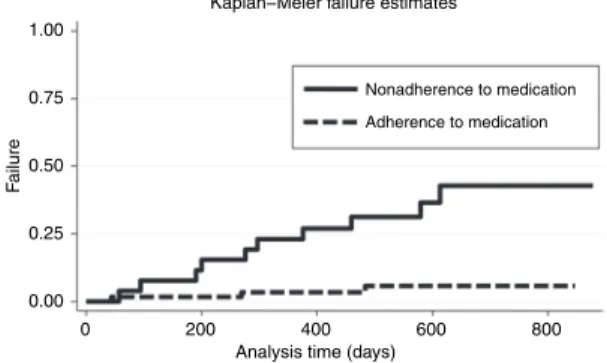
To detect associations of potential risk factors with hytensive crisis, Cox proportional hazards models were per-formed. Several factors were significantly associated with hypertensive crisis in bivariable analysis as well as after adjust-ment for age and sex (Table 2): female sex, higher grades of obesity, the presence of a hypertensive heart disease or a coro-nary artery disease, the presence of a somatoform disorder, a higher number of antihypertensive drugs, and nonadherence to medication. As measured by the hazard ratio, nonadherence was the most important factor associated with hypertensive crisis. Figure 2 shows the occurrence of hypertensive crisis subdivided by patients with nonadherence and patients with adherence to medication.
The presence of a somatoform disorder (P < 0.01) and a higher number of antihypertensive drugs (P = 0.04) were sig-nificantly associated with nonadherence to medication. The association remained significant, if the regression model was adjusted by age and sex.
None of the 16 patients who were treated by lifestyle inter-vention and who did not receive antihypertensive drugs expe-rienced a hypertensive crisis. Therefore, a sensitivity analysis without these 16 patients was performed. In Cox proportional hazards models adjusted for age and sex, the following factors were significantly associated with the occurrence of a hyper-tensive crisis: female sex (P < 0.01), higher grades of obesity (P = 0.01), the presence of a somatoform disorder (P < 0.01),
Figure 1 | Flow chart.
112 Eligible patients: - Aged 18 years or older, and
- Ambulatory blood pressure measurement performed
Excluded:
- 21 Normotensive patients - 2 Patients refused participation
89 Participating patients
85 Patients completed study and were included in analysis
Lost to follow-up: - 4 Patients
Figure 2 | Kaplan–Meier failure estimates for the occurrence of hypertensive
crisis subdivided for patients with nonadherence or adherence to medication. 0.00
0 200
Nonadherence to medication Adherence to medication
400
Kaplan−Meier failure estimates
Analysis time (days)
600 800 0.25 0.50 0.75 Failure 1.00
a higher number of antihypertensive drugs (P = 0.04), and nonadherence to medication (P = 0.02). The presence of a hypertensive heart disease (P = 0.05) or a coronary artery dis-ease (P = 0.06) were close to significance. Thus, these results were similar to the results presented in Table 2.
discussion
This prospective longitudinal study identified several poten-tial risk factors for hypertensive crisis, namely female sex, the grade of obesity, the presence of a hypertensive heart disease or a coronary artery disease, the presence of a somatoform dis-order, a higher number of prescribed antihypertensive drugs, and, most importantly, nonadherence to medication. However, confounding or interaction between these potential risk factors
cannot be excluded due to the small sample size. For example, the presence of a somatoform disorder and a higher number of prescribed antihypertensive drugs were significantly associ-ated with nonadherence suggesting a relation between these three factors. This study also suggests that there are specific causes for hypertensive crisis such as hyperthyroidism in some patients.
Previous retrospective studies have presumed that nonad-herence to medication is an important risk factor for hyper-tensive crisis.3–8 Our results now support this previous finding in a first prospective longitudinal study. This study therefore contributes to the ongoing discussion about whether non-adherence is an explanation for hypertensive crisis or not.9 Nonadherence was significantly associated with a higher table 1 | Baseline characteristics (mean ± s.d. or percentage)
Characteristic
Patients without
hypertensive crisis hypertensive crisisPatients with
P value All patients (N = 72) (N = 13) (N = 85) Age, years 52.3 ± 15.2 61.8 ± 10.1 0.03 53.8 ± 14.9 Female sex, n (%) 23 (31.9) 10 (76.9) <0.01 33 (38.8) Systolic BP, mm Hg 137.3 ± 13.0 142.1 ± 16.7 0.24 138.0 ± 13.6 Diastolic BP, mm Hg 80.5 ± 10.9 78.2 ± 11.4 0.49 80.1 ± 10.9 Hypertension, n (%) 72 (100.0) 13 (100.0) 1 85 (100.0) Stage 1, n (%) 53 (73.6) 7 (53.9) 0.15 60 (70.6) Stage 2, n (%) 19 (26.4) 6 (46.1) 25 (29.4)
Body mass index, kg/m2 29.3 ± 6.3 32.3 ± 6.0 0.11 29.8 ± 6.3
Obesity, n (%) 30 (41.7) 8 (61.5) 0.19 38 (44.7) Grade 0, n (%) 42 (58.3) 5 (38.5) 0.04 47 (55.3) Grade 1, n (%) 20 (27.8) 2 (15.4) 22 (25.9) Grade 2, n (%) 6 (8.3) 5 (38.5) 11 (12.9) Grade 3, n (%) 4 (5.6) 1 (7.7) 5 (5.9) Hyperlipidemia, n (%) 41 (56.9) 10 (76.9) 0.23 51 (60.0) Diabetes, n (%) 14 (19.4) 4 (30.8) 0.46 18 (21.2) Nicotine, n (%) 35 (48.6) 5 (38.5) 0.5 40 (47.1)
Hypertensive heart disease, n (%) 15 (20.8) 7 (53.9) 0.01 22 (25.9)
Coronary artery disease, n (%) 5 (6.9) 4 (30.8) 0.03 9 (10.6)
Hypertensive renal disease, n (%) 8 (11.1) 2 (15.4) 0.65 10 (11.8)
Creatinine, μmol/l 75.6 ± 13.2 79.1 ± 20.7 0.42 76.1 ± 14.5
Renal artery stenosis, n (%) 1 (1.4) 0 (0.0) 1 1 (1.2)
Previous stroke, n (%) 3 (4.2) 3 (23.1) 0.04 6 (7.1)
Thyroid disease, n (%) 10 (13.9) 5 (38.5) 0.03 15 (17.7)
Hyperthyroidism, n (%) 0 (0.0) 1 (7.7) 0.15 1 (1.2)
Depression, n (%) 13 (18.1) 5 (38.5) 0.1 18 (21.2)
Somatoform disorder, n (%) 5 (6.9) 4 (30.8) 0.03 9 (10.6)
Antihypertensive drugs, number of drugs 1.8 ± 1.5 3.0 ± 1.4 <0.01 2.0 ± 1.6
Nonadherence to medication, n (%) 16 (22.2) 10 (76.9) <0.01 26 (30.6)
Achieved BP control during ABPM, n (%) 38 (52.8) 7 (53.9) 0.94 45 (52.9)
Alcohol abuse, n (%) 12 (16.7) 2 (15.4) 1 14 (16.5)
number of prescribed antihypertensive drugs. This is a well-known phenomenon.18 Therefore, this study suggests that a higher number of prescribed antihypertensive drugs is not a true risk factor for hypertensive crisis, but related to hyperten-sive crisis via nonadherence.
In this study, the proportion of women experiencing hyper-tensive crisis was higher than that of men. Several previous studies found indications of an increased incidence of hyper-tensive crisis in women, but without satisfying explanations for these findings.4,19,20 It is well established that women more often suffer from somatoform disorders as compared to men and that this disease is associated with nonadherence.21–23 Therefore, a plausible explanation for the findings of our study might be that women had a higher prevalence of somato-form disorders predisposing these women to nonadherence. Regression analysis in our study supports this hypothesis.
A further finding was that the risk for hypertensive crisis was associated with the grade of obesity at the time of diagnosis. To the best of the authors’ knowledge, this finding has previ-ously not been reported. However, it is known that hyperten-sion control is more difficult in obese than in lean patients. The underlying pathophysiological mechanism is not fully under-stood, but overactivity of the sympathetic nervous system (e.g., due to hyperleptinemia) or the renin–angiotensin–aldosterone system as well as physical compression of the kidneys seem to play a role in this scenario.24,25
Our study has limitations. First, the sample size of 85 patients was small. It was too small for meaningful multivariable regres-sion models involving more than three variables. However, sample size was adequate to identify several significant asso-ciations as potential risk factors of hypertensive crises. Second, the patients included in this study had 24-h ABPM at a uni-versity hospital which might have led to a selection of patients
with rather severe hypertension, thus possibly limiting the generalizability of our data. Third, some hypertensive crises may have been missed because it was impossible to continually monitor BP during follow-up. Furthermore, unequal follow-up periods or patients lost to follow-up may have led to missed hypertensive crises. However, outpatient medical records were reviewed in all and structured interviews were conducted with most study participants. The approach in this study has been proven to be effective in the detection of end points.26,27 Fourth, to be plausible, the association between medical non-adherence and hypertensive crisis requires a proper definition of nonadherence. Generally, medical adherence is defined as the extent to which a patient takes a medication as prescribed by the treating physician.28 Patients were considered as being nonadherent, if the treating physician asked the patient whether he took medication irregularly and if irregular media-tion use was documented in the medical record. This approach should be appropriate. Methods such as pharmacy refills or electronic monitoring of pill cap openings have been shown to be insensitive methods for measuring medical adherence and are not superior to physician’s judgment.29
This study has research implications. Several potential risk factors for hypertensive crisis were identified, among them nonadherence to medication. These findings have to be con-firmed in a larger independent prospective study extended to a more generalized study population (i.e., a study popula-tion also seen by general practipopula-tioners). Ideally, such a study should not only incorporate the risk factors assessed in this study, but also extend the baseline assessment by further potential explanatory variables (e.g., measurements of differ-ent hormones, including leptin and insulin levels to explore the association between obesity and hypertensive crisis). Such a future study might also assess genetic polymorphisms table 2 | Variables associated with hypertensive crisis
Variable
Bivariable analysis Multivariable analysisa
HR (95% CI) P value HR (95% CI) P value
Age (HR per year increase) 1.04 (1.00–1.08) 0.05 1.03 (0.99–1.07) 0.14
Sex (HR for female vs. male sex) 6.15 (1.69–22.37) <0.01 5.27 (1.43–19.47) 0.01
Stage of hypertension (HR for stage 2 vs. stage 1) 2.17 (0.73–6.47) 0.16 2.48 (0.81–7.57) 0.11
Grade of obesity (HR per grade increase) 1.68 (1.01–2.79) 0.046 2.28 (1.19–4.37) 0.01
Hypertensive heart disease (HR for presence vs. absence) 3.82 (1.28–11.40) 0.02 4.14 (1.16–14.81) 0.03
Coronary artery disease (HR for presence vs. absence) 4.43 (1.36–14.44) 0.01 3.73 (1.09–12.80) 0.04
Previous stroke (HR for presence vs. absence) 4.39 (1.21–15.97) 0.03 3.02 (0.72–12.72) 0.13
Thyroid disease (HR for presence vs. absence) 3.09 (1.01–9.48) 0.048 1.74 (0.52–5.82) 0.37
Depression (HR for presence vs. absence) 2.36 (0.77–7.21) 0.13 2.13 (0.65–6.98) 0.21
Somatoform disorder (HR for presence vs. absence) 4.55 (1.39–14.87) 0.01 5.05 (1.34–19.03) 0.02
Number of antihypertensive drugs
(HR per number of drug increase) 1.45 (1.07–1.97) 0.02 1.68 (1.16–2.44) <0.01
Nonadherence to medication
(HR for nonadherence vs. adherence) 8.51 (2.34–30.95) <0.01 5.88 (1.59–21.77) <0.01
CI, confidence interval; HR, hazard ratio.
associated with hypertensive crisis, increased susceptibility to side effects and medication interactions, and/or vascular properties (such as the measurement of pulse wave velocity or augmentation index).30–32
In conclusion, this study identified several risk factors for hypertensive crisis, among them nonadherence to medica-tion. Even though there are open questions, this study suggests that the improvement of medical adherence in antihyperten-sive drug therapy is important to prevent hypertenantihyperten-sive crises. Physicians should be aware of medical nonadherence in some subpopulations such as patients with somatoform disorders. Acknowledgments: This study was supported by a grant from the Swiss Society of Hypertension (Bern, Switzerland). A.W.S. was supported by a Forschungskolleg Geriatrie Grant from the Robert Bosch Foundation (Stuttgart, Germany). The supporting institutions did not have any role in the design and conduct of the study; in the collection, management, analysis, and interpretation of the data; and in the preparation, review, or approval of the manuscript.
Disclosure: The authors declared no conflict of interest.
1. Chobanian AV, Bakris GL, Black HR, Cushman WC, Green LA, Izzo JL Jr, Jones DW, Materson BJ, Oparil S, Wright JT Jr, Roccella EJ; Joint National Committee on Prevention, Detection, Evaluation, and Treatment of High Blood Pressure. National Heart, Lung, and Blood Institute; National High Blood Pressure Education Program Coordinating Committee. Seventh report of the Joint National Committee on Prevention, Detection, Evaluation, and Treatment of High Blood Pressure. Hypertension 2003; 42:1206–1252.
2. Zampaglione B, Pascale C, Marchisio M, Cavallo-Perin P. Hypertensive urgencies and emergencies. Prevalence and clinical presentation. Hypertension 1996; 27:144–147.
3. Wu PH, Yang CY, Yao ZL, Lin WZ, Wu LW, Chang CC. Relationship of blood pressure control and hospitalization risk to medication adherence among patients with hypertension in Taiwan. Am J Hypertens 2010; 23:155–160.
4. Martin JF, Higashiama E, Garcia E, Luizon MR, Cipullo JP. Hypertensive crisis profile. Prevalence and clinical presentation. Arq Bras Cardiol 2004; 83: 131–6; 125.
5. Tisdale JE, Huang MB, Borzak S. Risk factors for hypertensive crisis: importance of out-patient blood pressure control. Fam Pract 2004; 21:420–424. 6. Shea S, Misra D, Ehrlich MH, Field L, Francis CK. Predisposing factors for severe,
uncontrolled hypertension in an inner-city minority population. N Engl J Med 1992; 327:776–781.
7. Sesoko S, Akema N, Matsukawa T, Kaneko Y. Predisposing factors for the development of malignant essential hypertension. Arch Intern Med 1987; 147:1721–1724.
8. Hajjar I, Kotchen TA. Trends in prevalence, awareness, treatment, and control of hypertension in the United States, 1988-2000. JAMA 2003; 290:199–206. 9. Wetzels GE, Nelemans P, Schouten JS, Prins MH. Facts and fiction of poor
compliance as a cause of inadequate blood pressure control: a systematic review.
J Hypertens 2004; 22:1849–1855.
10. Schoenenberger AW, Erne P, Ammann S, Perrig M, Bürgi U, Stuck AE. Prediction of hypertensive crisis based on average, variability and approximate entropy of 24-h ambulatory blood pressure monitoring.
J Hum Hypertens 2008; 22:32–37.
11. Peytremann-Bridevaux I, Santos-Eggimann B. Health correlates of overweight and obesity in adults aged 50 years and over: results from the Survey of Health, Ageing and Retirement in Europe (SHARE). Obesity and health in Europeans aged > or = 50 years. Swiss Med Wkly 2008; 138:261–266.
12. Schoenenberger AW, Schoenenberger-Berzins R, Suter PM, Zuber M, Erne P. Effect of moderate weight reduction on resting and exercise blood pressure in overweight subjects. J Hum Hypertens 2007; 21:683–685.
13. Report of the expert committee on the diagnosis and classification of diabetes mellitus. Diabetes Care 1997; 20:1183–1197.
14. Xin X, He J, Frontini MG, Ogden LG, Motsamai OI, Whelton PK. Effects of alcohol reduction on blood pressure: a meta-analysis of randomized controlled trials.
Hypertension 2001; 38:1112–1117.
15. Hermida RC, Chayán L, Ayala DE, Mojón A, Domínguez MJ, Fontao MJ, Soler R, Alonso I, Fernández JR. Association of metabolic syndrome and blood pressure nondipping profile in untreated hypertension. Am J Hypertens 2009; 22:307–313. 16. Varon J, Marik PE. The diagnosis and management of hypertensive crises. Chest
2000; 118:214–227.
17. European Society of Hypertension-European Society of Cardiology Guidelines Committee. 2003 European Society of Hypertension-European Society of Cardiology guidelines for the management of arterial hypertension. J Hypertens 2003; 21:1011–1053.
18. Chapman RH, Petrilla AA, Benner JS, Schwartz JS, Tang SS. Predictors of adherence to concomitant antihypertensive and lipid-lowering medications in older adults: a retrospective, cohort study. Drugs Aging 2008; 25:885–892.
19. Egan BM, Basile JN, Rehman SU, Davis PB, Grob CH 3rd, Riehle JF, Walters CA,
Lackland DT, Merali C, Sealey JE, Laragh JH. Plasma Renin test-guided drug treatment algorithm for correcting patients with treated but uncontrolled hypertension: a randomized controlled trial. Am J Hypertens 2009; 22:792–801. 20. Chapman RH, Benner JS, Petrilla AA, Tierce JC, Collins SR, Battleman DS,
Schwartz JS. Predictors of adherence with antihypertensive and lipid-lowering therapy. Arch Intern Med 2005; 165:1147–1152.
21. Kessler RC, Chiu WT, Demler O, Merikangas KR, Walters EE. Prevalence, severity, and comorbidity of 12-month DSM-IV disorders in the National Comorbidity Survey Replication. Arch Gen Psychiatry 2005; 62:617–627.
22. Hiller W, Rief W, Brähler E. Somatization in the population: from mild bodily misperceptions to disabling symptoms. Soc Psychiatry Psychiatr Epidemiol 2006; 41:704–712.
23. Cramer JA, Rosenheck R. Compliance with medication regimens for mental and physical disorders. Psychiatr Serv 1998; 49:196–201.
24. Wofford MR, Hall JE. Pathophysiology and treatment of obesity hypertension.
Curr Pharm Des 2004; 10:3621–3637.
25. Erkens JA, Panneman MM, Klungel OH, van den Boom G, Prescott MF, Herings RM. Differences in antihypertensive drug persistence associated with drug class and gender: a PHARMO study. Pharmacoepidemiol Drug Saf 2005; 14:795–803. 26. Schoenenberger AW, Erne P, Ammann S, Gillmann G, Kobza R, Stuck AE.
Prediction of arrhythmic events after myocardial infarction based on signal-averaged electrocardiogram and ejection fraction. Pacing Clin Electrophysiol 2008; 31:221–228.
27. Schoenenberger AW, Kobza R, Jamshidi P, Zuber M, Abbate A, Stuck AE, Pfisterer M, Erne P. Sudden cardiac death in patients with silent myocardial ischemia after myocardial infarction (from the Swiss Interventional Study on Silent Ischemia Type II [SWISSI II]). Am J Cardiol 2009; 104:158–163.
28. Frishman WH. Importance of medication adherence in cardiovascular disease and the value of once-daily treatment regimens. Cardiol Rev 2007; 15:257–263. 29. Wetzels GE, Nelemans PJ, Schouten JS, van Wijk BL, Prins MH. All that glisters is not gold: a comparison of electronic monitoring versus filled prescriptions–an observational study. BMC Health Serv Res 2006; 6:8.
30. Krüth P, Wehling M. Pharmacogenomics. What is relevant for the internal medicine specialist? Internist (Berl) 2003; 44:1524–1530.
31. Sunder-Plassmann G, Kittler H, Eberle C, Hirschl MM, Woisetschläger C, Derhaschnig U, Laggner AN, Hörl WH, Födinger M. Angiotensin converting enzyme DD genotype is associated with hypertensive crisis. Crit Care Med 2002; 30:2236–2241.
32. van Rijn-Bikker PC, Mairuhu G, van Montfrans GA, Sijbrands EJ, Zwinderman AH, Guchelaar HJ, Koopmans RP. Genetic factors are relevant and independent determinants of antihypertensive drug effects in a multiracial population.