Chaire des Sciences de la Communication et des médias
Université de Fribourg
PATRICK-YVES BADILLO DOMINIQUE BOURGEOIS
Référence :
Badillo, P. Y., & Bourgeois, D. (2017). The Swiss press model. Democracy, concentration and digital diversification. Recherches en communication, (44), 9-30
Abstract
Document téléchargé depuis http://www.dominiquebourgeois.eu.
Switzerland is a country where the press is key. Democracy is at the heart of the Swiss press, characterized by multilingualism, diversity of the press and a long tradition of newspapers readership. But the paid-for daily printed press has been faced with a crisis for the last decade with the development of the free press, the rise of Internet and a decline in advertising revenues. Consequently, the Swiss press model is evolving. With the help of various indicators, this paper highlights an increasingly strong concentration of the Swiss daily press between 2005 and 2014. Moreover, it analyses the strategies of the two main Swiss press groups, Tamedia and Ringier, towards profitable digital diversification. It shows that the Swiss press remains strong, contrarily to the French press, for example. Thus, the evolution of the Swiss press model is illustrative of a new economic model. However, the paper also emphasizes that the Swiss press is now faced with increasing competition from the world digital leaders, such as Google and Facebook.
The Swiss press model. Democracy, concentration and
digital diversification
Democracy, concentration and digital
diversification
Patrick-Yves Badillo1 and Dominique Bourgeois2
Switzerland is a country where the press is key. Democracy is at the heart of the Swiss press, characterized by multilingualism, diversity of the press and a long tradition of newspapers readership. But the paid-for daily printed press has been faced with a crisis for the last decade with the development of the free press, the rise of Internet and a decline in advertising revenues. Consequently, the Swiss press model is evolving. With the help of various indicators, this paper highlights an increasingly strong concentration of the Swiss daily press between 2005 and 2014. Moreover, it analyses the strategies of the two main Swiss press groups, Tamedia and Ringier, towards profitable digital diversification. It shows that the Swiss press remains strong, contrarily to the French press, for example. Thus, the evolution of the Swiss press model is illustrative of a new economic model. However, the paper also emphasizes that the Swiss press is now faced with increasing competition from the world digital leaders, such as Google and Facebook.
Media, and particularly newspapers, are considered as essential to democracy. This is particularly true in Switzerland where the press has a long standing tradition. Nevertheless, the
1 Patrick-Yves Badillo is a professor of Media and Communication Science at the University of Geneva, Switzerland, and the Director of Medi@LAB-Genève. 2 Dominique Bourgeois is a professor of Media and Communication Science at the
University of Freiburg, Switzerland.
number of newspapers has declined in Switzerland and there have been different mergers during the last twenty years; more recently the free print press and the free press on the Internet have developed considerably. The main objective of this paper is to highlight the characteristics of the press and its recent changes in the specific context of this small country. More precisely we will show the two main characteristics of the evolution of the Swiss press model: an increasing concentration and a successful digital diversification. First the Swiss press model and its crisis will be discussed: the general landscape of the Swiss newspapers, particularly of the daily newspapers, has indeed considerably evolved. Subsequently concentration in the Swiss daily press will be studied by using concentration indexes. Lastly we will clarify the digital diversification strategy which is developed by the two main Swiss press groups and the new competition on the online advertising market.
1. The Swiss press model and its crisis
1.1. The Swiss press model
“Switzerland is still a country where the press is key” (REMP, 2016, our translation). With a high number of print products, Switzerland was ranked seventh in the world for the newspaper density per capita in 2013: the number of daily copies distributed per thousand adult population was around 352 in 2013 (data from WAN-IFRA, 2015). In terms of daily newspaper readership, Switzerland is also in the top countries in the world: there were 4.894 million readers of dailies in 2013, which means a newspaper reach of 75.1% of the adult population (Source: WAN-IFRA, 2015). Thus Switzerland is comparable to Scandinavian European countries which have also very high readership of newspapers per capita.
Moreover there has been a long tradition of local and regional newspapers in Switzerland, although it is a small country in comparison with most European countries, since there are about 8 million inhabitants in Switzerland. Media, and particularly
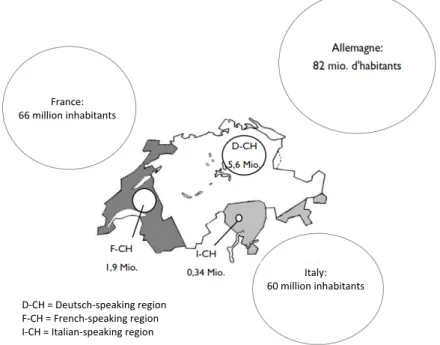
newspapers, are considered as essential to democracy. This is true in as much as the political system is based on direct democracy, with many “votations” at the national level, but also at the “canton” level (there are 26 cantons) and city or village level. The media play an important role to provide information and favor debates. Thus the diversity of the press is high in a country with four official languages ˗ German, French, Italian and Romansch – and almost a quarter of the population composed of foreign people living in Switzerland. Figure 1 below gives the numbers of inhabitants in the three main Swiss linguistic regions and in the main European border countries. The landscape of the press is marked by multilingualism and the small size of the country, which means small markets for press groups.
Figure 1: Comparison between the Swiss linguistic regions and the bordering countries with the same languages
Germany: 82 million inhabitants France: 66 million inhabitants Italy: 60 million inhabitants D‐CH = Deutsch‐speaking region F‐CH = French‐speaking region I‐CH = Italian‐speaking region
Source: based on an illustration in a report of the Swiss Federal Council: Conseil fédéral, 2016, p. 3, our translation; we have updated the figure for France.
Consequently, the large number of Swiss newspapers is correlated with the diversity of languages and diversity of markets. In his analysis of the daily press in the Romand part (French speaking part) of Switzerland, Borruat (1999) considered three main categories of regional daily press: the “supraregional” daily titles, such as Le Temps, the “cantonal” daily titles, such as Le
Quotidien Jurassien, La Liberté, Le Nouvelliste, and the “local”
daily titles, such as La Côte… Amez-Droz (2015) considered other categories for the Romand press by taking into account also the ownership: independent newspapers are distinguished from newspapers integrated into groups. Moreover, very local titles exist, with a small circulation and very local news: few titles have a circulation of more than 50,000 issues and there are combinations of titles.
In regards to media regulation, Switzerland is generally considered to be a “Democratic Corporatist Model”, as described by Hallin and Mancini (2004). In general, in Switzerland, media regulation is moderate: auto-regulation and co-regulation are privileged (Blum, 2014). Concerning the press, like other small European countries which are considered as typical of the “Democratic Corporatist Model”, the Swiss press has a long tradition of freedom, a high level of journalistic professionalization and high readership per capita. But there is no direct intervention of the state and the Swiss press model is close to what has been called “liberal corporatism”. In particular, contrary to other small European countries, such as Norway or Denmark, there are no direct press subsidies at the federal level. The Swiss Federal Government subsidizes only indirectly the distribution of press titles with preferential postal charges and a reduced VAT on newspaper subscriptions. Press subsidies amounted to 123 million Swiss francs – CHF – in 2013, most of which, i.e. CHF 73 million, was accounted for by the reduced VAT. Subsidies for reduced postal charges amount to CHF 50 million per year: the local and regional press enjoy 30 million and publications of professional societies and foundations 20 million. This assistance is far less than in other European countries. Moreover, concerning the various aspects of professional ethics, the Swiss press is
self-regulated: there are ombudsmen in big press companies and the Swiss Press Council “serves the public and the media as an appeals board in regard to media ethics” (Swiss Press Council, 2015, p.1). Of course, the press has to respect general laws; in particular, the agreement of the Competition Commission (COMCO), an independent federal authority, is necessary for any merger.
1.2. The crisis of the Swiss press
Although the characteristics of the Swiss press which has just been recalled are still present, the paid-for print press is faced with economic difficulties. A part of the explanation can be found in long term trends but the decline seems now particularly worrying for the paid-for print daily press. Since the beginning of the XXth
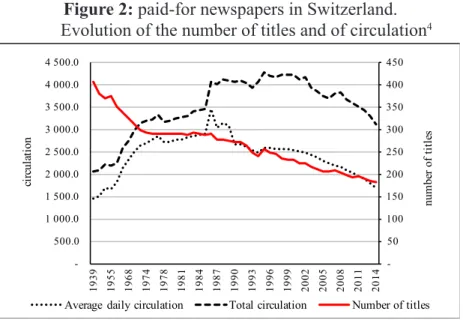
century, as in many other countries, the number of newspapers has declined in Switzerland. There were 406 paid-for newspapers in 1939 and only 181 in 2014. For a long period the decline in the number of newspapers has been accompanied by a growth in circulation, at least until the eighties (see Figure 2 below). This trend may be simply explained by the readership which has been at a high level in Switzerland. Nevertheless, the press landscape
changed in the nineties when the average circulation3 began to
decrease. In addition the total circulation began to decline in 2003. During the last twenty years there were different mergers and more recently the free print press and the free press on the Internet have developed considerably, at the expense of the paid-for press. These changes have led to great debates about the future of the Swiss press.
Debates about the role of the state in the media have grown in the last years, both because of the ongoing economic deterioration of the paid-subscription newspapers sector and because of discussions about the public service in radio and television,
3 The total circulation represents the sum of all the copies of all the titles, independently of the number of editions per week. The average daily circulation indicates the number of sold copies on average during a day of the week (thus the newspapers which are published only once a week have fewer weight than daily newspapers).
which is financed by license fees. While press subsidies for the printed press have secured a high and stable number of newspaper titles in Norway (Slaatta, 2015), that has not been the case for the Swiss press and now some Swiss journalists are arguing in favour of direct press subsidies. Moreover, a report of the Federal Media Commission (FMEC) recommends various forms of subsidy action in order to ensure a diverse and pluralistic media landscape: “(…) according to the FMEC, the media are caught up in an irreversible process of transformation. In the interests of democracy it appears advisable that this process should be accompanied by supportive measures.” But the FMEC adds: “In this process the potential influence of the state should be kept as small and brief as possible, and thus prevent a situation which merely maintains the structures” (Federal Media Commission – FMEC, 2014, p. 21).
The crisis is particularly strong for daily newspapers. Already in 1997 Bollinger denounced “la peau de chagrin des quotidiens
suisses”, i.e. the shrinking of the Swiss daily newspapers. The
number of daily paid-for newspapers dropped during the twenty last years. According to a document from the Federal Statistical Office, it moved back 40% between 1985 and 2006: there were 124 paid-for dailies (published at least 4 times per week) in 1985 and only 76 in 2006 (Kradolfer, 2007, p. 8). According to data from the WAN-IFRA (2015), there were 84 dailies in 2009 and only 79, among which 4 free dailies, in 2013 (WAN-IFRA, 2015; these data are not comparable with the previous data from the Federal Statistical Office). In a first period the decline was associated with an increase in the circulation of the existing newspapers: the average circulation of a Swiss daily newspaper was about 10000 copies in 1985 and 16000 in 2006. But with the development of the free daily press and the rise of Internet uses, the situation of the paid-for daily press has deteriorated since the beginning of the XXIst century.
Figure 2: paid-for newspapers in Switzerland. Evolution of the number of titles and of circulation4
-50 100 150 200 250 300 350 400 450 -500.0 1 000.0 1 500.0 2 000.0 2 500.0 3 000.0 3 500.0 4 000.0 4 500.0 1939 1955 1968 1974 1978 1981 1984 1987 1990 1993 1996 1999 2002 2005 2008 2011 2014 nu m be r o f t itl es cir cu la tio n
Average daily circulation Total circulation Number of titles
Source: figure made by the authors on the basis of data from the Swiss Federal Statistical Office, Neuchâtel, 2015. http://www.bfs.admin.ch/bfs/ portal/fr/index/themen/16/03/key/ind16.indicator.16010201.160201. html?open=4200002,1#1
The crisis of the Swiss press, particularly of the daily press, may be explained by the strong development of free news and a decline in advertising revenues.
The strong development of free news includes both the rise of Internet news platforms and the development of free print dailies. The Swiss readers have now access to many online news platforms, from the websites of the main Swiss publishing houses which have expanded their cross-platform presence (particularly Tamedia and Ringier) to the Swiss news portals such as Bluewin (owned by Swisscom, the main Swiss telecommunications company) and the portals of foreign companies, such as Google news. The development of free print dailies has been, of course, an element of competition which has affected the paid-for
4 Because of new methods of measure applied from 1995, it is not possible to compare the figures indicated from 1995 with those of the previous years. Moreover the statistics do not take into account the free newspapers, the official sheets, the specialized publications and the associative press.
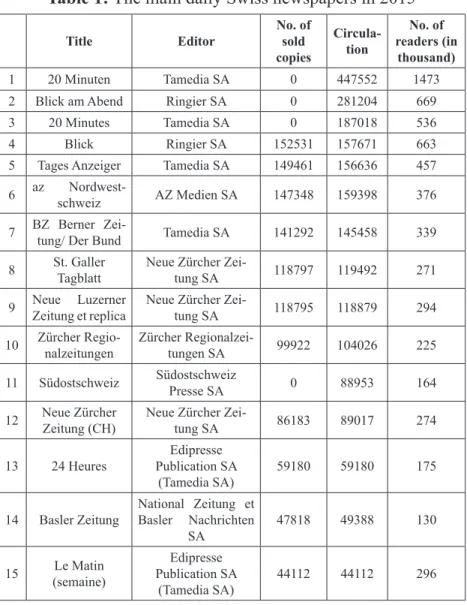
newspapers. The free German-speaking daily 20 Minuten is now the most read newspaper in Switzerland with about 1.5 million readers in 2015 (see Table 1 below). The free newspaper Blick am
Abend, with around 670,000 readers, is at the second place, just
ahead of the paid-for Blick (owned by Ringier; around 660,000 readers), and the free French-speaking newspaper 20 Minutes is at the fourth place, with around 540,000 readers in 2015.
The decrease of advertising resources of the Swiss press, particularly of the daily press, was very important during the recent years. For the whole press, the amount of net advertising resources was equal to about 2 million Swiss francs (CHF) in 2010 and only 1.436 million in 2015. Concerning the daily press, while the amount of net advertising resources reached 1.232 million CHF in 2005 and 1.341 million in 2007, it decreased since 2007 and reached only 620,000 CHF in 2015 (Source: Fondation Statistique Suisse en Publicité, http://www.werbestatistik.ch/ index.php?pid=1&l=fr). Such a substantial decrease has been a key cause for financial difficulties in the daily press and mergers. For the large Swiss groups, concentration is part of general growth strategies.
Some lines indicate combinations of titles. For example,
Zürcher Regionalzeitungen includes Der Landbote, Zürcher Oberländer, Zürcher Unterländer, Zürichsee Zeitung.
Table 1: The main daily Swiss newspapers in 2015
Title Editor No. of sold copies Circula-tion No. of readers (in thousand) 1 20 Minuten Tamedia SA 0 447552 1473 2 Blick am Abend Ringier SA 0 281204 669 3 20 Minutes Tamedia SA 0 187018 536 4 Blick Ringier SA 152531 157671 663 5 Tages Anzeiger Tamedia SA 149461 156636 457 6 az Nordwest-schweiz AZ Medien SA 147348 159398 376 7 BZ Berner Zei-tung/ Der Bund Tamedia SA 141292 145458 339 8 St. Galler Tagblatt Neue Zürcher Zei-tung SA 118797 119492 271 9 Neue Luzerner Zeitung et replica Neue Zürcher Zei-tung SA 118795 118879 294 10 Zürcher Regio-nalzeitungen Zürcher Regionalzei-tungen SA 99922 104026 225 11 Südostschweiz Südostschweiz Presse SA 0 88953 164 12 Neue Zürcher Zeitung (CH) Neue Zürcher Zei-tung SA 86183 89017 274
13 24 Heures Publication SA Edipresse
(Tamedia SA) 59180 59180 175 14 Basler Zeitung National Zeitung et Basler Nachrichten
SA 47818 49388 130 15 (semaine)Le Matin Publication SA Edipresse
(Tamedia SA) 44112 44112 296
Sources: mainly REMP and Schweizer Medien. http://www.remp.ch/ http://www.schweizermedien.ch/
2. An increasing concentration of the Swiss daily press
Concentration of media ownership matters in our societies because it may reduce pluralism, which is generally considered
as a basis of democracy, and also because it may affect economic efficiency (Doyle, 2014).
We will give concentration indicators for the Swiss daily press which has been characterized by many changes in the recent years. Since, until now, concentration in Switzerland has been mainly evaluated through the global market share of the three main companies (see Bonfadelli et al., 2006); it is relevant to propose a more elaborated measurement of ownership concentration. Moreover, it is interesting to consider the evolution of concentration and try to explain changes in concentration, and in particular recent changes. Our analysis will compare developments in the newspaper industry starting 2005. We choose to begin at this date because 2005 was an important year for the development of free newspapers. Although the first free daily Swiss newspaper, 20 Minuten, was published on December 13, 1999 for the first time by the Norwegian company Schibsted, it had a difficult start and the Swiss group Tamedia bought it completely in 2005. Furthermore, in French-speaking Switzerland, the first free daily newspaper, Le Matin Bleu, was published on October 31, 2005 by Edipresse, and 20 Minutes was published by Tamedia on March 8, 2006 for the first time. We will study how ownership concentration in the Swiss daily press industry has changed since 2005.
2.1. Method to measure media ownership concentration
The methodology was defined within the framework of a large scale international research project on concentration of the media (Noam, 2016). Badillo and Bourgeois (2016) calculated data for the Swiss media. Data for the Swiss press have been updated in the present paper. Concentration is estimated through the following indicators: the C3 and C4 ratios, the HHI and the Noam index.
C3/C4
The C3/C4 ratio is the sum of the market shares of the three/ four main companies.
HHI
The Herfindahl Hirschman concentration index (HHI) is equal to the sum of the squares of the market shares of all market participants (In our estimates, this index includes market shares over 1%). The HHI can range between zero - where the share of each firm is infinitely small - and 10,000, when a single firm accounts for 100% of the market (monopoly). The US Department of Justice’s antitrust enforcement guidelines classify market concentration levels as follows: for a HHI < 1,000, the market is not concentrated; for 1,000 < HHI < 1,800, the market is moderately concentrated; for HHI > 1,800, the market is highly concentrated. The HHI is an indicator which measures market power.
Noam Index
Noam has proposed another index with the objective to consider both market power and diversity. This index, referred as the Noam Index (NI), takes into account the number of independent media ‘voices,’ according to Noam (2016). Let N be the total number of independent media firms. The Noam index is defined as the ratio of the HHI to the square root of N. NI = HHI = 10,000 if, and only if, there is only one firm operating on the market. In all other cases, NI < HHI.
2.2. The Swiss daily press: strong increasing concentration between 2005 and 2014
With the emergence of the free daily press since 2000, the situation of the paid-for daily Swiss press has deteriorated. Concerning ownership concentration in the past two decades, a trend for increased concentration has been observed. A few big publishing houses own most of Swiss print titles: Tamedia, Ringier and NZZ (Neuen Zürcher Zeitung) Medien Gruppe. Nevertheless, there is still a large number of print titles, with many titles of a limited circulation, and, from an editorial point of view, a diversity of opinions, though “content diversity is not guaranteed by the multiplicity of titles”, as several small newspapers mainly
reproduce news agencies’ content and editorial collaborations at the national level are common (Cornu et al., 2012, p. 30).
• Concentration in the Swiss daily paid-for newspapers
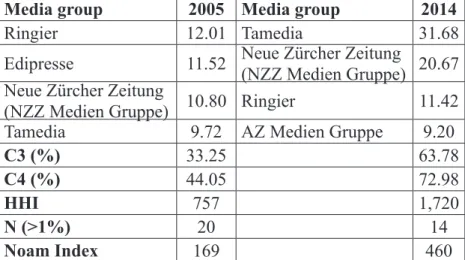
Table 2 below gives market shares of the four main companies and concentration indexes, based on circulation data of paid-for daily newspapers only.
Table 2: Swiss daily paid-for newspapers: market shares of the main groups
(circulation in %) and concentration indexes, 2005 and 2014
Media group 2005 Media group 2014
Ringier 12.01 Tamedia 31.68
Edipresse 11.52 Neue Zürcher Zeitung (NZZ Medien Gruppe) 20.67
Neue Zürcher Zeitung
(NZZ Medien Gruppe) 10.80 Ringier 11.42
Tamedia 9.72 AZ Medien Gruppe 9.20
C3 (%) 33.25 63.78
C4 (%) 44.05 72.98
HHI 757 1,720
N (>1%) 20 14
Noam Index 169 460
Source: our calculations based on circulation data from REMP. Only paid copies are taken into account. N is the number of media companies which have a market share above 1%.
The market of paid-for daily newspapers appears concentrated if we look at C4, which was around 73% in 2014 (C3 around 64% in 2014). The first company, Tamedia, represented almost one third of the market in 2014. If we observe the HHI, the result is less evident: the HHI was less than 1,800 in 2014, which corresponds to a moderately concentrated market, and the Noam Index is quite low, which may be explained partly by the HHI and partly by the diversity associated with 14 firms above 1% of the market in 2014. The evolution of all the indexes shows an increasing trend;
the Noam Index has more than doubled between 2005 and 2014, which can be explained mainly by some mergers.
• Concentration in the whole Swiss daily newspapers
(paid-for and free daily press)
Table 3 below gives market shares and concentration indexes for the whole daily Swiss press, i.e. for paid-for and free newspapers. In 2014 the hierarchy between the main newspapers is a little different from that which appears in Table 2. In particular, Ringier is at the second place, ahead of NZZ.
Table 3: Swiss daily newspapers (paid-for and free daily press): market shares of the main groups (circulation in %) and
concentration indexes, 2005 and 2014
Media group 2005 Media group 2014
Tamedia 25.63 Tamedia 45.09
Ringier 9.83 Ringier 17.45
Edipresse 9.47 Neue Zürcher Zeitung (NZZ Medien Gruppe) 13.55
Neue Zürcher Zeitung
(NZZ Medien Gruppe) 8.98 AZ Medien Gruppe 5.95
C3 (%) 44.93 76.09
C4 (%) 53.90 C4 (%) 82.03
HHI 1,105 HHI 2,583
N (>1%) 18 N (>1%) 12
Noam Index 260 Noam Index 746
Source: our calculations based on circulation data from REMP.
Tamedia’s expanded market share is linked in particular to the development of the free newspapers 20 Minuten (in German) and 20 Minutes (in French), and to various acquisitions: Tamedia bought a 80% share of the Espace Media Group in 2007; it took the control of Zürichsee Presse AG and Zürcher Unterland Medien AG in 2010; the main event was the merger between Tamedia and Edipresse (merger of their Swiss businesses), which
was completed in 2011; finally, Tamedia took the control of Ziegler Druck- und Verlags- AG (the newspaper Der Landbote) in 2013. The increase in Ringier’s market share since 2008 is due to the publication of the free daily Blick am Abend. The NZZ Medien group took control of LZ Medien in 2008 (the newspaper
Neue Luzerner Zeitung). In the French-speaking Switzerland, in
2010, Edition Suisse Holding (Philippe Hersant Group) took a majority of the capital in Rhône Media, which owns the daily Le
Nouvelliste.
Even if we can observe various results through different indicators, it is clear that concentration is strongly increasing between 2005 and 2014. In the context of decreasing advertising resources and growth of the free press, Tamedia is now the leading publisher of newspapers; it publishes the free daily newspapers
20 Minuten/20 Minutes and 20 Minuti (jointly with Giacomo
Salvioni for 20 Minuti) and paid-content daily newspapers. Ringier is in second place for daily newspapers: it owns the daily tabloid newspaper Blick, the free evening sheet Blick am Abend and the leading Sunday edition, Sonntagsblick. Moreover, in 2014 it bought the share of Tamedia in Le Temps. NZZ Medien Gruppe is an important group mainly in the German-language market of Switzerland.
• Swiss daily newspapers (paid-for and free daily press):
concentration by linguistic segments
Of course, if we look separately at the three main linguistic regions in Switzerland, concentration appears even higher. Table 4 hereafter gives concentration indexes in 2014 for the whole Swiss daily press by linguistic segments. The results are very clear and show high levels of concentration. The C4 ratios are very high, even in the German-speaking segment where there are more companies than in the other segments. The HHI is particularly high in the French-speaking segment where Tamedia is dominant. In the Italian-speaking segment, four companies share the market.
Table 4: Swiss daily newspapers (paid-for and free daily press): concentration indexes by linguistic segments in 2014
German-speaking Switzerland French-speaking Switzerland Italian-speaking Switzerland C3 (%) 80.60 88.44 88.74 C4 (%) 88.41 95.22 100.00 HHI 2,584 4,592 3,183 N (>1%) 9 7 4 Noam Index 861 1,736 1,592
Source: our calculations based on circulation data from REMP. The calculations are based on the same methodology as in previous Tables for Switzerland, but by taking into account the languages used in the newspapers.
3. The strategy of digital diversification: analysis of the
two main Swiss press groups and the new competition on the advertising market
Behind the paid-for daily press crisis and the trend towards concentration what is the exact situation of press companies? To provide some answers we will now focus our analysis on the strategies of the two main Swiss press groups, Tamedia and Ringier, especially in the digital sector. Moreover, they have to face the development of competition on the online advertising market.
3.1. Tamedia digital strategy
If Tamedia have been successful in the sector of the free print press thanks to its title 20 Minutes (in French and German), it has also set up a digital strategy, as underlined by Christoph Tonini, Chief Executive Officer of Tamedia: “We see digitalisation as an opportunity and are duly making our online offerings the focus of
our investments”5. We can observe some very positive results of
this strategy: the digital sector is highly profitable and is now one of the motors of development for Tamedia. Figure 3 below shows that Tamedia has tried to maintain its turnover around 1 billion CHF, but the digital share is increasing, from around 10% of the revenues in 2008 to more than 20% in 2015.
Figure 3: Tamedia total revenues and digital shares in this total
Source: Figure made by the authors, data collected from various financial reports.
In the digital sector, Tamedia has horizontal online platforms (platforms which can be used by many consumers for various needs) with three great platforms: Search.ch, Tutti.ch and Doodle; it has also a portfolio of vertical digital platforms (in e-commerce “vertical” means more specific platforms intended for specific services) which concern various segmented markets (car4you,
Homegate.ch, jobs.ch and karrier.ch, Fashionfriends, starticket, Olmero and renovero, zattoo). Tamedia proposes also other
horizontal platforms which are dedicated to digital advertising
5 Christoph Tonini, Chief Executive Officer, in Tamedia Annual report 2014, p. 8. http://www.tamedia.ch/fileadmin/files/documents/finanzberichte/2015/2014_ geschaeftsbericht_en.pdf
and services and to news: newsnet. In 2015 digital activities represented the more profitable segment with an impressive EBITDA above 30% (see Figure 4).
Tamedia is an illustration of a new online economic model which is radically changing the production of news. Scale and scope economies are at the heart of the system. The core of the business is not only to produce news and information, but, more and more, to offer digital content, which is highly profitable due to the Internet business model. Without any doubt, the development of mobile activities will reinforce this tendency. Such a strategy is very relevant from a financial point of view; but, unfortunately, is less and less focused on traditional media and journalism. In recent years, we can observe cuts in journalistic jobs and thus a reduction of the capacity to produce quality information, especially through investigative journalism.
Figure 4: Tamedia: EBITDA margin in Regional Print, National Print and Digital activities
Source: Figure made by the authors, data collected from various financial reports.
3.2. The Ringier group strategy
The Ringier group has tried to resist digital value destruction. Its turnover decreased from 1,536 million CHF in 2008 to 946 million in 2015. In the same time digital revenues increased substantially (see Figure 5). In 2015 digital revenues represented 36.6% of Ringier’s total revenues, while it represented only 8.5% in 2008 and 18.3% in 2012. Digital businesses contribute some 61% to 2015 EBITDA (only 50% a year earlier). The global Ringier EBITDA reaches 96 million CHF in 2015, which means an EBITDA margin around 10%. Even if we do not have access to all the data concerning the digital EBITDA segment (through the data provided by Ringier), it is clear that digital activities are increasing and represent the more profitable segment in the Ringier group.
Figure 5: Ringier total revenues and digital shares in this total
Source: Figure made by the authors, data collected from various financial reports.
In recent years the strategy of Ringier has been marked by costs reduction (with the end of the magazine “L’Hebdo” and job
cuts) and considerable development concerning digital activities. Digital activities include the four following segments:
- online marketplaces: alpha.ch, anibis.ch, autoscout24.
ch, immoscout24.ch, jobscout24.ch, jobup.ch, jobs.ch, topjobs.ch…;
- e-commerce: cash.ch, deindeal.ch, geschenkidee.
ch, geschenkidee.de, geschenkidee.at, ideecadeau.ch, ideecadeau.fr, parfumidee.ch, qualipet.ch;
- Digital Marketing : omnimedia.ch;
- Mobile Apps: MotoScout24, ALPHA, Anibis, AutoScout24,
cash, DeinDeal, Geschenkidee, ImmoScout24, jobs.ch, JobScout24, jobup.ch.
The link between what is called “publishing” activities (including online newspapers platforms) and digital activities is clearly stated: “Ringier Publishing is not only a key strategic pillar within the Ringier Group, it also provides additional growth impetus to many of the company’s digital businesses (…)”6. 3.3. The Swiss advertising market: Google-Facebook and Swiss groups
The Swiss advertising market is changing because of the development of online advertising. A recent study (Badillo et al., 2015) estimates the new trends of the Swiss advertising market linked to the impact of digital tools. It shows that the market structure will probably change drastically from mainly an offline market today to mainly an online market (estimated trend based on a survey). For media Swiss companies, which are quite small at the world level, it may be difficult to compete with large firms, like Google and Facebook, on the online advertising market. The world digital leaders (Google, Facebook) represent already more than 50% of the online advertising market in Switzerland. The
6 Michael Voss, Ringier Publishing and Entertainment CEO, in Ringier Annual Report
2014, op. cit., p. 13. Michael Voss left the company by mutual agreement in April
new challenge for the Swiss press will be the following: how to deal with this new competition? A first answer has been the Ringier-Swisscom-SSR (SSR is the public television company) advertising joint venture, approved by the regulation authority by the end of 2015. The objective is to create an online advertising platform attracting advertising resources.
4. CONCLUSION
The Swiss press model is evolving. The main Swiss press groups have been successful in adapting to the new context. Contrarily to France, the Swiss press has taken advantage of the development of the free press: as Badillo (2015, p. 47) clarified, the French press has not been able to be a key actor in the new press model for many years. Except for Ouest-France group, the French traditional press groups are not the main owners of the free newspapers. The Swiss press did not follow the same path. Firstly, in Switzerland, readership remains at a high level, by comparison with other European countries, and “information media” outlets continue to be considered as essential for democracy. Secondly, the Tamedia group has obtained substantial resources from the free press (with the impressive development of 20 Minutes) for over a decade.
Moreover, because of economic difficulties, particularly in the print paid-for daily press, there is a trend towards concentration led by the two big Swiss press groups, Tamedia and Ringier. There are also agreements with other Swiss groups, and also with foreign groups (like the joint venture between Springer and Ringier, approved in 2015). In general, Swiss press groups are trying to decrease their costs, which leads to integrated newsrooms and recently to job cuts.
Swiss press groups have developed also diversification strategies and in particular they focus on digital activities. The two main groups have now highly profitable digital segments, especially if we compare with European newspapers. For example, Hjarvard and Kammer (2015, p. 115) underlined that “no viable business model seems ready to replace the old one” in the Danish
press. Of course, paid-for print newspapers are faced to economic difficulties in Switzerland and a continuation of the concentration process can be expected. Nevertheless, if there are two main Swiss press groups, there remain also many “voices”. And the objective of ensuring a pluralistic media landscape, particularly in the press, is a core element in recent debates about the future of the media in Switzerland.
There is a paradox since Switzerland is a small country but the main Swiss press groups have been able to maintain profitable activities thanks to free newspapers, concentration and a digital shift. The press system has evolved with a very weak support from the state. However, digital destructive-creation and concentration are continuing. Increasing competition, especially in the area of digital advertising, where Google, Facebook etc. are present, is a new and great challenge.
References
Amez-Droz, P. (2015). Médias suisses à l’ère numérique. Lausanne: Presses polytechniques et universitaires romandes.
Badillo, P.-Y. (2015). Réorganisation des médias : la « presse » d’information en France, entre destructions et créations. In N. Pélissier, & E. Maas (Dir.), Vers une culture
médi@TIC? - Médias, journalisme et espace public à l’épreuve de la numérisation.
(pp. 37-50). Paris: Éditions l’Harmattan.
Badillo, P.-Y., & Bourgeois, D. (2016). Media Concentration in Switzerland. Chapter 14, in E. M. Noam, and The International Media Concentration Collaboration. Who
Owns the World’s Media? Media Concentration and Ownership around the World.
(pp. 357-379). New York, NY: Oxford University Press USA.
Badillo, P.-Y., Bourgeois, D., Amez-Droz, P., & Kempeneers, P. (2015). Le marché
publicitaire suisse face au défi numérique. Enquête. Medi@lab-Genève Laboratory,
University of Geneva, May 21, 2015. http://medialab-geneve.ch/wp-content/ uploads/2012/11/1-Enqu%C3%AAte-rapport-final1.pdf
Badillo, P-Y. (Coord.), Bourgeois, D., Deltenre, I., & Marchand G. (2016). Médias
publics et société numérique. L’heure du grand débat. Geneva: Slatkine.
Blum, R. (2014). La régulation des médias en Suisse. In Autorité indépendante d’examen des plaintes en matière de radio-télévision (AIEP)/Confédération suisse.
Entre liberté des médias et protection du public. La régulation des médias en Suisse et la jurisprudence de l’AIEP. (pp. 9-35). Bern: AIEP.
Bollinger, E. (1997). La peau de chagrin des quotidiens suisses. Communication et
Bonfadelli, H., Meier, W. A., & Trappel, J. (2006). Medienkonzentration Schweiz.
Formen, Folgen, Regulierung. Bern/Stuttgart/Wien: Haupt Verlag.
Borruat, R. (1999). La territorialité de la presse quotidienne en Suisse romande: Analyse d’un cas de concentration: la création du Quotidien Jurassien. Les cahiers
de l’institut de géographie, Géo-Regards, n° 51, Neuchâtel.
Conseil fédéral. (2016). Rapport d’analyse de la définition et des prestations du service
public de la SSR compte tenu de la position et de la fonction des médias électroniques privés. Rapport du Conseil fédéral du 17 juin 2016 en réponse au postulat 14.3298
de la Commission des transports et des télécommunications du Conseil des Etats (CTT-E). Berne : Confédération suisse.
Cornu, D. et al. (2012). Inventaire des médias suisses. In D. Cornu, et al. Les Médias en
Suisse, Structure et audience. (pp. 19-77). 7th ed. Lausanne: FCJ/CRFJ.
Doyle, G. (2014). Media ownership: diversity versus efficiency in a changing technological environment. In D. Throsby, & V.A. Ginsburgh (Eds) Handbook of
the Economics of Art and Culture. (pp. 357-377). Volume 2, Amsterdam: North
Holland.
Federal Media Commission. (2014). Media Subsidies: Current Position and
Recommendations for the Future. Biel/Bienne: Swiss Confederation.
Hjarvard, S., & Kammer, A. (2015). Online News: Between Private Enterprise and Public Subsidy. Media, Culture & Society, Vol. 37(1): 115–123.Hallin, D. C., & Mancini, P. (2004). Comparing Media Systems: Three Models of Media and Politics. Cambridge: Cambridge University Press.
Kradolfer, E. (2007). La diversité de la presse en Suisse, Un aperçu. Neuchâtel: Office fédéral de la statistique (OFS).
Noam, E. M., and The International Media Concentration Collaboration. (2016). Who
Owns the World’s Media? Media Concentration and Ownership around the World.
New York, NY: Oxford University Press USA.
REMP (Recherches et études des médias publicitaires). (2016). Website page on the Swiss press visited in June 2016: http://www.wemf.ch/d/media/presse.php
Slaatta, T. (2015). Print versus Digital in Norwegian Newspapers. Media Culture &
Society, Vol. 37(1): 124–133.
Swiss Press Council (2015). Business Regulations of the Swiss Press Council. http:// presserat.ch/Documents/Business_Regulations_of_the_Swiss_Press_Council.pdf WAN-IFRA (World Association of Newspapers and News Publishers). (2015). World
Press Trends 2015. Retrieved from http://www.wan-ifra.org/
Published under a Creative Commons Licence
"Attribution – NonCommercial – NoDerivs 4.0 International" (CC BY-NC-ND)