HAL Id: halshs-01683743
https://halshs.archives-ouvertes.fr/halshs-01683743
Submitted on 14 Jan 2018
HAL is a multi-disciplinary open access
archive for the deposit and dissemination of
sci-entific research documents, whether they are
pub-lished or not. The documents may come from
teaching and research institutions in France or
abroad, or from public or private research centers.
L’archive ouverte pluridisciplinaire HAL, est
destinée au dépôt et à la diffusion de documents
scientifiques de niveau recherche, publiés ou non,
émanant des établissements d’enseignement et de
recherche français ou étrangers, des laboratoires
publics ou privés.
DIALOGICAL CRITICAL THINKING IN
KINDERGARTEN AND ELEMENTARY SCHOOL
Marie-France Daniel, Mathieu Gagnon, Emmanuèle Auriac-Slusarczyk
To cite this version:
Marie-France Daniel, Mathieu Gagnon, Emmanuèle Auriac-Slusarczyk. DIALOGICAL CRITICAL
THINKING IN KINDERGARTEN AND ELEMENTARY SCHOOL : Studies on the impact of
philo-sophical praxis in pupils. The routledge International Hanbook of Philosophy for Children, 2017,
978-1-138-84767-5 (hbk). �halshs-01683743�
27
DIALOGICAL CRITICAL
THINKING IN KINDERGARTEN
AND ELEMENTARY SCHOOL
Studies on the impact of philosophical
praxis in pupils
Marie-France Daniel, Mathieu Gagnon and
Emmanuèle Auriac-Slusarczyk
The creator of the Philosophy for Children (P4C) programme, Matthew Lipman, suggests that children are able to mobilize critical thinking (CT), particularly when they are stimulated in this direction through P4C programme, and that they should be encouraged to do so as soon as they start school (Lipman, Sharp & Oscanyan, 1980). From this perspective P4C is a very useful pedagogy that contributes to improving the quality of education (Lipman, 1995, 2005). CT is one component of reasoning activity, and combines fruitfully with logical and creative thinking, and with caring attitudes to stimulate meaningful thinking about the world, as pro-posed in the P4C programme (Lipman, 1995).
Lipman’s thesis remains controversial in the community of academic philosophers and researchers, and continues to fuel debate. To shed light on this controversy, it is essential to evaluate pupils’ cognitive and epistemological development in order to, first, investigate the philosophical quality of the exchanges and, as a corollary, to illustrate the positive impact of P4C on learning in schools.
To that end, many philosophers and researchers involved in P4C have studied ‘evolution’ or ‘epistemic progress’ manifested within pupils’ discourse (among others: Auriac-Slusarczyk & Colletta, 2015; Golding, 2009, 2013; McCall, 2009; Millett & Tapper, 2012; Rondhuis, 2006). Also, since the 1980s, many studies have demonstrated the positive impact of P4C ses-sions on the development of logical reasoning in elementary and secondary school pupils (for a review: Topping & Trickey, 2007; Trickey & Topping, 2004).
However, a review of the literature relating to P4C shows that the only existing empirical studies on CT are conducted with adolescents in secondary school (among others: Collins, 2004; Gagnon, 2011; Haynes & Haynes, 2000; Lam, 2012; Othman & Hashim, 2006).
This chapter seeks to answer the following questions: Can P4C contribute to the develop-ment of CT in kindergarten and eledevelop-mentary school pupils? What eledevelop-ments should be embedded in the definition of CT? First we present the concept of CT as explored by philosophers. Then
Dialogical critical thinking in kindergarten and elementary school
we briefly describe the empirical model of the developmental process of CT that emerged from our analyses of pupils’ exchanges during P4C praxis. Finally, using this model as an analysis grid, we present the results of research projects we conducted with apprentice philosophers aged five to 12 years. Results show that these pupils did in fact engage in the process of CT, as defined in our model.
Critical thinking
Where does the concept of critical thinking come from? How is it conceptualized in the field of P4C? How is critical thinking studied empirically in the fields of psychology and epistemology? CT seems to have its source in informal or applied logic. At the beginning of the twentieth century, John Dewey, building on the theoretical model of Charles Sanders Peirce, pro-posed a reflective method in five steps to provide individuals with a tool to evaluate the causes and consequences of their actions (Dewey, 1903/1933). Dewey stressed the impor-tance of teaching/learning to think, in order to help students to reflect in an autonomous and critical manner. His aim was to improve the quality of the individual and of the demo-cratic experience (1916/1983). The movement of informal or applied logic continued to develop during the 1950s with philosophers such as Max Black and Monroe Beardsley, who attempted to make logic accessible to students. Black did so by associating logic with lan-guage, and Beardsley by emphasizing the search for meanings (vs. the search for truth). Then in 1962, Robert Ennis proposed a first definition of the concept of CT based on logical reasoning. Later on, Ennis’s definition of CT came to include two thinking modes, logical and creative, and the intellectual predispositions associated with these modes. These two modes of thinking are included in Lipman’s P4C programme. In the 1980s, the concept of CT was further developed by philosophers such as Richard-Stanley Peters, John Passmore and Michael Scriven, to name only a few. Their works represent a significant contribu-tion to recognicontribu-tion of the importance of thinking in educacontribu-tion. Today, the most quoted definitions of CT are those of Ennis (1962, 1985), Lipman (1988), John McPeck (1990), Richard Paul (1990) and Harvey Siegel (1988) (for more information, see Auriac-Slusarczyk, Adami & Daniel, 2011).
Since Lipman is the creator of the P4C programme, with his first collaborator Ann-Margaret Sharp and with Frederick Oscanyan, we succinctly present his definition of CT, inspired by the works of Peirce and Dewey. For Lipman, CT contributes to reinforcing complex thinking, which is mobilized through peer dialogue concerning situations, concepts or principles associated with daily life (Lipman, 1995). CT is a tool to counter non-reflective thinking and action. Individuals need critical thinking in order to think well and to evalu-ate, among all the information received, the most relevant in accordance with the objectives they pursue. At the core of Lipman’s definition is the notion of ‘good judgment’, that is, judgment that takes into account the central elements of a problem and follows the inquiry steps to solve it. In this sense, CT is governed by criteria, is self-correcting and is sensitive to context (Lipman, 1988, 2003).
Like Lipman, many proponents of P4C consider CT to be a meaningful tool for the reconstruction of society, but only to the extent that it is embedded in a non-indoctrinating pedagogy such as the community of inquiry (Fisherman, 2010; Matt, 1985; Tsiplakides, 2011; Weinstein, 1988). Some maintain that CT aims at the rational validation of achievements, structures and values based on criteria (Weinstein, 1988, 1994). Others define CT as thinking that is imaginative (Pritchard, 1987), autonomous and open to differences (Matt, 1985), and
that falls within the scope of inter-relational and dialogical ethics (Boe & Hognestad, 2010). CT is thinking that questions (Scholl, 2005) and searches for meanings (Nowell, 1995) to the extent that the content of discussions among pupils is contextualized based on the pupils’ school and family experiences (Weinstein, 1988). Proponents of P4C consider that CT, unlike the problem-solving approach with which it is sometimes confused, cannot be evaluated with standardized tests, which are too restrictive (Gagnon, 2011; Matt, 1985; Pritchard, 1987).
Over the last thirty years, researchers from various fields (i.e. health sciences, developmental psychology, epistemology) have been empirically investigating CT in students (students not involved in P4C). Among these, some establish a correlation between the development of CT and the personal epistemological development of students.
A review of the literature indicates that most studies are conducted with adolescents and particularly with young adults attending college and university (for an overview: Hofer & Pintrich, 2011). To measure the development of CT, most researchers use interviews or individual tests that are primarily associated with applying the rules of formal logic (Kwak, 2007).
Empirical research
Over the past ten years, we have conducted research projects on CT1 in 28 groups of pupils
aged five to 12 years from several countries (Quebec, Ontario, France, Mexico and Australia).2
Analyses were carried out on transcripts of pupils’ exchanges during P4C sessions.3
Phase 1. Toward a model of the developmental process of
(dialogical) critical thinking
The first research result we obtained was based on the qualitative methodology of Grounded Theory (GT) (Charmaz, 2005). The objective of a GT analysis is to draw out a new under-standing of a phenomenon from data collected on the ground. Thus, although we were familiar with the classical definitions associated with CT, we focused on the pupils’ manifes-tations of CT.
A developmental process of dialogical CT emerged from our analyses of pupils’ exchanges. In this process, CT is referred to as ‘dialogical’ CT (DCT) to highlight and clarify that CT mobilized within the P4C community of inquiry emerges from interactions and dialogue among peers. Philosophical dialogue stimulates divergence in points of view, which raises doubts or cognitive conflicts in pupils’ minds. The teacher can participate in raising these doubts by asking pupils for counter-examples, different alternatives and so on. These doubts and cognitive conflicts represent the starting point of the reflective and critical process (Dewey, 1903/1933).
The analyses revealed that DCT is not exclusively oriented towards argumentation and conceptualization (logical thinking). DCT also encompasses reflection based on divergent relationships with the intention of transforming perspectives (creative thinking), evaluating behaviours and social/ethical values to improve societal bases for human life (responsible thinking), and reconsidering one’s thoughts and perspectives in order to self-correct one’s rep-resentations of the world and one’s relationship to or engagement in the world (meta-cognitive thinking).
The analyses of the transcripts also revealed that the manifestations of these four thinking modes (logical, creative, responsible, meta-cognitive) included in our interpretative model are articulated along a spectrum from the simpler to the more complex. We used the notion
Dialogical critical thinking in kindergarten and elementary school
of ‘epistemological perspectives’ to express the diversity of manifestations inherent in each thinking mode and also to account for the increasingly complex process of DCT in pupils. Here epistemology refers to a relational epistemology (versus an individual one) that situates the development of thinking within a process of social construction: a process of dynamic thought and language construction with others (Thayer-Bacon, 2003). The concept of perspective refers to the groups of pupils’ representations of the world (i.e. are their representations of the world centred on the self? Are they open to others’ points of view or alternatives? Are they striving towards responsible improvement of society?).
To guide the interpretation of subsequent transcript analyses, six epistemological per-spectives that progressively emerged from repeated transcript analyses were named as follows: Egocentricity, Post-Egocentricity, Pre-Relativism, Relativism, Post-Relativism/ Pre-Intersubjectivity and Intersubjectivity (examples to illustrate the epistemological perspec-tives can be found in Daniel & Gagnon, 2011; and Daniel, Pettier & Auriac, 2011). In the perspective of Egocentricity, pupils’ representations of the world are personal and concrete, and statements are simple and generally isolated from peers’ ideas (vs. relationships). In Post-Egocentricity there is a slight decentring of representations that refer to the specific experience of the pupils’ immediate surroundings (i.e. family members). In Pre-Relativism, points of view underlie the beginning of generalized representations but remain rooted in the concrete environment. In Relativism, pupils’ statements are issued from reasoning, based on experience; they may present concrete and/or incomplete justifications; and statements imply convergent relationships between points of view. In Post-Relativism/Pre-Intersubjectivity, representa-tions involve conceptualized statements that introduce divergent relarepresenta-tionships; they presuppose the beginnings of a constructive evaluation. In Intersubjectivity, statements are conceptualized and justified with criteria; they are not expressed as closed conclusions but rather as question-ings; the relationships they underlie are divergent; and they seek correction and transformation of perspectives toward a Common Good (see Daniel & Gagnon, 2016). The operational model (see Appendix) became a meaningful tool for evaluating the pupils’ developmental process toward DCT.
Phase 2. Some empirical results
The model of the developmental process of DCT was used as a grid to analyse pupils’ exchanges during one full school year, and thus to identify which thinking modes and epistemologi-cal perspectives are mobilized when pupils philosophize (see Daniel et al., 2005; Daniel & Gagnon, 2011, 2012; Daniel, Pettier & Auriac, 2011). In this chapter, we limit the presenta-tion of results to the epistemological perspectives without differentiating the thinking modes.
For kindergarten pupils, results reveal that in most groups, at the end of the school year, the epistemological perspective of Pre-Relativism predominates, no matter what the subject, and no matter who acted as facilitator.
A comparative study was conducted with two groups of kindergarten pupils (experimental and control groups) who shared the same socio-economic and school conditions. The experi-mental group of apprentice philosophers tried to answer the question: ‘Are we free?’, whereas the control group asked themselves: ‘What is love?’ By grouping results linked to Egocentric (Egocentricity and Post-Egocentricity) and Relativist (Pre-Relativism and Relativism) per-spectives, we obtain the following results (see Table 27.1): 35 percent of pupils’ interventions in the experimental group were manifested in an Egocentric manner and 65 percent in a Relativist manner, whereas in the control group, 60 percent of interventions were manifested in an Egocentric manner and 40 percent in a Relativist manner.
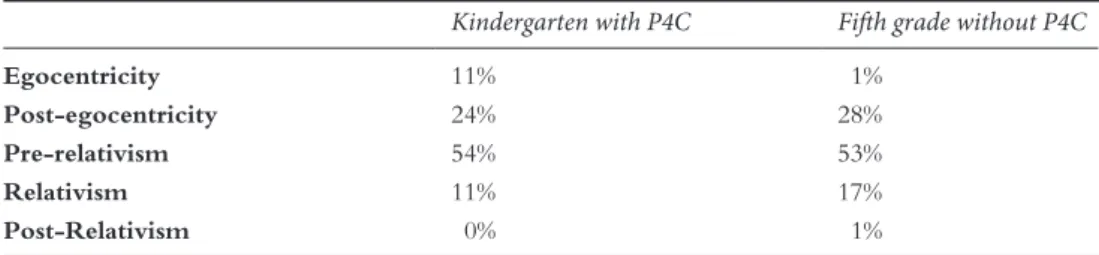
Is Pre-Relativism a simple or complex perspective for kindergarten pupils? To find out, we compared results from the kindergarten experimental group with a group of fifth graders who had no experience of philosophical praxis, and who were participating for the first time in an exchange on a question related to the same theme as the kindergarten group: ‘What does it mean to be free?’ Results (see Table 27.2) indicate that a greater percentage of kindergarten pupils’ interventions was situated in Egocentricity in comparison to fifth graders (11% vs. 1%); a greater percentage of fifth graders’ interventions was situated in Relativism (17% vs. 11%) and in Post-Relativism (1% vs. 0%) compared to those of kindergarten pupils; in both groups of pupils the predominant epistemological perspective was Pre-Relativism (54% and 53%). From this latter data, we might infer that Pre-Relativism is a complex epistemological perspective for kindergarten children.
We compiled results on epistemological mobilization in other groups of elementary school pupils who participated in the research (pupils from different countries who had different discussion themes and whose teachers had different facilitating styles). These results show that after one year of philosophical praxis with P4C, the groups from the first cycle of elemen-tary school were generally situated in a Pre-Relativist epistemology with a tendency toward Relativism, and that the groups from the second cycle of elementary school were generally situated in Relativist epistemology with a tendency toward Post-Relativism. A single group from the second cycle of elementary school that had more than two years of P4C praxis mobi-lized DCT consistent with Intersubjectivity.
Again, we can ask: is Relativism a complex perspective for pupils at the end of elementary school? Results from two distinct studies, using the developmental process model of DCT as an analysis grid, and conducted among undergraduate university students, indicate that the epistemology of these young adults fluctuates between Egocentricity and Relativism (Forges, 2013; Lechasseur, 2015). Given these results, Relativism would appear to be a complex epis-temological perspective for pupils at the end of elementary school.
Table 27.1 Comparison between two kindergarten classrooms
Group with P4C Group without P4C
Egocentricity 11% 35% 35% 60%
Post-Egocentricity 24% 25%
Pre-Relativism 54% 65% 36% 40%
Relativism 11% 4%
Table 27.2 Comparison between two groups of different ages
Kindergarten with P4C Fifth grade without P4C
Egocentricity 11% 1%
Post-egocentricity 24% 28%
Pre-relativism 54% 53%
Relativism 11% 17%
Dialogical critical thinking in kindergarten and elementary school
Discussion
From a theoretical point of view DCT differs from CT, as the components of DCT were not ‘inferred’ from existing definitions, but rather ‘emerged’ from the analyses of philosophical exchanges among pupils. As a result, DCT comprises four thinking modes and six epistemo-logical perspectives. It is essential that these components be included in a definition of CT because they better illustrate the complexity of pupils’ thinking and its progress following P4C praxis.
From an empirical point of view, results compiled from the literature show the impact of P4C on the development of logical reasoning in elementary and secondary school students, and they showed the mobilization of CT in adolescents. The results of the research presented in this chapter demonstrate for the first time that P4C has a significant impact on the mobilization of DCT among pupils in kindergarten and elementary school.
Moreover, most of the results compiled on logical reasoning relied on a quantitative para-digm, that is, they issued from standardized tests. The appropriateness of using standardized tests is regularly questioned in the study of CT and P4C. Conversely, the results on DCT issued from observing classroom interactions and analysing transcripts of exchanges among pupils. The qualitative methodology employed not only supports the quantitative results concerning the impact of P4C on the pupils’ cognitive development, but also, and mainly, provides indications of the thinking modes and epistemological perspectives that are involved in DCT. In that sense, the qualitative method allows us to widen and increase our compre-hension of the processes of mobilization and development of DCT when children engage in philosophical dialogue.
Conclusion
Can P4C contribute to the development of CT in kindergarten and elementary school pupils? Innovative and exploratory results corroborate Lipman’s thesis insofar as the results show that apprentice philosophers from kindergarten and elementary school are able to engage in the co-construction of DCT when they are stimulated by an approach such as P4C. These results do not indicate that children mobilize an accomplished DCT, one that is anchored in Intersubjectivity, but the results do indicate that children’s representations of the concepts dis-cussed transcend the simple perspectives associated with Egocentricity, being situating within more complex epistemologies.
In addition, the developmental model of DCT provides researchers and teachers with a tool for systematically evaluating pupils’ cognitive and epistemological evolution and progress when they are engaged in P4C praxis, and thus for assessing the value of the philosophical quality of their exchanges.
It would be appropriate to conduct further empirical research in other groups of pupils, of different cultural, socio-economic and educational backgrounds to verify/complete the current results. It would be relevant to examine, for example, the components inherent in DCT and their interactions. It would also be useful to examine the influence of educational policy on the developmental process of DCT; to study the impact of the adults’ teaching style on pupils cognitive and epistemological development; and to verify whether pupils can mobilize DCT on their own without the intervention of a teacher, and whether DCT is retained as a competency in the long term, when philosophical praxis is no longer present.
Mode/ Epistemological perspective
Logical Creative Responsible Meta-cognitive
Egocentricity Statement based on the perceptual experience of a specific and personal fact. Statement that gives meaning to a personal and concrete point of view. Statement that is related to a personal and specific behaviour tied to a social or moral belief. Retrospective statement about a personal and specific task, point of view, feeling, etc. Post-Egocentricity Statement based
on experience (personal or someone close) + reasoning. Statement that gives meaning to a personal point of view (but distanced from self). Particular/concrete statement tied to a moral or social rule (learnt). Not contextualized. Retrospective statement about a personal task, point of view, feeling, etc. (distanced from self). Pre-Relativism Somewhat generalized statement that is not justified, or has an implicit, circular or false justification. Statement that is new, divergent or that presents different situations/ solutions/ hypotheses (units) in relation to a personal idea or to someone else’s idea (peer or text). Statement linked to a somewhat generalized action in a moral or social perspective. Descriptive retrospective of a personal task, point of view, feeling, etc. (distanced from self). Relativism Incomplete or concrete justification (explanation)/ reasoning based on experience. Relationship that gives meaning to a peer’s point of view (by completing it or adding a nuance). Statement that explains a will to understand/ include others (from the immediate environment). (contextualized). Descriptive/ explanatory retrospective of another person’s task, thought, etc. (immediate environment). Post-Relativism/ Pre-Intersubjectivity Justification based on ‘good reasons’/simple reasoning. Relationship that presents a different context that takes into account the group’s perspective. Statement that justifies a desire to understand/ include others (distant environment) (contextualized). Descriptive/ explanatory retrospective of another person’s task, thought, etc. (distant environment).
Dialogical critical thinking in kindergarten and elementary school
Intersubjectivity Justification based on criteria. Conceptualization based on evaluative reasoning. Conceptualization Evaluative relationship that provides a different meaning and transforms the perspective. Transformation Doubt that underlies the evaluation of categories (rules, principles, social/moral values). Categorization Evaluative statement that expresses a change in perspective following the integration of criticism. Correction
Notes
1 The research projects were subsidized by the Social Sciences and Humanities Research Council of Canada.
2 Principal investigator: Marie-France Daniel. Collaborators: Louise Lafortune, Richard Pallascio, Teresa de la Garza, Christina Slade, Laurance Splitter (Project 1). Mathieu Gagnon, Emmanuèle Auriac-Slusarczyk (Project 2).
3 For methodological details, see Daniel et al., 2005; Daniel & Gagnon, 2011.
References
Auriac-Slusarczyk, E. & Colletta, J.-M. (Eds) (2015). Les ateliers de philosophie: une pensée collective en acte. Clermont-Ferrand, France: Presses universitaires Blaise-Pascal.
Auriac-Slusarczyk, E., Adami, J. & Daniel, M.-F. (2011). Tester les prédispositions à l’esprit critique au primaire. Psychologie & Education 1: 55–80.
Boe, M. & Hognestad, K. (2010). Critical thinking in kindergarten. Childhood & Philosophy 6(11): 151–165. Charmaz, K. (2005). Grounded theory in the 21st century: Applications for advancing social justice studies.
In N. Denzin & Y. Lincoln (eds.), The Sage Handbook of Qualitative Research (3rd edition) (pp. 507–537). Thousand Oaks, CA: SAGE Publications.
Collins, C. (2004). Education for a just democracy: The role of ethical inquiry. (Doctoral dissertation). University of South Australia, Adelaide.
Daniel, M.-F. & Gagnon, M. (2011). A developmental model of dialogical critical thinking in groups of pupils aged 4 to 12 years. Creative Education 2(5): 418–428.
Daniel, M.-F. & Gagnon M. (2012). Pupils’ age and philosophical praxis: Two factors that influence the development of critical thinking in children. Childhood & Philosophy 8(15): 105–130.
Daniel, M.-F. & Gagnon M. (2016). Dialogical critical thinking with 5 to 12 year-old pupils: A continu-ous epistemological development. In G. Gibson (Ed.) Critical thinking: Theories, methods and challenges
(pp. 45–76). New-York: Nova Publishers.
Daniel, M.-F., Lafortune, L., Pallascio, R., Splitter, L., Slade, C. & de la Garza, T. (2005). Modeling the development process of dialogical critical thinking in pupils aged 10 to 12 years. Communication
Education 54(4): 334–354.
Daniel, M.-F., Pettier, J.-C. & Auriac, E. (2011). The incidence of philosophy on discursive and language competencies of pupils aged four years. Creative Education 2(3): 296–304.
Dewey, J. (1903/1933). How we think. Boston: Heath and Co.
Dewey, J. (1916/1983). Démocratie et éducation. Introduction à la philosophie de l’éducation. Artigues-près-Bordeaux: L’Âge d’Homme.
Ennis, R. (1962). A concept of critical thinking. Harvard Educational Review 32(1): 81–111.
Ennis, R. (1985). Critical thinking and the curriculum. National Forum: Phi Kappa Phi Journal 65(1) : 28–31.
Fisherman, D. (2010). Thinking as two – philosophy, critical thinking and community of inquiry. Childhood &
Forges, R. (2013). Formation initiale des enseignants en enseignement de l’ÉPS. Étude des manifestations d’une
pensée critique visée, manifestée et stimulée. (Doctoral dissertation). Montreal: Université de Montréal.
Gagnon, M. (2011a). La pratique de la philosophie en communauté de recherche et le développement de la pensée critique d’adolescents. In M. Gagnon & M. Sasseville (Eds) La pratique de la philosophie en
com-munauté de recherche: applications et enjeux (pp. 267–282). Quebec City: PUL.
Gagnon, M. (2011b). Proposition d’une grille d’analyse des pratiques critiques d’élèves en situation de résolution de problèmes dits complexes. Revue Recherches Qualitatives 30(2): 122–147.
Golding, C. (2009). ‘That’s a better idea!’ Philosophical progress and philosophy for children. Childhood &
Philosophy 5(10): 223–269.
Golding, C. (2013). We made progress: Collective epistemic progress in dialogue without consensus.
Journal of Philosophy of Education 47(3): 423–441.
Haynes, F. & Haynes, B. (2000). The development of a conceptual framework for critical thinking and problem solving in K12. Critical and Creative Thinking 8(1): 15–22.
Hofer, B. & Pintrich, P. (2011). Personal epistemology. The psychology of beliefs about knowledge and knowing. New York: Routledge.
Kwak, D. (2007). Re-conceptualizing critical thinking for moral education in culturally plural societies.
Educational Philosophy and Theory 39: 460–470.
Lam, C.-M. (2012). Continuing Lipman’s and Sharp’s pioneering work on philosophy for children: using
Harry to foster critical thinking in Hong Kong students. Educational Research and Evaluation 19(2): 187–203.
Lechasseur, K. (2015). Modélisation de la mobilization des savoirs par une pensée critique chez des étudi-antes en sciences infirmières lors de stages cliniques. In G. Kpazaï (Ed.) Pensée critique et innovations dans
la formation universitaire (pp. 109–137). Montreal: Éditions Peisaj.
Lipman, M. (1988). Critical thinking: What can it be? Educational Leadership 46(1): 38–43. Lipman, M. (1995). À l’école de la pensée. Brussels: De Boeck Université.
Lipman, M. (2003). Thinking in Education. (2nd edition). Cambridge: Cambridge University Press. Lipman, M. (2005). Renforcer le raisonnement et le jugement par la philosophie. In C. Leleux (Ed.)
La philosophie pour enfants: le modèle de Matthew Lipman en discussion (pp. 11–24). Brussels: De Boeck
Université.
Lipman, M., Sharp, A.-M. & Oscanyan, F. (1980). Philosophy in the classroom. Philadelphia, PA: Temple University Press.
Matt, B. (1985). Coming to terms on critical thinking. Analytic Teaching 6(1): 14–18.
McCall, C. (2009). Transforming thinking: Philosophical inquiry in the primary and secondary classroom. London: Routledge.
McPeck, J. (1990). Critical thinking and subject specificity: A reply to Ennis. Educational Researcher 19(4): 10–12.
Millett, S. & Tapper, A. (2012). Benefits of collaborative philosophical inquiry in schools. Educational
Philosophy and Theory 44(5): 546–567.
Nowell, L. (1995). Education as meaning-making and the development of critical thinking. Analytic
Teaching 15(2): 19–25.
Othman, M. & Hashim, R. (2006). Critical thinking and reading skills: A comparative study of the reader response and the Philosophy for Children approaches. Thinking 18(2): 26–35.
Paul, R. (1990). Critical and reflexive thinking: a philosophical perspective. In B.F. Jones & L. Idol-Maestas (Eds) Dimensions of thinking and cognitive instruction (pp. 445–494). Hillsdale, NJ: Erlbaum. Pritchard, M. (1987). Critical thinking: Problem-solving or problem creating? Analytic Teaching 8(1): 2–29. Rondhuis, T. (2006). Philosophical quality of children’s thinking patterns. Thinking 18(3): 16–22. Scholl, R. (2005). Students’ questions: Developing critical and creative thinkers. Thinking 17(4): 34–46. Siegel, H. (1988). Educating reason: rationality, critical thinking and education. New York: Routledge. Thayer-Bacon, B. (2003). Relational ‘(e)pistemologies’. New York: Peter Lang.
Topping, K.J. & Trickey, S. (2007). Collaborative philosophical enquiry for school children: Cognitive effects at 10–12 years. British Journal of Educational Psychology 77: 271–288.
Trickey, S. & Topping, K.J. (2004). ‘Philosophy for children’: A systematic review. Research Papers in
Education 19(3): 365–380.
Tsiplakides, I. (2011). Critical and creative thinking in the English language classroom. International Journal
of Humanities and Social Science 1(8): 82–87.
Weinstein, M. (1988). Reason and critical thinking. Informal Logic 10(1) : 1–20.
Weinstein, M. (1994). Critical thinking and the psycho-logic of race prejudice. Analytic Teaching 14(2): 21–33.