HAL Id: hal-02380364
https://hal-cnrs.archives-ouvertes.fr/hal-02380364
Submitted on 26 Nov 2019
HAL is a multi-disciplinary open access
archive for the deposit and dissemination of
sci-entific research documents, whether they are
pub-lished or not. The documents may come from
teaching and research institutions in France or
abroad, or from public or private research centers.
L’archive ouverte pluridisciplinaire HAL, est
destinée au dépôt et à la diffusion de documents
scientifiques de niveau recherche, publiés ou non,
émanant des établissements d’enseignement et de
recherche français ou étrangers, des laboratoires
publics ou privés.
Blockchain Abstract Data Type
Emmanuelle Anceaume, Antonella del Pozzo, Romaric Ludinard, Maria
Potop-Butucaru, Sara Tucci-Piergiovanni
To cite this version:
Emmanuelle Anceaume, Antonella del Pozzo, Romaric Ludinard, Maria Potop-Butucaru, Sara
Tucci-Piergiovanni.
Blockchain Abstract Data Type.
SPAA 2019 - 31st ACM Symposium on
Paral-lelism in Algorithms and Architectures, Jun 2019, Phoenix, Arizona, United States. pp.349-358,
�10.1145/3323165.3323183�. �hal-02380364�
Blockchain Abstract Data Type
Emmanuelle Anceaume
‡, Antonella Del Pozzo
?, Romaric Ludinard
??,
Maria Potop-Butucaru
†, Sara Tucci-Piergiovanni
?‡
CNRS, IRISA
?
CEA LIST, PC 174, Gif-sur-Yvette, 91191, France
??IMT Atlantique, IRISA
†
Sorbonne Universit´e, CNRS, Laboratoire d’Informatique de Paris 6, LIP6, Paris, France
Abstract—The presented work continues the line of recent distributed computing community efforts dedicated to the theo-retical aspects of blockchains. This paper is the first to specify blockchains as a composition of abstract data types all together with a hierarchy of consistency criteria that formally charac-terizes the histories admissible for distributed programs that use them. Our work is based on an original oracle-based construction that, along with new consistency definitions, captures the eventual convergence process in blockchain systems. The paper presents as well some results on implementability of the presented ab-stractions and a mapping of representative existing blockchains from both academia and industry in our framework.
I. INTRODUCTION
The paper proposes a new data type to formally model blockchains and their behavior. We aim at providing con-sistency criteria to capture the correct behavior of current blockchain proposals in a unified framework. It is already known that some blockchain implementations solve eventual consistency of an append-only queue using Consensus [5], [4]. The question is about the consistency criterion of blockchains as Bitcoin [19] and Ethereum [24] that technically do not solve Consensus, and their relation with Consensus in general.
We advocate that the key point to capture blockchain behaviors is to define consistency criteria allowing mutable operations to create forks and restricting the values read, i.e. modeling the data structure as an append-only tree and not as an append-only queue. This way we can easily define seman-tics equivalent to eventually consistent append-only queue but as well as weaker semantics. More in detail, we define a se-mantic equivalent to eventually consistent append-only queue by restricting any two reads to return two chains such that one is the prefix of the other. We call this consistency property Strong Prefix (already introduced in [14]). Additionally, we define a weaker semantics restricting any two reads to return chains that have a divergent prefix for a finite interval of the history. We call this consistency property Eventual Prefix. Note that our consistency criteria specifically defined for blockchain systems have a similarity flavor with fork-consistency defined in [18], which concern a different area, i.e., the data integrity in the network file system domain.
Another peculiarity of blockchains lies in the notion of validity of blocks, i.e. the blockchain must contain only blocks that satisfy a given predicate. Let us note that validity can be achieved through proof-of-work (Dwork and Naor
[11]) or other agreement mechanisms. We advocate that to abstract away implementation-specific validation mechanisms, the validation process must be encapsulated in an oracle model separated from the process of updating the data structure. Because the oracle is the only generator of valid blocks and only valid blocks can be appended to the tree, it follows that, it is the oracle that grants the access to the data structure and it might also own a synchronization power to control the size of forks, i.e., the number of blocks that point back to the same block of the tree. In this respect we define oracle models such that, depending on the model, the size k of forks can be equal to 1 (i.e., strongest oracle model), strictly greater than 1, or unbounded (i.e., weakest oracle model).
The blockchain is thus abstracted by an oracle-based con-struction in which the update and consistency of the tree data structure depends on the validation and synchronization power of the oracle.
The main contribution of the paper is a formal unified framework providing blockchain consistency criteria that can be combined with oracle models in a proper hierachy of abstract data types[23] independent of the underlying com-munication and failure models. Thanks to the establishment of the formal framework the following implementability results are shown.
• The strongest oracle, guaranteeing no fork, has Consensus number ∞ in the Consensus hierarchy of concurrent objects [15] (Theorem V.2). Note that similarly to [8], [13], [7] we extend the validity property of Consensus to fit the blockchain setting.
• The weakest oracle, which validates a potentially
un-bounded number of blocks to be appended to a given block, is not stronger than Generalized Agreement Lat-tice [12].
• The impossibility to guarantee Strong Prefix in a message-passing system if forks of size k > 1 are allowed (Theorem V.6). This means that Strong Prefix needs the strongest oracle to be implemented, which is at least as strong as Consensus.
• A necessary condition (Theorem V.5) for Eventual Prefix in a message-passing system is that each update sent by a correct process must be eventually received by every correct process. Moreover, the result implies that it is impossible to implement Eventual Prefix if even a single
update is dropped at some correct process while it has been received at all the other correct processes.
The proposed framework along with the above-mentioned results helps in classifying existing blockchains in terms of their consistency and implementability. We used the frame-work to classify several blockchain proposals. We showed that Bitcoin [19] and Ethereum [24] have a validation mechanism that maps to our weakest oracle and then they only implement Eventual prefix, while other proposals map to our strongest oracle, falling in the class of those that guarantee Strong Prefix (e.g. Hyperledger Fabric [4], PeerCensus [9], ByzCoin [16], see Section V-C for further details).
Note that for space reasons all the theorems and lemmas proofs and some formal definitions do not appear in this article but are presented in the supplementary materials [3].
II. RELATED WORK
In [20] the authors extract Bitcoin backbone and define invariants that this protocol has to satisfy in order to verify with high probability an eventual consistent prefix. This line of work has been continued by [21]. However, to the best of our knowledge, no other previous attempt proposed a consistency unified framework and hierarchy capturing both Consensus-based and proof-of-work Consensus-based blockchains. In [1], the authors present a study about the relationships between Byzantine fault tolerant consensus and blockchains. In order to abstract out the proof-of-work mechanism the authors propose a specific oracle, in the same spirit of our oracle abstraction, but more specific than ours, since it makes a direct reference to proof-of-work properties. In parallel and independently of our proof-of-work, [5] proposes a formalization of distributed ledgers modeled as an ordered list of records. The authors propose in their formaliza-tion three consistency criteria: eventual consistency, sequential consistency and linearizability. Interestingly, they show that a distributed ledger that provides eventual consistency can be used to solve the consensus problem. These findings confirm our results about the necessity of Consensus to solve Strong Prefix. On the other hand, the proposed formalization does not propose weaker consistency semantics more suitable for proof-of-work blockchains as BitCoin. The work achieved in [5] is complementary to the one presented in [2], where the authors study the consistency of blockchain by modeling it as a register. Finally, [14] presents an implementation of the Monotonic Prefix Consistency (MPC) criterion and showed that no criterion stronger than MPC can be implemented in a partition-prone message-passing system.
III. PRELIMINARIES ON SHARED OBJECT SPECIFICATIONS BASED ONABSTRACTDATATYPES
The basic idea underlying the use of abstract data types is to specify shared objects using two complementary facets [22]: a sequential specification that describes the semantics of the ob-ject, and a consistency criterion over concurrent histories, i.e. the set of admissible executions in a concurrent environment.
A. Abstract Data Type (ADT)
The model used to specify an abstract data type is a form of transducer, as Mealy’s machines, accepting an infinite but countable number of states. In the following, an abstract data type refers to a 6-tuple T = hA, B, Z, ξ0, τ, δi. The values
that can be taken by the data type are encoded in the abstract state, taken from a set Z. We refer by ξ0 ∈ Z the initial
state of the ADT. It is possible to access the object using the symbols of an input alphabet A. Unlike the methods of a class, the input symbols of the abstract data type do not have arguments. Indeed, as one authorizes a potentially infinite set of operations, the call of the same operation with different arguments is encoded by different symbols. An operation can have two types of effects. First, it can have a side-effect that changes the abstract state according to the transition system formalized by a transition function τ . Second, operations can return values taken from an output alphabet B, which depends on the state in which they are called and an output function δ. For example, the pop operation in a stack removes the element at the top of the stack and returns that element (its output). B. Sequential specification of an ADT
An abstract data type, by its transition system, defines the sequential specification of an object. The sequential specifi-cation of an object describes its behavior when its operations are applied sequentially. That is, if we consider a path that traverses its system of transitions, then the word formed by the subsequent labels on the path is part of the sequential specification of the abstract data type, i.e. it is a sequential history. A sequential history of an ADT T refers to a sequence (σi)i≥0 (finite or not) of operations leading the state of T to
evolve according to its specification [3].
1) Concurrent histories of an ADT: Concurrent histories are defined considering a partial order relation among events executed by different processes. A set of processes invoking operations of an ADT defines a concurrent history. Operations are not executed instantaneously, i.e., given an operation o ∈ Σ = A ∪ (A × B), we denote by einv(o) the invocation
event of operation o and by ersp(o) the corresponding response
event. In addition, we denote by ersp(o) : x the returned
value associated to the response event ersp(o). In the following
E represents the set of events and Λ is the function which associates events to the operations in Σ. Given two events (e, e0) ∈ E2 we say that e 7→ e0 in the process order if they
are produced by the same process, e 6= e0and e happens before e0. Given two events e, e0 ∈ E, we say that e precedes e0 in
operation order, denoted by e ≺ e0, if e0 is the invocation of an operation occurred at time t0 and e is the response of another operation occurred at time t with t < t0. Finally, for any couple of events (e, e0) ∈ E2 with e 6= e0, we say that e
precedes e0in program order, denoted by e % e0, if e 7→ e0or e ≺ e0. These asymmetric event structures allow us to define a concurrent history of an ADT T =hA, B, Z, ξ0, τ, δi as a
6-tuple H = hΣ, E, Λ, 7→, ≺, %i [3].
2) Consistency criterion: A consistency criterion charac-terizes which concurrent histories are admissible for a given
abstract data type. It can be viewed as a function that associates a concurrent specification to abstract data types. Given a consistency criterion C, an algorithm AT implementing the
ADT T is C-consistent if all the operations terminate and all the admissible executions are C-consistent, i.e. they satisfy consistency criterion C.
IV. BLOCKTREE ANDTOKEN ORACLEADTS
In this section we present the BlockTree and the token Oracle ADTs along with consistency criteria.
A. BlockTree ADT
We formalize the data structure implemented by blockchain-like systems as a directed rooted tree bt = (Vbt, Ebt) called
BlockTree. Each vertex of the BlockTree is a block and any edge points backward to the root, called genesis block. By convention, the root of the BlockTree is denoted by b0. Two operations are provided: the append(b`)operation,
which appends a new block b` to the BlockTree, and
the read() operation, which returns a sequence of blocks of the BlockTree. This sequence of blocks is called the blockchain and is selected according to function f (see below). Only blocks satisfying some validity predicate P can be appended to the BlockTree. Predicate P is application dependent. Predicate P mainly abstracts the creation process of a block, which may fail (return false. Note that false is denoted by ⊥) or successfully terminate (returns true, denoted by >). For instance, in Bitcoin, a block is considered valid if it can be connected to the current blockchain and does not contain double-spending transactions.
We represent by B a countable and non empty set of blocks and by B0 ⊆ B a countable and non empty set of valid blocks, i.e., ∀b ∈ B0, P (b) = >. By assumption b0 ∈ B0; We also denote by BC a countable non empty
set of blockchains, where a blockchain is a path from a leaf of bt to b0. A blockchain is denoted by bc. Finally,
F is a countable non empty set of selection functions, f ∈ F : BT → BC; f (bt) selects a sequence of blocks bc from the BlockTree bt (note that b0 is not returned)
and if bt = b0 then f (b0) = b0. This reflects for instance
the longest chain or the heaviest chain used in some blockchain implementations. The selection function f and the predicate P are parameters of the ADT which are encoded in the state and do not change over the com-putation. The following notations are used: {b0}_f (bt)
represents the concatenation of b0with the blockchain of
bt; and {b0}_f (bt) _
{b} represents the concatenation of b0with the blockchain of bt and a block b.
1) Sequential specification of the BlockTree: The sequen-tial specification of the BlockTree is defined as follows. Definition IV.1 (BlockTree ADT (BT -ADT )). The Block-Tree Abstract Data Type is the 6-tuple BT-ADT=hA = {append(bh, b`), read(): b ∈ B}, B = BC ∪ {true, false}, Z =
BT × F × (B → {true, false}), ξ0 = (b0, f, P ), τ, δi, where
the transition function τ : Z × A → Z is defined by τ ((bt, f, P ), read()) = (bt, f, P ) τ ((bt, f, P ), append(b)) = ( ({b0}_f (bt) _ {b}, f, P ) if b ∈ B0 (bt, f, P ) otherwise and the output function δ : Z × A → B is defined by
δ((bt, f, P ), read()) = ( {b0} if bt = b0 {b0}_f (bt) otherwise δ((bt, f, P ), append(b)) = ( true if b ∈ B0 false otherwise
The semantic of the read and the append operations directly depends on the selection function f ∈ F . In this work we let this function generic to suit the different blockchain implementations. Figure 1 illustrates an exe-cution of the BT-ADT bt. Starting from the initial state ξ0, state ξ1 is obtained by appending block b1 to ξ0
and state ξ2 is obtained by appending block b2 to ξ1.
The read operation applied in state ξ1returns blockchain
{b0}_{b1}, and the read applied in state ξ2 returns
blockchain {b0}_f (bt)_{b2} = {b0}_{b1}_{b2}.
2) Concurrent histories of a BT-ADT and consistency cri-teria: A BT -ADT consistency criterion is a function that returns the set of concurrent histories admissible for a BlockTree abstract data type. We define two BT consis-tency criteria: BT Strong consisconsis-tency and BT Eventual consistency. For ease of readability, we employ the fol-lowing notations:
• E(a∗, r∗)refers to an infinite set containing an infinite
number of append() and read() invocation and re-sponse events. Similarly, E(a, r∗)refers to an infinite set containing (i) a finite number of append() invoca-tion and response events and (ii) an infinite number of read() invocation and response events;
• score : BC → N denotes a monotonically increasing
deterministic function that takes as input a blockchain bc and returns a natural number s as score of bc, which can be the depth, the weight, etc of bc. In-formally we refer to such value as the score of a blockchain; by convention we refer to the score of the blockchain uniquely composed by the genesis block as s0, i.e. score({b0}) = s0. Increasing monotonicity
means that score(bc_{b}) > score(bc);
• mcps : BC × BC → N is a function which, given
two blockchains bc and bc0 returns the score of the maximal common prefix of bc and bc0;
• bc v bc0iff bc prefixes bc0.
We now present the BT Strong Consistency criterion. Informally it says that any two read() operations return blockchains such that one is the prefix of the other. This is formalized through the following four properties.
The Block validity property imposes that each block in a blockchain returned by a read() operation is valid (i.e.,
ξ0 ξ0= { b0 , f, P } ξ1 ξ1= { b0 b1 , f, P } append(b1) : true if b1∈ B0 append(b3) : false if b3∈ B/ 0 ξ2 ξ2= { b0 b1 b2 , f, P } append(b2) : true if b2∈ B0 append(b3) : false if b3∈ B/ 0 read() : b_ 0 b1 read() : b_0 b_1 b2
Fig. 1: A possible path of the transition system defined by the BT-ADT.
satisfies predicate P ) and has previously been inserted in the BlockTree with the append() operation. Formally, Definition IV.2 (Block validity). ∀ersp(r) ∈ E, ∀b ∈ ersp(r) :
bc, b ∈ B0 ∧ ∃einv(append(b)) ∈ E, einv(append(b)) %
ersp(r)
The Local monotonic read property states that, given the sequence of read() operations at the same process, the score of the returned blockchain never decreases; Formally,
Definition IV.3 (Local monotonic read). ∀ersp(r), ersp(r0) ∈
E2, if ersp(r) 7→ ersp(r0), then score(ersp(r) : bc) ≤
score(ersp(r0) : bc0)
The Strong prefix property says that for each pair of read operations, one of the returned blockchains is a prefix of the other returned one. Formally,
Definition IV.4 (Strong prefix). ∀ersp(r), ersp(r0) ∈
E2, (e
rsp(r0) : bc0 v ersp(r) : bc) ∨ (ersp(r) : bc v ersp(r0) :
bc0)
Finally, the Ever growing tree states that scores of returned blockchains eventually grow. More precisely, let s be the score of the blockchain returned by a read re-sponse event r in E(a∗, r∗), then for each read() operation r, the set of read() operations r0 such that ersp(r) %
einv(r0)that do not return blockchains with a score greater
than s is finite. Formally,
Definition IV.5 (Ever growing tree). ∀ersp(r) ∈ E(a∗, r∗),
s = score(ersp(r) : bc) then
|{einv(r0) ∈ E | ersp(r) % einv(r0), score(ersp(r0) : bc0) ≤
s}| < ∞
Definition IV.6 (BT Strong Consistency (SC) criterion). A concurrent history H = hΣ, E, Λ, 7→, ≺, %i of the system that uses a BT-ADT verifies the BT Strong Consistency criterion if the Block validity, Local monotonic read, Strong prefix and the Ever growing tree properties hold.
We now present the BT Eventual Consistency rion, a weaker version of the Strong Consistency crite-rion. Informally, the BT Eventual Consistency criterion says that eventually any two read() operations return blockchains that share the same prefix, which differs from the BT Strong Consistency criterion by the Eventual prefix property. The Eventual prefix property says that
for each blockchain returned by a read() operation with s as score, then eventually all the read() operations will return blockchains sharing the same maximum common prefix at least up to s. Say differently, let H be a history with an infinite number of read() operations, and let s be the score of the blockchain returned by a read() operation r then, the set of read() operations r0, such that
ersp(r) % einv(r0), that do not return blockchains sharing
the same prefix at least up to s is finite. We formalise this notion as follows:
Definition IV.7 (Eventual prefix property). Given a concurrent history H = hΣ, E(a, r∗), Λ, 7→, ≺, %i of the system that uses a BT-ADT, we denote by s, for any read operation r ∈ Σ such that ∃e ∈ E(a, r∗), Λ(r) = e, the score of the returned blockchain, i.e., s = score(ersp(r) : bc). We
denote by Erthe set of response events of read operations that
occurred after r response, i.e. Er = {e ∈ E | ∃r0 ∈ Σ, r0 =
read, e = ersp(r0) ∧ ersp(r) % ersp(r0)}. Then, H satisfies the
Eventual prefix property if for all read() operations r ∈ Σ with score s, there is a set S = {(ersp(rh), ersp(rk)) ∈ Er2|h 6=
k, mcps(ersp(rh) : bch, ersp(rk) : bck) < s} and |S| < ∞.
Definition IV.8 (BT Eventual Consistency (EC) criterion). A concurrent history H = hΣ, E, Λ, 7→, ≺, %i of the system that uses a BT-ADT verifies the BT Eventual Consistency criterion if it satisfies the Block validity, Local monotonic read, Ever growing tree, and the Eventual prefix properties.
3) Relationships between Eventual Consistency and Strong Consistency: Let HEC and HSC be the set of histories
satisfying respectively the EC and the SC consistency criteria.
Theorem IV.1. Any history H satisfying SC criterion satisfies EC and ∃H satisfying EC that does not satisfy SC, i.e., HSC ⊂ HEC.
Proof of Theorem IV.1 and an illustration showing a BT Eventually Consistent history which is not Strongly Con-sistent are reported in the supplementary materials [3].
Let us remark that the BlockTree allows at any time to create a new branch in the tree, which is called a fork in the blockchain literature. Note that that histories with no append operations are trivially admitted.
In the following we introduce a new abstract data type called Token Oracle, which when combined with
the BlockTree will help in (i) validating blocks and (ii) controlling the presence of forks and their number, if any. B. Token oracleΘ
We now formalize the Token Oracle Θ to capture the creation of blocks in the BlockTree structure. The block creation process requires that each new block must be closely related to an already existing valid block in the BlockTree structure. We abstract this implementation-dependent process by assuming that a process will obtain the right to chain a new block b` to bh ∈ B0, if it
success-fully gains a token tknhfrom the token oracle Θ. Once
ob-tained, the proposed block b` is considered as valid, and
will be denoted by btknh
` . By construction b tknh
` ∈ B0. In the
following, in order to be as much general as possible, we model blocks as objects. More formally, when a process wants to access some valid object objh, i.e., P (objq) = >
it invokes the getToken(objh, obj`) operation with object
obj` from set O = {obj1, obj2, . . . }. If getToken(objh, obj`)
operation is successful, it returns the valid object objtknh
`
such that tknhis the token required to access valid object
objh. The set of valid objects is denoted by O0, i.e.,
∀objq ∈ O0, P (objq) = >. We say that a valid object
is generated each time it is successfully returned by a getToken(objh, obj`) operation and it is consumed when
the oracle grants the right to associate this valid object objtknh
` to objh. In the following, once an object is valid, if
it is clear from the context, we will not explicit the token tknwith makes the object valid.
A valid object objtknh
` is consumed through the
consumeToken(objtknh
` ) operation. No more than k
valid objects objtknh
`1 , . . . , obj
tknh
`j , 1 ≤ j ≤ k,
can be consumed for objh, where k is a
param-eter of the token oracle. The side-effect of the consumeToken(objtknh
` ) on the state of the token oracle
is the insertion of the valid object objtknh
` in a set related
to objhas long as the cardinality of such set is less than
or equal to k.
We specify two token oracles, which differ in the way tokens are managed. The first oracle, called prodigal and denoted by ΘP, has no upper bound on the number of
tokens consumed for an object, while the second oracle ΘF, called frugal, and denoted by ΘF, guarantees that no
more than k token can be consumed for each object. The prodigal oracle ΘP when combined with the
Block-Tree abstract data type will only help in validating blocks, while the frugal oracle ΘF manages tokens in a more
controlled way to guarantee that no more than k forks can occur on a given block.
For both oracles, when getToken(objh, obj`) operation
is invoked, the oracle provides a valid object with a certain probability pαi > 0 where αi is a “merit” parameter
characterizing the invoking process i. 1 Note that the
1The merit parameter can reflect for instance the hashing power of the
invoking process.
oracle knows αi of the invoking process i, which might
be unknown to the process itself. For each merit αi, the
state of the token oracle embeds an infinite tape where each cell of the tape contains either tkn or ⊥. Since each tape is identified by a specific αiand pαi, we assume that
each tape contains a pseudorandom sequence of values in {tkn, ⊥} depending on αi.2
When a getToken(objh, obj`)operation is invoked by a
process with merit αi, the oracle pops the first cell from
the tape associated to αi, and a valid obeject is provided
to the process if that cell contains tkn. Both oracles enjoy an infinite array of sets, one set for each valid object objh, which is populated each time a valid object obj` is
consumed. When the set cardinality reaches k then no more tokens can be consumed for that object. For the sake of generality, ΘP is defined as ΘF with k = ∞ while
for ΘF a predetermined k ∈ N is specified. Hence, the
state of the token oracle contains (i) the infinite array K of sets (one per valid object) of elements in O0, (ii) infinite tapes one for each possible merit, and (iii) the branching parameter k. We consider oracles that are linearizable (with respect to their sequential specification): they be-have as if all operations, including concurrent ones, are applied sequentially, so that each operation appears to take effect instantaneously as some point between their invocation and their response. The formal specification of ΘP and ΘF,k abstract data types can be found in the
supplementary materials.
In Figure 2 is depicted a possible path of the transi-tion system defined by ΘF,k-ADT and ΘP-ADT. When
a process with merit α1 invokes getToken(b1, bk), with
b1 the leaf of f (bt)), the first cell of tapeα1 is popped,
and if it contains a token, then getToken(b1, bk)returns a
valid block btkn1
k . Afterwards, when consumeToken(b tkn1
k )
is invoked, the oracle checks if the cardinality of the set in K[1]is strictly smaller than k, and if the affirmative inserts btkn1
k in K[1]. In any cases, consumeToken() returns the
content of K[1], in this case btkn1
k . It follows that a process
that gets a valid block for some block bhbut is not allowed
to consume it, is anyway notified with the set of valid blocks that saturated K[h].
C. BT-ADT augmented with Θ Oracles
We augment the BT-ADT with Θ oracles and we analyze the histories generated by their combination. Specifically, we define a refinement of the append(b`)
operation of the BT-ADT with the oracle opera-tions as follows: the append(b`) operation triggers the
getToken(bh ←last block(f (bt)), b`) operation as long as
it returns a valid block b`tknh, and once obtained, the
valid block might be consumed, and in any cases the append(b`) operation terminates. If less than k valid
2We assume a pseudorandom sequence mostly indistinguishable from a
Bernoulli sequence consisting of a finite or infinite number of independent random variables X1, X2, X3, . . . such that (i) for each k, the value of Xk
ξ0 ξ0= { {objtkn0 1 } {} {} . . . K tkn ⊥ ⊥ . . . tapeα2 ⊥ ⊥ tkn . . . tapeα1 .. . , k} ξ1 ξ1= { {objtkn0 1 } {} {} . . . K ⊥ ⊥ ⊥ . . . tapeα2 ⊥ ⊥ tkn . . . tapeα1 .. . , k}
getToken(obj1, obj`) : obj`tkn1
if pop(tapeα1) = tkn ξ2 ξ2= { {objtkn0 1 } {obj tkn1 ` } {} . . . K ⊥ ⊥ ⊥ . . . tapeα2 ⊥ ⊥ tkn . . . tapeα1 .. . , k} consumeToken(obj`tkn1) : {obj`tkn1} if |K[1]| < k
Fig. 2: A possible path of the transition system defined by the ΘF and ΘF,k-ADTs.
blocks have already been consumed for bh, the valid block
is consumed i.e. block b`tknh is appended to the block h
in the blockchain f (bt) (i.e., {b0}_f (bt)|_h{b`}) and the
append(b`) operation returns true, otherwise false. We
say that the BT -ADT augmented with ΘF or ΘP oracle
is a refinement R(BT -ADT, ΘF)or R(BT -ADT, ΘP)
re-spectively. The formal specification of these refinements are given in the supplementary materials.
Definition IV.9 (k-Fork coherence). A concurrent history H = hΣ, E, Λ, 7→, ≺, %i of R(BT -ADT, ΘF,k) satisfies
the k-Fork coherence if there are at most k append(btknh
` )
operations that return true for the same block b`.
Theorem IV.2 (k-Fork coherence). Any concurrent history H = hΣ, E, Λ, 7→, ≺, %i of the R(BT -ADT, ΘF,k) satisfies
the k-Fork Coherence. D. Hierarchy
We propose a hierarchy between BT-ADTs augmented with token oracle ADTs. We use the following nota-tion: BT-ADTSC and BT-ADTEC to refer respectively
to BT-ADT generating concurrent histories that sat-isfy the SC and the EC consistency criteria. When augmented with token oracles we get the following four typologies, where for the frugal oracle we explicit the value of k: R(BT-ADTSC, ΘF,k), R(BT-ADTSC, ΘP),
R(BT-ADTEC, ΘP), R(BT-ADTEC, ΘF,k). We aim at
studying the relationships among the different refine-ments. Let ˆHR(BT-ADT,ΘF,k) be the set of concurrent
his-tories generated by a BT-ADT enriched with ΘF,k-ADT
and ˆHR(BT-ADT,ΘP) be the set of concurrent histories
generated by a BT-ADT enriched with ΘP-ADT. Without
loss of generality, we consider only the set of histories from which have been purged unsuccessful append() response events (i.e., such that the returned value is false). All the following theorems are proven in the sup-plementary materials.
Theorem IV.3. ˆHR(BT-ADT,ΘF)⊆ ˆHR(BT-ADT,ΘP).
Theorem IV.4. If k1≤ k2 then ˆHR(BT-ADT,ΘF,k1)⊆
ˆ
HR(BT-ADT,ΘF,k2).
Finally, from Theorem IV.1, we have the following corol-lary.
Corollary IV.4.1. ˆH(R(BT-ADTSC,Θ)⊆ ˆHR(BT-ADTEC,Θ).
The above results imply the hierarchy depicted in Fig-ure 4. The arrows A → B in the figFig-ure indicate that the set of histories in A are included in the set of histories in B according to Theorems and Lemmas presented in Section V.
V. IMPLEMENTINGBT-ADTS
A. Implementability in the shared memory model
We now consider a system made of n processes such that up to f of them are faulty (stop prematurely by crashing), f < n. Non faulty processes are said correct. Processes communicate through atomic registers.
1) Frugal oracleΘF,k=1is at least as strong as Consensus:
We show that there exists a wait-free implementation of Consensus [17] by ΘF,k=1. Note that similarly to [8],
we extend the validity property of Consensus to fit the blockchain setting. Specifically, we have
Definition V.1 (Consensus C).
• Validity A value is valid if it satisfies the predefined
predicate P .
• Termination. Every correct process eventually decides
some value, and that value must be valid.
• Integrity. No correct process decides twice.
• Agreement. If there is a correct process that decides value b, then eventually all the correct processes decide b.
We first show that there exists a wait-free implementa-tion of the Compare&Swap() object by ΘF,k=1 assuming
that blocks are valid, i.e., belong to B0. Doing this implies
that, under the assumption that blocks are valid, ΘF,k=1
has the same Consensus number as Compare&Swap(), i.e., ∞ (see [15]). We then show that there is a wait-free implementation of Consensus C by ΘF,k=1 for any
block b ∈ B (i.e., b may not be valid). Doing this will imply that ΘF,k=1 has the same Consensus number as
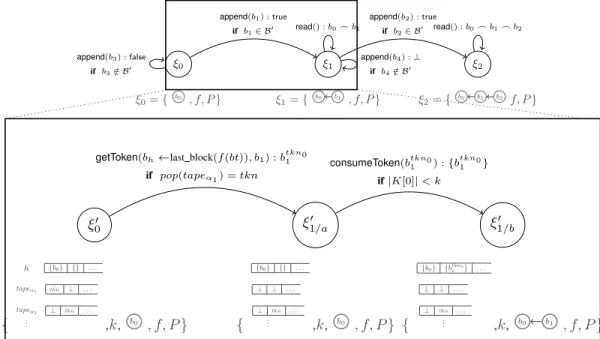
ξ0 ξ0= { b0 , f, P } ξ1 ξ1= { b0 b1 , f, P } append(b1) : true if b1∈ B0 append(b3) : false if b3∈ B/ 0 ξ2 ξ2= { b0 b1 b2 f, P } append(b2) : true if b2∈ B0 append(b4) : ⊥ if b4∈ B/ 0 read() : b0_ b1 read() : b0_ b1_ b2 ξ00 { {b0} {} . . . K tkn ⊥ . . . tapeα2 ⊥ tkn . . . tapeα1 .. . ,k, b0 , f, P } ξ1/a0 { {b0} {} . . . ⊥ ⊥ . . . ⊥ tkn . . . .. . ,k, b0 , f, P } getToken(bh←last block(f (bt)), b1) : btkn01
if pop(tapeα1) = tkn ξ01/b { {b0} {btkn1 0} . . . ⊥ ⊥ . . . ⊥ tkn . . . .. . ,k, b0 b1 , f, P } consumeToken(btkn01 ) : {btkn01 } if |K[0]| < k
Fig. 3: A possible path of the transition system defined by the refinement of the append() operation.
R(BT-ADTSC, ΘF,k=1) R(BT-ADTEC, ΘF,k>1) R(BT-ADTSC, ΘP) R(BT-ADTSC, ΘF,k>1) R(BT-ADTEC, ΘP) Theorem IV.4 Theorem V.6 Theorem IV.3 Theorem V.6 Theorem IV.3 Corollary IV.4.1 Corollary IV.4.1
Fig. 4: R(BT-ADT, Θ) Hierarchy. In gray we anticipate the combinations impossible in a message-passing system due to Theorem V.6.
Recall that Compare&Swap() takes three parameters as input, the register, the old value and the new value. If the value in register is the same as old value then the new value is stored in register and in any case the operation returns the value that was in register at the beginning of the operation.
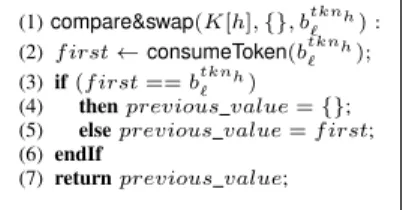
Figure 5 proposes an algorithm that reduces CAS object to ΘF,k=1object.
Theorem V.1. If input values are in B0 then there exists an implementation of CAS by ΘF,k=1.
Figure 6 describes a simple implementation of Con-sensus by ΘF,k=1. When a process p invokes procedure
Consensus with the block bhto which p wishes to append
its block b, it first sets its proposal (Line 1), and then loops invoking the getToken(bh, proposal)operation until a
valid block is returned (Lines 3-4). Once process p obtain a valid block, it invokes the consumeToken() operation with this valid block as a parameter. The consumeToken() returns the unique valid block for level level (Line 5). Note that this unique valid block is the one of the first process that invoked the consumeToken() operation. Thus the decision value is the valid block of the first process that invoked the consumeToken() operation (see Line 5), and thus it is the same for all the processes.
Theorem V.2. ΘF,k=1 Oracle has Consensus number ∞.
2) Prodigal oracle ΘP is not stronger than Generalized
Lattice Agreement: In this section we present a reduction of the prodigal oracle ΘP to Generalized Lattice Agreement
(GLA) [12]. We will first recall the properties of GLA, a version of lattice agreement generalized to a possibly infinite sequence of input values.
Definition V.2 (GLA Problem [12]). Let L be a join semi-lattice with a partial order v. Each process may propose an input value belonging to the lattice at any point in time. There is no bound on the number of input values a process may propose. Let vxi denote the x-th input value proposed by
a process pi. The objective is for each process pi to learn
a sequence of output values wyi that satisfy the following conditions:
1) Validity. Any learnt value wyi is a join of some set of input values.
2) Stability. The value learnt by any process pi increases
monotonically : x < y ⇒ wxi v w y i.
(1) compare&swap(K[h], {}, btknh` ) : (2) f irst ← consumeToken(btknh` ); (3) if (f irst == btknh` )
(4) then previous value = {}; (5) else previous value = f irst; (6) endIf
(7) return previous value;
Fig. 5: An implementation of CAS by the Frugal Oracle with k = 1.
Consenus(bh):
(1) proposal ← b; (2) validP roposal ← ⊥; (3) while (validP roposal = ⊥):
(4) validP roposal ← getToken(bh, proposal);
(5) return (consumeToken(validP roposal));
Fig. 6: An implementation of Consensus by the Frugal Oracle with k = 1.
3) Consistency. Any two values wxi and w y
j learnt by any
two processes pi and pj are comparable.
4) Liveness. Every value vixproposed by a correct process
pi is eventually included in some learnt value w y j of
every correct process pj, i.e. vxi v w y j
a) Reduction of the prodigal oracle to Generalized Lat-tice Agreement: In order to show the reduction of the prodi-gal oracle to GLA, we consider a lattice for each possible object objh a process wants to append its own object to.
Intuitively, in the context of the BT-ADT, the object objhis a
vertex of a tree that maps to a lattice whose input values are subsets of the vertex´s children. In order to formally define the input values of the lattice, let us recall that a consume token operation invoked to chain an object obj` to a given object objh, i.e., consumeToken(obj`tknh),
returns a set of objects that includes the chained object objtknh
` . In this context, the lattice input values belong then
to the objects power set, where the greatest lower bound is the empty set.
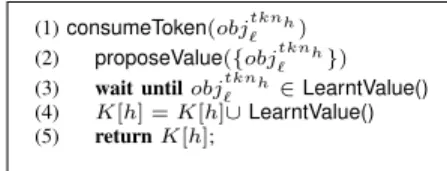
Figure 7 shows an implementation of con-sumeToken by GLA, where the process executes proposeValue({objtknh
` }) of GLA, taking the singleton set
{objtknh
` } to be a newly proposed value. The consume
token returns a set that reflects all the objects in the learnt set, which includes the proposed object.
Theorem V.3. ΘP Oracle is not stronger than Generalized
Lattice Agreement. Proof. (Sketch)
The proof follows from the implementation in Figure 7. Let us recall that the oracle must behave as an atomic object, which means that we need to show that the oracle is linearizable through GLA. GLA proposed values in our implementation are sets, where each proposed value is a singleton set containing a uniquely identified object. The join of any two proposed values is the union of the proposed singleton sets. Any learnt set is the union of some proposed sets. Any two learnt sets are comparable through the inclusion operator. The first step is to
show that the order of non-overlapping consumeToken opera-tions is preserved: if a process pi completes a consumeToken
ct1 operation before another process pj invokes another ct2
operation, then we must ensure that ct1 occurs before ct2 in
the linearization order, i.e. the effect of ct1 is visible to ct2.
Note that from the pseudo-code, the only values included in K[h] are learnt values, i.e. a join of some proposed values by the GLA Validity and from Line 2. Moreover, from Line 3 each process waits for its own proposed set to be learnt before the consumeToken completes. This means that the proposed set set1 by ct1 is learnt and included in K[h], before ct2 is
invoked. Since the learnt value set1 through ct1must now be
comparable to the learnt set set2through ct2, this implies that
the learnt set set2 through ct2 must also include set1. K[h]
will then include set1, i.e. ct2 has seen the effect of ct1. The
second step is to show that any two concurrent operations ct1
and ct2 can be linearized. By Consistency, even in this case
the learnt values must be comparable, either set1 is included
in set2 or the other way round. In both cases the effect of
one operation is visible to the other one, and then they can be linearized. The last step is to show the the implementation is wait-free. Wait-freedom is ensured by the Liveness property of GLA that ensures that the execution time of Line 3 is finite.
B. Implementability in a message-passing system model In this section we are interested in distributed message-passing implementations of BT-ADTs. In the following, we will present (i) the necessity of a light form of reliable broadcast to implement BT Eventual consistency, (ii) re-finement of BTs with Oracles that are not implementable in a message-passing system and (iii) the mapping of current existing implementations with our abstract data types.
To this end, we consider a message-passing system composed of an arbitrarily large but finite set of n pro-cesses, such that a subset of them can fail by exhibiting Byzantine failures, that is deviates arbitrarily from the
(1) consumeToken(obj`tknh) (2) proposeValue({obj`tknh}) (3) wait until obj`tknh∈ LearntValue() (4) K[h] = K[h]∪LearntValue() (5) return K[h];
Fig. 7: Reduction of the prodigal oracle to Generalized Lattice Agreement
distributed protocol P it should execute. A non-faulty process is said correct. Processes communicate by ex-changing messages over communication channels that can be asynchronous or synchronous (see [6]). We will specify whenever necessary the synchrony assumptions of the channels. By default we consider asynchronous channels.
The BlockTree is considered as a shared object repli-cated at each process. Let bti be the local copy of
the BlockTree maintained at process i. To maintain the replicated object we consider histories made of events related to the read and append operations on the shared object, i.e. the send and receive operations for process communications and the update operation for BlockTree replica updates. We also use subscript i to indicate that the operation occurred at process i: updatei(bg, b`)
indi-cates that i inserts its locally generated valid block b` in
bti with bg as a predecessor. Updates are communicated
through send and receive operations: an update related to a block b` generated on a process pi, which is sent
through the sendi(bg, b`)operation, and which is received
through the receivej(bg, b`)operation, takes effect on the
local replica btj of pjwith the updatej(bg, b`)operation.
In the remaining of this work we consider implementa-tions of BT-ADT in a Byzantine failure model where the set of events E is restricted to a countable set of events that contains (i) all the BT-ADT read() operations invocation events by the correct processes, (ii) all BT-ADT read() operations response events at the correct processes, (iii) all append(b) operations invocation events such that b satisfies predicate P and, finally (iv) send, receive and update events generated at correct processes. Note that the Oracle-ADT is by construction agnostic to failures.
1) Necessity of reliable communication: We define the properties on the communication primitive that each his-tory H generated by a BT-ADT satisfying the Eventual Prefix Property must satisfy. We need to first introduce the following definition:
Definition V.3 (Update agreement). A concurrent history H = hΣ, E, Λ, 7→, ≺, %i generated by a BT-ADT satisfies the update agreement property if properties R1, R2 and R3 hold.
• R1. ∀updatei(bg, b`) ∈ H, ∃sendi(bg, b`) ∈ H;
• R2. ∀updatei(bg, b`) ∈ H, ∃receivei(bg, b`) ∈ H such
that receivei(bg, b`) 7→ updatei(bg, b`);
• R3. ∀updatei(bg, b`) ∈ H, ∃receivek(bg, b`) ∈ H, ∀k.
Theorem V.4. The update agreement property is necessary to construct concurrent histories H = hΣ, E, Λ, 7→, ≺, %i gen-erated by a BT-ADT that satisfy the BT Eventual Consistency criterion.
Proof. The intuition of the proof is that to meet BT Eventual Consistency all the processes must have the same view of BlockTree eventually. In fact missing an update on the branch that will be eventually selected (which cannot be a-priori-known) would imply that the prefix (which will be arbitrarily long) for the process that missed the update will diverge forever. For space reason the proof of the theorem can be found in the supplementary materials.
We can now present the Light Reliable Communication (LRC) primitive.
Definition V.4 (Light Reliable Communication (LRC)). A concurrent history H satisfies the properties of the LRC abstraction if and only if:
• (Validity): ∀sendi(b, bi) ∈ H, ∃receivei(b, bi) ∈ H; • (Agreement): ∀receivei(b, bj) ∈ H, ∀k∃receivek(b, bj) ∈
H
From Theorem V.4, it is straightforward to show that LRC is necessary to implement BT Eventual consistency (by using arguments from [6]). The proof of the necessity is based on the Validity and Agreement for R1, R2 and R3. The interested reader can refer to the supplementary materials for the proof.
Theorem V.5. The LRC primitive is necessary for any BT-ADT implementation that generates concurrent histories which satisfies the BT Eventual Consistency criterion.
By Theorem IV.1, the results trivially hold for the BT Strong consistency criterion.
2) Impossibility of BT Strong Consistency with forks: The following theorem states that BT Strong consistency can-not be implemented if forks can occur. Intuitively the proof is based on showing a scenario in which two concurrent updates biand bjare issued, linked to a same block b and
two reads at two different processes read b_b
i and b_bj,
violating the Strong prefix property.
Observation. Following our Oracle based abstraction
(Section IV-C) we assume by definition that the synchro-nization on the block to append is oracle side and takes place during the append operation. It follows that when an append operation occurs and a correct process updates
its local blocktree then it cannot use anything weaker than the LRC communication abstraction.
Theorem V.6. There does not exist an implementation of R(BT-ADTSC, Θ) with Θ 6= ΘF,k=1 that uses a LRC
primitive and generates histories satisfying the BT Strong consistency.
The non-implementability of refinement R(BT-ADTSC, ΘP) and R(BT-ADTSC, ΘF,k>1) is a
direct implication of the theorem, whose effect is reported in gray in Figure 4.
From Theorem V.6 the next Corollary follows.
Corollary V.6.1. ΘF,k=1 is necessary for any implementation
of any R(BT-ADTSC, Θ) that generates histories satisfying
the BT Strong consistency.
Thanks to Theorem V.2 the next Corollary also follows. Corollary V.6.2. Consensus is necessary for any implemen-tation of a BT-ADT that generates histories satisfying the BT Strong consistency.
C. Mapping with existing Blockchain implementations We complete this work by illustrating the mapping in the following table between different existing systems and the specifications and abstractions presented in this paper. Interestingly, the mapping shows that all the pro-posed abstractions are implemented (even though in a probabilistic way in some case), and that the only two refinements used are R(BT -ADTSC, ΘF,k=1)and R(BT
-ADTEC, ΘP). In the following we discuss Bitcoin and
Redbelly, an interested reader can find the discussions for the other systems in the supplementary materials.
TABLE I: Mapping of some existing systems.
References Refinement Bitcoin [19] R(BT -ADTEC, ΘP) EC w.h.p Ethereum [24] R(BT -ADTEC, ΘP) EC w.h.p Algorand [13] R(BT -ADTSC, ΘF,k=1) SC w.h.p ByzCoin [16] R(BT -ADTSC, ΘF,k=1) PeerCensus [9] R(BT -ADTSC, ΘF,k=1) Redbelly [8] R(BT -ADTSC, ΘF,k=1) Hyperledger [4] R(BT -ADTSC, ΘF,k=1) D. Bitcoin
In Bitcoin [19] each process p ∈ V is allowed to read the BlockTree and append blocks to the Block-Tree. Processes are characterized by their computational power represented by αp, normalized as Pp∈V αp = 1.
Processes communicate through reliable FIFO authen-ticated channels, which models a partially synchronous setting [10]. Valid blocks are flooded in the system. The getToken operation is implemented by a proof-of-work mechanism. The consumeToken operation returns true for all valid blocks, thus there is no bounds on the number of consumed tokens. Thus Bitcoin implements a Prodigal Oracle. The selection function f selects the
blockchain which has required the most computational work, guaranteeing that concurrent blocks can only refer to the most recently appended blocks of the blockchain returned by a read() operation. Garay and al [20] have shown, under a synchronous environment assumption, that Bitcoin ensures Eventual consistency criteria with high probability. The same conclusion applies as well for the FruitChain protocol [21], which proposes a protocol similar to BitCoin except for the rewarding mechanism. E. Red Belly
Red Belly [8] is a consortium blockchain, meaning that any process p ∈ V is allowed to read the BlockTree but a predefined subset M ⊆ V of processes are allowed to append blocks. Each process p ∈ M has a merit param-eter set to αp = 1/|M | while each process p ∈ V \ M
has a merit parameter αp = 0. Each process p ∈ M
can invoke the getToken operation with their new block and will receive a token. The consumeToken operation, implemented by a Byzantine consensus algorithm run by all the processes in V , returns true for the uniquely decided block. Thus Red Belly BlockTree contains a unique blockchain, meaning that the selection function f is the trivial projection function from BT 7→ BC which associates to the BT-ADT its unique existing chain of the BlockTree. As a consequence Red Belly relies on a Frugal Oracle with k = 1, and by the properties of Byzantine agreement implements a strongly consistent BlockTree (see Theorem 3 [8]).
VI. CONCLUSIONS ANDFUTUREWORK
The paper presented a formal specification of blockchains and derived interesting conclusions on their implementability. Let us note that the presented work is intended to provide the groundwork for the construc-tion of a sound hierarchy of blockchain abstracconstruc-tions and correct implementations. We believe that the presented results are also of practical interests since our oracle construction not only reflects the design of many current implementations, but will help designers in choosing the oracle they want to implement with a clear semantics and inherent trade-offs in mind. Future work will focus on several open issues, such as the solvability of Eventual Prefix in message-passing, the synchronization power of other oracle models, and fairness properties for oracles.
a) Acknowledgments: . The authors thank the referees for their helpful comments.
REFERENCES
[1] I. Abraham and D. Malkhi. The blockchain consensus layer and BFT. Bulletin of the EATCS, 3(123):1–23, 2017.
[2] E. Anceaume, R. Ludinard, M. Potop-Butucaru, and F. Tronel. Bitcoin a distributed shared register. In Proceedings of the In-ternational Symposium on Stabilization, Safety, and Security of Distributed Systems (SSS), 2017.
[3] E. Anceaume, A. D. Pozzo, R. Ludinard, M. Potop-Butucaru, and S. Tucci Piergiovanni. Blockchain abstract data type - full version. https://hal.archives-ouvertes.fr/hal-02113770, 2019.
[4] E. Androulaki, A. Barger, V. Bortnikov, C. Cachin, K. Christidis, A. D. Caro, D. Enyeart, C. Ferris, G. Laventman, Y. Manevich, S. Muralidharan, C. Murthy, B. Nguyen, M. Sethi, G. Singh, K. Smith, A. Sorniotti, C. Stathakopoulou, M. Vukolic, S. W. Cocco, and J. Yellick. Hyperledger Fabric: A Distributed Operating System for Permissioned Blockchains. https://arxiv.org/pdf/1801.10228v1.pdf, 2018.
[5] A. F. Anta, K. Konwar, C. Georgiou, and N. Nicolaou. Formalizing and implementing distributed ledger objects. ACM SIGACT News, 49(2):58–76, 2018.
[6] C. Cachin, R. Guerraoui, and L. E. T. Rodrigues. Introduction to Reliable and Secure Distributed Programming (2. ed.). Springer, 2011.
[7] C. Cachin, K. Kursawe, F. Petzold, and V. Shoup. Secure and efficient asynchronous broadcast protocols. In Proceedings of the Annual International Cryptology Conference on Advances in Cryptology (CRYPTO), 2001.
[8] T. Crain, V. Gramoli, M. Larrea, and M. Raynal. (Leader/Randomization/Signature)-free Byzantine Consensus for Consortium Blockchains. http://arxiv.org/abs/1702.03068, 2017.
[9] C. Decker, J. Seidel, and R. Wattenhofer. Bitcoin meets strong consistency. In Proceedings of the 17th International Conference on Distributed Computing and Networking, page 13, New York, NY, USA, 2016. ACM.
[10] C. Dwork, N. Lynch, and L. Stockmeyer. Consensus in presence of partial synchrony. Journal of the ACM (JACM), 1988.
[11] C. Dwork and M. Naor. Pricing via processing or combatting junk mail. In Advances in Cryptology - CRYPTO ’92, 12th Annual International Cryptology Conference, Santa Barbara, California, USA, August 16-20, 1992, Proceedings, pages 139–147, 1992. [12] J. M. Falerio, S. Rajamani, K. Rajan, G. Ramalingam, and K.
Vaswani. Generalized lattice agreement. In Proceedings of the ACM Symposium on Principles of Distributed Computing (PODC), 2012.
[13] Y. Gilad, R. Hemo, S. Micali, G. Vlachos, and N. Zeldovich. Algorand: Scaling byzantine agreements for cryptocurrencies. In Proceedings of the Symposium on Operating Systems Principles
(SOSP), pages 51–68, New York, NY, USA, 2017. ACM.
[14] A. Girault, G. G ¨ossler, R. Guerraoui, J. Hamza, and D.-A. Seredin-schi. Monotonic prefix consistency in distributed systems. In Inter-national Conference on Formal Techniques for Distributed Objects, Components, and Systems, pages 41–57, Berlin, Germany, 2018. Springer.
[15] M. Herlihy. Wait-free synchronization. ACM Trans. Program. Lang. Syst., 13(1):124–149, 1991.
[16] E. Kokoris-Kogias, P. Jovanovic, N. Gailly, I. Khoffi, L. Gasser, and B. Ford. Enhancing bitcoin security and performance with strong consistency via collective signing. In 25th USENIX Security Symposium, USENIX Security 16, Austin, TX, USA, August 10-12, 2016., pages 279–296, Berkeley, CA, USA, 2016. USENIX Association.
[17] L. Lamport, R. Shostak, and M. Pease. The byzantine generals problem. ACM Transactions on Programming Languages and Systems (TOPLAS), 4(3):382–401, 1982.
[18] D. Mazieres and D. Shasha. Building secure file systems out of byzantine storage. In Proceedings of the twenty-first annual symposium on Principles of distributed computing, pages 108– 117. ACM, 2002.
[19] S. Nakamoto. Bitcoin: A Peer-to-Peer Electronic Cash System. https://bitcoin.org/bitcoin.pdf, 2008.
[20] E. Oswald and M. Fischlin, editors. The Bitcoin Backbone Proto-col: Analysis and Applications, volume 9057 of Lecture Notes in Computer Science. Springer, 2015.
[21] R. Pass and E. Shi. Fruitchains: A fair blockchain. In Proceedings of the ACM Symposium on Principles of Distributed Computing, PODC 2017, pages 315–324, New York, NY, USA, 2017. ACM. [22] M. Perrin. Distributed Systems, Concurrency and Consistency.
ISTE Press, Elsevier, 2017.
[23] M. Perrin, A. Most ´efaoui, and C. Jard. Causal consistency: beyond memory. In Proceedings of the 21st ACM SIGPLAN Symposium on Principles and Practice of Parallel Programming, PPoPP 2016, Barcelona, Spain, March 12-16, 2016, pages 26:1–26:12, New York, NY, USA, 2016. ACM.
[24] G. Wood. Ethereum: A secure decentralised generalised transac-tion ledger. http://gavwood.com/Paper.pdf, 2014.