HAL Id: hal-02411051
https://hal.archives-ouvertes.fr/hal-02411051
Submitted on 15 Dec 2019
HAL is a multi-disciplinary open access
archive for the deposit and dissemination of
sci-entific research documents, whether they are
pub-lished or not. The documents may come from
teaching and research institutions in France or
abroad, or from public or private research centers.
L’archive ouverte pluridisciplinaire HAL, est
destinée au dépôt et à la diffusion de documents
scientifiques de niveau recherche, publiés ou non,
émanant des établissements d’enseignement et de
recherche français ou étrangers, des laboratoires
publics ou privés.
Testing Compound Nucleus Hypothesis Across the 17 O
Nucleus Excitation
A. Nizigama, P. Tamagno, O. Bouland
To cite this version:
A. Nizigama, P. Tamagno, O. Bouland. Testing Compound Nucleus Hypothesis Across the 17 O
Nucleus Excitation. 5th International Workshop on Nuclear Data Evaluation for Reactor Applications
(WONDER - 2018), Oct 2018, Aix-En-Provence, France. �hal-02411051�
Testing Compound Nucleus Hypothesis Across
the
17O Nucleus Excitation
Aloys Nizigama*, Pierre Tamagno, and Olivier Bouland
CEA, DEN, DER, SPRC, Physics Studies Laboratory, Cadarache, F-13108 Saint-paul-lez-Durance, France
Abstract. The excited compound nucleus 17O* has been studied over
(n,α) and (α,n) cross sections modelling, respectively for 16O and 13C targets in their ground states. The modelling is fulfilled within the Reich-Moore formalism. We were able to calculate the (α,n) cross section by two separate ways: the direct kinematic standard route and by inversion of the (n,α) cross section using the compound nucleus hypothesis. Resonance
parameters of the resolved resonance range (0 to 6 MeV) were borrowed
from the CIELO project. In a first stage, the modelling is carried out in the referential of the incident particle (either way neutron or α) requesting
conversion of the CIELO neutron-type resonance parameters to the α-type. In a second stage, the implementation is uniquely designed in the center of mass system of the excited compound nucleus. The resonance parameters are thus converted in that unique reference framework. The comparison between direct kinematic cross section and inverted reciprocal cross section calculations enables the investigation of the compound nucleus hypothesis over the studied energy domain.
1 Introduction
The study of reactions that refer to the excited compound nucleus 17O* is of strong concern for reactors physics nuclear data evaluators. 16O is the most predominant isotope of oxygen in nature and contributes to gaz production observed in reactor through 16O(n,α)13C conversion. On this point of view, the 16O constitutes an important safety issue in the operation of reactors. Furthermore, the oxygen is overriding in the oxide fuels and plays a role in neutron thermalization in water. One can also emphasize the interest of 17O* excited compound nucleus as neutron source, especially meaningful in the s-process (astrophysics area), through the 13C(α,n)16O reaction. Taking into account nuclear structure aspect, the
17O* compound nucleus is characterized by weak level density and subsequent wide
resolved resonance range (RRR) that goes from 0 to 6 MeV. Two reaction types are fully open for this region: the neutron and α reactions. Due to its light nucleus structure feature, the 17O* compound nucleus makes it a nice candidate for models testing in the RRR.
Existing nuclear data discrepancies between measured and evaluated data according to the 16O(n,α)13C and reciprocal 13C(α,n)16O reactions, have been the subject of strong discussions within CIELO [1, 2] project. In 2014, the CIELO team summarized the situation [1] pointing out 30% of discrepancies between lower (IRMM 2007 [3], Harissopulos 2005 [4]) and higher (original Bair and Haas [5]) cross section trends. These discrepancies were also recorded between major evaluated data libraries. The old ENDF/B-VI evaluation was scaled on the higher cross section magnitude while the lower trend was adopted in the ENDF/VII.0 (unchanged in ENDF/B-VII.1) and JEFF-3.1 according the energy range below 6 MeV. Thereafter, that choice was completely re-examined in the last ENDF/B library. The CIELO team reported in 2018 [2] a raise up of about 40% to be applied to the ENDF/B-VII.1 (n,α) cross section. The modifications were included in the ENDF/B-VIII.0 file. However, the CIELO project recommended new experiments to corroborate these new changes.
Present work takes place in larger demarche that includes redesign of the technique of cross section evaluation meaning the determination of nuclear parameters using a unified framework approach. This paper presents the work on progress using a newly implemented computer branch [TOol for Reactions Analysis (TORA)] of the CONRAD code [6] whose purpose is to reach the above-cited objective. The tool is tested across dedicated modelling of the 16O(n,α)13C and 13C(α,n)16O cross sections in both projectile laboratory respective frameworks and center of mass of the excited compound nucleus (defining the unified approach).
2 Theoretical background
This work is fulfilled in the Reich-Moore formalism [7]. The R matrix, in which the gamma channels are beforehand eliminated, is given by:
𝑅
𝑐𝑐𝐽𝜋′= ∑
𝛾𝜆𝑐𝐽𝜋𝛾 𝜆𝑐′ 𝐽𝜋 𝐸𝜆𝐽𝜋−𝐸−𝑖Γ𝜆𝛾𝑡𝑜𝑡 𝐽𝜋 2 𝜆 (1)The quantities 𝛾𝜆𝑐𝐽𝜋 and 𝛾𝜆𝑐′𝐽𝜋 are the reduced width amplitudes, 𝐸𝜆𝐽𝜋 is the resonance energy and the parameter Γ𝜆𝛾𝐽𝜋𝑡𝑜𝑡 is the total gamma channel width of the λth state in a group of states contributing to the same total spin J and parity π of the compound nucleus. E is the energy of the incident particle. Since these resonance parameters are expressed in the neutron laboratory system according to the ENDF format of the evaluated data libraries, a reference framework transformation is usually needed to calculate reciprocal cross sections (exchanging projectile-ejectile pair roles).
3 Direct kinematics calculations according to the
16O(n,α)
13C
and
13C(α,n)
16O cross sections
The 16O(n,α)13C and 13C(α,n)16O cross sections calculations are fulfilled respectively in the neutron- and alpha-incident particle laboratory systems using TORA and validated by comparison to the calculations performed using SAMMY [8] and CONRAD [6] codes. The appropriate expressions are used to calculate neutrons and charged particles penetration factors, shift factors and hard-sphere scattering phase shifts. The first step lies in the neutron to alpha laboratory system transformation of the CIELO resonance parameters to reconstruct the direct kinematics 13C(α,n)16O cross section. The neutron laboratory frame is
by definition scaled on the neutron separation energy (Sn= 4143890 eV) to be juxtaposed to
corresponding alpha separation energy (Sα = 6359067 eV). The boundary limit (B) is
assigned to the shift factor value (S) and channel radii are respectively chosen to ac= 4.15
fm for the neutron channel and ac = 6.68 fm for the alpha channel. The reaction Q-value is
deduced according so. Figure 1 shows corresponding simulations. The TORA calculation is in good agreement with results obtained using both the CONRAD and SAMMY codes. The JEFF-3.3 evaluated cross section (left side picture) is lower to both simulated and Bair and Haas [5] measured cross sections. This is understood by the fact that the JEFF library is scaled on the lower assumed 16O(n,α)13C cross section magnitude.
Fig.1. 16O(n,α)13C (left) and 13C(α,n)16O (right)unbroadened cross sections versus projectile energy. The solid thick curves address the results from TORA. They are compared to reference calculations obtained using the CONRAD (short dash curve) and the SAMMY-8 (long dash curve) codes, and with the evaluated pointwise cross section from JEFF-3.3 (solid thin curve). On the left figure, the pseudo-experimental data are obtained by the inversion of the Bair and Haas 1973 (α,n) cross section which are plotted on the right figure (circular symbols). The modeling is fulfilled using the Reich-Moore parameters kindly released by L.C. Leal [9].
4 Nuclear data computation involving compound nucleus CoM
frame
4.1 Various calculated data for 17O* compound nucleus
Modelling of various neutron and α cross sections of reactions related to the 17O* compound nucleus has been fulfilled in the center of mass (CoM) system taking reference to the ground state energy of the 17O* nucleus. The main goal of this approach is to reduce the inconsistencies between data due to the frame reference dependence. All the parameters
occurring in the equation (1) are now established in the CoM system. The reduced amplitudes being energy independent physical parameters (see equation 2 below taken from [10]), they become suitable for the purpose of present work suggesting to replace the total gamma width occurring in the denominator of the Reich-Moore R-Matrix formulation by its corresponding amplitude.
𝛾
𝜆𝑐= (
ℏ 2Mcac)
1 2
∫ φ
c∗𝑋
𝐽𝑀𝜆dS
(2) φc∗ is the surface wave function for the channel c and 𝑋𝐽𝑀 𝜆 is the internal eigenfunctionrelated to the energy 𝐸𝐽𝑀𝜆 . The constants 𝑎𝑐 and Mc are respectively the channel radius and
the reduced mass. The integration is made over the totality of channel surfaces.
The modelling of nuclear reactions in the CoM frame of the compound nucleus enables a consistent and simultaneous production of data for nuclear reactions involving the same compound nucleus. Figure 2 shows the results of a simulation of the four reactions:
16O(n,n)16O, 16O(n,α)13C, 13C(α,n)16O and 13C(α,α)13C in the same frame.
Fig.2. The 16O(n,n)16O (long dash curve), 16O(n,α)13C (solid curve) ,13C(α,n)16O (long-short dash
curve) and 13C(α,α)13C (dotted curve) cross sections. The targets are respectively 16O and 13C in their ground states. Vertical solid and dash lines indicate respectively the position of the separation energies of the neutron and α particle on the energy scale. The dotted vertical lines indicate the position of the three bound states of the 17O* nucleus below the separation energy of the neutron. Present differential cross section (α,α) is computed according Blatt and Biedenharn formalism [11] at the CoM angle of 54 degrees.
In the CoM reference of 17O*, the excited states must appear at the same excitation energy for all the simulated reactions since a unique energy scale is used. Furthermore, bound states energies are no longer expressed as a negative value of energy.
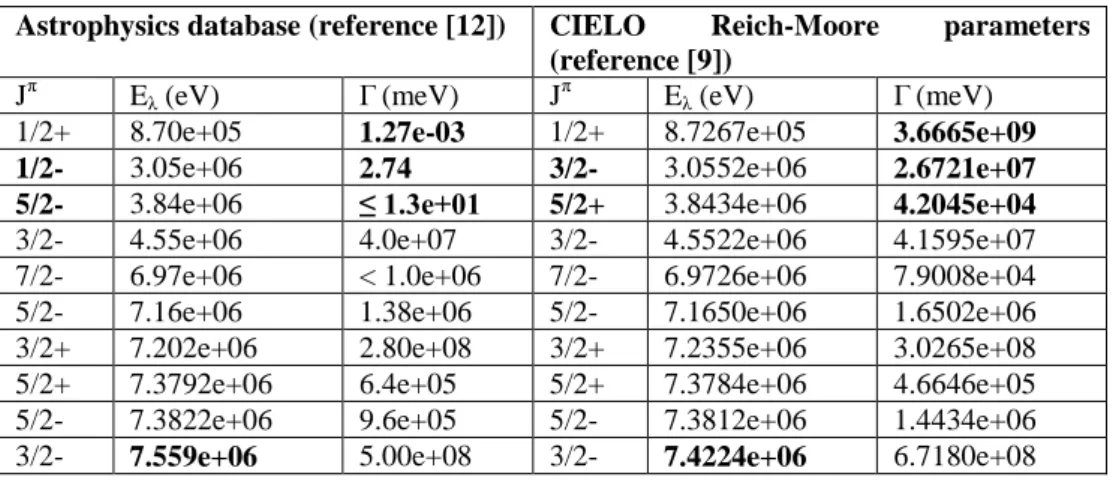
The use of the CoM frame gives also the tools to raise inconsistencies in the parameter files that support different energy scales. In the table 1 below, a straightforward comparison between resonance parameters from two separate databases (astrophysics [12] and reactors physics from CIELO project [9]) is done. Inconsistencies are highlighted. The three first total width values in the CIELO base are very large compared to those reported in the astrophysical base, suggesting very low life time assigned to these three levels. Two unexpected Jπ assignments (second and third levels) can also be noticed. On the contrary,
the level energies are in good agreement in spite of the highest level on which the energy is slight lower in the CIELO base.
Table 1. The comparison between resonances parameters for ten major levels from the
Astrophysics and the CIELO project database using the unified framework.
Astrophysics database (reference [12]) CIELO Reich-Moore parameters (reference [9])
Jπ Eλ (eV) Γ(meV) Jπ Eλ (eV) Γ(meV)
1/2+ 8.70e+05 1.27e-03 1/2+ 8.7267e+05 3.6665e+09
1/2- 3.05e+06 2.74 3/2- 3.0552e+06 2.6721e+07
5/2- 3.84e+06 ≤ 1.3e+01 5/2+ 3.8434e+06 4.2045e+04
3/2- 4.55e+06 4.0e+07 3/2- 4.5522e+06 4.1595e+07 7/2- 6.97e+06 < 1.0e+06 7/2- 6.9726e+06 7.9008e+04 5/2- 7.16e+06 1.38e+06 5/2- 7.1650e+06 1.6502e+06 3/2+ 7.202e+06 2.80e+08 3/2+ 7.2355e+06 3.0265e+08 5/2+ 7.3792e+06 6.4e+05 5/2+ 7.3784e+06 4.6646e+05 5/2- 7.3822e+06 9.6e+05 5/2- 7.3812e+06 1.4434e+06 3/2- 7.559e+06 5.00e+08 3/2- 7.4224e+06 6.7180e+08
4.2 Data reversibility
According to the assumption of Weisskopf and Ewing [13], the cross section of a reaction in which a projectile x collides with a target X to lead to a residual nucleus Y and an ejectile y, can be split as follows:
𝜎(𝑥, 𝑦) = 𝑆
𝑥(𝐸) × 𝜉
𝑥(𝐸) × 𝜂
𝑦(𝐸
𝑥)
(3) Above hypothesis relies on the fact that given compound nucleus Y* is formed from thecouple (x,X) and decays in the couple (y,Y). First product of right side term of Eq. (3) 𝑆𝑥(𝐸) × 𝜉𝑥(𝐸) represents the probability of the formation of compound nucleus. Among
those two variables, 𝑆𝑥(𝐸) represents the cross section for reaching the surface of the target
nucleus. The incident wave being partially reflected by the potential at the target nucleus surface, 𝜉𝑥(𝐸) is the probability denoting the fraction of the incident wave which interacts
with the nucleons of the target nucleus. The last variable 𝜂𝑦(𝐸𝑥) quantifies the decaying probability of the compound nucleus giving the couple (y,Y). E is the energy of the projectile and 𝐸𝑥 is the excited energy of a state of the compound nucleus created.
The interaction between a particle x and a target nucleus X does not always lead to the formation of a compound nucleus. Other interactions [14] may occur. A competition is possible between the reaction passing through the formation of the compound nucleus and other forms of reaction: surface and volume direct interactions, multiple collisions or even collective nucleon excitation (rotations and vibrations). The evaluation of the 16O(n,α)13C cross section has been classically performed using the inverted 13C(α,n)16O data from
from Bair and Haas [5] and Harissopulos [4]. This inversion of data relies on the compound nucleus hypothesis suggesting that the entire energy brought by the incident wave is right away and equitably shared among all nucleons of the target. The process must last long enough so that the way of the formation of the compound nucleus is “forgotten” by the latter. Subsequent decay probability in given channel is thus independent from the formation channel but both must be connected to the same nuclear state of the compound nucleus. The compound nucleus hypothesis has been illustrated through the computation of the 13C(α,n)16O and 16O(n,α)13C cross sections. Below are shown results of the comparison between the cross sections obtained by direct kinematics calculation on one side and those obtained by the data inversion on the other side. The inversion method used to obtain the inverse of a reaction cross section 𝜎𝑐𝑐′(𝐸𝑐𝐶𝑜𝑀) for which a compound nucleus is formed from a channel 𝑐 and decays into a channel 𝑐′ relies on the expression [15]:
𝜎
𝑐′𝑐(𝐸
𝑐′𝐶𝑜𝑀)ƛ
𝑐 2= 𝜎
𝑐𝑐′(𝐸
𝑐𝐶𝑜𝑀)
(2𝑖(2𝑖𝑐+1)(2𝐼𝑐+1) 𝑐′+1)(2𝐼𝑐′+1)ƛ
𝑐′ 2 (4)𝐸𝑐𝐶𝑜𝑀, 𝑖𝑐, 𝐼𝑐 and ƛ𝑐 are respectively the energy of the projectile in the CoM framework,
the spin of the projectile, the spin of the target and the reduced wavelength of the projectile in the channel 𝑐. 𝐸𝑐′𝐶𝑜𝑀, 𝑖𝑐′, 𝐼𝑐′ and ƛ𝑐′ are reciprocal quantities still in CoM system.
A quick eye on the Figure 3 shows that relative differences (down side plots) between the cross sections obtained from either the direct kinematics calculation or the pseudo cross sections obtained by inversion of data are very small. This trend is likely a confirmation of the predominance of a compound nucleus system at low excitation energy.
Fig.3. Comparison of the 16O(n,α)13C and 13C(α,n)16O cross sections obtained using direct kinematics calculation with the data obtained from the inversion of their reciprocal reaction cross sections labelled as pseudo data. The computation is performed using TORA. Relative differences in percentage are computed as the ratio [(Pseudo data – Direct kinematics calculated data)/Pseudo data].
5. Conclusion
A preliminary investigation of the 17O* compound nucleus has been made, using the CIELO Reich-Moore parameters, through a modelling of the 16O(n,α)13C and 13C(α,n)16O first in the incident particle laboratory frame and secondary in the CoM frame. Both two cross sections have been benchmarked to the inversed cross sections retrieved from the reciprocal reactions obtained using the relation (4). A comparison between nuclear parameters from the Astrophysics and Reactors physics databases highlighted notable differences. A solution to avoid the identified inconsistencies and reach a better accuracy is definitively the use of the CoM of the compound nucleus framework and energy-independent parameters in the nuclear reactions modelling. The approach has been set up by a simulation of the 16O(n,n)16O, 16O(n,α)13C, 13C(α,n)16O and 13C(α,α)13C reactions. A set of parameters obtained from a fit of experimental data within this unified framework, by the mean of a TORA full connexion to the CONRAD code, is foreseen.
6. References
1. M.B. Chadwick, E. Dupont, E. Bauge and al., Nucl. Data Sheets 118, 1 (2014) 2. M.B. Chadwick, R. Capote, A. Trkov and al., Nucl. Data Sheets 148, 189 (2018) 3. G. Giorginis and al., EDP Siences, 525 (2008)
4. S. Harissopulos and al., Phys. Rev. C 72, 062801 (R) (2005) 5. J.K. Bair and F.X. Haas, Phys. Rev. 7, 1356 (1973)
6. C. De Saint Jean and al., EDP Sciences 1, 251 (2008) 7. C.W. Reich and M.S. Moore, Phys. Rev. 111, 929 (1958)
8. M. Larson, Technical Report ORNL/TM- 9179/R8ENDF-364/R2, ORNL (2008) 9. L. Leal et al., EPJ Nuclear Sci. Technol. 2, 43 (2016)
10. A.M. Lane and R.G. Thomas, Rev. Mod. Phys. 30, 257 (1958) 11. J.M. Blatt and M.C. Biedenharn, Rev. Mod. Phys. 24, 258 (1952) 12. D. R. Tilley and al., Nucl. Phys. A 564, 1 (1993)
13. V.F. Weisskopf and D.H. Ewing, Phys. Rev. 57, 472 (1940) 14. V.F. Weisskopf, Nucl. Phys. 29, 174 (1957)