Publisher’s version / Version de l'éditeur:
Vous avez des questions? Nous pouvons vous aider. Pour communiquer directement avec un auteur, consultez la première page de la revue dans laquelle son article a été publié afin de trouver ses coordonnées. Si vous n’arrivez pas à les repérer, communiquez avec nous à [email protected].
Questions? Contact the NRC Publications Archive team at
[email protected]. If you wish to email the authors directly, please see the first page of the publication for their contact information.
https://publications-cnrc.canada.ca/fra/droits
L’accès à ce site Web et l’utilisation de son contenu sont assujettis aux conditions présentées dans le site
LISEZ CES CONDITIONS ATTENTIVEMENT AVANT D’UTILISER CE SITE WEB.
Technical Memorandum (National Research Council of Canada. Division of
Building Research); no. DBR-TM-39, 1956-03-01
READ THESE TERMS AND CONDITIONS CAREFULLY BEFORE USING THIS WEBSITE. https://nrc-publications.canada.ca/eng/copyright
NRC Publications Archive Record / Notice des Archives des publications du CNRC :
https://nrc-publications.canada.ca/eng/view/object/?id=d59877f7-f897-4a51-b0c4-62b7e54a21f5 https://publications-cnrc.canada.ca/fra/voir/objet/?id=d59877f7-f897-4a51-b0c4-62b7e54a21f5
NRC Publications Archive
Archives des publications du CNRC
Access and use of this website and the material on it are subject to the Terms and Conditions set forth at
Range of structural variation in organic terrain
The Associate Committee on Soil and Snow Mechanics is one of about thirty special committees which assist the National Research Council in its work. Formed in 1945 to deal with an urgent wartiIrie problem involving soil and snow, the Committee is now performing its intended task of co-ordinating Canadian research studies concerned with the phys ical and mechanical properties of the terrain of the Dominion. It does this through subcommittees on Snow and Ice, Soil Mechanics, Muskeg, and Permafrost. The Com-mittee, which consists of about fifteen Canadians ap-pointed as individuals and not as representatives, each for a .3-year term, has ft.mds available to it for making research grants for work in its fields of interest. In-quiries will be welcomed and should be addressed to: The Secretary, Associate Committee on Soil and Snow·Mechanics, c/o The Division of Building Research, National Research Council, ottawa, Canada.
This publication is one of a series being produced by the Associate Committee on Soil and Snow Mechanics of the National Research Council. It may therefore be reproduced, without c.mendment, provtded that the Division is told in advance and that full and due acknowledgment of this publication is always made. No abridgment of this report may be published without the written authority of the
NAT1G:/L RE35tRCH COUNCIL
'I'echrri.coI hemor andum No.
39
Ranfe of 3tructura1 V2ri2tion in Crfanic Terrain
by
!Ormcm • )tccd
forth
ANALYZED
Hepri'.'1t from I!TroJ.nsactions of the ROY21:3ociety
"
of
Canada,Volume
XLIX :Series
III :June 1955
:3ection Five
TRANSACTIONS OF THE ROYAL SOCIETY OF CANADA
VOLUME XLIX : SERIES III : JUNE, 1955 SECTION FIVE
Range of Structural Variation in Organic Terrain
NORMAN W. RADFORTH
Presented by GLEB KROTKOV, F.R.S.C.
INTRODUCTION
F
R O M the aspect of national ・」ッョッセケL problems concerning organic terrain in Canada are now becoming very critical indeed. The develop-ment of the Northwest in particular is accompanied by heavy financial loss because the properties of muskeg are seriously inhibiting normal engineering progress. The frustration arising from this is intensified by the obvious fact that the rate of development of northern exploration is ever increasing, and it has surpassed the contribution that muskeg research has so far made. The concern shown by the oil and forestry industries and by agencies responsible for road construction is being brought to the attention of the Associate Com-mittee on Soil and Snow Mechanics of the National Research Council. It is hoped that this trend will continue, for it effectively leads to formulation of pertinent programmes for muskeg research.For some years the writer and his associates have carried on muskeg investigation under the sponsorship of the Associate Committee on Soil and Snow Mechanics and the Defence Research Board. One aspect of the work has centred around ground studies (2, 3, 4), the other on aerial interpre-tation (5). At the present stage of progress, to satisfy both interests and to contribute towards the solving of the pressing engineering requirement, there is need to fulfil a particular subsidiary objective in the programme: the establishment of a classification system for macroscopic constituents of the peaty matrix of the organic terrain.
In the present work the writer wishes to assess the limitations of this sys-tem and test its application.
MACROSOPIC STRUCTURAL ENTITIES
In another account reference has been made to 16 categories of peaty structure which are encountered in the composition of organic terrain (5). For convenience here, these are again listed (Table I), and in the same order. Another useful set of categories has been supplied by Dachnowski-Stokes (1) in his work on southern peats. A list of his categories with slight modifications in arrangement appears in Table II.
The degree of contrast between the two sets of categories (d. Tables I and II) will be readily appreciated. The large number of entities in the one
52 THE ROYAL SOCIETY OF CANADA
as compared with the other is marked. The conceptions of form suggested by the two sets of designants differ widely. Interpretation of constituents as represented by the nomenclature differs somewhat in the two cases. Size of primary constituents has also been viewed differently. Combination
refer-TABLE I
DESCRIPTIVE TERMS FOR SIXTEEN CATEGORIES OF PEAT STRUCTURE
Category
number Description 1 amorphous-granular
2 non-woody fine-fibrous
3 amorphous-granular in fine-fibrous 4 amorphous granular in woody fine-fibrous
5 amorphous-granular, fine-fibrous, non-woody in woody fine-fibrous 6 amorphous-granular with woody fine-fibrous held in coarse-fibrous 7 non-woody fine-fibrous covering amorphous-granular in fine-fibrous 8 non-woody fine-fibrous; mound in coarse-fibrous
9 woody fine-fibrous held in coarse-fibrous 10 woody particles in non-woody fine-fibrous 11 woody and non-woody particles in fine-fibrous 12 coarse-fibrous, woody
13 coarse-fibrous traversing fine fibrous
14 . non-woody and woody fine-fibrous held in coarse-fibrous 15 woody with amorphous-granular in fine-fibrous
16 woody coarse-fibrous with scattered woody erratics
TABLE II
TERMIXOLOGY CATEGORIZING STRUCTI.'RE IN PEAT DERIVED FROM DACHNOWSKI-STOKES DESCRIPTION
Plant source Macerated Colloidal Reed Sedge Brown Moss Bog Moss Heath Shrub Trees Peat type pulpy fibrous woody Texture
coarse to very finely divided
coarse to fine-fibrous
woody
NOTE: Structure in this system is referred to in terms of prop-erties of identified units, e.g. compact, dense, matted, etc., and thus does not parallel the interpretation of structure by the present writer.
NORMAN W. RADFORTH 53
ence entities in one set emphasize meanings that either do not apply for the other set or apply in another way. Finally, although generic implications have not been avoided in either list, categories in Table I emphasize phy-sical aspects of structure while those in Table II relate more directly to botanical structure.
To proceed at further length with the comparison would hardly be justi-fied. Dachnowski-Stokes in his analysis of macroscopic detail was presum-ably concerned with sequence of materials to show how plant organismsin toto contributed to the bulk in peat constitution. In this he succeeded admir-ably. His contribution has also been very useful in establishing as a principle the conception of gross compositional change on the botanical basis. The work provided the fundamentals of a reference method for those in the applied field who wish to make a quick and valid assessment of mass struc-ture.
The requirements with which the writer has had to deal are beset by other specifications sometimes more exacting. In previous work the reasons for utilizing the components of the 16 categories (Table I) are not given. Variability in vehicular response to change of organic terrain was one cir-cumstance which had a relation to the terms for selection of macroscopic reference-matter. Degree of resistance to vertical compressional forces was another. Stability of the organic medium when subjected to mechanical forces was a third. Some others are relative permeability of the organic medium. insulation value of peaty deposits during climafrost recession, change in character of peaty matter with depth, and relative disintegration value of the organic matter following disturbance and aeration.
In prescribing for such a varied list of requirements, the unit of structure had to be small enough to afford reasonable flexibility for reference, and to account for the main types of gross structure encountered. Also, the ulti-mate units could not be entirely arbitrarily chosen because it has been shown by analytical method (2) that organization of the terrain is revealed on a natural basis. Only that selection of entities which reflected these natural relations, therefore, would afford widest application and validity. This mat-ter now requires further consideration.
Mere presentation of the 16 categories in Table I reveals little direct evidence of a system by which they have been derived. Examination of nearly 500 peaty samples secured primarily from an area of a 200-mile radius around Fort Churchill, Manitoba, shows that the ultimate peaty elements which predominate and which might be used appropriately to the specifications mentioned are few in number. Most prominent among them is a granular base composed of aggregates variable in size and shape. Because the shape of the aggregate (granules) is so very variable and con-sistently irregular, no designation other than "amorphous" seems applicable. Besides the amorphous-granular, there is a fibrous element. Though there is only one type of amorphous-granular element (morphologically) there
54 THE ROYAL SOCIETY OF CANADA
are several types of fibrous elements. The fibres may be woody (derived from tissues originally lignified) or non-woody (originally non-lignified and probably cellulose in origin). They are either fine in texture (1 mm. or less in smallest cross-section) or coarse (greater than 1 mm. in cross-section), and this description holds for woody and non-woody types except for the fact that non-woody coarse-fibrous is extremely rare and for all practical purposes negligible. Size range in coarse-fibrous members may be consider-able; the order of 1 em. to 1 dm. is not infrequent.
Combinations of Macroscopic Structural Entities
There are cases where these primary macroscopic units of construction occur unmixed with others, but these are relatively rare and therefore their significance is uncertain. In one exception a mass of non-woody, fine-fibrous peat was buried several feet beneath the back-fill of a well-travelled highway (Provincial Highway no. 69 near Moonbeam, Ontario). Eventually the road bed subsided and high walls of non-woody fine-fibrous peat heaved up. The newly exposed peat formed flanking embankments to the recon-structed highway. However, had the highway route been established 50 feet to the north of the existing site in the first instance, embarrassment would have been avoided. The pure component was confined locally and was not so prevalent as the peat of mixed constitution with which it was surrounded and with which it is likely that subsidence would not have occurred.
All other categories are mixtures of two or more basic components, as an examination of Table I will reveal.
For the inexperienced field observer, it is sometimes difficult to decide the category to which a given example of peat belongs. This is usually for three reasons. One is that each category allows for secondary difference in macroscopic form within the category; arrangements of constituent particles may differ; size of macrofossils may vary depending upon the botanical origin of the particles; and relative sizes of constituents may differ to a de-gree. A second reason is that other physical attributes of the sample are variable, for example, water content or amount and form of incorporated ice. The third reason is that the observer has no set of standards (type examples) with which to compare the sample he is inspecting in the field. Experiment has shown that, of the three, the last mentioned reason pro-vides the greatest source of trouble and leads to indecision. Also, this is where the demand for assistance lies. To meet this difficulty, peat samples representative of the categories would be most useful as collateral reference material. Though the scheme is not entirely impractical, it is, for the time being, not as feasible as the provision of a set of photographs. To satisfy this need, Figures 1-16 are suggested. Reference is made to the primary structural entities in the description of the figures where this is deemed necessary.
PLATE I. Sub-su rf ace m acro scop ic con str ucti on of m uskeg
F IG U R E I.- Ca tegor y no. I. Amorphou s-granul ar.
F IG UR E 2.-Ca tegory no. 2. No n-woody fine-fibrous.
FIG U RE 3.-Category no. 3. Am orphou s-granul a r in fine-fibrous,
PLATE II. Sub-surface macroscopic construction of muskeg (cont'd)
FIGURE 5.-Cat egory no. 5. Amorphous-granular, fine-fibrous, non -woody in woody
fine-fibrous .
FIGURE 6.- Category no . 6. Amorphous-granular with woody fine-fibrous held in coarse-fibrous .
F IGURE 7.-Cat egory no. 7. Non-woody fine-fibrous covering amorphous-granular in
fine-fibrous.
PLATE III . Sub-surface macroscopic construction of muskeg ( cont' d)
FIGURE 9.-Category no. 9. Woody fine-fibrous held in coarse-fibrous.
FIGURE 1O.-Category no. 10. Woody particles in non-woody fine-fibrous.
FIGURE I I.-Category no. II. Woody and non-woody particles in fine-fibrous. FIGURE 12.-Category no . 12. Coarse-fibrous, woody.
PLATE IV. Sub-surface macroscop ic cons truction of m uskeg ( co n t' d)
FI G UR E 13.-Cat egory no. 13. Coars e-fibrou s tr av ersin g fine-fibr ou s.
FI GUR E 14.-Cat egory no. 14. Non -wood y a nd wood y fine-fib rous held in coa
rse-fi'hr ou s.
FIG UR E IS .- C at egor y no . 15. Wo ody with a mo rp hous-gran ula r in fine-fibr ou s.
NORMAN W. RADFORTH 59
BIOLOGICAL JUSTIFICATION OF STRUCTURAL CATEGORIES
That a relationship exists between micro- and macrofossils in given ex-amples of peat was suggested in an earlier work (3). This provided limited evidence supporting a view that the occurrence of macrofossils, like the his-torical sequence of microfossils, reflected a natural organization in the peat matrix.
The use of categories (combinations of primary elements) has introduced another problem concerning the validity of the system of reference as a whole. Combinations of units are not necessarily the equivalent of single primary elements, and physical association may not justify assumption of biological association. Though the latter suggests a natural condition, the former may be to a degree, or even completely, artificial. The same con-tention might apply with respect to the condition governing the selection of categories. Also, the selection of categories was based, to some extent, on occurrence. There may be no claim for biological correlation here.
H the degree of artificiality involved should prove to be high, this would interfere with valid assessment of peat properties which must, by require-ment, reflect natural organization. The measure of dependability of the categories as reference factors is therefore related to microfossil sequence. To be highly dependable, biological comparisons must be manifest.
Structure in Depth
There are very few 6-inch square borings which do not show some struc-tural variation. This can be readily seen on the longitudinal faces of the sample when it is taken from a selected site in the organic terrain. Character variation was clearly expressed on the basis of microfossil sequence by the writer elsewhere (3). In the same account it was held that relationship existed between microfossil sequence and macroscopic content. However, reference was made to the latter in terms of primary structural elements; presence of structural categories (Table I) had not been adequately re-vealed or assessed at that time.
Where observations on macro-structure were given, the predominating primary element was named to identify the example as a whole. Thus for one type of microfossil sequence of relatively similar constitution throughout depth, it was indicated (2, p. 12) "that the macroscopic or visible com-ponent of the peat that will predominate is of the fibrous ribbon-like struc-ture, and that this condition will hold for the entire depth of the muskeg at that place." On the other hand, in an example for which the pattern of frequency in microfossil sequence changed with depth, it was suggested that (2, p. 12) "a gross structure predominantly non-fibrous and non-woody changing near the surface, however, to a slightly fibrous-woody constitu-tion," would obtain.
It would seem that, if the use of categories (Table I) is to be suitable and reliable for all cases, it should be applied to that type of gross sample potentially high in structural variation. This would afford, for the most
60 THE ROYAL SOCIETY OF CANADA
problematical type of organic terrain, assessment of the system of identifica-tion of macro-structure. Accordingly, by predicidentifica-tion from surface observa-tions (2, p. 12), a gross sample of peat most likely to exhibit variation in macro-structure with depth was chosen for analysis from the organic terrain at Chesnaye near Fort Churchill, Manitoba. Apart from the attempt to select for maximum variation, the sample was chosen without thought of possible relationship with oecological phenomena.
This sample, about 8 inches square in cross-section, was 40 inches in depth and represented the total thickness of the organic layer at the site. Another preliminary observation, which might have been made by anyone not familiar with the categories for identification of macro-structure, re-vealed that there were zones of different thickness recognized as layers at consecutive levels in the column. The physical or chemical variants which made it possible to detect these strata were colour, partiele arrangement, to some extent density of material, and other features, elusive, ill-defined, or impracticable as reference designants.
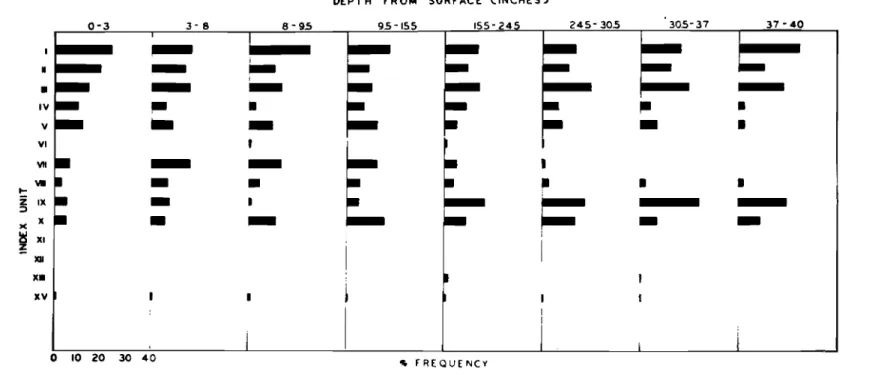
Microfossil analysis of the sample then followed, and the microfossil histogram patterns for the entire depth are shown in the eight columns of Fig. 18. The procedure for this has been described by the writer (2, p. 8). For the present analysis, a slight departure was allowed to facilitate com-parison of micro- and macro-structure; the eight columns correspond to the selected strata of different magnitude, not to equal intervals of depth. The plant equivalent of "index unit" is explained in (3, p. 63). However, the writer wishes to emphasize features of frequency trend rather than plant succession and, as is held in (3), the adoption of "index unit" avoids risk of prejudice on a botanical basis.
Examination of the histograms in Figure 18 shows a shift in pattern that is not erratic but orderly and thus reflects organization sustained but chang-ing. The trend towards shift is largely due to lessening prominence (but not disappearance) of index unit IX from right to left (base to top of peat) and somewhat of a rise to prominence of units V and VII. To a lesser ex-tent, frequency-increase in the same direction is noted for units IV and VIII. It will also be noted that at the 15.5 inch depth, the trend is suddenly em-phasized. Perhaps with unit III as an exception, the first three index units show no marked frequency trend. At the 15.5 inch depth, unit X overtakes IX and the former on the average exceeds the latter in prominence for the upper half of the peat.
Application to this example of the identification system for macro-struc-ture (Table I) was also achieved. From the base of the column towards the top for a distance of 2 inches, category 3 applied-amorphous-granular in fine-fibrous (d. Table I; Fig. 3). For the next 14 inches, category 2 oc-curred-non-woody fine-fibrous (d. Table I; Fig. 2). The next 15 inches were identified as category II-woody and non-woody particles in fine-fibrous (d. Table I; Fig. 11). The final 9-inch segment to the top of the
NORMAN W.RADFORTH 61
peat was designated as category 13-coarse-fibrous traversing fine-fibrous (d. Table I; Fig. 13).
No difficulty was encountered in identification; the four categories men-tioned were clearly marked. The fact that the zone limits of the categories did not coincide with those of the eight strata that had been acknowledged and used as limits for analytical purposes requires some consideration. It can be demonstrated that demarcation in peats, though due to physical or chemical factors, is not always strictly structural (d. p. 60). This was the case with regard to the eight strata in question. Attempts to rationalize these zones for identification purposes for general application would lead to taxo-nomic inconsistency. The macro-structure category system, however, which relies only on structure and presence or absence of woody remains, reflects the true nature of the constituent primary entities whatever the conditions surrounding the existence or distribution of the peat, and is thus taxo-nomically dependable.
Choice of taxonomic procedure, particularly in relation to natural re-quirements, can better be assessed if the macro-structure system is compared with a classification system already known to be dependent on natural attri-butes. The appropriate choice here is obviously the microfossil system of designation, which portrays the developmental history of the peat. For the test case analysed in this work, all but the top one-quarter of the peat was essentially characterized by the fine-fibrous primary element. Thus, the named macro-structure of the peat is correlated with its microfossil index equivalents (index units IX and X, principally IX) which are identified as to natural attributes through direct generic connection. Also, the intro-duction of woody and non-woody erratics in the top half of the lower three-quarters of the peat is coincident with a rise to prominence of index unit5 V and VII and VIII. These are undoubtedly equivalents of the erratics and the true botanical clue to the origin of the coarse-fibrous primary element which arises significantly in the top quarter of the peat. They also reflect natural relationships on the basis of the generic implication.
The comparisons reveal two other observations for which the writer claims significance. The identification of macro-structure contributes little or nothing when an attempt is made to reconcile the high incidence of index units I, II, and III in the microfossil analysis (Fig. 17). Secondly, the macro-structure system does not record change in generic source of the fine-fibrous primary element manifest in the microfossil record at the 15-inch level.
It has been demonstrated elsewhere (3) that indices I, II, and III, which represent Pinus sp., Picea glauca (Moench) Voss, and Picea mariana (Mill) BSP, have least influence in peat development. These and other arboreous types, though important as time and climate markers, are not so significant as shrub and herbaceous pollens and spores, which to a greater extent have originated in situ and therefore are more significant as indices of agents
62 THE ROYAL SOCIETY OF CANADA
incorporated within the peat in the course of its development. For this rea-son, the fact that the macro-structure system apparently partly eliminates microfossil indices I, II, and III does not suggest artificiality. It avoids artificiality and points to the acknowledged limitation in the microfossil system.
The failure of the macro-structure system to reveal change in origin of non-woody fine-fibrous content can be claimed to reflect some artificiality. That this is serious is questionable because, with the advent of Betula sp. and Ericads, the plants responsible for index units V and VII respectively, the switch in prominence from IX to X is a natural feature in the synoeco-logical sense. This is substantiated by field observation and by laboratory record.
It now seems reasonable to conclude that the design of the macro-struc-ture system of identification and classification is allied to biological trends and natural adjustments in the development of organic terrain. Therefore the feasibility of estimating relationship of structural change to depth of organic terrain on a rational and consistent basis seems to be established. If this conclusion is justified, it would be safe to predict that the occur-rence of categories of macro-structure would be repeated because the bio-logical phenomenon with which the category or categories would be asso-ciated would not likely be restricted to one site, but would be widespread and controlled by microclimatic, edaphic, topographic, and biotic factors. Also, for the same reasons, it might beexpected that some categories and sequences of categories would be more prevalent than others.
Relative to these points, only preliminary studies on range of structural variation have been attempted. Though the results are inconclusive, they do lend themselves to the establishment of principle and provide instructive collateral evidence for that already presented for the type example studied intensively.
To provide the information, 87 gross peat samples were identified accord-ing to the major macro-structure category representative throughout. In the majority of cases, for applied studies, this is apparently adequate and in actual fact, many, if not most examples would show that not more than a single category-reference is necessary to designate the example. On this basis, several categories occurred very frequently. Seven (numbers 2, 3, 4, 6, 7, 11, and 15) occurred more than half a dozen times. Number 4 oc-curred eleven times, number 2, twelve times, and number 3, showing highest frequency, seventeen times. Only one category, 16, did not occur among the examples examined. This is because it is difficult to secure a representative sample; the large woody chunks make sampling difficult.
After such confirmation, though on a limited scale, that macro-structure in depth is repeated throughout terrain and that some categories are com-moner than others, it is now appropriate to examine macro-structure in depth with respect to geographical aspects. Fig. 17 shows the source-dis-tribution for seventy-four gross peat samples in the vicinity of Fort Churchill,
• ICJ 0_ _ CJ C J . •
•
o0 CJ l • o o •6tV
J
1 1 0 1 1 9 0e
6
. : I Oa rr o 2 • 3 c-4 • 5 " 6 • 1 IS II 8 .. 10 • " cr m 12 .. 13 ." 14 .. 15 0 16 •FIGURE 17.···-0utlinc map of district immediately south of Churchill, Manitoba, with symbols indicating macro-structural constituents of muskeg samples.
DEPTH FROM SURFACE CINCHES) 0-3 3 - 8 8 - 9.5 9.5-155 155-245 245- 30.5 305-37 37 - 40 I セ
セ
-Nセ-セ
セ
セ
, セ•
•
V..
-
-VI,
VIt-
-
I w-
•
セ
•
•
l-i IX-
I :;) >< X•
-
-
-セ XI I XII X. xv o 10 20 30 40 , FREQUENCYNORMAN W. RADFORTH 65 Manitoba. Each example is identified according to macro-structure category
(d. Fig. 18 and Table I). Examination of the distribution suggests that for all four major groupings non-woody fine-fibrous matrix was common. In the atea with most examples this is substantiated by category 3 (amorphous-granular in fine-fibrous, Fig. 3) which represents over 30 per cent of the sites examined. For another area, Fig. 17 upper right, which has fewer ex-amples, the absolute number of sites showing a woody fine-fibrous primary element (in category 4) is twice as great as for the first area. This, along with other evidence of coarse-fibrous woody constitution which summarizes the situation for categories 6, 10, 11, 13, 14, and 15, suggests that, on the whole, the organic terrain is more generally woody and of coarse, resistant texture than is the case for the former area. Examination of a third area (Fig. 17, upper left) suggests that woodiness and coarse texture is perhaps more sporadic than for the former case. Finally, a fourth area (Fig. 17, lower left) by reason of the relatively high tendency towards woodiness, seems to be almost completely characterized by very coarse peats with a woody foundation.
There is a question as to whether in the last two areas an insufficient number of examples has been secured to warrant the decisions made. This would probably be so if it were to be claimed that a statistical analysis has been made. The latter will provide a basis for investigation in the future. The present work, it is thought, suggests validity of comparison on a quali-tative basis only. Acceptance of this for the third and fourth mentioned areas is perhaps strengthened when it is considered that initial field investi-gation, through the application of random testing for structural variation, suggested that the number of samples was sufficient to justify empirical results required.
BEARING CAPACITY ASSESSMENT
Resistance to compressional force by organic terrain has been difficult to assess mainly because of lack of evidence to demonstrate organization in peats on a macro-structural basis. Also, difficulties in this connection have arisen because there is lack of knowledge concerning the structure of the mineralized basal component of organic terrain.
Relative to the- first of these limitations, it is hoped that the information resulting from this investigation will be of some help. The macro-structure categories provide what is thought to be adequate facilities for identification
in terms of qualities that are directly related to bearing potential. Their application can be expected to reveal and prescribe for orderly association of structural facts, with bearing potential data likewise' appropriately aligned. In that the categories closely conform to conditions that depend on natural attributes, as demonstrated in this account, trend in structural-variation range and change in macroscopic structure, whether slight or great as expressed by' category description, apparently reflect' biological organization and the circumstances controlling oecological phenomena
66 THE ROYAl. SOCIETY OT C-'l....'\ADA
characteristic of peats. Again, bea.usc of the maita.b1c connection between bearing potential and macro-structure category, it may be expected that
bearing potential characteristics and conditiom can be intelligently and fully interpreted in all their aspects and impiicarions.
The inference that may be drawn from the evidence in Figure 17 rela-tive to bearing potential is perhaps trreial unless it is claimed that the information has assisted in the estaNmme:mrai. the principlethat variation in bearing potential of organic terram can be ponrayed through !tIhe macro-structure categories, Resistance tocomple<&c-yj force will increase directly for the Iour areas shown in Fig. 11 in the CEder discussed (p.65). With additionaldata,someof which mayDOWbesafdy predicted from collateral information, bearing potential <m:rsdected mbsidiary areas01" iJinear ron-figurations withinany of the four 3I'C2ScanDOW' bedrvised..
The limitation on estimatingbcuing:rr-",rialmentioned abm>e (p. 65) as a possible function of the w"liIj....ion セ the miner.a.l fonrwbrion layer associated 'Withthe peat,isstill tobe cxaminnl Its dIett willdoubdess show in quantitative computation for giwndcpt:bsul.セ tc:rrain. Itcan only
be claimed here that some evideaee is at h:md which demClll!tr3.kS that
grainsize of particles in the mineral
OOIIlJXDrDl
tI:nds toincrease aswoodi-nessand coarseness in the peatycrwnprmetJtセ the mineral ba:nme more prevalent.
With the macro-structure cattgoicscorrdamd with mineral fonndarioo layer, and the former now promincot as the III!isof.rc:famceforthe
stmc-tural patternofterrain, theapproadJ.1DiulnpcbticDul.セ
matiom
now becomes clearerand with it ann'mbdIIrセNLB。ョセ d. bearing values ispossible, TIle final wordOIla 0 w,. . .II intnpdationul.bearing
potentialcannot begiven,ィッキ・カ。Gセ 1IIII:iI
illl,,-
atinns iatroducalby vegetal coverage and topographic variuion aR UAI...!Od.. This :mayhe gainedby consulting other accoon1s
(2,
Sセ4).
AcniDWUDGJIDITS
The writerisgrateful £01" the wuliuucdsupport セ the Asaiate C0m-mitteeon Soil and SnowMrcbania" National ltc:scaJ(:h Councilul.Canada and the Arctic Research Sertim. Ddma: :Rew::an::h Board; the former assisting work onmuskeggroundlltoIIicsand tilelatter anribollillg toIWaJ:ds organic terrain studies from the air.
To Robert F. Legget, Chairmanul.the AwnciateQwnmittttOIlSoil and Snow Mechanics, the writcr's jpdrIilaJllClI5
mc.za.
Ifi!s jail Evd has given invaluable assistance.hセ iniIiati«,willathatof'Mr. W.J.
"Thomr, another whobasmntributaI diitrlly illdiewaft,hasdoneImdttofaci1i-tate the organization of data. Mc:BS. R. Eydt :md P. Trip IIaft Iatdy
assisted and their dfOJ1S along wiIh dMR ofJD:mYadier セ」ウ who provided datafrom
the
セ an:p2IIy
appn*plaJbf
the wDbr.NORMAN W. RADFORTH 67 REFERENCES er. Engi-..osits. Soil of phi; ,. ,f ID • ...sted 1. DAcHNowSKI-STOKES, A. P, i924), Science, 17: 107--33. 2. RADFOIlTH, N. W. (1952). neeriag jour., 35: 1-12
3. - - - (1953), The use of nt material in th-: recoe nition 01 nortne m organic terrain conditions. Trir.s Koy. Soc. Canada, Series Ill, ·n,Sec \. ':\-71. 4. - - - (1954:', Pale-obotanical method n ,!-.(; i,r',1IctIOT' of sub- .ummer ice
conditions in nonhero organic terrain. Trans. Roy. Canad.. rir-sIII, 48, Sec.. V: 51-64.
5. - - - (1955), Organic terrain organization from the air. Handbook no. 1 (Alti-tudes less than 1,000 feet), Canada, Dept. of National Defence, Defence Research Board, In press.
NATIONAL RESEARCH COUNCIL
aセsociate COMMITTEE ON SOIL AND SNOW MECHANICS LIST OF TECHNICAL MEMORANDA
1 Proposed field soil testing device. August 1945n
2 Report classified "restricted". September 1945 3 Report classified "confidential". November 1945 4 5 6 7 8 9
Soil survey of the Vehicle Proving Establishment, Ottawa. Oct. 1945*
Method of measuring the significant characteristics of a snow-cover. G.J. Klein. Nov. 1946*
Report classified "confidential" • November 1945
Report classified "restricted". March1947
Report classified "confidential". June 1947
Proceedings of the 1947 CiVilian Soil Mechanics Conference. Aug. 1947* 10 Proceedings of the Conference on Snow and Ice, 1947. Oct. 1947*
11
12 13 14
15
Proceedings of the 1948 Civilia."l Soil Mechanics Conference. Oct. 1949i.
Index to Proceedings of Rotterdam Soil Mechanics Conference. May 1949
Canadian papers: Rotterdam Soil Mechanics Conference. June 1949*
Canadian papers presented at the Oslo meetings of the International Union of Geodesy and Geophysics. December 1949
Canadian survey of physical characteristics of snow-covers. G.J. Klein. April 1950
16 Progpess report on organic terrain studies. N.W. Radforth. April 1950 17 Proceedings of the 1949 Civilian Soil Mechanics Conference. Aug. lS5C
18 Method of measuring the significant characteristics of a snow-cover. G.J. Klein, D.C. Pearce, L.W. Gold. November 1950
19 Proceedings of the 1950 Soil Mechanics Conference. April 1951 20 Snow studies in Germany. Major M.G. Bekker, Directorate of Vehicle
Development, セー。イエュ・ョエ of National Defence. May1951
21 The Canadian snow survey, 1947-1950. D.C. Pearce, L.W. Gold. Aug. 195J. 22 aセBャオ。ャ report of the Canadian Section of the International Society of
Soil Mechanics and Foundation Engineering (June 1950 - June 1951)
23 Proceedings of the Fifth Canadian Soil Mechanics Conference, Jan. 10 and II, 1952. May1952
LIST OF TECHNICAL MEMORANDA (Continued)
A suggested classification of muskeg for the engineer.
May1952 N.W. Radforth. 25 26 27 28 29 30 31 32 33 34 35 36 37 38
Soil mechanics papers presented at the Building Research Congress
1951. November 1952
Annual report of the Canadian Section of the International Society of 'Soil Mechanics and Foundation Engineering (June 1951 to
June 1952). December 1952
Proceedings of the Sixth Canadian Soil Mechanics Conference. Winnipeg. December 15 and 16, 1952. May1953
The use of plant material in the recognition of northern organic terrain characteristics. N.W. Radforth. March 1954
Construction and maintenance of roads over peat. F.E. Dryburgh and E.R. McKillop. (Reprinted with permission of D.S.I.R., Great Britain.) July 1954
Canadian papers presented at the Third International Conference on Soil Mechanics and Foundation Engineering. July 1954
The International Classification for Snow. (Issued by the Commission on Snow and Ice of the International Association of Hydrology.) August 1954
Annual Report of the Canadian Section of the International Society of Soil Mechanics and Foundation Engineering. June 1953 to June 1954.
July 1954
Proceedings of the Seventh Canadian Soil Mechanics Conference. Ottawa. December 10 and 11, 1953. September 1954
Palaeobotanical method in the prediction of sub-surface summer ice conditions in northern organic terrain. N.W. Radforth.
Proceedings of the First r・セゥッョ。ャ Soil Mechanics Conference, Fredericton, April 23 and 24. 1954
Proceedings of the Eighth Car.adieu Soil Mechanics Conference, Ottawa. December 16 and 17. 1954. April 1955. < •
Guide to the Field Description of Soils for Engineering Purposes. December 1955. Price 10 cents.
Proceedings of the Western Muskeg Research Meeting March 2, 1955.
September 1955.
Coupons for the purchase of publications of the Associate Committee on sッゥャセ、 Snow Mechanics are available in denominations of 5. 25 and 50 cents.